





In his research and policy work, Edward Zigler highlighted three broad propositions that served as motivation for the current study. First, drawing on broader developmental theory, he argued that programs serving children (birth through 12 years) should adopt a comprehensive approach that focuses on “the whole child,” including children's social, academic, and physical well-being (Zigler & Finn-Stevenson, Reference Zigler and Finn-Stevenson2007). This perspective was reflected in his work in the design of Head Start (Zigler & Valentine, Reference Zigler and Valentine1979), but also in Project Follow Through that followed Head Start children into elementary school (Abelson, Zigler, & Deblasi, Reference Abelson, Zigler and Deblasi1974; Zigler & Styfco, Reference Zigler and Styfco1993), and the School of the 21st Century that proposed an integration of services for children and families across the first 12 years (Zigler & Finn-Stevenson, Reference Zigler and Finn-Stevenson2007; Zigler, Finn-Stevenson, & Stern, Reference Zigler, Finn-Stevenson and Stern1997). Second, Zigler argued that comprehensive programs of this sort could have long-term impacts on children's academic and social outcomes, including the prevention of later problem behaviors and delinquency (Zigler et al., Reference Zigler, Finn-Stevenson and Stern1997; Zigler, Taussig, & Black, Reference Zigler, Taussig and Black1992). Third, he cautioned that long-term effects would require programming that incorporated both early childhood and middle childhood, rather than short-lived, one-time inoculations within a single developmental period (Zigler & Berman, Reference Zigler and Berman1983).
In highlighting the importance of this integrative developmental approach incorporating experiences in both early and middle childhood, Edward Zigler anticipated pressing questions facing contemporary early childhood programs (Bailey, Duncan, Odgers, & Yu, Reference Bailey, Duncan, Odgers and Yu2017; Haskins, Reference Haskins2016; Phillips et al., Reference Phillips, Lipsky, Dodge, Haskins, Bassok, Burchinal, Duncan, Dynarkski, Magnuson and Weiland2017). Do effects of early care and education (ECE) generally fade during middle childhood? Can experiences in middle childhood help to sustain or to mitigate effects of earlier care? Can children's experiences in early childhood and middle childhood help to reduce behavior problems and delinquency in adolescence and beyond?
Drawing on Zigler's three propositions and other research reviewed below, the current study examines ECE during children's first five years and children's after-school organized activities during middle childhood as they relate to problem behaviors in late adolescence and early adulthood. We use data from the National Institute of Child Health and Human Development (NICHD) Study of Early Child Care and Youth Development (SECCYD), a prospective longitudinal study that followed more than 1,200 children from birth into adulthood when the participants were age 26 years. Because the dataset includes extensive information about ECE and later participation in organized activities, we were able to assess children's experiences during the first 12 years in relation to later problem behaviors as reported by teachers during early and middle childhood and then self-reported by the study participants in late adolescence and early adulthood.
ECE and later problem behaviors
When the SECCYD began in 1991, there was little consensus about ECE effects on later socio–emotional well-being and development. Zigler (see Zigler & Trickett, Reference Zigler and Trickett1978; Zigler et al., Reference Zigler, Taussig and Black1992) and others (Clarke-Stewart, Reference Clarke-Stewart1991; Howes, Reference Howes2000; Phillips, McCartney, & Scarr, Reference Phillips, McCartney and Scarr1987) argued that ECE provides opportunities for children to develop social skills and competencies while reducing problem behaviors. Belsky (Reference Belsky1986, Reference Belsky2001), in contrast, argued that early and extensive ECE hours put children at risk for later problem behaviors because these early experiences disrupted children's relationships with their mothers. An ongoing debate ensued in academic publications (Love et al., Reference Love, Harrison, Sagi-Schwartz, van IJzendoorn, Ross, Ungerer and Chazan-Cohen2003; Vandell, Reference Vandell2004), but also in newspaper headlines and stories in the popular press that speculated about possible long-term negative repercussions of early childcare for later behavior problems (Crosnoe & Leventhal, Reference Crosnoe and Leventhal2016).
In a series of papers that examined the SECCYD children as they reached different developmental milestones, the NICHD Early Child Care Research Network (ECCRN) reported relations between three aspects of ECE (i.e., use of center-based ECE settings, average hours in care each week, and observed quality) and a broad array of child outcomes. Higher-quality ECE and more experience in center-based settings during the first five years was linked to higher math and literacy skills in early childhood (NICHD ECCRN, 2002), middle childhood (NICHD ECCRN, 2005b), middle adolescence (Vandell, Belsky, Burchinal, Steinberg, & Vandergrift, Reference Vandell, Belsky, Burchinal, Steinberg and Vandergrift2010), and late adolescence (Vandell, Burchinal, & Pierce, Reference Vandell, Burchinal and Pierce2016). However, ECE hours and center-based settings were associated with more externalizing behavior problems in early childhood (NICHD ECCRN, 2002) and middle childhood (Belsky et al., Reference Belsky, Vandell, Burchinal, Clarke-Stewart, McCartney and Owen2007; NICHD ECCRN, 2005b). More ECE hours continued to be linked to problem behaviors at age 15, with higher hours predicting adolescent self-reports of more risk-taking and higher impulsivity, whereas higher-quality ECE was associated with less (not more) externalizing behavior (Vandell et al., Reference Vandell, Belsky, Burchinal, Steinberg and Vandergrift2010). In contrast, the effects associated with center-based settings changed over time and were related to less risk taking and less impulsivity by the end of high school (Vandell et al., Reference Vandell, Burchinal and Pierce2016). Other longitudinal studies also have reported mixed findings with respect to educational and behavioral outcomes of high-quality ECE. Campbell, Pungello, Burchinal, Kainz, and Ramey (Reference Campbell, Pungello, Burchinal, Kainz and Ramey2012), for example, found strong evidence for educational benefits, mixed evidence for economic benefits, and little evidence for social adjustment outcomes such as internalizing, externalizing, substance abuse at age 30 years.
Changes in the direction of the relations between ECE and later problem behaviors over development raise questions about whether children's later experiences may account for these shifts. Drawing on Edward Zigler's recognition of the importance of the after-school hours during middle childhood for child well-being (Zigler & Finn-Stevenson, Reference Zigler and Finn-Stevenson2007; Zigler, Finn-Stevenson, & Marsland, Reference Zigler, Finn-Stevenson and Marsland1995; Zigler & Lang, Reference Zigler and Lang1991), we turn to children's organized after-school activities and ask if participating in activities help mitigate associations between early care hours and later problem behaviors.
After-school organized activities and later problem behaviors
After-school organized activities include 5-day-a-week programs operated by schools and community organizations as well as extracurricular activities such as sports and performing arts and youth clubs such as scouts and 4-H (Vandell, Larson, Mahoney, & Watts, Reference Vandell, Larson, Mahoney, Watts, Lerner, Bornstein and Leventhal2015). These activities provide opportunities for children to interact with adult mentors and peers while they engage in enrichment activities that are typically not part of the regular school day but are of interest to children (Zigler et al., Reference Zigler, Finn-Stevenson and Marsland1995). The activities also can provide opportunities for experiences that support the development of self-regulation and impulse control (Durlak, Weissberg, & Pachan, Reference Durlak, Weissberg and Pachan2010; Lareau, Reference Lareau2011), competencies that can help to keep problem behaviors at bay. They also provide supervised and safe spaces for children to go while parents are working (Aizer, Reference Aizer2004; Vandell et al., Reference Vandell, Larson, Mahoney, Watts, Lerner, Bornstein and Leventhal2015; Zigler & Lang, Reference Zigler and Lang1991; Zigler et al., Reference Zigler, Finn-Stevenson and Marsland1995), which can reduce opportunities for problem behaviors to develop.
Empirical research provides some support for Zigler's view of organized activities during middle childhood as a prevention strategy. In a meta-analysis contrasting child outcomes of youth who participated in after-school programs and those who did not, Durlak et al. (Reference Durlak, Weissberg and Pachan2010) found that lower problem behaviors were one of the most consistently reported impacts of high-quality after-school programs at the end of the program year. Similar findings have been reported in longitudinal analyses. For example, Vandell et al. (Reference Vandell, Simpkins, Pierce, Brown, Bolt and Reisner2020b) found meaningful reductions (effect sizes of .44–.46) in elementary students’ self-reports of misconduct (e.g., skipping school, getting into fights) for children who attended after-school programs or after-school programs in conjunction with extracurricular activities relative to children who were unsupervised after-school. However, these studies did not consider links between ECE and after-school organized activities or ways that these two settings, together, relate to children's problem behaviors.
Vandell, Lee, Whitaker, and Pierce (Reference Vandell, Lee, Whitaker and Pierce2020a) is the first study to our knowledge to examine associations between ECE and after-school experiences in relation to later child developmental outcomes. In that paper, higher-quality early childcare AND more epochs of organized activities during middle childhood were both linked to higher academic achievement at age 15 years, consistent with Zigler and Berman's (Reference Zigler and Berman1983) proposition that cumulative experiences in early childhood and middle childhood may result in larger, sustained academic gains. In addition, Vandell et al. (Reference Vandell, Lee, Whitaker and Pierce2020a) found differential associations in the behavioral domain at age 15. ECE hours was related to less impulse control at age 15, whereas organized activities during middle childhood were not related to impulse control at that age. Instead, organized activities during middle childhood predicted more social confidence in situations such as meeting new people and speaking in groups at age 15. The current study extends the study of long-term effects associated with ECE and organized activities by asking if these two settings are related, directly or indirectly, to a range of problem behaviors in late adolescence and early adulthood, consistent with cumulative or differential effects.
Integrative pathways
In his writings, Zigler proposed two pathways by which children's early experiences could be linked to adolescent and adult outcomes. The first pathway, illustrated in Figure 1, is an activities pathway. This pathway focuses on children's experiences in ECE, followed by their after-school organized activities, as they relate to promotion of social competencies and reductions in problem behaviors. A key element in the first pathway is the hypothesized continuity between ECE during early childhood and organized after-school activities during middle childhood. Children who attend center-based settings or who have more ECE hours in early childhood are anticipated to participate more frequently in organized activities during middle childhood.
Conceptual model of the relations between early care and education (ECE), organized activities, and individuals’ problem behaviors from early childhood to adulthood. Note. Data collection for early childhood is from 1 month to 54 months; middle childhood indicates kindergarten through 5th grade; data collection for adolescence is at 12th grade; and data collection for adulthood is at age 26.

This activities pathway could be the result of working parents using both ECE and organized activities for childcare while parents are at work (Zigler & Finn-Stevenson, Reference Zigler and Finn-Stevenson2007). It also may reflect parental values and beliefs such that parents who value high-quality enrichment opportunities for their children seek out ECE programs during early childhood and organized after-school activities during middle childhood (Lareau, Reference Lareau2011). Zigler argued for this type of activities pathway in his proposed School of the 21st Century where ECE and organized activities could, together, set the stage for later social competencies and fewer problem behaviors by providing sustained opportunities for children to interact with adult leaders and peers in enriching activities.
In his writings, Zigler (see Zigler et al., Reference Zigler, Taussig and Black1992) also proposed a second pathway, a child pathway, by which ECE (i.e., type of setting, hours, and quality) can influence later development. In the child pathway, ECE directly affects children's behavior and competencies, which are then carried forward into later development. Zigler likened this child pathway to a “snowball” effect in which children's skills and behaviors form the basis for later interactions with teachers and peers that then set the stage for subsequent development. A key question at the heart of the child pathway is whether effects associated with ECE persist over time into adolescence and early adulthood as a result of changes in children's behaviors that become self-perpetuating, perhaps as a result of changes in the children's and others’ expectations and behaviors.
The child pathway also may be relevant for children's subsequent organized activities. Children's misconduct and problem behaviors during early and middle childhood may influence their subsequent participation in organized activities if, for example, parents or schools actively seek out organized activities for children with behavior problems (Sandstrom & Coie, Reference Sandstrom and Coie1999). Alternatively, children with behavior problems may be excluded from some activities or the children may self-select out of the activities. Interest in children behaviors influencing selection into (or out of) organized activities has been central issue in research examining organized activities (Vandell et al., Reference Vandell, Larson, Mahoney, Watts, Lerner, Bornstein and Leventhal2015), but it has not been examined with respect to early behavior problems setting the stage for participation in later organized activities or exclusion from those activities.
The current study
In summary, the current study uses a large, prospective longitudinal study to ask if and how ECE and organized after-school activities are linked to problem behaviors in adolescence and adulthood. By testing these relations through structural equation modeling, we simultaneously consider two pathways that may contribute directly and indirectly to ECE effects: children's organized after-school activities and children's early behaviors.
Method
Participants
This study uses data from the NICHD SECCYD that followed children from birth to 26 years of age. For details about the sample and sample recruitment, see NICHD Early Childcare Research Network (2005a). The analysis sample in the current paper consists of all participants for whom there was at least one ECE report during the first five years (n = 1,258). Among these participants, 22% were ethnic minorities, 48% were female, 29% of the mothers had no more than a high school education; 29% had incomes less than 200% of the poverty level during early childhood (see Table 1).
Descriptive statistics for early care and education sample and age-26 sample
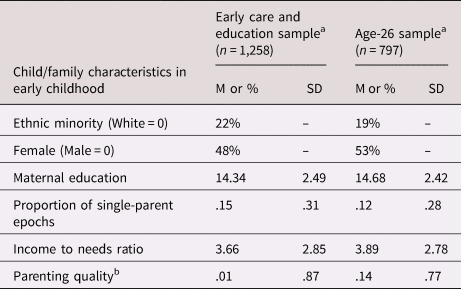
Note. aThe early care and education sample was the main analytic sample and the age-26 sample was the sample for the robustness checks.
b Composite score across HOME (i.e., Home Observation Measurement of the Environment) and maternal sensitivity in early childhood.
When the child participants were 15 years of age, the SECCYD team secured parental consent and adolescent assent from 946 families for future follow-ups. In 12th grade, 888 adolescents were reached and 779 agreed to complete an online survey (M age = 18.38 years, SD = .31, range = 17.58–19.27 years). At age 26, research staff were able to reach 875 participants, 814 of whom agreed to participate and completed the online surveys. Participation rates were similar across the original 10 study sites (i.e., 89% to 99%).
When we compared participants who did and did not have age-26 data, we found that participants with age-26 data were more likely to be female (X 2[1] = 17.31, Cramér's V = .12) and White (X 2 [1] = 17.79, Cramér's V = .12) than those missing age-26 data. Maternal education (t (1,256) = 6.86, p < .001, d = .40) was higher for the age-26 participants as was families’ income-to-needs ratio (t (1,254) = 4.05, p < .001, d = .24) and observed parenting quality in early childhood (t (1,256) = 6.93, p < .001, d = .39) than those missing age-26 data. Participants with age-26 data also had fewer single-parenthood epochs in early childhood (t (1,256) = −5.19, p < .001, d = .29).
Procedures and measures
This study includes measures from 1 month of age through 26 years of age and includes data reported by study children, their parents and teachers, as well as data collected through observations. Information about children's ECE (hours, types of care, and quality of care) was regularly collected between 1 and 54 months. Information about children's organized activities was collected regularly from kindergarten through 5th grade. Indicators of problem behaviors were collected during early childhood (54 months), middle childhood (kindergarten through 5th grade), adolescence (12th grade), and adulthood (26 years of age). Descriptive statistics and correlations are provided in Table 2.
Bivariate correlation among variables
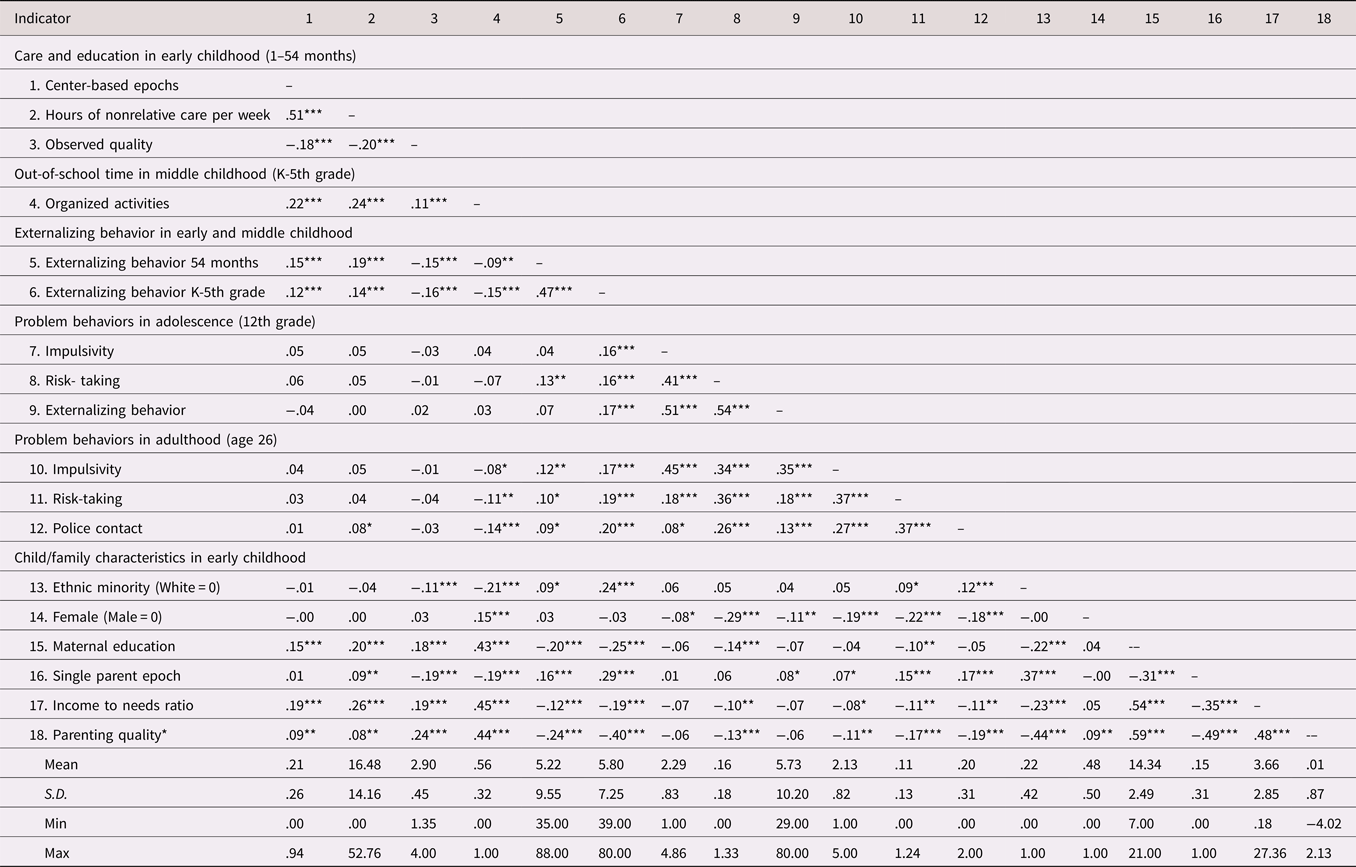
Note. aComposite score across HOME (i.e., Home Observation Measurement of the Environment) and maternal sensitivity in early childhood.
*p < .05. **p < .01. ***p < .001.
Early care and education (ECE)
During telephone and in-person interviews conducted at 3-month intervals (called epochs) from 1 month through 36 months and 4-month intervals (or epochs) from 40 to 54 months, mothers reported the types and hours of all regularly used nonmaternal care since the previous interview for a total of 17 epochs. Two indicators were derived from these interviews: proportion of epochs in center-based care and average hours of nonrelative childcare per week. Arrangements were classified as center, childcare home (any home-based care outside the child's own home), in-home care (any care in the child's own home that was not the father or grandparent), father care, and grandparent care. The proportion of epochs (or interviews) in which children were reported to be in center care for at least 10 hours per week was computed and used as the measure of center-based settings. The hours per week in all types of nonmaternal care, excluding fathers and grandparents, were summed for each epoch, and the mean of nonrelative care hours across epochs make up the measure.
The third ECE indicator was quality, which was assessed through observations conducted when study participants were 6, 15, 24, 36, and 54 months. Priority was given to observing more formal, center-based settings that were attended for 10 or more hours per week. At 6 to 36 months, quality was assessed during two half-day visits scheduled within a 2-week interval. At 54 months, quality was assessed during one half-day visit. Observers completed four 44-minute cycles of the Observational Record of the Caregiving Environment (ORCE) for each study child through 36 months and two 44-minute ORCE cycles at 54 months. Trained observers rated the child-care settings on various dimensions, including caregiver's sensitivity/responsivity and warmth to the study child using 4-point scales (e.g., 1 = not at all characteristic, 4 = highly characteristic). Detailed descriptions of the ORCE assessments can be found in NICHD Early Childcare Research Network (2002), including coding definitions, training procedures, and interobserver agreement. Reliability exceeded .90 at 6 months, .86 at 15 months, .81 at 24 months, .80 at 36 months, and .90 at 54 months. A mean observed childcare quality score was computed for each child across the five time points.
Organized activities in middle childhood
Mothers or primary caregivers reported the study children's participation in organized activities during middle childhood in a series of 13 telephone interviews (called epochs) between kindergarten and 5th grade. Mothers were interviewed twice annually in kindergarten, 1st grade, and 2nd grade during the fall and the spring of the school year when they reported the study children's before- and after-school care arrangements and activities between the hours of 7 a.m.–7 p.m. Interviews occurred on routine school days (i.e., not a school holiday or early dismissal day). In 3rd, 4th, and 5th grade, questions were modified to ask about activities from the end of the school day to 6 p.m. Mothers reported after-school activities three times (fall, winter, spring) during the school year when the study children were in 3rd and 4th grade, and once when the study children were in 5th grade, for a total of 13 epochs from kindergarten through 5th grade.
In each interview, mothers indicated if study children spent time that week in organized activities (at a before- or after-school program or a structured enrichment activity or lessons). They also reported the amount of time (hours that week) the study children spent in organized activities. The mean hours per week across the 13 epochs was highly correlated with the proportion of epochs (r = .60). A proportion of epochs in organized activities was used in the primary analyses because it was less skewed than mean hours per week and had been previously linked to child developmental outcomes during middle childhood (NICHD Early Childcare Research Network, 2004; Vandell et al., Reference Vandell, Lee, Whitaker and Pierce2020a).
Problem behaviors in early childhood and middle childhood
Teachers completed the Child Behavior Checklist Teacher Report Form (TRF; Achenbach, Reference Achenbach1991) to evaluate children's externalizing behavior problems (e.g., “hits others,” “disobedient at school,” “argues a lot”) at 54 months, kindergarten, 1st grade, 2nd grade, 3rd grade, 4th grade, and 5th grade (αs = .94 to .95). These reports were provided by seven different teachers across the time points. Raw scores were converted into standard T scores based on normative data for children of the same age and averaged, with higher scores indicating a higher affinity to display delinquent and aggressive behaviors. Externalizing behaviors at 54 months were used as an early childhood indicator that corresponded to when children's ECE was measured. Children's externalizing behaviors from kindergarten to 5th grade were averaged to create a middle childhood indicator that corresponded to when children's organized activities were measured.
Problem behaviors in adolescence
During the spring of 12th grade or the summer following, adolescents completed an online survey covering a variety of topics. Adolescent problem behaviors included three areas: impulsivity, risk-taking, and externalizing behavior.
Impulsivity
The Weinberger Adjustment Inventory (Weinberger & Schwartz, Reference Weinberger and Schwartz1990) was used to measure impulsivity. It consists of seven items (α = .81) that were rated using a 5-point scale (1 = false, 3 = not sure, 5 = true). Sample items included “I do things without giving them enough thought” and “I should try harder to control myself when I am having fun.” Scores were averaged across items such that higher values indicate more impulsive behavior.
Risk taking
Adolescents reported risk-taking behaviors using a 30-item questionnaire developed for use in the SECCYD based on prior studies of adolescents (Halpern-Felsher, Biehl, Kropp, & Rubinstein, Reference Halpern-Felsher, Biehl, Kropp and Rubinstein2004). The 30-item version (α = .84) was a short version of the original 53-item scale. Sample items included “Done something dangerous on a dare,” “Attacked someone with the idea of seriously hurting them,” and “Vandalized property/did graffiti.” Items were responded to using a 3-point scale (0 = not at all, 1 = once or twice, 2 = more than twice). The risk-taking score was created by taking the mean across all 30 items.
Externalizing behaviors
Adolescents completed the Youth Self-Report of the Child Behavior Checklist, which was adapted from the teacher-reported scale to assess externalizing behaviors (Achenbach & Rescorla, Reference Achenbach and Rescorla2001). For each item, the adolescent rated how well that item describes him or her currently or within the last 6 months using a 3-point scale (0 = not true, 1 = somewhat or sometimes true, 2 = very true or often true). The externalizing behaviors scale included 30 items (α = .86). Raw scores were converted to T-scores and averaged, with higher scores indicating a higher affinity to display delinquent and aggressive behaviors.
Problem behaviors in adulthood
At 26 years of age, participants self-reported a variety of indicators through an online or mailed survey that took 30 to 60 minutes to complete. This study included three types of problem behaviors: impulsivity, risk-taking, and police contact.
Impulsivity
Participants completed the same seven-item version of the impulsivity subscale from the Weinberger Adjustment Inventory as in 12th grade (Weinberger & Schwartz, Reference Weinberger and Schwartz1990). Higher scores indicated more impulsivity (α = .83).
Risk taking
This measure of adult engagement in risky behaviors is the same 30-item measure used in 12th grade (α = .77). Two items related to taking or stealing items were adapted to be appropriate for age 26 years.
Police contact
A series of questions were used to create an index of frequency and severity of contact with police. This index included indicators of the participants’ reports of the (a) number of arrests, (b) times spent in jail, (c) moving violation driving tickets, and (d) traffic accidents in the last 12 months. The items measuring arrests and time in jail were taken from the Panel Study of Income Dynamics (2015). For these items, participants reported the number of times each happened on a 4-point scale (0 = 0 times, 1 = 1 time, 2 = 2 times, 3 = 3 or more times) which was recoded to a 3-point scale given the low frequency at the two highest responses (0 = 0 times, 1 = 1 time, 2 = 2 or more times). Among the participants, 93 individuals were arrested once and 64 were arrested 2 or more times; in addition, 23 individuals spent time in jail once and 17 were in jail at least twice in the last 12 months.
The items on the number of tickets and accidents and whether these occurred while the participant was under the influence of drugs or alcohol were taken from Monitoring the Future Study (Schulenberg et al., Reference Schulenberg, Johnston, O'Malley, Bachman, Miech and Patrick2016). Participants reported the number of tickets and, separately, the number of accidents in the last 12 months (0 = 0 times, 4 = 4 or more times). If they reported a ticket/accident, they were then asked if the ticket/accident occurred after they had been drinking alcohol, smoking marijuana, or using other illegal drugs. The number of tickets and the number of accidents were recoded to the same 3-point scale used for the number of arrests and jail time (0 = 0 times, 1 = 1 time, 2 = 2 or more times). To take into account the elevated severity of being under the influence before receiving a ticket or getting into an accident, a participant who reported receiving 1 ticket or getting into 1 accident after using alcohol, marijuana, or illegal drugs was recoded as 2. Among the participants, 96 individuals had one accident in the last 12 months and 28 had 2 or more accidents or 1 accident after using drugs or alcohol. In addition, 123 individuals received 1 ticket in the last 12 months and 53 received 2 or more tickets or 1 ticket after using drugs or alcohol.
The four indicators of contact with the police were averaged where higher numbers indicate more police contact.
Covariates
Child and family characteristics were included in our analyses as controls for potential selection processes and omitted variables. The child characteristics, reported by the mother at the 1-month home interview, were child gender (female = 1) and ethnicity (European American, African American, Latino/a, and other) scored in the analyses as White = 0 and all others = 1. Family characteristics included maternal education in years reported at the 1-month interview; mean income-to-needs ratio across the 1-, 6-, 15-, 24-, 36-, and 54-month time points; and assessment periods or epochs the family was a single-parent household across the 1-, 6-, 15-, 24-, 36-, and 54-month time points. In addition, a score of parenting quality was created by taking the average of the standardized scores across (a) the HOME Inventory score which measures the quality of the home environment (mean of ratings at 6, 15, 24, 36, and 54 months; Bradley & Caldwell, Reference Bradley and Caldwell1988) and (b) maternal sensitivity, which was rated on a 4-point scale (1 = not at all characteristic, 4 = highly characteristic) from videotaped semistructured interactions in which the mother–child dyad played or worked together to solve developmentally appropriate tasks in early childhood (mean of ratings at 6, 15, 24, 36, and 54 months; NICHD Early Child Care Research Network, 2005a).
Plan of analysis
Figure 1 illustrates the theoretical relations we expected between children's ECE, organized activities in middle childhood, and problem behaviors from early childhood through adulthood. As noted in the Introduction, we expected two main pathways through which children's experiences in ECE would predict problem behaviors in adulthood. Through Pathway 1, the activities pathway, we expected ECE to be associated with problem behaviors in adulthood through children's organized activities in middle childhood. Organized activities were expected to predict adulthood problem behaviors directly or indirectly through adolescent problem behaviors. Through Pathway 2, the child pathway, we expected that ECE would directly predict children's behavior in early childhood and that these behaviors would be carried forward and reflected in children's behaviors during subsequent developmental periods. In Pathway 2, we also asked if children's externalizing behaviors predicted their later participation in organized activities. These pathways are not necessarily mutually exclusive. Both may contribute to processes by which ECE, organized activities, and children's behaviors are linked to problem behaviors in late adolescence and early adulthood.
To examine all of these developmental pathways simultaneously, a structural equation model (SEM) was estimated in Mplus 7 (Muthén & Muthén, Reference Muthén and Muthén2012). To test the activities pathway in our conceptual model shown in Figure 1, we estimated direct paths from ECE to children's organized activities and then from organized activities to individuals’ problem behaviors in adolescence and adulthood. To test the child pathway, we estimated direct paths from ECE to individuals’ problem behaviors at each time point, and the direct paths from problem behaviors at one time point to problem behaviors at the next time point. In addition, we estimated the direct path from problem behaviors in early childhood to organized activities in middle childhood to account for selection effects and the likely bidirectional influences between these paths. In addition to the directional paths, the indicators measured at the same developmental period were allowed to covary. For instance, children's externalizing behaviors and organized activities in middle childhood were all allowed to covary. The indirect effects were estimated as the product terms between direct paths. In Mplus 7, indirect effects are esitmated using the MODEL INDIRECT command to examine the extent to which organized activities in middle childhood and problem behaviors at the end of high school mediated the link between ECE or early externalizing behaviors and age-26 problem behaviors.
The covariates included in the model were child gender, child ethnic minority status, maternal education, family income-to-need ratio during early childhood, proportion of single-parent household epochs during early childhood, and parenting quality during early childhood. A saturated model was run in which we had all covariates predicting each of the main indicators shown in Figure 1 (i.e., ECE, organized activities, problem behaviors). To improve parsimony of the model, we then trimmed the model by dropping paths from the covariates to the main variables that were not statistically significant (p > .10). We used a range of model-fit indices including comparative fit index(CFI)/ Tucker–Lewis index (TLI), root mean square error of approximation (RMSEA), and standardized root mean square residual (SRMR). CFI/TLI need to be above .90, RMSEA needs to below .05, and SRMR needs to below .08 to indicate acceptable model fit (Hu & Bentler, Reference Hu and Bentler1999). To account for the missing data, we used full information maximum likelihood in our analyses (Enders, Reference Enders2010).
Because there is debate about whether imputing missing data on the outcomes biases the analyses in longitudinal studies (Young & Johnson, Reference Young and Johnson2015), we checked the robustness of the findings from our primary analyses based on the full ECE sample (N = 1,258) by conducting a separate set of analyses on the participants for whom we had age-26 data (N = 797). The same SEM was used to estimate relations using the robustness sample. Table 1 includes participant demographic characteristics of the early care and education sample used as the main analytic sample and the age-26 sample used for the robustness check.
Results
Descriptive statistics
As shown in Table 2, the proportion of epochs in which children spent 10 hr or more a week in center-based care from 1 to 54 months ranged from .00 to .94 (M = .21). Individuals, on average, spent 16.48 hr per week in nonrelative care in early childhood. In addition, children, on average, received moderately high quality-ECE on a scale of 4 (M = 2.90). With regard to organized activities in middle childhood, children were in organized activities between for 0% and 100% of the 13 epochs (M = 56%).
ECE was associated with children's organized activities in middle childhood. Specifically, children who spent more epochs in center-based care and who spent more hours in nonrelative care had more epochs in organized activities during middle childhood from kindergarten to 5th grade (r = .22 and r = .24, respectively, p < .001). In addition, children receiving high-quality ECE were more likely to have more epochs in organized activities during middle childhood from kindergarten to 5th grade (r = .11, p < .001).
Organized activities were related to fewer problem behaviors in adulthood. Specifically, individuals who had more epochs in organized activities in middle childhood had lower levels of impulsivity (r = −.08, p < .05), engaged in fewer risk-taking behaviors (r = −.11, p < .01), and less police contact (r = −.14, p < .001) at age 26.
Finally, more problem behaviors in early and middle childhood were related to more problem behaviors in 12th grade and at age 26 (rs = .04–.20).
Pathways from ECE to adult problem behaviors
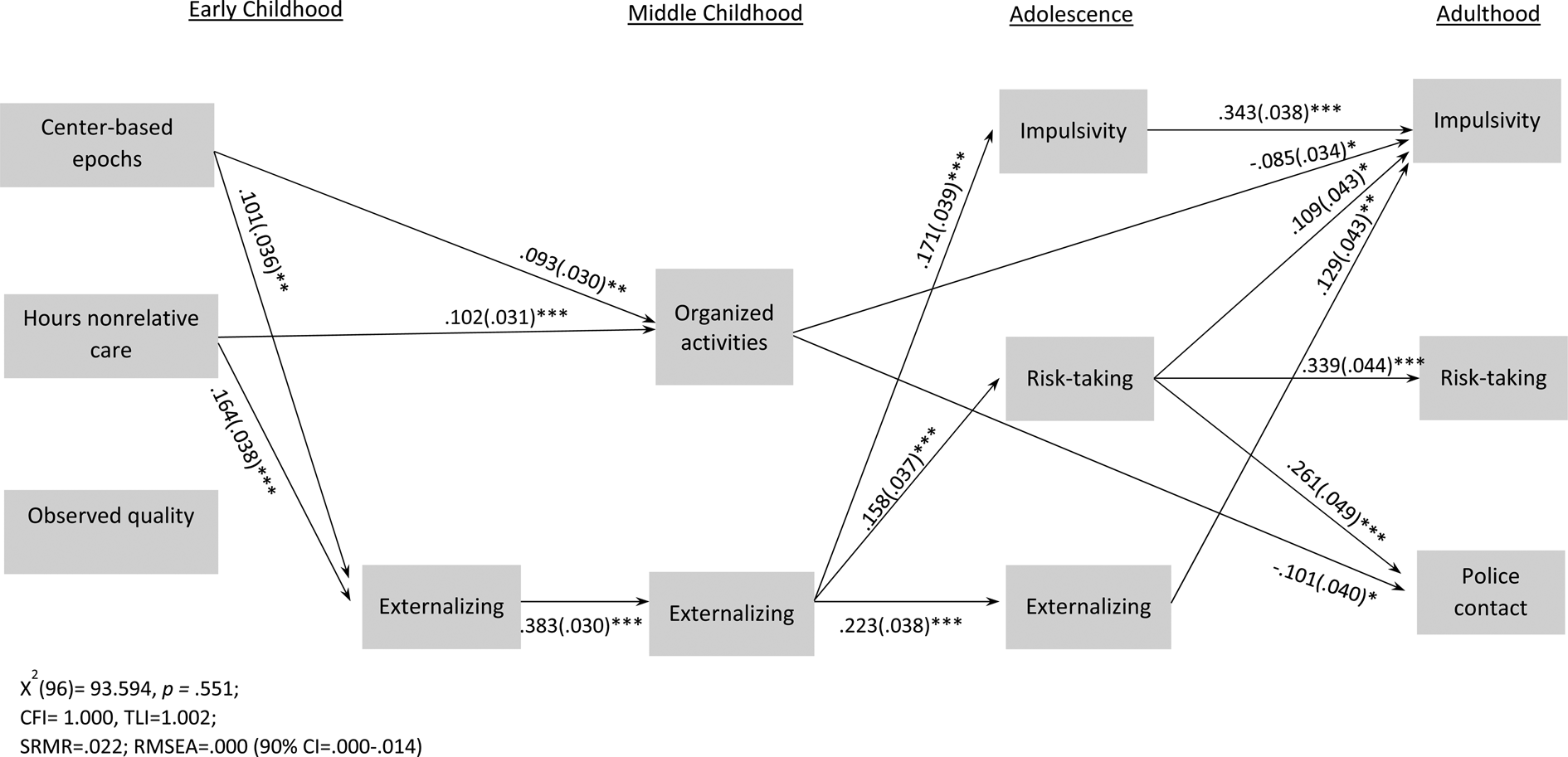
The primary goal of this study was to examine two developmental pathways that might link ECE, middle childhood organized activities, and later problem behaviors. As shown in Figure 2, the model presented great fit to the data (χ2 (96) = 93.594, p = .551; CFI/TLI = 1.000 /1.002; RMSEA = .000 [CI90%: .000–.014]; SRMR = .022). Figure 2 includes only the statistically significant paths; Supplementary Figure A1 in the Appendix displays all direct paths estimated. In addition, Supplementary Table A1 reports all path estimates for this model, and Supplementary Table A2 includes the within time covariances. The model indicated both direct and indirect associations between ECE, middle childhood organized activities, and problem behaviors, which we explain next.
Significant paths including early care and education, organized activities, and individuals’ problem behaviors from early childhood through adulthood (N = 1,258). Note. Only significant paths are shown. Covariates have been omitted for simplicity. Coefficients for all estimated paths are provided in Supplementary Table A1. Covariances between variables are presented in Supplementary Table A2. Covariates included in model are gender (Male = 0), ethnic minority status (White = 0), maternal education, early childhood income to needs ratio, epoch of single-parent household, composite score of HOME and maternal sensitivity, and dummy variables for 10 data collection sites. Data collection for early childhood is from 1 month to 54 months; middle childhood indicates kindergarten through 5th grade; data collection for adolescence is at 12th grade; and data collection for adulthood is at age 26. *p < .05. **p < .01. ***p < .001.
Pathway 1: Organized activities as an environment linking ECE to fewer adult problem behaviors
According to this pathway, ECE is related to adult problem behaviors via children's organized activities in middle childhood. As shown in Figure 2, children who were in more center-based settings in early childhood spent more time in organized activities in middle childhood (ß = .093, SE = .030, p = .002). In addition, children who spent more hours in nonrelative settings in early childhood spent more time in organized activities in middle childhood (ß = .102, SE = .031, p = .001). Children's organized activities, in turn, were directly associated with fewer problem behaviors in adulthood. Specifically, individuals who spent more time in organized activities in middle childhood reported less impulsivity (ß = −.085, SE = .034, p = .014) and lower police contact (ß = −.101, SE = .040, p = .012) at age 26.
Children's organized activities in middle childhood provided a pathway that indirectly linked ECE to fewer problem behaviors in adulthood (see Figure 2 and Table 3). More ECE hours predicted more organized activities that then predicted less impulsivity and less police contact (ß = −.009, SE = .004, p = .048; ß = −.010, SE = .005, p = .045, respectively). In addition, more center-based epochs in early childhood predicted more organized activities in middle childhood that then predicted less police contact at age 26 (ß = −.009, SE = .005, p = .050). These indirect pathways were statistically significant.
Significant indirect paths from early care and education (ECE) to adulthood problem behaviors (N = 1,258)

Note. Model includes gender (Male = 0), ethnic minority status (White = 0), maternal education, early childhood income to needs ratio, epoch of single-parent household, parenting quality, and dummy variables for 10 data collection sites.
**p < .01. *p < .05.
Pathway 2: Children's problem behaviors linking ECE to adult problem behaviors
According to the second pathway, ECE was related to adult problem behaviors through the continuity of individuals’ problem behaviors over time. As shown in Figure 2, children's proportion of center-based epochs (ß = .101, SE = .036, p = .006) and hours in nonrelative care (ß = .164, SE = .038, p < .001) were positively associated with children's externalizing behavior at 54 months, but ECE was not directly associated with problem behaviors in middle childhood, adolescence, or adulthood. Rather, children's problem behaviors were positively associated over time creating an indirect pathway between ECE and adulthood problem behaviors. Children's externalizing behaviors in early childhood positively predicted their externalizing behaviors during middle childhood (ß = .383, SE = .030, p < .001). Children's externalizing behaviors during middle childhood, in turn, predicted higher impulsivity (ß = .171, SE = .039, p < .001), more risk-taking (ß = .158, SE = .037, p < .001), and more externalizing behaviors (ß = .223, SE = .038, p < .001) in adolescence. Higher adolescent impulsivity (ß = .343, SE = .038, p < .001) and higher externalizing behaviors (ß = .129, SE = .043, p = .003) were associated with higher adult impulsivity. Finally, more risk-taking behavior in adolescence was associated with higher impulsivity (ß = .109, SE = .043, p = .012), more risk-taking (ß = .339, SE = .044, p < .001), and more contact with the police in adulthood (ß = .261, SE = .049, p < .001). As shown in Table 3, center-based ECE and hours in ECE were indirectly associated with impulsivity, risk-taking, and police contact at age 26 through early childhood, middle childhood, and adolescent problem behaviors (ß = .002–.004, SE = .001, p < .05).
Robustness check
To test robustness of the findings from our main analyses, we estimated the same SEM on the subsample of participants who had data at both ECE and age 26, which is labeled the age-26 sample in Table 1 (N = 797). Results from the robustness check were largely consistent with what we found for the larger ECE sample (N = 1,258). Results from the models are depicted in Supplementary Figures B1 and B2 and presented in Tables B1–B3 in Appendix B. Similar to what we found in the main analysis for the activities pathway, more center-based ECE (ß = .085, SE = .036, p = .019) and longer hours of ECE (ß = .076, SE = .037, p = .041) in early childhood predicted higher participation in organized activities in middle childhood. Children's participation in organized activities, in turn, was associated with lower levels of impulsivity (ß = −.080, SE = .033, p = .015) and fewer police contacts (ß = −.097, SE = .038, p = .011) in adulthood. The effect of the indirect associations between ECE and age-26 problem behaviors through middle childhood organized activities were similar in size across the main analysis (ß = −.009 – −.010, SE = .004–.005, p = .045–.050) and robustness check (ß = −.006 – −.008, SE = .004–.005, p = .085–.118). Although these indirect associations were statistically significant in the main analysis, the indirect associations were not statistically significant in the robustness check (Supplementary Table B1). The smaller sample size (N = 797) in the robustness check sample compared to the main analysis sample (N = 1,258) might have made it more difficult to detect statistical significance.
Consistent with our findings in the main analysis, we found continuity of individuals’ problem behaviors over time providing evidence for the child pathway. As shown in Supplementary Figure B1, children's hours in nonrelative care (ß = .172, SE = .044, p < .001) were positively associated with children's externalizing behaviors at 54 months. Children's externalizing behaviors in early childhood then positively predicted their externalizing behaviors during middle childhood (ß = .363, SE = .035, p < .001). Children's externalizing behaviors during middle childhood, in turn, predicted more impulsivity, risk taking, and externalizing behaviors in adolescence (ß = .157, SE = .039, p < .001; ß = .139, SE = .037, p < .001; ß = .209, SE = .038, p < .001, respectively). Higher adolescent impulsivity (ß = .345, SE = .038, p < .001) and higher externalizing behaviors (ß = .126, SE = .042, p = .003) were associated with higher adult impulsivity. More risk-taking in adolescence was associated with higher impulsivity (ß = .101, SE = .041, p = .015), more risk-taking (ß = .324, SE = .043, p < .001), and more contact with the police in adulthood (ß = .243, SE = .048, p < .001). Externalizing behaviors in early and middle childhood functioned as a significant indirect pathway linking ECE to problem behaviors in adolescence and adulthood (Supplementary Figure B1 and Table B1). Specifically, children receiving more ECE hours in early childhood had more externalizing behaviors in early and middle childhood, which in turn were linked to more problem behaviors in adolescence and adulthood (ß = .002–.003, SE = .001, p < .05). While the indirect pathways linking center-based ECE to childhood externalizing behavior, then to adolescent and age-26 problem behaviors did not reach statistical significance in the robustness check (ß = .001, SE = .001, p = .173–.188), the effect sizes were close to what we found in the main analysis (ß = .002, SE = .001, p = .027–.039).
Discussion
Motivated by Edward Zigler's proposition that children's experiences in the first 12 years could serve as primary prevention for later problem behaviors and delinquency (Zigler et al., Reference Zigler, Taussig and Black1992, Reference Zigler, Finn-Stevenson and Stern1997), the current study considered two pathways by which children's experiences during early and middle childhood are linked to problem behaviors in adolescence and adulthood. We found evidence in support of both an activities pathway and a child pathway. With respect to the first pathway, the activities pathway, we found that children who spent more hours in ECE and epochs in center-based ECE settings also had more epochs of organized activities during middle childhood. Their organized activities, in turn, predicted participants’ reports of less impulsivity and less police contact in adulthood. These direct links between organized activities and impulsivity and police contact at age 26 were significant, as were the indirect links between ECE hours and center-based settings and reduced impulsivity and police contact in adulthood, via children's organized activities during middle childhood.
These findings align with the School of the 21st Century that Edward Zigler envisioned to meeting the needs of children (birth to 12 years) and their families by providing both ECE and after-school programs (Zigler et al., Reference Zigler, Finn-Stevenson and Marsland1995). The findings also are consistent with other empirical research that has shown organized activities during middle childhood are linked to reductions in misconduct and fewer behavior problems (Durlak et al., Reference Durlak, Weissberg and Pachan2010; Vandell et al., Reference Vandell, Simpkins, Pierce, Brown, Bolt and Reisner2020b). The current study extends these prior studies by demonstrating that organized activities during middle childhood also served as a prevention pathway for adult misconduct and criminality. One unexpected aspect of these relations was that children's organized activities in middle childhood did not directly predict problem behaviors in adolescence. Moffit and Caspi's work on adolescence-limited and life-course-persistent antisocial behavior provides some insight (Moffitt, Caspi, Harrington, & Milne, Reference Moffitt, Caspi, Harrington and Milne2002). They argue that engaging in some problem or delinquent behavior is normative during adolescence whereas that might not be characteristic of childhood or adulthood. Two of our indicators, impulsivity and risk-taking, are often two hallmarks used to describe adolescence. Though life-course-persisters’ problem behavior during adolescence is part of a long-term pattern that spans childhood through adulthood, other individuals display patterns where their problematic behaviors are more likely to occur during adolescence as in the case of recovery offenders and, to some extent, adolescence-limited offenders. It is possible that some of the deviations in problem behaviors during adolescence may lessen the relations between participation in organized activities and problem behaviors, but those relations emerged again when predicting problem behaviors during adulthood.
In the current study, we also tested a second pathway, a child pathway in which we asked if ECE is associated with later development via changes in children's behavior. This second pathway was anticipated by Zigler's observation (Zigler et al., Reference Zigler, Taussig and Black1992) that ECE effects on child functioning could “snowball” effect over time by affecting children's behaviors and interactions with others that then perpetuate or sustain ECE effects over time. Although Zigler was primarily interested in positive snowball effects in which children's early competencies set the stage for later competence, however, negative effects also can snowball if children's problem behaviors set up negative interactions with teachers and peers that perpetuate over time.
Based on the initial SECCYD findings that early and extensive ECE hours were associated with problem behaviors during early childhood (NICHD ECCRN, 2002, 2003), we asked if these early problem behaviors were linked over time to later problem behaviors in middle childhood, in late adolescence, and then early adulthood, consistent with a snowball effect. With respect to this child pathway, we found that children who had higher ECE hours and more center-based ECE were reported by their teachers to display more externalizing behavior problems in early childhood, consistent with prior SECCYD reports. We then found that children's externalizing behaviors in early childhood were associated with higher externalizing behaviors during middle childhood, which were associated with higher impulsivity, risk-taking, and externalizing behaviors in adolescence. Adolescent risk-taking then predicted higher risk-taking, impulsivity, and police contact at age 26, whereas adolescent externalizing and impulsivity were both linked to impulsivity at age 26. Others have reported a similar continuity between disruptive behaviors in middle childhood and delinquency in adolescence (Broidy et al., Reference Broidy, Nagin, Tremblay, Bates, Brame, Dodge and Vitaro2003) and rule-breaking and criminality in early adulthood (Reef, Diamantopoulou, van Meurs, Verhulst, & van der Ende, Reference Reef, Diamantopoulou, van Meurs, Verhulst and van der Ende2010). The current study extends this prior research by linking ECE, indirectly, to these later problem behaviors.
Our inclusion of both the activities pathway and child pathway provides insight into earlier conflicting findings concerning ECE and individuals’ problem behaviors. Prior research utilizing SECCYD suggests that ECE hours were related to more problem behavior from early childhood through adolescence, but that more center-based ECE was related to more problem behaviors through middle childhood but fewer problem behaviors in adolescence (Belsky et al., Reference Belsky, Vandell, Burchinal, Clarke-Stewart, McCartney and Owen2007; NICHD ECCRN, 2002; Vandell et al., Reference Vandell, Belsky, Burchinal, Steinberg and Vandergrift2010, Reference Vandell, Burchinal and Pierce2016). Our findings suggest that the two pathways have conflicting implications for individuals’ problem behavior. According to the child pathway, higher ECE hours and more center-based ECE was associated with early externalizing behavior which carried forward to more problem behavior in adulthood. According to the activities pathway, the same two ECE indicators predicted higher participation in organized activities in middle childhood that predicted lower problem behavior in adulthood. As Zigler argued, participation in activities in middle childhood might mitigate the earlier problematic behavior, which most studies of ECE have failed to consider. The relations between center-based ECE and problem behavior may not change direction until adolescence (Vandell et al., Reference Vandell, Burchinal and Pierce2016), because individuals likely need to accumulate enough positive activity experiences to mitigate or reverse negative developmental processes. The number of years individuals participate in organized activities, which is also known as duration, is one of the strongest activity predictors of youth outcomes (Vandell et al., Reference Vandell, Larson, Mahoney, Watts, Lerner, Bornstein and Leventhal2015). All of these complexities underscore the importance of Zigler's argument for continued supportive programs across development.
It should be noted that the standardized coefficients associated with both the activities pathway and the child pathway, while statistically significant, were modest in size. However, given the 26-year time span of the study and the many intervening influences in children's lives, we did not anticipate large associations. That the associations were comparable to those found for other factors such as maternal education, family income, and parenting quality indicates that ECE and organized activities represent meaningful contexts for developing children, as Zigler (Zigler & Finn-Stevenson, Reference Zigler and Finn-Stevenson2007; Zigler et al., Reference Zigler, Finn-Stevenson and Stern1997; Zigler et al., Reference Zigler, Finn-Stevenson and Marsland1995) argued over the course of his career.
A somewhat surprising finding, or lack of finding, was the absence of relations between ECE quality and later problem behaviors or organized activities given evidence in other studies of the importance of ECE quality (Burchinal, Magnuson, Powell, & Hong, Reference Burchinal, Magnuson, Powell, Hong, Lerner, Bornstein and Leventhal2015). In the current study, ECE quality was unrelated to reports of later problem behaviors at any of the ages we examined. It also was unrelated to children's organized activities. This absence of significant effects does not mean that ECE quality is unrelated to other areas of children's development. In other SECCYD analyses (Belsky et al., Reference Belsky, Vandell, Burchinal, Clarke-Stewart, McCartney and Owen2007; NICHD ECCRN, 2002; Vandell et al., Reference Vandell, Belsky, Burchinal, Steinberg and Vandergrift2010, Reference Vandell, Burchinal and Pierce2016), ECE quality was consistently related to children's academic achievement and language development. One possible explanation of this difference is that the observational assessments of ECE quality focused on language and cognitive stimulation, not teachers’ efforts to foster social community or caring for others in the ECE settings. Gunnar, Kryzer, Van Ryzin, and Phillips (Reference Gunnar, Kryzer, Van Ryzin and Phillips2010) found these more social emphases were related to fewer problem behaviors at least in the short run.
A second surprising finding is that we did not find evidence of children's problem behaviors serving as a selection factor into organized activities, by either increasing or decreasing children's participation in activities in middle childhood, although there has been speculation about potential child effects on participation (Vandell et al., Reference Vandell, Larson, Mahoney, Watts, Lerner, Bornstein and Leventhal2015). At least with respect to problem behaviors, it did not appear that there were consistent selection processes in operation.
Although the large sample and detailed measures at multiple ages enabled us to test Zigler's integrative developmental approach to prevention science, two limitations of the current study should be noted. First, the ECE assessments were collected more than 20 years ago. This time lag is, of course, a necessary by-product of asking about the effects of early experiences on adult outcomes. However, it is still appropriate to ask if ECE and organized activities have changed substantially in the decades since 1990 and 2000s, making the findings less relevant for contemporary children. However, in many respects, circumstances surrounding ECE and organized after-school activities are remarkably similar to when Edward Zigler described the needs of working families who rely on ECE and after-school programs for their children combined with beliefs about the value of cognitive and social enrichment. Then, as now, ECE and organized activities are typically offered in community-based settings and parents worry about accessibility, affordability, and quality of the settings, suggesting that the overall ecology of these settings have not changed that much in the last 20 years. A second limitation is that the SECCYD is an observational study. Here, we sought to reduce the selection and omitted variable biases associated with a nonexperimental study by including a host of covariates in our analyses. Even so, causal inferences should not be drawn from our analyses.
Nonetheless, we believe that the current study illustrates the power of Edward Zigler's insights that children's experiences during the first 12 years may be meaningful for later child developmental outcomes, including reduced problem behaviors and delinquency.
Supplementary Material
The supplementary material for this article can be found at https://doi.org/10.1017/S0954579420001376.
Acknowledgments
A cooperative agreement (5 U10 HD027040) between the study investigators, which included Deborah Lowe Vandell and the Eunice Kennedy Shriver National Institute of Child Health and Human Development, supported the design and data collection of the SECCYD from birth through age 15 years. Special appreciation goes to Elizabeth Cauffman and Bonnie Halpern-Felsher for their contributions to the design and implementation of the end-of-high-school protocol and to the SECCYD site coordinators (Andrea Karsh, Susan Dell, Wendy Wagner Robeson, Carol Rangel, and Janet Gouge Johns) and the UC Irvine research team (Andrea Karsh, Stephanie Soto-Lara, Khamia Powell, Olaitan Jimoh, Lea Ibalio, Michael Mayfield, and Christopher Wegemer) for their efforts to locate study participants and coordinate data collection for the age-26 follow-up. Finally, we thank the study participants for their willingness to be a part of this longitudinal follow-up of a project that began shortly after their birth.
Financial Statement
Grants from the Charles Stewart Mott Foundation to Deborah Lowe Vandell supported the collection of the end-of-high-school assessments (2006-00365.01) and the age-26 assessments (2017-00786).
Conflicts of Interest
None.


 Open access

