


Timothy Pauketat (Reference Pauketat, Timothy and Thomas1997:31, Reference Pauketat2004) has famously invoked the cosmological metaphor of the Big Bang to describe the onset of the Mississippian period in the American Bottom region of the North American Central Mississippi Valley during the eleventh century AD (Figure 1). In so doing, he has evocatively drawn our attention to the extremely rapid and dynamic processes that gave rise to the huge center of Cahokia (11MS2) and surrounding settlements. It is no longer tenable to subscribe to the notion that the twinned processes of maize adoption and local population growth spurred a gradual, linear trajectory of surplus production, social hierarchy, and apparent urbanization. Instead, in less than a century, the American Bottom region witnessed the sudden birth of a metroplex characterized by large, earthen-mound centers articulated to scores of smaller sites throughout the region (Betzenhauser Reference Betzenhauser and Gregory2017; Emerson Reference Emerson1997; Pauketat Reference Pauketat2004). These seem to have been both cause and consequence of significant population inflows and outflows immersed in a rapidly evolving and complex religious, political, and economic milieu (Alt Reference Alt2018; Baltus and Baires Reference Baltus and Baires2020; Pauketat Reference Pauketat2013a; Wilson et al. Reference Wilson, Delaney, Millhouse and Gregory2017).
Location of Tombigbee Valley research region and other sites referenced in the text (figure by Charles R. Cobb).

The American Bottom Big Bang truly was unique. There is nothing of this scale and early manifestation to be found elsewhere in Mississippian period (AD 1000–1600) eastern North America. At the same time, it is now apparent that punctuated spurts of population movement and settlement evolution—albeit more modest in nature—were more the rule than the exception (Blitz Reference Blitz2010; Cobb and Butler Reference Cobb, Butler, Brian and Paul2006; Comstock et al. Reference Comstock, Cook, Blitz, Simon, Robert and Aaron2022; Wilson and Sullivan Reference Wilson, Sullivan and Gregory2017). In contrast to the potentially false appearance of abrupt cultural change fostered by a reliance on archaeological phases or stages (Birch et al. Reference Birch, Hunt, Lesage, Richard, Sioui and Thompson2022; Plog and Hantman Reference Plog and Hantman1990), the calendrical framework made possible by accelerator mass spectrometry (AMS) dating and Bayesian modeling lends credence to the “reality” of these big and little bangs that we can potentially attribute to migration. The causes of the relocations are not always evident, but they seem to have involved a mélange of climate and environmental change, conflict, pilgrimage, and other social factors.
Our investigations in the Tombigbee River ValleyFootnote 1 of eastern Mississippi and western Alabama demonstrate that one of these little bangs took place around AD 1300, followed by another about 150 years later. This is a period when the Mississippian lifeway of settled towns, earthen-mound complexes, and maize agriculture had already been well established throughout the larger region. Our Bayesian modeling of numerous radiocarbon dates from several sites in the drainage, with a particular emphasis on the small mound center of Lubbub Creek (1PI33, 1PI85), demonstrates that considerable volatility marked the political and demographic landscape. The focus on detailed settlement histories has allowed us to document a departure from what was once presumed to be a social environment characterized by the gradual rise and decline of towns and polities. This work demonstrates how continuing refinements in chronological modeling are allowing archaeologists more than ever to move away from stadial, taxonomic-driven conceptions of time and toward a greater appreciation of the continually emergent and nonlinear temporality of societies. We use our case study to advocate a middle-range theoretical approach toward linking chronology, migration, materiality, and emergence.
Balancing Time and Temporality in the Mississippian World
The idea that Mississippian settlements and polities witnessed tumultuous and divergent histories is no longer novel. Beginning at least as early as the 1990s, archaeologists began to question the received wisdom that the archetypical development of a Mississippian settlement system involved the steady arc—over decades or centuries—into a chiefdom or nonstate ranked society that then eventually disintegrated. David Anderson’s (Reference Anderson1994) influential work on chiefly cycling emphasized how factionalism, conflict, and warfare could lead to a repetitive waxing and waning of chiefdoms, many of which achieved considerable size and were characterized by a site-size hierarchy of primate and subsidiary settlements. Later studies questioned the frequency with which large, complex polities developed, although they conceded that conflict and aggrandizement greatly shaped the unruly histories of Mississippian chiefdoms (e.g., Blitz Reference Blitz1999; Hally Reference Hally and John1996; Muller Reference Muller1997). This research demonstrated that many Mississippian chiefdoms could be characterized as modest, single-mound centers of limited spatial scope and power; moreover, many communities likely lived outside the influence of anything that could be construed as a centralized political system—even weakly conceived. A consensus therefore emerged that Mississippian systems exhibited a wide range of political complexity and that their lifespans often departed from smooth undulations of rise and fall (and possible rise again).
Anderson (Reference Anderson and Gregory2017:297) later reflected that his cycling model was part of a trend to account for gross similarities in the trajectory of Mississippian systems that has increasingly been rejected by researchers invested in “specific event-centered histories” (see also Comstock et al. Reference Comstock, Cook, Blitz, Simon, Robert and Aaron2022:16; Wilson and Sullivan Reference Wilson, Sullivan and Gregory2017:1–2). Even so, the historical turn in Mississippian studies has still been of a rather coarse nature, hampered by a heavy reliance on ceramic seriations and older or numerically limited suites of radiocarbon dates to frame site and regional chronologies defined by periods and phases (Garland et al. Reference Garland, Thompson, Birch, Brannan, Parbus, Auerbach, Chapman, Love and Strawn2024; Holland-Lulewicz et al. Reference Holland-Lulewicz, Thompson, Wettstaed and Williams2020). In response, a few researchers have devoted considerable resources toward aggregating legacy radiocarbon dates and compiling large numbers of AMS samples to achieve more fine-grained chronological alternatives to phases and periods (e.g., Cobb et al. Reference Cobb, Anthony, Aaron, Kevin, Edmond and Brad2024; Lulewicz Reference Lulewicz2019; Meeks and Anderson Reference Meeks, Anderson, John and Hayes2013; Sullivan et al. Reference Sullivan, Smith, Meeks and Patch2024).
The resolution provided by these studies demonstrates that Mississippian communities were in a constant state of transformation in which attributes and practices were constantly adopted, modified, and dropped—sometimes involving incremental changes in quotidian lifeways, and at other times implicating qualitative shifts. Various forms of ongoing interregional interaction, ranging from long-distance trade to conflict, were instrumental to this dynamic. Further fueling these transformations, the Mississippian period was characterized by a recurring pattern of population movement at varying scales. The early process of “Mississippianization” itself seems to have involved peoples as well as practices radiating out of the American Bottom in multiple directions, where they seem to have become entangled with—rather than supplanted by—local Late Woodland lifeways (e.g., Baltus and Baires Reference Baltus and Baires2020; Comstock et al. Reference Comstock, Cook, Blitz, Simon, Robert and Aaron2022; Wilson and Sullivan Reference Wilson, Sullivan and Gregory2017). In turn, the latter part of the Mississippian sequence, beginning in the AD 1300s, witnessed large regional abandonments ranging from the American Bottom to the coastal Carolinas (Benson et al. Reference Benson, Pauketat and Cook2009; Cable Reference Cable2020; Cobb et al. Reference Cobb, Anthony, Aaron, Kevin, Edmond and Brad2024; Meeks and Anderson Reference Meeks, Anderson, John and Hayes2013; Williams Reference Williams, David and Cox1990). Between these temporal brackets of broad dispersals, there seem to have been recurring patterns of smaller-scale movements about which we know relatively little in terms of their character and local impacts because of the imprecise dating surrounding them (e.g., Cobb and Butler Reference Cobb, Butler, Brian and Paul2006; Kowalewski and Hatch Reference Kowalewski and Hatch1991; Regnier Reference Regnier2014).
Addressing these dynamics requires a recognition of the ongoing culture change stemming from the concrete actions of people—a grounds-up perspective, so to speak. This emphasis has been promoted by the new materialism and relational studies in archaeology, which frame societies within a context of emergence or becoming—in other words, an appreciation of the continually unfolding nature of culture change and transformational shifts in practice and worldview (Alberti Reference Alberti2016; Ingold Reference Ingold2011; Joyce Reference Joyce, A. Scott, M. Kosslyn and Buchmann2015). The philosophical underpinnings of emergence advocates are diverse, ranging from Gilles Deleuze to Alfred Whitehead (see Biehl and Locke Reference Biehl and Locke2010; Malafouris et al. Reference Malafouris, Gosden and Bogaard2021; Protevi Reference Protevi2006), whereas in the Mississippian sphere, Susan Alt (Reference Alt2018) has drawn inspiration from Homi Bhabha’s (Reference Bhabha1994) postcolonial slant on hybridity (for other Mississippian perspectives, see Baires Reference Baires2017; Pauketat Reference Pauketat, Robb and Pauketat2013b). Some North American approaches are more explicitly immersed in notions of becoming as phrased through Indigenous ontologies (e.g., Bernardini et al. Reference Bernardini, Stewart and Leigh2021; Duwe and Preucel Reference Duwe and Preucel2019). Although emergence or becoming might imply continuous change, Deleuze, at least, viewed it as a liberating form of immanence that implied “to create something new” (Deleuze Reference Deleuze1995:171). Likewise, Paul Rabinow (Reference Rabinow2008:3–4) maintained that emergence is more than simply social reproduction; it is more properly “a state in which multiple elements combine to produce an assemblage, whose significance cannot be reduced to prior elements and relations” (Rabinow and Bennett Reference Rabinow, Bennett, da Costa and Philip2008:398).
But how do we, as archaeologists, detect and identify something that is meaningfully new in an ontological sense? In our study, we admittedly elide many of the higher-order theoretical issues regarding emergence. Instead, we proffer what we believe is a conceptual bridge for addressing the temporality of emergence, with a particular focus on saltations that can be attributed to migration and emplacement. Borrowing from Manuel De Landa (Reference De Landa2011), Oliver Harris (Reference Harris2014:338–340) and Rachel Crellin (Reference Crellin2020:173–175) propose that we can potentially characterize these expressions as phase transitions—marked shifts in assemblages and ways of being that are the culmination of local, interrelated processes. Advances in radiocarbon dating and statistical modeling provide for the identification of these phase transitions with increasing accuracy. In turn, this allows the discipline to work toward an ethical Bayesian framework, representing a middle-range approach that emphasizes historically contingent practices rather than normative taxonomic sequences that flatten variation (Griffiths et al. Reference Griffiths, Carlin, Edwards, Overton, Johnston and Thomas2023).
In an essay that is just as relevant now as it was when written a decade ago, John Robb (Reference Robb2015) lamented the lack of middle-range theory in materiality studies. As he noted, there is a tendency to develop sophisticated theoretical models that then simply rely on an archaeological vignette to exemplify a philosophical point—an approach that is “inspiringly eloquent, but material remains always remain cast in the role of the isolated, dependent example” (Robb Reference Robb2015:166). Variations on this concern have appeared in other musings on the lack of grounding, so to speak, of materiality studies. Ian Hodder (Reference Hodder2011:157) has observed, “Despite attempts . . . to link archaeometry to current social theory, there is very little detailed description of artefacts in much of the literature dealing with materiality, material agency, phenomenology, and so on.” Even as materiality perspectives were beginning to gain widespread traction, this issue was highlighted two decades ago by Andrew Jones (Reference Jones2004), who expressed his frustration with the lack of communication between archaeological scientists and archaeological theorists.
Robb (Reference Robb2015:167–169) in large part was concerned with building “applicable theory” that emphasized how the concrete aspects of material culture and their affordances denoted how they should be used, how they should be responded to, and how they directed flows of action. In his view, this included patterning in archaeological assemblages in addition to the design elements of material culture. In contrast to the view popularized in processual archaeology that there was an independent realm of middle-range theory that linked higher-order theory and methodology (Raab and Goodyear Reference Raab and Albert1984), the approach advocated by Robb does not see a scalar ordering of, or schism between, method and theory, or between different types of theory; each envelops the other. This means that “at both the practical and theoretical level we are required to simultaneously consider how it is that artefacts are socially and culturally constructed, while also taking into account the physical and mechanical construction of artefacts” (Jones Reference Jones2004:329). To this we might add that materiality research needs to combine features, activity areas, landscape, and similar archaeological phenomena with the category of artifacts.
Falling within the perceived gap between empirical and theoretical research on materiality, it seems that there is a paucity of systematic research for assessing—or knowing (the epistemology)—what constitutes meaningful emergence. Archaeologists constantly date longitudinal trends in the archaeological record as part of our stock in trade. But how do we identify shifts in temporality and material culture that are qualitatively emergent? And can we do so more successfully by taking advantage of advances in the statistical modeling of large numbers of radiocarbon dates? It might be argued that these aims involve different notions of time: one (chronometric modeling) is based on objective renderings of calendrical time, and the other on how time is subjectively constructed or experienced (see Gosden Reference Gosden1994; Ingold Reference Ingold1993; Thomas Reference Thomas1996). But this kind of divide can potentially be bridged if we move away from the notion that ontology and epistemology are two different and separate entryways of engaging the past (Alberti Reference Alberti2016). As Preucel and Duwe (Reference Preucel, Duwe, Duwe and Preucel2019:15) point out, a major drawback to this duality is that it inserts a Western, arbitrary wedge between being and knowing (see also Watts Reference Watts2013:24). In our view, it is critical to ask the question “how can we know the emergent?” from both sides (Otto Reference Otto2018).
Craig Cipolla (Reference Cipolla2019:615) has observed that anthropologists and archaeologists typically view ontology as a variation of culture, but rarely are the two variables explicitly linked to one another. This is a critical step in any study of emergent change, given that significant shifts in the materiality of culture would likely signal ontological change. Given that Indigenous notions of temporality and identity in North America are frequently (if not universally) tied to migration, landscape, and emplacement (e.g., Basso Reference Basso1996; Deloria Reference Deloria1992; Duwe and Preucel Reference Duwe and Preucel2019; Momaday Reference Momaday and Capps1976; Nabokov Reference Nabokov2006), we propose that fine-grained chronometric assessments of population movement and landscape transformations (including the built environment) are key to conceptualizing qualitative transformations in the archaeological record that potentially manifest emergence as a historical process. Some archaeologists in the Southeast have already made innovative strides from this direction based on Indigenous ontologies of place making, emphasizing the importance of locality as a fusion of space and time (e.g., Baires et al. Reference Baires, Baltus, Parker and Kuehn2023; Sanger et al. Reference Sanger, Seeber, Bourcy, Galdun, Troutman, Mahar, Pietras and Kelly2021). They also stress the collective nature of lived knowledge and experience, where agency is distributed across humans, other-than-humans, and the landscape (Burkhart Reference Burkhart and Waters2004; Watts Reference Watts2013). Locality may supersede chronology for marking Indigenous life because “place becomes a reference point that is needed in life so that we know where we come from and who our relatives are” (Fixico Reference Fixico2003:25).
Time and Temporality at Lubbub Creek
Archaeological research in the Tombigbee River Valley has revealed that there were at least four modest-sized, single-mound sites along a 60 km stretch of floodplain in eastern Mississippi and western Alabama, as well as a number of smaller settlements (Blitz Reference Blitz1993; Jenkins and Krause Reference Jenkins and Krause1986; Peebles, ed. Reference Peebles1983; Rucker Reference Rucker1974; Figure 2). The earliest sites appear to have been established by at least the 1100s AD. Until our investigations, Lubbub Creek was the only mound site to have received extensive excavations, revealing a community within a bend of the Tombigbee River that covered about 11.3 ha at its peak (Blitz Reference Blitz1993:58; Figure 3). It contained multiple exterior and interior palisades (and later, a fortification ditch) and a habitation area centered on an earthen platform mound (originally about 3 m high) and adjacent plaza (Peebles, ed. Reference Peebles1983). A combination of closed-context ceramic seriations and radiocarbon dates suggested a Mississippian occupation from about AD 1000 to 1600. The conventional wisdom proposed that the construction of the mound-plaza complex and the first major growth of the community occurred in the interval between AD 1000 and1200 (Blitz Reference Blitz1993:57).
Key sites in the Tombigbee Valley. (Color online)

Primary features of the Lubbub Creek site (revised figure used with permission of the University of Alabama Press).

In recognition of the somewhat humble scale of Mississippian developments in the Tombigbee Valley compared to many other Mississippian regions, John Blitz’s (Reference Blitz1993) synthesis was an important statement against the prevailing political model of mound sites as the nucleus of centralized, hierarchical societies. As an alternative—at least for this drainage—he proposed that many such localities “may have been composed of a network of interacting modules in which political ‘administration’ was ritualist, competitive, segmented, and unstable” (Blitz Reference Blitz1993:183). His conclusions were drawn in part from the evidence in the region for only attenuated expressions of chiefly power: investments in earthworks were limited; mortuary distinctions were subtle compared to large, multimound centers; and there was no appreciable site-size hierarchy. This pattern, combined with what seemed to be a low population density for Lubbub Creek (an estimate of no more than 100 individuals), led Blitz (Reference Blitz1993:181) to surmise that it may have been a quasi-vacant ceremonial center for a dispersed population of residents in the surrounding countryside. In this scenario, the center regularly hosted gatherings for integrative activities, ritual events, and defense for these satellite communities.
Blitz’s demographic characterization of Lubbub Creek hinged on the necessary reliance on its extremely coarse chronological profile, constrained by ceramic seriations of varying duration and radiocarbon dates with broad standard deviations. As a result of these challenges, the accepted history of the site had been interpreted through a normative lens of Mississippian development: beginning with Malthusian pressures on the hunting and gathering (and perhaps some horticulture) practices of local Late Woodland (ca. AD 600–1000) peoples, “at approximately A.D. 950 the focus of the subsistence system shifted from wild plant foods to domesticated crops. Therein lies the transition from the Late Woodland to the Mississippian adaptation in the region” (Peebles Reference Peebles and Christopher1983:396). The early Mississippian occupation from AD 1000 to 1200 (the Summerville I phase) was characterized by a somewhat rapid growth that involved the construction of several palisades and a platform mound; the “mature” Mississippian phase (Summerville II and III phases)—AD 1200 to 1450—represented “the growth of the social and adaptive patterns set a few generations earlier. The community grew somewhat in size and population, but there were no radical changes in subsistence and, seemingly, no need for fortifications” (Peebles Reference Peebles and Christopher1983:396–397). The Summerville IV phase, beginning around AD 1450, represented the one marked shift in this smooth trajectory, with a significant contraction of site size, the construction of a defensive ditch, and a marked change in ceramic types (Peebles Reference Peebles and Christopher1983:401).
From this perspective, much of the history of the Lubbub Creek site was a 400-year sweep of relatively uninterrupted development and growth that, at the time, was widely thought to typify Mississippian centers. Our reevaluation of the site chronology, based on a total of 57 old and new radiocarbon measurements, has provided a somewhat different picture (Figure 4).Footnote 2 There seems to have been a continuous occupation extending from the Late Woodland to very late Mississippian periods, as postulated originally. But our research also shows that there was likely only a very minor Mississippian presence at this location in the AD 1100s to 1200s, which was then followed by two significant bumps. The settlement, rather than growing in a steady upswing, only significantly expanded in size beginning around AD 1300. After a period of occupation of about 150 years, it then altered in nature dramatically.
Bayesian-modeled dates of sites and site features.

Our attention first turned to submound ritual features and subsequent mound construction, given that these constitute the traditional ceremonial and political core of Mississippian towns. Much of the mound had been destroyed, but six rectangular structures below the mound remnant were identified (Figure 5). These included two wall-trench houses (where posts were set vertically in narrow trenches) and four single-post structures. The cluster of buildings was surrounded by a wooden fence or stockade (unrelated to the larger, perimeter palisades), creating a closed compound. This concentration of apparent special-use facilities likely comprised a ceremonial precinct that established a ritual nexus for the community, later anchored by the platform mound that was built over their remains (Blitz Reference Blitz1993:82–84). These buildings were originally presumed to coincide with the early founding of the site in the eleventh to twelfth centuries AD. Based on stratigraphy, the order of the buildings from early to late is as follows: Structure 4, Structure 3, Structures 2 and 5A (contemporary), and Structures 1 and 5B (contemporary; Blitz Reference Blitz1993:240). Structure 4 was the only one dated in the original study (cal AD 990–1180), based on a related internal feature. The two sets of paired structures appear to have been razed and then capped by a small clay platform. A subsequent mantle of earth over the platform held the first structure on the new mound.
Submound structures and associated calibrated radiocarbon dates (revised figure used with permission of the University of Alabama Press).

We were able to date two samples from each of three additional pre-mound structures, and to date one sample from the top of the first mound construction stage containing a building (see Figure 5). Except for what seems to be one anomalously early date from Structure 2, all of the dates fell within 20 years of one another and aggregated in the AD 1300s. The modeling results estimate that the final activity associated with the structures below the platform mound at Lubbub Creek occurred in cal AD 1350–1400 Footnote 3 (Primary Model: End of activity associated with the structures below Lubbub Creek’s mound; Figure 4). The date from the early mound stage structure is cal AD 1310–1400 (UGAMS-51370). This overlap suggests that mound construction may have followed in the immediate wake of the dismantling of the underlying structures, although modeling all of the dates from the mound sequence provides an estimate of start of mound construction at cal AD 1365–1400 (Alternative Model: Start of Lubbub Creek’s mound construction; Figure 4). In either case, these results strongly suggest that mound construction started at least a century later than originally presumed. Submound Structure 4 appears to belong to the early part of the Mississippian sequence, and the date of the one that follows, Structure 3, is unknown. But the construction of the mound seems to have been immediately preceded by the construction and razing of a dyad of wall-trench structures followed by the construction and razing of a dyad of single-post structures. The modeling suggests that the platform mound continued to be used until at least cal AD 1585–1635 (Primary Model: End of Lubbub Creek’s mound use; Figure 4).
In itself, the identification of “late” construction dates for the sets of ceremonial structures and mound is provocative but not necessarily earth-shattering. It could simply mean that the mound had been built after several centuries of settlement growth. What piqued our interest next, however, was a consistent pattern of late radiometric dates for putatively early Mississippian period features. The conventional view reflected in the Lubbub Creek report was that Summerville I, the first Mississippian phase, occurred from circa AD 1000 to 1200 (Peebles and Mann Reference Peebles, Cyril B. and Christopher1983:70). The three Summerville I radiocarbon dates available at the time displayed considerable variation, however, cumulatively spanning an interval of cal AD 880–1370. Without knowing more about the organic materials represented by these samples, the dates are problematic given the wide probability spreads for all of them. But we still cannot rule out at least a small-scale early Mississippian presence at Lubbub Creek, so we retain these dates in our analyses.
We have since dated five additional features that had been assigned to the Summerville I phase based on diagnostic pottery. These samples, when added to the three original Summerville I samples to develop our Bayesian chronological model for the onset of the Mississippian sequence, suggest a start date of cal AD 1280–1345 (Primary Model: Start of Lubbub Creek’s Mississippian occupation; Figure 4). If this estimate is generally representative of the start of the Summerville I occupation, it seems to represent a step-like evolution in the history of site occupation rather than a gradual arc. Here we should add that the Lubbub Creek study relied extensively on one ceramic type to define Summerville I contexts: Moundville Incised var. Moundville (Peebles and Mann Reference Peebles, Cyril B. and Christopher1983:70). In the current regional ceramic chronology, though, this is a very long-lived type; it may be common in early Mississippian contexts, but it persists well into the AD 1300s (Knight Reference Knight2010:16–17). Our takeaway from these data is that many of the contexts defined as Summerville I were contemporary with later Mississippian (Summerville II/III) components and that the early Mississippian occupation was much more modest than originally posited.
There is one more line of evidence to support the idea of a relatively late onset of major Mississippian activity at Lubbub Creek. Archaeological signatures of six wooden palisade lines were identified at Lubbub Creek. Based on their horizontal and vertical stratigraphic order, their construction was presumed to date to the Summerville I/early Summerville II time frame (ca. AD 1000 to early 1200s; Cole and Albright Reference Cole, Albright and Christopher1983). We were able to retrieve only a single viable AMS sample from the palisade lines, but it came from a bastion wall trench associated with the first and outer palisade (see Figure 2). That AMS date, cal AD 1300–1400 (UGAMS-50197), is squarely in line with the late returns we have for our Summerville I dates. Based on the chronometric data, the Lubbub Creek Mississippian occupation seems to have surged at some point after the late AD 1200s. A migration to this locality seems the most reasonable way to explain this dramatic change.
Our analysis does support the timing of the last significant Mississippian transformation as proposed in the original Lubbub Creek report. The modeling of 16 AMS dates from Summerville IV contexts (as defined by pottery types) yielded a start date of cal AD 1415–1455 for this phase (Alternative Model: Start of Summerville IV at Lubbub Creek), followed by an estimated end date for activity at Lubbub Creek of cal AD 1675–1700 (Primary Model: End of Lubbub Creek; Figure 4). This is a surprisingly late end date for the Mississippian period for anywhere in the Southeast. But it is reinforced by three radiocarbon dates that calibrate to post–AD 1600 at 95% confidence (UGAMS-44737, UGAMS-52610, UGAMS-52611).
As noted, the Summerville IV period at Lubbub Creek witnessed a notable contraction in area and the construction of a defensive moat. In addition, there were distinct changes in pottery types, and burial practices shifted emphasis from unflexed and flexed interments to the frequent placement of remains into ceramic urns. These changes are sufficiently striking as to suggest another little bang of population influx. It is not evident whether Lubbub Creek was temporarily abandoned before the appearance of new arrivals in the mid-fifteenth century, whether an outside group peacefully merged with the resident population, or whether belligerent immigrants replaced the original inhabitants. But these new pottery types and burial practices occur in a wide swath across Mississippi and Alabama (Regnier Reference Regnier2014; Sheldon Reference Sheldon1974; Sheldon and Jenkins Reference Sheldon and Jenkins1986), representing an archaeological horizon suggestive of an event-like change.
In short, the Lubbub Creek built environment appears to have experienced two abrupt transformations: a rapid build-up beginning around AD 1300, followed by a significant makeover around AD 1425. Why the hypothesized population inflows accounting for these little bangs may have occurred becomes more evident when we widen our scope to a regional perspective.
Upriver in the Tombigbee Drainage
To the north of Lubbub Creek, Yarborough was the one Mississippian settlement that had an extended excavated Mississippian sequence for comparison with Lubbub Creek (Solis and Walling Reference Solis and Walling1982). A significant portion of the site had been destroyed before excavations began, but it appears to have been a farmstead with only one domestic structure surviving site damage. Fortunately, the Mississippian inhabitants conveniently used a natural levee gully near the structure as a dump, leaving a stratigraphic record about 50–60 cm thick.
The Yarborough site occupation model is based on 11 radiocarbon short-lived plant samples from the refuse dump, seven from the structure, and two from pits. The modeling results indicate that Yarborough’s Mississippian occupation seemingly coincided with the creation of the levee refuse pit at cal AD 1215–1250 (Primary Model: Start of Yarborough midden accumulation; Figure 4). Activity associated with the refuse pit ended in cal AD 1360–1410 (Primary Model: End of Yarborough midden accumulation), suggesting no overlap with the start of activity of the domestic structure at Yarborough, modeled at cal AD 1455–1490 (which notably coincides with the late settlement reorganization at Lubbub Creek; Primary Model: Start of Yarborough’s Mississippian structure; Figure 4). These results support an earlier hypothesis by Blitz (Reference Blitz1993:66) that the site potentially had two distinct occupations. The estimate for the end of activity at Yarborough, based on feature contexts, is cal AD 1525–1640 (Primary Model: End of Yarborough’s Mississippian occupation; Supplementary material 4). The house has no evidence for rebuilding and was extensively burned. Given its start date in the mid to late AD 1400s, it likely was not occupied later than the early to mid–AD 1500s.
Our knowledge of Tombigbee Valley settlement has been broadened by four seasons of excavations at the Butler Mound site (22LO500), located about 40 km north of Lubbub Creek.Footnote 4 This is a single-platform mound site of about 1.7 ha. Our fieldwork, aided by gradiometer survey, suggests that this center, like Lubbub Creek, contained a relatively modest habitation at any one point in time. The survey data showed dozens of anomalies in the areas around the Butler mound (Boudreaux et al. Reference Boudreaux, Lieb, Smith, Harris and Cobb2018), but ground truthing of 42 anomalies determined that only eight of them were of archaeological interest. These were all confirmed as burned buildings west of the mound, and seven of these were investigated through excavations. In addition, limited excavations were carried out on the platform mound (Boudreaux et al. Reference Boudreaux, Lieb, Smith, Harris and Cobb2018, Reference Boudreaux, McKenna and Griffith2022).
The radiocarbon samples from Butler Mound include nine samples from mound contexts and 27 from domestic structure contexts (Figure 4). Our chronological models for the community estimate that Mississippian activity began in cal AD 1335–1385 (Primary Model: Start of Butler Mound Site) and that early construction associated with the mound started in cal AD 1430–1470 (Primary Model: Start of Butler Mound construction stage above Zone G midden deposit). This latter date, however, is from a lower mound stratum, not the first. Consequently, the inception of mound building somewhat precedes this date. Nonetheless, this chronology generally corresponds with the late mound beginnings at Lubbub Creek, more in the middle of the Mississippian sequence than at the beginning. The model further estimates that activity at Butler ended cal AD 1510–1630 (Primary Model: End of Butler Mound Site), with activity associated with the mound ending cal AD 1495–1565 (Primary Model: End of Butler Mound use).
Finally, it is important to emphasize that there was a late Mississippian fluorescence in the Black Prairie physiographic region, a terrain of rolling hills to the immediate west of the Tombigbee Valley (see Figure 2). Our chronometric modeling of three substantial sites in the region (Lyons Bluff [22OK520] and Curry [22OK578], both single-mound sites, and Stark Farms [22OK778], a dispersed village) suggests that Mississippian peoples may have begun to arrive in the prairie in the late AD 1200s, coinciding with the first little bang at Lubbub Creek. It then seems that a final emptying of the Tombigbee drainage (north of Lubbub Creek) into the Black Prairie occurred in the AD 1400s and 1500s.
Based on 23 radiocarbon samples, the start of the Curry site in the Black Prairie is cal AD 1275–1350 (Primary Model: Start of Curry Site; Figure 4) with an estimated end of occupation at cal AD 1455–1495 (Primary Model: End of Curry Site; Figure 4). We have modeled the Lyons Bluff chronometric dataset (20 radiocarbon and 1 TL dates) developed by Peacock and Hogue (Reference Peacock and Hogue2005), which suggests a start of occupation of cal AD 1300–1420 and an end date of cal AD 1600–1680 (Supplementary material 4; Figure 4). Our nine dates from the Stark Farms village site suggest a start of cal AD 1410–1460, more in line with the second little bang at Lubbub Creek, and an estimated end of occupation at cal AD 1545–1675 (Supplementary material 4; Figure 4). Clearly, there is some region-wide synchronicity in little bangs occurring around the late 1200s to early 1300s and the mid-1400s that begs explanation.
Place, Temporality, and Emergence in the Tombigbee Drainage
Our current chronological models from the Tombigbee Valley and the Black Prairie suggest the following sequence:
1. There seems to have been a modest onset of Mississippianization that potentially began as early as AD 1100. The fact that there are a number of Late Woodland sites that overlap this time frame may be indicative of the intrusive nature of the first Mississippian presence (Jenkins and Krause Reference Jenkins and Krause1986:82–85). The character of early Mississippian entanglements remains poorly understood and very chronologically imprecise, however.
2. Around AD 1300, there was a significant coalescence and growth at several nodal communities in the Tombigbee Valley and adjoining Black Prairie, highlighted at single-platform mound centers represented by the Butler Mound, Lubbub Creek, Lyons Bluff, and Curry sites.
3. About 125–150 years later, in the early to mid-1400s, another dramatic shift occurred as expressed in distinctive new ceramic types and changes in burial practices associated with the Summerville IV phase at Lubbub Creek. This change was echoed throughout a large portion of Alabama and Mississippi. In the Black Prairie, these dates coincide with the abandonment of the Curry site and the approximate start of occupation of Stark Farms. The second phase of occupation at Yarborough also begins in this time frame.
4. There was a variable termination to the Mississippian trajectory, where groups farther north appear to have abandoned their communities in the 1500s. At Lubbub Creek, in contrast, the community persisted for at least another century.
The timing of the first little big bang at approximately AD 1300 happens to coincide with a plummeting of the resident population of the huge multimound center of Moundville, about 50 km east of Lubbub Creek (Figure 1). At its peak in the AD 1100s and 1200s, Moundville represented one of the largest of all Mississippian sites, encompassing at least 29 mounds, a vast plaza, and large residential areas dispersed across an area of about 75 ha (Knight Reference Knight2010; Knight and Steponaitis, ed. Reference Knight, Steponaitis, Knight and Steponaitis1998; Wilson Reference Wilson2008). It also seems to have governed a considerable polity along the Black Warrior River, composed of a 40 km stretch of smaller mound sites, villages, and farmsteads (Knight and Steponaitis Reference Steponaitis, Vernon and Vincas1998:14–17; Welch Reference Welch, Vernon and Vincas1998). The demographic fortunes of Moundville declined rapidly around AD 1300 (Steponaitis Reference Steponaitis, Vernon and Vincas1998:39–40), however—a period that Knight and Steponaitis (Reference Steponaitis, Vernon and Vincas1998:18–19) characterize as a “remarkable evacuation” orchestrated by elites in order to create a sanctified ceremonial center and necropolis. The conventional wisdom on the nature of the relationship between the Lubbub Creek site and Moundville prior to this site depopulation was either that they were either linked by some kind of strong alliance or that Lubbub Creek was in a tributary/dependent relationship with its large neighbor to the northeast (Blitz Reference Blitz1993:181; Welch Reference Welch, Vernon and Vincas1998:135). Given what we now know of the chronology of Lubbub Creek, it seems to have been sparsely occupied during Moundville’s zenith, experiencing a major growth spurt only with the decline of Moundville.
The regional settlement reorganization during this time frame seems to have represented a downscaling of major mound centers such as Moundville (and contemporaries such as Etowah [9BR1], Georgia [King Reference King2003]). But the Lubbub Creek community maintained a certain fidelity to the hierarchical lineage, imposed order, and temporality of those grander cultural landscapes. For example, the mound and its subsurface compound share the same orientation, which is replicated in the construction of the interior palisades (Blitz Reference Blitz1993:84). Given that the staged construction of platform mounds was intimately tied to earth renewal and purification (Knight Reference Knight, Wood, Waselkov and Hatley1989), communities with earthworks in both of the Tombigbee drainage and Black Prairie regions evidently viewed significant labor investments in earthworks as critical to the sustenance of ritual life. Likewise, plazas typically were cleared and constructed at the same time as the adjacent platform mounds, serving as places of performance and axis mundi for the surrounding town (Cobb and Butler Reference Cobb and Butler2017; Kidder Reference Kidder2004).
Although the mound and plaza dyad may have centered community life, they were not necessarily socially accessible to all. Of the six palisade lines at Lubbub Creek, only the two outer ones had bastions and were apparently defensive. In contrast, a sequence of four smaller, square palisades lacking bastions was constructed around the mound and plaza, and they excluded all of the domestic structures (see Figure 2). These seem to have delineated a socially segregated space (Cole and Albright Reference Cole, Albright and Christopher1983:183–184). Similar enclosing practices at the Etowah site suggest that these may be examples of “invisible foregrounding” (sensu Battaglia Reference Battaglia1994), where social palisades draw attention to, and raise the mystique of, veiled locations that cannot be perceived or accessed by the community at large (Cobb and King Reference Cobb and King2005:181).
Similar restrictions carried over into the mortuary sphere. Notably, two different spatial patterns of burial are evident at Lubbub Creek prior to the fifteenth century AD. In addition to the dispersal of burials throughout the town, there was a formal cemetery (see Figure 2) surrounded by a wooden fence or stockade that held 21 extended burials aligned in four rows (Blitz Reference Blitz1993:101–102; Hill Reference Hill1981). Many of the imported objects at Lubbub Creek were associated with this restricted area, including a copper plate displaying a raptor motif and a cache of 12 copper arrow points (likely part of a headdress) interred with an adult male (Blitz Reference Blitz1993:102). These kinds of symbolism-laden objects were also found with the presumed “superordinate” male burials at Moundville (Blitz Reference Blitz1993:166).
The construction of wall-trench structures below the mound at Lubbub Creek seems a particularly noteworthy embodiment of temporality and a nod to the past. Pauketat (Reference Pauketat2007) has argued that this style of architecture is one of the influential traits that diffused out of Cahokia and the American Bottom beginning in the eleventh century AD. The radiocarbon dates available at the time of his hypothesis supported his wave-of-advance model, where these types of houses generally appeared later in correspondence with distance from the Central Mississippi River Valley. Conforming to this idea, wall-trench houses had become common at Moundville late in the Moundville I phase (ca. AD 1150–1200) and would eventually be replaced by single-post architecture around AD 1300 (Knight and Steponaitis Reference Steponaitis, Vernon and Vincas1998:18; Wilson Reference Wilson2008:45). At Moundville, these structures are associated with both domestic use and special-function contexts such as platform mound tops. But estimates for the construction of wall-trench structures at Lubbub Creek at AD 1100 now need to be moved forward two centuries. By this time, Cahokia and the other major American Bottom centers had long since declined into shadows of their former selves, so Moundville seems the more likely direct inspiration for the wall-trench structures at Lubbub Creek.
It should be emphasized that the only wall-trench structures at Lubbub Creek are the two beneath the mound and one built on the construction stage overlying the clay cap, suggesting that their status had become reserved for demarcating ritual space (Blitz Reference Blitz1993:251). With regard to the wall-trench rapid-dispersal model, Alt and Pauketat (Reference Alt and Pauketat2011:108) asked, “Was that technology meaningful or politically charged in ways that older construction modes were not”? We believe that the answer to that question is “yes,” but that even this same technology took on new meaning(s) with the passage of time. In their selective and limited construction at Lubbub Creek, wall-trench structures seem to be a manifestation of citationality. In her seminal work on the topic, Judith Butler (Reference Butler1993) viewed citationality as a form of performance and practice where linkages are paid (and often reinterpreted) to traditions elsewhere through the materialization of mimicry and resignification (Butler Reference Butler1993:13–15; see also Pauketat Reference Pauketat, Robb and Pauketat2013b). The one-off transfer of the wall-trench structure tradition to Lubbub Creek seems to be in homage to Moundville first, and to a more distant memory of Cahokia second. It should be noted, though, that there seems to be no solid evidence—beyond wall trenches—of a direct link between Cahokia and Moundville (Knight Reference Knight, Charles and Ryan2020).
Portions of a wall-trench structure have also been identified below the platform mound at the Butler Mound site, whereas (similar to Lubbub Creek) all of the residential structures investigated to date are single post (Boudreaux et al. Reference Boudreaux, Lieb, Smith, Harris and Cobb2018). The occurrence of special-use architecture beneath mounds is ubiquitous in the Mississippian world (although not always wall-trench forms; Cobb Reference Cobb, Zachary and Jason2015). The submound wall-trench structures at Lubbub Creek and Butler may signify a region-wide public display of the construction of distinctive architecture that recalls the past, a “compulsion to install an identity through repetition” (Butler Reference Butler1993:220).
The subsequent abrupt transition at Lubbub Creek at cal AD 1415–1455 seems to have involved a new round of population relocations and a reordering that seems more heterarchical than hierarchical. This time frame happens to coincide with the final cessation of mound use, mortuary interments, and special crafting activities that had been maintained at the Moundville necropolis, which Knight (Reference Knight2010:364) characterizes as “symptoms of a political breakdown that was presaged by decades of factional dissipation.” Although some of the last migrants from Moundville may have found a home at Lubbub Creek, wider movements also were at work. Notably, there was a significant intrusion of foreign pottery styles into the Tombigbee drainage (and throughout central Alabama) from various points on the compass (Regnier Reference Regnier2014:33–35; Sheldon and Jenkins Reference Sheldon and Jenkins1986). These include types (and their variants) associated with the Central Mississippi River Valley to the west (e.g., Barton Incised, Parkin Punctated) and the Gulf Coast to the south (e.g., Mound Place Incised, Pensacola Incised; for type descriptions, see Knight Reference Knight2010:38–40; Steponaitis Reference Steponaitis1983:304, 335–336, 338–339).
Platform mounds seem to have been maintained at those communities where they had been initially constructed in previous centuries; however, based on present evidence, the establishment of new settlements around AD 1450 and afterward in the Tombigbee Valley and Black Prairie occurred with a notable absence of earthworks. Jay Johnson (Reference Johnson and Bonnie2000:89–90) has observed that an apparent westward flow of populations from the Tombigbee drainage to the Black Prairie in the AD 1400s and 1500s involved a dispersed and decentralized settlement pattern quite unlike that of former times. One of the more distinctive shifts in the AD 1400s (including Lubbub Creek) is the appearance of urn burials as a new mortuary tradition. In some respects, urn burials seem to reflect a movement away from the privileging of individuality and distinction and toward the immersion of personhood into lived space. In contrast to individual extended or flexed burials, the new practice typically consisted of placing disarticulated and commingled individuals in large jars, which were then capped with inverted bowls (Brannon Reference Brannon1938; Moore Reference Moore1899, Reference Moore1904; Sheldon Reference Sheldon1974). Some of the urns display evidence of utilitarian use as cooking vessels (Rafferty et al. Reference Rafferty, Robert, Joseph and Hogue2015). Although they sometimes contain burial goods, rarely are there significant numbers of rare or imported objects.
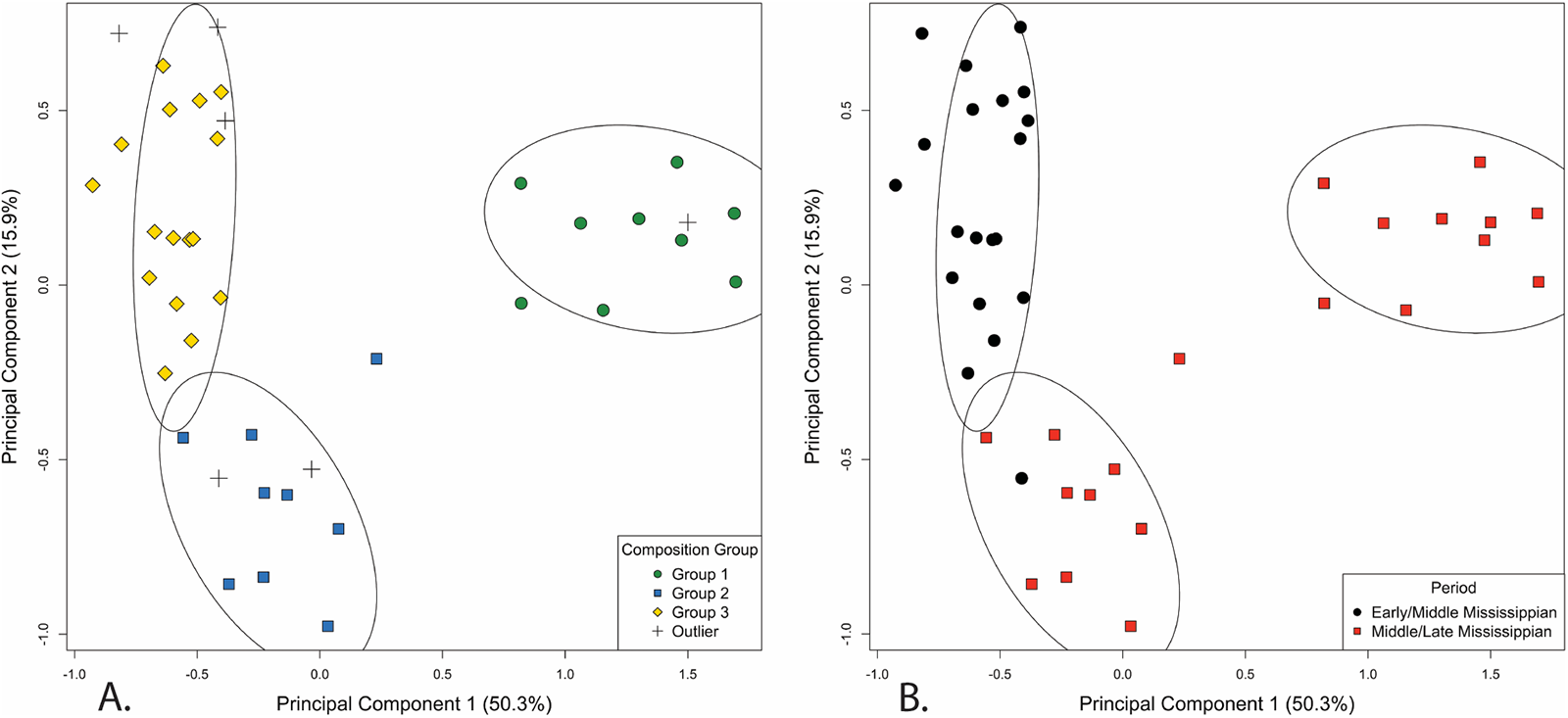
Our notion that emergences qua phase transitions were prompted in large part by population movement at approximately AD 1300 and again in the mid-1400s is supported by other lines of evidence. At Butler Mound, AMS dates indicate that the excavated domestic structures represent two different periods of occupation. Two of the buildings (Structures 2 and 3) date to the 1300s, whereas the other five (Structures 1, 4, 5, 6, and 7) all date to the last half of the 1400s or early 1500s. Furthermore, pottery composition trends attest to the likelihood that there were two chronologically distinct ceramic traditions at Lubbub Creek (Sorresso Reference Sorresso2024). A principal components analysis of paste chemical elements (determined through LA-ICP-MS) displays three compositional groups (Figure 6A). Group 3 includes pottery types from the early/mid-Mississippian period, and Groups 1 and 2 include pottery types from the mid-/late Mississippian period (Figure 6B). Given that similar pottery types are present in the two later groups, we cannot clearly distinguish them chronologically. Groups 2 and 3 are more similar chemically and may represent the continuous use of clay source(s) that were local to the Lubbub Creek site over the course of the Mississippian period. The distinct chemistry of Group 1, which consists of only middle/late Mississippian ceramics, likely reflects the arrival of nonlocal pottery later in the period.
Principal components analysis of chemical elements of early and late Mississippian pottery from Lubbub Creek (ellipses represent 90% confidence level): (A) groups segregated by chemical composition; (B) groups displayed by ceramic chronology. (Color online)

The spatial and material discourse of the earlier shift circa AD 1300 seems to have embodied practices of hierarchy from Moundville—a temporality founded in a dispersal to new locations but anchored, if not firmly, in the memory of the large mound and plaza complexes that once dominated the landscape. The emergence we see seems in large part to be a reemergence, given that migrants attempted to reconstitute lifeways that had structured their lives for generations. The second significant shift was immersed in plurality. Overall, the post–AD 1450 occupations at Lubbub Creek and elsewhere in the region seem to have the character of coalescent communities: settlements characterized by the somewhat rapid aggregation of peoples from multiple localities and the equally rapid transition of lifeways (Kowalewski Reference Kowalewski, Thomas and Ethridge2006). This pattern would become common with the upheaval associated with the colonial period (Beck Reference Beck2013; Ethridge and Shuck-Hall Reference Robbie and Shuck-Hall2009), but it has a deeper history that goes back at least as far as the early Mississippian period with the founding of Cahokia—a tradition also seen in central Alabama (Regnier Reference Regnier2014). It is quite possible that climate change was one of the variables (if not the only one) contributing to these dislocations and relocations, given that mid-fifteenth-century regional abandonments related to multidecadal droughts have been documented in various regions in the lower Midwest and Southeast (Cable Reference Cable2020; Cobb and Butler Reference Cobb and Butler2002; Krus and Cobb Reference Krus and Cobb2018; Meeks and Anderson Reference Meeks, Anderson, John and Hayes2013; Williams Reference Williams, David and Cox1990, Reference Williams, Brose, Cowan and Mainfort2001). The emerging coalescent temporality of the later Mississippian era seems to have involved discarding many elements of the memorialization of hierarchy associated with the earlier period, emphasizing instead the aggregation and accommodation among peoples from varied directions.
Our notion of ontological transformations perhaps aligns most closely with what Cipolla (Reference Cipolla2019) describes as a focus on non-Western worldviews, attempting to discern the reality of groups through established anthropological approaches. This emphasis—at least in our handling—perhaps suffers from relying on broad generalizations about Indigenous notions of temporality and landscape. But its longitudinal perspective does confer the advantage of addressing emergent change over time compared to the synchronic emphasis that seems to characterize many ontological and relational studies. Although we have cast the differences in little bangs as nominally about remembrance of hierarchy versus coalescence, they were much more than that, and the contrasts merit further exploration in future research. At the very least, we need to consider that peoples aggregating from different directions on the compass would have contributed in distinct ways to emergences and, likewise, may have experienced those emergences in variable ways.
If we are searching for further nuance on these emergences in a relational sense, perhaps they should not be viewed as distributed agency—which seems to imply something that is parceled out—but instead as collaborative agency absorbed in gathering practices. In the Tombigbee drainage, these practices invoked peoples, things, spaces, and places as migration prompted new renderings of locality, where place—and movement across space—was “the originary and continual manifestation of being, of knowing, of meaning” (Burkhart Reference Burkhart2019:xvii).
Conclusion
As is well known, significant theoretical advances in any type of research oftentimes are a product of new methodologies. Thanks to AMS dating and Bayesian modeling, the discipline of archaeology is now at a point where we can rely on increasingly refined chronologies to describe and explore with ever greater confidence some of the causes underlying the undulations and oscillations of Mississippian communities. The mechanical addition of large numbers of radiocarbon dates in and of itself, however, will not necessarily provide insights into the sensory dimensions of temporality and emergence in the absence of a theoretical framework. At the same time, sophisticated musings on emergence and becoming will remain proverbial castles in the air if they lack a robust foundation in case studies. As Robb (Reference Robb2015) maintains, we must strive to engage both method and theory as a single enterprise.
Southeastern archaeologists frequently rely on the notion of Mississippianization to characterize the rapid spread beginning in the eleventh century AD of such traits as mound-plaza complexes, maize agriculture, wall-trench houses, and ranked sociopolitical systems. From this perspective, we perhaps share a worldview with archaeologists elsewhere who describe radiating waves of migration and influence with such concepts as Neolithization (e.g., Séfériadès Reference Séfériadès2007; Thomas Reference Thomas2013:101–128). In reality, though, the process of Mississippianization continued unfolding—or emerging—irregularly for another five to six centuries as migration, trade, conflict, and other processes led localities to continually reinvent themselves. One of the major challenges in addressing Mississippian emergence(s) as opposed to Emergent Mississippian (a once popular term now largely discarded because of its teleological implications) is accounting for how veneers of broad similarity were promoted by various forms of interactions that quite frequently involved migration while simultaneously being remodeled locally in unique ways. As we advance toward resolving these scalar issues, Mississippian regional phenomena begin to look more and more like genres rather than complexes, phases, or stages. In other words, they seem to have an ever-changing compositional character drawn from the intersection of multilayered histories and conceptions of time.
Acknowledgments
We extend our thanks to the numerous institutions, organizations, and people—especially landowners—that have made this work possible. The fieldwork has involved a collaborative effort initiated by the Chickasaw Nation, and it continues to support our work through the Chickasaw Explorers Program. In addition to the Chickasaw Nation, our respective institutions—the Florida Museum of Natural History, the University of South Dakota, and Mississippi State University—have also lent backing in various ways. We are also grateful to the three external reviewers for their thoughtful critiques and suggestions.
Funding Statement
This work was supported by the National Science Foundation (grant BCS-1916596), the National Geographic Society (grant no. 9831-16), and the Chickasaw Nation.
Data Availability Statement
The data and coding used to support the analyses are available in the supplemental material.
Competing Interests
The authors declare none.
Supplementary Material
The supplementary material for this article can be found at https://doi.org/10.1017/aaq.2025.27.
Supplementary material 1. Bayesian chronological methodology and model descriptions (text).
Supplementary material 2. OxCal code (text).
Supplementary material 3. Radiocarbon dates (table).
Supplementary material 4. Posterior probabilities from the Bayesian models for start and end dates of key sites and features (table).
Supplementary material 5. Posterior probabilities from the Bayesian models for the estimated spans for Mississippian sites and mound use (table).




 Open access

