

Introduction
Screening tools that predict adverse health outcomes are helpful in making decisions regarding care plans and in better predicting a patient’s trajectory. For geriatric medicine outpatient services, which have limited capacity in Canada (Heckman, Molnar, & Lee, Reference Heckman, Molnar and Lee2013), tools applied at the point of care can provide valuable prognostic information for practitioners.
Most patients referred to a geriatric clinic have already experienced a decline in mobility and/or cognition and may have early or advanced degrees of frailty. A better understanding of physical and functional performance can guide interventions and referrals that target maintenance or improvement of functional activities. This may be a particularly important goal for community-dwelling seniors who wish to remain independent. In addition to questionnaires related to activities of daily living (ADL) and instrumental activities of daily living (IADL), functional evaluation can be characterized via objective physical performance measures (Guralnik, Ferrucci, Simonsick, Salive, & Wallace, Reference Guralnik, Ferrucci, Simonsick, Salive and Wallace1995).
The short performance physical battery (SPPB) is an objective physical performance measure focused on lower extremities physical function and measures balance, strength, and coordination (Guralnik et al., Reference Guralnik, Simonsick, Ferrucci, Glynn, Berkman, Blazer and Wallace1994) which are important contributors to mobility and independence (Guralnik et al., Reference Guralnik, Simonsick, Ferrucci, Glynn, Berkman, Blazer and Wallace1994). The SPPB has been well validated in higher functioning community-dwelling cohorts of older adults and is predictive of falls (Veronese et al., Reference Veronese, Bolzetta, Toffanello, Zambon, De Rui, Perissinotto and Manzato2014), subsequent disability (Guralnik et al., Reference Guralnik, Ferrucci, Simonsick, Salive and Wallace1995), ADL difficulty (Guralnik et al., Reference Guralnik, Simonsick, Ferrucci, Glynn, Berkman, Blazer and Wallace1994), and death (Guralnik et al., Reference Guralnik, Ferrucci, Simonsick, Salive and Wallace1995; Perera, Mody, Woodman, & Studenski, Reference Perera, Mody, Woodman and Studenski2006). It has been less widely examined as a prognostic tool in frailer patients referred for geriatric consultation. In this already at-risk cohort of older adults, whether the SPPB provides additional prognostic information needs further consideration. Thus, the objective of this study was to examine the association of the SPPB and one-year emergency department (ED) visits and hospitalizations in geriatric medicine outpatients.
Materials and Methods
We performed a prospective, one-year study of new referrals attending an outpatient geriatric clinic in Hamilton, Ontario. Participants were referred to the geriatrician for a variety of issues including falls, cognitive impairment, and need for a medication review. The only exclusions criteria for enrolling in the study were non-English speaking with no translator or being deemed not suitable for participation by the clinical staff due to severe cognitive impairment or agitation.
During the routine clinic appointment, a research assistant obtained informed consent and administered the SPPB. This performance-based tool is a continuous measure with scores ranging from 0–12. From previous validation (Bandinelli et al., Reference Bandinelli, Lauretani, Boscherini, Gandi, Pozzi, Corsi and Ferrucci2006; Subra et al., Reference Subra, Gillette-Guyonnet, Cesari, Oustric, Vellas and Platform2012), scores of 0–4, 5–8, and 9–12 indicate poor, intermediate, and good lower extremities function respectively. The research assistant also administered the Fried frailty phenotype tool (energy, physical activity, body mass, strength, and walking speed) (Fried et al., Reference Fried, Tangen, Walston, Newman, Hirsch and Gottdiener2001). The clinic staff routinely administers and collects the Timed Up and Go (TUG) Test, Lawton Instrumental Activities of Daily Living (IADL), Mini-Mental State Examination (MMSE), co-morbidities, height and weight, demographic information, and a full medication list.
The primary outcomes, ED visits, and hospitalizations within one year of the baseline assessment were abstracted from the hospital’s electronic records of residents of Hamilton and South Central Ontario, Canada.
Univariable analyses were based on non-missing observations for each variable to select significant confounders for the multivariable analysis. We used multiple logistic regression analyses to examine the relationship between SPPB and (a) ED visits (yes/no) and (b) hospitalizations (yes/no) over a one-year period. Co-variates included age, sex, Fried frailty phenotype, Lawton IADL, TUG, number of medications, MMSE, and number of co-morbidities. No significant collinearity was found in the full model tested by variance inflation factor (VIF) (VIF < 2). Odds ratios and 95 per cent confidence intervals were calculated. The Hamilton Health Sciences/McMaster University Faculty of Health Sciences Research Ethics Board approved this study (File #: 13-344).
Results
Overall, we approached 191 patients to participate in the study. Of those patients, 36 were not interested, 35 were excluded, and 120 were included in the study. Reasons for exclusion were being not suitable for participation or unable to provide consent (n = 28) and not speaking English/no translator (n = 7). In this cohort (mean age 80.6, SD 6.3 years; 53.3% women), over 90 per cent were pre-frail or frail, and 40 per cent, 28 per cent, and 32 per cent had good, intermediate, and poor lower extremities function respectively. There were no deaths or loss of follow-up at one year. Reasons for ED visits (n = 54) included infection, surgery, neurological complaints, musculoskeletal complaints, cardiac problems, diabetic hyperglycemia, and others. Reasons for hospitalizations (n = 42) included infection, surgery, cardiac complications, falls, fractures, diabetic complications, and others. Descriptive characteristics are presented in Table 1.
Baseline characteristics of included participants
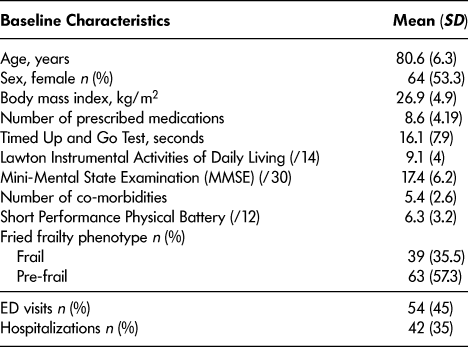
Note. Data are expressed as mean (standard deviation), unless otherwise specified.
Univariable Analyses
The results of univariable analyses are provided in Table 2. SPPB was associated with both ED visits and hospitalizations. The Fried frailty phenotype was associated with hospitalization only.
Summary of univariable analysis and final model for hospitalization and Emergency Department (ED) visit prediction
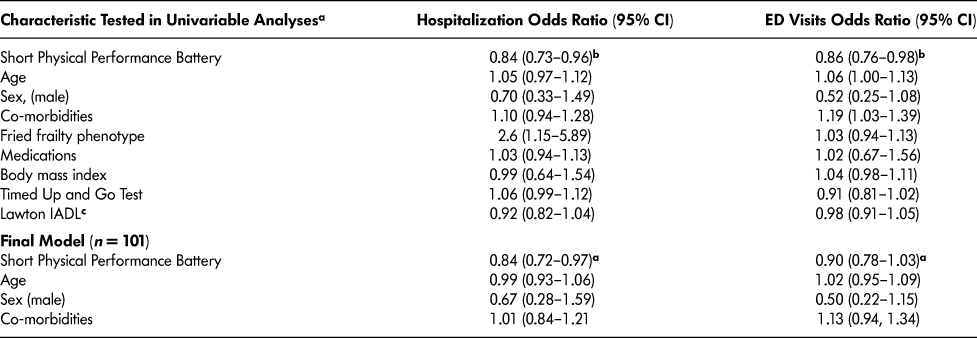
Note. a Variables were included in the model as continuous variables except sex, which was included as a categorical variable; b = significant difference (p < .05); c Lawton Instrumental Activities of Daily Living.
Multivariable Analyses
Age, sex, co-morbidities, and all the variables significantly associated with ED visits and hospitalizations in univariable regression analysis were included in the multivariable analysis. Although we evaluated Fried frailty phenotype in the multivariable analysis, we did not retain it in the final model because Fried frailty phenotype and SPPB have similar components (such as a walk test). Age, sex, and co-morbidities were retained in the final model as they are important confounders of physical performance, hospitalizations, and ED visits (Alexandre et al., Reference Alexandre, Corona, Brito, Santos, Duarte and Lebrao2018; Mondor et al., Reference Mondor, Maxwell, Hogan, Bronskill, Gruneir, Lane and Wodchis2017). Using non-missing observations (n = 101), age-, sex-, and co-morbidities–adjusted SPPB showed a higher predictive ability and were included as the final model to predict ED visits and hospitalizations (Table 2). Per 1-point increase in SPPB, the odds of hospitalization and ED visits decreased by 16 per cent and 10 per cent respectively.
Discussion
In this study population, the SPPB was associated with ED visits and hospitalizations. However, other frailty and functional performance measures such as Fried frailty phenotype, Lawton IADL, and TUG were not associated with ED visits and hospitalizations.
In Canada, there are limited resources for geriatric care with long wait lists to be seen by a geriatrician due to a geriatrician shortage (Heckman et al., Reference Heckman, Molnar and Lee2013). This critical shortage and long wait lists will be escalating as a result of the increasing number of Canadian older adults and limited number of certified specialists in geriatric medicine (only 242 geriatricians) (Hogan et al., Reference Hogan, Borrie, Basran, Chung, Jarrett, Morais and Woolmore-Goodwin2012). A tool that identifies those at risk of ED visits, hospitalizations, and other unfavourable health outcomes may save geriatricians’ time by allowing them to identify and support patients at risk using tailored interventions (including care plans and other referrals) (Bandinelli et al., Reference Bandinelli, Lauretani, Boscherini, Gandi, Pozzi, Corsi and Ferrucci2006). For example, SPPB could be used to triage patients so that only patients at risk of ED visits and hospitalization would be seen and followed up closely by geriatricians.
A recent randomized, controlled trial showed that a multicomponent intervention is effective in improving lower extremities function of older adults measured by SPPB (Cameron et al., Reference Cameron, Fairhall, Langron, Lockwood, Monaghan, Aggar and Kurrle2013). Improving lower extremities function (measured by SPPB scores) by 1 or 2 points results in clinically meaningful changes in the risk of disability and death among older adults (Guralnik et al., Reference Guralnik, Ferrucci, Simonsick, Salive and Wallace1995; Perera et al., Reference Perera, Mody, Woodman and Studenski2006). Therefore, tracking lower extremities function of older adults visiting geriatric clinics using the predictive value of SPPB could optimize geriatric care and identify older adults who need interventions to enhance their function and independence.
This is the first Canadian study to show the predictive value of the SPPB in a population with an already high degree of frailty and mobility impairments. This pragmatic study had minimal exclusion criteria to increase the generalizability of our results to people visiting specialist geriatric clinics. We used hospital administrative data to collect ED visits and hospitalizations to avoid any recall bias. The limitations of this study included (a) having a small sample size; (b) missing data of some baseline variables such as Lawton IADL and TUG; and (c) the clinical staff’s excluding participants if they could not implement the study measurements due to agitation or severe cognitive impairment. This latter exclusion criterion needed clinical judgment, which may not have been consistent across the clinical staff. Although it is unlikely, the included participants might have visited another ED that is not captured in our hospital record, which may underestimate the ED visit number in this study. Future studies should consider SPPB responsiveness to change, particularly in response to interventions to reduce frailty and improve lower extremities function.
Conclusion
In older adults with an already high degree of frailty and impairment, age-, sex-, and co-morbidities–adjusted SPPB provided additional prognostic information regarding ED visits and hospitalizations. Further studies are required to develop and validate a predictive model for ED visits and hospitalization using SPPB scores.



