




Introduction
Transculturality challenges the stability of cultural boundaries. Pennycook (Reference Pennycook2007a:92) writes, transcultural processes have brought us ‘beyond questions of ownership and origins’. While cultural practices have arguably been in flow throughout history, it is developments under colonialism and globalisation that brought the contacts between cultures under critical attention. Existing literature has offered rich evidence on the hybridisation of cultures, as well as cultural practices crossing between established geographical, social, and political boundaries (Ortiz Reference Ortiz1947; Higgins Reference Higgins2009; Li Wei & Zhu Reference Wei and Zhu2021; Borba, Fabrício, & Lima Reference Borba, Fabrício; and Lima2022; Arnold Reference Arnold2024). Transculturality crosses established boundaries and further creates new cultures. Pennycook (Reference Pennycook2007a:47) writes, transcultural practices ‘select, appropriate, refashion and return new cultural and linguistic forms’. New cultures are not formed in random collections but in regulated arrangements of selected cultural elements. However, this regulative dimension of transcultural processes has remained scarcely explored in the literature.
Recent sociolinguistic research has witnessed increasing caution against the view of transculturality as confined to practices in between named cultures (Hawkins & Mori Reference Hawkins and Mori2018; Liu Reference Liu2023). For this renders the transcultural parasitic to the established cultural boundaries and prevents us from conceiving transculturality in its own terms. As a remedy, Baker (Reference Baker2022) proposes to conceptualise transculturality as the dialogic transgression and creation of cultural territories. Echoing this dialogic view, Singh (Reference Singh2022:259) argues that transculturality is realised in interactions between ‘a dynamic practice and a reified culture’. Building on these insights, we explore the regulated production of transcultural spaces through the following Chinese New Year (CNY) installation at a Hong Kong shopping mall (‘the mall’ hereafter; see Figure 1).
It was two weeks from the beginning of Chinese New Year in Hong Kong. I was on my way to a pre-New Year family dinner gathering at New Town Plaza, a shopping mall located in the buzzing area of Shatin. As I entered the mall, my attention was caught by an orchard of artificial trees full of fake cherry blossoms (sakura) in the atrium. Surrounded by the pink blossoms was, on one side, a magenta train carriage, and on the other side, a chain of red arches resembling torii gates seen at Shinto shrines in Japan. As I gazed down from the ascending escalator, a collage of Shinto emblems and other Japanese cultural artifacts emerged into view: the pink blossoms, the magenta cart, the red torii gates, a giant cherry sculpture, a wall of golden pinwheels, red and purple stalls, a sakura floor pattern … (Jasper Wu, fieldnotes, 22 January 2019)
CNY installation at New Town Plaza.Footnote 1

The installation caught the attention of Jasper Wu (a post-nineties Chinese born and bred in Hong Kong) and Andre Theng (a Singaporean pursuing postgraduate studies in Hong Kong at the time of the project) as a creative combination of traditional Chinese practices and Japanese cultural emblems with traces of a touristic gaze. Discussions with Mie Hiramoto (a Japanese from the postwar generation) brought further attention to the wartime symbolisms of Imperial Japan associated with the Japanese-Shinto emblems. This offers a view into tensions between transcultural flows and historical memories entangled in the installation.
This article focuses on the relation between transcultural processes and historical boundaries. Drawing on the concept of assemblage (Deleuze & Guattari Reference Deleuze and Guattari1980/2013), we offer a perspective into the selection and organisation of semiotic elements producing the CNY installation. This transcultural assemblage creates three affective regimes (Wee & Goh Reference Wee and Goh2020): New Year festivity, simulated tourisms, and partial historicity. We argue that these affective regimes are regulated in a dual process of erasure (Gal & Irvine Reference Gal and Irvine2019; the selective blockage of competing lineages of rituals, traditions, and spaces) and forgetting (Deleuze Reference Deleuze1968/2014; the process evoking creative re-organisation of semiotic boundaries between cultural elements selected into the transcultural assemblage). The case sheds light on the regulative dimension of transculturality, which complements the dialogic transgression and creation of cultural territories.
The following begins by contextualising cultural contacts between Hong Kong and Japan in recent history (see the section Histories of Hong Kong-Japan). We then introduce our conceptual framework of assemblage, affective regime, and erasure-and-forgetting (see Transculturality as assemblage). This is followed by our analysis of the transcultural CNY installation produced in the regimes of festivity, tourism, and historicity (see Regimes of transcultural assemblage). The article closes with a discussion on the theoretical and empirical implications of thinking about transculturality through assemblage, affective regimes and the dual process of erasure-and-forgetting (see Concluding remarks).
Histories of Hong Kong-Japan: Wartime occupation and postwar contacts
Cultural contact between Hong Kong and Japan offers a productive example of tensions between historical memories and transcultural processes for two reasons. First, it presents an alternative case of transculturality inflicted not by Anglo-European colonialism but wartime Asian imperialism and postwar globalisation. Second, the interaction between histories of Japanese occupation and postwar transcultural consumption remains a topic under-explored in the field. The relatively minimal conflict between these developments in Hong Kong presents a salient case in post-colonial histories (see Chan Reference Chan2000).
Wartime Japanese occupation
The Imperial Japanese occupation of Hong Kong happened during WWII between 25 December 1941 and 25 August 1945. Compared to the substantive research on Anglo-European colonialism, the wartime imperialist expansion of Japan is less discussed in the sociolinguistic literature. Through a critical analysis of official school songbooks used between the early 1880s and the end of WWII in 1945, van der Does-Ishikawa (Reference van der Does-Ishikawa2013) points to semiotic links between Shintoism and Japanese imperialism during the wartime period. Research in cultural studies and anthropology has also shown the semiotic entanglement formed particularly in the deification of the Japanese emperor, militarisation of Shintoism and glorification of soldiers in death (Ohnuki-Tierney Reference Ohnuki-Tierney2002; Shimizu Reference Shimizu2023; see the section Partial historicity for elaboration). Another sociolinguistic study presents the conflicting narratives of the wartime period curated in history textbooks used in Hong Kong and Japan (Akashi Reference Akashi2017). Sparse mention is also made of the language policy implemented by the Japanese imperial government during the period of occupation (Sweeting Reference Sweeting2004). This existing body of literature shows a particular focus on the Japanese imperial influences within the pedagogic domain—in both Hong Kong and Japan.
Beyond education, the linguistic landscape of Hong Kong was temporarily overwritten by imperial Japanese references. For instance, Queen's Road became Meiji Road, and the Peninsula Hotel became the Tōa Hotel (‘East-Asian Hotel’). And the atrocities committed during the occupation period created traumatic memories for the generation: ‘at least ten thousand Hong Kong civilians were executed, while many others were tortured, raped, or mutilated’ (Carroll Reference Carroll2007:123). Repulsion against the brutality of Japanese imperial rule is found not only in the postwar contestations over the content in history textbooks. The repulsion is also reflected by the ongoing popularity in Hong Kong of anti-Japanese movies such as Fist of Fury (1972), Fearless (2006), Ip Man (2008) and Legend of the Fist (2010). Despite this contentious historical contact, Japanese cultural products are infused into the cultural life of present-day Hong Kong.
Postwar cultural consumption
As Bridges (Reference Bridges2003:1054–55) notes, ‘the Japanese “presence” in Hong Kong is clearly apparent’. Postwar Japan experienced rapid economic recovery and development. Hong Kong served as ‘a regional base for expanding and integrating’ the Japanese cultural industry into neighbouring regions (Otmazgin Reference Otmazgin2014:324). Popularity of Japanese popular culture, tourism, and other cultural products has grown rapidly in the city since the 1970s.
Sociolinguistic research presents sustaining interest among students in learning Japanese as a foreign language, driven primarily by their fondness towards Japanese popular culture (Humphreys & Miyazoe-Wong Reference Humphreys and Miyazoe-Wong2007). Research in anthropology and cultural studies points to the proliferation of Japanese corporations (Chan Reference Chan2000), popularity of Japanese brands (especially electronic appliances; Nakano Reference Nakano2009), and the wide consumption of popular culture (serial dramas, see Nakano Reference Nakano2002; manga, see Lai & Wong Reference Lai, Heung, Wong, Befu and Guichard-Anguis2001; pop music, see Ogawa Reference Ogawa, Befu and Guichard-Anguis2001) in the city. This is further accompanied by an enthusiasm for Japanese tourism (over 1.5 million Japan-bound Hong Kong travelers in 2015; JTB Tourism Research & Consulting Co. 2020). In local media, Japan is even metaphorically referred to by some Hongkongers as their 鄉下 ‘hometown’ (e.g. 卡夫卡 ‘Kafka’ 2023).
Historian Ernest Renan (Reference Renan and Giglioli1882/2018:251) wrote, ‘[t]he act of forgetting, … is an essential factor in the creation of a nation’. Arguably, transculturality under globalisation relies on similar semiotic processes of forgetting wars, conflicts, and brutalities of the past. This is not necessarily a criticism. Japanese culture is popularised in Hong Kong as a result of globalisation instead of an effect of wartime occupation (Chan Reference Chan2000). However, it is also undeniable that there are on-going sociopolitical tensions over the wartime histories, as shown in conflicts over narratives in history textbooks. The re-drawn historical boundaries point to the need to examine closely the selective and regulative function of ‘forgetting’ in transcultural processes. Next, we outline our framework for conceptualising transculturality as assemblage (Deleuze & Guattari Reference Deleuze and Guattari1980/2013) creating affective regimes (Wee & Goh Reference Wee and Goh2020) regulated by processes of erasure (Gal & Irvine Reference Gal and Irvine2019) and forgetting (Deleuze Reference Deleuze1968/2014).
Transculturality as assemblage: Affective regime and erasure/forgetting
Transculturality as assemblage
Transcultural spaces emerge from ‘the dynamics of flows, fixity and fluidity as cultural practices become embedded in different contexts’ (Pennycook Reference Pennycook2007a:122). Developed by Deleuze & Guattari (Reference Deleuze and Guattari1980/2013), the concept of assemblage explicates tensions between fixity and fluidity in semiotic processes. One initial adaptation in sociolinguistics is Pennycook & Otsuji's (Reference Pennycook and Otsuji2017) notion of ‘semiotic assemblage’, exploring through neo-materialism (e.g. DeLanda Reference DeLanda2006; Bennett Reference Bennett2010) interactions between the material and discursive, and between human and non-human actors. Pietikäinen (Reference Pietikäinen2021) shows through a Foucauldian lens (Foucault Reference Deleuze1975/1977) the function of discourse in regulating elements in an assemblage. Wee (Reference Wee2021) demonstrates the value of assemblage in presenting boundaries as binding but also contested. As Gurney & Demuro (Reference Gurney and Demuro2019) suggest, assemblage offers an ontological framework that challenges presumed binaries (e.g. material/discursive, human/non-human) and presents the flows, fixity, and fluidity in semiotic orders.
Assemblage highlights the regulative capacity of transculturality in bringing otherwise free-flowing cultural elements to accomplish ‘conjoined goals’ (Pietikäinen Reference Pietikäinen2022:556). An assemblage is comprised of two orders in interaction. On the one hand, there is a material order ‘of bodies, of actions and passions, an intermingling of bodies reacting to one another’; on the other hand, this is articulated with a discursive organisation ‘of acts and statements, of incorporeal transformations attributed to bodies’ (Deleuze & Guattari Reference Deleuze and Guattari1980/2013:102–103). Thinking transculturality through assemblage allows a perspective into the regulation of cultural flows in two processes: the re-calibration of their material arrangements on one hand, and the re-configuration of their discursive organisation on the other. Transcultural territories are formed in a mutual capturing between a material order and an organisation of discourse.
Singh (Reference Singh2022:142) offers an example from transcultural Hip Hop music. English and Punjabi transform into ‘the same thing’ under a discourse of translingualism. The connection between Punjabi and Urdu is transformed under a discourse of love into an index of solidarity between India and Pakistan—two nations that are otherwise in conflict (Singh Reference Singh2022:144). The transcultural piece is produced from a mutual capturing between the material arrangement of linguistic elements and specific discursive organisations. The CNY installation emerges from interactions between material arrangements (e.g. ema tablets and inscribed wishes, torii gates and photo-taking) and the discursive organisation of these material orders (e.g. in festivity, tourism, and historicity). Assemblage provides a heuristic framework for mapping the regulative dimension of transculturality without undermining the fluid dialogic production of transcultural territories.
Pietikäinen (Reference Pietikäinen2021:236) writes, ‘a productive assemblage produces new means of expression, spatial and temporal organisations, and behaviours’. Transculturality is not solely the breaking of boundaries or the unilateral integration of foreign elements into local use (Pennycook Reference Pennycook2007a:111–12). Assemblage offers an alternative view through ‘de-territorialisation’ and ‘re-territorialisation’. De-territorialisation is the process in which semiotic elements break away from their original systems. However, ‘one never deterritorializes alone; there are always at least two terms’ (Deleuze & Guattari Reference Deleuze and Guattari1980/2013:204). Re-territorialisation is the process in which elements losing their former territories conjoin in forming new territories; thus, ‘reterritorialization must not be confused with a return to a primitive or older territoriality’ (Deleuze & Guattari Reference Deleuze and Guattari1980/2013:204). Furthermore, ‘the territorial assemblage implies a decoding and is inseparable from its own deterritorialization’ (Deleuze & Guattari Reference Deleuze and Guattari1980/2013:391). Territories produced in assemblage are defined but not closed.
To draw again upon Singh (Reference Singh2022), the transcultural piece is not produced from just the de-territorialisation of English, Punjabi, or Urdu from their conventional use contexts; nor is it produced from the unilateral introduction of elements from one language into an established arrangement (e.g. putting English elements into a Punjabi arrangement). Rather, it is the coming together of elements from English, Punjabi, and Urdu; it is the re-localisation of these elements into the transcultural piece (Pennycook Reference Pennycook2007a). Furthermore, the territories shift: a translingual assemblage of English-Punjabi can transform into an assemblage of love in the encounter with Urdu. In the CNY installation, the initial contact between Japanese ema tablets (a wooden tablet used in Shinto rituals; see Figure 3) and Chinese conventional wish-phrases creates a new practice of New Year wish-making. This further transforms into territories of festivity (see New Year festivity), tourism (see Simulated tourism), and historicity (see Partial historicity). But what kind of regulative order is produced, and how are elements selected and regulated? We turn to the concepts of affective regime (Wee & Goh Reference Wee and Goh2020), and the dual process of erasure (Gal & Irvine Reference Gal and Irvine2019) and forgetting (Deleuze Reference Deleuze1968/2014).
Affective regime
Material and discursive elements in an assemblage interact in affective relations (Pietikäinen Reference Pietikäinen2021:239). Affect is the capacity to bring impact and be impacted. Affect evokes emotions, but it is more fundamentally about motivating particular senses and actions. As Milani (Reference Milani, Handler, Kaindl and Wochele2017:249) writes, affect produces ‘not cognitive states lodged somewhere in people's minds or body, but social forces that are produced, circulate and ignite social action’. While emotion such as happiness and anger are feelings possessed by the individual, affect motivates a range of senses and actions such as respect and vigilance that are not conventionally understood as emotions (Wee Reference Wee2016; Tse, Wu, & Theng Reference Tse, Wu and Theng2023). Affect as social force is regulative: ‘a moment of recruitment, articulation or enlistment when many complicated flows across bodies, subjectivities, relations, histories and contexts entangle’ (Wetherell Reference Wetherell2015:160). This regulative capacity is realised in affective regimes.
Affective regimes are sets of conditions ‘that govern with varying degrees of hegemonic status the ways in which particular kinds of affect can be appropriately materialised in the context of a given site’ (Wee Reference Wee2016:109). Interactions between material orders and discursive organisations—that is, interactions in an assemblage—create territories that regulate the appropriate senses and actions within the site occupied by the assemblage. Wee (Reference Wee2016), for instance, studies the Arlington National Cemetery: ‘a sense of somber remembrance and appreciation’ is evoked by the material order of ‘austere and well-maintained headstones surrounded by well-tended greenery’ organised under the institutional discourses of visitor's rules and the military legal institution. In the CNY installation, affective regimes emerge from interactions between the cultural emblems, mall visitors, social media blog posts, and the mall's official framing of the event. We identify three regimes in the analysis: the regime of New Year festivity (transforming established rituals), the regime of simulated tourism (redefining the cultural value of Chinese New Year), and the regime of partial historicity (regulating the historical narrative of the CNY installation). Affective regimes foster behavioral consistency within the transcultural territories.
However, affective regimes are not deterministic and do not function in isolation. As Wee & Goh (Reference Wee and Goh2020:21) note, differing senses and actions might be ‘motivated by differences in culture, politics, economics, and other factors’. For instance, mall visitors might bring with them different cultural interpretations of the CNY installation, such as Chinese conventions, Japanese practices, and creative mixing. Wee (Reference Wee2016:123) further notes that affective regimes are created on different scales, ranging from one particular site of interaction to an entire city (see further examples in Motschenbacher Reference Motschenbacher2023; Volvach Reference Volvach2023). However, as cultural elements re-territorialise in the CNY installation, they also re-localise different scales of interpretation into the transcultural territories. Across the three affective regimes, transculturality shifts from the site of immediate encounter (New Year festivity) to a space across Hong Kong and Japan (simulated tourism), and to a temporality across the wartime past and the globalising present (partial historicity). ‘Affective regime’ specifies the regulative effects of an assemblage. The regulative processes are elaborated below through ‘erasure’ and ‘forgetting’.
Erasure and forgetting
Cultural elements are selected and organised in the transcultural assemblage. Arrangements of these material and discursive elements constitute affective regimes fostering particular senses and actions in the resultant transcultural territories. Pennycook (Reference Pennycook2012) argues for a view in which transcultural developments are not the ‘unexpected’ exception but an inseparable part of historical processes. Particular elements are blocked in the process of re-territorialisation, while elements selected into the assemblage are transformed. A fluid consistency of the transcultural space is maintained in this dual process of erasure—selective blockage—and forgetting—the evocation of creative transformation.
Erasure is the process of blockage and exclusion. Gal & Irvine (Reference Gal and Irvine2019:20) write, erasure is the semiotic process ‘through which some phenomena (linguistic forms, or types of persons, or activities) are rendered invisible. Whatever is inconsistent with the ideologised schema either goes unnoticed or is explained away’. This is invoked to suppress information that might potentially disrupt the established schema in ideological oppositions (e.g. East vs. West; Gal & Irvine Reference Gal and Irvine2019:124). Erasure is also enacted in maintaining the semiotic coherence within particular territories. For instance, Karlander (Reference Karlander2019) presents tensions in the regulation of urban landscapes, where graffiti is conceived by authorities as disruptive and needs to be erased from the urban space. In the CNY installation, erasure is not necessarily motivated by ideological oppositions or spatial contestations. Particular elements are blocked primarily to avoid the transcultural territories from dissolving back into the established cultural boundaries (e.g. rituals and traditions) and from dismantling in the repulsion between dissonant elements (e.g. historical conflicts). Erasure of the Chinese and Japanese rituals of New Year wish-making (see New Year festivity), the Chinese familial traditions of New Year celebration (see Simulated tourism), and the wartime symbolisms of Imperial Japan (see Partial historicity) maintains an in-principle coherence in the CNY installation.
Forgetting is the process that evokes a creative effect in transforming elements selected into the transcultural space. Deleuze (Reference Deleuze1968/2014:9) writes, ‘it is in repetition and by repetition that Forgetting becomes a positive power’. The process of forgetting allows the creation of new cultural practices by re-arranging the semiotic boundaries of repeated cultural forms or discourses in the transcultural assemblage. Repetition in this sense is not the reproduction of the same but the creative re-arrangement of cultural elements in circulation (Pennycook Reference Pennycook2007b). Creativity in transcultural territories is the production of new cultural practices by re-drawing the historical boundaries between elements selected into the assemblage. Examining sociolinguistic developments in Canada under the globalisation of cultural industries such as tourism, Heller (Reference Heller2011:171) argues that linguistic elements in flow ‘are necessarily bound up in new practices’.
In the CNY installation, the process of forgetting evokes a re-organisation of boundaries between the material and discursive elements entering the transcultural assemblage. These re-organisations create the content within the affective regimes (see Regimes of transcultural assemblage). Re-organising the Japanese ema tablets with different cultural references creates a new practice of New Year wish-making, which constitutes the regime of New Year festivity. Joining Chinese New Year with discourses of blissful romance and Japanese tourism produces a space foreign to both the Chinese and Japanese traditions, creating the regime of simulated tourism. Integrating cultural expressions at the event with the marketing strategies of the mall fosters the postwar practice of globalised cultural consumption, regulating the regime of partial historicity.
In sum, the above approach to transculturality posits that transcultural processes are not only transgressive and creative; rather, this is coupled with a selective and regulative dimension. The concept of assemblage offers a heuristic framework presenting the regulation of transcultural territories by a mutual capturing between material orders and discursive organisations, and the selection of cultural elements through de- and re-territorialisation. The resultant transcultural territories constitute affective regimes regulating the senses and actions within the specific sites of interactions. This offers a perspective into the concrete semiotic effects of transcultural territories. The dual process of erasure and forgetting lies at the core of our approach. Erasure presents the blockage of elements that are potentially in dissonance. Forgetting presents the process evoking creative transformation of elements selected into the assemblage. The dual process of erasure and forgetting presents boundaries of affective regimes as regulated in the blockage of potentially dissonant elements and the creative re-organising of boundaries between elements selected into the assemblage.
Regimes of transcultural assemblage: Festivity, tourism, and historicity
Our data is drawn from a dataset of 176 photos and seventeen videos of CNY installations captured by Jasper Wu across multiple shopping malls since 2019 as part of an on-going project on Chinese-Japanese transcultural contacts in Hong Kong. Supporting data includes social media posts collected from event pages and fieldnotes. We analysed the images and videos qualitatively from a critical historical perspective. Three themes emerged from our cross-referenced sociocultural interpretations: traditional practices, consumption activities, and wartime symbolisms. Guided by an understanding of transculturality and affective regimes as local (Pennycook Reference Pennycook2007a; Wee Reference Wee2016), this article focuses on the CNY installation at New Town Plaza captured in 2019 as an exemplar case instead of drawing scattered examples from multiple sites. Below, we map the three affective regimes—New Year festivity, romantic tourism, and partial historicity—regulated by the dual process of erasure and forgetting in the transcultural assemblage.
New Year festivity
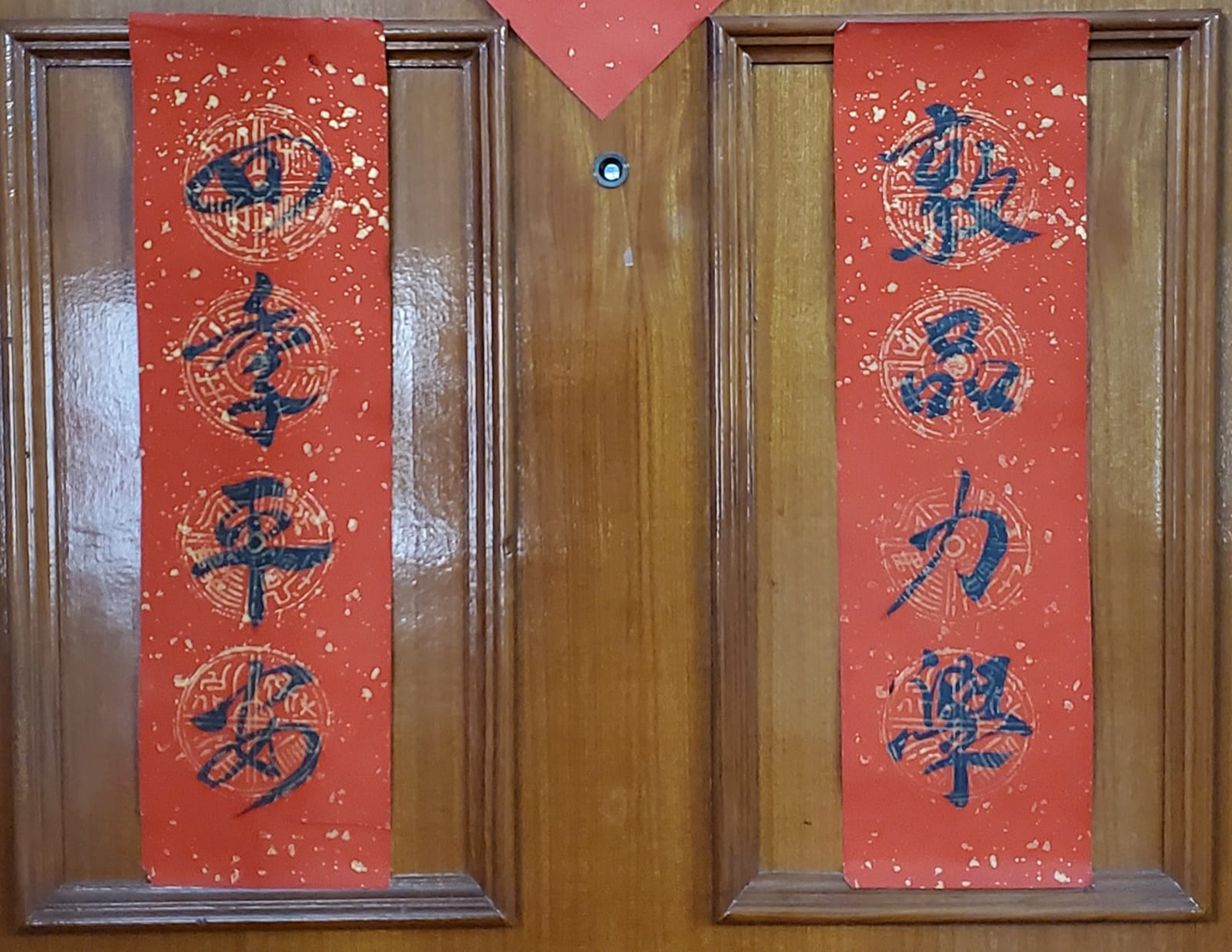
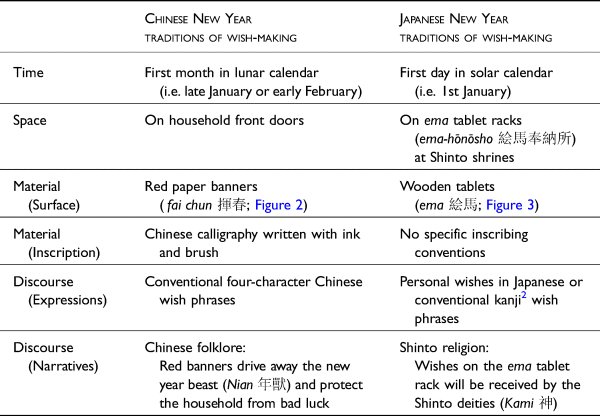
Wish-making is a New Year ritual common in both Chinese and Japanese cultures. Each of the cultures, however, has developed in history a different system for this ritual (Table 1). The practice of wish-making is re-configured in the CNY installation through the blockage of particular elements from the rituals and transforming other elements it selects into the transcultural assemblage. This section presents how this dual process of erasure and forgetting produces a practice of wish-making alternative to established rituals and creates a regime of New Year festivity in the CNY installation.
Comparison: Chinese and Japanese New Year wish-posting conventions/traditions.

Chinese fai chun on household frontdoor.
Japanese ema on ema-hōnōsho at Shinto shrine.Footnote 3
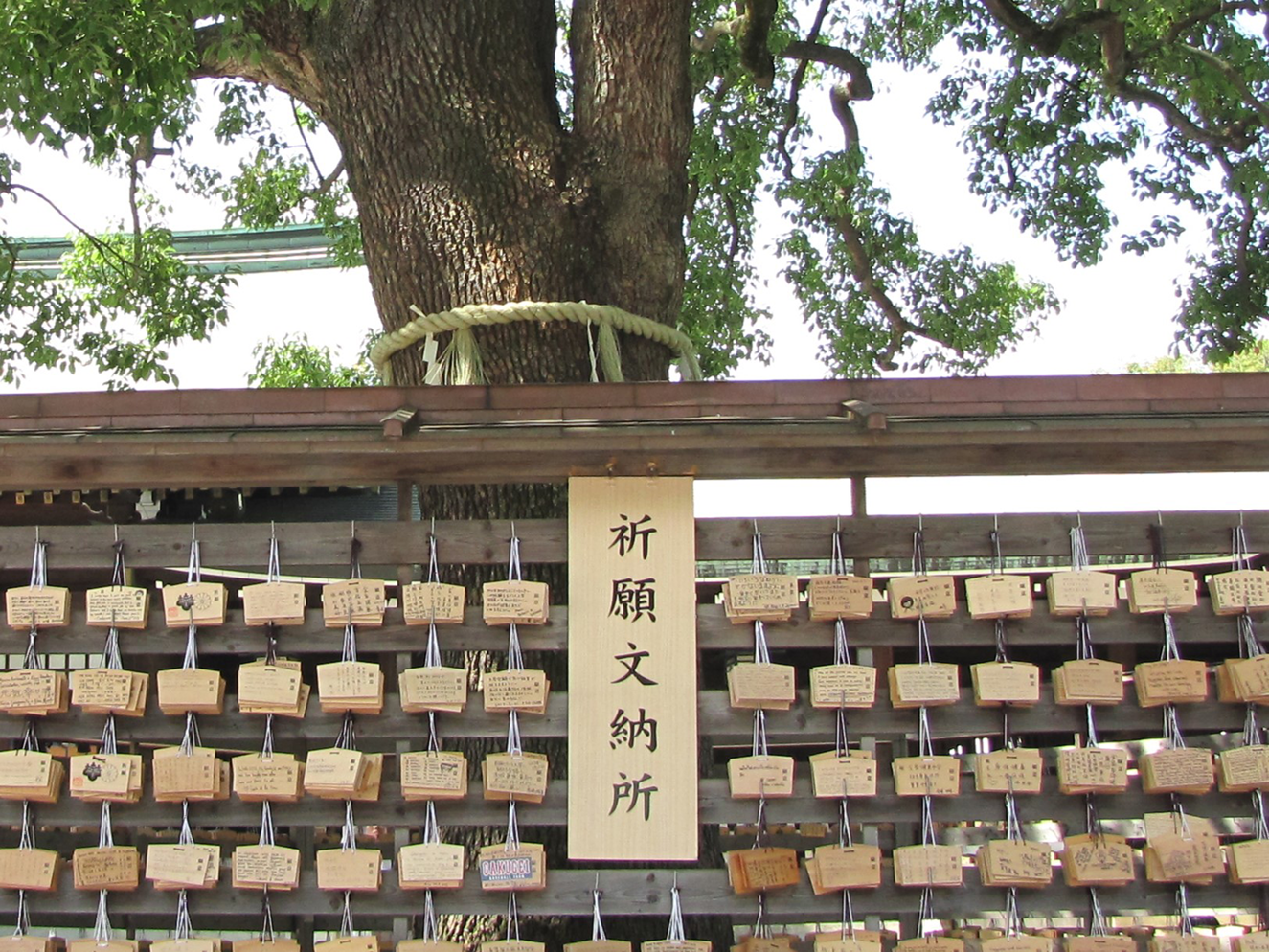
Set in a mall between late January and mid-February, the CNY installation blocks the Japanese timeframe, the Chinese artefact of red paper banners (fai chun), as well as the ritualised spaces of the household and shrines. It is thus also distanced from the historically developed Chinese folklore and Japanese religion—red banners are not posted to scare away the New Year Beast and ema tablets are not offered to the Shinto gods. This is not only to state the fact but also to highlight the spatial, temporal, and material re-configuration in place. It is by this re-configuration that the historical lineage of ritualised practices is erased from the practice of New Year wish-making developed in the CNY installation (Figure 4).
Wishing tablet rack in CNY installation.
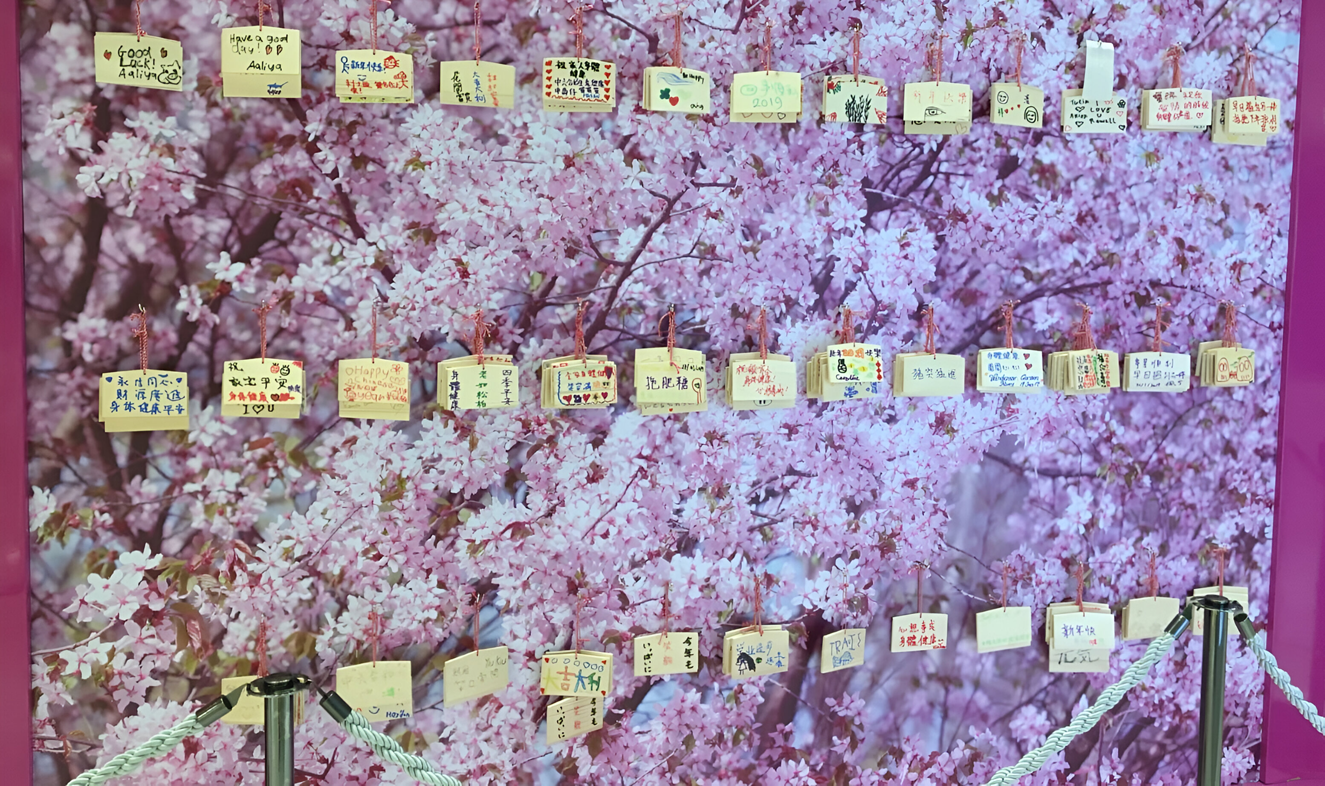
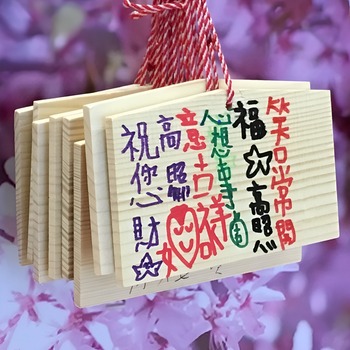
Boundaries between the ema tablets and a diverse range of semiotic resource are forgotten and re-configured in producing the alternative practice of wish-making in the CNY installation. However, forgetting is not amnesia; rather, it is the process evoking creative transformation of elements selected into the assemblage (Deleuze Reference Deleuze1968/2014:185). Conventional Chinese wish-phrases are joined with the ema tablets as a new material context and are intermingled with multimodal elements (Pennycook Reference Pennycook2007a). The wish-phrases are inscribed with graphics and colourful visual elements (Figure 5). For instance, 財星高照 ‘shined upon by the star of wealth’ and 如意古[吉]祥 ‘wishes fulfilled and blissful luck’ are inscribed with replaced (e.g. ⋆ for 星 ‘star’) and restructured (e.g. the insertion of a blissful face into the character 如) characters.
Recalibrated wish-phrases.Footnote 4

Wishes are not expressed only in conventional Chinese wish-phrases. The practice of wish-making is performed with multilingual resources and is oriented not only to typical Chinese aspirations for good fortune. Romance is one of the other prominent themes among wishes made in the CNY installation. For instance, the wish inscribed in Japanese 良縁に恵まれますように ‘[may I be] blessed with a good partner’ expresses a prayer for romance (Figure 6). Its phrasal formulation ますように aligns with ritualised forms in Japanese wish-making. Caught under the discursive frame of blissful romance designed for the installation, this cannot be read simply as a replication of Japanese rituals (see Simulated tourism).
Prayer for romance in Japanese.

The constellation of wishes is further transformed in interdiscursive connections. This goes deep into Chinese cultural history: the expression 執♥子之手 與♥子皆老 ‘to hold ♥ your hand and to grow old ♥ with you’ is a reformulation of a verse in the ancient Chinese classic 詩經 ‘The Book of Songs’ with added heart ideographs (Figure 7). The verse is frequently recited in wedding ceremonies to express vowing love. The Chinese classical verse simultaneously invokes a wish for a stable relationship, and a vow to make this relationship a life-long commitment.
Chinese classics.

The references to Chinese classics are juxtaposed with references to contemporary Japanese manga. For instance, 猪突猛進 is the signature phrase of a main character from the global-hit Japanese manga series Demon Slayer (Figure 8). The inscription is ‘bivalent’ with the character 猪 ‘boar’ in Japanese kanji—which resembles the traditional Chinese character 豬 ‘pig’—and the other characters are common in both writing systems (Woolard Reference Woolard1998). In ordinary Japanese, the phrase is a well-known four-character idiom to mean ‘to rush recklessly’. The manga character is portrayed with rash bravery but also a quality to constantly exceed oneself. Read in Chinese, the phrase could mean ‘pig charging forward’, culturally and temporally referencing 2019 being the Year of the Pig. Combining the Japanese, manga-informed and Chinese readings, it is plausible to read the wish-phrase as a vow to exceed oneself in the year ahead—to ‘charge like a boar’.
A popular phrase from Japanese manga.

The classical verse as well as the manga phrase further recalibrate the pragmatics of wish-making. New Year festivity is expressed not only in hopeful desires but also in self-demanding vows (to keep a life-long relation and to challenge oneself). Wish-making is transformed into a practice that is classical and pop, encompassing desires and commitments.
Ritualised practices are erased in the re-configured practice of wish-making, while the Japanese ema tablets and the Chinese conventional wish-phrases are selected into the CNY installation. Boundaries between these selected Chinese and Japanese elements are forgotten. Chinese conventional wish-phrases are transformed through their creative recalibration with multimodal elements (Figure 5). The practice of wish-making is further expanded to include multilingual Japanese prayers for romance (Figure 6). Through interdiscursive references, the wishes incorporate the cultural histories of Chinese classics (Figure 7) and of contemporary Japanese popular culture (Figure 8). The resultant constellation of wishes is at the same time a product of mall visitors’ participation and a discursive frame organising activities within the CNY installation (Wee Reference Wee2016; Wu Reference Wu2018). This creates a regime of New Year festivity that is multimodal and multilingual, classical and pop, wishful and votive.
Simulated tourism
The regime of festivity is constituted of the mutual capturing between ema tablets and the discursive organisation of inscribed wishes. However, this festive ambience does not function alone. It is organised together with a broader discursive frame cast over the CNY installation. As Pietikäinen (Reference Pietikäinen2021:236) notes, ‘discourse enables these products to function by re-territorialising relevant elements’. This section shows how Chinese New Year is redefined, and how the forgetting of boundaries between the Shinto emblems and the redefined Chinese New Year creates a second regime of simulated tourism.
Pennycook (Reference Pennycook2012:20) writes, transcultural practices create landscapes that are ‘not expected, but not so unexpected either’. Japanese cultural emblems are not alien in Hong Kong ever since the blooming of Japanese cultural industries in the 1970s. Nonetheless, the emblems are not intuitively expected, given their otherness in traditional Chinese New Year celebrations. White & Leung (Reference White, Leung, Laing and Frost2015:83) note, ‘Chinese New Year is a time for the family to reunite, enjoy each other's company and eat well’. One of these familial traditions is the pre-New Year reunion dinner (see fieldnotes in the Introduction). Another tradition is to visit family relatives during the New Year period (White & Leung Reference White, Leung, Laing and Frost2015:85). Traditionally, Japanese emblems do not express the Chinese values of familial solidarity. This material configuration erases the traditions of Chinese New Year. However, the mall offers a notion of Chinese New Year redefined in blissful romance and Japanese tourism.
The CNY installation is officially titled: 新春の幸福駅 ‘Blissfulness Station of Chinese New Year’ (Figure 9). This presents three discursive elements: Chinese New Year (新春), blissfulness (幸福) and Japaneseness (の in hiragana and 駅 in kanji). ‘Blissfulness’ is not posed in a familial or a general sense. Rather, it is the blissfulness of 戀人 ‘lovers’ and 文青 ‘hipsters’; and the Blissfulness Station is where lovers and hipsters ‘begin their blissful journal of the New Year’ (Figure 9).
Logo, name and welcoming.

This further transforms the atmosphere of New Year festivity created by the wall of wishes: ‘acquire a Blissful Wishing Tablet’ (幸福祝願牌; the official name of the ema tablets), write down your promises and blessings for your beloved, post your wishes on the wall and bask in the glow of your sweet love’ (Figure 10). Not all ema tablets posted on the wall align with this discursive frame of blissful romance. This echoes the point that affective regimes are regulative but not deterministic (Wee & Goh Reference Wee and Goh2020:20). However, the discourse of blissful romance adds nuance to the prayers of love inscribed in Japanese (Figure 6). These are not replications of Japanese practices but rather localised expressions of ‘blissful romance’ aspiring towards the New Year to come. This atmosphere of blissful romance is further coupled with an ambience of Japanese tourism.
Romance, blissfulness and wishes.

Blissful romance and Japanese tourism interweave in the name of the CNY installation. The inscription of ‘station’ in kanji 駅 instead of 站 in Chinese, as well as ‘of’ in hiragana の instead of 的 symbolically evoke a sense of Japaneseness (Blommaert Reference Blommaert2010; Theng & Lee Reference Theng and Lee2022). These symbolic inscriptions are incapsulated in a spatial reference to Japan. The name 幸福駅 indexes a tourist site in Japan with a name in the same inscribed form. The original space in Japan is a former train station in Obihiro, Hokkaido now dubbed 恋人の聖地 ‘Lover's Sanctuary’ in Japanese tourism guides (THE GATE 2018/2023). Both the Japanese space and the discourse of blissful romance are re-localised (Pennycook Reference Pennycook2007a) into the CNY installation through the form 幸福 bivalent in Japanese kanji and Chinese inscription.
The Japanese space is further iconised by the material order developed between the mall visitors and the selected cultural emblems. For instance, mall visitors gather to take pictures with the chain of torii gates (Figure 11), evoking the scenery of tourists visiting the renowned Senbon Torii at Fushimi Inari Shrine, Kyoto (Figure 12). However, the mall visitors do not ‘return with proof of having seen, experienced and encountered the [Senbon Torii] for themselves’ (Thurlow & Jaworski Reference Thurlow and Jaworski2014:463). Instead, their interactions with cultural emblems go through the forgetting of boundaries between the actual shrine and the CNY installation. This creates a fantasised Japanese way of New Year celebration filled with blissfulness and affiliated with the Japanese practices such as visiting torii gates.
Mall visitors taking photo with torii gates in CNY installation.

Tourists visiting the Senbon Torii at Fushimi Inari Shrine.Footnote 5

These offline activities are further conjoined with online posts about the event. Bloggers on Instagram present visits to the CNY installation as experiences approximating visits to Japan.
Today, I'm flying you to Japan (airplane)! Wait! It is actually the #2019BlissfulnessStation at New Town Plaza in Shatin @newtownplazahk (face with tongue). It's like being in Japan (cat with hearty eyes) (see Figure 13; emphasis ours)
To be frank, the purpose of travelling a thousand miles is all for some good photos (sakura pedal) Hongkongers are truly blessed; this is because New Town Plaza in Shatin has brought in a mini-Japan for everyone to come and shoot photos (camera) (camera) (see Figure 14; emphasis ours)
Flying you to Japan!

Mini-Japan.

The bloggers do not only write about the CNY installation but are also posing themselves as experiencers (Theng Reference Theng2021). Both posts express an experience of a simulated Japanese space. On the one hand, the bloggers employ a ‘tourist gaze’ (Smith Reference Smith2021) that frames the CNY installation as a ‘socially conditioned complex of representations and practices’ (Thurlow and Jaworski Reference Thurlow and Jaworski2014: 465) evoking a spatial sense of Japanese tourist sites (‘I'm flying you to Japan!’; ‘all for some good photos’). At the same time, this touristic experience is only meant to be simulative. It is a space that felt like Japan but brought in only as a reconfigured miniature.
The regime of New Year festivity is joined with the discourses of blissful romance and Japanese tourism. While traditional values of Chinese New Year are erased, the notion of Chinese New Year is retained and transformed in the CNY installation. The wall of wishes is layered with an additional discursive frame of blissful romance and, although less dominantly, hipster trends. This frame of blissful romance is further entangled with spatial references to Japanese tourist sites. Re-localisation of these sites into the CNY installation works together with the discursive frame of Japanese tourism. The transcultural practices of redefining Chinese New Year, posturing with the Japanese emblems and blog-posting about the CNY installation create a regime of simulated tourism foreign to both the Chinese and the Japanese traditions. As the next section shows, this reconfigured space of Chinese New Year expresses a historicity of its own.
Partial historicity
The regimes of festivity and tourism are enveloped in a historical space—the Hong Kong of Japanese wartime occupation and of postwar cultural contacts. Erasure is not the ‘actual eradication’ of the past but the blockage of semiotic lineages (Gal & Irvine Reference Gal and Irvine2019:21). Forgetting is not amnesia of the past but the creation of ‘a past which was never present’ (Deleuze Reference Deleuze1968/2014:111). The CNY installation constitutes a historical space of its own through the erasure of wartime symbolisms, and the forgetting of boundaries between New Year celebration and cultural consumption. This section presents how the bivalent history of cultural encounter between Hong Kong and Japan is regulated in creating a third regime of partial historicity—that is, a historical space that suspends wartime memories and celebrates the postwar cultural life.
Cultural emblems such as torii gates, ema tablets, and sakura trees bear ‘mnemonic traces’ (Hiramoto Reference Hiramoto2015) to Shinto shrines in Japan. This Shinto space was a major discursive agent sponsoring the militarist expansion of Imperial Japan during WWII, but it is also a space that is affectively familiar to Hongkongers through tourism and popular culture. The link between the Shinto space and wartime symbolisms is three-fold. At the core, it is the coupling between Shintoism and the political motives of imperialist expansion during WWII.
The Japanese emperor was ideologically reconstructed as the descendent of the chief deity Amaterasu Ōmikami (the Sun Goddess) in Shintoism (Ohnuki-Tierney Reference Ohnuki-Tierney2002:74). Wartime aggressions were framed under the rhetoric of ‘a divine world mission’ accomplished in the glory of the emperor—the Shinto Deity (Skya Reference Skya2009:12). Shinto shrines were instrumental in this ‘divine world mission’. In homeland Japan, the shrines offered ‘ideological justification’ in support of militarist expansion and actively participate in ‘the veneration of war dead’ (Shimizu Reference Shimizu2023:27). Overseas, Shinto shrines were established in then Japanese colonies as symbols of the imperial-divine reign (Shimizu Reference Shimizu2023), and sakura trees were planted in the colonies ‘to symbolically stamp occupied areas as spaces for Imperial Japan’ (Ohnuki-Tierney Reference Ohnuki-Tierney2002:122). Sakura trees were militarised as symbols of imperial soldiers sacrificed for the emperor. Particularly in the contentious space of the Yasukuni Shrine, fallen sakura pedals symbolised deceased soldiers, and blooming sakura trees symbolised their rebirth as glorious souls (Ohnuki-Tierney Reference Ohnuki-Tierney2002:111). While Shintoism is not by itself militaristic or imperialistic (Skya Reference Skya2009), Shinto emblems are entangled with Japanese imperialism in wartime histories.
In the CNY installation, this contentious historicity is erased by re-configuring the Shinto space. As Gal & Irvine (Reference Gal and Irvine2019:107) write, ‘erasure allows selective attention, ignoring the surround, thereby separating figure and background’. While selecting the Shinto emblems of torii gates, ema tablets and sakura trees into the CNY installation, the arrangement of these emblems blocks the material order and discursive organisation that constitute the wartime symbolisms. One critical re-arrangement is the erasure of the Shinto shrine itself. The torii gates are re-configured in the middle of a mall atrium leading not to an enshrined deity but only to more shops. The ema tablets are not offered to the deities but retained as mall displays. And the sakura trees will neither wane nor bloom. Erasure works powerfully to produce a compelling copy of imagined Japan which needs no originality for its metalinguistic effectivity. The Shinto space is not transposed into the installation. There is no shrine behind the torii gates; without the Shinto god's residential structure, rituals like wish-making on ema are void of their Shinto significance. The Shinto space is fragmentised and re-configured as a simulated ‘mini-Japan’.
As Deleuze (Reference Deleuze1968/2014:23) writes, forgetting introduces ‘a disequilibrium into the dynamic process of construction, an instability, dissymmetry or gap of some kind’. The regimes of festivity and tourism are further transformed in their encounter with the discourse of marketing. The regime of festivity is entangled with the online publicity of New Town Plaza. The welcoming message to CNY installation writes, ‘following [i.e. subscribing to] the official account of New Town Plaza on Instagram (@newtownplazahk) or WeChat to redeem a blissful wishing tablet’ (Figure 9). While the ema tablets are offered free-of-charge, visitors can only redeem a tablet after ‘following’ the official Instagram or WeChat account of New Town Plaza. Similar to the gathering of ‘likes’ (i.e. viewer endorsement of social media posts), the building of followers is one of the mechanisms afforded on social media platforms to gain market visibility (Hiramoto & Lai Reference Hiramoto and Lai2017; Smith Reference Smith2021). The visitors’ practice of wish-making is coupled with the mall's marketing strategy in building its follower base, with the boundaries between festivity and competitions in the ‘attention economy’ (Jones, Jaworska, & Aslan Reference Jones, Jaworska; and Aslan2021) forgotten. The ema tablets are further transformed from a material in transcultural wish-making to a marketing device.
The mall's marketing campaign is joined by bloggers making posts about the CNY installation. Collaboration between brands and social media influencers has become a prominent business model for boosting market visibility (De Veirman, Cauberghe, & Hudders Reference De Veirman, Cauberghe and Hudders2017). It is not always clear whether a blogger is sponsored by the mall. Nonetheless, the hashtags such as #NewTownPlaza and #新城市廣場 (tagging the mall), as well as #新春の幸福駅 and #2019 幸福車站 (tagging the installation) constitute a ‘searchable talk’ (Zappavigna Reference Zappavigna2015) connecting the discourses online and the activities offline (Figures 13 and 14). In this sense, practices of posting and hashtagging in relation to the CNY installation not only marketise the bloggers as experiencers of the event, but also the promotion campaign of New Town Plaza. Mall visitors and readers of online posts, in their sensual interactions with the installations align with the intended experiences of festivity and tourism which are sold by the mall. The torii gates and sakura trees are further transformed from emblems of a simulated ‘mini-Japan’ to components in a marketing machine spanning across the online and the offline, between individual bloggers and the mall institution.
The Shinto emblems—torii gates, ema tablets, and sakura trees—are bivalent in histories of cultural contact between Hong Kong and Japan. On the one hand, the emblems leave traces of Shinto symbolism and by association the wartime militarisation of Shintoism. On the other hand, these emblems are widely familiar among the Hong Kong public as cultural products through tourism and popular culture. The CNY installation erases the wartime symbolism by re-configuring, fragmenting the Shinto space. The absence of the shrine blocks the Shinto significance of the site. This suspends the linkage between the emblems and wartime histories. Concomitantly, boundaries between festivity, tourism, and cultural consumption are forgotten. The Shinto emblems are marketised and transformed into products circulating with the attention economy. In blocking the wartime symbolisms and encouraging consumption of the Shinto emblems as market products, the CNY installation creates a regime of partial historicity—suspending memories of wartime histories while fostering the postwar cultural life of globalisation.
Transculturality emerges from interactions between the Chinese, Japanese, and other cultural elements entering the Chinese New Year installation at New Town Plaza. Historical boundaries of these elements are partly erased (blocked) and partly forgotten (transformed) in producing the three affective regimes of the installation:
• In New Year festivity, ritualised practices (Chinese writing on fai chun and Japanese offering ema to Shinto gods) are erased. Boundaries between the forms of ema tablets and diverse inscriptions (Chinese wish-phrases, Japanese prayers, Chinese classics, Japanese manga) are forgotten. The CNY installation compels a sense of festivity not by the replication of rituals but by wish-making as a creative practice.
• In simulated tourism, New Year festivity intermingles with courtship and vacation. Familial traditions of Chinese New Year are erased. Boundaries between the discourses of Chinese New Year, blissful romance, and Japanese tourism are forgotten. The CNY installation compels a sense of simulated tourism alternative to the traditional values of familial solidarity, encouraging a romantic and hip celebration of the New Year.
• Partial historicity amplifies the effect of spatiality. Wartime symbolisms are erased through the fragmentation of the Shinto space. Boundaries between cultural expressions and marketing strategies are forgotten in the entanglement between festivity, tourism, and cultural consumption. The CNY installation compels a sense of historicity presenting contemporary globalisation and distanced from the colonial past.
The CNY installation emerges not from the unilateral introduction of foreign (e.g. Japanese) elements into the local cultural space of Hong Kong. Rather, both Japanese and local Chinese, as well as other cultural elements are selected and re-organised in producing the installation. Lineages of ritualised practices, familial traditions, and wartime-evoking spaces are erased. Concomitantly, historical boundaries of the selected elements are forgotten and re-organised in creating the regimes of festivity, tourism, and historicity.
Concluding remarks: Regimes regulated in erasure and forgetting
The case offers a perspective into the selective and regulative dimension of transcultural processes (Pennycook Reference Pennycook2007a). This echoes the emerging call to expand the concept of transculturality from cultural practices crossing between established boundaries to the dialogic transgression and creation of cultural boundaries (Baker Reference Baker2022; Singh Reference Singh2022). In this article, we build upon these theoretical insights in conceptualising transculturality through ‘assemblage’ producing ‘affective regimes’ regulated in the dual process of ‘erasure’ and ‘forgetting’.
Transculturality involves the dialogic transgression and creation of cultural boundaries; however, this dialogic process is inherently selective and regulative. The concepts of erasure and forgetting present these processes of selection and regulation. Erasure blocks disruptive elements from entering the installation (Gal & Irvine Reference Gal and Irvine2019). On the one hand, erasure suspends the return of rituals and traditions in preventing cultural elements from reverting to their origins by ignoring the ritualistic practices and familial traditions. On the other hand, it blocks the dissonance of histories in preventing the repulsion between conflicting cultural elements. In the CNY installation, wartime symbolisms are repressed in selective attention—that is, the fragmentation of the Shinto space. Erasure of the Shinto shrine decouples the Japanese-Shinto emblems (torii gates, ema tablets, and sakura trees) and Shintoism that backed the Japanese imperialist invasion. Erasure maintains an in-principle coherent ambience over transcultural territories.
Forgetting is the process evoking creative transformation (Deleuze Reference Deleuze1968/2014). It re-organises the boundaries between elements selected into the transcultural territory. Material and discursive elements are re-arranged in the transcultural territory in producing new cultural practices. The encounter between the ema tablets and the diverse inscriptions re-organises the boundaries of Japanese-Shinto practices, Chinese conventions and classics, and popular culture. This constitutes a conjoined practice of New Year wish-making (see New Year festivity). The encounter between the Japanese-Shinto emblems (torii gates and sakura trees) and the redefined discourse of Chinese New Year (blissful romance and Japanese tourism) creates a practice of simulated tourism (see Simulated tourism). The encounter between the festive-touristic activities and the marketing discourses blurs the boundaries of New Year celebration and promotion strategies. This re-arranges the visitors’ and bloggers’ activities into a practice of cultural consumption (see Partial historicity). Cultural elements are reconfigured through the process of forgetting in producing the transcultural territories.
Affective regimes create particular ambiences over the transcultural territory. The dual process of erasure and forgetting encourages certain senses and actions while sanctioning others (Wee Reference Wee2016). While regulative, the ambiences created are not deterministic and might shift across different frames of interpretation (Wee & Goh Reference Wee and Goh2020). The concept of affective regime presents the regulative order emerging from the dual process of erasure and forgetting. The CNY installation presents three affective regimes. The regime of New Year festivity emerges from the practice of wish-making, evoking a sense of resolution, and aspiration for the year to come (see New Year festivity). This sense of festivity is entangled with the regime of simulated tourism, evoking a sense of re-localised exoticness in the mall (see Simulated tourism). The sense of festive tourism is further incorporated into the regime of partial historicity, which envelops the CNY installation in the contemporary history of globalising cultural consumption (see Partial historicity).
Assemblage offers an ontology in which the selective and regulative dimension of transculturality can be presented without undermining the fluidity of transcultural flows. Cultural elements break away from established boundaries (de-territorialisation) and encounter with other elements in flow to create new cultural territories (re-territorialisation). Elements selected into the assemblage are regulated in the mutual capturing between a material order and a discursive organisation (Deleuze & Guattari Reference Deleuze and Guattari1980/2013:102–103; Pietikäinen Reference Pietikäinen2022). In the CNY installation, we have seen the mutual capturing between the ema tablets and the inscribed wishes (see New Year festivity), the cultural emblems (torii gates and sakura trees) and the discursive frames (blissful romance and Japanese tourism) (see Simulated tourism), as well as activities in the installation and the marketing discourse of globalised cultural consumption (see Partial historicity). Thinking through assemblage offers a perspective into the selective and regulative dimension within the dialogic transgression and creation of cultural boundaries.
As Wee (Reference Wee2021:18) notes, ‘the constituent parts of any assemblage are themselves assemblages. There is no final point where we can be assured of having arrived at some elemental entity’. In the light of this recursivity of assemblages, it is also plausible for us to argue that this transcultural assemblage of the CNY installation is itself a constituent of a larger assemblage—for instance, the cultural landscape of Hong Kong. On the one hand, our five-year dataset records that Japanese-styled Chinese New Year installations have been a sustaining feature at different malls, and Japanese anime-themed CNY products (e.g. Pokémon-themed fai chun) are prominent during the New Year period. On the other hand, the wartime histories of Japanese imperialism have remained a contentious issue. For instance, the public examination for the subject of world history in 2020 included a data-response question asking if Japan ‘did more good than harm to China’ between 1900 and 1945, which includes the wartime period of Japanese aggression that began in the 1930s (Zhang, Lau, & Chung Reference Zhang and Chung2020). The question stirred up heated public debates and resulted in it being struck out by the examinations authority.
With the rapid strengthening of sociocultural as well as political ties between Hong Kong and mainland China in recent years, it might be reasonable to anticipate changes in the city's cultural landscape. While the long-term effects can only be observed in future research, the two histories—that of wartime occupation and of postwar cultural consumption—remain in parallel development at present. Our point here is not to pass moral judgment on the decorations, or on other transcultural spaces for that matter. As Renan (Reference Renan and Giglioli1882/2018) suggests, forgetting might be inevitable in historical development and in the transcultural processes that are constitutive of history. Thinking transculturality in terms of assemblage, affective regime, and erasure/forgetting offers a theoretical approach to the tensions between transcultural processes and historical boundaries, in Hong Kong as well as cases beyond.
Transcultural processes are entangled with historical boundaries. Sociolinguistic studies have gradually shifted away from the view of transculturality as cultural practices formed in between established cultural categories to transculturality as the dialogic transgression and creation of cultural boundaries. This article contributes to this theoretical development by highlighting the selective and regulative dimension in the creation of transcultural territories. The article offers an approach that conceptualises transculturality as assemblage producing affective regimes regulated by the dual process of erasure and forgetting. The Chinese New Year installation at New Town Plaza demonstrates the value of erasure and forgetting in illustrating the selection and regulation of cultural elements in transcultural processes. Historical boundaries of selected elements are re-organised, creating affective regimes that regulate senses and actions within specific sites of interaction, such as the CNY installation. The concept of assemblage offers a heuristic framework encapsulating these selective and regulative processes, which connect the transgressive and creative processes in transculturality.





 Open access

