





Highlights
-
1. Monolingual Turkish-speaking children form predictions based on morphosyntactic cues.
-
2. Child heritage speakers of Turkish generate morphosyntactic predictions.
-
3. Reading skills in the majority language enhance prediction skills in the heritage language.
-
4. The amount of exposure to the heritage language facilitates predictive processing.
1. Introduction
The efficiency of spoken language processing can, in part, be explained by listeners’ ability to predict upcoming linguistic information. Not only mature (e.g., Altmann & Kamide, Reference Altmann and Kamide1999; Altmann & Mirković, Reference Altmann and Mirković2009; Dell & Chang, Reference Dell and Chang2014; Federmeier, Reference Federmeier2007; Ferreira & Chantavarin, Reference Ferreira and Chantavarin2018; Hale, Reference Hale2001; Hickok, Reference Hickok2012; Huettig, Reference Huettig2015; Huettig et al., Reference Huettig, Audring and Jackendoff2022; Kuperberg & Jaeger, Reference Kuperberg and Jaeger2016; Levy, Reference Levy2008; Norris et al., Reference Norris, McQueen and Cutler2016; Pickering & Gambi, Reference Pickering and Gambi2018; Pickering & Garrod, Reference Pickering and Garrod2013; Van Petten & Luka, Reference van Petten and Luka2012) but also developing monolingual listeners (e.g., Borovsky et al., Reference Borovsky, Elman and Fernald2012; Brouwer, Sprenger, & Unsworth, Reference Brouwer, Sprenger and Unsworth2017b; Brouwer et al., Reference Brouwer, Özkan and Küntay2019; Gambi et al., Reference Gambi, Gorrie, Pickering and Rabagliati2018; Lew-Williams & Fernald, Reference Lew-Williams and Fernald2007; Lukyanenko & Fisher, Reference Lukyanenko and Fisher2016; Mani & Huettig, Reference Mani and Huettig2012; Mani et al., Reference Mani, Daum and Huettig2016; Melançon & Shi, Reference Melançon and Shi2015; Özge et al., Reference Özge, Küntay and Snedeker2019, Özge et al., Reference Özge, Kornfilt, Macquate, Küntay and Snedeker2022; Özkan et al., Reference Özkan, Küntay and Brouwer2022; van Heugten & Shi, Reference van Heugten and Shi2009) may successfully pre-activate specific linguistic input before it is encountered based on a diverse number of cues during language comprehension. However, the development of predictive processing in monolingual children is subject to cross-linguistic differences, as not all cues are available, equally reliable, and/or transparent in all languages (e.g., Brouwer et al., Reference Brouwer, Özkan and Küntay2019; Candan et al., Reference Candan, Küntay, Yeh, Cheung, Wagner and Naigles2012; Mitrofanova et al., unpublished manuscript). In addition, individual-level differences such as linguistic knowledge (e.g., Borovsky et al., Reference Borovsky, Elman and Fernald2012; Brouwer, Sprenger, & Unsworth, Reference Brouwer, Sprenger and Unsworth2017b; Mani & Huettig, Reference Mani and Huettig2012), reading skills (e.g., Mani & Huettig, Reference Mani and Huettig2014), and language experience (e.g., Foucart, Reference Foucart2015) may also modulate monolingual children’s prediction skills.
While the prediction skills of monolingual children and adults are quite well understood, those of children growing up with more than one language remain largely unknown. Child heritage speakers show typically more variation in their linguistic abilities and language experience in both languages in comparison to monolingual children. They therefore provide an interesting case to examine the role of such factors on prediction skills. Given the language-specific aspect of predictive processing, heritage children’s prediction skills in one language may also be affected by the properties of their other language. The way in which two languages interact during bilingual predictive processing has almost exclusively been examined in adult second language (L2) learners, who learned their L2 later in life with an entrenched L1 system (e.g., for reviews, see Karaca et al., Reference Karaca, Brouwer, Unsworth, Huettig, Kaan and Grüter2021; Schlenter, Reference Schlenter2023). Heritage children, in comparison to adult L2 speakers, are exposed to both languages in parallel before reaching cognitive maturity. Therefore, studying their prediction skills will provide the opportunity to shed light on how two languages interact during predictive processing in a developing mind (Karaca et al., Reference Karaca, Brouwer, Unsworth, Huettig, Kaan and Grüter2021).
The aim of this study is to investigate prediction skills of child heritage speakers in their heritage language compared to monolingual children and to examine the role of individual differences in predictive processing. More specifically, we examine (1) to what extent child heritage speakers of Turkish are able to use case-marking cues to generate predictions in Turkish compared to Turkish-speaking monolingual children and (2) whether reading skills and language experience of heritage children (i.e., heritage language exposure and engagement in literacy activities in the heritage language) modulate their prediction abilities.
1.1. Predictive processing in monolingual and heritage children and heritage adults
While several accounts have placed a central role on prediction abilities for language learning (e.g., Chang et al., Reference Chang, Kidd and Rowland2013), others have suggested that generating predictions is not a necessary prerequisite for language learning and comprehension but rather offers a “helping hand” (e.g., Huettig & Mani, Reference Huettig and Mani2016). Given the importance placed on predictive processing within the language learning context, it has been extensively studied in monolingual children. Those studies have found that monolingual children are indeed able to form predictions based on semantic restrictions of the verb (e.g., Mani & Huettig, Reference Mani and Huettig2012) in combination with agent information (e.g., Borovsky et al., Reference Borovsky, Elman and Fernald2012) as well as morphosyntactic information such as case marking or gender marking, depending on the reliability of the cues (e.g., Brouwer, Sprenger, & Unsworth, Reference Brouwer, Sprenger and Unsworth2017b; Özge et al., Reference Özge, Küntay and Snedeker2019; Özkan et al., Reference Özkan, Küntay and Brouwer2022). For instance, 4–5-year-old Turkish-speaking monolingual children were able to predict the second noun phrase (NP) of a sentence based on the case-marking cues on the first NP with or without any additional help from the verb semantics (Özge et al., Reference Özge, Küntay and Snedeker2019), while monolingual children learning languages with less transparent and salient case-marking cues such as German and Hebrew, were not (e.g., Meir et al., Reference Meir, Parshina and Sekerina2024, for the findings of the three-picture paradigm experiment; Mitrofanova et al., unpublished manuscript). It should, however, be noted that Özge et al. (Reference Özge, Kornfilt, Macquate, Küntay and Snedeker2022) reported successful prediction skills in monolingual German-speaking children with a similar design. One potential reason for the differences in findings is how the data were analyzed across studies (e.g., using a difference score and cluster-based permutation in Mitrofanova et al. (Reference Mitrofanova, Minor, Westergaard, Sauermann, Gagarina, Özge and Sekerinaunpublished manuscript) versus generalized logistic regression in Özge et al. (Reference Özge, Kornfilt, Macquate, Küntay and Snedeker2022)).
Children’s prediction skills have also been found to be modulated by several individual-level factors, including their language skills and language experience. Monolingual children’s language skills, such as larger vocabulary size (e.g., Borovsky et al., Reference Borovsky, Elman and Fernald2012; Mani & Huettig, Reference Mani and Huettig2012; Özkan et al., Reference Özkan, Küntay and Brouwer2022), improved word reading skills (Mani & Huettig, Reference Mani and Huettig2014), and better target-like production of certain structures (e.g., Brouwer, Sprenger, & Unsworth, Reference Brouwer, Sprenger and Unsworth2017b for gender marking), benefitted their prediction skills. Their language experience, for example, the frequency of exposure to certain linguistic structures and semantic co-occurrences of words, has also been argued to modulate their prediction skills (Foucart, Reference Foucart2015).
The few studies available with bilingual children investigated their prediction skills in the majority and the heritage language. These studies have demonstrated that their prediction skills were modulated by (1) the presence or absence of the same type of cues in their two languages as well as their transparency and congruency across languages (e.g., Lemmerth & Hopp, Reference Lemmerth and Hopp2019; Meir et al., Reference Meir, Parshina and Sekerina2024) and (2) their language dominance, operationalized as relative vocabulary knowledge in two languages (e.g., Bosch & Foppolo, Reference Bosch and Foppolo2022; Theimann et al., Reference Theimann, Kuzmina and Hansen2021). More specifically, Brouwer et al. (Reference Brouwer, Özkan, Küntay, Blom, Cornips and Schaeffer2017a) found that four- and five-year-old bilingual children with various L1 backgrounds formed successful predictions in the majority language when verb-semantics information, a cue that is largely shared across languages, was present. Similar effects were also reported when two languages of bilingual children shared the same type of morphosyntactic cue for eight-to-nine-year-old Russian-German bilingual children (Lemmerth & Hopp, Reference Lemmerth and Hopp2019). Furthermore, in some cases they might even outperform the monolingual children in their predictive abilities in the majority language (e.g., Brouwer, Özkan, & Küntay, Reference Brouwer, Özkan, Küntay, Blom, Cornips and Schaeffer2017a; Meir et al., Reference Meir, Parshina and Sekerina2024). For instance, four-to-eight-year-old heritage speakers of Russian living in Israel were better able to use case-marking cues predictively in Hebrew (a language with less reliable case-marking cues compared to Russian) than age-matched monolingual Hebrew-speaking children (Meir et al., Reference Meir, Parshina and Sekerina2024, the findings of the three-picture paradigm experiment). Furthermore, Norwegian-English bilingual toddlers have been found to form faster and stronger predictions when tested in their dominant language (e.g., Theimann et al., Reference Theimann, Kuzmina and Hansen2021).
In sum, there is accumulating evidence that the cross-linguistic similarities between languages, the reliability of cues, as well as language skills modulate bilingual children’s prediction skills. However, the effect of their reading skills and language experience such as the amount of language exposure and use as well as the richness of language activities on their prediction abilities has not yet been examined, even though these factors have been consistently found to modulate (heritage) language comprehension skills of bilingual children (e.g., for reviews, see Paradis, Reference Paradis2023; Unsworth, Reference Unsworth, Nicoladis and Montanari2016).
The effect of such factors has been recently investigated in heritage adults, who have been found to form predictions in their heritage language to variable degrees. Heritage adults were reported to be slower than monolinguals (Fuchs, Reference Fuchs2021), or they did not always use all available morphosyntactic cues predictively (Sekerina, Reference Sekerina2015). For instance, in a recent study, Karaca et al. (Reference Karaca, Brouwer, Unsworth and Huettig2024) found that adult Turkish heritage speakers living in the Netherlands were able to use case-marking cues to generate predictions in their heritage language only when they also had access to verb-semantic information. Their prediction abilities based on case-marking cues that were scaffolded with verb semantics were facilitated by their spoken language experience in Turkish as well as their written language experience in both languages. Similar effects have also been attested in a recent study with adult heritage and L2 speakers of Russian (Parshina et al., Reference Parshina, Lopukhina and Sekerina2022), which found that higher levels of heritage language literacy experience and improved reading fluency in the majority language aided prediction skills during reading.
In conclusion, the available studies so far have suggested that heritage adults’ prediction skills were facilitated by their spoken and written language experience as well as their reading skills and that the effect of written language experience and reading skills may be transferable across two languages in adult heritage speakers. However, how such factors may modulate predictive processing in a developing bilingual mind has yet to be examined.
1.2. Case-marking and word order in Turkish
Turkish is a case-marking language with head-final features. Case information is marked by a dedicated morpheme on nouns, except for the nominative case, which is not overtly realized. Even though its canonical word order is Subject-Object-Verb (SOV), it allows relatively flexible word order variations (Erguvanlı, Reference Erguvanlı1984). Written corpus analyses have shown that one-third of the sentences followed the canonical SOV word order, and the other possible word orders were also reported to occur in varying frequencies. The verb-final word orders were more frequent than the verb-medial word orders (Milliyet Corpus, Özge et al., Reference Özge, Küntay and Snedeker2019), and the frequency of subject-initial and object-initial sentences was almost equal when the sentence started with an NP (Demiral et al., Reference Demiral, Schlesewsky and Bornkessel-Schlesewsky2008). Note that the high frequency of object-initial sentences was likely to be due to the pro-drop feature of Turkish, in other words, not due to OVS or OSV word orders but due to OV being more prevalent.
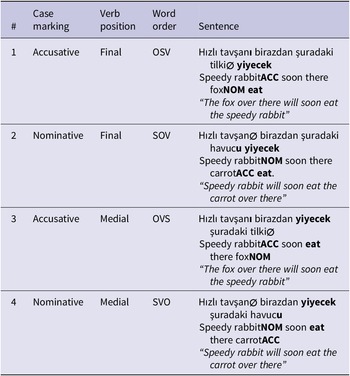
No matter the reason behind the high percentage of object-initial word orders, it still means that the first NP cannot always be safely assigned an agent role. The interpretation of thematic roles in transitive sentences mostly depends on the accusative case-marking on the direct objects, which is obligatory when the direct object is referential and specific (e.g., Ketrez & Aksu-Koç, Reference Ketrez, Aksu-Koç, Stephany and Voeikova2009), and the nominative case-marking, which is not overtly realized, on the matrix clause subjects. For instance, even though the sentences (1) and (2) start with the same NP, the noun “rabbit” is the subject in (1) while it is the object in (2).


Monolingual children start to produce these different word orders and accurately interpret the subject-initial and object-initial sentences at an early age (e.g., Ketrez & Aksu-Koç, Reference Ketrez, Aksu-Koç, Stephany and Voeikova2009; Sağın-Şimşek, Reference Sağın-Şimşek, Haznedar and Ketrez2016). This ability signals that children actively use nominative and accusative case-marking cues to interpret argument structures very early on (e.g., Slobin & Bever, Reference Slobin and Bever1982), suggesting an early sensitivity to the case-marking cues in language comprehension. Indeed, young Turkish monolingual children have been reported to show uncertainty in figuring out the argument structure of the sentences with non-specific and indefinite direct objects, which are not marked with an accusative case (Candan et al., Reference Candan, Küntay, Yeh, Cheung, Wagner and Naigles2012). However, they were able to incrementally use the accusative case on the sentence-initial NP to interpret the argument structure of the sentence and predict an agent to follow in the rest of the sentence more than when the first NP was marked with the nominative case (Özge et al., Reference Özge, Küntay and Snedeker2019; Özkan et al., Reference Özkan, Küntay and Brouwer2022).
In conclusion, the high frequency of object-initial sentences in the input and the transparency of case-marking cues make them robust and reliable cues in Turkish, which is demonstrated by monolingual children’s early use of those cues in language production, comprehension, and predictive language processing.
1.3 Current study
The few studies conducted with child heritage speakers have so far revealed that they are able to form predictions when the predictive use of morphosyntactic cues is supported by their other language and when they are tested in their dominant language, as measured by better vocabulary knowledge. However, it remains unknown to what extent heritage children are able to use case-marking cues predictively when the majority language is not a case-marking language and whether their reading skills and language experience modulate their prediction skills. To this end, the current study investigates three research questions:
-
1. To what extent do child heritage speakers of Turkish form predictions based on case-marking cues in Turkish compared to Turkish-speaking monolingual children?
-
2. To what extent are the prediction abilities of monolingual and heritage children affected by their developing word-reading skills in both languages?
-
3. To what extent are the prediction abilities of heritage children modulated by their language experience in Turkish?
With regard to the first research question, we hypothesized that monolingual Turkish-speaking children would be able to use case-marking cues predictively, replicating the findings of Özge et al. (Reference Özge, Küntay and Snedeker2019) and Özkan et al. (Reference Özkan, Küntay and Brouwer2022). For heritage children, two potential trajectories are considered: (1) heritage children do not predict using case-marking cues due to their reduced heritage language experience and/or the influence of a language with no grammatical case marking on nouns, Dutch, or (2) heritage children predict using case-marking cues that are early-acquired, frequent, and reliable in Turkish (partly in line with the findings of Meir et al., Reference Meir, Parshina and Sekerina2024). It is also conceivable that the prediction effect in the heritage children emerges later or is smaller in magnitude compared to monolingual children (in line with Lemmerth & Hopp, Reference Lemmerth and Hopp2019).
With regard to the second research question, we expected that prediction abilities of monolingual children would benefit from better reading skills in Turkish (Mani & Huettig, Reference Mani and Huettig2014) and prediction abilities of heritage children from better reading skills in both languages, given the transferable effects of biliteracy skills (Parshina et al., Reference Parshina, Lopukhina and Sekerina2022).
Regarding the third research question, we focused on heritage language exposure and engagement with literacy activities in the heritage language as measures of language experience in our study. This decision was made because certain language experience measures, such as language use and exposure, typically exhibit strong correlations. We hypothesized that as heritage children’s spoken and written language experience in Turkish increased, their prediction abilities would also improve (e.g., Foucart, Reference Foucart2015; Karaca et al., Reference Karaca, Brouwer, Unsworth and Huettig2024; Parshina et al., Reference Parshina, Lopukhina and Sekerina2022), given the robust mediating role of these factors in the (heritage) language abilities of bilingual children (e.g., Paradis, Reference Paradis2023; Unsworth, Reference Unsworth, Nicoladis and Montanari2016).
2. Methodology
2.1. Participants
Fifty-three monolingual children and 37 heritage children participated in this study. Four monolingual children were excluded due to having one non-native Turkish-speaking parent (n = 2), developmental language problems (n = 1), or eye detection/calibration problems (n = 1). Seven heritage children were excluded due to eye detection/calibration problems (n = 4) or due to extensive track loss (more than 50%) (n = 3).
The monolingual children (MAGE = 83 months, SDAGE = 6 months, RangeAGE = 76–99 months) were tested in primary schools in Turkey with permission of the Turkish Ministry of Education, the school principals, and the children’s parents or caregivers. All monolingual children spoke Turkish as their mother tongue and had minimal contact with English through schooling. The heritage children (MAGE = 90 months, SDAGE = 12 months, RangeAGE = 69–108 months) were tested in the Netherlands, in a quiet room at their homes. The selection criteria were that they should (1) be born in the Netherlands or immigrated to the Netherlands before the age of 4;0, (2) be exposed to Turkish and Dutch before the age of 4;0, (3) not be exposed to another heritage language at home, (4) have weekly contact with both Turkish and Dutch at the time of the testing. Exposure to the English language was prevalent in children’s language environments in the Netherlands and therefore was not considered as a reason for exclusion in this study. The heritage children were exposed to English in their everyday lives; however, this exposure was minimal, namely <9% of the time on average (M = 3.24, SD = 3.04; n = 6).
All heritage children were exposed to Turkish by birth and to Dutch before the age of 4;0 (M = 22.71 months, SD = 15.32 months, Range = 0–48 months). Their parents were either born in Turkey and moved to the Netherlands later in life (n = 26) or born in the Netherlands (n = 4). Among the parents who were born in the Netherlands, three were second-generation immigrants from Turkey, one was raised monolingually in Dutch, and one returned to Turkey in high school and then came back to the Netherlands in adulthood. For one child, both parents were second-generation immigrants from Turkey, and no heritage child had two non-Turkish-speaking parents.
The heritage and the monolingual children did not differ from each other on socioeconomic status (W = 687.5, p = .115), as measured by the highest parental education completed in any language (0 = no education, 1 = primary school, 2 = secondary school or equivalent, 3 = post-secondary school, 4 = university degree or higher). However, the heritage children (M = 89.67, SD = 12.48) were significantly older than the monolingual children (M = 83.12, SD = 6.29; W = 941.5, p = .037). Given this difference and the large age range within the two groups, we controlled for age in the analyses.
2.2 Materials
2.2.1. One minute word reading tasks
As a measure of children’s word reading skills, we used the one-minute word reading task in Turkish (Baydar et al., Reference Baydar, Küntay and Akcinar2012) and in Dutch (Eén minuut test [EMT]; Brus & Voeten, Reference Brus and Voeten1980), assessing real word reading accuracy and fluencyFootnote 1. In this task, the children were presented with a list of words in four columns and asked to read the words as accurately and as quickly as possible in one minute. The maximum number of words that could be read was 98 in Turkish and 116 in the Dutch version. The percentage of accurately read words was calculated separately for Turkish and Dutch.
2.2.2. Vocabulary tasks
As a measure of children’s language proficiency, we used the Crosslinguistic Lexical Task (CLT) in Turkish (CLT-TR; Yılmaz-Çifteci & Tuncer, Reference Yılmaz-Çifteci and Tuncer2022) and in Dutch (CLT-NL; van Wonderen & Unsworth, Reference Van Wonderen and Unsworth2021) from the LITMUS battery. The CLT is a colored picture-based vocabulary task that was constructed as a comparable vocabulary test for different languages so that bilingual children could be tested in both their languages (Haman et al., Reference Haman, Łuniewska and Pomiechowska2015). Children were presented with individual pictures and asked either what it was (for nouns) or what the characters were doing (for verbs). The presentation of noun and verb blocks were counterbalanced across participants. The tasks included 30 target items for nouns and 30 for verbs. Children’s responses were marked on an answer sheet by the experimenter and coded as correct if it is (an acceptable variant of) the target word. The percentage of total accurate responses was calculated separately for Turkish and Dutch.
2.2.3. Nonverbal general ability task
The matrix reasoning subtest of Wechsler Nonverbal-NL (WNV; Wechsler & Naglieri, Reference Wechsler and Naglieri2008) was used to ensure children’s nonverbal general ability was comparable in monolingual and heritage groups. In the matrix reasoning test, children were presented with an incomplete figural matrix and asked to select the figure that completed the matrix out of four or five options. The maximum points that could be achieved were 41.
2.2.4. Language experience questionnaire
The parents of the heritage children completed an online language experience questionnaire (Q-BEx, De Cat et al., Reference De Cat, Kašćelan, Prévost, Serratrice, Tuller and Unsworth2022). Based on parents’ responses in this questionnaire, we extracted certain background measures such as highest parental education level as well as several language experience measures including, their current language use and exposure in Turkish and in Dutch, as well as their engagement with literacy activities in both languages.
The proportion of the current language use and exposure in each language was measured by taking into account how much time the child spent with each interlocutor in different contexts such as home, school, community, and holidays. These proportions are therefore weighted for the time spent in different contexts and with different interlocutors. The engagement with literacy activities in each language was calculated based on the weekly frequency of activities that involve reading, writing, doing homework, and school lessons. The parents stated how frequently their children engage in these literacy activities (ranging from 0: almost never to 4: every day) per language. Engagement with literacy activities was calculated by dividing the total score for one language by the maximum possible score for that language. That is, the total of these proportions in different languages does not add up to 1. More detailed information about the calculation of these measures can be found in the manual of the Q-BEx (De Cat et al., Reference De Cat, Kašćelan, Prévost, Serratrice, Tuller and Unsworth2022).
2.2.5. Eye-tracking experiment
We used the same auditory and visual experimental stimuli as in Karaca et al. (Reference Karaca, Brouwer, Unsworth and Huettig2024, based on Özge et al., Reference Özge, Küntay and Snedeker2019). The auditory stimuli were transitive sentences with two overt arguments. In a 2x2 design, the case-marking on the first NP and the position of the verb were manipulated. The case marking on the first NP was either accusative (as in sentences (1), (3)) or nominative (as in sentences (2), (4)), and the verb was either in the sentence-final position (as in sentences (1), (2)), or in the sentence-medial position (as in sentences (3), (4)), as shown in Table 1. There were 32 items in total, and 8 items per condition.
Table 1. Overview of the manipulations of the experimental sentences

The sentences were edited in Praat (Boersma & Weenink, Reference Boersma and Weenink2017). Similar to Özge et al. (Reference Özge, Küntay and Snedeker2019), the structure of the verb-final sentences was as follows: 200 ms silence + adjective + the first noun + 300 ms silence + adverb + 200 ms silence + modifier + the second noun + verb + 1500 ms silence. Similarly, the structure of the verb-medial sentences was as follows: 200 ms + adjective + the first noun + 300 ms silence + adverb + verb + modifier + second noun + 1500 ms silence.
A visual display with three colored images accompanied each auditory stimulus on the screen (Figure 1). These images represented the first NP (e.g., rabbit), a plausible patient in a context where the first NP is the agent (e.g., carrot), and a plausible agent in a context where the first NP is the patient (e.g., fox). The patient and agent images represented the referents of the second NP in the nominative and accusative conditions, respectively. The agent, patient, and the first NP images appeared on the upper right, upper left, and lower middle positions of the screen equally often.

Figure 1. A sample of the visual display
2.3 Procedure
Monolingual children were tested in one session in a quiet classroom in the schools that they attended. The session took approximately 45 minutes, and children completed in total six tasks, of which only four are reported in this paper. The fixed order of administration for the tasks was (1) the eye-tracking experiment, (2) a Turkish vocabulary task, (3) a Turkish one-minute word reading task, (4) a Turkish sentence repetition task, (5) a story narration task, and (6) the Wechsler Nonverbal General Ability Test.
The heritage children were tested in two sessions, on average four weeks apart (minimum 2 weeks, maximum 11 weeks). The first session took place at their homes, where the first author visited them. It was made clear to children that the first author did not speak or understand Dutch to facilitate their Turkish use during the testing session. The order of the tasks in this session was (1) the eye-tracking experiment, (2) the Turkish vocabulary task, (3) the Turkish one-minute word reading task, (4) the Turkish sentence repetition task, and (5) the story narration task. The second session took place online via Zoom© with a native Dutch-speaking research assistant. The order of the tasks in the second session was (1) the Dutch vocabulary task, (2) the Dutch one-minute word reading task, (3) a Dutch nonword reading task, (4) the Dutch sentence repetition task, and (5) the Wechsler’s Nonverbal General Ability Test. Of these tasks, only the results of the eye-tracking experiment, vocabulary tasks, word reading tasks and the nonverbal general ability task are reported in this paper.
The children’s parents gave their written consent at the beginning of the (first) session. Ethical approval was granted by the Ethics Assessment Committee Humanities of Radboud University (2020-8963). All children received a Turkish storybook for participating in this study at the end of the (first) session.
For the eye-tracking experiment, we had four lists counterbalanced for verb position (sentence-medial, sentence-final) and case marking on the first NP (accusative, nominative). If a child listened to an item in the accusative condition in the verb-final block, they listened to it in the nominative condition in the verb-medial block. There were eight experimental items per condition in each block.
The eye-tracking experiment was presented using OpenSesame software (Mathôt et al., Reference Mathôt, Schreij and Theeuwes2012). The children were seated in front of a Tobii eye-tracker with a sampling rate of 120 Hz. Before the experiment, a five-point calibration was performed and repeated if necessary. The children were asked to move only minimally during the experiment. They were instructed to listen to the sentences carefully while looking at the objects that appeared on the screen. If there was an animation after the sentence, they were asked to say “yes” if the event described in the animation matched the sentence they had listened to and they had to say “no” if this was not the case. A drift correct procedure was performed at the beginning of each trial, followed by a blue fixation dot that appeared in the middle of the screen for 500 ms. The visual display was presented for 2000 ms (preview time), after which the auditory stimulus was initiated. In each block, ten trials were followed by an animation that either matched the event described in the sentence or not. The children’s yes/no responses to the animations were recorded by the researcher. The eye-tracking experiment took approximately 12 minutes to complete, including calibration and two practice trials.
2.4 Data preparation and analysis
Children’s eye gaze was sampled 120 times per second, corresponding to approximately one data point every 8 ms. The fixations that were invalid or fell outside the screen dimensions were removed. The fixation locations on the screen were automatically coded to be on the left, on the right, or on the bottom. The fixations that fell outside of these regions of interest were removed.
The predictive time windows in both verb-final and verb-medial sentences started with the onset of the adverb (after the first NP + 300 ms) and ended with the onset of the second NP. The predictive time window included the adverb and the modifier regions in the verb-final sentences and the adverb, the verb, and the modifier regions in the verb-medial sentences. We did not offset the predictive time window by 200 ms because we were interested in purely predictive looks and wanted to avoid any integration effects at a phonological level. The statistical analyses were carried out on the predictive time window, as we were only interested in potential prediction effects that occurred before the second NP onset. We performed separate analyses for verb-final and verb-medial blocks since the differences in duration of the predictive time windows in these blocks did not allow them to be directly compared in one model. All final models and a more detailed description of the data preparation and modeling are openly available in https://osf.io/f4s85.
Following Özge et al. (Reference Özge, Küntay and Snedeker2019), we used agent preference as the dependent variable in our analysis. It was calculated by coding the looks to the agent image as 1 and to the patient image as 0, after the fixations to the first NP image were removed from the dataset. The time in each trial was synchronized at the second NP onset, making it the new zero point.
To investigate the time course of prediction ability, we fitted logistic mixed-effect regression models to the dependent variable in R using the lme4 package (Bates et al., Reference Bates, Maechler, Bolker and Walker2015) and included the interaction between Condition (case-marking on the first NP: nominative/accusative), Time (continuous), and Group (monolingual/heritage) as fixed effects in the models. The binary variables Condition and Group were contrast-coded (nominative: −0.5, accusative: +0.5 and monolingual: −0.5, heritage: +0.5), and the continuous variable Time was centered around the mean and scaled. The random effects structure of the models included by-participant and by-item random intercepts and random slopes for Condition and Group. We backward fitted the random effects structure in our models (Barr et al., Reference Barr, Levy, Scheepers and Tily2013). The likelihood of the simpler model was compared against the more complex one using Akaike Information Criterion (AIC). We checked whether the trial order in a block (continuous), the presentation order of the blocks (categorical, contrast coded; verb-final-first: −0.5, verb-medial-first: +0.5), and age (in months, continuous) improved the model fit, and only included them in the final model if they did.
To investigate the role of word reading skills and language experience on prediction skills, we calculated a new dependent variable, overall prediction ability. This way we increased the power in subsequent analyses and avoided uninterpretable three-way interactions given the number of participants and the amount of missing data from heritage children (n = 2 for Turkish word reading task, n = 5 for Dutch word reading task, and n = 6 for language experience measures). We calculated children’s overall prediction ability by subtracting the mean agent preference in the accusative condition from the nominative condition in the predictive time window for each participant across all items, following Kukona et al. (Reference Kukona, Braze, Johns, Mencl, Van Dyke, Magnuson, Pugh, Shankweiler and Tabor2016). Positive values indicated that children showed a higher agent preference in the accusative condition than in the nominative condition, negative values indicated a higher agent preference in the nominative condition than in the accusative condition, and zero indicated that the mean agent preference was the same for the two conditions. The measures of word reading skills, vocabulary skills and language experience were continuous. The word reading and vocabulary skills were centered and scaled as they were percentages, and the language experience variables were only centered as they were proportions. We fitted multiple linear regression models to the dependent variable in R and included Group and the measures of word reading and language experience in different models one by one as a predictor. Since we were interested in the effect of different measures in the heritage group, we corrected the significance threshold for multiple comparisons in our analyses using the Benjamini-Hochberg procedure (Benjamini & Hochberg, Reference Benjamini and Hochberg1995). In all models, age was included as a control variable. In the models with word reading skills in the heritage group, heritage language vocabulary was also controlled in order to examine the effect of reading skills beyond vocabulary knowledge.
3. Results
3.1. Background measures
We compared the monolingual children and the heritage children on their performance in the nonverbal general ability task, on their Turkish word reading skills and on their vocabulary skills using an independent t-test when the distribution was normal and a Wilcoxon rank sum test otherwise. The results showed that the heritage children performed significantly better than the monolingual children in the matrix reasoning subtest based on age-normed scores (heritage: M = 59.12, SD = 11.09; monolingual: M = 50.04, SD = 9.57, t(45.65) = 3.51, p = .001). In addition, the monolingual children’s word reading scores in Turkish (M = 44.57, SD = 18.99) were significantly higher than that of the heritage children (M = 29.52, SD = 26.27; W = 346, p = .003). Monolingual children’s vocabulary scores in Turkish (M = 96.81, SD = 1.90) were also higher than that of heritage children (M = 80.18, SD = 14.78; W = 51.5, p < .001).
As shown in Table 2, heritage children’s cumulative exposure to two languages was similar. Their weighted current exposure to and use of both languages were also similar. Their engagement with literacy activities, however, was higher in Dutch than in Turkish. The heritage children’s word reading skills were better in Dutch (M = 39.27, SD = 26.95) than Turkish (M = 29.52, SD = 26.27, t(24) = 3.48, p = .002, Cohen’s d = 0. 70). There were three children who were not literate in either of the languages, and there were two children who were not literate in Turkish, but one of them was literate in Dutch. Heritage children’s vocabulary skills in Turkish (M = 80.18, SD = 14.78) and in Dutch (M = 72.88, SD = 12.59) were not significantly different (t(25) = 1.84, p = .078). Heritage children’s vocabulary and word reading skills significantly and moderately correlated in Dutch ((r(23) = .55, p = .004), but not in Turkish (r(26) = .33, p = .086). In addition, heritage children’s word reading skills in either language and their vocabulary skills in Dutch did not correlate significantly with any of the language experience measures, while their vocabulary skills in Turkish were significantly correlated with their current Turkish (r(21) = .44, p = .034) and Dutch use (r(21) = −0.44, p = .036).
Table 2. Overview of the language proficiency and experience measures of the monolingual and heritage children
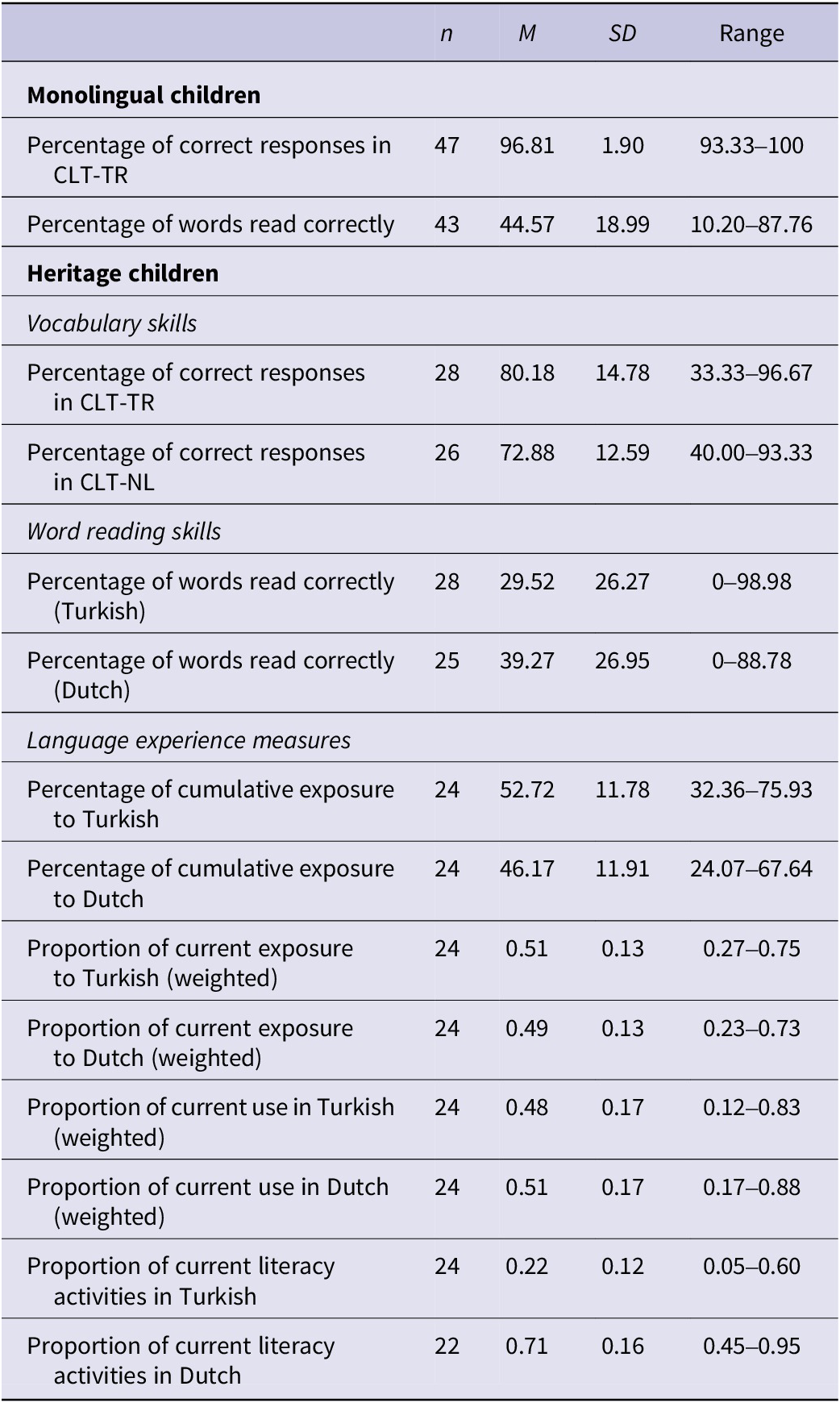
Heritage children’s current language use and exposure were positively correlated in Turkish (r(22) = .95, p < .001) and in Dutch (r(22) = .96, p < .001). Current Turkish use and current Dutch use (r(22) = −.99, p < .001) as well as current Turkish exposure and current Dutch exposure (r(22) = −.99, p < .001) were negatively correlated. Their engagement with literacy activities in the two languages were not correlated (r(20) = .03, p = .887). Given that some of the variables have a very strong relationship, we focused only on Turkish exposure and the engagement with literacy activities in Turkish as language experience measures in further analyses in order to limit the number of comparisons made on the same dataset.
We also checked whether age correlated with the word reading skills, vocabulary skills and language experience measures. In the monolingual group, age was moderately correlated with Turkish word reading skills (r(41) = .44, p = .003). In the heritage group, age correlated strongly with Turkish word reading skills (r(26) = .69, p < .001) and very strongly with the Dutch word reading skills (r(23) = .85, p < .001), but not with Turkish vocabulary (r(26) = −.03, p = .891), Turkish exposure (r(22) = −.23, p = .290) and engagement in literacy activities in Turkish (r(22) = −.07, p = .753). Heritage children’s word reading skills in Turkish and their vocabulary knowledge in Turkish correlated weakly and non-significantly (r(26) = .33, p = .086).
Considering the strong correlation between the reading skills in both languages and age in the heritage group, we created residualized reading scores by running two regression analyses on the word reading scores in Turkish and in Dutch with Age as the predictor (see Mani & Huettig, Reference Mani and Huettig2014). The residualized reading scores refer to the variability in children’s reading skills remaining after accounting for the variability explained by age.
3.2. Eye gaze data
Figure 2 shows the time course of agent preference in the verb-final block and in the verb-medial block for the monolingual and the heritage children. In the verb-final block, as expected, in both groups, the preference to look at the agent image increased through the course of the sentence in the accusative condition and decreased in the nominative condition. The difference in agent preference in the two conditions was already apparent in the predictive time window, between the onset of the adverb and the onset of the second NP, suggesting a prediction pattern for both groups. However, this pattern emerged relatively later in the predictive time window in the heritage children compared to the monolingual children.

Figure 2. Agent preference in the accusative (red line) and the nominative (blue line) condition over time for monolingual children (lower panels) and heritage children (upper panels) in the verb-final block (left panels) and in the verb-medial block (right panels).
Note: Agent preference in 50 ms time bins averaged across participants and across trials. The error bars indicate the standard error of the mean across participants. Positive values on the y-axis indicate preference for the agent image, and negative values indicate preference for the patient image, while 0 indicates no preference for either image. The shaded regions represent the predictive time windows.
The right panels of Figure 2 visualize the time course of agent preference in the verb-medial block for the monolingual and the heritage children. As predicted, in both groups, the preference to look at the agent image increased in the accusative condition and decreased in the nominative condition as the sentence unfolded. In the predictive time window, the agent preference of both groups started to show differences in the accusative and the nominative condition. This difference steadily increased in the monolingual group through the course of the predictive time window, while it fluctuated to some extent in the heritage group.
We conducted two types of analyses on our eye-gaze data separately in the verb-final and the verb-medial block to examine (1) the time course of children’s prediction ability and (2) the effect of reading abilities and language experience on children’s overall prediction ability.
3.2.1. The time course of children’s prediction ability in the verb-final block
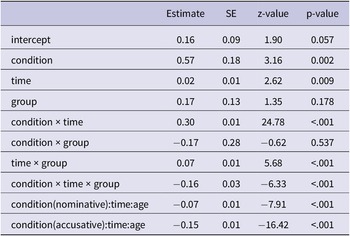
The most parsimonious model for the agent preference in the predictive time window in the verb-final block is given in Table 3. The effect of the control variable, Age, was significant in the nominative condition, suggesting that as children got older, their agent preference decreased significantly in the nominative condition as time progressed in the predictive window. Most importantly, the interaction between Condition, Time and Group was significant, suggesting that the time course of prediction ability was different in the two groups. In order to tease apart this significant interaction, we examined the time course prediction ability separately in the monolingual and the heritage children.
Table 3. Summary of the fixed effects from the logistic mixed effects regression model with the interaction between Time, Condition and Group in the verb-final block

Note: Agent preference ~ condition × time × group + condition: time: age + (1+ condition|participant) + (1 + group|item)
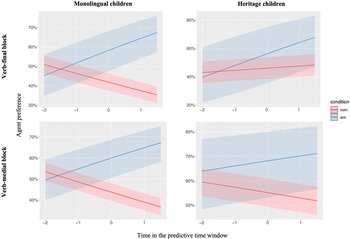
In the monolingual group, the effect of Condition (β = 0.66, SE = 0.20, z = 3.31, p < .001) as well as the interaction between Condition and Time was significant (β = 0.47, SE = 0.02, z = 27.93, p < .001; see Supplementary Table S1). In the heritage group, the effect of Condition was not significant (β = 0.40, SE = 0.35, z = 1.15, p = .250), but the interaction between Condition and Time was significant (β = 0.25, SE = 0.02, z = 10.55, p < .001; see Supplementary Table S2). These significant effects are visualized in the upper panels of Figure 3. It shows that in the monolingual group, agent preference significantly increased in the accusative condition while it decreased in the nominative condition over time. This pattern was also present in the heritage group, but to a smaller magnitude, as suggested by the smaller difference in agent preference between accusative and nominative conditions over time in the heritage group compared to the monolingual group.

Figure 3. Agent preference in the accusative (blue line) and the nominative (red line) condition over time based on the model calculations in the verb-final block (upper panels) and the verb-medial block (lower panels) for the monolingual (left panels) and heritage group (right panels).
Note: 0 represents the mean time in the predictive time window, with positive values indicating later points and negative values indicating earlier points in this time window.
3.2.2. The time course of children’s prediction ability in the verb-medial block
The summary of the most parsimonious model for the agent preference in the predictive time window in the verb-medial block is reported in Table 4. The effect of the control variable, Age, was significant. As children’s age increased, the difference in agent preference between the accusative and nominative conditions got smaller as time progressed in the predictive time window. Most importantly, the interaction between Condition, Time and Group was significant, suggesting that the time course of prediction ability progressed differently in the monolingual and the heritage group. In order to tease this effect apart, we carried out separate analyses for the monolingual and the heritage groups.
Table 4. Summary of the fixed effects from the logistic mixed effects regression model with the interaction between Time, Condition and Group in the verb-medial block

Note: Agent preference ~ condition × time × group + condition: time: age + (1+ condition|participant) + (1 + group|item).
In the monolingual group, the effect of Condition was significant (β = 0.66, SE = 0.18, z = 3.59, p < .001), as well as the interaction between Condition and Time (β = 0.38, SE = 0.02, z = 24.68, p < .001; see Supplementary Table S3). In the heritage group, the main effect of Condition was not significant (β = 0.48, SE = 0.27, z = 1.77, p = .077), but the interaction between Condition and Time was (β = 0.22, SE = 0.02, z = 10.80, p < .001; see Supplementary Table S4). These significant effects are visualized in the lower panel of Figure 3. Figure 3 shows that in both the monolingual and the heritage group, agent preference increased in the accusative condition and decreased in the nominative condition over the course of the predictive time window. The magnitude of this effect was smaller in the heritage group, suggested by the smaller difference in agent preference between accusative and nominative conditions over time in the heritage group compared to the monolingual group.
3.2.3. Interim summary of the time course of prediction ability
The analyses revealed that the time course of prediction ability was modulated by group differences in the verb-final and the verb-medial block, yet both monolingual and heritage children showed significant prediction effects. These results suggest a quantitative, not a qualitative, difference in the magnitude of the effect between the two groups.
3.2.4. The role of word reading skills and language experience on overall prediction ability
Before examining the effects of word reading skills and language experience, we first checked whether there were significant differences between the monolingual and the heritage children in their overall prediction ability. The results of the linear regression models showed that there were no significant differences between monolingual and heritage children in the verb-final (β = −0.02, SE = 0.06, z = −0.32, p = .750) and the verb-medial block (β = −0.01, SE = 0.06, z = −0.17, p = .863; see Supplementary Table S5, Supplementary Figure S1).
The correlations of prediction ability with (residualized) Turkish word reading skills, residualized Dutch word reading skills and two language experience measures are provided in Table 5. All reported results were analyzed with partial correlations between the overall prediction ability and a specific measure after taking age into account. In addition, in the analyses of word reading skills in the heritage group, vocabulary skills in the heritage language were also controlled for. In the verb-final block, the overall prediction ability and Turkish word reading skills showed a weak but significant positive correlation for the monolingual children when age was controlled for. A weak but nonsignificant positive correlation between the overall prediction ability and Turkish word reading was also observed for heritage children after age and Turkish vocabulary skills were taken into account. A significant and strong positive correlation was found between the overall prediction ability and heritage children’s Dutch word reading skills when age and Turkish vocabulary skills were controlled for. In the verb-medial block, a significant and strong positive correlation between heritage children’s prediction abilities and their Turkish language exposure was found when controlled for age. The heritage children’s overall prediction ability did not significantly correlate with their engagement with literacy activities in Turkish in either block.
Table 5. Partial correlations between overall prediction ability and all measures and summary outputs of the different linear regression models with overall prediction ability as the dependent variable for monolingual and heritage children in the verb-final and the verb-medial block

Note: In the partial correlation and the linear regression analyses with word reading variables with the heritage children, both age and Turkish vocabulary skills were controlled for, while in the analyses with language experience measures, only age was controlled for.
We then performed multiple linear regression analyses to investigate the effect of the same measures on the overall prediction ability of the monolingual and the heritage children after controlling for the effect of age. In addition, in the models with word reading skills in the heritage group, vocabulary skills in the heritage language were also controlled for. The results of these analyses for both groups in the verb-final and the verb-medial block are also provided in Table 5. The analyses revealed that in the verb-final block, monolingual children’s overall prediction ability was significantly and positively modulated by their word reading skills in Turkish. Heritage children’s overall prediction ability was significantly and positively modulated by their residualized word reading skills in Dutch after the effects of age and heritage language vocabulary were controlled for, but not by their residualized word reading skills in Turkish. As can be seen in the upper panel of Figure 4, as heritage children’s reading skills increased in Dutch, their overall prediction abilities in Turkish improved. In these models for heritage children, the heritage language vocabulary did not significantly modulate the overall prediction ability.

Figure 4. The effect of residualized word reading in Dutch (upper panel) on heritage children’s overall prediction ability in the verb-final block and the effect of Turkish exposure on heritage children’s overall prediction ability in the verb-medial block (lower panel).
In the verb-medial block, word reading skills did not significantly modulate overall prediction abilities of the monolingual children when age was taken into account. A significant effect of residualized word reading skills in either language was also not observed for heritage children when age and heritage language vocabulary were taken into account, as shown in Table 5. However, in the model with residualized Turkish word reading skills as a predictor and Age and heritage language vocabulary as covariates, a significant positive effect of vocabulary was found (β = 0.11, SE = 0.04, t = 2.52, p = .019, adjusted p = .047). This means that as children’s vocabulary knowledge in Turkish increased, their prediction skills in Turkish got better. In addition, heritage children’s exposure to Turkish significantly and positively modulated their overall prediction abilities in the verb-medial block. As can be seen in the lower panel of Figure 4, more exposure to Turkish facilitated their overall prediction ability. Their engagement with literacy activities in Turkish did not significantly modulate heritage children’s prediction abilities in either block.
4. Discussion
The present study aimed to investigate the morphosyntactic prediction abilities of child heritage speakers during spoken language comprehension. More specifically, it examined (1) the extent to which child heritage speakers of Turkish used case-marking cues predictively in their heritage language, Turkish compared to monolingual Turkish-speaking children in the verb-final and the verb-medial sentences, (2) the extent to which the developing reading skills of monolingual and heritage children modulated their prediction abilities and finally (3) the extent to which language experience (i.e., Turkish language exposure and engagement with literacy activities in Turkish) affected heritage children’s prediction abilities.
With respect to the first research question, the results showed that upon hearing a sentence-initial NP that was marked with accusative case, both groups of children started to look more at the agent image in the predictive time window than when the first NP was marked with nominative case. In other words, both monolingual and heritage children were able to form predictions about the upcoming information based on the case-marking cues on the first NP, replicating previous work with Turkish monolingual children (Özge et al., Reference Özge, Küntay and Snedeker2019; Özkan et al., Reference Özkan, Küntay and Brouwer2022), though the time course of this ability progressed differently in the monolingual than in the heritage children. Both groups were able to generate predictions when case marking was the only cue available at hand (i.e., the verb-final sentences) and when it was scaffolded by verb semantics (i.e., the verb-medial sentences). Note that it was not possible for the participants to use verb-semantics information on its own to predict the target nouns in this study, but verb semantics revealed more information about the event structure.
As a prediction effect was present in both verb-final and verb-medial sentences in both groups, it can be argued that the group-level differences pointed to a quantitative difference rather than a qualitative one between the two groups. Supporting evidence for this pattern comes from the current results of the overall prediction ability comparisons which revealed no differences between the monolingual and heritage children in terms of their overall ability to predict the upcoming information in both sentence types. These findings are in line with studies reporting morphosyntactic prediction in bilingual children based on gender-marking (Lemmerth & Hopp, Reference Lemmerth and Hopp2019) and case-marking cues (Meir et al., Reference Meir, Parshina and Sekerina2024; Mitrofanova et al., unpublished manuscript) when their two languages share the same type of predictive cues. In the present study, child heritage speakers’ ability to form predictions based on case-marking cues whilst simultaneously acquiring a language with no grammatical case marking on nouns suggests that it may not only be the presence/absence of the same type of cues in both languages that affects predictive processing. The transparency and reliability of the cue itself in a language also modulate its predictive use by the heritage children. In other words, regardless of their other language being a case-marking one or not, heritage children may be able to employ transparent and reliable case-marking cues in predictive processing. Nonetheless, their other language being a language that does not mark grammatical case on nouns may still account for the smaller prediction effects in the heritage group. Cross-linguistic influence has been argued to modulate adult L2 speakers’ predictive processing skills since L2 speakers whose L1 does not mark case information on nouns (i.e., English) were found to not be able to use case-marking cues predictively in the L2 (i.e., German, Japanese), while Russian-German L2 speakers were able to do so (Hopp, Reference Hopp2015; Schlenter & Felser, Reference Schlenter, Felser, Kaan and Grüter2021). The contrasting findings of the current study then may support the view that any potentially negative effects of cross-linguistic influence from the other language may be lessened when both languages are acquired in parallel.
In addition, this study also examined the extent to which the developing reading abilities of monolingual and heritage children modulated their prediction skills. The findings showed that monolingual children’s overall prediction ability was facilitated by their word reading skills in Turkish when case marking was the only available cue (in the verb-final sentences). This finding corroborates Mani and Huettig (Reference Mani and Huettig2014) by offering support from younger monolingual children with developing reading skills and is also compatible with previous work suggesting a cross-modality effect of written language skills on spoken language processing (Favier et al., Reference Favier, Meyer and Huettig2021; Huettig & Pickering, Reference Huettig and Pickering2019). The ability to read and write in one language improves the prediction abilities in spoken language comprehension through a number of factors (see Huettig & Pickering, Reference Huettig and Pickering2019), including increasing phonological awareness and sharpening and deepening lexical representations of the words (e.g., Huettig & Brouwer, Reference Huettig and Brouwer2015; Mani & Huettig, Reference Mani and Huettig2014).
Child heritage speakers’ overall prediction ability in the verb-final sentences was facilitated by their reading skills in the majority language, but not by their reading skills in the heritage language when their heritage language vocabulary and age were taken into account. We believe that this finding most likely reflects that heritage children were more skilled readers in Dutch compared to Turkish and that they received formal training in Dutch in schools. Given the effect of reading skills in the majority language on predictive processing in the heritage language, this study is the first to show that during bilingual predictive processing in a developing mind, effects of reading on prediction can take place not only across modalities but also across languages. One contributing factor may be that the letter-decoding skills of bilingual children who are learning to read in two languages with similar orthographic systems are interdependent (e.g., Durgunoğlu, Reference Durgunoğlu2002, also in line with the linguistic interdependence hypothesis, Cummins, Reference Cummins1979), which fits also with the finding of the strong positive correlation between the Turkish and Dutch reading skills of heritage children. Note that a study with adult heritage and L2 speakers of Russian also reported that oral reading fluency in the majority language aided their prediction abilities in the other language (Parshina et al., Reference Parshina, Lopukhina and Sekerina2022), though those findings were related to prediction skills during reading.
In regard to the effects of language experience on prediction skills of heritage children, this study focused on Turkish language exposure and engagement with literacy activities in Turkish. The results showed a facilitatory effect of language exposure but not of the engagement with literacy activities after age was taken into account in the verb-medial sentences, such that heritage children who were exposed to Turkish more in their everyday life showed better overall prediction abilities, while their engagement with literacy activities in Turkish did not play a role. The finding regarding the effect of language exposure is in line with previous studies arguing that the amount of exposure plays an important role in the development of (heritage) language skills of bilingual children (e.g., see Paradis, Reference Paradis2023; Unsworth, Reference Unsworth, Nicoladis and Montanari2016 for detailed discussions). Since the heritage children with more exposure to Turkish exhibited better prediction abilities, it may not only be the influence from a language with no grammatical case marking on nouns but also reduced experience in Turkish that led to smaller prediction effects in the heritage children compared to monolingual children.
Finally, we acknowledge that future research is needed regarding a number of issues. In the present study, we reported that the time course of predictive processing progressed differently in the monolingual and heritage children. To pinpoint the exact differences, future studies should examine the time course of predictive processing in two groups using different statistical analyses, such as divergence point analysis. Also, in this study, we cannot tease apart the effect of cross-linguistic influence and reduced language experience on predictive processing. To address this question, another group of child heritage speakers of Turkish whose other language also makes use of transparent case-marking cues, such as Russian, would be needed. In addition, the reason why engagement with literacy activities did not lead to better prediction ability is intriguing given that literacy activities offer children a qualitatively richer language that is grammatically more complex and lexically more diverse. Engagement with literacy activities improves children’s language proficiency and thus may also (directly or indirectly) be expected to modulate their prediction skills as it does affect their overall proficiency (e.g., Paradis, Reference Paradis2023). Indeed, the previous studies with heritage speakers have reported the important role of literacy training and activities in heritage language outcomes (e.g., Bayram et al., Reference Bayram, Rothman, Iverson, Kupisch, Miller, Puig-Mayenco and Westergaard2019; Gharibi et al., Reference Gharibi, Bayram and Guajardo2023; Kupisch & Rothman, Reference Kupisch and Rothman2018). The discrepancy in findings between previous studies and the present one may stem from methodological disparities. Previous studies primarily focused on production and/or successful comprehension, whereas our study centered on predictive processing, which may or may not occur independently of successful comprehension. Moreover, the divergence in results could also be attributed to the overall limited involvement in literacy activities among Turkish heritage children as a group in our sample, compounded by the fact that our sample comprised emergent readers. Without assessing a larger group of (older) heritage children exhibiting a wide range of engagement in literacy activities, we cannot rule out the potential influence of literacy activities on predictive processing.
In addition to engagement with literacy activities, as pointed out by an anonymous reviewer, the type and duration of the literacy training that heritage children received in the heritage language might also play a role in their language outcomes and therefore may modulate their prediction skills. It is possible that some of the child heritage speakers in our sample may have learned how to read and write in Turkish at home from their parents, while some others may have received more formal literacy training at weekend schools. Future studies may also try to examine the potential link between different types of heritage language literacy training activities and language outcomes to further unpack the relationship between literacy and predictive processing.
Relatedly, this study focused on certain modulating factors only, yet bilingual language development involves a myriad of individual difference measures (Paradis, Reference Paradis2023). Future research ideally should diversify the individual difference factors under investigation with larger sample sizes and reflect on the complex relationship between these variables as well (De Cat & Unsworth, Reference De Cat and Unsworth2023). Finally, the biliteracy effect in this study was observed between two languages with similar orthographic systems. In order to further explore the limits of such a transfer between languages in predictive processing, future research needs to examine the prediction skills of bilingual children learning to read and write in two languages with different orthographic systems.
5. Conclusion
Child monolingual and heritage speakers of Turkish are able to generate predictions based on case-marking cues in Turkish with or without the scaffolding of verb semantics. Even though the time course of their prediction ability shows differences compared to that of monolingual children, child heritage speakers’ overall prediction ability is on par with monolingual children. By examining the effect of reading skills and different language experience measures on the prediction ability of child heritage speakers, this study is the first to reveal that heritage children’s reading skills in the majority language as well as the amount of exposure to the heritage language promote their prediction abilities in spoken heritage language comprehension.
Supplementary material
The supplementary material for this article can be found at http://doi.org/10.1017/S1366728925000331.
Data availability statement
The data that support the findings of this study as well as the analysis scripts are openly available at OSF: https://osf.io/f4s85/.
Acknowledgments
This work was funded by the Centre for Language Studies at Radboud University. We would like to thank all our participants and their parents, the Ministry of Education in Turkey for supporting testing in schools, the principals and teachers in the schools for their help, and the Tulip Institute for their help in reaching out to the Turkish families in the Netherlands. We also thank Dr. Duygu Özge for sharing the original material with us, Yeşim Özüer for her help in recording the auditory stimuli for the eye-tracking experiment, and Merel Vermeer for her help in administering the tasks in Dutch and coding the data. We would also like to thank the anonymous reviewers who contributed valuable feedback on earlier versions of this manuscript.
Competing interests
The authors report no conflict of interest.





 Open access

