


1 Introduction
The time scale of by far the largest variability for the ice cover of the polar oceans is the seasonal time scale. It is, for example, frequently pointed out that only the snow cover of the northern hemisphere produces a greater seasonal albedo change than that produced by the sea ice of the Southern Ocean. In the literature other response times have been discussed for air-ice-ocean interactions, including the fractional-day-scale deformation of ice within the pack and at coastal and seaward margins, and these responses are known to have strong seasonal variations as well. The overall seasonal cycle of sea-ice conditions, and their interannual variation, is a topic of present-day concern because it is thought to have a statistical, if not dynamical, relationship to other cycles in the atmosphere and ocean, such as the “El Nino” sea surface temperature phenomenon of the tropical Pacific.
The great extent and remoteness of the global sea-ice cover calls for observation by polar-orbiting satellites, and indeed such platforms carrying visible-light, infrared (IR), and passive and active microwave imagers have provided useful “snapshots” of the polar regions (Reference Zwaliy and GloersenZwally and Gloerson 1977, Reference CarseyCarsey 1982). In order to examine the entire sea-ice cover of either polar region simultaneously, strip images with swath width from 100 to 2 000 km from a satellite passing over the polar regions, usually 12 to 14 times per day, over 1 to 6 days are merged, constructing a microwave image of the global ice cover on a time scale finer than the seasonal time scale, and the remaining task is to interpret the microwave behavior in terms of ice conditions and other convenient variables. What are the conditions of interest and how much difficulty can we expect in their unambiguous interpretation in spacecraft microwave data?
2 Background
Sea-ice properties and conditions of possible climatological interest are several: extent, thickness, albedo, open-water fractional area, drift speed, type, snow cover, melt-pond cover, ridging index and thermodynamic state (growing or ablating). Some properties are complex; clearly snow cover will affect growth rate, and such data are important, but is depth enough or is grain size or water equivalent also needed? In describing melt-ponds, is areal coverage sufficient or is depth distribution needed? It is apparent that considerable work must be done to prepare the list of pertinent ice conditions; model calculations and sensitivity studies are necessary, such as those of Reference MaykutMaykut (1982) for ice-cover response and of Reference Herman and JohnsonHerman and Johnson (1980) for climatological response.
The present status of microwave observation is also complicated. There is good agreement that monitoring of ice extent by various microwave as well as visible-light and IR methods is effective (Reference Carsey and ZwaliyCarsey and Zwally in press). There is also reported some success at locating, in the Arctic, the old-ice front marking the general extent of second-year and multiyear ice, and some success at estimating old-ice concentration. The determination of open-water area is made complex by the small size of many of the leads, by spatial variation in ice microwave emissivities (Reference CarseyCarsey 1982) and by the presence of minor or transition ice species in leads. Some work has been done in examining the transition from summer to fall (Reference CarseyCarsey 1982) during melt-pond freezing, lead freezing, and snowfall. Nothing has been done for quantitative measurements of snow cover on sea ice. The measurement of ice thickness from space appears to be impossible. The measurement of small-scale (~1 km) drift speed, deformation and ice type is accomplished only with time-consuming methods. Some of these measurements can be refined through research, and some of the problems, e.g. snow cover properties, are due for dedicated attack, as will be discussed below. At present, the ten-plus years of spacecraft microwave surveillance of sea ice yields a good record of some elements of the seasonal cycle, notably ice extent, and promises to provide a considerably more complete picture when the microwave behavior of ice properties of interest are better understood. Developing this understanding will require careful modeling of microwave and thermodynamic processes, field studies of sea-ice microwave properties, and examination of the existing data set from satellites for the Information contained In time series and inter-sensor comparison.
3 Key Elements of the Seasonal Cycles
There is no unique list of the key elements of the seasonal cycles of sea ice even for the climatological context. Also, a discussion of sufficiency of description of the overall seasonal march must take into account the uses to which data will be put, and these uses tend to change in time. It seems safe to say that, with respect to the climate system, the future will call for more detailed descriptions than are used in the present. Thus, it is useful to examine a rather extensive list of sea-ice climate-system parameters whose seasonal cycle is of likely interest, to discuss the relationship of the parameters to observable sea-ice properties, and to assess in detail the accessibility of some of the more critical cycles to measurement from space. A list of seasonal cycle elements which is arguably complete, i.e. probably’ excessive, is: extent, type, thickness, open-water fraction, albedo, snow cover, velocity, environment, budget, and surface fluxes. In what follows, these are explored in more detail.
3.1 Extent
The areal coverage and the shape of the ice pack constitute the ice extent which is unquestionably the most significant sea ice observable for climatology. Observation of extent was revolutionized by spacecraft instrumentation which made possible accurate, global, weekly maps of the ice pack. A number of instruments have proven useful including visible and IR scanners which suffer from problems of light level and cloudiness, passive microwave scanners which suffer from coarse resolution and an attendant error (Reference CarseyCarsey 1982), and active microwave scanners, which are expensive and labor-intensive. Hybrid programs involving multiple sensors are most profitable. There 1s a convenient though unexplored aspect of the pack which makes extent a convenient variable: the ice edge is spatially abrupt, especially in the cold seasons.
3.2 Type
Considerable effort has been expended in measuring ice type from space, and, while there is reason to believe that the determination of areal coverage of annual and old ice is straightforward (Reference Gloersen, Nordberg, Schmugge and WilheitGloersen and others 1973), there has been little success in making and verifying an estimate of old-ice distribution except in the special case of early-fall distribution. The value of ice type climatologically is in the estimate of regional ice balance and in using it, however questionably, as a proxy variable for ice thickness and roughness. The usual method of ice-type determination involves multifrequency analysis of thermally emitted microwaves, and various uncertainties concerning the emission variability due to ice character, snow character, and weather create errors of unexamined magnitude in this determination. Recent work by Comiso (unpublished) in which emissivities at different frequencies are assumed to vary in constant ratio 1s very promising in this area.
3.3 Thickness
The ice thickness, usually discussed as a thickness distribution (Reference Thorndike, Rothrock, Maykut and ColonyThorndike and others 1975), is a vitally important variable whose seasonal cycle is controlled by annual or first-year ice formation and growth, ice export, old-ice growth and summer ablation from top and bottom surfaces. No method exists for its measurement from space, and, indeed, it is difficult to establish in situ (Reference Hibler, Ackley, Weeks and KovacsHibler and others 1972).
3.4 Open-water fraction
Dynamic and thermodynamic processes in the ice pack create and close areas of open water called leads and polynyas. Physical arguments, confirmed by casual observation, indicate that the Arctic ice cover in winter should be only rarely less than 99% compact. Taken together as open water and thin ice, as is the case when photography is analyzed, coverage values up to 20% have been reported. This poses a very stringent observational requirement. In summer, the presence of melt ponds which are easily confused with open-water areas is also troublesome. These issues call into question the value of a research effort for measuring open water in the winter, and indicate precautions for the summer case, discussed below.
3.5 Albedo
The surface albedo of the ice pack has been shown by Reference Maykut and UntersteinerMaykut and Untersteiner (1971) to be important, especially the albedo of the summer pack. The surface short-wave albedo in general is determined by the surface conditions and the sun angle. Surface conditions of importance for ice are: snow cover, openwater area, melt-pond area and roughness. Some work has been done to measure ice albedo (Reference WendlerWendler 1973, Reference Pautzke and HornofPautzke and Hornof 1978, Grenfell and Perovich unpublished); no basin-wide calculations have been made. Prospects for making such a calculation via microwave data from space are good, as will be discussed below.
3.6 Snow cover
The snow cover on sea ice has also been shown to be significant in the heat balance of the Arctic Ocean, and considerable interannual variability has been observed (Barry unpublished), but no dependable basin-wide data set exists, and no method to obtain such a data set is conceivable except through the interpretation of satellite microwave date. This measurement is related to the albedo and even the ice-type measurement, as will be shown in the discussion to follow.
3.7 Velocity
Ice motion is the result of forcing by wind and current stresses. On a small (~10 km) scale, the velocity gradients produce ridges and open water which determine the mass balance and the local air-sea interaction. On a large (1000 km) scale, global air-sea interaction is influenced by the equatorward advection of latent heat and water properties. Ice velocity is measured by imaging radar on small scales and by imaging radar or buoys on large scales, but imaging radar methods are slow and labor-intensive even while they are accurate and fine in resolution. A principal problem is the efficient extraction of ice velocity data on scales from a few km to 1000 km for the entire sea-ice area.
3.8 Environment
The characteristics of the air and water surrounding the sea ice make up its environment including air temperature, wind-stress vector, water salinity and temperature, current vector, surface tilt and mixed-layer depth, assuming that the intermediate and deep waters are unchanging on time scales of observation. These variables are required in climatological studies for the calculation of heat, momentum and property fluxes, and they are estimated by using buoy measurement and modeling. An element of ice conditions that is difficult to estimate is the internal stress transmitted through the ice.
3.9 Budget
The ice budget is a local determination of the net rate that ice is formed, melted and advected at a given time. Knowledge of the environment and velocity permits the calculation of ice budget and the corresponding horizontal flux of latent heat and fresh water. The local ice budget is a measure of local climate and an element of the oceanic circulation. The ice budget appears to be a significant climate-model verification tool rather than a boundary or initial condition.
3.10 Surface fluxes
The horizontal and vertical fluxes of heat, mass and momentum are the consequence of the successful determination of the first nine elements in this list. The fluxes describe the net air-sea-ice interactions of the polar oceans including the net oceanic heat loss and the local poleward heat flux.
4 Sample Radiometric Annual Cycles
With respect to the elements of the seasonal cycle and their observational components, it is useful to examine a sample of annual cycle for a radiometric variable. Figure 1 shows the measured brightness temperature TB from Nimbus-5 Electrically Scanning Microwave Radiometer (ESMR) at 19,35 GHz, H-polarization, nadir scanning for a variety of sites in the Arctic. Each plot shows time dependence of brightness for a square area, 200 km along each side, centered at the indicated point. The left side shows cold season data for the fall of 1973 through to the spring of 1974; the right side overlaps the left side slightly and shows data for spring, summer and part of the fall of 1974, Also shown at the top are the mean ice and snow surface temperatures (Reference Maykut and UntersteinerMaykut and Untersteiner 1971) and the Arctic-wide surface atmospheric pressure trend (Reference ThorndikeThorndike 1982). The summer and early-fall portions of these plots have been previously discussed (Reference CarseyCarsey 1982) in the light of estimating the distribution of ice at the end of summer.
The annual cycle of 19.35 GHz microwave brightness from ESMR on Nimbus 5 for several 200 km square areas of the Arctic with the snow and ice surface temperatures of Reference Maykut and UntersteinerMaykut and Untersteiner (1971) and the mean surface pressure trend of Reference ThorndikeThorndike (1982). The cold and warm seasons overlap. The ESMR data are courtesy of F Huemmich, GSFC.

Interpretation of the forms of the curves is not straightforward. The governing equation for passive microwave radiometry is derived from the Rayleigh-Jeans Law and shows why the radiated intensity is called the brightness temperature:
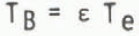
where ε is the emissivity and Te is the emitter temperature. Inspection of Figure 1 shows that Equation (1) with constant emissivity does not explain the data in the March-April-May time frame. Indeed, the variation in the warm season TB greatly exceeds likely temperature excursions. Thus, it is necessary to model the emissivity to interpret the data physically.
At 19.35 GHz a number of emissivity measurements and estimates have been made, and these are summarized in Reference Carsey and ZwaliyCarsey and Zwally (in press). In general, in the cold season, the ice types and emissivities are: first-year 0.92, old 0.82 ± 0.02, open water 0.5, and there are complications due to new ice which has an intermediate emissivity, to snow cover which reduces TB when dry and increases it when wet, and to clouds and precipitation which increase it. Thus, in winter TB can decrease because the open-water areal coverage increases, the cloud cover decreases, or more snow falls. At the ice margin, even in winter, the free-water content in the snow can vary sufficiently to produce a measurable change in TB; this may explain some of the behavior of the lowest plot taken from Fram Strait. The cold season data shown on the left have relatively little structure; there is a slight drop in TB at most sites during the early part of the season and a sharper increase toward the end.The small, 5 to 10 K, weekly time-scale bumps are not fully understood, but are thought to be due to a mixture of effects.
In the warm season, generalizations about the excessivity values cannot be made, because the ice surface is undergoing significant changes. These changes are reflected in the TB plots which are quite different from those of the cold season. It seems likely that the warm season is marked by five local maxima, as shown in the plot for 82°N 152°W (north Beaufort Sea). A speculative explanation for what is shown is as follows: bump 1, increase due to increase in Tice and decrease due to snow-crystal size growth; bump 2, increase due to snow wetness and decrease due to melt-pond formation; bump 3, increase due to pond drainage and decrease due to Toss by freezing of the skin of free water on hummocks; bump 4, increase due to pond freezing and to water skin forming on pond during day and decrease when water no longer forms; bump 5, increase due to freezing of leads and possibly to convergence of pack and decrease due to snowfall. Of these microwave events, only for the season containing bump 2 are there supporting in situ micro-wave and ice-character data; those obtained in summer 1982 as part of Radarsat/Free Flying Imaging Radar Experiment (FIREX) programs and not yet published. It is clear that the five bumps are not universally present, and it is proposed that this is due to differences in snow cover in different areas and, to a lesser extent, to the washout of maxima and minima due to local variation in seasonal advance within the 200 km grid.
The 19.35 GHz data from sea ice, like those in Figure 1, are of frequencies intermediate in terms of sensitivity to surface variables. Lower frequencies are less sensitive to ice types and snow cover, and higher frequencies are more sensitive to the surface conditions and less sensitive to the general ice-water contrast. It would be very useful to see data at 85, 37, 22 and 10 GHz, all usable frequencies for space observations, plotted in the same format as in Figure 1 in order to develop an understanding of the range of variation and sensitivity.
The Seasat data set contains data of that sort for the summer season and for latitudes below about 78°N. Figure 2 shows Synthetic Aperture Radar (SAR) images of the ice edge of the eastern Beaufort Sea in July and in October with overlays of TB for 18 and 37 GHz and scatterometer (SASS) data at 14.6 GHz. In all plots, the sensitivity to the ice/water change is apparent, and for 37 GHz there is indication of seasonal change in TB. The 37 GHz data have a surface resolution dimension of about 20 km, the 18 GHz of about 40 km, and the SASS of about 50 km; the SAR image itself is 100 km square; thus, the band of open water, which is the lined, white field in the image between Banks Island on the far right and the ice pack, is not truly resolvable, except possibly at 37 GHz. The SAR images have a resolution dimension of 25 m and are usually analyzed by a semi-intuitive pattern recognition method with the result that a feature must be substantial in size, perhaps 100 m, to be resolvable. This would mean that the analysis would miss perhaps 1/3 of the open water/thin ice,1% of the area, in the cold season (Reference HallHall 1980), and a negligible portion in the summer, when about 15% of the surface is open.
The ice margin of the eastern Beaufort Sea as recorded by SAR image and overlay of 18 and 37 GHz passive and 14.0 GHz active microwave (SASS) data, all from Seasat in 1978. Resolutions are SAR: 25 m; SASS: 50 km; 37 GHz: 20 km; 18 GHz; 40 km. The lines are isotherms and the numbers are in Kelvin except for the SASS figure for which the units are dBs.

The nature of the 37 GHz data at the margin is reiterated in Figure 3 showing the ice edge of the western Chukchi Sea in October. In this figure, the bright region in the center is taken to be open water, the dark featureless region to be grease ice, the grey area broken by lacy lines to be pack ice, and the bright, wavy lines to be pancake ice growing at the margin. In the 37 GHz overlay, the pancake ice is seen to be the brightest feature in the image by about 10 K. The microwave structure of a growing packice edge is thus probably resolvable.
Seasat SAR and 37 GHz SMMR overlay for the western Chukchi Sea in fall 1978. The dark area is taken to be grease ice, the bright, wavy lines at upper left and along the edge to be pancake ice, the white zone to be open water, and the grey area with lines to be pack ice with ridqes.

5 Target Areas for Research
Research should be initiated to develop measurement techniques for four areas of microwave observation of the sea-ice seasonal cycle. These are related to measurements of snow cover, surface albedo, ice production and atmospheric water. The following section will examine each of these areas in more detail.
5.1 Snow cover
The snow cover on sea ice has a relatively dependable annual cycle. The precipitation occurs almost entirely in the fall months. The snow blows about and the upper layers of snow grind into smaller particles over the winter and spring; there is formation of depth hoar (the angular growth of deeper crystals by vapor diffusion from the warmer ice surface (see Fig.1)) all winter; this is followed by firnification or rounding and growth of snow grains and ice in spring, wetting of snow in the form of water layers on the grains in early summer, ponding of bulk liquid’ water at the base of the snow, and finally the melt of the snow and formation of melt ponds usually in later June. The climatology of snow has been reviewed by Barry (unpublished work), and the surveillance of snow cover on land by passive microwave techniques has been examined by Reference Chang, Foster, Hall, Rango and HartlineChang and others (1982).
The remote sensing of dry snow is a multifrequency analysis in which the lower frequencies are sensitive to the characteristics of the substrate, and the higher frequencies, 37 and 85 GHz, are sensitive to the snow-crystal size while both ranges are sensitive to the water equivalent. For snow on land, in simple geometry, an error of ±5 cm thickness is obtainable; for snow on ice, there are complications of varying thickness, as shown in figure 4 from Reference Hibler, Ackley, Weeks and KovacsHibler and others (1972), of the snow-crystal size variation with depth, and of the possibly significant amounts of brine that have been observed in snow over first-year ice (Reference Ramseier, Gloersen, Campbell, Chang, Kondratyev, Rabinovich and NordbergRamseier and others 1975). Snow over land is characterized by layers of crust, which contribute to the thickness error, within the snow cover. These layers are caused by warm periods being followed by snowfall. It is not known if these occur to the same extent over sea ice. In general, it appears that the approach which has been used to estimate snow cover on land should be used for the snow cover on sea ice with appropriate care taken for uneven cover and varying grain size. The issue of brine in snow calls for further theoretical work. The overall task of estimation of snow cover on sea ice calls for intensive field work including examination of Southern Ocean ice/snow cover.
Typical spring snow cover on old ice in the central Beaufort Sea as recorded by Reference Hibler, Ackley, Weeks and KovacsHibler and others (1972).

The response of 37 GHz data to dry snow cover is particularly interesting. From the results of Reference Ulaby and StilesUlaby and Stiles (1980), the emissivity of snow-covered land can vary 0.12 for snow depth comparable to that of sea ice, and changes in grain size can account for as much as 0.1 change in emissivity. Thus, the snow cover on the ice is a quite significant variable in the net emissivity; it cannot be ignored if this frequency is to be used for any purpose.
Wet snow, that is snow grains having a thin coat of water, is very bright (see Fig.1 or Reference Ulaby and StilesUlaby and Stiles 1980). This change in T g is useful only to mark the onset of the melt in time (Reference Chang, Foster, Hall, Rango and HartlineChang and others 1982).
5.2 Surface albedo
The significance of the surface albedo is well known; in fact, the radiation balance controls the heat balance. This is also discussed by Reference Maykut and UntersteinerMaykut and Untersteiner (1971) who show specifically that the value of the summer albedo of old ice is critical to the survival of ice to summer’s end. Measurements of albedo, required for about half the year in the Arctic and three quarters of the year in the Southern Ocean, are rare. Values for the south-eastern Beaufort Sea have been published by Reference WendlerWendler (1973), for fast ice by Reference LanglebenLangleben (1968), and for pack ice by Reference Pautzke and HornofPautzke and Hornof (1978). Values from space such as those by Wendler are influenced by cloud and atmospheric effects while surface data such as Pautzke and Hornof’s are contaminated by instrument problems. Neither of these approaches will provide a basin-wide measurement without an impractical level of investment.
There is no direct method of measurement of surface albedo by microwave methods; however, it is feasible to use microwave methods to classify the surface into fractional areas of features and to identify a typical surface albedo for each feature. In summer, the surface of the Arctic Ocean is covered by melt-ponds, leads, hummocks and ridges. If the explanation (above) of the passive microwave behavior of the pack in summer is correct, theTB values associated with bump 3 describe melt-pond areal coverage when used in conjunction with the linearized brightness temperature equation

with

and

where εh and εR are emissivities of hummocks and ridges, Toh and ToR their temperatures, Ah, AR, AL, and Ap are fractional areal coverages of hummocks, ridges, leads and ponds, TBL and TBP the brightness temperatures of leads and ponds, τ is the atmospheric opacity, TA is the mean atmospheric temperature, TSp is the brightness temperature of free space and <ε> is the mean surface emissivity. This set of equations is not solvable unless some simplifications can be made such as the combining of hummocks and ridges and of leads and ponds. There is good reason to believe such simplifications can be made. What is not at all certain is that the net surface albedo created from such a classification, or a similar one done by active microwave analysis, will be useful since it requires application of typical albedo values with uncertainties.
5.3 Ice production
Ice production at the pack edge has potential for passive microwave measurement as is shown in Figures 2 and 3. Within the pack, initial ice production in fall can be estimated (Reference CarseyCarsey 1982), but during the cold season the production of new ice, the formation of ridges, the advection of ice, and the melting of ice in warmer water is very difficult to monitor. Fine-resolution imagery for the estimation of open water production will provide suitable data, and could be used in conjunction with passive microwave scanning to indicate the form that changes in open water, new ice and heavy ice coverage would take in that data set; the fine resolution data can explain what is being seen in the coarse resolution data, as is shown in Figures 2 and 3. In addition, the use of fine-resolution images will enable exact calculation of such processes as open-water production associated with vortex motion, shear zones, and ice-shore interaction.
5.4 Atmospheric water
Water vapor and suspended liquid water influence the measured microwave emissivity as well as other radiation. In the microwave, an atmosphere of a given opacity absorbs radiation proportional to how much is upwelling and emits radiation proportional to its own temperature. Thus, unless the surface is composed of a perfect blackbody, the atmosphere adds to TB, as in the case of sea ice. The sensitivity of TB to water is frequency-dependent, suggesting that measurement of suspended water is practical as has been shown for lower latitudes. The examination of atmospheric TB with microwave data is inevitably a complex iteration cycle between the relatively sensitive channels which see more atmosphere and the relatively insensitive channels which see more ice. The value of the work will lie in recording the variability and mean of the atmospheric water for different regions and different seasons in order to improve accuracy of other estimates requiring microwave analysis. The calculation could also conceivably alter heat budget equations through changes in propagation in the visible and IR spectra.
6 Conclusion
Clearly, the active and passive microwave data sets over sea ice can provide much more information about the seasonal cycle of sea ice and its environment. In order to portray accurately the key elements of the seasons, the microwave and thermal properties of the surface must be carefully modeled, and focused field studies must be undertaken to obtain the precise microwave behavior of various ice features in the critical seasonal transitions. At the present time the snow cover and the melt-pond cover seem to be the most important variables amenable to space surveillance.
The research described in this paper was carried out by the Jet Propulsion Laboratory, California Institute of Technology, under contract with the National Aeronautics and Space Administration.



