


Dietary patterns are related to many chronic diseases, including obesity, diabetes and CVD( Reference Palacios, Joshipura and Willett 1 ). However, accurate measurement of dietary intake is difficult to perform and considered one of the major methodological problems in nutritional epidemiological studies( Reference Tarasuk and Brooker 2 ). Dietary assessment methods that adequately describe and quantify intake, minimize systematic error and provide reasonably precise estimates of variability between individuals and/or groups are needed( Reference Willett 3 ) to explore associations between diet and disease( Reference Malekshah, Kimiagar and Saadatian-Elahi 4 ).
The FFQ is a widely used tool to obtain qualitative, descriptive information on usual food consumption patterns in epidemiological studies, due to its relatively low cost, time effectiveness and ability to measure usual consumption of nutrients in large populations( Reference Willett 3 ), although some investigators have questioned its use( Reference Illner, Freisling and Boeing 5 ). For an FFQ to be valid, it should consist of a list of foods typically consumed by the population of interest, including estimation of the portion size and appropriate recipes for preparation of these foods; it should also use an adequate food composition database for calculating nutrients from the list of foods included to use a reference period representing usual intake( Reference Cade, Burley and Warm 6 ). Therefore, it is necessary to establish the reproducibility and validity of each new FFQ for each new population group assessed( Reference Willett 3 ).
There are several validated FFQ for the US population, including the Harvard/Willett FFQ, the National Cancer Institute (NCI)/Block Health Habits and History Questionnaire, the Block FFQ and the NCI’s Diet History Questionnaire( Reference Subar, Thompson and Kipnis 7 ). However, few dietary assessment methods are designed specifically for the Puerto Rican population. Studies have shown that the dietary patterns of Puerto Rican adults differ from those in the general US population and that these differences in dietary pattern invalidate the use of other FFQ with this group( Reference Tucker, Bianchi and Maras 8 ). An adapted version of the NCI/Block FFQ was culturally adapted and validated for its use with Puerto Ricans aged ≥60 years living in Boston, MA, USA( Reference Tucker, Bianchi and Maras 8 ). It was also validated specifically for carotenoid intake against plasma carotenoids( Reference Bermudez, Ribaya-Mercado and Talegawkar 9 ), for vitamin E intake against plasma α-tocopherol levels( Reference Gao, Martin and Lin 10 ) and for vitamin B12 intake against plasma B12 levels( Reference Kwan, Bermudez and Tucker 11 ). However, there could be differences in dietary patterns between Puerto Ricans living in the continental USA and those living on the island, because of differences in availability of local foods and acculturation. Therefore, the objective of the present work was to assess the relative validity and reproducibility of an adapted version of this FFQ in a group of Puerto Rican adults living in Puerto Rico.
Materials and methods
Study population
Participants included a convenience sample of students, employees and faculty members of the Medical Sciences Campus of the University of Puerto Rico, who replied to study announcements posted around campus and sent by email. Inclusion criteria were age 21 years or older and being a student, employee or faculty member at this academic institution. Exclusion criteria were major diet changes in the past 6 months, unstable weight over the past 2 months, previous involvement in a dietary assessment study, or health conditions that affect memory and/or food selection. The inclusion and exclusion criteria were assessed with a screening form. The study was approved by the Institutional Review Board of the Medical Sciences Campus of the University of Puerto Rico. Participants gave informed consent before the study began. We aimed for a sample size of 100 individuals, based on the sample sizes used in similar studies( Reference Malekshah, Kimiagar and Saadatian-Elahi 4 , Reference Sebring, Denkinger and Menzie 12 – Reference Friis, Kruger Kjaer and Stripp 14 ).
Study design
Participation in the study consisted of three visits. During the first visit, participants read and signed the consent letter, completed a sociodemographic questionnaire and underwent anthropometric measurements. During the second visit, participants completed the FFQ and received detailed instructions on how to complete the 6 d food record at home, the standard method chosen to assess validation. Participants completed these independently and brought their food records back to the investigators. The third visit was 30 d after the first FFQ; during this visit, participants completed the FFQ again and received a small compensation to cover the expenses related to the study.
Anthropometric measurements
Height was obtained during the first visit using a portable stadiometer (Charder HM200P Portstad Portable Stadiometer, Taichung, Taiwan) and recorded in centimetres. Weight in kilograms and percentage body fat were obtained during the first visit only using a bio-electrical impedance scale (BF-350 TANITA Body Composition Analyser, Arlington Heights, IL, USA), while participants were wearing light clothes and no shoes. Participants were asked to avoid the following: alcohol use 48 h before the first visit; intense exercise 12 h before the first visit; eating or drinking (particularly caffeinated products) 2 h before the first visit; and, when possible, the use of diuretics for 7 d before the first visit. Participants were also asked to empty their bladder 30 min before the first visit. BMI was calculated as kg/m2.
Sociodemographic questionnaire
Participants completed a short questionnaire with demographic and socio-economic data. This included age (in years), sex and level of education (recorded as years of education).
Semi-quantitative FFQ
We adapted the semi-quantitative FFQ developed for Puerto Ricans living in Boston, MA( Reference Tucker, Bianchi and Maras 8 ) for Puerto Ricans living in Puerto Rico by adding foods typically consumed and produced locally, while deleting some foods that are not available locally or not typically consumed. The items added were cranberries, West Indian cherry, Spanish lime (also known as honey berry), Mallorca bread, cassava bread, Puerto Rican pasteles (meat pies consisting of a filling encased in a dough made of plantain or yucca, wrapped in a banana leaf), fritters (fried snacks made with meat, vegetable and seafood fillings), meat turnovers, viscera dishes (cuajito, morcilla and gandinga), local fish (red snapper, sea bass, sawfish), canned meat, cinnamon and adobo (spices and marinated food). The items eliminated were onion rings, rye bread, sour cream, cranberry sauce, rice crackers, plum juice and specialty sweet coffee drinks. The modified FFQ was composed of 193 items and was interviewer administered( Reference Cade, Burley and Warm 6 ). Respondents were asked to estimate the frequency of consumption of each item choosing from the following ten frequency categories: ‘never’, ‘less than once per month’, ‘once per month’, ‘2–3 times/month’, ‘once per week’, ‘2 times/week’, ‘3–4 times/week’, ‘5–6 times/week’, ‘once daily’ and ‘2 times daily’, using the preceding 12 months as the reference period. For certain items, several portion sizes were provided, so that participants could choose those most often consumed, with the help of three-dimensional food models (Nasco Life/Form® Food Replicas, Salida, CA, USA). In addition, for certain items, participants were asked if it was regular or wholegrain or if it was regular, reduced or without sugar/fat. Summary questions were also included at the end of each section (food group) and at the end of the FFQ on the use of salt at the table, most often used fat in cooking, frequency of dining out and the usual meal location. Open-ended questions were included for participants to specify the breakfast cereals and the type of breads most often consumed, and to specify frequently consumed foods not included. Finally, the FFQ included a section on supplement use, with questions on the use of nutrient supplements and multivitamins (four items), on the use of individual nutrients and supplements (thirteen items) and on the use of antacids (two items). Participants were asked to estimate the frequency (daily or occasionally) and duration (<1 year, 1–4 years, 5–9 years and ≥10 years) of use.
The program to convert the FFQ responses to food and nutrient intakes was written by an expert in nutrition programming from Northeastern University (Boston, MA, USA), who also scanned the FFQ (Opscan5; National Computer Systems, St. Paul, MN, USA) and transferred the data to electronic files. Nutrient profiles were calculated with the Nutrition Data System for Research (NDSR; program 2·8, version 25) developed by the Nutrition Coordinating Center, University of Minnesota (Minneapolis, MN, USA).
Food records
The 6 d food record was chosen as the reference method, based on the average number of days needed to assess most nutrient intakes in adults( Reference Nelson, Black and Morris 15 ), with inclusion of both weekday and weekend days. The food records were divided into breakfast, morning snack, lunch, afternoon snack, dinner and evening snack, with the times of consumption for each meal. In addition, the following columns were included: place of consumption, foods and beverages, quantity and preparation. Participants received detailed instruction on how to report the amounts of food and beverages consumed during the day. We also instructed the participants to record brands, cooking methods, ingredients used, any seasoning, gravy, dressing, sauces, butter and sugar added in the preparation of the foods consumed, with their respective amounts. Lastly, we instructed participants on how to record each food eaten at restaurants. Participants received written instructions, a sample of a completed diet record, a ruler and a portion size booklet with black-and-white drawings of actual serving portions, including images of spoons, bowls, cups and serving sizes of commonly eaten foods. These models aided participants in estimating portion sizes, to avoid over- or underestimation. A dietitian carefully reviewed the food records as participants brought their completed records back, for completeness and precision of the information. Each record was checked with participants for errors and omissions on specifying serving size, brands, type, etc.
Dietary data were analysed using the NDSR. Several recipes were created based on usual recipes from local cookbooks, such as for stewed beans, pan sobao (bread made with shortening), black beans, bacalaitos (salt cod fritters) and white rice. Participants with reported energy intake outside the range of 2510–20 920 kJ/d (600–5000 kcal/d) on the average of the two FFQ or the mean of the 6 d food records were excluded. To check for quality control, energy intake over the 6 d was analysed to ascertain any systematic trend towards under-reporting or to detect a possible effect of record-keeping on intake. No systematic trend was detected in energy or nutrient intakes during the 6 d of recording.
Statistical analyses
Descriptive analyses were used to assess the demographics of the study population. Nutrient data were not normally distributed; therefore, all nutrients were log transformed before analysis. Adjustment for energy was conducted to account for the confounding effect of total energy intake on other nutrients; this also provided some correction for the tendency of some individuals to regularly over- or underestimate portion sizes with the FFQ. Energy adjustment was done by computing residuals from regression models with nutrient intake as the dependent variable and total energy intake as the independent variable. The residuals were added to the expected nutrient intake for a participant with the mean energy intake( Reference Willett, Howe and Kushi 16 ).
Reproducibility between the first and second administration of the FFQ was assessed by paired t tests (two-sided). Associations between nutrient intakes from the FFQ and the mean of the 6 d food records were compared with Pearson correlation, paired t tests, cross-classification and Bland–Altman plots. The average of the two FFQ was used in all analyses, as an FFQ completed before the food records prevents the process of recording to be altered by an increased awareness of participants but comparing the food records with only the first FFQ could underestimate validity because the FFQ asks about past intake(
Reference Willett
3
). Therefore, use of the average from the FFQ before and after the food records allows for minimal and maximal estimates of true validity(
Reference Willett
3
). Also, day-to-day within-person variation in the food records can attenuate the correlations(
Reference Willett
3
). Therefore, the de-attenuated correlation was computed with the following equation:
 $$r^{{\asterisk}} =r_{0} \sqrt {[(1{\plus}intra_{x} /inter_{x} )/n_{x} ]} $$
, where r
0 is the observed correlation coefficient for any given nutrient between the two methods; intra
x
is the intra-individual variation; inter
x
is the inter-individual component of variance for each nutrient (which are derived from a repeated ANOVA); and n
x
is the number of days of food records(
Reference Willett
3
). Cross-classification analysis was used to assess the percentage of agreement and the ability of the FFQ to classify participants into similar quintiles of nutrient intake based on the results from the 6 d food records. For this test, quintile cut-off points were calculated for nutrient intakes, based on both methods, separately. Then, a cross-classification analysis was completed to identify the percentage of participants correctly classified (same quintile or within one quintile by both methods) or grossly misclassified (lowest quintile for one method and highest quintile for the other), and weighted kappa statistics (κ
w) and 95 % confidence intervals were calculated. The Bland–Altman plot was used to assess agreement between the two methods(
Reference Bland and Altman
17
). Briefly, this consists of plotting the difference between the methods against their mean, which allows investigation of any possible relationship between the measurement error and the true value, and detection of the direction of bias and whether it is constant across levels of intake. To interpret these plots, we used the categories reported by Watson et al.(
Reference Watson, Collins and Sibbritt
18
) for good agreement, when the difference between the two methods is about one standard deviation of the average nutrient intake from the 6 d food records; for fairly good agreement, when the difference between the two methods is about two standard deviations of the average nutrient intake from the food records; and for poor agreement, when difference between the two methods is about three standard deviations of the average nutrient intake from the food records.
$$r^{{\asterisk}} =r_{0} \sqrt {[(1{\plus}intra_{x} /inter_{x} )/n_{x} ]} $$
, where r
0 is the observed correlation coefficient for any given nutrient between the two methods; intra
x
is the intra-individual variation; inter
x
is the inter-individual component of variance for each nutrient (which are derived from a repeated ANOVA); and n
x
is the number of days of food records(
Reference Willett
3
). Cross-classification analysis was used to assess the percentage of agreement and the ability of the FFQ to classify participants into similar quintiles of nutrient intake based on the results from the 6 d food records. For this test, quintile cut-off points were calculated for nutrient intakes, based on both methods, separately. Then, a cross-classification analysis was completed to identify the percentage of participants correctly classified (same quintile or within one quintile by both methods) or grossly misclassified (lowest quintile for one method and highest quintile for the other), and weighted kappa statistics (κ
w) and 95 % confidence intervals were calculated. The Bland–Altman plot was used to assess agreement between the two methods(
Reference Bland and Altman
17
). Briefly, this consists of plotting the difference between the methods against their mean, which allows investigation of any possible relationship between the measurement error and the true value, and detection of the direction of bias and whether it is constant across levels of intake. To interpret these plots, we used the categories reported by Watson et al.(
Reference Watson, Collins and Sibbritt
18
) for good agreement, when the difference between the two methods is about one standard deviation of the average nutrient intake from the 6 d food records; for fairly good agreement, when the difference between the two methods is about two standard deviations of the average nutrient intake from the food records; and for poor agreement, when difference between the two methods is about three standard deviations of the average nutrient intake from the food records.
Sample size calculations were performed for energy and Ca with EpiInfo version 7·0·5. All analyses were performed using the statistical software package SAS version 9·1. Statistical significance was set at P<0·01, given the large number of non-independent statistical tests reported, to protect for the multiplicity of tests.
Results
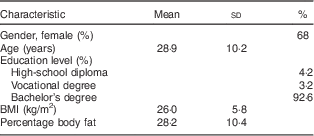
A total of 108 individuals were initially recruited to participate in the study; fourteen did not complete the 6 d food record or both FFQ and were excluded from the analyses; two additional participants were excluded based on reported energy intake outside the accepted range in the instruments used. Therefore, the total sample included in the present analysis consisted of ninety-two participants (85 %). Most participants were female (68 %), young adults (73 %) and with a bachelor’s degree (92 %; Table 1). A total of 45 % were normal weight, while 32 % were overweight and 23 % were obese.
Demographic characteristics of the study participants: a convenience sample of ninety-two Puerto Rican adults (≥21 years) from the Medical Sciences Campus, University of Puerto Rico, 2010
There were significant correlations for energy and for all measured nutrients between the first and the second administration of the FFQ, although results for the second administration tended to be systematically lower compared with the first administration (Table 2). The average correlation was 0·61, with values ranging from 0·43 to 0·73. Mean values for most nutrients did not differ significantly between the first and second FFQ, as assessed by the paired t test. The average difference between the two administrations was 4·8 %, from as low as 0·4 % for cholesterol to as high as 17·7 % for vitamin C.
Comparison of energy and energy-adjusted daily nutrient intakes as measured through two FFQ administrations among a convenience sample of ninety-two Puerto Rican adults (≥21 years) from the Medical Sciences Campus, University of Puerto Rico, 2010

RE, retinol equivalents.
* Percentage difference calculated individually as difference between the value obtained in the first FFQ and the value obtained in the repeated FFQ.
The energy-adjusted nutrient intakes from the average of the two FFQ were compared with the energy-adjusted nutrient intakes from the mean of the 6 d food records (Table 3). On average, there was a 16 % difference between these instruments, ranging from as low as 1·0 % for n 3 fatty acids to as high as 41·6 % for Na. To analyse how well both methods agreed, the correlation coefficients, comparing nutrient intakes from both methods, were calculated (Table 3). There were significant correlations between most nutrients from both methods, except for saturated fat, trans-fat, vitamin E, thiamin and n 3 fatty acids; the correlations improved when using the de-attenuation formula for repeated record days.
Comparison of energy and energy-adjusted daily nutrient intakes as measured through the average of the two FFQ and the mean of the 6 d food records (6dFR) among a convenience sample of ninety-two Puerto Rican adults (≥21 years) from the Medical Sciences Campus, University of Puerto Rico, 2010

RE, retinol equavalents.
* Percentage difference calculated individually as the difference between the value obtained from the FFQ and the value obtained from the food records.
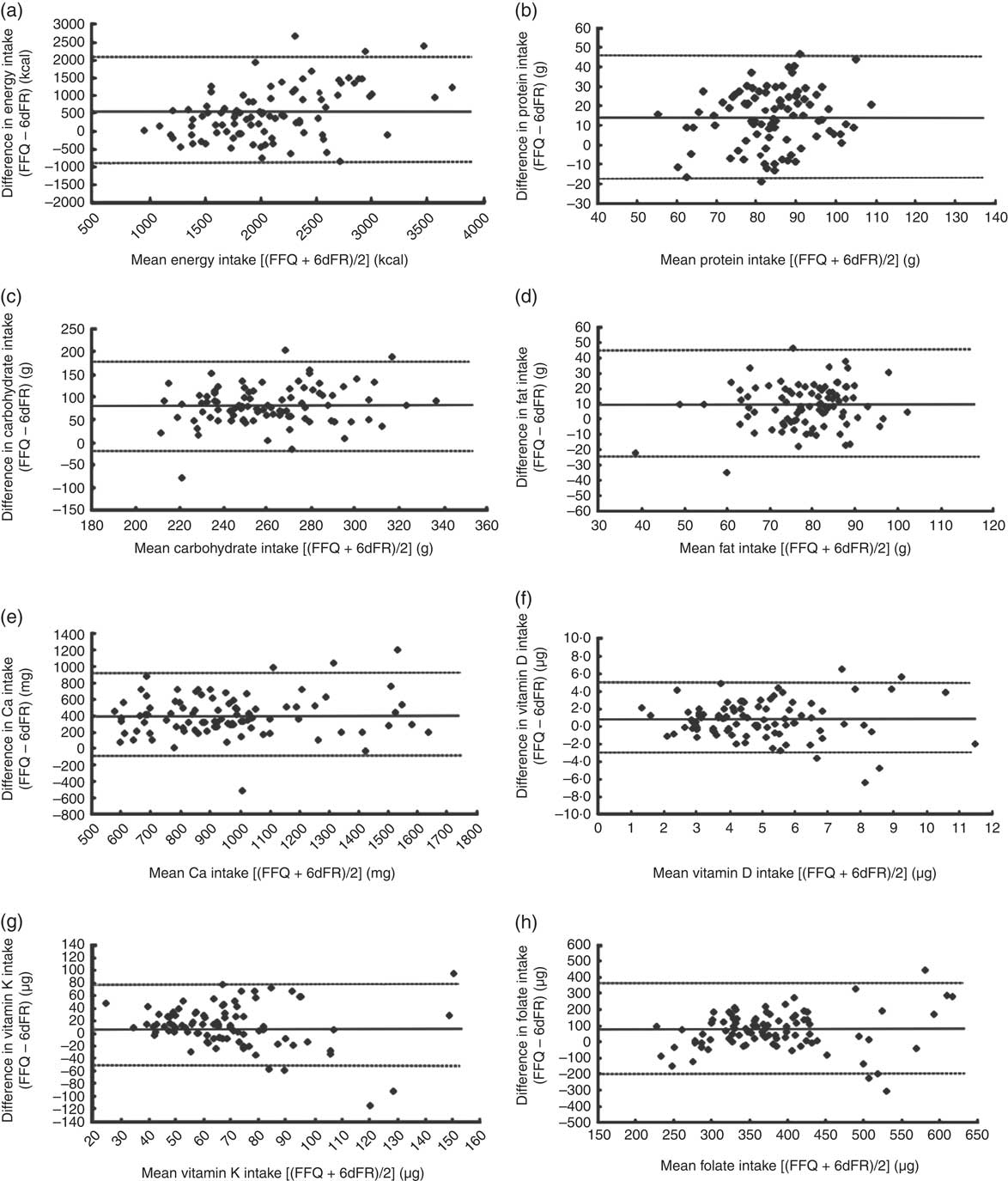
When considering if the methods agreed for individuals, the differences in nutrient intake between the FFQ and the 6 d food records were plotted against the mean nutrient intakes of the two methods for energy, macronutrients and for Ca, vitamin D, vitamin K and folate (Bland–Altman plots; Fig. 1). The points are scattered above and below zero in most plots, particularly for protein, fat, vitamins D and K and folate, suggesting that there was no consistent bias of one method v. the other. For energy, there was some bias towards a positive difference, suggesting that the FFQ provides a higher energy intake compared with the food record. Similar results were observed for carbohydrate and Ca. In addition, there was a trend of decreasing accuracy with increasing energy (i.e. over 10 460 kJ (2500 kcal)) for Ca, vitamins D and K and folate, as the scatter plots show over-dispersion at higher intakes, which further justifies the log transformation performed. When using the categories recommended by Watson et al.( Reference Watson, Collins and Sibbritt 18 ), we found that there was good agreement between methods for energy, protein, fat, vitamins D and K and folate, while there was fairly good agreement between methods for carbohydrate and Ca.
Bland–Altman plots assessing the relative validity of the newly developed semi-quantitative FFQ for estimating the daily intake of selected nutrients in a convenience sample of ninety-two Puerto Rican adults (≥21 years) from the Medical Sciences Campus, University of Puerto Rico, 2010. For each participant, the difference in intake between the average of the two FFQ and the mean of the 6 d food records (6dFR) is plotted against the mean intake from the two methods for: (a) energy (1 kcal=4·184 kJ); (b) protein; (c) carbohydrate; (d) fat; (e) calcium; (f) vitamin D; (g) vitamin K; and (h) folate. Lines —— represent the mean difference and lines - - - - - represent the 95 % limits of agreement. For energy intake, the mean difference between the two methods was 2193 kJ (524 kcal), with a 95 % CI of −4230, 8611 kJ (−1011, 2058 kcal); for protein, mean difference=14·6 (95 % CI −18, 47) g; for carbohydrate, mean difference=80 (95 % CI −18, 177) g; for fat, mean difference=10 (95 % CI −24, 44) g; for calcium, mean difference=396 (95 % CI −93, 885) mg; for vitamin D, mean difference=0·7 (95 % CI −3·0, 5·6) µg; for vitamin K, mean difference=12 (95 % CI −55, 79) µg; for folate, mean difference=83 (95 % CI −200, 367) µg
Comparisons of quintiles of energy-adjusted nutrient intakes by each method were used to assess the ability of the FFQ to classify individuals into the same or adjacent quintiles and to assess the degree of misclassification relative to the food record (Table 4). Most participants were correctly classified into the same or adjacent quintile (average of 66 %) by both assessment methods for energy and all nutrients studied. Gross misclassification was, on average, 3 %, with the highest for saturated fat (10 %). Values of κ w agreement ranged between 0·06 for thiamin (poor agreement) and 0·45 for Ca (moderate agreement).
Classification of participants into quintiles of intake: comparison between the average of the two FFQ and the mean of the 6 d food records among a convenience sample of ninety-two Puerto Rican adults (≥21 years) from the Medical Sciences Campus, University of Puerto Rico, 2010

RE, retinol equivalents.
Discussion
Several FFQ have been developed and validated for use in different populations. However, the particularity of Puerto Ricans’ dietary patterns led to the need to design and validate a culturally sensitive questionnaire. This is important, as other FFQ may not include ethnic-specific and staple foods consumed in Puerto Rico and may result in misclassification of dietary intake( Reference Tucker, Bianchi and Maras 8 ). Diet is a modifiable risk factor for many chronic diseases, and a valid FFQ could assess dietary intake to relate to such chronic diseases. Therefore, we assessed the relative validity and reproducibility of a modified FFQ, originally designed for use in the Puerto Rican population in the mainland USA, with a sample of Puerto Rican adults from San Juan, Puerto Rico.
The FFQ had good reproducibility, as shown by high correlations between nutrient intakes assessed across the two administrations of the instrument. In addition, most absolute values did not differ significantly between the two time points. The FFQ also appeared to provide valid estimates of most nutrients assessed when tested against 6 d food records. The absolute values differed significantly between the two methods, where the estimates from the FFQ were consistently higher than those of the 6 d food record with an average difference of 19 %. The Bland–Altman plots showed that the FFQ provided higher intake estimates for all nutrients compared with the food records, with relatively wide limits of agreement. Although the FFQ is being validated against multiple records with the latter as the standard in the present analysis, it is well known that records usually underestimate intake, due to changes in reporting across days( Reference Willett 3 ). In this case, the FFQ may, in fact, be more accurately reporting total energy intakes than the food record. Further validation with a biomarker, such as doubly labelled water, is needed to document this.
Nutrient estimates agreed well across methods, with significant correlations between energy and most nutrients. De-attenuation improved the correlations, with a mean correlation of 0·38, ranging from 0·11 for trans-fat to 0·63 for Ca. Most correlations were higher than 0·35 while only a few were less than 0·20 or not significantly correlated (vitamin E, thiamin, trans-fat and n 3 fatty acids). Macronutrient correlations ranged from 0·28 (carbohydrate) to 0·45 (energy). In addition, most participants were correctly classified into the same or adjacent quintile for all nutrients studied. The largest difference observed between the FFQ and the 6 d food record was for Na. The FFQ estimated Na intake as 41·6 % higher than the record. This may be related to the large variation of Na in processed v. home prepared foods and also to the difficulty estimating the amount of salt added when cooking and at the table. Nevertheless, the correlation between Na estimates from both instruments was good (r=0·47). The lowest correlations found were for fat-related nutrients, in particular for saturated fat, trans-fat, n 3 fatty acids and vitamin E. This may be related to the lack of type of fat reported on the food records for every meal.
Comparisons among studies can be difficult due to differences in sample size, age, sex, racial composition, educational background, design of the FFQ (e.g. number of food items, amount of open to closed questions, length of reference period of the recall) and the standard method used. Nevertheless, the correlation coefficients between the FFQ and the 6 d food record obtained in our study are comparable to similar validation studies for populations for whom the FFQ was designed( Reference Stram, Hankin and Wilkens 19 – Reference Kumanyika, Mauger and Mitchell 22 ), but considerably greater than those using a standard FFQ with Latino populations. Examples of the latter include the Insulin Resistance and Atherosclerosis Study FFQ validation (0·56 and 0·62 for energy and carbohydrates for non-Hispanic white v. 0·27 and 0·25 for Hispanics, respectively)( Reference Mayer-Davis, Vitolins and Carmichael 23 ); the Multiethnic Cohort FFQ (0·48 and 0·51 for energy and protein for non-Hispanic white men v. 0·33 and 0·27 for Latino men, respectively)( Reference Stram, Hankin and Wilkens 19 ); the Block FFQ (0·33 and 0·40 for protein and Ca in non-Hispanic white women v. 0·13 and 0·18 in Hispanic women, respectively); and the Harvard FFQ (0·53 and 0·62 for protein and Fe in non-Hispanic white women v. 0·09 and 0·15 in Hispanic women, respectively) – the latter two both in the WIC (Special Supplemental Nutrition Program for Women, Infants, and Children) dietary assessment validation study( Reference Block and DiSogra 24 ).
The Bland–Altman plots showed that the mean difference between the methods for most nutrients studied, particularly for energy, carbohydrate and Ca, was positive, suggesting a systematic overestimation of intakes obtained from the FFQ compared with the food record. The higher mean difference in energy intake from the FFQ was driven mainly by higher estimation of carbohydrate; although the correlation between the two methods was strong and statistically significant. However, this does not affect the ranking of individuals or the ability to use the data to relate to other variables. Although FFQ in general are considered to be semi-quantitative and are not assumed to be valid for assessing absolute quantitative nutrient intakes, they are useful for ranking individuals into categories of intake correctly. This was evidenced by the good agreement between methods in the cross-classification analysis according to quintiles of intake, as most participants (66 %) were correctly classified into the same or adjacent quintile of intake and only 3 % were grossly misclassified, with an average κ w value of 0·24. The highest proportion of participants correctly classified into the same quintile was for Ca and K (about 40 %); while for most other nutrients this ranged from 25 to 35 %. These results are comparable to other similar validation studies( Reference Vazquez, Alonso and Garriga 13 , Reference Friis, Kruger Kjaer and Stripp 14 , Reference Carithers, Talegawkar and Rowser 25 ).
There are some limitations to be considered in the present study. The sample size and its selection limit generalizability to the full Puerto Rican population, as in most validation studies. Most participants were women and this was a university-related population, with a high educational level; thus reproducibility and relative validity may also be higher compared with the full population. It is important to note that although the food record is one of the most used standards for dietary assessment, it is also subject to measurement error and may have presented a burden to participants, particularly as it included 6 d of intake. It is also known to result in underestimation of longer-term usual intake due to the focus on what is being consumed. Although the FFQ offers less detail on dietary intake, it is the most cost-effective method available for assessing usual intake and is, therefore, the most frequently used method for assessing diet in relation to chronic conditions( Reference Willett 3 ). The current study also has several strengths. The FFQ was validated against 6 d food records and each record was carefully reviewed by a dietitian for completeness and accuracy.
Conclusion
In conclusion, this semi-quantitative FFQ, previously validated with Puerto Ricans on the mainland USA, was also able to capture relatively valid and reproducible estimates of energy and most nutrients in a group of Puerto Rican adults living in Puerto Rico. The FFQ provided weaker results for selected nutrients, including vitamin E, thiamin, trans-fat and n 3 fatty acids. In addition, the FFQ estimates were systematically higher when compared with the reference, but it was good to rank individuals. This expands its use for descriptive and aetiological studies, and supports its use by nutritionists and dietitians in similar groups to assess intake in populations for relationships with chronic health conditions. This is particularly important in Puerto Rico, as the prevalence of obesity and diabetes are much higher than in other groups in the USA. Therefore, this relatively valid and culturally sensitive FFQ may be useful for implementing dietary interventions in similar Puerto Rican populations to better understand and improve diet-related health trends.
Acknowledgements
Acknowledgements: The authors wish to acknowledge Janice Maras for assistance with the dietary analysis. Financial support: This project was partially supported by the National Institutes of Heath (NIH; grant numbers 2G12-RR003051, S21MD001830, P01 AG023394, P50 HL105185 and K24DE016884). The NIH had no role in the design, analysis or writing of this article. Conflict of interest: None. Authorship: C.P., K.L.T. and K.J. designed the research; C.P., M.A.T. and J.B. conducted the research; C.P. and J.B. analysed data; C.P. and K.L.T. wrote the paper; C.P. had primary responsibility for final content. Ethics of human subject participation: The study was approved by the Institutional Review Board of the Medical Sciences Campus of the University of Puerto Rico; participants gave informed consent before the study began.



