


Introduction
Polar snow is stratified by atmospheric impurities such as radioactive debris from nuclear-bomb test series in the atmosphere and strong acids from major volcanic eruptions, which are the subject of this paper. The strong acids are important for their volcanic and climatic significance, and the radioactive debris for their usefulness in estimating the production of volcanic acids in major eruptions, The areal deposition pattern of bomb-produced total 8 activity is inferred from specific total β activity measurements on ice cores. Ice-core samples from various locations in Greenland were analyzed for specific total β activity, which originated from atmospheric nuclear-bomb tests in the early 1950s and 1960s. The Greenland locations are shown in Figure 1.
Map of Greenland locations where ice cores have been obtained for this study. HT, Hans Tavsen ice cap; CC, Camp Century; NS, North Site; NC, North Central; Su, Summit; Mil, Milcent; Cr, Crête; A, Site A; B, Site B; D, Site D; E, Site E; G, Site G; P20, Dye 3 pit 20; P36, Dye 3 pit 36; SD, South Dome.

The areal deposition pattern of volcanic strong acids is inferred from measurements of H+ and anion concentrations in snow layers, which are stratified by strong acids injected into the atmosphere by the A.D. 1815 Tambora (8°S) and the A.D. 1783 Laki (64°N) volcanic eruptions. The choice of these two eruptions for investigation is based on two considerations: a reasonable amount of data exists and both belong to the class of major eruptions.
Detailed stable-isotope analyses (δ18O) have been performed on all the ice cores presented, in order to provide a reliable dating of the ice. δ18O records exhibit seasonal oscillations in snow layers from regions where the annual rate of accumulation exceeds some 200 mm of ice equivalent per year. We obtain an absolute chronology by combining counting of δ18O annual oscillations downward from the top (Reference Dansgaard, Johnsen, Clausen and GundestrupDansgaard and others 1973), with fixed points determined by (for instance) bomb-produced radioactivity; see Figure 2, which shows a δ18O record (thin curve) and a total β activity record (thick curve) from location Summit in central Greenland.
The thin curve shows δ18O seasonal variations in the top 16 m of an ice core from location Summit, central Greenland, covering the period 1942-74, scale at bottom. The thick curve shows the measured specific total β activity (in disintegrations per hour per kg of ice, dph/kg), scale at top. The area above the natural background during e.g. 1962-66 represents the total β deposition from the atmospheric test series in the early ‘60s, corrected for radioactive decay.

Deposition of Bomb-Produced Total β Activity
The deposition of bomb-produced total β activity in the years 1962-66 and 1953-55 is of particular importance, because the total β activity in these years originates from geographically rather well-defined atmospheric bomb tests (the 1961-62 and the 1952-54 test series). Because the measurements were made at least 10 years after the bomb tests, the measured specific total β activities (in disintegrations per hour per kg of ice, dph/kg) are mainly due to 90Sr and 137Cs. According to the UNSCEAR Report (1982), the total fission yields from the atmospheric bomb tests in 1961 and 1962 were 102 MT TNT, mainly due to Russian test series at a high northern latitude (HNL) 75°N, and American test series at low northern latitudes (LNL) 17° and 2°N.
In 1952 and 1954 an atmospheric fission yield of 36.2 MT TNT was almost entirely due to American test series at LNL 11°N. Also according to the UNSCEAR Report (1982), production of the fission products 90Sr and 137Cs was 0.105 MCi/MT and 0.159 MCi/MT respectively. The yield distribution of the Russian and American test series and of the total bomb-produced β activity (the sum in MCi of the 90Sr and 137Cs produced) at HNL and LNL is shown in Table I.

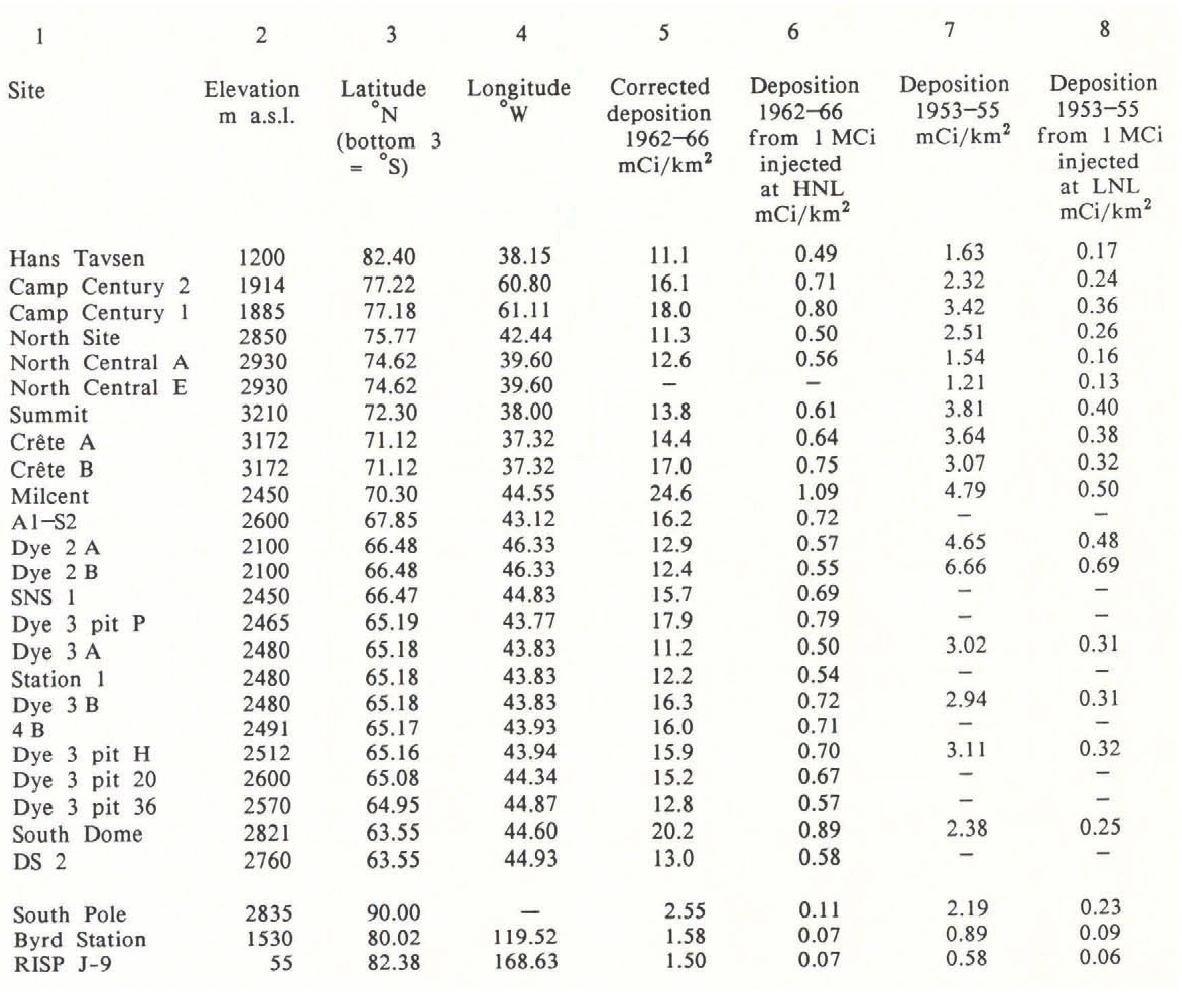
Detailed specific total β activity measurements were made on all ice cores from the Greenland locations listed in Table II. An example of one of these detailed records is shown in Figure 2 (thick curve). These total β activity measurements are the basis for the deposition rate values given in Table II. All measured values (e.g. in Fig. 2) are corrected for radioactive decay since formation (using a half-life of 29 years) and for natural β activity background. The background is mainly due to 210Pb and 40K (40K is the long-lived background component). For all sites the value of 150 dph/kg is used as an initial natural background (210Pb: 100 dph/kg; 40K: 50 dph/kg). In the following, the actual snow depths are converted into meters of ice equivalents, using the measured density profiles to calculate annual deposition rates. In order to estimate the HNL part of the 1962-66 deposition, the contribution from the LNL tests must be subtracted. The latter contribution is calculated as the ratio 16.5/36.2 of the 1953-55 deposition (LNL) (see Table I for the fission yields).
The deposition rates of bomb-produced total β activity (in mCi/km2) integrates the deposition over the years 1953-55 and over 1962-66. Table II shows the deposition rate for the period 1962-66 (from the Russian test series, 85.5 MT TNT at HNL in 1961 and 1962 (column 5)), and for the period 1953-55 (from the American test series, 36.2 MT TNT at LNL in 1952 and 1954 (column 7)). For comparison, data from a few locations in Antarctica have been added. In Antarctica the 5 year deposition period starts around mid-1963. The
 year shift is due to the inter-hemispheric stratospheric exchange of the radioactive debris which originated at HNL.
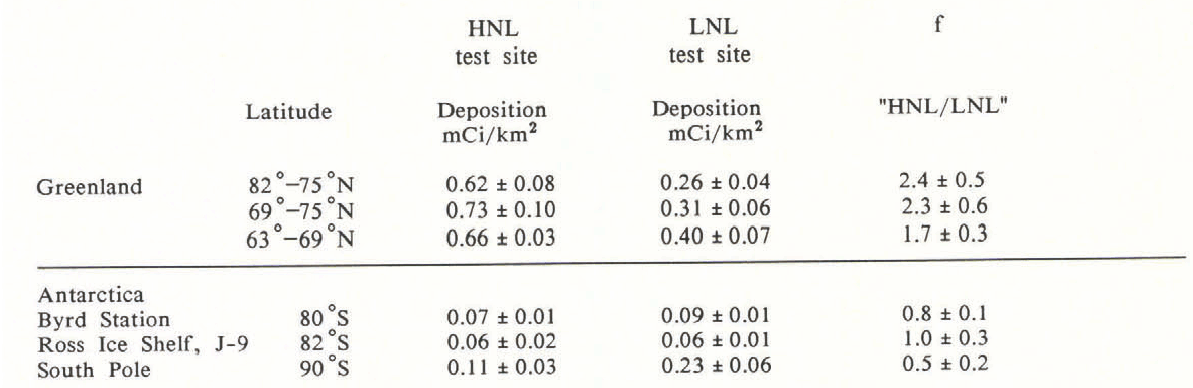
Columns 6 and 8 in Table II show the deposition rate which corresponds to the injection of 1 MCi of total β activity at HNL and LNL respectively. The deposition in the Milcent-Crête region shows a decreasing trend of some 40% in the west-east direction (see next section). This difference is explained by the accumulation at Crête being ≈40% less than at Milcent, whereas the specific total β activity is the same at the two sites. The data in columns 6 and 8 of Table II are further treated in Table III, where the Greenland data are averaged within latitude bands. The Antarctica values are means of 4, 13 and 2 sites in the vicinity of Byrd Station, J-9 and South Pole respectively. Table III then shows the deposition rate of total β activity at various latitude bands from a 1 MCi test at a HNL or LNL test site.
Table III shows, for Greenland, generally uniform deposition rates of bomb debris injected into the stratosphere at HNL and LNL. In Table III the ratio f between the deposition from a HNL and a LNL injection of a given magnitude is ≈2 in Greenland, and in Antarctica ≈1 and ≈0.5 for Byrd Station -J-9 and South Pole respectively.
The ratio between Greenland and Antarctica depositions from a HNL injection is ≈10 and 6 for Byrd Station -J-9 and South Pole respectively. This suggests that large volcanic events at HNL (e.g. Laki, Iceland) will be difficult to identify in Antarctic ice cores, even at South Pole, because the volcanic deposition is expected to be of the same order of magnitude as the background.
Deposition of Volcanic H2SO4
Detailed H+ concentrations were obtained by the ECM method (Reference HammerHammer 1980) from all the ice cores from Greenland locations, listed in Table IV. Furthermore, pH measurements were made on selected ice samples from the Laki and Tambora annual layers. Anion concentrations (SO4 2−, NO3 − and Cl−) were measured on four ice-core sequences which showed high acid concentrations due to the Laki eruption (Site A, Dye 3, 4B and 18C). Anion concentrations in acid layers caused by the Tambora eruption were measured at two sites (Site A and 18C). The data from 18C is from Reference Langway, Clausen and HammerLangway (1988, this volume). Along with these chemical ion-chromatographic analyses, liquid pH measurements were made and used to calibrate the ECM results. ECM data, converted into H+ concentrations (in μeq/kg) by the calibration mentioned above, are shown as the thick curves in Figure 3a and b for the time interval A.D. 1782-85 and A.D. 1815-18 respectively.
The thick curve shows the H+ concentration, in μ equivalent per kg of ice (μeq/kg), in the years around 1783 for the Greenland sites listed in Table IV, The H+ concentration is determined by the ECM method. The thin curve (Site A, Dye 3, 4B and 18C) shows the sum of nitrate and excess sulfate, which reflects the acidity of the ice. The vertical bars indicate the start of a calendar year as determined by seasonal δ 18O variations.


The anion analyses show that sulfate was the dominant anion during both eruptions. The nitrate level is similar to that found in other time intervals and other ice cores from central Greenland (Reference SteffensenSteffensen 1988, this volume). No increase of NO3 − takes place during the time of deposition of volcanic acid. Also the level of chloride concentration is similar to that observed in cores from other locations in Greenland (Reference Langway, Clausen and HammerLangway and others 1988, this volume). The thin curves in Figure 3a and b show the sum of NO3 − and excess SO4 2− concentrations in μeq/kg, excess SO4 2− is that left after the marine contribution has been removed. The marine contribution is defined as 0.10 × Cl− concentration, when it is assumed that all Cl− is of marine origin. This sum also reflects the acidity of the ice (Reference Finkel, Langway and ClausenFinkel and others 1986).

Based on the measured H+ and sulfate concentrations, we calculated the total deposition of volcanic H2SO4. This deposition is defined by the area above the background in Figure 3a and b. The results are listed in Table IV. Horizontal rows with the prefix L and T relate to data from Laki and Tambora respectively, and similar information is given in rows with the same number. Rows L1 and T1 show the mean concentration of H+ over the interval of the volcanic deposition (row L5 and T5). In a similar way, rows 2 and 3 express the background H+ concentrations and the volcanic H+ concentrations of the Laki and Tambora eruptions.
If we compare the volcanic H2SO4 depositions determined by the H+ and SO4 2− measurements for the two eruptions (Table IV, rows 8 and 10), we see that the two sets of data are in close agreement even though the H+ measurements are mainly based on a physical surface measurement (ECM), whereas the chemical data are based on “bulk” measurements.
If a similar comparison is made between the background H2SO4 depositions (rows 9 and 11), a clear difference is displayed. The H2SO4 background determined by the H+ method (row 9) is significantly higher than the background determined by the SO4 2− analysis (row 11), because HNO3 makes up a substantial amount of the natural-acidity background. Volcanic and background H2SO4. deposition values (58 and 50 kg/km2) for Tambora at Site A have to be corrected. This is because the anions were not measured over the entire ice-core sequence (see Fig. 3b, Site A). If corrected, the volcanic H2SO4 and background depositions (marked with an asterisk) are 41 and 23 kg/km2 respectively.
The west-east (Site D-Site B) change in the volcanic-acid deposition rates from the Laki and Tambora eruptions shows a decreasing trend of some 40%, similar to that found from the total β measurements. Quite different from this is the decreasing trend in volcanic-acid deposition of some 70% across the ice divide from Site B to Site E, where both volcanic-acid concentration and accumulation show decreasing trends. δ18O and accumulation-rate studies reported by Reference Clausen, Gundestrup, Johnsen, Bindschadler and ZwallyClausen and others (1988, this volume) imply that Site E is located in an accumulation “shadow” area, i.e. it has a relatively low rate of accumulation as compared to, for instance, the corresponding region west of the ice divide.
Estimate of the Magnitude of the Laki and Tambora Eruptions
The assumption of a similar global distribution pattern of the bomb-produced “total β activity” (i.e. 90Sr + 137Cs) and strong acids (e.g. H2SO4) injected into the atmosphere by violent volcanic activity at a given latitude, makes it possible to calculate the magnitude of the volcanic eruption in terms of millions of tons of H2SO4. The magnitude of the Laki and Tambora eruptions is calculated by comparing the volcanic H2SO4 deposition from these events with the total β deposition originating from known fission yields injected at HNL and LNL respectively (Table I).
All locations for which both total β data (Table II) and volcanic-acid data (Table IV) exist, are combined in Table V. The total β data used for Laki and Tambora are HNL and LNL values respectively.
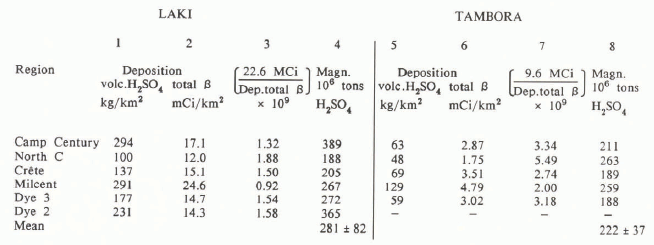
Column 3 in Table V shows that the HNL injection of 22.6 MCi total β activity (Table I), e.g. at Camp Century, is equal to 1.32 × 10⁹ times the total β deposition per km2 at this site. In a similar way, column 7 in Table V shows that the LNL injection of 9.6 MCi total β activity (Table I), e.g. at Camp Century, is equal to 3.34 × 10⁹ times the total β deposition per km2 at this site.
Calculated in this way, the total amount of H2SO4 injected by the Laki and Tambora eruptions is 280 × 106 tons and 220 × 108 tons respectively.
The standard deviations of the magnitudes listed in columns 4 and 8 in Table V correspond to 30 and 17% of the Laki and Tambora mean magnitudes respectively. Sastrugi (or snow-drift) noise in Greenland typically results in accumulation-series noise of about 40% of the yearly value (Reference Fisher, Reeh and ClausenFisher and others 1985), which to some degree must be reflected in the estimated magnitude.
The magnitude of the Tambora eruption is calculated to be 360 × 106 tons by Reference Langway, Clausen and HammerLangway and others (1988, this volume), based on Antarctic ice-core data from South Pole. Reference Legrand and DelmasLegrand and Delmas (1987) estimate the magnitude to be 150 × 106 tons of sulphuric acid, based on ice-core evidence from Dome C in Antarctica. Our estimate of the magnitude will probably underestimate the acid production because the total β injection and the volcanic eruption occur at different latitudes, i.e. the site of the volcanic eruption was more distant from Greenland than the bomb-test site, and the opposite is the case in Antarctica.
The magnitude of the Laki eruption may be overestimated because the gases ejected by this lava eruption barely reached the stratosphere and thus in this case the assumption of a similar distribution of volcanic gases and total β does not hold. This may also be the explanation of the difference between our estimate and that of Reference Hammer, Clausen and DansgaardHammer and others (1980) (a factor of 2-3), as they used the total β deposition over the year 1962 as a basis for their calculation. In the case of Tambora this error should not occur, because the acid gases reached the stratosphere.
Conclusions
The acid layers in Greenland ice from the two major volcanic eruptions, Laki (A.D. 1783) and Tambora (A.D. 1815), are easy to reach by shallow drilling and are therefore well suited for the study of deposition rates of volcanic acids. The suite of Greenland sites which has been investigated exhibits a uniform rate of deposition of total β activity from atmospheric bomb tests and of sulphuric acid from major volcanic eruptions (except for the regio nnorth-east of Crête, at Site E). Combination of the deposition patterns determined by bomb-produced total β activity and volcano-produced strong acid allows one to calculate the magnitude of these volcanic events. The total global deposited amount of sulphuric acid from the Laki and Tambora eruptions (281 and 222 × 106 tons respectively) is among the largest recorded in the continuous acidity record from Dye 3, which covers the last 10 000 years. The magnitude of the Tambora eruption presented here is in agreement with other reported values based on ice-core evidence from Antarctic data.
Acknowledgements
Thanks are given to the Commission for Scientific Research in Greenland, the European Economic Community (contract CLI-067 DK(G)) and the U.S. National Science Foundation, Division of Polar Programs, for financial support.



