

Introduction
Despite decades of advocacy for women’s workplace equity, their continued underrepresentation in STEM (Science, Technology, Engineering, and Mathematics) fields remains a major global challenge (Popo-Olaniyan et al Reference Popo-Olaniyan, Elufioye, Okonkwo, Udeh, Eleogu and Olatoye2022). Globally, in 2024, women accounted for approximately 28.2% of the STEM workforce in 146 countries and nearly 47.3% of non-STEM occupations (Society of Women Engineers 2024). Despite a 0.58% increase in the number of female STEM workers from 2015 to 2024, the gender imbalance remains significant. Cross-country evidence further underscores the global nature of these disparities. In the United States, women earn approximately 39% of STEM degrees but hold only 29% of STEM jobs (Mesi Reference Mesi2024). In the European Union, women represent approximately 27% of scientists and engineers, with notable gaps in leadership and research-intensive roles (Paksi et al Reference Paksi, Tardos, Takács, Suhajda, Mazancová, Bojnec and Kobolák2025). In Australia, women make up only 29.2% of the STEM workforce compared to 50% in non-STEM fields (Australian Bureau of Statistics 2025). Similarly, in Japan and South Korea, women account for less than 20% of STEM professionals, while in India and China, female representation in engineering-related fields remains below 25% (Greig Reference Greig2024). Existing research has sought to explain these numerical gaps, highlighting factors such as gendered educational pipelines, subject choice, social norms, and family formation patterns that shape who enters and completes STEM study. Building on this work, this review shifts the focus from entry into STEM to STEM workplaces themselves, synthesising evidence on workplace processes that shape the experiences of women who are already in, or qualified to enter, STEM employment.
Addressing gender inequity in STEM is critical not only for achieving fairness but also for driving economic growth, social progress, and innovation. Economically, gender disparities in STEM reduce labour market efficiency and limit the available talent pool, resulting in an estimated annual loss of trillions of dollars in potential global GDP (George Reference George2024). Socially, persistent underrepresentation restricts women’s access to high-skilled, high-paying roles, reinforcing broader patterns of income inequality and limiting their pathways to upward mobility (Moore Reference Moore2024). From an innovation perspective, diverse STEM teams have been shown to produce more creative solutions and enhance problem-solving capacity; the underrepresentation of women constrains the diversity of perspectives necessary for breakthroughs in science and technology (Smith-Doerr et al Reference Smith-Doerr, Alegria and Sacco2017). Together, these consequences underscore the urgency of fostering gender equity within STEM workplaces to enhance organisational performance, strengthen national economies, and promote inclusive societal development.
Women face significant barriers to entry, retention, and advancement in STEM fields, even when they possess equivalent qualifications and experience. These barriers include entrenched stereotypes about gender roles (O’Connell and McKinnon Reference O’Connell and McKinnon2021), limited access to mentoring and networking opportunities (Linehan and Scullion Reference Linehan and Scullion2008), pay inequality (Bird and Rhoton Reference Bird and Rhoton2021), lack of supportive workplace policies (Moser and Branscombe Reference Moser and Branscombe2022), the underrepresentation of women in leadership roles (Hideg and Shen Reference Hideg and Shen2019), and rigid workplace cultures that may favour male-dominated norms (Croft et al Reference Croft, Schmader and Block2015). In many STEM organisations, expectations of long hours, project-based work, and mobility requirements can further intensify these gendered barriers.
Efforts to address these challenges have gained momentum, but inclusive initiatives remain under-implemented or inadequately tailored to the diverse needs of women. Generic organisational policies aimed at supporting diversity and inclusion often fail to account for the heterogeneity of women, particularly in STEM fields, where nuanced challenges require tailored and proactive measures (Palid et al Reference Palid, Cashdollar, Deangelo, Chu and Bates2023). For example, mentorship and sponsorship programmes, while increasingly common, are not always geared towards women and do not adequately address their unique needs (Durbin and Tomlinson Reference Durbin and Tomlinson2014). Beyond mentorship and sponsorship programmes, women in STEM workplaces may also have distinct needs related to household labour, eldercare, community obligations, caregiving responsibilities, and psychological safety (Diekman et al Reference Diekman, Steinberg, Brown, Belanger and Clark2017; Settles et al Reference Settles, O’Connor and Yap2016). Flexible work arrangements, parental leave, and parenting support – which are critical for many women juggling work and family responsibilities – are often non-existent or under-implemented in STEM workplaces (Cech and Blair-Loy Reference Cech and Blair-Loy2019). These gaps hinder women’s ability to thrive and prevent individuals from pursuing or remaining in STEM careers.
The literature on barriers and inclusive initiatives in women’s employment is growing. However, it remains fragmented across disciplines, with studies often siloed into specific fields, such as sociology, psychology, and organisational studies. This fragmentation limits the development of a cohesive understanding. Only a limited number of narrative reviews focus on gender equity in STEM, and these typically address either education pipelines or isolated workplace factors rather than providing a comprehensive analysis of both barriers and inclusion strategies (Makarem and Wang Reference Makarem and Wang2020; Verdugo-Castro et al Reference Verdugo-Castro, García-Holgado and Sánchez-Gómez2022). There is a lack of comprehensive research consolidating this body of work to understand the full scope of barriers, their outcomes, and effective responses. Addressing these gaps is essential to provide more targeted and effective interventions for women’s employment in STEM and to foster workplaces where women can thrive and contribute equitably. The purpose of this review is to identify and map the available evidence from the literature related to the following questions:
-
(1) What are the barriers to women’s employment in STEM workplaces?
-
(2) What are the outcomes of barriers to women’s employment in STEM workplaces?
-
(3) What are inclusive organisational initiatives for women’s employment in STEM workplaces?
To address the research objectives, we conducted a systematic literature review of the barriers and inclusive initiatives impacting women’s employment in STEM workplaces. Given the fragmented and interdisciplinary nature of this research domain, a systematic literature review was deemed appropriate to identify, evaluate, and synthesise the available evidence (Snyder Reference Snyder2019). Systematic reviews are beneficial for consolidating existing knowledge, identifying research gaps, and providing evidence-based insights. To address the theoretical gap, the present study conducts a systematic review of 44 interdisciplinary publications, identified through a PRISMA (Preferred Reporting Items for Systematic Reviews and Meta-Analyses)-guided search across Web of Science, Scopus, APA PsycInfo, and Business Source Complete. These publications were screened and appraised in Covidence against predefined inclusion and exclusion criteria, to map the full spectrum of barriers, their outcomes, and evidence-based organisational initiatives that shape women’s employment in STEM workplaces. The insights from this study contribute to advancing theoretical frameworks, informing organisational policy, and guiding future research priorities aimed at fostering equity and inclusion.
The remainder of this paper is structured as follows. The section ‘Methodology’ outlines the methodology for this systematic literature review, which follows a rigorous and transparent process to identify, categorise, and synthesise evidence. The section ‘Results’ presents the findings, organised into three main categories: barriers, their outcomes, and inclusive initiatives. The section ‘Discussion’ discusses the implications of these findings, identifies gaps in the current research, and proposes directions for future study. The section ‘Conclusion’ concludes by summarising key insights and offering recommendations for policymakers, organisations, and researchers to foster equity and inclusion in STEM workplaces. Finally, Section ‘Limitation’ outlines the limitations of the review.
Methodology
This study employs a systematic literature review to critically examine the existing literature on barriers to, and inclusive initiatives for, women’s employment in STEM workplaces. The systematic literature review provides a comprehensive understanding of a topic by systematically identifying, evaluating, and synthesising all relevant studies (van Dinter et al Reference van Dinter, Tekinerdogan and Catal2021). This approach not only collates existing knowledge but also identifies research gaps, highlighting areas that require further investigation (MacDonald Reference MacDonald2013). This methodology is instrumental in business research, where the volume of published research is growing exponentially and often appears fragmented due to the field’s interdisciplinary nature (Snyder Reference Snyder2019). This challenge is exemplified in the current study. Systematic literature reviews can inform evidence-based decision-making by providing a potent synthesis of current evidence, enabling researchers and practitioners to make well-founded conclusions and recommendations (Briner and Walshe Reference Briner and Walshe2014). Furthermore, the systematic literature review process ensures rigour and minimises bias, enhancing the credibility and reliability of the review’s findings (Pare et al Reference Pare, Tate, Johnstone and Kitsiou2016).
Literature search and inclusion criteria
This review identifies three categories of literature relevant to the theme: exclusion or inclusion, women’s employment, and STEM workplaces. Specifically, this study focuses on empirical research at the intersection of these three knowledge systems, which enhances the reliability and applicability of the review’s findings. We conducted searches in comprehensive databases, including Web of Science, Scopus, APA PsycINFO, and Business Source Complete, to ensure that this systematic literature review captured the full range of relevant publications. This approach aligns with established methodologies in similar studies, such as Jennings et al (Reference Jennings, Zhao, Faulkner and Smith2024), which emphasise the importance of utilising multidisciplinary databases to provide a robust and inclusive foundation for literature synthesis (Jennings et al Reference Jennings, Zhao, Faulkner and Smith2024). In these databases, this study utilised Boolean connections for multiple keywords, ensuring consideration of possible variations. The Boolean operators detailed in the title, keyword, and/ or abstract search terms are as follows: (‘Exclusi*’ OR ‘Barrier*’ OR ‘Inclusi*’ OR ‘organi?ational initiatives’ OR ‘organi?ational policies’ OR ‘organi?ational practices’) AND (‘Wom?n* Employ*’ OR ‘Femal* Employ*’ OR ‘Wom?n* Job*’ OR ‘Femal* Job*’ OR ‘Wom?n* Career’ OR ‘Femal* Career*’) AND (‘Scienc*’ OR ‘Technolog*’ OR ‘Engineering’ OR ‘Mathemati*’ OR ‘STEM’).
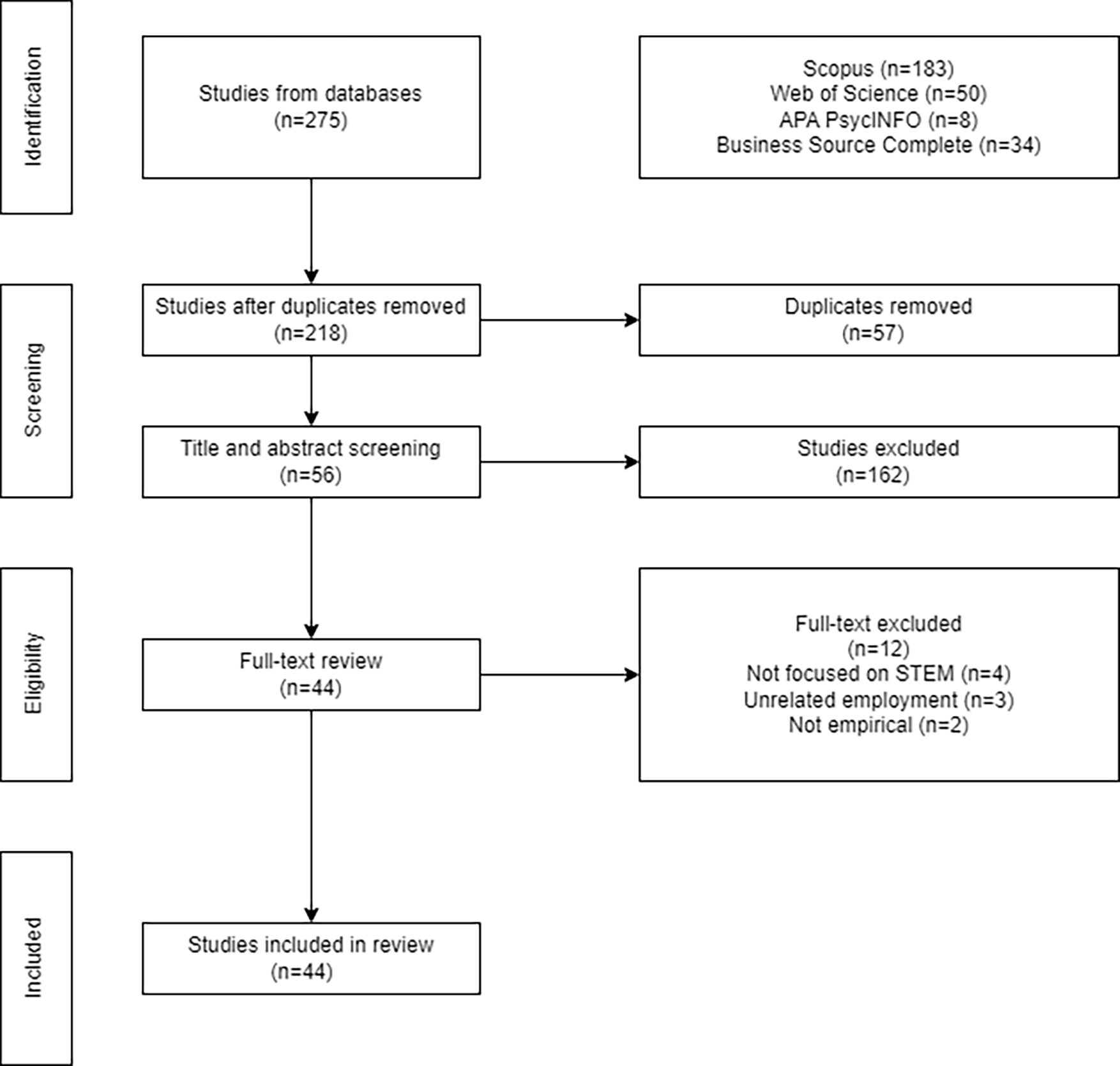
After conducting the Boolean operator search, non-English-language studies, non-peer-reviewed studies, and non-empirical studies were excluded using the screening protocols of these databases. This initial search yielded 275 publications, which were recorded and collated in Covidence, an online screening and data extraction tool. After removing duplicates, 218 publications remained in the data pool. Although our initial intention was to be wide-ranging, aiming to encompass a broad and diverse range of studies, it is important to recognise that research on women’s employment in STEM workplaces is highly dispersed; other publications may exist outside the scope of our search. This limitation underscores the inherent challenge of synthesising literature from a multidisciplinary and dispersed field.
Exclusion criteria
At the screening stage, this review focused on whether the publications referred to issues related to women’s employment, STEM workplaces, exclusion, and/or inclusion in the title and abstract. Where it was unclear whether a paper met this criterion, it remained in the study at this stage. According to this criterion, 162 publications were excluded and 56 publications remained.
Moving to the eligibility stage, we expanded the review from title and abstract to full-text review of these 56 publications. The full-text review examined the publications on the following exclusion criteria: (1) the publication focuses on non-STEM workplaces, including academic citation patterns, education, public health, and industries requiring limited formal training; (2) the publication focuses on academic progress and career aspirations, which are not directly linked to employment; and (3) the publication is not an empirical study. After applying these criteria, 12 publications were removed, and ultimately, 44 were used for the next step.
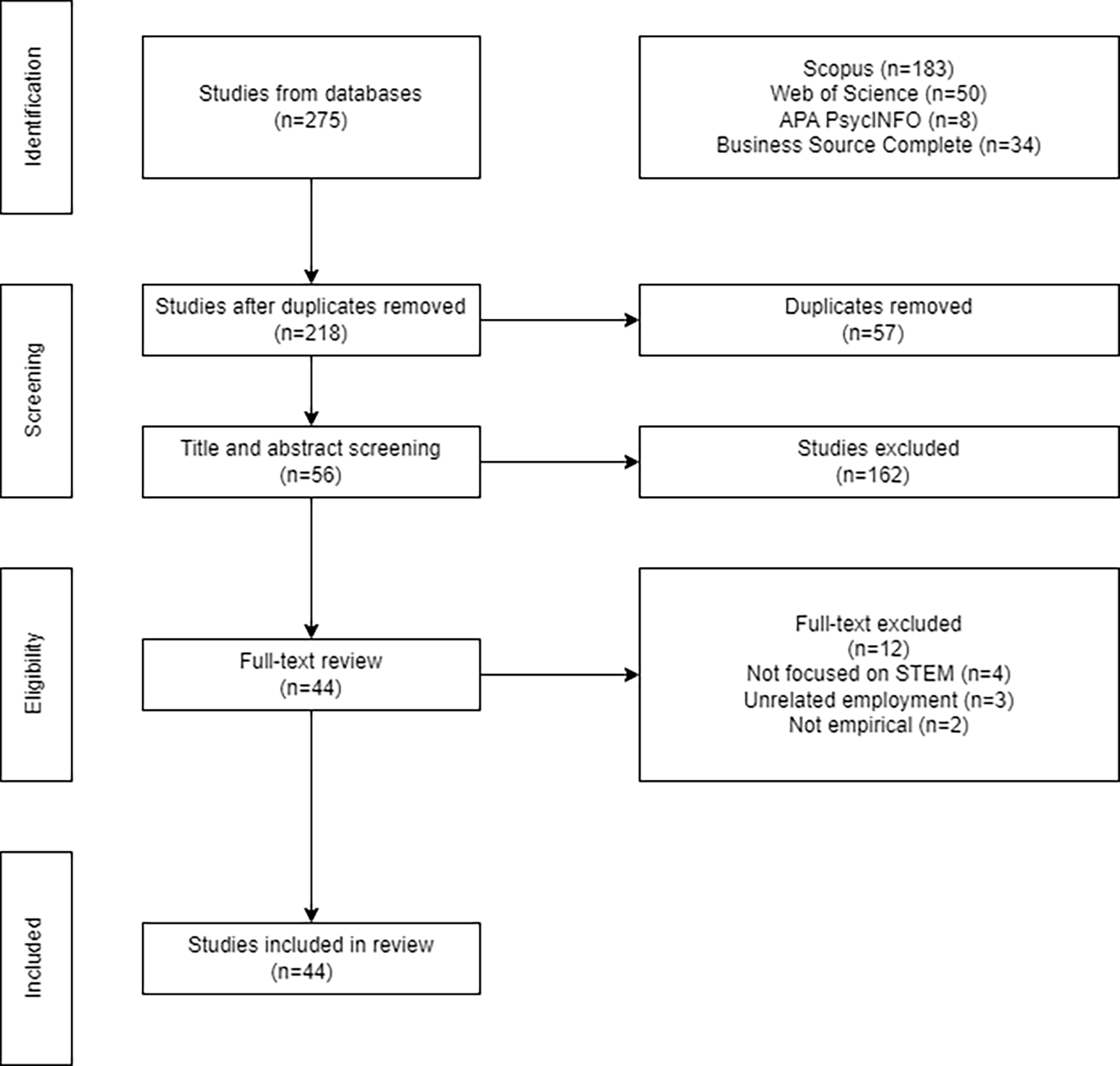
The PRISMA extension is highly useful for ensuring the rigour, transparency, and reproducibility of this systematic literature review (Batten and Brackett Reference Batten and Brackett2022). PRISMA provides a structured framework for developing and reporting reviews, helping to standardise the methodology and clarify the review process to readers (McMeekin et al Reference McMeekin, Wu, Germeni and Briggs2020). A PRISMA flow diagram (Figure 1) visually summarises the review process, detailing the identification, screening, eligibility, and inclusion of studies. By adhering to PRISMA guidelines, the review aligns with established best practices, enhancing its credibility and allowing readers to understand and replicate the research process.
PRISMA flow diagram.
Results
Interest and publisher
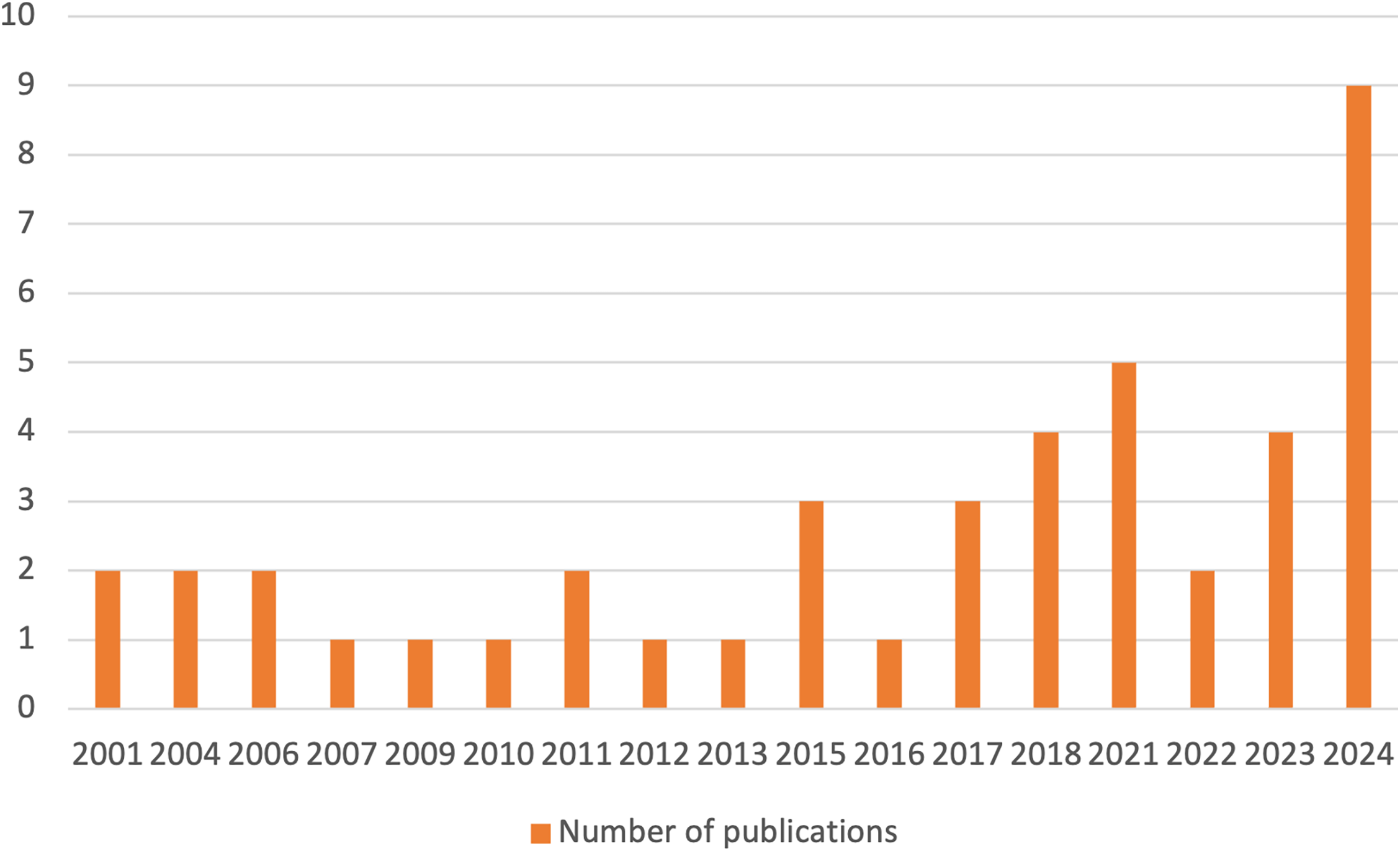
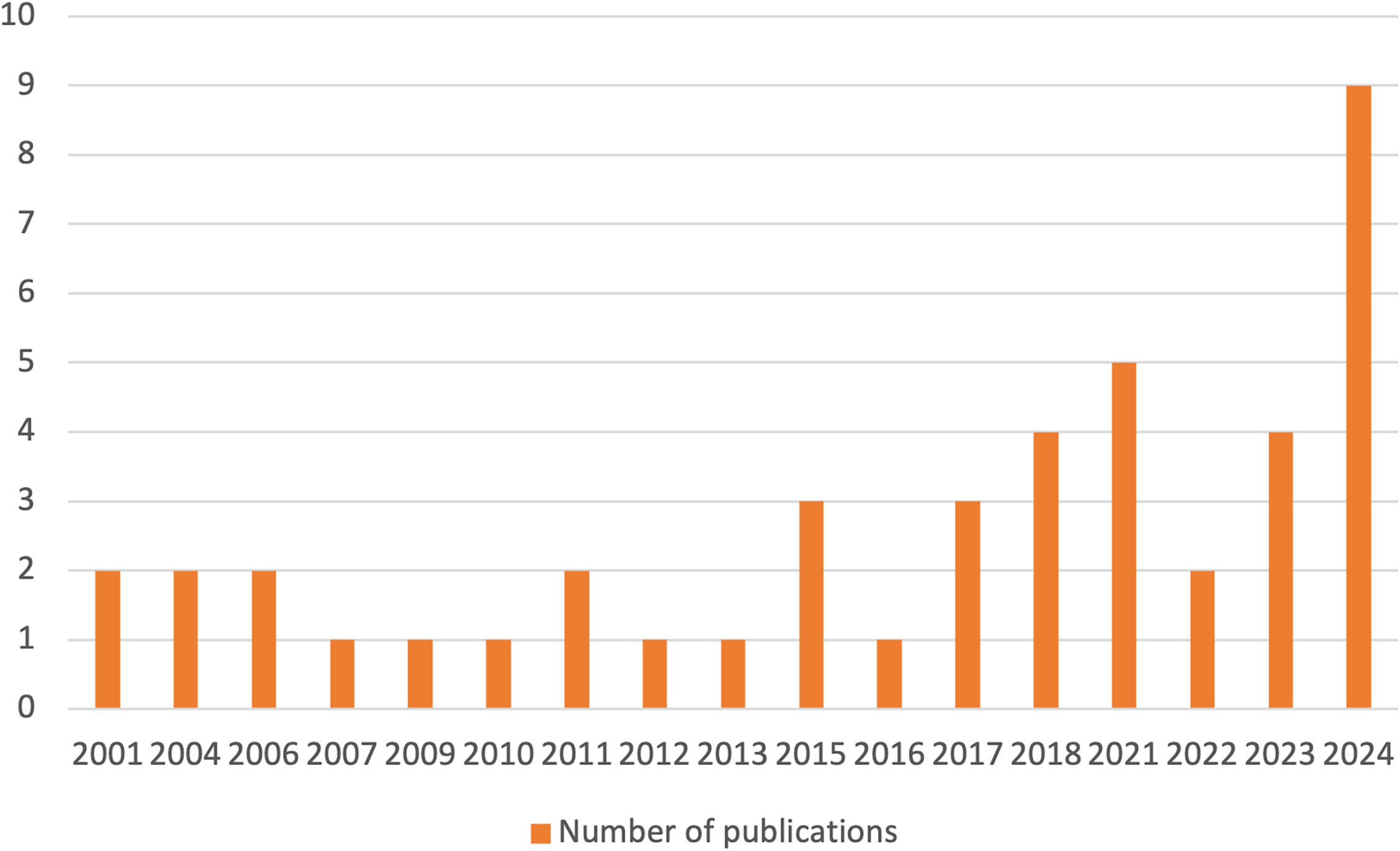
In recent years, there has been a growing academic interest in the exclusion and inclusion of women in STEM workplaces. Figure 2 illustrates the trend in the number of publications over time. The earliest publication dates back to 2001, demonstrating more than 20 years of research in this field.
The number of publications with yearly trends.
The 44 publications identified for this review appeared in 41 journals spanning diverse disciplines, including organisational behaviour, sociology, psychology, gender studies, and STEM-specific fields, underscoring the interdisciplinary nature of the research. Among these, three publications were published in Gender, Work & Organization. Two publications appeared in Equality, Diversity and Inclusion. To account for variations in publication quality, each reviewed article’s source journal was assessed using the Scimago Journal & Country Rank, which provides an objective, citation-based measure of journal quality and impact. The ranking details are presented in Appendix A.
Theoretical frameworks and methodology
Theoretical frameworks varied widely across the 44 studies, though a few prominent models recurred. Social Cognitive Career Theory (5) was among the most frequently employed lenses, guiding multiple investigations of women’s STEM aspirations and careers. Intersectionality-based frameworks (5) were equally prominent, with several studies explicitly examining how gender intersects with race/ethnicity and other identities to shape STEM experiences. Beyond these, many papers drew on feminist and gender-role theories – for example, standpoint feminism (3), gender schema theory (1), social role theory (1), and role identity theory (1). A few other conceptual models were invoked more sporadically (e.g., social exchange theory (2 studies), ecological systems theory (1 study), and Herzberg’s two-factor model (1 study)), reflecting the diverse theoretical approaches in this literature. Notably, eight studies did not explicitly identify a guiding theory, underscoring the inconsistent theoretical anchoring across the research corpus.
The reviewed studies employed diverse methodological approaches, with qualitative designs (23) being the most common, followed by quantitative (13) and mixed-method (8). Within the qualitative group, interviews dominated (semi-structured, unstructured, in-depth, and expert), complemented by case studies, surveys, grounded theory, and knowledge synthesis. Quantitative studies primarily relied on surveys, regression analyses, and experiments, while mixed-method designs integrated interviews with surveys to triangulate insights. Participant samples spanned both educational and professional contexts, ranging from undergraduate women in STEM to senior professionals across sectors. This distribution highlights a firm reliance on qualitative inquiry, supplemented by quantitative and integrative approaches to capture the complexity of women’s experiences in STEM. More information is provided in the full list of reviewed studies in Appendix A.
Findings
Identified barriers
Among the 44 publications, 25 addressed barriers to women’s employment in the STEM workplace, which can be categorised into four groups: bias-related barriers, stereotype threat, cultural barriers, and structural barriers. Ten publications address bias-related barriers to women’s employment in STEM workplaces, highlighting factors such as gender (Cundiff et al Reference Cundiff, Ryuk and Cech2018), race (Kachchaf et al Reference Kachchaf, Ko, Hodari and Ong2015), and age (McGee Reference McGee2018). Women from lower socio-economic backgrounds face compounded disadvantages in STEM fields due to limited access to quality education, professional networks, and information about STEM career pathways (Francis and Michielsens Reference Francis and Michielsens2021; Miller Reference Miller2004). Women with disabilities encounter additional barriers, including accessibility challenges in laboratories and field sites and pervasive negative stereotypes regarding their capabilities in STEM disciplines (Cyr et al Reference Cyr, Bergsieker, Dennehy and Schmader2021). Moreover, women with caregiving responsibilities or those who are married are often disadvantaged by hiring and promotion practices in STEM organisations that valorise constant availability and long working hours (Demaiter and Adams Reference Demaiter and Adams2009; Lapan and Smith Reference Lapan and Smith2023). Individuals from the LGBTQ+ community also face exclusion in STEM fields, where traditional gender roles and heteronormative expectations may be reinforced by conservative organisational cultures and informal networks (Bansal and Axelton, Reference Bansal and Axelton2025; Paquin and Fassinger Reference Paquin and Fassinger2011).
Stereotype threats (including leadership stereotypes and social identity threats) are identified in five studies as common barriers to women’s employment in STEM workplaces. In contexts where technical excellence is framed as an ‘innate’ ability and the ideal worker is implicitly coded as male, women are more likely to encounter doubts about their technical credibility, heightened scrutiny of their performance, and assumptions that men are better suited to demanding STEM roles (Cadaret et al Reference Cadaret, Hartung, Subich and Weigold2017; Cundiff et al Reference Cundiff, Ryuk and Cech2018). These stereotype-laden expectations operate at the level of everyday interactions, evaluation criteria, and informal commentary in STEM workplaces (Kachchaf et al Reference Kachchaf, Ko, Hodari and Ong2015). Implicit and explicit biases in performance appraisal, project allocation, and leadership selection further shape how women’s competence and potential are judged relative to their male peers in STEM roles (Amon Reference Amon2017; Cardador and Hill Reference Cardador and Hill2018).
Seven studies report that a negative organisational culture in STEM workplaces constitutes a distinct barrier to women’s employment. Exclusionary behaviours, microaggressions, and sexual harassment are embedded in some engineering, ICT, and research cultures and contribute to hostile or unwelcoming work environments for women in STEM organisations (Bolzani et al Reference Bolzani, Crivellaro and Grimaldi2021; Cross and Linehan Reference Cross and Linehan2006). Women are frequently excluded from informal technical networks and key project-based decision-making processes, particularly in teams and departments where social interactions revolve around male-dominated activities (McGee Reference McGee2018; Nash and Moore Reference Nash and Moore2024). Workplace norms that discourage or penalise flexible work arrangements are coupled with the project deadlines, long hours, and travel expectations common in STEM sectors, creating an organisational context that is less accommodating of employees with caregiving or other responsibilities (Bansal and Axelton Reference Bansal and Axelton2024; Gupta et al Reference Gupta, Raychaudhuri and Haldar2015; Miller Reference Miller2004).
Structural barriers (including policy-related prerequisites, organisational hierarchies, and resource allocation constraints) are explored in eight studies as significant obstacles to women’s participation and advancement in STEM employment. Women face significant barriers in accessing research resources, funding, and leadership roles, particularly within academia and high-tech industries, where hierarchical structures and competitive grant systems are strongly gendered (Herman Reference Herman2015; Paquin and Fassinger Reference Paquin and Fassinger2011). The absence of transparent and equitable policies governing remuneration, promotion pathways, and work expectations further entrenches gender disparities, placing women at a considerable disadvantage compared to their male counterparts (Siann and Callaghan Reference Siann and Callaghan2001). These workplace-level barriers are closely linked to earlier structural constraints in the education pipeline. Limited access to STEM subjects, gender-stereotyped guidance, and inadequate support for girls in primary and secondary education restrict their exposure to and preparation for STEM pathways (Baruah and Gaudet Reference Baruah and Gaudet2022; Cyr et al Reference Cyr, Bergsieker, Dennehy and Schmader2021; Francis and Michielsens Reference Francis and Michielsens2021). Table 1 in Appendix B summarises the types of barriers.
Outcomes of barriers
The 17 publications reveal that barriers have significant effects on women’s employment in STEM. Barriers related to gender, race, and disability contribute significantly to women’s underrepresentation in STEM workplaces, particularly in leadership roles. In six publications, these barriers are connected to patterns of underrepresentation, career mismatch, and attrition, where systemic biases and entrenched stereotypes steer women into roles that undervalue their skills and contributions or encourage them to exit STEM altogether. Gender, race, age, and disability-based exclusion significantly reduce the presence of women and other marginalised groups in influential STEM positions (Aslanbeigui et al Reference Aslanbeigui, Ramirez and Petchel2024; Miller Reference Miller2004). Systemic barriers, such as implicit biases and institutionalised stereotypes, can affect both men and women; however, the reviewed studies indicate that women are disproportionately pressured to accept roles that do not align with their qualifications, aspirations, or expertise, particularly in STEM workplaces (Cadaret et al Reference Cadaret, Hartung, Subich and Weigold2017; Khan et al Reference Khan, Soomro, Khan and Bodla2024). This misalignment not only stifles individual career growth but also perpetuates a cycle of undervaluing women’s contributions in STEM (Arslan and Kivrak Reference Arslan and Kivrak2004). Women with caregiving responsibilities or those from marginalised groups face compounded risks of exclusion and withdrawal from STEM employment due to rigid workplace policies and inadequate support systems (McNeely and Vlaicu Reference McNeely and Vlaicu2010).
Stereotype threat surrounding gender and technical competence is examined in seven publications and is consistently linked to negative psychological and career outcomes for women in STEM. Stereotype threat, where individuals fear confirming negative stereotypes about their social group, is associated with heightened stress and anxiety, reduced confidence, and lower expectations for long-term career persistence. While this phenomenon can affect individuals of any gender, the reviewed studies report more substantial effects for women in STEM workplaces, where stereotypes about technical competence and leadership potential remain particularly salient (Orser et al Reference Orser, Riding and Stanley2012; Turner et al Reference Turner, Bernstein, Taylor, Asangba, Bekelman, Cramer, Elton, Harvati, Williams-Hatala, Kauffman, Middleton, Richtsmeier, Szathmary, Torres-Rouff, Thayer, Villasenor and Vogel2018). These dynamics contribute to a self-reinforcing cycle in which women are less likely to put themselves forward for leadership roles, thereby perpetuating the stereotypes that restrict their advancement (Baruah and Gaudet Reference Baruah and Gaudet2022). Moreover, exclusive workplace environments exacerbate feelings of inadequacy or inferiority, even among highly qualified women (Cardador and Hill Reference Cardador and Hill2018; Luthar et al Reference Luthar, Kumar and Zillmer2020). Implicit and explicit biases further compound this issue, leading to unfair evaluations of women’s skills, contributions, and potential (McGee Reference McGee2018). These biases often manifest as limited opportunities for promotion, unequal recognition of achievements, and the undervaluation of women’s work (Bishu and Headley Reference Bishu and Headley2020).
There were seven publications that referenced women in STEM employment, highlighting the negative impact of workplace culture. Exclusionary behaviours, microaggressions, and sexual harassment in STEM organisations are associated with hostile work environments, negatively affecting women’s job satisfaction, productivity, and overall well-being (Cardador and Hill Reference Cardador and Hill2018; Villablanca et al Reference Villablanca, Beckett, Nettiksimmons and Howell2011). These behaviours not only undermine individual performance but also perpetuate a culture of inequity and discomfort, discouraging women from fully engaging in their roles or pursuing leadership opportunities (Harlow and Reyome Reference Harlow and Reyome2016). Exclusion from informal networks and key decision-making processes further marginalises women, limiting their influence, professional visibility, and access to opportunities for career growth (Bishu and Headley Reference Bishu and Headley2020). The lack of access to effective mentoring programmes exacerbates these challenges, as mentoring plays a crucial role in skill development, confidence building, and career advancement (Cozza Reference Cozza2011). Additionally, strict workplace policies and cultural biases that devalue or stigmatise flexible work arrangements disproportionately impact women, not only due to caregiving responsibilities but also because women are more likely to shoulder broader gendered expectations, such as household labour, eldercare, and community obligations (O’Connor and Cech Reference O’Connor and Cech2018). This rigidity often leads to increased stress, burnout, and eventual disengagement from the workforce (Macauley Reference Macauley2014).
Five publications showed how structural barriers further negatively impacted women’s employment in STEM. The persistent gender wage gap continues to economically disadvantage women, even when their qualifications and experience are on par with those of their male counterparts (Sassler and Meyerhofer Reference Sassler and Meyerhofer2023). Exclusion from promotion and leadership opportunities further restricts women’s access to senior roles, perpetuating gender inequality at the highest levels of decision-making (Kim Reference Kim2024). These systemic barriers, compounded by cultural factors such as implicit biases and exclusionary workplace practices, contribute to elevated turnover among women in STEM fields (Reggiani et al Reference Reggiani, Gagnon and Lunn2024). In addition, several studies indicate that limited access to leadership opportunities, inadequate mentorship, and unsupportive organisational cultures further exacerbate women’s decisions to leave STEM careers (Eagly Reference Eagly2021; Mesi Reference Mesi2024). This attrition represents a significant loss of talent, expertise, and diverse perspectives for organisations, ultimately impairing their ability to innovate and remain competitive in a global market. Furthermore, the lack of diversity within STEM teams narrows the scope of research and innovation, limiting the applicability and relevance of solutions to broader, more diverse populations (Graves et al Reference Graves, Kearney, Barabino and Malcom2022). Homogeneous teams are less likely to challenge established norms or explore alternative approaches, thereby missing opportunities for breakthroughs (Prieto-Rodriguez et al Reference Prieto-Rodriguez, Sincock, Berretta, Todd, Johnson, Blackmore, Wanless, Giacomini and Gibson2022). Table 2 in Appendix B summarises the types of outcomes.
Inclusive organisational initiatives
There were 19 publications related to inclusive organisational initiatives for women’s employment in STEM workplaces. For clarity, we categorise these initiatives based on their correspondence to bias-related barriers, stereotype threat, cultural barriers, and structural barriers.
Seven publications identified initiatives addressing individual and demographic traits to support diverse women in STEM. Providing mentorship to guide women’s career development and sponsorship to support their advancement benefits all women in STEM workplaces. However, these forms of support are particularly critical for women from underrepresented groups, who often face greater barriers to building professional networks and gaining visibility within organisations (Clarke Reference Clarke2011; Ruel Reference Ruel2018). Furthermore, training employees to recognise and address intersectional challenges (such as those faced by women of colour and LGBTQ+ individuals) is crucial (Atewologun et al Reference Atewologun, Sealy and Vinnicombe2016; Cross and Linehan Reference Cross and Linehan2006). These workshops raise awareness about implicit biases and equip participants with the skills to practise inclusive behaviours. Additionally, supporting employee resource groups and fostering partnerships with external organisations cultivates a sense of belonging (Biju and Pathak Reference Biju and Pathak2021; Gnilka and Novakovic Reference Gnilka and Novakovic2017; Randel et al Reference Randel, Galvin, Shore, Ehrhart, Chung, Dean and Kedharnath2018). These initiatives provide platforms for marginalised women to connect, share their experiences, and advocate for meaningful change.
Nine publications identified initiatives aimed at eliminating bias and reshaping perceptions of women in STEM. Stereotype threat reduction workshops can educate employees about the impact of implicit bias (Jackson et al Reference Jackson, Hillard and Schneider2014; Yates and Skinner Reference Yates and Skinner2021). These initiatives promote a more supportive and equitable work environment. Implementing structured and standardised recruitment processes helps eliminate gender bias in hiring (Sturm Reference Sturm2001; Wajcman and Lobb Reference Wajcman and Lobb2007). Tools such as gender-neutral job descriptions and anonymous application reviews have proven effective (Kemechian et al Reference Kemechian, Sigahi, Martins, Rampasso, de Moraes, Serafim, Leal Filho and Anholon2023; Kroese Reference Kroese2022). Encouraging employees to actively support women, challenge biases, advocate for inclusion, and participate in initiatives designed to reduce prejudice further enhances inclusivity (Kossek et al Reference Kossek, Su and Wu2017). Highlighting women’s achievements in STEM fields counters stereotypes about their abilities (Wang and Degol Reference Wang and Degol2017). Public recognition reinforces their value, and inspires others to pursue similar paths (Magee and Galinsky Reference Magee and Galinsky2008).
Five publications highlighted initiatives focused on cultivating inclusive and supportive organisational environments. Implementing flexible work arrangements, parental leave, and on-site childcare services helps accommodate diverse needs (Wang and Degol Reference Wang and Degol2017). Such policies enable women to balance their professional and personal responsibilities effectively. Building workplace alliances fosters a culture of inclusion and addresses microaggressions (Bohonos and Sisco Reference Bohonos and Sisco2021). Training programmes can teach employees how to act as allies and support their colleagues. Organising accessible and inclusive events ensures that all employees feel welcome, while avoiding initiatives such as after-hours gatherings that may exclude caregivers (Gabriel et al Reference Gabriel, Arena, Calderwood, Campbell, Chawla, Corwin, Ezerins, Jones, Klotz and Larson2022). Regularly assessing workplace culture is essential for identifying and addressing harmful behaviours such as exclusion or harassment, as well as for monitoring progress towards inclusivity goals (Barak Reference Barak2000). Ensuring women have equal opportunities to participate in high-profile and impactful projects helps prevent informal exclusion and promotes their visibility and influence (Thelma and Ngulube Reference Thelma and Ngulube2024).
Six publications identified initiatives aimed at enhancing career growth and financial equity for women in STEM. Introducing clear compensation policies and conducting regular pay audits are critical steps in reducing the gender pay gap (Castilla Reference Castilla2015). Transparency ensures that organisations are held accountable (Raza et al Reference Raza, Khokhar, Zubair and Rubab2023). Developing programmes to prepare women for leadership roles equips them with the skills needed to overcome challenges and excel in management positions (Ely et al Reference Ely, Ibarra and Kolb2011). Tracking the representation and advancement of women in STEM fields is equally important (Cheryan et al Reference Cheryan, Ziegler, Montoya and Jiang2017). Publicly sharing these metrics enhances the transparency and accountability of diversity initiatives (Castilla Reference Castilla2015). Creating structured career development pathways and offering upskilling opportunities can significantly improve retention rates for women in STEM (McDonald and Waite Reference McDonald and Waite2019). Tailored programmes that address specific challenges, such as balancing family responsibilities, are particularly effective in supporting their career progression (Mabkhot and Al-Ameryeen Reference Mabkhot and Al-Ameryeen2023). Table 3 in Appendix B summarises the types of initiatives.
Discussion
This systematic review aimed to map the existing literature on barriers and inclusion in women’s employment in STEM workplaces, identifying the types of barriers faced, their outcomes, and the range of inclusive organisational initiatives documented in the field. The publications included in the analysis were selected based on predefined methodological criteria, ensuring relevance and rigour. Although numerous studies have explored various interventions to address workplace barriers, relatively few have examined the direct outcomes of these initiatives in fostering inclusion, and there is limited evidence on their long-term impact. The application of theoretical frameworks was sparse, with much of the literature relying on foundational theories such as gendered organisations and intersectionality, while newer perspectives remained underutilised. This review highlights the predominance of challenges, including persistent characterisation biases, structural barriers, and exclusionary workplace cultures, which undermine the effectiveness of inclusive initiatives.
Key gaps include insufficient measurement of outcomes tied to workplace inclusion, the lack of a nuanced understanding of intersectional experiences, and the need for more innovative theoretical and practical approaches to sustain inclusive organisational change. These gaps persist for several reasons. First, measuring workplace inclusion and its outcomes remains methodologically challenging, particularly when linking organisational policies to long-term employment outcomes. Second, few studies fully integrate intersectionality into STEM workplace research due to data limitations and complex study designs. Finally, organisational and cultural resistance often slows the adoption of innovative inclusion practices, especially within male-dominated STEM environments. Addressing these challenges requires more robust methodological approaches, cross-disciplinary collaborations, and stronger policy and organisational commitments to foster systemic change.
Intersection dynamics of barriers
A significant contribution of this review was to provide an extensive mapping of the barriers to women’s employment in STEM workplaces, categorising them into four primary groups: characteristics, stereotypes, culture, and structure. While this review focuses on women’s overall experiences in STEM workplaces, intersecting factors such as race, socio-economic background, and caregiving responsibilities can amplify disadvantages for some groups of women. These characteristics are not standalone barriers but are amplified by systemic biases in STEM workplaces (Kachchaf et al Reference Kachchaf, Ko, Hodari and Ong2015). Similarly, women from lower socio-economic backgrounds struggle to overcome barriers due to limited professional networks and resources, perpetuating inequities even for those with comparable qualifications to their male peers (Bend and Fielden Reference Bend and Fielden2021). Stereotypes contribute to exclusion by undermining women’s confidence, fostering implicit biases, and perpetuating unequal evaluations of their abilities. These biases affect individual career progression and reinforce systemic norms that favour male-dominated leadership and technical expertise (Akanji et al Reference Akanji, Mordi and Ajonbadi2024). Workplace culture emerges as a significant barrier, often characterised by exclusionary initiatives, such as microaggressions, informal exclusion from decision-making processes, and rigid policies that fail to accommodate diverse needs. This toxic culture discourages women from pursuing long-term careers in STEM and contributes to high attrition rates (Ortiz-Martínez et al Reference Ortiz-Martínez, Vázquez-Villegas, Ruiz-Cantisani, Delgado-Fabián, Conejo-Márquez and Membrillo-Hernández2023). Structural barriers, including a lack of transparent policies on pay equity, promotions, and resource allocation, further entrench gender disparities (Smith and Sinkford Reference Smith and Sinkford2022). These barriers reflect broader systemic failures, starting from inequities in early STEM education, where girls are less encouraged to pursue technical fields.
Systemic outcomes of barriers
The findings of this review reveal a range of outcomes stemming from barriers to women’s employment in STEM workplaces. Together, they highlight the pervasive and systemic impact of these barriers on women’s representation, career trajectories, and organisational outcomes. Exclusion based on characteristics results in severe underrepresentation, career mismatches, and higher attrition rates among women in STEM fields. These issues are particularly pronounced in leadership and decision-making roles, where diversity is critically low. The phenomenon of stereotype threat, coupled with systemic pressures such as institutionalised stereotypes and implicit biases, often leads to heightened stress, anxiety, and reduced performance (Kossek et al Reference Kossek, Su and Wu2017). This discourages women from pursuing leadership roles, reinforces the very stereotypes that hinder their advancement, and compels them to accept roles misaligned with their expertise, stifling career growth and perpetuating the undervaluation of their contributions. A negative workplace culture also contributes to adverse outcomes. When workplace cultures are hostile, women report lower job satisfaction, reduced productivity, and poorer overall well-being (Miner-Rubino and Cortina Reference Miner-Rubino and Cortina2004; Sojo et al Reference Sojo, Wood and Genat2016). Strict workplace policies that stigmatise flexible arrangements and inadequate mentoring exacerbate stress and burnout, driving many women to disengage from the workforce. Structural barriers perpetuate systemic inequities, such as the gender wage gap, exclusion from promotion opportunities, and lack of leadership access. These barriers hinder women’s career progression and lead to elevated turnover rates in STEM fields, representing a significant loss of talent and innovation potential for organisations.
Fostering inclusion through organisational initiatives
This review provides insights into the barriers and their outcomes and emphasises the importance of inclusive organisational initiatives as a solution. It is insufficient – or even counterproductive – to address these barriers in isolation, particularly when developing effective interventions to promote inclusivity. For example, tackling structural issues without addressing cultural or stereotype-related factors risks perpetuating systemic inequities at different levels (Bo Reference Bo2019). At the organisational level, proactive initiatives may include the implementation of transparent pay structures, the revision of rigid workplace policies to accommodate caregiving responsibilities, and equitable access to leadership opportunities. At a relational level, initiatives such as mentorship programmes for underrepresented groups, bias training, and inclusion-focused leadership development can foster equitable workplace dynamics. The findings from this review suggest that sustainable change requires a comprehensive approach that integrates structural, cultural, and relational interventions to address barriers effectively. For instance, addressing cultural biases through allyship actions has the potential to create enduring organisational change (Warren and Warren Reference Warren and Warren2023). Examples of allyship actions include encouraging colleagues to advocate for fair recruitment initiatives or to challenge implicit stereotypes. Similarly, actions focused on improving early STEM education opportunities for girls from diverse socio-economic backgrounds can help mitigate structural inequalities at their root. By identifying these interconnected pathways, this review offers a roadmap for advancing inclusion and equity in STEM workplaces.
Suggestions for future research
The existing literature on women’s employment in STEM workplaces focuses more on the barriers and their outcomes, and research on inclusive initiatives is nascent. There are several key avenues for further exploration. Overall, both theoretical development and empirical research should be further developed.
Theoretical utilisation and development
This review identified significant gaps in the theoretical understanding and application of frameworks related to inclusive organisational initiatives in STEM workplaces. First, there is a need for stronger theoretical linkages between the mechanisms of inclusive initiatives and their outcomes. For example, while many studies explore interventions such as mentorship or stereotype threat reduction, there is limited theoretical exploration of how these initiatives translate into systemic change and measurable outcomes, including increased representation and improved workplace culture.
Second, further development of theoretical models is required to better understand the complex, non-linear relationships between elements of inclusion. Existing frameworks provide a solid foundation, but additional work is needed to incorporate intersectionality and diverse organisational contexts (Shore et al Reference Shore, Cleveland and Sanchez2018). Using systems theory or a social ecological approach could elucidate how contextual factors, such as organisational size, industry norms, and regional policies, act as barriers or facilitators of inclusion. Testing these frameworks across varied populations and workplace settings would enhance their applicability and robustness.
Ultimately, future research should strive to achieve greater consensus on the definition and operationalisation of workplace inclusion. The lack of an agreed-upon definition hampers the ability to measure and compare outcomes across studies. Utilising empirically tested inclusion scales and frameworks, such as Roberson’s inclusion conceptualisation, could help clarify the links between initiatives and outcomes, including feelings of belonging, authenticity, and emotional support (Roberson Reference Roberson2019). This theoretical clarity would advance academic understanding and inform the design of more targeted and effective inclusion strategies in STEM workplaces.
Empirical research directions
This review highlights critical gaps in empirical research on inclusive organisational initiatives in STEM workplaces, underscoring the need for evidence-based approaches to address systemic barriers. While theoretical models provide a foundation, empirical studies are crucial for validating these frameworks and examining their practical implications across diverse contexts.
First, more longitudinal studies are needed to assess the sustained impact of inclusive initiatives on women’s career trajectories and organisational outcomes. Many existing studies focus on short-term effects, leaving open questions about the long-term efficacy of interventions such as mentorship programmes, stereotype reduction workshops, and flexible work policies. Longitudinal research could also reveal how inclusive initiatives influence retention, leadership progression, and workplace culture over time.
Second, given that most of the reviewed studies relied on correlational evidence, future research should prioritise experimental and quasi-experimental designs to establish causal relationships. Beyond assessing the effectiveness of inclusion initiatives, it is equally critical to test how systemic barriers causally influence women’s career trajectories, leadership representation, and retention in STEM workplaces. For example, controlled trials could evaluate the effectiveness of stereotype threat reduction workshops or pay transparency initiatives. At the same time, intervention studies could measure the impact of structured hiring processes, such as anonymous application reviews, on reducing gender disparities in recruitment.
Third, cross-cultural and intersectional research is crucial to understand how inclusive initiatives operate in different settings and for diverse groups of women. Comparative studies across industries, regions, and organisational sizes would provide insights into the contextual factors that enhance or hinder the effectiveness of inclusion initiatives. Empirical research should also focus on how intersectional identities, such as race, socio-economic status, and LGBTQ+ identities, affect women’s experiences and outcomes in STEM workplaces.
Finally, there is a pressing need for improved metrics and tools to measure workplace inclusion and its outcomes. Existing measures often lack consistency, making it difficult to compare results across studies. Developing standardised inclusion scales that capture dimensions such as belonging, authenticity, and emotional support would facilitate more rigorous empirical testing. These tools would advance academic research and provide organisations with actionable data to monitor and improve their inclusion efforts.
Conclusion
This review synthesises the existing literature on exclusion and inclusion for women in STEM workplaces, focusing on the barriers, outcomes, and interventions designed to promote inclusion. Categorising the findings into four key areas – bias-related barriers, stereotype threat, cultural barriers, and structural barriers – this review highlights the multifaceted and interconnected challenges women face in STEM. These categories provided a framework for understanding how systemic inequities manifest and persist within STEM environments.
The review also explores inclusive initiatives that hold promise for promoting equity and belonging. Despite the potential of these initiatives, the review found significant gaps in their empirical validation and theoretical underpinnings. Inconsistent definitions and measurements of workplace inclusion further highlight the need for robust frameworks to guide research and implementation.
Future research should prioritise empirical studies that assess the long-term effects of inclusive initiatives on individual and organisational outcomes. Cross-cultural and intersectional perspectives are essential to ensure interventions are contextually relevant and address the diverse experiences of women in STEM. Developing standardised metrics to evaluate workplace inclusion would facilitate cross-study comparability and enhance the practical applicability of research findings.
In conclusion, this review’s findings provide a roadmap for advancing equity and inclusion in STEM workplaces. By addressing the systemic antecedents of exclusion and investing in evidence-based initiatives, organisations and researchers can create environments that support women’s success and drive innovation and competitiveness in STEM industries.
Limitation
Although the review focuses on workplace-related factors, we acknowledge that educational primary choice represents a critical upstream determinant of women’s participation in STEM. Future systematic reviews should explore how educational pathways interact with workplace dynamics to influence long-term career outcomes.
While this review focuses exclusively on studies examining STEM workplaces, we acknowledge that some identified barriers and inclusion practices may also occur in broader professional contexts. Future research should aim to compare STEM and non-STEM workplaces to clarify which patterns are STEM-specific and which are more general.
Supplementary material
To view supplementary material for this article, please visit https://doi.org/10.1017/elr.2026.10064.


 Open access

