





1. Introduction
1.1. Demonstrative variation in German
Demonstratives such as this and that are among the most frequently used words in language (Brysbaert & New, Reference Brysbaert and New2009). Research on their use in spoken communication has confirmed that demonstratives often play a pivotal role in establishing joint attention between interlocutors on a given referent (Diessel & Coventry, Reference Diessel and Coventry2020; Jara-Ettinger & Rubio-Fernandez, Reference Jara-Ettinger and Rubio-Fernandez2024; Levinson et al., Reference Levinson, Cutfield, Dunn, Enfield, Meira and Wilkins2018; Peeters et al., Reference Peeters, Krahmer and Maes2021; Skilton, Reference Skilton2024). Whether speakers select a proximal demonstrative (such as this) or a distal demonstrative (such as that), across languages, indeed often depends on whether a referent is already in the psychologically shared space between speaker and addressee (Peeters et al., Reference Peeters, Hagoort and Özyürek2015; Rocca et al., Reference Rocca, Wallentin, Vesper and Tylén2019; Rubio-Fernandez et al., Reference Rubio-Fernandez, Long and Özyürek2026). Similarly, when it comes to written language, it has been proposed that the degree of (presumed) accessibility of a referent in the mind of the reader would drive a writer to use either this or that in a given sentence (Ariel, Reference Ariel1990). Recent research, however, interestingly suggests that the discourse genre of a text is the main predictor of writers’ demonstrative choice, at least in Dutch, English and Mandarin Chinese (Maes et al., Reference Maes, Krahmer and Peeters2022a; Peeters et al., Reference Peeters, Schuurman, Zhai, Krahmer, Gu and Maes2025).
Here we further investigate this recent claim in German. There are two main reasons for why a focus on German in this domain can be considered theoretically relevant and important. First, there is a long tradition of studying writers’ demonstrative use in German, with mixed outcomes that have previously been theoretically difficult to integrate, as we will show below. Second, there exists an interesting asymmetry in the demonstrative system used in German written discourse. Like many languages, written German has two frequently used demonstrative variants, as proximalFootnote 1 demonstrative pronouns and determiners [diese (Frau), dieser (Mann), dieses (Kind); ‘this woman, this man, this child’] and adverbs (hier; ‘here’) can be distinguished from distal demonstrative pronouns (die, der, das; ‘that’) and adverbs (da, dort; ‘there’). However, written German is deprived of unambiguous distal determiners (e.g., die Frau, der Mann, das Kind) as written language lacks word stress to clearly indicate whether a definite article or demonstrative is intended. This asymmetry raises the question to what extent the proximal variant has taken over the function of a distal demonstrative, as has been claimed to happen for recognitional demonstratives, traditionally associated with distal demonstratives (e.g., in English, ‘Do you remember that guy we met in Paris’), but in German suggested to be taken over by the proximal term (e.g., Himmelmann Reference Himmelmann and Fox1996; Schumacher & von Heusinger, Reference Schumacher, von Heusinger, Riesberg, Reinöhl and Hellwig2026).
The variation between German proximal ( diese , dieser , dieses ) and distal ( die , der , das ) demonstrative pronouns has received detailed attention in a number of recent empirical studies (Bader et al., Reference Bader, Portele, Schäfer, Hörnig, von Wietersheim, Konietzko and Featherston2022; Bader & Portele, Reference Bader and Portele2019; Fuchs & Schumacher, Reference Fuchs and Schumacher2020; Patil et al., Reference Patil, Bosch and Hinterwimmer2020, Reference Patil, Hinterwimmer and Schumacher2023; Patterson et al., Reference Patterson, Schumacher, Nicenboim, Hagen and Kehler2022, Reference Patterson, Patil, Ventura, Lialiou, Schumacher and Hinterwimmer2025; Patterson & Schumacher, Reference Patterson and Schumacher2021; Schumacher et al., Reference Schumacher, Patterson, Repp, Gianollo, Jędrzejowski and Lindemann2022). In these studies, differences in use between the two types of demonstrative pronouns have been investigated both on the level of local discourse variables affecting the presumed accessibility and prominence of referents (order of mention: e.g., last mentioned vs mentioned earlier; syntactic function: e.g., subject vs object; thematic role: e.g., stimulus vs experiencer) and on the more global discourse level (e.g., the discourse modality or register at hand).
Compelling evidence for an effect of local variables is scarce. For example, proximal demonstrative pronouns, more so than distal ones, have been suggested to prefer the last-mentioned noun phrase (NP) in the previous sentence as their antecedent (Zifonun et al., Reference Zifonun, Hoffmann and Strecker1997 in Patterson & Schumacher, Reference Patterson and Schumacher2021). However, participants’ use of the two German demonstrative variants showed largely the same pattern in this regard in rating experiments using ditransitive contexts with three antecedents differing in prominence, as in example (1) (Patterson & Schumacher, Reference Patterson and Schumacher2021), and also in sentence completion experiments using sentences such as in example (2) (Bader et al., Reference Bader, Portele, Schäfer, Hörnig, von Wietersheim, Konietzko and Featherston2022). The latter experiments also showed the same behavior in situations in which this last-mention preference was overruled by thematic role preferences in implicit causality sentences. There is indeed growing agreement that der and dieser are quite similar in terms of local structural and semantic variables (Bader et al., Reference Bader, Portele, Schäfer, Hörnig, von Wietersheim, Konietzko and Featherston2022; Patil et al., Reference Patil, Hinterwimmer and Schumacher2023).
-
(1) Die Eigentümerin vermietete die Parkfläche dem Anwohner. Der/Dieser war froh über den langfristigen Vertrag. (Patterson & Schumacher, Reference Patterson and Schumacher2021, p. 1447)
The (female) owner rented the parking space to the (male) resident. ‘That’/‘This’ was delighted about the long-term contract.
-
(2) Der Fischer beeindruckt Peter, weil der/dieser …. (Bader et al., Reference Bader, Portele, Schäfer, Hörnig, von Wietersheim, Konietzko and Featherston2022, p. 408)
The fisherman impresses Peter, because ‘that’/‘this’ ….
Fuchs and Schumacher (Reference Fuchs and Schumacher2020) suggested an interesting alternative account for explaining the difference between German proximal and distal demonstrative use, i.e., their differential capacity to bring about a durable topic shift in discourse. In their sentence continuation experiment, they asked participants to write six sentences following introductory sentences such as in example (3), starting with either an ambiguous personal ( er/sie ), distal ( der/die ) or proximal ( dies-er/−e ) pronoun. The results first show that both proximal and distal variants were predominantly used to establish a topic shift from the subject (‘der Pfleger’) to the object referent (‘den Heimbewohner’). As such, they both obey to the same degree the rule of avoiding to refer to the most prominent referent (‘der Pfleger’). However, the results also indicate that distal demonstratives resulted in more robust topic shifts than proximal demonstratives, as the number of re-mentions of the referent was higher after having started with a distal (vs a proximal) demonstrative. Nevertheless, subsequent research could not confirm this finding in a forced-choice judgment task, as respondents did not more often associate distal (as compared to proximal) demonstratives with more durable topic shift contexts (Schumacher et al., Reference Schumacher, Patterson, Repp, Gianollo, Jędrzejowski and Lindemann2022).
-
(3) Jeden Morgen hat der Pfleger den Heimbewohner gekämmt. Dabei hat er/der/dieser … (Fuchs & Schumacher, Reference Fuchs and Schumacher2020, p. 195)
Every morning, the (male) nurse combed the (male) resident. At the same time ‘he’/‘that’/‘this’ …
On a more global discourse level, it has been suggested that German proximal demonstratives are more commonly associated with the written modality, while distal demonstratives would be more strongly preferred in spoken discourse. For example, in their experiments on the difference between personal and demonstrative pronouns, Patterson et al. (Reference Patterson, Schumacher, Nicenboim, Hagen and Kehler2022, p. 5) decided to use the proximal rather than the distal demonstrative variant because they considered dieser ‘better suited to a written experiment than der , which is perceived by some speakers to be slightly pejorative and is more appropriate in spoken, possibly less formal, contexts’. However, the empirical evidence for this idea is mixed, as witnessed, for example, in Patterson et al.’s (Reference Patterson, Patil, Ventura, Lialiou, Schumacher and Hinterwimmer2025) spoken version replications of two earlier, written experiments (Hinterwimmer & Patil, Reference Hinterwimmer and Patil2022; Patterson & Schumacher, Reference Patterson and Schumacher2021). In their first replication experiment, no difference was found in participants’ acceptability ratings between the written and spoken use of proximal and distal demonstratives. In their second experiment, using rather unusual experimental sentences with two demonstrative NPs as in example (4), the use of two distal demonstratives (‘Die … dem’) turned out to be more acceptable in the spoken as compared to the written version. As a tentative suggestion, Patterson et al. (Reference Patterson, Patil, Ventura, Lialiou, Schumacher and Hinterwimmer2025) propose that both modality (spoken vs written) and register (neutral vs informal) played a role here. Specifically, they conjecture that the use of two distal demonstratives may have pushed the spoken sentence from a neutral into a more informal register, while the written equivalent with two distal demonstratives would feel less acceptable because of the unnatural combination of the written modality and informal language use.
-
(4) Im Konzert gestern Abend hat sich eine Musikerin mit einem Stimmnachbarn gestritten. Die/Diese hat nach dem Konzert kein Wort mehr mit dem/diesem gesprochen. (Patterson et al., Reference Patterson, Patil, Ventura, Lialiou, Schumacher and Hinterwimmer2025, pp. 25–26)
In the concert last night, a (female) musician argued with a (male) colleague. ‘That’/‘This’ did not speak a word anymore with ‘that’/‘this’ after the concert.
This explanation seems in line with experimental evidence for the role of register in German demonstrative use. Concretely, Patil et al. (Reference Patil, Bosch and Hinterwimmer2020) showed a clear preference in forced-choice tasks for distal demonstrative pronouns in informal contexts and proximal pronouns in formal contexts. However, as these results were obtained on the basis of a small set of similar, constructed examples only, the scope of these ‘global’ register preferences remains unclear, for example, in view of corpus studies finding relatively large numbers of distal pronouns in formal conversations (Weinert, Reference Weinert and Weinert2007) and newspaper texts (Bosch et al., Reference Bosch, Rozario and Zhao2003). As such, it remains to be seen whether the experimental effects of register hold under more natural circumstances.
In sum, on the basis of existing studies, it seems fair to conclude that the influence of local variables on the German writer’s use of proximal vs distal demonstratives is limited, while global variables such as modality and register may tentatively be considered to play a more important role in explaining which demonstrative a writer uses in a given sentence or text. Yet, the picture sketched by the existing literature remains incomplete. First, the studies discussed above almost exclusively focused on demonstrative pronouns referring to animate referents. It remains to be seen whether existing findings generalize to demonstrative NPs and adverbs, and to demonstratives referring to non-animate referents and non-nominal (i.e., abstract, propositional) antecedents (cf. Maes et al., Reference Maes, Krahmer and Peeters2022b). Second, the role of global discourse variables such as modality and register deserves to be investigated in a more systematic way, and not simply as a by-product of the study of local variables. In other words, local and global variables should be contrasted within the same study and taken into account in the same research design. Third, almost all previous experimental work on demonstratives in German circumvents natural written language production. Most of the theoretical proposals put forward are tested through constructed sentences that are implemented in forced-choice, continuation or rating tasks, where participants are invited to play the part of language expert or evaluator, fully aware of the research focus on these little demonstrative words, while at the same time largely kept in the dark about the type of discourse the sentences would fit in. The writers’ behavior in such environments is likely quite different from their behavior in writing full texts in a specific genre given a particular discourse goal. In particular, the role of higher-order discourse variables can hardly be investigated reliably in such restricted experimental contexts. And we know that participants’ intuitions on demonstratives not necessarily match the reality of their everyday use (e.g., Piwek et al., Reference Piwek, Beun and Cremers2008).
Finally, even when suggestions on the difference between proximal and distal demonstratives in German are plausible and some results replicate, it remains unclear how to explain them in an overarching theoretical framework. Why would proximal demonstratives be strongly associated with writing and formal language, and distal demonstratives with speaking and informal language (Patterson et al., Reference Patterson, Patil, Ventura, Lialiou, Schumacher and Hinterwimmer2025)? To advance our understanding, an experiment is required that is based in an established theoretical framework and allows for systematically analyzing the influence of global vs local variables in German writers’ naturalistic written demonstrative use.
1.2. The present study
In the present study, we aim at providing a comprehensive account of the difference between proximal and distal demonstrative use in German. Our theoretical starting point is the conceptual framework set out in Peeters et al. (Reference Peeters, Krahmer and Maes2021). This theoretical account considers demonstrative variance to be dependent on a combination of physical, psychological and referent-intrinsic factors. The relative importance of these factors is influenced by sociocultural parameters, such as personal characteristics of the individual language user and affordances offered by the physical or discourse context. For demonstratives in written discourse, the framework considers the affordances provided by genre experiences as most crucial in explaining demonstrative variation.
Discourse genres are commonly defined in terms of pre-existing assumptions on how writers interact with addressees and referents (Biber, Reference Biber1993; Weaver & Kintsch, Reference Weaver, Kintsch, Barr, Kamil, Mosenthal and Pearson1991). These assumptions are firstly related to different discourse goals, for example, the goal of the writer to narrate, expose or evaluate (Mar et al., Reference Mar, Li, Nguyen and Ta2021). Lifelong experiences of writing and reading texts given specific goals and intentions likely lead to differences in how language users conceptualize how they use and perceive language across genres. Specifically, demonstratives are considered as ways of expressing default interactional assumptions connected to particular discourse genres. Concretely, proximal demonstratives are seen as expressing the primary focus of a writer on the topic of a text, thus stressing in the first place the tight connection between a writer and the topic they write about. Distal demonstratives, on the other hand, primarily express the interaction of writers with their readers, as they provide discourse referents with a flavor of familiarity (Peeters et al., Reference Peeters, Krahmer and Maes2021). As such, it is proposed that an increasing preference for distal demonstrative anaphors should be observed when the role of the addressee becomes more prominent in the discourse setting at hand (as in narrative discourse, for instance), while an increasing preference for proximal demonstratives should be observed when writers are focused more on the topic of their text, as in an expository context (Peeters et al., Reference Peeters, Krahmer and Maes2021).
Thus far, both corpus research in English (Maes et al., Reference Maes, Krahmer and Peeters2022a) and text production experiments in Dutch and Mandarin (Peeters et al., Reference Peeters, Schuurman, Zhai, Krahmer, Gu and Maes2025) have confirmed these preferences in writers’ demonstrative use by looking at the presence of demonstratives across different genres. Obviously, the genre differences hypothesized here are related to notions like modality and register prominent in the existing German demonstrative literature. It is likely to assume that the narrative genre can be strongly associated with informal spoken and written discourse settings and the expository genre with more formal writing. The conceptual framework outlined above suggests that, underlying these notions, however, one should situate the assumptions related to the differential relations between writer, the referents discussed in their text and their addressee(s) across discourse genres.
Methodologically, in the current study, we replicated the established setup that was used in Peeters et al. (Reference Peeters, Schuurman, Zhai, Krahmer, Gu and Maes2025) in the study of written demonstrative variation in Dutch and Mandarin. As such, we here asked German respondents to write two short texts in different genres (narrative and expository) based on two different scenarios. This setup allows for contrasting a potential influence of discourse genre with the effect of ‘local’ variables such as the relative distance between demonstrative and antecedent, and whether the demonstrative is in subject or initial position in the sentence or not. In line with the conceptual framework discussed above, we expected to find an overall preference for proximal demonstratives in expository texts, and for distal demonstratives in narrative texts (Peeters et al., Reference Peeters, Krahmer and Maes2021). Under such an account, any meaningful remaining variation in demonstrative use might be attributed to local discourse variables (Maes et al., Reference Maes, Krahmer and Peeters2022a). In contrast, if written discourse is strongly associated with proximal demonstrative use across the board in German (Patterson et al., Reference Patterson, Patil, Ventura, Lialiou, Schumacher and Hinterwimmer2025), we should observe substantial proximal demonstrative usage regardless of genre.
2. Method
2.1. Participants
A total of 100 native speakers of German (40 female, 59 male, 1 not disclosed; M age = 34,8; age range = 21–72 years old) participated in the experiment via the online platform Prolific (www.prolific.com). Sample size was determined a priori in line with power considerations outlined by Peeters et al. (Reference Peeters, Schuurman, Zhai, Krahmer, Gu and Maes2025). Participants received financial compensation of their time.
2.2. Design and stimuli
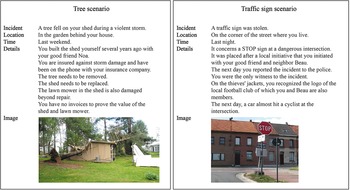
Design and stimuli were identical to the (Dutch and Mandarin) experiments reported by Peeters et al. (Reference Peeters, Schuurman, Zhai, Krahmer, Gu and Maes2025). As such, the study had a 2 (discourse genre: narrative vs expository) × 2 (scenario: tree vs traffic sign) design. Stimuli consisted of a short written description of a recent event, an image providing the visual environment in which that event was said to have taken place and a table with information in which the main event details were summarized. Two scenarios were used. In the tree scenario, it was described that a pine tree fell on a shed in the participant’s backyard during a storm last weekend, damaging both the shed and the lawn mower inside of it. The shed was described as having been previously constructed by the participant together with their friend Noa. The result of the storm was depicted in the accompanying image. In the traffic sign scenario, it was described that the participant woke up in the middle of the night from noise in the street, after which they saw a stop sign being stolen by a group of people that wore coats with the local football team’s logo on it. The traffic sign had been placed in the street following a request by the participant and their friend and next-door neighbor Beau. The morning following the theft, the participant was said to have witnessed a cyclist almost being hit by a car in the absence of the traffic sign. An image depicting a stop sign in an urban street environment accompanied this written scenario. Figure 1 shows the exact information provided to the participants, here translated into English. We opted for these two scenarios as they consistently led to the use of demonstratives in other languages (Peeters et al., Reference Peeters, Schuurman, Zhai, Krahmer, Gu and Maes2025), while they do not include demonstratives themselves. The full experiment can be found via the OSF link below.
Overview of the main information provided to the participants for each of the two scenarios, here translated into English.

Figure 1. Long description
The image consists of two side-by-side panels.
Left Panel: Tree scenario.
- Incident: A tree fell on your shed during a violent storm.
- Location: In the garden behind your house.
- Time: Last weekend.
- Details: You built the shed yourself several years ago with your good friend Noa. You are insured against storm damage and have been on the phone with your insurance company. The tree needs to be removed. The shed needs to be replaced. The lawn mower in the shed is also damaged beyond repair. You have no invoices to prove the value of the shed and lawn mower.
- Photo: A large uprooted tree has fallen across a small tan garden shed in a grassy yard.
Right Panel: Traffic sign scenario.
- Incident: A traffic sign was stolen.
- Location: On the corner of the street where you live.
- Time: Last night.
- Details: It concerns a S T O P sign at a dangerous intersection. It was placed after a local initiative that you initiated with your good friend and neighbor Beau. The next day you reported the incident to the police. You were the only witness to the incident. On the thieves’ jackets, you recognized the logo of the local football club of which you and Beau are also members. The next day, a car almost hit a cyclist at the intersection.
- Photo: A street corner in front of brick houses featuring a red octagonal S T O P sign and other smaller directional signs.
2.3. Procedure
Participants first provided informed consent and basic demographic information (age, gender, educational background, native language). They were informed that the experiment consisted of writing two separate texts on the basis of two different scenarios. The order of presentation of the two scenarios (tree vs traffic sign) was fully counterbalanced across participants and each participant saw each scenario only once. For each scenario, participants were instructed to write an email of about 150–200 words explaining what happened, either to their friend (in the narrative condition, for both scenarios) or to the head of calamities of their insurance company in the tree scenario or the local head of police in the traffic sign scenario (in the expository condition). Whether a scenario was part of the narrative or the expository condition for a given participant was counterbalanced across participants. As such, each participant saw two different scenarios and wrote one narrative and one expository email. Besides the addressee of the text, instructions in the narrative and the expository condition were identical except that, in the expository condition, the aim of the text was ‘to describe in detail what happened, starting from the relevant facts and events’, while in the narrative condition, the aim of the text was described as ‘to tell your friend what happened, from your personal perspective’. The experiment was carried out online in a Qualtrics environment (Qualtrics, Provo, UT).
2.4. Data coding
We first identified all demonstratives present in the 200 elicited texts. For each demonstrative, we first coded their variant (proximal vs distal), number (singular vs plural), word class (pronoun/determiner vs adverb) and type of use (text-based vs situation-based; see below). These data were used for calculating descriptive statistics. As a basis for the statistical analysis, we then coded each demonstrative’s position in the clause (clause-initial vs clause-non-initial), the grammatical role of the phrase that contained the demonstrative (subject vs other) and the position of the antecedent in relation to the demonstrative (same or directly preceding clause vs an earlier clause). In line with earlier work (Maes et al., Reference Maes, Krahmer and Peeters2022a; Peeters et al., Reference Peeters, Schuurman, Zhai, Krahmer, Gu and Maes2025), demonstratives were also considered to be ‘in subject position’ when they were the subject of a coordinated or subordinated sentence, and demonstratives were also considered ‘in sentence-initial position’ when they were part of the first syntactic element of a coordinated or subordinated sentence. Also when calculating the distance between demonstrative and antecedent, what we considered a clause or sentence was not based on capital letters and periods, but on grammatical roles (i.e., the presence of a subject and a conjugated verb). The raw and coded datasets, including all elicited texts, and the code book are available on OSF (https://osf.io/xbsdt/).
Two coders coded all data separately. After having coded 200 cases, they discussed the inconsistencies, adapted some of the coding variables and also sharpened some coding instructions. After subsequently finishing the coding of all demonstratives, one coder compared the results for each variable separately and split all inconsistencies into two groups: clear errors and interpretation differences. Clear errors were corrected, and interpretation differences were discussed and resolved. For most variables used in the analysis, all differences were caused by errors: word class (12 of 12), demonstrative variant (8 of 8), number (27 of 29), grammatical role (37 of 37) and demonstrative form (adverb, pronoun, NP; 52 of 52). For two other variables (type of use, n = 16 and type of text-based demonstrative, n = 24), inconsistencies mostly reflected ambiguous demonstratives [type of use: text-based or situation-based; type of text-based: (indirectly) anaphoric or first mention]. For the variable type of use, we decided to choose for text-based whenever a plausible text-based interpretation could be found, when any antecedent trigger was present in the context or when the demonstrative variant (the proximal one) could reasonably be changed into a distal one without clear semantic change. For inconsistencies on the variable text-based, we decided to consider some cases as vague or ambiguous. For the other two variables, antecedent position (n = 67) and position in the clause (n = 71), we solved most of the differences by strictly considering clauses only when a conjugated verb was present.
3. Results
A total of 818 demonstratives were found in the overall dataset. We observed both situation-based and text-based demonstratives (Maes et al., Reference Maes, Krahmer and Peeters2022b). Situation-based demonstratives (e.g., Du glaubst es ja nicht was gestern Nacht hier passiert ist. ID26Footnote 2. ‘You do not believe what happened here yesterday’; Ich bin über diese Mailadresse erreichbar. ID57. ‘I can be reached via this email address’), which find their interpretation in the writing situation (e.g., the container of the text, the time or place of writing) but outside the written text itself, do not pragmatically allow for variation in selecting either a proximal or distal term. Therefore, these instances (n = 103) were excluded from further analysis. Cataphoric (n = 63; e.g., Ich hoffe, du genießt deinen Urlaub trotz dieser Nachricht: … ID750. ‘I hope you enjoy your holiday despite this update: …’) and first-mention (n = 14; e.g., Am letzten Wochenende hatten wir diesen unglaublich starken Sturm . ID305. ‘Last weekend we had this incredibly strong storm’) demonstratives were excluded as well, as they (by definition) have no antecedent and therefore did not allow for full coding. Obviously, we also excluded all die-der-das NPs, as they do not reliably allow one to determine their demonstrative or definite nature, including NPs with a likely demonstrative interpretation (e.g., Aber in dem Fall ist das Stopp Schild super wichtig . ‘But in that case, the stop sign is very important’).
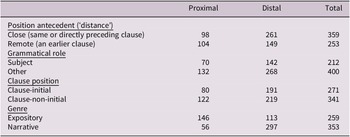
Application of the exclusion criteria resulted in a remaining dataset of 612 German text-based anaphoric demonstratives that entered the analysis, which included 202 proximal and 410 distal demonstratives (excluding one case of jener). Out of these 612 demonstratives, 245 (208 singular; 37 plural) were used as a pronoun, 131 (115 singular; 16 plural) as a determiner (all proximal) (‘dies-’, cf. English this, these) and 236 (29 proximal, 207 distal) as an adverb (‘hier’, ‘da-’, cf. English here, there). Table 1 shows the distribution of demonstratives as a function of the position of the antecedent in relation to the demonstrative (same/directly preceding vs an earlier clause), the grammatical role of the phrase that contained the demonstrative (subject or not), the position of the demonstrative in the clause (clause-initial or not) and the two text genres.
Number of proximal vs distal demonstratives observed across the two levels of each of the four categorical predictors in the data that were statistically analyzed (n = 612)
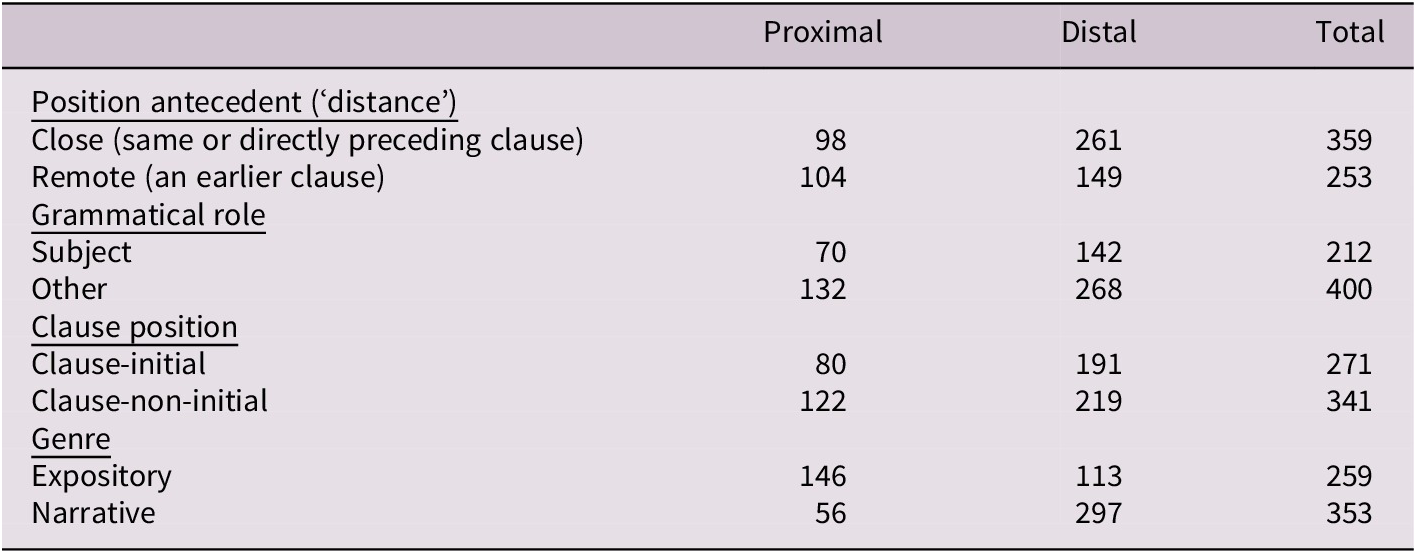
Table 1. Long description
The table consists of four columns: Category, Proximal, Distal, and Total.
1. Position antecedent (distance):
- Close (same or directly preceding clause): Proximal 98, Distal 261, Total 359.
- Remote (an earlier clause): Proximal 104, Distal 149, Total 253.
2. Grammatical role:
- Subject: Proximal 70, Distal 142, Total 212.
- Other: Proximal 132, Distal 268, Total 400.
3. Clause position:
- Clause-initial: Proximal 80, Distal 191, Total 271.
- Clause-non-initial: Proximal 122, Distal 219, Total 341.
4. Genre:
- Expository: Proximal 146, Distal 113, Total 259.
- Narrative: Proximal 56, Distal 297, Total 353.
The descriptive statistics in Table 1 numerically confirm that writers preferred to use proximal demonstratives in expository texts and distal demonstratives in narrative texts. In addition, a stronger preference for distal (vs proximal) demonstrative use can be numerically observed for close relative to more remote antecedents. Besides an overall preference for distal demonstratives, no strong influence of the grammatical role of the demonstrative phrase that contained the demonstrative or the position of the demonstrative in the sentence is expected based on the descriptive statistics.
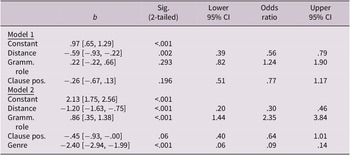
To test for the predictive power of genre in relation to local discourse-structural variables sensitive to the accessibility of referents (i.e., distance, grammatical role and clause position), we carried out an overall binary logistic regression analysis. The binary dependent variable in this analysis was the use of a proximal (German equivalents of this, these, here) or distal (German equivalents of that, those, there) demonstrative. To test our theoretical predictions, we opted for a hierarchical regression approach to data analysis (forced entry), comparing a model (Model 1) that included the three categorical ‘local’ accessibility-based factors (distance, grammatical role, clause position) to a model (Model 2) that additionally included genre (expository vs narrative) as a categorical predictor.
It was observed that Model 1 explained significantly more variance in the data compared to a baseline, intercept-only model, χ 2 (3) = 14.44, p = .002, R 2 = .023 (Cox-Snell), .032 (Nagelkerke). As such, the model explained about 2% (Cox-Snell) to 3% (Nagelkerke) of variance in the writers’ choice of demonstrative type (proximal vs distal). Out of the three individual ‘local’ predictors, only the distance between demonstrative and antecedent significantly explained variance in the data (p = .002). This finding confirms that participants used more distal (vs proximal) demonstratives when the antecedent was close (i.e., in the same or directly preceding clause) to the demonstrative (vs when the antecedent was more remote). Model 2, in which genre was added as an additional predictor, explained significantly more variance in the data compared to Model 1, χ 2 (4) = 157.30, p < .001, R 2 = .23 (Cox-Snell), .32 (Nagelkerke). As such, adding genre to the model led to about 21% (Cox-Snell) to 29% (Nagelkerke) of additional variance in the writers’ choice of demonstrative type (proximal vs distal) being explained by this model compared to the model that did not take into account the genre of the texts. Table 2 shows that the genre of the text indeed significantly explained variance in the data, statistically confirming that writers used more proximal demonstratives in expository texts and more distal demonstratives in narrative texts. Also in this final model, the distance between demonstrative and antecedent significantly explained some variance, as in the earlier model. In light of the large difference in explanatory power of the two models, this predictor arguably had a significant but small influence. The same holds for the grammatical role of the phrase that contained the demonstrative (subject or not). With much variance explained by genre, there was a slight preference for writers to use a distal (rather than a proximal) demonstrative when the demonstrative was in non-subject (vs in subject) position in a phrase.
Logistic models of predictors of anaphoric demonstrative variation in German (95% BCa bootstrap confidence intervals based on 1000 samples in brackets)
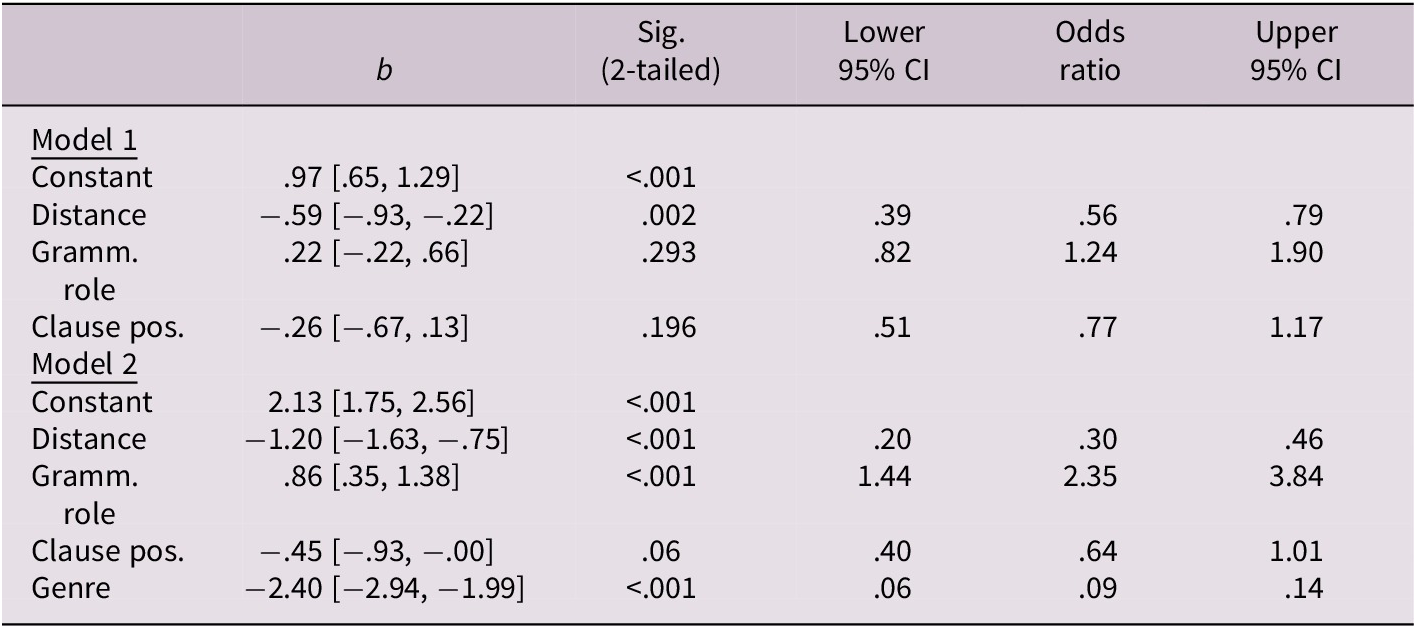
Table 2. Long description
The table is divided into Model 1 and Model 2. Columns from left to right are: Predictor, b [95 percent B C a bootstrap confidence intervals], Sig. (2-tailed), Lower 95 percent C I, Odds ratio, and Upper 95 percent C I.
Model 1 data:
* Constant: b = .97 [.65, 1.29], Sig. < .001.
* Distance: b = minus .59 [minus .93, minus .22], Sig. = .002, Lower C I = .39, Odds ratio = .56, Upper C I = .79.
* Gramm. role: b = .22 [minus .22, .66], Sig. = .293, Lower C I = .82, Odds ratio = 1.24, Upper C I = 1.90.
* Clause pos.: b = minus .26 [minus .67, .13], Sig. = .196, Lower C I = .51, Odds ratio = .77, Upper C I = 1.17.
Model 2 data:
* Constant: b = 2.13 [1.75, 2.56], Sig. < .001.
* Distance: b = minus 1.20 [minus 1.63, minus .75], Sig. < .001, Lower C I = .20, Odds ratio = .30, Upper C I = .46.
* Gramm. role: b = .86 [.35, 1.38], Sig. < .001, Lower C I = 1.44, Odds ratio = 2.35, Upper C I = 3.84.
* Clause pos.: b = minus .45 [minus .93, minus .00], Sig. = .06, Lower C I = .40, Odds ratio = .64, Upper C I = 1.01.
* Genre: b = minus 2.40 [minus 2.94, minus 1.99], Sig. < .001, Lower C I = .06, Odds ratio = .09, Upper C I = .14.
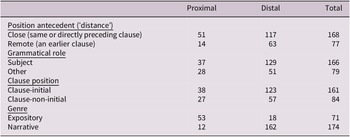
As the lion share of previous experimental work on written German demonstratives has exclusively focused on demonstrative pronouns (e.g., Bader & Portele, Reference Bader and Portele2019; Bader et al., Reference Bader, Portele, Schäfer, Hörnig, von Wietersheim, Konietzko and Featherston2022; Bosch et al., Reference Bosch, Rozario and Zhao2003; Bosch et al., Reference Bosch, Katz, Umbach, Schwarz-Friesel, Consten and Knees2007; Bosch & Umbach, Reference Bosch, Umbach, Bittner and Gagarina2007 Hinterwimmer et al., Reference Hinterwimmer, Brocher and Patil2020; Kaiser, Reference Kaiser, Reich, Horch and Pauly2011; Portele & Bader, Reference Portele and Bader2016; Weinert, Reference Weinert2011), we replicated the above analysis but restricted the dataset to include demonstrative pronouns only. Table 3 shows the descriptive statistics for the demonstrative pronouns (n = 245) in this restricted dataset. Besides the overall preference for distal demonstrative use, the clear role of genre stands out again numerically.
Number of proximal and distal pronominal demonstratives observed across the two levels of each of the four categorical predictors
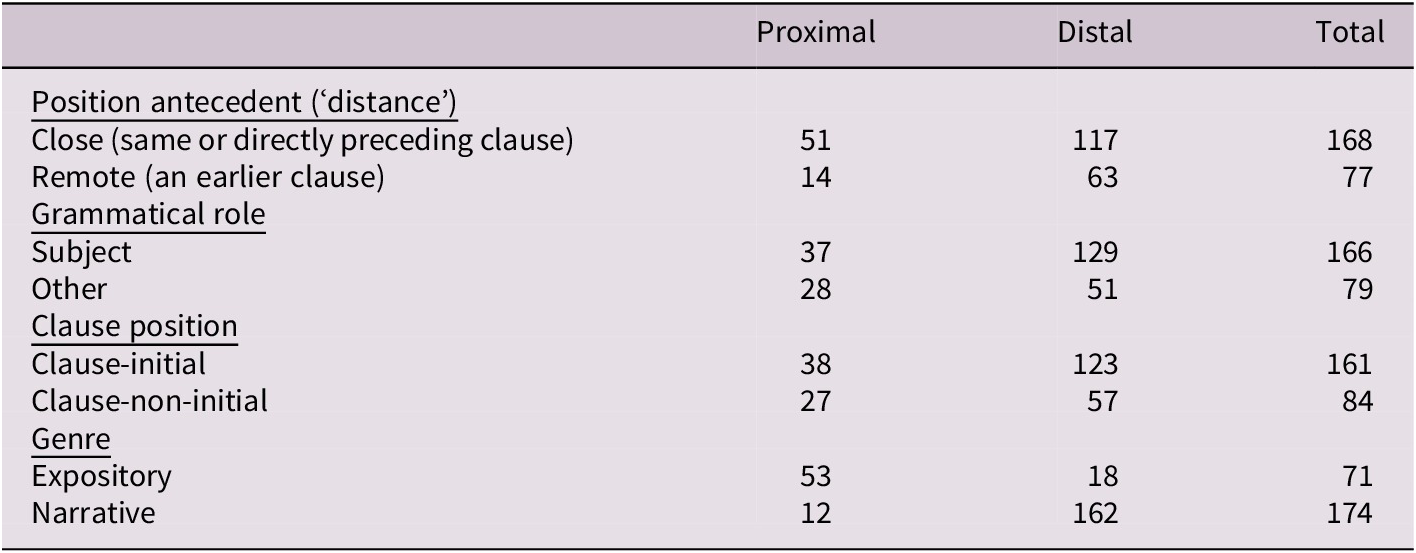
Table 3. Long description
The table is organized into four main categories with two levels each.
1. Position antecedent (distance):
- Close (same or directly preceding clause): 51 Proximal, 117 Distal, 168 Total.
- Remote (an earlier clause): 14 Proximal, 63 Distal, 77 Total.
2. Grammatical role:
- Subject: 37 Proximal, 129 Distal, 166 Total.
- Other: 28 Proximal, 51 Distal, 79 Total.
3. Clause position:
- Clause-initial: 38 Proximal, 123 Distal, 161 Total.
- Clause-non-initial: 27 Proximal, 57 Distal, 84 Total.
4. Genre:
- Expository: 53 Proximal, 18 Distal, 71 Total.
- Narrative: 12 Proximal, 162 Distal, 174 Total.
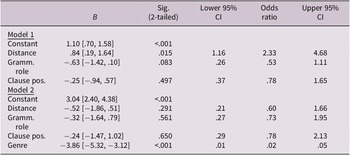
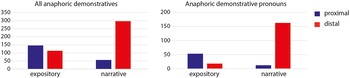
In the analysis on the demonstrative pronouns, Model 1 explained significantly more variance in the data compared to a baseline, intercept-only model, χ 2 (3) = 10.75, p = .013, R 2 = .043 (Cox-Snell), .063 (Nagelkerke). As such, the model explained about 4% (Cox-Snell) to 6% (Nagelkerke) of variance in the writers’ choice of demonstrative type (proximal vs distal). Out of the three individual ‘local’ predictors, again only the distance between demonstrative and antecedent significantly explained variance in the data (p = .013), meaning that participants used relatively more proximal (vs distal) demonstrative pronouns when the antecedent was close (i.e., in the same or directly preceding clause) to the demonstrative (vs when the antecedent was more remote). Note that the directionality of this effect was indeed opposite to the finding in the overall dataset as reported above, as reflected in the opposite polarity of the corresponding b values. Model 2, in which genre was added as an additional predictor, explained significantly more variance in the data compared to Model 1, χ 2 (4) = 118.71, p < .001, R 2 = .38 (Cox-Snell), .56 (Nagelkerke). As such, adding genre to the model led to no less than about 34% (Cox-Snell) to 50% (Nagelkerke) of additional variance in the writers’ choice of demonstrative pronoun type (proximal vs distal) being explained by this model compared to the model that did not take into account the genre of the texts. Table 4 shows that the genre of the text indeed significantly explained variance in the data, statistically confirming that writers used more proximal demonstratives in expository texts and more distal demonstratives in narrative texts. With genre added to the model, none of the ‘local’ variables significantly explained any variance in the data anymore. Figure 2 visually illustrates the influence of genre on German writers’ demonstrative use.
Logistic models of predictors of anaphoric demonstrative variation in German, including only demonstrative pronouns (95% BCa bootstrap confidence intervals based on 1000 samples in brackets)
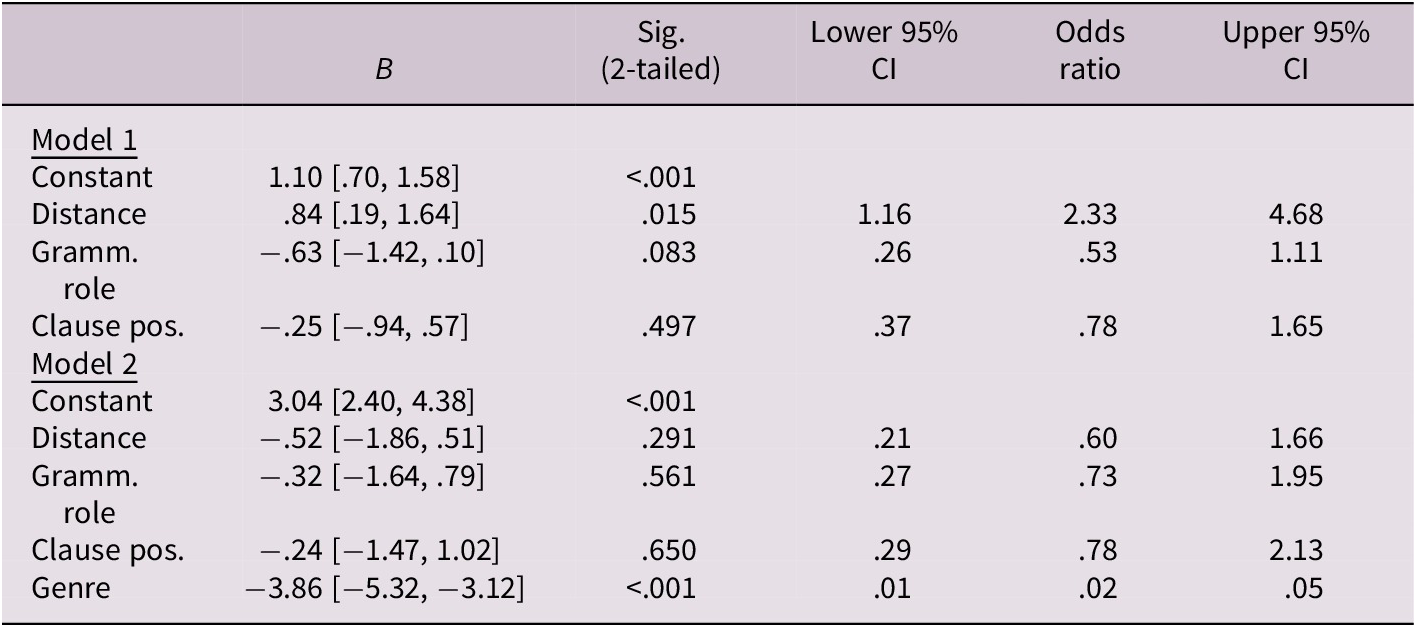
Table 4. Long description
The table is divided into Model 1 and Model 2. Columns include B with 95 percent B C a bootstrap confidence intervals in brackets, Sig. 2-tailed, Lower 95 percent C I, Odds ratio, and Upper 95 percent C I.
Model 1 predictors:
* Constant: B is 1.10 [0.70, 1.58], Sig. is less than .001.
* Distance: B is .84 [0.19, 1.64], Sig. is .015, Odds ratio is 2.33 with C I [1.16, 4.68].
* Gramm. role: B is minus .63 [minus 1.42, .10], Sig. is .083, Odds ratio is .53 with C I [.26, 1.11].
* Clause pos.: B is minus .25 [minus .94, .57], Sig. is .497, Odds ratio is .78 with C I [.37, 1.65].
Model 2 predictors:
* Constant: B is 3.04 [2.40, 4.38], Sig. is less than .001.
* Distance: B is minus .52 [minus 1.86, .51], Sig. is .291, Odds ratio is .60 with C I [.21, 1.66].
* Gramm. role: B is minus .32 [minus 1.64, .79], Sig. is .561, Odds ratio is .73 with C I [.27, 1.95].
* Clause pos.: B is minus .24 [minus 1.47, 1.02], Sig. is .650, Odds ratio is .78 with C I [.29, 2.13].
* Genre: B is minus 3.86 [minus 5.32, minus 3.12], Sig. is less than .001, Odds ratio is .02 with C I [.01, .05].
For all anaphoric demonstratives (left panel, n = 612) and only the demonstrative pronouns (right panel, n = 245), the number of proximal (in blue) and distal (in red) demonstratives observed across the expository vs narrative conditions.
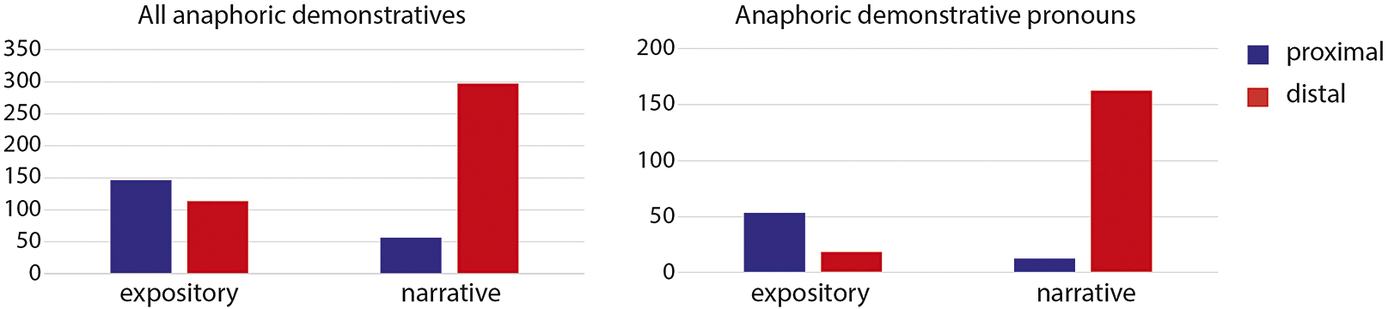
Figure 2. Long description
A two-panel bar chart. A legend on the far right indicates that blue bars represent proximal and red bars represent distal.
Left Panel: Titled All anaphoric demonstratives. The Y-axis ranges from 0 to 350 in increments of 50. The X-axis has two categories: expository and narrative.
- In the expository category, the proximal blue bar is approximately 150 and the distal red bar is approximately 115.
- In the narrative category, the proximal blue bar is approximately 55 and the distal red bar is approximately 300.
Right Panel: Titled Anaphoric demonstrative pronouns. The Y-axis ranges from 0 to 200 in increments of 50. The X-axis has two categories: expository and narrative.
- In the expository category, the proximal blue bar is approximately 55 and the distal red bar is approximately 20.
- In the narrative category, the proximal blue bar is approximately 15 and the distal red bar is approximately 165.
4. Discussion
In this study, we asked German participants to write emails to a friend and a local authority using scenarios stimulating natural conditions for writers to produce narrative and expository texts, respectively. Participants relatively more often used proximal demonstrative pronouns ( dies- ), determiners ( dies- ) and adverbs ( hier ) in their expository texts, and distal demonstrative pronouns ( der , die , das ) and adverbs ( da- ) in their narrative texts, thereby confirming genre as the main factor explaining demonstrative choice in German. As such, the present study shows that German writers’ demonstrative use aligns with earlier corpus-based and experimental observations in English, Mandarin and Dutch (Maes et al., Reference Maes, Krahmer and Peeters2022a; Peeters et al., Reference Peeters, Schuurman, Zhai, Krahmer, Gu and Maes2025). It can also be seen as a confirmation of suggestions made in previous studies about the role of global discourse variables in driving demonstrative choice in written German discourse (Patil et al., Reference Patil, Bosch and Hinterwimmer2020; Patterson et al., Reference Patterson, Patil, Ventura, Lialiou, Schumacher and Hinterwimmer2025).
We observed only a minor influence of local, structural variables that could be related to the assumed prominence or accessibility of discourse referents (cf. Ariel, Reference Ariel1990; Botley & McEnery, Reference Botley and McEnery2001; Kirsner, Reference Kirsner1979). In our analysis on demonstrative pronouns, the relative distance between demonstrative and antecedent explained a small proportion of the variance in writers’ demonstrative use, but only when genre was not taken into account in the analysis. Interestingly, proximal demonstrative pronouns preferred close (vs remote) antecedents, while the opposite was true when all demonstratives (pronouns, determiners, adverbs) were included in the analysis.
The free writing situation used in our experiment did not allow us to directly test demonstrative variation in more refined configurations of local variables as discussed in the Introduction, such as structural (e.g., order of mention, clause position), syntactic (subject vs object) and semantic (implicit causality, semantic roles, referent animacy) influences. The carefully constructed sentences as used in earlier rating and sentence completion experiments simply did not (systematically) show up in our data, nor do our texts allow for a systematic analysis of demonstratives used to refer to more vs less persistent topics. This raises the question to what extent constructed examples in previous work represent everyday language use.
Nevertheless, the genre-based theoretical framework we adopted in the present study may well be used to shed more light on earlier acceptability differences in examples like (5) and (6), taken from Patil et al. (Reference Patil, Hinterwimmer and Schumacher2023, p.14). Crucially, the second sentence in these examples contains an evaluation of the content of the first sentence. Unlike the proximal demonstrative, the distal demonstrative in these cases is able to refer to the discourse topic in the first sentence, thereby breaking the often confirmed rule of demonstratives avoiding to refer to the most prominent referent (e.g., Bosch et al., Reference Bosch, Rozario and Zhao2003; Portele & Bader, Reference Portele and Bader2016).
-
(5) Maria hat Peter geohrfeigt. Die /? Diese hat sich einfach nicht im Griff!
Maria slapped Peter. She_distal /? She_proximal just cannot control herself!
-
(6) Volker hat Anja einen Donut vom Bäcker mitgebracht. Der /? Dieser ist wirklich ein fürsorglicher Mensch!
Volker brought Anja a donut from the baker. He_distal /? He_proximal really is a caring person!
Patil et al. (Reference Patil, Hinterwimmer and Schumacher2023) offer experimental evidence for these acceptability differences and propose a local prominence-based theoretical solution following Hinterwimmer and Bosch (Reference Hinterwimmer, Bosch, Grosz and Patel-Grosz2016, Reference Hinterwimmer, Bosch, Patel-Grosz, Grosz and Zobel2018). In their view, the most prominent referent in these examples is not the one based on local structure or semantics (i.e., the discourse topics ‘Maria’ and ‘Volker’), but the external ‘perspectival center’ of the speaker/narrator evaluating the content of the first sentence. Distal demonstratives turn out to be sensitive to such perspectival centers, which means they can refer to the (less prominent) discourse topic (i.e., Maria, Volker), while still obeying the rule of avoiding reference to the most prominent referent (i.e., the perspectival center). Proximal demonstratives are arguably not sensitive to such perspectival centers, and thus, when they pick out the discourse topic as their referent, they break this rule, resulting in low acceptability.
This elegant theoretical solution leaves open the question of why the prominence scales for the two demonstrative pronouns would be different (Patil et al., Reference Patil, Hinterwimmer and Schumacher2023, p.12). The genre framework we presented may be helpful here. Although the evaluative stance of the narrator can be described in terms of local discourse dynamics (i.e., the establishment of an external perspectival center), it is clear that the phenomenon is typically (though not exclusively) part of the toolbox of the narrative genre. The use of a distal demonstrative in situations like these can be seen as a pre-eminent device for writers to connect to their addressee, to enrich stories, add sidelines and express the position of the narrator. Creating and acknowledging a bond between writer and addressee is one of the major pragmatic functions of distal demonstratives, again, particularly in narrative contexts (Maes et al., Reference Maes, Krahmer and Peeters2022a, pp. 6–8). It has long been established that these solidarity-type demonstratives ‘are perhaps the most curious semantically, since the distance marker that seems to establish emotional closeness between speaker and addressee’ (Lakoff, Reference Lakoff, Fox, La Galy and Bruck1974, p. 351). The German evaluative examples commonly represent this pragmatic function. In the present study, the traffic sign scenario offered a typical occasion for writers to not only convey the facts, but also provide their own evaluation of who stole the stop sign and why. It resulted in a handful of cases like example (7), all in the narrative condition. Changing the distal forms into proximal ones is not impossible, but less acceptable, and it would strip the fragment of its typical narrative flavor.
-
(7) Ich glaube, das war vielleicht der Max oder der Holger. Die bauen immer so eine Scheiße. Vielleicht, haben die sich gedacht, lass uns das Ding mal mitgehen lassen, … (ID350-351)
I think it might have been Max or Holger. Those are always pulling of this kind of crap. Maybe those thought, let us just steal the thing.
In explaining demonstrative variance, we considered writer-referent-addressee assumptions based on discourse goals as primary variable, and we used genre rather than register as the most appropriate denominator capturing these relational assumptions. In defining genre as well as register, discourse goals and social relations between communication partners are pivotal (e.g., Biber & Conrad, Reference Biber and Conrad2012). However, compared to other (spoken) language varieties, the written mode is more dependent on conventional ‘genre’ structures and less dependent on direct interaction and situational ‘register’ conditions. Earlier genre studies (Maes et al., Reference Maes, Krahmer and Peeters2022a; Peeters et al., Reference Peeters, Schuurman, Zhai, Krahmer, Gu and Maes2025) show that specific demonstrative variants (proximal vs distal) are pervasive linguistic features of specific discourse genres (e.g., expository vs narrative), irrespective of specific register variables also known to be strong drivers of demonstrative variance, like the preference for proximal demonstratives in written or formal discourse (Patil et al., Reference Patil, Bosch and Hinterwimmer2020; Patterson et al., Reference Patterson, Patil, Ventura, Lialiou, Schumacher and Hinterwimmer2025), or the use of distal demonstratives with familiar communication partners (with ‘familiar that’ demonstratives as a case in point, Gundel et al., Reference Gundel, Hedberg and Zacharski1993)Footnote 3. As such, in future work it would be interesting to compare the effect of genre and register more directly, for instance, by eliciting or analyzing texts that are made to orthogonally differ in genre (e.g., narrative vs expository) and register (e.g., formal vs informal; familiar vs unfamiliar addressee) so as to determine the independent influence of each of these global discourse variables.
All in all, the present study shows that discourse genre predicts demonstrative use in German text. As in face-to-face spoken communication, language users actively take into account the relation to their addressee, which is reflected in the type of demonstrative they prefer to use in a given discourse setting. While experimental studies across languages so far point in the same direction when it comes to the effect of discourse genre on written demonstrative use, future research on more complex (e.g., three-term or even richer) demonstrative systems may shed light on how the selection of a demonstrative may also partially differ across languages in written text.
Funding statement
Open access funding provided by Tilburg University
Competing interest
The authors declare none.

 Open access

