

Political competition is most commonly considered a mediator of public goodsFootnote 1 provision through its disciplining effect on incumbent politicians attempting to maximize prospects for re-election—and most empirical studies uncover a positive relationship. We argue that political competition, in a legislative context, can also mediate the provision of public goods by affecting the policy-making process in between elections. Specifically, competitive or fractionalized parties can render coalition formation and legislative bargaining more difficult, thus hindering the efficiency of policymaking. A formalization of this argument illustrates how these countervailing effects of political competition can lead to a net positive or net negative effect on public goods provision in different settings. Theories that do not take both mechanisms into account accordingly fail to accurately capture the impacts of political competition on public goods provision in some contexts. We argue that in places where legislative bargaining is more challenging and electoral accountability weak, we should observe a net negative relationship between political competition and public goods provision. New democracies with weak party systems and low levels of transparency fit this description and are also contexts that have been under-studied empirically—possibly explaining the often positive findings to date.
Contrary to much of the existing empirical literature, we present evidence from both within and across countries that confirms a net negative relationship between political competition and public goods provision in settings of weak party institutionalization and low transparency. In particular, we provide rigorous empirical evidence from Mali showing that the negative effect of competition on public goods via legislative bargaining inefficiencies can dominate the expected positive effects stemming from electoral incentives. Examining whether our theory holds more generally, we present evidence from cross-country panel data that the relationship between political competition and public goods hinges critically on the level of party system institutionalization, with political competition leading to better (worse) public goods provision under higher (lower) levels of party system institutionalization.
To understand the intuition of our theory of political competition, consider an elected legislature comprised of politicians who are office-motivated, and thus have electoral incentives to deliver public goods, but simultaneously have incentives to misappropriate funds and shirk. When the legislature is comprised of multiple parties, they must work together through coalitions or bargains to produce public goods. Increases in political competition should dampen misappropriation and shirking, thus improving public goods outcomes. But they simultaneously complicate the bargaining process—such as by increasing the time and resources required to take decisions, reducing the total budget that can be extracted from the central government, or inducing temporary or permanent stoppages on on-going projects—thus worsening public goods outcomes. The key insight of our theory is: how political competition ultimately affects public goods provision depends on the relative sizes of these positive and negative effects.
This theoretical insight additionally delivers predictions about the conditions under which political competition is more likely to exert a net negative effect on public goods provision. First, legislative inefficiencies should only emerge where bargaining is required for policy-making due to differences in preferences or priorities; the negative relationship should not obtain in places where there is already a policy consensus. Policy consensus may become more likely due to either supply-side factors or demand-side factors. On the supply side, if there is a clear majority coalition, consensus is more likely. On the demand side, it is more likely if there is broad agreement among voters over policy priorities. Second, bargaining becomes increasingly difficult when goods are more excludable or particularistic, and thus harder for citizens to share. Third, at an institutional level, legislative bargaining is more difficult in weak party systems where bargaining partners face high levels of volatility across elections, and are thus less able to make credible commitments. We test the first of these two implications in Mali—a young, low-income democracy. We test the third using cross-country panel data spanning various institutional contexts.
Mali is an ideal setting in which to test our theory since its political decentralization to the commune level allows us to exploit within-country variation in party systems and legislative policy-making while holding constant other aspects of the institutional context—namely, that parties are weak and transparency is low. Using a panel dataset of local electoral outcomes for each rural commune government (from the 2004 and 2009 elections) and local public goods provision (specifically, the numbers of water boreholes, clinics, schools, and kilometers of rural roads four years after each election, in 2008 and in 2013, respectively) along with a first differences framework, we first present evidence of a strong and robust negative effect of political competition on public goods provision. Our first differences model mitigates important endogeneity concerns that arise from both omitted variables and the possibility of reverse causality. We then use both quantitative and qualitative data to test whether the mechanism responsible for this negative relationship is indeed increased difficulty of legislative bargaining. To test whether our theory offers general insights beyond the Mali case, we construct a panel dataset of 164 countries spanning 1975–2015 and find that increasing political competition leads to better (worse) public goods provision under high (low) levels of party system institutionalization, in accordance with our theory. Furthermore, the salutary effects of political competition on public goods provision in settings of high party system institutionalization are more pronounced in settings with high levels of transparency.
This paper contributes to the literature on democratic accountability by exposing a new, previously ignored relationship between electoral competition and the ability of legislative bodies to effectively govern in between elections. While it has long been recognized that political competition exerts dual effects in the electoral and legislative arenas (Sartori Reference Sartori1976), Laver (Reference Laver1989) raises the dilemma that electoral competition and legislative bargaining are often considered independently. In concluding, he speculates that there might be “a systematic tendency for party-induced change in one part of the system to have contradictory effects in another” (Laver Reference Laver1989, 323). We apply these insights to the outcome of public goods provision for the first time. In doing so, we bring together two literatures that, while linked by similar theoretical roots in rational choice theory, have generally remained separate. These are the democratic accountability literature (e.g., Besley Reference Besley2006; Fearon Reference Fearon, Przeworski, Stokes and Manin1999) that examines the strategic incentives elections impose on politicians and the legislative bargaining literature (e.g., Riker and Brams Reference Riker and Brams1973; Weingast and Marshall Reference Weingast and Marshall1988; Williams Reference Williams2017) that examines how institutional contexts condition the ability of coalition partners to sustain credible commitments. We show how the same forces that incentivize politicians to behave accountably once in office can simultaneously make their job of legislative policy-making harder and less efficient.
We further contribute to the literature on democratic development in poor countries with our insights about the conditions under which a net negative effect of competition is most likely to obtain—namely, in countries with weak parties and low transparency. A systematic review we conducted of the evidence on the relationship between political competition and public goods provisionFootnote 2 uncovers mostly positive findings across Western countries, but a more mixed picture emerges for the developing world. The majority of cross-country studies demonstrate the benefits brought about by democratic transition or consolidation,Footnote 3 but two studies tellingly find that these benefits do not accrue to low-income countries or benefit the poor (Boix Reference Boix2001; Ross Reference Ross2006). Among single-country studies, the bulk of the support for a positive relationship comes from Western democracies,Footnote 4 and some from middle-income democracies such as Mexico, India, Brazil, and Pakistan.Footnote 5 But all of those latter countries also have studies showing the opposite (or no) relationship.Footnote 6 Few studies have examined this relationship in low-income democracies like Mali, adding to the novelty of our study.
Our theory and evidence provide one explanation for mixed findings in the existing literature: younger, lower-income democracies face the dual burdens of exhibiting weaker electoral accountability, due in part to poor access to information, and more inefficient legislative bargaining due to weak party systems and particularistic politics. Together, these features of developing democracies may mean that political competition leads to worse instead of better policy outcomes.
POLITICAL COMPETITION AND PUBLIC GOODS PROVISION
In an elected legislature, policy outcomes are determined both by the size of the budget for public goods (i.e., the amount actually spent) and the production function that turns inputs (expenditures) into outputs (public goods). Corruption or misappropriation of public funds is a key predictor of the actual size of the public budget. The efficiency of legislative bargaining is a key determinant of the productivity of policy-making. Bandiera, Prat, and Valletti (Reference Bandiera, Prat and Valletti2009) would call the former constraint on public outputs active waste, and the latter passive waste. While active waste provides utility to the politician, e.g., through rent-seeking, the latter provides none. By creating strong electoral incentives, political competition is likely to curb active waste—for example, by inducing a greater fear of sanctions among politicians or improved preference alignment between voters and politicians—and could even reduce passive waste. But, since more competitive parties are more fractionalized and less able to compromise and make inter-temporal commitments—resulting in more time and resources being required to take decisions and/or recurring stoppages on on-going projects—we additionally expect increased political competition to exacerbate passive waste. We discuss the logic for each of these countervailing effects, in turn. We then consider when we should expect to see a net negative effect.
Political Competition and Electoral Accountability
Standard models of electoral accountability suggest that increasing political competition leads to superior public goods provision through either a sanctioning or selection mechanism (e.g., Besley Reference Besley2006; Fearon Reference Fearon, Przeworski, Stokes and Manin1999). A credible threat from the opposition disciplines incumbent behavior in office, and a greater choice from among which voters can select a politician more generally increases the likelihood of preference alignment. Empirically, this should mean that increases in competition result in greater public goods provision, assuming such is preferred by the electorate. For example, Hatfield (Reference Hatfield2015) provides a model where local governments’ competition for capital drives up the provision of productive public goods. Similarly, Brueckner (Reference Brueckner2006) models political competition enhancing incentives to invest in human capital. Weingast (Reference Weingast1995) and Hatfield and Padró i Miquel (Reference Hatfield and i Miquel2012) argue more generally that political competition can enhance incentives for long-term productive investments.
Political Competition and Legislative Bargaining
While voters may be better able to extract public goods in more competitive elections, we assert that greater electoral competition should simultaneously make legislative bargaining more difficult in contexts where legislative bodies control public goods policy, thus worsening public goods provision. Competition can impede the efficiency of legislative bargaining in two distinct ways. First, political competition in the form of a more fractionalized party system multiplies the possibilities of coalition formation, thus increasing bargaining complexity. For example, as Laver (Reference Laver1989) shows for a majority rule system, moving from three to seven parties (the average in our empirical case) moves the system from seven to 127 possible coalitions, from four to 5,040 different ways of forming a coalition (allowing for different orders of formation), and from three to 35 different minimum winning coalitions.Footnote 7
Second, political competition in the form of more equally weighted parties, e.g., parties with similar vote or seat shares, can make bargaining agreements harder to sustain because it is easier for parties with similar weights (or seat shares) to find alternative coalitions and thus renege on agreements. At one extreme, in a majority-rule system, a majority party will form the most durable government because it does not need a coalition in order to pass legislation. At the other extreme, equally sized parties may find it difficult to negotiate because each will have the same expectation of being able to form, and dominate, a majority coalition. In particular, the less dominant is the plurality party, the more likely it is that the second largest party will be able to form a winning coalition with a smaller party or otherwise undermine the attempts at coalition formation of the largest party. Furthermore, the greater the dispersion of parties' power, the greater the number of available small parties with which a larger party can form a coalition. Together, these forces may contribute to more time and resources being required to take decisions and/or recurring stoppages on on-going projects.
Legislative Bargaining and Public Goods Provision
Legislative bargains are critical to policymaking. Legislative bodies must bargain over both the preferred types of public goods and their location. Especially when representatives are accountable to geographically distinct constituencies, as in our empirical case,Footnote 8 there may be considerable preference fractionalization on both dimensions. Failure to form or sustain a legislative bargain can result in a prolonged decision-making process (which could potentially even stem the flow of inter-governmental transfers), stalled provision of services, or outright conflict and nonprovision of services. Examining the effect of ease of legislative bargaining on a related outcome, budget stability, Huber, Kocher, and Sutter (Reference Huber, Kocher and Sutter2003) show that majority coalitions with greater strength and higher power dispersion have lower deficits because a strong party can better put pressure on relatively weaker ones to stabilize the budget. Edin and Ohlsson (Reference Edin and Ohlsson1991) similarly find that minority governments—formed by plurality parties that do not attain majority status and thus need to form coalitions with other parties—produce less efficient fiscal policy because bargaining within parliament is more difficult than within a majority party coalition. Roubini and Sachs (Reference Roubini and Sachs1989) attribute this to the intertemporally inefficient policy that results when power is heavily dispersed. And, Alesina and Drazen (Reference Alesina and Drazen1991) similarly argue that delayed fiscal reforms can be attributed to preference dispersion.
The long-standing American politics literature on vote trading, or log-rolling, in Congress provides intuition for how legislative bargaining can affect public goods outcomes (Buchanan and Tullock Reference Buchanan and Tullock1962). Notably, Williams (Reference Williams2017) has applied insights from this older literature to explain a more recently observed phenomenon of project noncompletion, particularly prevalent in developing countries. The intuition with respect to public policy is that while legislators representing different groups can pass projects with narrow interest groups by trading votes, making credible commitments is challenging due to noncontemporaneous benefit flows to each party and nonsimultaneous voting opportunities. In short, those benefiting early have incentives to renege on agreements, preventing potential coalitions from forming in the first place (Weingast and Marshall Reference Weingast and Marshall1988). While the nature of politics as a repeated game can help parties solve commitment problems, this mechanism is less useful in weaker party systems where there is less party discipline, more personalistic politics, and more frequent party switching by politicians.
In our empirical case, local public goods need broad-based support among commune councilmembers for successful planning, production, and completion. When councils are fractionalized as a result of competitive races, intra-council bargaining may suffer from similar problems faced by vote traders in Congress. The particular nature of local public goods provision, with its many steps from policy decision to fund transfer to procurement to construction, increases the likelihood that bargaining failures stymie successful policy implementation.Footnote 9 So even if coalitions do get formed, additional inefficiencies from their instability and unwieldiness might manifest as more frequent and less productive meetings to decide on infrastructure projects or aspects of service provision, or as partially constructed (and thus useless) infrastructure projects. Our predictions and empirical tests are consistent with either mechanism: competition impeding coalition formation or inefficient decision-making by a weak coalition.
WHEN COMPETITION WILL LEAD TO BAD OUTCOMES
The net effect of political competition on public goods provision ultimately depends on the relative degree to which it dampens misappropriation and shirking via electoral incentives versus dampens bargaining efficiency (Appendix E derives this with a formal model). We argue that it is likely to be net negative where parties are weaker—and thus legislative bargaining is harder—and where transparency is low, making it more difficult for voters to hold politicians accountable (Besley Reference Besley2006). These are both common features of young, low-income democracies.
The dampening effect of political competition on legislative bargaining efficiency is likely to be strongest where politics is particularistic and party systems are weak—features which exacerbate the complexity of coalition formation and undermine coalition durability. The natural complexity of coalition formation can be mediated by party strategies that make the problem more tractable. For instance, parties can align with their ideological neighbors or rely on historical relationships with other parties (Laver Reference Laver1989). While these insights may be true for established democracies, we argue that parties in the young and often weak party systems found in most democracies of the developing world have less access to such strategies; they are less likely to have distinct ideological attachments (Conroy-Krutz and Lewis Reference Conroy-Krutz and Lewis2011), are newer and frequently split, or enter or exit the system (Gottlieb and Larreguy Reference Gottlieb and Larreguy2016), making historical coalitions a weaker predictor of future coalition formation.
Testable Implications of Theory
Hypothesis 1. In places with weak political accountability and weak party systems, there should be a net negative relationship between political competition and public goods provision.
We first test this in our quantitative data from Mali. We additionally test whether local actors perceive this negative relationship in our qualitative data from Mali. We finally test it using cross-country panel data from 164 countries spanning 1975–2015, regressing public expenditures on legislative competition, and taking party system institutionalization and government transparency as moderators.
Hypothesis 2. The negative relationship between political competition and public goods provision should be most apparent where bargaining or coalitions are required to make policy due to fractionalized preferences on the supply or demand side.
We test this implication in two ways. First, we examine whether the effect is more pronounced in places with greater preference fractionalization on the supply side, namely in places without a majority party on the council. Majority parties can easily achieve policy consensus as they have latitude to make policy without bargaining with other parties or councilmembers. Second, we examine whether the effect is more pronounced in places with greater preference fractionalization on the demand side, or where there is less consensus among voters about what the priorities of the council should be.
Hypothesis 3. The negative relationship between political competition and public goods provision should be most apparent for more excludable goods.
We test this implication by examining whether the effect is more pronounced for the local public goods in our data that are by their nature more excludable and thus more difficult to share.
Hypothesis 4. Where bargaining efficiencies are indeed driving a negative relationship between political competition and public goods provision, we should see evidence of weak parties.
We examine this implication in our qualitative data where we provide evidence of personalistic politics and party disloyalty.
POLITICAL CONTEXT
Our empirical context of Mali is a country with weak parties and low transparency. Democratic since 1991, this status faltered following a military coup and the loss of the North to Islamist forces in 2012 and until presidential elections in 2013. Our analysis, however, evaluates political competition in earlier local elections (2004 and 2009) when political stability was considered among the highest in the region. In spite of this stability, Mali’s party system is regarded as among the weakest in Africa (Riedl Reference Riedl2014) (we discuss additional qualitative evidence for this below). Transparency is also low as Malian voters have exceedingly little information about local politics and hold politicians to quite low standards (Gottlieb Reference Gottlieb2016). Not only is civic education inaccessible to most, but the vast majority of adults are illiterate. Furthermore, there is evidence that commune councilmembers collude to withhold information about rent-seeking from voters Gottlieb (Reference Gottlieb2015).
Our empirical tests exploit the fact that, in 1996, the country was divided into 703 new locally governed “communes,” bringing democratic governance closer to the people. These administrative units are salient because they have both the right to tax and the responsibility to provide local public goods. Below, we describe how Mali’s local governments are elected and how they raise and spend resources on local public goods.
Electoral Context
Public policy in each commune is made by a commune council. Since 1999, commune councilors have been elected with five-year mandates; subsequent elections occurred in 2004, 2009, and 2016.Footnote 10 In each election, parties submit closed candidate lists, and seats are accorded to parties based on proportional representation. The number of seats on the council ranges from eleven to 45, based on population, and an average of six parties compete for seats. For the first three of these elections, the mayor and her bureau (several adjunct positions) were elected indirectly from among the commune councilors.Footnote 11
There are a few regularities of Mali’s local elections that are worth noting. First, as evidence of the importance of coalition politics, when the largest party has a plurality of seats rather than a majority, the mayor is more likely to come from one of the smaller parties. The typical rationale is that the plurality party prefers to buy off the support of the smallest party necessary to form a minimum winning coalition, and offering them the mayorship is a credible way to secure a committed ally. Second, incumbent mayors won in only 29% of communes in 2009 (though there are no term limits)—one piece of evidence of Mali’s high electoral volatility. Another is rampant party-switching—not only by voters, but also by politicians. In a survey we carried out of more than 600 local politicians just before the 2016 elections, about a quarter said that they had switched parties at least once in their career.
Local Policy-Making
The mayor and several also indirectly elected members of an executive bureau manage the day-to-day affairs of the commune; other councilmembers are only required to participate in regular council meetings. While the mayor and bureau members can set the agenda, policy decisions are subject to a full vote by the council. In the more than half of communes where no party won a clear majority, this means that coalitions among councilors and parties are required to make and implement policy, including deciding on the composition of the commune bureau. Because of the politicking required to indirectly elect the mayor among communes without a majority party, the mayor is often beholden to other parties and does not have the clout to railroad through policy decisions.
Communes have full control over administration of their budgets and are solely responsible for providing primary health care, sanitation, primary education, and security.Footnote 12 As a result of meager tax revenues, rural councils receive about $30,000 per annum for use on community development projects from a government agency established in 2001 to alleviate capacity problems: the Agence Nationale d’Investissement des Collectivités Territoriales, or ANICT. This represents on average about two-thirds of their budget and is the largest source of revenue (in addition to government subsidies, a small amount of tax revenue, and donor aid). These project funds typically allow communes to select one village per annum (among an average of 18) in which to build a community development project. Our primary measure of public goods provision considers the aggregated numbers (i.e. the stock) of each of four different types of local public infrastructure projects within the commune in 2009 and in 2013—i.e., four years after the two elections we study. As project funds are distributed annually, the four-year lag between these two years of data collection should be sufficient to capture real changes in public goods.
Public financing of urban communes differs substantially from that of rural communes, motivating us to limit our sample to Mali’s 666 rural communes. For example, urban communes can raise taxes on businesses and profit from the use of local land by private companies. In addition, demand for public services is likely to vary substantially across rural and urban areas, posing nontrivial challenges for measurement and modeling. By focusing on rural communes, we consider institutionally similar and thus comparable units.
EMPIRICAL STRATEGY AND DATA
In this section, we first describe our data and empirical strategy for the quantitative analysis of how political competition affects public goods. We then describe our qualitative data collection strategy.
Quantitative Analysis
We employ a first differences estimation strategy, using panel data on local elections (2004, 2009) and the provision of local public goods (2008, 2013) to test the effect of changes in electoral competitiveness on public goods provision. We estimate the following empirical specification:
 $$\Delta P{G_{i,2013 - 2008}} = {\beta _0} + {\beta _1}\Delta Competitio{n_{i,2009 - 2004}} + {\theta _2}P{G_{i,2008}} + \gamma {{\bf{X}}_i} + {\varepsilon _i},$$
where i indexes communes, ΔPG i,2013–2008 is a measure of the change in a public goods outcome in commune i between 2008 and 2013, ΔCompetition i,2009–2004 is a measure of the change in the competitiveness of electoral races in commune i between 2004 and 2009, PG i,2008 is the public goods outcome in 2008, and Xi is a vector of control variables, described below. Standard errors are clustered at the cercle level (administrative unit between the region and commune) to allow for arbitrary autocorrelation of errors among communes within a cercle, since cross-commune development projects and donor investments vary at this level.
By observing changes between the 2004 and 2009 elections, we can examine how political competition influences public goods outcomes four years later, in 2008 and 2013, respectively (i.e., well into the administration).Footnote 13 Use of panel data helps mitigate some endogeneity concerns; we can account for all time-invariant, commune-specific factors that affect both political competition and the provision of public goods. Having panel data also allows us to include PG i,2008—the public goods outcome in the initial year, 2008—in our model. Imbens and Wooldridge (Reference Imbens and Wooldridge2009) argue, in the context of panel data and a first differences model, that including a lagged dependent variable is a relatively attractive approach compared to a model that omits this control since it makes observations with different changes in political competition during 2004–09 comparable on lagged outcomes.Footnote 14 By including it, we can increase the precision of our estimates and flexibly allow different communes to be on different trends according to initial levels of public goods provision. For example, communes that recently built schools (i.e., classrooms) may instead invest in equipment such as desks, tables, or chalkboards in subsequent years—consistent with the marginal utility of investment in schools decreasing in the number of schools previously built.Footnote 15 We show that our results are additionally robust to inclusion or exclusion of several controls, added incrementally.
Independent Variables
We measure electoral competitiveness in two ways: with a Herfindahl-Hirschman index (HHI) and the winning party’s margin of victory. The first better captures the idea that increasing political competitiveness exacerbates the complexity of coalition formation. The second corresponds more closely to the idea that the relative strength of the plurality party matters for its ability to form durable coalitions.Footnote 16 Because of the way each measure is constructed, larger values indicate less political competitiveness.
We operationalize HHI—a common measure of concentration or fractionalization employed in both the political science and economics literatures—in the standard way. For each commune i and for each of the two election years we consider, the HHI is constructed by summing the squared seat shares (s p) of all parties p ∈ {1,…,n} that competed in the commune council elections:
 $$HH{I_i} = \mathop\sum\limits_{p = 1}^n {s_p^2} .$$
Since s p ∈ [0, 1]∀p, HHI i ∈ [0, 1]. In two communes with the same number of parties competing, the commune with the closest to an even distribution of votes across parties would have the lower HHI i of the two.
We operationalize the relative strength of the largest opposition party by measuring its Margin of Victory with respect to the winning party. If the margin is large, then the dominant party should be better able to railroad through policy-making decisions or form a winning coalition with a smaller party; if it is small, the plurality party will be more likely to be held hostage by the second largest party.
Dependent Variables
We measure the change in public goods provision between 2008 and 2013, our dependent variable, using commune-level data on the number (stock, not flow) of water boreholes, clinics, and schools and the number of kilometers of rural roads (often unpaved) (Government of Mali 2008, 2013). These are the only four locally constructed infrastructure outcomes available for all communes and both years, and they comprise the most important and high-cost infrastructure built with community development funds provided by the ANICT.Footnote 17 Our focus on quantities rather than expenditures is an important one given potential variation in the efficiency with which commune governments turn expenditures into useful infrastructure—something we subsequently explore with analyses that consider expenditures as our outcomes. Focusing on small project-based infrastructural investments also makes it feasible to observe change over the five-year time period; ANICT project funds are granted on an annual basis and investments are expected to be invested quickly.
To construct our primary outcome variable, we combine data on the number of each type of infrastructure into a summary index, or Anderson Index, using methods described by Anderson (Reference Anderson2008). The index standardizes and mean centers each of the four composite variables, and then combines them into a single index using an inverse covariate weighted average. We call this our public goods index. As a robustness check, we additionally consider an alternate public goods index: one that uses the same four composite variables and carries out a principal components analysis (PCA). We call the first principal component emerging from this analysis our PCA public goods index.
By combining multiple measures to construct an index, we reduce the total number of hypothesis tests conducted, thus helping us avoid over-rejection of the null hypothesis due to multiple inference (Anderson Reference Anderson2008). However, we additionally examine each of the four individual goods separately; when we do so, we normalize each variable by subtracting its mean and dividing by its standard deviation so that effect sizes can be easily compared across goods.
Control Variables
We include a number of control variables which we iteratively add to ensure that our results are robust and not sensitive to the particular control set used. First, we control for a measure of change in electoral volatility, which we capture using a Pederson Index (PI). Given the high volatility of Mali’s political system caused, in part, by frequent party switching by candidates, we worried that our measures of competitiveness might be capturing volatility in addition to partisan pressures. In theory, these constructs could have opposite effects on governance, e.g., partisan pressures in a competitive system may lose force when party attachments are unstable. For each commune i and for each of the two elections t on which we focus (2004 and 2009), we thus construct PI i,t by summing the absolute value of the difference in the seat shares (s p) in the election of period t and that of period t − 1 (the previous election)Footnote 18 of all parties p ∈ {1,…, n} that competed in either election, and then dividing by two:
 $$P{I_{i,t}} = {{\mathop\sum\limits_{p = 1}^n {\left| {{s_{p,t}} - {s_{p,t - 1}}} \right|} } \over 2}.$$
Second, we control for the change in logged population between 1998 and 2009. Doing so explicitly allows communes with different population trends leading up to the 2009 elections to have different public goods outcomes four years after the election. For example, communes that were already growing rapidly leading up to the 2009 elections may be experiencing an upward trend in development. To the extent that such trends are correlated with changes in electoral competition between the 2004 and 2009 elections, we might be worried about omitted variable bias if we fail to include these controls.
Finally, we control for the overall level of (or growth in) development in a commune by including measures of the state of public goods provision by the central government and by NGOs and other nonstate actors. The central government provides two types of infrastructure for which we have consistent commune-level data over time: kilometers of paved roads built by the central government and the number of national sources of electricity. To capture goods provided by NGOs, we control for the number of NGOs operating in the commune and development projects run by other nonstate actors. We estimate specifications that control for access to these goods in two different ways: their 2008 levels, and changes in their levels between 2008 and 2013. We generally show that the results are invariant to whether we control for levels or changes.
Qualitative Analysis
To better understand the mechanisms that produced the relatively surprising finding in the quantitative data, we collected rich narrative data from local politicians in a targeted sample of communes. During July-August 2016, we interviewed 111 locally elected councilors from 24 communes in Mali. These were randomly sampled from 16 different commune types to maximize variability in responses on our constructs of interest. To generate commune types, we first created quartiles for measures of change in electoral volatility (using a Pederson Index) and competitiveness (using the HHI) between elections. Then, we selected one or two communes at random from the 16 unique combinations of our two categorical variables. In each of the 24 sampled communes, we used prior (2004 and 2009) election and councilmember data to identify parties and politicians to interview.
We targeted at least one current or former commune councilor from each of the following party types: a dominant party that won the most votes in either year; an opposition party that won the second most votes in either year; and a marginal party that was not one of the top two parties in either year. In each party, we aimed to interview the politician that was highest on the party list, as they would presumably have the best information.
EFFECTS OF COMPETITION ON PUBLIC GOODS PROVISION
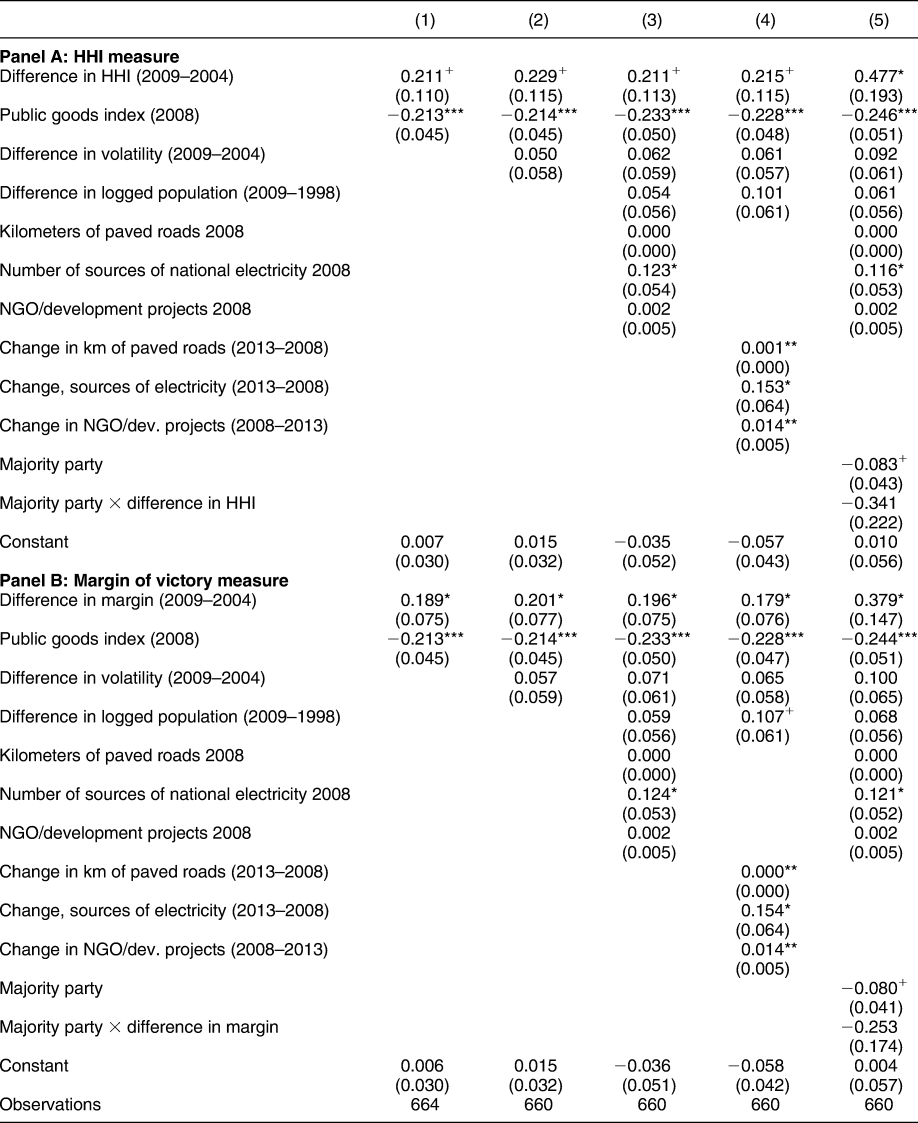
Table 1, Panel A presents results from estimating equation (1), where we measure political competition with the HHI. We incrementally add controls, starting with only the lagged value of public goods provision (column 1). We then add our difference in volatility measure (columns 2), finding that it is statistically insignificant and its inclusion has little effect on the coefficient on political competition. Third, we add controls for logged population, the initial (2008) levels of two public goods provided by the central government—kilometers of centrally built paved roads and the number of sources of electricity—and the number of NGOs and other development projects operating in the commune (column 3). Column 4 then replicates column 3 but with differences rather than levels of the latter three controls (column 4).
Effect of Change in Political Competition (2004–09) on Change in Public Goods Index (2008–13)

All regressions come from OLS models with standard errors clustered at the cercle level. +p < 0.10, *p < 0.05, **p < 0.01, ***p < 0.001.
We find a consistent story across all four specifications; a standard deviation increase in the HHIFootnote 19 between elections (a decrease in political competition) is associated with between a 0.065 and a 0.070 standard deviation increase in our public goods index.Footnote 20 We thus interpret our findings as a modest but robust decrease in the quantity of public goods provided by commune governments due to greater political competition. A similar story emerges when we instead measure political competition using the margin of victory of the winning party, as shown in Panel B of Table 1. Here, a standard deviation—or 23.4-percentage point—increase in the margin of victory between elections is associated with between a 0.082 and a 0.093 standard deviation increase in the public goods index. While the controls for central government infrastructure and NGO projects are positively signed and at times statistically significant (see columns 3 and 4), their inclusion has little effect on the magnitude or statistical significance of the coefficient on political competition. This provides at least suggestive evidence that political competition is uncorrelated with unobservables simultaneously driving public goods provision by both the local and central governments, or by both local governments and NGOs.
Averaging the four coefficients we report here (0.065, 0.070, 0.082, and 0.093) gives an average effect size of 0.078. This is comparable in magnitude—though oppositely signed—to effect sizes reported in the literature from other settings. For example, Hatfield and Kosec (Reference Hatfield and Kosec2013) and Arvate (Reference Arvate2013) examine the effects of political competition on public goods provision in the United States and in Brazil, respectively. They estimate that a standard deviation increase in competition is on average associated with a 0.142 and a 0.050 standard deviation increase in public goods outcomes, respectively.
Our first differences specification effectively controls for all time-invariant, commune-specific differences which might potentially influence changes in the public goods index. However, we might expect different regions of Mali to be on different trends in public goods provision, which could conceivably themselves account for changes in the public goods index. To ensure that any such trends are not driving our results, Appendix Table A.2 adds region dummies to each of the specifications shown in Table 1. Different regions clearly exhibit differential trends over this period—with the three northern regions of Kidal, Gao, and Tombouctou generally exhibiting the largest downward trends—but these trends do not appear to be heavily correlated with changes in political competition over this period, as evidenced by little change in the magnitude or statistical significance of the coefficient on competition when region trends are included. This suggests that the increasing violence and instability of the North starting in 2012 does not influence our findings.
By contrast, we find evidence that not only are communes on differential trends with respect to the initial period (2008) levels of public goods production, but that these trends are correlated with changes in political competition during 2004–09; consequently, when we fail to control for the initial public goods index level, the coefficients on political competition decline in magnitude and become statistically insignificant (Appendix Table A.3). Communes with more public goods in 2008 (e.g., schools) systematically build fewer of these goods during 2008–13, with similar patterns for other types of infrastructure; by explicitly modeling this, we increase the precision of our estimates.Footnote 21
To examine whether our results are appreciably affected by omitted variable bias, we carry out sensitivity analysis suggested by Imbens (Reference Imbens2003) and Harada (Reference Harada2013). This analysis is described in Appendix C.2; there we show that any omitted variable would need to be a lot more influential than our existing control sets to invalidate our findings. This supports our causal interpretation of the results.
Robustness Tests
To test the robustness of our findings, we examine both whether they hold up to different measures of political competition and to different measures of public goods provision. First, we consider alternate measures of political competition. While our independent variables are constructed using seat shares, the translation of seat shares into bargaining weights is not necessarily linear. Measures of bargaining power, such as Shapley-Shubik or Banzhaf indices (Banzhaf Reference Banzhaf1964), take into account the extent to which a party is formative on any given coalition due to their ability to swing a vote by threatening exit. In Appendix C.3, we describe these indices further and show in Appendix Tables A.4–A.6 that our results are robust to using a party’s Banzhaf power rather than seat share when calculating each independent variable. We additionally show that our results are robust to using as the independent variable a margin of victory measure that accounts for the number of parties competing (Appendix Table A.7) and the standard deviation of seat shares on the council (Appendix Table A.8).
In addition to being robust to alternate measures of political competition, these findings are also robust to alternate measures of the quantity of public goods provided. Appendix Table A.9 shows, for the HHI (Panel A) and margin of victory (Panel B) measures of political competition, respectively, that our main findings still hold when we instead use a public goods index constructed using a principal components analysis.
Placebo Tests
Electoral competition in a commune should influence local provision of goods, but not the provision of goods by the central government—suggesting a useful placebo test. If provision of goods by the central government were to change with changes in local levels of political competition, one might worry that an omitted variable driving both competitiveness and higher economic development in a commune explained our results. Appendix Table A.10, Panels A and B present regressions of the number of kilometers of paved roads built by the central government between 2008 and 2013 on changes in competitiveness between 2004 and 2009 as measured by the HHI and margin of victory, respectively, while Panels C and D carry out the same two analyses for the number of sources of electricity provided by the national government. In no case does a change in political competition in a commune yield a change in access to these centrally funded public goods.
Falsification Test
One might also worry that we had estimated a spurious relationship if communes that experienced a decrease in political competition during 2004–09 were already on a trend toward higher levels of public goods provision. If this were the case, then the prior trend itself might partly explain realized public goods improvements during 2009–13. We explore this possibility in Appendix Tables A.11 and A.12, where we estimate a specification identical to that presented in equation (1), but instead take as our outcome variable changes in a public goods index between 2003 and 2006—a period predating the 2009–13 period used for our main outcomes. This is consistent with a test of unconfoundedness suggested by Imbens and Wooldridge (Reference Imbens and Wooldridge2009) and implemented in other similar empirical settings (Aker Reference Aker2010).Footnote 22 We form an index using data on the number of boreholes and health clinics, given that data on schools and roads are not available for the earlier year (2003). We estimate each of the five specifications shown in Table 1—our main results table. Whether we measure political competition using the HHI (Appendix Table A.11) or the margin of victory (Appendix Table A.12), changes in political competition during 2004–09 do not predict higher or lower changes in public goods outcomes during 2003–06. We thus fail to reject the null hypothesis of parallel trends. We conclude that pre-trends are unlikely to explain our results.
EVIDENCE OF BARGAINING INEFFICIENCIES
We test our argument that the negative effect of political competition on public goods is working through increased legislative bargaining inefficiencies by examining several observable implications of such a mechanism, and then exploring several alternative explanations for our findings. As indicated by our theoretical discussion, we should only observe this positive relationship where councils must bargain to make policy (Hypothesis 2). We use both supply- and demand-side indicators of preference fractionalization to measure the likely intensity of the bargaining problem.
First, we examine whether the negative effect of competition on public goods is more pronounced in places with greater preference fractionalization on the supply side, namely in places without a majority party on the council. Where one party holds the majority of council seats—as is the case for 39% of rural commune councils—bargaining and coalition formation is unnecessary. In such cases, the majority party can simply appoint its own members to the executive bureau responsible for day-to-day commune operations and agenda setting since the support of only a simple majority of councilmembers is required for election to these posts.
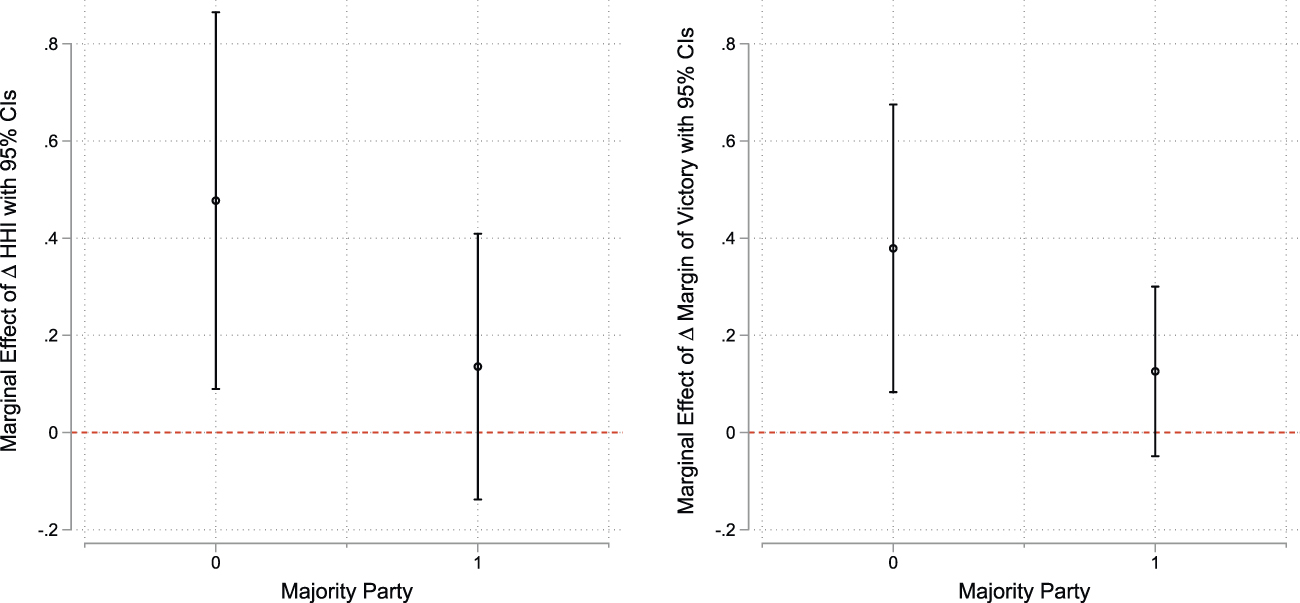
Thus, we examine whether the negative relationship between political competition and our public goods index is conditional on there not being a majority party on the council. Figure 1 reports the results of an interaction equation comparing the effect of political competition in communes with versus without a majority party.Footnote 23 As predicted by the theory, the negative effect of political competition on public goods is being generated by localities without a majority party on the council; there is no relationship in communes with a majority party. Notably, the effect size among this subpopulation is now more than twice as large as it was among the full sample and we can reject the null with greater confidence.Footnote 24
Effect of Change in Political Competition (2004–09) on Change in Public Goods Index (2008–13), By Majority Party

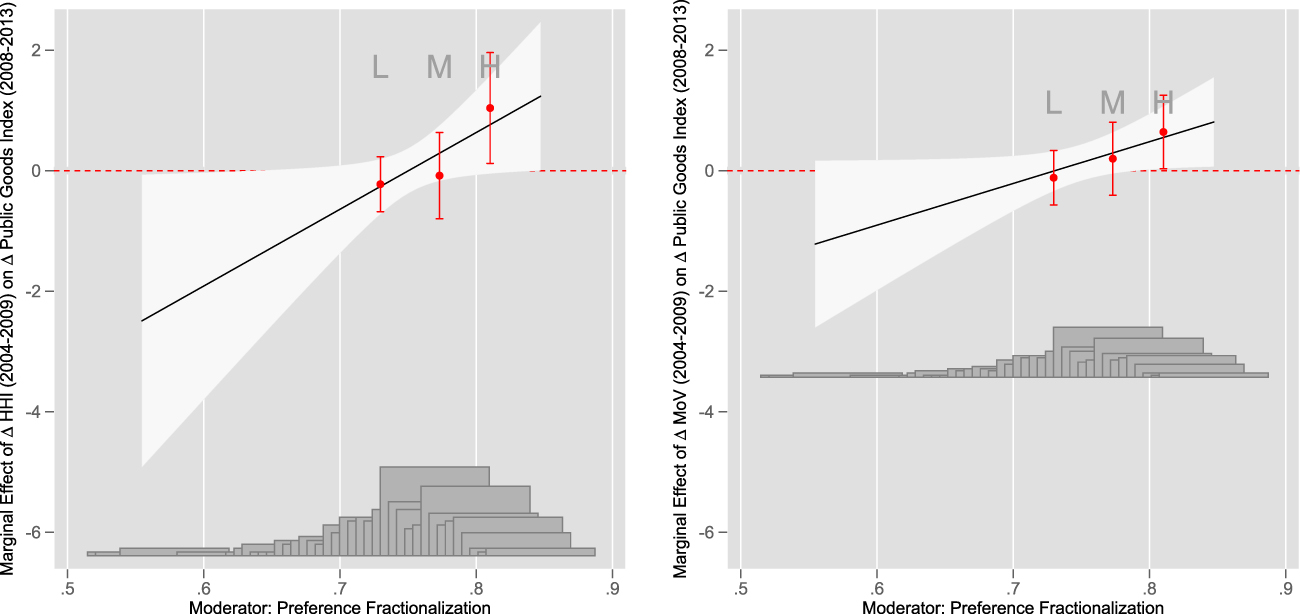
While the existence of a majority party on the council is a supply-side indicator of the existence of a political consensus that would reduce bargaining inefficiencies, a demand-side indicator would be the existence of a consensus among voters about policy priorities. We exploit the fact that communes vary in the extent to which residents agree upon priorities of the commune council. Using geo-coded Afrobarometer survey data (Afrobarometer 2002–2008; BenYishay et al. Reference BenYishay, Rotberg, Wells, Lv, Goodman, Kovacevic and Runfola2017) from 232 Malian communes,Footnote 25 we test the related observable implication that consensus among residents about priorities over public goods makes the negative relationship between political competition and public goods provision less likely. Consistent with the theoretical expectation, a significant negative relationship only manifests in places where there is more preference fractionalization, or less consensus over public priorities (see Figure 2 and Appendix C.7). This suggests that bargaining among councilmembers may fail not only because of disagreement over placement of infrastructure and the logistics of its construction, but also over which type of infrastructure to build.
Effect of Change in Political Competition (2004–09) on Change in Public Goods Index (2008–13), By Preference Fractionalization
Note: The distribution of the moderating variable, preference fractionalization, is arrayed along the x-axis. L, M, and H indicate Low, Middle, and High terciles of the moderator, respectively.

A second observable implication of bargaining inefficiencies explaining our findings is that political competition should differentially affect the provision of individual goods according to the level of coordination required for their provision (Hypothesis 3). Goods that are less excludable and easier to share should be easier for parties to coordinate on. In this case, the cost of forming coalitions should be lower and the benefits of forming them higher.
Water provision infrastructure—in the Malian context, usually boreholes—is likely to be particularly excludable (hard to share). Fetching water is a frequent, physically demanding, and often time-consuming activity. It is often performed by adult women who, in addition to providing 43% of agricultural labor in developing countries (Food and Agriculture Organization of the United Nations 2016), also contribute significantly to nonfarm businesses and home work, and accordingly have a very high opportunity cost of their time. Adult women are also politically active. For these reasons, proximity to a clean water source is accordingly highly valued (Wright Reference Wright2012), and there are likely to be intense debates on where to locate boreholes.
The next two goods in our index are either used by less economically and politically active individuals—schools—or are used less frequently in general—clinics—making debates over their location potentially less intense. Comparing the two, clinics are typically less numerous than schools: in our data, the median number of clinics per commune at baseline (2008) is just two, while the median number of primary schools per commune is ten. This could make clinics more difficult to bargain over. To see why, imagine that the median commune council decides to build a third clinic and an eleventh school, each in a new village. The choices of where to locate the new clinic will, by definition, be more numerous than the choices of where to locate the new school. This will complicate decision-making almost mechanically, making bargaining over the placement of the marginal clinic more challenging than bargaining over the placement of the marginal school. Finally, in many rural communities, the poor accept that children having a long walk to school is the norm—reducing contention about whether travel times to schools are acceptable.
By contrast, since roads are by their very nature a network that spans and connects multiple communities, they should be less excludable and easier to share—though there may be disagreement on the route if there is not a natural one already. As such, we would rank order these four goods, from most likely to generate bargaining difficulties to least: boreholes, clinics, and then finally roads and schools (how these latter two goods should be ranked is not entirely clear or beyond debate).
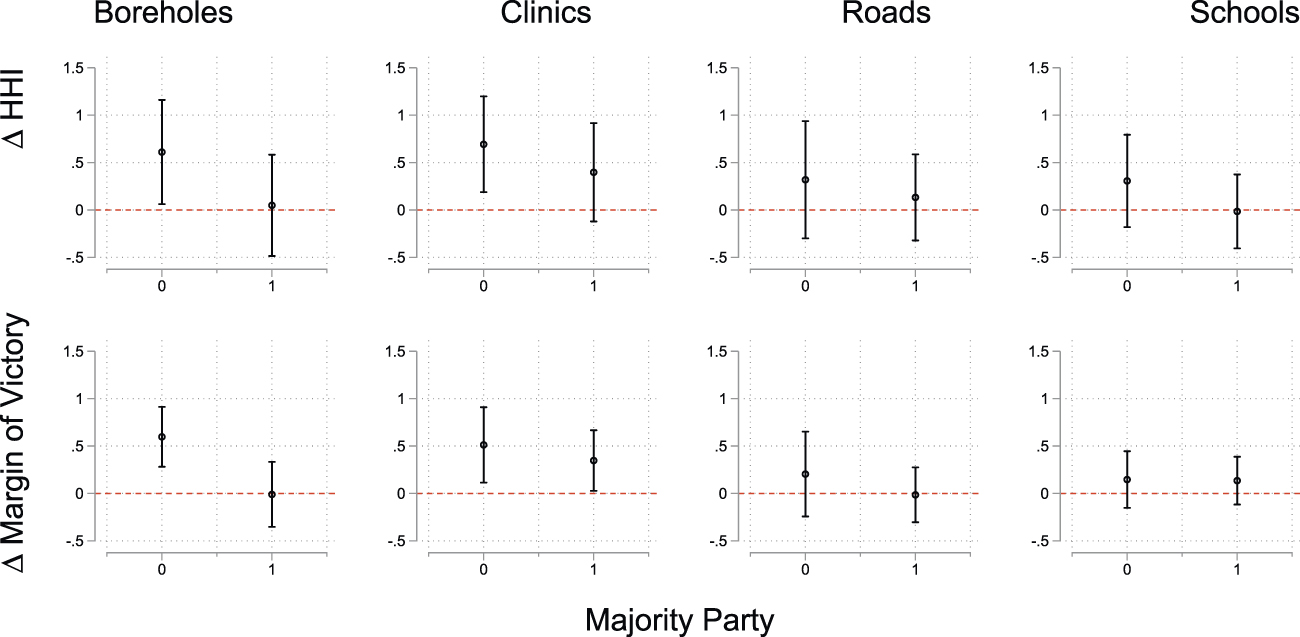
Using seemingly unrelated regression (SUR) to jointly test the effect of political competition on individual public goods provision outcomes in Appendix Table A.14, we find positive impacts on access to water and health clinics, especially among communes without a majority party on the council (depicted in Figure 3). Specifically, a one standard deviation decrease in political competition as measured by the HHI (margin of victory) predicts 0.63 (0.59) more boreholes and 0.21 (0.19) more clinics per commune, on average.Footnote 26 In communes without a majority party on the commune council, these effects are even larger; there, the same increase in the HHI (margin of victory) measure predicts 1.8 (1.7) more boreholes and 0.37 (0.27) more clinics per commune, on average, and these effects are always statistically significant at the five-percent level or higher.Footnote 27 There is no significant effect on roads or schools. We can further reject the null hypothesis that the coefficient on change in political competition in each component public good regression is jointly equal to zero (p = 0.08 for HHI and p = 0.00 for margin of victory).
Effect of Change in Political Competition (2004–09) on Change in Public Goods (2008–13), By Majority Party

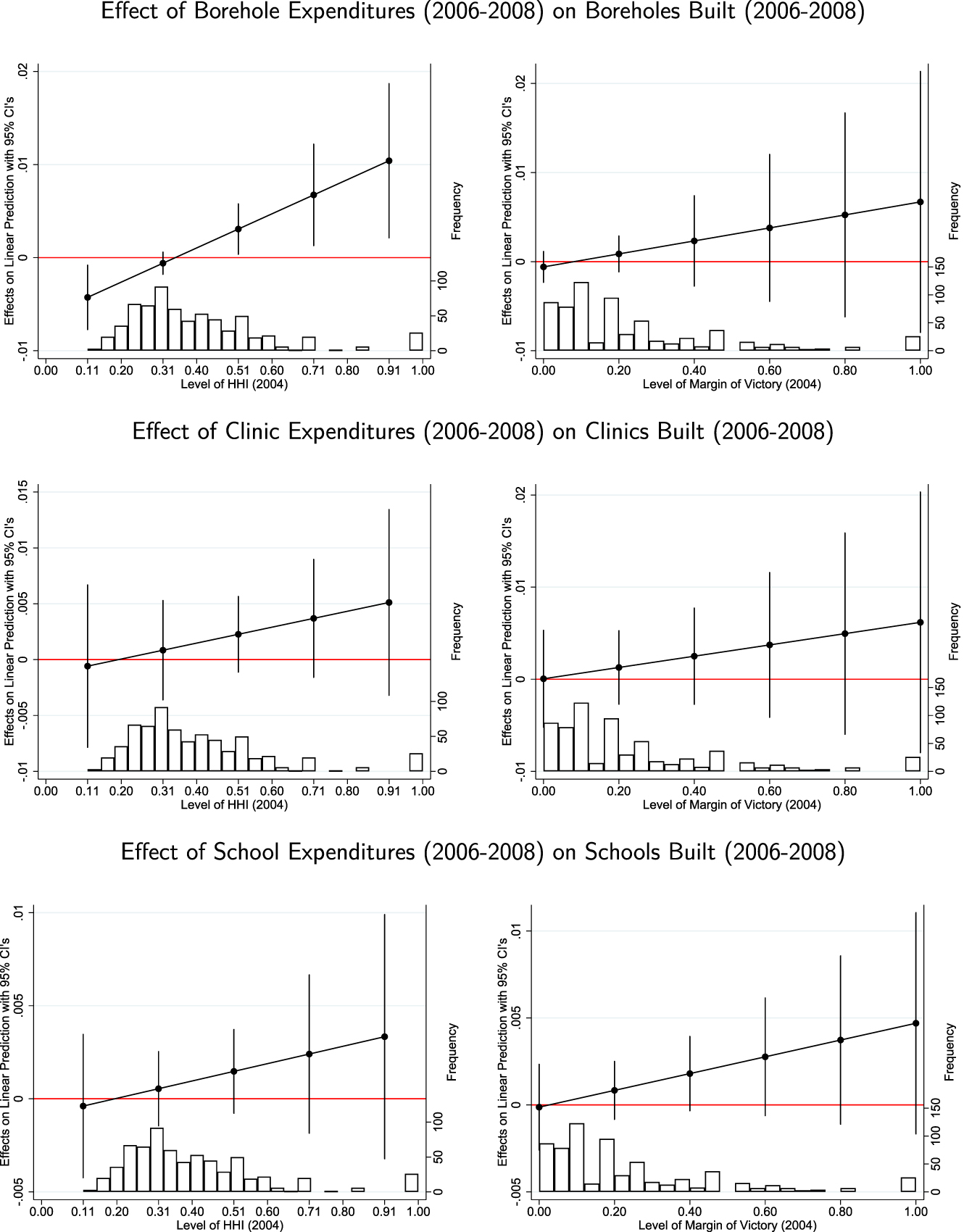
A third observable implication of the argument that legislative bargaining inefficiencies are driving the negative relationship between political competition and public goods is that the same amount of local public expenditures should yield fewer outputs in more competitive places. We explore this possibility using data on public expenditures by the commune during 2006–08 on boreholes, clinics, and schools (we lack data on road expenditures), and combining this with data on the total numbers of boreholes, clinics, and schools constructed during the same period. We regress the number of each good built over the three-year period on the amount spent on it during that same period, the level of competition in the previous election (2004), and their interaction. These results appear in Appendix Tables A.15, A.16, and A.17, respectively—and are additionally depicted visually in Figure 4.
Relationship between Public Expenditures and Outputs, Conditional on Competition

Our theory implies that public goods expenditures should have a less positive effect on outputs in more competitive places. We should thus observe a positive slope as the marginal effect of public expenditures goes from more to less competitive. For all three goods, we find evidence that the relationship is in the expected direction (see Figure 4), though the positive coefficient on the interaction term is only statistically significant in the case of boreholes.Footnote 28 We interpret this as suggestive—though certainly not definitive, given null results for two of the goods—evidence that bargaining inefficiencies are a mechanism through which political competition reduces the quantity of public goods provided.
Finally, we discuss another way in which inefficient bargaining can lead to fewer outputs. In contrast to the above case in which budgets are spent less efficiently in more competitive places, it is also possible that inefficient bargaining can lead to smaller budgets to start. Indeed, there is a weak negative relationship between competitiveness in 2004 and total spending on the three above goods between 2006 and 2008. One explanation for this could be the government withholding funds from inefficient places. ANICT transfers from the central government are made in three tranches (ANICT 2010). The first tranche, 45% of the total, is to be used as a deposit for project services. The second, 35% of the total, will only be transferred after 75% of the initial tranche has been justifiably spent; indeed, the whole contract can be annulled if the first tranche of funds is not justified within 60 days or if the site or nature of the project changes. In this way, some communes may remain with less than half of the potential project amount if they cannot effectively spend the initial funds due to disagreements within the council.
Qualitative Evidence
In this section we marshal evidence from our qualitative interviews with politicians in Mali in 2016 to evaluate three observable implications of our argument: (1) that a negative relationship between competition and public goods provision should lead to a negative (positive) perception of political competition (concentration) (Hypothesis 1), (2) that what drives increases in competition are empirically things that make bargaining harder, and (3) that there is evidence of weak parties (Hypothesis 4).
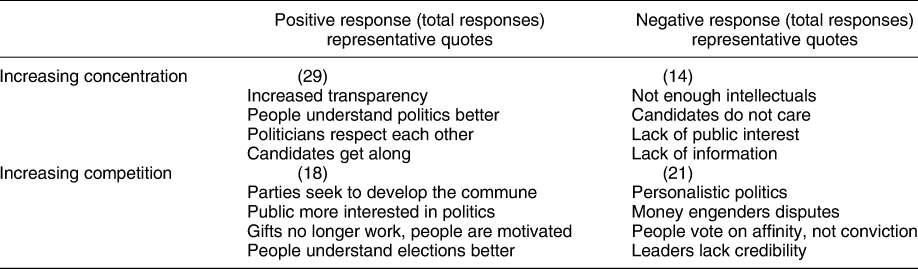
First, politicians indeed have a negative (positive) perception of political competition (concentration). Interviewees were told that, according to our data, their commune had recently become much more, more, less, or much less competitive relative to other communes and asked to explain that trend. Many interpreted decreasing competitiveness as a “good” thing. For instance, one politician remarked that decreasing competitiveness was “the result of the population beginning to understand that politics is a competition that should be played out passively and not in disorder and aggressiveness.”Footnote 29 To illustrate this trend more systematically, we coded whether explanations of the changing level of competition took on a positive or negative tone.Footnote 30 Table 2 reports the total counts in each category, and representative responses. There were twice as many positive answers among the decreasingly competitive communes, and slightly more negative answers in the increasingly competitive places. In several cases, remarks about decreased competitiveness were directly tied to increasing public goods provision—e.g., one commune’s respondents suggested a long history of a dominant party is helpful for getting things done, with even the opposition attributing increases in public goods to the mayor.Footnote 31
Perceptions of Changing Competitiveness Among Politicians Interviewed in July-August 2016

Before being told about relative changes in competition, politicians were asked to explain the level of political competition in their commune. Three main drivers of competition emerged. First, competition can cleave along ethnic lines, e.g., some politiciansFootnote 32 said the mayor directs most public works to co-ethnics. Second, competition can cleave along geographic lines. One politicianFootnote 33 said that “voters did not want politicians from other villages to take the reins of the mayor’s office” for fear of having benefits cut off, while anotherFootnote 34 explained that competition is driven by some villages breaking off and forming their own party. Third, greater competition may also be a manifestation of personal conflicts among existing local politicians (we discuss evidence for this below).
Each of these features has the potential to exacerbate bargaining inefficiencies. When politics cleaves along nonprogrammatic lines, compromise is difficult; one ethnic group or village is likely to benefit at the expense of another. But, of the above three drivers of competition, the latter is most likely to change during our period of study, and changes rather than levels are what we are capturing in our first differences quantitative analysis.Footnote 35 We thus turn our attention to how personalistic politics can exacerbate bargaining on a council.
Marginal increases in political fractionalization are often attributed to party reconfigurations resulting from personal ambitions and intra-party disputes. This highlights the very personalistic nature of politics, common among weak parties in new democracies. Politicians we interviewed suggested a key reason for personalism in politics: getting a seat on the council is a way to enrich oneself and get access to information. For instance, one politician left the party of the incumbent mayor when he heard the mayor was running again to have a better chance at winning the mayorship.Footnote 36 We also noticed that the word trahison, or “betrayal,” was mentioned numerous times in our interviews—a word that might appear out of place in party politics in a less personalistic setting. In response to questions about party switching and electoral failures, politicians in 10 of the 24 sample communes mentioned betrayal, referring to fellow party members who either left their party for another or otherwise acted against prior party agreements.Footnote 37 These respondents were almost twice as likely to come from communes that experienced above-median increases in competitiveness. Such party system fractionalization and uncertainty can contribute to both greater complexity when forming coalitions and less credible commitments when trying to sustain them.
Alternative Explanations
In one of the few empirical studies that similarly finds a negative relationship between political competition and public goods provision, Boulding and Brown (Reference Boulding and Brown2014) attribute the relationship to an omitted variable—underdevelopment—driving both higher incumbent turnover and lower public goods. They argue that municipalities with fewer resources are less able to mobilize voters and so incumbents rarely win reelection. It is in these places that look competitive that social spending is also lowest. While we aim to account for such an explanation by estimating a first differences model and controlling for factors that would impact the local budget such as population size and indices of development, we can also control for the potential mediator of voter turnout. When we add the change in voter turnout from 2004 to 2009 to equation (2), the coefficients on our measures of political competitiveness remain substantially unchanged and still statistically significant, providing evidence against this alternative explanation.
Another plausible alternative explanation for a negative relationship between political competition and public goods provision is that parties are competing on private transfers instead of or in addition to public goods provision. In young democracies where newer parties have weak reputations, clientelist appeals or political promises to targeted groups and individuals are often more credible than universal policies (Keefer Reference Keefer2007), and demands to supply targeted benefits can outweigh marginal increases in returns to programmatic investments (Kitschelt and Wilkinson Reference Kitschelt and Wilkinson2007). Studies have documented a positive correlation between political competition and clientelism or targeted transfers in such contexts (Weitz-Shapiro Reference Weitz-Shapiro2012; Wilkinson Reference Wilkinson, Kitschelt and Wilkinson2007; Levitsky Reference Levitsky, Kitschelt and Wilkinson2007; Kopecký Reference Kopecký2011). But for increases in targeted transfers to be the cause of subsequent decreases in public goods provision, the two outputs must be substitutes, e.g., because of distinct politician types or a limited budget of time or effort (Adida et al. Reference Adida, Gottlieb, Kramon and McClendon2017).
In our qualitative data, competition is indeed predicated, at least in part, on targeted rather than programmatic interests. As one respondent says: “Here, personal interests reign. Supporters want to have more, so political parties work hard to satisfy them.”Footnote 38 However, there is little evidence in our qualitative or additional quantitative data that the provision of public goods and private transfers are substitutes. One observable implication would be that politicians have a time budget such that spending more time on constituency service makes them less likely to work to provide public goods. Evidence for this is weak: about 70% of respondents say that doing one does not impede them from doing the other.
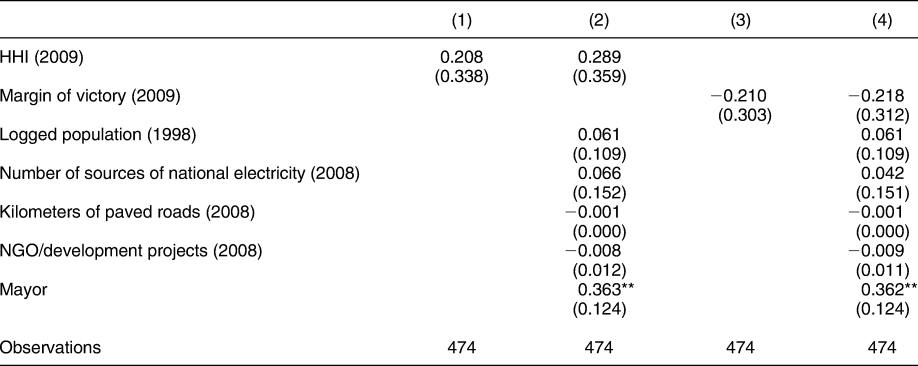
To quantitatively assess the relationship between private transfers, public goods provision, and political competition, we conducted a phone survey with 479 elected officials in a representative sample of 246 rural communes in the weeks before the November 20, 2016 Malian local elections, surveying the mayor and a high-ranking member of the largest opposition party. To measure private transfers, we asked how much money per month each politician spent on constituents during the last mandate; to measure vote-buying—sometimes considered another instance of private transfers to citizens—we asked each respondent how much they expected their party to spend on campaigning in the upcoming election (see Figures A.1 and A.2 for the distributions of responses). We find a positive and significant correlation between private transfers and the 2008 and 2013 levels of the public goods index (and no correlation with expected vote-buying)—evidence against their being substitutes. When we regress monthly constituent spending during the 2009–16 period on political competition in the 2009 elections in Table 3, we find a null relationship, further suggesting that an increase in private transfers due to political competitiveness is not driving the decline in public goods.Footnote 39
Effect of Political Competition (2009) on Monthly Constituent Spending During 2009–16

All regressions come from ordered probit models with region fixed effects and standard errors clustered at the cercle level.
+p < 0.10, *p < 0.05, **p < 0.01, ***p < 0.001.
GENERALIZABILITY
While we have demonstrated evidence of a novel relationship between political competitiveness and public goods provision in Mali, its import should not be limited to a single case. In the theory section, we identified scope conditions that indicate where such a relationship should manifest outside of Mali. In particular, the depressive effect of competition on public goods provision should be most likely to arise in contexts with weak and nonprogrammatic parties that are less capable of disciplining members and achieving compromise in policy debates. Additionally, the established positive effect of competition on public goods provision should be more likely to manifest (and even reverse the negative effect) where voters are better able to hold politicians accountable.
To test these predictions outside the Mali case, we constructed a panel dataset of 164 countries spanning the period 1975–2015. Since we are interested in legislative competition, we use a Herfindahl index (HHI) for legislative elections coded from the DPI dataset (Keefer Reference Keefer2005) as our independent variable. For our dependent variable, we use data on both public expenditures from the Statistics on Public Expenditures for Economic Development (SPEED) database (IFPRI 2017) and on development outcomes related to public expenditures from the World Development Indicators (WDI) database (World Bank 2017) as proxies for public goods provision.
As our key moderating variable, we use an index of party system institutionalization from V-Dem (Coppedge et al. Reference Coppedge, Gerring, Lindberg, Skaaning, Teorell, Altman, Bernhard, Fish, Glynn, Hicken, Knutsen, Krusell, Lührmann, Marquardt, McMann, Mechkova, Olin, Paxton, Pemstein, Pernes, Petrarca, Römer, Saxer, Seim, Sigman, Staton, Stepanova and Wilson2017), which is formed by combining indicators for party organizations, party branches, party linkages, distinct party platforms, and legislative party cohesion. For simplicity, we code an indicator variable for the index of party system institutionalization being above the median (high), as opposed to below the median (low). In settings of high party system institutionalization, our theory predicts that an increase in the HHI (i.e., a decrease in legislative competition) may harm public goods outcomes. By contrast, when party system institutionalization is low, a similar decrease in legislative competition should be beneficial for public goods outcomes.
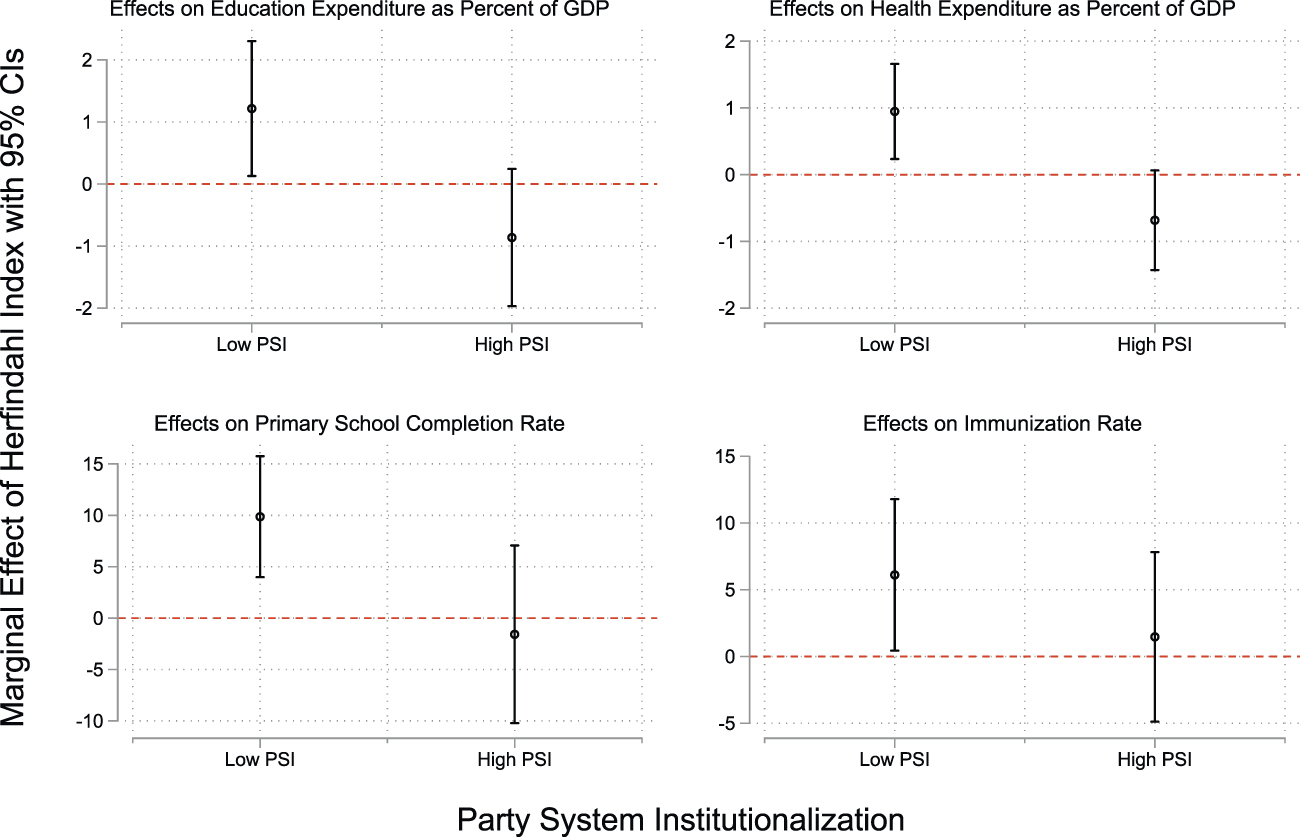
Our empirical specification takes advantage of over-time changes in both legislative electoral competitiveness and public goods outcomes, running a two-way (country and year) fixed effects regression. We interact the time-varying independent variable of competitiveness with a time–invariant country-level indicator for high party system institutionalization, which allows us to estimate differential slopes for the two sets of countries. Results appear in Appendix Table A.20 and key outcomes are depicted visually in Figure 5. We find strong support for our theory outside the Mali case, whether looking at public expenditures (inputs) or citizens’ access to services (outputs). In countries with low party system institutionalization, there is a positive and statistically significant relationship between the HHI and several outcomes—education and health expenditures as a share of GDP, primary school completion rates, and immunization rates for measles—indicating a negative relationship between political competition and public goods provision. By contrast, in countries with high party system institutionalization, this relationship either attenuates or reverses to obtain the negative relationship between the Herfindahl index and public goods outcomes (or the positive relationship between competition and public goods) that is predicted by much of the existing literature.Footnote 40
Cross-Country Analysis of Effect of Political Competition on Public Goods, Conditional on Party System Institutionalization
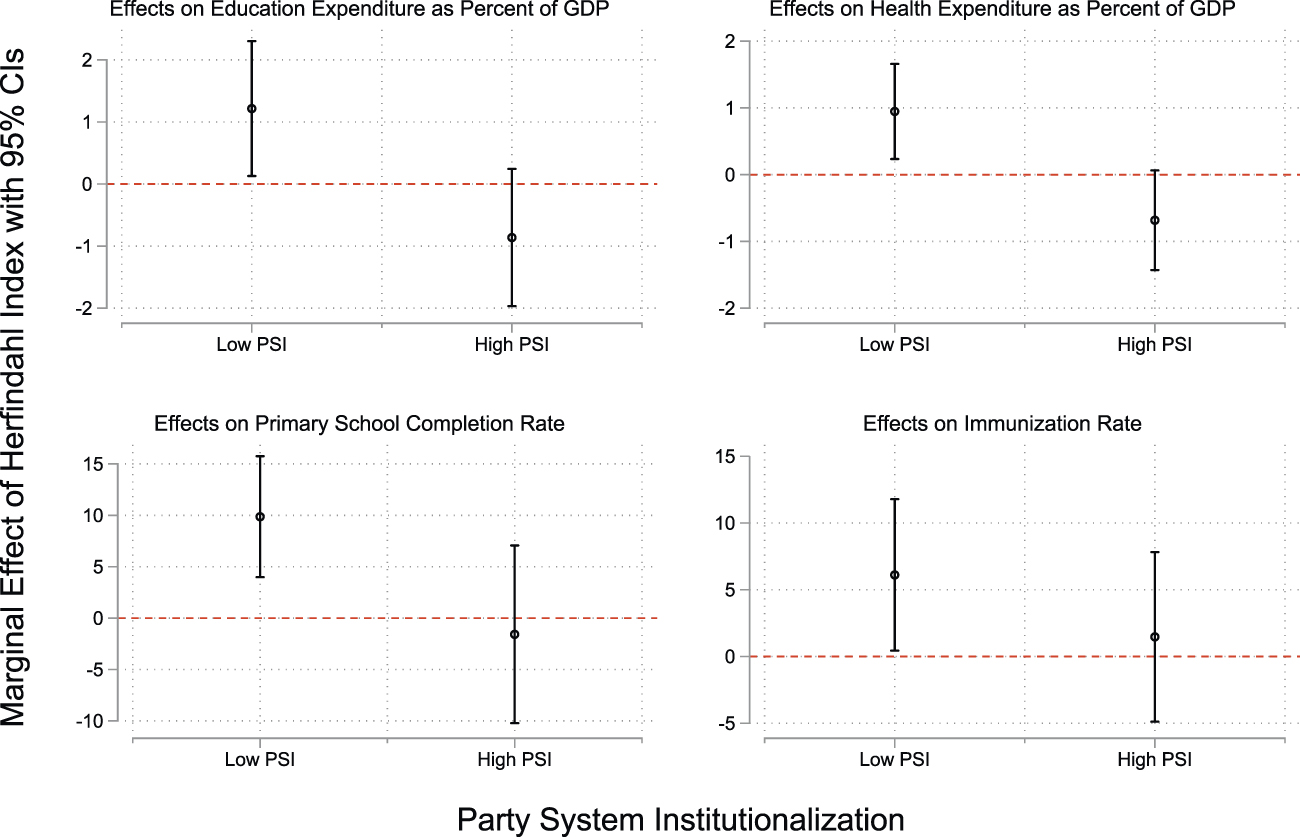
Our theory additionally suggests that the benefits of party competition should accrue in more transparent systems where electoral accountability is more likely to produce voter-preferred outcomes. Lacking comparable cross-country data on government transparency, we instead use country-level data on perceptions of corruption from Transparency International as a proxy for the extent to which electoral incentives are perceived to discipline politician behavior. Our expectation from the theory is that salutary effects of political competition should only manifest in a setting of high party system institutionalization where elections additionally discipline politician behavior. We thus compare the relationship between party competition and public goods provision across three categories of countries: those with low party system institutionalization (where we expect the relationship to be negative), those with high party system institutionalization and low corruption (where we expect the relationship to be positive), and those with high party system institutionalization and high corruption (where we expect no systematic trend).Footnote 41 We find that, in most cases, having higher party system institutionalization and lower corruption is superior: those are the countries where the expected benefits of competition are most likely to accrue (Appendix Table A.20, Panel B).
CONCLUSION
We presented an argument that introduces two ways in which political competition can moderate public goods provision—electoral incentives and legislative bargaining—whereas the extant literature focuses largely on the first. Our theory suggests the conditions under which we should expect a net negative relationship between political competition and public goods provision to emerge: places where parties are weak and government transparency is low—features common among many young, low-income democracies. We test this main implication of our theory in two ways. First, using detailed local government–level panel data, we robustly show that increases in political competition lead to decreases in public goods provision in one low-income democracy, Mali. Second, we show that these results generalize to other weak party systems using panel data from 164 countries.
Using quantitative and qualitative data from Mali, we further provide evidence that the negative relationship between political competitiveness and public goods outcomes is indeed being generated by bargaining inefficiencies, as suggested by our theory. First, we show that the negative effects of competition on public goods are most likely to materialize where legislative coalitions are more difficult to maintain—namely, where there is no majority party on the council that can railroad through policy decisions or where there is greater preference fractionalization among voters. Second, we demonstrate that goods that are more excludable and thus more difficult to share (like water boreholes and clinics) imply greater bargaining inefficiencies, making a net negative effect of political competition on their provision more likely. Finally, we provide evidence that money is indeed being wasted; we show that the production function turning public expenditures into public goods is less efficient in more competitive places. In addition, we find no evidence that expenditures on public goods are instead being reallocated to private transfers, refuting one key alternative explanation.
Our theory and evidence highlight an important feature of political competition that has thus far been ignored in the literature: its potential to exacerbate the daily workings of governance in between elections. This suggests that efforts to support democracy in the developing world would do well to pay attention to the increased potential for bargaining inefficiencies in legislatures, and perhaps experiment with ways to improve effective governance in the long intervals between elections.
While our work highlights how political competition may worsen public goods production between elections, we have also noted that this could be due to either of two factors: inefficiencies in forming a coalition or inefficient decision-making by a weak coalition that cannot commit to decisions related to public goods provision. Future research is needed to adjudicate between these mechanisms and also to uncover precisely at which stage inefficiencies emerge. For example, how does political competition separately influence the speed and durability of coalition formation, the speed with which decisions over which public goods and services to build and supply are made, and the efficiency of their actual provision (construction or delivery)? Answers to these questions have important implications for our understanding of how public goods provision could suffer as a result of political competition, and what policies may work to circumvent such a negative consequence.
SUPPLEMENTARY MATERIAL
To view supplementary material for this article, please visit https://doi.org/10.1017/S0003055418000667.
Replication materials can be found on Dataverse at: https://doi.org/10.7910/DVN/VKOMCK.


 Open access


Comments
No Comments have been published for this article.