


Introduction
Forage scarcity and poor nutrition during the dry winter months are among the most significant constraints to promoting livestock development. Because of the acute winter conditions, livestock farming in most mountain environments relies heavily on agricultural production and agroforestry. Forage oats (Avena sativa L.) are a succulent forage crop with excellent growth habits, quick post-cut recovery, good forage quality, and good palatability (Khanal et al., Reference Khanal, Baral, Tiwari and Devkota2017). It belongs to the Poaceae family, is native to the Mediterranean area, and ranks fifth in cereal production worldwide (Numan et al., Reference Numan, Muhammad, Tariq, Fazal, Shamsher and Amir2016). For better growth and productivity, oats prefer temperate and cool subtropical environments. Oat plants tolerate a wide range of soil conditions but require adequate fertility for good dry matter yield and quality (Gyeltshen et al., Reference Gyeltshen, Yonten Nirola and Rai2017).
In Bhutan, winter forage scarcity is a major constraint in animal production. Oats are grown as green forage to provide high-quality fodder during cold, dry winters. Forage oats are generally planted after paddy and buckwheat cultivation since it needs less investment. Currently, only two varieties of oats are available for winter forage production in the extension program—Stampede and Fodder Oat of Bhutan (FOB). Fodder oat varieties are not only limited in number but are also two decades old since their recommended cultivation in 2003. With the genetic improvement of dairy cattle over the last two decades, dairy farmers need more options for quality forage to fully exploit the production potential of improved dairy cattle breeds. Under this study, new varieties were evaluated in the temperate environment of Central Bhutan. The first objective of the study was to assess the growth characteristics, dry matter production, and nutritional quality of oat varieties during the summer and winter seasons under temperate conditions of Bhutan. The second objective was to select and recommend suitable oat varieties for winter fodder production in the temperate environments of Bhutan.
Materials and methods
Oat varieties
A total of seven varieties were included in the field experiments (Table 1). Five cold-tolerant varieties of forage oat originating from China, known to provide high forage yield in high-altitude areas, were introduced in Bhutan in 2017 with assistance from the International Centre for Integrated Mountain Development (ICIMOD). The Chinese varieties were Longyan No. 1, Longyan No. 2, Longyan No. 3, Qingyin No. 1, and Linna. They are cultivated in the Tibetan plateau and possess positive attributes such as tolerance to extreme cold, resistance to drought, and tolerance to poor soils. The other two varieties were from the currently cultivated forage oats in Bhutan. These varieties were Stampede and FOB.
Varieties of forage oat and their origin

Experimental site, design, and treatment
Two different experiments were performed in the summer and winter. A summer field experiment was conducted between March and October and a winter experiment between November and April. The experiments were carried out in the Chamkhar Valley of Bumthang district in central Bhutan. The valley is located at an altitude of 2,650 m above sea level with a geographic position between 27.54°N and 90.75°E.
A Randomized Complete Block Design was used with seven varieties of oat under experimental treatments. Each variety treatment was repeated six times. The treatments included five cold-tolerant oat varieties: Longyan No. 1, Longyan No. 2, Longyan No. 3, Qingyin No. 1, and Linna. Two existing cultivated oat varieties namely Stampede and FOB were used as control treatments. Individual plots measured 4.5 m2 (3 × 1.5 m) and there was a total of 42 plots. Each replication had seven plots.
Management and treatment application
The seed was sown at the rate of 125 kg per/ha. Fertilizer Single Superphosphate (SSP) was applied at the rate of 370 kg/ha. For summer cultivation, irrigation was not provided because light rains were frequent. For winter cultivation, irrigation was provided when treatment plots were dry.
Field measurement and data collection
The crop was harvested at the booting stage, 75 days after sowing. The data recorded were: fresh and dry matter yield, the number of tillers, plant height, and leaf-to-stem ratio. The entire plot was harvested for the fresh yield, and fresh plant material was weighed with a weighing scale. Ten plants were randomly selected from each plot for plant height, and measured with a measuring scale. Ten plants were selected randomly, and plant parts were segregated into leaf and stem and then weighed separately to calculate the leaf-stem ratio (LSR). The tiller numbers per plant were counted and recorded from 10 plants randomly selected from each plot.
Laboratory analysis
Plant materials were mixed after harvest and a representative sample weighing 250 g was collected from each plot. The total number of samples collected was 42. These samples were used to estimate dry matter content and nutrients. The laboratory tests for dry matter and nutrient content were performed at the Animal Nutrition Laboratory, Bumthang. Samples were dried in a hot air oven at 65°C for 48 hr. Crude protein, which is one of the most important criteria for forage quality evaluation (Assefa & Ledin, Reference Assefa and Ledin2001; Caballero et al., Reference Caballero, Goicoechea and Hernaiz1995), was determined using the Kjeldahl method (AOAC, 1990).
Data analysis
The datasets of summer and winter experiments were analyzed independently. Data were processed in Microsoft Excel and exported to SPSS Version 23. The dataset was checked for outliers, followed by Shapiro–Wilk’s and Levene’s tests for normality of data and homogeneity of variance, respectively. The Generalized Linear Model with Multivariate ANOVA was used to compare the mean differences in various parameters between new and existing oat varieties. Means between treatments were compared with the Tukey Pairwise comparison test. Differences in means were considered significant when the p-value was less than .05.
Results
Plant height, number of tillers per plant, and LSR
The mean plant height, tiller numbers per plant, and leaf-to-stem ratio are presented in Table 2. At the time of harvest in summer, the oat variety Qingyin No. 1 had a greater plant height (61 cm) and the highest tiller number per plant (five tillers per plant). However, the LSR was highest for Longyan No. 2 (LSR 0.73). During harvest in late winter, Longyan No. 2 provided a greater plant height (64 cm) and the highest number of tillers per plant (seven tillers per plant), followed by Qingyin No. 1. Longyan No. 1, 2, and 3 were the top three varieties with LSRs of 1.49, 1.31, and 1.35, respectively.
Morphological parameters (mean plant height, tiller numbers, and leaf-to-stem ratio) among oat varieties in summer and winter

Note. **p ≤ .01; ns, nonsignificant (p > .05).
Abbreviation: LSR, leaf stem ratio.
Forage yield and quality
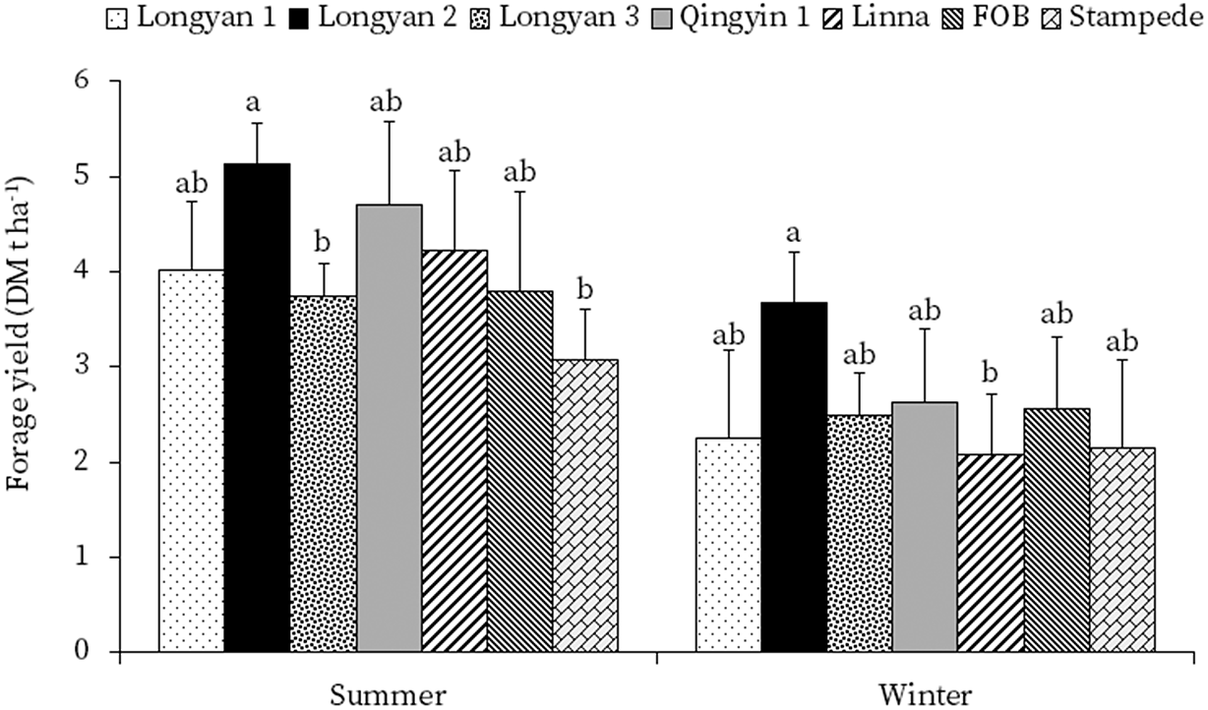
Among the oat varieties, Longyan No. 2 gave the highest forage yields of 5.00 and 4.00 DM t/ha in summer and winter, respectively (Figure 1). Qingyin No. 1 was the second highest in forage yield with less than 5.00 DM t/ha in summer and less than 3.00 DM t/ha in winter. Stampede gave the lowest forage yield in both seasons, 3.00 and 2.00 DM t/ha in summer and winter, respectively.
Forage yield of oat varieties in summer and winter. Means with different letters are significantly different.
In terms of forage quality among oat varieties grown in summer, Longyan 2 and Longyan No. 3 had the highest crude protein contents of 15% each, followed by Longyan No. 1 and FOB with each showing a crude protein content of 14% (Figure 2). The variety Qingyin No. 1 had the lowest crude protein content of 12% in summer. However, in winter cultivation, the oat variety Linna had the highest crude protein content of 13%, followed by Longyan No. 1, Longyan No. 2, and Longyan No. 3, each having a crude protein content of 12%. The variety Stampede gave the lowest crude protein content of 9% in winter.
Crude protein content of oat varieties in summer and winter. Means with different letters are significantly different.

Discussion
Morphological characteristics
Morphological characteristics such as plant height, tiller number, and LSR are indicators that provide accurate yield estimations (Ansar et al., Reference Ansar, Ahmed, Malik, Nadeem, Majeed and Rischkowsky2010; Mendoza-Pedroza et al., Reference Mendoza-Pedroza, Sánchez-Espinoza, Álvarez-Vázquez, Sosa-Montes, Maldonado-Peralta and Garay-Martínez2021). Both Longyan No. 2 and Qingyin No. 1 offered a generally good rate of plant growth. Qingyin No. 1 was also reported to have greater plant height in Nepal’s Lalitpur area (Pant et al., Reference Pant, Ghimire, Prenil and Upreti2022). The results of this study, which are consistent with those of earlier investigations (Chohan et al., Reference Chohan, Naeem, Khan, Kainth and Sarwar2004; Lodhi et al., Reference Lodhi, Marghazani, Hamayun and Marri2009; Mendoza-Pedroza et al., Reference Mendoza-Pedroza, Sánchez-Espinoza, Álvarez-Vázquez, Sosa-Montes, Maldonado-Peralta and Garay-Martínez2021), show that oat cultivars varied from one another in terms of morphological features. Howarth et al. (Reference Howarth, Martinez-Martin, Cowan, Griffiths, Sanderson, Lister, Langdon, Clarke, Fradgley and Marshall2021) found that all the traits of oat crops are significantly influenced by the environment, hence environmental factors and varietal characteristics may both contribute to the variation in morphological traits among oat varieties (Pant et al., Reference Pant, Ghimire, Prenil and Upreti2022; Singh et al., Reference Singh, Singha, Takawle, Shindey and Shrivastav2018). Hence, the adaptability of different oat varieties to a given environment differs, also due to genetic variations that affect hormonal balance and cell division rate (Zaman et al., Reference Zaman, Hussain, Aziz and Hayat2006).
Forage yield
Dry matter yields from Longyan No. 2 (4.0 t/ha) and Qingyin No. 1 (3.0 t/ha) are higher than the average yield (0.5 t/ha) from traditional winter forages like turnip, radish, and pumpkin grown by dairy producers in Bhutan (Wangchuk & Dorji, Reference Wangchuk and Dorji2008). However, the dry matter yields of Longyan No. 2 and Qingyin No. 1 are comparable to those of grass hay and silage, which are typical winter fodder in temperate regions of Bhutan. The greater plant growth also explains the substantially higher dry matter yields of Longyan No. 2 and Qingyin No. 1 in both seasons. Taller plants generally produce more dry matter than dwarf plants (Baron et al., Reference Baron, Salmon and McLeod1999; McKenzie et al., Reference McKenzie, Middleton, Solberg, DeMulder and Najda1997). Compared with Stampede and FOB varieties, the relatively higher plant growth and dry matter production of Longyan No. 2 and Qingyin No. 1 also indicate their greater adaptation to temperate climates of Bhutan. Qingyin No. 1 was also among the high-yielding forage oat varieties in Tibet (Zhang et al., Reference Zhang, Ma, Shao, Wang, Shen and Fu2019). Additionally, the greater forage yields suggest that these oat varieties are more resistant to cold than Stampede and FOB. Hence, Longyan No. 2 and Qingyin No. 1 have better prospects of addressing the severe fodder scarcity in winter.
Forage quality
All varieties of oat demonstrated appropriate crude protein levels above 7%, which is necessary for ruminants’ growth (Cappellozza, Reference Cappellozza2019). Among oat varieties, Linna and Longyan No. 2 had the highest levels of crude protein at 13 and 12%, respectively. According to studies (Barros et al., Reference Barros, Quaassdorff, Aguerre, Colmenero, Bertics, Crump and Wattiaux2017; Yue et al., Reference Yue, Li, Tong, Li, Zhao, Guo, Guo, SHi and Yan2022), high milk yield is correlated with high crude protein levels in feed. It implies that Linna and Longyan No. 2 have a greater chance of increasing milk yield in the winter. However, it should be noted that while Linna had the highest crude protein content among oat cultivars, its dry matter yield was the lowest. It suggests that Linna may need to be harvested a little later than other oat cultivars to maximize its forage yield. This is important because the forage growth stage determines the amount of dry matter produced and the nutrients present (Reiber et al., Reference Reiber, Peters, Hoffmann and Schultze-Kraft2012), indicating that a trade-off between dry matter production and nutritional value is required to maximize the benefits that Linna oat might offer. Longyan No. 2, which has the second-highest level of crude protein, can provide fodder of high quality as winter forage. Additionally, Longyan No. 2 plants are leafy and can attract animals. As a result, Longyan No. 2 combined with hay or paddy straw may improve the quality of winter feed.
Conclusions
This study was successful in identifying new fodder oat varieties in addition to the current varieties used in the extension program. In comparison to Stampede and FOB, the oat varieties Longyan No. 2 and Qingyin No. 1 have better production performance. As a result, in temperate Bhutan, livestock farmers now have additional options when choosing oat varieties for winter forage production. Although the oat variety Linna appears promising, more research is required to determine whether adjusting the harvest date might improve the forage DM yield and crude protein content. This study recommends Longyan No. 2 and Qingyin No. 1 as new oat varieties for fodder production in late winter in the temperate climates of Bhutan. In the future, there is an opportunity to experiment with combining these varieties with hairy vetch, a species of forage legume shown to be cold-tolerant in Bhutan. Combining oats with legumes, especially in the winter, may significantly boost pasture dry matter yield without compromising quality. The oat-legume mixture may be produced on a wider range of different soils, which could also benefit the environment.
Acknowledgments
The authors thank Professor Dr. Ruijun Long, Lanzhou University, China, for arranging oat variety seeds. The authors are also thankful to ICIMOD for its encouragement and support. Core funds of ICIMOD supported this study with funds contributed by the Governments of Afghanistan, Australia, Austria, Bangladesh, Bhutan, China, India, Myanmar, Nepal, Norway, Pakistan, and Switzerland. The authors also thank the reviewers for their constructive comments and suggestions.
Open peer review
To view the open peer review materials for this article, please visit http://doi.org/10.1017/exp.2023.7.
Data availability statement
The data on the findings of this study are available from the corresponding author upon reasonable request.
Competing interest
The authors certify that there is no conflict of interest with any organization regarding the material discussed in the manuscript.
Disclaimer
The views and interpretations in this publication are those of the authors. They do not imply the expression of ICIMOD’s opinion concerning the legal status of any country, territory, city, or area of its authorities, the delimitation of its frontiers or boundaries, or the endorsement of any product.


 Open access


Comments
Comments to the Author: Title- Please reformulate, avoid using “well”
The Abstract section- must improve, please don t enumerate the studied varieties, “the seven oat varieties were evaluated for morphological traits…in two growth conditions.”
– please avoid using “tallest” for plant height
– also, for the presentation of the results to be more exact do not use “around” or “approximately”
– in the Introduction section- “Five cold-tolerant… can be moved to the Material and methods section
– please please insert a table with the name of varieties and their origin
– please add soil analyses- if you have any; and also the temperature and rainfall during the experimental period
– “The spacing adopted…”- please delete, is not necessary
– “rate of 50 kg per acre”- please use ha for area
– “thoroughly”- in a scientific paper you don t need to use epithets, try to avoid this type of interpretation
– in the discussion section- “Understanding the morphological…”- please reformulate
– “The quantifiable physical…”- which are these? please specify
– “Forage yield is greatly…” for this formation you must have some correlation
– in all paper please use a scientific language
– please avoid using “leafy” try another term
– “Different oat varieties..”Please reformulate: … the adaptability of oat variety to different environment conditions…
– “their yields are comparable to those…”- which yields?
– “Taller plants generally produce…”- if you make some correlation this can be more visible
– “The relatively higher plant growth…”- not quite, this can be the variety attribute or in relationship with tillering capacity
– “However, it should be noted…”- please reformulate … a negative correlation is highlighted between crude protein content and…
– “It suggests that Linna may need…”- considering that you harvested in the booting stage, the vegetative stages are almost done
– “of the greatest quality as winter…”- please change with “high quality”
– in the Conclusion section- “After paddy and buckwheat…”- this can be inserted in the Introduction section, is not a conclusion
– please insert “in temperate Buthan conditions”.
– “Additionally, there is an…”- also, there is not a conclusion of your research