


Introduction
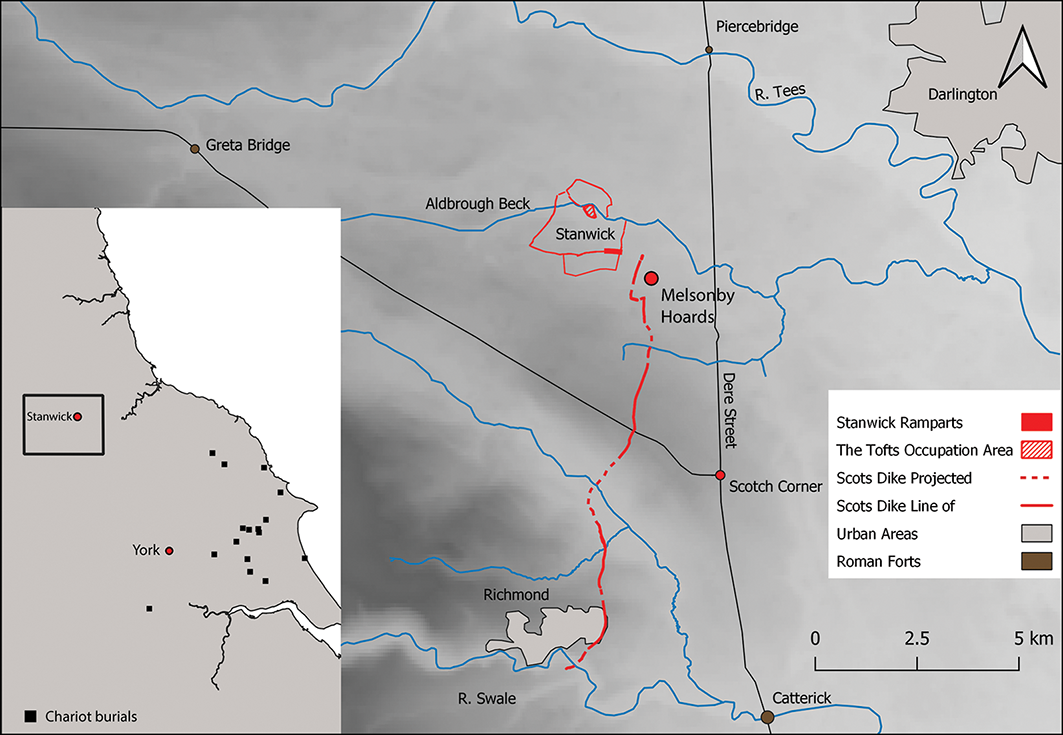
In 2021, two associated Late Iron Age (c. 100 BC–AD 70) metalwork deposits were discovered on farmland at Melsonby, North Yorkshire, close to where the ‘Stanwick hoard’ is thought to have been found in 1843 (MacGregor Reference MacGregor1962) and less than 1km from the ‘royal site’ (oppidum) after which this early find is named (Figure 1). Subsequent archaeological excavation in 2022 revealed two, related hoards which, together, represent one of the largest Iron Age metalwork deposits found so far in Britain. Comprising horse harness and vehicle elements, alongside weapons and vessels, the significance of the Melsonby finds lies both in the range of objects and in their archaeological context.
Location of Melsonby in relation to Stanwick and Yorkshire Wolds chariot burials (drawn by Claire Nesbitt).

Figure 1 Long description
The map illustrates the geographic relationship between Melsonby, Stanwick, and Yorkshire Wolds chariot burials. It highlights key locations such as Greta Bridge, Piercebridge, Darlington, Aldbrough Beck, and Richmond. The map includes symbols for Stanwick Ramparts, The Tofts Occupation Area, Scots Dike Projected, Scots Dike Line of Urban Areas, and Roman Forts. The inset map shows the broader context of Stanwick in relation to York and other chariot burials. The map uses color coding and labels to indicate significant archaeological sites and features.
The assemblage includes evidence for four-wheeled vehicles that are a characteristic feature of the Iron Age in continental Europe (e.g. Pare Reference Pare1992; Schönfelder Reference Schönfelder2002) but have not previously been found in Britain. Two-wheeled vehicles are attested, though most are from Middle Iron Age (c. 400–150 BC) burials on the Yorkshire Wolds (Giles Reference Giles2012) (Figure 1, inset) with only a single chariot burial from the Late Iron Age identified to date (Pembrokeshire, mid-first century AD; Comeau Reference Comeau2022). Here, we present a brief overview of the material from Melsonby and its significance for reassessing Iron Age Britain.
Discovery
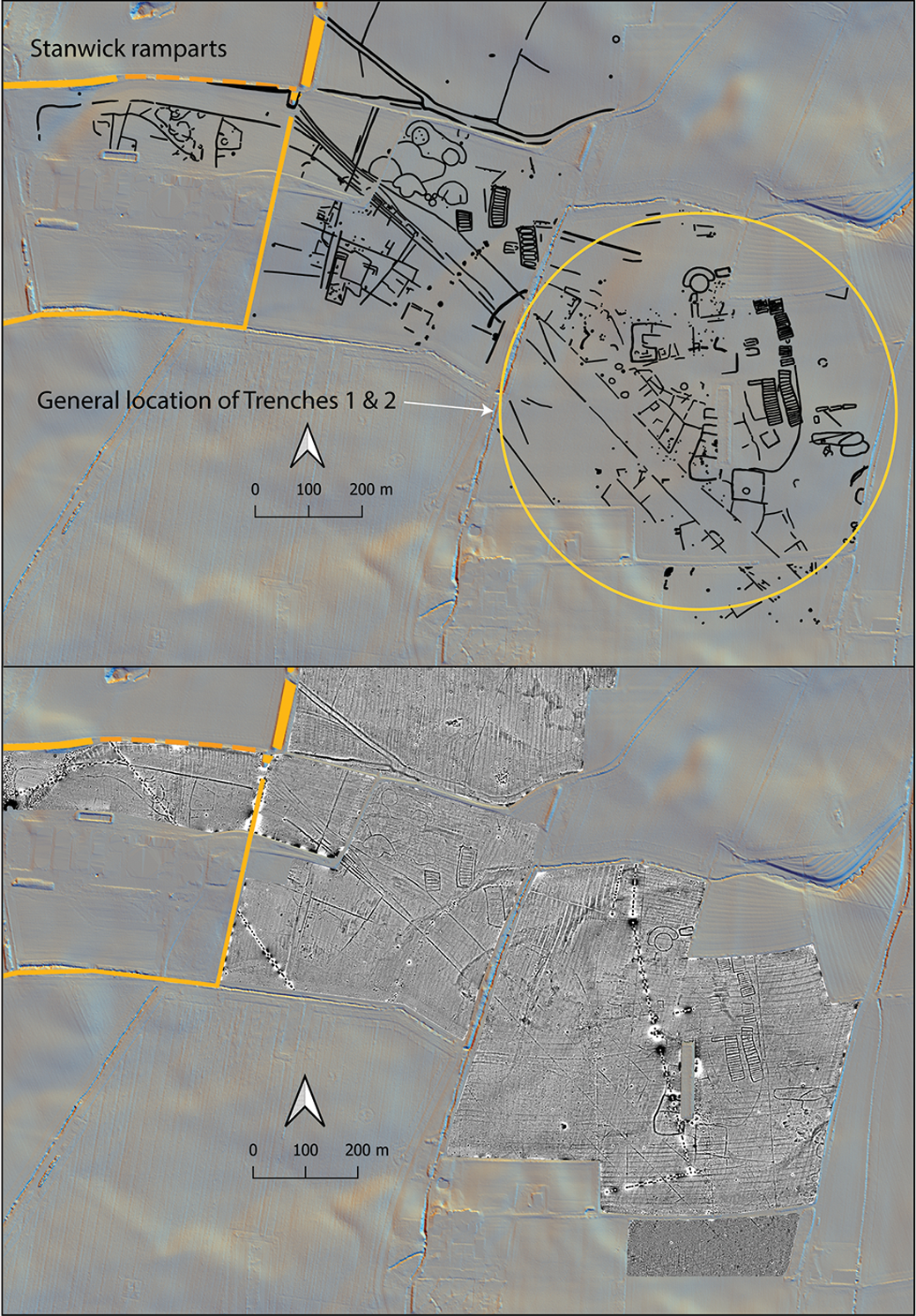
The Melsonby deposits were first encountered by Peter Heads who was metal-detecting with the landowner’s permission. He alerted Tom Moore at the Department of Archaeology, Durham University, who confirmed that the assemblage was likely to qualify as Treasure under the Treasure (Designation) Order 2002. After the British Museum and Portable Antiquities Scheme were notified, it was agreed that an excavation should take place to recover the artefacts and determine their context. Geophysical surveys were also conducted to provide information on the wider archaeological setting (Figure 2) and the relationship between this site and the Late Iron Age power centre at Stanwick.
General location of Trenches 1 and 2, in relation to geophysical survey results (drawn by Tom Moore & Claire Nesbitt).
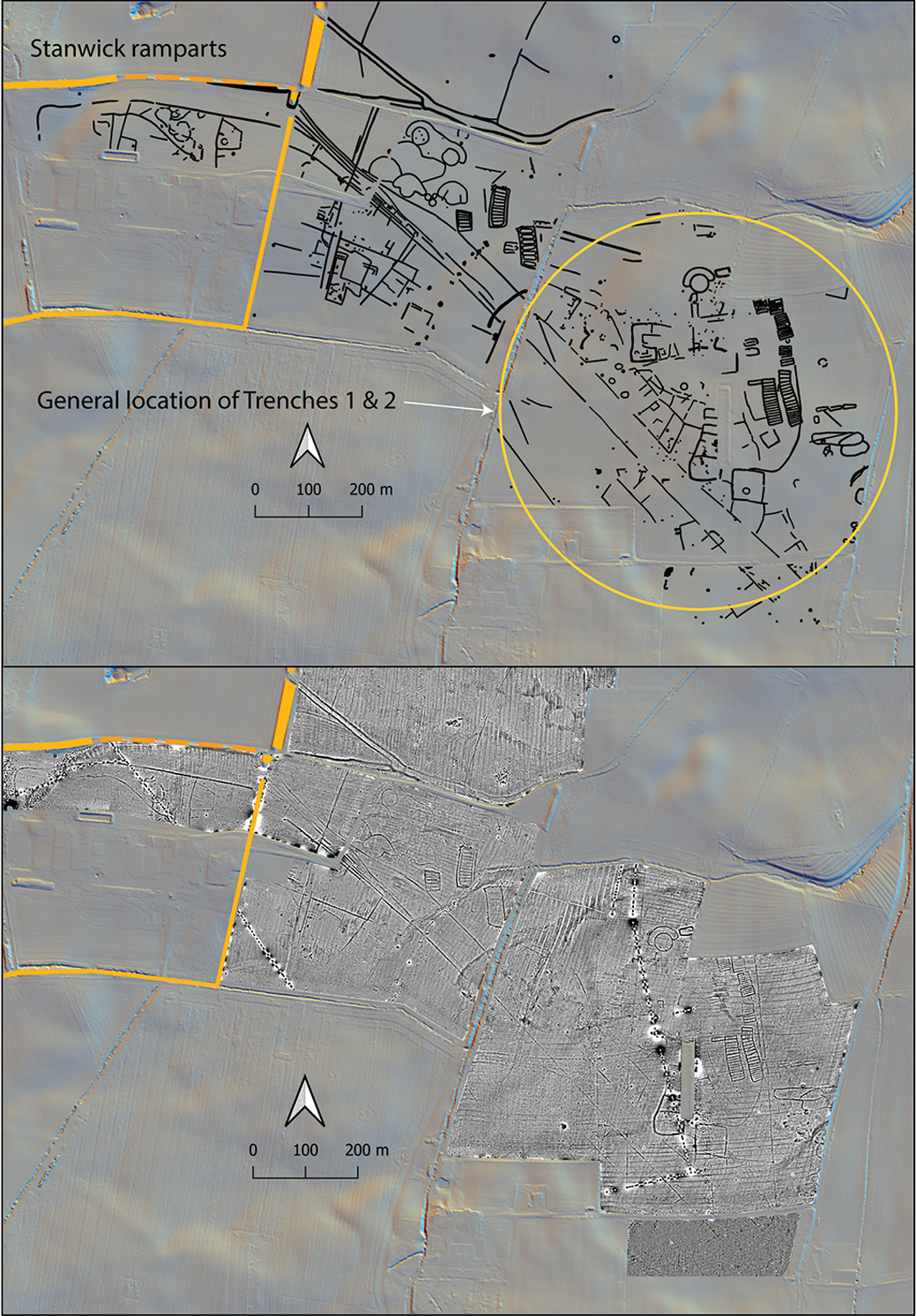
Figure 2 Long description
The map displays the general location of Trenches 1 and 2, marked with an arrow and label. The map includes geophysical survey results, with various lines and shapes indicating different features. The Stanwick ramparts are outlined in yellow, and a circular area is highlighted around the trenches. The map also includes a scale bar indicating distances in meters.
In this article, we use the term ‘hoard’ to describe the deposits, reflecting both their legal definition (see Treasure Act 1996; Treasure (Designation) Order 2002) and the nomenclature of past discussions of metalwork from Melsonby (Haselgrove Reference Haselgrove2016), although we acknowledge that such terminology can impact interpretations (see below). The deposits are hereafter referred to as Hoard 1 and Hoard 2, following the sequence in which these assemblages were revealed and excavated, in the corresponding trenches opened over the initial discoveries. The 1843 find is here designated Hoard 3 (MacLauchlan Reference Maclauchlan1849; Haselgrove Reference Haselgrove2016: 344). Fragmentary contemporaneous metalwork was also recovered from the area in 2011 and 2013 (Haselgrove & McIntosh Reference Haselgrove, Mcintosh and Haselgrove2016). This numbering therefore allows flexibility for the inclusion or exclusion of earlier finds in the sequence.
Trench 1
Hoard 1 was placed at the bottom of an east–west ditch, which formed a sub-division of a suite of enclosures (Figure 2). The Hoard 1 deposit measures approximately 2 × 1.6m across, and up to 0.5m deep. Given the size and complexity of the deposit, it was not possible to excavate more of the ditch, leaving some doubt as to whether the ditch was open or had been recut to receive Hoard 1.
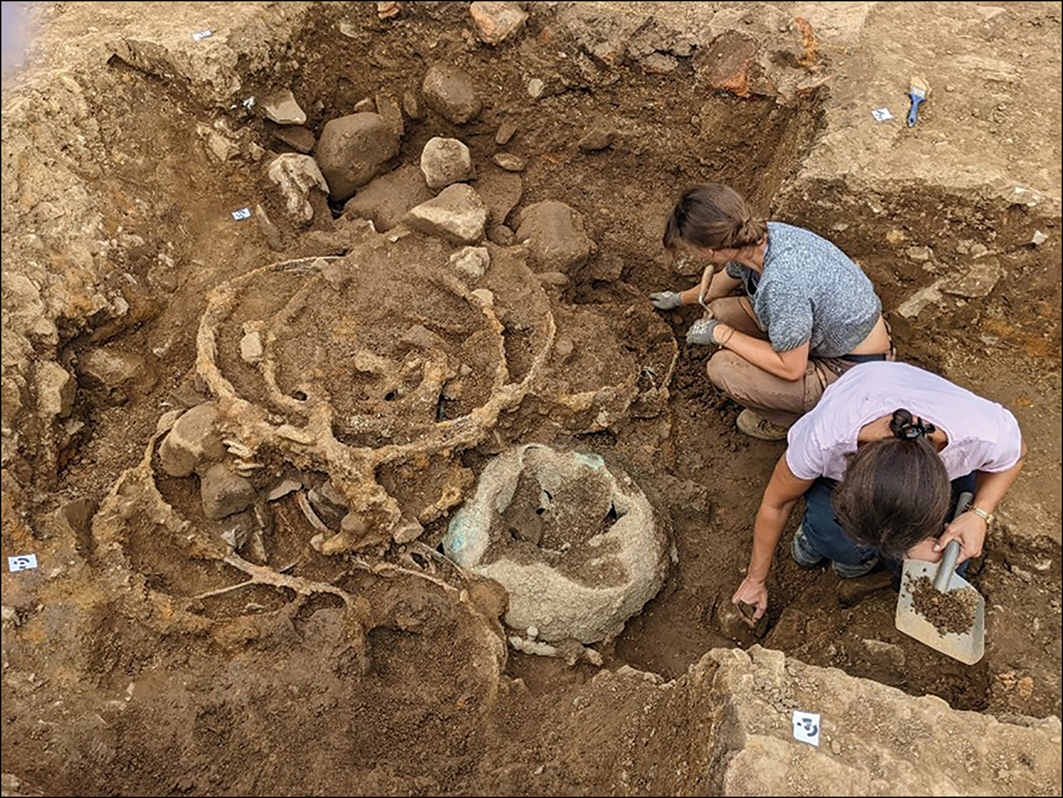
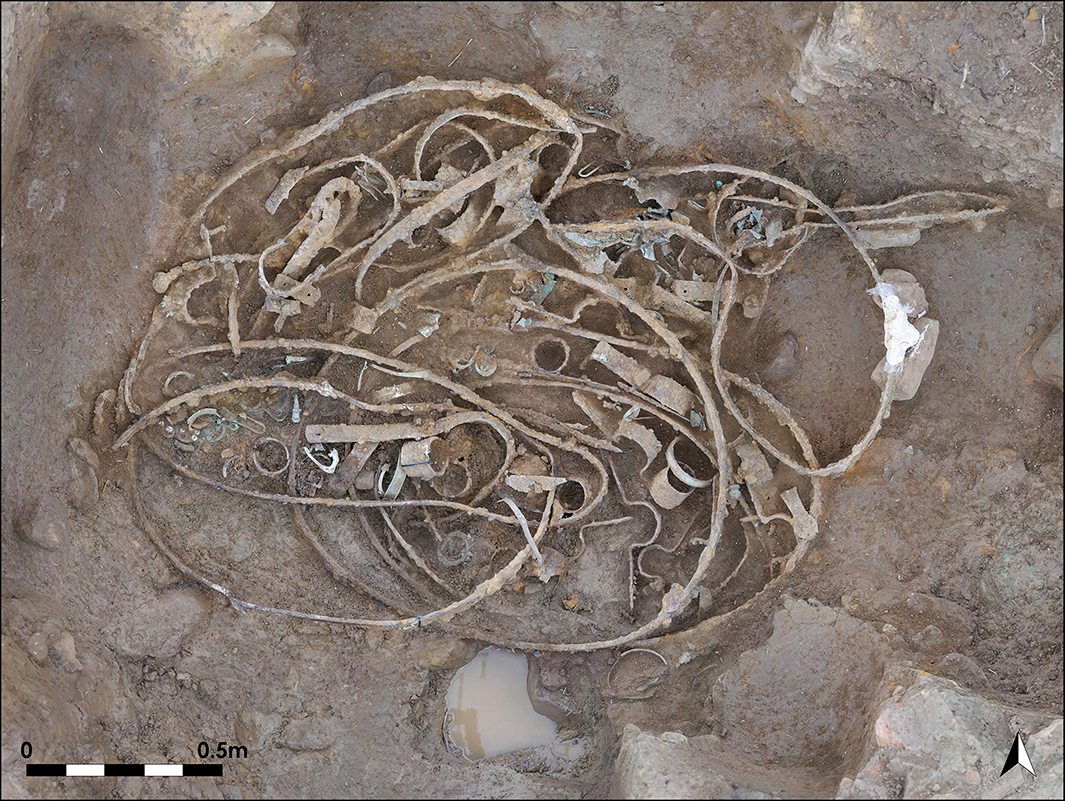
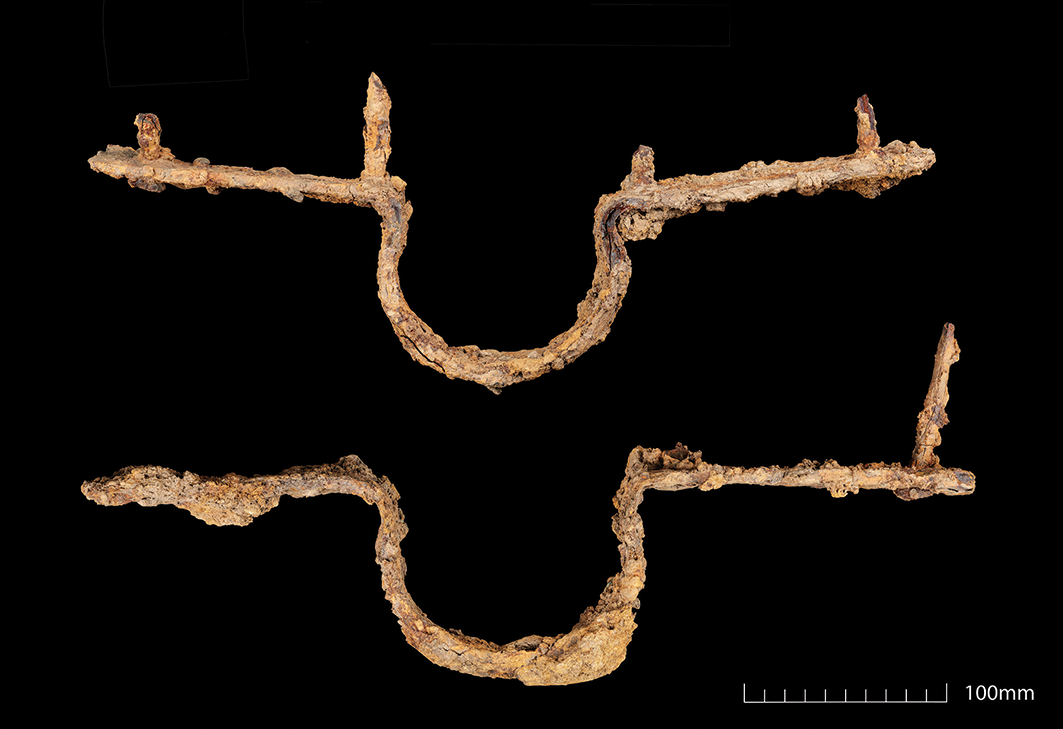
The assemblage includes 28 iron tyres of varying sizes and widths, all of which are bent or deformed (Figure 3) but had been carefully stacked. Within and between the tyres were hundreds of entangled metal artefacts, mostly horse harness and vehicle fittings, including a series of unusual U-shaped iron brackets (Figures 4 & 5). Three iron lanceheads and two copper-alloy vessels were also recovered—an inverted cauldron placed over some of the tyres and metalwork, and a large, upturned, lidded vessel at the base of the deposit.
The deposit of iron tyres in Trench 1 shortly after being uncovered (photograph: Durham University).
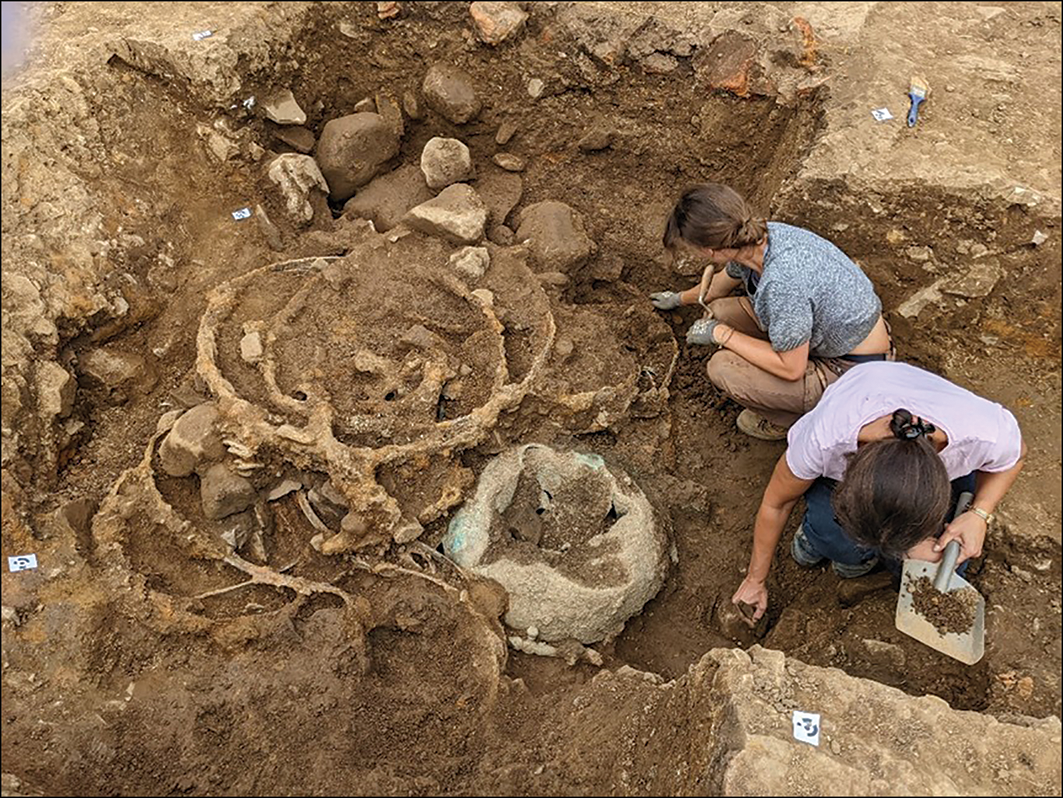
Figure 3 Long description
Two individuals are carefully excavating an archaeological site. The site reveals ancient iron tires and skeletal remains, with one skeleton partially encircled by an iron tire. The area is filled with large rocks and soil, indicating a significant archaeological discovery. The individuals are using tools to carefully uncover and examine the artifacts.
The bent iron tyres, hub elements and U-shaped iron brackets in Hoard 1 during excavation (photograph: Durham University).
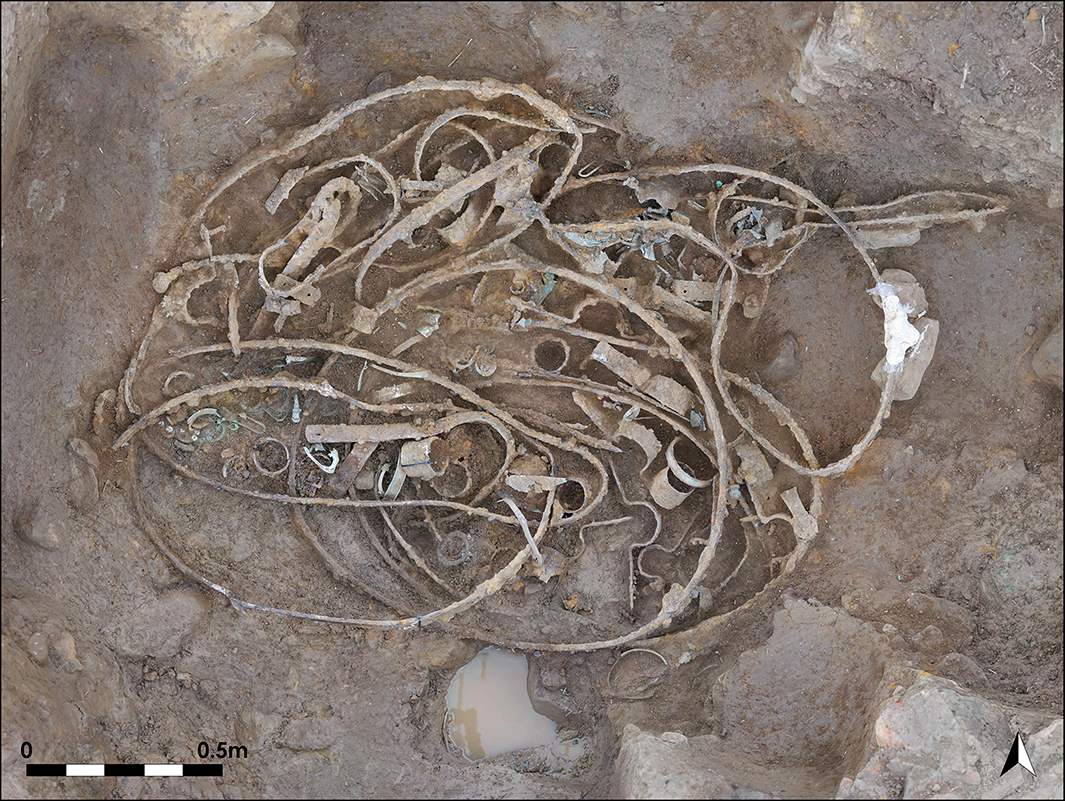
Figure 4 Long description
The image depicts an archaeological excavation site featuring a carefully stacked assemblage of 28 bent iron tyres of varying sizes and widths. These tyres are deformed but arranged meticulously. Interspersed within and between the tyres are hundreds of entangled metal artefacts, primarily horse harness and vehicle fittings. Notably, a series of unusual U-shaped iron brackets are visible among the artefacts. The excavation reveals the intricate arrangement and condition of these historical items, providing insights into their preservation and context.
Examples of the U-shaped iron brackets (photograph by Alexander Jansen, Durham University).

Figure 5 Long description
The image displays several U-shaped iron brackets, which are part of an archaeological assemblage. These brackets are made of metal and appear to be historical artifacts, likely used in horse harnesses or vehicle fittings. The photograph captures the intricate details of the brackets, showcasing their design and condition.
Several large rocks appear to have been thrown in while the deposit was open, including one, found in situ, that had crushed the cauldron base. Absence of soil between the objects and the presence of matching items spread throughout the deposit, imply a single episode of deposition; however, the fill around the deposit was overlain by a layer of objects dominated by more horse harness, giving the impression of a final ‘throwing-in’ of material.
Trench 2
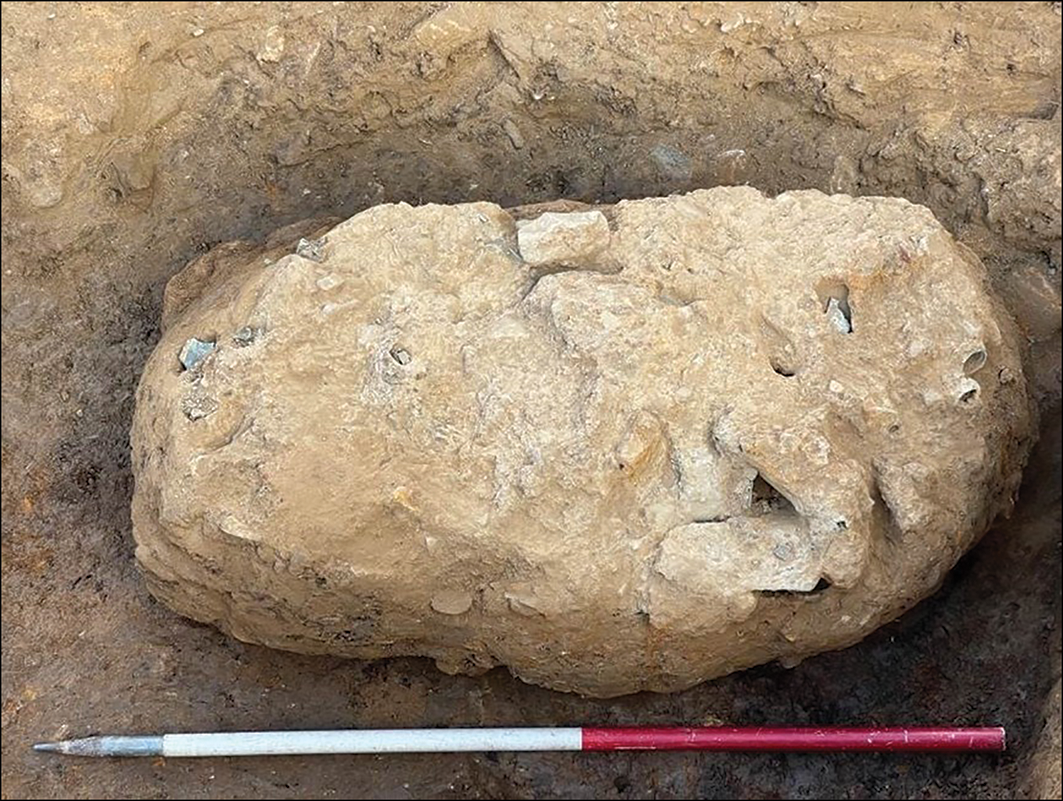
About 25m to the north of Trench 1, Trench 2 was positioned over Hoard 2, which had also been laid on the base of an east–west aligned ditch, part of the same set of enclosures (Figure 2). The deposit formed a discrete mass defined by a layer of dense iron concretion (Figure 6). This meant that excavation in the field was not possible, so Hoard 2 was lifted as a block (measuring approximately 1 × 0.7 × 0.4m) for investigation under laboratory conditions.
The Hoard 2 deposit in situ in Trench 2 during excavation (photograph: Durham University).

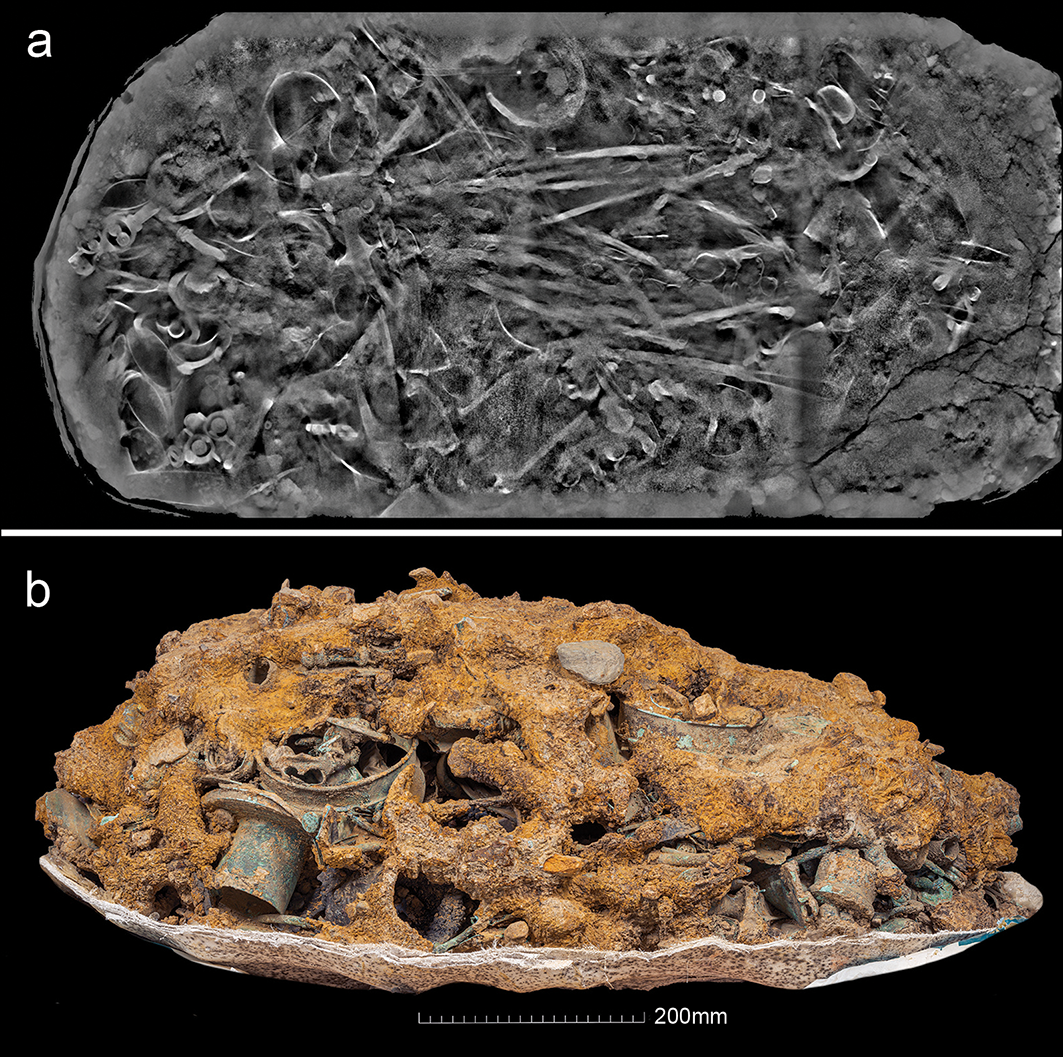
After lifting, the block was CT scanned by µ-VIS X-Ray Imaging Centre at the University of Southampton (Figure 7), revealing a mass of items, including horse harness, similar to that encountered in Hoards 1 and 3, as well as spears and long copper-alloy tubes. Excavation in the laboratory revealed that the artefacts were part of a void-ridden mass, accreted together through corrosion. Iron spearheads were laid at the bottom of the bundle and a possible iron pilum shaft, identified on the CT scans and just visible in the block, was threaded through hollow copper-alloy items. The tightly gathered nature of the deposit suggests the artefacts were bundled together and wrapped in organic material; this is also supported by the presence of mineralised impressions of textile fragments in the ditch-fill and traces of mineralised textile on some objects along the edges of the deposit (Susanna Harris pers. comm. 2024). Any attempt to disassemble the block is likely to result in damage to the artefacts, destroying this rare preservation of the depositional act. Thus, the artefacts currently remain in the entangled form in which they were deposited.
a) Still image of the CT scan of the Hoard 2 block-lifted deposit (courtesy of µ-VIS X-ray Imaging Centre, University of Southampton); b) a photograph of the block after excavation in the laboratory (photograph by Alexander Jansen, Durham University).

Figure 7 Long description
The first image is a CT scan of a block-lifted deposit, revealing intricate details of the internal structure. The second image is a photograph of the same block after it has been excavated in a laboratory setting, showing its physical appearance and the various objects embedded within it.
The contents of the deposits
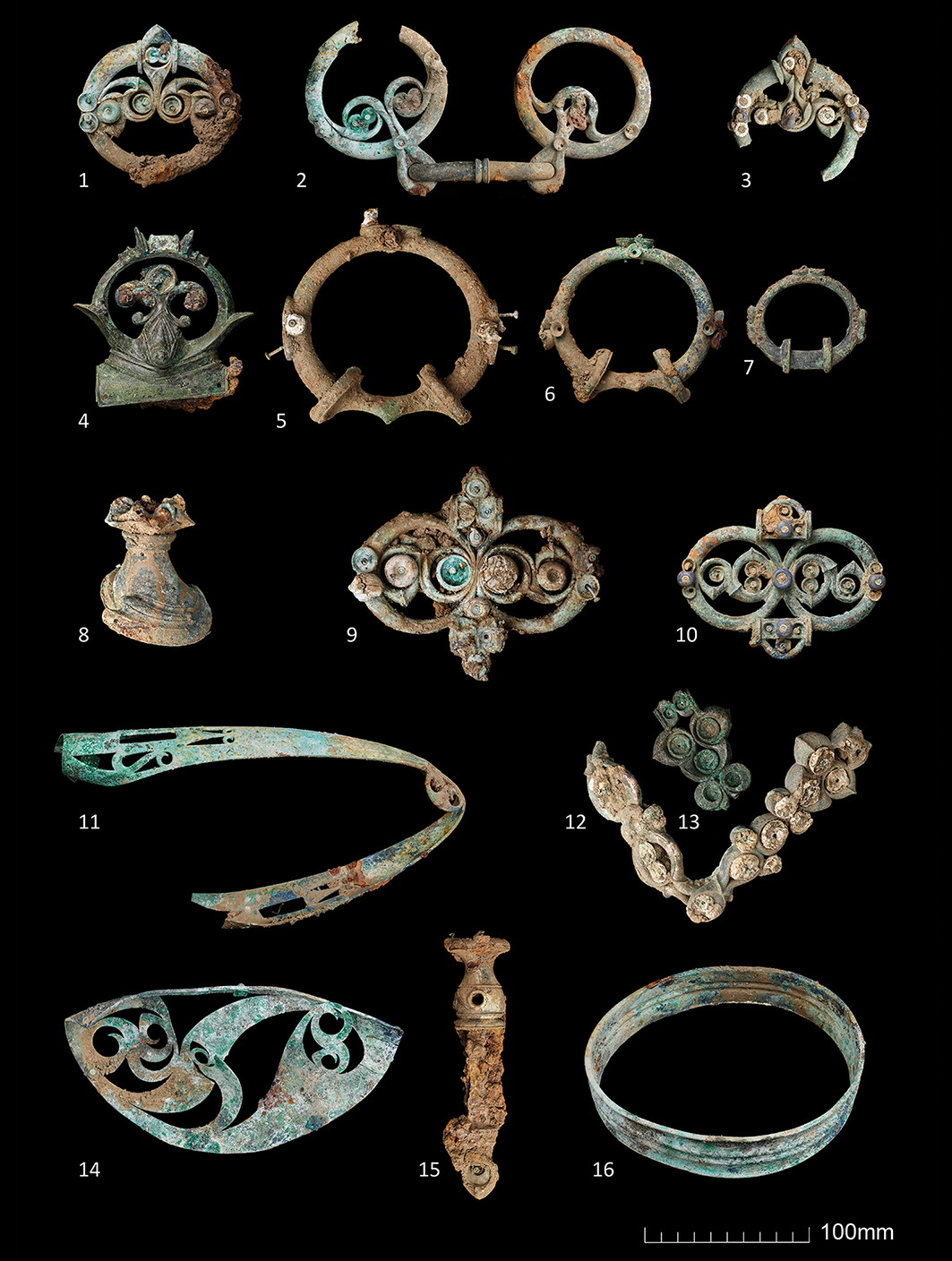
Separate fragments and complete objects from Hoards 1 and 2 represent a combined total of almost 950 items deriving from at least 300 whole objects (see online supplementary material (OSM) Appendix 1, though later joining and refitting during conservation may revise this number). Most were found in Hoard 1, with at least 88 items in Hoard 2. Almost two-thirds of the artefacts are copper alloy and the rest are iron. About three quarters of the assemblage is derived from horse-drawn vehicles and components of horse harness. As well as the iron tyres and brackets, these include nave bands, linchpins, yoke fittings, finials, kingpins, bolts and tubular adornments alongside ornate copper-alloy bits, strap fittings and terrets (rein rings), the latter often atypically large (Figure 8), and some fragments of melted silver. The remaining assemblage includes vessels and spears, an iron mirror, box components, a shield boss, edge bindings, repoussé sheetwork, melted pieces of copper alloy and tiny fragments of metalwork.
Composite image of the types of objects included in Hoard 1: 1 & 3) strap fittings; 2) bit; 4 & 8) finials; 5–7) terrets; 9 & 10) strap unions; 11) yoke fitting; 12 & 13) possible tracery elements; 14) decorative openwork fitting; 15) linchpin; 16) nave band (photographs by Alexander Jansen, Durham University).

Figure 8 Long description
The composite image displays a collection of objects from Hoard 1, each labeled with a number and description. The objects include strap fittings, bits, finials, terrets, strap unions, yoke fittings, possible tracery elements, decorative openwork fittings, linchpins, and a nave band. These items are arranged in a grid format, with each object photographed by Alexander Jansen from Durham University. The assemblage provides evidence for four-wheeled vehicles, a characteristic feature of the Iron Age in continental Europe, but previously not found in Britain. Two-wheeled vehicles are also attested, though most are from Middle Iron Age burials on the Yorkshire Wolds, with only a single chariot burial from the Late Iron Age identified to date. The material from Melsonby is significant for reassessing the Iron Age in Britain.
Based on their condition, it seems probable that many of the items arrived at the site complete but were damaged and broken in preparation for deposition. The separation of matching and paired elements of the harness and vehicle components throughout Hoard 1 also suggests that, at the very least, the vehicles were dismantled before deposition. It is not clear how much of the organic components were included but the survival of intact rivets (Figure 8 no. 14) with washers on some of the ornamental sheet-metal items suggests some were buried still attached to leather or other organic backing. Occasional traces of charcoal within edge-binding-type objects and potential indications of wood on parts of the iron nave bands may support this supposition. In contrast, most items in Hoard 2 were buried whole, although their wooden components were removed or damaged before deposition. The voids in the bundle could be an indication of organic elements having decomposed in situ, although they may equally stem from the way the items were wrapped.
The core of Hoard 1 is the 28 iron tyres. All were distorted, some bent wholly out of shape, before deposition (Figure 4), indicating that the wooden elements were missing or damaged before burial. The tyres are up to 50mm wide and at least 10mm thick, and encompassed wheels ranging in diameter from approximately 0.77–1.08m, indicating they may derive from vehicles of different sizes. Among the tyres was a series of broad, flat iron bars with a central U-shaped bend, described here as brackets (Figure 5). These items are not found on two-wheeled chariots in Britain. Some retained long nails protruding from the flat side of either arm, indicating they were once attached to thick, wooden items around a cylindrical component. Almost 50 pieces of U-shaped brackets were identified and up to 26 pieces of cylindrical iron bands (up to 100mm diameter and 100mm deep) were also found in Hoard 1 (see Figure 4). These cylinders fit comfortably within the U of the brackets and resemble hub collars from four-wheeled wagons of first-century BC to first-century AD date found in continental Europe (Schönfelder Reference Schönfelder2002; see below). These brackets could be under-straps below the axle, but research is ongoing. The presence of kingpins (essential for the steering mechanism on wagons but not chariots), the substantial size of many of the tyres, the brackets and the oversized horse harness metalwork indicate that the deposit contains the remains of substantial four-wheeled wagons instead of, or as well as, lighter two-wheeled chariots/carts. The assemblage amounts to a minimum of seven wagons, more if some vehicles were two-wheeled, although we cannot exclude the possibility that parts of different vehicles were buried rather than entire examples.
The copper-alloy artefacts from both Hoard 1 and Hoard 2 are similar in form, decorative motifs and design to objects found nearby in 1843 (Hoard 3; Macgregor Reference MacGregor1962; Haselgrove & McIntosh Reference Haselgrove, Mcintosh and Haselgrove2016: 344–47). There are hints too that the nineteenth-century discoveries included a separate deposit, possibly a Hoard 4, which included iron tyres (Macgregor Reference MacGregor1962; Haselgrove & McIntosh Reference Haselgrove, Mcintosh and Haselgrove2016: 344–47): a contemporary record mentions “an adjacent spot” where “large iron hoops, conjectured [to be] tires of chariot wheels” had been discovered (Archaeological Institute 1847). Horse bits recovered from Hoards 1, 2 and 3 are all straight-bar snaffles of Late Iron Age three-link derivative type (Figure 8 no. 2; Palk Reference Palk1984). Ornate cast openwork strap unions, button and loop fasteners, D-shaped triple projection terrets, shallow relief repoussé sheet work and ribbed ferrules also feature in all three deposits. Parallels for decorative details can be found across all three, from the winged protrusions on the Hoard 2 and 3 terrets and strap fittings, to the coral-adorned vase-headed linchpins in Hoards 1 and 2. Keeled roundels and trumpet shapes are the most frequent motifs, finding affinities in Late Iron Age metalwork from southern Scotland to southern England (e.g. Hunter Reference Hunter, Haselgrove and Moore2007; Joy Reference Joy2010).
Yet, there are also differences between the three hoards. The sword scabbard from Hoard 3 is without comparison in the 2022 deposits. Cauldrons occur only in Hoard 1, although a large bucket was found in Hoard 3 (Haselgrove Reference Haselgrove2016). Only Hoard 1 contains oversized strap unions and terrets; those in Hoards 2 and 3 are large but not overly so. Complementary harness sets in similar styles are recognisable within and across the hoards, suggestive of manufacture in related workshops, distinctions in size and decoration between the sets in the three hoards support the notion that they were made to be used as sets and that this was referenced in their deposition.
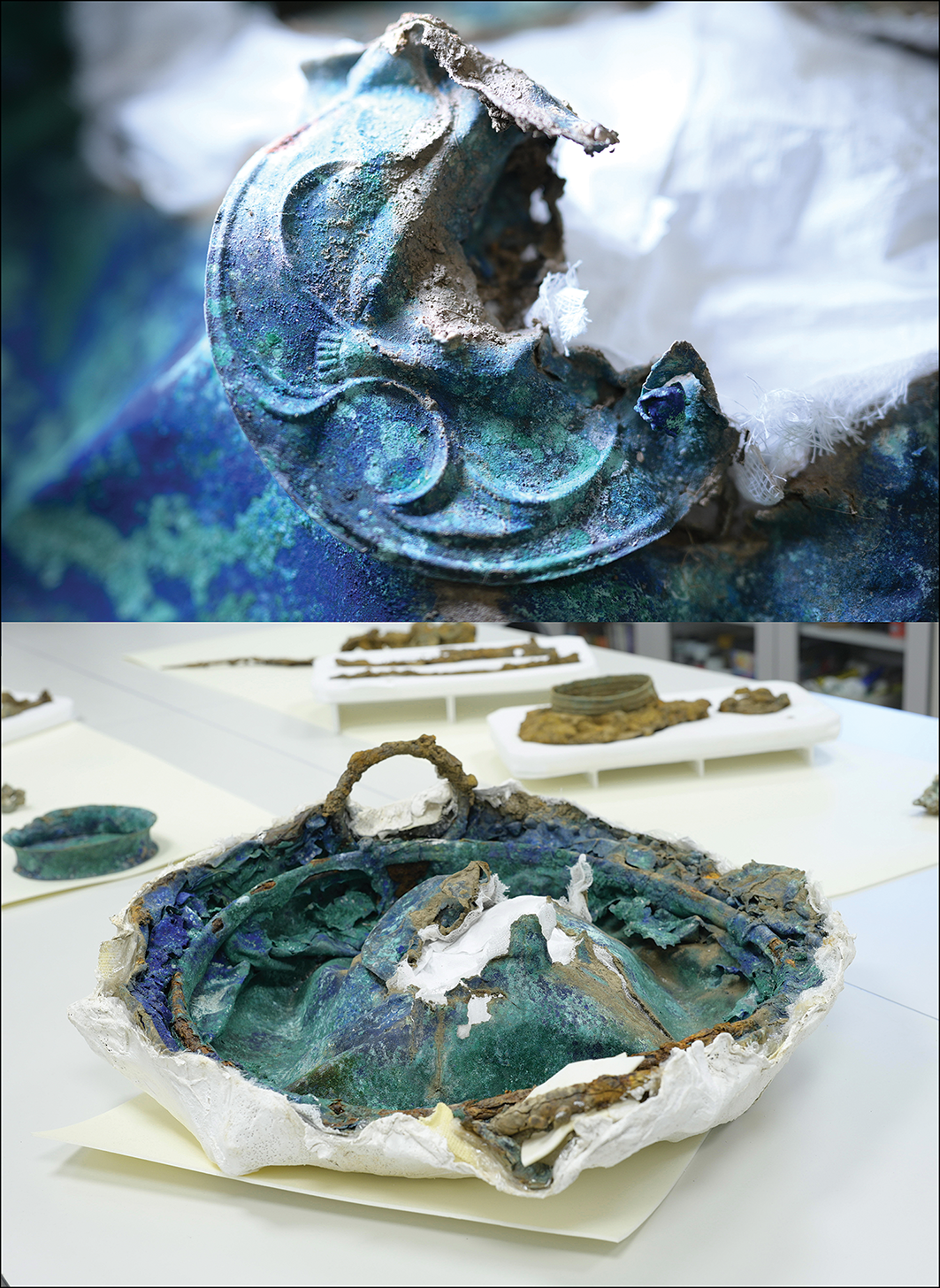
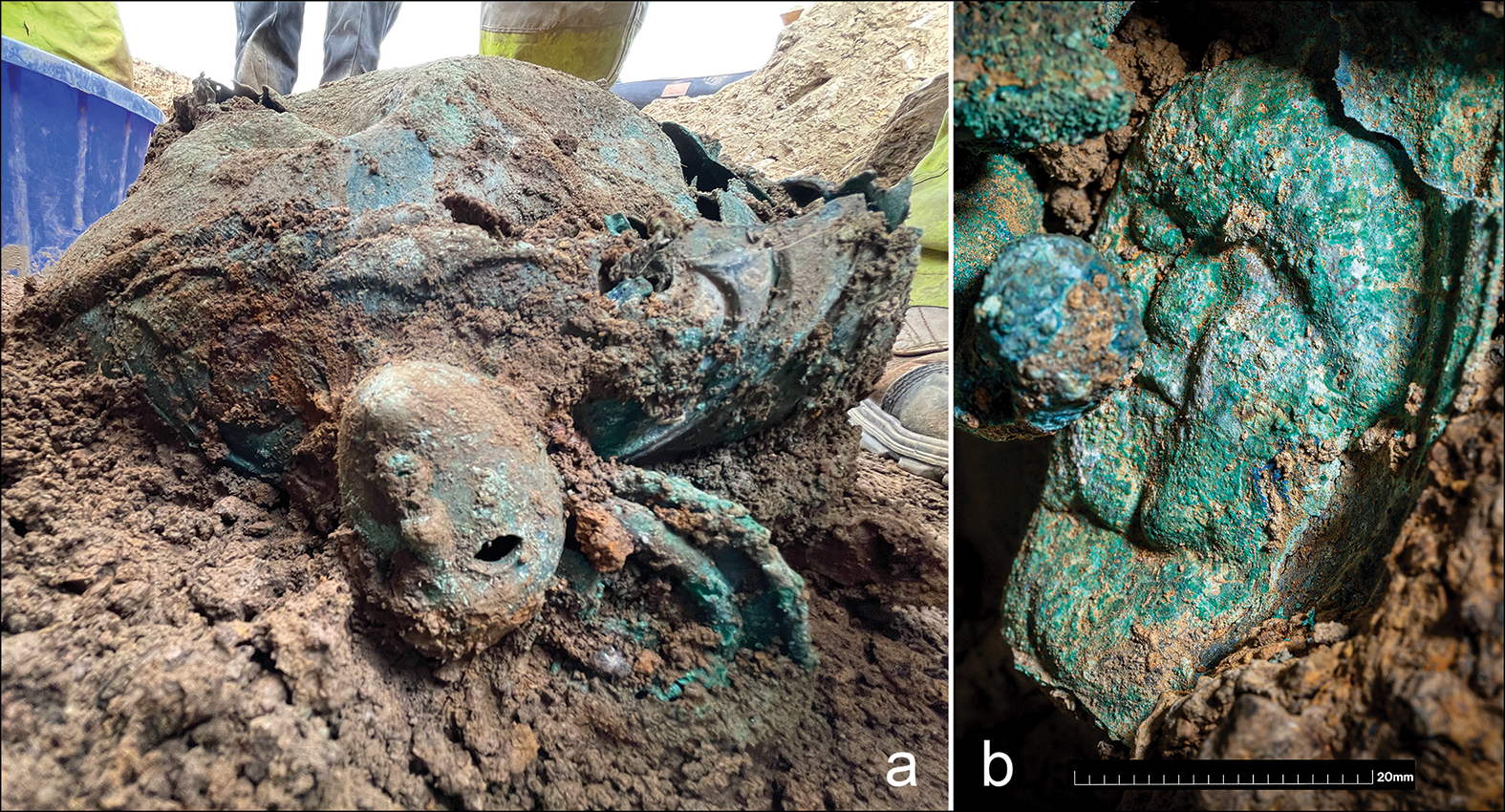
Hoard 1 also includes some unusual items. The large iron mirror is currently without parallel in Iron Age metalwork hoards, its size is closer to the large bronze mirrors from Late Iron Age burials farther south in England (Joy Reference Joy2010) than to the smaller iron mirrors from Middle Iron Age graves of women on the Yorkshire Wolds (Giles Reference Giles2012). The cauldron from Hoard 1 is one of the larger Iron Age examples recovered, with an estimated capacity of 35 litres (cf. Baldwin & Joy Reference Baldwin and Joy2017: 120–38). Its novel decoration includes images of fish in repoussé on its base (Figure 9), perhaps depicting freshwater trout or salmon set in a ‘Celtic Art’ style pattern of swirling water. Depictions of fish on Iron Age objects are rare across Europe, and significant given the debate relating to possible taboos around fish consumption in the British Iron Age (Dobney & Ervynk Reference Dobney, Ervynck, Haselgrove and Moore2007) raising questions as to the use of this vessel. The second vessel from Hoard 1 (Figure 10a) is also unusual in a British context. Its shouldered bowl is redolent of earlier Etruscan cauldrons or wine-mixing bowls (lebes) and its decoration includes applied coral studs and two cast copper-alloy human face masks with their hair pulled back.
The cauldron from Hoard 1 and a close-up of the fish motif on the cauldron base (top image) (photographs by Alexander Jansen, Durham University).

Figure 9 Long description
The image consists of two photographs. The top photograph shows a close-up view of a fish motif on the base of a cauldron. The motif is intricately designed with a combination of blue and green hues, and the cauldron appears to be made of metal with some areas showing signs of wear and corrosion. The bottom photograph displays the entire cauldron, which is large and has a capacity of approximately 35 liters. The cauldron is placed on a white surface, and other metal artifacts are visible in the background.
a) The second vessel from Hoard 1 during excavation (photograph: Durham University); b) the repoussé face in Hoard 2 block (photograph by Alexander Jansen, Durham University).

Figure 10 Long description
The first image shows a partially excavated copper-alloy vessel from Hoard 1, covered in dirt and revealing intricate details. The second image is a close-up of a repoussé face design from Hoard 2 block, showcasing detailed craftsmanship with a greenish patina. Both artefacts exhibit similar decorative motifs and designs characteristic of Late Iron Age metalwork.
Several harness pieces were decorated with coral bosses (probably Corallium rubrum, native to the Mediterranean) in cupped settings, secured with small copper-alloy rivets. These adorn most of the oversized harness elements, from exceptionally large terrets and linchpins to strap unions and bits (Figure 8). These are some of the latest and most elaborate coral-decorated items from Iron Age Britain. Other strap fittings and terrets were further embellished with bosses of blue glass or red and yellow glass and enamel. The latter support a Late Iron Age date (Davis Reference Davis2014), while the style of a drop-handle and perforated, floral decorative panel in Hoard 1 and phalerae from horse harness from Hoard 2, point to the influence and presence of Roman forms of objects.
Some items from Hoards 1 and 3 were subjected to intense heat before burial, although this is not the case for Hoard 2. This is most apparent in Hoard 1, which contained partially melted objects, droplets of melted copper alloy, larger melted masses and fragments of melted glass. The iron tyres may have been heated to enable their bending, with haematite formation on the surfaces supporting this suggestion (Fell Reference Fell, Ashton and Hallam2004). No specific group of items seems to have been preferentially burnt; and burnt, melted and partially melted objects were interspersed throughout the deposit. Together with the lack of discolouration to the sediment in and around the deposit and the absence of charcoal concentrations, this suggests that the heating did not occur in situ.
The vehicles
One of the most intriguing aspects of the new Melsonby finds are the unusual vehicle elements and the insights these furnish into insular Late Iron Age vehicles. Evidence for two-wheeled vehicles in Britain comes from late fifth to second century BC burials, mostly in East Yorkshire (Giles Reference Giles2012; Hamilton & Adams in Stephens Reference Stephens2023: 202–10), with outliers in West Yorkshire, southern Scotland and Wales (Brown et al. Reference Brown2007: 121–59; Carter et al. Reference Carter2010; Anthoons Reference Anthoons2021; Comeau Reference Comeau2022). Many of the vehicle components encountered in these burials approximate to those found at Melsonby, for example in the vase-headed linchpins and single-hoop iron tyres. Some of the Melsonby tyres, however, are of a larger diameter, and the iron components and size of the adornments are more substantial than those of lightweight two-wheeled chariots. With the exception of the Pembrokeshire chariot (Comeau Reference Comeau2022), Late Iron Age vehicles in Britain are attested primarily through stray finds and small hoards of terrets, bits and linchpins—which could come from either chariots or wagons—and indirectly by wheel ruts at numerous settlements, including Stanwick (Haselgrove Reference Haselgrove2016: 161).
Reconstructing the Melsonby vehicles is difficult owing to their dismantled state, but the closest comparison might lie in the remains of two four-wheeled wagons preserved in a peat bog near Dejbjerg, Denmark, and dated to c. 100 BC (Schönfelder Reference Schönfelder, Erzsébet and Schönfelder2010; Schovsbo Reference Schovsbo2010). These wagons were buried in pieces but retained many of their copper-alloy adornments, which find parallels at Melsonby, including tubes and ferrules, finials and openwork. A small repoussé face from Hoard 2 (Figure 10b) also echoes those adorning the Dejbjerg wagon (Schönfelder Reference Schönfelder, Erzsébet and Schönfelder2010: 259, fig. 2). The wooden components of the flat-bed wagons from Dejbjerg were adorned with copper-alloy sheet casings and cast fittings, including the Y-shaped pole, the wheel spokes and the body panels. The distribution of Late Iron Age four-wheeled wagons extends across much of continental Europe and their existence in Britain might be anticipated, but Melsonby represents the first potential tangible evidence.
The closest comparisons for the U-shaped brackets are Roman examples from continental Europe (e.g. Künzl Reference Künzl1993), although these have a more enclosed, cupped central element. The large iron nails, bolts and rings in Hoard 1 also invite comparison with ironwork on later Iron Age and Roman vehicles, such as carpenta, although further research is needed to determine the validity of such a comparison.
Chronology of the Melsonby deposits
Comparisons for horse harness in the Melsonby deposits can be drawn from several hoards dated to the first century AD, including: Middlebie, Dumfriesshire (Hunter Reference Hunter, Haselgrove and Moore2007); Polden Hill, Somerset (Davis Reference Davis2014); Santon, Norfolk (Spratling Reference Spratling1975); and Seven Sisters, West Glamorgan (Davies & Spratling Reference Davies, Spratling, Boon and Lewis1976; Davis Reference Davis2014). These hoards contain Iron Age objects made and buried around the time of the Roman conquest of southern Britain (AD 43). The presence in the Melsonby assemblage of Roman-style objects, similar to those from these other hoards, implies a date of deposition between the late first century BC and mid-first century AD, when comparable material first appears at the Stanwick oppidum, and reflects the mid-first century AD date proposed for Hoard 3 (Haselgrove Reference Haselgrove2016: 349).
Preliminary radiocarbon dating and chronological modelling (see OSM Appendix 2) of three short-lived samples incorporated into the deposits suggest that Hoard 1 dates to 35 cal BC–cal AD 40 (86% probability; EFN5; Figure S1) or cal AD 45–70 (9% probability) and that Hoard 2 dates to 40 cal BC–cal AD 40 (91% probability; FN141; Figure S1) or cal AD 50–70 (4% probability). Chronological modelling based on so few dated items cannot be regarded as robust, but the consistency of the results so far supports its reliability. At present the radiometric dating supports stylistic comparisons, suggesting that both hoards were deposited before the mid-first century AD (Hoard 1, 89% probability; Hoard 2, 93% probability), although there is a small possibility that both were deposited later in the first century AD. An earlier date from the underlying ditch fill in Trench 2 (FN38) might imply that Hoard 2 was inserted into an existing feature; a more intensive dating programme is currently underway to assess this.
The context of the discoveries
With no evidence that Hoards 1 and 2 had been disturbed prior to discovery, it is clear that these finds first encountered in 2021 were not part of the 1843 hoard(s). Similarities in the style and design of objects between all three hoards, as well as the proximity of their locations, do, however, indicate that all were roughly contemporaneous, perhaps separated by as little as a few months or years. This suggests that an event, or sequence of events, of some significance took place in the Late Iron Age which led to the destruction and deposition of an extremely large quantity of metalwork that constitutes a huge amount of portable wealth.
Consideration of the wider context may help explain why the material was deposited. The site is located around 800m south-east of the Late Iron Age ‘royal site’ at Stanwick, one of the insular complexes often considered part of the European oppidum phenomenon (Haselgrove Reference Haselgrove2016). Occupied during the first century BC to first century AD, Stanwick is likely to have been the central place of a regional confederacy of communities known to classical writers as the Brigantes (Haselgrove Reference Haselgrove2016). Preliminary dates from the Melsonby hoards indicate they were laid down when Stanwick was a major sociopolitical centre with connections to the expanding Roman Empire, indicated by the increasing presence of exotic Roman imports beginning around the turn of the millennium (Willis Reference Willis and Haselgrove2016: 247).
Excavations in the 1990s at Melsonby revealed settlement activity around 80m north of Trench 2, dating between the third century BC and late first century AD (Haselgrove Reference Haselgrove2016: 342). The recent geophysical survey (Figure 2) demonstrates that the roundhouses and enclosures examined by Haselgrove and the ditches where the deposits were found formed part of an intensively utilised landscape, including field systems, settlement and possible ritual or funerary features. The enclosures, from whose ditches Hoard 1 and Hoard 2 derive, are close to a large track or droveway running north-west towards Stanwick and south-east towards Scotch Corner, where Iron Age occupation and craftworking have been identified (Fell Reference Fell2020). A small excavation to the west of the Melsonby site suggests that the trackway dates from the Late Iron Age but was modified through the Roman period.
Comparisons and interpretation of the deposits
Although hoards of horse harness, weaponry or cauldrons have been identified previously in Britain, the discovery of these items together makes the Melsonby hoards exceptional. No other find from Late Iron Age Britain associates remnants of several wheeled vehicles and horse harness with a cauldron, a mirror and martial equipment. Apart from burial contexts, the assemblage appears unique in north-west Europe. The quantity of vehicle remains is unprecedented, particularly with the presence of tyres and iron fittings for multiple horse-drawn vehicles. Finds of wheels from Iron Age Britain are rare, typically deriving from dismantled or complete two-wheeled chariots buried with inhumations that pre-date the Melsonby deposits by at least two centuries (Giles Reference Giles2012; Stephens Reference Stephens2023). Complete cauldrons are also rare and also tend to pre-date the Melsonby deposit. Where several cauldrons are found together, for example at Chiseldon, Wiltshire (Baldwin & Joy Reference Baldwin and Joy2017), and Glenfield, Leicestershire (Thomas Reference Thomas2018), very little additional metalwork was found in direct association with them.
Vehicle parts, including nave bands and iron tyres, have been found in other hoards, but few compare directly to Melsonby. The Polden Hill hoard contained iron hoops possibly from a vehicle, while the Santon hoard contained nave bands and possible axle caps (Spratling Reference Spratling2009; Davis Reference Davis2014: 80). A deposit encountered at Ham Hill hillfort, Somerset, in the nineteenth century included human remains, alongside “spearheads, with articles of brass and iron, together with many fragments of chariot wheels” (Colt Hoare Reference Colt Hoare1827: 41), potentially akin to Melsonby. The closest parallel, in terms of the quantity and range of artefacts, is the votive deposit from Llyn Cerrig Bach, Anglesey. This included horse harness, nave bands, parts of 23 iron tyres, martial equipment, slave chains and tools. However, this assemblage is thought to have accumulated over centuries (c. 350 BC–AD 150; Macdonald Reference Macdonald2007), in contrast to the close sequence of deposits at Melsonby.
There are two potential explanations for the Melsonby hoards, for the motivations behind their creation and for what they may represent, which have dominated previous discourse, but these new discoveries suggest alternative possibilities. MacGregor (Reference MacGregor1962: 20) argued that Hoard 3 was a metalworker’s collection intended for later retrieval and recycling. Although metalworking was taking place in the wider Stanwick complex (Haselgrove Reference Haselgrove2016: 206; Fell Reference Fell2020), the lack of crucibles and metalworking equipment or residues at Melsonby makes it unlikely that the artefacts were destined to be scrap metal (Webley et al. Reference Webley2020). Melted copper-alloy fragments from the plough soil have previously been interpreted as casting waste, but an alternative explanation is considered below. Lack of wear on the bits and the well-preserved coral and glass adornments on many of the harness fittings also argue against objects in the process of being recycled, as these would likely have been removed. The structured nature of these deposits and the highly selective composition of the material further refute recycling. All three primarily comprise horse harness and vehicle parts, with only some martial equipment and occasional vessels and a lack of personal adornments (e.g. brooches) and ceramics. The juxtaposition of the careful arrangement of the material and the drama of noisy, symbolic acts of deliberate destruction, attested by the piled-up bent tyres and boulders thrown onto the mass of metalwork, suggests that the Melsonby deposits are better considered a set of carefully articulated acts with highly charged meanings.
Wheeler (Reference Wheeler1954: 2) argued that the 1843 hoard represented a disturbed burial. Although some organic items may have been included and subsequently decomposed, human remains do not appear to have been present. The presence of a small amount of animal bone in Trench 1 and cremated (probably animal) bone in Trench 2 suggests this absence is not simply the result of soil conditions. Certain aspects of the deposits may nevertheless imply a link to a funerary event; uneven exposure to heat, sufficient to melt some items of copper alloy, silver and glass from Hoards 1 and 3, could have resulted from the placement of items on a funeral pyre. This suggestion was raised for the 1843 material (Haselgrove & McIntosh Reference Haselgrove, Mcintosh and Haselgrove2016: 348) and other similar metalwork deposits with indications of burning (Davis Reference Davis2014). The inclusion of vessels for feasting, along with other objects likely to have been used in ostentatious display, such as the lances and vehicles, are also evocative of contemporaneous elite funerary assemblages from southern Britain, such as those from Lexden, Colchester and Folly Lane, St Albans (Foster Reference Foster1986; Niblett Reference Niblett1999). Some components of Hoard 3, including ring mail and a sword, reflect material from these burials (Haselgrove Reference Haselgrove2016: 349), as does the inclusion in Hoard 1 of two ornately decorated nave bands with designs reminiscent of those on a possible nave band from Folly Lane (Niblett Reference Niblett1999: no. 11, 146–7, fig. 57). Furthermore, the proximity of Melsonby to the Stanwick ‘royal site’ recalls the location of other Late Iron Age funerary monuments on routeways into such complexes (Moore Reference Moore2020: 566). Although a little further afield, comparisons might also be drawn with the cremation burial at La Mailleraye-sur-Seine in northern France (c. 150 BC; Lequoy Reference Lequoy and Cliquet1993), which contained a similar assemblage of an upturned cauldron, iron tyres and martial equipment.
In identifying the motives behind these deposits, it is important to recognise that acts frequently categorised separately as hoards, votive deposits or funerary assemblages often formed a spectrum of inter-related practices (Cooper et al. Reference Cooper2020). Hoards associated with funerary events need not be defined by the presence of human remains. There may never have been a burial at Melsonby, even if material was exposed to funerary pyres. Despite the lack of evidence for cremation in North Yorkshire—a practice that was becoming more common in Late Iron Age southern Britain—it remains possible that such a rite was practised but that the human remains were deposited in ways that are not visible archaeologically.
Regardless of the nature of the events that led to their creation, the Melsonby hoards represent acts of major conspicuous consumption. Their very scale emphasises the power and wealth of the individuals and communities who inhabited Stanwick and raises the question as to who orchestrated such events. Stanwick has been plausibly associated with high-status individuals, such as Queen Cartimandua, identified by the Roman historian Tacitus (Annals 12.37–40; Grant Reference Grant1971; Haselgrove Reference Haselgrove2016: 466–70) as a client ruler, allied to Rome, around the period AD 51–69. The range of material at nearby Melsonby certainly affirms the idea that Stanwick was a major assembly place for a powerful client network, reflecting the wide geographical reach of the Brigantes. It is not possible, however, to relate the hoards directly to any individual, and initial dating evidence suggests that if the hoards did relate to a funeral, the event was more likely to mark the passing of Cartimandua’s parent or grandparent, rather than her own. Tacitus’s comments do, however, corroborate recent archaeological evidence on the role of powerful women in the Iron Age (Giles Reference Giles2012), and remind us that even if the Melsonby hoards were not connected to Cartimandua, they may have related to events surrounding an equally important female ruler. Other aspects of the Melsonby deposits may reflect the complex ways in which power was manifested. The inclusion of communal feasting equipment and the relative lack of identifiably personal objects contrasts with the apparent individuality expressed in some contemporaneous funerary assemblages (Davis Reference Davis2014: 260). This may indicate that such events were as much about community as individuals, with power, at least in part, held within negotiated social frameworks (Moore & González-Álvarez Reference Moore, González-Álvarez, Fernández-Götz and Thurston2021).
Conclusions
The discoveries at Melsonby demonstrate the necessarily incomplete nature of archaeological distribution maps, which rely heavily on complex, past depositional choices, and the ability of new finds to change our understanding of protohistoric societies. The presence of four-wheeled wagons at Melsonby, with similarities to continental vehicles, would transform our understanding of the forms of wheeled transport and the role of such vehicles in the British Iron Age. At the same time, the scale of the Melsonby deposits emphasises that communities in northern Britain had levels of material wealth comparable to their counterparts elsewhere in Europe. Conservation, analysis and research are in the early stages and further work will significantly augment our understanding of this material; Melsonby is only just beginning to reveal its secrets.
Acknowledgements
We are grateful to the following for their support of the project: Peter Heads, Tim and Paul Westgarth for the initial find; in addition, the following provided invaluable assistance: Fernando Alvarez Borges, Eric Andrieux, Kamal Badreshany, Sam Bithell, Jenni Butterworth, Jill Cook, Lucy Creighton, Mary Davis, Michael Dee, Helen Drinkall, Lorne Elliott, Keith Emerick, Nicky Garland, Melanie Giles, Rebecca Griffiths, Duncan Hale, Andy Hammon, Fraser Hunter, Alexander Jansen, Pam Lowther, Susanna Harris, Colin Haselgrove, Mark Mavrogordato, Andrew Mayfield, Faye McLean, Claire Nesbitt, Charlotte O’Brien, Adam Parker, Ian Richardson, Peter Rowe, Martin Schönfelder, Tudor Skinner, Mansel Spratling, Emma Tilley, Caitlin Wakefield, Janine Watson, Ben Westwood, Hannah Woodrow and Andrew Woods.
Funding statement
This project was funded by the UK Government and Historic England (Project 9119), Leverhulme Trust (RPG-209-359) and Colin Haselgrove. CT scanning was supported by the National Research Facility for Lab-based X-ray CT (NXCT) at the µ-VIS X-ray Imaging Centre, University of Southampton, through the Engineering and Physical Sciences Research Council grant EP/T02593X/1.
Online supplementary material (OSM)
To view supplementary material for this article, please visit https://doi.org/10.15184/aqy.2026.10311 and select the supplementary materials tab.
Author contributions: using CRediT categories
Sophia Adams: Conceptualization-Equal, Data curation-Equal, Formal analysis-Equal, Investigation-Equal, Methodology-Equal, Resources-Equal, Writing - original draft-Equal, Visualization-Supporting Writing - review & editing-Equal. Jamie Armstrong: Data curation-Supporting, Formal analysis-Supporting, Investigation-Supporting, Methodology-Supporting, Project administration-Supporting, Resources-Supporting, Visualization-Equal, Writing - review & editing-Supporting. Alex Bayliss: Formal analysis-Supporting; Methodology-Supporting, Writing - review & editing-Supporting. Tom Moore: Conceptualization-Equal, Data curation-Equal, Formal analysis-Equal, Funding acquisition-Lead, Investigation-Lead, Methodology-Equal, Project administration-Lead, Resources-Equal, Visualization-Equal, Writing - original draft-Equal, Writing - review & editing-Equal. Emily Williams: Data curation-Equal, Formal analysis-Equal, Investigation-Supporting, Methodology-Supporting, Project administration-Supporting, Resources-Supporting, Visualization-Supporting.


 Open access

