


Introduction
Citizens’ expectations can be a formidable forecasting tool once aggregated. One of the most concrete examples of this phenomenon was provided by British anthropologist and statistician Francis Galton more than a century ago. In the fall of 1906, Galton attended the West of England Fat Stock and Poultry Exhibition in Plymouth. As Galton walked through the fair, he stumbled upon a weight-judging competition. The crowd was asked to guess the dressed weight of an ox that was put on display before them. By paying a small fee, people could enter the contest. They were provided with a card on which they wrote their best estimate of the animal's weight along with their name and address. Prizes were to be given to the most accurate participants. As Galton (Reference Galton1907: 450) later wrote,
[t]he competitors included butchers and farmers, some of whom were highly expert in judging the weight of cattle; others were probably guided by such information as they might pick up, and by their own fancies. The average competitor was probably as well fitted for making a just estimate of the dressed weight of the ox, as an average voter is of judging the merits of most political issues on which he votes, and the variety among the voters to judge justly was probably much the same in either case.
Once the contest was over, Galton was able to gather the cards to study the participants’ estimates. The median guess of the 787 participants was 1,207 lbs. The actual weight of the dressed ox proved to be 1,198 lbs. In other words, the common judgment of the contestants was too high by less than 1 per cent of the ox's total weight. However, when looked upon separately, individual estimates were, in most cases, much less accurate. This came as a surprise to Galton, who had hypothesized that the mix of a few experts and numerous unskilled fair-goers would lead, on average, to a rather poor appraisal of the ox's true weight (for a re-examination of Galton's paper, see Wallis, Reference Wallis2014). Galton's country fair visit serves as the classic illustration of the “wisdom of crowds” (WOC) principle. According to this principle, “under the right circumstances, groups are remarkably intelligent, and are often smarter than the smartest people in them. […] Even if most of the people within a group are not especially well-informed or rational, it can still reach a collectively wise decision” (Surowiecki, Reference Surowiecki2004: xiii–xiv). In fact, it is even argued that the WOC principle extends to individuals themselves: repeated estimations aggregated across a single person are generally more accurate than single estimations (“inner-crowd wisdom”), although aggregating the answers of different individuals (“outer-crowd wisdom”) tend to give better results (Fiechter and Kornell, Reference Fiechter and Kornell2021; van Dolder and van den Assem, Reference van Dolder and van den Assem2018). In a classic experiment, akin to the ox weighting competition studied by Galton, economist Jack Treynor had his students guess the number of jelly beans in a jar. Aggregation, once again, proved a successful strategy. Treynor (Reference Treynor1987: 50) noted that “[a]pparently it doesn't take knowledge of beans, jars or packing factors for a group of students to make an accurate estimate of the number of beans in a jar. All it takes is independence.”
Election campaigns, not unlike sporting events, are carnivals of expectations. Taking a quick look at the history of election forecasting, one will find wagers on papal elections as soon as the beginning of the sixteenth century, massive straw polling operations by general interest magazines at the turn of the twentieth century and even predictions based on “partisan-flavoured” sodas and ice cream sales (see, for example, Erikson and Tedin, Reference Erikson and Tedin2016; Herbst, Reference Herbst1993; Rhode and Strumpf, Reference Rhode, Strumpf, Vaughan-Williams and Siegel2013). We can add to these more extravagant or commercially oriented attempts at forecasting election outcomes the treasure trove of voter intention surveys that have been conducted since the advent of modern public opinion polling in the 1930s, vote and seat share forecasts by modellers and aggregators, and the countless hours of speculation by pundits and journalists about parties’ and candidates’ electoral prospects. Expectations are clearly an essential part of election campaigns in competitive democracies. Although their motivations and level of objectivity may differ, pundits, pollsters, researchers, politicians and voters all engage in speculations about who will win and by how much.
We often turn to pollsters and panels of experts to answer these questions. However, as a group, citizens have been credited with being just as or even more accurate than traditional forecasting methods (Gaissmaier and Marewski, Reference Gaissmaier and Marewski2023; Graefe, Reference Graefe2016; Murr, Reference Murr, Arzheimer, Evans and Lewis-Beck2017). The main objective of the present article is to explore both individual- and group-level correlates of citizens’ forecasting accuracy in order to draw conclusions on how these potential predictors could be exploited to improve forecasts based on aggregated citizens’ expectations. This objective is in line with Graefe's (Reference Graefe2016: 227) statement that “[f]uture research should focus on developing methods to identify the most accurate forecasters in a sample.” To achieve this goal, we use massive datasets from the Ipsos Canada Election Surveys (n = 134,236), the Local Parliament Project (n = 37,380), the 2019 Canadian Election Study (n = 41,843) and the online voting-prediction tool Datagotchi (n = 65,544).
The Wisdom of Crowds
As explained by de Oliveira and Nisbett (Reference de Oliveira and Nisbett2017: 2066, italics added), crowd wisdom “is typically observed when estimates are independent and randomly chosen to be aggregated by some method like averaging. This often allows people's errors to cancel out during the averaging process, as each person's guess is comprised of truth plus some positive or negative error.” Three models are often invoked to explain the WOC principle (see Brennan, Reference Brennan, Hannon and Ridder2021: 376–77; Špecián, Reference Špecián2022: 56–63), namely, (1) the Miracle of Aggregation, (2) Condorcet's Jury Theorem and (3) Hong and Page's (Reference Hong and Page2004) Diversity Trumps Ability Theorem (see also Page, Reference Page2007). All of these models have received a fair amount of criticism. Nevertheless, there is ample empirical evidence that groups of citizens predict election outcomes better than individual citizens taken separately (Murr, Reference Murr, Arzheimer, Evans and Lewis-Beck2017).
Page and Shapiro (Reference Page and Shapiro1992, Reference Page, Shapiro, Elkin and Soltan1999) have claimed that skeptical views about the knowledge and the reasoning capacities of the public are not well-founded despite decades of research underlining the political ignorance and inattentiveness of individual citizens. Instead, they show that public opinion on policies is rational as a whole partly because randomly-distributed errors in individual judgments tend to cancel out in the aggregate. Therefore, citizens can collectively formulate reasonable opinions without most individuals possessing a vast knowledge of political matters. This has often been referred to as the “miracle of aggregation.” Many scholars have criticized this so-called “miracle.” According to Page and Shapiro's critics, simple statistical aggregation only offers a partial remedy to the somewhat low levels of political knowledge among the public (Althaus, Reference Althaus1998; Bartels, Reference Bartels1996; Brennan, Reference Brennan, Hannon and Ridder2021; Caplan, Reference Caplan2007, Reference Caplan2009; Gilens, Reference Gilens and Berinsky2019; Kuklinski and Quirk, Reference Kuklinski, Quirk, Lupia, McCubbins and Popkin2000).
The miracle of aggregation is one manifestation of the WOC. The term “wisdom of crowds” was popularized by American journalist James Surowiecki (Reference Surowiecki2004) and has been used by multiple authors to explain the accuracy of citizens’ election forecasts (Miller et al., Reference Miller, Wang, Kulkarni, Poor and Osherson2012; Murr, Reference Murr2011). Although it has older roots (see Landemore, Reference Landemore, Landemore and Elster2012: 1), the WOC principle is mostly derived from Condorcet's (Reference Condorcet1785) jury theorem, which states that the probability of a group coming to a correct decision tends toward unity as the group increases in size. For this theorem to be true, four conditions must be met: (1) the group has to make a choice between two alternatives (one correct and one incorrect) according to a majority rule, (2) each individual has to make his or her decision independently of others (see Lorenz et al., Reference Lorenz, Rauhut, Schweitzer and Helbing2011), (3) the probability of voting for the correct alternative has to be the same for every member of the jury (uniformity in competence) and (4) this probability must be above 50 per cent. Condorcet's original conditions have since been relaxed by many authors. The theorem holds even when all members do not have the same probability of making the right decision and under certain forms of correlated voting (see, for example, Becker et al., Reference Becker, Brackbill and Centola2017; Boland, Reference Boland1989; Grofman et al., Reference Grofman, Owen and Feld1983; Ladha, Reference Ladha1992). It is also possible to extend Condorcet's theorem to situations where there are more than two options (List and Goodin, Reference List and Goodin2001). In fact, individuals within a group need not even predict better than chance on average for the group to beat the average citizen, as this can be achieved by weighting individuals’ judgment on the basis of their competence (Shapley and Grofman, Reference Shapley and Grofman1984).
More substantively, Larrick et al. (Reference Larrick, Mannes, Soll and I2012) have established two conditions for crowds to be wise, that is, (1) individuals within the group need some minimal knowledge or expertise about the issue at hand and (2) they need to hold diverse perspectives—an idea at the heart of the “diversity trumps ability theorem” (DTA) (Hong and Page, Reference Hong and Page2001, Reference Hong and Page2004). This theorem states that “groups of ordinary individuals that are inclusive, and thus cognitively diverse, will outperform narrower groups of individuals that have superior ability” (Quirk, Reference Quirk2014: 129). The DTA theorem rests on four main conditions: (1) the problem at hand must be sufficiently difficult, (2) all problem solvers need to have some degree of ability in solving the problem, (3) the group of problem solvers must be diverse and (4) the group of problem solvers has to be reasonably big and must be drawn from a large enough population (Page, Reference Page2007: 158–65). Landemore (Reference Landemore, Landemore and Elster2012, 261) has even proposed to generalize Hong and Page's DTA theorem into a “numbers trump ability theorem” since diversity should be a natural consequence of increasing group sizes (see Quirk, Reference Quirk2014, however), although one might expect diminishing returns from each additional individual over a specific threshold (Jacobson et al., Reference Jacobson, Dobbs-Marsh, Liberman and Minson2011).
Cognition and Affect
In one of the first empirical analyses of the factors influencing predictive judgment, McGregor (Reference McGregor1938: 182) stated that “[a]n individual's pre-existent attitudes, wishes, and knowledge concerning a given social situation provide a frame of reference that will influence the formation of the premises upon which his predictions concerning events related to that situation will be based.” We find, in this frame of reference, two of the main ingredients of the expectation-formation process: (1) predispositions or preferences and (2) information. In other words, voters’ expectations about electoral outcomes are simultaneously influenced by affect (mostly partisan biases) and cognition (information effects) (Dolan and Holbrook, Reference Dolan and Holbrook2001).
Partisan Biases
It has long been recognized that preferences exert a major influence on expectations (Rehm and Gadenne, Reference Rehm and Gadenne2013: 91–92). Apart maybe from purely cognitive limitations, motivated reasoning is probably the single most important threat to forecasting accuracy. Without fail, research on voters’ expectations shows that partisan preferences are strongly correlated with their expectations of election winners (Mongrain, Reference Mongrain2021a). For example, Hayes (Reference Hayes1936) observed that the majority of people who intended to vote for incumbent president and Republican candidate Herbert Hoover in the US presidential election of 1932 also expected him to win; just as most Democratic supporters were keen on predicting a victory for Franklin D. Roosevelt, who ultimately won in a landslide. Hayes (Reference Hayes1936: 186) also noted, among other things, that Socialist voters “were presumably in the best position to guess the winner of the race dispassionately” because they could hardly expect anything from their candidate. Since marginal parties have no realistic chance of gaining power, their reasoning should be less driven by wishful thinking. Relatedly, individuals who describe themselves as independents should be less susceptible to motivational biases. Furthermore, in observing that upper-class Republicans were less prone to forecast a Hoover victory than their lower-class co-partisans, Hayes (Reference Hayes1936: 187) turned to the “greater penetration of the upper groups by the more reliable indicators of the real outcome” as a potential explanation. This is in line with studies arguing that greater information inputs or knowledge can moderate the effect of wishful thinking on expectations. Another potential mechanism explaining the high correlation between voter intention or partisanship and expectations is social homophily. Because individuals tend to spend time with people sharing political views similar to their own, pre-existing biases are often reinforced by social contacts (for a review, see Mongrain, Reference Mongrain2023). A certain degree of diversity and disagreement is thus deemed desirable as “partisan bubbles” tend to filter out disagreeable and politically uncongenial information (Leiter et al., Reference Leiter, Reilly and Stegmaier2020; Uhlaner and Grofman, Reference Uhlaner and Grofman1986).
Taking into consideration motivational biases is essential to the study of voters’ expectations: failing to adequately control for individual preferences will necessarily lead to biased estimates. This is particularly true in the case of election forecasting: in essence, elections are contests of competing values and ideologies. Therefore, objectivity is hard to achieve because individuals are rarely free of “ego-involvement.” As mentioned by Cantril (Reference Cantril1938: 389, footnote 22), on a host of social events, “the average judgment of a group of individuals […] cannot be compared qualitatively with the average judgment of a group on the length of a line or the number of beans in a jar.” For this reason, Treynor's (Reference Treynor1987) statement according to which a group does not need “knowledge of beans” to make a decent guess when eyeballing a candy jar might not apply to politics; poorly informed voters are presumably more likely to rely on affect (that is, their partisan preferences) to guide their judgment. The vast majority of studies that followed the pioneering work of the 1930s confirmed the close association of partisan preferences and expectations (see, for example, Dolan and Holbrook, Reference Dolan and Holbrook2001; Krizan et al., Reference Krizan, Miller and Johar2010; Mongrain, Reference Mongrain2021a).
Information Effects
Intuitively, one might expect expertise or knowledge to have much to do with forecasting skills. The evidence, however, is rather mixed. In their pioneering work on citizen forecasting, Lewis-Beck and Skalaban (Reference Lewis-Beck and Skalaban1989) and Lewis-Beck and Tien (Reference Lewis-Beck and Tien1999) concluded that education and contextual factors, such as closeness to the election and (perceived) tightness of the race, were more important than political interest or involvement in predicting voters’ accuracy. Lewis-Beck and Tien (Reference Lewis-Beck and Tien1999: 180) argued that “[m]ore educated people are better able to understand the political world,” but also that “[t]heir more extensive social networks link them naturally to more information.” Dolan and Holbrook (Reference Dolan and Holbrook2001) found that political knowledge was significantly related to accurate election predictions, and that greater sophistication reduced the influence of wishful thinking on citizens’ expectations. Miller et al. (Reference Miller, Wang, Kulkarni, Poor and Osherson2012) concluded that self-ratings of political and election knowledge increased forecasting accuracy. These results support the intuitive expectation established above: knowledge does appear to be positively associated with forecasting ability.Footnote 1
More recently, Morisi and Leeper (Reference Morisi and Leeper2024) have investigated the impact of individual and exogenous informational characteristics on citizen forecasting accuracy during the 2016 Brexit referendum. Sophistication, which was measured using respondents’ level of education and political attentiveness, was directly associated with greater accuracy in predicting the result of the Brexit referendum and indirectly by reducing the influence of partisan biases. The effects noted by Morisi and Leeper (Reference Morisi and Leeper2024) were, however, relatively small. Additionally, the level of attention paid to politics seemed much more important than education as a predictor of forecasting accuracy.
A few works have also suggested that the size and nature of an individual's social network could play a role in providing politically-relevant information and, thereby, contribute to forecasting accuracy. Larger personal networks, frequent political discussion with family, friends and colleagues, ideological or partisan heterogeneity as well as politically knowledgeable contacts were deemed potentially beneficial to the quality of individuals’ prospective judgment about election outcomes (Leiter et al., Reference Leiter, Murr, Ramírez and Stegmaier2018, Reference Leiter, Reilly and Stegmaier2020; but see Mongrain, Reference Mongrain2023).
Improving Forecasts
As already mentioned, the average judgment within a group is usually closer to the truth than that of a randomly-chosen individual. This raises one important question: can we improve the outcome of statistical aggregation by putting a premium on competence or sophistication? Research on decision-making and prospective judgment has not always been kind to experts. The usefulness of expertise was already questioned more than eighty years ago by McGregor (Reference McGregor1938) who concluded that professors were no more proficient than their students at predicting social events. The research conducted by Tetlock (Reference Tetlock2017) on expert opinion is often summarized with the author's observation that the average expert barely did better than a “dart-throwing chimp” at making accurate predictions in a variety of domains. In fact, according to Hammond (Reference Hammond1996: 278), “in nearly every study of experts carried out within the judgment and decision-making approach, experience has been shown to be unrelated to the empirical accuracy of expert judgments” (but see Jacobson et al., Reference Jacobson, Dobbs-Marsh, Liberman and Minson2011).
Nevertheless, there is empirical evidence pointing in the opposite direction. Murr (Reference Murr2015) has shown that delegating and weighting forecasts according to respondents’ level of competence improved citizens’ prediction of US presidential outcomes. Competence was measured by identifying characteristics of accurate forecasters in past elections and calculating the predicted probability of a correct forecast in the current election (thus giving more weight to respondents sharing these characteristics). Delegation then works by eliminating individuals below a certain level of competence and keeping only those above that same threshold (see Kazmann, Reference Kazmann1973). It is, in essence, an “epistocratic” approach to decision-making as it restricts the forecasting task to the most competent members of the group (a “select crowd”; see Budescu and Chen, Reference Budescu and Chen2015).
In another study, Mongrain (Reference Mongrain2021b) distinguishes between two views of the WOC principle in citizen forecasting. He refers to these as the “democratic view” and the “technocratic view.” The “technocratic” approach is somewhere halfway between a democratic rule of full inclusion (equality) and an epistocratic rule of competence-based discrimination (quality). Using district-level data from multiple elections in Canada, France, Germany and Great Britain, the author created two indices, one based on respondents’ factual knowledge of politics and one based on respondents’ own past forecasting performance (from panel survey data). Weighting by these indices produced modest, but noticeable, increases in the number of correctly predicted district races. One of the major limitations of Mongrain's (Reference Mongrain2021b) study, however, was the very small number of respondents in each district (notwithstanding the complete lack of data for many districts).
Given the above discussion of citizens’ forecasts and crowd wisdom, this article puts forward the following two hypotheses:
H1: Politically sophisticated voters will be more likely to correctly forecast the outcome of an election in their district.
H2: At the aggregate level, socially and cognitively diverse groups will be more likely to correctly forecast the outcome of an election in their district.
Data and Methods
To test these hypotheses, we use data from nine surveys conducted during Canadian national and provincial election campaigns between 2011 and 2022. More precisely, the analyses rely on data collected from various Ipsos Canada Election Surveys, the Local Parliament Project (LPP), the 2019 Canadian Election Study (CES) and Datagotchi, a gamified knowledge-transfer and data collection app. Ipsos surveys for the 2011 and 2015 federal elections as well as the 2011 and 2014 Ontario general elections were conducted in the last few days of the campaign and/or on election day (exit polls). To measure expectations about district-level outcomes, respondents were asked the following question: “If you had to bet $1000.00 of your own money, which party's candidate do you think will win in your riding during this election?”Footnote 2 The 2011 federal election is a particularly interesting case for the study of citizen forecasting. The Liberal Party dropped in third place for the first time in the country's history, while the New Democratic Party (NDP) had its best performance since its creation by winning a total of 103 seats out of 308, including 59 of Quebec's 75 seats (this was later referred to as the “Orange Wave”). The NDP formed the Official Opposition for the first time, in large part owing to its success in Quebec, which “ha[d] always been exceedingly difficult terrain for the CCF-NDP” in past elections (Whitehorn, Reference Whitehorn, Frizzell and Pammett1997: 105). The NDP's sudden surge in voter intentions in the last few days of the campaign provides a perfect test of citizens’ reactivity to changing campaign dynamics. The 2019 federal election is another interesting case: the incumbent Liberal Party received slightly less votes than the Conservative Party (33.1 vs 34.3%) but nonetheless won more seats (157 vs 121). District-level forecasts, which provide seats rather than national vote share estimates, might be particularly useful in that kind of situation.
The 2015 CES of the LPP also questioned its respondents about their electoral expectations. More precisely, LPP respondents were asked to rate the likelihood of winning, on a 0–100 scale, for each party in their local district (“Thinking now about where you live, how likely is each party to win your constituency?”). Data from the 2015 Ipsos survey and the 2015 LPP survey were combined following harmonization. More precisely, winning probabilities from LPP respondents were used to identify the most likely winner. Forecasts were coded 1 when the party with the highest likelihood of winning given by a respondent matched the actual winner and 0 otherwise.
Data from the 2019 CES were collected through a phone survey as well as a web survey. The phone survey included the following question: “In your own local riding, which party has the best chance of winning?” Respondents were not given a predefined list of possible outcomes. Those who named more than one party were invited to provide their best guess. Internet respondents were asked to rate the likelihood (on a 0–100 scale) of each party winning in their riding. As for the LPP, respondents’ probability estimates for each party were used to create a binary indicator of forecasting accuracy (0 = incorrect, 1 = correct) in order to merge answers from the phone and web surveys.Footnote 3
Finally, the Datagotchi data were collected during the 2022 Quebec general election. The following question was used to measure respondents’ expectations: “In your opinion, which party has the best odds of winning in your riding?” The previous election in 2018 was the first election since 1970 to be won by a party other than the federalist Liberal Party of Quebec (PLQ) or the sovereigntist Parti Québécois (PQ). The Coalition Avenir Québec (CAQ), a nationalist center-right party, formed a majority government in 2018 by winning 74 seats (out of 125) in the Quebec National Assembly with 37.4 per cent of the popular vote. In 2022, the CAQ increased its majority by gaining a total of 90 seats with 41 per cent of the vote. During the entire duration of the campaign, between 28 August and 2 October, the CAQ remained high above the other parties in terms of voter intentions (at around 40% compared to less than 20% for its closest competitor). Although, the CAQ's victory was hardly surprising, the outcomes of local (riding) races were much less certain. Section C of the online appendix displays voter intention data for each election.
Table 1 provides a brief overview of each election's outcome as well as the percentage of respondents who made a correct district-level forecast in these elections. The table also displays the percentage of districts falling in different ranges of sample sizes and the average number of respondents per district in each election. As can be seen, with the exception of the 2015 Canadian federal election, a clear majority of voters correctly predicted the outcome in their own riding. Therefore, in most cases, the average voter did significantly better than would have a simple coin toss (especially if we consider the fact that more than two candidates might be competitive in many districts—see, for example, Gaines, Reference Gaines1999; Johnston and Cutler, Reference Johnston, Cutler, Grofman, Blais and Bowler2009).
Overview of Election Outcomes and Citizens’ Forecasts
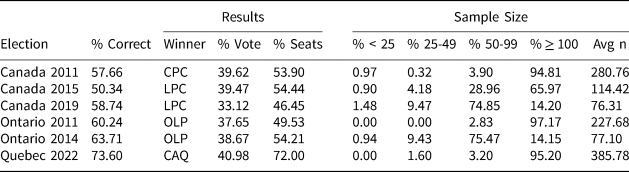
Notes. Election results retrieved from Elections Canada, Elections Ontario, and Elections Quebec. CAQ = Coalition Avenir Quebec. CPC = Conservative Party of Canada. LPC = Liberal Party of Canada. OLP = Ontario Liberal Party.
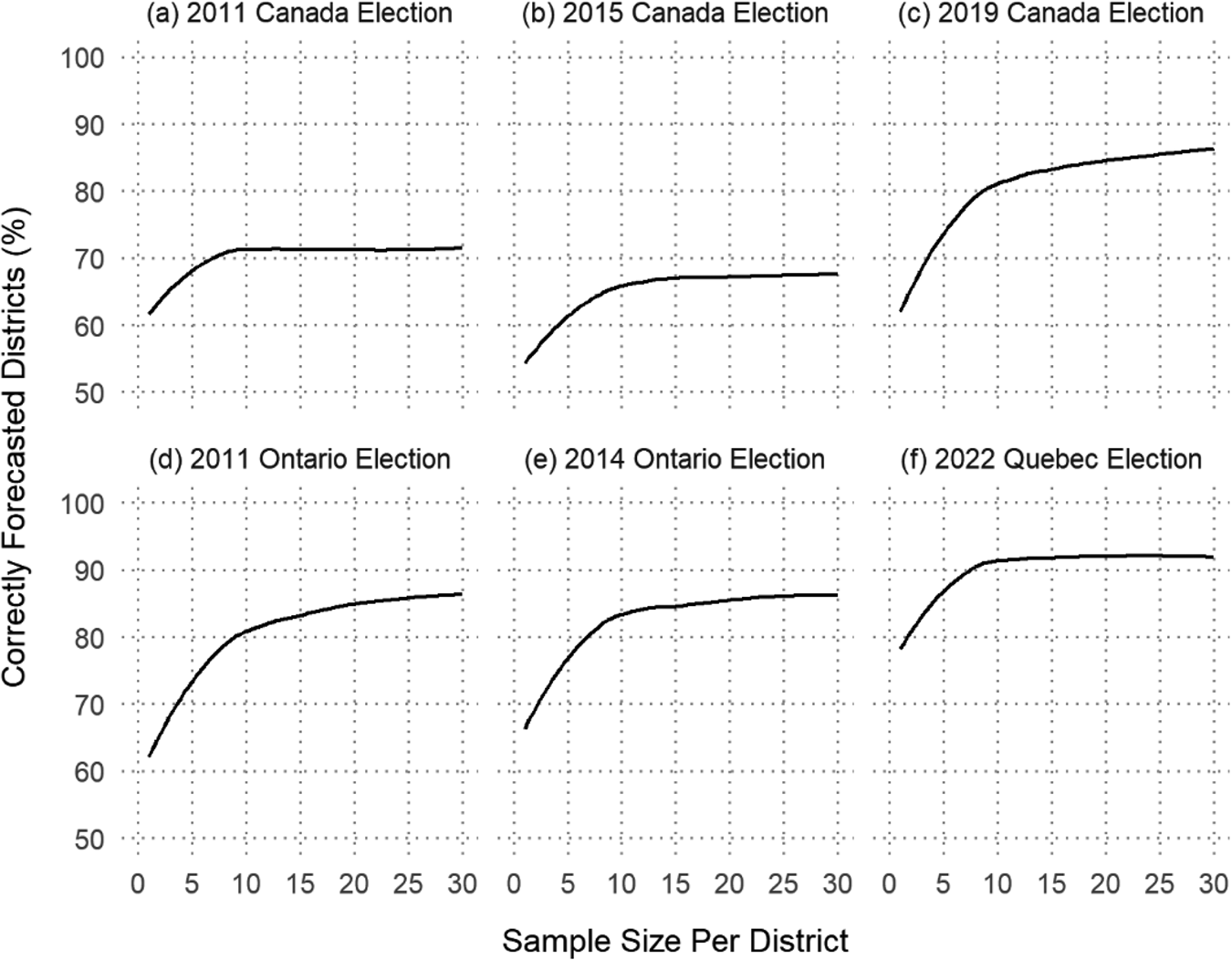
The chosen surveys are characterized by very large samples totalling thousands and, in most cases, tens of thousands of observations with respondents in every (or almost every) district. Therefore, these are ideal datasets to study the benefits of aggregation as we have relatively large subsamples in each cluster (district). On the question of sample size, one could reasonably ask how large a group needs to be in order to reap the benefits of collective wisdom and aggregation. Research on experts’ estimates and forecasts tend to show that beyond a relatively small number of inputs, improvement in collective accuracy rapidly declines. The exact point of diminishing returns varies, but it is often found between five and twelve individuals only (see, for example, Hemming et al., Reference Hemming, Burgman, Hanea, McBride and Wintle2018; Hogarth, Reference Hogarth1978; Hora, Reference Hora2004). In a study of experts’ predictions regarding various geopolitical questions, Satopää et al. (Reference Satopää, Baron, Foster, Mellers, Tetlock and Ungar2014: 353) established that the optimal group size was around fifty. In his study of citizens’ constituency-level forecasts in the 2010 British general election, Murr (Reference Murr2011: 782) concluded “that in most cases about 20 respondents suffice to have a much greater than 50 per cent chance of getting it right.” Overall, to the extent that other requirements are met, the WOC does not appear to require particularly large crowds to function properly. In order to assess the optimal group size for district-level forecasts, random samples of sizes varying from 1 to 30 (that is, 1, 2, 3… 30) were drawn from each district with at least sixty respondents. In other words, we executed multiple random draws of successively larger numbers within each district. For each sample size, the sampling procedure was repeated ten times with replacement. The aggregated forecasts from the ten trials were averaged to get the percentage of correctly predicted seats at each sample size. The results are shown in Figure 1. We see rather clear improvements in collective accuracy as within-district samples increase in size. It seems, however, that the rate of improvement considerably weakens beyond approximately ten to fifteen respondents. The trend across elections shown in Figure 1 strengthens the argument that we have more than enough observations per district (see Table 1) to observe and test WOC effects.
Percentage of Correctly Predicted Districts at Varying Sample Sizes.
Notes. The aggregation of respondents’ expectations is based on data from 304 (out of 308) districts in the 2011 Canadian federal election, 310 (out of 338) in the 2015 Canadian federal election, 253 (out of 338) in the 2019 Canadian federal election, 106 (out of 107) in the 2011 Ontario general election, 81 (out of 107) in the 2014 Ontario general election, and 123 (out of 125) in the 2022 Quebec general election.
To test the two hypotheses established above, we proceed in two steps. First, we estimate multilevel random effects logistic regression models for individual-level forecasts of district (riding) election outcomes. The dependent variable—voters’ riding-level forecasts—is a binary indicator coded 1 for correct forecasts and 0 otherwise. We use educational attainment and political interest as proxies for political sophistication (see Morisi and Leeper, Reference Morisi and Leeper2024; Turper and Aarts, Reference Turper and Aarts2017). Education has been found to cultivate political interest and information seeking (Grönlund and Milner, Reference Grönlund and Milner2006; Le and Nguyen, Reference Le and Nguyen2021) and there is ample evidence that well-educated citizens are less susceptible to wishful thinking and generally better at anticipating election outcomes (Dolan and Holbrook, Reference Dolan and Holbrook2001; Meffert et al., Reference Meffert, Huber, Gschwend and Pappi2011; Morisi and Leeper, Reference Morisi and Leeper2024). However, according to Elo and Rapeli (Reference Elo and Rapeli2010), interest is the most suitable proxy for political knowledge when compared to other measures such as self-assessed knowledge or the accuracy of party placements on a left-right scale. Luskin (Reference Luskin1990: 351) concluded that political “[s]ophistication depends, above all, on motivation (interest, occupation and, indirectly, parental interest). It also depends on ability (intelligence). But the big informational variables (education and [media usage]) have little effect.” Respondents with a university degree were coded 1 and all other respondents were coded 0. Interest with politics or the election was measured on a 0–10 scale (which was rescaled from 0 to 1). Note that respondents’ interest was only recorded in the 2015 LPP and 2019 CES. At the individual level, every model includes basic sociodemographic controls (sex, age and household income) and vote choice, which serves as a proxy for partisanship since respondents were not questioned about their party identification (PID) in most surveys. For the 2015 LPP and 2019 CES, we were able to use partisan identification instead of vote choice in the additional models with both education and political interest as measures of sophistication.
Consequently, there are two sets of regressions. In the first set, all models include vote choice (1 = intend to vote for winner, 0 = otherwise) as a proxy for partisan preference and education as a measure of sophistication. In the second set, models include PID (1 = identify with one of the losing parties, 2 = no PID, 3 = identify with the winning party) instead of vote choiceFootnote 4 and both education and political interest as measures of sophistication. The first set of models also include an interaction term between vote choice and education, the expectation being that motivational biases will be weaker among highly educated voters (more concretely, the gap in the probability of making a correct forecast should be smaller between highly educated losers and winners than between losers and winners with a lower level of education). Following a similar logic, the second set of models include an interaction term between PID and political interest. All models have random slopes for the interaction terms (since we can assume election outcomes are more evident in certain districts than in others, education or interest might play a lesser/greater role in enhancing or decreasing partisan biases).
In addition to individual-level characteristics, in both sets of regressions, models include one measure of competitiveness and one measure of change as district-level variables, namely the (standardized) margin of victory (the difference in vote share between the local winner and the second-place candidate) and a dummy variable for reelection (1 if the incumbent party candidate was reelected and 0 otherwise). Since federal electoral districts were reviewed in 2012, the incumbent party reelection variable was replaced by a variable denoting boundary changes for the 2015 Canadian election. As mentioned by Murr (Reference Murr2011: 778, italics in original), “boundary changes may greatly change the size and composition of a constituency rendering past election results useless for predictions.” As voters are nested within groups (districts), it is essential to take into account the level of competitiveness in each riding as well as other potential unobserved group-level factors. Finally, response date (the standardized number of days between the interview and election day) was also accounted for in models for the 2015 and 2019 federal elections as well as the 2022 Quebec general election as respondents were interviewed over a period of several weeks. The closer we get to election day, the easier it should be to make a correct forecast.Footnote 5
In the second step, we estimate logistic regression models using districts (groups) instead of individual respondents as the unit of analysis. Following Murr (Reference Murr2011), these models look at the influence of informational (cognitive) and sociological diversity on the accuracy of aggregated forecasts using entropy-based diversity indices. Informational diversity is captured through respondents’ education, level of political interest, vote choice (since respondents with different political orientations can be attentive or exposed to different information sources) and response date (as more information, and presumably more accurate information, becomes available as election day gets closer), while sociological diversity is captured through respondents’ sex, age and income level.Footnote 6 The diversity measures (D) were computed as shown in Equation 1:
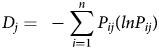
where Pi is the proportion of respondents within district j who possess the ith diversity characteristic and n is the number of characteristics considered (for example, n = 6 if there are six age categories).
Therefore, the diversity index is the negative sum of the products of each characteristic's proportion in a district and the natural log of its proportion. Higher values of the index indicate greater diversity. In order to properly capture diversity, we kept each variable's original scale when appropriate. For example, education was not dichotomized on the basis of university education; to obtain a fine-grained measure of educational diversity, we recorded the proportion of individuals in each category (for example, less than high school, high school diploma, some college and so forth). These models also include group size (the number of respondents within each district), (standardized) margin of victory and incumbent party reelection (or boundary changes) as covariates. Following Murr (Reference Murr2015), group size was logged to normalize its distribution. Group diversity was measured at the district level since it was the smallest geographical unit associated to respondents in all cases, with the exception of the 2022 Quebec general election. In the 2022 Datagotchi survey, the first three digits of respondents’ postal code (that is, the Forward Sortation Area [FSA]) were also available. Therefore, we measured diversity both at the district and the FSA levels among Datagotchi respondents.
Results
Figure 2 shows the percentage of correct forecasts at the individual and group levels for each election. Group-level (or district-level) forecasts correspond to the aggregation of individual forecasts inside every district. Consider the 2022 Quebec general election. Whereas about 73.6 per cent of citizens correctly predicted which party would win in their local riding, about 92 per cent of groups did—an increase of 18.4 percentage points. Across all elections, around 60.4 per cent of respondents were able to correctly identify the winning candidate in their district. The success rate for group-level forecasts in all five elections was 78.8 per cent, an increase of over 18 percentage points.
Accuracy of Individual- and District-Level Forecasts.
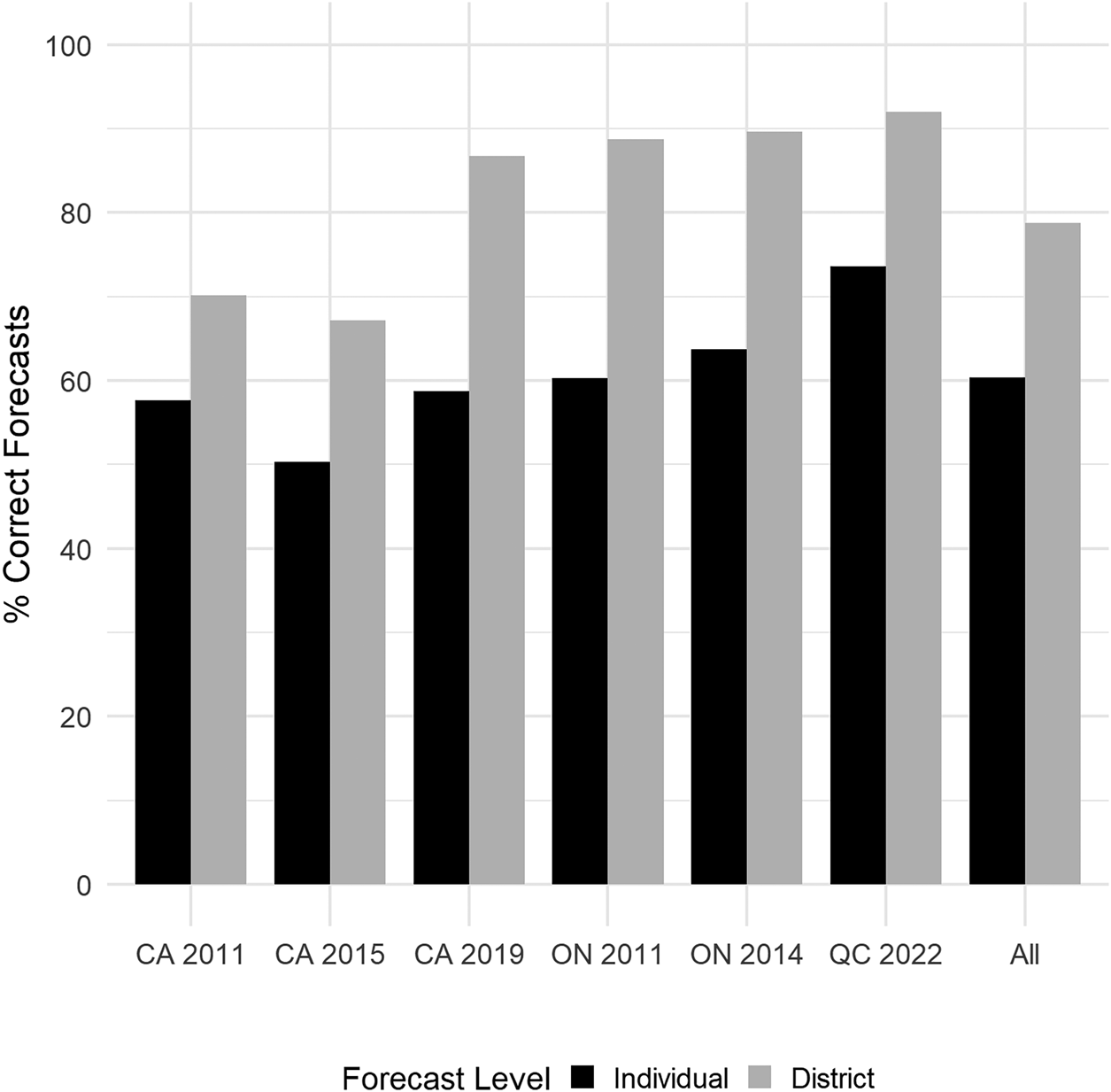
One could argue that the patterns observed in Figure 1 and Figure 2 are driven by the greater number of respondents on the winning side (we do observe that respondents who intend to vote for the winning candidate represent a plurality of voters in most districts). As suggested by previous research, there is a clear association between voters’ preferences and electoral expectations. Individuals supporting the winning party or candidate tend to display greater accuracy simply because they “benefit” from their biases (just as losers’ biases tend to act against them). Therefore, we reproduced Figure 1 and Figure 2 for losers and winners (according to their voter intention) separately. These additional analyses are available in section D of the appendix. We find the same patterns in both groups (that is, larger groups tend to provide more accurate forecasts and aggregation beats the average voter), although the accuracy of individual- and district-level forecasts are considerably higher among winners. As such, the partisan biases of winners appear to partially “compensate” for the partisan biases of losers. When it comes to citizens’ electoral forecasts, one might wonder if there is wisdom in the crowd or if there is mostly bias (wishful thinking) in the crowd. It does seem like a significant portion of the “wisdom” in the crowd stems from winners’ partisan biases.
The number of predicted seats for each party in each election from aggregated citizens’ forecasts as well as the actual outcomes can be found in Table 2. As can be seen, the mean absolute error (MAE) ranges from a low of 0.6 (Ontario 2011) to a high of 13.1 (Canada 2011) percentage points. We also computed the symmetric percentage error (SPE) and log accuracy ratio, or log error (LE), to give a better sense of the relative magnitude of errors across elections (see Tofallis, Reference Tofallis2015). SPE and LE values close to 0 indicate more accurate forecasts (see section E of the appendix for details): for example, the mean absolute SPE (sMAPE), which as an upper-limit of 100, ranges from a low of 1.5 (Ontario 2011) to a high of 41.7 (Canada 2011). In the three provincial elections, voters as a group correctly ranked each party. In the 2019 federal election, voters correctly predicted the overall outcome, although they overestimated the Conservatives’ seat share and underestimated that of the Bloc Québécois. Despite the fact that the Liberal Party lost the popular vote, aggregated citizens’ expectations correctly gave the Liberals a plurality of seats. In the 2011 and 2015 federal elections, voters proved collectively unable to anticipate the outcome. Although aggregated expectations correctly predicted a victory of the Conservative Party in 2011, they pointed toward a minority government (less than 155 seats). Furthermore, citizens’ expectations for the 2011 federal election did not hint at the possibility of an “Orange Wave” for the NDP. In 2015, not only did voters collectively fail to foresee the victory of the Liberal Party, but they considerably overestimated the seat share of the NDP. If citizens’ performance across the six elections can be deemed respectable overall, there is clearly room for improvement.
Predicted Number of Seats from Aggregated Citizens’ Forecasts
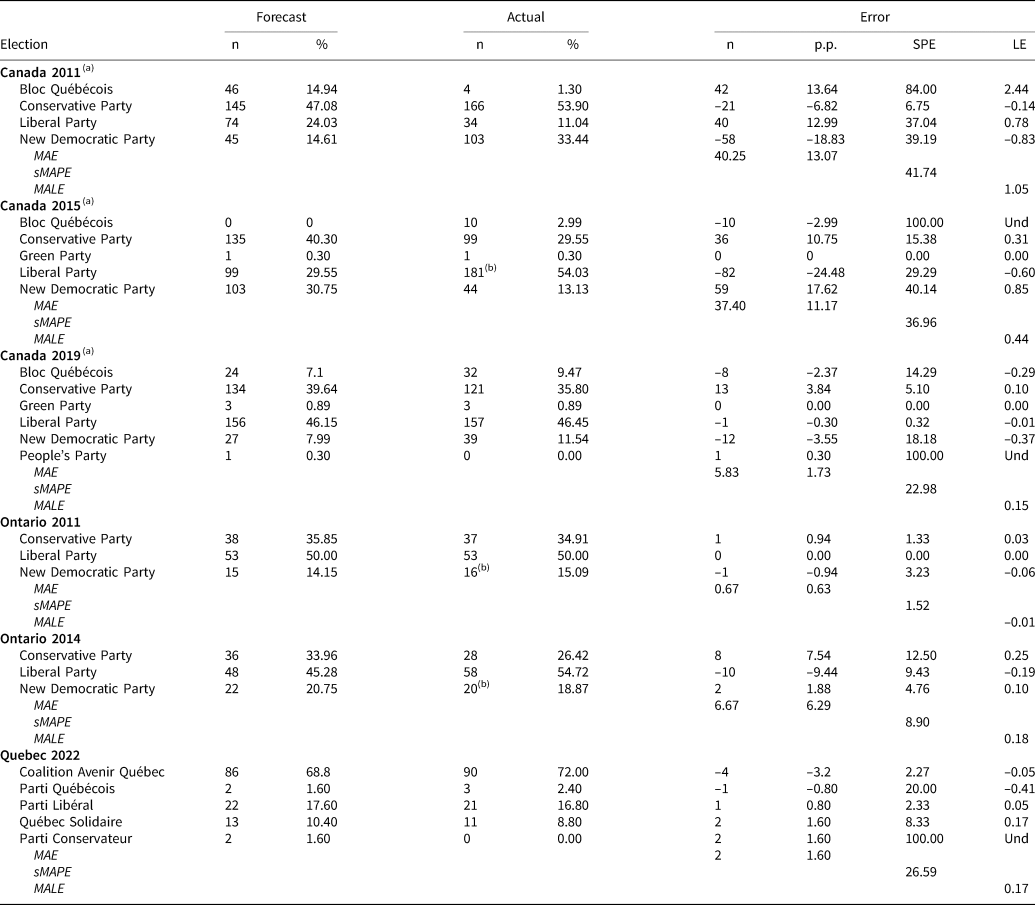
Notes. (a) In the 2011, 2015, and 2019 Canadian federal elections, a tie was predicted in certain districts; between the Bloc Québécois and the NDP in Abitibi—Baie-James—Nunavik—Eeyou (32.47 percent each) and between the Conservative Party and the NDP in Nunavut (50 percent each) in 2011; between the Conservative Party and the Liberal Party in Eglinton—Lawrence (41.59% each) and Scarborough Centre (39.25 percent each), and between the Liberal Party and the NDP in Winnipeg Centre (39.13% each) in 2015; between the Bloc Québécois and Conservative Party in Abitibi—Baie-James—Nunavik—Eeyou (23.81% each), between the Conservative Party and the Liberal Party in Fleetwood—Port Kells (32.08% each) and Winnipeg South (40% each), between the Conservative Party, the Green Party, and the People's Party in Nunavut (25% each), between the Bloc Québécois and the NDP in Rimouski-Neigette—Témiscouata—Les Basques (31.91% each), and between the Liberal Party and the NDP in Surrey Centre (44.23% each) in 2019. Therefore, the total number of predicted seats is 310 (instead of 308) in 2011 and 345 (instead of 338) in 2019. There are 338 forecasted seats in 2015 as the missing forecasts for the northern territories (i.e., Northwest Territories, Nunavut, and Yukon) are “compensated” by the three previously mentioned tied district-level races. (b) Because there were no observations for Northwest Territories, Nunavut, and Yukon in the 2015 Canadian federal election, the score of the Liberal Party (which won the seats in those ridings) was adjusted accordingly by removing three seats. Because there were no observations for Timiskaming—Cochrane in both the 2011 and 2014 Ontario general elections, the score of the Ontario New Democratic Party (which won the local seat in both cases) was adjusted accordingly by removing one seat in each case. p.p. = percentage points. MAE = mean absolute error. SPE = symmetric percentage error (maximum = 200; values close to 0 indicate accurate forecasts). sMAPE = symmetric mean absolute percentage error. LE = log accuracy ratio or the natural logarithm of the quotient of the forecasted value and the actual value (values close to 0 indicate accurate forecasts). MALE = mean absolute log error. Und = undefined (i.e., natural logarithm of 0).
Table 3 displays the results of the two sets of regression models described above. Starting with the first set of models, we find, as expected, that respondents who voted for the winning candidate in their district were more likely to make a correct forecast than those who voted for one of the losing candidates. On average, and all else being equal, a vote for the winning candidate leads to an increase in the probability of a correct forecast at the district level of about 20 percentage points by a minimum in the 2022 Quebec general election and of 51 percentage points by a maximum in the 2015 Canadian federal elections.Footnote 7 This is not surprising in light of the vast literature on motivational biases. Tests of first and second differences show that the interaction term between vote choice and education is statistically significant in all cases, with the exception of the 2015 federal election. In other words, the gap between losers and winners in the predicted probability of making a correct forecast is smaller among respondents with a university degree than it is among others. While education does not seem to matter for winners, it makes a small, but noticeable difference among supporters of losing parties (between 7–16 percentage points depending on the election). The results in Table 3 also highlight the importance of task difficulty. Larger margins of victory and incumbent reelection (no change) are associated with a higher likelihood of making a correct forecast. For example, a one standard deviation increase in the margin of victory increases the odds by 7–15 percentage points on average depending on the election, while incumbent reelection increases the odds by an average of 11–48 percentage points.
Predictors of Forecasting Accuracy in District-Level Elections at the Individual Level
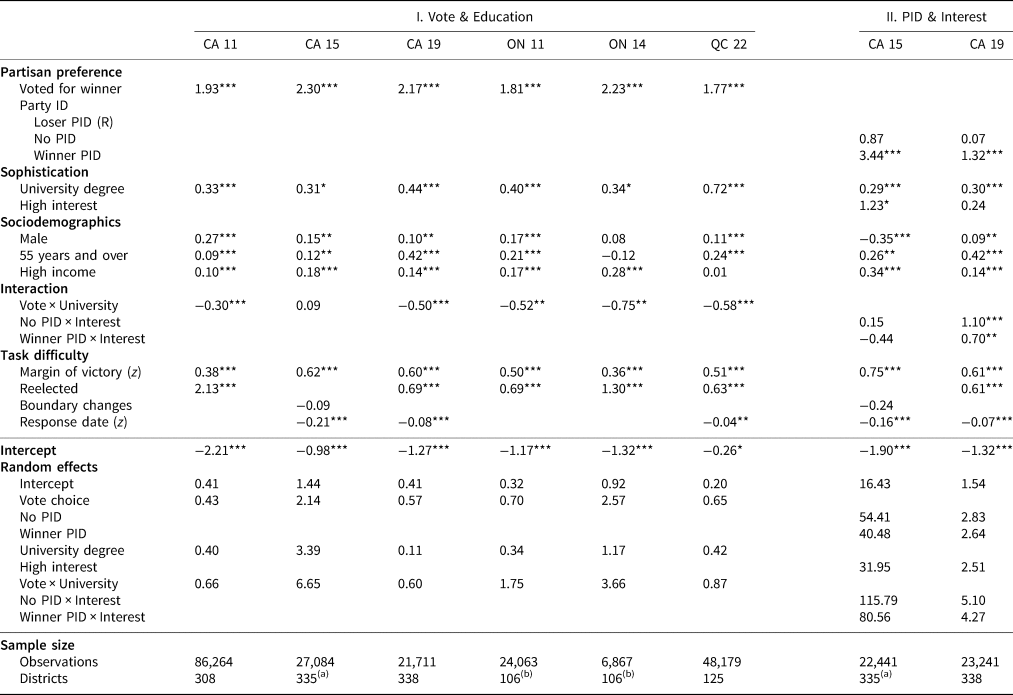
Notes. DV: Individual-level forecasting accuracy (0 = incorrect, 1 = correct). Multilevel random effects logistic regression models. Significance levels: * p < 0.05; ** p < 0.01; *** p < 0.001. (a) No observations for Nunavut, Western Arctic (Northwest Territories) and Yukon. (b) No observations for Timiskaming—Cochrane. Regression analyses adjusted for age, sex, education and household income. Weights were computed using the Public Use Microdata Files (PUMFs) of the 2011 National Household Survey (Statistics Canada, 2014) for the 2011 Canadian federal election and the 2011 Ontario general election; the 2016 Canadian Census (Statistics Canada, 2022) for the 2015 Canadian federal election and the 2014 Ontario general election; and the 2021 Canadian Census (Statistics Canada, 2023) for the 2019 Canadian federal election and the 2022 Quebec general election. R = reference category.
The second set of models broadly confirms the previous findings in that (1) respondents who share the partisan identity of the winner are substantially more likely to make a correct forecast than those who identify with one of the losing parties and (2) education appears to have a positive but relatively small influence on forecasting accuracy, one that is mostly concentrated among losers. The most interesting results, however, have to do with political interest. On average, and all else being equal, moving from the minimum to the maximum value on the interest scale increases the probability of a correct forecast by 26 and 15 percentage points in the 2015 and 2019 federal elections, respectively. In both elections, interest has a considerably stronger impact among independents (32 and 31 percentage points in 2015 and 2019, respectively) than among both respondents identifying with losing (19 and 6 percentage points) and winning (9 and 15 percentage points) parties.
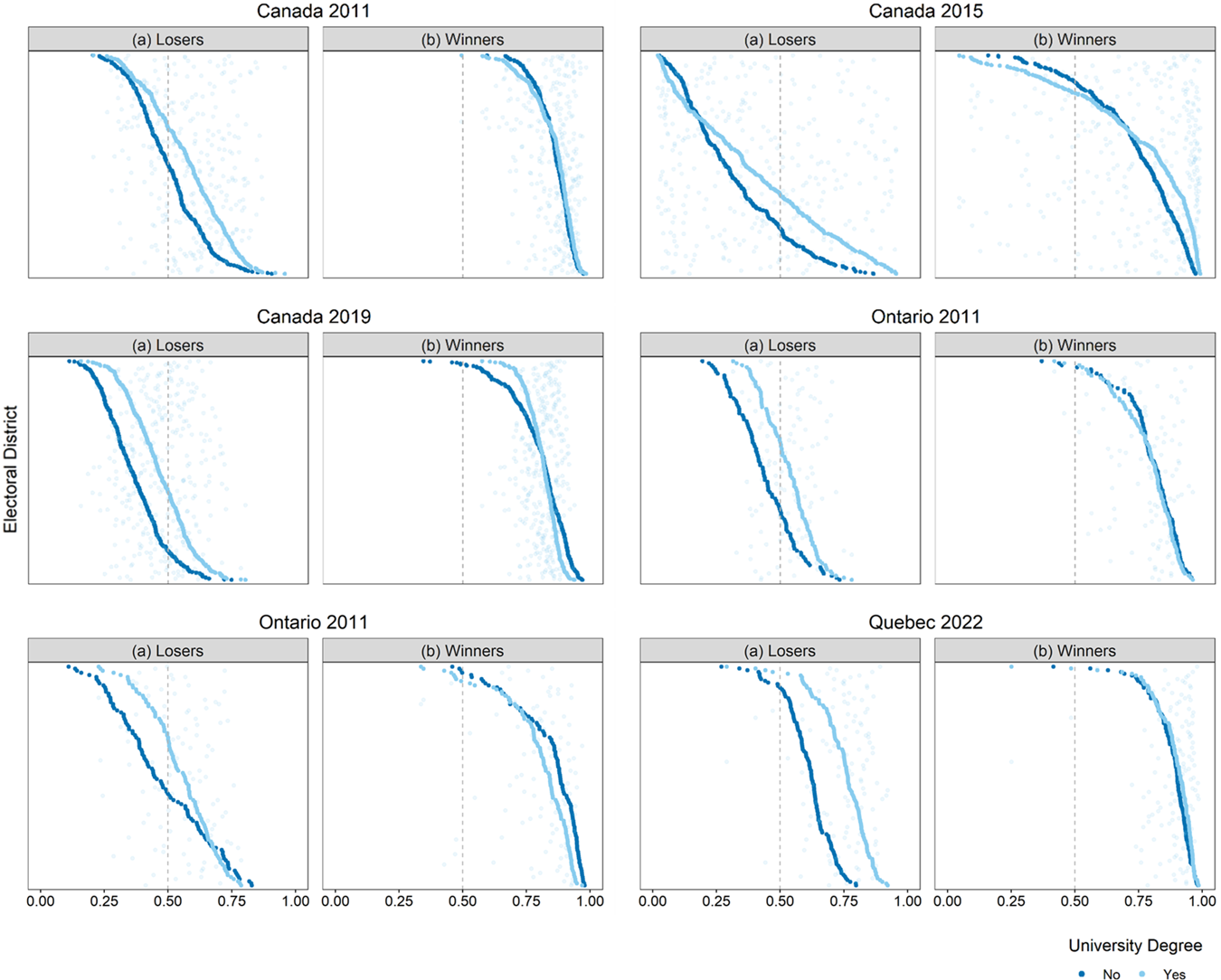
One way to better visualize and assess the impact of education and interest on forecasting accuracy is to plot the predicted probabilities of making a correct forecast in each district when these variables are set to their minimum values and then to their maximum values, while holding other covariates constant (at their mean or modal value). This is shown in Figure 3 (education only) and Figure 4 (education and interest) for supporters of losing and winning parties in each election. Each dot represents the predicted probability of making a correct forecast in a district. Figure 3 shows the predicted probability of making a correct forecast for voters with lower education (dark blue dots) as well as the predicted probability for voters with higher education (light blue dots). Figure 4 shows the predicted probabilities for respondents with lower education who are uninterested in politics (dark orange dots) compared to those of respondents with higher education who are also highly interested in politics (light orange dots). These graphs provide a clear illustration of previous findings (that is, education matters for losers but not so much for winners and political interest in conjunction with educational attainment increases accuracy among losers, independents and winners), but they also cast doubt on the usefulness of these potential markers of competence to improve forecasts in the aggregate. Although, on average, education and interest improve the likelihood of a correct forecast across districts, most of the observed improvements stay well below the 50 per cent mark among losers—those who are the least likely to correctly guess the outcome. In fact, delegating (restricting) the forecasting task to respondents with a university degree and a relatively high level of political interest (that is, above 0.6) produces percentages of correctly predicted district outcomes identical to those found for all respondents irrespective of their education or level of interest.
Predicted Probability of Correct Forecast by District According to Education.
Note. Semitransparent dots show the predicted probability for highly-educated voters before being arranged in descending order.
Predicted Probability of Correct Forecast by District According to Education and Interest.
Note. Semitransparent dots show the predicted probability for highly-educated and highly-interested voters before being arranged in descending order.
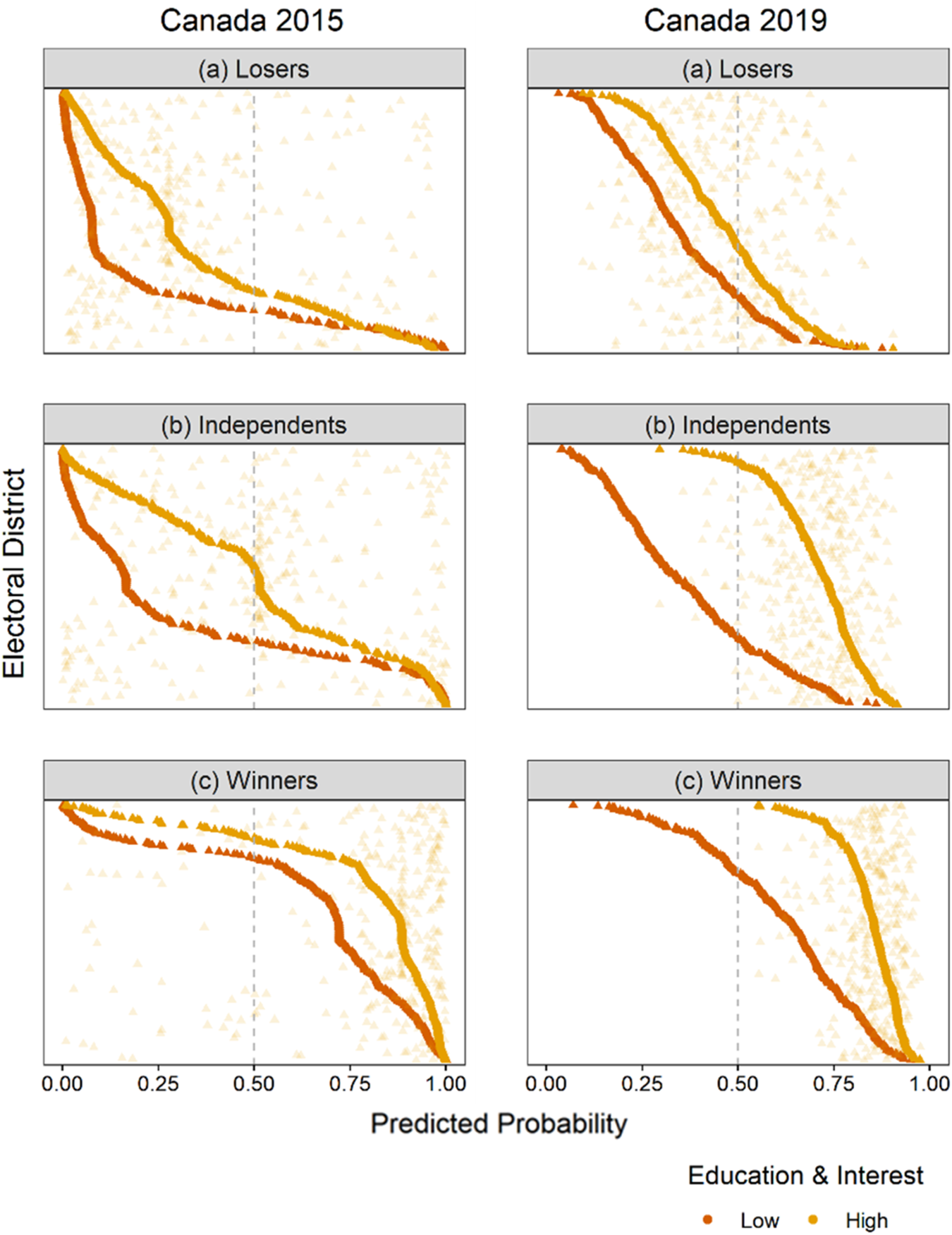
Table 4 shows the impact of diversity on group-level forecasts. Consistent with Murr's (Reference Murr2011) results, diversity does not seem to matter much. Across elections, there are no discernible patterns and most diversity indices have statistically insignificant coefficients. Using an overall measure (index) of diversity does not lead to different conclusions. Note that diversity, as measured in Table 4, is a property of the group of forecasters. However, it can also be conceptualized as a property of respondents’ immediate environment (their district). Therefore, we ran additional analyses using measures of sociological diversity derived from census data within each district. These analyses, which are available in section F of the appendix, do not suggest that diverse social environments boost accuracy. Group size (logged) is also statistically insignificant, which might appear as surprising. However, this is as one should expect considering the fact that the benefits of aggregation in terms of forecasting accuracy drop considerably beyond only a few respondents (as shown in Figure 1). The vast majority of districts have samples well above the 10–15 respondent threshold.
Predictors of Forecasting Accuracy in District-Level Elections at the Group Level
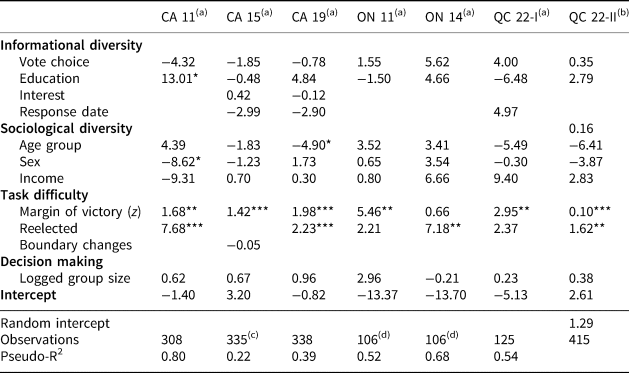
Notes. DV: Group-level forecasting accuracy (0 = incorrect, 1 = correct). (a) Logistic regression models. (b) Multilevel random effects logistic regression model (for this model, diversity was measured at the level of the forward sortation areas (FSAs); FSAs are embedded within districts). Significance levels: * p < 0.05; ** p < 0.01; *** p < 0.001. (c) No observations for Nunavut, Western Arctic (Northwest Territories) and Yukon. (d) No observations for Timiskaming—Cochrane.
While our findings support Hypothesis 1 as highly educated and politically interested respondents tend to be more accurate than respondents with lower levels of education or interest, there is no convincing evidence in favour of Hypothesis 2. Socially and cognitively diverse crowds do not appear to outperform more uniform groups. However, the fact that educated and interested respondents are more likely to form accurate expectations about election outcomes does not necessarily mean that we can rely exclusively on their judgment to obtain better results in the aggregate.
Conclusion
Our goal in this study has been to assess individual- and group-level explanations of citizens’ forecasting accuracy regarding election outcomes. More precisely, we looked at two potential markers of sophistication or competence among individual voters—education and political interest—as well as different measures of group sociodemographic and informational diversity. As expected, both education and political interest are positively related to forecasting accuracy and appear to reduce the influence of partisan preferences on expectations, especially among losers. However, the effect of education is quite small. Unfortunately, for most elections, educational attainment was the only available proxy for political sophistication. Although education has been found to possibly correlate with political attentiveness, it can be seen as a relatively weak proxy for sophistication (Luskin, Reference Luskin1990). As noted by McGregor (Reference McGregor1938: 195, emphasis in original), we have to keep in mind that “[i]t is the nature of one's information that is determinative, not the amount.” Interest for politics, which is closer conceptually to political sophistication, seems to play a more determinant role than education in explaining the likelihood of a correct forecast, although the evidence is limited to only two elections. More importantly, our results suggest that discriminating on the basis of education or level of interest will hardly translate into any benefits in the aggregate. Doubts can also be raised about the benefits of diversity in improving group-level accuracy. Like Murr (Reference Murr2011), we found no convincing evidence that a mix of heterogeneous individuals, either in terms of their sociodemographic profiles or the information they possess, helps to increase the group's chances of making a correct forecast. Our findings are also consistent with those of de Oliveira and Nisbett (Reference de Oliveira and Nisbett2017), who concluded that diverse crowds resemble homogeneous ones when making numerical judgments, such as predicting candidates’ vote shares.
Therefore, while Larrick et al. (Reference Larrick, Mannes, Soll and I2012) have identified expertise and diversity as necessary properties for groups to be effective forecasters, our results seem to suggest that the aggregation of citizens’ electoral expectations is not easily improved upon using measures of political sophistication and informational or sociological diversity. The extant literature does point to other potentially fruitful strategies, that would however require the collection of experimental or panel data, such as group deliberation (Navajas et al., Reference Navajas, Niella, Garbulsky, Bahrami and Sigman2018; see also Becker et al., Reference Becker, Brackbill and Centola2017; Mercier and Claidière, Reference Mercier and Claidière2022), combining respondents’ own estimates with their estimates of other people's judgments (Fujisaki et al., Reference Fujisaki, Yang and Ueda2023), or weighting on prior performance (Hill and Ready-Campbell, Reference Hill and Ready-Campbell2011).
The present article is not without limitations. First, it is important to mention that crowd wisdom can be mobilized for a variety of tasks, including idea generation, problem solving, or even policy-making. All of these tasks involve a great deal of future-oriented thinking (for example, which decision or idea will be most efficient or yield the biggest returns). However, we cannot make the claim that our results apply to all instances in which collective intelligence is mobilized. Rather, our results speak to a much narrower strand of the literature, namely citizen forecasting of election outcomes. Second, in all six elections, members of parliaments were elected from single-member districts (SMD) according to a first-past-the-post (FPTP) rule. This limits the generalizability of our findings. Elections conducted in multimember districts (MMD) under a party-list proportional representation (PR) system could prove more challenging for voters. Third, the 2019 CES, Datagotchi, Ipsos and LPP surveys are among the very few existing surveys to include large-enough samples at the district level to reliably test the WOC prinicple in the context of elections; relying on these very large datasets comes at a price however. As already mentioned, few items were available to measure respondents’ political sophistication. Finally, sophistication is a multifaceted concept (see Oscarsson and Rapeli, Reference Oscarsson and Rapeli2018), one we admittedly could not fully grasp with educational attainment and interest alone. Although sophistication is not limited to factual knowledge of politics, future research on voters’ expectations should consider measuring the influence of election-specific knowledge (for example, party slogans, leaders, platforms, polling trends and so forth) on forecasting accuracy (Miller et al., Reference Miller, Wang, Kulkarni, Poor and Osherson2012).
Acknowledgements
First, we wish to thank the three anonymous reviewers for their excellent suggestions and comments. We are also grateful to the participants of the “Perceptions of Government” panel at the 2023 Midwest Political Science Association Conference and members of the Media, Movements and Politics research group at the University of Antwerp for their feedback on previous versions of this article.
Supplementary Material
The supplementary material for this article can be found at https://doi.org/10.1017/S0008423924000465.
Declaration of Competing Interests
Competing interests: The authors declare none.


 Open access

