

Introduction
In contemporary Western societies, women consistently express lower levels of political ambition, conventional political knowledge,Footnote 1 and political interest (Fox & Lawless, Reference Fox and Lawless2014; Fraile & Gomez, Reference Fraile and Gomez2017; Kittilson, Reference Kittilson2016; Wolak & McDevitt, Reference Wolak and McDevitt2011) than men. As these persistent gender differences indicate unequal potential for participation in the democratic system (Kostelka et al., Reference Kostelka, Blais and Gidengil2019) and the underrepresentation of women’s interests, it is imperative to investigate their underlying mechanisms. While studies underline the importance of gendered patterns in political socialization for gender gaps in political interest (Bos et al., Reference Bos, Greenlee, Holman, Oxley and Lay2022; Fraile & Sánchez-Vítores, Reference Fraile and Sánchez-Vítores2020), research also indicates that it has a heritable component (Dawes et al., Reference Dawes, Cesarini, Fowler, Johannesson, Magnusson and Oskarsson2014; Klemmensen et al., Reference Klemmensen, Hatemi, Hobolt, Skytthe and Nørgaard2012; Weinschenk et al., Reference Weinschenk, Dawes, Kandler, Bell and Riemann2019). Therefore, this article asks how the heritability of political interest relates to the process of gendered political socialization in the development of gender gaps in expressed political interest. In answering this question, we combine insights from behavioral genetics with gendered political socialization.
We theorize that gendered political socialization results in differences not only in reported political interest (the phenotype), as previous studies have demonstrated, but also in the heritability thereof (the effect of genotype). The enriched environment hypothesis suggests that genes play a greater role in explaining variation between individuals when they are in an enriched environment for that phenotype (Rowe et al., Reference Rowe, Jacobson and Van den Oord1999). Research has shown that boys find themselves, on average, in a more stimulating environment for developing interest in politics compared to girls because of gendered political socialization (Bos et al., Reference Bos, Greenlee, Holman, Oxley and Lay2022). Based on these notions, we expect that heritability is more important in explaining boys’ expressed political interest compared to girls’ and that this differs across age groups as individuals increasingly internalize gendered notions about politics over the life course.
We test our hypotheses using the German TwinLife study of preteen, adolescent, and young adult twins (aged 11–25). We contribute to the study of gender gaps in political traits and the role of genes therein by demonstrating how gender differences in expressed political interest and the heritability thereof differ across young age groups. Heritability is relatively large and stable for boys, while this is not the case for girls. The shared environment component has a greater impact on (pre)teen girls’ expression of political interest than it does for young adult women, while it is zero for males in all age groups. We explain these results as attributable to differences in political socialization that are conditioned by genetic differences: the less stimulating environment for girls might limit the expression of their genetic predispositions for political interest, especially during their younger years. While we do not have explicit measures of the socialization environment, we rule out several alternative explanations for these differences between boys and girls. We conclude that the gender gap in political interest is best understood as a result of both genetic and environmental influences, as well as the interaction between the two.
Gendered political socialization
A variety of political gender gaps have been demonstrated over the last decades: importantly, women display lower levels of conventional political knowledge, political ambition, and political interest than men (Fox & Lawless, Reference Fox and Lawless2014; Kittilson, Reference Kittilson2016). In Germany, the country under study here, the size of the gender gap in political interest is of average size (Fraile & Gomez, Reference Fraile and Gomez2017), and women display lower levels of different types of political participation, which has been explained by different political socialization experiences (Pfanzelt & Spies, Reference Pfanzelt and Spies2019). The gendered division of labor in society, including the historically dominant role of men in politics, has resulted in gender norms about politics (Eagly, Reference Eagly1987; Sapiro, Reference Sapiro1983). The current low representation of women in politics (Paxton et al., Reference Paxton, Kunovich and Hughes2007) leads to the continued reinforcement of traditional gender roles and gender stereotypes regarding women’s political competency (Huddy & Terkildsen, Reference Huddy and Terkildsen1993; Sanbonmatsu, Reference Sanbonmatsu2002).
The intersection of gender and political socialization processes results in gendered political socialization, the process by which children infer that politics is for men and thus does not fit with women’s gender roles (Bos et al., Reference Bos, Greenlee, Holman, Oxley and Lay2022). Through gender socialization, boys and girls learn from a young age onward what is (not) expected from them in terms of behavior and preferences and receive differential treatment based on their sex (Eccles et al., Reference Eccles, Freedman-Doan, Pam, Jacobs, Yoon, Eckes and Trautner2000; Eccles et al., Reference Eccles, Jacobs and Harold1990). This occurs in tandem with political socialization, the process of political learning and familiarization with the political system (Jennings, Reference Jennings, Dalton and Klingemann2007; Sapiro, Reference Sapiro2004). Through gendered political socialization, girls internalize the gender stereotype that politics is a male domain (Koenig et al., Reference Koenig, Eagly, Mitchell and Ristikari2011; Mariani et al., Reference Mariani, Marshall and Mathews-Schultz2015; Mayer & Schmidt, Reference Mayer and Schmidt2004), which does not fit with their gender role. This contributes to early gender differences in political interest and ambition and increased association of politics with men, which grow when children become older (Bos et al., Reference Bos, Greenlee, Holman, Oxley and Lay2022; Fraile & Sánchez-Vítores, Reference Fraile and Sánchez-Vítores2020). Gendered political socialization processes can also imply that women receive reduced political learning or encouragement compared to men (Dynes et al., Reference Dynes, Hassell, Miles and Preece2019).
Based on this literature, we can conclude that while both boys and girls learn gendered notions about politics, the political socialization environment is not equally “rich” for girls as it is for boys. Applied to our dependent variable, political interest, this would mean that (1) boys are more encouraged than girls when they start to show an interest in politics, and (2) boys and girls do not equally consider politics as something that fits with their gender role, and therefore they are not equally stimulated to develop interest in politics.
Based on findings for other countries (Bos et al., Reference Bos, Greenlee, Holman, Oxley and Lay2022; Cicognani et al., Reference Cicognani, Zani, Fournier, Gavray and Born2012; Fox & Lawless, Reference Fox and Lawless2014; Fraile & Sánchez-Vítores, Reference Fraile and Sánchez-Vítores2020), we expect to find smaller gender gaps in political interest during preadolescence than during adolescence and young adulthood, as the socialization of preteens occurs at an earlier stage and gender stereotypes are internalized to a lesser extent.
H1: The gender gap in interest in politics is smaller among preteens than among teens and young adults.
Heritability and the enriched environment hypothesis
While the importance of the socialization environment for political development is firmly established, there is also a vast accumulation of evidence on the genetic basis of political traits. Twin studies from different countries show that political ideology and beliefs (e.g., Alford et al., Reference Alford, Funk and Hibbing2005; Hatemi et al., Reference Hatemi, Medland, Klemmensen, Oskarsson, Littvay, Dawes, Verhulst, McDermott, Nørgaard, Klofstad, Christensen, Johannesson, Magnusson, Eaves and Martin2014; Ksiazkiewicz et al., Reference Ksiazkiewicz, Klemmensen, Dawes, Christensen, McGue, Krueger and Nørgaard2020) and political interest have a heritable component (Bell et al., Reference Bell, Schermer and Vernon2009; Dawes et al., Reference Dawes, Cesarini, Fowler, Johannesson, Magnusson and Oskarsson2014; Klemmensen et al., Reference Klemmensen, Hatemi, Hobolt, Skytthe and Nørgaard2012; Weinschenk et al., Reference Weinschenk, Dawes, Kandler, Bell and Riemann2019). Different methodologies, such as extended family designs (Hatemi et al., Reference Hatemi, Hibbing, Medland, Keller, Alford, Smith, Martin and Eaves2010) and the analysis of genome-wide data (Benjamin et al., Reference Benjamin, Cesarini, van der Loos, Dawes, Koellinger, Magnusson, Chabris, Conley, Laibson, Johannesson and Visscher2012), have led to similar conclusions. Studies also suggest that the role of genes in political attitudes emerges primarily in early adulthood and is absent in adolescence (Eaves et al., Reference Eaves, Martin, Heath, Schieken, Meyer, Silberg, Neale and Corey1997; Hatemi, Funk, et al., Reference Hatemi, Funk, Medland, Maes, Silberg, Martin and Eaves2009). Existing studies on the role of genes in political gender gaps have not led to uniform findings. While some studies find differences in patterns of heritability of political knowledge and issue positioning by gender (Hannagan et al., Reference Hannagan, Littvay and Popa2014; Hatemi, Medland, et al., Reference Hatemi, Medland and Eaves2009), others do not find sex differences in the variance components of political ideology (Eaves et al., Reference Eaves, Martin, Heath, Schieken, Meyer, Silberg, Neale and Corey1997; Hatemi, Funk, et al., Reference Hatemi, Funk, Medland, Maes, Silberg, Martin and Eaves2009). However, none of these studies has looked at gender differences in the heritability in political interest.
Heritability in behavioral genetics is the proportion of population variance in a particular trait that cannot be attributed to environmental factors (for a review of behavioral genetics methods and concepts, see Medland & Hatemi, Reference Medland and Hatemi2009). Heritability is not an individual characteristic—that is, 30% heritability of trait X does not mean that 30% of an individual’s trait X is due to genes. Moreover, heritability is not unconditional. This implies that in different populations, the same trait may show different levels of heritability, largely as a function of the differing environments that those populations inhabit, which condition how genes get expressed and therefore how much of the trait variance they explain. This can even be true of the same population as context changes (Fazekas & Littvay, Reference Fazekas and Littvay2015).
Research in behavioral genetics shows that environments moderate the expression of genetic dispositions (Rowe et al., Reference Rowe, Jacobson and Van den Oord1999): in a more enriched environment, the expression of the trait is more stimulated, a mechanism through which the genotype can more strongly influence the expressed phenotype (Bronfenbrenner & Ceci, Reference Bronfenbrenner and Ceci1994; Scarr, Reference Scarr1992). Studies demonstrate how the social context can act as a moderator of the expression of genetic predispositions (Baier & Van Winkle, Reference Baier and Van Winkle2021; Heath et al., Reference Heath, Berg, Eaves, Solaas, Corey, Sundet, Magnus and Nance1985; Rowe et al., Reference Rowe, Jacobson and Van den Oord1999; Scarr-Salapatek, Reference Scarr-Salapatek1971; Shanahan & Hofer, Reference Shanahan and Hofer2005; Turkheimer et al., Reference Turkheimer, Haley, Waldron, D’Onofrio and Gottesman2003), supporting the enriched environment hypothesis. These studies show that the genetic component for the trait under study (e.g., cognitive ability, IQ) explains more variation among individuals in an advantaged environment (e.g., enriched educational opportunities), while a disadvantaged environment suppresses the importance of genetic variation. Heritability thus matters more in enriched environments than in impoverished environments, where variation is driven more by shared environment effects (Rowe et al., Reference Rowe, Jacobson and Van den Oord1999).
In a more stimulating political socialization environment, we should thus expect political phenotypes to have higher levels of heritability (i.e., to be more influenced by genes at the population level). Based on the evidence of gendered political socialization processes, we argue that this difference in socialization environments can generate differential pathways of the expression of genes into phenotypes (i.e., observed traits) for men and women regarding expressed political interest, because boys find themselves on average in an environment that allows for a better expression of their genetic predisposition. Therefore, we expect a gender gap in the heritability of interest in politics (H2), as heritability is conditional on the environment and individual experiences, which are most likely different between men and women from an early age onward. Moreover, this difference is expected to be larger from adolescence onward (H3), as gender norms regarding politics are expected to become increasingly salient parts of individuals’ environment, as well as increasingly internalized, when approaching adulthood and legal voting age.
H2: The heritability of interest in politics is higher for boys and men than for girls and women.
H3: The gender gap in the heritability of interest in politics is smaller among preteens than among adolescents and young adults.
Research design
Data and variables
To test these hypotheses, we use the German TwinLife data set (Diewald et al., Reference Diewald, Riemann, Spinath, Gottschling, Hahn, Kornadt, Kottwitz, Mönkediek, Schulz and Weigel2019). TwinLife is a family-based study of four age cohorts of monozygotic (identical) and dizygotic (fraternal) same-sex twins, including 4,000 twin families. We use the first wave of the study (collected in two half-waves, from September 2014 to May 2015 and from September 2015 to April 2016). We employ the data of twins of three cohorts, aged 11–12, 17–18, and 22–25 at the time of the survey. We refer to these groups as preteens, teens/adolescents, and young adults, respectively.
The use of this data set offers several advantages. First, a unique feature of the TwinLife data is that political interest is measured from preadolescent age onward—younger than in most studies—which gives us new insights regarding the age at which political gender gaps appear in genotypes as well as phenotypes. Second, it allows us to provide new insights on political gender gaps across age groups in a relatively understudied European context, as recent works have relied on U.S. data (e.g., Bos et al., Reference Bos, Greenlee, Holman, Oxley and Lay2022; Elder, Reference Elder2004; Fox & Lawless, Reference Fox and Lawless2014; Mayer & Schmidt, Reference Mayer and Schmidt2004; Wolak & McDevitt, Reference Wolak and McDevitt2011, all rely on U.S. samples).
We consider Germany as a less likely case compared to the United States regarding gender differences, which implies that if the expected gender differences are found here, they are likely to be present in other less gender-equal environments. Germany ranks 10th on the global gender equality index (World Economic Forum, 2020), partially due to its ratings for the political empowerment subindex, while the United States ranks 86th and has significantly lower political empowerment ratings. German politics has been marked by the female presence of Angela Merkel over the past decades, and 40% of ministers and 31% of parliamentarians are women. However, within Europe, Germany scores relatively average on gender equality and political gender differences among the public: the country has a median score on the Gender Equality Index from the Institute for Gender Equality, as well as for the size of the gender gap in political interest (Fraile & Gomez, Reference Fraile and Gomez2017). Importantly for our study, research indicates that political socialization environments in Germany differ for boys and girls: young German women are less likely to engage in various types of political participation because they receive lower levels of political support from parents, peers, and schools (Pfanzelt & Spies, Reference Pfanzelt and Spies2019).
Our dependent variable, political interest, is measured with this question: “Generally speaking, how interested are you in politics?” (1 = not at all, 2 = not so much, 3 = quite interested, 4 = very interested). Beyond this main item of interest, we have measures of age at the time of the interview and biological sex (which does not differ within but only between twin pairs, as only same-sex twins are included in the TwinLife study). The analyses in this article are based on an analytic sample of 5,597 twin respondents with valid information on our variables of interest.
We run several robustness checks using variables that are indicative of the underlying mechanism or alternative explanations sustaining gender differences in political interest. Parental political interest is directly measured from parental questionnaires, using the same variable wording as for the twins. Self-esteem is an average of three items: feeling of worthlessness (reverse-coded), liking oneself the way one is, and being satisfied with oneself. Associational activities (separately for sports association or club; choir/music or theater group; church or religious group; trade union/professional association/student council; voluntary fire and rescue services/technical relief association; local history association/citizens association/marksmen club; political organization/party and/or citizens’ initiative) covers four categories for frequency of attendance: never, less than once a month, every month, and every week. Unfortunately, these variables are mainly available for the oldest two age groups.
Twin analyses
We analyze the data using a series of twin models. Twin models take advantage of a natural experiment, whereby monozygotic (MZ) twins share essentially the same genome, and dizygotic (DZ) twins share on average only half of their genetic variants, as with typical biological siblings. Intuitively, for twins raised together, if variance in the trait is entirely idiosyncratic, we should expect twins to be uncorrelated. If variance in the trait is influenced by shared life experiences like socialization, we should expect the correlation among MZ twins to be equivalent to the correlation among DZ twins. If variance in the trait is affected by genetic variants, we should expect the correlation among MZ twins to be higher than the correlation among DZ twins (as they share more genetic material). At the extreme, if the MZ correlation is double the DZ correlation, then genes account for all the covariation between twins, with any residual individual variation attributed to measurement error or idiosyncratic life experiences. For more details on twin modeling, including exhaustive discussions of its assumptions, see Medland and Hatemi (Reference Medland and Hatemi2009).
The goal of a standard twin analysis is to break down the population variation of a trait into three components: the additive genetic component (A), the common environment component (C), and the unique environment component (E). For this reason, these models are commonly referred to as ACE models. A captures the broad-sense heritability of the trait by estimating the proportion of the variation that is attributable to genetic factors. Strictly, it is for additive effects of many genetic variants with a small effect size and where the effect of a particular variant is linear (i.e., the effect of having one copy of the variant is half as big as the effect of having two copies of the variant), but in practice, it also captures much of the nonlinear dominant genetic effects, which cannot be explicitly modeled with twins alone; thus, broad-sense heritability because it captures the cumulative effect of genes (Coventry & Keller, Reference Coventry and Keller2005). C captures the effect of the shared environment of the twins (e.g., shared life experiences, shared socialization). E is a residual term that captures unique life experiences (e.g., unshared life experiences, idiosyncratic differences in reactions to shared experiences) as well as measurement error.
To examine sex differences, we use a scalar sex-limitation model (Neale et al., Reference Neale, Røysamb and Jacobson2006). This approach tests whether the A, C, and E components for males and females are equivalent. The standard twin model is nested within this model, as it is equivalent to a non-sex-limitation model because it presumes that variance components are equivalent across sexes. Then, we compare model fit of the different models and opt for the more parsimonious model (i.e., the standard twin model) if it is not significantly worse fitting. If the parsimonious model is worse fitting, that suggests that the sex-limitation model better accounts for the data, indicating significant sex differences in the variance components. We cannot test the more general nonscalar sex-limitation model with these data, as they do not contain opposite-sex DZ twin pairs; future research that seeks to replicate these results should utilize these pairs where they are available.
The twin study method has been criticized mostly for the equal environments assumption (EEA) that underlies this design (Beckwith & Morris, Reference Beckwith and Morris2008; Charney, Reference Charney2008; Joseph, Reference Joseph2010). In short, the EEA entails that for identical and fraternal twin pairs, the shared environment contributes equally to the trait of interest. The counterargument is that identical twins spend more time together and are treated more similarly, which violates this assumption. We do not see grounds for an EEA violation in our study, as the shared environment in this case refers to practices of gendered political socialization, which is unlikely to be different for MZ twins than for DZ twins in the impact of the development of political interest. Only same-sex twin pairs are included in the study.
Model estimation
We conduct the analysis using a series of structural equation models on different subsamples (by age groups) within the TwinLife data set. We then compare the pattern of estimates for A, C, and E across models to obtain the variance decomposition of political interest. These models implement the scalar sex-limitation model described earlier (Neale et al., Reference Neale, Røysamb and Jacobson2006). All models were estimated using the OpenMx package in R (Neale et al., Reference Neale, Hunter, Pritikin, Zahery, Brick, Kirkpatrick, Estabrook, Bates, Maes and Boker2016).
We also include robustness checks (presented in the Supplementary Material) in which we regress political interest on gender and parental political interest, self-esteem, and associational activity (using regular ordinary least squares [OLS]) and estimate the MZ and DZ correlations for interest in politics when covariation with these variables has been partialled out. This was accomplished by regressing interest in politics on these respective variables, removing the covariance by taking the residual, then calculating the MZ and DZ correlations of those residuals. All statistical tests are based on two-tailed tests unless otherwise noted.
Results
To test our first hypothesis regarding the gender gap in political interest by age cohorts, we compare the mean level of political interest across groups (Figure 1).Footnote 2 While during early adolescence, both boys and girls express an equally low interest in politics, at higher ages, men start to express a relatively higher political interest than women. In line with our expectations, the gender gap in political interest does not appear until adolescence. Among the youngest cohort, the level of political interest is generally low and differs between boys (M = 1.84, SD = 0.76) and girls (M = 1.77, SD = 0.73), with boys expressing slightly higher political interest (t(1937) = 2.33, p = .01). In the two higher age groups, during adolescence and young adulthood, the level of interest in politics is higher and shows much larger sex differences, with males (M = 2.31, SD = 0.79; M = 2.38, SD = 0.81) expressing a higher average interest in politics than females (M = 2.03, SD = 0.67; M = 2.05, SD = 0.69), t(2100) = 8.48, p < .001 and t(1946) = 9.67, p < .001. These results provide strong support for H1.
Average level of interest in politics, by sex and age groups. Bars indicate 95% confidence intervals. N = 5, 989. Source: Authors’ calculations using TwinLife Wave 1 (2014–2016).

In Table 1, we present descriptive statistics for several factors that may explain the reported gender differences in political interest. While self-esteem is an individual trait that could be a result of a stimulating socialization environment, parental interest and associational activities are more directly indicative of the socialization environment. Importantly, parental political interest does not differ by sex of their twins. Self-esteem, however, is significantly higher for males than for females (only available in the two oldest age groups). The higher self-esteem of males may be indicative of a more stimulating environment regarding their various abilities that leads to higher self-esteem, which, in turn, may result in reporting higher political interest.
Summary statistics for parental political interest, self-esteem, and associational activity

Notes: Cells report means unless otherwise indicated. All variables have been rescaled to have a minimum of 0 and a maximum of 1. All estimates are based on a single twin from each pair to avoid correlated observations. Total N = 3,083 but differs per variable.
* Statistically significant sex difference within age category at the 95% level.
Source: Authors’ calculations using TwinLife Wave 1 (2014–2016).
Our main indicator of the social environment is associational activities. In the two oldest age groups, males show higher sports club attendance. Among teens, girls are more likely to participate in music and theater groups. Among young adults, men more often attend civic support groups, history clubs, and political organizations than women, which can be either a result or a source of their higher values in political interest. However, it should be noted that attendance is very low across these three types of groups. We do not find these differences among adolescents, while they do display differences in political interest.
As a robustness check, we test to what extent these variables account for gender differences in political interest using OLS regression (results are displayed in Supplementary Material, Table S1). These alternative explanations do not attenuate the effect of gender on interest in politics, as gender predicts interest in politics in every model specification. While some of these variables predict differences in political interest, the predictive effect of gender is essentially unchanged across all these alternative explanations, hence they are not driving the gender differences in political interest.
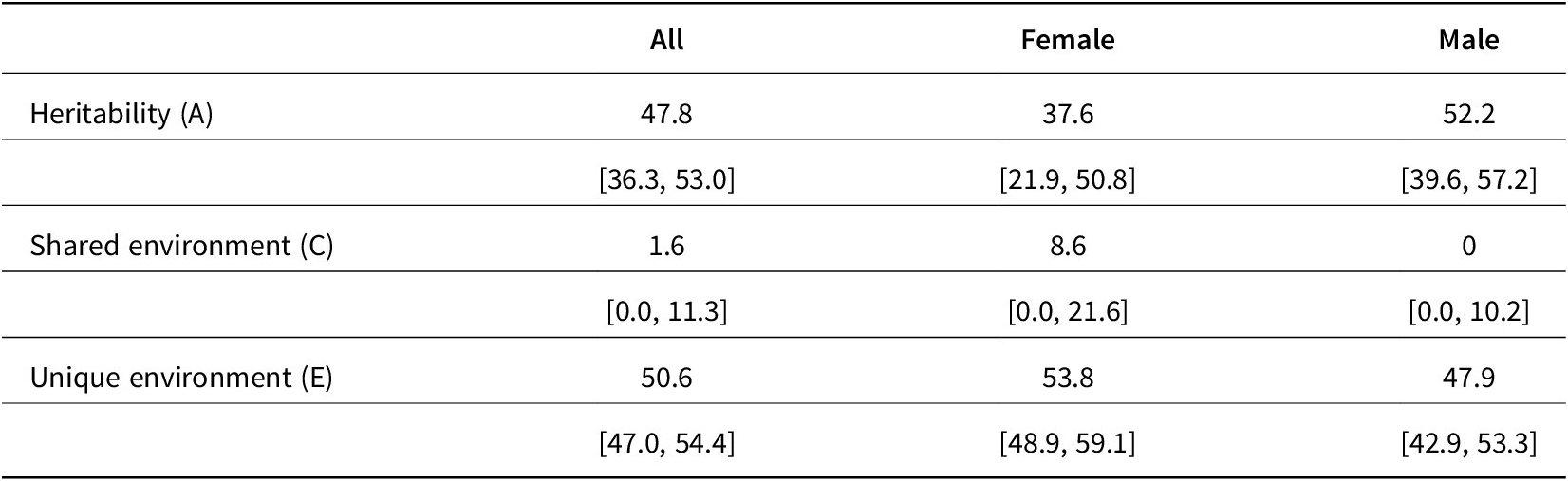
The results of the twin models are presented in Table 2, providing estimates of heritability (A), the shared environment (C), and the unique environment (E) from the unconstrained ACE models across sexes. Overall, the heritability estimate of political interest indicates that genes are estimated to account for 48% of the variance in interest in politics. This estimate is somewhat smaller than most previous heritability estimates of political interest (Bell et al., Reference Bell, Schermer and Vernon2009; Dawes et al., Reference Dawes, Cesarini, Fowler, Johannesson, Magnusson and Oskarsson2014; Klemmensen et al., Reference Klemmensen, Hatemi, Hobolt, Skytthe and Nørgaard2012), perhaps because these studies do not observe such a young sample including preteens, as we do (Weinschenk et al., Reference Weinschenk, Dawes, Kandler, Bell and Riemann2019, find a similar estimate).
ACE estimates for interest in politics, unconstrained model (95% CIs in brackets)
Note: N = 5,989 in 2,941 complete pairs.
Source: Authors’ calculations using TwinLife Wave 1 (2014–2016).
While the overall variation due to the shared environment is very small (2%), large variation is due to the unique environment (51%). Females show a smaller heritable component (38%) than males (52%), but this difference is not statistically significant at p < .05. When comparing the sex-limitation model and the standard model, the sex-limitation model does not fit the data worse than the simpler standard model, indicating that the sex-limitation model should be preferred because significant sex differences are present, perhaps driven in part by the unequal variance in interest. The sex-limitation model also indicates that males have more variation in political interest than females.Footnote 3 The comparison of the model fit of the different models and the full parameter estimates for the baseline unconstrained ACE model are reported in the Supplementary Material (Table S2).
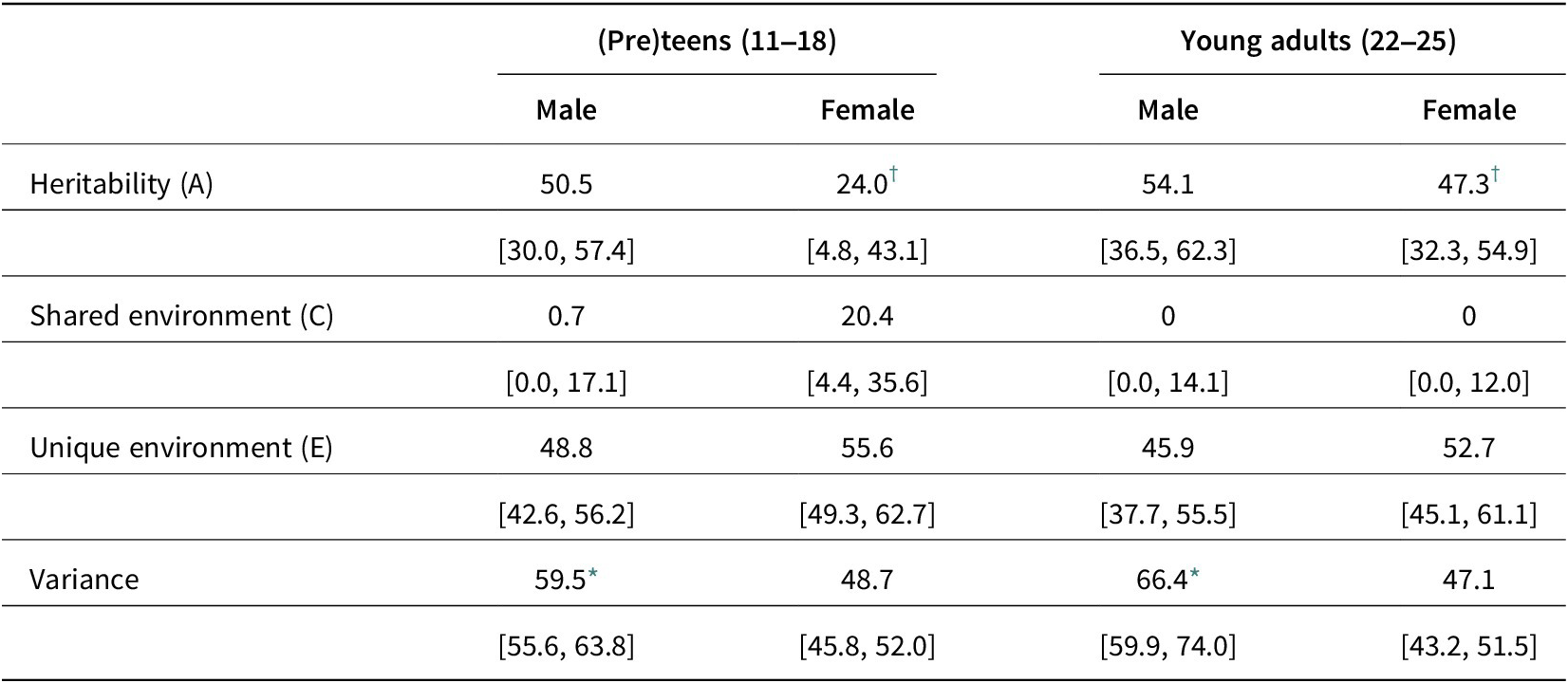
Next, we constrain the model further to allow for variation between age groups. The best fitting of these age constraint models is one in which we constrain parameters to be equivalent across the preteen and teen categories for males and females separately and leave the parameters for both men and women unconstrained. This means that we are pooling the estimates for (pre)adolescents to produce four groups (male/female by [pre]adolescent/adult).Footnote 4 Table 3 shows the results of this model, presenting ACE parameters alongside the variability estimates for the different groups. As the heritability estimates in the analysis significantly differ from zero for all subgroups, we can conclude that heritability plays a role in their expression of political interest.
ACE and variability estimates for interest in politics, sex-limitation model (95% CIs in brackets)
Note: N = 5,989 in 2,941 complete pairs.
* Statistically significant sex difference within the age category.
† Statistically significant age group difference within the sex category at the 95% level (statistical tests presented in the Supplementary Material, Table S3a–d).
Source: Authors’ calculations using TwinLife Wave 1 (2014–2016).
Two findings stand out here. First, there is a large difference in heritability of political interest between boys and girls in their adolescent years (51% versus 24%, a difference of 26.6 points, but statistically significant only at p < .1), which disappears during adulthood (54% versus 47%, not statistically different). Relatedly, whereas girls have a sizeable and significant shared environment component to interest in politics, boys do not. Second, the results show that heritability is higher for females in young adulthood than during adolescence (47% and 24%, statistically significant at p < .05), while the estimates for males are very similar across age groups (51% and 54%). A higher age for women thus coincides with an increase in the expression of genes related to interest in politics, which might be due to the fact that they are increasingly able to choose their own environment in young adulthood. The results also indicate that in their preadult and young adult years, there is more variability in political interest among males than among females. We further elaborate on these results below.
These findings indicate modest support for H2 positing a larger heritable component for males compared to females. While the larger heritable component in political interest of boys compared girls in their preadult years is in line with H2, it does not reach statistical significance in part because of the large confidence interval of heritability for girls. However, an important result is the significant difference in heritability estimates for females across age groups. Moreover, the model fit and the pattern of results are not in line with the expectation that the gender gap in heritability is smaller among preteens than the other age groups (H3) and show interesting patterns from the oldest age group onward. To further explain these findings, we take a closer look at the differences in estimates for the shared and unique environment.
First, we observe a pattern in which the shared environment (C) estimate is zero for males in all age cohorts, which implies that shared environment effects are not accounting for population variance in interest in politics among males. In contrast, the heritability estimates for girls in the younger age cohorts equal those for the shared environment (around 20%), which also leads to the large confidence intervals.
Second, the unique environment estimate (E) is similar across sex and age groups. This implies that the differences between males and females that we discussed earlier are solely because for the girls the variance is split between the A and C estimates. The fact that the unique environment does not account differently for variance in political interest across sexes, is in line with expectations as the impact of individual experiences is not expected to differ by gender.
Third, only in the adult cohort, we observe similar results for males and females. We interpret this as an indication of women during adulthood being less constrained by their environment, which leads to their genetic predispositions being more fully expressed. The shared environment estimate is here also zero for women, as for men, and the heritability estimate is significantly higher compared to younger cohorts, and no longer demonstrates sex differences. While these results are not in line with the expectation formulated in H3 that the gender gap in heritability would be larger for older age cohorts, they have potentially important implications regarding gene-environment interactions for women and self-selection into environments, which we elaborate on later.
As we do not have direct measures of the (gendered) political socialization experiences of the twins in our study, we estimate whether the previously used additional variables (parental political interest, self-esteem, and associational activities), impact our heritability estimates across sexes (Table S5 in the Supplementary Material). Even though these variables do not explain gender differences in political interest, they could reduce the variance components in interest in politics across groups. However, the results in Table S5 indicate that they only minimally impact the heritability estimates, if at all. Only the attendance of political clubs accounts for a part of the variance component in a way that it reduces the heritability estimate slightly, but, as seen in Table 1, only a very small share of (adult) respondents attends such clubs. Therefore, we conclude that these variables are not major factors for explaining variation in the heritability of interest in politics. Moreover, they are suboptimal proxies for the socialization environment, for instance the fact that parents of girl twins do not differ in expressed political interest from parents of boy twins, does not mean that they will provide equally stimulating socialization environments as well.
The pattern of differences in the heritability and shared environment estimates across age groups that differs by sex points toward a gendered effect that we have not been able to explain with our robustness checks. In other words, there is a shared experience by the twins—who, we recall here, are always of the same sex—that coincides with the differences in heritability. The shared environment estimate is expected to also include the impact of the shared socialization experiences of the twin pairs. As we know from gendered political socialization research (Bos et al., Reference Bos, Greenlee, Holman, Oxley and Lay2022), girls find themselves in a less stimulating political socialization environment in Germany (Pfanzelt & Spies, Reference Pfanzelt and Spies2019). The fact that the shared environment estimate seems to account for more variance in political interest among the preadult cohorts, could therefore be explained by the differential political socialization that the female twin pairs receive that may impede the expression of their genetic predisposition. On the other hand, males find themselves on average in a more encouraging environment than females, which we hypothesized to allow for a greater expression of their genetic predisposition, as shown by their larger heritability estimates. Their negligible shared environment estimates could be explained by the reasoning that males apparently react differently to their socialization environment, while this is not the case for girls at young ages and during adolescence, who seem to react similarly to their socialization environment that is usually less stimulating for girls.
Among the adult group, however, the shared environment component is no longer of relevance in explaining variation in political interest for females—as for males in all age cohorts—differently from preteen and teenage girls. We explain this by the fact that adult women are increasingly able to choose their own environment—for instance, by moving out of the parental home. This is line with the theory that genes drive experiences through the mechanism that genotypes lead to self-selection into environments that reinforce and/or sustain genetic predispositions (Scarr & McCartney, Reference Scarr and McCartney1983). We test this explanation by comparing the twin correlations and ACE estimates for all twins aged 18 and older by their residence status (Supplementary Material, Table S6). Twin pairs who have moved out of the parental home have higher heritability estimates than those still living at home; however, because of the small sample size, this difference is not statistically significant, yet in the expected direction.
Finally, there is one puzzling finding. We anticipated, in keeping with past research that suggests increasing heritability for a variety of traits after leaving the parental home (e.g., because of selecting into new environments) and research on the emergence of gender gaps in political interest, that we would see a parallel emergence of two gender gaps—in the mean of interest in politics and in the heritability of interest in politics. Instead, we observe a gap in heritability in the preteen and teenage years (but not the young adult years), where boys have higher heritability than girls but there is no difference among men and women, and a gap in mean interest in the teenage and young adult years, where young adult men and teenage boys have a higher mean interest (but not in the preteen years when interest is generally lower among both boys and girls). Resolving what underlies this pattern of results and replicating it in additional samples or longitudinally will shed light on how gender differences that impact the environment estimates interact with genetic predispositions to contribute to these gaps.
Conclusion
This study combined a behavioral genetics approach with insights from gendered political socialization to study gender differences in political interest. Using German twin data, we studied the difference in heritability estimates between females and males from preadolescence onward, based on the notion that genes are more important for the expression of a phenotype—in this case, political interest—when in an enriched environment for that phenotype—in this case, the political socialization environment, which is more stimulating for boys than for girls. In doing so, not only do we provide new results regarding the gender gap in expressed political interest across (pre)adolescence and adulthood, we also study the root of these differences by demonstrating how heritability contributes to gender gaps in expressed political interest. We argue that the ongoing process of (gendered) political socialization may have consequences not only for the expression of the phenotype (mean expressed political interest), but also for its sources of variation, such as the genotype.
As expected, we observe different patterns by sex in the variance decomposition of interest in politics. While for males the heritability estimate is stable across age groups, for girls during their preadult years, this estimate is much smaller, as the variance is split between the genes and the shared environment. The biggest differences between male pairs across age cohorts are thus due to genetic differences, while this is less the case for preadult girls because of their relatively larger shared environment estimates and lower heritability estimates. In adulthood, the heritability estimate for women is higher and does not differ from the estimate for men. We attribute this finding to the explanation that by that life phase, women can more easily select into environments in which they can pursue their predisposition that drives interest in politics, which is supported by our indications of larger heritability estimates for twins who moved out of the parental home.
However, also in adulthood women are still less interested in politics, which may be explained by differential early socialization experiences. We argue that the relatively larger importance of the shared environment in explaining variation in political interest among younger girls is likely due to the differential socializing treatments that they receive, based on gender norms and stereotypes surrounding politics that has been documented extensively by previous research. Consequently, girls find themselves on average in a less stimulating environment for interest in politics (Bos et al., Reference Bos, Greenlee, Holman, Oxley and Lay2022) and arguably with greater variability in the extent to which they are encouraged to be interested in politics. This could result in the shared environment playing a greater role in explaining variation in interest among girls. Previous studies have documented how the development of an average lower interest in politics among females already starts during the “impressionable years” (Fraile & Sánchez-Vítores, Reference Fraile and Sánchez-Vítores2020), underlining the importance of the political socialization process during adolescence and young adulthood.
This study has a few main limitations that provide bases for future studies. First, we compare individuals across age cohorts, while longitudinal analyses that track individuals’ political interest over time can provide stronger inferences. Longitudinal analyses keep the socializing experiences constant within individuals, while we cannot observe such differences between the cohorts under study here. Future waves of the TwinLife study (i.e., once six years have passed to account for the age gaps between cohorts) will offer the possibilities to pursue a longitudinal design.
Second, we do not have explicit measures of gendered socialization experiences that we can relate to the level of political interest expressed by the respondents. As socialization is a complex process that involves different actors, environments, and even the media, such measures are difficult to operationalize, and they are especially scarce in combination with twin study data. Therefore, in our study, we use indicators of parental political interest, self-esteem, and associational activities. While some of these variables are related to political interest, they are not sufficient to explain gender differences in expressed political interest and heritability estimates. Inferences could be made regarding the socialization environment by future studies by including measures such as rural/urban residence, size of town, and mean levels of religiosity in the region, as we know that these correlate with more traditional gender norms. Adding geographical data would offer the possibility to include such proxy measures.
Third, related to the previous point, based on our findings, we cannot exclude the possibility that the differences that we find between sexes and age groups in heritability are due to environmental differences—despite the difference in shared environment estimates. Studies indicate that while environmental circumstances could sustain heritability differences across groups, alternative explanations are genetic differences and gene-environment interactions (Wicherts & Johnson, Reference Wicherts and Johnson2009)—all of which we are unable to test in our study.
Finally, the measure of interest in politics in this dataset relies on a single item. Previous twin study research has found that relying on single item measures has the potential to drive up the unique environment estimate due to measurement error (Friesen & Ksiazkiewicz, Reference Friesen and Ksiazkiewicz2015).
Despite these limitations, this study provides new findings regarding gender differences in expressed political interest and the heritability thereof across age groups, from preadolescence onward. The difference in heritability estimates for females across age groups, together with a change in the shared environment estimates, provides new insights in how behavioral genetics can help to explain the gender gap in political interest. We interpret our findings as the results of gendered political socialization environments that lead to gender differences not only in expressed political interest, but also in different heritability and shared environment estimates that contribute to variance in reported political interest. The future directions discussed here will be able to reveal new details of how these gene-environment interactions operate.
Our findings and interpretations thereof are in line with previous studies that demonstrate that gendered political socialization experiences contribute to political gender gaps (Bos et al., Reference Bos, Greenlee, Holman, Oxley and Lay2022; Dynes et al., Reference Dynes, Hassell, Miles and Preece2019; Fox & Lawless, Reference Fox and Lawless2014) and adds to the study of the heritability of political traits, with several contributions. First, the finding that heritability estimates for political interest are already observed at relatively young ages and differ between boys and girls during (pre)adolescence adds to existing knowledge regarding the genetic influence on political attitudes by age and gender. Our findings support the claim put forward in previous studies, based on differences in genetic components for a range of different political attitudes, that no universal explanation should be adopted to account for the magnitude of sex differences on all political behaviors (Hatemi, Medland, et al., Reference Hatemi, Medland and Eaves2009), as our findings for political interest differ from those for other political traits. For instance, our results indicating a gender gap in heritability estimates observed at younger ages, but not during adulthood, stand in contrast with studies using (middle-aged) adult samples reporting gender differences in such estimates for political knowledge (Hannagan et al., Reference Hannagan, Littvay and Popa2014) and a number of political attitudes from the Wilson-Patterson inventory (Hatemi, Medland, et al., Reference Hatemi, Medland and Eaves2009). Based on these differences, we conclude that the mechanisms underlying the expression of political interest are different than of political knowledge and political ideology. To better understand these mechanisms, it would be worthwhile to examine previously identified genetic covariates of political ideology and interest in politics, like personality traits (Dawes et al., Reference Dawes, Cesarini, Fowler, Johannesson, Magnusson and Oskarsson2014; Weinschenk & Dawes, Reference Weinschenk and Dawes2017; Weinschenk et al., Reference Weinschenk, Dawes, Kandler, Bell and Riemann2019; Weinschenk et al., Reference Weinschenk, Dawes, Klemmensen and Rasmussen2023), cognitive style (Ksiazkiewicz et al., Reference Ksiazkiewicz, Ludeke and Krueger2016; Ksiazkiewicz & Krueger, Reference Ksiazkiewicz and Krueger2017), and religiosity (Friesen & Ksiazkiewicz, Reference Friesen and Ksiazkiewicz2015; Ksiazkiewicz & Friesen, Reference Ksiazkiewicz and Friesen2021), through the lens of gendered socialization.
Second, our results underline the importance of explicitly modeling differences in heritability estimates not only by sex, but also by age groups. In contrast with previous studies regarding political (Eaves et al., Reference Eaves, Martin, Heath, Schieken, Meyer, Silberg, Neale and Corey1997; Hatemi, Funk, et al., Reference Hatemi, Funk, Medland, Maes, Silberg, Martin and Eaves2009) and religious attitudes (Eaves et al., Reference Eaves, Hatemi, Prom-Womley and Murrelle2008), we do observe a significant heritable component to political interest already occurring at relatively young ages for boys and girls. While the estimates for males remain stable until early adulthood, this is not the case for females, as they become larger due to the reduction in the shared environment estimate. These findings provide new insights regarding the differential genetic influence at different ages and life stages for women, which we attribute to the change in environment when moving out of the parental home. We thereby build further on previous work that has suggested that the onset of genetic influences in political attitudes occurring during young adulthood are rooted in the life-cycle change of leaving the parental home (Hatemi, Funk, et al., Reference Hatemi, Funk, Medland, Maes, Silberg, Martin and Eaves2009), but—at least for political interest—qualify this by showing a different trajectory for women than for men. These results are best interpreted as a gene-environment interaction, in which the environment acts as a moderator of the expression of the genotype. The study thereby highlights the importance of connecting social theories and the study of social contexts with the study of genetics, as they can reinforce each other to arrive at inferences regarding gene-environment interactions (Shanahan & Hofer, Reference Shanahan and Hofer2005).
This study contributes to the existing body of literature regarding both the impact of genes in the development of political interest over the early phases of the life course and the gender differences therein, providing new insights using a relatively recent data set of German twins. How should our findings be interpreted relative to other contexts? We argue that the conclusions from our study can be expected to largely hold in different countries, particularly when it comes to the heritability estimates of political interest. The reason is the absence of particularities in the German political and educational system that would lead us to expect this trait developing differently in relation to genetic predispositions and the environment compared to other developed democracies. The sex and age differences we have observed could be dependent on country-specific norms and practices, such as the age at which it is most common to move out of the parental home and the type of gendered practices and socialization. However, given Germany’s previously discussed ranking within Europe as a “median” case for gender equality as well as the size of the gender gap in political interest, together with work demonstrating gendered patterns in political socialization (Fraile & Gomez, Reference Fraile and Gomez2017; Pfanzelt & Spies, Reference Pfanzelt and Spies2019), we may realistically expect that the gender differences that we interpret as an indication of the less stimulating political environment for girls, are at least equally, if not more profoundly, observed in other Western countries.
Supplementary material
The supplementary material for this article can be found at http://doi.org/10.1017/pls.2023.16.
Data availability statement
This article earned the open science badge for Open Materials. The replication code for this study is available on Harvard Dataverse at: https://www.doi.org/10.7910/DVN/GKXESE.


 Open access

