


Introduction
In the absence of written language, anthropomorphic figures formed a central part of prehistoric and protohistoric funerary art, conveying information regarding daily life and complex afterlife beliefs (Knight Reference Knight2012; McNiven & Brady Reference McNiven, Brady, McDonald and Veth2012; Nimura Reference Nimura2015; Robb Reference Robb2020). Details such as clothing, sexual traits and gender markers offer insights into ancestral perceptions and social structures (McDonald Reference McDonald, McDonald and Veth2012; Hays-Gilpin Reference Hays-Gilpin and Bolger2013; Donaldson Reference Donaldson, Meaden and Bender2020; Grube Reference Grube, Meaden and Bender2020).
Within this framework, the Late Kofun period (sixth–seventh centuries AD) represents a transformative phase in Japanese state formation, marked by a shift in elite mortuary practices. An earlier tradition of single burials in vertical pits sealed by mounds (tateanashiki sekishitsu 竪穴式 石室) was superseded by the use of horizontal stone chambers (yokoanashiki sekishitsu 横穴式石室), which allowed multiple interments (Oda Reference Oda1968; Takagi Reference Takagi1993; Yanagisawa Reference Yanagisawa, Makoto and Steinhaus2005; Suzuki Reference Suzuki and Kazuo2011). This innovation transformed the funerary space from a closed monument into a setting for recurrent ritual interaction (Mori Reference Mori1985; Mizoguchi Reference Mizoguchi2013; Steinhaus & Kaner Reference Steinhaus and Kaner2016), embodying the importance of ancestral lineage and collective identity. On the southerly island of Kyushu, this transition was distinct; the alignment of entrance corridors with burial chambers—often containing ‘open’ coffins—emphasised visibility of the deceased during reopening ceremonies (Wada Reference Wada2009; Kawano Reference Kawano2023). Drawing on mythological concepts of the underworld (yomi 黄泉)—specifically the journey of the creator deity Izanagi to seek his consort, Izanami—these chambers functioned as liminal zones for symbolic rituals of engagement and separation between the living and the dead. In this context, the tomb acted as an active apparatus for enacting ‘deathways’. Distinct from ‘burial’—which focuses primarily on the physical disposal of remains—the concept of deathways encompasses the entire, culturally embedded process of social transition from life to ancestorhood (Robb Reference Robb, Nilsson Stutz and Tarlow2013). As Robin (Reference Robin2016: 433) posits for Late Neolithic Sardinia (4400–3500 BC), tombs were decorated specifically “to achieve deathways both spatially and ritually” through their adornment and architecture.
Kyushu’s location as a natural bridge to the Korean Peninsula fostered a regional identity shaped by migratory flows and technological exchange that created a hybridised and entangled material culture (Mizoguchi Reference Mizoguchi2013; Barnes Reference Barnes2015). The sixth century was further defined by the rise of regional military elites and political friction, including the Iwai Rebellion (AD 527–528), reflecting Kyushu’s resistance to central authority (Kawano Reference Kawano2023). This balance of continental hybridity and regional autonomy shaped a unique funerary language: the decorated tombs (sōshoku kofun 装飾古墳).
While the anthropomorphic figures in these tombs are well documented, their interpretation remains a subject of ongoing debate. Scholarship has fluctuated between biographical models—viewing images as records of earthly achievements—and ritual-symbolic models reading scenes as postmortem voyages (Shiraishi Reference Shiraishi1999; Tatsumi Reference Tatsumi2011; Yanagisawa Reference Yanagisawa2022). Functionalist perspectives have also distinguished between the apotropaic role of figures on façades and the commemorative status of internal depictions (Kusaka Reference Kusaka1967; Fujii & Ishiyama Reference Fujii and Ishiyama1979). Stylistically, despite continental ties (Kidder Reference Kidder1964; Macé Reference Macé2020), there is consensus that Kyushu’s iconography maintains a distinctively local, simplified execution (Sahara Reference Sahara1999).
Despite appearing frequently since the sixth century in mural (hekiga-kei 壁画系) and rock-cut (yokoana-kei 横穴系) decorated tombs (Kobayashi Reference Kobayashi1964; Mori Reference Mori1972; Saitō Reference Saitō1973; Otomasu Reference Otomasu1974; Kawano Reference Kawano2023), the human figure is neither quantitatively nor compositionally dominant. Moreover, while some scholars interpret so-called narrative tombs (where the human figure might be expected to be central, akin to Chinese and Korean traditions) as representations of afterlife visions or scenes from the deceased’s life (Kusaka Reference Kusaka1978; Mori Reference Mori1985; Shiraishi Reference Shiraishi1999; Nagao Reference Nagao2022; Yanagisawa Reference Yanagisawa2022; Kawano Reference Kawano2023), human iconography is still generally marginal and secondary to geometric motifs on Kyushu.
This article challenges conventional individualistic interpretations by demonstrating that the purpose of these tombs was not to celebrate individual identity. Instead, tombs and their decoration frequently reflect a shared, collective vision of death, expressed through a language of abstraction and a collective visual lexicon, wherein the human figure assumes a less central role in favour of more abstract and impersonal representations of the ritualised interactions between the living and the deceased within the funerary environment.
Materials and methods
This study investigates the representation of the anthropomorphic figure in 38 decorated tombs across northern and central Kyushu (20 mural, 18 rock-cut). While decorated tombs exist elsewhere in Japan, such as Tohoku, the Kyushu corpus represents a distinct and pioneering tradition. The phenomenon originated and flourished within Kyushu before spreading to other regions; consequently, the island maintains the highest concentration of decorated tombs, accounting for 53 per cent of the national total (448/849; Sakaguchi & Murakami Reference Sakaguchi and Murakami2025).
The 38 tombs included in this study are located in Fukuoka, Ōita, Saga and Kumamoto (Figure 1) and were selected because anthropomorphic iconography emerged here first during the sixth century. As a zone of long-standing cultural exchange with the Korean Peninsula, Kyushu provides a unique context for the examination of why human figures remained strikingly anonymous in funereal iconography. Despite continuous contact and the absorption of various peninsular artistic elements, individualised portraiture was not adopted. This study therefore treats the decoration of tombs on Kyushu as a specific regional phenomenon with its own ritual and iconographic development.
Locations of the Kyushu decorated tombs discussed in the study (figure by author, produced using QGIS 30.4).

While broader archaeological inventories of the Kyushu region suggest the presence of anthropomorphic motifs in a wider number of decorated tombs (e.g. Shinoto Reference Shinoto2014), the present selection of 38 sites was dictated by the necessity for verifiable primary documentation. This refined sample does not imply that earlier surveys are unreliable; rather, substantial pigment deterioration and a lack of visual documentation at other sites precluded the visual confirmation required for this analysis. This corpus relies on comprehensive photographic and archaeological documentation, direct investigations (2023–2024) under the IRIAE–MAECI (International Research Institute for Archaeology and Ethnology; Italian Ministry of Foreign Affairs and International Co-operation) mission, and additional archaeological fieldwork conducted during the same period.
The analytical approach combined both quantitative and qualitative methods. Quantitative analysis encompassed the cataloguing of human figures, noting their frequency and distribution within each tomb. Qualitatively, the study explored iconographic differences, execution techniques, relative dimensions and compositional relationships with other iconographies present, as well as with the architectural elements of their respective tombs.
This analysis is grounded in the concept of ‘agency’, which serves as a key interpretive framework for understanding the function of anthropomorphic representations in a decorated funerary space. Gell’s (Reference Gell1998) seminal theory posits images as active social agents, capable of influencing behaviour rather than merely encoding symbolic meaning, thereby breaking a historical taboo against attributing agency to inanimate objects (Robb Reference Robb2010). While Gell links agency to human intentionality, making images secondary agents, scholars such as Robin (Reference Robin2017) demonstrate how images possess multiple, cumulative agencies that leverage their symbolic roles to act on various levels.
Within this context, decorated tombs are understood as active apparatuses designed to meet specific ritual needs, facilitating the social and spatial transition of the deceased (Robin Reference Robin2016). To assist analysis and to understand how deathways are visually enacted in Kyushu tombs, a comprehensive taxonomy was developed to categorise the anthropomorphic figures. This taxonomy focused on several key aspects: the typology of the human figure, distinguishing between simple figures with an open-armed posture (referred to as ‘大’) and those with more complex postures that included carrying weapons, riding a horse or navigating a boat; the recognisability of sexual traits; and the presence or absence of clothing and accessories. For the analysis of the iconographic arrangement and the relationships between human figures and other motifs, Domingo Sanz’s classification (Reference Domingo Sanz and Domingo Sanz2008: 106), originally elaborated for Iberian rock art, was adopted and extended. Four categories are considered: ‘exclusive motif’, denoting a sole motif on the wall; ‘isolated motif’, indicating a figure sharing the surface but at a distance from other motifs; ‘compositions’, which include unrelated motifs without explicit scenic associations or defined scenes; and the novel ‘narrative’ category, employed here for the first time, which refers to a visual composition where multiple elements (often including human figures) are spatially and visually related to evoke an action, event or change of state that can be inferred by the observer without external information. A single human figure, if isolated and static, does not constitute a narrative scene unless it is visibly implicated in an action or event (cf. Ranta et al. Reference Ranta2019; Tilley Reference Tilley2021; Kawano Reference Kawano2023).
The relative dimensions of the human figures were analysed according to specific criteria tailored to different iconographic contexts. For figures appearing as exclusive motifs, proportions were calculated against the total surface of the wall they occupied. In the case of isolated and compositional motifs, comparisons were drawn with other iconographies present on the same wall. Finally, within narrative scenes, dimensions were evaluated in relation to other non-anthropomorphic subjects depicted within that scene. This comprehensive taxonomy enabled systematic comparison and identification of patterns across the corpus, specifically in relation to the visual articulation of postmortem processes.
The anthropomorphic figure in the corpus
A total of 77 human-figure representations are identified: 51 in mural decorated tombs and 26 in rock-cut tombs. In mural tombs, anthropomorphic representations are mainly painted (49/51); the remaining two are engraved and no examples are in relief. Conversely, rock-cut tombs show a predominance of relief depictions (17), followed by engravings (6) and a small number of paintings (3, all part of the Seto 14 tomb). Compositions are the most frequent category of iconographic arrangement in both mural (24 cases) and rock-cut tombs (16 cases). The narrative category is present in mural tombs (20 cases) but absent in rock-cut tombs, where exclusive motifs are common (eight cases). Mural tombs show a clear prevalence of human representations smaller than other iconographies; this occurs in 19 cases in both the compositions and narrative categories. In the latter, no human figure is dominant in scale. Only three figure compositions are larger and two are equivalent in size compared to other iconographies. A different situation emerges in the rock-cut tombs: human figures classified as exclusive motifs generally have larger dimensions. In the compositions category, there is a tendency towards dimensional parity with other iconographies; only three figures differ substantially from this proportion.
Anthropomorphic figures with identifiable sexual traits are not observed in either type of tomb (mural or rock-cut). While facial features (eyes, nose, mouth) are depicted in 11 cases within rock-cut tombs, they appear in only one instance in a mural tomb. Conversely, human figures depicted with recognisable attire and/or headgear are predominantly found in mural tombs (23 cases in total), with only four cases found in rock-cut tombs.
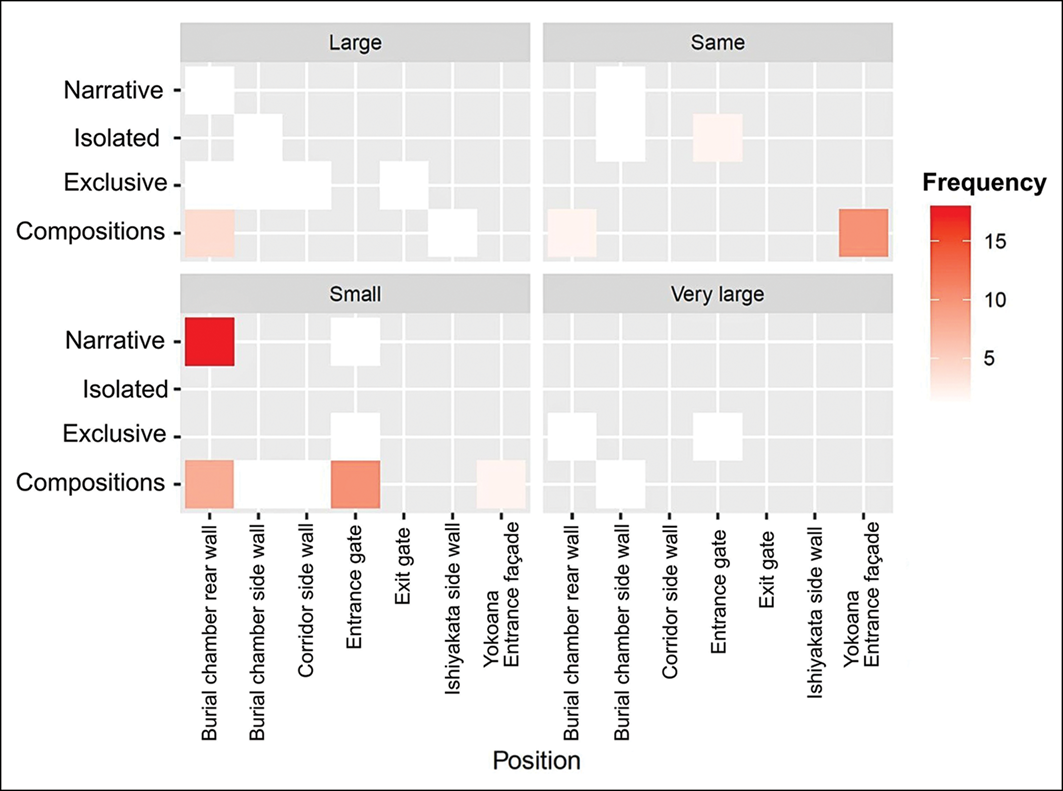
To complete the quantitative analysis, two multivector comparisons were conducted. The first explores the distribution of human figures in relation to their position on the architectural elements, their compositional relationship and their relative dimensions (Figure 2). The results indicate a concentration of ‘narrative – small’ iconography on the rear wall of the burial chamber, and somewhat less frequent positioning of ‘compositions – small’ iconography on both the rear wall and the entrance gates (either for the antechamber or burial chamber) in mural tombs. In the case of rock-cut tombs, a higher frequency of ‘compositions – same size’ iconography is observed on the external façade.
Heatmap showing the distribution of human figures by architectural position, compositional relationship and relative dimension (figure by author).
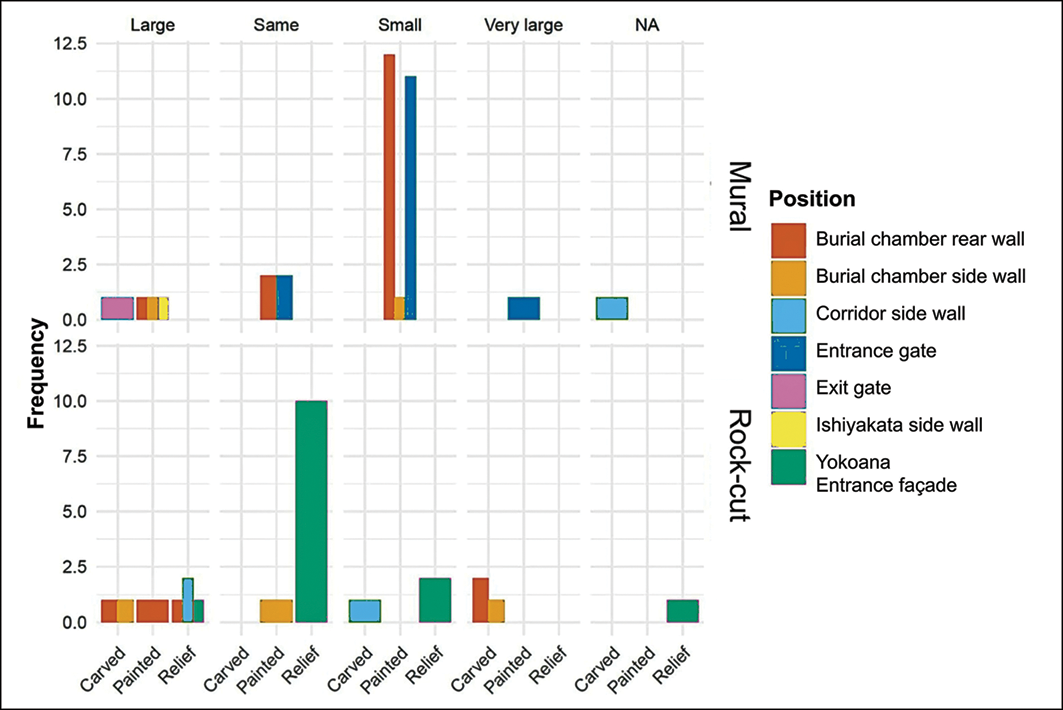
The second comparison cross-references size, position on the architectural element and execution technique. The results are summarised in Figure 3. This reveals a clear prevalence of small painted human figures on the rear wall and entrance gates of the mural tombs, and of comparatively sized or larger figures in relief on the entrance façade of rock-cut tombs.
Grouped bar chart showing human figure frequency by size, architectural position and execution technique (figure by author).
Discussion
Combined quantitative and qualitative analyses of the decorated tombs highlight three key points, visually synthesised in Figure 4: 1) the anthropomorphic figure, when represented alongside other iconographies, typically assumes smaller or equivalent dimensions; 2) human figures are depicted on specific architectural elements of the tomb; and 3) representations lack individual or sexual characteristics.
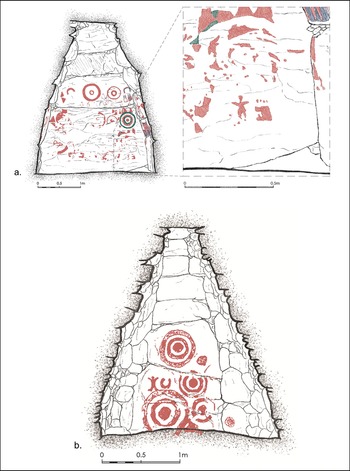
Visual synthesis of core findings: a) hierarchical subordination of human figures relative to geometric motifs in Nakabaru-kitsunezuka tomb passageway (redrawn by architect Mariapia Di Lecce after Tanushimaru-machi Kyōiku Iinkai 2004: 6); b) strategic positioning within specific architectural elements here on the rear wall of Tashiroōta tomb (adapted from the original work by Kusaka Hakkō; © courtesy of the National Museum of Japanese History); c) systematic neutralisation of individual traits here in Nabeta 8 rock-cut tomb façade (Kumamoto-ken Kyōiku Iinkai 1984: 86(8); reproduced with permission). These images exemplify the reduced-equal scale, spatial agency and anonymity that characterise the Kyushu anthropomorphic corpus.

Figure 4 Long description
Panel A: Line drawings of anthropomorphic figures and geometric motifs in Nakabaru-kitsunezuka tomb passageway. The figures are shown in a hierarchical subordination relative to the geometric motifs. Panel B: A detailed depiction of the rear wall of Tashirota tomb, featuring anthropomorphic figures strategically positioned within specific architectural elements. Panel C: Line drawings of anthropomorphic figures on the facade of Nabeta 8 rock-cut tomb, showing systematic neutralization of individual traits.
Visual subordination of the anthropomorphic depiction
Given its generally smaller size compared to other iconographies, the anthropomorphic figure may be seen as a marginal subject within the overall visual strategy. This tendency is evident in mural tombs, where the human figure relates directly to other subjects in compositions and narrative scenes. For instance, in the compositions from the tombs of Nakabaru-kitsunezuka (Figure 5a) and Furuhata (Figure 5b), human figures are notably smaller than the concentric circle motifs. The significance of this observation is demonstrated by the placement of these motifs on the rear wall of the burial chamber, the surface associated with the deposition of the primary deceased (Wada Reference Wada2009; Kawano Reference Kawano2023). In the tomb of Nakabaru-kitsunezuka, the figure is depicted in the lower band of the wall, lacking a central arrangement, and thus proving difficult to identify. Another example is provided by the Ōzuka tomb, where five horses and six associated riders are depicted on the stones of the entrance gate to the burial chamber. The human figures appear considerably smaller than the horses, exhibiting a scale disproportionate to reality. The horses, with their muzzles oriented towards the passage, may represent a form of procession awaiting the transit of the deceased (Yanagisawa Reference Yanagisawa2004: 48–50). Thus, the scale of the depicted figures may not reflect their real-world dimensions but rather their hierarchical or ritual importance within the funerary context.
Human figure (compositions category): a) on the rear wall of Nakabaru-kitsunezuka; b) on the rear wall of Furuhata (images redrawn by architect Mariapia Di Lecce after Tanushimaru-machi Kyōiku Iinkai 2004: 6 and after Ukiha-shi Kyōiku Iinkai 2007: 37, respectively).

Figure 5 Long description
Panel A: A cross-sectional diagram of the rear wall of Nakabaru-kitsunezuka burial chamber. The diagram shows various red human figure compositions and circular patterns. The scale at the bottom indicates measurements in meters. Panel B: A cross-sectional diagram of the rear wall of Furuhata burial chamber. This diagram also displays red human figure compositions and circular patterns. The scale at the bottom indicates measurements in meters.
The same dynamic can be observed in tombs featuring narrative scenes. While human figures are proportioned relative to each other, they remain smaller in scale than—or at most equivalent to—other elements within the scene, particularly the quivers, a prominent motif in these depictions (as noted in the tombs of Gorōyama, Mezurashizuka, Haru and Torifunezuka). For example, in the Mezurashizuka tomb (Figure 6), the scene is dominated by three central quivers, which occupy almost the entire available surface area, while human figures are portrayed on an unnaturally small scale. This scene has been interpreted as a depiction of the journey of the deceased from the world of the living to the world of the dead (Harunari Reference Harunari1999; Shiraishi Reference Shiraishi1999; Tatsumi Reference Tatsumi2011); in this case, the size of the three central quivers may indicate protection for the deceased during the journey.
Human figure (narrative category) in the Mezurashizuka tomb, rear wall (adapted from the original work by Kusaka Hakkō; © courtesy of the National Museum of Japanese History).

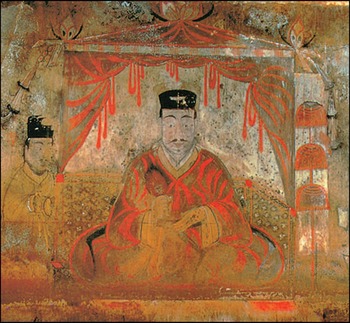
These representational choices suggest the application of a principle of visual hierarchy, potentially echoing the ‘hieratic scale’, wherein the size of an iconographic subject is directly correlated to its symbolic importance. Egyptian Old Kingdom (c. 2700–2200 BC) statues demonstrate the hieratic scale (Robins Reference Robins1994: 39), as does West African art, where the hieratic scale reveals a discernible tension between realism and symbolism, employing altered proportions to emphasise prominent figures and communicate social or religious values and power structures (Pasztory Reference Pasztory1970: 300). This observation contrasts with previous scholarship on Kyushu’s decorated tombs, including the assertion that the human figure held a central commemorative role similar to that recognised in the contemporaneous tombs of the Korean Peninsula (Saitō Reference Saitō1983: 151). In the latter case, human figures not only occupy a central position in the iconographic arrangement but are represented with realistic proportions compared to the other subjects or in accordance with the principles of hieratic scale. Drawing a parallel with the coeval Koguryŏ (37 BC–AD 668) tombs, individuals of noble or higher status were depicted at larger scales than their servants and attendants (cf. Nelson Reference Nelson and Bolger2013; Ahn Reference Ahn2015; Perrin Reference Perrin2016). At the mid-fourth-century Anak Tomb 3 in South Hwanghae Province, for example, the figure of the tomb’s occupant, Dong Shou 동수, is reproduced centrally and dominates the wall, while the attendant figures are smaller (Figure 7).
Mural from Anak Tomb No. 3 depicting the deceased noble (Dong Shou 동수) and attendants, Koguryŏ Kingdom, mid-fourth century AD; note the use of hierarchical scale to denote individual social status (Wikimedia Commons; https://commons.wikimedia.org/wiki/File:Man_-_Anak_Tomb_No._3.jpg).

The situation differs with respect to the human figures positioned on the entrance façade of rock-cut tombs (Figure 8). In these instances, the human figure is depicted with dimensions equivalent to those of other iconographies on the same surface—typically quivers, bows and occasionally boats and horses. In most examples, figures are rendered in the simplified posture with outstretched limbs (大), seemingly interposing themselves symbolically between the entrance and the visitor. In this context, the human figure does not assume a subordinate role but stands alongside the other iconographic subjects, creating a cohesive visual system.
Relief human figure (compositions category) on the entrance façade of the Nabeta 27 rock-cut tomb (photograph by author, drawing from Kumamoto-ken Kyōiku Iinkai 1984: 86(23); reproduced with permission).

The spatial significance and agency of anthropomorphic depictions
The placement of specific iconographies on particular architectural elements contributes to shaping the meaning, function and perception of funerary spaces (Dronfield Reference Dronfield1996; Bradley Reference Bradley1998, Reference Bradley2009; Robin Reference Robin2010, Reference Robin2016, Reference Robin2017; Cummings et al. Reference Cummings and Fowler2014; Robb Reference Robb2015). Iconographic motifs are not neutral; when associated with certain structural components they may acquire agency and symbolic meanings that transcend their visual content. Thus, architectural context is not a neutral canvas; it actively shapes the meaning and agency of the images it contains. For instance, images placed on doorways or thresholds often engage with the concept of a boundary, marking the transition between the world of the living and that of the dead (Robin Reference Robin2010, Reference Robin2016, Reference Robin2017).
Analysis of the decorated Kyushu tombs shows that the anthropomorphic figure is predominantly located on three key architectural elements: the façade surrounding the entrance to rock-cut tombs; the side stones of the entrance gate to the burial chamber; and the rear wall of the burial chamber. Key to reconstructing the agency of these tombs is the question of whether they functioned as ‘open’ or ‘closed’ structures and thus the extent of the audience for their iconography. Unlike the sealed pit tombs of the earlier Kofun period, Kyushu’s decorated tombs were designed for multiple, successive interments, although accessibility was strictly regulated by architecture. In horizontal stone chambers, the restricted internal volume suggests rituals were limited to small groups of approximately four or five adults (based on an average height of 1.60–1.65m; cf. Hudson Reference Hudson2024: 44). While burial chambers could accommodate several standing individuals, the connecting passageways acted as ‘anatomical filters’, necessitating single-file traversal. This design favoured an intimate, serial encounter with the paintings rather than a collective spectacle.
Rock-cut tombs presented a different dynamic. While their internal spaces were similarly limited, their decorated façades were situated in open areas accessible to the broader community. Consequently, these external large-scale iconographies were available for public viewing and provided substantial visual impact.
Each of the three recurrent placements contributes differently to the symbolic construction of the tomb, its ritual environment and the agency of the images. The figures on rock-cut tomb façades primarily serve to ward off harmful external forces. This protective function is consistent with the tombs’ design for multiple, re-openable burials. The consistent sizing of these figures on the façade appears to be both functional and symbolic. An interpretation of these iconographies as guardians at the tomb entrance (Kusaka Reference Kusaka1967: 14) is supported by the symbolic meaning of associated depiction of weapons, also understood as safeguards for the burial (Fujii & Ishiyama Reference Fujii and Ishiyama1979: 19; Saitō Reference Saitō1983: 154, Reference Saitō1989:140; Mori Reference Mori1985: 63; Shiraishi Reference Shiraishi1999: 77; Yanagisawa Reference Yanagisawa2004: 53).
Gates often function as liminal zones: thresholds between two states of being (Robin Reference Robin2010: 447–55). The rear wall, on the other hand, represents the innermost, most sacred area of the tomb, often associated with the deceased’s final placement (Wada Reference Wada2009; Kawano Reference Kawano2023). In Japanese culture and mythology, the entrance corridor (sendō 羨道) is considered the liminal space between this world and the next, the entrance to the antechamber the location where Izanagi encounters his wife, and the rear chamber (genshitsu 玄室) her final resting place (Kawano Reference Kawano2023: 124). While this mythology may help explain spatial layout, such generalisation overlooks the unique peculiarities of the Kyushu tradition. By interpreting these spaces as a ‘decorated stage’ for the ‘seen deceased’ for a returning soul, this approach treats iconography as passive decoration rather than active agency. Crucially, this model fails to account for the systematic anonymity identified in this study: if these motifs were primarily intended to welcome or celebrate the individual deceased, the systematic absence of personal likeness remains unexplained. Shifting the focus from ‘passive decoration’ to ‘active agency’, this study argues that these figures do not merely adorn the architectural space but actively structure its ritual trajectory.
The presence of anthropomorphic figures at these three specific locations thus suggests their role not as portraits or individualised depictions, but as ritual markers of passage: visual elements that accompany or symbolise the transition from life to death. It could be argued that the human figure painted on the rear wall of the burial chamber represents or is associated with the deceased but the lack of individualising features indicates instead that they are part of a broader and more anonymous iconographic system.
The anonymous figure: the absence of distinguishing traits
Analysis of the corpus reveals a strong tendency towards the stylisation of the human figure, with an almost complete absence of anatomical or sexual traits that would suggest individual characterisation. Even in more elaborate contexts, such as the Takehara tomb, the figures lack expressiveness and distinctive physiognomic features. No iconography within the corpus exhibits explicit primary or secondary sexual characteristics, even where the technique adopted would have allowed a more realistic rendering. The Ōzuka tomb is emblematic: while the animals are depicted with remarkable morphological accuracy, including sexual characteristics, the horse riders are stylised and lack physiognomy (Figure 9).
Horses and riders in the Ōzuka tomb. The equestrian figure in detail: horse) height 0.3m, width 0.54m; horse rider) height 0.07m, width 0.07m; groom) height 0.15m, width 0.07m (images redrawn by architect Mariapia Di Lecce after Yanagisawa Reference Yanagisawa2004: 6).

The neutralisation of individualising and sexual traits does not seem to be attributable to stylistic limitations but rather represents an iconographic choice. This approach differs from other contemporaneous figurative systems, such as the tomb paintings of Koguryŏ, where human figures are often characterised by physiognomic details and distinctive clothes, attributable to the identity of the deceased (Nelson Reference Nelson1993; De Benedittis Reference De Benedittis2013; Ahn Reference Ahn2015; Perrin Reference Perrin2016; Kim Reference Kim and Park2020). The deliberate choice of anonymity within Kyushu’s decorated tombs is further illuminated when contrasted with funerary markers. While anthropomorphic haniwa 埴輪 from the Kanto region exhibit high degrees of role-based characterisation—depicting warriors, shamans or even simple human figures with detailed attire and sexual traits—the Kyushu decorated tombs tradition follows a different path. The regional tradition of funerary stone sculptures (sekijin 石人)—though generally more stylised and anonymous than haniwa—also occasionally possess identifiable sexual traits (Figure 10).
Anthropomorphic haniwa (a–c) and sekijin stone statues (d–e), all from the sixth century AD: a) female shaman offering a cup (Gunma; ColBase); b) bearded man (Ibaraki; ColBase); c) female shaman offering a cup (Fukuoka); d) a quiver-shaped human figure (Fukuoka); e) female body (Fukuoka) (c–e, photographs by author).

This tendency toward abstraction reflects a significant shift in funerary ideology. The architectural transition from sealed vertical pits to re-openable horizontal chambers suggests that as rituals moved into the private, sacred space of the tomb, the focus shifted from the social identity of the individual to a sense of ancestral belonging. Within this collective environment, iconography was not intended to function as a portrait. The anonymity of the human figure, therefore, was not a result of stylistic limitation, but a precise ideological choice to express a communal vision of death—one where the deceased was integrated into a collective ancestral body rather than distinguished as an individual.
Conclusions
Examination of the anthropomorphic figures within the decorated tombs of Kyushu reveals a novel and perhaps unexpected role for such iconography, challenging conventional interpretations by demonstrating that the human figure is rarely the central protagonist. This research provides three principal conclusions that reframe our understanding of these depictions.
First, and contrary to expectations, the human figure is cast in a subordinate role within abstract narratives, often secondary to dominant geometric and abstract motifs in mural tombs. Their consistently reduced scale suggests they functioned as minor characters, part of a much grander, abstract narrative. Unlike in the Koguryŏ tradition, where human figures frequently occupy the main walls, Kyushu’s figures are comparatively small, implying a hierarchy where the human form is subordinate to, or merely equal with, other iconographic elements.
Second, the meaning and agency of these figures are intrinsically linked to their deliberate positioning on specific architectural elements. This includes the public-facing façades of rock-cut tombs where they act as guardians and the entrance passage gates marking liminal thresholds or the sacred rear walls of mural tombs where they function as an abstract marker of the final journey of the deceased. This strategic positioning underscores a collective vision of the journey beyond rather than the commemoration of an individual.
Finally, the pre-eminence of anonymity and collective identity is expressed in the rendering of stylised, non-individualised forms, intentionally stripped of personal identity. This confirms that portraiture was not the objective; instead, the emphasis was on a shared, symbolic visual language. As visual images respond to shared cultural patterns (Knight Reference Knight2012: 25–28), the simplification of the human figure in Kyushu tombs did not compromise its meaning, instead it adhered to established stylistic conventions understood by the community. While our instinct may be to seek the individual in the tomb, this research demonstrates that the focus on Kyushu was unequivocally on the community. These simplified figures were not rudimentary; they were conventional, communicating a shared visual language that required no intricate detail for comprehension.
The decorated tombs of Kyushu represent a distinct approach to deathways, one that diverges from traditions where the individual is a central figure. The visual system in these tombs prioritises abstract imagery and a collective vision over personal commemoration. Here, the agency of the anthropomorphic figure is defined not by a specific individual but by its symbolic role as part of a collective narrative. The consistent subordinate scale and anonymous nature of these figures reveal a funerary conception centred on a shared, community-based understanding of the journey beyond death.
Acknowledgements
The author is grateful to Keitarō Sakaguchi, Tōmei Yoshida and Kazutaka Kawano for their essential support during fieldwork. Thanks also go to three anonymous reviewers and Mark Hudson for comments on the manuscript.
Funding statement
This research received no specific grant from any funding agency or from commercial and not-for-profit sectors.






 Open access


