





Policy Significance Statement
Food security, already a concern in lower-middle-income countries such as Nigeria, worsened with the COVID-19 pandemic, forcing decision-makers to weigh uncertain health outcomes against uncertain economic outcomes with limited data to inform choices. In such circumstances, formal and informal insurance mechanisms may offer protection. Our analysis examines whether female participation in a savings group was associated with food security after COVID-19. We find that female savings group membership is associated with improvements in food security, though the strength of the relationship diminishes over time. The analysis does not allow us to establish a causal relationship or rule out selection bias. We argue that better data on the activities of groups and randomized impact evaluations would help policymakers better understand if and how to support savings groups to harness food security-improving potential.
1. Introduction
Poverty and food insecurity remain pervasive in most low-income countries. Nigeria, the largest and fastest growing country in sub-Saharan Africa, is home to over 82 million people living below the national poverty line and 133 million living in multidimensional poverty, a measure which considers health, education, living standards, work, child survival and shocks (NBS, 2022). It is also a country where food insecurity will likely worsen with the combined effects of climate change, recurring conflicts, inflation, and the lasting impacts of the COVID-19 pandemic. In this paper, we ask whether savings groups, a popular system of resource pooling by poor households, can serve as an insurance mechanism in response to food security shocks for vulnerable populations. In the absence of national social safety programs or accessible, competitive, and well-functioning private insurance markets, savings groups are hypothesized to provide an opportunity for individuals and households to diversify risk, especially for women in a particularly gender-unequal country (Para-Mallam, Reference Para-Mallam2017; Dizon et al., Reference Dizon, Gong and Jones2020; Do, Reference Do2023). Our paper tests if this hypothesis holds in Nigeria, in the context of the health and subsequent economic shocks caused by the COVID-19 pandemic.
This study contributes to the literature by examining the relationship between female participation in savings groups and food insecurity in Nigeria. We use data from the 2018 to 2019 in-person general household survey panel (GHS), supported by the Living Standards Measurement Study-Integrated Survey on Agriculture (LSMS-ISA), as our baseline to compare with the outcomes from four phone-based surveys in April, June, August, and November 2020. More specifically, we seek to answer the question: What is the association between savings groups membership and food security during COVID-19?
Aided by four waves of panel data that pre-date and then span the pandemic, and regression analyses, we present evidence of a positive association between female participation in savings groups and food security. Savings groups include both formal and informal schemes, including locally known Adashi, Esusu, or Ajo groups. Importantly, self-selection and specific targeting processes may have contributed to group participation decisions which limit our ability to establish causal impacts. Due to a lack of detail on group characteristics, we are unable to further disaggregate outcomes by group characteristics or functioning. Several African governments, multilateral donors, and foundations already support group-based interventions to improve aspects of women’s economic empowerment (Gash and Odell, Reference Gash and Odell2013; Brody et al., Reference Brody, Hoop, Vojtkova, Warnock, Dunbar, Murthy and Dworkin2017; Gugerty et al., Reference Gugerty, Biscaye and Leigh Anderson2019), including in Nigeria (de Hoop et al., Reference de Hoop, Molotsky, Paek, Castro-Zarzur, Adegbite, Adeoye, Panagoulias, Warren, Bock, Ajayi, Sambo Umar, Aja Obasi and Siwach2022), we argue that as the frequency of “shocks” increases, so does the urgency of understanding the relative impact of these investments on a household’s ability to smooth income. Specifically, given our mixed evidence and weak results, we conclude that additional investments in understanding the particular form and function of savings groups, and longitudinal data on food security are essential to guide how to design, monitor, and evaluate pro-poor projects and programs targeting resilience (World Bank, 2022), and indeed their efficacy relative to alternative policy options.
2. Background: COVID-19, savings groups, and food security in Nigeria
2.1. COVID-19 and food security
There are several factors decreasing food security (Adjognon et al., Reference Adjognon, Bloem and Sanoh2020; Amare et al., Reference Amare, Abay, Tiberti and Chamberlin2021). The most recent pre-COVID-19 panel of Nigeria’s General Household Survey (GHS) reveals falling net consumption per capita, particularly among households experiencing agricultural and other economic shocks. In successive rounds of the survey, “doing nothing” increasingly emerges as the dominant response to shocks, as chosen by 69 percent of affected households in 2018. The COVID-19 pandemic introduced a major health shock to many already asset- and savings-depleted households, with widespread implications for food security (Béné et al., Reference Béné, Bakker, Chavarro, Even, Melo and Sonneveld2021).
During the early phases of the COVID-19 pandemic experts predicted an overall decline in food security due to restrictions in movements, livelihood and income losses, and supply chain disruptions (Elsahoryi et al., Reference Elsahoryi, Al-Sayyed, Odeh, McGrattan and Hammad2020; Laborde et al., Reference Laborde, Martin, Swinnen and Vos2020). Such impacts were expected to hit vulnerable populations particularly hard because they spend a larger proportion of their income on food and have less access to financial markets to absorb income and price shocks.
Indeed, evidence indicates that food security decreased after the start of the pandemic, but that the effects were heterogeneous across populations (Dasgupta and Robinson, Reference Dasgupta and Robinson2021). For instance, Adjognon et al. (Reference Adjognon, Bloem and Sanoh2020) found a relative decrease in food security in urban Mali compared to rural areas between periods before the pandemic (October 2018 to July 2019) and during the pandemic (May and June 2020). A study on the effects and coping mechanisms associated with COVID-19 in Ethiopia, Malawi, Nigeria, and Uganda further suggests that across the four countries, 77 percent experienced income losses with a disproportionate burden for households that were food insecure before the pandemic (Josephson et al., Reference Josephson, Kilic and Michler2021). Data from high-frequency phone surveys implemented as part of the Living Standards Measurement Study—Integrated Survey on Agriculture (LSMS-ISA)—indicate that food security after COVID-19 was particularly low in Nigeria with a longitudinal analysis suggesting that the prevalence of moderate or severe food insecurity increased from 47 percent of the adult population in 2018–2019 to 75 percent in June 2020 (Amankwah and Gourlay, Reference Amankwah and Gourlay2021).
Nigeria implemented several restrictions at the beginning of the pandemic, increasing sharply in mid-March 2020, peaking in May 2020, and slowly declining thereafter. Restrictions included travel limitations, curfews, social distancing, self-isolation, quarantine, and contact tracingcontributing to supply chain disruptions, price increases (Jacobs and Okeke, Reference Jacobs and Okeke2022), and worsening food security over the course of the pandemic (Devereux et al., Reference Devereux, Béné and Hoddinott2020; Mahajan and Tomar, Reference Mahajan and Tomar2021). Nationwide curfews led to the closure of many business operations and reduced opportunities for informal workers (Federal Government of Nigeria (FGN), Abuja, Nigeria, 2020). Dasgupta and Robinson (Reference Dasgupta and Robinson2021) assessed Nigeria to be midway among nine SSA countries on a “stringency of containment measure” index assessed by the Oxford COVID-19 Government Response Tracker (OxCGRT). Amankwah and Gourlay, Reference Amankwah and Gourlay2021 analyze household survey datasets collected during the first few months of the pandemic in Nigeria and found that more than 40 percent of the survey respondents reported losing their jobs as a result of COVID-19. Additionally, 90 percent of Nigerian households reported price increases in July 2020 likely leading to reductions in food expenditures, especially for the poorest households (Amankwah and Gourlay (Reference Amankwah and Gourlay2021). Since the pandemic prices have increased further with Nigeria having recently faced the highest annual inflation in nearly three decades (close to 30 percent) (Iliyasu and Sanusi (Reference Iliyasu and Sanusi2024)).
2.2. Savings groups, shock, and food security in Nigeria
Formal savings groups with established implementation models (e.g., Village Savings and Loan Associations and Savings and Internal Lending Committees), or informal “self-selected groups of individuals who periodically contribute to the shared goal of the group” (Le Polain et al., Reference Le Polain, Sterck and Nyssens2018), are hypothesized to offer mechanisms that might manage risk, reduce poverty and improve food security. These mechanisms largely operate through a pool of savings from multiple households that can provide insurance to cope with unanticipated shocks, or credit to build assets, though groups also include a platform for sharing financial, time, and information resources, collective bargaining power, and social commitment devices (Ligon et al., Reference Ligon, Thomas and Worrall2002; Wahhaj, Reference Wahhaj2010).
Group savings can allow individuals to share risk across households in the same community (Klonner, Reference Klonner2003; Allen and Panetta, Reference Allen and Panetta2010; Dizon et al., Reference Dizon, Gong and Jones2020). A group-based risk strategy is most effective for idiosyncratic shocks, such as an injury to a family member. But even broadly co-variant risks may be effectively managed ex-poste if households vary in the timing and extent of their exposure, both economically and physically, and their ability to withstand the shock. All else equal, the larger and more diverse the number of group members or networked groups, the more likely it is that groups can help members cope. Nonetheless, lengthy or repeated shocks can deplete group savings as a resilience strategy; de Milliano et al. (Reference de Milliano, de Hoop, Holla, Yohun, Mulyampiti, Namisango, Akinola, Natukunda, Okello, Khaoya and Joseph2022) find that between 52 and 65 percent of savings group members in Nigeria and Uganda reported lower personal savings than before the pandemic. Without credit infusions, savings groups members may have to resort to negative coping strategies, such as selling productive assets or reducing health, education, and food expenses Béné, Reference Béné2020. In addition to serving as an ex-post insurance mechanism to cope with unanticipated shocks, such as COVID-19, exposure constant, greater economic security through savings group participation would be expected to reduce vulnerability to a shock and thereby its impact. Steinert et al. (Reference Steinert, Zenker, Filipiak, Movsisyan, Cluver and Shenderovich2018) use a meta-analysis to demonstrate that savings groups have statistically significant effects on poverty reduction, including increases in household expenditures and income, returns from family businesses, and food security. The same meta-analysis suggests reduced program effectiveness for women, however. Nonetheless, if a member’s livelihood is temporarily compromised, income may be smoothed either through access to individual savings or group savings in the form of credit (Karlan et al., Reference Karlan, Savonitto, Thuysbaert and Udry2017; Demont, Reference Demont2022; Walcott et al., Reference Walcott, Schmidt, Kaminsky, Jyoti Singh, Anderson, Desai and de Hoop2023) or transfers from other households (Christian et al., Reference Christian, Kandpal, Palaniswamy and Rao2019; Somville and Vandewalle, Reference Somville and Vandewalle2022).
Participation in savings groups can also lead to asset accumulation and wealth creation, for example through investments in small businesses, (Karlan et al., Reference Karlan, Ratan and Zinman2014) and possibly help people overcome any innate resistance to saving (Steinert et al., Reference Steinert, Zenker, Filipiak, Movsisyan, Cluver and Shenderovich2018). Similarly, if pooled member contributions can compensate for losses, while there is a potential for moral hazard, participation may also allow individuals to take welfare-increasing risks that they would not otherwise (Yesuf and Bluffstone, Reference Yesuf and Bluffstone2009). Some scholars argue that participation in informal savings groups encourages greater economic activity and leads to improved household welfare (Ksoll et al., Reference Ksoll, Lilleør, Lønborg and Rasmussen2016) and higher consumption levels (Le Polain et al., Reference Le Polain, Sterck and Nyssens2018). Lukwa et al. (Reference Lukwa, Odunitan-Wayas, Lambert and Alaba2022) reviewed the recent literature and found that informal savings groups can promote social, economic, and health transformation in sub-Saharan Africa. A recent multi-country study associated lower food security during the pandemic across several sub-Saharan African countries with “female-headed households, the poor, and the less-formally educated,” and those who had to borrow rather than being able to rely on savings (Dasgupta and Robinson, Reference Dasgupta and Robinson2021). Although savings groups cannot eliminate gender discrimination or formal educational deficits, they can lessen the need to borrow in times of crisis (Kansiime et al., Reference Kansiime, Tambo, Mugambi, Bundi, Kara and Owuor2021).
Savings groups, however, are not without their own risks or shortcomings. High interest rates can expose vulnerable borrowers to high levels of indebtedness and the group’s collective savings to an elevated risk of defaults on repayments (Le Polain et al., Reference Le Polain, Sterck and Nyssens2018; Landman and Mthombeni, Reference Landman and Mthombeni2021). Groups unable to access a secure means of storing contributions face increased risks of theft or loss of funds (Lagu, Reference Lagu2023). Such risks are associated with low within-group trust in Nigeria, which may cause higher drop-out rates as evidenced in a longitudinal analysis by Meysonnat et al. (Reference Meysonnat, Wineman, Anderson, Adgebite and de Hoop2022). COVID-19 and the associated restrictions may also affect the functioning and effectiveness of groups (de Hoop et al., Reference de Hoop, Desai, Siwach, Holla, Belyakova, Paul and Jyoti Singh2020; Adegbite et al., Reference Adegbite, Anderson, Chidiac, Dirisu, Grzeslo, Hakspiel, Holla, Janoch, Jafa, Jayram, Majara, Mulyampiti, Namisango, Noble, Onyishi, Panetta, Siwach, Sulaiman, Walcott and de Hoop2022), with social distancing rules, for example, replacing physical meetings with virtual meetings, meeting in smaller numbers, or using different means of communication and/or digital payment technologies. Adegbite et al. (Reference Adegbite, Anderson, Chidiac, Dirisu, Grzeslo, Hakspiel, Holla, Janoch, Jafa, Jayram, Majara, Mulyampiti, Namisango, Noble, Onyishi, Panetta, Siwach, Sulaiman, Walcott and de Hoop2022) provide evidence that although groups had the ability to increase individual resilience of members these changes contributed to negative effects of COVID-19 on group resilience. This accords with Walcott et al. (Reference Walcott, Schmidt, Kaminsky, Jyoti Singh, Anderson, Desai and de Hoop2023) whose evidence synthesis found that covariate shocks can result in negative consequences on group sustainability, despite contributing to individual resilience.
On net, however, survey data in Nigeria reveal a high prevalence of savings groups participation in Nigeria. Both the LSMS-ISA/GHS-2018/19 and the NLPS ask “Does any female member of the household belong to an Adashi/Esusu/Ajo or other savings groups?” Meysonnat et al. (Reference Meysonnat, Wineman, Anderson, Adgebite and de Hoop2022) found that in the GHS sample in 2010, 61 percent of villages in Nigeria reported having a women’s group in 2010, rising to rising to 70% in 2018. The average number of women’s groups has also risen from approximately two to three per village, averaging 22 meetings per year. Savings groups participation has been rising over time from 23% of sampled households in 2010 to 46% in 2018.
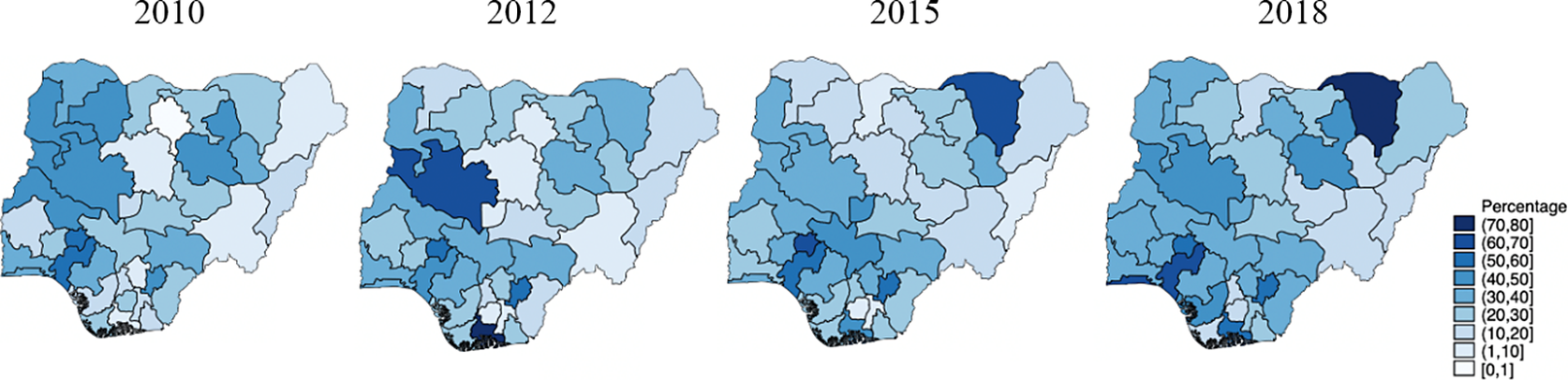
Figure 1 shows that the percentage of households in which at least one female member is in a savings group is larger in the southern zones of Nigeria (in the states of Ebonyi, Enugu, Anambra, Imo, and Abia) than in the north. The higher exposure in the South may be related to greater opportunities women in this region have to socialize outside the home, whereas conventional socio-cultural norms that impose restrictions on women are more prevalent in Nigeria’s northern zones (Desai et al., Reference Desai, Speed and MacLean2018). This sub-regional variation is important as the spatial reach and covariance of climate and food security risks have implications for the most effective scale-up of savings groups, such as across the Government of Nigeria’s investmentsunder the Nigeria for Women Project (de Hoop et al., Reference de Hoop, Molotsky, Paek, Castro-Zarzur, Adegbite, Adeoye, Panagoulias, Warren, Bock, Ajayi, Sambo Umar, Aja Obasi and Siwach2022).
Percentage of households in which at least one female member is in a savings group over space and time.
Source: Meysonnat et al. (Reference Meysonnat, Wineman, Anderson, Adgebite and de Hoop2022) based on data from the Nigeria LSMS-ISA/GHS.
3. Data and methods
3.1. Data sources
We use data from the World Bank’s Living Standards Measurement Study—Integrated Surveys on Agriculture (LSMS-ISA). The LSMS-ISA in Nigeria is collected by the World Bank in collaboration with the Nigerian Bureau of Statistics (NBS). The Nigeria LSMS-ISA, also known as the General Household Survey (GHS), is a panel dataset that focuses on agricultural data, welfare, and socio-economic characteristics conducted through face-to-face interviews. The last available round was conducted through face-to-face interviews in 2018–2019. The data are representative at the national level and of the six geopolitical zones.
During the COVID-19 pandemic, the World Bank continued collecting data using high-frequency phone surveys (Brubaker et al., Reference Brubaker, Kilic and Wollburg2021; Gourlay et al., Reference Gourlay, Kilic, Martuscelli, Wollburg and Zezza2021; Milusheva et al., Reference Milusheva, Lewin, Gomez, Matekenya and Reid2021). In Nigeria, the phone surveys were collected monthly between April 2020 and April 2021 from a random sample of the GHS-Panel in 2018–2019. The phone surveys were sampled to be nationally representative, though because of uneven phone access weights were developed to align with the in-person household survey sample.
We use the LSMS-ISA/GHS-2018/19 survey, the last face-to-face round prior to the pandemic, combined with selected rounds from the National Longitudinal Phone Survey (NLPS) that included specific information on food security. The high-frequency phone surveys included a food insecurity module in round 1 (April–May 2020), round 2 (June 2020), round 4 (August 2020), and round 7 (November 2020). The LSMS-ISA/GHS-2018/19 contains 4975 household observations. Based on the included food insecurity questions, we created a balanced sample for households in the GHS 2018/19, the NLPS rounds 1, 2, 4, and 7. The panel comprises 1811 households.
3.2. Definition of key variables
3.2.1. Outcome variables
Our main outcome variables are indicators of household food security contained within the in-person LSMS-ISA/GHS-2018/19 and the NLPS. These questions are drawn from the Food Insecurity Experience Scale (FIES), an eight-question instrument used by Food and Agricultural Organization (FAO) to produce estimates of the prevalence of food insecurity for SDG target 2.1 (Cafiero et al., Reference Cafiero, Viviani and Nord2018). Several studies have found strong correlations between these questions, confirmed by the three groupings emerging from a principal component analysis (PCA) shown in Supplementary Figure A1. The first group consists of the indicator “went a whole day without food,” which reflects the most severe food insecurity situation. The second group reflects inadequate access to food during the day and consists of the indicators “were hungry but did not eat,” “ran out of food,” and “skipped meals.” The third group includes the indicators “worried about not having enough,” “ate less than you should,” “worried about not having enough,” “unable to eat preferred food,” and “ate only a few kinds of food.” Together, these indicators capture inadequate diet diversity and the mismatch between desired consumption and food availability. We therefore focus the analyses on three indicators of food security that reflect these groupings as identified in the PCA analysis. Hence, in our regression analysis, the key outcomes variables are i) a binary variable taking the value 1 if the household skipped a meal, ii) a binary variable taking the value 1 if the household ate only few kinds of foods, iii) and a binary variable taking the value 1 if the household went a whole day without food.
3.2.2. Savings groups membership
We measure savings groups membership as the participation of at least one female household member in savings groups as queried in the LSMS-ISA/GHS-2018/19 survey and round 4 (August 2020) of the phone surveys. Both the LSMS-ISA/GHS-2018/19 and the NLPS ask “Does any female member of the household belong to an Adashi/Esusu/Ajo or other savings groups?” Savings groups participation was captured only in the fourth round of the NLPS. For our analysis using all rounds of the phone survey, we imputed the round 4 values across the pandemic rounds assuming minimal changes in participation in the relatively short time span between April and November 2020.Footnote 1
While the survey questions on savings groups do not provide information on the nature and functions of the savings groups, previous studies and data from LSMS-ISA/GHS 2018/19 suggest that in Nigeria, savings groups are predominantly rotating savings and credit associations (ROSCA). These ROSCAs allow members to make periodic savings deposits and offer the possibility to borrow up to a certain amount, generally equivalent to the expected total contributions over a given saving cycle. Individuals self-select into these groups, meaning that individuals who participate may systematically differ in unobservable ways not captured by survey questions.
3.2.3. Other variables
The analysis includes several variables used as controls. The variables are measured in the LSMS-ISA/GHS-2018/19 and capture household sociodemographic and economic characteristics- and various community-level characteristics, including infrastructure availability and rainfall patterns and anomalies. Supplementary Table A1 presents more details on the definition and nature of these variables.
3.3. Econometric model and identification strategies
We use two approaches to assess the association between female savings groups membership and food security. The first approach uses a quasi-difference-in-difference analysisFootnote 2 to examine the effect of female savings groups membership on food security. While this approach accounts for time-invariant unobservable characteristics, it assumes negligible movement in and out of savings groups. For these reasons, we also implement an OLS regression analysis.
We first implement a quasi-difference-in-difference analysis, leveraging the panel nature of the data. We assume savings groups membership status in the pre-COVID-19 LSMS-ISA/GHS data as fixed and consider the following specifications:
 $$ {FS}_{ht}={\alpha}_s+{\beta}_1{SG}_{h-2018/19}+\unicode{x03BB} {SG}_{h-2018/19}\ast {T}_t+{Z}_{2018/19}\theta +\gamma {T}_t+{\mu}_h+{\epsilon}_{ht} $$
In this equation, FS denotes our food security indicator. We consider separate models for each of our three food security variables described in sub-Section 3.2. $ {SG}_{h-2018/19} $
is a dummy variable that takes the value of 1 if household h has at least one female member in a saving group in 2018; T is a set of dummy variables capturing the NLPS survey rounds and
$ {SG}_{h-2018/19} $
is a dummy variable that takes the value of 1 if household h has at least one female member in a saving group in 2018; T is a set of dummy variables capturing the NLPS survey rounds and $ \unicode{x03BB} $
is a vector of coefficients capturing the effects of having a female household member in a savings group in 2018/19 on the household’s food security situation during the early months of COVID-19 (these effects are in addition to the potential effects before 2018/2019). This setup allows us to address time-invariant unobservable by comparing the food security situation of households that have at least one female member in a savings group and households with no members in a savings group before and after the onset of the COVID-19 pandemic. A key identifying assumption is that, if the pandemic did not occur, the food security situation of the two groups would have followed the same trend. In addition, the model assumes that savings groups membership had no effects on food security before 2018/2019.
$ \unicode{x03BB} $
is a vector of coefficients capturing the effects of having a female household member in a savings group in 2018/19 on the household’s food security situation during the early months of COVID-19 (these effects are in addition to the potential effects before 2018/2019). This setup allows us to address time-invariant unobservable by comparing the food security situation of households that have at least one female member in a savings group and households with no members in a savings group before and after the onset of the COVID-19 pandemic. A key identifying assumption is that, if the pandemic did not occur, the food security situation of the two groups would have followed the same trend. In addition, the model assumes that savings groups membership had no effects on food security before 2018/2019.
Equation (1) also relies on the assumption that savings groups membership does not change in the post-COVID-19 period. However, we have evidence from the descriptive analysis that this assumption fails. Data from the August 2020 round of the NLPS reveals 13 percent of households joined a savings group for the first time in 2020 and 28 percent of households that were in a savings group in 2018 were no longer in an active group in 2020. This data limitation likely compromises the identification in the quasi-diff-in-diff models. As shown in the result section, the main coefficients were imprecisely estimated. This finding contrasts with theoretical priors and empirical evidence from other contexts that savings groups act as a coping mechanism for households (Walcott et al., Reference Walcott, Schmidt, Kaminsky, Jyoti Singh, Anderson, Desai and de Hoop2023). To further investigate the relationship between savings groups membership and food security, we consider alternative specifications that focus only on assessing the association between savings group membership and food security, acknowledging that these results would not have a causal interpretation. We consider the following regression equation for this alternative approach:
 $$ {FS}_{ht}={\alpha}_s+{\beta}_1{SG}_{ht}+{Z}_{2018/19}\theta +\gamma {T}_t+{\mu}_s+{\epsilon}_{ht} $$
SG is a binary variable that takes the value 1 if at least one female household member is part of a savings group, Z is a set of control variables measured in the LSMS-ISA/GHS-2018/19 survey. The regression equation also includes time and state-fixed effects to control for differential temporal and spatial variation in food security due to unobserved factors.
We are interested in the parameter $ {\beta}_1 $
which captures the association between savings groups membership and food security. We consider and address sources of bias. Reverse causality would affect the estimates if food security were driving households into savings groups or if it limits their ability to participate in savings groups. It is possible that food-secure households are better able to save money and join a savings group. It is also possible that more food-insecure households join a savings group to have additional access to credit, mitigate risk, or create a savings commitment device. To address this issue, we consider a specification that controls for the initial food security situation in 2018/19. Unfortunately, because the savings groups question was not asked on earlier LSMS-ISA/GHS waves, we have only one pre-pandemic observation and cannot explain a household’s initial selection into the group, leaving open the possibility of selection bias in this second model.
$ {\beta}_1 $
which captures the association between savings groups membership and food security. We consider and address sources of bias. Reverse causality would affect the estimates if food security were driving households into savings groups or if it limits their ability to participate in savings groups. It is possible that food-secure households are better able to save money and join a savings group. It is also possible that more food-insecure households join a savings group to have additional access to credit, mitigate risk, or create a savings commitment device. To address this issue, we consider a specification that controls for the initial food security situation in 2018/19. Unfortunately, because the savings groups question was not asked on earlier LSMS-ISA/GHS waves, we have only one pre-pandemic observation and cannot explain a household’s initial selection into the group, leaving open the possibility of selection bias in this second model.
Selection bias on unobservable characteristics arises when the decision to join a savings group is driven by factors that are not measured and that may also explain household food security. Ideally, we could use an instrumental variable that affects savings groups membership and is not correlated with food security to identify and estimate causal effects. However, it is hard to identify a valid instrument given the strong interrelation between household decision-making (including joining a savings group) and well-being (including food security). Instead, we include a rich set of control variables related to the characteristics of the head of household, the gender dynamic related to asset ownership and decision-making within the household, well-being proxied by consumption per-capita, and the characteristics of the community where the household resides. Additionally, we include state fixed-effects ( $ {\mu}_s) $
in the regressions to control for unobserved state characteristics that may potentially be correlated with savings groups membership and food security.
$ {\mu}_s) $
in the regressions to control for unobserved state characteristics that may potentially be correlated with savings groups membership and food security.
Another concern that might bias the estimate of $ {\beta}_1 $
is related to measurement errors in key variables of interest. Savings groups membership is self-reported and subject to error if households do not have the same understanding of what constitutes a savings group. Further, although the LSMS-ISA/GHS and round 4 of the NLPS include questions on savings groups membership, rounds 1, 2, and 7 of the NLPS do not. Instead, in these three rounds, we impute savings groups membership based on the values observed in round 4 of the NLPS. The key assumption underlying this imputation is that there is limited scope for individuals to enroll in, or exit, a savings group in the eightmonths span during the COVID-19 pandemic which was captured in the analysis. However, as discussed above we cannot rule out movement in and out of savings groups given how much variation existed between the LSMS-ISA/GHS round (2018/19) and August (2020), the two observations of savings groups membership status. To address potential bias due to measurement errors in the savings groups variable, we also report the main findings with the sample limited to only the LSMS-ISA/GHS-2018/19 survey and round 4 of the NLPS.
$ {\beta}_1 $
is related to measurement errors in key variables of interest. Savings groups membership is self-reported and subject to error if households do not have the same understanding of what constitutes a savings group. Further, although the LSMS-ISA/GHS and round 4 of the NLPS include questions on savings groups membership, rounds 1, 2, and 7 of the NLPS do not. Instead, in these three rounds, we impute savings groups membership based on the values observed in round 4 of the NLPS. The key assumption underlying this imputation is that there is limited scope for individuals to enroll in, or exit, a savings group in the eightmonths span during the COVID-19 pandemic which was captured in the analysis. However, as discussed above we cannot rule out movement in and out of savings groups given how much variation existed between the LSMS-ISA/GHS round (2018/19) and August (2020), the two observations of savings groups membership status. To address potential bias due to measurement errors in the savings groups variable, we also report the main findings with the sample limited to only the LSMS-ISA/GHS-2018/19 survey and round 4 of the NLPS.
Finally, we run several sub-sample analyses in the second model (Equation 2) to test whether the results differ across various sub-populations. We first compare associations between rural and urban households given that rural households derive their income primarily from agricultural activities while urban household incomes are non-farm based. The motives for saving might also differ, reflecting the differences in household livelihoods and access to credit. In addition, the COVID-19 restrictions and livelihood opportunities differed considerably between rural and urban households. We therefore present a sub-sample analysis by zone, distinguishing the north of Nigeria from the south. There are significant cultural and other contextual differences between the two zones, including gender norms. Finally, using Google mobility data we disaggregate the analyses between areas where the mobility was low (below the median) and relatively high (above the median).
For inference, we cluster the standard errors at the enumeration area level. Both the LSMS-ISA/GHS-2018/19 and the NLPS are designed to be nationally representative. Hence, all regressions are weighted. The World Bank and NBS provided sample weights. The NLPS weights are based on the LSMS-ISA/GHS-2018/19 and adjusted to maintain national representativeness. However, it is possible that the households included in the NLPS differ from excluded households, which if not random, creates a potential source of sample selection bias. For this reason, we further adjust the sample weights using inverse probability weighting, with the probability weights derived as the inverse of the probability of being selected in the first round of the NLPS. This probability was obtained by running a probit regression of a binary variable taking the value 1 if a household in the LSMS-ISA/GHS-2018/19 is selected for the NLPS round 1 on various household characteristics measured in the LSMS-ISA/GHS-2018/19. The results of this probit regression are in Supplementary Table A3 of the Appendix.
4. Results
4.1. Descriptive statistics
In Table 1 we report statistics on the food security of households with a female member in a savings group and households with no female member in a savings group, over time. During the first few months of the COVID-19 pandemic, the food security of all households worsened considerably. In 2018/19, 26 percent of households reported skipping a meal in the 20 days preceding the interview, by April–May 2020, this percentage had risen to 75 percent. Other indicators of food security showed similarly large increases. In August and November 2020, the food security situation improved compared to the situation in April–May 2020, but remained worse than the pre-pandemic situation. Over the same period, climate shocks have also affected agricultural production and food security. In 2018, the Northern states experienced several episodes of low rainfall with 17 percent of rural households reporting droughts that caused crop loss. In the Southern states, flooding affected 11 percent of households. The improvement in food security several months into the COVID-19 pandemic could reflect the mobility restrictions loosening, enabling some households to earn additional income.
Comparing food security of households by savings groups membership over time
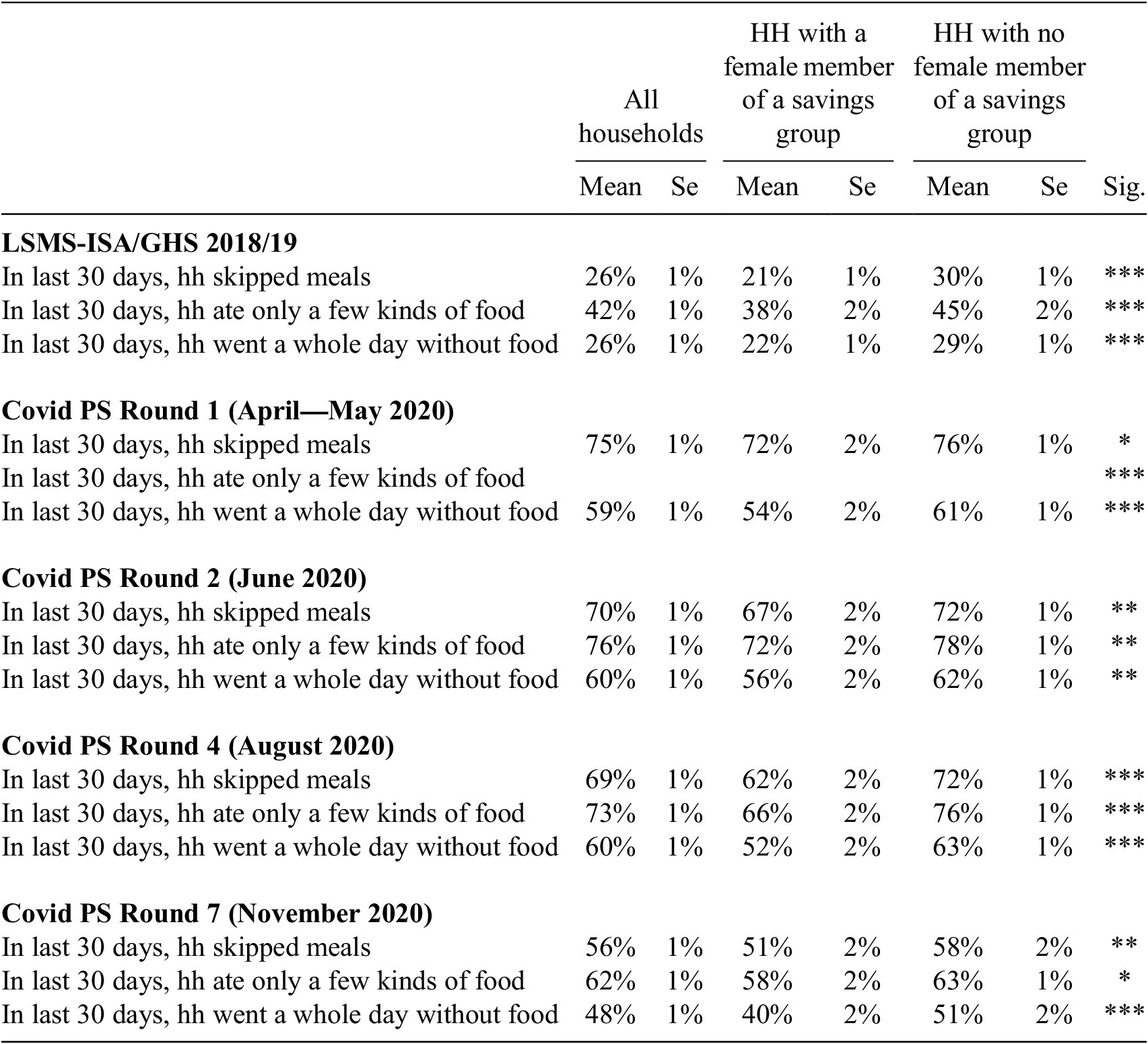
Note. hh = household; *** p < 0.01, ** p < 0.05, * p < 0.1.
Table 2 reports the mean and standard errors for key variables from the LSMS-ISA/GHS-2018/19). The statistics are presented separately for all households, households with a female member in a savings group, and households with no female member in a savings group. The table also reports the results of t-tests comparing the means between the two groups. The descriptive statistics indicate that the food security of households with at least one female member as part of a savings group is significantly better than of households without, with fewer households reporting skipping food, going a whole day without food, or eating fewer kinds of food. There are other significant differences between the two groups of households. Households with a female member in a savings group are larger (6.05 members versus 5.20 members). These households are more likely to reside in a community that has a savings and credit group, has no bank or financial institution, or are not connected to public transportation. In these households, female members are more likely to own a non-farm asset. The heads of these households are less likely to be divorced or widowed.
Descriptive statistics on the main variables used in the analysis in the baseline year
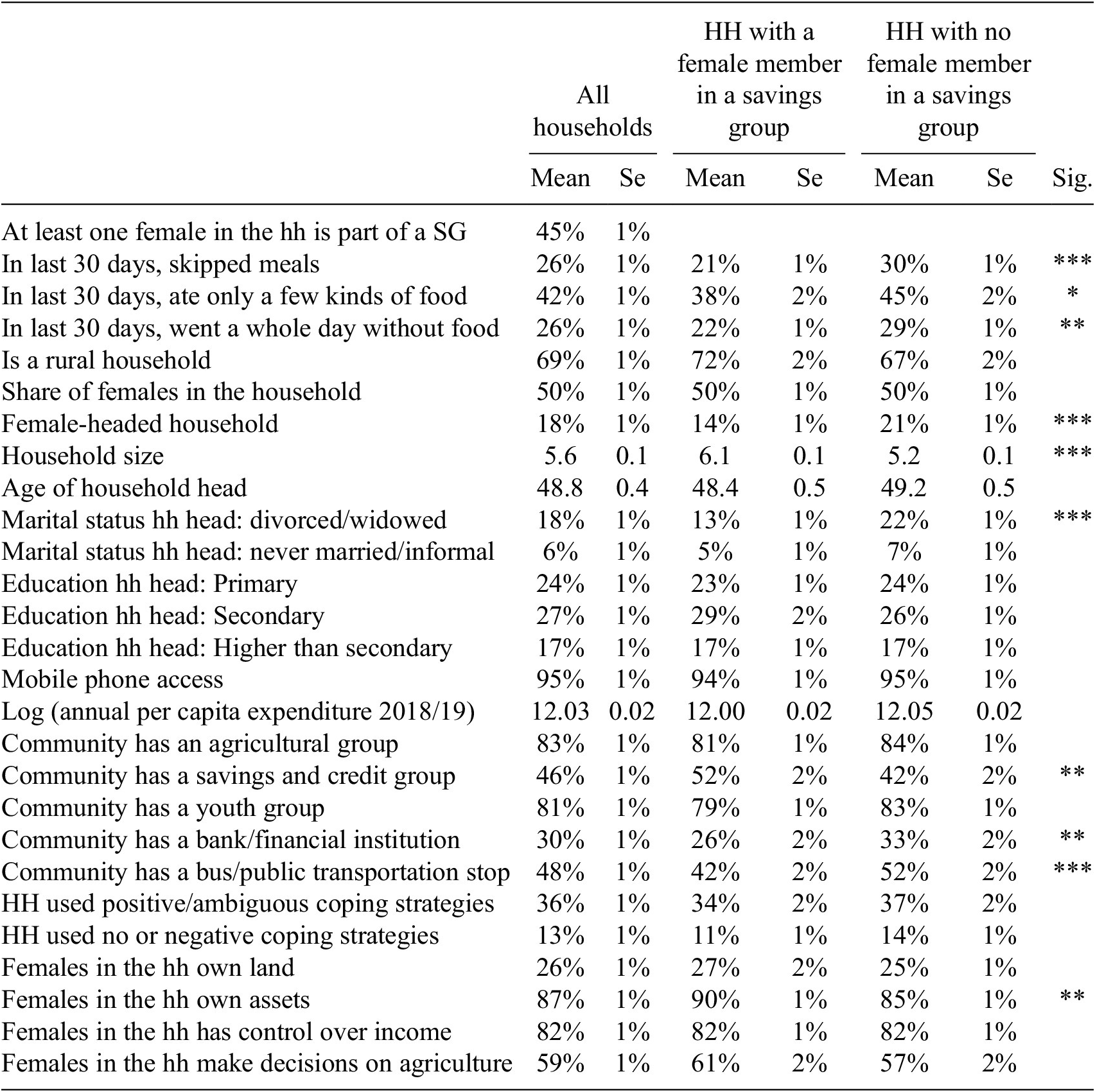
Note. SG = saving group; HH = household; *** p < 0.01, ** p < 0.05, * p < 0.1.
4.2. Quasi-difference-in-difference findings
In Table 3, we report the results from the quasi-difference-in-difference regression where we keep savings groups membership constant, as represented in equation (1). We find that female savings groups membership in 2018/19 significantly reduces the likelihood of a household skipping a meal in the 30 days preceding the survey interview by 10 percent in the first few months of the COVID-19 pandemic. However, the coefficient estimates of our other measures of food security (columns 2 and 3), while negative as expected, are not statistically significant. This result could indicate that the role of savings groups as a coping mechanism for shocks might be less strong than hypothesized.
Quasi-difference-in-difference regression of savings groups membership on food security
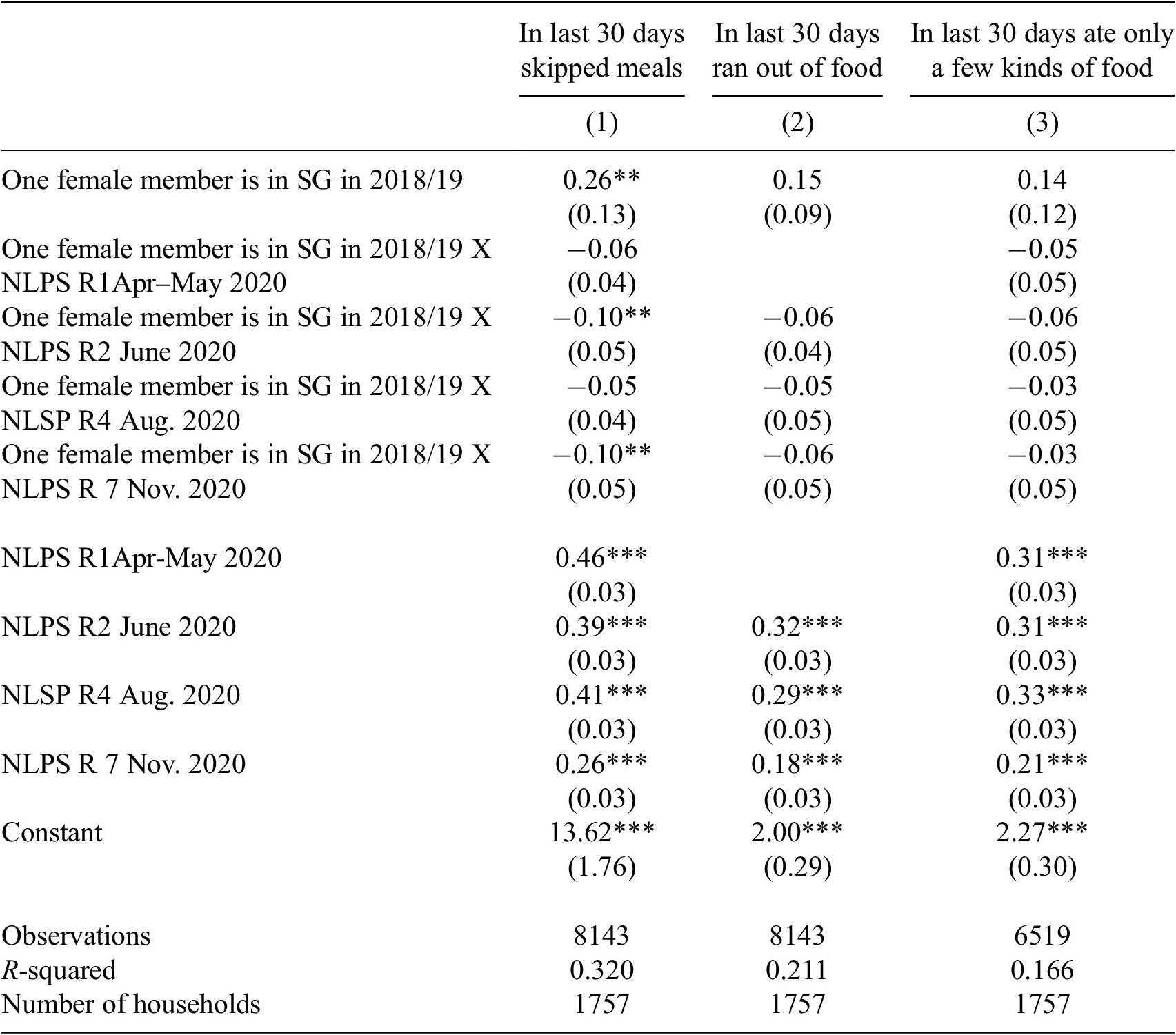
Note. SG = savings groups. NLPS = Nigeria longitudinal panel survey. All regressions are using household fixed effects. The estimates use survey weights adjusted with inverse probability of inclusion in the NLPS. Standard errors are clustered at the enumeration area level. *** p < 0.01, ** p < 0.05, * p < 0.1.
4.3. Association between membership in savings groups and food security
4.3.1. Main OLS regressions
Prompted by our inability to credibly establish causal effects with the quasi-difference-in-difference estimates, we now focus the analysis on exploring potentially interesting correlation patterns. We begin with an OLS estimation of equation (2) which enables us to examine the correlates of food security and household savings groups membership. This analysis is for exploratory purposes and the coefficient estimates do not have a causal interpretation. We address issues that could potentially bias the coefficients of savings groups in later sections. In all models, standard errors are clustered at the enumeration area level. For each outcome variable, we first estimate the most parsimonious model with no covariates and the full model with all covariates including time fixed effects. We find that, across all specifications, household membership in savings groups is strongly correlated with all indicators of food security. The coefficient estimates from the specification with no control variables (columns 1, 3, and 5 of Table 4) drop substantially when adjusting for differences in potential correlates of food security (columns 2, 4, and 6 of Table 4) though they remain statistically significant. Holding households and community characteristics constant and accounting for trends over time, we find that the likelihood of skipping meals, running out of food, and eating only a few kinds of food is 5–6% lower in households with a female member in a savings group.
OLS regression of savings groups membership on household food security
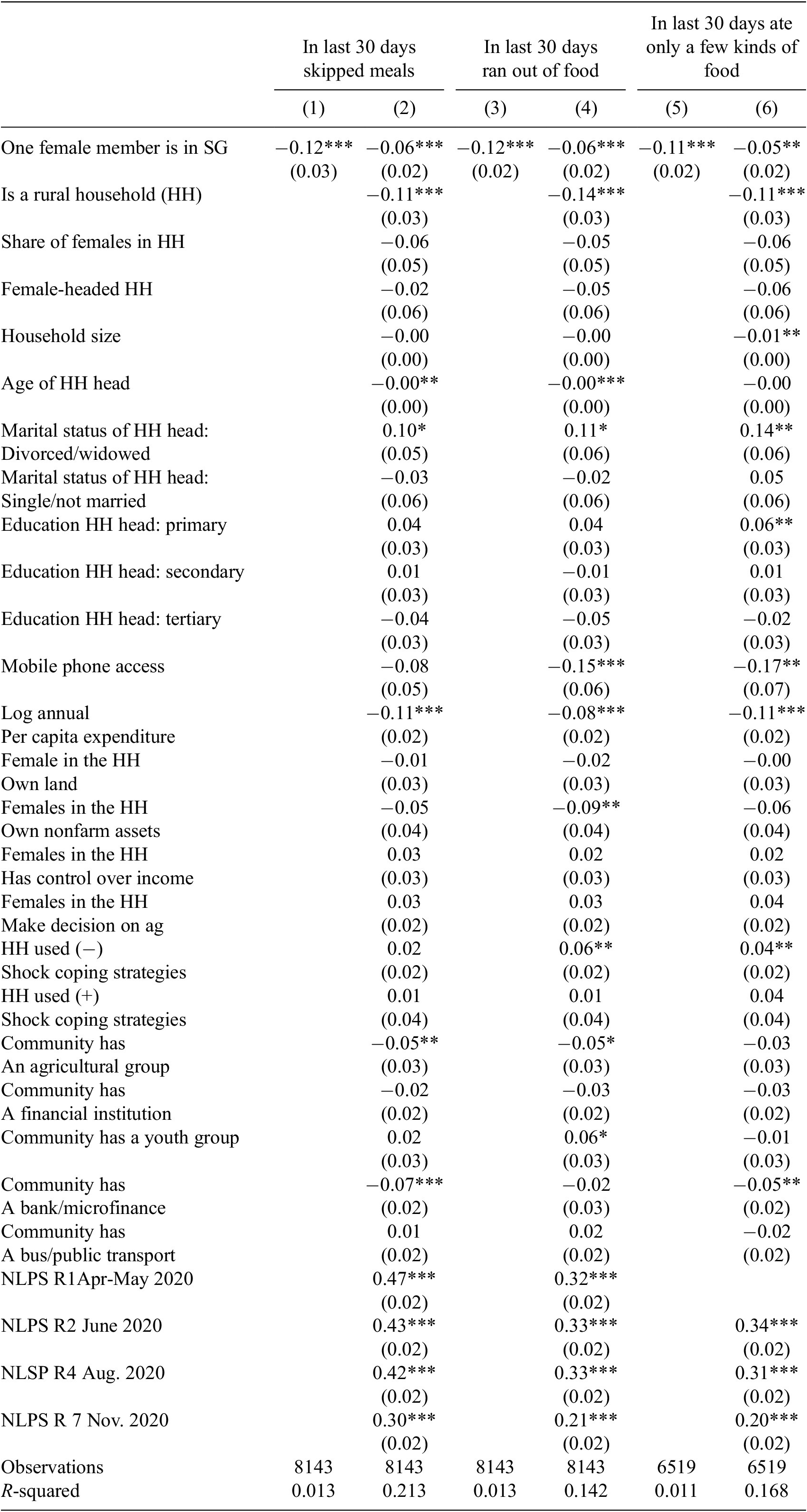
Note. SG = savings groups. NLPS = Nigeria longitudinal panel survey. All regressions presented are based on equation (2) estimated using OLS. All regressions include dummy variables for state fixed effects and a constant term not shown. The estimates use survey weights adjusted with inverse probability of inclusion in the NLPS. Standard errors are clustered at the enumeration area level. *** p < 0.01, ** p < 0.05, * p < 0.1.
Table 4 also shows that several household and community characteristics are correlated with food security, confirming findings from Table 2’s descriptive analyses. Not surprisingly, the food security situation of urban households in Nigeria is much better than for rural households. The regressions indicate that, all else constant, rural households are more likely to experience a deterioration of food security before and during the COVID-19 pandemic. We also find that the probability of being food secure is associated with a decrease in the age of the head of the household. As expected, wealthier households with high consumption per-capita and access to mobile phones have a high probability of being food secure. Households that reside in a community with an agricultural group or a bank or microfinance institution have higher food security. The coefficients of the survey round variables are all statistically significant, with the signs and magnitudes of these variables consistent with a spike in food insecurity in the first round of the NLPS, which corresponds to the first few months of the COVID-19 pandemic.
4.3.2. Addressing issues with the OLS regression
As raised in the identification strategies section, the causal interpretation of the OLS estimates is compromised by several issues that we address as a check on the robustness of the findings.
Using only round 4 of the covid phone survey. The last robustness check of the main findings addresses potential measurement errors in the savings groups membership variables due to imputed values for the NLPS round 1, 2, and 7. We run the same specifications underlying the main findings and the fixed effects regression using only the LSMS-ISA/GHP-2018/19 and the NLSP round 4. The savings groups membership variables, shown in Table 6, have the same negative sign and similar magnitude. The results of the OLS regressions (columns 1, 3, and 5 of Table 6) are close to the OLS estimates in Table 4. Hence, using only the NLPS round for which we have direct measures of household saving group membership does not invalidate the main findings.
Controlling for initial food security status. Table 5 shows an OLS regression with the initial food security situation in 2018/19 included on the right-hand side. For ease of exposition, only the relevant coefficients are shown. We find that the pre-COVID food security situation is a strong predictor of the food security situation during the COVID-19 pandemic. Households who skipped meals in 2018/19 were 72–76 percent more likely to skip meals during the COVID-19 pandemic. Households who ran out of food in 2018/19 were 64–66 percent more likely to also run out of food in 2020. Households who ate only a few kinds of food in 2018/19 were 77–80 percent more likely to also eat a diversified diet in 2020. The table also shows that the association between savings groups membership and food security is negative and statistically significant across all specifications but one (when the outcome is “ate only a few kinds of food” and all covariates are included in the regression). More importantly, the coefficient estimates when the full set of control variables are included in the models and initial food security situation is held constant are similar to the coefficient estimates of the main model. However, we still cannot interpret the effects as causal, and thus maintain caution in interpreting the correlations.
OLS regression of savings groups membership on food security with control for initial food security situation
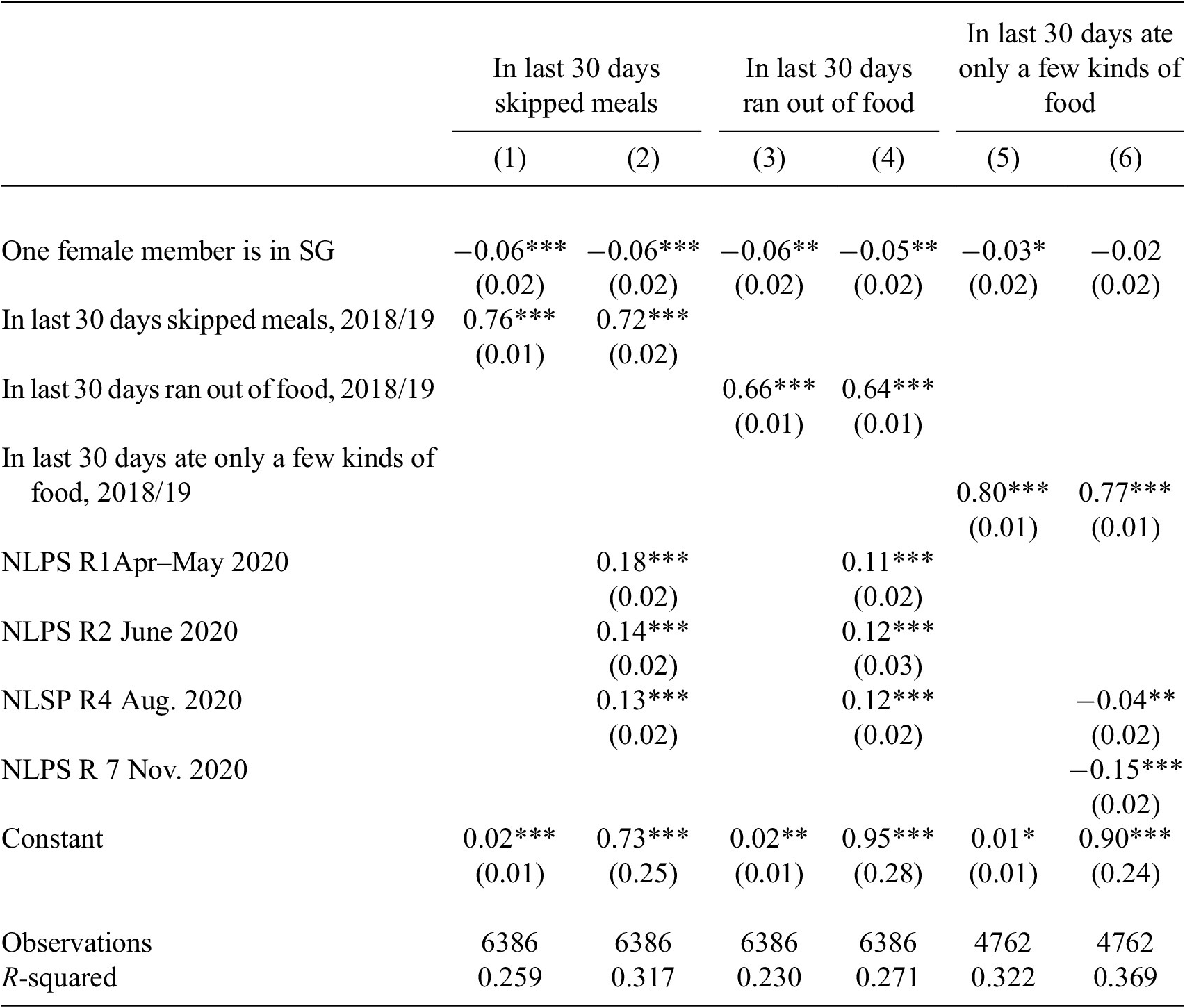
Note. SG = savings groups, HH = household, HHH = head of household and NLPS = Nigeria longitudinal panel survey. All regressions presented are based on equation (2) estimated using OLS. All regressions include dummy variables for state fixed effects and household and community characteristics not shown. The estimates use survey weights adjusted with inverse probability of inclusion in the NLPS. Standard errors are clustered at the household level. *** p < 0.01, ** p < 0.05, * p < 0.1.
OLS and Fixed effects regression of savings groups membership on food security using the LSMS-ISA/GHS-2018/19 and only the NLPS round 4
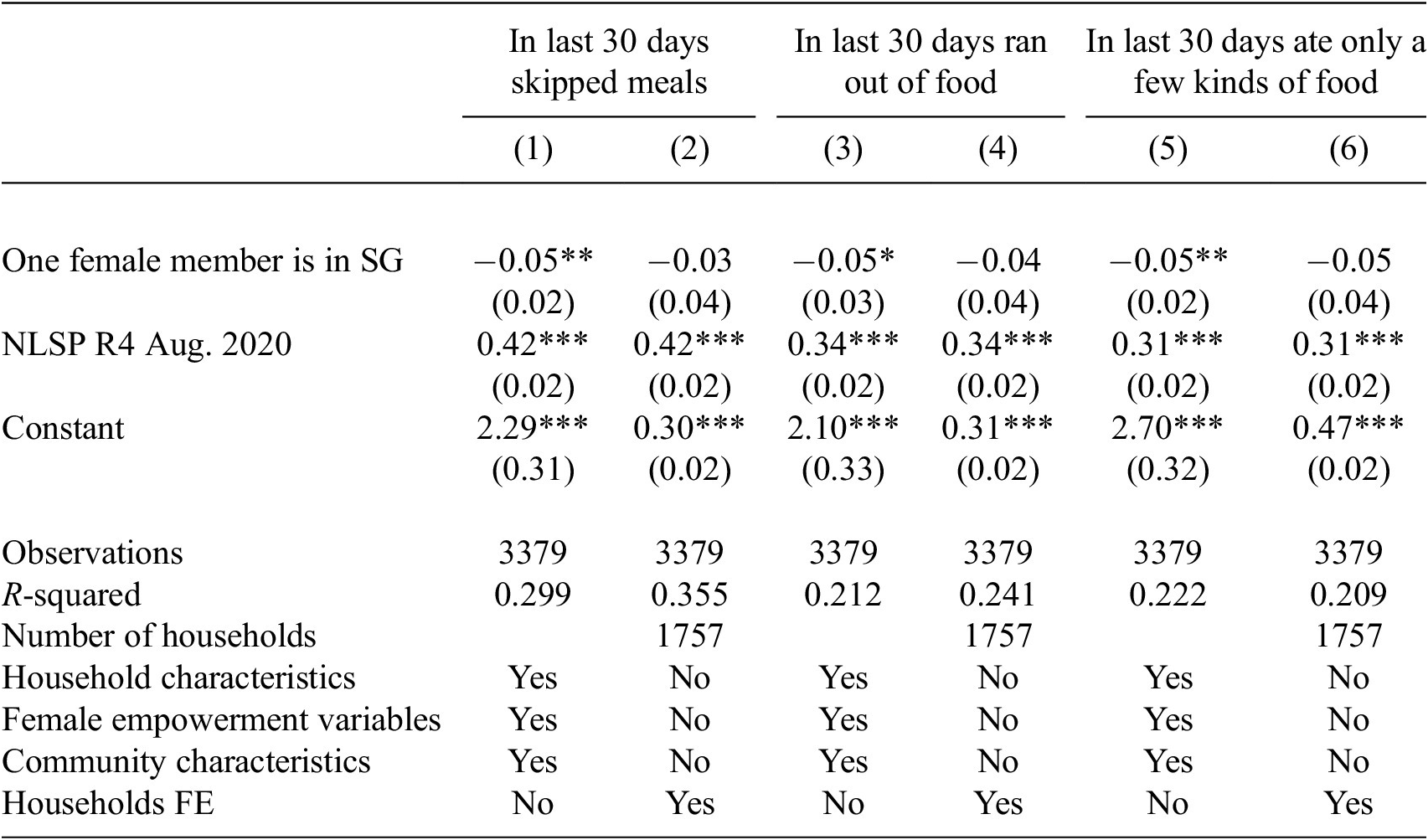
Note. SG = savings groups. NLPS = Nigeria longitudinal panel survey. All regressions presented in are based on equation (2). Coefficients in columns 1, 3, and 5 are estimated using OLS. Coefficients in columns 2, 4, and 6 are estimated using household fixed effects. All regressions include dummy variables for state fixed-effects not shown. The OLS regressions also include household and community characteristics not shown. The estimates use survey weights adjusted with inverse probability of inclusion in the NLPS. Standard errors are clustered at the household level. *** p < 0.01, ** p < 0.05, * p < 0.1.
OLS regressions of savings groups membership on food security in various sub-samples
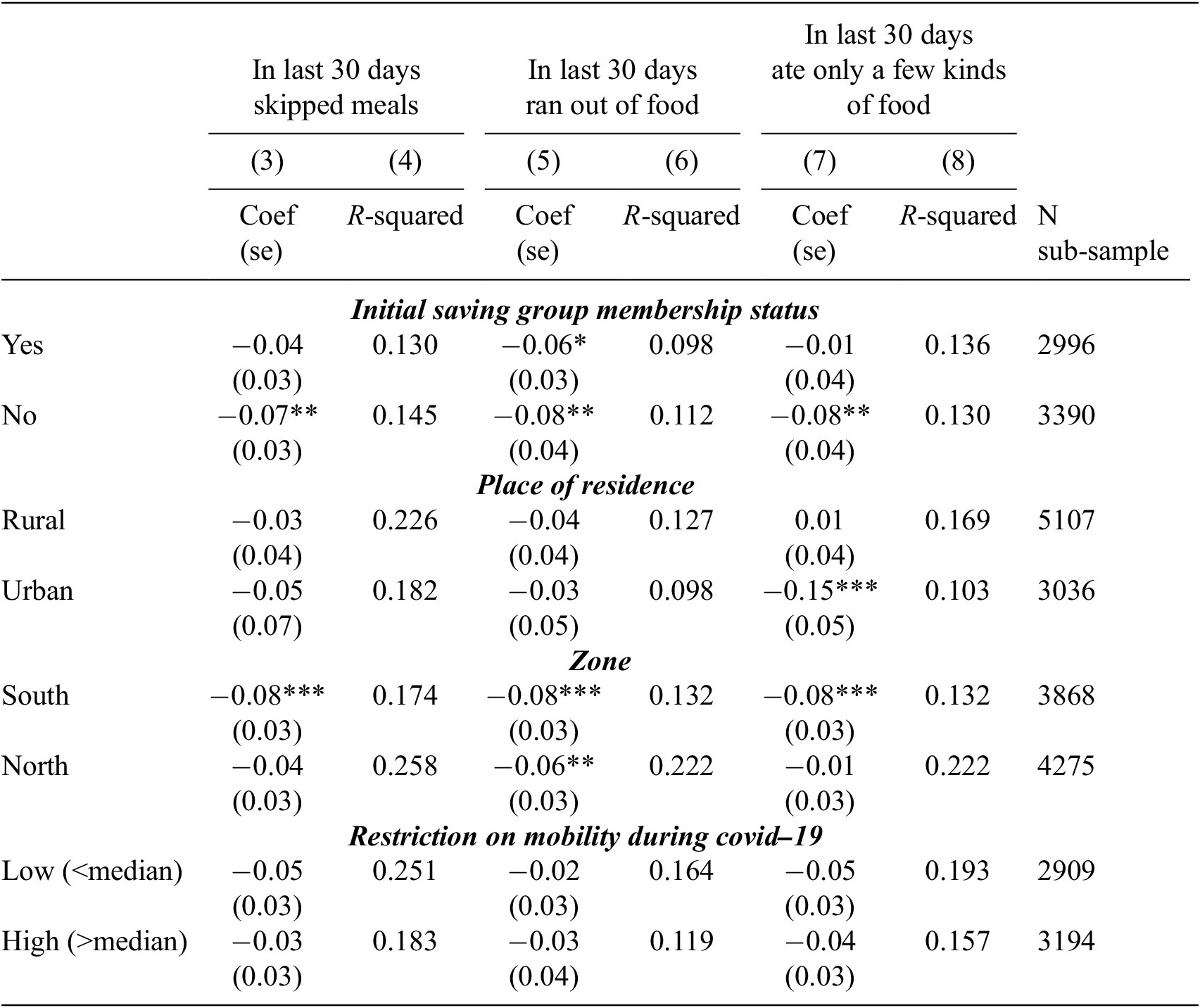
Note. All regressions presented in are based on equation (2) and estimates using OLS. The table only displays the coefficient of savings groups membership, the R-squared, and the sample size. All regressions include dummy variables for state-fixed effects and household and community characteristics. The estimates use survey weights adjusted with inverse probability of inclusion in the NLPS. Standard errors are clustered at the enumeration area level. *** p < 0.01, ** p < 0.05, * p < 0.1.
4.4. Heterogeneity and sub-sample analysis
We have established that household savings groups membership is associated with higher food security during the COVID-19 pandemic though the results cannot be causally interpreted. Next, we explore whether this association differs across sub-populations focusing on the specification described in equation, hence primarily on correlation.
4.4.1. Sub-samples heterogeneities
We run the specification in equation (2) on various sub-samples defined by initial savings groups membership in 2018/19 by residence of the household and the strength of restrictions on mobility induced, directly and indirectly, by the COVID-19 pandemic. Table 7 shows the estimated coefficients of the savings groups variable in OLS regressions of equation (1) on each of these samples. The negative correlation between savings groups membership and food security is large for households who were not part of saving groups in 2018/19 and may have joined a savings group between late 2019 and August 2020. The positive association between savings groups and food security is also stronger in urban areas and in southern zones of Nigeria.
5. Discussion and conclusions
Following the onset of COVID-19, initial assessments predicted that the health impacts of the pandemic and sub-sequent policies would have wide socio-economic consequences. These consequences are expected to be mitigated by the extent of formal and informal insurance schemes or methods of smoothing income and consumption.
The findings of this paper contribute to the growing literature on the impact of COVID-19 shocks on food security in low-income countries, particularly in Nigeria (Amare et al., Reference Amare, Abay, Tiberti and Chamberlin2021; Abay et al., Reference Abay, Amare, Tiberti and Andam2021), but in a potentially unexpected way. To understand the role of savings groups as a potentially mitigating factor, we leveraged the in-person LSMS-ISA/GHS 2018/19 survey and four rounds of follow-up phone surveys in Nigeria. We first examined the trends in household food security before and after the few months on the COVID-19 pandemic. Descriptive analyses suggest that food insecurity spiked in the initial months of the pandemic but decreased later to levels higher than the pre-pandemics levels. This finding is consistent with ex-ante studies projecting a decrease in food security following the pandemics (Laborde et al., Reference Laborde, Martin, Swinnen and Vos2020) and studies conducted after the onset of the pandemics that also found sharp decreases in food security globally (Béné et al., Reference Béné, Bakker, Chavarro, Even, Melo and Sonneveld2021) and in Nigeria (Amare et al., Reference Amare, Abay, Tiberti and Chamberlin2021; Abay et al., Reference Abay, Amare, Tiberti and Andam2021).
We then asked whether membership in savings groups, a form of informal co-insurance mechanism popular in Nigeria, could have mitigated risks to food security over the course of the pandemic. Descriptive analyses show that although food security decreased for all households, the decrease was weaker in households with at least one female member participating in a savings group relative to households without a savings group member. We further investigated the relationship between savings groups membership and food security using regression analyses, controlling for various household and community characteristics, and time and state fixed-effects. We find that households with at least one female member in a savings group are 5–15% less likely to report skipping meals, running out of food, and eating fewer kinds of food. Savings groups membership is also negatively correlated with the overall food security experience scale. We also find that the association between savings groups membership and food security is weaker in rural areas, in the northern states, and when mobility restrictions as a cultural norm or policy responses are less stringent.
Quasi-difference-in-difference analysis to address endogeneity issues provides mixed support to the findings of the correlational analysis. With this set up, we find that having a female household member in a savings group before the pandemics led to a 10% decrease in the risk of skipping meals in the first few months of the pandemics, but no statistically significant effect on other indicators of food security.
Given the common literature citing the benefits of savings groups (Section 2), and the considerable policy attention, including in Nigeria, this single causal effect is of some note (e.g., Lukwa et al., Reference Lukwa, Odunitan-Wayas, Lambert and Alaba2022). However, overall the results only present limited evidence on the effectiveness of savings groups because of data limiting the assessment of causal effects. Additionally, we are unable to establish gender effects, though women’s ability to participate in community groups is generally considered a dimension of women’s empowerment and it is important to explore (Alkire et al., Reference Alkire, Meinzen-Dick, Peterman, Quisumbing, Seymour and Vaz2013; Malapit et al., Reference Malapit, Quisumbing, Meinzen-Dick, Seymour, Martinez, Heckert, Rubin, Vaz and Yount2019).
Our results reflect several data challenges, most notably around gender and mechanisms hypothesized to be particularly important to women. Collecting data on women, that is, collecting individual data rather than household data from a single (usually male) respondent is expensive and requires intentionality. We are only able to address threats to causal identification imperfectly, and remain limited by the observational and non-random nature of our data and the unavailability of a valid instrumental variable. Hence, time-varying unobservable factors may still bias the estimates. We also lack the data to investigate the mechanisms that could potentially be driving the results. Both the LSMS-ISA/GHPS-2018/19 and the different rounds of the NLPS collect limited information on groups. They do not capture group structure and functioning, or other pathways such as information sharing that might affect the effectiveness of groups as informal insurance mechanisms, or if there are unique gender components (Allen and Panetta, Reference Allen and Panetta2010). While there are qualitative works on savings groups in Nigeria, highlighting their heterogeneity across space and time (Adeola et al., Reference Adeola, Adeleye, Muhammed, Olajubu, Oji and Ibelegbu2022), to our best knowledge, there is no publicly available survey dataset that contains variables on saving groups’ characteristics and quantitative estimates of food security. Finally, the short panel (less than a year of data during the pandemic), is insufficient to conclude whether savings groups can contribute to long-term food security when covariate shocks, such as COVID-19 have longer-term consequences (de Milliano et al., Reference de Milliano, de Hoop, Holla, Yohun, Mulyampiti, Namisango, Akinola, Natukunda, Okello, Khaoya and Joseph2022; Sanyal et al., Reference Sanyal, Namisango, Mulyampiti, Akinola, Iskarpatyoti, de Hoop, Yihun, Khaoya, Okello, Natukunda and Tijani2022; Siwach et al., Reference Siwach, de Hoop and Holla2023).
Recent evidence and theoretical priors suggest that integrated social protection programs may achieve larger benefits than stand-alone programs, especially for covariant risks (Bossuroy et al., Reference Bossuroy, Goldstein, Karimou, Karlan, Kazianga, Parienté and Wright2022; de Hoop et al., Reference de Hoop, Molotsky, Paek, Castro-Zarzur, Adegbite, Adeoye, Panagoulias, Warren, Bock, Ajayi, Sambo Umar, Aja Obasi and Siwach2022), though we cannot causally support this. Ultimately for prioritizing policy and investments, it will be important to understand the cost-effectiveness of alternative approaches to improve food security, including nutritional considerations (Kumwenda et al., Reference Kumwenda, Nhlema, Maganga, Rogers, Walton, Boiteau and Webb2015; Cliffer et al., Reference Cliffer, Suri, Langlois, Shen, Nikiema Ouedraogo, Zeba, Lanou, Garanet, Vosti, Walton, Green, Chui, Rosenberg, Webb and Rogers2018; Griswold et al., Reference Griswold, Langlois, Shen, Cliffer, Singh, Potani, Riffenburg, Chatterton, Leppänen, Suri, Chui, Vosti, Walton, Green, Sawi, Koroma, Wegner, Manary, Rosenberg, Webb and Rogers2020). Despite rich household panel data and innovative high-frequency phone surveys, inconsistency across instruments limits confidence in any causal statements on the impact of groups as a mechanism for managing food security risk, and the cost-effectiveness compared to alternatives. Considering the growing probability of increasingly frequent climate and other shocks likely to affect production and prices in Nigeria and other food insecure regions, investing in coordinated data collection efforts and evaluation designs could provide the infrastructure to support more informed evidence-based policy and investments for the future.
Supplementary material
The supplementary material for this article can be found at http://doi.org/10.1017/dap.2025.10007.
Data availability statement
Replication data and code can be found in GitHub at https://github.com/EvansSchoolPolicyAnalysisAndResearch/savings-groups-food-security-D4P.
Acknowledgments
The authors are grateful for the excellent research assistantship by several cohorts of graduate research assistants at the Evans School Policy and Analysis and Research group (EPAR) who have processed and published on GitHub the Stata code processing the LSMS-ISA/GHS datasets used in the analyses of this paper. We also would like to thank Chinmaya Holla, Garima Siwach, and David Seidenfeld who commented on earlier versions of the analysis and the paper.
Author contribution
Conceptualization: C.L.A; D.A; M.M; T.H. Methodology: C.L.A; D.A; Data curation: M.M; M.A,; C.H.; D.A. Formal Analysis: C.L.A; D.A. Writing original draft: C.L.A; D.A; M.M. Writing—Review and Editing: C.L.A; D.A; T.H. Funding Acquisition: C.L.A; T.H. All authors approved the final submitted draft.
Funding statement
This research was supported by grants from the Gates Foundation [INV-043044 and OPP1201417]. The funder had no role in study design, data collection and analysis, decision to publish, or preparation of the manuscript.
Competing interests
The authors declare none.


 Open access


Comments
No Comments have been published for this article.