





Highlight
-
• FL enhances high-discernibility neuromyth discernment, while the native language (NL) benefits low-discernibility myths.
-
• Negative framing amplifies FL advantages in myth identification accuracy.
-
• FL buffers discernment suppression caused by information richness.
-
• Task-dependent language effects reveal context-specific cognitive mechanisms.
-
• Neuromyth susceptibility is modulated by language–task–feature interactions.
1. Introduction
The proliferation of misinformation in the digital age poses a significant challenge across domains ranging from politics and public health to educational neuroscience. A unifying feature of effective misinformation – whether political fake news, health conspiracy theories or educational neuromyths – is its reliance on a “seductive allure.” This appeal often derives from neuroscientific jargon, emotional narratives, alignment with prior beliefs or the sophisticated presentation of artificial intelligence (AI)-generated content that mimics credible information (Kozyreva et al., Reference Kozyreva, Lorenz-Spreen, Herzog, Ecker, Lewandowsky, Hertwig, Ali, Bak-Coleman, Barzilai, Basol, Berinsky, Betsch, Cook, Fazio, Geers, Guess, Huang, Larreguy, Maertens and Wineburg2024; Weisberg et al., Reference Weisberg, Keil, Goodstein, Rawson and Gray2008). Countering such misinformation requires overriding intuitive, heuristic processing to engage in more analytical and critical evaluation (Ecker et al., Reference Ecker, Lewandowsky, Cook, Schmid, Fazio, Brashier, Kendeou, Vraga and Amazeen2022; Lewandowsky et al., Reference Lewandowsky, Ecker, Seifert, Schwarz and Cook2012).
Within education, “neuromyths” – persistent misconceptions that misrepresent neuroscientific findings (e.g., learning styles, left–right brain dichotomies) – exemplify this problem (Bissessar & Youssef, Reference Bissessar and Youssef2021). They are not mere factual errors but are often intuitively appealing and resistant to correction, potentially misdirecting pedagogical practice and resources (Dekker et al., Reference Dekker, Lee, Howard-Jones and Jolles2012; Pashler et al., Reference Pashler, McDaniel, Rohrer and Bjork2008). Furthermore, the evaluation of scientific information often occurs in multilingual contexts. Educators and learners worldwide access scientific information, news and online content not only in their native language (NL) but also in a foreign language (FL), primarily English (Dekker & Kim, Reference Dekker, Kim, Robinson, Yan and Kim2022). This distinction is significant because the Foreign Language Effect (FLe) suggests that using a foreign language can reduce emotional reactivity and increase psychological distance, potentially promoting analytical thinking (Costa et al., Reference Costa, Foucart, Hayakawa, Aparici, Apesteguia, Heafner and Keysar2014; Keysar et al., Reference Keysar, Hayakawa and An2012).
Recent research on language proficiency and misinformation susceptibility reveals complex patterns. Some studies suggest that proficient bilinguals may be less accurate at detecting fake news in an FL, possibly due to reduced sensitivity to truth (Muda et al., Reference Muda, Pennycook, Hamerski and Białek2023). In contrast, other work indicates that bilingualism or higher FL proficiency may enhance information navigation efficiency (Sobotkova et al., Reference Sobotkova, Pointon and Walton2025) and critical evaluation skills (Gura, Reference Gura2025). The effect appears context dependent, influencing beliefs in conflict settings (Erlich et al., Reference Erlich, Aslett, Graham and Tucker2026) and vulnerability to health misinformation (Caramancion, Reference Caramancion2022; Mansour et al., Reference Mansour, Holland, Saucedo, Ramirez, Lane, Salisbury, Marwaha, Fernandez, Allen, Garikiparthy, Rodriguez, Renovato, Land, Belmares and Chacon2024; Schroeder & Chen, Reference Schroeder and Chen2021). Despite this growing interest, it remains unclear how the foreign language effect (Fle) modulates the detection of neuromyths, which are characterized by the specific allure of neuroscientific terminology. It is uncertain whether the analytical processing potentially triggered by an FL helps penetrate this allure, or if the cognitive load associated with FL processing impairs the evaluation of complex scientific claims.
This study investigates the FLe in the context of neuromyth discernment. We utilize neuromyths as a theoretically diagnostic case of science-related misinformation. By examining how NL versus FL processing affects the identification of these myths, this research aims to clarify how linguistic context shapes defenses against misinformation, offering implications for education and digital literacy in multilingual environments.
2. Literature review
2.1. The overview and influencing factors of neuromyths
Neuromyths, defined by the Organization for Economic Cooperation and Development (OECD) as “misinterpretations of neuroscientific findings that form erroneous educational beliefs,” originate from oversimplification during scientific knowledge dissemination (OECD, 2002). These misconceptions typically retain fragments of scientific facts but distort empirical evidence through cognitive biases in transmission pathways. Characterized by surface-level scientific plausibility yet lacking empirical validation, prevalent neuromyths include (1) the hemispheric dominance myth misrepresenting Sperry’s split-brain research as rigid left/right brain specialization, despite neuroimaging evidence of integrated bilateral processing (Bressler & Menon, Reference Bressler and Menon2010); and (2) the learning styles fallacy erroneously assuming sensory-specific instruction enhances learning, contradicted by meta-analyses showing no significant outcome improvements (Pashler et al., Reference Pashler, McDaniel, Rohrer and Bjork2008). These persistent myths demonstrate how authentic scientific discoveries become distorted when translated into educational practice without rigorous scrutiny (Torrijos-Muelas et al., Reference Torrijos-Muelas, González-Víllora and Bodoque-Osma2021).
Neuromyths are prevalent across educational contexts worldwide (Adiguzel et al., Reference Adiguzel, Potvin, Sarrasin, Vanhoolandt, Corfdir, Japashov, Mansurova, Tsai, Wu, Elmas, Atik-Kara, Kucukkayhan, Zaid, Kouchou, Voulgari, Sy, Sakho, Ng, Charland and Létourneau2025), with consistently high acceptance rates among educators – from Canada and China to Greece and Latin America – particularly regarding learning styles and hemispheric dominance myths (Craig et al., Reference Craig, Wilcox, Makarenko and MacMaster2021; Deligiannidi & Howard-Jones, Reference Deligiannidi and Howard-Jones2015; Zhang et al., Reference Zhang, Jiang, Dang and Zhou2019). Despite intervention attempts through teacher training programs, their effectiveness remains limited due to persistent misconception rates and diverse dissemination pathways rooted in cognitive biases and systemic weakness in scientific communication (Adiguzel et al., Reference Adiguzel, Potvin, Sarrasin, Vanhoolandt, Corfdir, Japashov, Mansurova, Tsai, Wu, Elmas, Atik-Kara, Kucukkayhan, Zaid, Kouchou, Voulgari, Sy, Sakho, Ng, Charland and Létourneau2025; Macdonald et al., Reference Macdonald, Germine, Anderson, Christodoulou and McGrath2017; OECD, 2002).
The formation of neuromyths stems from multidimensional factors, including the oversimplification of complex neuroscientific findings by educators lacking specialized knowledge, leading to distorted interpretations, such as rigid hemispheric dichotomies (Geake, Reference Geake2008; Goswami, Reference Goswami2008). Additionally, the commercialization and public misrepresentation of preliminary research, exemplified by the Mozart effect, enables unverified hypotheses to detach from empirical constraints (Rato et al., Reference Rato, Abreu and Castro-Caldas2013). Moreover, pseudoscientific legitimization through neuroscience terminology and emotional narratives exploits public reverence for scientific authority (Dekker et al., Reference Dekker, Lee, Howard-Jones and Jolles2012; Weisberg et al., Reference Weisberg, Keil, Goodstein, Rawson and Gray2008). Furthermore, systemic gaps in teacher training, where non-academic sources perpetuate misconceptions about neural-behavioral relationships, significantly contribute to the persistence of neuromyths (Hughes et al., Reference Hughes, Sullivan and Gilmore2020; Macdonald et al., Reference Macdonald, Germine, Anderson, Christodoulou and McGrath2017). Broadly speaking, these processes transform nuanced evidence into enduring myths through cognitive biases and systemic vulnerabilities in knowledge translation (Ansari et al., Reference Ansari, De Smedt and Grabner2012; Ferrero et al., Reference Ferrero, Garaizar and Vadillo2016).
2.2. The status of intervention in neuromyth
The development of intervention strategies targeting neuromyths demonstrates increasing diversity, yet their effectiveness remains limited by cognitive inertia and knowledge translation barriers. Current mainstream approaches, such as short-term training, often produce temporary reductions in neuromyth acceptance due to memory decay and behavioral persistence, with significant rebound effects observed within one month (Ruiz-Martin et al., Reference Ruiz-Martin, Portero-Tresserra, Martínez-Molina and Ferrero2022).
Teachers’ cognitive defense mechanisms further undermine interventions, with more than half reinforcing existing beliefs when confronted with conflicting evidence (Newton & Salvi, Reference Newton and Salvi2020). Foundational neuroscience literacy deficits compound these challenges, exemplified by misinterpretations of lifelong plasticity as uniform learning efficiency across lifespan, thereby obscuring early education’s critical importance (Goswami, Reference Goswami2006).
Immersive training offers promising alternatives through cognitive restructuring and experiential learning. Howard-Jones et al. (Reference Howard-Jones, Jay and Galeano2020) demonstrated sustained efficacy using constructivist frames where teachers observed students excelling in contradictory learning modalities, effectively deconstructing the visual-auditory-kinesthetic (VAK) learning style myth with effects persisting after six months. Similarly, Carboni et al. (Reference Carboni, Maiche and Valle-Lisboa2021) found that educators participating in neuroplasticity research developed enhanced critical thinking and neuromyth identification capabilities, though behavioral translation requires further classroom validation. Ultimately, the core challenges lie in balancing resource-intensive deep training against education systems’ practical constraints (Adiguzel et al., Reference Adiguzel, Potvin, Sarrasin, Vanhoolandt, Corfdir, Japashov, Mansurova, Tsai, Wu, Elmas, Atik-Kara, Kucukkayhan, Zaid, Kouchou, Voulgari, Sy, Sakho, Ng, Charland and Létourneau2025). And it necessitates the need to address neuromyth propagation mechanisms to develop contextually resilient interventions that address systemic neuroscience literacy gaps (Liu et al., Reference Liu, Yu, Liu, Li, Feng and Lin2025).
2.3. The overview and moderating factors of the foreign language effect
The FLe, raised by Keysar et al. (Reference Keysar, Hayakawa and An2012), refers to systematic differences in cognition, emotion and decision-making when individuals operate in a non-native language compared to their mother tongue. It fundamentally challenges the traditional view of language as a neutral information carrier (Keysar et al., Reference Keysar, Hayakawa and An2012). Like space or time, language can promote psychological distance, which is conducive to focusing on the context of information to demonstrate its significance (Braida et al., Reference Braida, Rodríguez-Ferreiro and Hernández2023).
Research on related topics has expanded to domains including causal association, self-evaluation, moral judgments and risk assessment. This phenomenon operates through a cognitive-affective decoupling mechanism, whereby FL use reduces emotional activation while enhancing analytical processing, thereby diminishing framing effects and heuristic biases in decision-making contexts (Costa et al., Reference Costa, Foucart, Hayakawa, Aparici, Apesteguia, Heafner and Keysar2014). In moral judgments, FL promotes utilitarian choices by weakening emotional intuitions and strengthening outcome-based calculations, as evidenced in dilemmas like the trolley problem where individuals more readily sacrifice minorities to save majorities (Fernández-Sanz et al., Reference Fernández-Sanz, Romero-Rivas and Rodriguez-Cuadrado2023; Geipel et al., Reference Geipel, Hadjichristidis and Surian2015a; Yavuz et al., Reference Yavuz, Küntay and Brouwer2024). Collectively, these findings demonstrate the significant role of language in restructuring cognitive pathways and judgment processes beyond mere communication functions. Importantly, the FLe attenuates framing effects by reducing emotional arousal in FL contexts, where decision preferences shift based on equivalent information presented as gains versus losses (Costa et al., Reference Costa, Foucart, Hayakawa, Aparici, Apesteguia, Heafner and Keysar2014; Harris et al., Reference Harris, Ayçiçeği and Gleason2003). This suppression of affective responses promotes analytical processing, thereby diminishing reliance on emotional heuristics and enhancing rational decision alignment with expected values.
However, the magnitude of FLe is moderated by contextual and individual factors. External information richness – defined by the detail and logical coherence of task-related information – weakens the FLe in risk decisions when explicit data compensates for FL processing fluency limitations (Costa et al., Reference Costa, Foucart, Hayakawa, Aparici, Apesteguia, Heafner and Keysar2014; Vives et al., Reference Vives, Aparici and Costa2018). Simultaneously, individual differences significantly modulate the effect: late language learners often exhibit stronger FLe due to heightened cognitive load (Al-Khatib & Fletcher, Reference Al-Khatib and Fletcher2019), while advanced proficiency reduces emotional distance and attenuates the effect (Oganian et al., Reference Oganian, Heekeren and Korn2018). Furthermore, cultural frames interact with information richness to reshape cognitive priorities, demonstrating that FLe’s behavioral outcomes are neither universal nor static but dynamically contingent on linguistic, cognitive and cultural variables.
2.4. The dual-process theory of the FLe
The dual-process theory posit that decision-making is guided by both intuitive, emotion-driven processes (System 1) and deliberate-analytic processes (System 2) (Kahneman, Reference Kahneman2011). The FLe has been explained through this framework, whereby FL use simultaneously attenuates emotional reactivity and increases cognitive load, thereby shifting the balance of decision-making from intuition to deliberation (Gawronski et al., Reference Gawronski, Luke, Creighton and Carlston2013; Kahneman, Reference Kahneman2011).
FL use attenuates intuitive emotional processing, thereby weakening the influence of affect-driven intuitions on decision-making. Compared with the NL, emotional resonance in FL contexts is significantly reduced, particularly for negative stimuli, as shown in behavioral and neuroimaging studies (Caldwell-Harris, Reference Caldwell-Harris2015; Wu & Thierry, Reference Wu and Thierry2012). This emotional blunting lowers the perceived immorality of taboo behaviors and increases utilitarian judgments in moral dilemmas, such as the footbridge scenario where FL speakers are more willing to sacrifice one to save many (Geipel et al., Reference Geipel, Hadjichristidis and Surian2015a, Reference Geipel, Hadjichristidis and Surian2015b). It also reduces loss aversion and dampens negativity bias, leading individuals to perceive risks less severely and evaluate potential gains more positively (Hadjichristidis et al., Reference Hadjichristidis, Geipel and Savadori2015; Keysar et al., Reference Keysar, Hayakawa and An2012). Thus, by diminishing the automatic impact of affect, FL contexts encourage more emotionally detached decision outcomes.
At the same time, FL use enhances deliberative cognitive processing by imposing greater cognitive load, which shifts individuals toward analytic strategies. Because FL comprehension generally requires more effort and reduces fluency, individuals engage in slower, more systematic reasoning (Costa et al., Reference Costa, Foucart, Hayakawa, Aparici, Apesteguia, Heafner and Keysar2014). This cognitive demand fosters greater attention to statistical and semantic information while reducing sensitivity to emotional framing (Keysar et al., Reference Keysar, Hayakawa and An2012). Neurocognitive evidence confirms this shift, with increased activation in prefrontal and parietal regions during FL moral judgments (Corey et al., Reference Corey, Hayakawa, Foucart, Aparici, Botella, Costa and Keysar2017). Moreover, processing disfluency heightens attentional engagement and weakens the vividness of moral simulations, contributing to utilitarian tendencies (Dylman & Champoux-Larsson, Reference Dylman and Champoux-Larsson2020). Consequently, deliberation is not merely a byproduct of emotional suppression but is actively strengthened through the cognitive effort required in FL processing.
Finally, the dual-process account highlights that the FLe reflects a dynamic reweighting between intuition and deliberation rather than a simple replacement. Neural evidence shows that FL contexts decrease connectivity in emotion-related regions while strengthening control networks, thereby shifting the balance of decision-making toward rationality (Wu et al., Reference Wu, Liu, Yao, Li and Peng2020). However, this effect is moderated by factors such as proficiency and cultural background: Moderate proficiency tends to amplify the effect, while near-native proficiency diminishes it (Wong & Ng, Reference Wong and Ng2018). Overall, the dual-process perspective suggests that the FLe arises from the combined attenuation of emotion and enhancement of cognition, leading to more rational and outcome-oriented judgments in emotionally salient decisions.
2.5. The present study
Existing research on neuromyths has primarily focused on documenting their prevalence across educational populations and testing short-term interventions (Craig et al., Reference Craig, Wilcox, Makarenko and MacMaster2021; Painemil et al., Reference Painemil, Manquenahuel, Biso and Muñoz2021; Zhang et al., Reference Zhang, Jiang, Dang and Zhou2019). While such studies documented the widespread nature of neuromyths, they largely remain correlational and intervention effects tend to diminish within months (Ferreira & Rodríguez, Reference Ferreira and Rodríguez2022; Howard-Jones et al., Reference Howard-Jones, Jay and Galeano2020; Ruiz-Martin et al., Reference Ruiz-Martin, Portero-Tresserra, Martínez-Molina and Ferrero2022). This persistence may be partly attributed to the intuitive and simplified narratives of neuromyths, which retain a “scientific” veneer and are reinforced in educational practice (Goswami, Reference Goswami2006; Tsang et al., Reference Tsang, Francis and Pavlidou2024). However, most of this work adopts a monolingual perspective, neglecting the potential influence of multilingual contexts.
Yet, although studies of the FLe have yielded important insights into decision-making and moral reasoning (Costa et al., Reference Costa, Foucart, Hayakawa, Aparici, Apesteguia, Heafner and Keysar2014; Keysar et al., Reference Keysar, Hayakawa and An2012), their implications for education remain underexplored. Evidence linking FL use to promotion of analytic thinking (Costa & Sebastián-Gallés, Reference Costa and Sebastián-Gallés2014; Geipel et al., Reference Geipel, Hadjichristidis and Surian2015b; Hadjichristidis et al., Reference Hadjichristidis, Geipel and Savadori2015; Hayakawa et al., Reference Hayakawa, Costa, Foucart and Keysar2016) has not been systematically linked to neuromyth interventions. These interventions continue to rely on knowledge-based or critical thinking approaches (Dersch et al., Reference Dersch, Renkl and Eitel2022; Ruiz-Martin et al., Reference Ruiz-Martin, Portero-Tresserra, Martínez-Molina and Ferrero2022), with little attention to the moderating role of language in information processing (Newton & Salvi, Reference Newton and Salvi2020). Addressing these gaps through a cross-disciplinary integration of FLe and neuromyth research may provide novel theoretical insights and more sustainable strategies for educational practice.
To address these limitations, we propose an experimental approach to examine how language environments, emotional framing (intrinsic factor) and informational support (extrinsic factor) collectively influence neuromyth discernment. This study centers on three research questions: (1) How do language modalities affect decision-making regarding neuromyths of varying discernibility levels? (2) How do emotional frames (positive/negative) modulate perceived credibility of differentially discernible neuromyths? and (3) To what extent does informational scaffolding influence credibility assessments across discernibility levels?
Based on the above theoretical framework, we propose three corresponding hypotheses. Hypothesis 1 predicts that the FLe will enhance discernment of highly discernible neuromyths but that native language processing will facilitate rejection of low-discernibility neuromyths, reflecting the task-dependent nature of analytic engagement. Hypothesis 2 predicts that negative framing will amplify FL-induced discernment advantages relative to positive framing. Hypothesis 3 predicts that informational richness will suppress overall discernment accuracy, while FL processing will partially mitigate this suppression for medium-discernibility neuromyths. Through two interrelated studies employing mixed-design experiments, we systematically examine these mechanisms: Study 1 (Experiment 1) employs a two-factor design comparing three neuromyth types across language conditions; Study 2 (Experiments 2–3) investigates interactions between language environments, emotional framing and informational richness. This approach aims to provide initial experimental evidence on how language context may shape neuromyth discernment and to inform future language-sensitive approaches to neuromyth mitigation.
3. Study 1
3.1. Participants and design
A priori power analysis using G*Power 3.1 software (Faul et al., Reference Faul, Erdfelder, Lang and Buchner2007) determined the minimum sample size for Experiment 1. The results required detecting a large effect size (f = 0.25, α = 0.01, 1 – β = 0.95) and showed a minimum sample of 58 participants.
We controlled participants’ English proficiency to ensure comprehension while preventing FLe attenuation at advanced levels (C1 or higher; Wong & Ng, Reference Wong and Ng2018). It is important to note that the participants were recruited from a homogeneous EFL (English as a FL) background in China. Following the standardized national curriculum, these students typically began formal English instruction around the age of 9 or 10 and utilized English primarily in academic settings (e.g., coursework, examinations) rather than for daily communication. This educational uniformity minimizes the variance in age of acquisition (AoA) and context of use within the sample. Using the LexTALE test (Lemhöfer & Broersma, Reference Lemhöfer and Broersma2012), we screened 614 Mandarin-speaking undergraduates from an eastern Chinese university. According to the Common European Framework of Reference (CEFR), we recruited 208 participants meeting B2 standards (scored between 60 and 80 points) for the formal experiment. The final sample included 110 males and 98 females (M age = 21.59 ± 1.82 years). To isolate the cognitive effects of language processing from the influence of professional experience or domain-specific knowledge, we specifically targeted a non-specialist sample. It should be noted that 92.3% had no formal training in psychology, neuroscience, biology or related fields, and none were in-service teachers. This exclusion criterion ensures that the observed effects are not confounded by ingrained pedagogical beliefs or prior professional exposure to neuromyths. There were no significant differences between the FL and NL groups in terms of gender ( χ 2 = 0.33, p = 0.567, Cramer’s V = 0.040), participation in professional conferences ( χ 2 = 0.08, p = 0.78, Cramer’s V = 0.019) and professional degree/education ( χ 2 = 0.006, p = 0.936, Cramer’s V = 0.006).
Experiment 1 employed a 2 (language modality: native, foreign) × 3 (neuromyth discernibility: high, medium, low) mixed-design to preliminarily investigate individuals’ ability to discern neuromyths across linguistic contexts. Language modality served as a between-subjects factor, while neuromyth discernibility functioned as a within-subjects factor. Dependent variables included discernment accuracy (measured through response scores), cognitive load during experimentation and text comprehensibility ratings. Participants were randomly assigned to native or FL conditions, with gender distribution balanced across groups.
3.2. Materials
To ensure reliability and universality of neuromyth stimuli while minimizing controversial items, the selection followed a five-step protocol:
-
1. Literature-based compilation: Using OECD (2002), Dekker et al. (Reference Dekker, Lee, Howard-Jones and Jolles2012) and Howard-Jones (Reference Howard-Jones2014) as foundational sources, we collected and identified 448 neuromyths through systematic literature review (112 English publications).
-
2. Consolidation and frequency screening: Redundant and repetitive statements were merged into 117 unique items. This study takes the frequency of use of neuromyths in previous research as the criterion for assessing the general recognition of neuromyths in the academic circle. Then, we retained 55 high-frequency neuromyths (≥2 citations in previous studies).
-
3. Cross-linguistic validation: Two native English speakers (fluent in Chinese) and two bilingual neuroscience graduate students performed iterative translation to ensure conceptual equivalence and linguistic precision.
-
4. Discernibility rating: 122 volunteers (59 female) rated items on a 9-point scale (1 = completely true; 9 = completely false). Higher scores indicated greater discernibility (i.e., lower deception potential).
-
5. Stimulus categorization: Using percentile rankings, we selected 7 low-discernibility neuromyths (LN) items (M = 3.34, SD = 1.46; bottom 12%), 7 medium-discernibility neuromyths (MN) items (M = 4.26, SD = 1.16; middle 12%) and 7 high-discernibility neuromyths (HN) items (M = 6.07, SD = 1.65; top 12%). Each item is accompanied by three options: correct, incorrect and I do not know. Participants earn one point for identifying a neuromyth as incorrect and no points are awarded for the other options. To counter response bias, 21 general neuroscience statements were added.
3.3. Measurements
English proficiency. The LexTALE vocabulary test was administered to assess participants’ English proficiency. This validated instrument measures vocabulary knowledge in intermediate-to-advanced second-language learners. Participants judged whether 60 letter strings (40 real words; 20 pseudowords) constituted actual English words. Each correct identification (real word) or rejection (pseudoword) was scored 1 point. The LexTALE index was calculated as [(correct real words/40 × 100) + (correct pseudowords/20 × 100)] / 2. Scores between 60 and 80 indicate B2-level proficiency according to the CEFR, reflecting ability to comprehend complex texts on concrete/abstract topics (Brysbaert et al., Reference Brysbaert, Lagrou and Stevens2017).
Cognitive load. Cognitive load was measured through two self-report dimensions on 9-point scales: (1) Perception of difficulty: Perceived task difficulty (“How difficult do you think the materials reading just now was?”; 1 = very easy, 9 = very hard), validated as sensitive to intrinsic cognitive demands (Sweller et al., Reference Sweller, Van Merrienboer and Paas2019); (2) Mental effort: Mental effort investment (“How much effort did you invest in during the recent judgment task?”; 1 = minimal, 9 = maximal), established as a reliable indicator of germane processing (Van Merrienboer et al., Reference Van Merrienboer, Schuurman, De Croock and Paas2002).
Text comprehensibility. A supplementary 9-point scale item assessed perceived text understanding (“How well did you understand the materials?”; 1 = not at all, 9 = completely), providing contextual interpretation for primary measures.
3.4. Procedure
This study strictly adhered to the ethical principles outlined in the Declaration of Helsinki, with the research protocol approved by the Institutional Review Board of university (Approval No. HR358-2024). Participants first provided written informed consent before completing the LexTALE vocabulary test to assess English proficiency. Those meeting B2 standards of the CEFR were randomly assigned to native or FL conditions.
Prior to formal experimental tasks, participants received and were acquainted with a bilingual glossary containing 23 neuroscience terms identified from stimulus materials by two volunteers without backgrounds in psychology, biology or neuroscience. This familiarization prevented terminology-related comprehension issues in the participants.
In the formal experimental phase, participants evaluated statements related to neuromyths and general neuroscience through the Wenjuanxing platform (www.wjx.cn) in an independent laboratory. The experimental instructions deliberately omitted the term “neuromyth” to prevent response bias: “Welcome! You will read general statements about the brain. Please judge each as ‘correct,’ ‘incorrect,’ or ‘I don’t know.’” Cognitive load measures and comprehensibility ratings were collected after the evaluation. The procedure lasted for averaged 10–15 minutes, after which participants received pecuniary considerations.
3.5. Results
3.5.1. Relationship of neuromyth discernibility with cognitive processing
Pearson correlation analyses examined relationships between neuromyth discernibility scores and cognitive processing measures. Results revealed that HN scores showed a significant negative correlation with perceived difficulty (r = −0.32, p < .01), indicating easier discernment reduced reading difficulty. MN scores correlated negatively with material comprehensibility (r = −0.21, p < .01) and mental effort (r = −0.17, p < .01), suggesting moderate discernibility enhanced comprehension while reducing cognitive demand. LN scores demonstrated negative correlations with comprehensibility (r = −0.36, p < .01) and mental effort (r = −0.14, p < .05), but a positive correlation with perceived difficulty (r = 0.21, p < .01). These patterns indicate that low discernibility increases cognitive load, impeding comprehension while demanding greater mental effort.
Regarding language effects on cognitive processing, no significant differences emerged between NL and FL conditions for material comprehensibility (M = 6.37, SD = 1.60 versus M = 6.64, SD = 1.27), t(207) = −1.35, p > .05, Cohen’s d = 1.44, or perceived difficulty (M = 4.88, SD = 2.16 versus M = 4.92, SD = 2.08), t(207) = −1.43, p > .05, Cohen’s d = 2.12. However, participants in the FL condition reported significantly greater mental effort investment (M = 7.55, SD = 1.40 versus M = 7.08, SD = 1.43), t(207) = −2.39, p < .05, Cohen’s d = 1.42, indicating elevated cognitive load during FL processing.
3.5.2. Interaction effects of language context on neuromyth discernibility
A two-way repeated-measures ANOVA examined response differences to neuromyths across discernibility levels between language groups. Significant main effects emerged for neuromyth discernibility, F(2, 412) = 888.47, p < .001,
$ {\eta}_{\mathrm{p}}^2 $
 = .81, whereas the main effect for language was non-significant, F(1, 206) = 0.01, p = .94,
$ {\eta}_{\mathrm{p}}^2 $
= .81, whereas the main effect for language was non-significant, F(1, 206) = 0.01, p = .94,
$ {\eta}_{\mathrm{p}}^2 $
 < .01. A significant interaction between discernibility and language was observed, F(2, 412) = 11.89, p < .001,
$ {\eta}_{\mathrm{p}}^2 $
< .01. A significant interaction between discernibility and language was observed, F(2, 412) = 11.89, p < .001,
$ {\eta}_{\mathrm{p}}^2 $
 = .06.
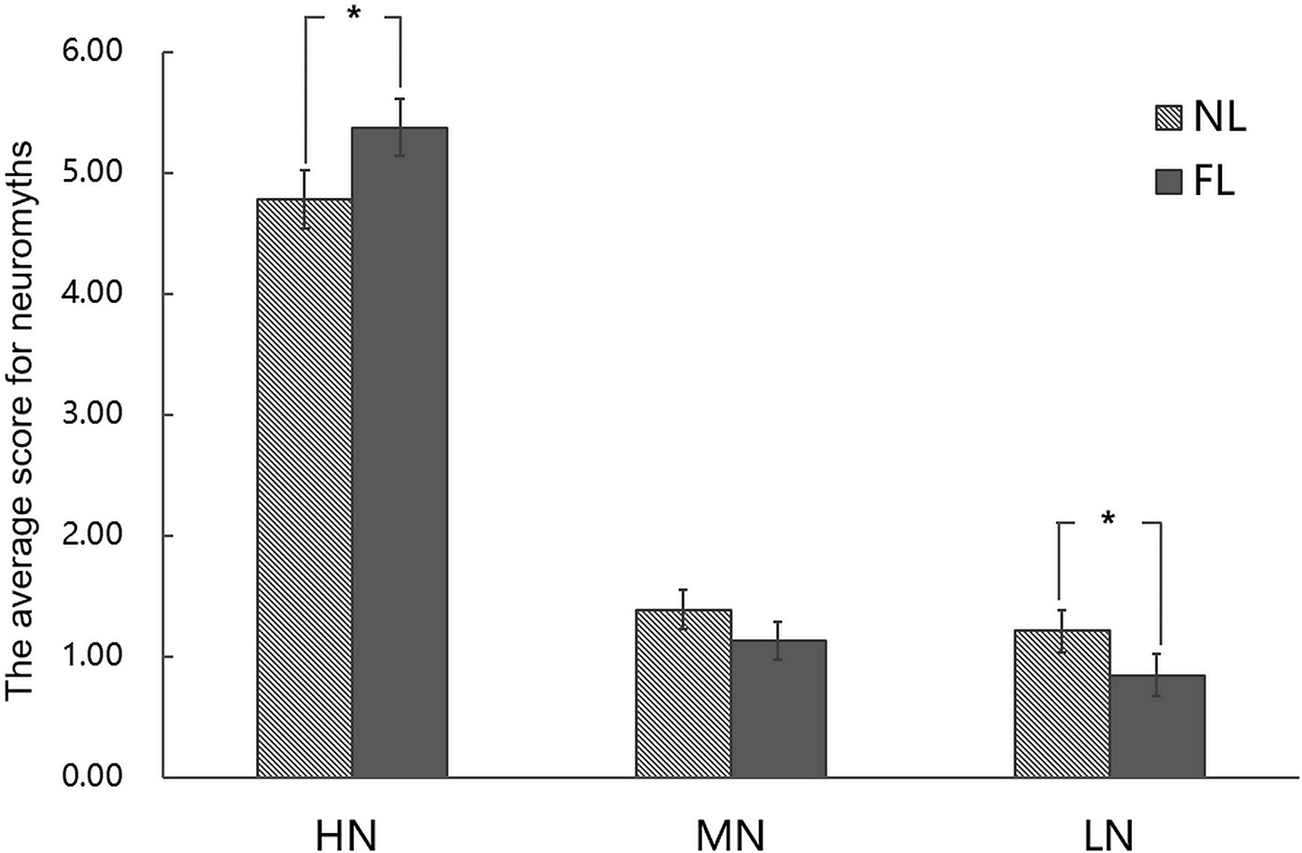
Simple effects analyses revealed that in HN, the FL group (M = 5.38, SD = 0.17) scored significantly higher than the NL group (M = 4.78, SD = 0.17), p < .05(see Figure 1). No significant between-group difference emerged for MN, p = .107. Conversely, for LN, the NL group (M = 1.22, SD = 0.13) outperformed the FL group (M = 0.85, SD = 0.12), p < .05. These findings indicate differential neuromyth discernment patterns across language contexts: NL processing enhanced detection of LN, whereas FL processing facilitated identification of HN.
The scores of the three discernibility neuromyths in different language conditions.

Figure 1. Long description
The vertical y-axis is labeled The average score for neuromyths and ranges from 0.00 to 6.00. The horizontal x-axis contains three categories: H N, M N, and L N. A legend in the top right identifies two conditions: N L represented by diagonal striped bars and F L represented by solid dark gray bars.
* For H N, the N L bar is approximately 4.8 and the F L bar is approximately 5.4. A bracket with an asterisk indicates a significant difference between them.
* For M N, the N L bar is approximately 1.4 and the F L bar is approximately 1.1.
* For L N, the N L bar is approximately 1.2 and the F L bar is approximately 0.8. A bracket with an asterisk indicates a significant difference between them.
All bars include vertical error bars indicating variability.
3.6. Summary
Study 1 examined how foreign-language processing interacts with neuromyth discernibility levels to influence discrimination accuracy (H1). The 2 × 3 mixed-design experiment revealed that foreign-language contexts enhanced accuracy for HN by promoting analytical processing through reduced emotional resonance and increased cognitive deliberation (Kahneman, Reference Kahneman2011; López et al., Reference López, Zhang, Arredondo and Kim2021), supporting H1. Conversely, native-language processing unexpectedly improved accuracy for LN items, suggesting that cumulative cognitive load from foreign-language processing and sequential task presentation may exceed resource capacity during high-deception judgments (Roussel et al., Reference Roussel, Joulia, Tricot and Sweller2017). These findings extend dual-process theory by demonstrating boundary conditions where cognitive fluency overrides foreign-language advantages: When task complexity exhausts cognitive reserves, native-language processing preserves residual resources for systematic evaluation (Costa & Sebastián-Gallés, Reference Costa and Sebastián-Gallés2014). The reliance on questionnaire methodology limited the ability to measure cognitive load precisely during item-by-item processing. Study 2 was designed to address this by examining how emotional framing and external scientific cues interact with language effects. Grounded in dual-process theory, FL use restructures emotional processing and cognitive resource allocation, potentially attenuating emotionally charged neuromyth interference.
4. Study 2
Study 2 used reaction time as a cognitive load proxy by online experimental program. Experiment 2 tests framing-induced biases on neuromyth judgment accuracy and decision confidence across language contexts. Experiment 3 employs neuroimage as scientific authority cues to simulate neuromyth legitimization, assessing whether FL use buffers interference with critical evaluation.
4.1. Experiment 2
4.1.1. Participants and design
The minimum sample size for Experiment 2 was determined using G*Power software (Faul et al., Reference Faul, Erdfelder, Lang and Buchner2007) through an a priori power analysis for between-group differences. Parameter settings (effect size f = 0.25, α = 0.01, power = 0.95) indicated a required minimum of 36 participants to detect large effects.
Following Study 1’s protocol, 200 Mandarin-speaking undergraduates with English as L2 from an Eastern Chinese university were screened, sharing an identical EFL educational history and limited variation in language use contexts. Sixty-five participants meeting CEFR B2 standards were selected (30 males, 35 females; M age = 21.68 ± 1.81 years). It should be noted that 90.8% had no formal training in psychology, neuroscience or biology. There were no significant differences between the FL and NL groups in terms of gender ( χ 2 = 0.01, p = 0.909, Cramer’s V = 0.014), participation in professional conferences ( χ 2 = 0.20, p = 0.658, Cramer’s V = 0.055) and professional degree/education ( χ 2 = 0.002, p = 0.968, Cramer’s V = 0.005).
A 2 (Language: native versus foreign) × 2 (Emotional Framing: positive versus negative) × 3 (Neuromyth Discernibility: high/medium/low) mixed design was implemented. Language served as a between-subjects factor; emotional framing and discernibility as within-subjects factors. Dependent variables included: neuromyth discrimination accuracy, per-trial reaction time, self-reported decision confidence, cognitive load and text comprehensibility. Participants were randomly assigned to language groups with gender balanced across conditions.
4.1.2. Materials
To enable emotional framing manipulation while controlling response duration, Experiment 2 required selection and refinement of neuromyth stimuli from Study 1’s 55 original items. We selected stimuli representing the top 9%, middle 9% and bottom 9% of discernibility scores, yielding 15 items categorized into low (LN: M = 3.30, SD = 1.48), medium (MN: M = 4.30, SD = 1.30) and high discernibility (HN: M = 6.02, SD = 1.68) levels.
Two psychology graduate assistants modified each Chinese statement of neuromyths into the two versions of positive framing (PF) and negative framing (NF) and ensured unambiguous expression. For instance, regarding the neurological myth of water intake, the PF is expressed as: “Adequate water intake (6–8 glasses daily) prevents brain atrophy.” However, the NF is expressed as: “Insufficient water intake (6–8 glasses daily) causes brain atrophy.” This produced 15 equivalent statements about PF and NF, respectively. Ten volunteers rated emotional valence of the 30 statements on a 9-point scale from extremely negative to extremely positive. The result confirmed significant valence differences between PF (M = 7.27, SD = 0.88) and NF (M = 2.47, SD = 1.19), t(28) = 12.56, p < .001, d = 1.05.
Finally, bilingual translation involved two native English speakers proficient in Chinese and two Chinese-English bilingual psychology/neuroscience graduate students. They ensured conceptual equivalence across language versions through forward-backward translation. In addition, 30 general neuroscience statements were included as fillers to balance response patterns.
4.1.3. Measurements
Experiment 2 employed the same measurement methods and tools as in Study 1, namely the LexTALE vocabulary test, cognitive load and text comprehensibility.
4.1.4. Procedure
The experimental procedure commenced with identical initial steps as Study 1. First, participants completed an English vocabulary proficiency assessment and familiarized themselves with 23 specialized neuroscience terms. Subsequently, participants accessed the formal experiment through the Credamo platform (www.credamo.com) in an independent laboratory. During trials, participants judged statement veracity via keyboard responses (with reaction time recorded), followed by immediate self-confidence of answers ratings on a 9-point scale after each judgment. Finally, cognitive load and text comprehension measures were administered. The entire procedure required 10–15 minutes to complete, with all participants receiving monetary compensation upon fulfillment of protocol requirements.
4.1.5. Results
The degree of self-confidence in distinguishing neuromyths
. A repeated-measures ANOVA revealed significant main effects for neuromyth discernibility difficulty (F(2, 126) = 14.00, p < .001,
$ {\eta}_p^2 $
 = 0.18) and framing condition (F(1, 63) = 6.59, p = .013,
$ {\eta}_p^2 $
= 0.18) and framing condition (F(1, 63) = 6.59, p = .013,
$ {\eta}_p^2 $
 = 0.10). The main effect of language was non-significant (F(1, 63) = 0.43, p = .516,
$ {\eta}_p^2 $
= 0.10). The main effect of language was non-significant (F(1, 63) = 0.43, p = .516,
$ {\eta}_p^2 $
 = 0.01). No significant three-way interaction emerged among discernibility difficulty, language and frame condition (F(2, 126) = 2.14, p = .122,
$ {\eta}_p^2 $
= 0.01). No significant three-way interaction emerged among discernibility difficulty, language and frame condition (F(2, 126) = 2.14, p = .122,
$ {\eta}_p^2 $
 = 0.03), nor two-way interactions for framing condition × language (F(1, 63) = 0.01, p = .911,
$ {\eta}_p^2 $
= 0.03), nor two-way interactions for framing condition × language (F(1, 63) = 0.01, p = .911,
$ {\eta}_p^2 $
 < 0.01) or discernibility difficulty × language (F(2, 126) = 0.09, p = .918,
$ {\eta}_p^2 $
< 0.01) or discernibility difficulty × language (F(2, 126) = 0.09, p = .918,
$ {\eta}_p^2 $
 = 0.003).
Critically, a significant discernibility difficulty × framing condition interaction occurred, F(2, 126) = 6.10, p = .003,
$ {\eta}_p^2 $
 = 0.09. Simple effect analyses (see Figure 2A) indicated no significant confidence differences between frame conditions for HN (p = .241) or MN (p = .387). However, for LN, confidence was significantly higher under PF (M = 6.89, SD = 0.17) versus NF (M = 6.48, SD = 0.16), p < .001. These findings suggest that PF enhances metacognitive confidence specifically when evaluating ambiguous neuromyths.
The interaction effects of the three variables on self-confidence (A), the accuracy rate of identifying the neurological myths (B, C), and reaction time (D) in Experiment 2.

Figure 2. Long description
The figure consists of four panels labeled A through D.
Panel A is a bar chart showing the average degree of self-confidence in distinguishing neuromyths on the y-axis from 5.00 to 7.00. The x-axis lists H N, M N, and L N. Light gray bars represent P F and dark gray bars represent N F. In H N and M N, confidence levels are similar between groups. In L N, P F shows a significantly higher confidence level than N F, marked with three asterisks.
Panel B shows the average score for neuromyths on a y-axis from 0.00 to 4.00. The x-axis lists H N, M N, and L N. Light gray bars represent N L and dark gray bars represent F L. Scores decrease from H N to L N. In L N, F L is significantly higher than N L, marked with two asterisks.
Panel C shows the average score for neuromyths on a y-axis from 0.00 to 4.00. The x-axis lists H N, M N, and L N. Light gray bars represent P F and dark gray bars represent N F. In all three categories, N F scores are higher than P F scores, with significant differences marked by one asterisk for H N and three asterisks for M N and L N.
Panel D shows the average discrimination reaction time for neuromyths on a y-axis from 0 to 10,000. The x-axis lists N L and F L. Light gray bars represent P F and dark gray bars represent N F. Reaction times are much higher for F L than N L. Within the F L group, N F has a significantly higher reaction time than P F, marked with three asterisks.
The accuracy of distinguishing neuromyths. In order to investigate the accuracy of the responses of the two groups of participants to different neuromyths under different framing, the two-way repeated measures ANOVA revealed significant main effects of neuromyth discernibility, F(2, 126) = 121.61, p < .001,
$ {\eta}_p^2 $
 = 0.66 and framing type, F(1, 63) = 94.10, p < .001,
$ {\eta}_p^2 $
= 0.66 and framing type, F(1, 63) = 94.10, p < .001,
$ {\eta}_p^2 $
 = 0.60. However, the main effect of language was non-significant, F(1, 63) = 0.35, p = .558,
$ {\eta}_p^2 $
= 0.60. However, the main effect of language was non-significant, F(1, 63) = 0.35, p = .558,
$ {\eta}_p^2 $
 = 0.01. No significant interactions emerged between framing type and language or among all three factors, F(2, 126) = 1.55, p = .216,
$ {\eta}_p^2 $
= 0.01. No significant interactions emerged between framing type and language or among all three factors, F(2, 126) = 1.55, p = .216,
$ {\eta}_p^2 $
 = 0.01.
Significant neuromyth discernibility × language interaction was observed, F(2, 126) = 3.38, p = .037,
$ {\eta}_p^2 $
 = .05. Simple effects analyses (Figure 2B) indicated non-significant differences between language groups for HN and MN (both ps > .05). For LN, the NL group demonstrated significantly lower discernment scores (M = 0.52, SD = 0.11) than the FL group (M = 1.02, SD = 0.11), p = .002, suggesting enhanced LN discernment in FL contexts.
The discernibility × framing interaction reached significance, F(2, 126) = 19.60, p < .001,
$ {\eta}_p^2 $
 = 0.24. Simple effects tests (Figure 2C) showed that NF significantly enhanced discernment across all levels: for HN (M = 3.06, SD = 0.15; M = 3.34, SD = 0.18; p = .027), MN (M = 1.14, SD = 0.16; M = 2.49, SD = 0.16; p < .001) and LN (M = 0.40, SD = 0.09; M = 1.13, SD = 0.09; p < .001). This pattern indicates progressively stronger benefits of NF as neuromyth discernibility decreases.
The reaction time of distinguishing neuromyths. A repeated-measures ANOVA revealed significant main effects for neuromyth discernibility (F(2, 126) = 4.10, p = .019,
$ {\eta}_p^2 $
 = 0.06), framing type (F(1, 63) = 12.02, p < .001,
$ {\eta}_p^2 $
= 0.06), framing type (F(1, 63) = 12.02, p < .001,
$ {\eta}_p^2 $
 = 0.16) and language context (F(1, 63) = 83.37, p < .001,
$ {\eta}_p^2 $
= 0.16) and language context (F(1, 63) = 83.37, p < .001,
$ {\eta}_p^2 $
 = 0.57). The three-way interaction was non-significant (F(2, 126) = 0.44, p = .65,
$ {\eta}_p^2 $
= 0.57). The three-way interaction was non-significant (F(2, 126) = 0.44, p = .65,
$ {\eta}_p^2 $
 = 0.01) as were the discernibility × language (F(2, 126) = 1.66, p = .19,
$ {\eta}_p^2 $
= 0.01) as were the discernibility × language (F(2, 126) = 1.66, p = .19,
$ {\eta}_p^2 $
 = 0.03) and discernibility × framing interactions (F(2, 126) = 2.12, p = .13,
$ {\eta}_p^2 $
= 0.03) and discernibility × framing interactions (F(2, 126) = 2.12, p = .13,
$ {\eta}_p^2 $
 = 0.03).
But the framing × language interaction reached significance (F(1, 63) = 4.05, p = .048,
$ {\eta}_p^2 $
 = 0.06). Simple effects analysis (Figure 2D) showed no framing difference in NL contexts (p = .30). However, in FL contexts, PF elicited significantly faster response times (M = 8,296.26 ms, SD = 417.93) than NF (M = 9,560.76 ms, SD = 480.59; p < .001). This pattern indicates that NF in FL contexts imposes greater cognitive load during neuromyth discernment.
4.2. Experiment 3
4.2.1. Participants and design
Experiment 3 adopted the same a prior power analysis and participant screening procedure as Experiment 2. The calculation results indicated that the appropriate sample size should be at least 36 participants. Following the pattern of Study, 180 Mandarin-speaking undergraduates with English as L2 from an Eastern Chinese university were screened, sharing an identical EFL educational history and limited variation in language use contexts. Sixty-seven participants meeting CEFR B2 proficiency were selected (32 males, 35 females; M age = 21.67 ± 1.79 years). It should be noted that 90.8% had no formal training in psychology, neuroscience or biology. There were no significant differences between the FL and NL groups in terms of gender ( χ 2 = 0.02, p = 0.890, Cramer’s V = 0.017), participation in professional conferences ( χ 2 = 0.02, p = 0.893, Cramer’s V = 0.017) and professional degree/education ( χ 2 = 0.01, p = 0.908, Cramer’s V = 0.014).
A 2 (Language: native versus foreign) × 2 (Information Richness: more versus less) × 3 (Neuromyth Discernibility: high/medium/low) mixed design was implemented. Language served as a between-subjects factor; information richness and discernibility as within-subjects factors. Dependent variables included: neuromyth discrimination accuracy, per-trial reaction time, self-reported decision confidence, cognitive load and text comprehensibility. Participants were randomly assigned to language groups with gender balanced across conditions.
4.2.2. Materials
Experiment 3 builds upon Experiment 2’s finding that NF enhances neuromyth discernment, particularly under high ambiguity conditions. This study specifically examines whether supplementary cognitive stimuli (neuroimages) interfere with the FLe advantage. Given the need to pair neuromyths with neuroimages, we selected 24 items from Study 1’s original 55 neuromyths, representing the top 15%, middle 15% and bottom 15% of discernibility scores. The 12 items each for the two groups of information richness. These were categorized into low (LN: M = 3.46, SD = 1.33), medium (MN: M = 4.25, SD = 1.19) and high ambiguity (HN: M = 5.83, SD = 1.47) levels. All items employed the NF validated in Experiment 2, with emotional valence confirmed through 9-point ratings (1 = “extremely negative” to 9 = “extremely positive”) by 10 psychology students (M = 2.54, SD = 1.06).
For the 12 information-rich neuromyths,we found 36 neuroimages from cognitive neuroscience literature to match, with each neuromyth assigned three potential images. Ten non-specialist volunteers rated text-image relevance on a 9-point scale (1 = “completely irrelevant” to 9 = “completely relevant”), retaining the highest-rated image per neuromyth (M = 8.17, SD = 0.83) as formal external stimuli.
In the Information-Poor (Baseline) condition, the text was presented alone. To ensure consistent visual layout and fixation points across both conditions, a gray placeholder square of the same dimensions was displayed in the position of the image for the Baseline condition (see Figure 3). Thus, the comparison focused on the presence versus absence of neuroscientific visual evidence. To balance response patterns, 24 neuroscience statements (half with neuroimages) were added as fillers. Bilingual equivalence was maintained using the translation protocol established in Experiment 2.
Examples of neuromyth materials with varying levels of information richness. The left represents the materials of information-poor condition under the NL condition (A). The right represents the materials of information-rich condition under the FL condition (B).

4.2.3. Measurements
Experiment 3 employed the same measurement methods and tools as in Study 1, namely the LexTALE vocabulary test, cognitive load, and text comprehensibility.
4.2.4. Procedure
The overall procedure and experimental platform of Experiment 3 were identical to those used in Experiment 2. The entire experiment took approximately 10 to 15 minutes. All participants who completed the experiment received monetary rewards upon task completion.
4.2.5. Results
The degree of self-confidence in distinguishing neuromyths. A repeated-measures analysis of variance was conducted to examine the effects of neuromyth discriminability and information richness on self-confidence levels. The results revealed significant main effects for neuromyth discriminability (F(2, 130) = 13.03, p < .001,
$ {\eta}_p^2 $
 = 0.17) and information richness (F(1, 65) = 28.04, p < .001,
$ {\eta}_p^2 $
= 0.17) and information richness (F(1, 65) = 28.04, p < .001,
$ {\eta}_p^2 $
 = 0.30), while the main effect of language was non-significant (F(1, 65) = 0.63, p = .430,
$ {\eta}_p^2 $
= 0.30), while the main effect of language was non-significant (F(1, 65) = 0.63, p = .430,
$ {\eta}_p^2 $
 = 0.01). Post hoc comparisons with Bonferroni adjustment indicated that confidence levels for LN (M = 6.83, SD = 0.14) were significantly higher than for HN (M = 6.52, SD = 0.15; p = .002) and MN (M = 6.34, SD = 0.16; p < .001). Additionally, confidence was significantly higher under information-rich condition (M = 6.84, SD = 0.16) compared to information-poor condition (M = 6.29, SD = 0.15; p < .001).
No significant interaction effects were observed between neuromyth discriminability and language (F(2, 130) = 0.68, p = .570,
$ {\eta}_p^2 $
 = 0.01), information richness and language (F(1, 65) = 0.58, p = .570,
$ {\eta}_p^2 $
= 0.01), information richness and language (F(1, 65) = 0.58, p = .570,
$ {\eta}_p^2 $
 = 0.005) or neuromyth discriminability and information richness (F(2, 130) = 1.20, p = .304,
$ {\eta}_p^2 $
= 0.005) or neuromyth discriminability and information richness (F(2, 130) = 1.20, p = .304,
$ {\eta}_p^2 $
 = 0.02). The three-way interaction among neuromyth discriminability, information richness and language was also non-significant (F(2, 130) = 0.58, p = .559,
$ {\eta}_p^2 $
= 0.02). The three-way interaction among neuromyth discriminability, information richness and language was also non-significant (F(2, 130) = 0.58, p = .559,
$ {\eta}_p^2 $
 = 0.01). These findings demonstrate that both information richness and discriminability level influence individuals’ confidence in discriminating neuromyths, with higher confidence observed under conditions of greater information richness and lower discriminability.
The accuracy of distinguishing neuromyths. A three-way repeated-measures ANOVA was conducted to examine group differences in responses to neuromyths of varying discernibility across information richness conditions, with accuracy, reaction time and confidence level as dependent variables. For accuracy, significant main effects emerged for neuromyth discernibility (F(2, 130) = 90.22, p < .001,
$ {\eta}_p^2 $
 = 0.58) and information richness (F(1, 65) = 36.82, p < .001,
$ {\eta}_p^2 $
= 0.58) and information richness (F(1, 65) = 36.82, p < .001,
$ {\eta}_p^2 $
 = 0.36). The main effect of language was non-significant (F(1, 65) = 0.002, p = .967,
$ {\eta}_p^2 $
= 0.36). The main effect of language was non-significant (F(1, 65) = 0.002, p = .967,
$ {\eta}_p^2 $
 < 0.01). Non-significant interactions were observed between neuromyth discernibility and language (F(2, 130) = 0.12, p = .886,
$ {\eta}_p^2 $
< 0.01). Non-significant interactions were observed between neuromyth discernibility and language (F(2, 130) = 0.12, p = .886,
$ {\eta}_p^2 $
 = 0.002), information richness and language (F(1, 65) = 0.26, p = .612,
$ {\eta}_p^2 $
= 0.002), information richness and language (F(1, 65) = 0.26, p = .612,
$ {\eta}_p^2 $
 = 0.004) and neuromyth discernibility and information richness (F(2, 130) = 2.98, p = .055,
$ {\eta}_p^2 $
= 0.004) and neuromyth discernibility and information richness (F(2, 130) = 2.98, p = .055,
$ {\eta}_p^2 $
 = 0.04).
A significant three-way interaction emerged among neuromyth discernibility, information richness and language, F(2, 130) = 3.52, p = .032,
$ {\eta}_p^2 $
 = 0.05. Simple-simple effects analyses (Figure 4) revealed that for HN, mean scores were significantly lower under information-rich condition than information-poor condition in both NL contexts (M = 2.00, SD = 0.19 versus M = 2.49, SD = 0.22; p = .031) and FL contexts (M = 1.88, SD = 0.20 versus M = 2.72, SD = 0.23; p < .001). For MN, this pattern held in NL contexts (M = 0.77, SD = 0.15 versus M = 1.40, SD = 0.20; p < .001) but not in FL contexts (p = .875). For LN, mean scores were again significantly lower under information-rich condition in both NL (M = 0.26, SD = 0.11 versus M = 1.03, SD = 0.15; p < .001) and FL contexts (M = 0.28, SD = 0.12 versus M = 1.00, SD = 0.16; p < .001).
The interaction of the three factors: language, discernibility, and information richness.

Figure 4. Long description
The y-axis is labeled The average score for neuromyths and ranges from 0.00 to 3.00. The x-axis contains three primary groups: H N, M N, and L N. Each primary group is divided into two sub-categories. H N contains N L and F L. M N contains N L 2 and F L 2. L N contains N L 3 and F L 3. A legend indicates that hatched bars represent High information richness and solid dark gray bars represent Low information richness.
Data trends from left to right:
- In the H N group, N L shows scores of approximately 2.00 for high richness and 2.50 for low richness. F L shows approximately 1.85 for high richness and 2.75 for low richness.
- In the M N group, N L 2 shows approximately 0.75 for high richness and 1.40 for low richness. F L 2 shows nearly equal scores around 1.00.
- In the L N group, N L 3 shows approximately 0.25 for high richness and 1.05 for low richness. F L 3 shows approximately 0.30 for high richness and 1.00 for low richness.
Statistical significance brackets with asterisks appear above all pairs except F L 2, indicating that low information richness consistently results in higher average scores for neuromyths compared to high information richness across most conditions. Error bars are present on all bars.
Post hoc comparisons further showed that in NL contexts with information-rich condition, HN scores significantly exceeded MN (p < .001) and LN (p < .001), while MN surpassed LN (p < .001). Under information-poor condition in NL contexts, HN scores were significantly higher than both MN (p < .001) and LN (p < .001), though MN and LN did not significantly difference (p = .062). In FL contexts with information-rich condition, HN > MN > LN (all p < .001). Under information-poor condition in FL contexts, HN exceeded both MN (p < .001) and LN (p < .001), but MN and LN were comparable (p = .879).
These findings demonstrate differential effects of language and information richness across discernibility levels. Both language contexts showed elevated scores under information-poor condition for HN and LN. However, for MN, only NL contexts exhibited higher scores with information-poor condition, while FL contexts showed no information richness effect.
The reaction time of distinguishing neuromyths. A three-way repeated-measures ANOVA revealed significant main effects of neuromyth discernibility (F(2, 130) = 5.46, p = .013,
$ {\eta}_p^2 $
 = 0.06), information richness (F(1, 65) = 23.81, p < .001,
$ {\eta}_p^2 $
= 0.06), information richness (F(1, 65) = 23.81, p < .001,
$ {\eta}_p^2 $
 = 0.27), and language context (F(1, 65) = 40.98, p < .001,
$ {\eta}_p^2 $
= 0.27), and language context (F(1, 65) = 40.98, p < .001,
$ {\eta}_p^2 $
 = 0.39). Post hoc analyses indicated significantly faster response times in the NL condition (M = 4639.79 ms, SD = 526.53) compared to the FL condition (M = 9516.78 ms, SD = 550.66; p < .001). MN (M = 7740.13 ms, SD = 496.54) elicited slower responses than both HN (M = 6871.69 ms, SD = 407.43; p = .016) and LN (M = 6623.03 ms, SD = 420.83; p = .009). Lower information richness (M = 6206.11 ms, SD = 472.96) resulted in faster responses than higher information richness (M = 7950.46 ms, SD = 361.14; p < .001).
No significant interactions emerged between neuromyth discernibility and language (F(2, 130) = 0.009, p = .991,
$ {\eta}_p^2 $
 < 0.01), information richness and language (F(1, 65) = 0.16, p = .695,
$ {\eta}_p^2 $
< 0.01), information richness and language (F(1, 65) = 0.16, p = .695,
$ {\eta}_p^2 $
 < 0.01) or discernibility and information richness (F(2, 130) = 0.02, p = .977,
$ {\eta}_p^2 $
< 0.01) or discernibility and information richness (F(2, 130) = 0.02, p = .977,
$ {\eta}_p^2 $
 < 0.01). The three-way interaction was non-significant (F(2, 130) = 2.42, p = .097,
$ {\eta}_p^2 $
< 0.01). The three-way interaction was non-significant (F(2, 130) = 2.42, p = .097,
$ {\eta}_p^2 $
 = 0.04).
4.3. Summary
Study 2 systematically examined how framing effects (Experiment 2) and informational richness (Experiment 3) modulate the language-discernibility interaction established in Study 1. Key findings revealed that NF in foreign-language contexts enhanced discrimination of LN, while framing effects were absent in native-language contexts (supporting H2), consistent with System 1 dominance. The introduction of informational richness demonstrated its detrimental impact on accuracy, particularly for HN and LN, with a significant three-way interaction confirming contextual specificity (H3). Notably, foreign-language processing partially counteracted richness-induced impairments for MN, revealing its dual mechanism: promoting System 2 engagement under low cognitive load but being compromised under high informational load. Unexpected, the result of self-confidence and accuracy emerged dissociations. PF and high informational richness inflated confidence without improving accuracy, indicating metacognitive illusions stemming from fluency heuristics (Alter & Oppenheimer, Reference Alter and Oppenheimer2009). These findings refine dual-process frames by delineating boundary conditions for foreign-language advantages.
5. General discussion
5.1. The effect of language environments, information framing, and richness
This study compared FL (English) and NL (Chinese) contexts in neuromyth discernment across two sub-studies and three experiments, focusing on language, framing effects, and information complexity.
Results indicate that FL contexts enhance detection of highly discernible neuromyths, as the additional decoding demands may encourage more deliberate evaluation, thereby increasing attention to logical inconsistencies (Kahneman, Reference Kahneman2011; Sweller, Reference Sweller1988; Wu & Thierry, Reference Wu and Thierry2013). However, this advantage diminishes under high information complexity, where cognitive load depletes working memory resources (Costa et al., Reference Costa, Vives and Corey2017). In contrast, NL contexts facilitate recognition of less discernible myths through efficient semantic retrieval and knowledge integration (Costa et al., Reference Costa, Foucart, Hayakawa, Aparici, Apesteguia, Heafner and Keysar2014; Simon & Newell, Reference Simon and Newell1971) yet are more vulnerable to heuristic shortcuts and emotional interference, particularly under NF (Caldwell-Harris, Reference Caldwell-Harris2015; Geipel et al., Reference Geipel, Hadjichristidis and Klesse2018).
Emotional processing further differentiates the two contexts: FL use reduces sensitivity to affective cues, improving accuracy in negative frames (Everaert et al., Reference Everaert, Huybregts, Berwick, Chomsky, Tattersall, Moro and Bolhuis2017; Pavlenko, Reference Pavlenko2012), though this effect weakens as proficiency approaches native levels (Wong & Ng, Reference Wong and Ng2018). In contrast, NL contexts amplify emotional involvement, which may bias intuitive judgments in emotionally charged scenarios (Pavlenko, Reference Pavlenko2012, Reference Pavlenko2017). Overall, the findings highlight a context-dependent dynamic: FL processing fosters analytic thinking but is constrained by task complexity, while NL processing supports efficient knowledge-based judgments yet risks emotional and heuristic biases.
This study highlights the interactive role of FL contexts and NF in shaping individuals’ susceptibility to neuromyths. The findings suggest that FL processing, by attenuating emotional involvement, facilitates analytic evaluation and reduces emotion-driven biases (Corey et al., Reference Corey, Hayakawa, Foucart, Aparici, Botella, Costa and Keysar2017; Costa et al., Reference Costa, Foucart, Hayakawa, Aparici, Apesteguia, Heafner and Keysar2014). In line with prior work on moral judgment, FL contexts create emotional distance that enhances reliance on analytic reasoning over intuitive responses (Keysar et al., Reference Keysar, Hayakawa and An2012; Geipel et al., Reference Geipel, Hadjichristidis and Surian2016). NF further amplifies this effect by heightening threat perception and directing cognitive resources toward scrutinizing information validity, thereby compensating for misleading claims of medium discriminability (Baumeister et al., Reference Baumeister, Bratslavsky, Finkenauer and Vohs2001; Hadjichristidis et al., Reference Hadjichristidis, Geipel and Savadori2015). However, this advantage is not universal. Results also show that NL contexts retain superiority in processing large sets of low-discriminability neuromyths, where high semantic accessibility and contextual inference enable efficient detection of subtle conceptual inconsistencies (Gao et al., Reference Gao, Zika, Rogers and Thierry2015; Pavlenko, Reference Pavlenko2012). These findings underscore the boundary conditions of the FL effect: while FL contexts enhance logical scrutiny under emotionally charged or negatively framed conditions, NL contexts remain advantageous in tasks demanding rapid semantic integration. Overall, the interplay between language environment and information framing suggests a jointly shape evaluative strategies, whereby FL contexts suppress emotional bias and NF reallocates cognitive resources, jointly fostering more rational neuromyth evaluation.
This study extends prior findings by examining the interaction between information richness and the FL effect in neuromyth discernment, highlighting a dynamic balance between cognitive depth and external informational support. Results reveal clear information-type specificity: FL contexts enhance detection of highly discernible myths through analytic processing, whereas NL contexts facilitate efficient identification of LN via semantic fluency and intuitive vigilance (Costa et al., Reference Costa, Foucart, Hayakawa, Aparici, Apesteguia, Heafner and Keysar2014; Howard-Jones, Reference Howard-Jones2014; Keysar et al., Reference Keysar, Hayakawa and An2012). However, framing and information richness significantly recalibrate these effects. PF in FL contexts inflated confidence for LN without improving accuracy, reflecting misattributed processing fluency (Alter et al., Reference Alter, Oppenheimer, Epley and Eyre2007; Hook & Farah, Reference Hook and Farah2013). Conversely, NF may have encouraged more careful evaluation, counteracting such biases (Hadjichristidis et al., Reference Hadjichristidis, Geipel and Savadori2015; Kahneman, Reference Kahneman2011). External cues further moderated judgment: high informational richness (e.g., neuroimages) reduced accuracy under NL by reinforcing heuristic reliance on “scientific halos” (Caldwell-Harris, Reference Caldwell-Harris2015; Weisberg et al., Reference Weisberg, Keil, Goodstein, Rawson and Gray2008, Reference Weisberg, Taylor and Hopkins2015), while FL processing mitigated this effect by engaging analytic scrutiny and neutralizing cognitive overload (Neys, Reference Neys2006; Sweller, Reference Sweller1988). These findings underscore that FL contexts do not uniformly strengthen or weaken cognition but strategically reallocate resources depending on information complexity and framing. Critically, they caution against overloading scientific communication with technical jargon or neuroimaging cues, which may enhance perceived credibility without improving comprehension, and highlight the need to balance professional accuracy with cognitive accessibility.
5.2. Implications for teacher education
This study yields significant insights for teacher education by leveraging the cognitive advantages of FL contexts. Teacher education programs may consider bilingual pedagogical strategies, particularly in neuroscience education, embedding cautionary frames within foreign-language materials. This approach capitalizes on the emotional distance effect of FL to enhance critical analysis and mitigate heuristic biases. Instructional materials must be tailored to linguistic environments: native-language resources should incorporate explanatory elements (e.g., visual brain mechanism diagrams) to deepen semantic processing, while foreign-language materials ought to streamline terminology and adopt modular structures to optimize cognitive load.
Furthermore, professional development curricula should incorporate training modules on “cognitive strategy switching.” These would help educators address language-dependent biases by activating logical verification mechanisms in NL contexts through scenario-based simulations and guided practice. Collectively, these strategies provide directions for future research neuroscience literacy and fostering evidence-based teacher training practices.
5.3. Limitations and future direction
Despite systematically investigating the FLe on neuromyths discernment across three experiments, this study has limitations that warrant attention. First, the current study focused exclusively on university students rather than in-service teachers. While this homogeneous sample allowed us to isolate the fundamental cognitive effects of language context by minimizing confounds related to varying levels of teaching experience and professional knowledge, it limits the ecological validity of our findings for educational practitioners. Teachers’ accumulated pedagogical experience and specific professional training might interact with the FLe in complex ways – either by buffering against misconceptions through expertise or, conversely, by reinforcing certain myths through ingrained practice (Wauthia et al., Reference Wauthia, Beauset, Bertieaux and Duroisin2026). Although previous work suggests that students and pre-service teachers show similar responses to neuromyths (Novak-Geiger, Reference Novak-Geiger2023), differences in teaching experience and neuroscience knowledge may limit the generalizability of the findings (Hughes et al., Reference Hughes, Sullivan and Gilmore2022; Ruiz-Martin et al., Reference Ruiz-Martin, Portero-Tresserra, Martínez-Molina and Ferrero2022). Future research should expand the sample to include both novice and experienced educators. Such comparative designs would help disentangle the respective contributions of language processing, teaching experience, and domain knowledge to neuromyth discernment.
Second, although we controlled for objective proficiency using LexTALE, we did not employ a comprehensive bilingual background questionnaire (e.g., LEAP-Q). While our sample of Chinese EFL learners shares a relatively homogeneous learning history regarding AoA and usage context, we could not statistically account for individual differences in language use frequency or informal exposure. Previous research suggests that the bilingual experience is multifaceted and can influence neuromyth beliefs in complex ways (Rincón et al., Reference Rincón, López, Galvis and Navarro2022). Thus, future studies should include detailed measures of language background to explore how specific bilingual traits might interact with the FLe on neuromyth discernment. In addition, while this study controlled FL proficiency at an intermediate (B2) level to isolate a clear FLe baseline, future research should systematically investigate how the effect varies across the proficiency spectrum. Specifically, experimental designs comparing low (A1–A2), intermediate (B1–B2), and high (C1–C2) proficiency learners could reveal non-linear dynamics: the cognitive load associated with low proficiency might overwhelm analytic gains, while the reduced emotional distance at near-native proficiency might attenuate the FLe’s advantage in countering emotionally charged neuromyths (Privitera et al., Reference Privitera, Li, Zhou and Wang2023; Wong & Ng, Reference Wong and Ng2018). Such research would clarify the boundary conditions of the FLe’s applicability in educational contexts and future debiasing research. Moreover, the current study focused exclusively on L1-Chinese–L2-English bilinguals, a language pair marked by significant linguistic distance (logographic versus alphabetic scripts) and distinct cultural-educational contexts (Pei et al., Reference Pei, Howard-Jones, Zhang, Liu and Jin2015). The observed effects of framing and information richness on neuromyth discernment may therefore be specific to these linguistic and cultural disparities, particularly given well-documented cross-cultural differences in neuromyth prevalence (Dekker et al., Reference Dekker, Lee, Howard-Jones and Jolles2012; Ferrero et al., Reference Ferrero, Garaizar and Vadillo2016; Torrijos-Muelas et al., Reference Torrijos-Muelas, González-Víllora and Bodoque-Osma2021). It is an open question whether similar patterns would emerge in linguistically closer pairs (e.g., Spanish-English or Dutch-German) or in contexts where the L2 is more integrated into the daily environment. Future research should replicate these findings across diverse language combinations to clarify the extent to which linguistic distance and cultural background moderate the FLe.
Thirdly, the focus on framing effects and information richness overlooks critical moderators like scientific literacy (Osborne & Pimentel, Reference Osborne and Pimentel2023), epistemic beliefs (Painemil et al., Reference Painemil, Manquenahuel, Biso and Muñoz2021), and cross-cultural dimensions (Ferrero et al., Reference Ferrero, Garaizar and Vadillo2016), which may reconfigure language-context interactions. Methodologically, inconsistencies between Study 1 (batch-response paradigm) and Study 2 (real-time judgments) suggest that measurement tools may inadvertently alter cognitive strategies (Jiao et al., Reference Jiao, Wang, Timmer and And Liu2025; Keysar et al., Reference Keysar, Hayakawa and An2012). Future work should develop dynamic assessment protocols to trace decision trajectories during neuromyth evaluation. Moreover, regarding the visual stimuli in Experiment 3, we compared neuroimages against a gray placeholder. While this design effectively captures the ecological contrast between “text with scientific evidence” and “text alone,” it does not strictly rule out the possibility that the mere presence of any visual stimulus contributed to the effect, regardless of its content. Although previous research suggests that brain images carry a specific persuasive power distinct from other visuals (e.g., Fernandez-Duque et al., Reference Fernandez-Duque, Evans, Christian and Hodges2015; McCabe & Castel, Reference McCabe and Castel2008), future studies should include neutral visual controls (e.g., bar graphs or abstract diagrams) to rigorously isolate the “neuro-scientific halo” from general visual processing effects.
Fourth, a statistical limitation warrants acknowledgment. The present study employed mixed-design ANOVAs, which, while appropriate for the experimental structure, do not fully account for item-level variability in the neuromyth materials. Future studies may benefit from adopting linear mixed-effects models that simultaneously model both participant- and item-level random effects, thereby providing more robust estimates of the observed effects (Baayen et al., Reference Baayen, Davidson and Bates2008). Additionally, some interaction effects observed across experiments were modest in magnitude, and the use of multiple comparisons across three experiments raises the possibility of inflated Type I error. These statistical considerations suggest that the present findings should be treated as preliminary and in need of replication before strong theoretical conclusions are drawn.
Finally, the present behavioral evidence does not directly speak to the underlying neural or cognitive mechanisms. Future studies employing neurophysiological (Liu et al., Reference Liu, Wang, Timmer and Jiao2022; Xie et al., Reference Xie, Liao and Ni2026) and oculometric approaches (Baus et al., Reference Baus, Bas, Calabria and Costa2017; Thierry & Wu, Reference Thierry and Wu2007) could clarify how FL processing amplifies prefrontal engagement or optimizes attentional allocation during myth discernment.
6. Conclusion
Across two sub-studies comprising three experiments, this research examined how the FLe shapes the recognition of neuromyths. The findings suggest that language may influences neuromyth identification in a task-dependent manner. In bulk-reading tasks, foreign language contexts were associated with better recognition of high-discernibility neuromyths, while native language use was more advantageous for identifying low-discernibility neuromyths. In single-decision tasks, foreign language use was associated with an overall advantage across discernibility levels. Moreover, under negative framing, participants appeared to displayed greater caution toward neuromyths in foreign language contexts, whereas no such difference emerged in the native language. Finally, the inhibitory role of information richness proved context-dependent. High informational load reduced recognition accuracy for both high- and low-discernibility neuromyths across contexts, and for medium-discernibility items, foreign language use buffered the detrimental effects of information overload. These findings offer preliminary insights into the context-sensitive nature of language effects on neuromyth discernment. Given the limitations of the present design, including sample characteristics and the short-term nature of the experimental tasks, future research should examine whether these patterns generalize across diverse populations and educational settings.
Data availability statement
The materials, data and analyses that support the findings of this study are openly available in Open Science Framework at https://osf.io/bncfj/?view_only=346752c5d1ae475a9f7860cb9bc5847b.
Acknowledgements
The authors thank all the participants who participated in this study. This research was supported by the Important Project for Educational and Teaching Research in Provincial Undergraduate Universities of Fujian Province [grant FBJY20250293] and General Project of Higher Education Research Planning of the China Higher Education Association [grant 25XX0308].
Competing interests
The author(s) declared no potential conflicts of interest with respect to the research, authorship, and/or publication of this article.


 Open access

