


It has been claimed that there is a specific Nordic leadership style [characterized by] delegation of power and responsibility to employees, as well as a high degree of consensus-seeking where every employee’s voice is important, [and] stresses the necessity of cooperation.
This chapter examines how Nordic leadership norms at the individual level reflect and reinforce the cooperative underpinnings of Nordic capitalism. These Nordic leadership norms – characterized by cooperation, consensus-building, power-sharing, and collaborative decision-making – have proven more effective at addressing wicked problems like those represented by the Sustainable Development Goals. Moreover, these leadership norms are essential to the functioning of the Nordic tripartite model, where ongoing cooperation between labor, business, and government requires leaders skilled in building consensus across diverse stakeholder groups.
Individual-level analysis alone cannot explain societal-level outcomes. Subsequent chapters explore organizational-level and societal-level factors to paint a more complete picture of Nordic capitalism. By examining how individuals exercise leadership in the Nordic context, we gain crucial insights into how Nordic capitalism functions and how it has achieved its comparatively strong progress toward sustainable development.
What Is Leadership?
Leadership is often debated, and arriving at an agreed-upon leadership definition is not straightforward. Renowned leadership scholar Joseph Bass stated, “There are about as many different definitions of leadership as there are persons who have attempted to define the concept.”Footnote 1 The proliferation of leadership definitions is partly because the word leadership has two distinct meanings: (1) a position of authority or a specific role at the top of a hierarchy (e.g., the “Leadership Team” composed of the CEO and C-suite) or (2) a process (i.e., something you do).Footnote 2
This chapter focuses on leadership as a process. Anyone can exercise leadership; one need not be in a formal leadership position to practice the leadership process. Leadership scholar Joseph Rost provides a useful definition of leadership as a process. He defined leadership as “an influence relationship among leaders and followers who intend real changes that reflect their mutual purposes.”Footnote 3 Rost’s definition allows for a blurring of formal roles where, at any given time, a leader can become a follower, and a follower can become a leader.
Leadership is more commonly considered in terms of process in the Nordics rather than a position of formal authority, whereby Rost’s definition provides a useful basis for defining leadership in the Nordic context. Nordic organizational hierarchies are generally flatter, formal roles are less pronounced, and individuals have a high degree of autonomy. In the book Business Leadership and Culture, Björn Bjerke wrote, “In Scandinavia, greater importance is attached to turning leadership into a process and a matter of cooperation, rather than a role or a quality.”Footnote 4 Most everyone is expected to exercise leadership when the situation demands it, irrespective of their position.Footnote 5
Rost’s definition of leadership emphasizes the essential concept of mutual purpose. In this view, leadership is more than just influencing others; leadership involves fostering a shared sense of purpose. Such ideas of leadership directly connect to considerations of leadership as “framing,” as the leadership scholar Gail Fairhurst has developed.Footnote 6 Establishing a shared view of mutual purpose among many stakeholders involves leadership processes such as negotiation and consensus-building, which focus on clarifying the group’s higher order purpose.
Much ink has been spilled considering whether Hitler, Stalin, or other nefarious figures throughout history demonstrated leadership. These individuals influenced millions of people. Does that represent leadership? These debates are effectively about purpose – whether purpose matters if we call something “leadership.”
In my view, leadership is (i.e., descriptive) and should be (i.e., normative) rooted in ethical considerations.Footnote 7 I have been informed deeply by my experiences studying leadership across the Nordic context and through my ongoing conversations with Mads Øvlisen, the former CEO of Novo Nordisk. I would, therefore, categorize the actions of Hitler, Stalin, and others who pursue a purpose that harms the common good as unethical coercion – not leadership.
Therefore, the question is not merely “What is leadership?” but rather “What is good leadership?” Here, the word “good” has a dual meaning: (1) Effective and (2) Contributing to the common good. Figure 5.1 illustrates that good leadership requires both effectiveness and a purpose aligned with the common good.
Good leadership?
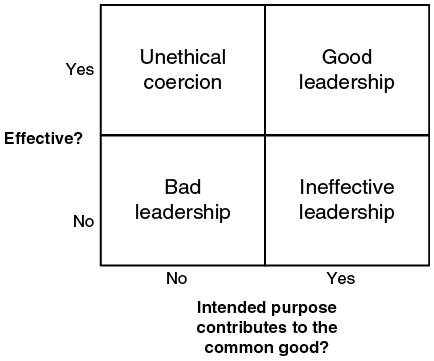
Figure 5.1 Long description
Two cross two matrix categorizes types of leadership based on two dimensions:
The Vertical axis, left side: Effective? with options Yes on the top row and No on the bottom row.
The Horizontal axis bottom: Intended Purpose Contributes to the Common Good? with No in the left column and Yes in the right column. Each of the four quadrants contains a leadership type:
1. Top-left quadrant: Yes, effective; No, common good: Unethical Coercion
2. Top-right quadrant: Yes, effective, Yes, common good: Good Leadership
3. Bottom-left quadrant No effective, No common good: Bad Leadership
4. Bottom-right quadrant No effective, Yes common good: Ineffective Leadership
The diagram is used to illustrate that good leadership requires both effectiveness and alignment with the common good. Leadership that is effective but not aligned with ethical goals is labeled as unethical coercion.
The “common good” refers to conditions, outcomes, or resources that benefit members of a community or society, enhancing the well-being of individuals as a collective rather than focusing on the advantage of specific groups or individuals at the expense of others. The concept of the common good has its roots in ancient Greek philosophy. It has been a central theme in various ethical, social, and political discussions throughout history, from the works of Plato and Aristotle to contemporary debates. Balancing individual freedoms with the needs and well-being of the community or society is a key challenge in realizing the common good.Footnote 8
In sum, we can define good leadership as an influence relationship between leaders and followers (where a follower can become a leader and vice versa) who intend to effect real changes that reflect their mutual purposes – and each purpose contributes to the common good.
Considering this leadership definition, we can prosperously use the Sustainable Development Goals as a “purpose compass” because each SDG represents a consideration for the common good. SDG #1 “No Poverty,” SDG #3 “Good Health and Wellbeing,” SDG #4 “Quality Education,” SDG #13 “Climate Action,” and so on, all the SDGs share the common feature that they are various expressions of the common good.
Therefore, aligning the purpose to the SDGs helps to ensure alignment with the common good. However, tensions can readily arise in the pursuit of the common good. Alignment to one SDG may conflict with another. The pursuit of SDG #8 “Decent Work and Economic Growth” could negatively impact SDG# 14 “Life Below Water” or SDG #15 “Life on Land” if the associated economic activities cause environmental harm. The common good is a concept subject to varying interpretations, where achieving it often involves navigating inherent tensions and disagreements among stakeholders with different values and priorities. Good leadership is necessary to address the tensions that can arise and build consensus about the actions to take.
Wicked Problems
The SDGs share another feature: Each of the SDGs represents a wicked problem.
The concept of wicked problems was launched on the global stage by Horst Rittel and Melvin Webber, two University of California, Berkeley, professors, in their classic 1973 article, “Dilemmas in a General Theory of Planning.”Footnote 9 A wicked problem is described as extremely difficult – if not nearly impossible – to solve because of its complexity, the uncertainty of potential solutions, the lack of a defined stopping point, the commingling of the wicked problem with other problems (which can be wicked problems in their own right), and the need for cooperation among actors who may have never collaborated before.
Wicked problems are often profoundly values-laden and situated within ongoing ethical debates contributing to their challenging nature. Some groups may have different beliefs about the problem because they subscribe to different values or schools of ethical thought that result in contrary opinions about what is “right” or “wrong.”
As a result, wicked problems often involve disagreements about whether there is even a problem in the first place.Footnote 10 For example, SDG #5 “Gender Equality” has the mission statement to “Achieve gender equality and empower all women and girls.” Iceland is routinely cited as achieving the world’s highest levels of gender equality, topping WEF’s Global Gender Gap Index in each of the seventeen years since the report’s inception in 2009. Nevertheless, much work remains to be done, even in Iceland, because women are measured at only 92.6 percent (2025) parity to men across a suite of dimensions, including economic empowerment.Footnote 11 However, some groups may deny that gender inequality is a problem in the first place. Similarly, the wicked problem of climate change, SDG #13 “Climate Action,” is even more challenging as some groups deny it is a problem in the first place.Footnote 12
Rittel and Webber contrast wicked problems with “tame problems.” Tame problems are not necessarily easy to solve but they are solvable through proven means. Solving tame problems became central to modern management education following the Industrial Revolution – challenges suited to quantification, standardization, and efficiency. Optimizing factory production, streamlining logistics, or solving a complex equation are all tame problems. Even putting a person on the moon, while extraordinarily difficult, qualified as a tame problem because it could be addressed through scientific and technical methods with clear endpoints.
As industrialization advanced, the world’s challenges were increasingly treated as tame problems – issues to be solved through rational planning, measurable outcomes, and techniques taught in industrial engineering and MBA programs. Henry Ford, widely celebrated as an American hero of efficiency, embodied this approach. His deployment of Taylorism remains a staple of management education and is still held up as a success story. Rittel and Webber wrote:
During the industrial age, the idea of planning, in common with the idea of professionalism, was dominated by the pervasive idea of efficiency. Drawn from 18th-century physics, classical economics and the principle of least means, efficiency was seen as a condition in which a specified task could be performed with low inputs of resources. This has been a powerful idea. It has long been the guiding concept of civil engineering, the scientific management movement, much of contemporary operations research, and it still pervades modern government and industry.Footnote 13
While important efficiency advancements of historic proportions were unquestionably being made, Rittel and Webber were troubled by what they felt was a growing arrogance among a professional class that believed that all problems could be solved through rationalization, planning, and more efficiency. Rittel and Webber utilized the problem of poverty as a different problem from the tame problems.
Poverty is a wicked problem made all the more wicked because it is commingled with other wicked problems. With a wicked problem, it is difficult to know where the problem starts and ends and even how to define the problems at hand. Poverty was a different kind of problem than what the efficiency professionals who emerged from the industrial revolution had grown accustomed to solving. Rittel and Webber wrote:
Consider, for example, what would be necessary in identifying the nature of the poverty problem. Does poverty mean low income? Yes, in part. But what are the determinants of low income? Is it deficiency of the national and regional economies, or is it deficiencies of cognitive and occupational skills within the labor force? If the latter, the problem statement and the problem “solution” must encompass the educational process. But, then, where within the educational system does the real problem lie? What, then, might it mean to “improve the educational system”? Or does the poverty problem reside in the deficient physical and mental health?Footnote 14
Today, we also know the problem of poverty as SDG #1 “No Poverty.” Within this short excerpt, Rittel and Webb connect several SDGs, each of which is a wicked problem in its own right. They begin with SDG #1 “No Poverty.” In discussing low income, they connect it with SDG #8 “Decent Work and Economic Growth.” They then contact that wicked to education, thereby moving into the realm of SDG #4 “Quality Education.” They also raise the specter of physical and mental health issues, which is SDG #3 “Good Health and Well-Being,” as connected to poverty. Rittel and Webb demonstrate how the wicked problems represented by the SDG are deeply commingled and exceedingly difficult, if not impossible, to definitively “solve.”
Wicked Problems Demand Cooperation
Leadership scholar Keith Grint provides crucial insights into how different types of problems demand different leadership responses. In his influential article “Problems, Problems, Problems: The Social Construction of Leadership,” Grint categorizes problems as critical, tame, or wicked – each requiring a distinct approach. His central question is deceptively simply: What is good leadership for the problem at hand?Footnote 15
Critical problems call for a commander response. These are urgent, high-stakes situations – the building is on fire – where there’s no time for deliberation and the leader must provide a decisive answer for what to do.
Tame problems, Grint explains, are best addressed through management: planning, organizing, and applying proven solutions to well-defined challenges. Increasing factory production, creating transportation timetables, building bridges, and designing computers are all examples of tame problems – complex challenges that can be solved through technical expertise and established procedures. These are the problems that emerged alongside industrialization and respond well to Taylorism and the efficiency techniques taught in industrial engineering and MBA programs.
Wicked problems, by contrast, require a fundamentally different approach. These problems are deeply intertwined with other issues, shaped by conflicting values, and resistant to clear solutions. They demand leadership grounded in humility and cooperation. As Grint notes, the more wicked the problem, the greater the “requirement for collaborative resolution.” Wicked problems may not have definitive solutions, but they can be approached constructively through asking better questions and engaging others in the search for shared, workable paths forward.
This distinction matters because leaders often misdiagnose the problem type. Too frequently, leaders default to a commander or management approach not because it is suited to the problem, but because it is the response they’re most comfortable delivering. A leader who declares, “I have the answer,” in the face of a wicked problem may be acting on preference, not accurate assessment. Treating wicked problems as tame or critical risks overconfidence – and poor outcomes. Progress on wicked problems requires the humility to admit no single actor holds the answer, and that constructive action depends on asking good questions and fostering real cooperation
Nordic Leadership Norms: Cooperation at the Core
As we shift attention to leadership norms in the Nordic context, I detail how cooperation is at the core of Nordic leadership, supported by several closely related leadership norms. A norm is a shared rule about acceptable or unacceptable social behavior. Norms can be thought of as a tendency or a cultural default position.
I draw upon comparative leadership scholarship, including the Global Leadership and Organizational Behavior Effectiveness (GLOBE) study, and my own experiences and scholarship comparing leadership approaches in Nordic and US contexts. As will become apparent, norms of Nordic leadership are particularly well suited to addressing sustainability challenges given the “increasing requirement for collaborative resolution” to address wicked problems.
Norms of Cooperation
Leadership scholarship is performed by management scholars studying organizations. Given that expectations for cooperation so deeply permeate Nordic culture, it feels odd to call it out as a norm unique to the act of leadership. But on a comparative level, like the Nordics vis-à-vis the US, expectations for cooperation is readily apparent defining aspect of Nordic leadership.
Expectations for cooperation permeate all facets of Nordic society, evident from the youngest ages. Children are taught in childcare about democratic principles and resolving conflicts by leveraging cooperation and consensus-building. In grown-up venues, like negotiations between employers and labor unions, cooperative relationships are built upon trust and long-term mutual interests.Footnote 16 Perhaps not surprisingly, individuals from the Nordics are routinely sought on the global stage as effective and trustworthy peace brokers, able to establish a cooperative posture between various actors in the most conflict-ridden circumstances.
In the book Return of the Vikings, Chris Shern and Henrik Jeberg emphasize the central role of cooperation throughout Nordic life, drawing upon their comparative experiences, each working and living in the Nordics and the US. They offer that “collaboration and cooperation are effective in the workplace and in coalition politics in the Nordics because they come naturally. This way of thinking and acting is what people have known all their lives.”Footnote 17 The authors contrast US norms, describing how competition is routinely celebrated and embraced.
Bjerke emphasizes that Nordic cooperation is achieved through consensus-building and effective negotiation: “The typified Scandinavian business leader is a negotiator. Scandinavian top managers stress that their most important ability is to obtain results in cooperation with the employees, combined with their ability to negotiate.”Footnote 18 Bjerke further describes, “They are not autocratic, but use a delegating and participatory style; use power if necessary, but then based on legitimacy; consult their subordinates; look for cooperation, compromises, and consensus; are collective individuals.”Footnote 19 This seemingly contradictory idea of “collective individuals” took my American mind a long time to grasp.
Individuals throughout the US and Nordics value individual freedom and autonomy. Still, the Nordics maintain that individual freedom is more effectively achieved by considering the collective We, whereas the US embraces the Me as the means.
Like many cross-cultural leadership writings, the Nordic Leadership report relies heavily on the work of social psychologist Geert Hofstede. Hofstede constructed the masculine–feminine cultural dimension against which tendencies for (or against) cooperation and consensus-building are measured.Footnote 20 The Nordic nations were deemed the most feminine societies globally. The US resides in the masculine zone.Footnote 21 The Nordic Leadership report provides this useful characterization of Hofstede’s masculine–feminine cultural dimension:
Masculinity represents a preference in society for performance, heroism, determination, and materialistic rewards for success. Femininity stands for a preference for cooperation, modesty, care of the weak, and quality of life. These opposing pairs can also be described such that society, in the first case, is more inclined to competition or, in the second case, is more oriented to consensus.Footnote 22
In Sustainability Leadership, Henrik Henriksson and Elaine Weidman Grunewald connect cooperation and consensus-building across Nordic societies to the global sustainability leadership role the Nordics has assumed, emphasizing the important role of leadership to establish a mutual purpose, and steering activities toward addressing that purpose.Footnote 23
Norms of Modesty
Modesty is one of the more immediately observable norms of Nordic leadership. The need for “saving face” is rejected as a conspicuous act of self-promotion. In the Nordics, effective leadership requires leaders to look a bit foolish from time to time – not have all the answers – and to be able to laugh at themselves in a self-deprecating manner. The GLOBE study is arguably the most extensive cross-cultural comparative leadership study ever undertaken. Leadership norms related to modesty are discussed within comparisons of self-protective leadership:
It is apparent that the Nordic Europe cluster is characterized by its extremely low ranking for Self-Protective leadership. Being self-centered, status conscious, face saving, and inducing conflict are attributes seen as extremely inhibiting to effective leadership.Footnote 24
When discussing the norm of modesty in Nordic leadership, individuals commonly reference Janteloven – a term derived from Aksel Sandemose’s 1933 satirical novel En flyktning krysser sitt spor (A Fugitive Crosses His Tracks). Originally conceived as a critique of small-town social control mechanisms, with the core principle “you’re not to think you are more important than anybody else,” Janteloven’s cultural interpretation has evolved. While Sandemose intended to illuminate the oppressive aspects of social conformity, contemporary Nordic discourse has reframed janteloven more positively as an expression of social solidarity and collective responsibility.
Contemporary scholarship discusses Janteloven’s paradoxical role in Nordic organizational culture. While potentially constraining individual excellence through what has been termed “tall-poppy syndrome,” the norm simultaneously facilitates cooperation by suppressing displays of individual superiority that might impede collective action.Footnote 25 Organizational behavior research suggests that reduced status differentiation enhances information sharing and trust formation, critical components for effective stakeholder cooperation.
The norm of modesty (not worrying about “saving face”) is essential to effectively tackle wicked problems since these problems come with far more questions than answers. Revisiting Grint’s figure, we see that the more wicked a problem is, the more uncertainty about its solution. Asking questions is essential to better understanding potential courses of action. If concerned about saving face, one will be less likely to expose one’s lack of an answer by asking questions – and ultimately less likely to act.
Norms of Humanism
Ideals of humanism run deep in Nordic culture and are readily apparent in Nordic leadership. Humanism is “a democratic and ethical life stance that affirms that human beings have the right and responsibility to give meaning and shape to their own lives. Humanism stands for building a more humane society through an ethics based on values in a spirit of reason and free inquiry through human capabilities.”Footnote 26
Humanism has not been explicitly called out as a leadership norm in prior scholarship, to my knowledge, but it is merited. In their report, The Nordic Perspective, the Nordic Council of Ministers wrote, “Compassion, tolerance, and conviction about the equal value of all people” are central to a Nordic approach to the world.Footnote 27
When studying leadership in the Nordics, I saw individuals like Marianne Barner of IKEA and Mads Øvlisen of Novo Nordisk practice a humanistic leadership approach. Barner was the key architect and implementer of the humanistic policies IKEA established for its supply chain in the 1990s–2000s, including “what is in the best interest of the child” if one ever encountered the potential for child labor in a supply chain.Footnote 28 At the time, many American-based firms facing pressures to address child labor in their supply chains adopted a rather simplistic compliance approach of dropping a supplier if child labor allegations arose for fear of consumer backlash and potential boycotts. However, as described in What Works for Working Children, this reaction can result in worse working conditions for a child laborer, including child prostitution.Footnote 29
Through Barner’s leadership, IKEA developed procedures and a code of conduct to address the root causes of child labor and take action in the child’s best interest, resulting in the IWAY (for “IKEA Way”) standard of requirements for environmental, social, and working conditions. Harvard Business Review has since featured Barner as the protagonist of one of the most well-known Harvard case studies of responsible business leadership challenges. The case demonstrates how deep-seated reverence for humanism was embedded in the leadership shown by Barner and IKEA.Footnote 30
Norms of Democracy
The Nordic region demonstrates a long-standing commitment to the ideals of democracy. Democratic ideals can be found in every aspect of society, including leadership. Democracy is fundamentally about the dispersion of power; the Nordic leadership norm of democracy is directly related to the norm to disperse power throughout the organization. Bjerke referred to this leadership approach in the Nordics as “non-authoritative” leadership.
The Nordic leadership norm of democracy and embracing the stakeholder approach are two sides of the same coin. The stakeholder approach represents an effort to extend democratic participation and disperse power. Swedish management scholar Eric Rhenman, a longtime champion of industrial democracy, was an originator of the stakeholder concept.
The first time “stakeholder” appeared in management literature anywhere in the world was in Rhenman’s classic 1968 book Industrial Democracy and Industrial Management.Footnote 31 Rhenman connected the practice of democratic leadership with improved efficiency and greater equality of opportunities for employees:
First, it is expected that democratic measures will arouse the employee’s interest and cooperation. Secondly, it is hoped that if employees have a greater part in running the business, it will be easier to tap their resources of experience, knowledge and ideas. In the long run, this should provide the employees themselves with greater opportunities for personal development and education.Footnote 32
Rhenman connected his prescriptions for power dispersion to the broader debate between capitalism versus communism. He critiqued Marx’s assertion that capital owners and laborers were necessarily in conflict: “From the early days of industrialization and of the labor movement, conflict between employer and employee has been a marked social phenomenon … In his criticism of eighteenth-century capitalism, Marx was one of a motley company of writers, all extreme as himself, who in their different ways regarded conflict as something fundamental and explosive.”Footnote 33
In Management in Scandinavia, authors Jette Schramm-Nielsen, Peter Lawrence, and Karl Henrik Sivesind described how the Nordic leadership norm of democracy is a product of culture and policy.Footnote 34 They summarize Nordic leadership as “characterized by informality, equality, and restraint” that takes a “consensual, participative, and inclusive approach to decision making and change implementation.” The authors emphasize that Nordic leadership involves “a reluctance by most managers to articulate their power, an inclination to reasonableness and quiet persuasion, rather than to charismatic dominance.”Footnote 35 They further connect the Nordic leadership democracy norm with efficiency, stating that the Nordics “have developed a management style which is extraordinarily participative and process-oriented without losing the battle for efficiency.”Footnote 36
Norms of Pragmatism, Critical Thinking, Systems Thinking, and Stewardship
While the following norms of pragmatism, critical thinking, systems thinking, and stewardship are not well established in the leadership scholarship, through my own experiences, I am convinced of their importance to more fully describe Nordic leadership.
Pragmatism is deeply embedded in Nordic leadership. A pragmatic approach involves collecting and considering empirical evidence (data) to determine what works, then adjusting as needed to do more of what works and less of what does not. Bjerke summarized this approach as “rational and practical”: “Scandinavians prefer systematic, rational, and detailed problem-solving, where decisions may not necessarily come fast, but where problems are well penetrated when decisions are taken.”Footnote 37
Nordic governmental agencies demonstrate “a voracious appetite for data,”Footnote 38 and Nordic companies can say the same. In the Nordics, leadership depends heavily upon the merits of the rational argument and its supporting facts. Nordic leadership is strikingly less charismatic than in the US, where showmanship is more greatly valued. In the Nordics, facts and data matter most in influencing others to take action.
The pragmatic leadership approach often leads to cooperation that spans traditional boundaries when such partnerships are of mutual benefit. Strong engagement and cooperation can be readily observed among Nordic companies, labor unions, government, universities, and research institutions.Footnote 39 The collaborative relationships between company management and labor unions are essential in a Nordic context and directly supported by the pragmatism leadership norm.Footnote 40
Critical thinking is pervasive in Nordic culture and, in my view, represents a unique Nordic leadership norm. Critical thinking is “the systematic evaluation or formulation of beliefs, or statements, by rational standards,”Footnote 41 and therefore related to pragmatism. Nordic educational systems emphasize critical thinking through specific pedagogical practices, including mandatory oral examinations where students must defend their analytical positions and extensive use of problem-based learning approaches.Footnote 42
When I began teaching business school students in the Nordics, I was caught a bit off guard by many of my students’ capacity and predisposition for critically examining the readings I had assigned. While my US students were more likely to treat my assigned readings, from the Harvard Business Review, as a suite of “facts,” my Nordic students, by contrast, often picked apart the arguments within the articles, suggesting they were not sufficiently supported with sound empirical evidence or appropriate logic. Perhaps not surprisingly, Nordic countries perform conspicuously well in country-level measurements of critical thinking, like the Media Literacy Index that assesses a populace’s potential for resilience to “post-truth” politics and “fake news.”Footnote 43
I am unaware of any formal cross-cultural academic study that draws out Nordic leadership as demonstrating comparatively more substantial critical thinking. However, when I encountered Donald Schön’s book The Reflective Practitioner,Footnote 44 I found that he described what I had observed in the Nordics. The reflective practitioner exercises critical thinking as a central component of leadership, emphasizing the ability to reflect critically on one’s actions to engage in continuous learning. Critical thinking is a fundamental aspect of Nordic leadership.
Through my Nordic experiences, I became aware of the capacity to identify systemic problems and address them with effective systems. In contrast, I came to recognize a tendency in the US to push systems-level problems down to the individual in a reductionist approach. I found systems thinking to be a dominant leadership approach in the Nordics.
The reductionist approach that can be witnessed in the US arguably stems from a school of management developed and deployed in the Industrial Revolution; problems were considered solvable through rational means that involved reducing a problem to its elements and solving each more minor problem. Rittel and Webber poked holes in this “one-size-fit-all” approach by claiming that while a reductionist approach might work well to solve tame problems, wicked problems are different and require a view toward the overall system, to consider the “whole.”
Nordic educational systems connect directly to systems thinking and committed consideration for the whole. Denmark, with its traditions of the folkehøjskole (folk school) centering on the philosophical idea of Bildung, is a good example (Chapter 4).Footnote 45 In 2020, David Brooks wrote in the New York Times about the Nordic approach of educating the whole person:Footnote 46
They look at education differently than we do. The German word they used to describe their approach, Bildung, doesn’t even have an English equivalent. It means the complete moral, emotional, intellectual and civic transformation of the person. It was based on the idea that if people were going to be able to handle and contribute to an emerging industrial society, they would need more complex inner lives …
… The idea was to create in the mind of the student a sense of wider circles of belonging – from family to town to nation – and an eagerness to assume shared responsibility for the whole.
The world is a system, and everything is connected – sustainability challenges are interconnected with other challenges.
The Nordic leadership norm, stewardship, serves as a helpful summation of all the Nordic leadership norms. Stewardship implies a self-imposed responsibility to care for something or someone for a considerable time. A stewardship approach focuses on value creation. In contrast, an extractive approach happens when one extracts as much value as possible. For a manager, this may mean extracting as much time and effort as possible from their direct reports. For a CEO or influential shareholder, this may mean extracting as much financial profit as possible from their company. An extractive approach tends to have a short-term perspective, whereas a stewardship approach emphasizes the longer term.
I realized stewardship was a fundamental norm of Nordic leadership through my engagements with Mads Øvlisen of Novo Nordisk. Øvlisen led the initiative during his tenure as CEO to change Novo Nordisk’s articles of association to explicitly express a corporate purpose “to conduct its activities in a financially, environmentally, and socially responsible way” consistent with a stewardship approach.Footnote 47 I saw this tendency to embrace a stewardship approach with many Nordic leaders who worked hard to establish the structures to ensure better long-term success for their organizations.
Can Nordic Leadership Solve Every Problem?
Nordic leadership norms are well suited to tackle wicked problems like those of the SDGs. But that does not mean command and management responses are less important.
The video “Swedishness,” shown at the 2013 Eurovision Contest in Malmö, Sweden, humorously depicts what could happen if a “typical” Nordic leadership response of cooperation and consensus-building was applied to a critical problem. The scene begins with the commander of a Swedish battalion calling upon his troops to attack, but the situation quickly devolves:
Battle scene. Tanks. Fire.
narrator: What’s interesting is, the Swedes are an extremely equal people. There are no hierarchies here. The Swedes prefer a so-called flat organization. [Pans to soldiers in the middle of a war scene.]
commander: We attack on my command!
soldier (unnamed): Yes, Captain!
commander: That is, if you feel like it. I mean, I don’t have to decide everything all the time. Do you want to make a decision?
soldier (unnamed): Oh, maybe it’s Ingrid’s turn. [Turns to another soldier.] Ingrid! Ingrid! Do you want to attack? [Bomb goes off; everyone covers heads.] Do you want to attack?
soldier (ingrid): I think we should have a group discussion about this.
commander: That’s a good idea!
soldier (unnamed): We should bring in Lars, then.
commander: Yes.
soldier (unnamed): Lars? Do you want to attack? [Covers head as a bullet flies by.]
This scene humorously highlights that while Nordic leadership thrives in cooperative settings, some urgent situations may require a more decisive, top-down commander approach. In keeping with Grint’s leadership offerings, the problem must first be considered to determine the most appropriate leadership response.
Nordic leadership will not solve every problem. Nevertheless, it presents a compelling alternative to the dominant top-down, command-style leadership models that dominated twentieth-century US management teachings to address complex, interconnected challenges more effectively.
Nordic Leadership in the World
Nordic leadership norms are increasingly recognized beyond the Nordic region as offering a compelling alternative to the leadership models traditionally taught in many American business schools. As calls grow to reorient management education toward societal stewardship and stakeholder engagement rather than solely focusing on shareholder primacy, Nordic business schools are uniquely positioned to lead this shift. They draw upon leadership styles long promoted in a Nordic context emphasizing trust, collaboration, and long-term responsibility, and are now moving to articulate these approaches more explicitly. One such effort is the Nordic Nine, developed by Copenhagen Business School, where I completed my PhD.
The Nordic Nine outlines a set of leadership capabilities that reflect Nordic commitments to cooperation, modesty, stewardship, critical thinking, and democratic engagement. One of these capabilities – “You are competitive in business and compassionate in society” – captures the dual commitment to individual performance and collective well-being that defines Nordic leadership. Others emphasize ethical reflection, responsibility toward future generations, and learning as a mutual process.Footnote 48
In this sense, the Nordic Nine responds to American business school critiques from Andrew Hoffman at the University of Michigan, who argues that business education is “broken” and must shift to train “stewards of the market.” Hoffman’s leadership vision aligns closely with the leadership norms promoted in Nordic societies and explicitly advanced by Copenhagen Business School through the Nordic Nine, which seeks to cultivate leaders capable of engaging complexity with humility, shared purpose, and a long-term view of value creation.Footnote 49
In 2024, several practitioners and scholars of Nordic leadership penned the “Nordic Leadership Manifesto,” a compelling call that underscores the significant potential Nordic leadership offers to the world. The manifesto criticizes traditional management models rooted in Taylorism, as put into practice by Henry Ford, which tend to treat individuals solely as means in an assembly-line approach and prioritize profit maximization. Instead, the Nordic Leadership Manifesto advocates for the dispersion of power and top-down control, aligning more closely with democratic ideals and leadership approaches in the Nordic context. Drawing upon the philosophical groundwork laid by Grundtvig, whose ideas of “nation building from below” emphasized the cultivation of a well-informed and engaged citizenry, the manifesto calls for leadership to be reconceived as a collective practice rooted in community. By emphasizing the cooperative and consensus-driven norms of Nordic leadership, the manifesto proposes that the Nordics can become the epicenter for a global management revolution, effectively rethinking leadership to tackle global challenges represented by the SDGs and to shape a sustainable and hopeful future.Footnote 50
Parting Reflections
Nordic leadership, deeply embedded in cooperation and consensus-building, more effectively addresses wicked problems like those represented by the SDGs. The Nordic leadership approach contributes to the Nordic region’s strong performance in meeting these goals and offers good examples whose potential application transcends regional boundaries. This approach is consistent with democratic ideals, distributing power widely across society to enhance responsiveness and accountability.
Leaders (and anyone practicing leadership) worldwide can adopt Nordic leadership principles, regardless of their cultural context. Many leaders have a default style that shapes their response to challenges; however, Nordic leadership emphasizes the importance of adapting one’s approach by carefully considering the problems at hand. This flexibility is crucial, not just for the SDGs, where cooperation and consensus are often more effective than top-down directives, but also in urgent global crises.
The Danish response to the Covid-19 pandemic illustrates how Nordic leadership norms can facilitate swift, decisive action based on established trust and collective agreement. Under Prime Minister Mette Frederiksen, Denmark’s early and comprehensive measures – closing borders, shutting schools, prohibiting large gatherings, and implementing supportive financial packages – demonstrated how effectively such leadership can minimize the impact of crises.
As wicked problems like those posed by the SDGs grow more urgent, so does the need for leadership to evolve into a process that mobilizes cooperation, builds consensus, and enables decisive action. The capacity to forge deep trust among stakeholders before crises arise is essential for rapid and effective responses. Nordic leadership offers pivotal lessons for navigating complex challenges and achieving more sustainable outcomes.

 Open access