

Introduction
Archaeologists and historians are still coming to terms with the remarkable discoveries in the 1980s and 1990s at the cemeteries of Lefkandi in Euboea.Footnote 1 An enormous apsidal building, elaborate and costly burials of a man and a woman inside the structure and a cemetery teeming with imports were among the startling finds that made the post-palatial period characterised as a Dark Age glow.Footnote 2 This Protogeometric (PG) community had mastered such skills as bronze casting and gold working, and was connected to a wide world that extended from Italy to Macedonia to Cyprus and beyond.Footnote 3 Not only did it import precious minerals and valuable metal vases, but it exported goods as well, probably silver and/or grain.Footnote 4 Euboean pottery (including trade amphorae) found on Cyprus and in the Levant, as well as the identification of a shared ceramic koinē covering Boeotia, Phokis, East Lokris, Thessaly, Skyros and some of the Cyclades, testify to the island's strength and influence.Footnote 5 It was one of the first and most active participants in a widening Mediterranean world, a well-connected hub in a growing network.Footnote 6
The quantity and variety of imports and metalwork, especially from the Toumba cemetery located at one end of the apsidal building, offered a richness unmatched anywhere else in the Aegean at such an early date. Scholars at first addressed questions related to production and distribution – where the objects were made and who transported them – with debates over the origin of various goods and over eastern versus Greek trade initiatives in the Aegean, debates which remain rather inconclusive.Footnote 7 More recently, and more productively, scholars have discussed the consumption of imports, with particular concern for their role in shaping and negotiating local social and political dynamics within a community emerging from the disruption and poverty that followed the Late Bronze Age.Footnote 8 To varying degrees, it is the role of the elite that has been emphasised in acquiring, using and disposing of imports qua prestige-goods.Footnote 9 At the risk of over-simplifying diverse and nuanced perspectives, the prevailing model may be briefly summarised. Imports from the east – exotica, such as a Cypriot bronze ash urn in the apsidal building or Cypro-Phoenician bowls – were acquired through exchanges dominated by the elite and contingent on personal relationships at the highest levels of society: marriage or, more frequently, gift-exchange.Footnote 10 Next, the distribution and circulation of the imports were controlled, restricted and rationed. Finally, and following from the first two points, the exotica as prestige-goods were displayed to distinguish a group of elite, to join an international group of elite, or to compete among the Lefkandi elite; they were gifted in order to acquire prestige through generosity; or they were removed from circulation to increase their value. Thus, this perspective maintains, long-distance imports were both a cause of increased social complexity and a means for the elite to secure and preserve status.Footnote 11
Lefkandi has helped to forge the perception of a symbiotic relationship between eastern exotica and elite status that scholars maintain continued through the Orientalising period (late eighth and seventh centuries) and beyond.Footnote 12 Ian Morris's claim that ‘[t]he orientalizing movement was a class phenomenon’Footnote 13 encapsulates, albeit in unusually explicit language, pervasive perceptions of the relationships between Greece and the East, whereby a vaguely defined geographical sphere becomes synonymous with luxury and a source of external authority and power. Perhaps the fact that current approaches to Lefkandi fit so neatly within this discourse should alert us to the need to take a second look. Understanding what happened at Lefkandi at the time when contact between the Aegean and the Near East was resuming is a critical first step in assessing the many factors underlying Mediterranean cross-cultural dynamics.
This paper offers a new perspective on the grave assemblages at Lefkandi and, more broadly, on exchange and consumption in the Early Iron Age, by focusing not on high-status imports but on trinkets.Footnote 14 A trinket is here defined as a small object, of manifestly foreign origin, neither locally produced nor even locally imitated, and made of relatively inexpensive material. For example, a faience scarab is a trinket. It was small enough to be worn around the neck or wrist, and its details were only discernible from up close. The form had Egyptian and Near Eastern parallels, and inscribed hieroglyphs reinforced its otherness and rendered it manifestly non-local. Moreover, neither local production nor local imitation of this type of object existed on Euboea, suggesting that the object's distant origin was essential to its ontological status and to its meaning. A local copy, that is, could not serve as a substitute.Footnote 15 Finally, as will be discussed in more detail below, faience was relatively inexpensive. Some counter-examples may help to define further the category of trinket. A clay bead may be small and made of a widely available material,Footnote 16 but it was not sufficiently foreign in terms of origin, form or iconography to be classified as a trinket. Conversely, an engraved bronze bowl could evoke distant lands,Footnote 17 but was produced on a scale that made the object easily visible, and out of a material widely acknowledged to be valuable. In ancient Greek, the appropriate word for trinkets might be athurmata, associated with frivolity and childish play and on one occasion described by Homer as the cargo of ‘greedy and deceitful’ Phoenicians.Footnote 18 There are a number of possible synonyms for ‘trinket’ in English: bibelot, gewgaw, bauble, doodad or curio. With different connotations, all refer to minor exotica: on the one hand, somewhat wondrous and unusual; on the other, somewhat cheap. Relatively neglected in the scholarly literature, the ambiguity and potential contradiction of trinkets makes them an interesting subject for study.
The paper first considers whether trinkets as imports can be integrated into models of elite consumption at Lefkandi. The discussion does not attempt to be comprehensive, but draws attention to some of the limitations of socio-political explanations of consumption at this site. In addition, it underscores the extreme variability and heterogeneity in the grave assemblages, and concludes that there was no established language of elite display and no consistent rationing of imported goods. Thus divorced from any simple equation with the consumption of eastern exotica, the trinkets require a close analysis of their form, context, use and meaning, which is the subject of the next section. This analysis, which draws on comparanda from around the Mediterranean, suggests that non-rational belief in the protective power of trinkets rather than utilitarian socio-political aims best explains their selective use and deposition. Three interrelated causes or conditions for the existence of this belief are then examined. The article concludes by considering the broader implications of this study for the social structure at Lefkandi and for connections between the Aegean and the East in the Iron Age.
Socio-political approaches to Lefkandi
Archaeologists began to focus predominantly on socio-political explanations for variation in mortuary practices in the 1970s.Footnote 19 Arthur Saxe (Reference Saxe1970) and Lewis Binford (Reference Binford and Brown1971) gave impetus to the turn to assessing the structure and organisation of cultural groups and the rank and status of individuals through an examination of funerary rites and land use.Footnote 20 Such approaches sought to demonstrate how burials could mirror the scope and extent of the relationships of the living with the dead and reflect social complexity. The subsequent post-processualist critique was directed more against the processualist assumptions, methods and universalising cross-cultural aims than against their goal of explaining change and variation in light of social relationships. These critiques pointed out that mortuary rituals do not reflect but rather construct, negotiate and contest social and political identities and ideologies, and they highlighted the enormous variability to mortuary rituals that processualist approaches could not satisfactorily explain. Cemeteries were places where agents (collective and individual) could use material goods and social practices to transform as well as to replicate norms. But despite the new interpretive paradigms, socio-political concerns have remained paramount, and the elite and elite goods have played the predominant role.Footnote 21
Yet the application of socio-political models of consumption to Lefkandi, particularly those involving conceptions of prestige-goods, gift-exchange and elite display, raises several problems, which can be organised under four rubrics: (1) geography, (2) chronology, (3) find context and (4) the interpretation of specific goods.
(1) After several decades, Lefkandi remains exceptional in its regional context. Imported goods appear nowhere else on or near mainland Greece in such quantity at such an early period. The discrepancy is startling and defies ethnographic parallels. We may perhaps imagine that an elite at Lefkandi prevented local non-elite from consuming exotica, causing variation between Toumba and the other cemeteries at Lefkandi; but how did they prevent nearly every other city in mainland Greece? The situation is particularly paradoxical because if the goods were circulated through gift-exchange, as is often maintained, then members of the elite should have been gifting prestige items at the regional level and beyond, causing a more diffuse distribution pattern. Not only would we expect gift-exchange among the elite to spread luxury goods further than the confines of Lefkandi, but peer-polity interaction and competition should have compelled other elite to emulate the consumption and display at Lefkandi, and thus to seek exchange from Lefkandi elite or from their trading partners, who would have been eager to acquire more goods and to develop more contacts.Footnote 22 A contrast might be helpful here: in Iron Age Europe, sometimes invoked as comparandum for Lefkandi, imports were concentrated at several Late Hallstatt centres, and multiple cemeteries contained burials that could be ranked according to a shared symbolic system.Footnote 23 This pattern contrasts with the regional isolation of Lefkandi and, as we will see, with the variety of grave goods within its cemeteries.
Perhaps Lefkandi simply was remarkably isolated from the rest of the Aegean. Yet the imports and the ceramic koinē point to connectivity, and the tradition of an Archaic Lelantine War, whether true in detail or not, suggests that at least by the seventh century, more than one Euboean community was sufficiently competitive to fight, and sufficiently interconnected to obtain allies from far and wide.Footnote 24 The geographic location of Lefkandi further suggests that connectivity was an important part of its function, for it was not the first landing point for a trader coming from the east, but it was an excellent stopping point for anyone going north, up the strait, or west, to the mainland.
(2) Although the graves at Lefkandi, with a few exceptions, disappeared after c. 825 and the record of imported exotica ceased, Euboean goods continued to appear in the east, and in greater quantity.Footnote 25 An engine of exchange – elite funerary consumption – seems to have disappeared, and yet exchange intensified.
(3) Few explanations of exotica at Lefkandi address their nearly exclusive appearance in graves. Instead, the burial assemblages of the dead are used to reconstruct the status of the living, which is a perilous interpretive leap.Footnote 26 The assumption is that as people became richer, they deposited more in graves. In order to calculate social stratification on the basis of tombs, one needs a larger sample, and one needs settlement evidence. It is particularly important to know if production was closely associated with the elite.
The graves themselves are more diverse than might be expected for one wealthy family, as is often maintained, including shafts lined and unlined, trench-and-hole burials and double burials. Important new understanding of the burial rituals further contributes to the picture of pronounced variation both in burial type and in the economic status of the burying groups. Although the first excavators thought that the dead were cremated and a token of their ashes placed in a grave, we now know that the deceased in the shafts were inhumed, but their bones decayed and left little to no trace.Footnote 27 This means that the cremation pits in Toumba were primary burials, and most of them were very poor in terms of grave goods: of the thirty-five pyres, twelve were empty, and seven contained only one or two objects.Footnote 28 One reason for this variation may be a lack of formal planning, for the burial ground had no clearly defined border.
(4) All foreign items tend to be considered of equal value: an import is an import. The application of statistical approaches in particular risks flattening out meaningful distinctions among objects by conflating several different items into one analytic category. Considering a gold earring equivalent to gold foil, for instance, makes possibly inaccurate assumptions about value.Footnote 29 The variety and not just the quantity of exotica at Lefkandi needs explanation. Indeed, the range of goods far exceeds the norm in societies where elite goods are rationed. For contrasts in the ethnographic record, we can look to nineteenth-century Nuristan (Afghanistan), where elite symbols were rationed and higher-rank items were formally similar to lower-rank items, but more elaborately wrought and crafted of more valuable material. For instance, the number of bells on a wooden bowl or the number of iron bars on a table depended on rank.Footnote 30 This type of ranking does not occur at Lefkandi.
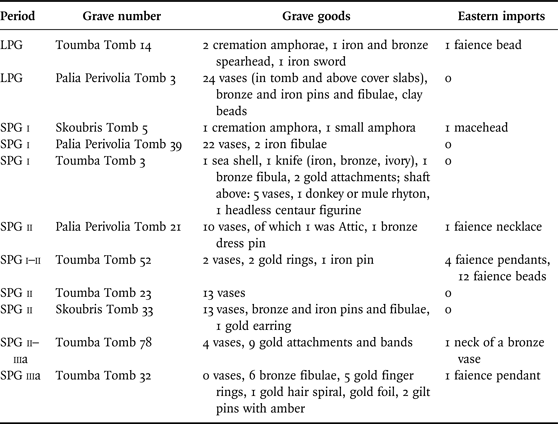
Not only are imports at Lefkandi often considered of equal value, but they are usually associated with the elite. Did such a clear semantic distinction exist? Quantitative and statistical approaches unfortunately do not offer a reliable method for analysing rank in the Lefkandi assemblage because of the relatively small number of tombs, the lack of osteological data, and the absence of well-published settlement evidence. A more qualitative approach, however, can be used to assess the extent to which eastern imports were rank indicators at Lefkandi. There are, it should be emphasised, many ways to evaluate the status of a burial, such as location, size or type; one measure is the quantity of grave goods, with a higher number of goods indicating higher rank.Footnote 31 So one might expect the quantity of grave goods to correlate with the presence of eastern imports. Yet in every period represented at Lefkandi following the construction of the apsidal building, there were, on the one hand, tombs with few grave goods, but an eastern import; and on the other hand, tombs with many grave goods, but few if any eastern imports (see Table 1). (It is necessary to include graves from all Lefkandi cemeteries in this discussion, because rank indicators should, by definition, be meaningful throughout the community.) For example, in LPG, Toumba Tomb 14 contained two cremation amphorae, an iron and bronze spearhead, an iron sword and a faience bead.Footnote 32 This tomb may be contrasted with Palia Perivolia Tomb 3, which contained twenty-four vessels, bronze and iron pins and fibulae, and clay beads.Footnote 33 Both were shaft graves of the same depth (1.30 m). The first had few grave goods but a faience bead that must be an eastern import, while the second had comparatively many more vessels and metal, but no eastern goods. Such contrasting burials can be found in almost every period. In SPG i, Skoubris Tomb 5 contained a cremation amphora, another small amphora and an imported macehead inside the cremation amphora, with all its connotations of power and authority.Footnote 34 In contrast, Palia Perivolia Tomb 39 held five pots and two iron fibulae, with an associated deposit on a shelf above one end of the tomb with seventeen vessels, but no valuable imports.Footnote 35 Similarly, Toumba Tomb 3 contained a sea shell, a knife, a bronze fibula and two gold attachments, and, in the shaft above the burial, five vases, a donkey or mule rhyton, as well as the famous wheel-made centaur figurine (here headless).Footnote 36 These last offerings are unusual, but the gold items are probably of local manufacture, and though the knife contains ivory, the knife itself is probably of local or regional origin.Footnote 37 None of the objects is an import like the macehead in Skoubris Tomb 5, there found with little else. In SPG ii, Palia Perivolia Tomb 21 contained ten vases, of which one was Attic, one bronze dress pin and an imported faience necklace.Footnote 38 Toumba Tomb 52 (SPG i–ii) similarly had few items with only two vases, two gold rings and one iron pin, but a large quantity of faience (four pendants and twelve beads).Footnote 39 At the other end of the spectrum, one may point to Toumba Tomb 23, with thirteen vessels, but nothing else,Footnote 40 or Skoubris Tomb 33, with thirteen vessels (one a possible Cretan import), bronze and iron pins and fibulae, and one gold earring unrelated to the Cypriot or Levantine repertoire.Footnote 41 Only in SPG iiia were imports more widespread than before, and tombs with exotica contained many goods, and vice versa. Contrasts between graves became less sharp. Toumba Tomb 78 (SPG ii–iiia), a shaft grave 1.70 m deep, had four pots, seven gold attachments, two gold bands and the neck of a bronze vase that was probably imported.Footnote 42 Toumba Tomb 32 had no pots, six bronze fibulae, a smaller quantity of gold and two amber bulbs on two gilt pins, suggesting lack of access to gold. In this comparatively less wealthy grave, though, an imported faience pendant was present.Footnote 43 In LG, only two graves have been found, a cremation and an inhumation, and the correlation between imports and wealth once again breaks down. Cremation is a more expensive way to dispose of the body, but the imported seal was found with the inhumation.Footnote 44
Selection of graves at Lefkandi with low numbers of grave goods but including eastern imports, and with high numbers of grave goods but without eastern imports.
In sum, from LPG through SPG ii and then again in LG, any relationship between eastern exotica and elite graves was not a simple equation. Exotica appear in graves that, in their context, seem relatively poorer than others, while there are many graves teeming with goods and built with considerable manpower that have no eastern imports. A variety of objects were deposited in a variety of groupings, and just as there was no single way to inter the dead, so also there was no standardised burial vocabulary, no single function of the exotic as a uniform and consistent status marker, and no rationing of exotica to one cemetery. The absence of clear deposition and distribution patterns contrasts with traditional ranked societies such as the Hallstatt.
The point is not that the elite did not have access to eastern imports, but that there was no straightforward signifying system wherein imports denoted elite, a system into which trinkets could be inserted. So what made these small objects desirable and what type of consumption do they represent? Recognising the limitations of explanations focused exclusively on elite agency opens the possibility that more factors governed the deposition of these objects than socio-political concerns. With this background, we can look more closely at the trinkets themselves.
The mortuary functions of a trinket
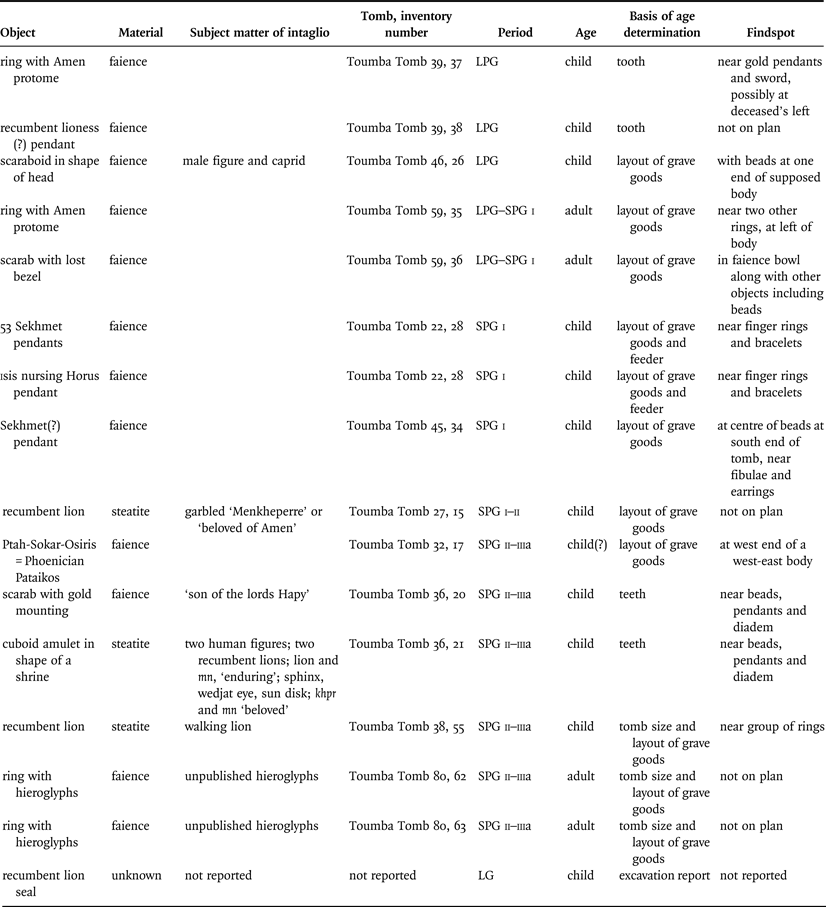
There are sixteen scarabs, scaraboids, seals, pendants or rings from eleven tombs at Lefkandi, from LPG through LG (see Fig. 1 and Table 2).Footnote 45 Their chronological distribution is relatively consistent. All are imports from the east and might be classified as ‘Aegyptiaka’, though it is unlikely that they are specifically Egyptian. These disparate objects may be studied as a group on the basis of their size, portability, foreign origins and inscribed or figured character, and are here classified as trinkets.
Trinkets from Lefkandi: Pataikos (Toumba Tomb 32, 17), an Amen ring (Toumba Tomb 39, 37) and a recumbent lion (Toumba Tomb 38, 55). Photos: John Blazejewski/Princeton University, after Popham, Sackett and Themelis Reference Popham, Sackett and Themelis1979–80, Plate 235a; Popham and Lemos Reference Popham and Lemos1996, Plate 142a, g. Reproduced with permission of the British School at Athens. See Table 2 for further information.

Scarabs, scaraboids, seals, figural pendants and inscribed rings from the Toumba cemetery at Lefkandi.
A brief survey of figured eastern exotica from the Middle Geometric period and earlier reveals how rare these objects were in their Aegean context. At Athens, two ivory stamp seals, probably carved locally, appeared in an EG ii burial,Footnote 46 and a figurine of Hat-Mehit was found in an MG ii grave.Footnote 47 At Anavysos, a scarab was placed in an MG ii inhumation,Footnote 48 and at Eleusis the so-called Isis burial produced an Isis figurine and three scarabs along with MG pottery and finds, and another scarab accompanied a second burial that dates shortly thereafter.Footnote 49 A figurine of a seated deity was placed in an MG tomb at the Serraglio cemetery on Kos.Footnote 50 Rhodes, probably home to Phoenicians and/or Cypriots, produced more substantial quantities of imports, but mostly from the later eighth century.Footnote 51 An exception is at Ialysos, where a PG burial contained a bone amulet with stamped circles, a faience figurine of Bes and a faience pyramid seal.Footnote 52 There are more finds on Crete, particularly from the Knossos area. At Vrokrastro, two tombs with late tenth- or early ninth-century burials contained a total of seven seals.Footnote 53 At Knossos, Fortetsa Tomb 6 dating to EPG contained a faience ring with a schematic royal cartouche,Footnote 54 and Fortetsa Tomb 9 dating to the PG period contained a faience amulet of Sekhmet.Footnote 55 There were two scarabs deposited in the late ninth-century Tekke ‘Jeweller's’ tombFootnote 56 and one in an MG burial on the lower Gypsades.Footnote 57 Eleftherna has produced a faience figurine of Sekhmet with a possible Phoenician or Aramaic inscription in an MG–LG burial pithos.Footnote 58 The more plentiful finds on Cyprus will be discussed below.
Only in the LG period did minor, figural imports appear in abundance throughout the Aegean, increasingly in sanctuaries rather than graves. Aegyptiaka were made at Rhodes, and in the seventh century Naukratis began to provide a steady supply.Footnote 59 In Italy, Egyptian(ising) scarabs appeared in the first half of the eighth century, at Veii, Tarquinia, Cumae, and especially Capua and Pontecagnano, possibly carried by Greeks.Footnote 60
In its geographical and chronological context, therefore, the quantity of minor exotica at Lefkandi stands out, even if the overall number at first appears to be small. They were among the most manifestly exotic objects at the site, bearing foreign imagery, inscribed with foreign symbols (hieroglyphs), and even representing foreign deities. With their outlandish visual idioms, they appeared more exotic than a bronze pitcher or gold bands. Iconography, signs and/or raw materials were dramatically ‘other’, neither local nor locally imitated. But, as discussed, small and worn close to the body, they were not prestige-goods on par with, for instance, a bronze bowl. They may have had a strong visual interest, but their semantic message was not directed towards an audience of observers such as a group of mourners; they were not for display. Who would want to showcase such cheap material? Steatite was neither rare nor hard to work, and faience was friable. Admittedly, it is difficult to recover ancient perceptions of materials, and in the Bronze Age faience production may have been centrally controlled and used primarily in religious contexts, valued for its lustre and composite character, but by the Late Bronze Age faience was not uncommon.Footnote 61 And while the scarcity of faience objects in the Early Iron Age Aegean might suggest that it had high value, Georg Nightingale has shown that the faience at Lefkandi was of low quality.Footnote 62 Most significantly, many of the faience objects found at the site were made in moulds, and thus bore the visible traces of mass production. Some of the trinkets at Lefkandi even occur in exact duplicates. One can infer that consumers at Lefkandi were aware that the objects were not unique but serially produced. The act of placing a scarab in a gold setting (Toumba Tomb 36, 20) to increase its worth exposes the intrinsic low value of these trinkets.
Trinkets were notably absent from the most prestigious burials at Lefkandi: the cremation and inhumation within the apsidal building. In addition, Crielaard has convincingly identified ten Cypriot elite tombs with certain defining characteristics, many of which were shared with the Lefkandi building burial: the dead were the first to be interred in a new cemetery; they received cremation, particularly in urns; they were accompanied by weapons and dining equipment; and frequently they also were accompanied by antiques.Footnote 63 In only three of these elite tombs was the deceased buried with a trinket, although such objects were not uncommon on Cyprus.Footnote 64
In the decades after grave deposits end at Lefkandi, these minor objects were certainly not restricted to a Greek elite, as evidenced by the distribution of scarabs and scaraboids. Beginning in the eighth century, they were deposited in sanctuaries in too great a quantity – by hundreds and sometimes thousands – to be the purview of one narrow social group. At Pithekoussai, scarabs, scaraboids, lyre-player seals, cartouche rings and eastern figurines were deposited in tombs that have been rightly characterised by the excavator as non-elite (in contrast with princely burials at Cumae and Eretria) because of the grave assemblages and the large number of tombs.Footnote 65 Günther Hölbl explains away the quantity of Aegyptiaka at Pithekoussai as an exception to elite Italian consumption due to the ostensibly low price of scarabs at such a trading centre,Footnote 66 but it is more likely that these minor objects were already generally inexpensive in the Early Iron Age.
So it seems that a small number of people at Lefkandi decided to deposit trinkets, for reasons unrelated to socio-political display. A closer look at the mortuary deposition of scarabs, scaraboids, seals and figured/inscribed pendants and rings demonstrates that these minor objects performed a particular function in their context. Data on age is difficult to obtain for Lefkandi, because most of the organic remains have not left a trace, yet close analysis of the published, scaled plans and the grave goods indicates a correlation of trinkets with age (see Table 2). Two burials with bones that were present and analysed show that children were interred (Toumba Tombs 36 and 39).Footnote 67 For other graves, it is possible to determine whether the deceased was an adult or a child on the basis of the size of the grave, the type of grave offering and/or the layout of the offerings. That is, vessels were laid around a corpse wrapped in a burial shroud pinned with fibulae, and jewellery and other personal adornments were placed on the body or shroud. It is thus possible, for instance, to calculate that the deceased in Toumba Tomb 46 was less than half a metre tall; in Toumba Tomb 22, just over a metre (and note that a feeder was also present); in Toumba Tombs 45 and 27, well less than a meter; and in Toumba Tomb 38, about a metre.Footnote 68 The deceased in Toumba Tomb 32 was not surrounded by enough offerings to take a straightforward measurement. S/he could have been as tall as 1.4 m, but grave goods laid on the body (the only goods in the tomb) cover only about 0.80 m of the tomb length. Table 2 makes clear what criteria have been used to establish if the deceased was an adult or a child.
Not only were the minor, inexpensive, portable imports deposited with children, but there was a close relationship between the objects and the bodies of the deceased. The objects were pierced to be worn around the neck, and rings obviously were made for the fingers. The placement of the grave goods within the tombs indicates that trinkets were deposited near the head or chest of the deceased, as shown by their location at one end of the grave (Toumba Tomb 32) and proximity to earrings (Toumba Tomb 45) or diadem (Toumba Tomb 36).Footnote 69 Sometimes the trinkets were found with necklace beads that may have been on the same string (Toumba Tomb 46). The pendants in Toumba Tomb 22 may have been laid next to the deceased, and the grave goods in Toumba Tomb 38 seem slightly scattered and disturbed, but otherwise there is a close connection between object and corpse. The adult burials differ significantly: in Toumba Tomb 59, the scarab was placed in a faience jar, and in Toumba Tomb 79, a burial for a warrior-trader, the cylinder seal was outside the funerary cauldron.
Although some of the trinkets recall seals, which in many regions and periods were closely associated with their owners and worn on bodies, it is clear that at Lefkandi these objects were not generally used for sealing, for sealings were preserved in Toumba Tomb 22, but without any figural seal impressions. The North Syrian cylinder seal in adult Toumba Tomb 79, found along with a scale and weights, may be an exception.Footnote 70 In contrast, the children buried with seal-like objects would have had no need to engage in sealing activity. They held no political power and were not yet fully socialised beings.
The significance of these manifestly foreign objects can be deduced from formal properties, placement close to the corpses of children, and contemporary parallels. The inscribed hieroglyphs bore formulas apposite for burial contexts, the figured deities were associated with fertility and/or averting evil, and scarabs were linked with concepts of regeneration and renewal. Families used these objects to invoke foreign deities or forces, so as to capture their power or to protect against them in a mortuary context. They are best understood as amulets or talismans. Amuletic practice was common in Egypt and quickly spread to the Near East and thence to Cyprus.Footnote 71 The garbled hieroglyphs, the style of the Lefkandi trinkets and the absence of distinctly Egyptian funerary amulets like heart scarabs make a Near Eastern or Cypriot rather than Egyptian origin most likely. The deposition of the trinkets foreshadows practices at Pithekoussai, where such objects were buried overwhelmingly with children and/or sub-adults, and were placed near the chest and neck.Footnote 72
In a study of perceptions of Phoenician traders, Susan Sherratt suggested that over time some Lefkandi residents thought that they had been ‘fobbed off’ by faience wares that would be regarded ‘as not much more than the equivalent of children's toys in their place of origin’.Footnote 73 This statement, while acknowledging the low material value of trinkets, neglects their prevalent use in tombs in the Near East. Such widespread consumption was driven by the belief or at least the hope that talismans might work. The Phoenician cemetery (tenth–seventh centuries) of Tyre Al-Bass provides a recently published parallel for the practice. Here non-elite were cremated and placed in one or two urns, with scarabs in 20 per cent of the burials, mixed with the bones or placed at the top of the urn.Footnote 74 The cemetery at Azor provides another recently published Levantine example.Footnote 75 Mourners who placed trinkets in the graves at Lefkandi similarly believed they would protect the dead on an eschatological journey, or protect the living from the restless spirit of the dead. Without literary sources, it is impossible to be more precise. Children seem to have been selected for this treatment because they were not yet fully developed social and physical beings, and thus were particularly in need of help on a journey or of propitiation. Elsewhere in the Early Iron Age, including among members of Lefkandi's cultural koinē, the bodies of children also received different sepulchral treatment from adults. They were not accompanied by trinkets, but were frequently interred rather than cremated, and placed in intramural graves.Footnote 76
Although we cannot be very precise about the details of beliefs, the deposition of trinkets with children at Lefkandi represents an amuletic or talismanic practice negotiating the relationship between mourners and the body as well as the spirit of the deceased. There are, of course, social dimensions to this practice: special treatment of children indicates that lineage was important to the society, and the ability to provide a particularly powerful protection for or against the dead may have been considered a privilege. Talismanic practice, however, also introduces an important and underemphasised explanation to the consumption at Lefkandi and the variation therein, which cannot be subsumed under socio-political readings: varying conceptions of the power of the exotic.
Recovering the talismanic function of some of the objects in the tombs offers an addendum to interpretations of eastern exotica as elite consumption, reflections of social status or vestiges of economic models dominated by an aristocracy. Although work on mortuary variability has succeeded in exposing the rich complexity of funerary rituals and the difficulty in moving from archaeological remains to descriptions, explanations and analyses of the many actions, objects and motivations entangled in the rites for the dead,Footnote 77 comparatively little scholarship has attempted to assess beliefs, conceptions or superstitions about the dead and the afterlife.Footnote 78 Few archaeologists have denied the role of belief in funeral ritual, but many today doubt its role as a primary cause of variability, and hesitate to use material evidence to recover eschatology in a prehistoric period.Footnote 79 But variation in belief begins to explain why some people at Lefkandi deposited trinkets while others did not, and opens the possibility that other goods, too, were placed in graves because they had a particular eschatological function. Differences in fashion, taste, belief or cognitive frameworks, in addition to economic well-being, explain the heterogeneity within the grave assemblages at Lefkandi as well as its regional exceptionalism.
This amuletic practice itself, however, needs further explication. As Lewis Binford maintained, ‘The argument against an idealist position is, of course, to point out that, by a referral of observed differences within one class of phenomena (behavior) to postulated differences within another (ideas), we are forced to seek the explanations for differences in ideas and in the conditions favoring their change.’Footnote 80 The rest of this article will, accordingly, consider three interrelated causes or conditions for the talismanic value of minor exotica at Lefkandi: continuity with the past, foreign influence and the monumentalisation of eschatology.
Three conditions of talismanic practice at Lefkandi
There were precedents for burial with amulets. In LH iiic, not only adults but especially children received intramural burial at Lefkandi, interred underneath floors and close to walls. One burial was accompanied by a ‘vaguely humanoid’ green steatite stone amulet, with incised circles on one flat side.Footnote 81 Perhaps people discovered such burials at Lefkandi with amulets when repurposing the site in the Early Iron Age. Amulets, including low-value trinkets, were more common at LH iiic Perati in Attica, where there were more imports than anywhere else on the mainland at this time: thirty-five scarabs, figurines, seals, rings and crescent or rosette ornaments from fourteen tombs, with one surface find.Footnote 82 Elsewhere, glass and soft stone seals were deposited in Late Helladic tombs in Phthiotis and southern Thessaly. In particular, at Elateia, simple steatite, pressed glass and fluorite sealstones were deposited in large numbers in post-palatial and PG graves, and some of them were made exclusively for the tomb.Footnote 83 Perhaps the practice at Lefkandi was acquired through contact with such places on the mainland, where seals continued to be deposited with the dead. The pottery record, at least, attests to some form of contact among Euboea, Attica and Thessaly in the Early Iron Age.
The chronological gap between much of this activity together with the limited use of amulets at Lefkandi, however, suggests an external stimulus was also necessary. The eastern character of the Lefkandi trinkets indicates that the stimulus came from overseas, and the particular use of the objects implies that people and not just goods were on the move. The trinkets, that is, were not sold with instructions. The deposition of these objects was imagined to be a powerful and efficacious act, and such a practice was not commercially acquired along with an object but learned at a more personal level. So it is most likely that residents of Lefkandi travelled to a place where they observed or heard about the power of amulets, or that people migrated to Lefkandi and brought the practice with them. The two options are not, of course, mutually exclusive.Footnote 84 Euboeans probably were themselves involved in trade, commerce and military ventures in the east by the LPG period, when Euboean vessels (among them amphorae) appear at Tyre and Cyprus. There are also signs of immigrants and intermarriage at Lefkandi. Athenian trench-and-hole burials stand out in the Toumba mortuary record.Footnote 85 A cauldron burial of a warrior-trader (Toumba Tomb 79) containing Phoenician and Cypriot jugs, a scale, weights and a cylinder seal has an excellent parallel at Achziv.Footnote 86 The skilled working of metals, an MG cup with a Semitic inscription from Eretria and the historical tradition that Phoenicians were on the island all build the case for the movement not just of goods but also of people – people who valued trinkets and knew how to use them.Footnote 87 Similarly, at Pithekoussai, where trinkets were deposited in considerable number, there is good evidence for foreigners.Footnote 88
The lack of eastern parallels for the majority of Lefkandi burials does not militate against the presence of immigrants, for burial forms in Phoenicia varied significantly. Moreover, burials are not always a clear sign of ethnicity. The tombs of Euboean colonists at Pithekoussai, for instance, were not especially Euboean in form, and on Cyprus, despite the attested mix of Greeks, Eteocypriots and Phoenicians, burial forms quickly assumed a rather uniform appearance (dromos and chamber tomb).Footnote 89 Although many scholars have been sceptical about identifying migration in the Early Iron Age archaeological record,Footnote 90 the discoveries of a Phoenician shrine at Kommos and of cippi at Knossos and Eleftherna, although admittedly later in date, make such doubts increasingly tenuous.Footnote 91
Any easterners active in the Early Iron Age Aegean are usually identified as Phoenicians, but there is evidence that connections between Cyprus and Lefkandi were relatively strong, and it is probable that the practice of depositing amulets was imported by Cypriots or learned by residents of Lefkandi travelling to Cyprus.Footnote 92 The close relationship in material culture between Cyprus and Phoenicia renders distinguishing the two difficult,Footnote 93 but many finds at Lefkandi can be attributed more closely to Cyprus than Phoenicia, beginning in the earliest Iron Age tombs. A Cypriot bird vase was buried in a Lefkandi EPG grave along with a local imitation.Footnote 94 EPG local pottery at Lefkandi, such as the straight-sided pyxis, the bird vase and the lentoid flask,Footnote 95 demonstrates the impact of Cypriot models and/or resident Cypriots either producing the goods or creating a demand. The remains of the man in the apsidal building were buried in a Cypriot antique, possibly a family heirloom,Footnote 96 and imported objects from Cyprus abound following the construction of the apsidal building: flasks, mace, white-painted and black-on-red jugs, a wheeled stand, and possibly some of the bronze vessels. The gold diadems at Lefkandi also have good parallels on Cyprus.Footnote 97 Euboean pottery appeared in Cyprus in the Protogeometric period, particularly along the southern coast, and was imitated at Amathus.Footnote 98 Most importantly, on Cyprus, amulets – both local sealstones and imported Aegyptiaka, of low- and high-value material – occur in the earliest levels of Iron Age burials.Footnote 99 Amathus, with its combination of early Greek and Phoenician imports, may be the best candidate for a multicultural setting for learning amuletic practices, or for Cypriot immigration to Lefkandi.
Traditional beliefs strengthened or (re)stimulated by foreign influences are still not sufficient to explain the talismanic practice at Lefkandi. Why do imports not appear in such numbers at other sites where the historical record or excavation suggests close contacts with Cyprus and the east? The third necessary condition is the topography and phenomenology of the Toumba cemetery. Unlike the other necropoleis at Lefkandi, and unlike the cemeteries elsewhere in the Aegean, the graves at Toumba were laid out at one end of an enormous, elaborate apsidal building covered by a low tumulus. Much of the discussion of this monument has focused on the chronology of events, namely, whether it was initially constructed as a residence or as a funeral building.Footnote 100 The evidence for an intended sepulchral purpose is strong: there are no other residences in the area; the building was incomplete and hardly used; the central colonnade was widened around the burials, indicating forethought; and the cremation fire from the burial pit predates the floor above it.Footnote 101 Nevertheless, in focusing on such sequences of events, it is possible to miss the forest for the trees. Regardless of why it was first built, the monument was the largest structure in the area and the focal point of the graves; it had a profound visual impact. And whether it was intended as a home or a tomb, ultimately it was a house cum tomb, a monument that gave visual form to ideas about memorialising the dead and about the importance, potency and afterlife of the dead. Built, doubtless, as an extravagant burial marker elevating the social status of the deceased and their families, it engendered mortuary ideas and practices, which would have been reinforced over the years as more and more people laid graves around the tumulus. As a sepulchral house, the monument fostered the notion that the dead should be cared for and that, in some way, they resided in the tomb. The fact that Toumba Tomb 68 echoes the burials in the apsidal structure suggests that there was a collective memory of what lay under the mound.Footnote 102 Moreover, the placement of tombs specifically around the eastern edge of the mound, where the entrance to the apsidal building had been located, and sometimes cut into the mound itself, further suggests that people remembered the covered building's structure and that they desired to make a meaningful connection to the building and to the residents within.
It is possible that the monument was conceived as a heroön, for there are some features within the apsidal building that may have been used for ritual purposes. Moreover, a krater near the burials may have received libations, and in front of the tumulus an area at least 7.5 × 3.0 m was flattened out and a large tripod erected, perhaps serving as a place for feasting or other ritual activity.Footnote 103 No offerings, however, have been identified, and the designation heroön is probably anachronistic and narrow. Nevertheless, the structure monumentalised the practice of honouring, protecting and remembering the dead, and provided a focal point for conceiving of a continued presence of the deceased. Such a mortuary landscape provided suitable grounds for talismanic practice to flourish.
Conclusion
Nicolas Coldstream, an authority on the Early Iron Age, prefaced a discussion of foreigners at Lefkandi with the following assertions:
We can dispense quite briefly with the supposition that a large quantity of imported orientalia in the richer tombs must necessarily indicate the presence of merchants from the East Mediterranean. No: these eastern exotica take their place in the richer tombs beside fine imports from Athens and elsewhere, and are better explained as displaying the eclectic tastes of a local aristocracy, always interested in eastern and other foreign contacts, but always interred in accordance with the peculiar local burial rites. Some eastern merchants may well have resided at Lefkandi, but we will not find them among the burials so far excavated.Footnote 104
Coldstream does not define ‘richer tombs’. Perhaps, as so often in scholarship, the presence of orientalia is used to define a richer tomb and then … a richer tomb contains orientalia. A close look at the contents of several graves has demonstrated instead that the connection between imports and status is assumed more often than it can be proven. The alleged inhabitants of the tombs, Coldstream's ‘local aristocracy’, also pose problems, for the consumption pattern and regional exceptionalism at Lefkandi do not fit well into models of prestige-goods or gift-exchange. Coldstream's recourse to ‘eclectic tastes’ gives up the game. It is the ‘eclectic tastes’ of the buriers that requires explanation; taste is the question, not the answer. This eclecticism extends to burial types, which we now know were not as uniform as Coldstream implies.Footnote 105
The two most prevalent reconstructions of the social structure at Lefkandi – a ‘Big Man’ society or a closed aristocracy – appear increasingly limited in explaining the site.Footnote 106 The preliminary excavation reports of the settlement indicate that it was not an unstable social system, as once was thought. Settlement at Xeropolis instead was continuous, and the community flourished after the death of the supposed Big Man in the apsidal building, rather than disintegrating, as Big Man models demand.Footnote 107 The lack of spatial delimitation to the Toumba cemetery, the absence of clear symbols of rank and the variety of depositional practice and burial goods speak against seeing it as the resting place for one group. Lefkandi is perhaps best characterised as a multicultural, proto-urban trading community, oriented towards the coast and closely linked with a variety of peoples.Footnote 108 It was a well-connected node in an expanding network. Although the Toumba cemetery has been interpreted as the burial plot for the richest family in Greece, it is more likely that it was a burial ground for multiple families marked by immigration and marriage across cultural divides and holding varying views on death and burial ritual.
Trinkets were one manifestation of these beliefs. Some grave goods were made specifically for burial, such as some ceramic vessels or gold items too flimsy to be worn, and objects other than trinkets testify to a complex eschatology. The most well-known example is the Lefkandi centaur, a wheel-made figurine deposited in two separate graves: the body was placed on top of the cover slabs of Toumba Tomb 3, with an iron knife or dagger in the grave itself, and the head was laid in Toumba Tomb 1.Footnote 109 Some of the excavators, astonishingly, argued that the figurine was an object once valued by two family members and broken upon their death so that they both could share it.Footnote 110 Petros Themelis was surely closer to the truth when he suggested that this action represented the ritual slaying of a death daemonFootnote 111 – the types of malevolent hybrid beings warded off by a powerful amulet. Speculation can quickly run rampant here, and it is not possible to be very specific about what people thought. But that different people thought different things, and that these thoughts were learned at a personal level, were structured in part by the funerary landscape, and were reflected in the varied grave goods, is hard to dismiss.
I have focused on a group of objects whose form, contexts and comparanda permit a climb up Hawkes's ladder of inference. It is uncertain to what extent high-status items such as metal bowls and cauldrons or gold jewellery shared mortuary meaning with the minor amulets; surely some did. My purpose has not been to explain the function of all the grave goods, but to argue, first, that beliefs and world-views were to some extent operative and in part explain variability, and, second, that some of these beliefs involved either immigration or contact at intimate, personal levels, situations in which practices could be transmitted and ideas about the dead shared. Coldstream himself argued that intermarriage was visible at Lefkandi in a tomb with faience vessels,Footnote 112 but I maintain that the cultural connection was more widespread and not restricted to the movement of women alone.
Talismanic consumption was not contingent upon economic factors, but depended on a latent belief stimulated by Cypro-Phoenician customs, on the one hand, and the monumentalisation of eschatology, on the other. Intermarriage, immigration or Euboean travel abroad may explain the encounter with eastern ideas, and large numbers need not have been involved. Talismanic practice cannot explain the consumption of all goods at Toumba, but it suggests that varying eschatological beliefs in addition to varying socio-political structure best explain the archaeological record at the site. What is important is that the cultural contact involved more than objects of display – ideas, too, were on the move, and along pathways not restricted to elite mechanisms of exchange. By unlinking intercultural exchange from a narrow elite, it is possible to recover multiple channels through which movement and communication occurred in the Early Iron Age, and to restore agency to actors largely neglected from archaeological literature: children and the sub-elite. If the cemeteries of Lefkandi represent the beginning of a dynamic renewal of contacts between Greece and the east, then perhaps the origins of Orientalising lie not so much in an emergent, decadent elite turning to the luxurious east, but in humble objects and new ideas on the move.



