

“It's about when I'm lying there at night thinking about things,” Streisand says. “I have so many thoughts and feelings about what's happening to our country.”
–Barbra Streisand interviewed by Bridget Read for Vogue Footnote 1In 2018 Barbra Streisand released her first record of newly recorded music in two years. Walls, her 36th studio recording, offered a mixture of original songs and covers. The release attracted significant media coverage and positive reviews. That attention focused on the explicit politics of the project, specifically its criticism of Donald Trump's cruel and divisive politics, the literal and figurative walls he tried to build.Footnote 2 Walls also represents a musical summary of Streisand's career. The songs on the album are a mixture of originals and covers that encompass many styles: Broadway, Latin, jazz, pop, rock, and soul. Tying everything together is Streisand's meticulous and expansive voice. She uses each tune to create contained dramas, stories with sweeping arcs of emotion. This is music carefully crafted to evoke “big” feelings in its listeners. In orchestrating a particular set of positive feelings—love, hope, and longing—Walls, like much of Streisand's work, is deeply sentimental. Understanding our current political crises, Walls asserts, is more an act of sympathy than intellect. To change the world, we must “feel the tears” that have been cried.
Throughout her long career, critics, journalists, and scholars have frequently commented on Streisand's dramatic and highly emotive style of performance, noting again and again that the petite, slightly “odd” woman was, in fact, “a big-voiced emotional belter.”Footnote 3 In his review of a 1963 concert held in the Café Pompeii at the Eden Roc Hotel, critic Bob Freund describes Streisand as “slightly weirdo” with a “strikingly homely face” but “who belts with an emotion you little suspect is there at first.”Footnote 4 In later years, this characteristic would be described as “sentimental” and “schmaltz.” A 1994 article in The Times of London pondered the ticket rush for the singer's upcoming UK shows: “Why will so many fork out so much, to hear a woman who has never been remotely near the cutting-edge of popular music sing sentimental ballads for two hours?”Footnote 5 In his review of the 1994 tour's first show at Wembley Stadium, Jeff Kaye described a “sentimental performance” in which the singer “talked about life, love and politics, taught a little Yiddish and offered velvety renditions of songs spanning her career.”Footnote 6 Even Streisand herself characterized that tour as a “sentimental journey.”Footnote 7 Twelve years later, reviewing a 2006 live performance in Washington DC, critic Libby Copeland described Streisand as “pure schmaltz: “What is it about Streisand that makes her at once so appealing to some people, and so awful to others? For better or for worse, she is pure schmaltz—the show tunes, the big voice, the roses, the notoriously manicured hands and the whiff of perfectionism they give off.” For Copeland, Streisand's emotionality is part of a larger-than-life persona where everything is over-the-top, from the singing to the décor to the exacting manicure.Footnote 8
During the 2006 tour, Streisand regularly included a segment where she brought a George W. Bush impersonator on stage to discuss politics. The performed “debate” satirized the then current president's flippant unconcern for major environmental and social problems such as climate change and wealth inequality. The skit drew press criticism as well as audience hecklers, but, as Howard Reich notes in a 2006 interview with Streisand, politics have always been an integral part of the singer's public life. Despite the criticisms, “Streisand,” Reich writes, “clings to her conviction that she has a duty to speak out.”Footnote 9 As film scholar Vivian Sobchack notes, Streisand is both beloved and despised for this commitment to an aesthetic of “too much”—too much politics, too much emotion, too much nostalgia, too much Jewishness.Footnote 10
The 2006 concert skit, though, is more than another example of Streisand's political commitments; it is a demonstration of the singer's larger aesthetic where sentimentality and politics are thoroughly integrated, are, in fact, one and the same. In a great deal of writing about the singer, these two aspects of Streisand's career are treated as different and, ideally, separable. “Please just sing, Barbra” runs the headline of a 2006 article in the Omaha World-Herald. Nonetheless, from her early days of fame through to the present, including most recently Walls, Streisand's sentimentality has always been intertwined with her political convictions and activism: In the same concert featuring the George W. Bush impersonator, Streisand introduced Rogers and Hammerstein's “Cockeyed Optimist” with a reflection on “finding hope in a gardenia and in a ‘baby's smile.’”Footnote 11 The sentimental and the political are part of the same discursive world: climate disaster and war, flowers and smiling babies.
This fusion is not unique to Streisand, and my essay here is intended to show how deeply rooted this connection between sentimentality and politics has been in US American cultural history. Since its development as an independent philosophical idea in the eighteenth century, sentimentality has always had a political valence as well as a racialized character (whiteness). In nineteenth-century America, sentimentality, in its philosophical and literary form, became a cultural force, mainly through the many female novelists of the era. Through the work of Harriet Beecher Stowe, it was tied closely to abolitionism. Later, in the Progressive Era, sentimental culture—literature, theater, and journalism—focused on new causes: temperance, child labor, “white slavery,” and other social problems of the industrial era.Footnote 12
The tropes of what Jennifer A. Williamson, Jennifer Larson, and Ashley Reed call the “sentimental mode,” remain an important stream in US American culture, nourishing all kinds of art from the literary work of Toni Morrison to the country pop songs of Dolly Parton.Footnote 13 In this essay, I trace Streisand's engagement with the “sentimental mode” in her recorded music. Given her work across media, especially film but also television, focusing on music might seem narrow. Scholars, however, have not produced much work specifically on her music, especially her singing, arguably the nucleus of her sentimentality. Despite her eclectic repertory, one that straddles Tin Pan Alley, Musical Theater, Pop, Rock, and R&B, Streisand has been drawn again and again to songs that lyrically touch on sentimental tropes (suffering, tears, family, children) and musically provide a platform for the expression of big feelings.
A good part of my discussion focuses on Walls, not simply because it is recent, but because, in its explicit politics, the album highlights especially well the inherent, racialized politics of the sentimental mode. Although always present to some degree, the politics of Streisand's sentimentality has only fully manifested at specific historical moments—for example, 1969's What About Today? and the 2006 concert tour. Walls is only the most recent example of this: The album is explicitly designed to spur “political engagement through emotional, cross-boundary identification.”Footnote 14 The record uses aesthetics, particularly the emotional directness of music, to instruct listeners in affective identification with the suffering of people around the world. However, in its focus on racial others—such as immigrants from the global South—Walls also brings with it the problematic racial legacy of sentimental politics where genuine concern for the downtrodden was mixed with essentialist ideas of racial identity and hierarchy. In her study of the white feminist tradition, Kyla Schuller argues that white women reformers from the nineteenth century through the present, although often speaking for racial others, have, in fact, worked “to liberate privileged women while keeping other structures of injustice intact.”Footnote 15 The sentimental politics of Walls echoes Schuller's critique: With its vague appeals to love, children, and goodness, the songs on the album avoid the specificities of the crises they mention, especially the ways these crises—mass migration, famine, war, and poverty—are sustained by racialized systems of capital and empire.
The sentimental often works in conjunction with Streisand's public identity, especially her Jewishness. For example, in the film Yentl (1983) Streisand presented her ethnic and religious identity in sentimental terms, Jewishness signifying nostalgia and family life, especially a remembrance of or yearning for parental love. In a similar way, Streisand's highly emotive approach to song interpretation was, in the ears of many gay listeners, an analogue to the queer experience in a straight society. In his book Widescreen Dreams: Growing Up Gay at the Movies, scholar Patrick E. Horrigan describes the revelatory power of Streisand's vocal performances in the film Funny Girl (1968): “One moment she sings with full-chested gusto, then suddenly she speaks the words of the song with a quiet laugh, and then again she sings in her purest head tones.” Hearing such virtuosic and expressive freedom made Horrigan feel “that no matter how miserable her life was, it was better to be her—better to look like that and talk like that and walk like that and sing like that—better to be her than anyone else in the world.”Footnote 16 For Horrigan, Streisand was a template for being fully and flamboyantly one's true self, a model for how to navigate the confines of straight society.
There has been a growing number of music scholars engaging with the large body of scholarship on sentimentality from literary and American Studies.Footnote 17 Stephen Downes offers a broad overview of musicological work, tracing the influence of sentimentality through nineteenth and twentieth-century music cultures, mostly in the Western art music tradition but with forays into popular genres such as the music of Antonio Carlos Jobim and Carole King.Footnote 18 Emily Gale's pathbreaking dissertation on sentimentality in US American music argues that, despite being derided, sentimentality stands at the center of commercial popular music providing “some of the country's most visible and challenging constructions of race, class, gender, sexuality, nationality, and morality.”Footnote 19 In their work, Sumanth Gopinath and Anna Schultz offer a detailed analysis of Karl and Harty's 1941 hillbilly hit “Kentucky,” a sentimental song embedded in a complicated history of cultural remembering and forgetting.Footnote 20 Also central to my argument is Mitchell Morris's recent study of 1970s popular music, The Persistence of Sentiment. Although he doesn't explicitly situate 70s pop in a historical tradition of sentimental practice, his analysis of musicians such as Barry Manilow, Dolly Parton, and Karen Carpenter offers an incisive, historically specific analysis of the place of “big” feelings in popular music.Footnote 21
The scholarship directly on Streisand by authors such as Linda Pohly, Pamela Wojcik, Vivian Sobchack, and Stacy Wolf, although touching on issues of sentiment, race, and politics, have mostly focused on other important characteristics: Streisand's musical technique, her film acting and directing, her Jewishness, her gender play, and her status as a queer icon. Sentimentality, I believe, ties all these strands together.Footnote 22 Highlighting Streisand's use of the “sentimental mode” bridges the divide in the scholarly and popular understanding of Streisand, an understanding that largely treats her music and her politics as separate phenomena. As I will show, they are one and the same thing.
Schmaltz, Kitsch, and Sentimentality
Rooted in the eighteenth century British philosophy of “sentiment” or “sensibility” (the terms were often used interchangeably), sentimentality proposed feeling as moral truth. Philosophers, such as David Hume and Adam Smith, and novelists, such as Samuel Richardson, Henry Mackenzie, and Laurence Sterne, asserted that humans possessed a unique “capacity for extremely refined emotion and a quickness to display compassion for suffering.” These ideas laid the foundation for a more socially and politically oriented “belief in or the hope of the natural goodness of humanity…manifested in a humanitarian concern for the unfortunate and helpless.”Footnote 23 It was in this form that the ideas of sensibility and sentiment took hold in nineteenth century American life.Footnote 24 In its original formation, sentimentality was closely tied to its male authors and the figure of the “man of feeling,” an androgynous ideal “encompassing the republican discourses of both manly virtue and benevolent motherhood.” However, as Mary Chapman and Glenn Hendler note, “by the middle of the nineteenth century…American sentimentality seemed to have become ensconced solely in the feminine ‘world of love and ritual,’ in ‘the empire of the mother.’”Footnote 25
The primary cultural location of this feminized, American sentimentality was literature, particular the enormously successful novels by women writers such as Susan Warner (Wide Wide World, 1850), Maria Cummins (The Lamplighter, 1854), and Elizabeth Stuart Phelps (The Gates Ajar, 1869). These novelists drew on many of the same themes and topics: The necessity of (protestant) religious faith, the joys and struggles of domestic life, and the sufferings inflicted on the innocent, especially women and children. The most important sentimental book in the United States was Harriet Beecher Stowe's 1852 antislavery novel Uncle Tom's Cabin, which became the template for the sentimental mode. In the preface to the novel, Stowe writes that the “object of these sketches is to awaken sympathy and feelings for the African race…to show their wrongs and sorrows, under a system so necessarily cruel and unjust as to defeat and do away the good effects of all that can be attempted for them, by their best friends, under it.”Footnote 26 The novel offers repeated, tear-stained scenes of family separations: wives from husbands and, especially, children from mothers. Significantly, it was the death of Eva St. Clare, a white child, that became the best-known scene of suffering in the novel.Footnote 27
The historical politics of sentimentality, so closely tied to slavery, were inevitably defined by US racial ideology, specifically its definitions of blackness and whiteness. The sentimentality of Stowe and others took root in the context of slavery, the bondage of those with Black skin. As many scholars have demonstrated, despite their abhorrence of the US's “peculiar institution,” many abolitionists and critics still believed in essential racial differences between blacks and whites.Footnote 28 Over the course of the nineteenth and twentieth centuries, the nature of whiteness would expand, eventually embracing identities previously deemed non-white such as Irish, Italians, and Jews. Furthermore, although the “cultural formation” of blackness would itself undergo significant changes during this time period, the binary of white–Black remained.Footnote 29 Whiteness continued to be the norm against which racial difference is measured. It remained, in the words of George Lipsitz, “a structured advantage that is impersonal, institutional, collective, and cumulative.”Footnote 30 In adopting the tropes of sentimentality, Streisand was also adopting its racialized outlook, its whiteness. This is certainly complicated by her Jewish identity, but it does not negate it: The music and lyrics of Walls frequently gesture toward racial Others as the victims of political and social injustice. As with the nineteenth century sentimentalists, there is an implied divide in Streisand's politics between the racial Otherness of the victims and the whiteness of those who need to wake up to that suffering.
Today, the charge of sentimentality is largely pejorative, a way to describe something that is both too emotional and fake at the same time. Oscar Wilde famously described it as the desire to have “the luxury of an emotion without paying for it.”Footnote 31 More recently, philosopher Michael Tanner called it a “disease of feelings” in which the sentimentalist bounces from one intensive emotional encounter to another with no consistent investment.Footnote 32 For Michael Bell, modernism was one of the forces that discredited sentimentality. “An attack on sentimentality,” Bell writes, “was one of the few threads uniting the internal variety of modernisms.”Footnote 33 As T. S. Eliot famously wrote, “Poetry is not a turning loose of emotion, but an escape from emotion.”Footnote 34 Nevertheless, sentimentality—its tropes and preoccupations—never went away. Its concerns continued to inform both “high” art and mass-mediated popular forms.Footnote 35
The Tough and Sentimental Girl from Brooklyn
The early reception of Streisand focused a lot on her kookiness and unusual looks (usually a code for her Jewish nose). Journalists and critics have also frequently noted her remarkable ability to emote on stage and on record, her predilection for schmaltz.Footnote 36 Schmaltz, Carl Wilson writes, describes performances “saturated [with] demonstrative sentiment.” The Yiddish word for rendered chicken fat, “schmaltz” entered the American vernacular through East European Jewish immigrants who became entertainers, particularly in vaudeville.Footnote 37 Just as you would add schmaltz to a dish to intensify its body and flavor, you could add “schmaltz” to an act to bolster its emotional appeal. So much fat, however, could be sickening, and the term took on a negative connotation over time. A schmaltzy performance was too much, an unnecessary and over-the-top exhibition of easy emotion. As a Jewish Brooklynite, Streisand would have been very familiar with the literal and figurative forms of schmaltz. A staple condiment in the city's Jewish delicatessens, schmaltz was also the specialty of Yiddish theater and Jewish vaudeville. Singers such as Sophie Tucker crooned on stage and on record about their beloved Jewish mothers (see, for example, Tucker's 1928 recording of “My Yiddishe Momme,” written by Jack Yellen and Lew Pollack). Streisand inherited this tradition in some general ways—an approach to dramatic song interpretation—and also in some very literal ways. Her breakthrough stage performance was portraying Jewish vaudeville singer Fanny Brice in 1964's Funny Girl.
The critiques of her sentimentality are related to Streisand's unusual genre position. Over her career she has occupied different locations on the mainstream musical map. In a review of her 2017 Netflix special, “Barbra: The Music, The Mem'ries, The Magic,” Alex Frank writes that “Streisand is essentially genre-less…best described as an extremely moderate middle ground between jazz and pop.”Footnote 38 Despite traversing many genres (Musical Theater, Tin Pan Alley, pop, and soul) and styles (torch songs, ballads), Streisand does not have an obvious and strong relationship to any particular one. Early in her career, her song choices and style placed her somewhere between a Broadway belter and a jazz-influenced Tin Pan Alley song interpreter. By the late-1960s, Streisand was recording rock and pop songs, then a little later soul, R&B, and disco. From the 1980s she has swung between genres, often, as on Walls, on the same album. Genre, as Eric Weisbard observes, however, is not the only way the popular music landscape is organized: At least since the 1980s Streisand is perhaps best situated by format —Adult Contemporary—than genre. In her case, Weisbard's notion of format better reflects her primarily middled-aged, middle-class, and mostly white audience.Footnote 39
The growing scholarly discussion on sentimentality in popular music studies, musicology, and ethnomusicology is part of a larger application of the sentimental mode to American culture more broadly. A touchstone of this work is Lauren Berlant's writing on “intimate publics” and what she terms the “unfinished business of sentimentality.” For several decades, Berlant's writing has focused on the relationship between national identity and the shifting boundaries of what constitutes public versus private life. Central to Berlant's analysis is the idea of the “intimate public sphere,” a “porous, affective scene of identification among strangers that promises a certain experience of belonging and provides a complex of consolation, confirmation, discipline, and discussion about how to live as an x.”Footnote 40 In the twentieth century, this scene of identification has been provided most often by commercial popular culture such as the novels, films, radio programs, magazines, digital media, and music that surround us. The materials that constitute intimate publics articulate a complex mixture of social affirmations and criticisms. They offer stories of adjustment to social demands but also utopian promises of escape and even transcendence. Thus, the intimate public's relationship to politics and political action is “uneven and complex.” Streisand's body of work from the 1960s to the present is an important and celebrated part of this intimate public sphere of mid-twentieth century women's culture. Although critically positioned as a modern-day, 1960s-style protest record, Walls is better understood in Berlant's terms as an example of the “unfinished business of sentimentality” in American life.
A Sentimental (and Political) Career
What has Streisand's sentimentality looked and sounded like? We can discern it both in the specific lyrical tropes she returns to again and again and through a performance style that prioritizes big feelings, the establishment of an affective community. The politics of the songs I consider—“People” and “Evergreen”—appear at first glance oblique. There is no reference in either to current events or specific political concerns. And unlike a song such as 1973's “The Way We Were,”—another major commercial hit for Streisand—it is not attached to a narrative with political meanings (in the film, directed by Sydney Pollack, Streisand plays the Left-wing activist Katie Morosky). Nevertheless, the sentimental orientation of these songs—their emphasis on abstract notions of love, faith, dependence, and family—still offer a generalized politics, a way to reconcile private desires with public ones. Through the mediation of Streisand, listeners, in the words of scholar Ray Pratt, can experience the “interrelation of individual and social situations.” “Personal categories,” he continues, when shared, “become political categories,” a desire for a feeling of community. In contrast to the uncaring and sometimes cruel world in which they live, Streisand's sentimental aesthetic offers listeners a world of “utopian longings.”Footnote 41
We can hear the sentimental mode in her first big commercial recording, “People.” Composer Jules Styne and lyricist Bob Merrill wrote the song for the 1964 Broadway show Funny Girl, a portrait of vaudevillian Fanny Brice and her tempestuous relationship with Nicky Arnstein. The song became an integral part of the show and a massive commercial hit for Streisand, a defining moment in the emerging star's career. The song is a ballad, a statement of Brice's developing romantic feelings for Arnstein, but it is also sentimental. Although it deploys some typical romantic language— “lovers,” “one very special person,” “no more hunger and thirst,”—the song's focus on the abstract collective noun “people,” replaces the trope of lovers alone against the world with a general statement on the human condition: We all need loving companionship.
Perhaps more sentimental is the song's emphasis on children and “need”: “We're children, needing other children/And yet letting a grown-up pride/Hide all the need inside/Acting more like children than children.” On the 1964 studio recording, Streisand draws out “need” and “needing,” emphasizing it melodically and timbrally. This overlaying of adult hunger for romantic and sexual desire with the hunger of children who are inherently dependent on adults gives the song a sentimental complexion that sits oddly next to the conventional tropes of heterosexual love ballads. A celebration of childhood and a concern to protect it run throughout her career, showing up in her recordings and films as well as in interviews. Streisand has been very open about her own difficult childhood—the death of her father when she was a toddler, her mother's emotional unavailability, and her stepfather's negligent and often cruel behavior toward her. Although always housed, the family was poor and struggled to buy necessities. Streisand has recounted several times the story of her water-bottle doll: “I didn't have a doll, but I would fill a hot-water bottle as a substitute and pretend. [My neighbor] Tobey knitted a little pink wool sweater and hat for it…and I swear it felt more like a real baby than some cold doll.”Footnote 42
The lyrics, however, are only a part of its sentimentality. The song's emotional power emerges from the interaction of these lyrics with Streisand's voice, always the heart of the matter and the expressive center of her musical aesthetics. Voice sits at the intersection of all the tensions between truth and artifice so characteristic of Streisand's career. In the sentimental literary tradition, genuine sensibility transcends words and can only be expressed through “stylized actions and physical demonstrations.”Footnote 43 Streisand conveys her own acute sensibility through her body, particularly her voice. As Allan Moore writes, “vocal meaning is not only a factor of what is said, but of the attitude that seems to be held by the singer,” attitudes reflected in a singer's approach to register, voice location (head/chest), rhythm, and pitch. For example, Streisand is exceptionally scrupulous about pitch, making sure it is defined and specific, but she is flexible in terms of rhythm, almost always delaying and anticipating downbeats.
The notion that the human voice is the primary carrier of human emotion, an index to the authentic self, is deeply rooted in Western history.Footnote 44 Singers, of course, have realized such emotional expressions with “paralinguistic” sounds, using their voices to produce sobs, sighs, warbles, and other intensifying gestures.Footnote 45 With the emergence of sensitive electrical amplification technology in the early twentieth century, singers discovered new ways to highlight these effects.Footnote 46 Streisand frequently uses such gesture—sighs and whispers, for example—to intensify the big emotions so important to her music.
Squarely in the Tin Pan Alley-Broadway tradition, “People” has a striking, off-kilter form. Comprised of forty-six measures, the song is rondo-like with 8-measure A sections returning after intervening sections of 10 and then 12 measures. The return to the A sections give the song a circular feeling, an imitation of our constant, perhaps never satisfied, need for “people.” Streisand works with and against the ritornellos, giving each return a growing urgency. The final 8 measures replay the A melody an octave higher and give Streisand significant space to sing at her full belt.
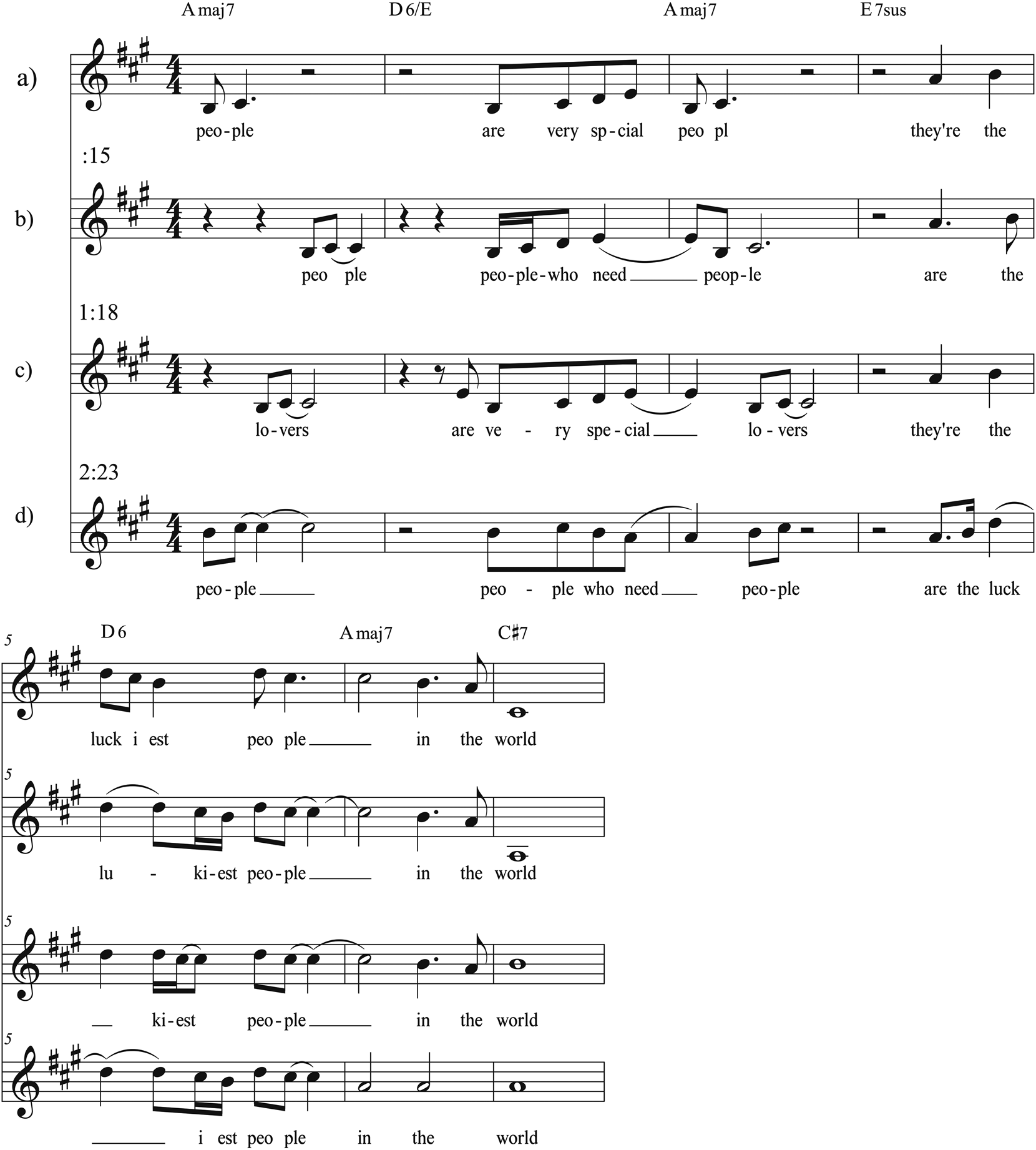
Throughout the 1964 studio performance, Streisand shifts from a low chest voice to a head voice, and later a belt, as she leaps up to the high D appoggiaturas on the words “luckiest people,” the highest notes in the song. The leap is a concise gesture of musical longing, suggesting that the things we need are just out-of-reach. The dissonant D's, sometimes approached with a leap, other times through stepwise climb, recur throughout the song and are sonic signifiers of our basic insecurity and need, even as adults, for companionship with others. Above all, it is Streisand's flexible and variable phrasing that really pushes things into overdrive. I have transcribed three different iterations of this melodic gesture throughout the song. Streisand consistently varies her phrasing. You can see this clearly when comparing her phrasing to the published sheet music—Streisand stretches and pulls the melody, sometimes on the beat, sometimes off, sometimes anticipating, sometimes delaying resolution. She focuses particularly on the word “people,” almost always delaying the start of the two-note motif. The shifting flow of melody suggests a corresponding stream of emotions that are straining at the borders, too big to be contained by the pulse or the bar lines. Unlike the tradition of the “power ballad” described by David Metzer, Streisand's performing style generally eschews the steady escalation of intensity (often via modulations) characteristic of Barry Manilow's “Mandy,” (1974) Whitney Houston's “I Will Always Love You,” (1992) or Celine Dion's “My Heart Will Go On” (1997) (Musical Example 1).Footnote 47
Comparison of opening phrase from “People,” music and lyrics by Jules Styne and Bob Merrill. Streisand studio recording released in 1964, Columbia Records: (a) published sheet music; (b) first phrase starting at :15 seconds; (c) second statement of opening melody, 1:18; (d) final statement of second half of first phrase, 2:23.

Written by Streisand and Paul Williams for the 1976 remake of A Star is Born (dir. Frank Pierson), “Evergreen” became the singer's second number one song on the Billboard charts, following “The Way We Were” from two years earlier. Both songs were integral to the films that inspired them—“Evergreen” was subtitled on the sheet music as “Love Theme from A Star is Born” and is prominently featured as a performance number mid-way through the film. “The Way We Were,” although not a musical film, features the eponymous song during the opening credits. However, unlike that song, written by Marvin Hamlisch and Alan and Marilyn Bergman, Streisand co-composed “Evergreen” with songwriter Paul Williams. The song became a massive hit, one of Streisand's biggest selling records up to that point.
The performance of “Evergreen” heard in the film and subsequently released as a single is a fascinating mixture of Tin Pan Alley ballad and 1970s soft rock. After an 8-bar introduction, the song moves through two 16-bar sections (AA1), then a 16-bar bridge (B), returning to the earlier music now split into an 8-bar variation of the primary melody followed by 6-bars of a coda. Although it is in a conventional pop music key, A major with the bridge moving to D, there is a great deal of harmonic substitutions, twists and turns that color moments we heard earlier in a new light. The shifting harmonies and modulations, as well as the large-scale form echo Tin Pan Alley practice, and give Streisand powerful tools to convey shifting emotional states. Similarly, the straightforward diatonic melody—another pop characteristic—lends itself to elaboration and development, something she takes full advantage of in the last A section. Streisand also rolls out many of her most powerful expressive vocal tools. Over the three-minute song, Streisand traverses a good part of her vocal range, reaching as low as B3 to a climactic D6 as the bridge gives way to the A section again, Streisand moving from a head-voice whisper to a big-chest belt.
Lyrically, the song offers a relatively straightforward account of romantic love. The central metaphor—love is unchanging and enduring like an evergreen—and statements that love is “soft as an easy chair” and “fresh as the morning air” are love song clichés. The couple's love is so strong that they practically merge in a spiritual fusion of “morning glory and midnight sun.” Still, the lyrics do hint at struggle. The narrator was uncertain at first, but “like a rose under the April snow/I was always certain love would grow.” Toward the end of the song, we also hear a hint of a stormy world outside the bliss of their romantic union, troubles that they have learned to “sail above.” The insistence of the refrain, “love, ageless and evergreen,” also suggests that the threats toward their happiness require frequent reaffirmations.
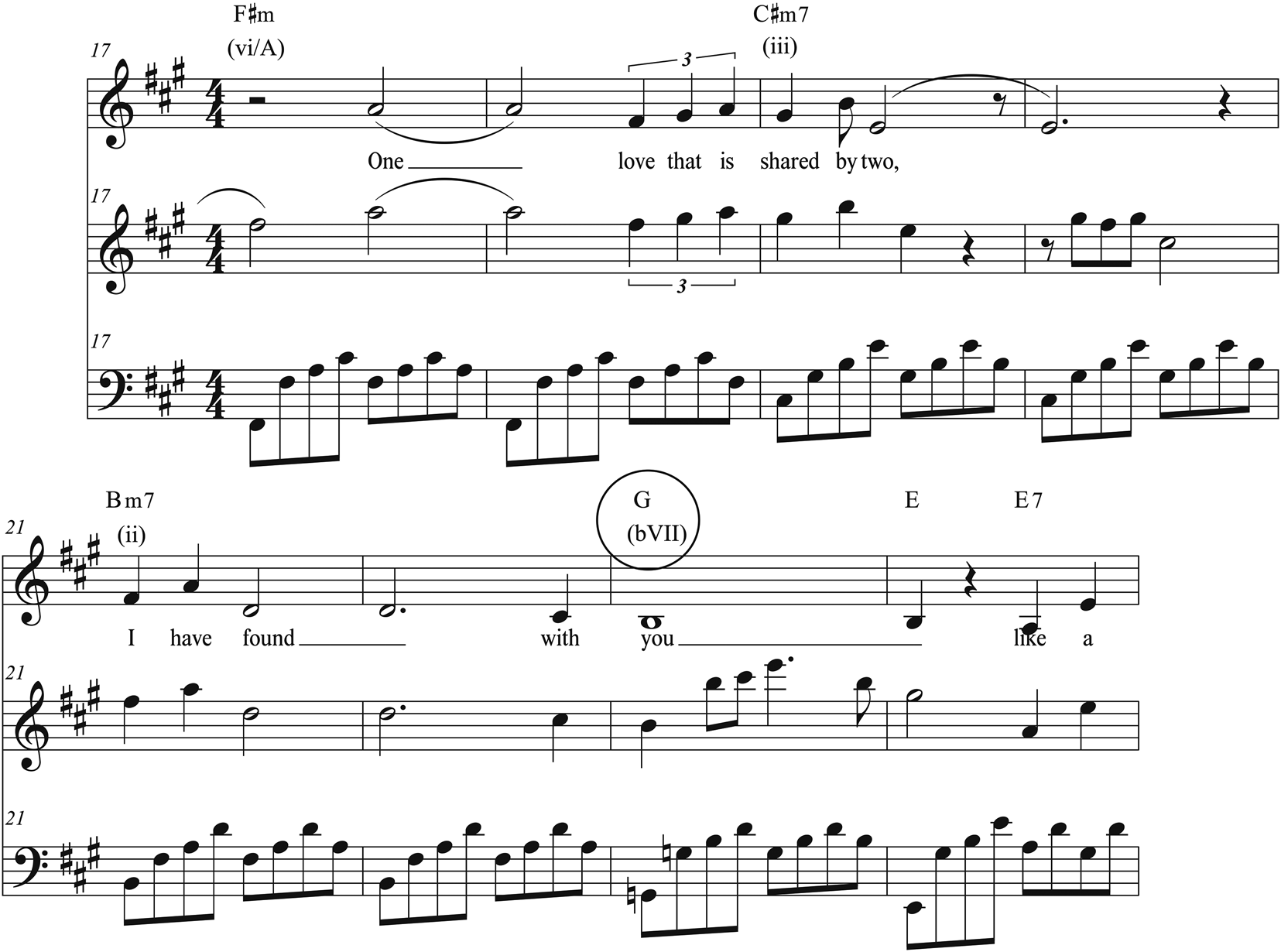
These lyrical hints at turbulence are made explicit through the musical setting, especially via the rapid harmonic shifts, such as the bVII chord on “you,” in bar 15 of the first A section—repeated again at the same place in the next A section but now in D. Often, the use of bVII implies a mode shift to aeolian. Here, though, the chord gives the feeling of a moment of unexpected transport—a gesture to the spiritual world of their ageless love (it also hints at the key of C, one of the alternate harmonic locations tentatively offered in the song). Just as quickly as it appeared the G major chord vanishes, and we move chromatically to E Major, the V of our home key (Musical Example 2). During the bridge the song pivots to D, but as with the opening key, chromatic intrusions (C Maj, C# min7) make sure we never quite find a resting place. These moments of chromatic escape, dotted throughout the song, forcefully return in the song's coda: After a brief return to D major, we slip briefly to D minor then, with Streisand repeating “evergreen,” we hear descending and ascending parallel major triads—A, Bb, B, and C—over a pedal in A. Love, the music suggests, may stay evergreen, but its physical realization is all too fleeting, our material world defined by constant change.
Another kind of chromaticism makes a brief appearance in the second verse, when Streisand sings a blue note—a C-natural against the key's C#—on “certain” (part of the phrase: “I was always certain love would grow.”) Later in the song, we hear another blues-like phrase, when Streisand sings a descending major pentatonic over “morning glory and the midnight sun.” These gestures, albeit brief, are a reminder that Streisand's influences extend beyond Broadway and the Great American Songbook to popular Black singing styles found in the blues, R&B, and soul. Of course, the influence of Black musicking extends much further back—minstrelsy, vaudeville, Tin Pan Alley, and Broadway musicals were all built on substantial appropriations of Black musical genres, styles, and practices.
As many scholars have noted, twentieth century Jewish composers and performers were especially drawn to Black musical practices. Feeling a kinship to another ostracized US American minority, many Jewish artists, including composers and musicians, found Black musical and theatrical practices a powerful means of emotional expression, a way to voice the struggles and joys of their own social position outside the dominant white protestant culture.Footnote 48 However, as Michael Rogin, Jeffrey Melnick, and others have argued, appropriating Black music was also a way to assimilate into American whiteness and cross the nation's rigid color line.Footnote 49 Streisand's use of Black vernacular musical practices, especially her forays into R&B, funk, and disco in the 70s, connects her to this complex and contradictory history. Adopting what Eden Elizabeth Kainer and Robert Dawidoff call “Blackvoice,” Streisand can draw on Black vernacular practices to expand her expressive palette and, at the same time, show a sympathy with and understanding for the Black American experience.Footnote 50 In this way, Streisand's use of Blackvoice is thoroughly sentimental, a musical assertion that emotional connection unites all of us, regardless of race.
Although “Evergreen” avoids some of the most familiar sentimental tropes—children, family, domesticity—it embraces a broader idea of the sentimental: A shared intimate space, in Lauren Berlant's terms an “intimate public,” where emotion is transparent and expressed without hesitation or embarrassment. This virtual space of public intimacy offers a feeling of the way the world could be, an ethical place of open and honest human connection. Like the texts Berlant analyzes, the song's “capacious emotional continuity” offers “an ongoing potential for relief from the hard, cold world.” “Indeed,” she continues, “the offer of the simplicity of the feeling of rich continuity with a vaguely defined set of like others is often the central affective magnet of an intimate public”.Footnote 51
“Evergreen,” music and lyrics by Barbra Streisand and Paul Williams, measures 17—24. The harmony is in A major except for the brief move to G, the bVII of the key (circled). Columbia, 1976.

“Bridges to a Better Day”: the Sentimental Politics of Walls
Even before we hear any music, Walls announces its sentimentality through its cover art. Printed on the physical copies of CDs and downloadable as a PDF with the digital version, the cover (Figure 1) features a photograph of Streisand touching a dark gray rock wall that extends up and beyond the frame. She is looking up, presumably at the top of the wall. She is wearing a black-fringed shawl, the color nearly matching the black and gray rock. It is Streisand's blond hair and bright face, however, that are the focus, the center of the mise-en-scène. At the bottom right corner in beige lettering we read Streisand's name and the title Walls. The singer has literally put herself at the center of the social crisis: We don't see migrant children in cages—an issue obliquely referenced in the lyrics of “What's On My Mind”—but Streisand herself, trapped behind walls. An ungenerous viewer might see just another example of celebrity narcissism, an embarrassing example of a star enamored of her own magnanimousness. A more psycho-biographical reading might suggest a reference to her complex history with fame, her battles to keep at least some of her life private. The walls she is “trapped” by are, in fact, her own—the photograph was taken on the grounds of Streisand's Malibu compound.Footnote 52
The album cover of Walls, Columbia, 2018.

The songs on the album, especially the original ones such as the title track “Walls,” oscillate between the personal and the socio-political. In her autobiography, Streisand herself recalls how she insisted that lyricist Alan Bregman revise the title track to “broaden the idea so that it's not just about physical walls but also about emotional walls that can build up between people…friends, lovers, husbands, and wives.”Footnote 53 The liner notes begin with “A Note from Barbra”: She laments the erosion of political values and decency under Trump (whom she doesn't name specifically). She concludes her letter with a gesture to the “millions of young people” who have raised their voice in protest. This young generation is “more interested in building bridges than walls.” Adjacent to the letter is a photograph of Streisand. Dressed casually in a sweater, she is seated in a large leather chair at a desk writing in a paper journal. We can assume— because the text is next to the photo—that Streisand is composing the very note we are reading. She writes with pen and paper, no mediation of computers, just the old-fashioned directness of a handwritten letter.
The final page of the liner notes features a photo montage. We see photographs of Streisand with her son, Jason; next to her manager Marty Erlichman; and posed with her current husband, James Brolin, Brolin's son, Josh and his pregnant wife, Kathryn. In addition, we see a photo featuring fresh eggs (presumably from her own chickens) and roses (from her own garden). Finally, there is a quartet of dog images: Streisand's personal assistant, Renata Buser holding Streisand's beloved Coton de Tulear, Samantha; two additional photos, one of Fanny and the other of Scarlet and Violet. The final image is of two dogs in a stroller—Miss Violet and Miss Scarlett—visiting the grave of the recently deceased Samantha. In a 2018 article Streisand revealed that Scarlet and Violet were clones of Samantha. Fanny was not a clone but came from Samantha's breeder.Footnote 54 This final image is remarkable—as over-the-top display of sentimentality as one could imagine. Two adorable, furry, white puppies visiting the grave of their deceased “genetic” mother. Here the classic tropes of American sentimentality—children, familial love, and suffering—are condensed into an image of bizarre, early twenty-first century high-kitsch. The only thing missing are the young puppies’ tears.Footnote 55
The musical production on Walls is uniformly rich: Nearly every pop musical device you can think of is deployed including ½ step “truck driver” modulations, changes of mode within songs, strings sections, harp glissandos, and vocal choirs. Streisand and producer Jay Landers keep nearly all the songs within the typical 4-minutes of a pop song recording. Along with “Don't lie to Me” and “What's On My Mind,” another song, “The Rain Will Fall” (written by Streisand, Jonas Myrin, Charlie Midnight, and Jay Landers), also adopts pop song conventions—clear verse/chorus structures, driving backbeats, and a thicker texture with more electric instruments.
Tears, as we have seen, are an important component of the sentimental mode. In the lead single from Walls, “Don't Lie to Me,” Streisand sings, “Why can't you feel the tears I cry today.” A Streisand-directed music video literalizes these tears by showing a woman wiping her face with her hands, a young African-American woman yelling (perhaps “crying out” and not weeping), and Obama wiping a tear away. Later in the song, we see a brief shot of the face of the Statue of Liberty, the copper stains resembling tears. Amid a montage of protesters, we see a figure holding a sign, “The Entire World is Crying.” The song's outrage—and many critics have heard anger in Streisand's singing on the album—is joined with tears, tears for the victims of the Trump's outrages.Footnote 56 Also significant here is the explicitness of the political message. The generalized, abstract lyrics—accusing someone of lying—are here clearly articulated to the specific context of Trump's presidency. Along with images of crying people, we see images of Trump and Trump Tower juxtaposed with video and still photos of protests against his policies and for racial and social justice.
Many of Streisand's tears are for “young people.” This is most evident on the track “What's On My Mind,” a ballad focused on the plight of suffering children. Given the song's Latin signifiers—nylon-string guitar, even eighth-note Latin “Bolero” rhythm, and minor key harmony—the children here may be those who were detained crossing the US-Mexican border.Footnote 57 As with the other songs on Walls, the lyrics are open to other interpretations, and the children in question could be anywhere around the globe (“The cries from distant shores/Fall on ears too deaf to care”), a fact sonically highlighted by Streisand's use of “exotic” sounding minor-key melismas. The lyrics suggest a subject position much like Streisand's own: Someone who sees the pain of children through “photographs” on the news. The tragic plight of these children fills her thoughts; they are all that is “on her mind.”
It is not simply the focus on children that makes the song classically sentimental. It is the specific religious framing of the victims. The lyrics focus on the “innocence” of children, how each one is “born divine.” Children are spiritually pure and born to love, not hate. Later Jesus Christ is invoked as a reminder that such cruelty toward children is immoral and against the wishes of God: “One wise man told us all/ Only love can drive out hate/ If we disregard his call/It could be too late.” The song's narrator cannot come to grips with so much suffering for “God's creation” that “sometimes [her] eyes just want to cry.” The tears and Christian religion of the song are tempered by the song's concluding idea, a plea for more love: “And love cannot exist alone/ It must be shared, it must be shown.”
As Lauren Berlant argues, the sentimental is more than a set of tropes; it is itself a “form,” a “dynamic pattern”:
As when a refrigerator is opened by a person hungry for something other than food, the turn to sentimental rhetoric at moments of social anxiety constitutes a generic wish for an unconflicted world, one wherein structural inequities, not emotions and intimacies, are epiphenomenal. In this imaginary world the sentimental subject is connected to others who share the same sense that the world is out of joint, without necessarily having the same view of the reasons or solutions: historically, the sentimental intervention has tended to involve mobilizing a fantasy scene of collective desire, instruction, and identification that endures within the contingencies of the everyday.Footnote 58
Even when we put aside the songs that evoke the classic mise-en-scène of sentimentality—children, family, unjust suffering—Walls is suffused with a “sentimental rhetoric,” projecting in sound and words a world where human feeling and connection displaces the “structural inequities” of the world. The album offers a “fantasy scene of collective desire, instruction, and identification,” that will supplant our damaged and unjust world.
Streisand's sentimental mode of music making is not limited to pop anthems. Sentimental tropes, both musical and lyrical, infuse her approach to other genres and styles. In the songs “Walls,” “Lady Liberty,” and “Better Angels,” Streisand adopts a Broadway sound, eschewing electronics for acoustic instruments and quiet rhythmic accompaniment. The open textures of these songs offer Streisand the most space for her distinctive phrasing and timbral shifts. “Walls,” the title track, though, is worth a closer examination as it represents many of the sentimental musical and lyrical characteristics so prominent throughout the album.
“Walls” features only acoustic piano, strings, and orchestral percussion (cymbals, timpani). The tempo is quite slow (approximately 70 beats per minute) and Streisand uses that time to carefully sculpt her lines. The entire song is a modified Tin Pan Alley form, AABA1BCA1, with clear 8 bar units and a conventional tonal harmonic language (i.e., not modal or blues-based). Firmly in G minor—there are clear V-i cadences at several key points—the song also flirts with other tonal areas, especially the VI of the key, Eb Major. In the A sections, after moving from the G minor to Eb-flat to C minor (i — VI — iv), the song veers, through a common tone, to Ab Major—a chord not in G minor (but the IV in Eb). Although the Eb key area is never established, the frequent move to Ab in the A sections as well as the prominence of Eb in the bridge, make that key central to the song's narrative. The literal and figurative walls we build leave us trapped (G min) with nothing but glimpses (Eb) of somewhere free. It is in the C section—a moment of formal surprise—where Streisand offers her most impassioned lyrics of hope—“if we took the chance to simply say we forgive” we could destroy these walls. Here the song moves briefly but firmly to F major, flat VII of g minor, an unusual harmonic move that greatly heightens the desire to transcend the walls dividing us. This utopian moment soon dissolves and the song ends where it began with a mournful, looping piano phrase in g minor. Figure 2 outlines the form and harmonic plan of the song.
Harmonic plan of “Walls”.

Similar to her singing on “People,” Streisand favors very elastic phrasing. In the first two A sections, Streisand routinely delays her arrival on the downbeats. The cretic meter of the lyrics—long-short-long (“high and low,” “thick and thin,” etc.)—strongly suggest that the second accented word land on the downbeat of the next measure, yet Streisand rarely does that, almost always delaying the arrival. Streisand often creates the most metrical tension with the key words in the song, in this case, “Walls.” Listen especially to the final A section where Streisand, voice breaking, runs the end of “gone” into “Walls,” delaying its arrival until well into the measure. Not only does she run the words of each section together, but she also connects two different grammatical sentences with “of”: “And then we'd forget, they would be gone / [of] Walls, here and there, everywhere.”
If the harmony of the song tells a story of confinement—the way walls “keep you out and keep you in”— Streisand's voice is all movement, always on the edge of bursting through the musical restrictions. Downbeats and measures cannot constrain her need to express her feelings on the suffering caused by so much division. Throughout the song, her timbre shifts dramatically, first breathy and whisper-like, then slightly raspy as if from exertion (perhaps crying), to, late in the song, a full, soaring belt. All these paralinguistic gestures convey the great emotion she is feeling and wishes you, the listener, to feel as well. Although we hear and feel her anguish sonically, the lyrics are generalized to include us: “We” build walls and “we” can tear them down. As discussed before, the walls of the song are abstract. The context, of course, points to the literal walls President Trump built, but the lyrics are less specific and point to all kinds of figurative walls in our personal and social lives, walls of misunderstanding or emotional protection that we experience in our romantic relationships, families, and communities. This abstract, generalized quality detaches the song from any specific reality and places it in an imagined space. “In this imaginary world,” Lauren Berlant writes, “the sentimental subject is connected to others who share the same sense that the world is out of joint, without necessarily having the same view of the reasons or solutions.”Footnote 59
The final category of song on the record are the “classic” pop and rock tunes of the 1960s and early 70s, “Imagine” (1971) (but fused with 1967's “What a Wonderful World”—a late Tin Pan Alley-type song) and “What the World Needs Now” (1965). Here, too, Streisand, suffuses the generic expectations of these songs with her specific mode of sentimentality. “Imagine/What a Wonderful World” begins with muffled voices echoing as if trapped in that well from the album cover. Streisand and her collaborators make some additional modifications to the song. The famous piano part is mostly stripped down to sparse, rhythmically diffuse arpeggios that wistfully emphasize the leading tone (D#) over the E major harmony. Streisand dramatically alters the melody, most noticeably on the last two measures before the refrain (“Imagine all the people…”). On the word “above” (“above us only sky”) Streisand leaps upward a minor 7th (B3 to A4) before spilling back down to the dominant, a clever piece of word painting. In place of John Lennon's repetitive, chant-like melody, and limited falsetto flourishes, Streisand substitutes her big vocal belt and a dramatic melodic jump that intensifies the dominant, creating the opportunity for a very Streisand-like ratcheting up of the emotional intensity (she makes a similar move a little later with the words “And no religion too”). After the second time through the verse-refrain, the song dramatically pivots to C major and “What a Wonderful World.” The modulation appears to musically respond to the rhetorical thought experiment of “Imagine”: We don't have to imagine a better world, because our world is already “wonderful,” a fact made real through the shift to the untroubled, white-note key of C major. Now on familiar Tin Pan Alley territory, Streisand shifts to more of a belt, rising in her range. Soon the two songs blend together, followed by more key changes (we end up in Eb), and an intensifying orchestral accompaniment. The song ends with Streisand singing “Imagine” on F and G, an ambiguous way to cadence. The song gives us just a taste of transcendence; it is still just beyond our grasp.
With “What the World Needs Now,” Streisand steers things into the world of R&B. This is a genuine surprise on a record that only hints at Black musical genres and practices. Streisand begins “What the World Needs Now” slowly and a cappella, an empty stage on which to dramatize Hal David's lyrics. Streisand uses this space to reshape the song's opening melody. She draws out “world” in the first phrase (“what the world needs now/is love sweet love”), her voice breaking at the beginning of the second phrase (“it's the only thing/that there's just too little of”). On the repeat, she modifies the melody on “need,” jumping up to C5 before falling back to the written melody note of F4. With the B section, Streisand interpolates a more extensive revision of the melody, this time emphasizing “Lord” by leaping again to C5 (“Oh Lord, we don't need another mountain”). Together, these musical gestures show again how Streisand sentimentalizes her performances, invoking and combining two defining tropes of the sentimental mode, dependence and religion. The overlaying of sentimentality onto an already sentimental song is also characteristic: This is Streisand going “big” (or for detractors, offering, again, “too much”).
Taken at a relatively slow tempo, the musical texture gradually thickens with strings. Eventually a piano enters, marking out a steady pulse, the first clear rhythmic groove. And then, around two minutes in, the song begins a dramatic transformation: Drums enter, followed by a syncopated bass line accompanied by rich seventh-chord, soul harmonies. Backup singers, male and female, support Streisand with blues-inflected lines. In the liner notes, Streisand describes the song as Luther Vandross in style but, given the political context of the record, Marvin Gaye also seems an apt reference.Footnote 60 Curiously, as if the lyrics themselves didn't signify a political message, Streisand remarks in the liner notes that Bachrach's song was his way of criticizing the Vietnam War.
The Ambivalence of Streisand's Sentimental Politics
Streisand's music, throughout her career but represented most recently by Walls, represents what Lauren Berlant describes as a female generated “affective and intimate public sphere that seeks to harness the power of emotion to change what is structural in the world.” The tears and broken families of the album can be healed by “a culture of ‘true feeling’…that sanctifies suffering as a relay to universality in a way that includes women in the universal while attaching the universal more fully to a generally lived experience.” This sentimental worldview, Berlant shows, is riddled with “contradictions about desire, suffering, and fantasies of amelioration.” A transformed subjectivity is limited in its power to transcend and repair the structural inequities and injustices of our modern lives. “Sentimentalists,” Berlant writes, “talk about the emotional costs of injustice, not the material ones; the personal impacts of not changing, not the structural benefits of continuity.”Footnote 61 For historian of feminism Kyla Schuller, the sentimentality of Walls is less ambiguous: By not confronting the deeper structures of racism, capitalism, and imperialism that created these crises, Streisand's protest ends up elevating the position of white women saviors at the expense of those racial others. Not only is she not helping, she is actually hurting the very people she is trying to help.Footnote 62
Despite the lavish sounds and images, and the earnestness of its expression, the substance of Streisand's protest is restricted by its sentimental focus. The album's reliance on sentimental tropes of children and tears shows very clearly the limits of its liberal perspective. We have walls but no specific walls. She has things on her mind but nothing too precise, no mention of the XL Pipeline, Black Lives Matters, or other social justice movements happening at the time of the album's release. In his famous essay critiquing the American tradition of protest novels—a tradition built largely from Stowe's famous novel—James Baldwin notes not just its sentimentality but its abstractions. The nuances of social life—real people in real situations—is flattened out into a “theology” that denies full, complex life to its characters. Novels like Uncle Tom's Cabin or Richard Wright's Native Son (1940) play out a drama always from the same script: Black life is inherently lacking and must be uplifted and redeemed by noble and caring white people. The ideology of white supremacy is a cage trapping all of us: “It is a peculiar triumph of society—and its loss—that it is able to convince those people to whom it has given inferior status of the reality of this decree [the inferiority of Black people]; it has the force and the weapons to translate its dictum into fact, so that the allegedly inferior are actually made so, insofar as the societal realities are concerned.”Footnote 63 The generalities of Streisand's protest, the abstraction of its victims into suffering migrants or children, is, as Baldwin notes, actually comforting, reaffirming existing ideologies, ideologies that created our problems in the first place (i.e., white supremacy and capitalist individualism). What he says about the protest novel is equally applicable to the protest song: “The ‘protest’ novel, so far from being disturbing, is an accepted and comforting aspect of the American scene, ramifying that framework we believe to be so necessary.”Footnote 64
Walls arrives in a dynamic cultural moment, a time of significant generational changes. Streisand's liberal, baby boomer perspective—arguable dominant in the American cultural life since the 1970s—is giving way to a new, younger cultural formation focused much more on the complex intersections of race, identity, technology, and social and economic inequality. We are in a paradigm shifting moment—a dramatic challenge to the liberal/neo-liberal moment of baby boomer leadership of the 1990s.Footnote 65 The post-Obama, and especially, post-2016 cultural climate is very different. Despite the shifting culture, Streisand's larger aesthetic has not essentially changed—despite roaming popular music genres, she has always remained focused on her voice and her meticulous approach to song interpretation.Footnote 66 Her sentimental approach to politics is rooted in a middle-class whiteness and feminism that has not absorbed a contemporary situation more explicitly engaged with challenging a pervasive white supremacy.
Streisand's sentimental politics may be insufficient to ground meaningful political action but it still offers a kind of comfort, a way, if only fantastically, to imagine a better, more just world. Throughout her career, Streisand has used the sentimental mode, not simply to entertain, but to connect with listeners, to literally move them, and, in the case of Walls, to move them toward political awareness, if not action. An essential thread running through all her musical and cinematic work, sentimentality provided a way for Streisand to tie together the many different parts of her identity: her regional and ethnic specificity, her place in both Broadway and rock culture, her iconic status as a global pop star, and her political activism. Sentimentality offers an important and unifying aesthetic for understanding Streisand's art and politics.
Acknowledgments
I would like to thank Louis Niebur and Jacqueline Warwick. Both heard or read earlier versions of this project and their sharp observations, suggestions, and encouragement have made this final version immeasurably better. Thank you, also, to my colleagues in the Humanities and Cultural Studies Department for their continued support and advice. Finally, a special thank you to Jacqueline Avila, Anna Marinela Lopez, and the two anonymous reviewers for their supportive but also very detailed and incisive criticisms.
Competing interests
None.
Andrew Berish is an associate professor in the Department of Humanities, Arts, and Film at the University of South Florida. He is the author of Lonesome Roads and Streets of Dreams: Place, Mobility, and Race in Jazz of the 1930s and ‘40s (University of Chicago Press, 2012) and Hating Jazz: A History of Its Disparagement, Mockery, and Other Forms of Abuse (University of Chicago Press, 2025).



 Open access

