

I Introduction
Sometime in the third century b.c.e., the descendants of Lucius Cornelius Scipio Barbatus buried him in a sarcophagus on the central axis of their monumental family tomb. Since its rediscovery in 1780, this sarcophagus, painted and engraved with biographical text, has become a touchstone in explanations of the development of Roman history, politics, burial and epigraphy. In particular, the detailed elogia of Barbatus and his descendants have often been treated as origin points for Roman historiography and historical sensibility, with their texts hypothesised to quote from funerary orations imagined to be housed in the lost family archives that may have provided fodder for Rome’s first written histories.Footnote 1 The temporal proximity between the death of Barbatus and the birth of Q. Fabius Pictor, often hailed as Rome’s first historian, roughly ten years later conveniently places the earliest phase of the Tomb of the Scipios right on the cusp of Rome’s mid-republican historiographical revolution.Footnote 2 This link is rendered all the more tantalising by the family’s close relationship with notable early authors of historical texts on Roman themes, such as Polybius, Ennius (rumoured in antiquity to be depicted on the tomb itself) and Scipio Africanus’ own son, P. Cornelius Scipio.Footnote 3
But the instinct to treat the sarcophagi in the Tomb of the Scipios primarily as text — to refashion them into the sort of chronologically ordered written archive so familiar to historians of later epochs — can elide the significance of their specific sepulchral context. The Scipionic inscriptions were inseparable from the sarcophagi they graced, and these in turn existed in precise relation to one another inside a broader chamber tomb. Barbatus’ sarcophagus, for instance, was not found in isolation. Over 100 years after his death, the Scipios excavated additional space behind his sarcophagus to accommodate the burial of another family member: Paulla Cornelia. Yet, despite emphasis in the first major publication of the tomb that Paulla Cornelia and Barbatus’ sarcophagi functioned as a unit, her burial has generally received only passing mention in studies of the tomb.Footnote 4 Researchers have been more interested in the longer verse epitaphs narrating the careers of the great men of Roman history. When it is addressed, the unique and highly visible position of her sarcophagus is generally simply attributed to space constraints in an increasingly crowded tomb.Footnote 5 I will argue that the placement of Paulla Cornelia’s sarcophagus was purposeful. Indeed, the visual and tactile relationships between it and Barbatus’ sarcophagus provide a key to the Tomb of the Scipios’ articulation of family history. I contend that family history, as perpetuated within the tomb, was not linear or chronological, but prioritised contact, continuity and comparison.
Such a model complicates the traditional narrative that written materials, particularly those preserved in elite families’ domestic archives, formed the main basis for mid-republican family history and Roman historical sensibility more broadly.Footnote 6 Recent scholarship has rightly reassessed this narrative and its almost exclusive focus on written text and chronological historicity in the Hellenistic tradition as evidence of historical thought. In particular, this work has highlighted the existence of ‘alternatives to written history’ like funeral processions, eulogies, inscriptions, paintings, triumphs, plays, epics, temples and, to a lesser extent, tombs.Footnote 7 Scholars have also increasingly advocated for more expansive approaches to historical consciousness and the perception of time itself.Footnote 8
Broadly, this research demonstrates that the distinction drawn by most modern historian between structures like tombs and narrative accounts like those of Polybius or Livy as archaeology versus ‘history’ is a modern one. Later Roman authors defined a monimentum (monumentum) as anything constructed for the sake of memory, inclusive of written accounts, poems and songs, buildings and temples. But they make clear that the original monimentum was the tomb.Footnote 9 Monimenta were fundamental to Roman historical culture, but, as Seth Bernard has illustrated, while later Roman historians referred to their own works as monimenta, the term was never exclusively textual. It remained deeply rooted in the material and experiential expression of the past.Footnote 10 Memory itself, as facilitated by monimenta and otherwise, could also be conceived as constructed and perpetuated through movement and sensory engagement within space, as Bergmann has shown in her analysis of how movement and visuality allowed later Roman houses to function as ‘memory theatres’.Footnote 11 For the most part, though, research on the physical and experiential side of Roman historical sensibility has focused on the role of publicly accessible buildings and performances, occasionally including the exteriors of tombs, but very rarely their interiors.Footnote 12
My analysis of the Tomb of the Scipios therefore seeks to apply these lessons about unwritten, experiential history in the public sphere to revise our understanding of the constituent parts of more private familial histories, particularly the ones families told themselves about their own past. I do not seek to reconstruct the lost elite domestic archive from which the Tomb of the Scipios’ inscriptions have often been assumed to quote.Footnote 13 Rather, I treat the tomb’s interior in its entirety as a monimentum and site for the experiential perpetuation of historical memory, recontextualising the famous inscriptions within their spatial and sensory environment. To do this, I turn to methodologies adopted from sensory archaeology.Footnote 14 My aim is not to retroject modern sensibility uncritically onto the peoples of the past by assuming that a visitor to the present archaeological site has the same experience of the tomb as, say, Barbatus. Instead, I explore how the sensory experiences inside the tomb differed from those outside the tomb, and how these experiences may have changed over time.Footnote 15
By answering these questions, I seek to identify the particularities of the Scipios’ articulation of family history inside the tomb as compared to the more accessible and public spectacle of history outside it.Footnote 16 I will demonstrate that, while the Scipionic epitaphs point towards approaches to written history informed by the Greek historiographic tradition,Footnote 17 they also engage with older Italic strategies of historical commemoration that were not primarily textual.Footnote 18 Read back into their original context, what we see in these texts is not a chronological historical sensibility or mere excerpts from lost domestic archives. Instead, the tomb articulated history as an evolving conversation between the Scipios and their ancestors, a conversation within which the epitaphs were not necessarily more important than other features and affordances of the tomb. Space, movement and sensory inputs shaped the Scipios’ engagement with their ancestors and their understanding of the past.
Multigenerational tombs like that of the Scipios were thus spaces where families exerted control over both content and access to historical information. Like the domestic archive, the tomb was a curated collection of historical materials comprising, yes, the inscribed texts, but more importantly, bodies (both alive and dead) and the experiences and relationships associated with those bodies. Ultimately, I argue that the Tomb of the Scipios is not primarily valuable to historians as a reflection of a lost family archive, but as a kind of ‘archive’ in its own right — a place not for reading history, but for relating to it.
II
Before analysing how the tomb’s interior served the family’s private engagement with its history, I will briefly review the tomb’s broader context and the evolution of its public façade, drawing in particular on the important recent work of Rita Volpe and the Sovrintendenza ai Beni Culturali di Roma Capitale.Footnote 19 While aimed at somewhat different audiences, the tomb’s interior and exterior articulated similar themes. Like the epitaph of Barbatus, which commemorated his political career and fine forma, the tomb’s exterior seems to have advertised the family’s political accomplishments as well as the physical appearance of its more prominent male members.Footnote 20 But unlike the epitaph of Barbatus on a sarcophagus within the tomb, the façade was always broadly visible. Its articulation of family history was thus oriented toward the Roman public, operating alongside other mechanisms for the generation of broader collective historicity.Footnote 21
The tomb’s location served this aim. Its position along the recently constructed via Appia allowed the Scipios to benefit from the visibility provided by this upgraded artery. Their tomb sat just outside the city’s Servian Wall, between the via Appia and the older via Latina that both branched out from the Porta Capena.Footnote 22 This positioning along the via Appia had political significance.Footnote 23 The road was originally built to facilitate Roman military conquest and colonial expansion southward into Samnium, a process Scipio Barbatus boasted about in his epitaph.Footnote 24 Indeed, the landscape around the tomb was dominated by monuments to elite families involved in southward and seaward conquest.Footnote 25 Cicero indicates that at least three other tombs of major mid-republican families were built along the via Appia around the same time, although the Tomb of the Scipios is the lone survivor.Footnote 26
The positioning of the tomb was pragmatic as well as propagandistic. An earlier multigenerational tomb of the Cornelii was situated nearby, so the tomb’s location allowed for some continuity between the burials of the Cornelii Scipiones and their broader gens.Footnote 27 This tomb, likely in use throughout the fourth century and perhaps into the early third century b.c.e., contained the remains of multiple sarcophagi. This included two inscribed examples: one for an otherwise unidentifiable L. Cornelius and another for a P. Cornelius Scapula, which also details that he reached the office of pontifex maximus. Footnote 28 On the basis of this tomb’s location, Pisani Sartorio and Quilici Gigli have proposed that the Cornelian gens may have owned land in the area covering both this earlier tomb and the Tomb of the Scipios.Footnote 29
The Tomb of the Scipios itself is cut into the tuff bedrock of a hill that still rises beside the via Appia. It is possible that the family’s villa sat above the tomb on this rise.Footnote 30 Nearby, likely also on Scipionic land, sat the temple of the Tempestates (the storm goddesses), which L. Cornelius Scipio boasted about founding in his epitaph.Footnote 31
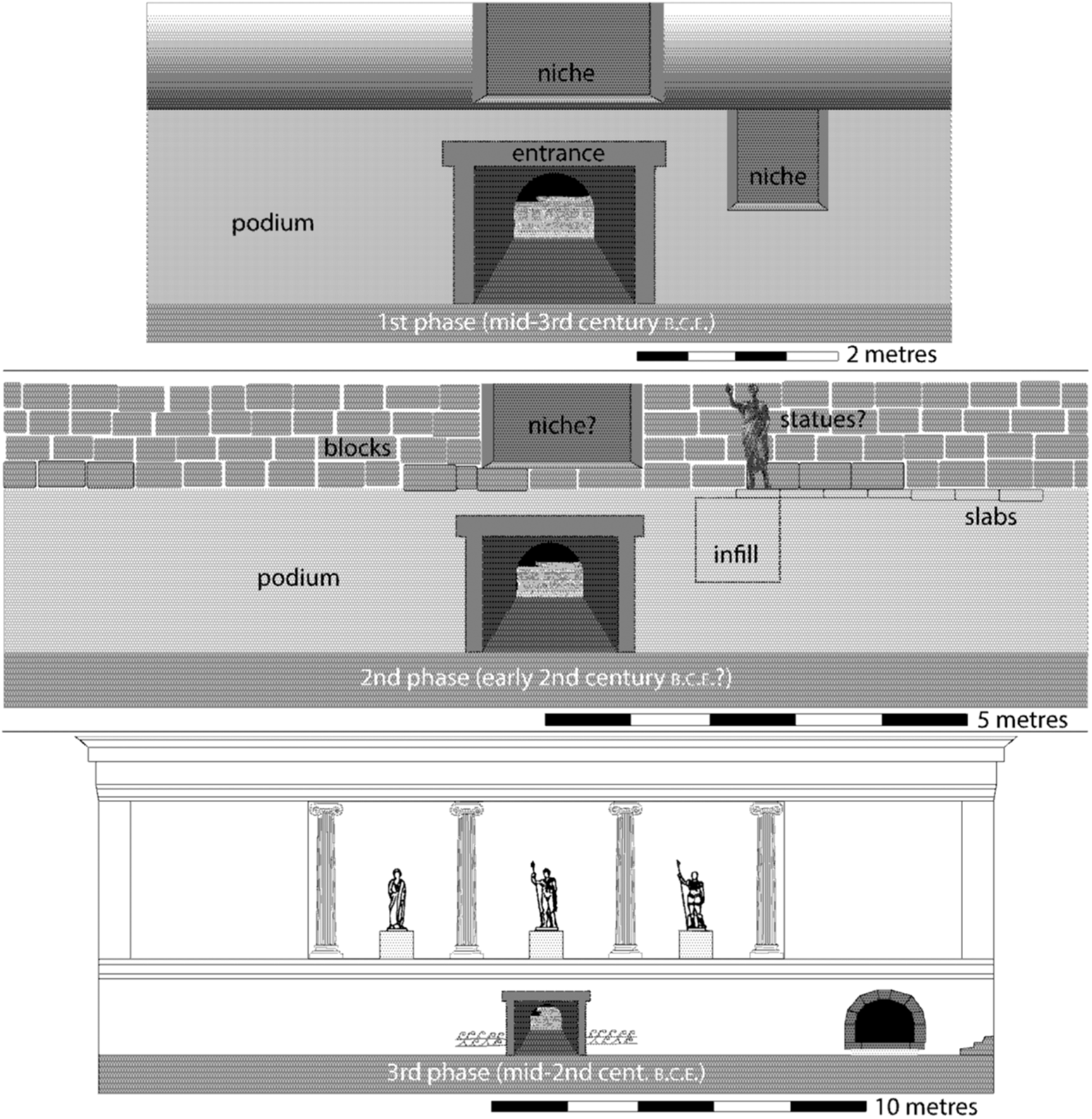
Thanks to the work of Rita Volpe and the Sovrintendenza ai Beni Culturali di Roma Capitale, we now have a much clearer sense of the development of the tomb’s façade.Footnote 32 The tomb’s first phase likely dates to the mid-third century b.c.e., sometime after the death of Barbatus around 270 b.c.e.Footnote 33 This original façade appears to have consisted of a roughly 2 m high tuff bank carved into the bedrock, with a possible deeper cut area above and at least two large niches (Fig. 1). Around the early second century b.c.e., the façade underwent a major renovation, where it was cut into and lined with blocks of tufo giallo della via Tiberina. This construction filled in the niche beside the entrance and created a sort of podium, the top of which was lined with tufo del Palatino slabs, some pierced by irregular holes — possibly the remains of pins or other supports used to anchor trophies or statues.Footnote 34
The three phases of the tomb’s façade. (Adapted by author from Volpe Reference Volpe2021)

Finally, between roughly 150 and 135 b.c.e., the tomb façade was updated again on a grand scale.Footnote 35 These renovations have been attributed to Scipio Aemilianus, the most prominent figure in the family at that time.Footnote 36 At this point, a second, smaller chamber, accessible through an arched doorway, was excavated into the bedrock beside the main entrance. In phase with this development, a monumental tripartite structure was constructed above the original façade.Footnote 37 Though the exact configuration remains speculative, remnants of at least one column survive, and ancient observers indicate it included three monumental marble statues, two of which were likely in military dress and one in civilian or triumphal dress.Footnote 38
Similar figures and possibly historical scenes seem to have adorned the base of the façade in painted plaster. While it is unclear when the front face of the podium was first plastered, the scenes were regularly updated.Footnote 39 The multiple surviving layers of plaster preserve distinct decorative programmes, including red waves and human figures on multiple registers who were potentially part of a historical or processional scene.Footnote 40
The paintings demonstrate that the Scipios’ modifications to the tomb’s exterior were likely more frequent than the major architectural renovations outlined in Volpe’s three phases. They show that the family was constantly updating and revising the narrative it told to the world at large, a tendency also evident in the tomb’s interior. However, while this focus on active engagement and revision characterised both the tomb’s exterior and interior, there were key distinctions between the family’s articulation of its history without and within. Only the most successful male Scipios appear to have been highlighted on the façade, possibly (in the case of Scipio Africanus) regardless of whether they were in fact buried in the tomb.Footnote 41 Inside the hypogeum, however, women and men who died without achieving major honours could achieve greater prominence within the family’s more private articulation of its history.
III
The circumstances of the tomb’s preservation and rediscovery in the late eighteenth century fundamentally shaped modern understandings of the space within the Tomb of the Scipios and the role of its epitaphs. Recontextualising the tomb’s sarcophagi thus requires deconstructing both the physical and intellectual consequences of this event. The various interventions the tomb underwent over the prior centuries have also rendered it difficult to reconstruct both its interior and exterior. These include alterations by subsequent generations of Scipios and the Cornelii Lentuli (a family that adopted the tomb in the first century c.e.), destruction and modification due to late antique and mediaeval construction and industry and, finally, seventeenth- and eighteenth-century antiquarian interventions.Footnote 42
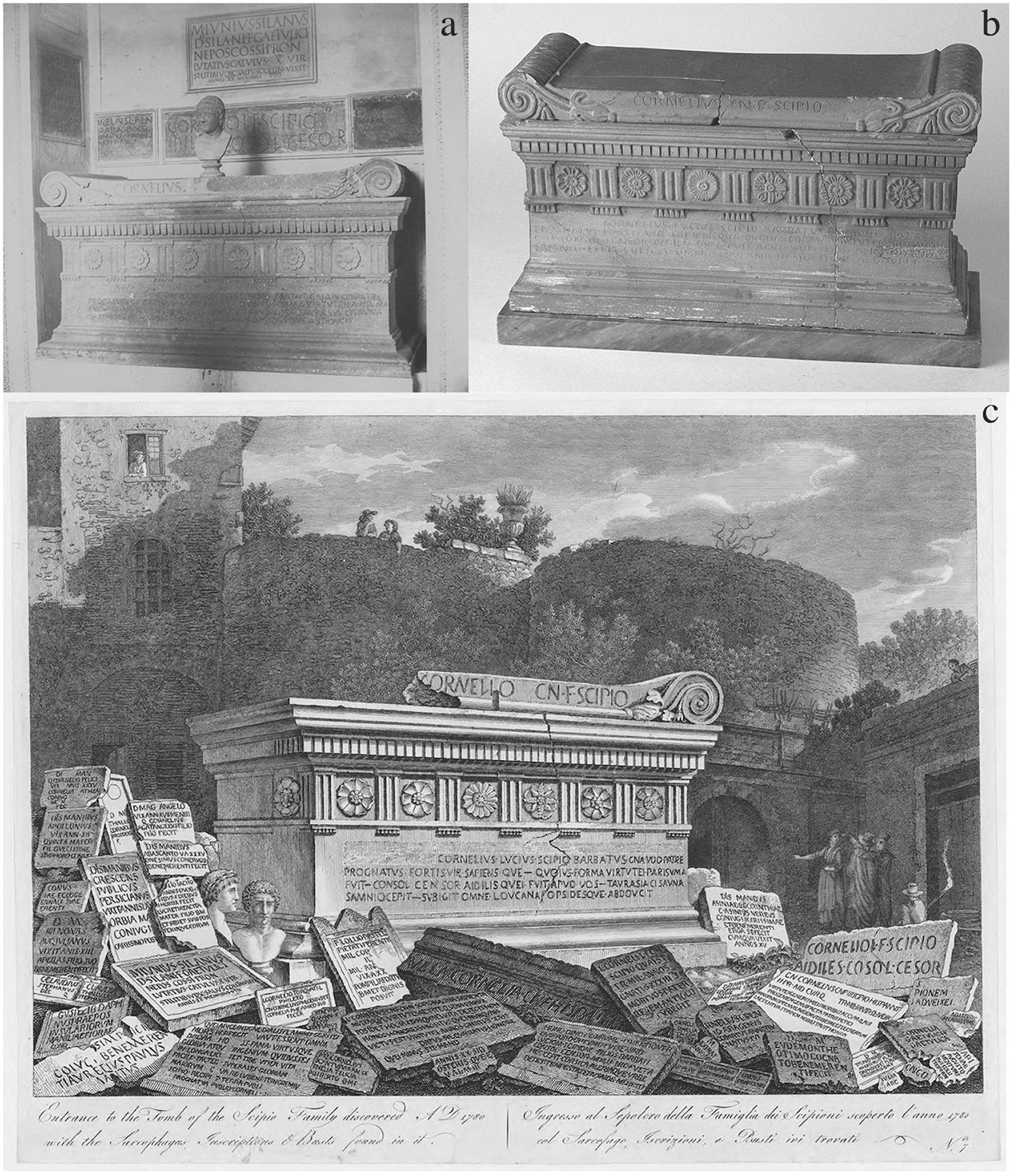
The hypogeum’s formal rediscovery occurred in 1780 when the Sassi brothers, who owned a vineyard on the land above the tomb, tunnelled into its southern corner and began systematically removing its contents.Footnote 43 Contemporary accounts and artistic depictions framed the tomb’s ‘excavation’ primarily as a hunt for new inscriptions (Fig. 2c).Footnote 44 Both visitors and early generations of researchers mourned how other remnants, including the bones of the Scipios themselves and uninscribed fragments of their sarcophagi, were carelessly cast aside or given away as souvenirs.Footnote 45 Central to this process was the decontextualisation and fragmentation of the sarcophagi’s inscribed slabs, which were transported to the Vatican soon after the tomb’s rediscovery.Footnote 46 Only Barbatus’ monumental sarcophagus survived (mostly) intact, a feat accomplished by tunnelling into the tomb’s ceiling to create an opening large enough to remove it.Footnote 47 This sarcophagus, in splendid isolation, swiftly became synonymous with the tomb itself, reproduced endlessly in the form of miniatures, stone inkwells and even replica funerary monuments (including that of a former US Postmaster General) (Fig. 2b).Footnote 48
(a) The sarcophagus of Scipio Barbatus, the ‘Head of Ennius’, and inscribed slabs from the sarcophagi of Barbatus’ son (centre, directly above), Scipio Asiagenus Comatus (left), and an unnamed member of the family (right) as they were displayed in the Vatican Museums in the 1860s. (British School at Rome Research Collections, John Henry Parker Collection, jhp-0336). (b) Stone inkwell modelled on the sarcophagus of Scipio Barbatus. An inscription inside the lid reads ‘Model of the tomb of Scipio – made of part of the stone of the original’. Calke Abbey, nineteenth century. (© National Trust/Ian Buxton, David Midgelow & Brian Birch). (c) Print depicting the sarcophagus of Barbatus surrounded by other inscriptions found in the Tomb of the Scipios in the foreground, with tourists approaching the eighteenth-century entryway to the tomb in the background. (British School at Rome Research Collections, Ashby Collection. Prints, tapri-mis-071)

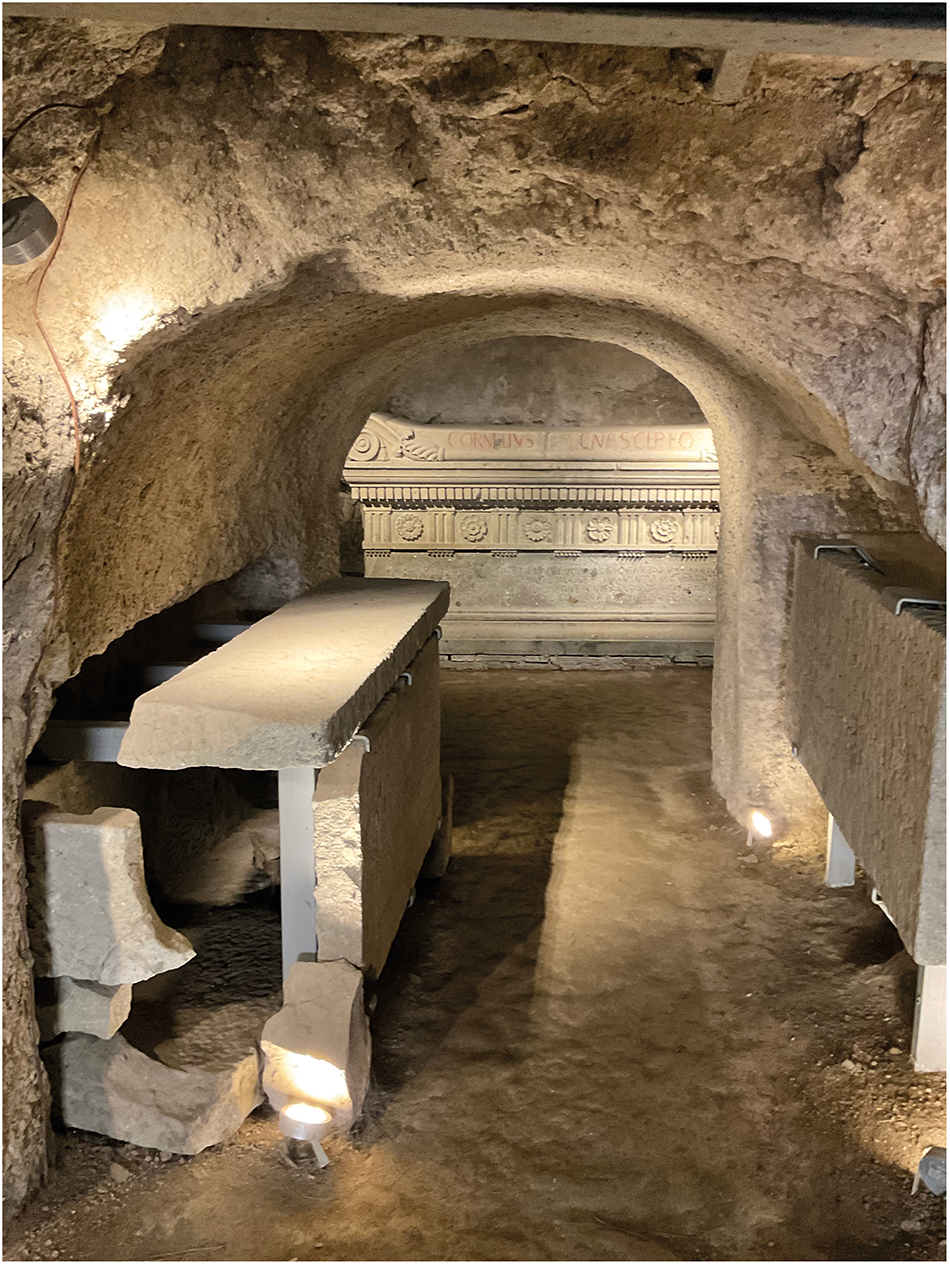
The rest of the sarcophagi were cut apart or disassembled in order to transport and mount them on the walls of the galleries of the Vatican Museums. They ceased to be sarcophagi and became solely inscriptions. Barbatus’ son’s slabs were placed directly above Barbatus’ sarcophagus in roughly the position Paulla Cornelia’s had occupied in the tomb, while her inscribed cornice was relegated to a less prominent position (Fig. 2a). Replicas of the materials held in the Vatican Museums were commissioned for display inside the tomb, where updated reproductions now sit in roughly their original contexts.Footnote 49 The major exception, however, remains the joint sarcophagi of Barbatus and Paulla Cornelia. His is pushed backwards into the deeper recess where her sarcophagus once stood, while a replica of her titulus is currently stored in the tomb’s eastern corner, invisible from its central axis.
The incorporation of the Scipionic inscriptions into epigraphic corpora further divorced text from context. While the CIL and the ILS did not publish the inscriptions in precisely the same order, they both aimed at a generally chronological structure. In both corpora, Barbatus’ titulus and elogium are published first and Paulla Cornelia’s is published last.Footnote 50 The presentation of the Scipionic elogia in the Vatican Museums and epigraphic corpora thus subconsciously shaped how modern scholars read them, just as surely as the original placement of the sarcophagi in the tomb would have shaped how ancient visitors would have encountered and engaged with them.
Although there has always been interest in understanding the tomb’s original structure,Footnote 51 it is only in the last century, with a series of renovations and new excavations, that the internal layout began to come back into focus. Initial excavation and restoration work in the 1920s and’30s included analysis of the stones used to make the sarcophagi.Footnote 52 But it was not until Filippo Coarelli’s groundbreaking reanalysis of the tomb’s remains that its phasing and the original orientation of its 30-plus sarcophagi became more widely legible.Footnote 53 The recent excavations and interventions under the auspices of the Sovrintendenza ai Beni Culturali di Roma Capitale have further clarified and complicated this picture.Footnote 54
Still, there remains a disconnect between the archaeological research conducted on the tomb and many historical and philological readings of its texts, which remain some of the most intensely studied inscriptions in the Latin language.Footnote 55 The following sections aim to bridge that gap by first establishing the physical layout of the tomb and its sarcophagi and then reading the famous elogia back into their original context.
IV
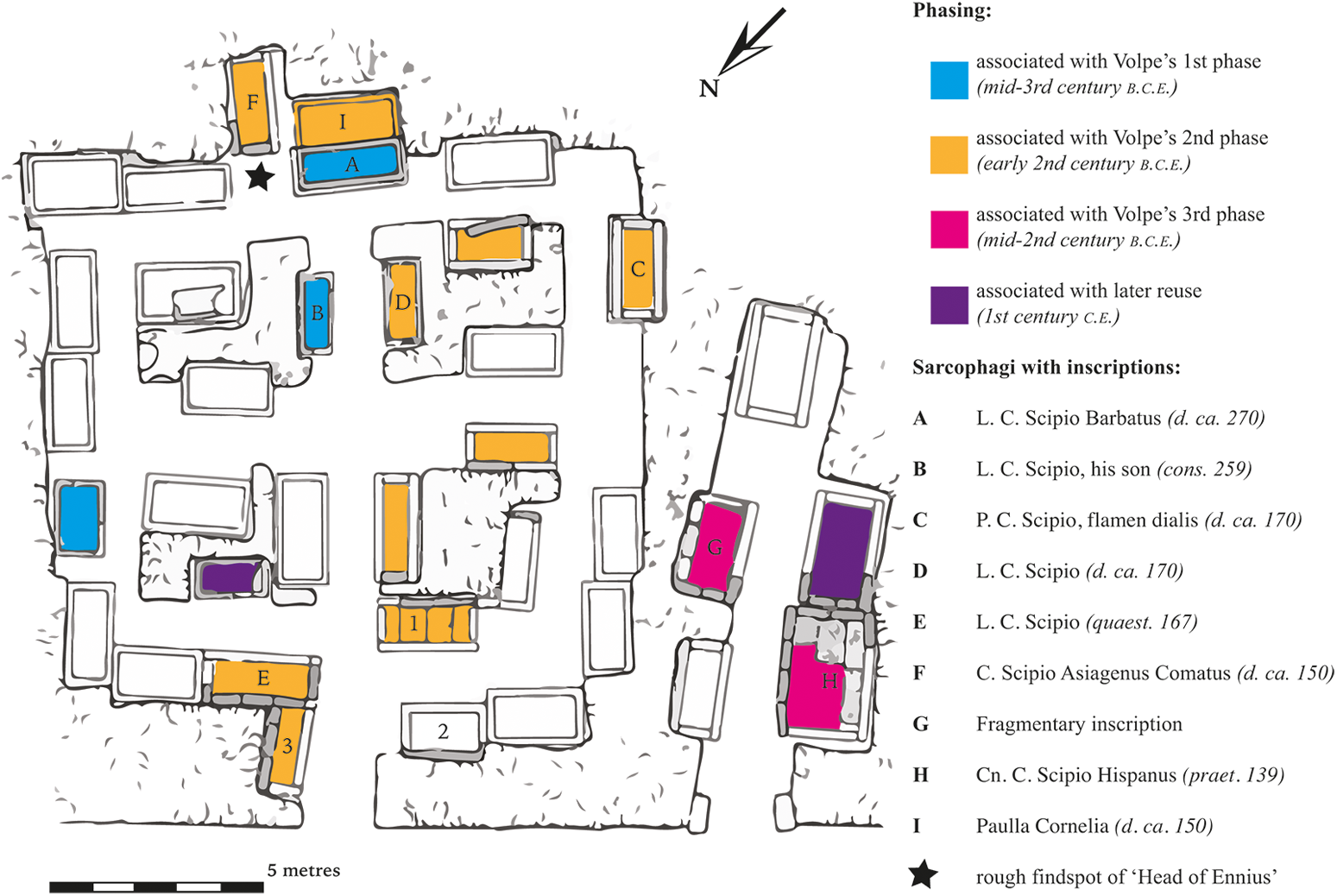
The original hypogeum was a large space roughly square in shape, subdivided by four large pilasters that supported an arched ceiling (Fig. 3). Over time, sarcophagi lined almost all the available open walls in the tomb, with additional space being excavated into the tomb walls and pilasters to make room as necessary. Although today only nine inscribed sarcophagi survive, the Scipios interred an estimated 32–34 members of their family over the course of more than a hundred years.Footnote 56 While contemporary chamber tombs in Rome and Etruria are often compared to houses, the Scipios’ tomb never adopted a domestic plan.Footnote 57 Its boxy layout may owe to the space’s possible origin as a quarry, with the Scipios’ sarcophagi replacing the blocks of tuff that had been removed generations before.Footnote 58 Still, while the Tomb of the Scipios was not modelled on an atrium house, the sorts of approaches scholars have deployed to study how later Roman domestic space structured movement, memory and social relations apply equally well to the hypogeum context.Footnote 59
Plan of the interior of the tomb c. first century c.e., with approximate phasing and locations of inscribed, extant and probable sarcophagi (lettering based on Coarelli Reference Coarelli1972). (Adapted by the author from Loreti and Simeone Reference Loreti, Simeone, Bernard, Bernardi and Esposito2008)

The limitations the tomb imposed on movement and visibility illustrate the fundamental differences between the neat, chronological ordering of family history evident in the family’s publicly oriented funeral processions and orations and the more flexible, amorphous structure of private history once within the tomb. Research on the role of the pompa funebris in Roman historical thought has generally emphasised its chronological nature, with those wearing the masks of earlier ancestors preceding the newly deceased, who was followed in turn by living members of the family.Footnote 60 The procession transformed the recently deceased into a historical figure while reiterating the family’s broader history to a potentially forgetful general audience through its display of additional ancestors in civic and triumphal garb. This was oral and physical history, manifested and marked by bodies, both dead and alive, and offering a chronological view of past and present.Footnote 61
Such visual continuity and structure became impossible once the familial participants of the funeral entered the tomb. The tomb’s internal layout with its four pilasters meant that that there was no vantage point from which all sarcophagi were simultaneously visible. For example, a visitor standing at the intersection of the tomb’s two perpendicular central corridors and facing the sarcophagus of Barbatus would have been able to see, at most, four of the tomb’s 32–34 sarcophagi (Fig. 4). Paulla Cornelia’s sarcophagus, which would have also been visible from this location, has not been reconstructed in its original position in the modern tomb. As the sarcophagus on the right of the photograph demonstrates, the fact that some (mostly later) sarcophagi were inserted into deep niches cut into the walls further impacted their potential visibility and legibility from anywhere except directly in front of them. To read the epitaphs, visitors would have needed to move and, depending on their height, stoop. Indeed, the narrow corridors necessitated by the pilasters (and further narrowed by the accretion of sarcophagi over time) were more suited to processing rather than to gathering in a large group. Because movement was necessary to interact with the deceased as a collective, one might imagine that, even after the formal pompa funebris ended outside, the family continued to move in a more fluid manner inside the tomb. The structure of the tomb itself did not mandate any particular itinerary, beyond the encouragement to walk down the central axis provided by the sightline from the entrance. In any case, movement through the tomb would have shaped the order in which the epitaphs were read and the way they were experienced.
View of a reproduction of the sarcophagus of Barbatus (centre), his son (left) and Paulla Cornelia’s son (right) as seen from the intersection of the tomb’s perpendicular corridors. Paulla Cornelia’s sarcophagus would originally have been visible behind that of Barbatus. (Photograph: Author)

Movement also impacted their legibility. As people walked through the tomb, perhaps casting the light of carried lamps or torches or obscuring this illumination with their shadows, the ability to make out portraits and sarcophagi, much less the texts upon them, would have varied. Such concerns about lighting and legibility are one potential explanation for the fact that, while the names of some of the Scipios are painted in red on the easier-to-see lids of the sarcophagi, the texts placed on their walls are both incised and rubricated to maximise their legibility in raking light.Footnote 62 For example, the lid of the sarcophagus on the left in Figure 4 was painted with the titulus of Barbatus’ son, while its front face contained the engraved elogium. While the electric lighting of the modern tomb is not comparable to ancient circumstances, light carried by visitors in the form of lamps or torches would similarly have been cast from above the top of the sarcophagus, illuminating lid more directly than the front face.
The interior appearance of the tomb further heightened the visual impact of the sarcophagi. In contrast to the vividly painted exterior, there is little evidence that the interior walls of the Tomb of the Scipios were plastered or painted.Footnote 63 The exposed tuff walls would have instead mimicked the texture of the tuff sarcophagi. Although the body lies at the centre of the experience of most tombs, the simple interior of the Tomb of the Scipios meant that the experience of the visitor, surrounded by bare tuff, echoed that of the corpse encased in its tuff sarcophagus.
Indeed, the simple presence of sarcophagi emphasised a specific element of the family’s engagement with the past: inhumation. Like the rest of the Cornelian gens, the Scipios were apparently famous for continuing to practise the ‘ancient rite’ of inhumation long after cremation had become the norm in Latium.Footnote 64 While it is difficult to reconcile the accounts of later authors with our limited archaeological evidence from this period, available data suggest that cremation replaced inhumation as the most common burial practice in the region sometime between the fourth and third centuries b.c.e.Footnote 65 Stone sarcophagi like those inside the Tomb of the Scipios became less common after the third century b.c.e. and did not return to popularity until the second century c.e.Footnote 66 It is also clear that the Scipios did indeed inhume the dead inside their sarcophagi. Contemporary accounts of the opening of the tomb in the eighteenth century consistently refer to whole, un-cremated bones, which tourists even took home as keepsakes or ‘relics.’Footnote 67 One visitor was even given a gold ring found on the fingerbone of Scipio Barbatus as a gift and reported that the skeleton he saw was ‘very complete.’Footnote 68
Thus, when Barbatus was interred in the early third century b.c.e., his method of burial was likely not particularly noteworthy (even if the elaborate nature of his sarcophagus was). But subsequent inhumation burials in simpler sarcophagi were remarkable — remarkable enough that authors like Cicero and Pliny the Elder would remember their oddness hundreds of years later, incorporating this fact into their own historical accounts. By monumentalising the presence of interred rather than cremated bodies, the Scipios’ sarcophagi served as unwritten historical records that commemorated each unusual Scipionic funeral and created a direct visual link to the family’s founding members, emphasising the antiquity of their family line.Footnote 69
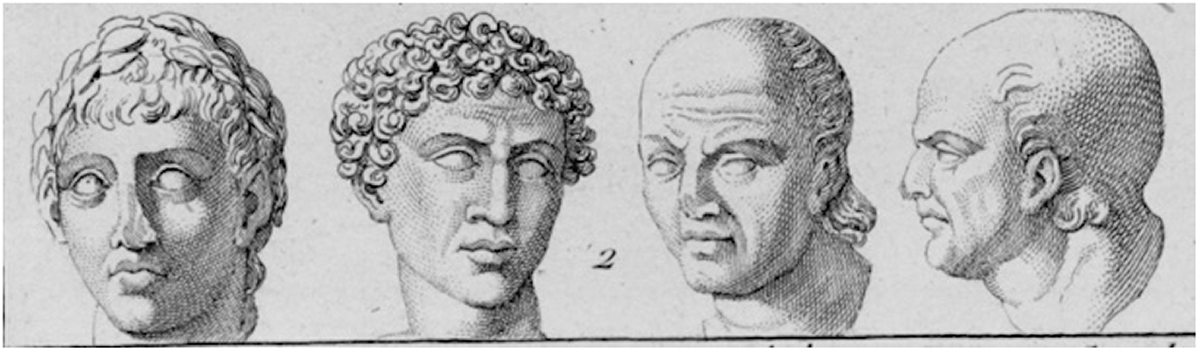
The sarcophagi were not the only way the bodies of the deceased were memorialised within the tomb’s interior. Just as statues spotlighted notable members of the family on the tomb’s exterior, at least three portrait busts have been found in its interior. Two were reportedly discovered close to sarcophagi after the tomb’s rediscovery in 1780: a tuff bust of a young man crowned with a laurel wreath and a terracotta or bronze bust of a balding, middle-aged man (Fig. 5).Footnote 70 Unfortunately, only the first of these two busts survives (the so-called ‘Head of Ennius’ now in the collections of the Vatican Museums).Footnote 71 The last of the three mid-republican busts was uncovered in the interior of the tomb during restoration work in 1926. Unfortunately, this bust, also made of tuff, was stolen almost immediately after discovery, and its precise findspot is unclear.Footnote 72
Three busts found during excavations in the 1780s. From left to right: the tufo ‘Head of Ennius’; a marble imperial bust from the tomb’s later reuse; and front and side views of a lost bust of uncertain material. (Seroux d’Agincourt Reference Seroux d’Agincourt1823 : vol. 4, pl. 12)

Thus, although the evidence is fragmentary, it is likely that the interior of the tomb held several portraits.Footnote 73 Indeed, though not well attested in mid-republican Roman burials, such portraits were a regular feature of later Roman chamber tombs.Footnote 74 Given the widespread spoliation of the tomb during periods of antiquarian collecting, if there were originally portrait sculptures in the tomb, it is frankly surprising that any survived. In particular, if there were any marble statues like the ones Cicero describes on the tomb’s façade, these would likely have been destroyed in the late antique or mediaeval periods, perhaps burnt in a lime kiln that was constructed within the tomb. This kiln was positioned such that it allowed for entrance into the hypogeum itself, which would not have been necessary if its users were merely removing remains of a marble façade.Footnote 75
How exactly the family chose whom to commemorate within the tomb is unclear, as is the exact positioning of any portraiture. It seems likely, however, that the busts were in some way associated with the sarcophagi, perhaps (as Coarelli argues) placed atop the lids, or merely freestanding nearby.Footnote 76 As with the sarcophagi, the number of portraits would likely have grown over time. Volpe has suggested that the family transferred statues from the tomb’s exterior to its interior whenever it updated the façade,Footnote 77 turning it into a sort of sepulchral museum roughly analogous to the display of imagines in the atria of the living.Footnote 78
These imagines and those wearing them have already been recognised as critical elements of the enactment of family history in senatorial funeral processions, so it stands to reason that portraits inside the tomb could serve a similar function.Footnote 79 If the funeral procession ended within the tomb, living family members and perhaps also those wearing ancestral imagines would have come face to face with many of the same ancestors inside the tomb, embodying the dead in stone, wax and flesh.Footnote 80 Regardless of their precise placement, the statues, evidently often made of the same material as the sarcophagi, mediated between the living and the entombed dead and provided a visible audience to any speech within the tomb. Indeed, it is tempting to read the epitaph of Scipio Barbatus in this light, given the explicit connection drawn between the text and the countenance of the deceased. Barbatus is described as a ‘strong and wise man, whose physical appearance (forma) was most equal to his manly virtue.’Footnote 81 Certainly, this phrase, like the altar-like shape of the sarcophagus itself, evokes Barbatus’ exposure to Hellenistic ideals and culture.Footnote 82 But, when read upon his sarcophagus inside the tomb, it also emphasised the temporal divide between the lost countenance and the corpse decaying within its tuff enclosure. Since Barbatus would have merited an imago, his forma could be both lost and present simultaneously. One can therefore imagine this elogium being read to a portrait of Barbatus or in the presence of someone wearing an ancestor mask that preserved his fine forma (and presumably impressive beard). At the very least, anyone reading this text would have recently come face-to-face with their lost forebear, either as part of a pompa funebris or via display in an atrium.
Consequently, the texts engraved upon the tomb’s sarcophagi cannot be fully understood in isolation from their materiality, context and immediate audience, which included both the living visiting the tomb and the dead as embodied in its sarcophagi and portraiture.Footnote 83 These were not disembodied, easily accessible texts, as they now appear when printed in the CIL and ILS or mounted on walls of the Vatican Museums, but objects that held the remains of the family’s ancestors, monumentalising and archiving each Scipionic funeral. The way the texts interacted with and informed each other would have shifted over time with the addition of further burials. But throughout, they directly addressed and engaged both the living and the dead, facilitating conversation between the two groups. The texts were not merely read — they were experienced through movement and shaped by the tomb’s distinct sensory affordances.
V
To illustrate this process, I will analyse how the sarcophagi in both of the tomb’s chambers engaged with the hypogeum context in general and with their sepulchral neighbours in specific. I will begin with an analysis of the only sightline in the tomb we can reconstruct with reasonable confidence, examining how the sarcophagi and their texts engaged with one another and surmounted temporal barriers. I will then explore the positioning of the remaining extant sarcophagi in both of the tomb’s chambers.
Figure 4 represents not only an excellent reconstruction of one of the original sightlines within the Tomb of the Scipios but the only sightline for which all of visible sarcophagi (or at least their inscriptions) survive (see Fig. 3). Due to this accident of preservation, our understanding of alternate sightlines remains uncertain. Still, the sightline mostly reconstructed in Figure 4 illustrates several intriguing facets of Scipionic historical consciousness.
By the mid-second century b.c.e., four sarcophagi would have been visible from this point (though replicas of only three can be seen today): that of Barbatus, that of Paulla Cornelia and those of their respective sons (A, I, B and D on Fig. 3). The fact that these two parent-child pairs, multiple generations apart, are juxtaposed in this narrow space already hints at the non-chronological temporality evident within the tomb.
Barbatus’ monumental sarcophagus served as a focal point. At 1.42 m tall, it was significantly larger and more elaborate than any of the subsequent sarcophagi in the tomb (Fig. 2a; A on Fig. 3; Fig. 4; Fig. 6, below). The form of this sarcophagus represented a radical break from the simple tuff slab or more elaborate dwelling-shaped sarcophagi used in Latium in earlier periods (or indeed, those in the fourth-century tomb of the Cornelii).Footnote 84 Instead, the sarcophagus takes the shape of a Hellenistic altar, whose closest contemporary structural parallels have been found in southern Italy and Sicily.Footnote 85 The form of Scipio Barbatus’ sarcophagus therefore drew on the very parts of southern Italy where Barbatus and his descendants were actively engaged in conquest, a theme echoed in his epitaph:
...
[L. Corneli]o Cn. f. Scipio.
[/////////////////////////// /]
Cornelius Lucius Scipio Barbatus, Gnaivod patre
prognatus, fortis vir sapiensque, quoius forma virtutei parisuma
fuit; consol, censor, aidilis quei fuit apud vos; Taurasia Cisauna
Samnio cepit, subigit omne Loucanam opsidesque abdoucit.Footnote 86
Lucius Cornelius Scipio, son of Gnaeus.
… Lucius Cornelius Scipio Barbatus, born from his father Gnaeus,
a good and wise man, whose physical appearance was most equal to his manly virtue.
He was consul, censor, and aedile among you; he captured Taurasia [and] Cisauna
in Samnium, subjugates all Lucania and carries away hostages.
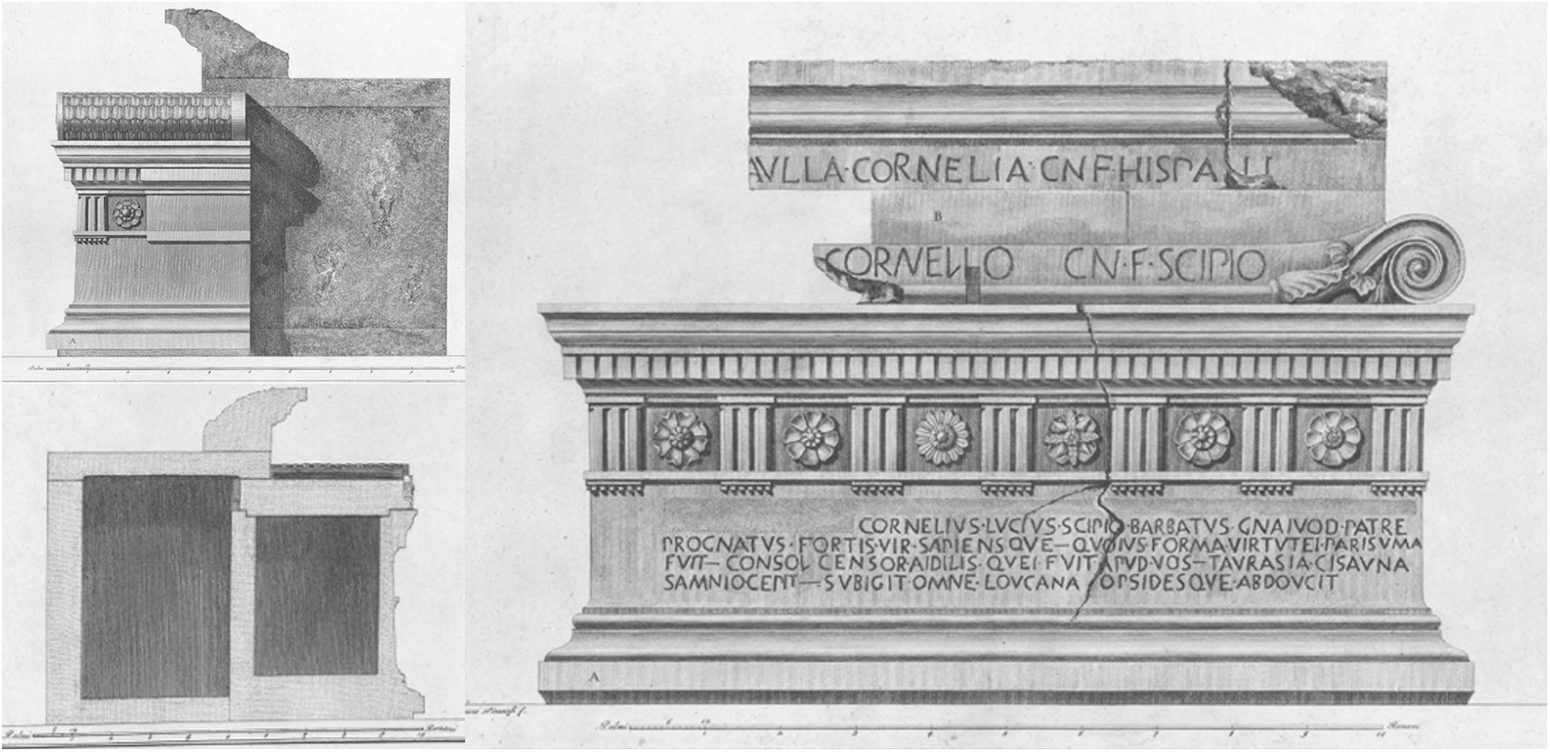
Side, cut-away and frontal views of the sarcophagus of Scipio Barbatus and the sarcophagus of Paulla Cornelia as they were found in the 1780s. (Piranesi Reference Piranesi1785)

The sarcophagus’ appearance and poetic elogium thus worked together to commemorate Barbatus’ personal history in these regions. The text most obviously emphasises Barbatus’ extractive relationship with southern Italian sites and peoples in its concluding lines, but also through an intriguing tense shift. After relying on the perfect tense (fuit…fuit…cepit), in the final line the inscription shifts to the historical present (subigit…abdoucit).Footnote 87 This shift has the effect of presenting the project of Scipionic conquest as ongoing, almost suggesting that Barbatus continues to act through his descendants.Footnote 88 It also foreshadows the collapse of past and present subsequently created by the addition of Barbatus’ nearest neighbour in the tomb’s second phase: Paulla Cornelia.
While less elaborate, Paulla Cornelia’s sarcophagus was also oriented towards maximum visibility from the tomb’s entrance (I in Figure 4). Her much simpler inscription read in full: ‘Paulla Cornelia, daughter of Gnaeus, (wife) of Hispallus’ ([P]aulla Cornelia Cn. f. Hispalli).Footnote 89 To accommodate her burial, space had been excavated behind the sarcophagus of Barbatus, with the work apparently taking place carefully around this much older burial.Footnote 90 Paulla Cornelia’s sarcophagus did not function independently. As Piranesi’s drawings make clear, the cornice and titulus of Paulla Cornelia’s sarcophagus were carved to hover above that of the tomb founder, while the back wall of Barbatus’ sarcophagus became the front wall of Paulla Cornelia’s (Fig. 6).Footnote 91 Her burial was designed to be conspicuous — not only was it in a prominent position, but the inscribed cornice is made from bright white travertine that still stands out against the duller, rougher, earth-toned tuffs of the tomb’s other extant sarcophagi.Footnote 92 Despite its position in a recesses far from natural light, this material would have made Paulla Cornelia’s sarcophagus and its inscription visible (if not necessarily legible) from the tomb’s entrance.
The form and text of Paulla Cornelia’s sarcophagus also engaged with that of Barbatus. Her titulus paralleled Barbatus’ directly below: her Cornelia above his Cornelio, her Cn(aei) f(ilia) over his Cn(aei) f(ilio), her tie to the Scipios by marriage (Hispalli) above his by inheritance (Scipio) (Fig. 6). These were texts meant to be read together, just as the sarcophagi they graced were built one atop the other, with the form of her larger cornice echoing that of his smaller cornice below.
Yet, despite the many remarkable characteristics and privileged position of Paulla Cornelia’s sarcophagus, it has received comparatively limited scholarly attention, mostly relating to the question of its date and assuming that its positioning was a matter of convenience rather than expression.Footnote 93 While I agree that this sarcophagus must be one of the later additions of the tomb’s second phase, I find it unlikely the Scipios chose its position simply because they had run out of better options. Various Scipionic men who died around the same period could have been awarded this valuable real estate (such as Asiagenus Comatus, buried at F on the plan, or the Lucius Cornelius Scipio buried at E). Whoever manipulated the slabs comprising Paulla Cornelia’s monumental sarcophagus into place went to an immense amount of effort to ensure her burial was notable and legible.
I posit that, by the time she died, Paulla Cornelia had become a prominent figure in the family, likely in relation to both age and influence. Her death is generally assumed to date to the end of the Volpe’s second phase (around 150 b.c.e.), again, mostly because she is presumed to be one of the final depositions in the tomb’s main chamber.Footnote 94 I am hesitant, however, to assume she was the final burial in this space simply due to her location. From a phasing perspective, the sarcophagus of Cornelius Scipio Asiagenus Comatus, and the cut to accommodate it (F on the plan), would almost certainly postdate her burial, as otherwise his sarcophagus would have needed to be temporarily moved in order to put hers into place.Footnote 95 Similarly, the incomplete sarcophagus nearest the entryway (3 on the plan) seems equally likely to be one of the latest additions to the main chamber and could just as easily postdate as pre-date Paulla Cornelia’s burial. Thus, while Etcheto calculates that Paulla Cornelia may have been well into her sixties when she died, she could have been somewhat younger, though certainly well into middle age.Footnote 96 Regardless of exact age, by this point she had significantly outlived her husband, Hispallus, without remarrying and leaving the family.Footnote 97 She had probably seen at least one promising son buried — the L. Cornelius Scipio who had died at age 20, interred just steps away (D on the plan), was likely her child.Footnote 98 Another son, Hispanus, would outlive her to be buried in the neighbouring chamber (H on the plan).Footnote 99 Finally, as her name indicates, she was a member of the gens Cornelia by both blood and marriage.Footnote 100
If Barbatus’ position in the tomb is universally interpreted as a demonstration that the family viewed him as its founder and pater familias, it is equally plausible that Paulla Cornelia’s placement was similarly meaningful and not merely caused by lack of space. The fact that her sarcophagus shared a wall with that of Barbatus might relate to the logistical complexities of assembling her sarcophagus behind his. But it also tied their sarcophagi together as a unit that spanned multiple generations of family history. Her sarcophagus was larger than his; in fact, it was the tallest sarcophagus in the tomb. It is likely that she also had significant stature within the family’s self-conception. If not, presumably the Scipios would have placed one of the later male depositions who similarly received only a titulus in the space she occupied instead.Footnote 101
We should therefore not assume that Paulla Cornelia was not significant in the family’s construction of its past simply because she was a woman and because she is not attested in extant historical literature. Indeed, looking slightly ahead in Roman history, we find clear evidence of another female member of the gens Cornelia (and a descendant of Scipio Barbatus, no less) whose status as family matriarch was celebrated within the construction of family history. Cornelia, daughter of Scipio Africanus and mother of the Gracchi, even received a public statue in the porticus Metelli in the late second century b.c.e., possibly graced with similarly pithy inscription indicating her relationship with her father and her sons.Footnote 102 This public celebration likely mirrored more private commemorative practices that indicated her prominent status within her family. Returning to the funerary realm, the limited available evidence suggests that some important and longer-lived aristocratic women may have received public laudationes and elaborate funerary processions.Footnote 103 Scipio Africanus’ widow Aemilia Tertia may have been one of the beneficiaries of such largesse: Granius Licinianus reports that, during her funeral, the sound of trumpets woke her from apparent death.Footnote 104 The presence of these trumpets as well as the survival of this mirabilium in a much later text suggest that her funeral was elaborate and notable enough to gain a foothold in public memory, just like the funerals accorded to high-achieving elite men.Footnote 105 Given that Aemilia Tertia’s 163–162 b.c.e. funeral was likely organised by her heir, Scipio Aemilianus, it is no great leap to imagine that Paulla Cornelia received similar honours during her own funeral roughly a decade later.Footnote 106
Thus, while my argument must remain speculative, it is reasonable to conclude that Paulla Cornelia’s position and lack of a lengthy elogium do not indicate her unimportance within the family’s understanding of its past. As a woman, she lacked the ability to achieve many of the foundational elements of a traditional laudatio or elogium: political office and military victories. Nonetheless, she, like Barbatus, anchored the tomb’s central sightline, ensuring that those entering the tomb beheld her sarcophagus from a distance before they looked more closely at any of the intervening depositions. Her privileged position in the tomb, contrasted with her invisibility in historical literature, rather illustrates the disconnect that must have existed between the elements of family histories that were more likely to survive in or align with accounts outside of the family’s control (e.g. laudationes and funerary processions for office-holding men; ancestor masks and temple dedications) and those that were more likely to go unmentioned in later historical literature unless something particularly unusual happened (like Aemilia Tertia waking from the dead). The barriers to women’s entry into public histories were high in the republican period.Footnote 107 Given the important role elite women played in cementing aristocratic gentes during Republic, however, it is unsurprising that individual women might receive greater prominence in private renditions of history that the families themselves controlled than they generally did in other accounts.Footnote 108
The immediate proximity of the sarcophagi of the sons of both Barbatus and Paulla Cornelia further supports the reading of them as pater familias and mater familias respectively. Barbatus’ son was buried against one of the pilasters directly in front of Barbatus’ sarcophagus (B on Figure 3, to the left on Figure 4), and his sarcophagus employs similar terminology to that of his father, linking them in lineage and language to one another but also to the rest of the Scipios inside the tomb. I should pause here to note that the close intertextual relationship between the sarcophagi of Barbatus and his son, as well as complexities of orthography, spelling and the fact that both have painted inscriptions on the lid but incised inscriptions on the front face, have prompted over a century’s worth of debate as to their respective dating and phasing. Several scholars have proposed that the sarcophagus and text of Barbatus’ son predates those of the Barbatus himself and that both of their elogia may significantly postdate the original burials.Footnote 109 I agree with Kruschwitz, however, that the simplest possible chronology (with Barbatus’ sarcophagus and its texts being created shortly after his death and the same for his son) is the most likely scenario.Footnote 110 In any case, my primary interest is the way the sarcophagi were experienced by later visitors to the tomb. These visitors would have perceived both sarcophagi and their texts as representing the family’s earliest generations, irrespective of the precise order in which the texts were composed. Like modern scholars on all sides of the chronological debate, they would presumably have observed the correspondences between the two objects and understood them to be engaged in a close dialogue with one another that emphasised the similarity of father and son, regardless of which part of the conversation came first.
Like his father’s, Barbatus’ son’s elogium is ‘historical’ in scope. The full elogium reads:
Painted on the lid:
L. Cornelio L. f. Scipio.
Aidiles, cosol, cesor.Footnote 111
Lucius Cornelius Scipio, son of Lucius.
Aedile, consul, censor.
Incised on the front face:
Honc oino ploirume cosentiont R[omane]
duonoro optumo fuise viro,
Luciom Scipione. Filios Barbati,
consol, censor, aidilis hic fuet a[pud vos].
Hec cepit Corsica Aleriaque urbe,
dedet Tempestatebus aide mereto.Footnote 112
This one man, the majority of Romans agree,
of the good [men], was the best,
Lucius Scipio. This man was the son of Barbatus,
he was consul, censor, aedile among you.
This man captured Corsica and the city of Aleria,
and he dedicated a temple to the Tempestates in return for their favour.
Barbatus and his son’s elogia have often been assumed to quote from lost funeral orations, which has made them particularly valuable to historians seeking to reconstruct lost elite domestic archives.Footnote 113 A key piece of supporting evidence for this argument is the use of the phrase apud vos. Barbatus’ elogium describes him as someone who was ‘consul, censor, and aedile among you (apud vos).’ His son’s formulation is similar: ‘This man was consul, censor, and aedile among you (apud vos).’Footnote 114 Several scholars have noted that the use of apud vos in these inscriptions suggests that the two texts address not just the family, but rather the whole Roman citizenry.Footnote 115 But while these inscriptions probably did originate as quotations from the men’s public funeral orations, their impact being reread by subsequent generations inside the tomb would have been somewhat different. The vos inside the tomb was not only the Roman public writ large. It was also the family,Footnote 116 or, more specifically, the living family who had just entered the tomb, as well as the ancestors interred nearby, still invoked, even in death, as members of the Roman citizenry. One can imagine the Scipios reading aloud the measured verse of these epitaphs and addressing the sarcophagi, the portraits of dead family members and living family members. Read in this new context, the repeated use of the deictic hic in this inscription (‘this man’) might even simulate a gesture on the part of the living reader towards the deceased.Footnote 117 Such a gesture would be towards the sarcophagus and its inhabitant, effectively making the reader of the inscription the mediator between the deceased man (hic) and the surrounding family present in the tomb (vos).
If a visitor reading the elogium of Barbatus’ son turned round, they would have immediately faced the sarcophagus of Paulla Cornelia’s son, who had died some 80 years later (D on Figure 3, to the right on Figure 4). The sarcophagus of this other Lucius Cornelius Scipio invited comparison with those of his more illustrious forebears nearby. His early death and limited experience stood in marked contrast to Barbatus and his son. He could boast of no similar public honours apud vos; he had earned neither an imago nor a funeral oration, so instead of looking to accomplishments beyond the tomb, his inscription focuses on its interior:
L. Cornelius Cn. f. Cn. n. Scipio. Magna sapientia
multasque virtutes aetate quom parva
posidet hoc saxsum. Quoiei vita deficit, non
honos, honore. Is hic situs, quei nunquam
victus est virtutei. Annos gnatus XX is
l[…]eis [man]datus: ne quairatis honore
quei minus sit mandatus.Footnote 118
Lucius Cornelius Scipio, son of Gnaeus, grandson of Gnaeus. This stone holds
much wisdom
and many virtues along with a paltry lifespan.
His life was lacking in [public] honour,
[but] his honour was not lacking. He is buried here, who was never
conquered in manly virtue. Having lived twenty years,
he was entrusted to [this place]. Do not ask about the [public] honour
of him to whom little was entrusted.
Even more so than the elogium of Barbatus’ son, with its repeated use of hic, this text contextualises itself within the tomb by having its reader address the sarcophagus itself (hoc saxsum). Not only does the reader describe the sarcophagus upon which the inscription is written as a stand-in for the deceased,Footnote 119 the stone almost seems to speak back. The inscription ends with an exhortation not to inquire about the offices held by the deceased, an exhortation that springs from the sarcophagus itself, which speaks on behalf of the Scipio entombed inside it. This exhortation is directed at a plural, and potentially critical, audience (ne quairatis).Footnote 120 This audience is presumably the same as the vos in Barbatus and his son’s nearby epitaphs: the family, both living and dead.Footnote 121
The fact that the audience must be told not to ask about the lack of official positions he held suggests that such questions may have been fair game. It paints a picture of Scipionic commemorative practice where it might be reasonable for the living to query the dead about their accomplishments, but also their failures. Yet the sarcophagus’ placement relative to those of Barbatus and his son still suggests a position of honour, indicative of his family’s belief that, had he lived longer, he would have rivalled the accomplishments of his more famous namesakes. Though lacking in specific accomplishments, his epitaph still echoes those of the two more illustrious Lucius Cornelius Scipios nearby, focusing on his virtus, honos and conquest, if of a different sort — rather than conquering other peoples, he remains unconquered.
The familial, spatial and intertextual relationships between the sarcophagi of Barbatus and Paulla Cornelia and those of their sons nearby therefore suggest that the arrangement of burials within the tomb was not simply coincidental but, in fact, communicative. The tomb mingled multiple generations together while emphasising parental ties, creating a sort of non-linear family tree. While the sightline comprising the sarcophagi of Barbatus, Paulla Cornelia and their two sons is the only one that can be confidently reconstructed based on surviving materials, looking more broadly at the sarcophagi affiliated with the central corridor demonstrates how questions of movement, sight, contact and legibility structured the arrangement of sarcophagi in the tomb more broadly.
The other two surviving inscribed sarcophagi aligned with the central corridor both date to Volpe’s second phase and, notably, are both inscribed on their short rather than long faces. This choice seems to have been made to maximise their legibility to those walking the central corridor, suggesting that association with this axis was more important than possession of a lengthy verse elogium. A case in point is the sarcophagus of another Lucius Cornelius Scipio who died sometime after 167 b.c.e., which was placed near the tomb’s entrance (E on Figure 3).Footnote 122 This choice ensured that the sarcophagus was legible to someone walking down the tomb’s central corridor without requiring them to detour to the left after entering the space. While it is possible the sarcophagus originally had a longer elogium on the long face directed at this side passage, this slab has been lost. The concise resumé on the sarcophagus’ short face suggests that being easily read by those approaching the sarcophagus of Barbatus was more important than following convention and inscribing the sarcophagus on its long face or lid. One wonders if the same held true for the two incomplete sarcophagi on the opposite side of the corridor whose short faces were also directed at the central axis (1 and 2 on Figure 3). Whoever carved space into the entryway to accommodate the sarcophagus of Lucius Cornelius Scipio’s nearest neighbour apparently also sought to capitalise on the ability to ensure its legibility along the central corridor (3 on Figure 3).
Unlike Barbatus, Paulla Cornelia and their children, the Lucius Cornelius Scipio who died after 167 b.c.e. (E in Figure 3) was not buried in proximity to the teenager who was likely his son.Footnote 123 This child, Cornelius Scipio Asiagenus Comatus (who died sometime around 150 b.c.e.), evidently could not be accommodated along the central corridor. Nonetheless, significant effort was taken to inter him nearby (F in Figure 3). His sarcophagus was similarly inscribed on its shorter face. Indeed, this was only face that would have been legible, since the sarcophagus was placed sideways in a deep niche specially carved to accommodate it beside Barbatus’ and Paulla Cornelia’s sarcophagi (F in Figure 3). Beyond his name and filiation, the only information the short text provides is that he died at age sixteen.Footnote 124
As Harriet Flower has already noted, the tomb’s private, familial audience explains its inclusive treatment of the Scipios’ less prominent male members, including this sixteen-year-old Asiagenus Comatus and the twenty-year-old son of Paulla Cornelia.Footnote 125 But they were not just commemorated alongside their more famous ancestors — their epitaphs also engage in dialogue with them. Such is the case for Paulla Cornelia’s son’s rough contemporary, who represents the only extant inscribed sarcophagus from one of the less visible locations off the central axis (C on Figure 3). This sarcophagus, of a Publius Cornelius Scipio who died around 170 b.c.e., illustrates the discursive nature of the tomb’s engagement with the past. Even more so than those of the various Lucii on the central corridor, it creates an active sense of dialogue with the dead via its use of the second person:
Quei apice insigne Dial[is fl]aminis gesistei,
mors prefe[cit] tua ut essent omnia
brevia, honos fama virtusque
gloria atque ingenium, quibus sei
in longa licu[i]set tibe utier vita,
facile facteis superases gloriam
maiorum. Quare lubens te in gremiu,
Scipio, recipit terra, Publi,
prognatum Publio, Corneli.Footnote 126
For you who wore the spiked hat of a flamen Dialis,
your death brought it about that they were all
short, your public office, reputation, and manly virtue,
your glory and talent. If you had been permitted
to use these things over the course of a long life,
you would have easily surpassed the glory
of your ancestors. Therefore, Scipio, gladly
the earth retakes you into her bosom,
Publius Cornelius, son of Publius.
The inscription co-opts the voice of the living reader to console the unfortunate Publius directly for his lack of achievements, but also to assure him he still has an honourable place among his ancestors both in memory and inside the tomb.Footnote 127 The bosom of the earth referenced in the close of the poem can be understood as the Tomb of the Scipios itself. Living reader, dead Publius and the other ancestors are thus all buried together at the moment of reading.
Thus far, I have confined my analysis to the tomb’s main chamber as occupied during Volpe’s first two phases. I turn now to the second chamber that was added during the third phase. Spatially, this chamber represented a crucial break in the way the Scipios engaged with their ancestors. Unfortunately, only two inscribed sarcophagi survive from this space, so it is hard to arrive at firm conclusions. Both of them, however, suggest a continued interest in facilitating dialogue between the living and the dead, as both turn the voice of the living into that of the dead via first-person address. The most complete of these is the epitaph of Gnaeus Cornelius Scipio Hispanus (H on Figure 3), which, after his name and lengthy list of accomplishments,Footnote 128 continues:
Virtutes generis mieis moribus accumulavi,
progenium genui, facta patris petiei.
Maiorum optenui laudem, ut sibei me esse creatum
laetentur; stirpem nobilitavit honor.Footnote 129
I added to the virtues of my family with my conduct,
I produced offspring, I strove to emulate the deeds of my father.
I obtained the praise of my ancestors, so that they rejoice
that I was begotten; [my] public office made [my] lineage renowned.
Not only does Hispanus speak through the voice of the reader — the other ancestors (hailing from both chambers — remember that Paulla Cornelia was likely his mother) speak too. They provide praise and they rejoice. The present tense verb laetentur summons the voices of the dead in the reader’s present time and present place, the tomb itself.Footnote 130
The other surviving inscription from the second chamber is more fragmentary (G on Figure 4), but it too appears to contain a first-person verb: ‘I lived (with)’ (adveixei).Footnote 131 Coarelli argues that this suggests the deceased was a woman, the wife of the Scipio ‘with whom’ she lived.Footnote 132 This raises the intriguing possibility that one of the other women buried in the tomb received an elogium that purported to speak in her voice.
The use of the first person in these two inscriptions may indicate that the Scipios’ major architectural renovations in the mid-second century accompanied changes in their commemorative practices.Footnote 133 The extant inscriptions in the main chamber transition from third-person speeches describing the deceased to an assembled audience of living and dead family members (A, B, and D on Figure 3) to more direct address where the living reader spoke to the sarcophagus or to the deceased himself (D and C on Figure 3). But when they opened the second chamber, it seems the Scipios were less focused on using elogia to speak to their ancestors. Rather, they wanted their ancestors to speak back. And they used the first person to invoke and channel these voices, creating an active dialogue between the living and the dead. If indeed the tomb’s inscriptions were read aloud (the fact that most of them are in verse would certainly have facilitated oral performance), whether read one at a time or many at once, they would have created a sense of lively conversation within the tomb, heightened by the echoes of the words within the cavernous hypogeum. Taken together, these sarcophagi shed light on how the Scipios could think about time and blur distinctions between past and present as well as living and dead. Instead of commemorating family history in a linear fashion, the tomb prioritised contact, comparison and communication between the living and the dead and among the dead themselves.
The central corridor the Tomb of the Scipios’ main chamber provides an especially compelling snapshot of the family’s non-linear curation of its history. Walking down this passageway in the mid-second century would have immediately brought into view the sarcophagi of both Barbatus and Paulla Cornelia, collapsing over a hundred years into a single sightline and reading. This sense of condensed time and contact between different generations would have been facilitated by the stones used in each sarcophagus, with the old-fashioned lapis Albanus of Barbatus’ set against the newfangled travertine of Paulla Cornelia’s. If a visitor then engaged with each sarcophagus on this corridor as they walked by, they would first have encountered the later sarcophagus of L. Cornelius Scipio (quaestor 167 and E on the plan) and further along the juxtaposition of the sarcophagi of two other L. Cornelii Scipiones, the son of Barbatus (consul 259, B on the plan) and the son of Paulla Cornelia, who had died many decades later (C on the plan). Finally, they could come close enough to read the tituli of the parents of these two men, Barbatus and Paulla Cornelia and, beside them, the sarcophagus of the son of the L. Cornelius Scipio buried near the doorway. Walking down this corridor did not replicate the sort of chronological family history evident in senatorial funeral processions.Footnote 134 Scipios from different generations mingled together, both those who had earned the right to an ancestor mask and those had (or could) not. This was how the family articulated its history in the private portion of the funeral, the part that outsiders like Polybius evidently did not witness.Footnote 135 Sarcophagi from different periods related to one another through space and text: Barbatus’ titulus in the shadow of Paulla Cornelia’s, the conquests and political honours of his son across from the moral unconquerability and honour of hers. The focus was on the ancestors as a community that mingled with the living and the newly dead inside the tomb, not simply on an unbroken line of successive triumphant generals.
History was thus constantly being revisited and reworked each time the dead and the living came into contact. Indeed, the epitaphs themselves were mutable. The inscription of Publius Cornelius Scipio, the tragically short-lived flamen Dialis, was modified sometime after its original composition, adding a new opening line, ‘For you who wore the spiked hat of a flamen Dialis’, above the original inscription in smaller text that was out of alignment with what had been written before. Flower argues that the family wanted to highlight that he had actually held a political office, which was not evident in the original inscription.Footnote 136 Perhaps this edit was the result of someone asking the very question the epitaph of Lucius Cornelius Scipio told everyone not to ask: what public honours had he in fact held?
The epitaph of Barbatus was subject to a more enigmatic editing process. At the very least, the first line and the start of the second line of the original inscription on the front face of his sarcophagus were chiselled off at some juncture.Footnote 137 Since these inscriptions would only have been seen by close family members, propagandistic concerns are an unlikely rationale for editing. Instead, something about the story the family wanted to tell itself about its own past had changed.Footnote 138 Regardless of the specifics, we are at minimum left with clear evidence that the texts inside the tomb, just like its internal layout, contents and exterior façade, were subject to revision. The precise rationale for these revisions eludes us, but their primary audience inside the tomb was the Scipios themselves. History was adaptable and responsive to the changing needs of the present, even when written in stone.Footnote 139
VI Conclusion
There are many ways to experience history — reading it in a linear narrative is but one. Dreams, spirit possession, objects and movement are among many strategies for remembering, relating to and reshaping past that have been explored in anthropological literature, often with an eye towards different approaches to relating to time itself.Footnote 140 In recent years, ancient historians’ understanding of what history was to the ancient Romans has similarly expanded beyond annalistic accounts to include things like plays, buildings and funeral orations.Footnote 141 Still, chronological narratives (if in a wider variety of genres, both written and spoken) have generally remained central to reconstructions of the development of Roman historical thought. Bernard, however, has recently proposed that we should be alive to the possibility that more diverse historical sensibilities (of the sorts he identifies in Iron Age Italy) persisted into the mid-republican period.Footnote 142
I argue that the Tomb of the Scipios provides a compelling demonstration that we can indeed find such approaches to the past in the mid-Republic. The tomb illustrates how Roman historical sensibility in the period that saw the creation of the first annalistic histories was not necessarily or exclusively chronological — it could also be synchronic and interactive. In the Tomb of the Scipios, the dead were both past and, in a physical sense, present. This presence facilitated the articulation of a malleable family history connecting disparate generations through communication and contact.
I make no claims that the Scipios’ particular approach to sepulchral history-curation was entirely typical of contemporary elite gentes. Ancient sources inform us that the Scipios’ and broader Cornelian gens’ funerary practice often cultivated distinction. Examples include their continued use of inhumation and the addition of a detour in their funeral processions to the Temple of Jupiter Optimus Maximus to retrieve the ancestor mask of Scipio Africanus.Footnote 143 In addition, the inscriptions within their tombs (both the fourth-century b.c.e. tomb containing the sarcophagus of P. Cornelius Scapula and the Tomb of the Scipios itself) are unusual in comparison to most known contemporary Roman burials.
Nonetheless, the Tomb of the Scipios is representative of an important broader trend that characterises elite Roman burial practice in the mid-Republic: the adoption of the large multi-generational chamber tomb. While elites elsewhere in the Italian peninsula had a longer tradition of large multi-generational chamber tombs, Romans seem to have adopted this burial custom only in the fourth and third centuries b.c.e. in conjunction with the broader reorganisation of urban and suburban space that took place during this period.Footnote 144 As the name suggests, these tombs’ main innovation was that they allowed powerful Roman families to bury multiple generations together, since reopening a chamber tomb (or even adding a room) to accommodate new burials was easier than separately burying individual family members near one another.Footnote 145 This change in burial custom had important historical implications. For the first time, the ancestors of a given family branch could all be collected in one space and engaged with as a group. This fundamentally changed the ways elite families could interact with the dead in commemorating family history. Large multi-generational chamber tombs looked to the future as well as the past, reserving space for members of the family generations ahead, preparing for a rich history that did not yet exist. Over time, such tombs became quasi-archival spaces where families stored, curated and, most crucially, regularly visited and engaged with the collected remains of their ancestors.
Though the Tomb of the Scipios is the best-preserved example of this type of tomb, I believe it to be representative of a broader mid-republican interest in regular, material engagement with the embodied dead that encompassed these trends in internal mortuary architecture as well as more public forms of communication like funerary processions. Aristocratic histories in the mid-Republican period were thus not limited to words and experiences. They were also relationships. The sorts of evolving historical relations that we see inside the Tomb of the Scipios are also evident in the atria of houses, where the stored imagines suggest ancestors’ persistence of members of the household. They exist in mid-republican funerary processions with their ever-lengthening cortege of ‘living and breathing’ ancestors who listened to each laudatio recapitulating and reinterpreting their accomplishments in light of the new member joining them.Footnote 146 Such speeches and processions were opportunities to emphasise, reestablish or complicate relationships within a given family and between members of the family and the populace through the decision of whom to include and whom to leave out.Footnote 147
By the late Republic, such relational histories were still regularly invoked as a rhetorical strategy. Cicero provides an example of this tactic when he reports that, in the early first century b.c.e., L. Licinius Crassus used the passing of the pompa funebris of an elderly female relative of his target, M. Brutus, as an opportunity for invective. He asks Brutus, ‘What do you want that aged woman to report [about you] to your father? What to all those whose imagines you see being conducted? What to your ancestors? What to L. Brutus, who freed this populace from kingly domination?’Footnote 148 This rhetorical trope of summoning an antagonist’s ancestors to hold him to account (even more famously deployed by Cicero himself against Clodia via her ancestor Ap. Claudius Caecus) draws its power from an existing aristocratic tradition of conversational, relational engagement with the familial past.Footnote 149 Crassus’ questions, directed at a disappointing young scion of an illustrious family, call to mind the questions that might have been forestalled by the ne quairatis in the elogium of the L. Cornelius Scipio who died at age twenty. More broadly, the imagined conversations that permeate Crassus’ invective against Brutus and Cicero’s against Clodia (between the dead and the living as well as between the dead about the living) parallel the sorts of conversations that the Tomb of the Scipios appears to have facilitated. Granted, the examples discussed above date to the late Republic, but they point to the persistence of a relational understanding of the past beyond the mid-Republic.
These two examples from the Ciceronian corpus also highlight the more prominent role women could wield in conversational approaches to the past. In his attack on Clodia in the Pro Caelio, Cicero enlists not only her male ancestors and their imagines viriles, but also notable female ancestors.Footnote 150 The L. Licinius Crassus of De oratore similarly uses the pompa funebris of a woman, Junia, apparently accompanied by the imagines of her (male) family members, to alienate a disappointing young man from a glorious family history.Footnote 151 While my arguments about the prominence of Paulla Cornelia must remain speculative due to her lack of attestation outside of the tomb, I hope that further research into conversational history and the role of tombs in the development of mid-republican historical culture will rescue other Roman women from similar obscurity. Paulla Cornelia was not simply an afterthought in the Tomb of the Scipios, hovering outside of historical thought behind a man whose name we recognise from Livy’s later annalistic account.Footnote 152 Recontextualising the remains of her sarcophagus within the tomb demonstrates that, in her family’s articulation of its past, she was likely a historical agent in her own right.

 Open access

