





Impact statement
Bacterial cellulose (BC) is increasingly explored in biodesign as a wearable material at the skin interface, yet the vocabulary used to describe its material-skin relations remains inconsistent across textile engineering, design research, and biomedical literature. Terms such as comfort, care, and skin wellness are often used interchangeably, creating ambiguity about what project documentation claims, what material performance is demonstrated, and how reported effects should be interpreted.
This study addresses that ambiguity by mapping how comfort, care, and skin wellness are articulated across twenty cases organised into two analytical sets. The analysis shows how established textile-comfort vocabulary expands into broader care and wellness narratives when BC operates in hydrated, membrane, composite, or living-material states at the skin interface. The proposed three-pillar analytical scaffold and working glossary provide designers, researchers, and practitioners with a shared reference for distinguishing sensory experience, material performance, and health-related claims. As biofabricated materials move from experimental biodesign contexts towards fashion and skin-contact applications, more precise and responsible descriptions of material–skin interaction become a design responsibility. This work supports clearer research positioning and more informed communication in the development of BC wearable materials.
Introduction
Bacterial cellulose (BC) is a biofabricated material produced by acetic acid bacteria. One commonly studied producer, historically referred to as Acetobacter xylinum, is now classified as Komagataeibacter xylinus and forms a nanofibrillar extracellular cellulose during fermentation (Gregory et al. Reference Gregory, Tripathi, Fricker, Asare, Orlando, Raghavendran and Roy2021; Wang et al. Reference Wang, Tavakoli and Tang2019). In this study, BC refers to cellulose produced in monoculture bacterial systems and fermentation involving a symbiotic culture of bacteria and yeasts (SCOBY) in design and biodesign contexts (Gregory et al. Reference Gregory, Tripathi, Fricker, Asare, Orlando, Raghavendran and Roy2021; Wang et al. Reference Wang, Tavakoli and Tang2019). BC produced by pathogenic bacteria sits outside the scope of the analysis. Its hydrated nanofibrillar structure, high water retention, and conformability help explain why BC is frequently explored for skin-contact applications in biodesign and materials design (Gregory et al. Reference Gregory, Tripathi, Fricker, Asare, Orlando, Raghavendran and Roy2021; Wang et al. Reference Wang, Tavakoli and Tang2019). Biodesign refers in this paper to design practices that engage with biological principles, living organisms, and regenerative processes (Karana et al. Reference Karana, McQuillan, Rognoli and Giaccardi2023; Myers Reference Myers2012); materials design refers to design research that explores material qualities, experiences, performance, and emerging resources (Duarte Poblete et al. Reference Duarte Poblete, Romani and Rognoli2024). Over the past decade, BC has been investigated within both fields as a wearable material whose tactility, conformability, and cultivation-based origin distinguish it from materials produced through conventional textile processes (Costa et al. Reference Costa, Rocha, Fernandes, Queiroz, Agra, Amorim and Sarubbo2022; Domskiene et al. Reference Domskiene, Sederaviciute and Simonaityte2019; Nayak et al. Reference Nayak, Cleveland, Tran and Joseph2024). As BC moves from experimental prototyping toward applications that operate directly at the skin interface, it appears across textile and wearable material contexts and skin-contact product formats including biotextiles, wound-contact membranes, and cosmetic skin masks. In this paper, biotextile refers to textile materials derived from biological sources or produced through biological processes, including both biobased fibres and biofabricated materials; in biomedical and skin-contact applications, biotextiles may operate as medical or therapeutic interfaces (Burnstine and Camargo Reference Burnstine and Camargo2025; Ornaghi Júnior and Garavatti Reference Ornaghi Júnior and Garavatti2025). The skin interface refers to the zone of contact between the skin surface and a material, where physical, biological, and experiential interactions take place (Byrd et al. Reference Byrd, Belkaid and Segre2018). Across these contexts, BC is increasingly described through comfort-related language such as fit, adhesion, breathability, and moisture management, and through broader skin-care or wellness narratives (Provin et al. Reference Provin, dos Reis, Hilesheim, Bianchet, de Aguiar Dutra and Cubas2021; Wood et al. Reference Wood, Verran and Redfern2023). The vocabulary used to describe material-skin interaction in design research is often informed by biotechnology, biomedical, and dermatological contexts, where different assumptions and evidentiary standards apply. The same terms can carry different evidentiary weight depending on which discipline uses them, and similar materials may be described through different vocabularies, or different materials through similar ones (Karana et al. Reference Karana, Barati, Rognoli and Zeeuw van der Laan2015; Veelaert et al. Reference Veelaert, Du Bois, Moons and Karana2020).
This vocabulary instability reveals a gap that the study addresses. Comfort and skin wellness are sometimes used interchangeably in BC discourse, even when they refer to different aspects of material-body interaction, and design research currently has no shared analytical scaffold for tracking how these terms travel, overlap, and delimit one another when BC is positioned as a wearable material at the skin interface. The aim of this study is to examine how comfort, care, and skin wellness are articulated when biobased and biofabricated wearable materials meet the skin, and how skin health operates as the boundary at which design-research analysis hands over to clinical scholarship.
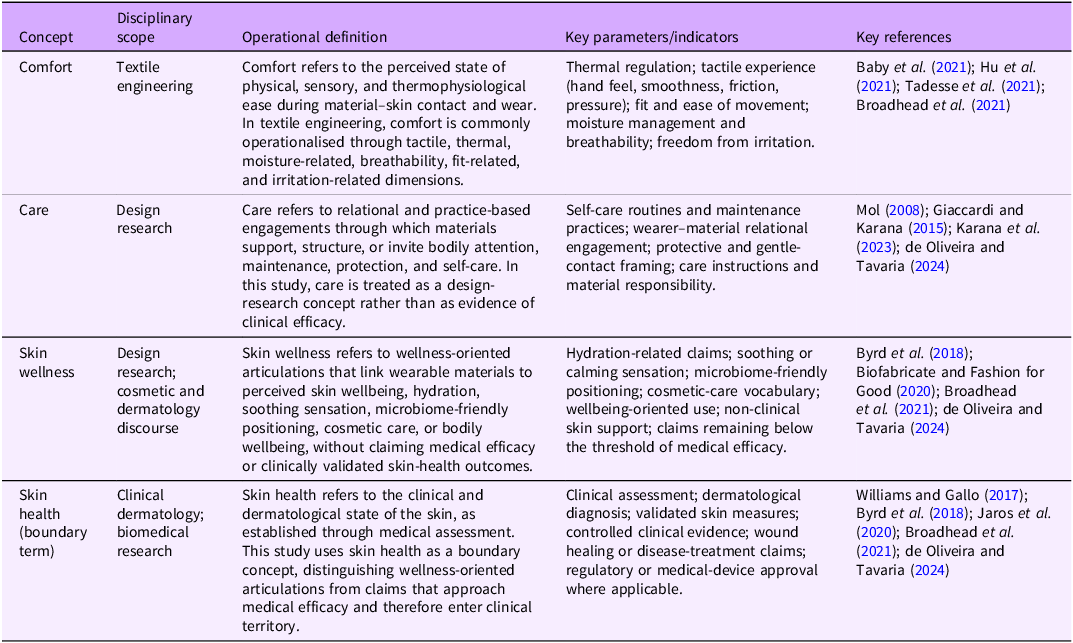
Comfort is treated through textile engineering, where its dimensions of thermal, tactile, fit, and moisture-related ease are tied to operational testing traditions (Hu et al. Reference Hu, Wang, Zhang, Gan and Liu2021; Tadesse et al. Reference Tadesse, Loghin, Dulgheriu and Loghin2021). Care is read through design research and care-ethics scholarship, operating as a relational and practice-based concept rather than as evidence of clinical efficacy (Karana et al. Reference Karana, McQuillan, Rognoli and Giaccardi2023; Mol Reference Mol2008; Wang et al. Reference Wang, Guo, Bowman, Zhai, Shu, Zhang, Helms, Capel and Vines2026). Skin wellness sits across cosmetic-dermatological communication and design research, used for wellbeing-oriented claims that stop short of medical efficacy (Broadhead et al. Reference Broadhead, Craeye and Callewaert2021; de Oliveira and Tavaria Reference de Oliveira and Tavaria2024). Skin health refers to the clinical and dermatological state of the skin established through medical assessment (Byrd et al. Reference Byrd, Belkaid and Segre2018; Williams and Gallo Reference Williams and Gallo2017). Section Research Design and Table 1 define this scaffold in operational terms; Supplementary Table S4 provides the full working glossary.
Analytical scaffold for skin-interface articulation
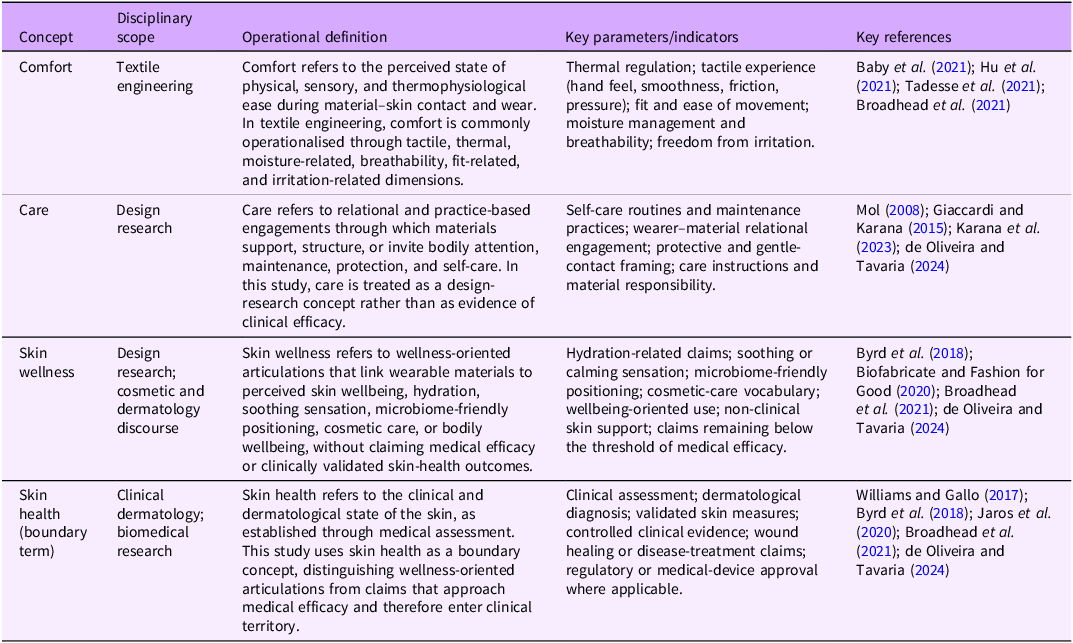
Table 1. Long description
A table with five columns and four rows. The columns are labeled Concept, Disciplinary scope, Operational definition, Key parameters/indicators, and Key references. The rows are labeled Comfort, Care, Skin wellness, and Skin health. Row 1: Concept, Textile engineering, Comfort refers to the perceived state of physical, sensory, and thermophysiological ease during material-skin contact and wear. In textile engineering, comfort is commonly operationalised through tactile, thermal, moisture-related, breathability, fit-related, and irritation-related dimensions., Thermal regulation; tactile experience (hand feel, smoothness, friction, pressure); fit and ease of movement; moisture management and breathability; freedom from irritation., Baby et al. (2021); Hu et al. (2021); Tadesse et al. (2021); Broadhead et al. (2021). Row 2: Concept, Design research, Care refers to relational and practice-based engagements through which materials support, structure, or invite bodily attention, maintenance, protection, and self-care. In this study, care is treated as a design-research concept rather than as evidence of clinical efficacy., Self-care routines and maintenance practices; wearer-material relational engagement; protective and gentle-contact framing; care instructions and material responsibility., Mol (2008); Giaccardi and Karana (2015); Karana et al. (2023); de Oliveira and Tavaria (2024). Row 3: Concept, Design research; cosmetic and dermatology discourse, Skin wellness refers to wellness-oriented articulations that link wearable materials to perceived skin wellbeing, hydration, soothing sensation, microbiome-friendly positioning, cosmetic care, or bodily wellbeing, without claiming medical efficacy or clinically validated skin-health outcomes., Hydration-related claims; soothing or calming sensation; microbiome-friendly positioning; cosmetic-care vocabulary; wellbeing-oriented use; non-clinical skin support; claims remaining below the threshold of medical efficacy., Byrd et al. (2018); Biofabricate and Fashion for Good (2020); Broadhead et al. (2021); de Oliveira and Tavaria (2024). Row 4: Concept, Clinical dermatology; biomedical research, Skin health refers to the clinical and dermatological state of the skin, as established through medical assessment. This study uses skin health as a boundary concept, distinguishing wellness-oriented articulations from claims that approach medical efficacy and therefore enter clinical territory., Clinical assessment; dermatological diagnosis; validated skin measures; controlled clinical evidence; wound healing or disease-treatment claims; regulatory or medical-device approval where applicable., Williams and Gallo (2017); Byrd et al. (2018); Jaros et al. (2020); Broadhead et al. (2021); de Oliveira and Tavaria (2024).
Note: Wellness-oriented claims are treated as discursive or product-positioning claims unless supported by clinical evidence.
To address this aim, the paper uses a cross-disciplinary qualitative comparative case mapping across twenty cases organised in two sets. Set A comprises eight cases situated within textile and wearable material research and development, drawing on engineering-oriented performance testing, commercial textile communication, and design-driven textile material practice. Set B comprises twelve bacterial cellulose skin-Interface material cases drawn from biodesign research and adjacent contexts, including biomedical BC research, cosmetic skin-care research, HCI, and speculative biodesign practice. Set A functions as a comparative reference set whose comfort vocabulary is relatively stabilised through textile-engineering tradition; Set B examines BC at the skin interface in contexts where comfort, care, and skin-wellness vocabularies are still in formation. The comparison is discursive rather than typological. It tracks how vocabulary shifts and overlaps across the two sets. The analysis proceeds through three dimensions: experiential articulation, material-operational grounding, and comfort, care, and skin-wellness positioning.
The paper’s primary contribution is the analytical scaffold itself. The scaffold comprises three pillars, comfort, care, and skin wellness, with skin health serving as a boundary marker, tested across twenty cases. It offers a boundary-aware tool for clearer research positioning and interdisciplinary communication. A secondary contribution is the working glossary in Supplementary Table S4, which consolidates terminology drawn from textile engineering, design research, biodesign, biomedical research, and cosmetic skin-care literatures. It provides a shared vocabulary for biodesigners to describe material–skin interaction more consistently across contexts.
Related work: framing biofabricated wearable materials
Biofabricated wearable materials have gained visibility within biodesign and materials design as emerging systems that operate in close relation to the body. Research and practice around these materials sit across multiple knowledge contexts, including design experimentation, textile-oriented understandings of wearability, and skin-facing framings associated with care and wellbeing. As a result, key terms used to describe material–skin interaction are often drawn from different traditions and are not always differentiated in consistent ways. This section reviews relevant work to position BC within this landscape and to clarify how comfort- and wellness-oriented framings have been used to describe wearable materials at the skin interface.
Biodesign and contemporary materials design as contexts for emerging wearable materials
Within biodesign and materials design research, materials are treated as starting points for inquiry and learning. In Material Driven Design (MDD), for example, materials are explicitly positioned at the beginning of the design process, shifting emphasis from predefined problem-solving toward exploratory engagement with material qualities and anticipated experiences (Giaccardi and Karana Reference Giaccardi and Karana2015; Karana et al. Reference Karana, Barati, Rognoli and Zeeuw van der Laan2015). In this framework, materials are approached through both technical and experiential characterisation, and designers articulate a “material experience vision” that links physical properties to aesthetic, emotional, and meaning-related dimensions (Karana et al. Reference Karana, Pedgley and Rognoli2014; Pedgley et al. Reference Pedgley, Rognoli, Karana, Pedgley, Rognoli and Karana2021). In textile and fashion contexts, this perspective foregrounds embodied interaction, tactility, and behaviour in use, where material exploration often precedes product definition and iterative testing occurs in proximity to the body (Bang et al. Reference Bang, Harsaae, Nyvang, Mikkelsen, Reitan Andersen and Ricard2025; Ribul et al. Reference Ribul, Goldsworthy and Collet2021). Wearability thus emerges as a relational outcome of material–body interaction. A well-known early example is Suzanne Lee’s BioCouture (Collet Reference Collet, Karana, Giaccardi, Nimkulrat, Niedderer and Camere2017), which explored BC cultivated through fermentation as biofabricated material within fashion products. The project illustrates how material exploration and embodied considerations, such as tactility, behaviour in use, and proximity to the body, can precede product definition in textile and fashion-oriented biodesign practice.
This material-centred orientation becomes particularly significant in relation to emerging and biofabricated materials. As Duarte Poblete et al. (Reference Duarte Poblete, Romani and Rognoli2024) argue, emerging materials often lack consistent terminology and require taxonomic tools to structure understanding and communication. Their taxonomy distinguishes biofabricated materials, produced through the involvement of living organisms, from other biobased categories, highlighting the importance of production mechanisms in classification. Similarly, the Biofabricate “Biomaterials report for the fashion industry” clarifies distinctions among biomaterial, biobased, biofabricated, biosynthetic, and bioassembled materials, defining biofabrication, in fashion-relevant terms, as the fabrication of materials by living organisms (Biofabricate and Fashion for Good 2020). Such descriptions shape how materials are positioned, communicated, and evaluated in design practice.
Biodesign further reframes this landscape by shifting from designing with biological matter to designing with living systems (Myers Reference Myers2012). This shift is particularly relevant for wearable materials at the skin interface, where biofabricated systems can introduce variability, specific care requirements, and material behaviour that changes during use. The agency of microbial organisms contributes not only to material formation, but also to variability and responsiveness across conditions of use. For instance, ECO-SKIN from Biodesign Challenge (2025) frames BC as an experimental skin-contact system, foregrounding speculative wellness positioning and embodied interaction at the interface. This becomes even more important when wearable materials are conceived as “living artefacts,” in which biological processes remain fundamental, and the behaviour of materials can be difficult to define (Karana et al. Reference Karana, McQuillan, Rognoli and Giaccardi2023). For example, NextSkins (2022) positions engineered living BC as a responsive and programmable skin interface, where biological activity and changing material states are central to how wearability is imagined and communicated. This concept leads to a new understanding of the interactions between materials and skin. In such contexts, wearability cannot be reduced to form and fit only, it also depends on how material–skin interaction is articulated, through a combined vocabulary of experiential descriptors (what wearers feel) and performance-oriented terms (what is implied to be assessable or comparable).
Furthermore, materials biography and materials identity underline that classification and naming influence how materials are understood and adopted (Duarte Poblete et al. Reference Rognoli, Duarte Poblete, Mateus, Leonor and Paoliello2026; Rognoli et al. Reference Rognoli, Petreca, Pollini and Saito2022). As Myers (Reference Myers2012) situates biodesign within a broader cultural shift at the intersection of nature, science, and creativity, biofabricated wearable materials can be understood as materials whose scope, production processes, and wearable applications are inseparable from the conceptual frameworks through which they are defined and positioned. These contextual distinctions matter because, in wearable and skin-interface applications, the way materials are classified and positioned directly shapes how comfort- and wellness-related qualities are described.
Comfort, care and skin wellness in skin-contact wearable materials
In textile research, skin comfort is commonly articulated as an outcome of measurable material–skin interaction. Sensory responses such as itch and prickle have been associated with mechanical stimulation by coarse fibres, rather than solely immunological reactions, demonstrating that discomfort may arise from fibre diameter and nociceptor activation (Jaros et al. Reference Jaros, Wilson and Shi2020). Textile engineering literature further decomposes comfort into thermal, moisture, and tactile dimensions, evaluated through parameters such as air permeability, thermal resistance, moisture transport, and surface friction (Iftikhar et al. Reference Iftikhar, Anjum, Choudry, Zahid, Khan, Nawaz and Umar2026; Kim and Kim Reference Kim and Kim2019; Tadesse et al. Reference Tadesse, Loghin, Dulgheriu and Loghin2021). Instrumental assessment of fabric hand links production variables to measurable properties including smoothness, flexibility, and compression (Vasile et al. Reference Vasile, Malengier, De Raeve and Deruyck2019), while quantitative characterisation of textile structures reinforces the alignment between structural parameters and performance outcomes (Shahidi et al. Reference Shahidi, Marasinghe, Ebrahimi, Oliveira, Perera, Briggs-Goode, Dias and Hughes-Riley2025). In this context, comfort is framed as a technical and physiological condition emerging from frictional behaviour, fibre structure, and heat and moisture transfer and thermophysiological comfort at the skin interface (Baby et al. Reference Baby, Mathur and DenHartog2021; Li Reference Li2001; Tadesse et al. Reference Tadesse, Loghin, Dulgheriu and Loghin2021).
However, as discussions shift toward vulnerable or diseased skin, the vocabulary expands beyond sensation. In dermatological literature, atopic dermatitis is characterised by barrier dysfunction, increased transepidermal water loss (TEWL), inflammation, and pruritus (Leung and Bieber Reference Leung and Bieber2003). Textile selection is therefore implicated not only in comfort perception but in exacerbating or alleviating symptoms, with fibre composition and surface properties influencing irritation and barrier integrity (Fenton and Al-Salama Reference Fenton and Al-Salama2021; Jaros et al. Reference Jaros, Wilson and Shi2020). Interventions such as acid-coated textiles designed to restore physiological skin pH (Jaeger et al. Reference Jaeger, Rothmaier, Zander, Ring, Gutermuth and Anliker2015) and softened fabrics to reduce irritation illustrate how material parameters become aligned with clinical outcomes. Here, comfort-related descriptors overlap with physiological stability, as textile–skin interaction is framed in relation to barrier function and inflammatory response rather than immediate tactile sensation.
A further shift occurs in biofunctional and therapeutic textile research. Biofunctional textiles are described as materials capable of antimicrobial activity, wound care support, or delivery of active agents (Hipler Reference Hipler2006; King et al. Reference King, Gupta and Guidoin2013). Antimicrobial and wound-dressing applications of BC emphasise high water retention, biocompatibility, and hydrogel behaviour, positioning textiles as medical or quasi-medical interfaces (Ciechańska Reference Ciechańska2004; Czaja et al. Reference Czaja, Krystynowicz, Bielecki and Brown2006; Maneerung et al. Reference Maneerung, Tokura and Rujiravanit2008). Clinical and cosmetic applications, such as BC facial masks, evaluate skin hydration and user satisfaction simultaneously, blending experiential comfort with functional skin outcomes (Amnuaikit et al. Reference Amnuaikit, Chusuit, Raknam and Boonme2011). In parallel, microbiome research reframes skin wellness in ecological terms, associating dysbiosis with inflammatory conditions and highlighting the role of textiles in mediating microbial balance (Broadhead et al. Reference Broadhead, Craeye and Callewaert2021; de Oliveira and Tavaria Reference de Oliveira and Tavaria2024; Williams and Gallo Reference Williams and Gallo2017). Such perspectives expand wellness beyond symptom relief to include microbial diversity, barrier resilience, and even psychological wellbeing (Tyson-Carr et al. Reference Tyson-Carr, Leng, Scott, Adams, Hoptroff, Murphy, Fallon, Paterson, Thomas, Giesbrecht and Roberts2025).
As stated above, recent biodesign research further complicates this landscape by introducing living and care-based wearable materials. Living Therapeutic Skin concepts envision on-skin artefacts embedding engineered microbes within BC materials, combining wearability and regenerative ecological framing (Kim et al. Reference Kim, Zeng, Ellis, Karana, Mateus, Patrocinio and Leonor2026). Care-based practices emphasise mutualistic relationships between wearer and living material, extending wellness discourse toward relational and affective dimensions (Guarino et al. Reference Guarino, Ferraro and Rognoli2025; Rognoli and Duarte Poblete Reference Rognoli, Duarte Poblete, Mateus, Leonor and Paoliello2026). Across these narratives, comfort descriptors such as softness, breathability, and flexibility, coexist with claims of antimicrobial action, microbiome modulation, and regenerative care. Yet the literature rarely differentiates clearly between comfort and broader notions of skin wellness, despite the growing integration of bioactive and biofabricated components in wearable materials.
Positioning BC within comfort and skin wellness
BC travels between several discursive positions in contemporary scholarship and practice. Within biodesign, BC is frequently framed as a biofabricated material grown through fermentation rather than extracted or spun, with cultivation-based approaches emphasising growth logic, zero-waste shaping, and material agency (Chan et al. Reference Chan, Shin and Jiang2018; Cohen et al. Reference Cohen, Sicher, Merino, Yavuz, Scholz, Howlett and Setchi2022; Morrow et al. Reference Morrow, Ribul, Eastmond, Lanot and Baurley2023). On the scientific side, the production context matters for how BC is named. Pedroso-Roussado (Reference Pedroso-Roussado2024) clarifies that what some design literature calls “SCOBY cellulose” is more accurately described as BC produced by acetic acid bacteria within a symbiotic culture of bacteria and yeasts (Supplementary Table S1 summarises the BC production systems and scope boundaries relevant to this study). BC is also produced in laboratory monoculture systems using Komagataeibacter strains, as well as in pilot-scale fermentation for material innovation (Quijano et al. Reference Quijano, Rodrigues, Fischer, Tovar-Castro, Payne, Navone, Hu, Yan, Pinmanee, Poon, Yang and Barro2024; Wang et al. Reference Wang, Tavakoli and Tang2019; Yu et al. Reference Yu, Rognoli, Bertola, Mateus, Patrocinio and Leonor2026).
In textile engineering and materials science, BC is evaluated through measurable parameters familiar to fabric testing such as tensile strength, air permeability, tear resistance, moisture behaviour, and surface properties (Costa et al. Reference Costa, Rocha, Fernandes, Queiroz, Agra, Amorim and Sarubbo2022; Wood et al. Reference Wood, Verran and Redfern2023). Reinforcement strategies, including composite integration with proteins, plasticisers, or other substrate materials, extend BC’s mechanical performance and address its brittleness when dried (Chan et al. Reference Chan, Shin and Jiang2018; Provin et al. Reference Provin, dos Reis, Hilesheim, Bianchet, de Aguiar Dutra and Cubas2021). These strategies improve handling and durability for wearable applications, but introduce tensions with BC’s biodegradability profile, where composites that enhance mechanical performance can also slow or complicate end-of-life degradation, challenging BC’s sustainability claim.
Biomedical and biomaterials research engage BC through a different evidentiary regime. BC’s nanofibrillar architecture, high water retention, and reported biocompatibility support applications in wound contact, hydrogel design, and active-ingredient delivery (Czaja et al. Reference Czaja, Krystynowicz, Bielecki and Brown2006; Khan et al. Reference Czaja, Krystynowicz, Bielecki and Brown2024; Maneerung et al. Reference Maneerung, Tokura and Rujiravanit2008). Cosmetic and clinical skin-care research investigates BC sheet masks for hydration, soothing, and cooling effects, sometimes evaluated through clinical or pharmaceutical formulation methods (Amnuaikit et al. Reference Amnuaikit, Chusuit, Raknam and Boonme2011; de Oliveira and Tavaria Reference de Oliveira and Tavaria2024; Pacheco et al. Reference Pacheco, De Mello, Chiari-Andréo, Isaac, Ribeiro, Pecoraro and Trovatti2018). In these registers, BC’s relationship to skin is positioned through functional or clinical outcomes, and claims approach the boundary at which design-research scholarship hands over to clinical evidence. The vocabulary used in these registers differs from the vocabulary that biodesign-led BC research uses.
Lee’s BioCouture (2010–2014) framed BC as “speculative clothing for everyday wearing” and a “bio-grown second-skin” (Collet Reference Collet, Karana, Giaccardi, Nimkulrat, Niedderer and Camere2017; Lee Reference Lee2011), establishing an early reference for design-led BC garment exploration. Giulia Tomasello’s Bio Conductive Skin (2019) engages BC-related conductive material as a second-skin interface, bringing biodesign and interaction design into close relation. The NextSkins research consortium positions BC through probiotic-textile and microbiome-oriented vocabulary that braids biodesign with biomedical-adjacent research (NextSkins 2022). In Human-Computer Interaction(HCI)-adjacent design research, Bell et al. (Reference Bell, Chow, Choi and Alistar2023) document a SCOBY breastplate grown over thirteen weeks, articulating slow design, intimate body-material interaction, and the design implications of working at the pace of a living organism. These projects approach BC at the skin interface through living-material articulation, design-led making practices, and body-relational vocabulary that adjacent disciplines such as biomedicine and biotechnology do not typically engage.
The three-concept scaffold: comfort, care, skin wellness
Comfort belongs to textile engineering, where its dimensions of thermal, tactile, fit, and moisture-related ease are tied to operational testing traditions (Baby et al. Reference Baby, Mathur and DenHartog2021; Li Reference Li2001; Tadesse et al. Reference Tadesse, Loghin, Dulgheriu and Loghin2021). Care belongs to design research and care-ethics scholarship, operating as a relational and practice-based concept rather than as evidence of clinical efficacy (Giaccardi and Karana Reference Giaccardi and Karana2015; Karana et al. Reference Karana, McQuillan, Rognoli and Giaccardi2023; Mol Reference Mol2008). Skin wellness sits across cosmetic-dermatological communication, design research, and biofunctional textile practice, used for wellbeing-oriented claims that stop short of medical efficacy (Broadhead et al. Reference Broadhead, Craeye and Callewaert2021; de Oliveira and Tavaria Reference de Oliveira and Tavaria2024). Skin health, by contrast, refers to the clinical and dermatological state of the skin established through medical assessment (Williams and Gallo Reference Williams and Gallo2017. It marks the boundary at which design-research analysis hands over to clinical scholarship. The scaffold is operationalised in Section Research Design and Table 1.
Methodological approach
Comfort and skin wellness are described differently across textile engineering, biodesign, biomedical research, and cosmetic skin care. Words like soft, breathable, soothing, and skin-friendly travel between these fields but do not carry the same meaning. This study examines how these terms are articulated when biofabricated wearable materials encounter the skin, using BC in biodesign as the focal case.
Research design
This study uses cross-disciplinary qualitative comparative case mapping (Patton Reference Patton2014; Yin Reference Yin2018). The choice is deliberate. Cases sit across textile engineering, biodesign, biomedical research, cosmetic skin-care research, and HCI, and their vocabularies do not align by default. A cross-disciplinary design lets each set be read on its own terms before they are compared. The analysis follows thematic coding principles (Braun and Clarke Reference Braun and Clarke2019), with three coding cycles detailed in the following section. The study is not a systematic review, not a material performance evaluation, and not an exhaustive vocabulary map of biofabricated wearable design. Its purpose is to examine how comfort, care, and skin wellness are articulated when biofabricated wearable materials encounter the skin, and where skin health enters as a boundary.
Comfort is treated through textile engineering, especially tactile, thermal, moisture-related, breathability, fit-related, and irritation-related dimensions (Hu et al. Reference Hu, Wang, Zhang, Gan and Liu2021; Slater Reference Slater1977). Care is approached through design research and care ethics, where materials are understood through practices of attention, maintenance, protection, and responsibility. Skin wellness is harder to place, because it sits across cosmetic and dermatological discourse and design research (Broadhead et al. Reference Broadhead, Craeye and Callewaert2021; de Oliveira and Tavaria Reference de Oliveira and Tavaria2024). And skin health, by contrast, refers to the clinical and dermatological condition of the skin established through medical assessment (Williams and Gallo Reference Williams and Gallo2017; Byrd et al. Reference Byrd, Belkaid and Segre2018). The asymmetry between these terms is intentional.
The analytical scaffold was developed in two phases. First, an initial a priori structure was derived from literature in design research, materials experience, textile comfort, and biodesign. Second, the categories and descriptors were refined iteratively through engagement with the twenty cases. Supplementary Table S5 documents the descriptor provenance and refinement trail.
The literature review was used to generate a working glossary that functions as an analytical tool and an intermediate research output. The glossary consolidates the three pillars and the skin-health boundary term used across the manuscript, organised in tiers. Tier 1 covers the three analytical pillars and the skin-health boundary term. Tier 2 covers supporting terms grouped by material category, design and discourse, skin interface, comfort and sensory dimensions, care and wellness boundaries, and methodology. The glossary is provided as Supplementary Table S4.
Case identification and selection
The procedure drew selectively on PRISMA-style reporting principles to improve transparency rather than applying PRISMA as a formal systematic review framework (Veroniki et al. Reference Veroniki, Hutton, Stevens, McKenzie, Page, Moher, McGowan, Straus, Li, Munn, Pollock, Colquhoun, Godfrey, Smith, Tufte, Logan, Catalá-López, Tovey, Franco, Chang, Garritty, Hartling, Horsley, Langlois, McInnes, Offringa, Welch, Pritchard, Khalil, Mittmann, Peters, Konstantinidis, Elsman, Kelly, Aldcroft, Thirugnanasampanthar, Dourka, Neupane, Well, Akl, Wilson, Soares-Weiser and Tricco2025). The present study is a qualitative comparative case mapping with a focused analytical purpose. The present study is a qualitative comparative case mapping with a focused analytical purpose. It combines theoretical sampling principles (Patton Reference Patton2014) with case-selection rigour derived from comparative case research (Yin Reference Yin2018). The study therefore adopted selected reporting principles, including documented search sources, screening counts, and exclusion reasons, while leaving aside PRISMA’s synthesis framework. Cases were identified through a targeted search across peer-reviewed literature, conference proceedings and publicly documented research and design projects in biodesign, materials design, biotechnology, textile engineering, HCI, cosmetics, and dermatology.
The search drew on academic databases (Scopus, Web of Science, Google Scholar), peer-reviewed journals across design research, textile and materials science, and biomaterials, design and biodesign platforms (Biofabricate, Materiom, Fashion for Good, Future Fashion Lab, Dezeen, Designboom), industry reports (Biofabricate and Fashion for Good 2020), and academic theses repositories (Politesi, RCA Research Online, ArtEZ Studium Generale). The full source matrix is documented in Supplementary Table S2. The case search covered 2010–2026, beginning with Suzanne Lee’s BioCouture work as an early reference point for BC garments in biodesign discourse, foundational literature published before 2010 was retained for conceptual and scientific grounding.
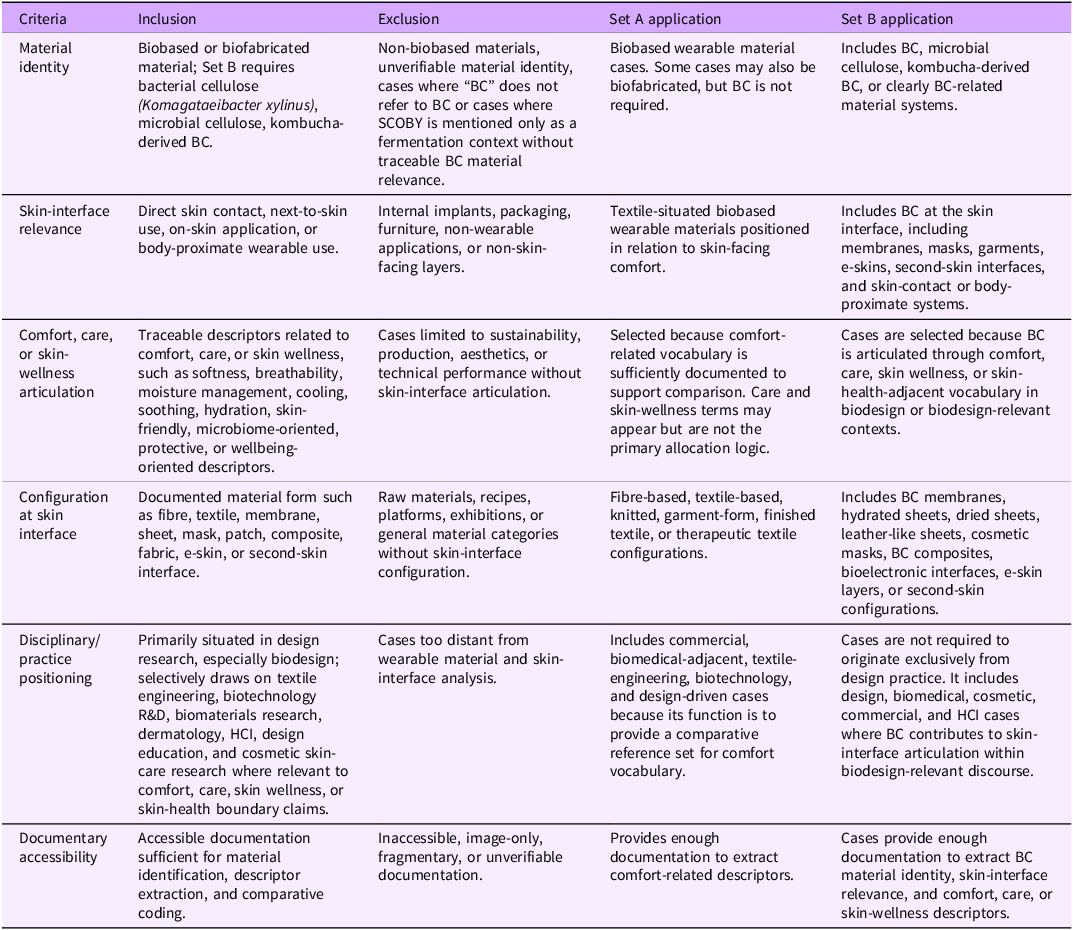
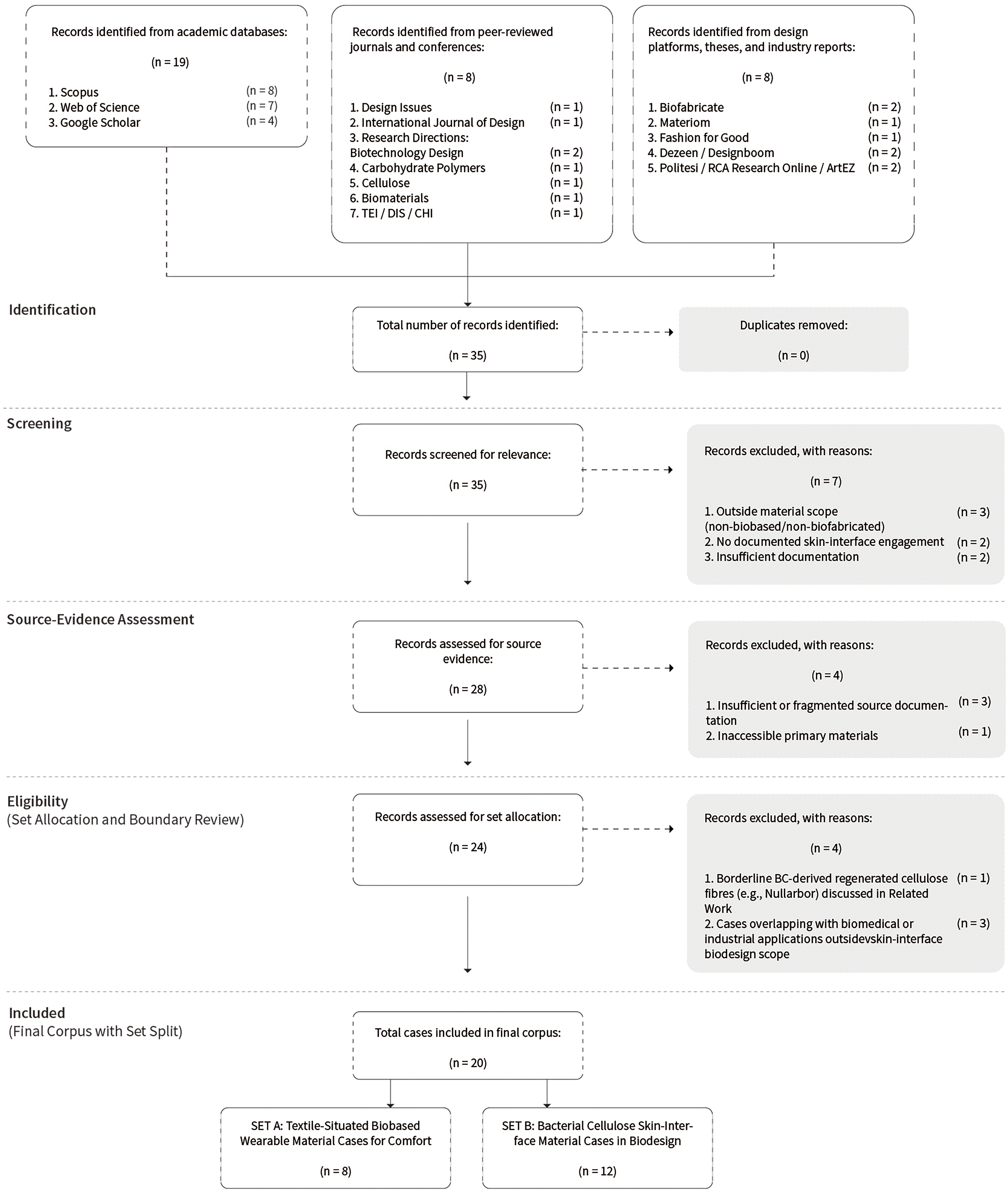
Screening proceeded in four stages: initial identification, relevance screening, source-evidence assessment, and set allocation. An initial pool of 35 candidate cases was reduced to 28 after relevance screening, 24 after source-evidence assessment, and 20 after set allocation and boundary review. Of the fifteen excluded cases, some did not meet the material identity or skin-interface criteria, while others lacked sufficiently documented comfort, care, or skin-wellness articulation. The search, screening, and exclusion summary is provided in Supplementary Table S2. Six operational criteria guided the final selection, i.e., material identity; skin-interface relevance; comfort; care; or skin-wellness articulation; configuration at the skin interface; disciplinary positioning; and documentary accessibility. Each criterion is operationally defined in Table 2. The four-stage selection procedure is visualised in Figure 1.
Operational definitions and case selection criteria
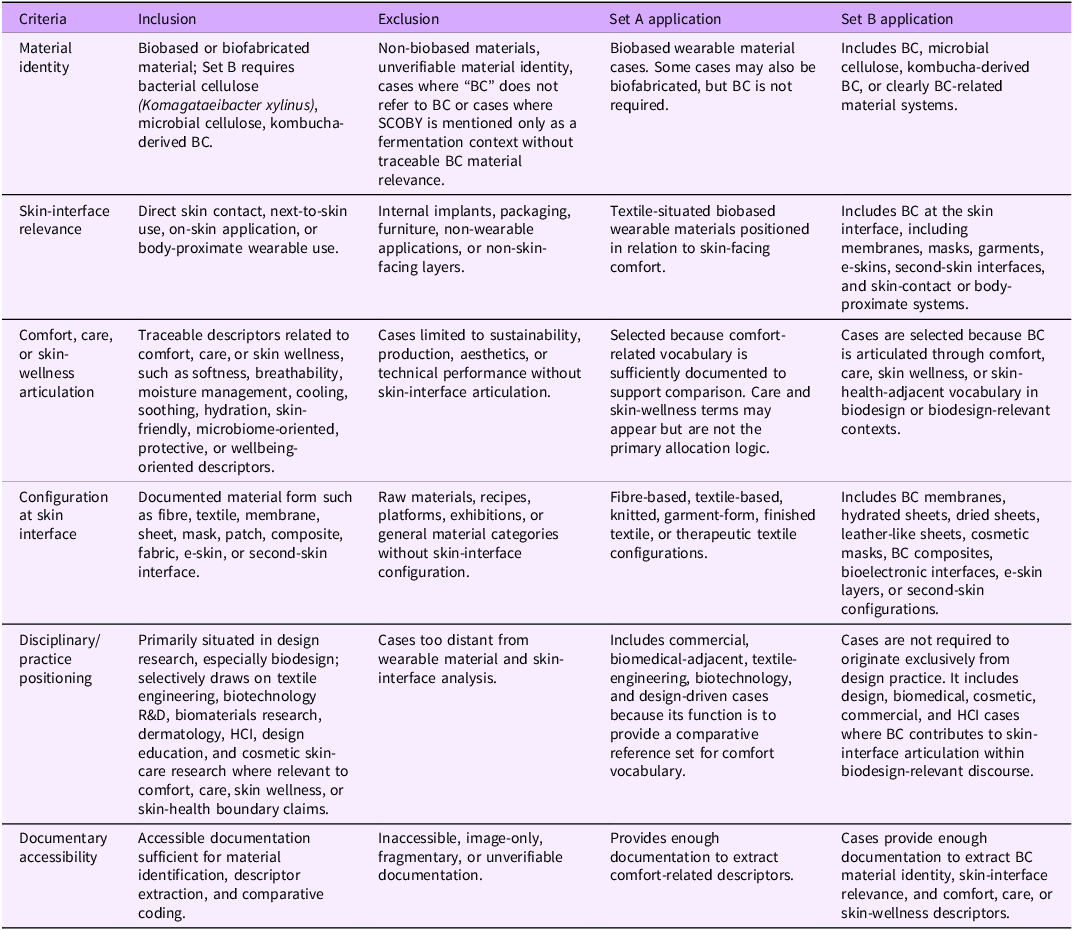
Table 2. Long description
A table with six rows and four columns detailing criteria for inclusion, exclusion, and application in Set A and Set B. The columns are labeled Criteria, Inclusion, Exclusion, Set A application, and Set B application. The rows are labeled Material identity, Skin-interface relevance, Comfort, care, or skin-wellness articulation, Configuration at skin interface, Disciplinary/practice positioning, and Documentary accessibility. Each row provides specific details under each column, describing the criteria and their applications. For example, under Material identity, inclusion requires biobased or biofabricated material, exclusion includes non-biobased materials, Set A application involves biobased wearable materials, and Set B application includes bacterial cellulose. The table provides a comprehensive guide for selecting cases based on these operational definitions.
Identification, screening, exclusion, and set allocation flow.
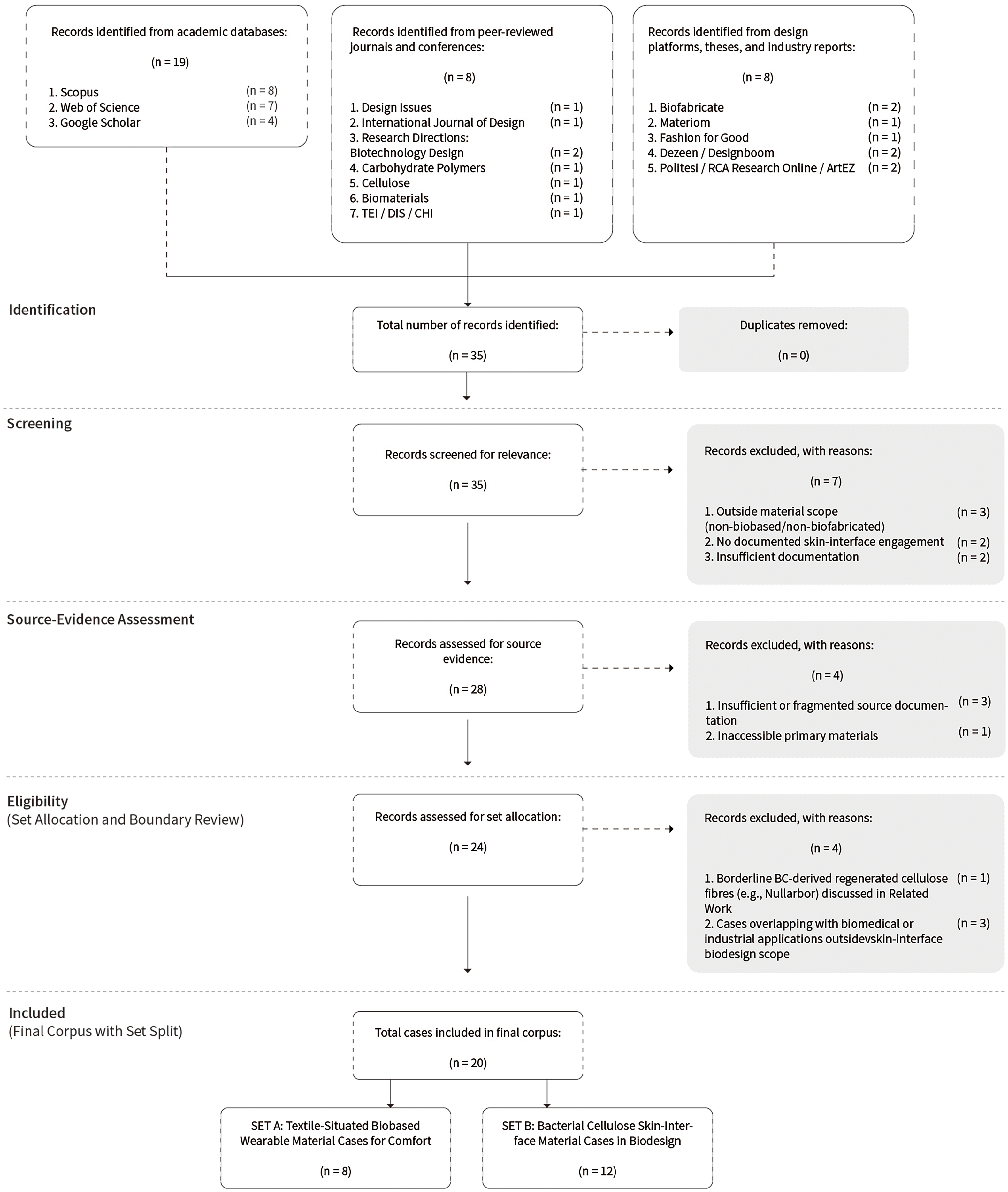
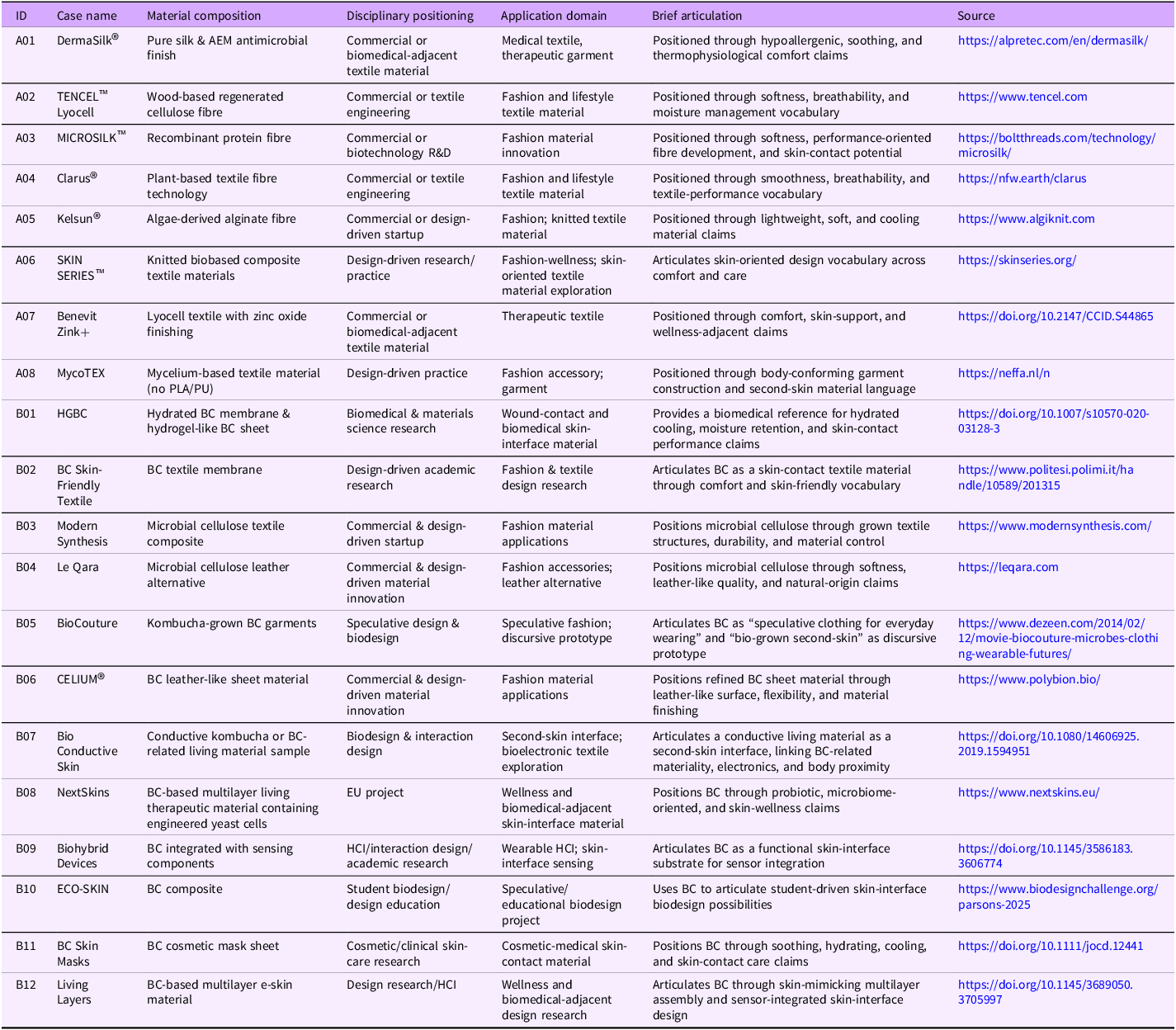
The final corpus comprises 20 cases, organised in two sets. Set A: Textile-Situated Biobased Wearable Material Cases for Comfort includes 8 cases. Set A functions as a comparative reference set for relatively stabilised comfort vocabulary in textile-situated biobased wearables, not as a performance benchmark or material exemplar to be evaluated. The cases in this set span textile engineering, commercial biomedical-adjacent textile development, biotechnology R&D, design-driven startups and research or practice. Full case-level descriptors, disciplinary positioning, and source type are provided in Supplementary Table S3.
Set B: BC Skin-Interface Material Cases in Biodesign includes 12 cases. Set B examines BC at the skin interface in biodesign and biodesign-adjacent contexts, where comfort, care, and skin-wellness vocabularies are still in formation. Cases span biodesign, design-driven startups and academic research, biomedical and materials science research, cosmetic and clinical skin-care research, HCI, student biodesign, and speculative design. Membership “in biodesign” refers to analytical positioning within BC skin-interface discourse, not to uniform design-led provenance. Full case-level descriptors are provided in Supplementary Table S3. The complete corpus, with disciplinary positioning and application domain across both sets, is summarised in Table 3.
Main corpus overview across Set A and Set B
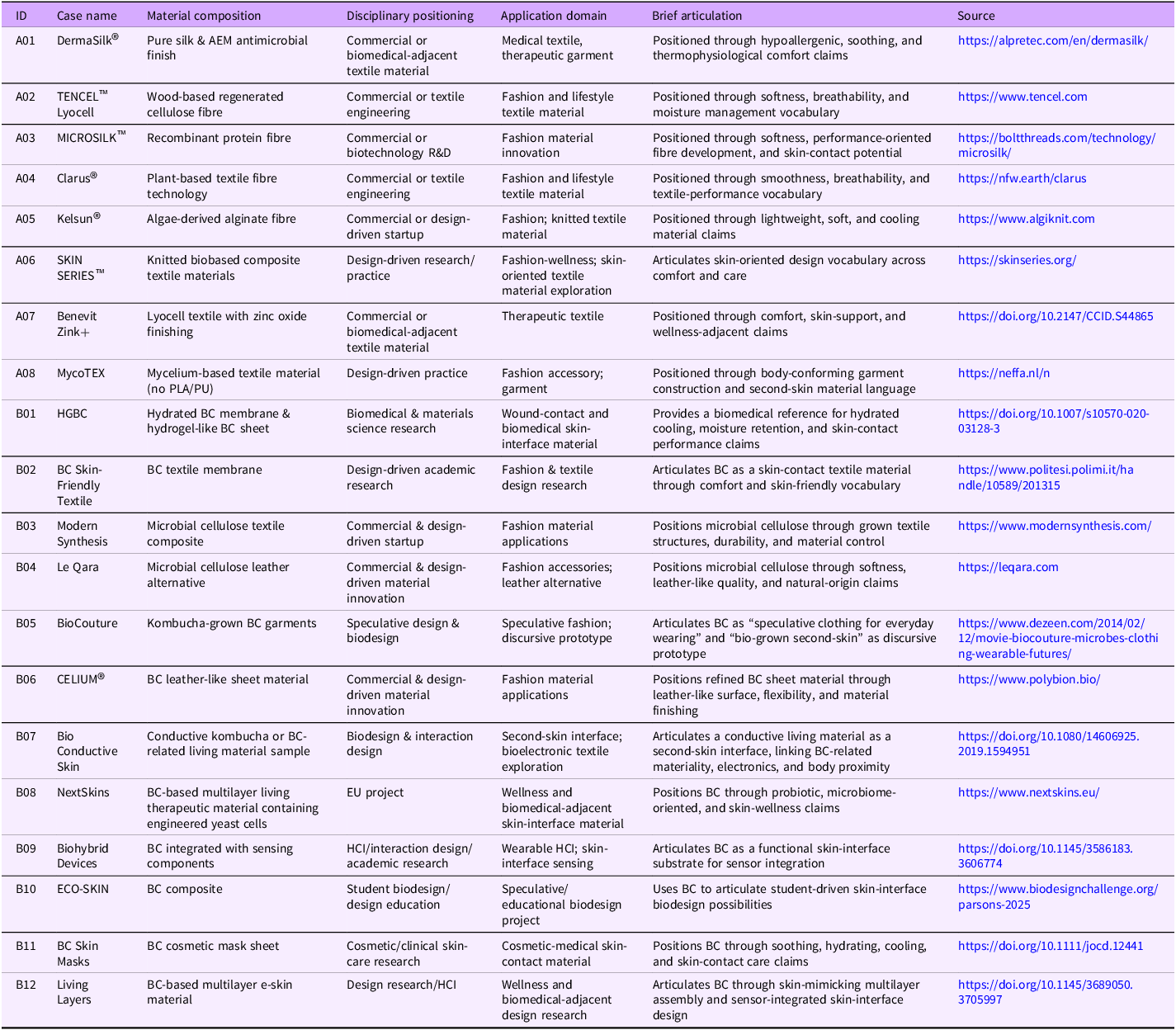
Table 3. Long description
The table presents a comparison of different case studies focusing on biomaterial compositions and their applications. It includes columns for ID, case name, material composition, disciplinary positioning, application domain, brief articulation, and source. The table has 12 rows, each representing a unique case study. Each row provides details on the material composition, disciplinary positioning, application domain, brief articulation, and source for each case. The cases cover a range of materials and applications, including medical textiles, fashion materials, therapeutic textiles, and more. Notable cases include DemaSilk, TENCEL Lyocell, MICROSILK, Clarus, Kelsun, SKIN SERIES, Benevit Zink+, MycoTEX, HGBC, BC Skin-Friendly Textile, Modern Synthesis, Le Qara, BioCouture, CELIUM, Bio Conductive Skin, NextSkins, Biohybrid Devices, ECO-SKIN, BC Skin Masks, and Living Layers.
Comparative logic
The comparison between Set A and Set B is discursive, not typological. Set A is not used as a material benchmark against which BC cases are evaluated, and Set B is not analysed as a set of cases that fall short of textile-engineering standards. Instead, the two sets allow the paper to ask a different question: when comfort, care, and skin wellness travel from a relatively settled vocabulary into an emerging one, what shifts, what holds, and where do the terms start to bound each other?
A finer-grained partition was possible. Cases were split into three sets (biobased fibres, non-BC biofabricated wearables, BC wearables), they mirrored the term hierarchy within biobased, biofabricated, and BC introduced in 1. The two-set design was chosen because the analytical interest lies in the discursive shift between stabilised textile-comfort vocabulary and emerging BC discourse in biodesign. The asymmetry has a methodological consequence. Set A already contains biofabricated cases (MICROSILK™, MycoTEX), retained there because their articulation has been pulled into the stabilised comfort discourse rather than because they are biobased. Disaggregating the broader biofabricated category is a productive direction for future work, noted in the Discussion section.
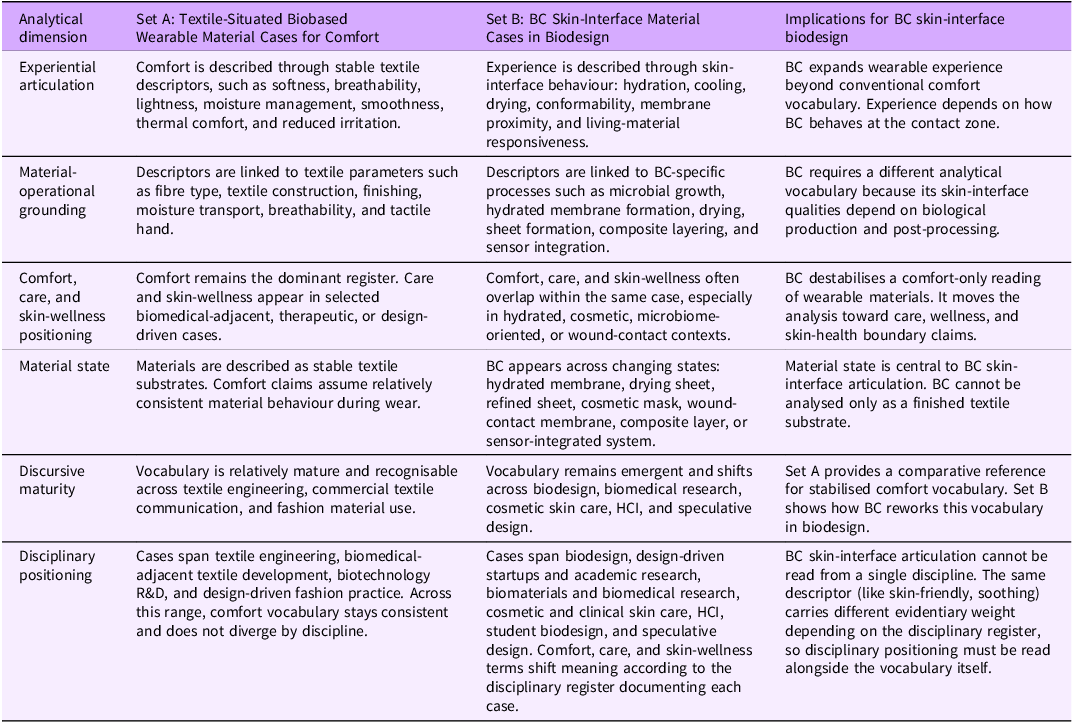
Coding proceeded in three cycles, following Braun and Clarke (Reference Braun and Clarke2019). The first cycle was open. Descriptors were extracted as fragments and preserved in their source phrasing, with quotation marks retained where the language was verbatim. The second cycle moved to axial coding, organising descriptors along three analytical dimensions applied as lenses rather than buckets: experiential articulation (how the material-skin relation is described at the level of perception), material-operational grounding (whether descriptors are tied to material properties or processes), and comfort, care, and skin-wellness positioning (how a case engages the three scaffold pillars and approaches the boundary with skin health). The third cycle was selective. The analytical scaffold was sharpened against the cases, and ambiguous descriptors were re-read with attention to provenance. Supplementary Table S5 records three provenance levels (source-language descriptors retained verbatim, paraphrased descriptors, and analytical syntheses developed by the authors). Cross-case patterns and shifts are consolidated in Table 4.
Cross-set analytical comparison and implications
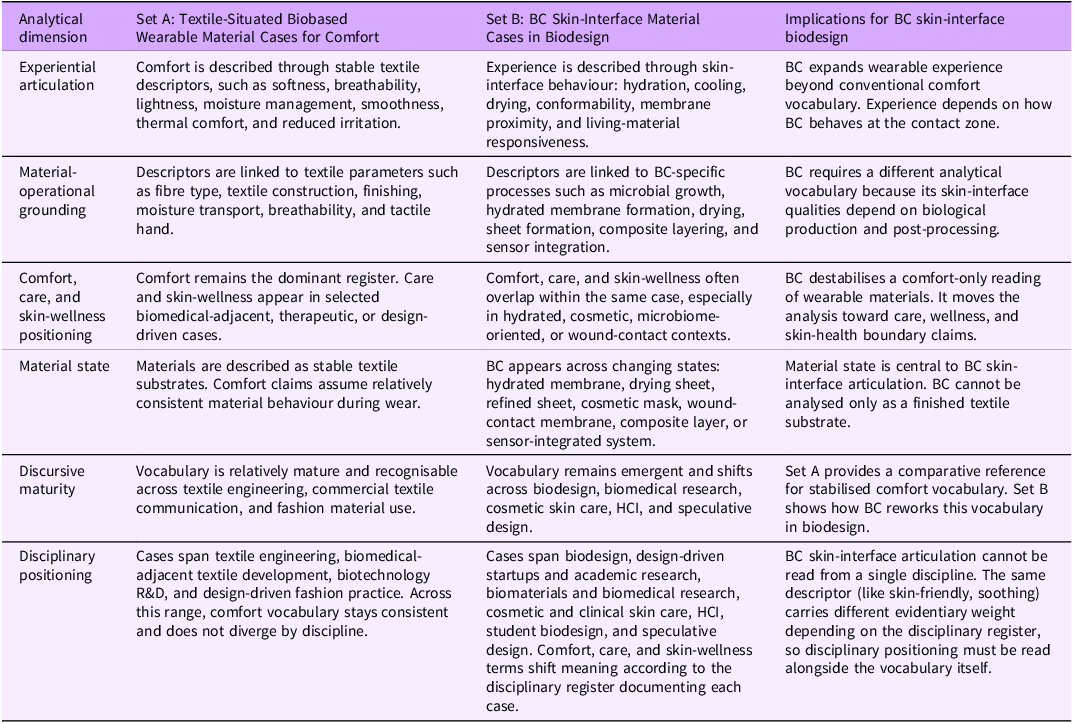
Table 4. Long description
A table with six rows and four columns comparing textile-situated biobased wearable material cases for comfort and BC skin-interface material cases in biodesign. The columns are labeled Analytical dimension, Set A: Textile-Situated Biobased Wearable Material Cases for Comfort, Set B: BC Skin-Interface Material Cases in Biodesign, and Implications for BC skin-interface biodesign. The rows are labeled Experiential articulation, Material-operational grounding, Comfort, care, and skin-wellness positioning, Material state, Discursive maturity, and Disciplinary positioning. Each row provides detailed comparisons and implications for BC skin-interface biodesign.
Results
This section presents the findings derived from the comparative case mapping of the two analytically constructed sets. The analysis draws on the cases outlined in Table 3 and Table 4, selected to represent distinct material framings and interface configurations within biobased wearable materials contexts. Across both sets, recurring descriptors, material references, and positioning patterns were comparatively mapped. The observations are organised below in relation to Set A, Set B, and their cross-set comparison.
Set A: stabilised vocabulary in textile-situated biobased wearables
Stabilised comfort vocabulary
The eight Set A cases share a stabilised comfort vocabulary drawn from textile-engineering traditions. Across the corpus, recurring descriptors include softness, breathability, moisture management, smoothness, lightness, and reduced irritation. Source documentation links these descriptors to specific cases with consistent meaning. TENCEL™ (A02) articulates softness, breathability, and moisture management in fibre-based form; Clarus® (A04) articulates smoothness and breathability through plant-based fibre technology; Kelsun® (A05) articulates lightweight, soft, and cooling in algae-derived fibre form; DermaSilk® (A01) articulates hypoallergenic, soothing, and thermophysiological comfort in therapeutic silk textile form. The same comfort terms recur across cases drawn from different fibre origins (plant, animal, microbial, algal, fungal) and different application domains (everyday wear, therapeutic textile, fashion innovation). Full case-level descriptors are provided in Supplementary Table S3.
Disciplinary breadth without vocabulary divergence
Set A spans five disciplinary positionings. It spans commercial textile engineering (A02 TENCEL™, A04 Clarus®), commercial biomedical-adjacent textile material development (A01 DermaSilk®, A07 Benevit Zink+), commercial biotechnology R&D (A03 MICROSILK™), commercial design-driven startup (A05 Kelsun®, A08 MycoTEX), and design-driven research and practice (A06 SKIN SERIES™). Despite this disciplinary breadth, the comfort vocabulary remains stable across the corpus. MICROSILK™ (biotech R&D) and TENCEL™ (textile engineering) share descriptors of softness and fibre smoothness; MycoTEX (design-driven startup) and Kelsun® (commercial design-driven) share descriptors of softness and body-conforming qualities; DermaSilk® (biomedical-adjacent) and Benevit Zink+ (biomedical-adjacent) share comfort-with-skin-support vocabulary. The disciplinary range does not produce vocabulary divergence within Set A.
Material-operational grounding
Comfort claims in Set A are documented in terms of measurable or recognisable textile parameters. Source descriptions tie descriptors to fibre composition, weave or knit structure, finishing technique, thermal resistance, water vapour permeability, and tactile properties. TENCEL™ moisture management is described in relation to lyocell fibre behaviour; DermaSilk® hypoallergenic positioning is described in relation to silk fibre and antimicrobial finishing; Benevit Zink+ comfort and skin-support claims are described in relation to lyocell base and zinc oxide finishing. Descriptor provenance, including which terms appear verbatim in source documentation and which are paraphrased, is documented in Supplementary Table S5. Set A’s analytical function is to establish a stabilised comfort vocabulary as comparative reference; Set B is then read against this reference to identify where BC discourse follows, extends, or departs from textile comfort traditions.
Set B: Emerging articulation of BC at the skin interface in biodesign
Vocabulary diversity across cases
Set B comprises cases in which BC is positioned explicitly as a biofabricated skin-interface material, often in membrane, hydrogel-like, sheet, or composite configurations operating under sustained dermal contact conditions.
Across these cases, experiential vocabulary expands beyond garment-level descriptors. While softness and flexibility remain present, articulation increasingly foregrounds adhesion, hydration, moist contact, conformability, translucency, and membrane-like surface behaviour. As indicated, cases such as B01 and B11 describe comfort through proximity and sustained interface conditions rather than through fibre-level performance (see Table 4).
Hydration behaviour is central. Cooling sensation, moisture retention, and moist-touch perception are repeatedly referenced. Nanofibrillar structure and biological origin are frequently invoked as explanatory characteristics. However, these references are not consistently accompanied by measurable textile parameters.
Material state variability is more visible than in Set A. References to hydrated versus drying states, membrane flexibility under moist conditions, and surface transformation appear across several cases. Drying may be associated with stiffening or reduced conformability. State change is therefore present in documentation, although it is not always elaborated as a distinct experiential dimension.
Wellness-oriented framing is more prominent in Set B. Experiential descriptors are frequently accompanied by terms such as soothing, regenerative, moisturising, dermal-supportive, wound-related, or responsive. Hydration and adhesion are occasionally linked to wound healing, antimicrobial function, or bioactive relevance. These framings appear in proximity to perceptual descriptors within the same documentation.
Care-related practices are also observable. Several cases refer to application routines, hydration maintenance, patch wear, or prolonged contact conditions. Comfort is described not only as an immediate tactile appraisal but also in relation to ongoing interaction with the material.
Compared with Set A, Set B exhibits the following results: (i) expanded experiential vocabulary; (ii) stronger emphasis on surface proximity and hydration; (iii) more frequent wellness-oriented language; (iv) visible reference to membrane state variability; (v) less consistent linkage between descriptors and standardised textile metrics.
Cross-set comparison along six analytical dimensions
The coding cycles described in Section Comparative Logic worked through three analytical dimensions: experiential articulation, material-operational grounding, and comfort, care, and skin-wellness positioning. The cross-set comparison adds three further dimensions that only become visible when the two sets are read against each other: material state, discursive maturity, and disciplinary positioning. The comparison between Set A and Set B was therefore developed along these six analytical dimensions, consolidated in Table 4.
Experiential articulation
Set A cases describe experience through textile-engineering descriptors like softness, smoothness, breathability, moisture management, lightness, and reduced irritation. Across the eight cases, the experiential vocabulary stays close to fabric hand and body comfort during wear. Set B cases describe experience through what BC does at the skin interface: hydration, cooling, drying, conformability, membrane proximity, and skin-like contact. Case HGBC (B01) and case BC Skin Masks (B11) emphasise hydrated cooling. Case BioCouture (B05) emphasises drying and second-skin contact. Case Bio Conductive Skin (B07) and case Living Layers (B12) emphasise membrane-like interface behaviour. Experience is articulated less through stable fabric attributes and more through material behaviour at the contact zone.
Material-operational grounding
Set A descriptors are tied to recognisable textile parameters such as fibre type, weave or knit structure, finishing process, thermal resistance, and moisture transport. TENCEL™ (A02), Clarus® (A04), and MICROSILK™ (A03) all link comfort claims to fibre construction. Set B descriptors are tied to BC-specific operations like microbial growth, hydrated membrane formation, sheet drying, composite layering, bioactive integration, and sensor integration. HGBC (B01) and Modern Synthesis (B03) tie claims to fermentation and post-processing; Biohybrid Devices (B09) and Living Layers (B12) tie claims to sensor embedding and multilayer assembly. The grounding logic differs: Set A draws on a settled parameter vocabulary, Set B on BC-specific process descriptions.
Comfort, care, and skin-wellness positioning
In Set A, comfort is the dominant register; care and skin wellness appear in specific cases but remain secondary. DermaSilk® (A01) and Benevit Zink+ (A07) extend toward dermatological-adjacent care; SKIN SERIES™ (A06) extends toward skin-oriented design vocabulary; MycoTEX (A08) uses second-skin language; the rest stay within comfort. In Set B, comfort, care, and skin wellness frequently appear together. BC Skin Masks (B11) articulate soothing, hydrating, and cosmetic-care claims that approach the skin-health boundary. NextSkins (B08) articulates probiotic and microbiome-oriented skin wellness. BioCouture (B05) and Bio Conductive Skin (B07) articulate care through cultivation, growth, and body-material intimacy. Set B cases more frequently move across the three pillars within a single case description, while Set A cases generally remain within comfort.
Material state
Set A cases describe textiles as stable substrates whose properties remain consistent during wear, regardless of fibre source or construction method. Comfort vocabulary in Set A assumes this stability. Set B cases describe BC across multiple states like hydrated membranes (B01 HGBC, B11 BC Skin Masks), drying sheets (B05 BioCouture during garment formation), refined sheet material (B03 Modern Synthesis, B06 CELIUM®), composite layers (B09 Biohybrid Devices, B12 Living Layers), and conductive living samples (B07 Bio Conductive Skin). Material state is part of the case description in Set B in a way that is largely absent from Set A. The same BC case can present different experiential and skin-related qualities in different states.
Discursive maturity
Set A vocabulary draws on long-established textile-engineering and textile material traditions. Terms such as soft, breathable, moisture-managing, hypoallergenic, and skin-friendly are used across cases with shared reference points, even when supporting evidence is not always provided. Set B vocabulary spans biodesign, biomedical research, cosmetic skin care, HCI, and speculative design. Terms such as living, skin-like, regenerative, bioactive, probiotic, and second-skin are used across cases but with shifting register. These terms operate variously as metaphors in B05 and B07, material properties in B01 and B11, and functional claims in B09 and B12.
Disciplinary positioning
Set A is positioned across textile engineering, biomedical-adjacent textile material development, biotechnology, and design-driven fashion practice. Across this disciplinary range, the comfort vocabulary remains consistent across cases. Set B is positioned across biodesign, design-driven startups and academic research, biomaterials and biomedical research, cosmetic and clinical skin-care research, HCI, student biodesign, and speculative design. Across this range, vocabulary does not travel with the same stability. Comfort, care, and skin-wellness terms shift meaning depending on the disciplinary register from which a case is documented. The same word can mean different things. For example, “soothing” in the cosmetic-clinical context of B11 describes a formulated cosmetic effect. In B05, by contrast, a speculative biodesign context, the word does not appear, but second-skin and body-material intimacy operate as proximate descriptors.
Discussion
The comfort-wellness boundary work
The central comparative finding is that comfort, care, and skin wellness operate differently as a discursive cluster in both sets. In Set A, comfort holds the centre; care and skin wellness appear in specific cases where the material-engineering or biomedical-adjacent register supports them. SKIN SERIES™ occupies the most explicitly care-oriented position in Set A. Its design-driven framing extends comfort vocabulary toward skin-oriented care, while retaining textile comfort as its basis. Benevit Zink+ and DermaSilk® extend toward dermatological-adjacent wellness through specific finishing technologies (zinc oxide, antimicrobial silk treatment), but the wellness claims remain tethered to comfort and to documented functional ingredients.
Set B works differently. Comfort, care, and skin wellness frequently appear within the same case description, with vocabulary moving across the three pillars without settling on one as primary. NextSkins exemplifies that probiotic, microbiome-oriented, and skin-wellness vocabulary is integral to the project rather than an extension of a comfort baseline. BC Skin Masks (B11) similarly braid soothing, hydrating, and cosmetic-care claims into a single articulation that approaches the skin-health boundary defined in Table 1.
The boundary itself becomes operationally visible in how cases use the term skin-friendly. As defined in Supplementary Table S4, skin-friendly refers to wearable claims of non-irritation, hypoallergenic positioning, or microbiome compatibility, with parameters that stop short of medical efficacy. In Set A, skin-friendly travels with documented functional support (DermaSilk’s antimicrobial finish, Benevit Zink+’s zinc oxide layer). In some cases from Set B, skin-friendly operates closer to discursive positioning than to documented parameters. Analytically, this comparison shows that the same term carries different evidentiary weight depending on which side of the boundary the case sits, and skin health remains the threshold beyond which design-research analysis hands over to clinical scholarship.
Material state as analytical bridge between set A and Set B
A specific feature of BC skin-interface articulation is the role of material state. Set A documentation generally presents these materials as stable textile substrates whose intended properties persist during ordinary use. Comfort vocabulary in Set A rests on this stability and does not need to specify a state before claims can be made. Set B operates on different ground. BC appears across hydrated, drying, refined sheet, composite, and conductive-living configurations, and each state produces a different skin-interface description. HGBC (B01) and BC Skin Masks (B11) articulate hydrated cooling and moisture retention that depend on the wet membrane state; BioCouture (B05) articulates body contact and drying transformation during garment formation; Living Layers (B12) articulates skin-mimicking properties that depend on multilayer assembly in the dry state.
This is not a deficit of BC discourse. It reflects that BC is a microbially produced material whose qualities are inseparable from production and post-production state. The vocabulary BC discourse generates around hydration, drying, conformability, and state transformation is doing work that textile-comfort vocabulary does not need to do, because Set A’s substrates do not undergo comparable state shifts during wear. Material state thus functions less as a comparable dimension across the two sets, and more as a register of articulation that BC discourse develops in response to its own materiality. The state-sensitive vocabulary is part of what makes BC skin-interface articulation specific.
The discursive maturity gradient
A second comparative pattern is best read as a difference in discursive maturity rather than as a difference in material category. Set A’s vocabulary draws on textile-engineering traditions accumulated over decades of practice and standardised testing. Terms such as soft, breathable, moisture-managing, and smooth carry shared reference points across the corpus. TENCEL™ (A02) and Clarus® (A04) use these descriptors with consistent meaning, even when each case engages different fibre origins. Set B’s vocabulary is in formation. Terms such as living, skin-like, regenerative, bioactive, probiotic, and second-skin recur across cases but with shifting register. Second-skin in BioCouture (B05) operates as speculative biodesign metaphor for grown clothing; in Bio Conductive Skin (B07) it operates as design-driven framing of bioelectronic body proximity; in Living Layers (B12) it operates as design-research articulation of skin-mimicking multilayer architecture. The word shifts from one context to another without its meaning remaining constant. In this shift the comparison surfaces from a stabilised vocabulary with shared reference points to an emerging vocabulary with reference points still being negotiated. Both vocabularies are doing real analytical work in their own contexts. However, the gradient is descriptive, not evaluative. Set B’s vocabulary is not a deficit version of Set A’s, and Set A’s stability is not a virtue Set B should aspire to. Each register suits its disciplinary and material context. The methodological consequence for biodesign is that BC skin-interface scholarship cannot import textile-comfort vocabulary unchanged, because the vocabulary travels into a discursive context where its reference points have not yet settled.
Biodesign’s disciplinary distinctness in BC skin-interface research
BC at the skin interface is engaged by several research traditions, each operating with different evidentiary expectations. Biomedical research (B01 HGBC) tests BC against clinical outcomes such as wound contact, hydration retention, and barrier function. Cosmetic-clinical research (B11 BC Skin Masks) tests BC against formulation parameters, dermatological tolerance, and soothing or hydrating effects. Biotechnology and materials science investigate BC production strains, fermentation conditions, and structure-property characterisation; commercial BC textile development (B03 Modern Synthesis, B06 CELIUM®) focuses on durability, finishing, and material scalability. HCI and interaction design (B09 Biohybrid Devices, B12 Living Layers) treat BC as a substrate for sensor integration and functional skin-interface design. Each of these registers contributes to the field, but none alone captures the specific design-led articulation examined here.
Biodesign’s contribution to BC skin-interface scholarship sits across BioCouture (B05), Bio Conductive Skin (B07), and NextSkins (B08), and is recognisable through a specific set of moves such as articulation of BC as a living material with its own production agency, articulation of design-led making practices that engage growth and state transformation, articulation of body-relational and experiential vocabulary that adjacent disciplines do not require, and articulation of BC’s positioning across comfort, care, and skin wellness in ways that hold open the discursive instability rather than resolving it into a single register. Biodesign-specific scholarship on BC at the skin interface is therefore not supplementary to biomedical, cosmetic, or HCI work on BC. It is the discipline within which the discursive work documented in this study takes place.
Limitations, reflections, and future work
Several limitations also help define and extend the contribution this study makes. The two-set design is deliberate rather than exhaustive, prioritising discursive clarity over comprehensive coverage. It reflects the discursive focus of the study opening a route for future application-specific studies. The cross-disciplinary breadth of Set B (biomedical, cosmetic, HCI, speculative, student biodesign, design-driven commercial) supports vocabulary comparison but suggests the value of follow-up studies focused on specific subregisters and application contexts. Case identification followed PRISMA-based transparency principles, not a systematic review framework, and the corpus is intended as a structured sample that captures representative framings rather than an exhaustive inventory of BC skin-interface practice.
On the limits of glossary work. A working glossary clarifies how terms are used in this study, but it cannot stabilise vocabulary that is in formation across multiple disciplines simultaneously. When skin-friendly encounters BC Skin Masks documentation, or when second-skin travels from BioCouture to Bio Conductive Skin to Living Layers, the same term carries different evidentiary weight and different design intent. The glossary makes these shifts visible and provides a shared basis for discussing them, even when full stabilisation remains premature. Still this glossary can be expanded. Karana et al. (Reference Karana, McQuillan, Rognoli and Giaccardi2023) treat the resistance of living materials to fixed categorisation as analytically generative rather than as a problem to be solved, and we approach the discursive instability of BC skin-interface vocabulary in the same spirit as an opportunity for more precise, context-aware articulation.
Future work could disaggregate the biofabricated category through dedicated taxonomic work, develop empirical user studies of BC at the skin interface, and engage longer-term BC living-material interface design beyond the initial articulation phase examined here. Future studies could test the proposed terminology in collaborative settings (e.g., workshops with designers and adjacent experts), and examine how comfort and wellness framings evolve across different BC states (hydrated, drying, coated, composited) and durations of wear.
Conclusion
This study examined how skin comfort, care, and skin wellness are articulated when BC is positioned as a wearable material in biodesign. By comparing textile-situated biobased wearable cases with BC skin-interface cases, the analysis showed that comfort, care, and skin wellness are related but not interchangeable. Comfort mainly refers to embodied sensory experience. Care refers to practices of use, maintenance, and sustained interaction. Skin wellness works as a broader positioning term that connects material experience, skin contact, and bodily support.
The study also showed that these concepts are articulated differently depending on disciplinary context. In textile-oriented contexts, comfort is generally described through stabilised textile-performance vocabulary linked to tactile, thermal, and moisture-related properties. In BC skin-interface contexts, however, comfort becomes more closely tied to hydration, adhesion, membrane behaviour, material state, and prolonged interaction with the body. Across these contexts, experiential descriptors, material characteristics, and wellness-oriented claims often overlap without clearly distinguishing between sensory experience, material performance, and health-related implications.
The main contribution of the study is therefore not the glossary alone, but the analytical lens developed through the comparison. This lens helps distinguish between experiential articulation, material-operational grounding, care-related practice, and wellness positioning. It shows that the shift from comfort to wellness does not happen only through new terminology. It also depends on how the material meets the skin, how its state changes, and how its use is maintained over time.
The study further clarifies why BC terminology requires specific attention within biodesign. Unlike conventional textile substrates, BC may appear as a hydrated membrane, drying sheet, refined material, composite, or living interface. These changing states directly influence how comfort, care, and skin wellness are articulated and understood. As a result, frameworks borrowed from textile engineering, biomedical research, or materials science cannot be transferred directly into biodesign without adjustment. BC at the skin interface requires vocabulary that can account for biological production, material state, experiential contact, and evidentiary boundaries simultaneously.
The method could also be applied to other contested terms in biodesign, including those used in projects involving algae, mycelium, and other microbial material systems.
Future research should test and refine the distinctions highlighted in this work through empirical wearer studies, experimental prototyping, and collaboration with dermatology, biomedical research, textile engineering, and materials science. This would help biodesign develop clearer and more responsible ways to describe comfort, care, skin wellness, and skin health at the material–skin interface.
Supplementary material
The supplementary material for this article can be found at https://doi.org/10.1017/S2977905726100511
Data availability statement
The authors confirm that the data supporting the findings of this study are available within the article and its supplementary materials.
Acknowledgements
The authors are grateful for the Biodesign Lab (B.LAB) from the Department of Design at Politecnico di Milano.
Author contributions
Conceptualisation: Z.Y.; S.S.D.P.; V.R. Methodology: Z.Y.; Data curation: Z.Y.; Data visualisation: Z.Y; Writing original draft: Z.Y.; S.S.D.P; Writing review & editing: Z.Y.; S.S.D.P.; V.R. Supervision: S.S.D.P.; V.R. All authors approved the final submitted draft.
Financial support
This research received no specific grant from any funding agency, commercial or not-for-profit sectors. The first author, Ziqian Yu, was supported by the China Scholarship Council (CSC) for her PhD research.
Competing interests
The authors declare no competing interests.
Ethical standards
Not applicable.


 Open access

