


In recent years there has been an increased focus on meal pattern among children and adolescents(Reference Rampersaud, Pereira and Girard1–Reference Merten, Williams and Shriver4). First, there has been much interest in meal pattern in relation to health status(Reference Rampersaud, Pereira and Girard1). Special attention has been given to the importance of eating breakfast, which has been associated with a multitude of positive health benefits, especially an association with body weight. Breakfast skipping among young people has been shown to be associated with an increased likelihood of being overweight or obese(Reference Andersen, Lillegaard and Overby5–Reference Groholt, Stigum and Nordhagen8) and having higher BMI(Reference Barton, Eldridge and Thompson9, Reference Delva, Johnston and O'Malley10). A recently published study among Norwegian children showed increased odds of being overweight when fewer than four meals were eaten the previous day(Reference Vik, Øverby and Lien11).
Second, studies from the 1980s to today have described a distinct change in meal pattern in children and adolescents, more than observed in the adult population(Reference Nicklas, Morales and Linares2, Reference Samuelson3, Reference Moreno, Rodriguez and Fleta12). These changes vary widely from one region to the other(Reference Moreno, Rodriguez and Fleta12). Generally, information about children's and adolescents’ meal frequency is scarce. However, in Europe an increased prevalence of irregular meal patterns has been reported. In Norway it has been reported that 15 % of healthy children and adolescents skip breakfast and 30 % skip lunch twice weekly or more(Reference Overby, Margeirsdottir and Brunborg13). In the USA the prominent trend is an increase in snacking events between meals(Reference Moreno, Rodriguez and Fleta12).
A third focus on meal pattern has concerned the importance of how and with whom meals are eaten. Family meals (eating together as a family with one or two parents present) appear to be associated with a variety of positive health behaviours in childhood and adolescence(Reference Mamun, Lawlor and O'Callaghan14). An American 10-year longitudinal study of black and white girls aged 9–19 years suggested that eating together as a family during childhood may have multiple health benefits in later years, such as fewer eating disorders, lower alcohol and tobacco consumption and less extreme weight-control behaviours(Reference Franko, Thompson and Affenito15).
Knowing the probable health benefits of having regular meals and that eating patterns established during adolescence shape diet later in life(Reference Larson, Neumark-Sztainer and Hannan16), an analysis of changes in meal pattern and factors associated with meal patterns in children is important. In Norway breakfast is usually sandwiches or cereals, school lunch is usually packed sandwiches, while dinner is a hot meal, and supper is often sandwiches or cereals. Many Norwegians have supper, most probably because they have an early dinner (16.00–18.00 hours) which is not all common in other European countries(17).
The present study aimed to analyse changes in meal pattern in Norwegian children from 2001 to 2008 in general; to analyse associations between meal pattern and gender, parental educational level and number of parents in the household; and to analyse the association between intake of unhealthy snacks, meal pattern and the mentioned variables.
Methods
Sample and procedure
The current study is a part of the Fruits and Vegetables Make the Marks (FVMM) project. In 2001, forty-eight schools from Hedmark and Telemark counties (twenty-four schools in each county) were randomly selected and invited to participate in the project FVMM, and thirty-eight agreed to participate. All 6th and 7th graders (age 10–12 years) in these thirty-eight schools were invited to take part in a questionnaire survey. These thirty-eight schools were contacted again in 2008, and were invited to participate once more in a similar survey. At that time twenty-seven schools agreed to participate, and all 6th and 7th graders in these twenty-seven schools were invited to participate. Pupils from the twenty-seven schools, from both 2001 and 2008, constitute the study sample of the present study (Table 1)(Reference Bere, Hilsen and Klepp18). Further details on the sampling process are available elsewhere(Reference Bere, Hilsen and Klepp18). Eleven schools that participated in 2001 did not participate in 2008. In a previously reported attrition analysis, no significant differences between the present study sample from the twenty-seven schools participating in both the 2001 and 2008 surveys and pupils at the eleven schools that participated in 2001 but not in 2008 were observed regarding sex, parental education level, and fruit and vegetable intake at school and all day(Reference Bere, Hilsen and Klepp18).
Description of participants included in 2001 and 2008: 6th and 7th grade pupils from twenty-seven elementary schools in two Norwegian counties
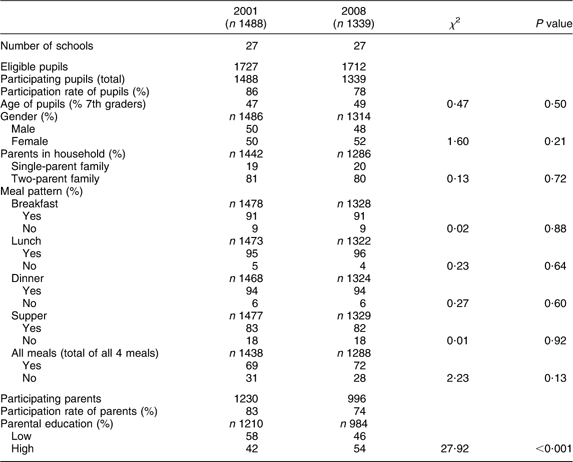
During both data collections (in 2001 and 2008), the same questionnaire was completed by the children in the presence of a trained project worker in the classroom. One school lesson (45 min) was used to complete the questionnaire. The present study sample includes in total 2827 children (1488 in 2001 and 1339 children in 2008) out of 3439 eligible (participation rate 82·2 %). The main reason why children did not participate in the study was absence from school on the survey day. The participation rates for parents were 83 % in 2001 and 74 % in 2008 (Table 1). Table 1 gives a description of the participants and shows that there were no differences in numbers living with one parent between 2001 and 2008. The parents participating in 2008 had higher education than those participating in 2001 (P < 0·001; Table 1). This is similar to what has been seen in Norway in general during the past 10 years; that there is an increased part of the population having high education(19).
Research clearance was obtained from the Norwegian Social Science Data Services. Written informed consent was obtained from parents and children prior to participation in the study.
The questionnaire included questions about meals wherein the participants were asked if they had breakfast, lunch, dinner or supper the previous day. The question was answered ‘yes’ or ‘no’. A sum score was made including if they had breakfast, lunch, dinner or supper yesterday, ranging from 0 to 4 meals yesterday. This was further dichotomized into having fewer than 4 meals per day and having 4 meals per day. This variable is called ‘all meals’. Another sum score of unhealthy snacks was made from the following three items from an FFQ: ‘How often do you drink soda (including sugar)?’, ‘How often do you eat candy (e.g. chocolate, mixed candy)’ and ‘How often do you eat potato chips?’ All items had ten response alternatives (‘never’, ‘less than once a week’, ‘once a week’, ‘twice a week’, …, ‘six times a week’, ‘every day’, ‘several times every day’), and they were scored (0, 0·5, 1, 2, …, 6, 7, 10), giving the unhealthy snack scale a range from 0 to 30 times/week.
Further, the children filled in questions about gender and number of parents in the household. Number of parents in the household was assessed by: ‘Tick the alternative showing the persons living at home with you’. Response alternatives were mother, father, stepmother and stepfather. Participants could tick more than one alternative if they lived with two parents. If parents were separated, the participants were supposed to tick the alternative showing the parent they live with most of the time. All responses were added and, eventually, dichotomized into living with one parent or living with two parents. Parental educational level was assessed individually in a questionnaire filled in by the parents, with one question: ‘What level of education do you have?’ The question had four response alternatives: ‘elementary school’, ‘high school’, ‘college or university’ (3 years or less) and ‘college or university’ (more than 3 years). This variable was dichotomized into lower (no college or university education) and higher (having attended college or university).
Statistical analysis
Differences in gender, parental education, number of parents in the household and meal pattern between 2001 and 2008 were analysed by χ 2 tests (Table 1). Crude and adjusted data were analysed by different multilevel linear-mixed models with breakfast, lunch, dinner, supper and all meals as the dependent variables. Crude results are only commented upon in the text (data not shown in any table). Relevant confounders were chosen according to the literature, and all adjusted models (Table 2) included gender, parental education, number of parents in the household, time of data collection and grade. In all adjusted models the following interaction terms were included: time × gender, time × parental education and time × number of parents in the household. This was done to assess possible interaction between time and the examined variables. Results presented in the text regarding unhealthy snacks (data not shown in any table) were analysed by a multilevel linear-mixed model with unhealthy snacks as the dependent variable, and adjusted for all meals, gender, parental education, number of parents in the household, time of data collection and grade. All models were also adjusted for school as a random effect. Accepted significant level was set at P < 0·05. All statistical analyses were performed using the SPSS statistical software package version 17·0 (SPSS Inc., Chicago, IL, USA).
Meal pattern in children from 2001 and 2008 according to gender, parental education, number of parents in the household and year the study was performed*: 6th and 7th grade pupils from twenty-seven elementary schools in two Norwegian counties

*Multilevel linear mixed models adjusted for grade and all variables presented for each model.
†'All meals’ includes a sum score of whether breakfast, lunch, dinner and supper was eaten yesterday. Variable is dichotomized into having fewer than 4 meals per day and having 4 meals per day.
Results
Results from the present study showed that there were no significant changes in children's meal pattern from 2001 to 2008. For both years more than 90 % of the participants reported that they had eaten breakfast yesterday, while approximately 95 % had eaten lunch, 94 % had eaten dinner, 82 % had eaten supper and about 70 % had eaten all four meals (Table 1).
All of the specific meals were analysed according to gender, parental education, number of parents in the household and study year and further adjusted for grade. No significant interactions were observed between time and gender (breakfast: P = 0·88, lunch; P = 0·91, dinner: P = 0·31, supper: P = 0·08, all meals: P = 0·15), parental education (breakfast: P = 0·69, lunch: P = 0·84, dinner: P = 0·16, supper: P = 0·90, all meals: P = 0·75) or number of parents in the household (breakfast: P = 0·74, lunch: P = 0·50, dinner: P = 0·40, supper: P = 0·79, all meals: P = 0·78), meaning that the associations between meal patterns and examined variables have not changed from 2001 to 2008; therefore the further results are presented for 2001 and 2008 together (Table 2).
In the unadjusted analysis more girls than boys reported that they had eaten lunch (effect size: 2·4 (95 % CI 0·9, 3·9) percentage points) the previous day, and fewer girls than boys had eaten supper (effect size: −3·8 (95 % CI −6·6, −1·0) percentage points). However after adjusting for relevant confounders, only the relationship that more girls than boys had eaten lunch yesterday (effect size: 1·8 (95 % CI 0·1, 3·4) percentage points) remained significant (Table 2). Unadjusted and adjusted relationships were otherwise similar, and in the following the results from the adjusted models (Table 2) are presented. More children with higher educated parents had eaten breakfast v. those with lower educated parents (effect size: 4·2 (95 % CI 1·9, 6·5) percentage points). Furthermore, more children living with two parents had eaten breakfast (effect size: 5·1 (95 % CI 2·1, 8·2) percentage points) and lunch (effect size: 4·0 (95 % CI 1·8, 6·1) percentage points) v. those living with single parents. There were no significant differences in the number of children eating dinner or supper regarding gender, parental education, number of parents in the household or study year (Table 2). Further, analysing the sum score of all meals, more children with higher educated parents than lower educated parents (effect size: 4·7 (95 % CI 0·8, 8·7) percentage points) and more children living with two parents than living with one parent (effect size: 6·2 (95 % CI 1·1, 11·3) percentage points) had all four meals yesterday (Table 2). There were no significant differences by gender or study year analysing the sum score of all meals (Table 2).
Crude data showed that those having 4 meals yesterday had a lower intake of unhealthy snacks v. those who had fewer meals (5·7 times/week v. 6·3 times/week, P = 0·001); however when adjusting for gender, grade, parental education, number of parents in household and study year, the difference was not significant (5·5 times/week v. 5·9 times/week, P = 0·06).
Discussion
No significant changes in meal pattern were observed in Norwegian children between 2001 and 2008. Few studies have described changes in meal pattern over time in the same geographic and age population as the present study. One study that has, the Bogalusa Heart Study, included 1584 children aged 10 years from 1973 to 1994; it described changes in meal patterns over time and reported different trends, including an increased number of breakfast skippers(Reference Nicklas, Morales and Linares2). A review of more recently conducted studies from European countries has described meal changes among children and adolescents as going from regular meals to skipping main meals(Reference Samuelson3). The general trend in higher-income countries is an increased number of snacks and meals eaten away from home, and more consumption of fast food and energy-containing beverages(Reference Moreno, Rodriguez and Fleta12). The increased focus on the importance of regular meals may positively have influenced the finding of no changes in meal patterns during 8 years in the present study. Breakfast represents a healthy habit and associations with positive health outcomes have been widely described(Reference Agostoni and Brighenti20), ranging from reduced prevalence of overweight(Reference Wurbach, Zellner and Kromeyer-Hauschild21) via improved dietary quality(Reference Rampersaud, Pereira and Girard1) to improved school performance(Reference Hoyland, Dye and Lawton22). The relationship between overweight and meal frequency is still debated; some have found that skipping meals yields higher odds of being overweight(Reference Andersen, Lillegaard and Overby5, Reference Vik, Øverby and Lien11, Reference Wurbach, Zellner and Kromeyer-Hauschild21), while others have not detected significant associations(Reference Nicklas, Morales and Linares2).
Among the children living with only one parent, there were more breakfast and lunch skippers compared with those living with two parents. The literature on family correlates of children's and adolescents’ breakfast consumption has recently been reviewed by Pearson and co-workers(Reference Pearson, Biddle and Gorely23). The review showed that living in two-parent families and parental breakfast eating were among the social factors that play a prominent role in adolescents’ breakfast habits(Reference Pearson, Biddle and Gorely23). The first association is in accordance with the results of the present study. Most studies have explored family correlates only in relation to breakfast consumption. However, in the present study we found that living in a one-parent family also was related to skipping lunch. Stewart and Menning described that children in non-traditional family households (single parent, step-parent, no parent) are more likely to display unhealthy eating habits such as skipping breakfast and lunch(Reference Stewart and Menning24). A possible explanation for these findings could be that single-parent families, wherein the parent is also in employment, have less time to shop and prepare meals than two-parent families. Further it might be more difficult to be present in the morning when children have breakfast. Recent research has shown that having at least one parent present in the morning substantially increased the likelihood of eating breakfast among adolescents(Reference Merten, Williams and Shriver4). In addition, research showed that having family meals in itself is related to improved dietary profiles(Reference Neumark-Sztainer, Hannan and Story25). Another study showed that the effect of family meals provides a lasting positive influence into young adulthood(Reference Larson, Neumark-Sztainer and Hannan16). The relationship between meal skipping and one-parent families has important implications for the development and implementation of effective nutrition interventions in high-risk groups.
In the present study, children with higher educated parents reported to have breakfast more often than those with parents with lower education. This relationship is also discussed in the literature; however, in the mentioned review by Pearson and co-workers, breakfast consumption was not related to parental education in five of eight samples and positively associated with breakfast consumption in three samples(Reference Pearson, Biddle and Gorely23). The HELENA (Healthy Lifestyle in Europe by Nutrition in Adolescence) study, which was not included in the mentioned review, found a significant influence of socio-economic status on breakfast habits, as the percentage of adolescents having ‘adequate’ breakfast increased as socio-economic status increased(Reference Moreno, Kersting and de Henauw26).
More boys than girls were lunch skippers; however the difference was rather small (2 percentage points). These results are in accordance with results from the HELENA study where girls had significantly higher mean frequencies of meals daily than boys(Reference Moreno, Rodriguez and Fleta12). However most studies find that girls skip meals more often than boys(Reference Moreno, Rodriguez and Fleta12, Reference Story, Neumark-Sztainer and French27–Reference Siega-Riz, Popkin and Carson29). In general, studies report that boys have diets lower in fruits and vegetables(Reference Rasmussen, Krolner and Klepp30) and higher in sugar-sweetened soft drinks(Reference Bere, Glomnes and te Velde31) compared with girls. The trend of skipping meals will add to an already negative dietary pattern for boys.
Some studies report that those who skip meals have a higher intake of energy-dense food and unhealthy snacks(Reference Rampersaud, Pereira and Girard1). In the present study, crude data showed that those who had skipped one or more meals the previous day had a higher intake of unhealthy snacks. However, this relationship was not present when adjusting for parental education, gender and study year.
Strengths and limitations of the study
The present study comprises two cross-sectional surveys in a well-defined population and includes a high number of participants, covering a time span from 2001 to 2008 from the same region.
Limiting the results of the study is the dietary methodology. Studies have shown that one 24 h recall does not characterize an individual's typical meal pattern, but may be sufficient for characterizing meal habits of large groups of children(Reference Thompson and Byers32), as presented herein. A further limitation of the study is the definition of meal pattern by asking only one question for each meal that is answered yes or no. Data being self-reported is another limitation. The questions regarding meal pattern have not been validated. However, a validity and reproducibility study has been conducted among Norwegian 6th graders for other variables in the questionnaire such as intake of fruit and vegetables(Reference Andersen, Bere and Kolbjornsen33). That study showed that both the 24 h recall part and the frequency part gave consistent responses on separate occasions in the test–retest study. Moreover, the 6th graders were capable of recording yesterday's intake of vegetables, but overestimated intake of fruit and juice. Also, the snacking variable is limited since some potential snacks, such as cookies, nuts and juices with added sugar, are not included. Another limitation is that the participating pupils were from only two of Norway's nineteen counties and no large cities are situated in these two counties. On the other hand, Oslo is the only large city in Norway (>250 000 inhabitants) and as Norway in general is a rather homogeneous country, we believe the results are likely to be generalizable to the other counties as well.
Conclusions
The current study shows a stable meal pattern from 2000 to 2008 among Norwegian children. Characteristics associated with skipping meals were living in a one-parent family, having parents with low education and being a boy. The results are important for health promoting strategies, which should give special attention to single-parent families.
Acknowledgements
The FVMM project is funded by the Research Council of Norway. The authors declare that they have no competing interests. K.-I.K. conceived the FVMM project. E.B. and K-I.K. designed the present study. N.Ø., T.H.S. and E.B. analysed and interpreted the data. N.Ø., T.H.S. and F.N.V. drafted the manuscript, and E.B. and K.-I.K. revised it critically. All authors have approved the final version of the manuscript.



