

Introduction
The religious landscape of Roman Africa has long been analysed through the lens either of cultural continuity or rupture, often framed within colonialist and post-colonialist debates over ‘Romanisation’, ‘resistance’ and the persistence of ‘indigenous’ traditions (Gasparini and Mastino Reference Gasparini and Mastino2021; McCarty Reference McCarty2024, 7–23). Scholarship has traditionally emphasised ideological and ethno-cultural interpretations, positioning religious practices and monuments within a binary framework of ‘assimilation’ versus ‘survival’ (e.g., Cadotte Reference Cadotte2007). However, such perspectives risk oversimplifying the complex interactions between local traditions and the broader structures of the Roman Empire. Rather than viewing North-African religious phenomena as relics of a Libyan, Punic, or ‘Africanised’ past, or as passive reflections of imposed Roman models, this study seeks to situate them within the dynamic social, material and economic networks of the second and third centuries AD. In so doing, it also aims to move beyond a second binary that continues to shape the study of North Africa under the Roman Empire: the divide between cultural histories that emphasise stasis (for example, Le Glay Reference Le Glay1966a; Hugoniot Reference Hugoniot2000, 46–57; Le Bohec Reference Le Bohec2013, 181), and socio-economic histories that stress change through Africa’s ‘economic boom’ (Hobson Reference Hobson2015) and changing ‘consumer culture’ (Dossey Reference Dossey2010).
A closer, situated examination of some religious practices at sites across Roman Africa (Figure 1) reveals a more nuanced picture, in which religious expression developed at those discrete points where local pasts, resources and lifeways articulated with imperial social ideals, shared discourses and global economies. The High Roman Empire fostered a vast interconnected world, forming a cultural koiné unified by military dominance, political institutions and economic networks. This globalising force encountered local diversity sparking varied reactions, from enthusiastic adoption to outright resistance. Rather than passive assimilation, local cultures actively engaged with global influences, adapting, reworking and sometimes re-exporting modified ideas in a process of mutual transformation. The concept of glocalisation helps explain these dynamics (Gasparini Reference Gasparini, Mazzilli, Montoya González and Sokołowski2025a). Unlike earlier approaches based on the notions of ‘Romanisation’, ‘hybridity’, ‘creolization’, ‘discrepant identity’, ‘Rome’s cultural revolution’, ‘creolage’, etc., glocalisation accounts for the fluid and agentic processes shaping Roman culture. It moves beyond sharp oppositions, recognising the unpredictable, multi-directional interplay of local and global elements in the ever-evolving, socio-cultural landscape of the Roman Empire. Urbanisation and mobility spurred cultural exchanges, allowing creativity to flourish in cosmopolitan hubs while reinforcing urban and rural ‘subcultural’ particularities.
Sites discussed in the text. 1: Tipasa; 2: Saldae; 3: Sitifis; 4: Cuicul; 5: Lambaesis; 6: Cave of Zemma; 7: Thamugadi; 8: Tiddis; 9: Cirta; 10: Cave of Taya; 11: Khenchela; 12: Announa; 13: Calama; 14: Thubursicu Numidarum; 15: Hippo Regius; 16: Aïn Chabrou; 17: Theveste; 18: Ksiba Mraou; 19: Naraggara; 20: Bir Derbal; 21: Ammaedara; 22: Thuburnica; 23: Simitthus; 24: Bulla Regia; 25: Sufetula; 26: Thugga; 27: Majoura; 28: Aïn el-Djemala; 29: Aïn Golea; 30: Thignica; 31: Siddi Kaddou; 32: Medjez el-Bab; 33: Sivalis; 34: Aïn Djelloula; 35: Thuburbo Maius; 36: Utica; 37: Gamarth; 38: Sidi el-Hani; 39: Carthage; 40: Hammam Lif; 41: Soliman; 42: Beled Belli; 43: Pupput; 44: Thinissut; 45: el-Kénissia; 46: Hadrumetum; 47: Thysdrus; 48: Curubis; 49: Thapsus; 50: Kerkouane. (M. McCarty, with basemap using data from Esri, USGS, NOAA).

Archaeological evidence reveals how names, objects and spaces participated in these transformations, shifting from standardised forms to locally reinterpreted expressions. This is why, in order to reach the goals of this study, we have selected four areas that continue to be understood through the previously mentioned problematic binary frameworks: the way gods are named by worshippers; the unusual assemblages of terracotta statues that served as the foci of worship in some imperial-period sanctuaries; the built spaces where cult took place, alongside the religious and social functions they performed; and the votive stelae which filled sanctuaries across the region. All have repeatedly been marked as ‘African’, Oriental’, or Romano-African’, and set within wider narratives of persistence or resistance to ‘Romanisation’ simply because, observationally, they just seem different. Of course, these aspects of cult only appear unusual when some material aspects of worship, in some parts of imperial-period Italy, by some elite subset of the population are taken as normative. By resituating these names, objects and spaces within more localised dynamics, it will be possible to evaluate these differences from a less monolithic and generalising perspective. That is precisely what we aim to do here, through a series of case studies that combine close analysis of finds with social, economic and material contextualisation.
1 Drawing on epigraphic data, we will first examine the remarkable frequency and semantic transformation of the epithet Augustus, together with a few other neo-Punic, Greek and Latin ‘power-related’ attributes. Far from indicating imperial cult or the ‘Romanisation’ of local ‘indigenous’ gods, this widespread ‘Augustalisation’ reflects a complex linguistic and ideological negotiation between local religious traditions and Roman imperial symbolism, resulting in a distinctive vocabulary of divine authority.
2 The widespread use of terracotta figures in sanctuaries such as those at el-Kénissia and Thinissut challenges conventional interpretations that link them exclusively to cultural survival within a rural lower class. Instead, these statues should be considered within the contexts of production, global trade and the broader religious economy, where material choices were influenced by technological advancements and access to specialised craftsmanship.
3 Similarly, the architectural features of ‘African’ and ‘Romano-African’ temples do not communicate a specific or systematic ethnocultural connotation, but rather participate in a flexible and pragmatic adaptation of imperial models, shaped by functional, scenographic and ideological considerations. The triporticoed courtyards, elevated cellae and monumental altars of these sanctuaries must be understood as result of the negotiation of a wider Mediterranean architectural koiné, tailored to the needs of local communities.
4 The thousands of stelae dedicated to Saturn across Africa provide a specific case study of the intersection between religious devotion and socio-economic change. Traditionally interpreted as vestiges of Punic religious practices or evidence of rural, non-elite worship, these monuments in fact reveal the aspirations of an emerging ‘middle class’, deeply engaged in the social and economic transformations of the imperial period. Their iconographic emphasis on sacrifice, often displaying distinct regional variations, reflects both participation in imperial cultic normativity and the adaptation of these motifs within a localised (individual as well as communal) framework. Rather than being passive recipients of religious traditions, the dedicants of these stelae actively expressed their own religious and social agencies, using public acts of devotion to assert status and affiliation with broader imperial structures.
By approaching North-African religious practices through the interconnected lenses of onomastics, material culture, economic infrastructure and social mobility, this multifold study transcends rigid cultural dichotomies and explores the fluid and evolving nature of religious expression in the Roman world. The archaeological and epigraphic evidence underscores the extent to which theonymy, cultic artifacts and sacred locations were embedded within the vibrant glocal mechanisms of Mediterranean imperial life, trade and craft-production during the second and third centuries AD.
[BDA/VG/MM]
Naming gods
Our first case-study concerns divine onomastics. In Roman Africa, epigraphic evidence documents no fewer than 439 theonyms (for example, ‘Mercury’) and 593 qualifiers (for example, ‘Augustus’) applied to those theonyms. Most of these onomastic elements are in Latin (248 theonyms, 454 attributes), while Greek texts are less frequent (171 theonyms, 117 attributes) and neo-Punic inscriptions are quite rare (20 theonyms, 22 attributes). By far the most recurring divine epithet is Augustus/-a/-i/-ae. Alain Villaret’s research (Reference Villaret2019, 126) has made it possible to establish that, in Africa Proconsularis, almost 80% of the religious dedications make use of such onomastic attribute. This is confirmed now by the Sylloge Inscriptionum Religionis Africae Romanae (SIRAR: https://humanidadesdigitales.uc3m.es/s/nuevo-sirar/page/home; cf. López-Gómez and Gasparini Reference López-Gómez and Gasparini2025). At the time of writing this text, SIRAR has collected 5,752 epigraphic entries from 679 different locations in Roman Africa, of which as many as 1,686 inscriptions make use of the term Augustus as an adjective (and not as an anthroponymic per se).
Imperator/Αὐτοκράτωρ, Caesar/Καῖσαρ and Augustus/Σεβαστός represented the Latin and Greek official imperial tria nomina, acting as the emperor’s praenomen, nomen and cognomen. That means that, in principle, Augustus should be considered an ‘anthropophoric epithet’ or, in other words, an epithet attributed to deities that is formed from an individual human name (Gasparini, Alvar Ezquerra and Bonnet Reference Gasparini, Alvar Ezquerra and Bonnet2025, 5). The epigraphic evidence from North Africa reveals a significant trend of assigning divine epithets derived from personal anthroponyms: 22 instances have been identified across modern Morocco, Algeria, Tunisia and Libya, applied to nine Roman deities. Aesculapius, Caelestis, Genius, Juno, Mercurius, Pollux, Saturnus, Silvanus and Venus receive the epithets of Bellensis, Cassiana, Extricatianus, Graniana, Meddensis, Pegasianus, Privatensis, Repentinus, Silvius, Sittiana, Sobarensis and Ulpius (Gasparini Reference Gasparini, Aounallah and Mastino2020, Reference Gasparini, Gasparini, Alvar Ezquerra and Bonnet2025b, Reference Gaspariniforthcoming). The distribution of these inscriptions is highly localised, with the majority concentrated in northeastern Tunisia, particularly in the Haut Mornag region south of modern Tunis. Except for an early example from Lepcis Magna (mid-first century AD), all these inscriptions date between the second and third centuries AD, showing the extreme degree of individualisation that the process of religious appropriation could attain during this period.
Does the massive ‘Augustalisation’ of theonymy in North Africa necessarily reflect the presence of an actual imperial cultic practice behind these designations? Clearly not. This is not the formal structure of ritual devotion to the emperor, but rather a semantic and symbolic strategy, a linguistic elevation of divine names through the imperial register. The widespread use of Augustus as an epithet does not imply that each of these deities was worshipped as the emperor or through imperial cult, but rather that the authority and prestige associated with the imperial title were being rhetorically transferred to the divine realm. In other words, the epithet Augustus became, especially from the very end of the first century AD, so widespread that, in North Africa, its ‘imperial coefficient’ (Robert Schilling apud Dunand Reference Dunand1963, 349; Villaret Reference Villaret2019, 23) quickly swelled to the point of converting itself into a very common, honorific appellation, a sort of ‘Dear Mister God/Dear Miss or Mrs Goddess’. Of course, the fact that the epithet Augustus became so widely used and semantically inflated during the second and third centuries AD – essentially losing its original anthropophoric connotation – does not imply that it ceased to operate as a ‘power-related’ onomastic attribute (on the taxonomy of divine onomastics, see Alvar Ezquerra et al. Reference Alvar Ezquerra, Beltrán Ortega, Fernández Portaencasa, Gasparini, López-Gómez, Pañeda Murcia, Pérez Yarza, Alvar Nuño, Martínez Maza and Alvar Ezquerra2024). On the contrary, it continued to reflect the symbolic transference of human political and social authority into the divine sphere (cf. McCarty Reference McCarty2024, 142–52).
One must ask why this systematic ‘Augustalisation’ of religious epigraphy occurred so intensely across the North-African territory, and not in other parts of the Mediterranean world. In Rome and Italy, for instance, this phenomenon is rare or minor, with a rate of only 5% and 26%, respectively (Gregori Reference Gregori, Bodel and Kajava2009; Villaret Reference Villaret2019, 125–6); in the Western provinces, it appears quite sporadically, in 29% of cases (Villaret Reference Villaret2019, 126–7); in the Eastern Mediterranean it is altogether exceptional, with a rate of 15% and only 112 epigraphic occurrences, half of which are found in the Balkan Peninsula (Villaret Reference Villaret2019, 109–22; Camia Reference Camia, Caneva, Gasparini and Petridouforthcoming). A plausible explanation lies in the Punic substratum of North Africa, particularly in the traditional structure of Punic religious dedications, which, in the case of the tophet-sanctuaries, where the vast majority of these dedications came from, are generally introduced by the formula, ‘To the Lord, to Baal…/To the Lady, to Tanit…’ (D’Andrea Reference D’Andrea2014). The fact that this phenomenon took root so firmly in North Africa, but not in the Near East, calls for a careful consideration of the specific cultural configurations of these two regions, and in particular of their markedly different religious and institutional ecologies. The process of ‘Augustalisation’ does not appear to emerge spontaneously within the linguistic and socio-cultural fabric of the Greek-speaking East (Camia Reference Camia, Caneva, Gasparini and Petridouforthcoming), even where ostensibly ‘promising’ Phoenician-Punic formulae were already in place. Rather, it seems to gain traction – and indeed to ‘ignite’ – primarily within Roman contexts, where the interaction between imperial power, civic institutions’ and religious language created especially favourable conditions for the routinised transfer of the epithet Augustus to the divine sphere. However, a monolithic view of the Phoenician-Punic world can be misleading, leading us to seek in the Phoenician East what actually appears to be characteristic of the Punic West. Moreover, more than 95% of Phoenician and Punic inscriptions dedicated to the Lord refer to the god of the Tophet, Baal Hammon, and we know that this type of sanctuary is absent (or at least not attested) in the Phoenician East. That is, the particular, regional practices of theonymy popular in pre-imperial Africa created the conditions and habits which encouraged imperial-period ‘Augustalisation’. This was not permanence, but a glocal fitting of imperial terms into pre-existing practices.
If this hypothesis is correct, it would first explain the extremely high concentration of this usage in Africa Proconsularis, where approximately 80% of religious inscriptions contain the epithet Augustus. In contrast, the percentage tends to decrease considerably in regions further east and west: in the Tripolitanian area the rate drops to around 30%, in Mauretania Caesariensis to 50% and in Mauretania Tingitana to only 20% (Villaret Reference Villaret2019, 126).
Secondly, and more importantly, such possible extensive recalibration of the Punic dedicatory formulas suggests that, regardless of the ‘ethnic’ or ‘linguistic identity’ of the dedicants – hundreds of men and women of diverse origins and social standings (see the broad evidence collected in SIRAR) – the traditional structure of invocation was re-semanticised within a new shared ideological framework. That is, the inherited religious language of Punic dedications – particularly the invocation of a divine lordship – was retained, but filled with new imperial content. In this process, the sovereign figure of the Roman emperor, embodied by the title Augustus, came to replace or absorb the semantic function once fulfilled by local deities such as Baal or Tanit. The epithet Augustus thus acted as a translatable marker of divine authority, which could be inserted into the inherited formula to maintain the continuity of ritual language while adapting it to the transformed political and religious landscape of the Roman Empire. This interpretive shift illustrates not a passive absorption of imperial ideology, but rather a regional creative negotiation of older religious forms with new symbols of power. The widespread use of Augustus as an epithet in divine nomenclature in Africa Proconsularis should therefore be seen not as evidence of emperor worship or political flattery, but as a linguistic strategy of cultural mediation – one that allowed local communities to articulate continuity with their religious past while also aligning themselves with the broader hegemonic structures of the Roman Empire. From a linguistic and cultural perspective, the widespread use of the epithet Augustus in North-African religious inscriptions may be interpreted as a case of code-switching, a strategic alternation between cultural-linguistic codes: the old linguistic frame remained in place, but the content of authority shifted. The divine lordship once attributed to Baal was now increasingly expressed through the Roman imperial epithet Augustus, which had itself evolved from a personal imperial cognomen to a generalised marker of sacral authority. The result is a hybridised language of worship in which the invocation of divinity simultaneously gestures towards local tradition and imperial ideology by strategically embedding imperial authority within a locally intelligible and ritually familiar framework.
The complexity of similar dynamics of cultural negotiation is further illuminated by possible cases of what might be termed the ‘pseudo-Africanisation’ of religious onomastics, that is instances where new divine names appear to have been retroactively embedded within a local, autochthonous framework, yet articulated through the linguistic register of Roman imperial power. Two particularly striking examples are the deities GD (from the Cave of Zemma) and Bacax (from the Cave of Taya), both of whom are invoked with the epithet Augustus in third-century inscriptions from Numidia (Gasparini Reference Gasparini2024; Kaabia Reference Kaabia2025). These figures are entirely unattested outside their immediate and extremely restricted epigraphic contexts. Their emergence, which coincides chronologically with the reign of Septimius Severus (193–211 AD) – an emperor of African origin – has led some scholars to speculate that their promotion reflected a deliberate policy of imperial support for ‘indigenous’ cults (e.g., Cid López Reference Cid López1987, 136; cf. Dal Covolo and Rinaldi Reference Dal Covolo and Rinaldi1999, 187–272; Swain, Harrison and Elsner Reference Swain, Harrison and Elsner2007, 401–502; Ando Reference Ando2012, 122–46). However, a more convincing interpretation sees these cases not as top-down restorations of ‘authentic’ local religion, but rather as expressions of an ‘antiquarian sacralisation’: a culturally strategic and ideologically-charged process whereby the local magistrates of Thibilis and Phua sought to construct or revive imagined ancestral cults within a Roman religious vocabulary (cf. McCarty Reference McCarty2024, 317–18, making a similar argument for ritual terminology). Much like the adoption of Augustus in wider divine onomastics functioned as a form of symbolic code-switching, the creation (or reactivation) of deities such as GD and Bacax may be understood as the (re-)invention of tradition under the guise of archaism. These gods are not survivals in a strict sense, but pseudo-archaic reconstructions, legitimised and sacralised through epigraphy and ritual in a way that made them appear local and ancient, while in fact serving contemporary political, religious and identity needs. In this interpretive framework, the invocation of Augustus alongside entirely local and otherwise unknown divine names becomes especially meaningful. It signals a double movement: on the one hand, a gesture towards deep cultural memory or putative ancestral legitimacy; on the other, the embedding of these invented identities within an imperial linguistic and ideological matrix. These onomastic choices represent a high level of discursive creativity, allowing local actors to craft religious forms that were simultaneously rooted in a localised past and legible within the Roman imperial religious universe. In this way, African epigraphy offers compelling evidence for how local agency actively reshaped the landscape of divine names through selective memory, linguistic hybridity and ritual innovation.
In addition to Augustus, twelve other epithets – for a total of 382 occurrences – emphasise divine sovereignty in Roman Africa and can be classified as ‘power-related’. No fewer than five epithets and more than half of the attestations are found in neo-Punic: ᵓdn (199 occurrences: https://humanidadesdigitales.uc3m.es/s/nuevo-sirar/item/40966), rbt (12: SIRAR 2057; 2059–62; 2067-–69; 2259; 2278; 2281), ᶜwgsṭs (2: SIRAR 2352–3), rzn (1: SIRAR 2253), rznt (1: SIRAR 2364). Beyond the frequent epithets of ‘Lord/Lady’ (ᵓdn/rbt) traditionally used to refer to Baal and Tanit until the second century AD and the – earlier and much rarer – epithets of ‘Prince/Princess’ (rzn/rznt) (second–first centuries BC), it is important to highlight the early – though sporadic – instance of the direct adaptation of the term Augustus into neo-Punic (ᶜwgsṭs), attested at Lepcis Magna (8 BC).
Greek attestations are exceedingly rare and belong to a particularly ‘creative’ category of texts. They include a magical amulet from Siddi Kaddou (SIRAR 5709) and a defixio from Carthage (SIRAR 5729), both dating to the second–third centuries AD, in which the invoked deities are referred to as κύριοι θεοί, ‘Lord Gods’, as well as another defixio from the second century AD, again from Carthage (SIRAR 5732), that uses the unusual designation βασίλιον, ‘Royal/Imperial’. These Greek expressions reflect a distinctive linguistic and conceptual inventiveness, characteristic of the magico-religious sphere, where conventional divine epithets are often reshaped or newly coined to enhance the perceived efficacy of the ritual formula.
Alongside Augustus, the Latin ‘power-related’ epithets include Dominus/-a/-i/-ae (110), Princeps (1), Rex (4)/Regina (48) and Decanus (1). Excluding cases of uncertain attribution, in 71 instances the epithet Dominus is assigned to Saturnus, while all other deities – both male (Aesculapius, Baal, Malagbelus, Middon, Neptunus, Pluto, Silvanus) and female (Caelestis, Ceres, Isis, Panthea, Tellus, Terra, Victoria) – do not exceed three attestations each. In only one case is the term not used in an absolute sense, but instead specifies the domain of the deity: Neptunus as Dominus undarum from Thugga (‘Lord of the waves’: SIRAR 3641). Similarly, the epithet Princeps is used at Lambaesis to invoke Jupiter Optimus Maximus not only as Gubernator omnium rerum and Rector caeli terrarumque, but also as Princeps deorum (SIRAR 1012), while Regina – when not used as the traditional epithet of Juno as part of the Capitoline triad – likewise serves to elevate the deity to the role of Regina tenebrarum in two defixiones from Hadrumetum (SIRAR 5745–5746) or Regina deum in a dedication to Juno as vera deum rectrix from Naraggara (SIRAR 5128). The meaning of the epithet Decanus dei magni, found in a defixio in Latin but written in Greek letters from Hadrumetum (SIRAR 3814), dating to the second century AD, is perhaps to be sought in Egyptian astrology. Finally, the term Rex was far more ideologically sensitive due to its negative connotations in Roman political culture, because of its strong association with monarchical rule. Nonetheless, one example found in Saldae applies to Jupiter the epithet of maximus caelicolum rex summus tonans, emphasising his supreme celestial authority (SIRAR 183). The term also appears in a second-century-AD defixio calling upon Chaos and Mercurius from Carthage and invoking the reges demoniorum (SIRAR 2544). This usage is consistent with traditional Roman religious formulations and does not challenge significantly established ideological norms. However, the other two instances are much more remarkable: in Beled Belli, the epithet Rex Augustus was applied to Saturnus (SIRAR 3045), and, in Sivalis, Rex Magnus was used for Pluto (SIRAR 5251). Both Augustus and Rex, albeit in completely different ways and proportions, appear to have lost their intrinsic ideological value, the former becoming inflated in usage, while the latter neutralizing its negative connotations.
The North-African epigraphic corpus offers an exceptional laboratory for understanding how divine onomastics could be strategically reshaped in response to shifting religious, linguistic and political frameworks within the Roman Empire. Among the most telling phenomena is the massive and consistent use of the epithet Augustus in religious inscriptions, an occurrence that, far from indicating widespread emperor worship, reveals instead the emergence of Augustus as a linguistic coefficient of sacral power. Originally an anthropophoric epithet rooted in the imperial tria nomina, Augustus in North Africa underwent a profound semantic shift: it was detached from its function as a personal cognomen and refunctionalised as a culturally intelligible marker of divine prestige. Its usage transcended social, ethnic, gendered, or linguistic boundaries, becoming accessible to any dedicant, an honorific no longer restricted by its imperial origins but resemanticised as a neutral and elevated title of divine authority. This remarkable linguistic transformation was not arbitrary, but was facilitated by the enduring vitality of local dedicatory formulas – particularly those of Punic origin – that traditionally invoked divine lordship. In this context, Augustus functioned as a translatable substitute for the native expression of divine supremacy, enabling a code-switching strategy in which the formal matrix of ritual address remained stable while its ideological content shifted. This ‘Augustalisation’ of divine epigraphy thus signals not passive acculturation, but active local agency in reconfiguring divine language to match both ancestral continuity and contemporary imperial allegiance.
Yet this dynamic did not move in one direction only. Alongside the inflationary use of Augustus in divine titulature, North Africa also witnessed a parallel phenomenon of ‘artificial Africanisation’ of divine names. In highly localised inscriptions (such as, for example, the mentioned tituli found in the Cave of Zemma and Taya referring to the deities GD and Bacax), we see the deliberate resurrection, if not invention, of gods with ostensibly archaic or indigenous identities by means of a process of ‘antiquarian sacralisation’ whereby local magistrates reimagined ancestral religious frameworks to bolster their own authority and articulate a distinctively African appeal for their Roman urban religion (on Roman Antiquarianismus see now Schwitter Reference Schwitter2024).
The broader picture of divine epithets in North Africa further confirms the region’s exceptional capacity for creative negotiation. Power-related epithets in neo-Punic remained in use well into the second century AD, often coexisting with – and arguably smoothing the path for – the adoption of Augustus within the same linguistic register. The above-mentioned early and rare, but telling, adaptation of Augustus itself into neo-Punic (ᶜwgsṭs) marks a moment of extraordinary linguistic convergence between Roman and local religious idioms. By contrast, the far less common Greek evidence – restricted to defixiones and magical amulets – illustrates a different register of creativity. In these ritual contexts, epithets such as κύριοι θεοί or βασίλιον were innovatively employed to amplify ritual efficacy through an experimental vocabulary. Finally, the use of Latin epithets such as Dominus, Princeps and Rex – though quantitatively limited – demonstrates how even ideologically sensitive terms could be absorbed into divine titulature when appropriately contextualised. The epithet Dominus, especially prevalent in connection with Saturnus, appears to have carried few problematic political overtones, functioning instead as a standard expression of divine authority. Likewise, Princeps and Rex, despite their ideological baggage within Roman political discourse, could be recontextualised to articulate divine rulership either in cosmic terms or in relation to specific domains.
In sum, North African divine onomastics reflects a landscape of extraordinary discursive plasticity and permeability. Whether through the semantic inflation of imperial epithets, the antiquarian reinvention of local divinities or the creative deployment of power-related titles across multiple languages, local actors across the region repeatedly demonstrated their ability to refashion the language of the divine in ways that were politically intelligent, ritually grounded and culturally resonant.
[VG]
Materialising gods
Materiality is often ignored or downplayed in studies of religion in Roman Africa, driven by the idealist frameworks brought to bear on understandings of the region (McCarty Reference McCarty2024, 16). Yet drawing more on materially-oriented frameworks is key to building deeper understandings of worship in the Roman Empire and moving beyond culture-historical paradigms (Graham Reference Graham2021; Versluys and Woolf Reference Versluys, Woolf, Rüpke and Woolf2021), to recognise the ways that global power structures (including economies) articulated in distinctively glocal ways.
One of the distinctive features of some sanctuaries in Africa Proconsularis is their adoption of medium- and large-scale terracotta statuary, both as objects that could be offered in a sanctuary and as cult statues, the focal points of worship activity. Indeed, two sanctuaries excavated around the turn of the twentieth century that became the type-cases for ‘Oriental’ sanctuaries in Africa because of their design (Sebaï Reference Sebaï2010; McCarty Reference McCarty2024, 320–26) – el-Kénissia and Thinissut (Figure 2) – provided rich assemblages of terracotta statuary depicting a variety of subjects, some of whose iconography seems to sit outside the repertoires of Classical art: bearded male deities on sphinx-thrones; winged, lion-headed female deities; female goddesses bedecked in jewellery atop their own sphinx-thrones. And (like most aspects of cult in imperial-period Africa), these statues are often explained as evidence of religious continuity, of Oriental, Punic, or generically ‘African’ survivals into the Roman period: seen perhaps most vividly in how these statues are displayed in the ‘Salle Punique’ of the Bardo Museum (Aounallah Reference Aounallah2018, 66–71), despite their manufacture under the empire.
Findspots of terracotta statuary and other objects in the sanctuary at Thinissut (M. McCarty, after Merlin Reference Merlin1910).
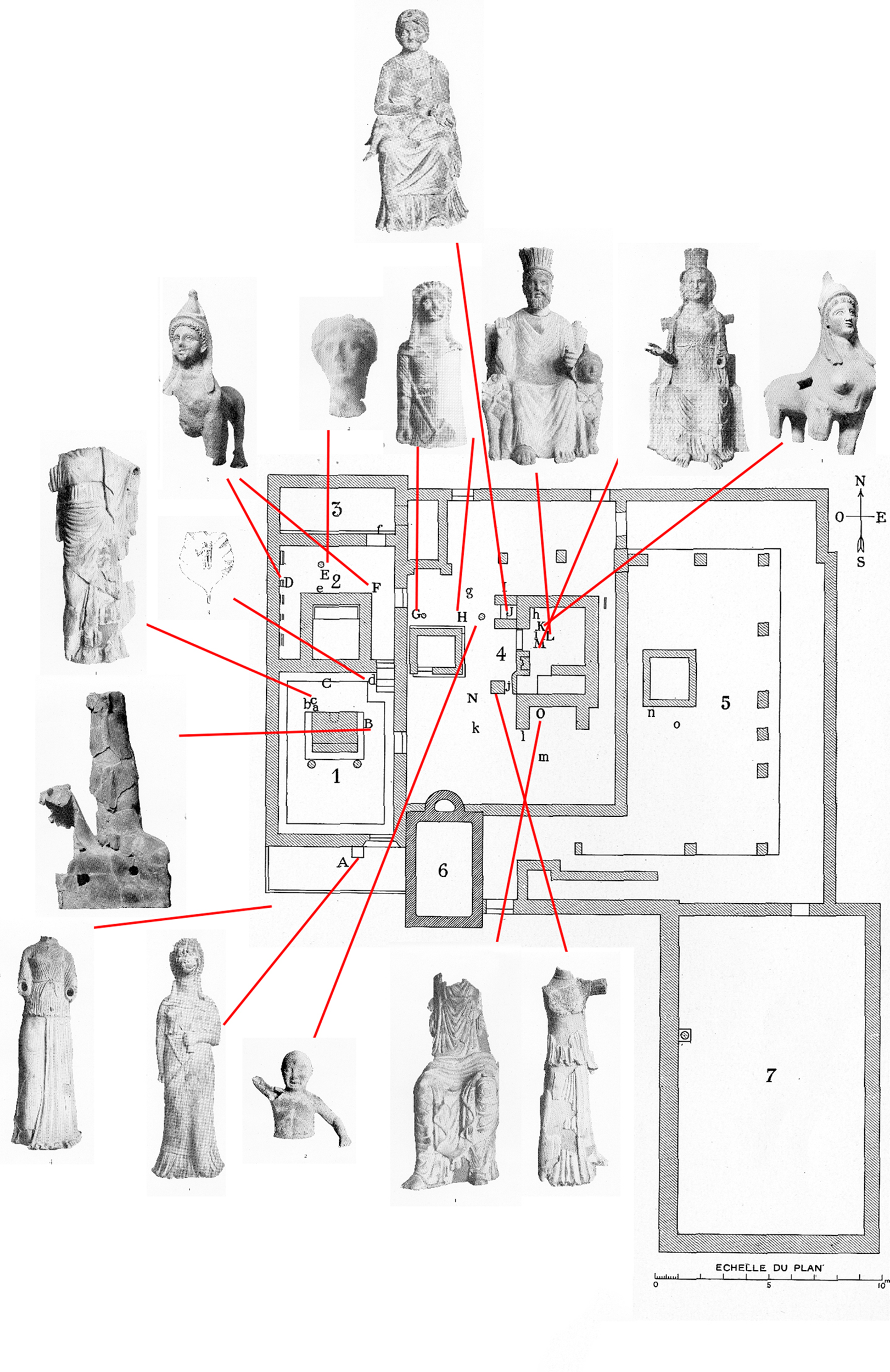
The evidence for terracotta statuary in North-African sanctuaries is varied and often lacks high-quality archaeological context: that is, these statues were almost always discovered during colonial-period, site-clearance excavations, or as chance finds. To the two sanctuaries mentioned above, we can add eight other ‘sanctuaries’ (the objects may have been in secondary context) where large-scale (>1 m tall) terracotta statues were excavated, and another five rich in medium-scale (∼30 cm tall) terracotta statuettes (Table A; Figure 3).
Distribution of terracotta statuary assemblages from Africa (M. McCarty, with basemap using data from Esri, USGS, NOAA).
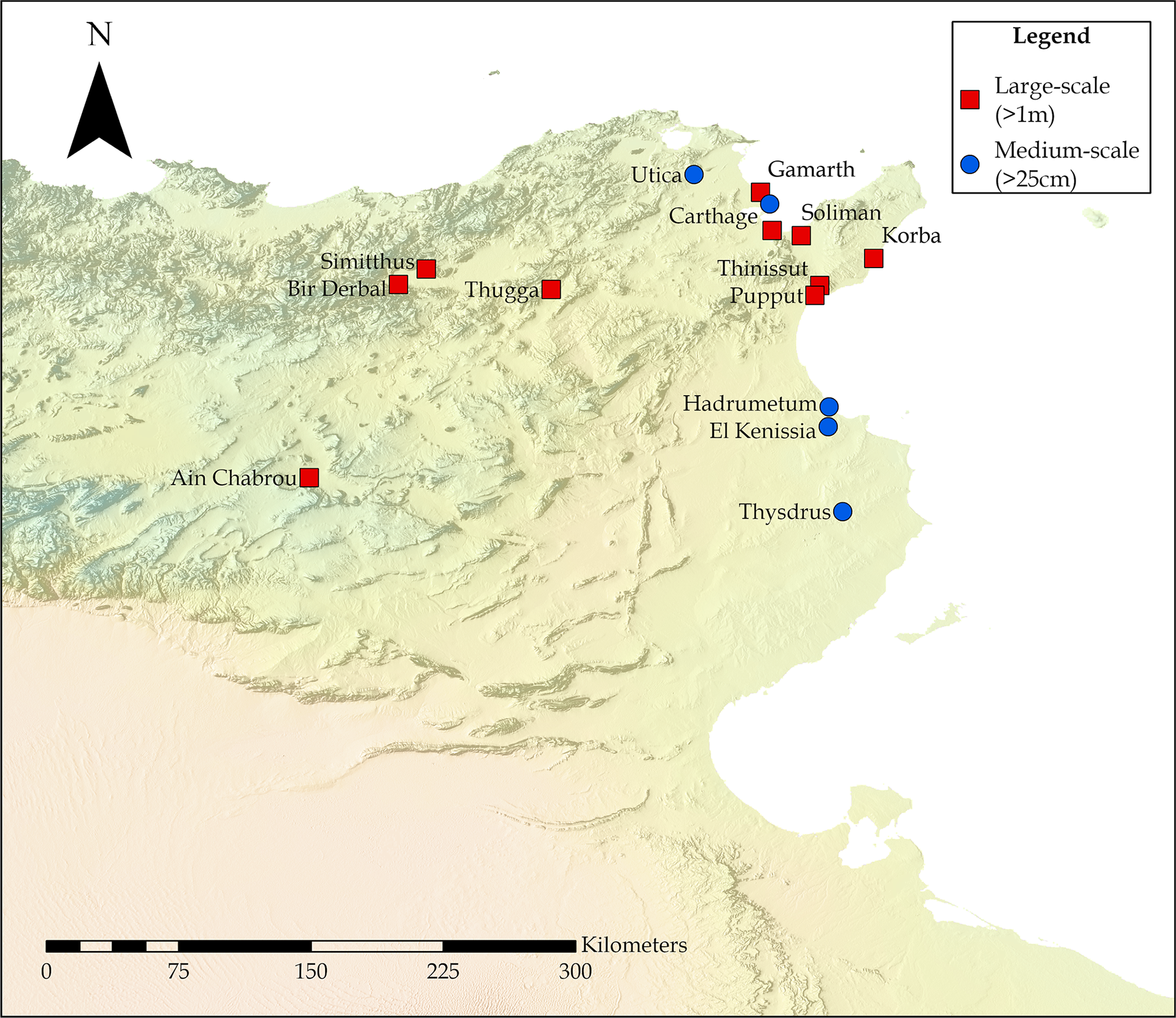
Sites with medium- and large-scale terracotta statuary

Where excavated as assemblages, the excavations were conducted by amateur archaeologists during the colonial era (el-Kénissia, Thinissut and Bir Derbal), and sometimes not described at all (Curubis); only at Simitthus were there slightly more scientific excavations that were mostly published. At both Thinissut and Bir Derbal, the large-scale statues seem to have been displayed on pedestals at focal points in the sanctuaries, serving as the locus of ritualised activities rather than solely votive offerings or displays: a topic to which we shall return. Others were discovered by chance without any excavation or contextual data, usually by colonial functionaries (Aïn Chabrou, Hammam Lif), or are known only from private antiquities collections (Hr. Biniana/Hadrumetum, Thysdrus). And a final group represents assemblages that may have been in secondary context, perhaps intentionally hidden (Carthage), deposited in favissae (Soliman, Gamarth) or otherwise discarded in fills (Pupput). All of the archaeological contexts in which these terracottas have been found seem to date from the Roman imperial period, although the chronology of the excavated sanctuaries remains debated (McCarty Reference McCarty2024).
Scholars have generally explained the appearance of these terracottas through the two second-order categories that underpin most accounts of religion in the ancient Maghreb: cultural origin and economic class, with the two often imagined as heavily overlapping. With their iconographies and media, the statues are taken to represent the survival or persistence of indigenous or Oriental traditions of mentality or practice at odds with any ‘Romanisation’, or as being the downmarket substitutes commissioned by the rural poor who could not afford marble deities (Merlin Reference Merlin1910, 51; Le Glay Reference Le Glay1966a, 216; Bullo and Rossignoli Reference Bullo and Rossignoli1998; Dridi and Sebaï Reference Dridi and Sebaï2008, 112–13). For Alfred Merlin (Reference Merlin1910, 54–55), such statues were evidence of ‘popular religion’, differentiated from the ‘official’ religion of the Roman state, marked as much by medium as iconographies: ‘local beliefs’ held by a rural population. For Marcel Le Glay (Reference Le Glay1966a, 274), such images were equally part of rural cults marked by their ‘Orientalism’.
Such views are compounded by the approaches taken to studying such statues: almost exclusively from iconographic and art historical perspectives (Merlin Reference Merlin1910; Bullo and Rossignoli Reference Bullo and Rossignoli1998; Zeghal Yazidi Reference Zeghal Yazidi, Ferjaoui and Redissi2019, with the exception of Zehnacker Reference Zehnacker1965). In his account of North-African pottery that covers nearly every other type of ceramic object from Africa, including architectural terracottas and mould-made figurines, Michel Bonifay (Reference Bonifay2004) leaves aside these larger sculptures, perhaps as ‘art objects’. Silvia Bullo and Cinzia Rossignoli (Reference Bullo and Rossignoli1998) use the iconographies and styles to argue both for an early date of the sanctuary at Thinissut and for the persistence of Punic mentalities and traditions under a light gloss of adopting some Hellenistic elements. Of course, both iconography and style could be reprised and appropriated at later moments to add a surplus of meaning to images: this has even been seen as the defining feature of art produced under the Roman Empire (Hölscher Reference Hölscher2004).
Three problematic ideas underlie such interpretations: first, the emphasis on culture-historical categorisation; second, a supposed class-based disjunction between a Romanised elite and stubbornly resistant rural subalterns; and third, that marble was automatically preferable to clay. The culture-historical approach has been problematised and rejected on a host of theoretical grounds that we have raised elsewhere: it imposes modern categories born of colonialist endeavours that rarely seem to have mattered to ancient worshippers; it homogenises; it dematerialises (McCarty Reference McCarty, Alcock, Egri and Frakes2016; Ardeleanu Reference Ardeleanu2021, 10-–12; McCarty Reference McCarty2024). The second two ideas can easily be problematised even with a cursory look at the material itself. A lifesize terracotta statue of a cuirassed male tentatively identified as Constantine, discovered near Medjez el-Bab (Gauckler Reference Gauckler1902, 18; Gauckler and Poinssot Reference Gauckler and Poinssot1907, 161, no. 262), suggests that terracotta statuary could be a full participant in the dynamics of honour, commemoration and imperial power – hardly opposed to any sense of ‘Romanisation’. A second, three-quarters-lifesize cuirassed figure from Aïn Chabrou may also have represented an imperial figure (Gsell Reference Gsell1899, 76), and Theodor Kraus identified a just-under-lifesize terracotta statue from Simitthus as a possible imperial portrait in the guise of Hercules (Khanoussi Reference Khanoussi1994, 49). Large-scale terracottas were hardly anathema to Roman imperialism. As for the supposed ruralness of terracottas, a large assemblage of terracotta statuary comes from a late-antique deposit of cult materials at Carthage – seemingly gathered intentionally and hidden, rather than awaiting reuse (Gauckler Reference Gauckler1899). That is, urban consumers in a metropolis could select terracotta as a medium for figured dedications just as readily as rural populations. Pupput, Thysdrus and Hadrumetum were also all significant cities. And more generally, rural populations of imperial-period Africa could be remarkably well informed and agile at negotiating with imperial power-brokers in epigraphic documents (Kehoe Reference Kehoe1988), connected to luxurious cosmopolitan foodways (De Grossi Mazzorin et al. Reference De Grossi Mazzorin, Eccher, Marconi, Paterlini, Tecchiati, Zanetti, de Vos and Maurina2019) and consumers of other widely- circulating goods (Dossey Reference Dossey2010). As for being downmarket, the terracottas excavated at Gamarth and Bir Derbal were gilded, no doubt substantially increasing their cost. Terracotta statuary in sanctuaries was not necessarily poor, rural or resistant to Roman authority.
We need other explanatory frameworks to understand these objects, their users and their place in North-African history. And so, I argue that these objects are better understood as parts of much broader chains of production, technology and meshworks of practice and consumption that developed under the Roman Empire.
The use of clay to produce cult statues seems, in general, to be part of a much wider, microregional ‘terracotta habit’. The production and consumption of figured terracottas had a visible geographic circumscription in North Africa. That is, making, dedicating and depositing terracottas was a regional phenomenon, both in temple and in funerary contexts, as Solenn de Larminat (Reference de Larminat, Giorgos Papantoniou Demetrios and Dikomitou-Eliadou2019; Reference de Larminat, Huysecom-Haxhi and Muller2020) has noted. I rely heavily on the painstaking work she did to collate and catalogue over 800 terracotta statuettes from the region, even if there are some key objects and sites missing from her data set. Large numbers of terracotta figures of different scales – from almost lifesize to under 20 cm in height – were discovered in sanctuaries across the region (Table A). A single piece of a terracotta statue was also excavated in the Temple of Saturn at Thugga (Carton Reference Carton1897, 30) and parts of a large-scale statue (perhaps a portrait of the deceased?) from a tomb at Khanguet (Renault Reference Renault1909, 74). Statuettes appear more widely, especially in burials (Figure 3). Plastic vessels – head vases, zoomorphic vases – also have a wider distribution, not considered here. In both sanctuaries and burials, terracotta figures appear regularly primarily from Utica to Thysdrus, along the African coast and immediate interior; the key exceptions come from the sanctuaries at Bir Derbal, near Thuburnica; Simitthus, in the same region; and Aïn Chabrou, near Theveste.
The distribution of this ‘terracotta habit’ does not seem to be a product of excavation, recognition or publication bias, although the Tunisian littoral has been the focus of many of the largest and best-published excavations. Despite large-scale excavation in the necropolis of Sitifis – which was published in its entirety (Guéry Reference Guéry1985) – and at Thamugadi (which was largely published in short annual notes) – no terracottas are recorded. The only figured terracotta objects known from Thamugadi are mould-made plaques and antefixes (Ballu and Cagnat Reference Ballu and Cagnat1903, 30; Le Glay Reference Le Glay1966a, 129–30). The same is true of Lambaesis, where the necropolis was briefly explored (Cagnat Reference Cagnat1893, 24), Tiddis (Février Reference Février1970) and Tipasa (Baradez Reference Baradez1957). In more recent, but largely unpublished, excavations in Algeria, figured terracottas seem similarly to be absent from burials. Figured objects – even fragmentary ones – were far more likely to draw the eyes of colonial archaeologists (professional and amateur) than other kinds of material, which also suggests that this absence from some sites is not merely the product of terracottas being ignored. There was a historical, regional terracotta habit in imperial-period Africa, closely connected with the littoral of modern Tunisia.
It is also worth noting that the worship practices around large-scale terracotta statues were themselves also tightly tied to terracotta objects. When found in sets, the large-scale terracottas are generally not found alongside sculpture in other media besides votive stelae: whole statue groups and sanctuaries selected this medium to the exclusion of others when figuring central deities. But beyond that, wherever these terracotta statues have been excavated in primary contexts, they were tied to specific ceramic offerings, usually of lamps. At Simitthus, a deposit of more than 150 lamps, collected over centuries, was found in the east-slope sanctuary that was filled with terracotta statuary (Khanoussi Reference Khanoussi1994, 44). At Bir Derbal, a host of lamps was dedicated in front of the niches that framed the terracotta statues (Carton Reference Carton1918). And at Thinissut, lamps were not only found at the bases of the statues, but even deposited inside the statue of a woman-and-child, using the production holes that were left open in its base to insert the objects (Merlin Reference Merlin1910, 21). While the use and deposition of lamps in African sanctuaries has often been tied solely to ‘Oriental’ gods or Punic persistence, such lychnocentric practices are actually attested in a very small number of sanctuaries, most of them Roman imperial period (McCarty Reference McCarty2024, 373–74). And with the exception of Sidi el-Hani (Gridel Reference Gridel1927), all are the sanctuaries replete with large assemblages of figural terracottas. There were specific ways of consuming terracotta lamps in ritualised practices tied to terracotta statues. Not only was there a microregional ‘terracotta habit’, there was a tighter connection of terracotta deities and terracotta lamps that went beyond merely using such objects as vernacular offerings (pace Mendes Reference Mendes2021).
While one could generally connect this zone of the ‘terracotta habit’ to the region of Carthaginian control and culture, as part of a ‘permanence punique’, there are three strong reasons to search for alternative explanations. First, scale and function: although small-scale terracotta statuettes and other figured objects were regularly used as sanctuary offerings and grave-goods in Punic Carthage and Cap Bon (Cherif Reference Cherif1997), there is no evidence either for the kinds of large-scale statues found in these imperial-period sanctuaries, or for terracotta figures serving as the focus of worship. The largest terracottas known from Carthage fall into the 40–50 cm tall range (Cherif Reference Cherif1997, 170).
Second, iconography: some of the terracotta statues have precedents from earlier periods from Carthage and the Punic world, especially the lion-headed goddess with klaft and vulture-wings from Bir Derbal and Thinissut (Figure 4). Similar figures appear on seals and amulets from the fourth century BC (Redissi Reference Redissi1990), and later on denarii minted by Metellus Scipio in Africa on the eve of the Battle of Thapsus, where the figure is perhaps labelled as the G(enius) T(errae) A(fricae) (RRC 460/4). Likewise, the enthroned female figures in long tunics – including those whose veils flare out behind their heads – participate in much older and more widespread iconographic traditions, generally related to Demeter (Olcese Reference Olcese2021). But even if some of the statues drew on these earlier iconographies, there are also adaptations. The lion-headed goddess at Thinissut, for example, seems to hold a distinctive attribute clutched to her chest, its top broken but its bottom a flared cylinder: although difficult to identify, it is not the ankh or lotus held by earlier iterations of the figure. The terracotta is not a ‘replica’ of earlier versions, but an adaptation of earlier iconographic traditions. The seated women with children on their laps are rarely found in pre-imperial-period contexts in Africa; there is one example from Kerkouane (Fantar Reference Fantar1986, 309, no. 8). The context of examples from Carthage demonstrates that they are imperial-period in date (Villefosse and Delattre Reference Villefosse and Delattre1891, pace Bullo and Rossignoli Reference Bullo and Rossignoli1998), though they enjoyed popularity in Sicily from the archaic period (Pedrucci Reference Pedrucci2015). And similarly, the goddess standing atop a lion from Thinissut has no direct parallels from the pre-imperial period in Africa. In short, even if individual figure-types and iconographies had a long history, their appropriation and recombination in individual figures – and ultimately into assemblages – is a phenomenon of the imperial period. Redeploying earlier figure-types and iconography in images of gods was a means of attributing both particular qualities to the god and a sense of antiquity to a cult; the terracotta goddesses of Africa are no more ‘Punic’ than every bronze and stone Mercury in Gaul that reprises a Polykleitan pose and iconography is ‘Greek’.
Statue of a lion-headed goddess. From Thinissut. First/Second century AD. Terracotta. Musée du Bardo. Photo: Alexander van Loon, CC-BY-SA 4.0.

Finally, there is other evidence that the ‘terracotta habit’ was tied to wider networks of imperial-period consumption rather than a particular cultural background. Thinissut is the only sanctuary that offers more archaeological context for the statuary, and here the catalogued lamps also point to a regionalised material koine. Several of the lamps bear stamps, and these stamps are generally from workshops whose products are heavily concentrated along Cap Bon and the coast of Byzacena, even if they travel more widely.Footnote 1 That is, other terracotta objects in the sanctuary suggest that there was a koiné of product distribution and consumption in the second–third centuries AD that roughly overlaps with the use of figurines in sanctuaries and tombs, rather than some pre-existing cultural background.
Instead of Punic persistence, this geography of terracotta assemblages can be linked to the patterns of ceramic production, the technical competencies and the infrastructure of imperial-period Africa than to any form of survival. The lack of detailed technical analysis of the large-scale terracotta statues makes drawing this connection with certainty impossible; it does, however, point to the necessity to conduct new work on these statues with a focus on their technical (rather than iconographic) qualities, a project which is currently under proposal.
In the most general terms, the growing number and spread of terracottas in sanctuaries can be tied to the enormous boom in ceramic production and consumption across Africa in the imperial period (Dossey Reference Dossey2010): a phenomenon itself tied to changing patterns of landholding, investment and connection to Mediterranean-wide markets. In other words, this was a phenomenon deeply tied to empire – but one equally grounded both in regional geologies and pre-Roman traditions of production. The number of excavated kilns and workshops for ceramic production – especially of amphorae – continues to grow for Punic, imperial-period, and late-antique Tunisia, gradually filling in the still-lacunose picture of ceramic production in the region (Bonifay Reference Bonifay2004; Ben Moussa Reference Ben Moussa2007; Chelbi Reference Chelbi and Ferjaoui2010). The vast majority of workshops seem to have specialised in particular kinds of products, given the range of both material (fabric) and technical (potting/firing) demands of making slipped tablewares, cookwares/amphorae/storage vessels (Bonifay Reference Bonifay2004), or mould-made objects (Figure 5). Indeed, for the imperial period in particular, one of the oft-noted truisms is that ARS could be produced in inland villas, while amphorae were (almost) always made close to the coasts: a marked geographic division of production tied to the particular patterns of trade, distribution and specialisation in the empire. This pattern, of course, is not without exceptions, especially in smaller workshops that provisioned more local or regional markets (Bonifay Reference Bonifay and Hitchner2022). At the same time, excavated kilns from Roman Africa show evidence of specialisation as either amphora/coarseware or ARS kilns. Still, this was not always the case. At Carthage, Gauckler excavated a series of Hellenistic kilns and a workshop that seemed to make everything from storage vessels, to tablewares decorated with appliqués, whose moulds were excavated, to figurines: an unusually broad spectrum of technically diverse wares (Gauckler Reference Gauckler1915, 512–16). Nevertheless, specialised production seems to have been the norm, even in the pre-imperial period. At Kerkouane, for example, part of the city’s major sanctuary complex was given over to producing small, mould-made statuette offerings (Fantar Reference Fantar1986, 155–60, 177–78). This is the only evidence to date in Africa, though, for craft production happening within a sanctuary, and such close connection of coroplastic-making to temple spaces is also rare in the wider Mediterranean.Footnote 2
Terracotta statuary assemblages plotted against known ARS/amphora production sites (M. McCarty, with basemap using data from Esri, USGS, NOAA).

If this general uptick in ceramic production, especially for amphorae along the coast, provided the baseline infrastructure for the terracotta boom and the statues found in imperial-period sanctuaries, the kinds of skills and competencies necessary for making large-scale terracotta statues stretches into a host of adjacent industries as well. Neither regional ceramic consumption patterns, nor the production boom alone, can wholly explain the popularity of large-scale ceramic statues.
The process and skill involved in making terracotta statuary differed substantially between large-scale, hand-made statuary and smaller-scale, mould-made figurines, suggesting the probability of different craftspeople, even when iconographies might be repeated. For mould-made objects, the crafting skill generally lay in making the mould, preparing the clay and firing. The latter two skills were shared with potters creating other kinds of objects, and explains why the production of mould-made statuettes was often a small industry set adjacent to larger pottery industries across the ancient Mediterranean, which might provide the infrastructure of levigation tanks and kilns (Muller Reference Muller2014). The actual moulding of terracotta statuettes and lamps – activities that were linked by their shared reliance on moulds and sometimes attested in the same workshop space (e.g., the ‘Commercial Building’ in the Athenian Agora: Handler Reference Handler2012) – might take place in small spaces, using relatively unskilled labour (Muller Reference Muller2014; Reference Muller2018, 159); children are even attested working in a late-antique, Egyptian lamp-moulding shop (Dzierzykray-Rogalski and Grzeszyk Reference Dzierzykray-Rogalski and Grzeszyk1991). In Africa, there is evidence for lamp- and figurine-making connected to ARS production sites in general, but no evidence for the precise relationship between spaces and personnel where these activities took place. The connection between mould-made products and amphorae is much rarer, but can be seen at Majoura (near Capsa), where wasters from amphorae, cookwares and lamps were all found together (Nasr and Capelli Reference Nasr and Capelli2018). This site may be the exception that proves the rule.
The production of larger-scale terracottas, made by hand, demanded a much more specialised set of craft skills. In general, large-scale, hollow terracotta statuary was made in pieces with a range of techniques: the main trunk sections were often created by coiling to allow for a hollow body, with some parts pushed out from the inside to give contours; then clay for surface details and relief elements – drapery, arms, heads, etc. (sometimes even made by moulding) – added; and finally, the surface finished for textures and patterns (Jeammet Reference Jeammet2003). Verification of the methods used to create the African examples in new analysis will allow a more detailed picture of the variety of production steps (and their potential variability across objects/sites/time), but for now this seems the most likely process, at least for the Thinissut and Gamarth assemblages. Both of these have a number of large holes pierced in the sides/back of figures, of varying shapes; while these have variously been interpreted as vent holes and ways of lightening the statues (Merlin Reference Merlin1910, 8; Zehnacker Reference Zehnacker1965), at least some were most probably also used as finishing holes, to allow the sculptor to insert hands/tools into the trunk for manipulating the shape and contours by pressing outwards from inside the hollow trunk, or to attach separately-made parts (Jeammet Reference Jeammet2003). In other words, the production of these larger scale images would have been a very different affair from the small-scale, moulded terracottas, requiring different techniques (coiling), the skill to do fine sculptural finishing work in the clay and to attach elements. Although coil-making could be connected to local (‘Libyan’ or ‘African’) traditions of hand-made pottery produced in the imperial period (especially in Byzacena: Morel Reference Morel1998), both the fine fabric and skilled kiln-firing distinguish the statuary from this tradition (Bonifay Reference Bonifay2004, 75–76). The finishing sculpting skills may well have overlapped with those of artists working to produce metal (bronze) sculpture; the gilding found on the Bir Derbal statues may also speak to close connections with metalworkers, both for the gold itself and for application of the gilding (which, in antiquity, could be attached to bronze and terracotta using similar binding agents; mercury-gilding metals was far rarer as a practice, reserved for the most deluxe objects: Darque-Ceretti et al. Reference Darque-Ceretti, Felder and Aucouturier2013). That is, different craft experts were needed from those who produced either mould-made terracotta objects or ceramic vessels.
Even the finishing and firing process of some of the terracotta statues distinguished them from other ceramic vessel production. The enthroned deity from Thinissut, for example, is coated in a red slip that recalls those used on ARS tablewares: evidence for similar material preparation that might be linkable to particular regional workshops with scientific analysis, but for the moment simply confirms that the makers of the statue had access to the kinds of levigation infrastructure used in making ARS. This may hint at ties to ARS production. On the other hand, the firing must have occurred under different conditions from ARS wares. In ARS kilns, the fire box vented directly into the furnace; the ceramics being fired were protected from the smoke and fire by being loaded into saggars, stackable terracotta boxes that are routinely found at ARS production sites. The larger amphora kilns, used without saggars (but perhaps with ceramic spacers when firing cookwares), may have been necessary for firing such large-scale objects. Still, with both ARS and amphora kilns connecting the firebox to the kiln interior via ceramic floors, a slipped object like the deity from Thinissut would probably have needed a stand to prevent it sitting directly on the grate, and protection from the smoke and ash rising through the kiln that would have altered the slip – perhaps even a custom-made saggar, or an alternative system for venting the kiln. In other words, finishing and firing these statues drew on pyrotechnical infrastructure and expertise from multiple industries, and cannot be tied to just one.
A graffito scratched in the back of the statue of the goddess atop a lion from Thinissut may also hint at how specialist production was sought for the statues in the sanctuary. The interpretation of the graffito is not certain, but Raimondo Zucca (Reference Zucca2005) has proposed seeing it not as a votive dedication, but rather as a craftsman’s signature and location: Saturninus P(ublii) fil(ius) Phae[radi]tanus Maius. Although there was a host of pottery-producing areas closer to the Thinissut sanctuary, and such geographically proximate workshops may have provided other objects dedicated there (like the lamps), the commissioner of the goddess-statue went further away to obtain his dedication. And while Pheradi Maius became an important ARS C/D production site in late antiquity, attested in field survey and kiln excavation (Ben Moussa Reference Ben Moussa2007, 108–31), there is possible evidence for earlier ARS A and cookware production (Hasenzagl and Capelli Reference Hasenzagl and Capelli2019). The site may have had both the craft infrastructure, developed over the course of the imperial period, and a specialist sculptor who was sought to provide at least one of the large-scale images at Thinissut.
In short, the production and use of large-scale terracotta statues, with an especially heavy concentration from Carthage to Byzacena, was part of a larger ‘terracotta habit’ of consumption and the boom in ceramic production that developed in this region in the imperial period, rather than the result of preexisting cultural traditions. Still, linking the statues to any one of the specialised ceramic-making industries – or even solely to ceramic-making itself – is impossible. Rather, the statues demanded a range of complementary technical competences and infrastructure connected to a variety of industries. The statues emerged from this wider industrial landscape, rather than from a single type of craft production.
The wider microregional consumptive ‘terracotta habit’ and proximity to other ceramics and metalworking industries each offer partial explanations for the choice of terracotta statues and their use, but neither offers a full explanation for the choices and practices that led to these objects becoming foci of worship in imperial-period sanctuaries. How and why did terracotta become the medium of choice, especially in sanctuaries like Thinissut, Bir Derbal and Simitthus that also hosted distinctive lychnocentric rites?
And here, the specific portfolios and concerns of the deities worshipped in these spaces may have been entangled with the medium chosen to materialise these gods for their worshippers. The vast majority of the terracotta assemblages feature statues of figures iconographically related to agriculture, childhood and human reproduction. Without wanting to restore the vague and homogenising notions of ‘fertility cults’ born of nineteenth-century anthropology that recent works have compellingly rejected (e.g., Carroll Reference Carroll2019), it is worth noting that metaphors and practices linking agricultural and personal fertility were a regular feature of the Graeco-Roman world that could be mobilised in cult contexts (e.g., Ovid, Fasti 4.633–34; Macrobius, Saturnalia 1.12.20–21. Cf. DiLuzio Reference DiLuzio2016, 47–49, 111–13). De Larminat (Reference de Larminat, Giorgos Papantoniou Demetrios and Dikomitou-Eliadou2019, 330) notes that enthroned goddesses are the second most common ceramic figure-types in sanctuaries (after the ‘human with offering’ category); although she names the figures ‘Tanit’, they also draw on the iconographies of Demeter/Ceres and Juno, with polos, piglet (at Curubis) and veil. Indeed, the sanctuary assemblages from Soliman, Thysdrus and Pupput focus on enthroned women, while those from Curubis and Gamarth may focus on Pluto, Ceres and Proserpina, with Pluto in Africa often cast as a deity of agricultural fertility (Cadotte Reference Cadotte2007, 341). Images of children are the next most common type in de Larminat’s sanctuary assemblages. To these, we might add at least some of her ‘worshipper’ figures, as well as all the lunula-wearing figures she identifies as the Phrygrian moon-goddess Men (an identification based wholly on homogenising Orientalism), given that the lunula is marked in North-African art as an attribute of young girls, and perhaps even the dove statuettes, since these birds also serve as a regional marker of girlhood (McCarty Reference McCarty2024, 233–43). The sanctuaries at Thinissut and el-Kénissia were tied to tophet-like rites that revolved around children, and at Thinissut, the seated, nursing deity was a clear locus of ritualised activity and lamp-dedication. Even the sanctuary at Simitthus, where a figure in the guise of Hercules is the best-preserved terracotta statue, seems to have been concerned with children, based on fragments of a baby’s leg in terracotta (Khanoussi Reference Khanoussi1994, 50, no. 3). At Aïn Chabrou, the set of deities and iconographies is even more diverse than in the Thinissut assemblage, but includes an enthroned woman with breast bared, an enthroned Ceres-like figure and two ithyphallic males, perhaps tied to fertility like the marble, ithyphallic Priapus from Aïn Djelloula who holds a tunic full of agricultural wealth (Foucher Reference Foucher1956). De Larminat (Reference de Larminat, Huysecom-Haxhi and Muller2020) also notes that terracotta figurines from tombs are almost exclusively connected to children’s burials. The ceramic figures of imperial-period Africa, and especially the terracotta gods, are closely linked to a specific set of concerns and cults tied to terrestrial fertility, reproduction and childhood.
Here, the medium may well be part of the message, as materials were incorporated into semiotic practices of meaning-making. Both medical texts and popular metaphors in the Roman Mediterranean speak of the physical and moral mouldability of children (Holman Reference Holman1997), comparing their bodies to clay. Galen (De Semine 2.5.29–32), for example, speaks of an embryo as clay being shaped by a moulder in the womb. The preference for terracotta offerings around reproduction is also not a materialised metaphor confined to Africa; lifesize votives of children made from terracotta are found in Italy and Britain, though they are more often represented as swaddled and perhaps related to a distinctive phase in a baby’s life-course. In Hellenistic Italian sanctuaries, such figures are even linked to a similar set of deities as appear in these African clay sanctuaries: besides nursing goddesses and Ceres/Juno, Minerva, Apollo and Aesculapius seem to be major deities (Graham Reference Graham2013). From the Hippocratics on, the uterus could be compared to a clay pot: perhaps a metaphor expanded in the material of these hollow nursing figures, played upon further by the placement of lamps within the goddess at Thinissut, and visible elsewhere in ritualised practices related to childbirth in the Roman world. After all, children’s burials regularly played on the metaphorical slippage between tomb and womb as infant bodies were interred in modified clay vessels, especially amphorae (Graham Reference Graham2016).
Admittedly, the direct evidence for these child-as-clay and mother-as-pot metaphors comes from literary and practical traditions found outside of North Africa. And, as in all parts of the wider Roman world, imaginations of corporeality and regimes of bodily care in Africa sat along a spectrum between cosmopolitanism and localism (for example, Thébert Reference Thébert2003 on baths; Benseddik Reference Benseddik2010 on healing cults) – much like the religious practices examined throughout this article. Still, there is some evidence for the presence of these metaphors in Africa. After all, cosmopolitan medical traditions and ideals circulated among the physicians attested epigraphically in the region (Gummerus Reference Gummerus1932), and by the fourth century AD, Carthage was a (if not the) major centre of Hippocratic training (Sabbah Reference Sabbah1998): a situation that is unlikely to have emerged overnight. More directly, the use of clay vessels for burying infants is widely attested across North Africa in both pre-Roman and imperial-period Africa; these kinds of material metaphors were widespread and deeply engrained in popular imagination.
In other words, the specific set of concerns around reproduction and children that worshippers brought to these sanctuaries, perhaps the portfolios attributed to the deities worshipped there, shaped the choice of materials to fashion gods, votaries and votives. It was not the ‘Africanness’ of these gods or the poverty of their worshippers, but rather – in a much more cosmopolitan manner – that clay and vessel were appropriate for matters related to children and childbirth.
Reducing worship at Thinissut, Bir Derbal, or any of these sanctuaries to a mere cultural phenomenon, to persistent Oriental or African mentalities, ignores the plurality of the entanglements objects like these terracotta statues had in much wider sets of productive, consumptive, ritual and conceptual chains. It was not that earlier traditions and practices were wholly meaningless here. In one way, many of the statues reprise, appropriate and adapt earlier and distinctive regional iconographies: claims of antiquity, and – with the lion-headed figures – a marked strangeness and differentiation from other statuary gods. At the same time, the use of figured terracottas ties worship practices at these sanctuaries to a wider regional pattern of consumption, a ‘terracotta habit’ that knits together tombs, temples and workshops primarily in coastal Byzacena. These practices depended on the ceramic industries that grew up in this region, both for raw materials and infrastructure: industries that were part-and-parcel of an imperial export economy and economic boom. The terracotta habit cannot be excised from the economies and infrastructure of the Roman Empire as cultural survival or persistence. But even so, the distinctive large-scale terracottas that dominated certain African sanctuaries were not only enmeshed in the labour, technology and economy of empire, but in a host of metaphors and discourses around materiality and the immediate needs, hopes and concerns of worshippers. Understanding religion in Roman Africa requires understanding the full array of such entanglements and relationships, the interplay between global and glocal.
[MM]
Housing gods
Sanctuaries, too, are often interpreted via cultural (or accultural) labels that possibly obscure more than they reveal. A highly debated and historiographically significant typology in scholarly discourse is that of the so-called ‘African’ or ‘Romano-African’ temples (Charles-Picard Reference Charles-Picard1954, 152–64; Lézine Reference Lézine1959; Le Glay Reference Le Glay1966a, 275–78; Pensabene Reference Pensabene1990, Brouquier-Reddé Reference Brouquier-Reddé1992, 228–31; Saint-Amans Reference Saint-Amans2004, 222–36; Ritter Reference Ritter2006, 555–56; D’Andrea Reference D’Andrea2014, 309–10; Reference D’Andrea2017a; Reference D’Andrea2018a; Bonzano Reference Bonzano2019; McCarty Reference McCarty2024, 320–83). These sacred spaces are characterised by a longitudinally developed triporticoed courtyard that opens, on its unporticoed side, onto one or more rooms, generally three (Table B; Figures 6–7). In most cases, these rooms protrude from the portico and may be elevated (as in the ‘Romano-African’ type) or not (as in the ‘African’ type) on a podium, which in some cases supports the entire structure. They are generally interpreted as cellae. However, especially in the case of multiple rooms, it would be more appropriate to avoid the interpretation as cellae, as their exact function sometimes remains uncertain. The Antonine temple of Mercury at Thugga, for example, possesses three such rooms, but the dedicatory inscription explicitly speaks of two cellae (DFH 34).
‘African’ temples. A: Hippo Regius (B. D’Andrea, after Rossignoli Reference Rossignoli1994, 568, figure. 4). B: Thinissut, hypothetical reconstruction of the temple in phase 2 (see D’Andrea Reference D’Andrea2014, 121–30; B. D’Andrea, after Merlin Reference Merlin1910, pl. I). C: Thuburbo Maius (B. D’Andrea, after Lézine Reference Lézine1968, figure. 6). D: Thugga (B. D’Andrea, after Carton Reference Carton1897, 369, figure. 1; Poinssot Reference Poinssot1955, 33, figure. 1). E: el-Kénissia, hypothetical reconstruction of the temple in phase 2 (see D’Andrea Reference D’Andrea2014, 97–109; B. D’Andrea, after Carton Reference Carton1906, pl. I). Caption: A, Altar; C, Cistern; P, Portico; R, Room (usually interpreted as cellae). The dotted structures are hypothetical reconstruction proposals.

‘Roman-african’ temples. A: Thuburnica, hypothetical reconstruction of the temple (see D’Andrea Reference D’Andrea2014, 183–88; B. D’Andrea, after Carton Reference Carton1907; Euzennat and Hallier Reference Euzennat and Hallier1986, 77, 3c). B: Ammaedara (see McCarty Reference McCarty2024, 347–50; M. McCarty, after Le Glay Reference Le Glay1961, 326, figure. 6). C: Thamugadi (see McCarty Reference McCarty2024, 342–46; M. McCarty, after Le Glay Reference Le Glay1966b, 127, figure. 4; the light grey walls are hypothetical reconstruction proposals). Caption: A, Altar; B, Base; C, Cistern; P, Portico; R, Room (usually interpreted as cellae); SP, Sacrificial Platform.

Main temples associated with the presumed ‘African’ and ‘Romano-African’ typology

The earliest attestations of this assumed architectural type date to the late first century AD, though its widespread adoption occurred in the following century, and especially in the first half of the third century. Marcel Le Glay (Reference Le Glay1966a) associates these sanctuaries with the cult of Saturn and situates them within a culturally characterised evolutionary three-step framework. The first step would consist of a ‘Semitic’ type proposed by Alexandre Lézine (Reference Lézine1959), later named ‘pseudo-African’ and understood within a framework of resistance to Hellenism. These ‘Semitic’ temples were open-air sanctuaries featuring a porticoed courtyard with a central betyl. However, the only possible evidence of this type is at Cirta (Berthier and Charlier Reference Berthier and Charlier1955, 221–30; D’Andrea Reference D’Andrea2014, 271–74) – but even this is hypothetical. The second step of this evolutionary process would be the ‘African’ temples (Figure 6; Hippo Regius, Thinissut, Thugga and Thuburbo Maius; maybe el-Kénissia during the first half of the second century AD: D’Andrea Reference D’Andrea2014, 100–101); the third the ‘Romano-African’ ones (Figure 7; Ammaedara, Cuicul, Thamugadi, Thubursicu Numidarum and Thuburnica). Some examples of the presumed typology have also been identified in Tripolitania (Pensabene Reference Pensabene1990; Bonzano Reference Bonzano2019). The ‘Romano-African’ temples incorporate an unmistakably Italic architectural feature: elevation on a podium. As argued by Johannes Eingartner (Reference Eingartner2005), the aedes on a podium, either inscribed within a porticoed courtyard or positioned at its rear, attested in North Africa from the first century AD, undoubtedly has Italic origin. So, it makes sense that they served as a source of inspiration for the application of similar architectural solutions in the sanctuaries under examination. Whereas Gilbert Charles-Picard (Reference Charles-Picard1954) associated the ‘African’ type with Roman culture, viewing it as a fundamental break from Punic tradition, Le Glay argues that its origins lie in a Semitic tradition, later acquiring architectural elements from the Roman world. The predominant orientation of these sanctuaries along an east–west axis – more specifically, northwest-southeast – seems to fit into a local tradition and, more generally, a Phoenician and Punic tradition (Fantar Reference Fantar1986, 198–214; Perra Reference Perra1998; D’Andrea Reference D’Andrea and Tahar Mohamed2017b), while the north–south orientation of the temple at Thuburnica frequently occurs in the Italic tradition. Once again, however, rather than being connected to ethno-cultural ‘norms’, the orientation of these temples should be considered in relation to the city planning and local topography. From the second century AD, both typologies exhibit structural and decorative elements – bases, columns, capitals and entablatures – that are characteristic of Roman architectural tradition (Pensabene Reference Pensabene1990; Saint-Amans Reference Saint-Amans2004, 228).
This interpretation has been questioned for several reasons. First, it does not appear possible to establish a definitive architectural typology, as the sacred places in question merely exhibit recurring elements that are variously combined rather than forming a consistent structural pattern (Rossignoli Reference Rossignoli1994, 588–89; D’Andrea Reference D’Andrea2014, 309; Bonzano Reference Bonzano2019, 227). The same variety can be seen in the location of these sanctuaries, which are generally located in urban centres (in central or relatively peripheral areas), but also in rural areas, as in the case of Thinissut. In this regard, however, it should be noted that it is hard to apply a rigid dichotomy between urban and rural (or intermediate forms such as peri-urban and suburban) in second–third-century Roman Africa, where the urban phenomenon took different forms depending on the (micro)regions considered (e.g., Hobson Reference Hobson2019; Scheding Reference Scheding, de Ligt and Bintliff2020). Both the location and orientation of these sanctuaries were undoubtedly influenced by the settlement and topographical characteristics of the sites and micro-regions where they were established. Second, the supposed typology is not exclusively associated with the cult of Saturn; rather, it encompasses sanctuaries dedicated to other deities, as occurs in Bulla Regia, Thugga and probably Sufetula (Table B; Pensabene Reference Pensabene1990; Brouquier-Reddé Reference Brouquier-Reddé1992, 229–31; Saint-Amans Reference Saint-Amans2004; Bonzano Reference Bonzano2019; for Thugga, see also Ritter Reference Ritter2006). Furthermore, some Saturnine temples included by Le Glay within this type (Hippo Regius, Thuburbo Maius, Thuburnica and Thubursicu Numidarum) should be excluded due to the lack of sufficient data regarding their architectural complexes and/or their actual association with the cult of Saturn. Third, the alleged Semitic origin of these temples has been contested, given the non-existence of a monolithic ‘Semitic world’, which is itself a product of a Western, Orientalist and homogenising perspective that should be abandoned. Additionally, as argued by Meriem Sebaï (Reference Sebaï2010), no Levantine typology corresponding to the one proposed by Lézine can be identified (see also Vella Reference Vella1998).
The evolutionary framework hypothesised in the transition from the ‘African’ to the ‘Roman-African’ typology is in fact inapplicable, as they are located in distinct sites and regions. Certain elements, as we have seen, have cultural and religious roots in Phoenician-Punic traditions (such as the betyl cult and, maybe, temple orientation) and Italic-Roman traditions (such as elevation on a podium). Others, such as the presence of porticoed courtyards and one or more cellae in religious contexts, are attested both in the Levantine (Pensabene Reference Pensabene1990) and Phoenician worlds (D’Andrea Reference D’Andrea and Tahar Mohamed2017b; Chiarenza Reference Chiarenza, Ferjaoui and Redissi2019) as well as in the Classical tradition (De Vincenzo Reference De Vincenzo2013, 209–82). Yet others, such as the adoption of the peristyle in both public and private architecture, were a pan-Mediterranean phenomenon from the Hellenistic period onwards.Footnote 3 Moreover, as argued by Stefan Ritter (Reference Ritter2006), a clear distinction between the Italic and African typology is often difficult to make, given that they share several structural and decorative elements.
In light of this, it is evident that, alongside the deconstruction of these typologies, it is necessary to abandon the ethnocultural labels that have accompanied them and that have unduly centralised and polarised the debate around the binary concepts of ‘old/new = Libyan (or Punic)/Roman’, ‘persistence = resistance’ and ‘innovation = Romanisation’ (Ritter Reference Ritter2006; Ardeleanu Reference Ardeleanu2021, 10–12; McCarty Reference McCarty2024, 322–23). These interpretations often constitute overgeneralisations based on modern mental frameworks that seek to categorise, schematise and ‘nationalise’ highly diverse phenomena, which in second–third century AD North Africa were shaped by the interaction between local and micro-regional dynamics and Mediterranean networks. This is further compounded by the fragile documentary basis upon which these theoretical constructs – mere houses of cards – have been built, including site plans, chronologies, and interpretations that frequently do not withstand re-examination of the evidence and new archaeological research.
Therefore, this deconstruction must be accompanied by a reconstruction that starts from the archaeological contexts, aiming to understand the functional, religious, economic and social factors that may have influenced the choice of specific architectural solutions within the broader framework of an imperial-era ‘global market’. This market offered a wide range of options that, rather than being dictated primarily by ethnocultural criteria – though these may have played a role, were more often shaped by practical needs and the stylistic tastes of a glocal elite and the craftspeople they employed. This dual perspective – local yet situated within a global network that facilitated the extensive circulation of people, ideas and fashions – provides the framework within which the study of these religious contexts should be situated.
In religious contexts such as those under consideration, the organisation of space and functional logistics largely correspond to ritual requirements, especially in the changing contexts of empire (cf. McCarty Reference McCarty and Barrettforthcoming). The courtyards of these sacred spaces were quite large (ranging between 300 and 900 m2)Footnote 4 and well suited to the needs of a cult centred on animal sacrifice. The key place of the courtyard in these ritual performances is attested by the images and inscriptions on votive stelae dedicated to Saturn (D’Andrea Reference D’Andrea2018b; Reference D’Andrea, Guirguis, Muscuso and Pla Orquín2020a; McCarty Reference McCarty2024; see infra), as well as by the prominence and monumental nature of the altars, which were often positioned at the centre of the courtyard and aligned with the entrance to the cella – the central one when there were three, as seen in the examples of Ammaedara, Thamugadi, Thuburnica and, probably, Hippo Regius and Thinissut.
The case of Thamugadi is particularly illustrative: at the foot of the altar, there was an area featuring a functional setup for tethering animals with a rope (Le Glay Reference Le Glay1966b, 126–28; McCarty Reference McCarty2024, 342–46). It was connected to a small channel, which probably served to drain water used for cleansing the space after sacrifices. The chaîne opératoire of sacrifice required large, open-air spaces to accommodate the various actions involved, including the transport of live animals, their slaughter and butchering (with all the associated challenges, such as sanitation and odours), the preparation and cooking of the meat, the offering to the deities and human consumption by priests and worshippers. The fundamental role of water in these practices is demonstrated by the presence of cisterns, such as those found at el-Kénissia, Thinissut, Thuburbo Maius, Thugga and Thuburnica (although the contemporaneity with the imperial-era temple remains doubtful for some of them; D’Andrea Reference D’Andrea2014, 101, 124–27, 142–43, 158–41, 184–85).
Regarding the human consumption of sacrificial meat, there is a notable lack of evidence related to kitchens and ritual banquets in these sacred spaces. However, this absence may be partially due to the lack of systematic excavations and to the absence of immovable and non-perishable material traces associated with these activities (McCarty et al. Reference McCarty, Hagler, Egri and Rustoiu2025). This raises the issue of the audience that witnessed and participated in these sacrificial practices. In this regard, it is important to distinguish between private rites, which were numerically predominant in a votive cult such as that of Saturn, and public rites, which are nonetheless attested by inscriptions. In the case of private rites, it is likely that small, predominantly familial, groups visited the temple either spontaneously or on specific dates, leading to a sequence of private sacrificial acts, presumably conducted under the supervision of priests. In fact, sacerdotes were particularly numerous in the cult of Saturn, although various functions have been proposed for this title (Le Glay Reference Le Glay1966a, 359–400; McCarty Reference McCarty2024, 212–25). Public, communal rites may have involved much larger numbers of worshippers, and the spacious courtyards probably accommodated this need. In this regard, two factors must be considered: on the one hand, the general population increase during the imperial period; and on the other, the greater economic resources available both to those who participated in these rites and to their promoters. It is plausible that the designated space for the audience was the portico, which, being covered and adorned with various decorative and cultic installations, provided a suitable setting for collective ritual observance. At Thamugadi, for example, a base probably used to support a statue that has been identified at the end of the northern corridor of the portico (Figure 7; see Le Glay Reference Le Glay1966b, 127). Furthermore, the role of the portico’s roof in shielding the public from the sun should not be underestimated, given the climatic conditions of the region.
Beyond their functional purpose, the areas of these temples frequented by the audience also served scenographic criteria, designed to stage the sacrificial pièce in the most effective way possible. The entrance, typically located on the short side – usually the eastern side – aligned with both the altar and the (principal) cella of the temple, provided an ideal theatrical setting for the arrival of the sacrificial procession and the sequence of ritual acts preceding and following the animal’s slaughter (for the ritual sequence of the sacrificium, see Prescendi Reference Prescendi2007, 31–51, 71–135). The architectural solution of a triportico open on the side opposite the entrance facilitated the gathering of the public and directed their attention towards the central scene (the altar) while maintaining a visual connection with the sancta sanctorum in the background. The economic, social and political significance of the cult, and particularly of the sacrificial ritual, fully justifies the adoption of these architectural solutions without the necessity of attributing them to specific ethnocultural influences, as has been done in the past. North Africa’s specificity in the imperial context is rooted both in earlier cultural-religious traditions and in local, micro-regional and regional dynamics of the imperial period. However, cultural labelling of these phenomena is both impossible and methodologically unfounded, even more so when it is based on binary dichotomies such as those previously evoked.
The cellae represent the most sacred part of a differentiated cultic space, where the priestly and political elite reaffirmed their power by elevating the holiest areas, as in the ‘Romano-African’ temples. Although, as we noted previously, the adoption of the podium in these cases undoubtedly originates from the Roman architectural tradition, it clearly responds to functional, ideological and scenographic considerations (as for the Isiac cults, see Gasparini Reference Gasparini, Gasparini and Veymiers2018) – enhancing the temple’s aura while simultaneously increasing the perceived distance between the deity and worshippers. The tripartition of the cella has been associated with the need to venerate multiple deities (Bonzano Reference Bonzano2019, 228–29), but this interpretation cannot be universally applied. The presence of niches at the back of these chambers, particularly in the central room but sometimes also in the lateral ones (as observed in the temple of Saturn at Thugga and at Thuburnica), suggests that these spaces indeed functioned as cellae, but this assumption cannot be systematised, and they could also have been used for other liturgical purposes. Furthermore, the multiplication of cellae does not necessarily indicate the multiplication of the deities housed in the temple.
The selection of structural and decorative elements from the Classical tradition responded not only to aesthetic preferences but also to the availability of these architectural solutions – and the specialised craftsmen who implemented them – within the newly-expanded global market facilitated by the Roman Empire. Dedication inscriptions clearly demonstrate that the construction, renovation, decoration and embellishment of Saturnine sanctuaries had strong euergetic and politico-administrative implications, aimed at expressing adherence to cosmopolitan tastes (Pensabene Reference Pensabene1990; Saint-Amans Reference Saint-Amans2004, 228). While in some cases this may have reflected divisions within local communities – at Thignica, for example, two different sanctuaries of Saturn are probably in use during the same period (D’Andrea Reference D’Andrea2017a, 11–12; Reference D’Andrea2018a, 50) – such adherence was primarily driven by pragmatic considerations. The monumentality and architectural investment in porticoes, podia, enclosures, cellae, entablatures and other decorative elements reflect significant economic expenditures, which are again documented by inscriptions and were feasible only within the context of the economic boom experienced by North-African provinces during this period (Hobson Reference Hobson2015). For instance, the sum of 150,000 HS was spent on the reconstruction/restoration of the ‘African’ temple of Saturn at Thugga, a project jointly dedicated by the pagus and civitas in 194/195 AD (CIL 8.26498 = ILTun 1400 = SIRAR 3595). By way of comparison, the highest recorded expenditure for a public building in North Africa is the 600,000 HS spent on a temple dedicated to the Genius of Lambaesis (CIL 8.18226-7 = SIRAR 867 and 1055). This latter case represents an exceptional sum, as the average cost of constructing a public building in North Africa, based on epigraphic evidence, is estimated at 43,500 HS (Duncan-Jones Reference Duncan-Jones1982, 63–119). In this regard, it is interesting to note that the summae honorariae mentioned in connection with sites in North Africa are generally below 10,000 HS and exceed 20,000 HS only in one case (30,000 to 38,000 HS in Carthage; see Briand-Ponsart Reference Briand-Ponsart1999). In 164/165 AD, at Theveste, two members of a local family spent 63,000 HS (50,000 for construction and 13,000 for decoration) for a cella dedicated to Saturn (Le Glay Reference Le Glay1961, 333–35 = SIRAR 5407), if we accept the proposed interpretation of this inscription. Comparatively more modest was the 13,180 HS expenditure by the civitas Popthensis for the templum cum orna[mentis] dedicated to Saturn at Ksiba Mraou (ILAlg I, 1109 = Le Glay Reference Le Glay1961, 421–22 = SIRAR 4724), though this case clearly reflects a completely different social and economic context than major centres such as Thugga and Theveste. In these instances, the investment was deemed a worthwhile endeavour, given the prestige it conferred and its significant social and political repercussions.
In conclusion, the ‘houses of the gods’ adapted to the world they belonged to – an expanded world that provided new architectural repertoires, a new political and cultural frame of reference and new economic opportunities. Ultimately, however, this broader framework enclosed a reality that remained mostly local/(micro)regional, where power dynamics changed only minimally and where public religion, as always, faithfully reflected the structures of power and prevailing socio-political relationships.
[BDA]
From ‘African peasants’ to an imperial middle class: the case of the stelae to Saturn
As with sanctuaries, the thousands of stelae dedicated to Saturn from Africa Proconsularis to Mauretania Sitifensis in the second and third centuries AD (Le Glay Reference Le Glay1961; Reference Le Glay1966a; Reference Le Glay1966b; Schörner Reference Schörner and Croxford2007; D’Andrea Reference D’Andrea2015; McCarty Reference McCarty2024) have often been examined in terms of continuity with Punic or African pasts: as synonymous with ‘permanence’, ‘Africanisation’, or ‘Punicisation’, ‘Romanised’ only in iconographies that replace old signs with new ones. As with the terracotta statues, culture has also been tied to assumptions about the class of worshippers, separating a ‘Roman’ or ‘Romanised’ urban elite from populations of poor, rural Africans. However, if we turn from analysing these stelae as a homogeneous group and approach them more contextually, we realise that the material, epigraphic and iconographic choices made by both producers and dedicators are entangled with a host of wider social, cultural and economic changes that were simultaneously driven by ‘global’ Mediterranean social economies and expressed in very local and microregional ways. The votive stelae dedicated to Saturn over the course of the imperial period demonstrate both key ruptures with the earlier stele-cults to Baal Hammon and entanglement with the ways that a growing ‘middle class’ sought to establish its power and prestige in the growing urban centres of the province. That is, they, too, were integral parts of the productive, consumptive and social revolutions that reshaped North Africa in the imperial period.
A host of differences creates a clear break between the stelae dedicated to Saturn in the imperial period and the earlier traditions of Baal Hammon worship in tophet-like stele sanctuaries of the second–first centuries BC, hinting that the cult of Saturn ought to be seen in the context of the empire (Figure 8; cf. McCarty Reference McCarty2024). First, there is a chronological gap: most stele-sanctuaries with Latin dedications to Saturn date from the late first century through to the fourth century AD, although this dating is based primarily on onomastic, stylistic and epigraphic grounds, save for the handful of sites where dates are offered by consular or provincial year (McCarty Reference McCarty2024, 74, 142–52, 391–93); the neo-Punic stelae to Baal Hammon seem, by contrast, to be a phenomenon of the first century BC–first century AD, and die out as Punic ceases to be a language of epigraphic display (Wilson Reference Wilson, Mullen and James2015; D’Andrea Reference D’Andrea2014; Reference Wilson, Mullen and James2015). This already hints at the ways stele-cults were enmeshed with wider linguistic and commemorative practices and their shifts in the imperial period, rather than isolated from those changes. Second, there is a broad geographic distinction between where Baal Hammon was worshipped and where Saturn was worshipped: stele-sanctuaries to the former cluster from the Tunisian Tell to the Tunisian littoral, while the latter has a much wider range, stretching west into northern Algeria (D’Andrea Reference D’Andrea2018a). Much of this geographic difference, especially the development of stele-cults on the frontier along the Aurès and in the urban centres of eastern Mauretania, can be explained via the large-scale, imperial-period migration to these zones, driven by military recruitment patterns and imperial colonisation projects (McCarty Reference McCarty2011); again, entanglement with empire shapes these regionalised practices. Even at individual sites where stelae are dedicated to both Baal Hammon and Saturn, these stelae seem to come from different parts of the site and undergo different processes of archaeological deposition, as at Thignica, where most of the Saturn-stelae were deposited in a favissa (Berger and Cagnat Reference Berger and Cagnat1889), but occasional stelae to Baal Hammon are found as stray objects across the site (Ben Hassen Reference Ben Hassen2006, 120–32; Ben Hassen and Ferjaoui Reference Ben Hassen and Ferjaoui2008). Indeed, there are very few sanctuary assemblages that include both deities. And even when iconographies on stelae might be maintained through this period, they are emptied of their original significances and paired with a host of new referents; for example, the so-called ‘sign of Tanit’ could be transformed into a goddess in the Thusca region, an altar-table at Thugga or a compositional divider at Thignica (Figure 9; cf. D’Andrea Reference D’Andrea2014, 209–11; McCarty Reference McCarty2024, 92–98).
Stele-sanctuaries across Africa, by date and deity (M. McCarty, with basemap using data from Esri, USGS, NOAA).

Adapted ‘signs of Tanit’. A: From Cirta, second–first century BC. Limestone. Constantine, Musée National de Cirta. B: From Thignica, late first–third century AD. Limestone. Carthage, Musée de Carthage. C–D: From Thugga, first century BC/AD. Limestone. A: Photo: M. McCarty. B: Photo: M. McCarty. C–D: M. McCarty, after photos in the Fonds Poinssot, INHA, Paris.

Three other features of the stelae, though, also hint that they are best seen as entangled with local and regional social, economic and ideological dynamics: the infrastructure of production; a growing ‘middle class’ able to purchase these expensive display objects; and the ways stelae focus on iconographies of sacrifices and sacrificers as consumers of particular forms of social capital.
Across Africa, the quarrying of stone blocks and their carving into figured or inscribed stelae was closely connected to wider patterns of landholding and the development of specialised carvers with both the tools and technical competence to produce such monuments (Wilson Reference Wilson and Sanader2005). This can perhaps be seen most clearly at Calama, where the pink onyx from La Mahouna becomes one of the materials used for Latin votive stelae. This quarry was only exploited from the early imperial period, offering not only a terminus post quem for the stelae, but suggesting that new patterns of power, landholding and display drove this stone-working boom: the quarries seem to have sat on an imperial estate created with the organisation of the new province (AAA fe. 9, 18–19; Toubal Reference Toubal and Trousset1995, 60), and the first attested monument using La Mahouna onyx is an imperial tropaeum at Hippo Regius (Hermann et al. Reference Hermann, Tykot, van den Hoek, Blanc, Pensabene and Gasparini2015, 164–65; Ardeleanu Reference Ardeleanu2021, 203–205), which may be one of the few examples of ‘state art’ in Africa (Baratte Reference Baratte and Delestre2005, 155). And while the growth of stone-cutting workshops in many inland regions seems connected to the rise of local elites in the late-Hellenistic period – people like the commissioner of the Numidian tower-tomb ‘of Atban’ at Thugga, who flags the stone-cutters as part of the prestige package of the inscription (RIL 1; Camporeale Reference Camporeale, Mugnai, Nikolaus and Ray2016); or those who used blocks of coloured stone to pick out the door frames of their elite residences (Ardeleanu Reference Ardeleanu2021, 148) – stone-quarrying and -cutting industries across the urban centres of Africa boomed to support the rapid monumentalisation of these towns and euergetic practices of the second and third centuries (Jouffroy Reference Jouffroy1986; Laurence, Esmonde Cleary and Sears Reference Laurence, Esmonde Cleary and Sears2011, 132).
The interconnection of the boom in quarries, stone-carving workshops, general monumentalisation, a rising ‘middle class’, and stele-sanctuaries can be seen most clearly in the cities of imperial-period Africa. Onomastic analysis has demonstrated that the dedicators of stelae were rarely among the civic elite and public benefactors: there is only one dedicant of senatorial rank and one equestrian (Le Glay Reference Le Glay1966a, 402), and stelae dedicants can rarely be associated with other monument-dedicators at the same sites. Yet dedicants were certainly wealthy enough to dedicate carved-stone monuments, and may even have developed honorific titles and positions like sacerdos calqued on those of the civic realm to distinguish themselves from their peers (McCarty Reference McCarty2024, 212–25).
At Aïn Golea, for example, the votive practices of a small community can be linked to the changing social and economic patterns of empire. Only three stelae were discovered here (Le Glay Reference Le Glay1961, 205, nos 1–3), all dedicated in Latin to Saturn Augustus – offering a probable second-century AD terminus post quem (McCarty Reference McCarty2024, 142–52) – by figures with peregrine names (itself unusual in the dedications to Saturn, where a vast majority of dedicants bear the tria nomina of citizens) and double filiation (Gascou Reference Gascou1999). Two of the dedicants make their offerings to celebrate their achievement of sacerdotal status. Remains visible on the surface suggest a villa or village centre, replete with ashlar structures, a monumental entrance arch, a bath building, a battery of cisterns and a number of press- and mill-elements (De Vos Raaijmakers and Attoui Reference De Vos Raaijmakers and Attoui2017, site DU395, identified as a small ‘city’). Without excavation, the chronology of the site’s development remains unclear. Still, the dedication of an honorific arch celebrating Hadrian by a local, Philoxenus, whose son was adlected to the ordo of a town (perhaps Thugga, whose civitas had an ordo from the first century AD: DFH 49), suggests increased wealth, a building boom and new honorific practices in the early second century AD (CIL 8.25955). The growing wealth and prestige of residents at Ain Golea could even be tied directly to the changes in land-tenure and agricultural management under Hadrian; not only was he the emperor honoured here, but the village may even have served as the centre of an imperial estate in the region where the Aïn el-Djemala inscription was erected (Carcopino Reference Carcopino1906, 429–30). Instead of seeing the stele-sanctuary in this village as a product of the ‘indigeneity’ or ‘Africanness’ of the dedicants, the votives dedicated here instead suggest the increased wealth of the inhabitants, changing patterns of consumption (purchasing stone monuments) and even an appropriation of the kinds of honorific hierarchies of neighbouring urban centres which drove the boom in imperial-period Saturn sanctuaries.
The boom in monumental stonework at Aïn Golea, including this group of Saturn stelae, also hints at the problems with another conceptual framework often applied in histories of North-African religion: the (false) binary between rural and urban cult patterns (most recently, Mattingly Reference Mattingly2023, 493). The agricultural boom of the second–fourth centuries AD generated surpluses of wealth; particular practices among those benefiting from this wealth led to investment in what became one of the empire’s densest tapestry of monumental civic centres, which in turn generated new social interactions and institutions and ultimately led to some centres gaining municipal and colonial status (Dufton and Fentress Reference Dufton, Fentress and Hitchner2022). Even rural centres such as Aïn Golea – almost certainly dependent on Thugga – developed stone-working industries and sanctuary spaces where local inhabitants could erect their own prestige monuments, rather than travelling to and dedicating at Thugga. That is, the inhabitants at Aïn Golea appropriated practices from nearby towns, and deployed them in their own community; they replicated urban institutions, spaces and rites as soon as they had the wealth and infrastructure to do so. Still, as worshippers at Aïn Golea established a temple and moved towards stele-dedication, worshippers at Thugga shifted their cult away from a stele-field and towards a new, monumental courtyard temple for spectacles of animal sacrifice (McCarty Reference McCarty2024, 332–42), of the kind discussed in the previous section. Practices of socio-economic differentiation and segregation continued to change, but in ways that expanded the continuum of status distinction. Like the large-scale terracottas, these Saturn stelae not only suggest that the urban/rural divide is one imposed by modernity, but also point to the deep social, economic and cultural integration (without equivalence) of these realms.
The greater wealth of dedicants and the adoption of new models by both buyers and producers – driven by the global markets of the imperial era (Hobson Reference Hobson2015) – can also be observed in the choice of iconographies. Perhaps the most distinctive and innovative feature of Saturnine stelae from the second–third centuries AD is the centrality of the sacrificial act, whose depiction largely conforms to the cultic and iconographic norms of Roman tradition. The scene represented is the praefatio, with a focus on the animal designated for sacrifice and the altar upon which it will be offered, towards which it willingly proceeds (D’Andrea Reference D’Andrea, Guirguis, Muscuso and Pla Orquín2020a, 35–39). By the second century AD, this became the most common scene on stelae across Africa: over 500 surviving votive stelae repeat such scenes (McCarty Reference McCarty2024, 270–71). The precursors to the adoption of this new model are already evident in a series of six stelae, dated to the first century AD, discovered in the tophet of Sousse/Hadrumetum (D’Andrea Reference D’Andrea2014, 92–93; Ben Abid Reference Ben Abid2014; McCarty Reference McCarty2024, 296–311). On the one hand, as suggested in the previous section, this representation simply reflects practices that were performed in Saturnine sanctuaries during this period. On the other hand, while responding to a private votive act, sacrifice was also a public ritual with significant economic and social dimensions. Through this act, the dedicant reaffirmed their position within the community as well as their adherence to the (new) ritual and cultural model.
On the second–third centuries AD stelae, cattle appear in percentages equivalent to ovicaprines. This importance of cattle contrasts sharply with earlier Saturnine stelae, where ovicaprines were overwhelmingly dominant, and even more so with stelae dedicated to Baal Hammon (Figure 10; cf. D’Andrea Reference D’Andrea, Guirguis, Muscuso and Pla Orquín2020a, 32–33). Once again, this trend is reflected in ritual reality, as evidenced by certain votive inscriptions that record offerings ex vitulo or ex pecoribus (e.g., Le Glay Reference Le Glay1966b 6, no. 1 = SIRAR 1500, from Announa; 165–70, nos 2, 6–7, 9, 12 = SIRAR 1456–58, 1460, 1462, from Khenchela; Ben Abid et al. Reference Ben Abid, Chérif, D’Andrea and Gavini2024, nos 18, 144, 206, 225, from Thignica). At the time, and perhaps more significantly, this shift towards showing bovines aligns with the dedicant’s desire for social self-representation. The economic disparity between the sacrifice of a bovine and that of a caprine, as well as the substantial difference in the quantity of meat provided, underscores the symbolic value of the choice. In the sacrificial tariff from Hellenistic Carthage (CIS 165, 167–70, 3,915–17), the fee paid for a bull was ten times, and a calf five times, higher than for a ram; a two-year-old bull might yield 375 kg of meat and offal, while a young ovicaprine might yield 6 kg (Von den Driesch Reference Von den Driesch1976). Offering a bovine, in practical and economic terms, was a significantly more costly endeavour, and one that could feed a much larger group: a hint at the way claims of bull-sacrifice could carry very different implications for the status of the offrand (McCarty Reference McCarty2024, 317).
Animals (numbers and percentages) represented on steles dedicated to Baal Hammon and/or Tanit and on steles dedicated to Saturn (B. D’Andrea, based on the database available at https://doi.org/10.13125/caster/4416; see D’Andrea Reference D’Andrea, Guirguis, Muscuso and Pla Orquín2020a; Reference D’Andrea2020b).

This focus on public, elite offerings can be seen clearly on the stelae from Thignica, where over 300 stelae date to the two centuries under examination (D’Andrea Reference D’Andrea2014, 194–99; McCarty Reference McCarty2022; Ben Abid et al. Reference Ben Abid, Chérif, D’Andrea and Gavini2024). Here, cattle are almost systematically represented, to a much greater extent than ovicaprines (Figure 11; cf. Ben Abid et al. Reference Ben Abid, Chérif, D’Andrea and Gavini2024, 289–98). The association with actual sacrifices is suggested by some inscriptions, as we have seen, but it is highly unlikely to assume that every depicted bull represented the ‘real’ offering made. The representation of the cattle indicates rather an ‘ideal’ sacrifice, and it is precisely for this reason that the inscriptions emphasise the reality of sacrifice in certain specific cases. A similar observation has been made for the Greek world, where the idealisation of ox sacrifice in texts and images is not reflected in the ritual practices attested archaeologically in sanctuaries (McInerney Reference McInerney2010, 2–12; Ekroth Reference Ekroth and Campbell2014, 157–58; Klöckner Reference Klöckner, Hitch and Rutherford2017, 209–12; Chandezon and D’Andrea Reference Chandezon, D’Andrea, Carbon and Pirenne-Delforge2025).
Details of Saturnine stelae in which the victimarius is about to slaughter the animal (B. D’Andrea, based on the database available at https://doi.org/10.13125/caster/4416; adjusted after D’Andrea Reference D’Andrea, Guirguis, Muscuso and Pla Orquín2020a, 38, figure 9).

To sum up, we can say that these stelae are inspired by the ritual reality of the imperial age, and the new focus on public acts of sacrifice-at-altar that we also see in temple architecture. However, on the one hand, it seems mistaken to seek an automatic correspondence between images, texts and ritual practices actually performed. On the other hand, the stelae themselves, their images and their texts work to create new ideals and norms revolving around wealth and public benefaction-through-sacrifice. Regardless, the votive stele itself serves as tangible evidence of the economic capacity of this emerging ‘middle class’ of dedicants and their adherence to successful models circulating in this new imperial world. Returning to the example of Thignica, the near-systematic presence of the epithet Augustus associated with Saturn, along with the remarkable frequency of sacerdotes of Saturn (appearing on 66% of the stelae), exemplify how this cult was employed as a means of expressing and reinforcing alignment with elite and imperial models of religious and social prestige (Gordon Reference Gordon, Beard and North1990; McCarty Reference McCarty2024, 212–14).
However, as with the architectural and decorative choices of sanctuaries, the possibilities offered by the imperial global market were adapted within local and regional contexts. In the case of sacrificial representations, this adaptation introduced variations to the classical scheme attested in the Roman world. The most intriguing innovation, characterising particularly the stelae production in central Tunisia (Haut Tell and floodplains of the ouidian Khalled, Siliana and el-Kebir), is the depiction of scenes in which the animal (tied up and/or in an attacking position) seems to be trying to escape its impending fate (i.e., for Thignica: Ben Abid et al. Reference Ben Abid, Chérif, D’Andrea and Gavini2024, nos 4, 80, 103, 112, 133, 159, 169, 192, 260) or where the victimarius is about to slaughter the animal (Figure 11; see also D’Andrea Reference D’Andrea2020b, nos 22, 25, 540, 557, 1,107, 1,259, 1,407).Footnote 5 More broadly, the quantity and variety of sacrificial representations associated with the cult of Saturn in North Africa have no parallel in other regions of the empire; there are more such scenes from Africa than Italy, the Gauls and Germanies combined (Huet Reference Huet1992; Reference Huet, Moser and Knust2017). This suggests a distinctly regional specialisation and an appropriation of an imported iconographic motif and ritual act, reshaped and popularised within a local framework.
New models, new economic opportunities and new social and religious dynamics – mediated by a constant tension between individual, local, regional and global dimensions – emerge as the fundamental elements shaping these phenomena. These cannot, and should not, be examined as homogeneous, identity-based groups defined in opposition to one another or strictly categorised along ethnic or cultural lines. Le Glay’s so-called ‘African peasants’ are, in reality, the expression of a new middle class, one that, through votive rituals and the cult of Saturn, articulates its aspirations and claims visibility, breaking free from the silence to which it might otherwise have been consigned. In the religious sphere, a ‘popular’ phenomenon of such scale and deliberate visibility as the cult of Saturn finds few parallels in the ancient world. Rather than reflecting a static, rural society or the ‘impossible romanisation des âmes’ (Le Glay Reference Le Glay1966a, 485), it stands as a testament to a dynamic and vibrant reality – one that was open to the global innovations of the empire while remaining firmly anchored in its own traditions.
[BDA/MM]
Conclusions
The four cases analysed in the previous sections clearly suggest that the religious practices and architectural choices in North Africa during the second and third centuries AD cannot be thoroughly understood through simplistic models of cultural survival, resistance to ‘Romanisation’, or linear evolution from Libyo-Punic traditions. Instead, the cultscapes of Roman Africa are better understood as fluid and relational: drawing on both regional and koiné traditions, symbol-systems and practices, but refashioning them in dialogue with one another. That is, religion in the imperial-period Maghreb should be seen as thoroughly glocal.
The study of divine onomastics in Roman North Africa reveals a remarkably dynamic and creative religious landscape. The epithet Augustus emerges as the most widely-used divine attribute, appearing in nearly 80% of dedications in Africa Proconsularis. Originally an imperial cognomen, Augustus underwent a semantic shift: detached from its personal association with the emperor, it became a generalised marker of sacral authority accessible to individuals of any ethnicity, gender or status. This transformation was probably enabled by the persistence of Punic linguistic frameworks of invocation, allowing a form of code-switching in which traditional religious formulas were retained but infused with imperial symbolism. Concurrently, a phenomenon of ‘artificial Africanisation’ saw local magistrates resurrect or invent deities with archaising names framed within Roman religious grammar. The broader onomastic landscape includes continued use of traditional neo-Punic titles and rare but inventive Greek and Latin epithets, often stripped of their political connotations. Overall, these strategies highlight a high level of local agency, showcasing North Africa as a site of ritual innovation and hybridised expressions of divine sovereignty.
The presence of large-scale terracotta statuary in sanctuaries reflects not a mere survival of pre-Roman traditions, but an integration into the economic and technological networks of the empire. The so-called ‘terracotta habit’ – a widespread preference for terracotta in both funerary and religious settings – was deeply embedded in regional consumption patterns and ceramic production infrastructure. Far from being an indicator of rural poverty or cultural resistance, these statues were closely tied to trade networks, specialised artisans and the economic boom of North Africa in this period. Beyond material considerations, the choice of terracotta as a medium for cult images appears to have been conceptually significant. The association of clay with metaphors of formation and transformation, well established in ancient medical and philosophical thought, suggests that materiality itself played a role in shaping religious experience. This perspective challenges rigid ethno-cultural interpretations of North African religion, emphasising instead the full spectrum of material, economic and ritual interactions that shaped these practices. These sanctuaries and their terracotta assemblages were not static relics of an indigenous past but dynamic components of an evolving imperial religious landscape, reflecting both local traditions and broader economic and technological trends.
Similarly, the architectural and decorative elements of ‘African’ and ‘Romano-African’ temples should not be viewed as vestiges of a pre-Roman past or markers of an imposed ‘Romanisation’. These religious structures were shaped by the practical realities of an interconnected imperial world, where architectural choices were influenced as much by economic and material conditions as by aesthetic and ideological considerations. The integration of classical decorative elements in these sanctuaries was not simply a matter of cultural influence, but a reflection of the economic infrastructure and availability of skilled, specialised artisans under the empire. These temples functioned as active religious spaces, where large-scale sacrificial rituals reinforced both communal worship and elite authority. Their porticoed courtyards, monumental altars and multiple cellae were not dictated solely by ethnic or cultural traditions, but by functional, scenographic and ideological factors. The financial investment in these temples, as attested by inscriptions, underscores their role as centres of political and social engagement, with local elites often funding their construction and decoration as a means of expressing civic identity and imperial affiliation. Rather than being seen as evidence of a linear cultural evolution, these religious buildings should be understood as the product of complex interactions between local traditions and the broader imperial economy.
The thousands of stelae dedicated to Saturn across North Africa further illustrate how religious practices were embedded within these shifting socio-economic dynamics. Rather than representing simple continuities with Punic religious traditions or a rigid dichotomy between Romanisation and indigenous resistance, these votive monuments must be examined in relation to the economic expansion and social mobility of their dedicants. The widespread dedication of carved stone stelae reflects the increasing wealth of a middle class that was neither part of the traditional elite nor among the impoverished rural population, but was actively engaging in new forms of religious patronage and self-representation. This trend was closely tied to the expansion of quarries, the growth of stone-carving workshops, and the monumentalisation of urban centres, highlighting the materiality of these objects as a key factor in understanding their significance. The iconographic choices displayed on these stelae, particularly their emphasis on sacrificial rituals, demonstrate how North-African worshippers adopted and adapted Roman religious imagery. While these representations generally conform to standard Roman cultic conventions, they also introduce regional variations, such as depictions of the victimarius preparing to slaughter the sacrificial animal or the animal attempting to resist its fate. The sheer number and variety of these sacrificial representations distinguish the North-African Saturnine stelae from those found elsewhere in the empire, revealing a localised reinterpretation of imported religious motifs.
Ultimately, the religious changes analysed in this article challenge reductionist views of the region’s religious life as either a static holdover from Punic tradition or a passive reflection of ‘Romanisation’. These religious practices, whether expressed through divine onomastic, terracotta iconography, temple architecture or dedicatory stelae, were shaped by the tension between local traditions and the imperial framework, reflecting the agency of worshippers in negotiating their position within a changing world. The case studies examined here do not merely reveal patterns of adaptation or resistance, but illustrate the fundamentally glocal nature of religious life in second- and third-century North Africa. Glocalism, as mentioned in the introduction, is not merely a spatial dialectic between the global and the local: it is a social and temporal process, rooted in relational interactions among individuals and groups. As these examples suggest, temporalities matter: societies and individuals responded differently to imperial frameworks at different moments, generating new, context-specific religious expressions. This article ultimately aims to show that, in North Africa, the standardisation of goods and ideas within the globalised market of the second and third centuries AD did not erase local religious preferences, nor did the global market absorb and override the region’s cultic diversity. The religious landscape of Roman Africa emerges as a dynamic matrix in which cultic choices and individual acts of devotion were rarely imposed from above, but stemmed from a wide spectrum of local possibilities and personal agency. Far from being a peripheral reflection of Roman religious norms, Africa’s epigraphic, material, and architectural evidence highlights how religious traditions were continually co-produced through social practice. Glocalisation, then, is not only a heuristic to frame cultural transactions; it is a lens through which to understand the creative and dialogic essence of Roman religion itself.
[BDA/VG/MM]
Acknowledgements
This publication is a result of the RYC2021-031174-I project, based at the Universidad Carlos III de Madrid and funded by MCIN/AEI/10.13039/501100011033 and the European Union ‘NextGenerationEU/PRTR’ (Principal Investigator: Bruno D’Andrea). This study was also conducted within the framework of the research project ‘Omnipotens. Manufacturing and Empowering Gods in Greco-Roman Antiquity’ (OMEGA), based at the Universidad Carlos III de Madrid (2022–2025) and funded by the Spanish Ministry of Science and Innovation (PID2021-127020NB-I00; Principal Investigator: Valentino Gasparini), as part of the National Programme for Scientific, Technical and Innovation Research (PEICTI 2021–2023). A highly simplified version of this contribution was presented at the conference Social and Economic Change in Roman North Africa in the Second and Third Centuries AD, organised by Rubina Raja, Andrew Wilson and Marie Theres Wittmann at the Royal Danish Academy of Sciences and Letters in Copenhagen on 14 March 2025. We are very grateful to the organisers of this event for offering us this opportunity.
Abbreviations
- AAA
1911. Atlas archéologique de l’Algérie. Édition spéciale des cartes au 200.000e du Service Géographique de l’Armée, avec un texte explicatif rédigé par S. Gsell. A. Jourdan and Fontemoing & Cie, Algiers and Paris.
- CIL
1863–. Corpus Inscriptionum Latinarum. Berlin-Brandenburgischen Akademie der Wissenschaften, Berlin.
- CIS
1881–1962. Corpus Inscriptionum Semiticarum. Pars prima, Inscriptiones phoenicias continens. Republicae typographeo, Paris.
- DFH
Khanoussi, M. and Maurin, L. (eds) 1998. Dougga, fragments d’Histoire. Ausonius, Bordeaux.
- ILAlg I
Gsell, S. (ed.) 1922. Inscriptions latines de l’Algérie, I: Inscriptions de la Proconsulaire. Champion, Paris.
- ILTun
Merlin, A. 1944. Inscriptions latines de la Tunisie. Presses Universitaires de France, Paris.
- RIL
Chabot, J.-B. 1940–1941. Recueil des inscriptions libyques. Imprimerie nationale, Paris.
- RRC
Crawford, M. H. 1975. Roman Republican Coinage, I–II. Cambridge University Press, Cambridge.
- SIRAR
https://humanidadesdigitales.uc3m.es/s/nuevo-sirar/page/home (accessed on 7 juin 2025)
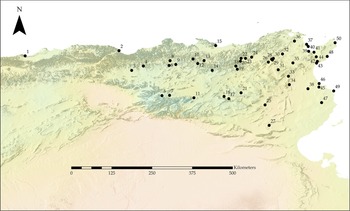


 Open access

