


The cheetah Acinonyx jubatus is categorized as Vulnerable on the IUCN Red List (Durant et al., Reference Durant, Groom, Ipavec, Mitchell and Khalatbari2022), having suffered considerable range contractions and population declines (Durant et al., Reference Durant, Mitchell, Groom, Pettorelli, Ipavec and Jacobson2017). In Tanzania, the species is believed to persist in at least four populations: Serengeti–Mara, Tarangire–Maasai Steppe, Ruaha–Rungwa, and Katavi–Ugalla (Durant et al., Reference Durant, Groom, Ipavec, Mitchell and Khalatbari2022). Nevertheless, cheetah presence remains uncertain in other remote and little-studied areas in the country. The largest tract of potential cheetah habitat for which data are lacking is the Selous–Nyerere ecosystem in southern Tanzania. This > 90,000-km2 landscape centres around Nyerere National Park (30,893 km2) and Selous Game Reserve (18,020 km2), and includes additional protected areas, including Mikumi and Udzungwa Mountains National Parks and several Forest Reserves, Wildlife Management Areas and Open Areas (Fig. 1).
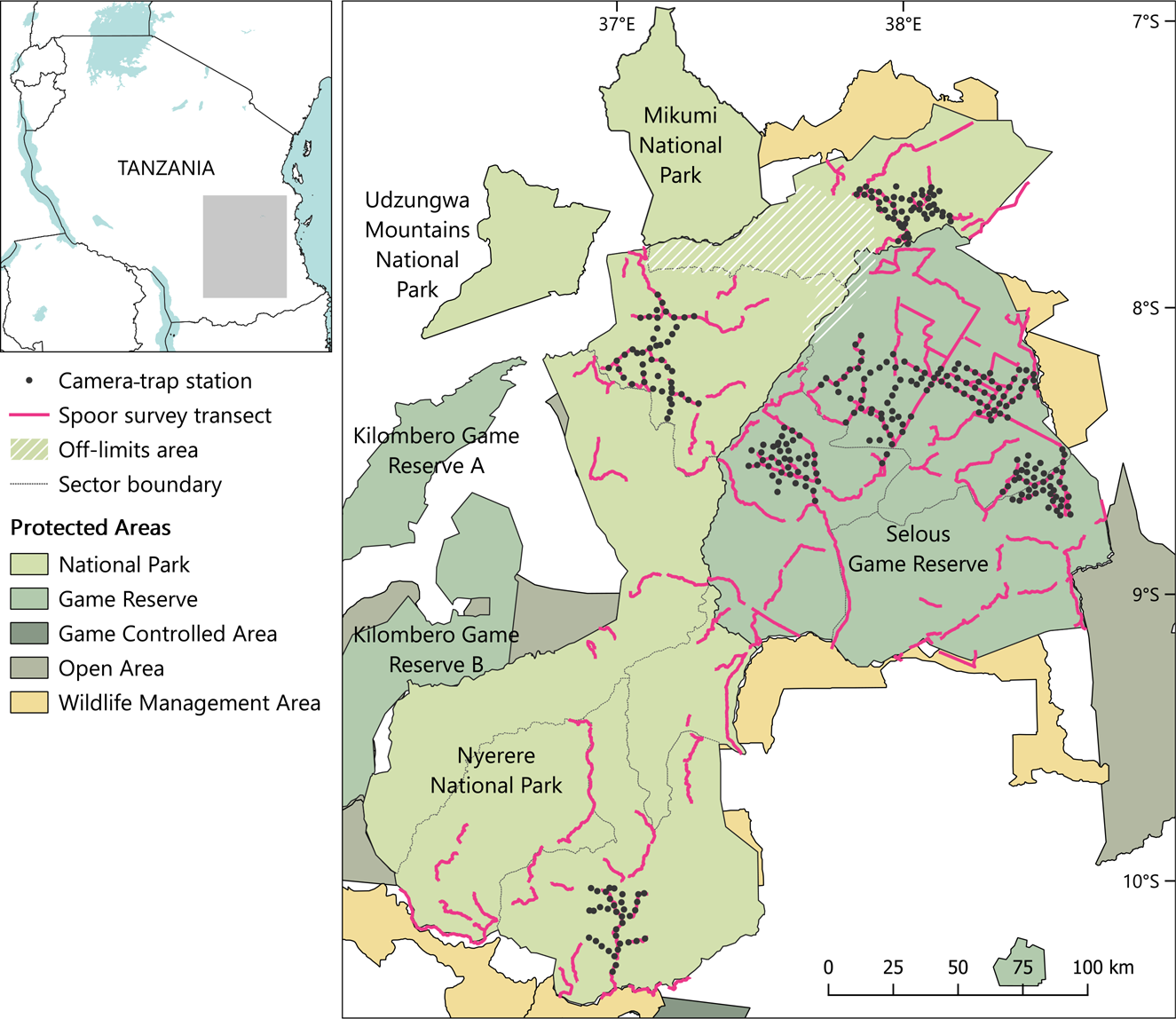
2020–2022 survey effort in Selous–Nyerere, including camera-trap and sign-based spoor surveys. Each point represents a paired station of two camera traps, with one on each side of the road or trail. (Readers of the printed journal are referred to the online article for a colour version of this figure.)
The cheetah is currently considered possibly extant in Selous-Nyerere by IUCN (Durant et al., Reference Durant, Groom, Ipavec, Mitchell and Khalatbari2022), and there are historical records from the landscape. Gros (Reference Gros2000) collated 15 separate records of cheetahs in Selous Game Reserve and Nyerere National Park (two thirds of Selous Game Reserve was re-gazetted as Nyerere National Park in 2019), and a similar number in adjacent Mikumi National Park. The last sightings were from 1993, the year data were collected for the study. The first Tanzania National Carnivore Action Plan (TAWIRI, 2009) stated that cheetahs were ‘reported to be present in the Selous in the 1980s, possible up to the early 2000s’. A more recent version of the Action Plan (TAWIRI, 2016) stated that the last confirmed sighting in Selous Game Reserve was in the late 1990s. Although both reports stated that cheetah persistence in Selous–Nyerere is unlikely, they also suggest that because of the area's vastness, remoteness and low levels of research and tourism, it is nevertheless possible that cheetahs persist, and highlighted the need for surveys in the area.
During 2020–2022, we carried out sign-based (spoor) and camera-trap surveys across Selous Game Reserve and Nyerere National Park. Spoor surveys involved surveying all suitable roads in the study area to record signs of large carnivores and their prey, following the method described in Strampelli et al. (Reference Strampelli, Henschel, Searle, Macdonald and Dickman2022b; areas of the ongoing hydropower development project were considered unsuitable and excluded; ‘off limits' in Fig. 1). Camera-trap grids were deployed to estimate the population density of large carnivores, following protocols described in Searle et al. (Reference Searle, Smit, Strampelli, Mkuburo, Ikanda and Macdonald2021) and Strampelli et al. (Reference Strampelli, Henschel, Dickman, Searle, Mkuburo and Smit2022a).
We carried out a total of 2,786 km of spoor surveys across all sectors of Nyerere National Park and Selous Game Reserve (Fig. 1), surveying c. 33,300 km2 of the landscape (148 of 242 15 × 15 km survey sites). We deployed a total of seven semi-regular camera-trap grids totalling 319 paired stations in all three sectors of Selous Game Reserve and in three of the six sectors of Nyerere National Park (Fig. 1); each grid was active for 3–4 months, resulting in a collective total of 33,188 camera-trap nights, and covered a combined area of 3,865 km2 (calculated as the sum of the area of the minimum bounding polygon around each grid).
Although our effort was relatively extensive and representative, we did not record any evidence of cheetahs. Opportunistic enquiries with photographic and hunting tourism operators, protected area managers, rangers and game scouts similarly did not provide any evidence of current or recent presence since the last reported sighting in the late 1990s (TAWIRI, 2016). The records obtained also illustrated the low frequency of sightings when they did occur: a game scout we spoke to observed cheetahs only twice during 51 years working in the Game Reserve (1969–2006 and 2008–2022, with cheetah sightings in 1969 and 1973; Joseph Salehe Kilindo, pers. comm., 2021).
Confirming absence with complete certainty over an area of this size is virtually impossible, but we believe our efforts were sufficient to indicate that cheetah persistence is unlikely. Furthermore, although the landscape is large and remote, potential observers are nevertheless present in most areas; in particular, until the 2010s hunting companies operated in most parts of the landscape. However, opportunistic enquiries yielded only three reported sightings, all > 40 years ago, unlike in other hunting areas with a known low density of cheetahs where operators regularly report sightings of the species (e.g. Rungwa Game Reserve; P. Strampelli, pers. obs., 2018). Although the spatial movement patterns of cheetahs mean they are less well-suited to road-based spoor and camera-trap surveys than other large carnivores (Fabiano et al., Reference Fabiano, Sutherland, Fuller, Nghikembua, Eizirik and Marker2020; Strampelli et al., Reference Strampelli, Henschel, Searle, Macdonald and Dickman2022b), our lack of survey records combined with this lack of observation of the species by the many potential observers in the landscape supports our conclusion that Selous–Nyerere should not be treated as potential contemporary cheetah range.
Although we did not survey the various Open Areas, Wildlife Management Areas and Forest Reserves that act as a buffer around Selous Game Reserve and Nyerere National Park, and therefore cannot exclude cheetah presence in these areas, the more anthropogenically impacted nature of most of these areas (TAWIRI, 2018) suggests it is unlikely that cheetahs would be present here while being absent from the core of the complex. Similarly, we did not carry out surveys in Mikumi National Park or Udzungwa Mountains National Park. However, Mikumi National Park receives a high volume of tourists and there have been no reports of cheetahs in this area since the 1990s, suggesting current presence is unlikely. Udzungwa Mountains National Park comprises primarily mountainous and gallery forest habitat (Fig. 2), and there are no historical records of cheetahs from this area (TAWIRI, 2016). We therefore believe it is also unlikely that cheetahs are present in these areas.
(a) Ecoregions in the Selous–Nyerere landscape (Olson et al., Reference Olson, Dinerstein, Wikramanayake, Burgess, Powell, Underwood and D'amico2001), and (b) elevation across the Selous–Nyerere landscape (Farr & Kobrick, Reference Farr and Kobrick2002) and adjoining wildlife corridors (TAWIRI, Reference Penrod, Kija, Kakengi, Evans, Pius, Olila and Keyyu2021). (Readers of the printed journal are referred to the online article for a colour version of this figure.)
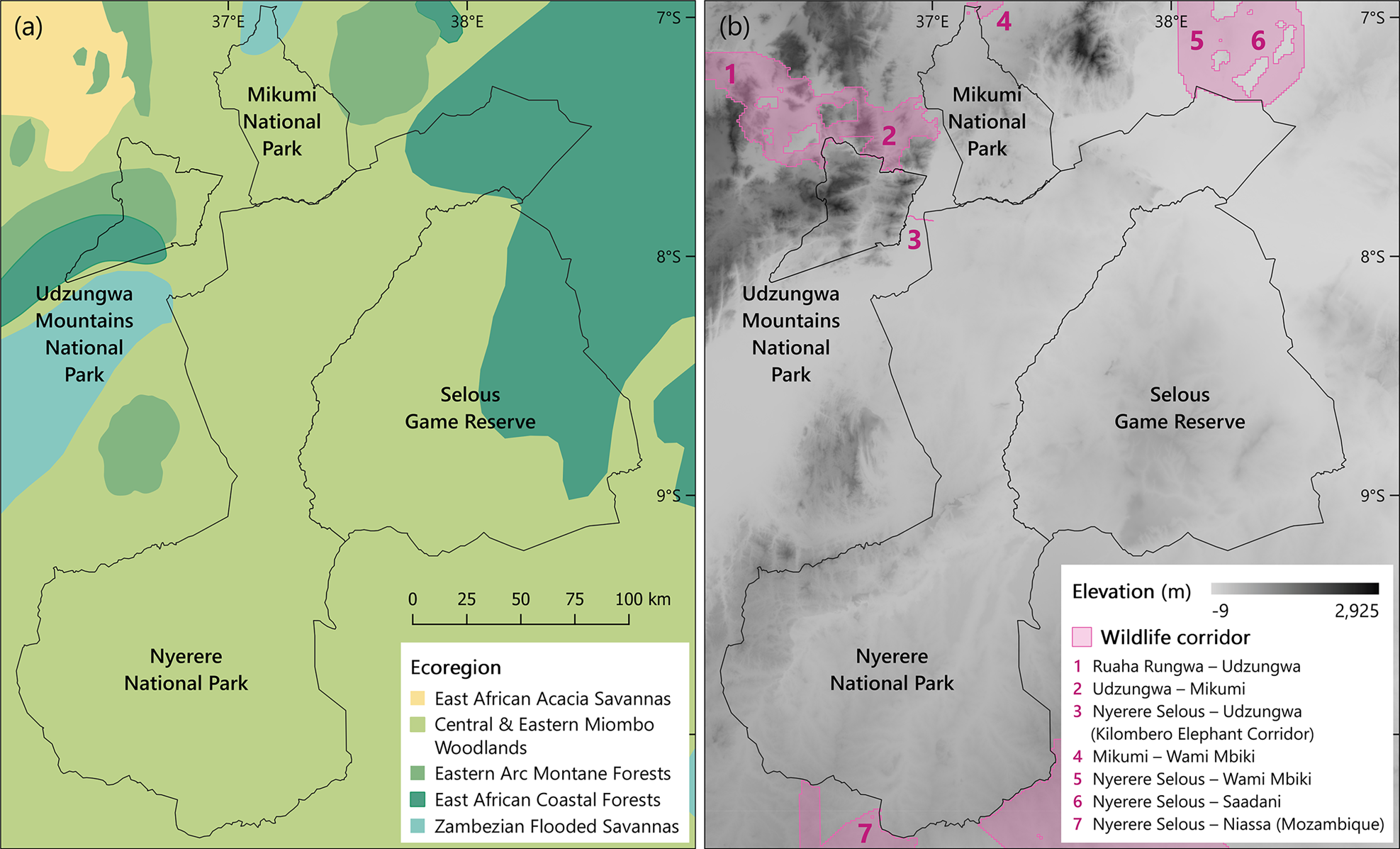
Based on our findings, and the fact that all other expected large carnivore species were found to be relatively well-distributed (Lion Landscapes, unpubl. data, 2022), we believe it is possible that Selous–Nyerere, including Mikumi National Park, never hosted an independent resident population of cheetahs. Rather, it is possible that individuals recorded in these areas were dispersers from elsewhere, or that Selous–Nyerere formed the endpoint of one or more connected populations. Gros (Reference Gros2002) presented several records from north of Mikumi National Park towards the known population in the Tarangire–Maasai Steppe. The Tarangire complex was, and still may be, connected to Mikumi National Park and northern Nyerere National Park through corridors passing through Handeni Game Controlled Area and Wami-Mbiki Game Reserve (corridors 4 and 5 in Fig. 2b), although ongoing wildlife movement within these corridors is uncertain (Jones et al., Reference Jones, Caro and Davenport2009; TAWIRI, Reference Penrod, Kija, Kakengi, Evans, Pius, Olila and Keyyu2021). It is possible that cheetahs recorded in Mikumi National Park and the north of Selous–Nyerere were dispersers arriving via these corridors, or that a continuous population existed between Tarangire and Mikumi and Selous–Nyerere, with the latter areas being at the edge of the range and cheetahs not being able to persist there without this link. Cheetahs could have similarly reached Selous–Nyerere from Ruaha–Rungwa, through the Ruaha Rungwa–Udzungwa corridor (corridor 1 in Fig. 2b) and then the Udzungwa–Mikumi or Udzungwa–Nyerere Selous corridor (corridors 2 and 3, respectively, in Fig. 2b; which are also similarly at risk of fragmentation; TAWIRI, Reference Penrod, Kija, Kakengi, Evans, Pius, Olila and Keyyu2021), to reach the areas north and south of the Rufiji River, respectively. An alternative explanation for the species' past presence in the area south of the Rufiji could be a connection to the Niassa ecosystem in Mozambique, through the persistent but degraded Nyerere Selous–Niassa corridor (corridor 7 in Fig. 2b; Jones et al., Reference Jones, Caro and Davenport2009; TAWIRI, Reference Penrod, Kija, Kakengi, Evans, Pius, Olila and Keyyu2021). However, there appears to have never been many cheetahs in the Niassa ecosystem, with only a few records from Niassa National Reserve in the 1970s (Purchase, Reference Purchase2006), so this is also uncertain.
Although impossible to confirm with certainty, this theory would explain why reports of cheetahs ended in Selous-Nyerere in the late 1990s, when these corridors began experiencing high levels of disturbance and fragmentation. All corridors of interest show increasing levels of habitat conversion and degradation and are considered at risk (Jones et al., Reference Jones, Caro and Davenport2009; TAWIRI, Reference Penrod, Kija, Kakengi, Evans, Pius, Olila and Keyyu2021). This theory would also negate the need to explain the apparent disappearance of a cheetah population in Selous–Nyerere: given the size of the area, its relative intactness, and the fact that all other large carnivore species remain widespread (Lion Landscapes, unpubl. data, 2022), the disappearance of a stable, standalone population in Selous–Nyerere is difficult to explain. The absence of a historical well-established population would also explain the current absence of cheetah records from Niassa National Reserve (Purchase, Reference Purchase2006).
Nevertheless, it remains unclear why there may never have been a well-established cheetah population in Selous–Nyerere. Cheetahs are present in miombo woodlands in western Ruaha National Park and Rungwa Game Reserve (Strampelli et al., Reference Strampelli, Searle, Smit, Grau, Henschel and Lobora2021), and most of Selous–Nyerere also primarily consists of miombo woodlands (Fig. 2a). However, the miombo woodland in Selous–Nyerere is generally more closed, potentially making it less favourable for the species' hunting habits. In addition, the area becomes exceptionally hot and humid from November to March, whereas the relatively high elevation of miombo woodlands in Ruaha-Rungwa (1,000–1500 m; Olson et al., Reference Olson, Dinerstein, Wikramanayake, Burgess, Powell, Underwood and D'amico2001) ensures that temperature and humidity are lower. The climatic conditions in Selous–Nyerere are similar to those in Zambia's Luangwa valley, where cheetahs are also absent. Although cheetahs do persist in similarly hot conditions elsewhere, such as Zakouma, Chad, such areas are less humid, suggesting that humidity may play a key role in habitat suitability for the species.
Our findings were presented at a meeting to revise the IUCN Species Survival Commission Eastern Africa Regional Conservation Strategy for Cheetah and African Wild Dog, held in Laikipia, Kenya on 27–30 September 2022. The presentation and subsequent discussion resulted in Selous–Nyerere being recategorized from possibly extant to recoverable cheetah range.
Author contributions
Funding acquisition, conceptualization: CS, PS, AD; study design, fieldwork: CS, PS, LH, SP, KO, NS, DI, SM, GH, DM, EM; writing: CS, PS; revision: all authors.
Acknowledgements
We thank the Government of Tanzania, Tanzania Wildlife Research Institute, Tanzania Wildlife Management Authority, Tanzania National Parks Authority, and Frankfurt Zoological Society for their support of this research. We are grateful to the Lion Landscapes field staff, Tanzania Wildlife Management Authority Game Officers, and Tanzania National Parks Authority Conservation Officers and Rangers who participated in data collection, and to tourism operators in the landscape who supported our fieldwork, especially Essential Destinations, Lake Manze Camp, Luke Samaras, Majestic Rivers and Lionel Song. This research was funded by Wildlife Conservation Network's Lion Recovery Fund, the Darwin Initiative Capability & Capacity fund, WWF Germany, and the National Geographic Society Big Cats Initiative. Financial and logistical support was provided by Frankfurt Zoological Society through the Selous Ecosystem Conservation and Development Project funded by the United Republic of Germany through the German Development Bank (KFW). Scholarship funding for CS and PS was provided by the University of Oxford NERC Environmental Research Doctoral Training Partnership (NE/L002612/1); CS is currently funded by a Dennis Curry Postdoctoral Research Fellowship. AD is funded by a Recanati-Kaplan Senior Research Fellowship.
Conflicts of interest
None.
Ethical standards
This research abided by the Oryx guidelines on ethical standards. Fieldwork was carried out under research permits 2020-159-NA-1997-20, 2020-160-NA-1997-20, 2021-173-NA-2021-42, 2021-174-NA-2021-42, 2022-526-NA-2021-042, and 2022-527-NA-2021-042, granted by the Tanzania Commission for Science and Technology and Tanzania Wildlife Research Institute. The research was based on active collaboration among researchers and conservation practitioners from the study country and elsewhere, and featured a strong capacity-building component.
Data availability
As this paper presents a lack of evidence, there are no data to make available.


 Open access

