
Foreign aid has increased substantially in recent decades. Official development assistance from members of the Organisation for Economic Cooperation and Development grew from $85 billion in 1990 to $147 billion in 2015.Footnote 1 Scholarly focus has risen commensurately, with attempts to explain the effectiveness of foreign aid, patterns of cross-national aid allocation and subnational aid composition, and the role of recipient governance in aid delivery prominently featured. Despite this attention, no unifying framework exists to incorporate the findings from these often separate lines of inquiry.
This study advances a theory of targeted, self-interested development that improves cohesion in our understanding of foreign aid allocation and generates implications from this for examining aid effectiveness. Determinants of aid allocation have changed over time, with development concerns playing a significantly more important role today than historically. As interconnections between industrialized and developing countries grow, donors increasingly view the security and welfare of their own citizens as affected by spillovers from less-developed states. Policymakers in aid donors today claim that transboundary problems such as terrorism, unwanted migration, spread of disease, regional instability, crime, gang violence, and trafficking in persons and illicit substances are exacerbated by underdevelopment. As a result, they seek to promote their own well-being by pursuing development abroad, targeting those countries where development is in their own interest.
Targeted, self-interested development (hereafter, targeted development) marks a change in aid policy from the past. As foreign aid became an important policy tool in the decades following World War II, its allocation was often guided by the geopolitics of the Cold War. Security and donors’ economic interests were overwhelmingly found to trump the desire for development promotion in explaining aid allocation patterns.Footnote 2 The dissolution of the Soviet Union brought an end to the bipolar justifications for aid, causing precipitous declines in commitments to some former client states. In the Democratic Republic of the Congo (then Zaire), where the authoritarian regime of Mobutu Sese Seko had supported anticommunist efforts in Africa during the 1980s, aid from members of the OECD fell from $1.1 billion in 1988 to $152 million in 1992.Footnote 3
While the geopolitical reasons for granting aid were changing in the 1990s, globalization was increasing the depth and speed of connections between states. As Keohane and Nye observed at the end of the decade, “different relationships of interdependence intersect more deeply at more points.”Footnote 4 Policymakers in industrialized states have articulated concerns about the role of development in an era of increased interdependence. When discussing the future of the international development agenda, United Kingdom Prime Minister David Cameron claimed that “it's … in our interests that we build a more prosperous world. If we don't, the problems of conflict, the problems of mass migration, the problems of uncontrollable climate change are problems that will come and visit us at home.”Footnote 5 Donor states, increasingly unable to insulate themselves from negative spillovers emanating from developing countries, are altering aid policy in an attempt to mitigate problems in the source countries. Following the terrorist attacks of 11 September 2001, United States President George W. Bush created a new institution, the Millennium Challenge Account, calling for an approach to aid that would make it more effective at spurring development and better able to “challenge the poverty and hopelessness and lack of education and failed governments” that allow terrorist groups to flourish.Footnote 6
If the goal is to prevent problems such as conflict, mass migration, climate change, and others from having an impact on the donor, assistance will be targeted toward those states most likely to inflict these costs in the first place. This separates targeted development from the concept of “enlightened self-interest” advanced by leaders such as Tony Blair; it does not hypothesize a world in which “idealism becomes realpolitik.”Footnote 7 The theory advanced here argues that industrialized states pursue development when and where it benefits themselves, not simply because it benefits themselves. Nor does it provide much support for a “moral vision” guiding relations toward developing states,Footnote 8 arguing instead that development, like other goals, is pursued to benefit the donor.
Targeted development points to a need to move beyond the categorization of aid allocation as primarily a dichotomy between “donor interest” and “recipient need,” which has been employed since the 1970s.Footnote 9 Under this framework, “donor interest” aid mainly advances the geopolitical and economic goals of donors, and serving the donor's interest does not depend on development outcomes. In a recent example, Kilby and Dreher argue that “if the donor is motivated by self-interest, its allocation decision does not depend on how the recipient uses aid and the recipient might not select developmental policies.”Footnote 10 Targeted development argues that donor interests have evolved and development has become a self-interested goal of donor states.
The theory implies a change in aid allocation patterns over time. The shift in allocation and outcomes following the end of the Cold War has been well documented,Footnote 11 but the same is not true for the post-2001 period. Scholars and development activists have hypothesized that following the terrorist attacks of 11 September 2001, foreign aid will again be diverted from development and increasingly used for nondevelopment, geopolitical purposes that result in allocation patterns resembling those of the Cold War more than those observed in the 1990s.Footnote 12 Targeted development suggests that a return to the Cold War policy of largely sidelining development concerns is unlikely, since rising interdependence has increased the concern of industrialized states with spillovers from underdevelopment. The few empirical studies that separately analyze aid allocation since 2001 focus on changes for a few variables in a limited number of donors.Footnote 13 By contrast, the following empirical analysis probes differences in the pattern of aid allocation between the Cold War, 1990s, and post-2001 periods for all OECD donors and allows the relationship between aid and each explanatory variable to vary over time.
This study examines whether observed aid allocation patterns are consistent with a new emphasis for using aid to pursue targeted development. Analyzing a dyadic data set of aid from twenty-three donors to 156 recipients, I find significant changes in the determinants of aid allocation over time. For the Cold War period, a traditional donor interest explanation applies: aid is positively associated with multiple measures of strategic importance of the recipient to the donor, such as military assistance, arms transfers, membership on the United Nations Security Council, bilateral trade, and status as a former colony. In the post-2001 period, aid allocation is consistent with donors focusing resources on developing states from which spillovers are likely: aid flows disproportionately to poor, large, proximate states and to those with ties to the donor through trade and migration. Additionally, the importance of traditional measures of strategic significance declines significantly in this period. Comparing both periods with the intervening time of the 1990s uncovers no evidence that aid in the post-2001 period reverts to patterns observed during the Cold War.
Understanding aid through a framework of targeted development also incorporates seemingly disparate findings in the literature regarding the importance of recipient governance in bilateral aid allocation. Studies have documented a lack of importance for recipient government quality in determining the amount of bilateral aid received.Footnote 14 Yet recent work has shown that donors vary the composition of aidFootnote 15 or its method of deliveryFootnote 16 to account for differences in governance. Together, this implies that governance influences the composition, but not necessarily the amount, of a recipient country's foreign aid. These results are consistent with predictions from a targeted development framework. A donor gives foreign aid where development is in its own interest, even if a recipient is poorly governed. The donor then varies the composition of aid based on governance, in an attempt to increase its development impact. Following the main results on allocation patterns, the analysis revisits the relationship between recipient governance and both the amount and composition of aid received. Findings confirm the expected patterns for the post-2001 period. Additionally, I find no evidence that donors varied the composition of aid in response to governance during the Cold War, and the relationship between governance and aid in the post-2001 period varies with distance between donor and recipient.
The analysis lays out the ways in which targeted development differs from traditional donor-interest and recipient-need explanations of aid allocation and examines whether observed patterns are consistent with this framework. However, it is not possible to prove that targeted development is occurring by examining aid allocation, any more than it is possible to prove that traditional donor-interest or recipient-need explanations are correct. Neither is it likely that targeted development has completely replaced other motivations for giving aid. Donor motivations are complex, and no single motivation can explain aid flows in any period. Instead, the evidence is consistent with an increased emphasis on targeted development relative to other donor motivations, and this fills an important gap in understanding aid policy.
These observed changes in aid allocation patterns have important implications for studying aid effectiveness. The increased importance of targeted development relative to other geopolitical goals suggests that donors will be more motivated to promote development outcomes in the current period than they have been historically. The shift in donor motivations could lead to a change in the relationship between aid and development, suggesting that studies of aid effectiveness should examine results separately by period to avoid missing changes over time. Additionally, the difference in aid composition across recipients based on the quality of governance raises issues for interpreting the interaction of governance and aid in studies of effectiveness because the intended outcomes may vary based on the composition of aid, which in turn varies based on governance quality. I probe these issues in more depth in the conclusion.
Back to the Past?
For decades, scholars have analyzed patterns in bilateral aid allocation in an attempt to determine donor motivations. Following Fleck and Kilby,Footnote 17 it makes sense to categorize modern foreign aid into three periods, which they call the Cold War, interwar (1990–2001), and war on terror (post-2001), when discussing the potential for broad changes in aid policy over time.
Cold War
Few scholars doubted the underlying geopolitical motivations for aid during the Cold War. McGuire argued that aid in the 1950s was “an instrument designed to strengthen the power position of the United States in the world struggle with Soviet Communism.”Footnote 18 Friedman observed that “[aid's] assigned role is to help win over to our side those uncommitted nations that are also underdeveloped and poor.”Footnote 19 Empirical studies of aid allocation that include the Cold War period confirm the view that aid was primarily a tool for advancing the political and economic interests of donor states.Footnote 20 This view was reinforced by the decline of aid when the Cold War ended.Footnote 21 Radelet observes that “with the end of the Cold War, foreign aid lost much of its raison d’être and much of its remaining support.”Footnote 22
The 1990s
In the aftermath of the Cold War, the relative importance of using aid for geopolitical purposes declined. Brautigam and Knack note the fall in aid to authoritarian regimes that had been strategically important during the Cold War.Footnote 23 Lancaster notes of US aid in the 1990s that “without the Cold War rationale, the priority of aid diminished considerably in the foreign policy community.”Footnote 24 Woods argues that the focus of aid shifted from geostrategic goals in the Cold War to promoting human security in the 1990s.Footnote 25 Bearce and Tirone show that aid in the 1990s differed from Cold War aid in that it was more likely to both induce economic reform in recipients and lead to economic growth.Footnote 26 Others demonstrate that aid is less likely to entrench authoritarian regimes in the post-Cold War period.Footnote 27
Post-2001
Activists and scholars have suggested that with the emergence of the global war on terror, aid will return to its Cold War pattern. An Action Aid report on foreign aid claims that “the war on terror is like a new Cold War where everything is subordinated to a single purpose.”Footnote 28 Christian Aid published “The Politics of Poverty: Aid in the New Cold War” in 2004.Footnote 29 After finding that aid was more development oriented in the 1990s than during the Cold War, Bearce and Tirone, whose analysis ends in 2001, offer the out-of-sample prediction for the war on terror that “as foreign aid once again becomes more useful for military-strategic purposes, it becomes less effective at promoting economic growth and development.”Footnote 30 Woods notes that, as a result of the war on terror, one concern is that “donors may hijack foreign aid to pursue their own security objectives.”Footnote 31 An Oxfam (UK) report claims that the war on terror will “weaken donors’ commitment to poverty reduction.”Footnote 32 Stone writes regarding aid that “in the aftermath of September 11, 2001, development has once again been subordinated to the priorities of security strategy.”Footnote 33
There are, however, reasons to suspect aid in a post-2001 world does not eschew development in favor of mainly geopolitical goals associated with the war on terror. Policy initiatives and statements suggest a growing concern with development even apart from links with terrorism. In the United States the George W. Bush administration initiated two new, substantial aid programs—the Millennium Challenge Account (MCA) and the President's Emergency Plan for AIDS Relief (PEPFAR)—both of which had eligibility criteria that effectively excluded front-line states in the fight against terrorism.Footnote 34 Lancaster notes that President Bush elevated development to the “first tier of US foreign policy priorities, along with defense and diplomacy,” arguing that it was “the first time for many decades that a US president has declared that promoting development abroad is a key priority in US foreign policy.”Footnote 35 President Barack Obama continued this emphasis, signing a policy directive on global development in 2010 that set development as a key goal of US foreign policy and established a Quadrennial Diplomacy and Development Review linking development with broader policy goals. In justifying large increases in development assistance while advocating austerity at home, United Kingdom Deputy Prime Minister Nicholas Clegg argued that “If you want to deal with terrorism, extremism, if you want to stop people upping sticks and moving across continents and coming to settle in Europe and here, you have got to make sure the circumstances are better for them.”Footnote 36 Japan's Official Development Assistance Charter claims that “humanitarian problems, such as extreme poverty, famine, refugee crises, and natural disasters, as well as global issues such as those related to the environment and water … are cross border issues that present a grave threat to each and every human being.”Footnote 37
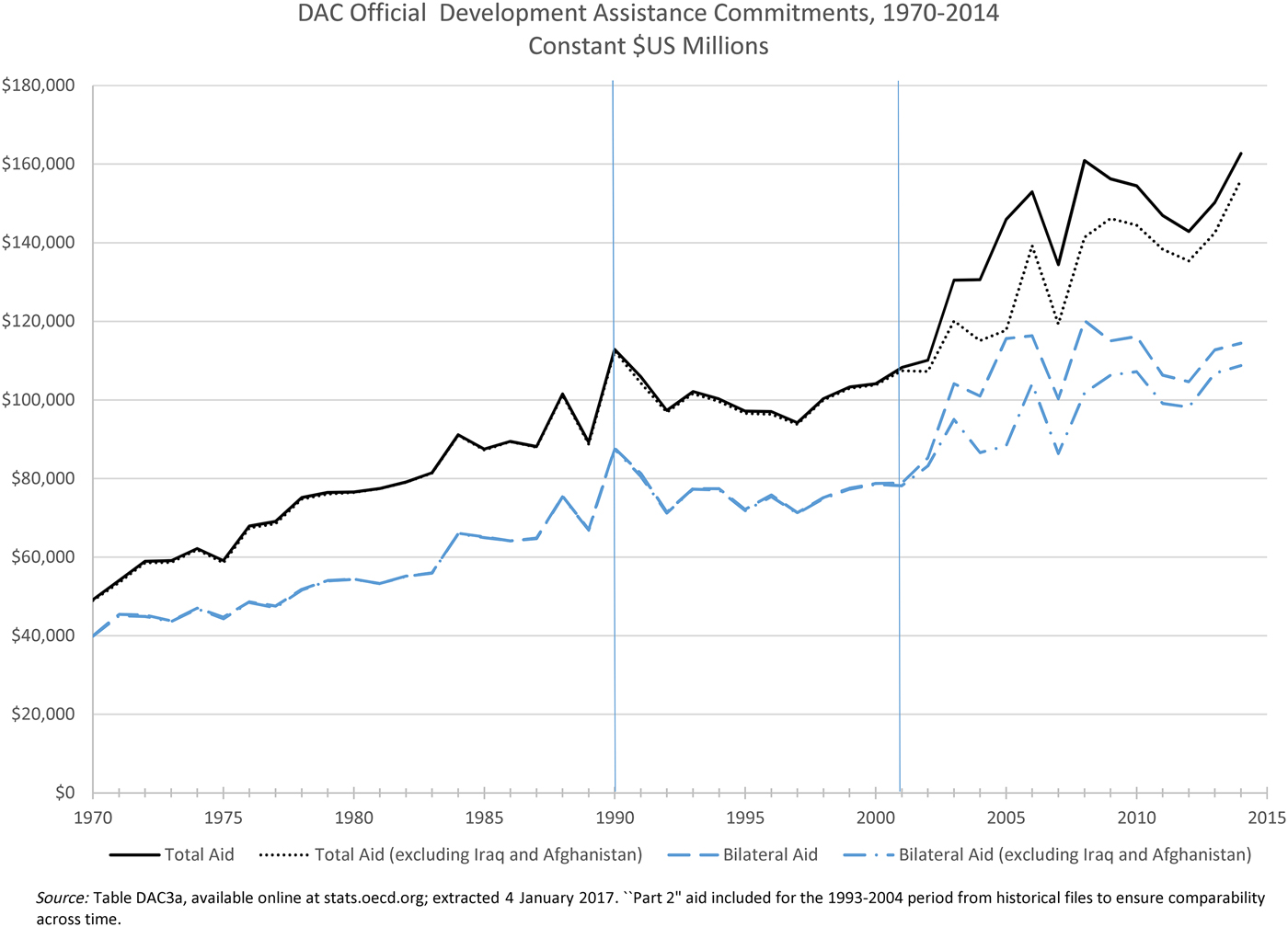
A focus on lessening spillovers from underdevelopment does not imply that donors forego using aid for geostrategic purposes. Donors can engage other strategic priorities without sidelining development by increasing overall aid flows. The evidence suggests that this has occurred. Aid commitments from OECD countries have risen markedly in the post-2001 period. Figure 1 shows aid commitments from members of the Development Assistance Committee (DAC) of the OECD from 1970 to 2014 for both total aid (including contributions to multilateral institutions) and the bilateral portion of their aid, with dotted lines indicating commitments excluding those to Iraq and Afghanistan. Even excluding increases in aid resulting from the large commitments to these two countries, total aid commitments increased by 50 percent from 2000 to 2014, from $104 billion to $156 billion, despite significant volatility in the wake of the global financial crisis. The post-2001 trend was not driven by only a few donors; Austria, Belgium, Finland, France, Ireland, Italy, the Netherlands, New Zealand, Spain, Sweden, the United Kingdom, and the United States all recorded aid increases of more than 50 percent between 2001 and 2006, with some (but not all) declining after the onset of the financial crisis.Footnote 38
DAC official development assistance commitments, 1970–2014
There are few empirical analyses that examine aid allocation specifically in the post-2001 period. Those that exist, while offering important insights, are limited in terms of the countries covered and variables whose impact is modeled as changing over time. Moss, Roodman, and Standley compare aid from the United States in the 1990s with the post-2001 period and argue that most countries did not see a change in aid allocation post-2001; change occurred on the front lines of the war on terror, but not at the expense of the rest because aid budgets increased.Footnote 39 Fleck and Kilby analyze US aid across all three periods; they find variations in the impact of recipient income on aid allocation, but do not examine changes in the relationship between other variables and aid flows over time.Footnote 40 Clist examines changes in the responsiveness to recipient income and governance in aid allocation for seven bilateral donors, finding that there is increasing sensitivity to poverty but not governance; this study also does not test for differences in donor interest variables across periods.Footnote 41
Targeted Development
The central argument of this study is that industrialized countries increasingly pursue development abroad in their own self-interest. Connections between industrialized and developing countries have deepened in recent decades. Wealthy countries are less able to insulate their populations from problems associated with underdevelopment abroad than they were historically. To combat these problems, wealthy states will pursue a strategy of targeted development. The argument that aid in the post-2001 period will resemble Cold War aid assumes (implicitly) that the importance of development has remained constant. If increasing concerns for the impact of underdevelopment on donor well-being influence donor preferences, then there is no particular reason to expect a return to Cold War aid patterns simply because geopolitical concerns increase in importance.
It is important to distinguish nondevelopment self-interest pursued with aid from self-interest pursued through development. Nondevelopment self-interest consists of buying/rewarding military support or votes in international bodies, propping up friendly governments, rewarding countries that open up to donor exports, or more generally “buying” favors from the recipient government in exchange for aid. The intended outcome can be achieved even if no additional development occurs. This is what has traditionally been meant by donor interest, and such factors have been found to influence the allocation of foreign aid.
Interest pursued through development generates different predictions regarding aid allocation. According to the theory of targeted development advanced here, substantial portions of aid are targeted to promote development in the donor's best interest. This implies a cross-national allocation pattern in which a donor focuses aid on recipients from which the likely impact of spillovers from underdevelopment is high. Additionally, it implies that donors care about development effectiveness associated with aid and will alter aid composition to account for quality of governance in chosen recipients.
Cross-National Allocation Patterns
Analysis of targeted development alongside donor-interest and recipient-need explanations is complicated by the fact that, for some individual variables, the hypothesized relationship between the variable and aid can be consistent with both targeted development and other motivations. However, each of the three explanations is associated with a different combination of relationships between multiple variables and aid.
Table 1 lists potential explanatory variables for aid allocation and their predicted relationship(s) with aid under different donor motivations. There is no consensus in the empirical literature regarding the variables to include when studying aid allocation. This lack of a generally accepted starting point complicates comparisons with existing work and generates a list of variables too numerous to include in one study, often collinear with each other, and at times significantly lacking in country coverage. To keep the analysis manageable, Table 1 includes enough variables to distinguish patterns across potential explanations, variables that are widely used as well as a few key ones to test the theory, and variables that have high cross-country coverage to avoid as much as possible selection effects resulting from missing data.
Predicted association between explanatory variables and aid allocation
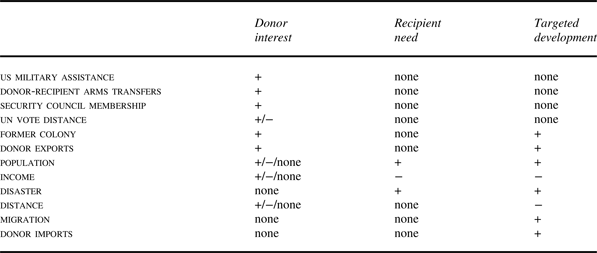
The variables in Table 1 can be classified into three categories: traditionally donor interest, traditionally recipient need, and specific to targeted development. I discuss the relationship between quality of governance in a recipient and aid flows separately rather than including it with other variables in Table 1. Control variables without a clear relationship to one of these three concepts are not included in the table. Targeted development overlaps at times with donor interest and recipient need, but also generates predictions on variables not clearly identified with either of these explanations.
Donor Interest
The first category includes variables that are traditionally thought of as donor interest, that is, variables that measure the importance of a recipient to the advancement of the donor's own security or economic goals, separate from any development impact. Countries important enough to receive military assistance from the United States are likely to see an increase in foreign aid (separate from military aid) from at least the US and possibly from other donors. The impact on other donors can occur if either security importance to the US is a good proxy for importance to other donors or if other donors free-ride on the US in security agreements but contribute by supporting important recipients with foreign aid. No other donor makes data on military assistance available. Another potential measure of military salience is the transfer of arms from the donor to the recipient. This variable is imperfect because some arms transfers are commercial sales motivated by profit while others represent some form of military aid. However, to the extent that donor governments must allow such transfers to occur, the variable may pick up strategic importance.
Donors may use aid to buy influence with countries occupying one of the rotating seats on the UN Security Council,Footnote 42 and multiple studies argue that foreign aid may be used to influence voting in the UN General Assembly.Footnote 43 While a widely used measure, the direction of the relationship between similarity in voting in the UN General Assembly and foreign aid is theoretically ambiguous. A donor may give more aid to countries that have generally similar votes to itself, either as a reward for this practice or because UN votes are correlated with a general alignment of priorities that is associated with more aid.Footnote 44 On the other hand, a donor may use aid to “buy” votes on specific issues from countries that are generally more distant to itself, suggesting a negative relationship between aid and vote similarity.
Neither targeted development nor recipient need generate expectations of a relationship between these first four variables and aid allocation. The last two variables in the donor interest section—former colony and donor exports—are predicted to have a positive association with aid flows by both donor-interest and targeted-development explanations, although for different reasons. From a traditional donor-interest point of view, former colonies will receive more aid as colonial powers seek to maintain their sphere of influence after independence. Donors can use aid as leverage in international trade negotiations, pushing aid recipients to be more open to their exports; they can also tie aid directly to the purchase of exports. Neither of these explanations requires development to occur for donor interest to be met. Targeted development goes a step further and argues that donors seek to promote development in their former colonies because the historical ties that bind them together can also serve as transmission vehicles for negative spillovers (e.g., unwanted migration, spread of disease through travel, instability that draws in the former colonial power). Likewise, targeted development is consistent with increasing development in export markets, to further boost demand (compared to forced opening without development). Because the hypothesized direction is the same for both explanations, these variables cannot by themselves disentangle the explanatory value of donor interest and targeted development. Instead, they form part of the expected pattern across variables for each explanation.
Recipient Need
The next three variables—population, income, and disaster—are recipient-level variables. Recipient-need and targeted-development explanations yield the same predictions regarding the relationship between these variables and aid flows. The recipient-need explanation is obvious: poorer countries, larger countries, and those more affected by natural disasters will have more need. From a targeted-development perspective, it is also true that countries that are poorer, larger, or affected by a natural disaster are more likely to create negative spillovers than are wealthier, smaller countries that have not experienced a disaster.
A difficulty with the existing literature, which persists here, is the ability to interpret any sign on income or population in terms of donor interest. For instance, aid used to buy geopolitical favors is consistent with a negative coefficient on both variables because these favors may be cheaper to buy from small, poor states.Footnote 45 Economic interests, on the other hand, suggest that aid should flow disproportionately to large, wealthier states where the potential markets are bigger. Thus a donor-interest framework does not provide a clear prediction with regard to the expected signs on these variables.
Targeted Development
In addition to the overlaps noted, targeted development generates hypotheses for variables that do not fit neatly into the donor interest/recipient need dichotomy and have not been widely used in previous empirical analyses of aid allocation. Donors should be most concerned with spillovers from nearby states, ceteris paribus, implying a negative relationship between distance and aid. A pure recipient-need explanation would privilege those states most in need, regardless of distance, suggesting no particular relationship between distance and aid. A traditional donor-interest explanation could be formed for any relationship between aid and distance: (1) no relationship—donors give aid where it best suits their interests on other measures; (2) positive relationship—donors use aid to project power outside their immediate spheres of influence; or (3) negative relationship—donors use aid to solidify influence in their own neighborhoods. Of course, donors may use aid for all three, suggesting that perhaps the most likely outcome is noise if donor interest is driving the relationship between aid and distance. Few studies have controlled for distance. Dollar and Levin report coefficients on distance for the period 2000–2003 in their study of aid allocation: it is generally negative, but they do not report this coefficient for earlier periods.Footnote 46 Bueno de Mesquita and Smith report a negative coefficient on distance in their study of aid allocation from 1973 to 2001, but it is not significant once they control for trade.Footnote 47 Stone finds a negative relationship between distance and aid allocation in his examination of the 1990s; this is interpreted in the light of migration and refugees, which fits with the concept of targeted development, although that is not the argument of the study.Footnote 48
Migration and imports are two additional variables not included in most studies of aid allocation. Bermeo and Leblang examine the relationship between migration and aid allocation in the post-Cold War period and conclude that donors seek to decrease migration by using aid to promote development in previous migrant-sending states.Footnote 49 Data limitations on migration do not allow an over-time comparison with the Cold War period, but the expectation is that a measure of migrants from a recipient living in a donor will have a positive relationship with aid flows in the post-2001 period. There are multiple reasons that donors may favor development in recipients from which they receive higher imports. First, they may wish to invest in increasing the quality of the imports. Second, since wages are higher in more developed countries, promoting development can eventually raise the wages in the source country, decreasing the difference between domestic and foreign wages in the long run. Finally, in countries targeted for development promotion, donors may pursue this through both foreign aid and increased openness to the recipient country's imports. Most allocation studies focus on trade openness in the recipient, donor exports to the recipient, or total trade between donor and recipient, rather than separately examining the link between donor imports from a recipient and aid to that recipient.Footnote 50 An explanation linking migration and/or imports with aid allocation that does not involve development promotion is not readily apparent.
As Table 1 makes clear, it is necessary to examine trends over time and on multiple variables to determine the relative explanatory power of donor interest, recipient need, and targeted development. In any period all three may be operating; it is in observing variation that one can evaluate their relative importance—to each other and to themselves historically—as explanations of aid allocation. Consistent with the predictions for changing motivations over time, this study tests the hypothesis:
H1
Observed patterns across explanatory variables for aid allocation in the post-2001 period are consistent with donors pursuing targeted development; this represents a change from the Cold War period, where observed patterns are more consistent with a traditional (nondevelopment) donor-interest explanation.
Recipient Governance and Aid Allocation
Beyond offering insights into the characteristics of countries that will be targeted by donors, the targeted-development framework predicts that donors will take steps to increase the development outcomes associated with aid. The benefits associated with decreased spillovers from underdevelopment accrue only if development occurs. Scholars have attempted to ascertain donors’ commitment to development by examining the link between recipient governance and the amount of aid received. The premise is that, since aid is more likely to promote growth in better-governed countries,Footnote 51 we will observe higher aid flows to well-governed states if donors are using aid to promote development. Most scholars analyzing the link between aid and quality of recipient governance (which has many definitions) find little evidence of donor selectivity with regard to governance. While a few studies argue that bilateral aid has become more selective with respect to governance over time,Footnote 52 most studies find no link between governance and bilateral aid flows,Footnote 53 or no change over time in the relationship.Footnote 54 Some even argue that poorly governed countries receive more aid,Footnote 55 or that bilateral donors have become less selective regarding quality of governance over time.Footnote 56
There is a problem with inferring donor intentions from the relationship (or lack thereof) between recipient governance and the amount of aid allocated to a country because governance is simultaneously a signal of capacity and need. While well-governed countries may have higher capacity to turn aid into development, they may also have less need for aid and be less likely to inflict spillovers on other states. Recent studies of the relationship between recipient governance and aid composition offer a step forward in disentangling donor responses to both the need and capacity signaled by recipient governance quality. Scholars have shown that donors alter the sectoral composition of aidFootnote 57 or the delivery mechanismFootnote 58 in response to governance. The variation suggests that donors require more oversight and less recipient government involvement in poorly governed states, which is consistent with donor concern for development outcomes.
Targeted Development and Governance
Targeted development generates predictions for the relationship between aid and governance that incorporate both the aggregate amount of aid offered to a recipient by a donor and the composition of aid. Regardless of government quality, donors target countries from which they expect spillovers, in keeping with the lack of sensitivity to governance found in existing cross-national allocation studies. They then seek to improve outcomes by tailoring the composition and delivery of aid to fit the needs and capabilities of countries with different levels of governance, which is also consistent with previous results.
Moving beyond existing findings, the theory predicts that donors should be particularly concerned with the potential for increased spillovers associated with poor governance if it occurs in states more likely to create spillovers for themselves in the first place. This suggests that when the likelihood of spillovers is high independent of recipient governance, a donor will respond to poorer governance with more aid. The empirical analysis tests whether donors respond differently to quality of governance based on proximity, with the assumption that the likely impact of spillovers on the donor decreases with distance.Footnote 59
The targeted development framework is also consistent with recent findings that donors respond to the capacity signal of governance by altering the composition and method of delivery of aid flows. Variations in governance quality are consistent with different ability and/or willingness of the recipient government to use aid for development. Donors aiming to achieve development in chosen recipients will account for this by varying the composition of aid, focusing on sectors with relatively high government involvement in well-governed recipients, and on sectors with more limited government involvement in poorly governed recipients. Altering the composition of aid away from sectors with high public-sector involvement allows donors to continue engaging poorly governed recipients while attenuating the negative effects of poor governance on aid outcomes. Following the main analysis of cross-national aid patterns, I revisit the question of aid composition.
Data
The main data set includes yearly, dyadic data on aid commitments from twenty-three OECD donors to 156 recipients for the period 1973 to 2012.Footnote 60 The dependent variable is the natural log of (one plus) aid commitments from a donor to a recipient in a given year.Footnote 61 Data are from the OECD's International Development Statistics online database.Footnote 62 I follow the general trend in the literature studying aid allocation by using data on aid commitments, rather than disbursements which may lag the original policy decision by several years.
Explanatory variables can be categorized as recipient level or dyad level. Recipient-level variables include income and population drawn from the World Bank's World Development Indicators.Footnote 63 Income is measured in constant dollars and both variables are logged. Disaster is the natural log of (one plus) the sum of the total number of people affected or killed as a result of natural disasters in a country in a given year.Footnote 64 Civil war equals 1 if a recipient experienced one or more civil wars in a given yearFootnote 65 and 0 otherwise.
Democracy is the average of a recipient's values on the civil liberties and political rights variables published by Freedom House; this scale ranges from zero to seven and is inverted so that higher scores reflect greater democracy.Footnote 66 Us military assistance is the log of (one plus) the reported constant-dollar value of military aid received by the recipient from the United States in a given year.Footnote 67 Security council member is an indicator variable that equals 1 if a recipient held a rotating seat on the United Nations Security Council in year t and 0 otherwise.Footnote 68 Governance is measured using data from the Worldwide Governance Indicators (WGI) data set for each recipient-year and reflects average value on five measures: political stability, government effectiveness, regulatory quality, rule of law, and control of corruption.Footnote 69 Because of concerns with the comparability of the raw values over time, a yearly rank is created with a value of 1 assigned to the country with the worst average governance for the year in this data set, ranging up to a maximum of 162 for the country with the best governance average in the year with the highest country coverage. This variable is then logged and used for the analysis.Footnote 70
Dyadic measures are included to capture donor-recipient relationships. Distance records the log of distance between donor and recipient.Footnote 71 The log of (one plus) the dollar value of arms transfers from donor to recipient is included (sipri arms transfers).Footnote 72 UN vote distance measures the absolute value of the difference between donor and recipient ideal point estimates for UN General Assembly Votes.Footnote 73 Donor exports and donor imports are from the International Monetary Fund's Direction of Trade Statistics. Footnote 74 Former colony equals 1 if the recipient was ever a colony of the donor (coded from the CIA World Factbook) and 0 otherwise. Migration is the log of migrant flows from the recipient to the donor.Footnote 75
Analysis: Dyadic Aid Allocation
The analysis tests the hypothesis that aid allocation in the post-2001 period is consistent with donors pursuing a strategy of targeted development. It compares the post-2001 period to the Cold War and the 1990s to determine if there have been changes over time in the allocation of foreign aid, and to look for evidence of a reversion to Cold War patterns in the post-2001 period.
As in all dyadic studies of aid allocation, the dependent variable has multiple zero values: 28 percent of the observations in the post-2001 period and 41 percent in the Cold War period are zeros. There is no consensus in the aid literature regarding the appropriate way to model these. In the main analysis, I follow studies that specify a Tobit model with left censoring at 0.Footnote 76 Another common approach is a two-part model: a selection equation modeled using probit or logit with a binary dependent variable indicating whether or not the observation has positive values for aid, followed by a level equation estimated using OLS and restricted to those observations with strictly positive aid values.Footnote 77 Because there are benefits and drawbacks to either approach,Footnote 78 and to facilitate comparisons with the widest possible range of studies, I also report results from a two-part analysis. Results are reported separately for the Cold War and post-2001 periods, as well as in models for the entire 1973–2012 time frame in which all explanatory variables are interacted with period-indicator variables. Results from the interaction models facilitate comparison of coefficients across periods, but interpreting the impact of individual variables on aid allocation in any period other than the base period is not straightforward.Footnote 79
Fixed effects for year and donor are included in all Tobit and OLS models.Footnote 80 Recipient fixed effects are not included. The hypotheses concern donor intent, and the interpretation of results on dyadic variables is inconsistent with the theory when recipient fixed effects are included. For instance, with recipient (rather than donor) fixed effects, a negative coefficient on distance would signal that recipients receive more aid from donors that are closer (the variation would hold the recipient fixed but vary the distance to donors), but would not tell us whether donors give more aid to recipients that are closer to themselves. Analogous problems with interpretation apply to other dyadic measures once recipient fixed effects are included. The theoretical expectation is that variation across recipients is more important than variation within a recipient, particularly for variables that change slowly over time within a country. One of the main arguments for including fixed effects is to control for recipient-specific, time-invariant omitted variables that may be correlated with included variables of interest. A key test of the theory examines changes over time; to the extent that change over time is observed, it is unlikely to be driven by unmodeled, time-invariant factors.
To ensure that measures precede aid allocation decisions, many of the time-varying explanatory variables are lagged by one period. Measures of strategic importance (military aid, arms transfers, and membership in the United Nations Security Council) are not lagged because aid commitments are expected to increase while the recipient is strategically important rather than in the year following strategic importance.Footnote 81 The measure for natural disasters is also not lagged—these are often associated with immediate increases in aid commitments, which may be recorded in the same calendar year. As a practical matter, choosing to lag any variable or not does not change conclusions. Standard errors are clustered on dyad to address concerns of heteroskedasticity.
Dyadic Aid Allocation by Period
Table 2 reports results of the analysis of dyadic aid allocation separately for the periods 1973–1988 (Cold War) and 2002–2012 (post-2001). Models 1 and 2 use all available data for each period. Model 3 presents the same analysis for the post-2001 period restricted to dyads present in both periods to ensure that any observed differences are not a result of changes over time in donors and recipients, or in countries/dyads with data availability. The p-values associated with post-estimation t-tests for a significant difference in coefficients across the periods are reported (coefficients from Models 2 and 3 are compared to Model 1).
Determinants of dyadic aid allocation
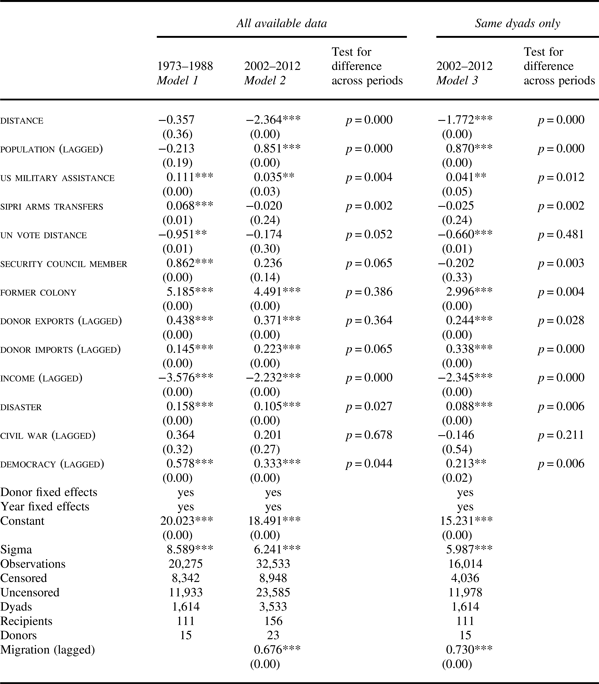
Notes: Dependent variable is the log of (one plus) aid commitments from donor to recipient in year t. Tobit models with standard errors clustered on dyad; p-values in parentheses. All variables except civil war, former colony, democracy, un vote distance, and security council member are measured in natural logs. *p < .10; **p < .05; ***p < .01.
The results in Table 2 strongly support H1: coefficients have the signs predicted by the targeted development hypothesis in the post-2001 period and the differences across time periods are striking. During the Cold War (Model 1), donors gave more aid, on average, to recipients that were poor (lower income), strategically important (higher US military assistance, higher arms transfers, and rotating members of the UN Security Council), and trade partners (higher exports and imports), but did not privilege large or nearby states. In the post-2001 period (Models 2 and 3) donors gave more aid to recipients that were poor, populous, and proximate to themselves. The coefficient on distance becomes negative and significant in the post-2001 period, while the coefficient on population becomes positive and significant.
There is a significant decrease in the value of coefficients on us military assistance, sipri arms transfers, and security council member, and the latter two variables are not significant in the post-2001 period.Footnote 82 Trade remains positively correlated with aid allocation, with donor imports gaining in importance relative to donor exports.Footnote 83 Since data on migration are available for the post-2001 period only, Models 2 and 3 are also estimated separately including migration and the resulting coefficient is reported at the bottom of the results in Table 2; as hypothesized, it is positive and significant.Footnote 84
Status as a former colony of the donor retains a significant relationship with aid flows in the post-2001 period, although its importance may have declined over time. The change over time for the coefficient on income is consistent with an interpretation that donors were more concerned with poverty in the Cold War. However, the results of the two-part analysis that follows suggest that an alternative interpretation based on using aid to buy influence in the Cold War may be more valid. To determine whether the results are driven by any particular region, the main models were re-estimated dropping each region in turn and the main conclusions hold.Footnote 85
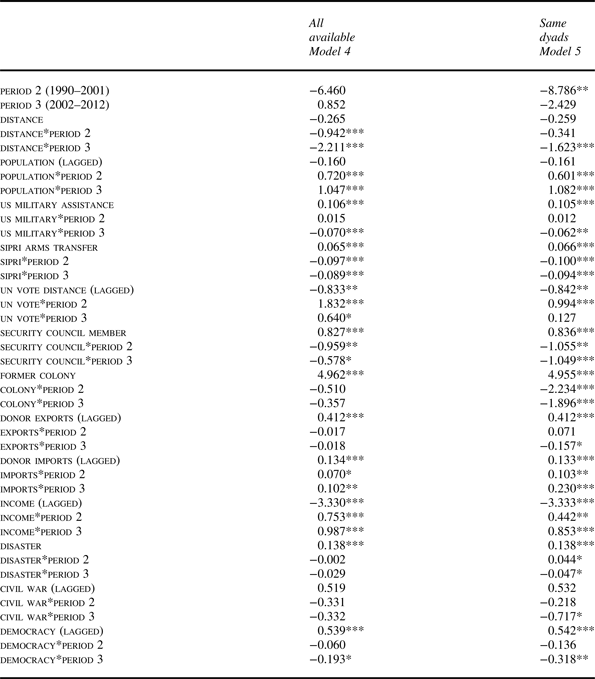
An alternative to the separate period analyses is the interaction framework discussed earlier. The models in Table 3 cover the full period from 1973 to 2012. Two indicator variables are added: period 2 takes the value of 1 for observations in the years 1990–2001, while period 3 takes the value of 1 for observations in years 2002–2012. The omitted category is the Cold War (1973–1989). Every variable from Table 2 is entered into the models on its own and interacted with both period 2 and period 3.Footnote 86 In addition to providing an alternative specification, the inclusion of all three periods facilitates analysis of any possible “reversion” of aid to its Cold War pattern in the post-2001 period.
Determinants of dyadic aid allocation, period interactions
Notes: Dependent variable is the log of (one plus) aid from donor to recipient in year t. Tobit models with standard errors clustered on dyad. All variables except period 2, period 3, civil war, former colony, democracy, un vote distance, and security council member are measured in natural logs. *p < .10; **p < .05; ***p < .01.
In Table 3 the coefficient on each non-interacted substantive variable can be interpreted as its value during the Cold War (omitted period). The coefficients on the interaction terms measure differences from the Cold War. For example, the coefficient on population represents the (not significant) relationship between population and aid allocation during the Cold War. The positive, significant coefficient on the interaction term population*period 2 shows that the coefficient in period 2 (1990–2001) has shifted significantly in a positive direction compared to its value in the Cold War, while the positive, significant coefficient on population*period 3 is also interpreted relative to the Cold War. For any variable, the value in period 2 or period 3 is the sum of the coefficient on the base term and the coefficient on the appropriate interaction term. Overall, the interaction terms between substantive variables and period 3 demonstrate the same shifts over time observed in Table 2.
The results in Table 3 show no evidence of reversion to a Cold War pattern for aid allocation. In many cases comparing the coefficient for a variable interacted with period 3 with the same variable interacted with period 2 suggests that aid may be moving even further from its Cold War pattern in the post-2001 period. For instance, for both distance and population interaction with period 3 produces coefficients of larger magnitude than interaction with period 2, and the impact of us military assistance does not appear to have fallen for period 2 but does decrease significantly from its Cold War value in the post-2001 period.
Alternate Specifications
I conduct alternative analyses for individual donors and donor years, a recipient-level analysis with variables aggregated across all OECD donors for a recipient in a given year, and additional robustness checks. To conserve space, results of these analyses are in the supplemental appendix, but are discussed here. The first approach estimates Models 1 and 2 from Table 2 for each donor with data available for both periods. The results provide additional evidence consistent with movement toward targeted development, and demonstrate that changes over time are observed widely across donors. Of the sixteen donors with data available in both periods,Footnote 87 the results for fifteen show a coefficient on population that changes from insignificant or negative in the Cold War to significant and positive in the post-2001 period. For distance, ten of sixteen donors change from an insignificant or positive coefficient in the Cold War to a significant, negative coefficient in the post-2001 period. The coefficient on us military assistance is positive and significant for twelve donors during the Cold War and only five donors in the post-2001 period. Sipri arms transfers also see a decline as do donor exports, while the number of donors with a positive, significant coefficient for donor imports increases from three to eight. For these donors, thirteen have sufficient data on migrant flows to include this in the analysis for the post-2001 period without drastically reducing the number of observations; of these, nine show a significant and positive association between migrant flows from the recipient to the donor and aid allocation from the donor to the recipient.
A separate analysis estimates 498 cross-section Tobit regressions by donor year using the observations for Models 1 (254 donor years) and 2 (244 donor years). The most notable changes over time are again on the coefficients for distance and population. In the Cold War period the coefficient on distance is significant and positive in 26.4 percent of the regressions, while the same is true for only 2 percent of the regressions in the post-2001 period. The coefficient on distance is significant and negative in 57.8 percent of the post-2001 regressions compared to only 11 percent of the Cold War regressions. The trend toward more populous countries in the later period is again observed: the coefficient on population is significant and positive for 56.1 percent of the regressions in the post-2001 period, compared with 7.9 percent in the Cold War. Changes in the directions hypothesized also occur for the coefficients on us military assistance, sipri arms transfers, and donor imports.
Dyadic trends may reflect a division of labor among donors that has no impact on the total amount of aid received by a recipient summed across donors. To examine this possibility, dyadic variables were collapsed across donors from the dyad-year level to the recipient-year level and the equations from Table 2 re-estimated at the recipient level. In this analysis, the changing coefficients between the two periods on distance and population are observed, as is the decline in importance for sipri arms transfers and former colony and the increase in importance of donor imports relative to donor exports. This suggests that the shift toward targeted development from the Cold War to post-2001 period is not a result of changes in donor specialization, but holds for aggregate OECD allocation as well. To address concerns that the results may be driven by outliers, models are estimated excluding observations in the top 1 percent of dyadic aid commitments and (separately) the top 5 percent of dyadic aid commitments; in neither case are any conclusions altered. Additional models were estimated using a time trend in place of year fixed effects and substituting the polity2 variable from the Polity IV databaseFootnote 88 for the Freedom House measure of democracy; again, no qualitative changes to results are indicated.
Two-Part Approach
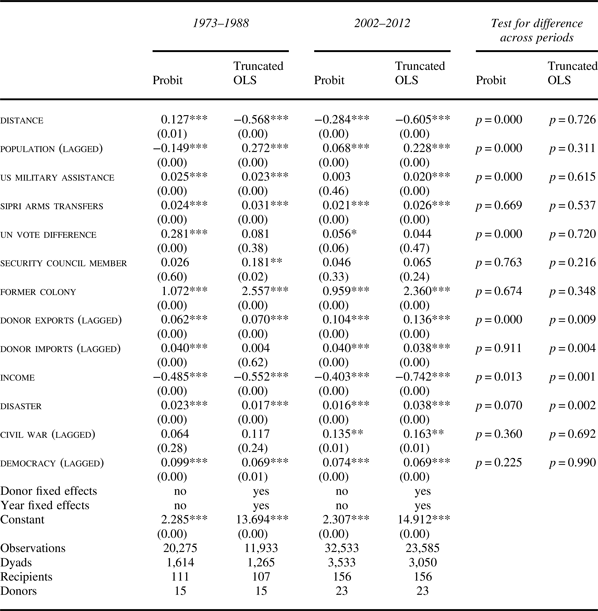
A two-part analysis of aid allocation estimates selection and level equations separately, allowing the relationship between a variable and aid to vary across the two equations. To facilitate comparison with previous work, Table 4 reports results of a two-part analysis for both the Cold War and post-2001 periods.Footnote 89 The selection equation is modeled as a Probit, with a binary dependent variable that equals 1 for observations that have positive aid.Footnote 90 The level equation is modeled using OLS and confined to dyads that have positive aid values. The results from the truncated OLS models should be interpreted as the relationship conditional on receiving any aid.
Two-part analysis of dyadic aid allocation
Notes: For probit models, the dependent variable equals 1 if the recipient received aid from the donor in year t and 0 otherwise. Truncated OLS models include only observations with positive aid; the dependent variable is the log of aid from donor to recipient in year t. Standard errors clustered on dyad; p-values in parentheses. All variables except civil war, former colony, democracy, un vote distance, and security council member are measured in natural logs. *p <. 10; **p < .05; ***p < .01.
Interesting results emerge, particularly in light of previous work. The analysis confirms changes over time: for the key variables for which a significant change is noted over time in the Tobit models, either the selection or level equations (or both) are consistent with the difference. It appears that a significant portion of the change over time for the relationship between aid allocation and distance, population, and us military assistance comes during the selection phase.
Bueno de Mesquita and Smith model the expectations for aid allocation at both stages based on selectorate theory,Footnote 91 arguing that allocation can be explained through an “aid-for-policy” framework.Footnote 92 While a test of their theory is beyond the scope of this analysis, it is consistent with it to say that donors find it cheaper to buy favors from small, poor countries. Thus, we should observe negative coefficients on income and population in the selection equation. However, conditional on choosing to buy a favor from a larger or richer country—perhaps it needs a concession particular to that recipient—the donor needs to spend more money to make it worthwhile for governments of these recipients. This suggests positive coefficients on income and population in the level equation.
Against this backdrop, changes in the coefficients on income and population over time in Table 4 are informative. During the Cold War, they are largely consistent with an aid-for-policy framework, lending support to the theory advanced by Bueno de Mesquita and Smith.Footnote 93 From the Cold War to the post-2001 period the negative coefficient on income decreases in magnitude in the selection equation and increases in magnitude in the level equation, moving away from the expectations of an aid-for-policy framework. Additionally, the coefficient on population in the selection equation changes from negative and significant during the Cold War to positive and significant in the post-2001 period, again suggesting movement away from an aid-for-policy explanation. This reinforces the findings of Bueno de Mesquita and Smith for the period that they study, but suggests that this explanation has become less salient in the post-2001 period.
Analysis: Recipient Governance and Aid Allocation
Targeted development implies that donors give aid where they most wish to benefit themselves by decreasing underdevelopment; this can include poorly governed states, particularly where poor governance increases the likelihood of negative spillovers. Having chosen recipients, if donors care about development outcomes they will vary the composition of aid to reflect the willingness and capacity of the recipient government to use aid for development.
Governance and Aid Amount
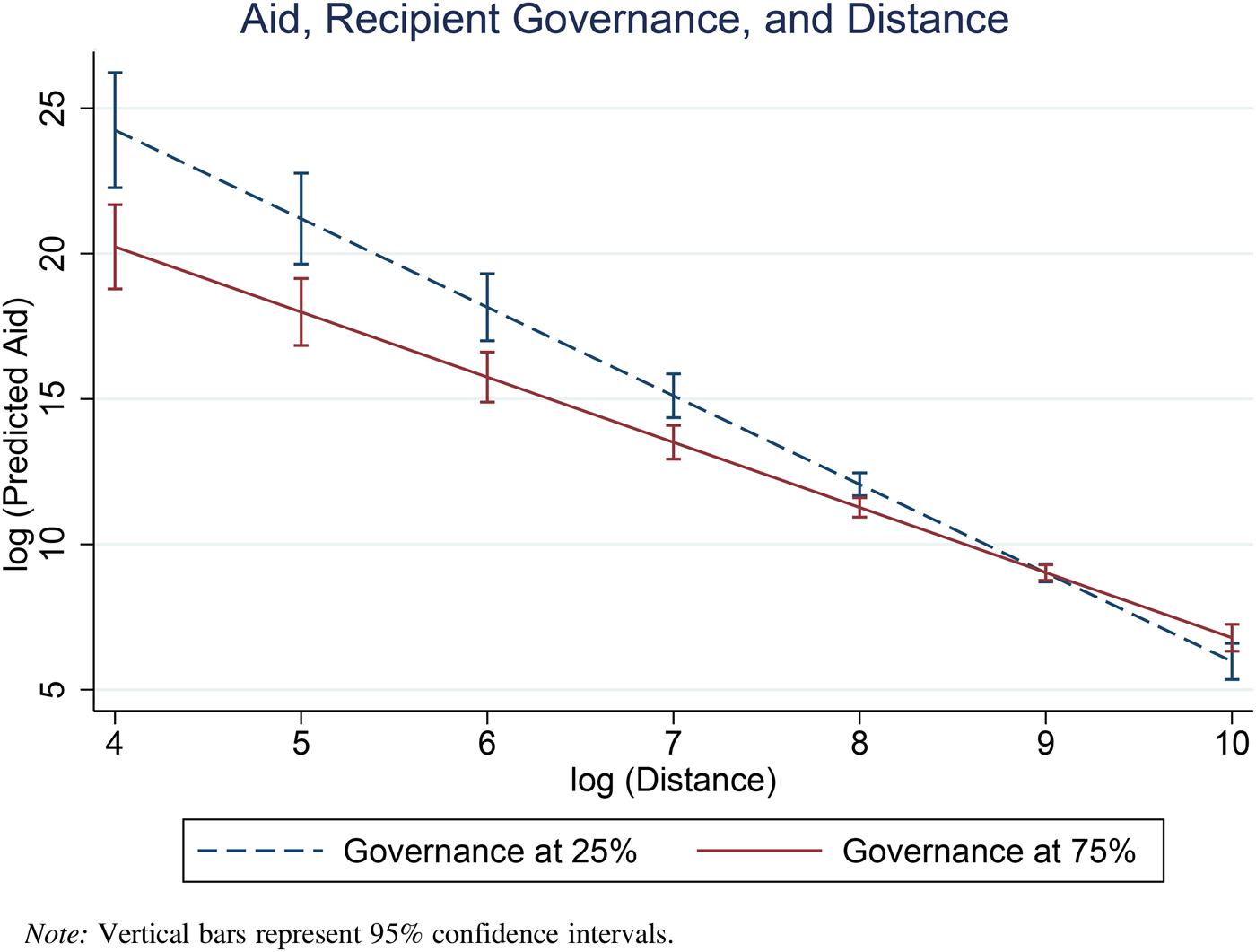
To examine the relationship between governance and aid allocation in the post-2001 period, the measure of governance rank from the Worldwide Governance Indicators (wgi) is added to Model 2 from Table 2. The coefficient on this variable is insignificant (−0.127; p = 0.32). I did not include this measure in the previous section because of lack of data on governance for the earlier period, but including it does not detract from the findings for the post-2001 period.Footnote 94 Donors worried about negative spillovers will be particularly concerned with poorly governed, nearby states. They can respond by increasing aid to these recipients, relative to well-governed nearby states and/or poorly governed, distant states. This suggests that the relationship between governance and aid will vary by distance, which can be examined by adding an interaction term between distance and governance to Model 2. Because the interpretation of interaction terms in nonlinear models is difficult, I follow the suggestion of GreeneFootnote 95 and graph the relationship.Footnote 96
Based on an estimation of Model 2 including wgi and its interaction with distance, Figure 2 depicts the relationship between distance and aid for a relatively poorly governed country (wgi set to its value at the 25th percentile) and a relatively well-governed country (wgi set to its value at the 75th percentile), with other variables held at their mean values. In both cases, aid decreases with distance. However, for recipients in the neighborhood of the donor, the poorly governed state receives significantly more aid than the better-governed state. This difference declines as distance increases.Footnote 97
Predicted aid, recipient governance, and distance in the post-2001 period
Governance and Aid Composition
Donors can respond to the decrease in capacity and/or willingness to use aid for development in poorly governed states by altering the composition of aid. I revisit the issue of aid composition using data from the OECD's online Credit Reporting System (CRS) database.Footnote 98 Data are more sparsely available for earlier periods, although these are used to provide comparison over time. The analysis uses the breakdown of aid by sector,Footnote 99 and results are reported here for general budget support, economic infrastructure, production sectors, social sectors, and humanitarian assistance.Footnote 100 Involvement of the recipient government varies based on the sector to which aid is given. To a rough approximation, recipient government involvement decreases for sectors moving from left to right in Table 5.Footnote 101 Donors concerned about aid effectiveness should give a smaller portion of aid to sectors where the recipient government is heavily involved if government quality is low.
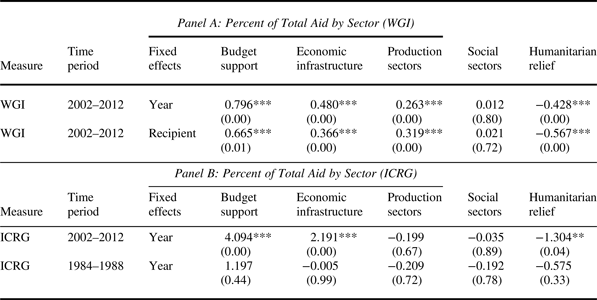
Aid by sector
Notes: Estimated using a seemingly unrelated Tobit framework with errors clustered on recipient; p-values in parentheses. Controls: democracy, income, population, disaster, civil war. See supplementary appendix for full results. *p <.10; **p < .05; ***p < .01.
The unit of analysis is the recipient-year, with aid commitments summed for all bilateral OECD donors. This is preferable to a dyadic approach to sector-level analysis because dyadic patterns could be influenced by donor specialization across sectors, which is encouraged under guidelines for aid effectiveness. The dependent variables are the percent of total OECD aid committed to a recipient in year t that is allocated to a given sector (logged).Footnote 102 For the post-2001 period, the main measure of governance is the WGI measure because of its wide country coverage. Since this measure begins in 1996, to allow for comparison with the Cold War an alternate measure is used that averages a recipient's score on two components of the International Country Risk Guide (ICRG) ratings, Control of Corruption and Rule of Law, rescaled to lie on the interval [0,1], with higher levels representing better governance. While this measure is available since 1984, its country coverage is smaller.Footnote 103 Table 5 reports coefficients on governance variables (wgi or icrg) across sectors. Equations for all sectors are specified in a multi-equation system using a seemingly unrelated Tobit framework with left-censoring at 0 and standard errors clustered on recipient. Full regression results are available in the supplemental appendix and include controls for democracy, income, population, disaster, and civil war. Models include either year or recipient fixed effects. Panel A reports results for the 2002–2012 period using the wgi measure of governance. In this period, countries with better governance have a larger percentage of their aid allocated to budget support, economic infrastructure, and production sectors, while the portion of aid allocated for humanitarian relief declines as governance improves.
Panel B of Table 5 shows results from models using the ICRG measure. For the post-2001 period, variation across sectors in the relationship between governance and aid is again observed. Coefficients on the ICRG variable for the period 1984 (first year the measure is available) to 1988 do not show this variation across sector. The results from this period should be interpreted with care because donors were less likely to report aid by sector.Footnote 104 Nevertheless, it is suggestive that no pattern for governance emerges across sectors in the Cold War period.
Conclusion
Historically, industrialized states have used foreign aid as a policy tool to advance their interests vis-à-vis developing countries. Globalization has increased connections between these groups of states and decreased industrialized countries’ ability to insulate themselves from problems outside their borders. As a result, promoting development abroad has become an important foreign policy goal, with implications for studying the allocation and effectiveness of foreign aid.
There have been significant changes in the determinants of aid allocation over time, with strong evidence that aid in the post-2001 period is best understood through a framework incorporating targeted development. Where the likely impact on a donor of negative spillovers from underdevelopment in a recipient is high, the amount of aid allocated to that recipient will also be high. Additionally, variations in aid composition suggest that donors consider recipient government capacity for development. These patterns are present in the post-2001 period but absent in the Cold War. This is consistent with the growing importance of targeted development and inconsistent with predictions that the commencement of the global war on terror marks a return to Cold War patterns of aid allocation. The results suggest that under a targeted development strategy some developing states—those less connected and therefore generating fewer spillovers to donors—will receive less aid. If aid is successful at promoting development then a widening gap between targeted states and those left out can be expected.
While analysis of aid effectiveness is beyond the scope of this study, the findings present important implications for that line of research. The shift in allocation patterns over time is consistent with an increased emphasis on development. Motivations do not imply results: it is possible that aid will not produce the intended development outcomes. Perhaps donors are not particularly effective at bringing about development even when that is their intention, or perhaps bureaucratic inertia makes it difficult for aid agencies—many of which were founded in the Cold War—to shift gears. Yet new motivations bring at least the possibility of new outcomes, and scholars studying effectiveness should not combine historical periods in which motivations and the resulting allocation patterns are significantly different.
Additionally, the cross-recipient variation in aid composition requires a rethinking of how effectiveness is measured at different levels of governance. Well-governed countries receive a different basket of aid than poorly governed countries. Aid to recipients with better governance scores is disproportionately composed of what Clemens and colleagues refer to as “early impact aid”—aid that can plausibly be related to the usual measure of effectiveness: income growth in a five-year period.Footnote 105 Poorly governed states disproportionately receive aid that, even if effective at vaccinating babies, providing water after an earthquake, or starting kindergartens, is unlikely to register as effective using this measure. This suggests some of the difference in “effectiveness” observed across recipients with different quality of governance is a result of dissimilarity in aid composition. The extent to which income growth in five years is an appropriate measure of effectiveness varies with aid composition and therefore—based on these results—with governance. This compositional effect should be incorporated into studies of the links between aid, growth, and governance.
The heightened emphasis on development in foreign aid policy stems from an increase in the importance of development as a foreign policy goal of donor states. An increase in the relative importance of nondevelopment outcomes that can be pursued with aid could lead to a corresponding decrease in the emphasis placed on development in crafting aid policy. How likely is this to occur? Security concerns such as Russia's increased use of military force, violence and unrest in the Middle East, and China's attempts to increase its influence in Asia suggest that aid donors will see rising demands on their foreign policy resources. This could lead them to redirect aid from a targeted development strategy. A wave of nationalist rhetoric and policies in industrialized states might lead to a preference for focusing resources domestically, leaving fewer resources for aid. On the other hand, the impact on donor states of underdevelopment abroad is increasing rather than lessening, as interconnections between countries continue to rise and the contribution of developing countries to global problems, such as climate change, increases. While a relative weakening of development as a priority is always possible—and under some circumstances even probable—it is unlikely that it will be in the interest of donor states to return to the Cold War pattern of largely ignoring development concerns in favor of pursuing other goals with foreign aid.
Supplementary Material
Supplementary material for this article is available at <https://doi.org/10.1017/S0020818317000315>.



