





1. Introduction
This paper defends a contextualist view of epistemic justification – one that sees the meaning of ‘justified’ not as fixed, but as shifting with the aims and limitations of our conversations. Whether a belief counts as ‘justified’ depends not just on the evidence, nor the method by which the belief was formed, but on the conversational context. The payoff is the resolution of one of the central divides in epistemology – between internalist and externalist theories of justification.
A few philosophers (Alston Reference Alston2005; Cohen Reference Cohen2016; Greco Reference Greco2017 and Pettigrew Reference Pettigrew2022) have suggested that internalists and externalists are using ‘justification’ in different ways, but this view is surprisingly rare, and none develop the semantics.Footnote 1 I will defend this view by showing how neatly the internalist/externalist debate maps on to some distinctions from the semantics and metaethics literature.
I will argue that we can dissolve much of the internalist/externalist disagreement by making two plausible assumptions. First, we can connect the concept of justification to deontic concepts like ought and permissible. Second, we can apply the standard semantics for deontic concepts, which is contextualist. The result is an independently motivated contextualism about epistemic justification.
Section 2 rehearses some of the thought-experiments, intuitions, and arguments in the internalist/externalist debate in epistemology. Section 3 introduces the deontic conception of justification and the standard contextualist semantics for deontic terms. Section 4 shows how the contextualist semantics accounts for all the opposing arguments. Section 5 develops the idea to apply to internecine debates within internalism and externalism. Section 6 considers whether polysemy is better than contextualism. Section 7 discusses how disagreement might remain even given contextualism. Section 8 discusses alternative ways to develop the semantic details. Section 9 concludes.
2. Internalist and externalist arguments
A central divide in epistemology is between internalism and externalism about justification. Let an internal state be a state necessarily shared by duplicates; external states need not be. Paradigmatically, internal states include beliefs and experiences. Internalism says that only internal states can be justifiers. A paradigm example of internalism is evidentialism, which says that S is justified in believing p iff believing p fits S’s evidence.Footnote 2 Externalism allows external states to be justifiers. A paradigm example is reliabilism, which says that S is justified in believing p iff the belief that p was generated by a reliable process.Footnote 3
We can state these positions as supervenience theses:
Internalism
The justificatory state of agents supervenes on their internal states.
Externalism
The justificatory state of agents does not supervene on their internal states.
Let us briefly rehearse three arguments for internalism and two for externalism.Footnote 4
2.1. New evil demon argument for internalism
The New Evil Demon Argument can be traced to Cohen’s (Reference Cohen1984) objection to reliabilismFootnote 5 :
NEW EVIL DEMON
Imagine that unbeknown to us, our cognitive processes (e.g., perception memory, inference) are not reliable owing to the machinations of the malevolent demon.
Cohen writes:
It follows on a Reliabilist view that the beliefs generated by those processes are never justified. Is this a tenable result? I maintain that it is not … It strikes me as clearly false to deny that under these circumstances our beliefs could be justified. (Cohen Reference Cohen1984: 281).
Thus, only internalism gives us intuitive results.
2.2. Clairvoyance argument for internalism
Laurence Bonjour gave the following purported counter-example to externalism:
CLAIRVOYANT
Norman, under certain conditions that usually obtain, is a completely reliable clairvoyant with respect to certain kinds of subject matter. He possesses no evidence or reasons of any kind for or against the general possibility of such a cognitive power, or for or against the thesis that he possesses it. One day Norman comes to believe that the President is in New York City, though he has no evidence either for or against this belief. In fact the belief is true and results from his clairvoyant power, under circumstances in which it is completely reliable. (BonJour Reference BonJour1980: 62).
Reliabilism says that Norman is justified, but many philosophers think that the intuitive verdict is that Norman is not justified. After all, when we consider Norman’s perspective, from the inside, he has nothing to go on when it comes to the justification of the belief. He simply finds himself the with belief and has no available reason to think he should have that belief.
2.3. Guidance argument for internalism
Pollock and Cruz writeFootnote 6 :
It is important to distinguish between two uses of norms (epistemic or otherwise) [e.g, if condition C obtains, then S is justified]. On the one hand, there are third-person uses of norms wherein we use the norms to evaluate the behavior of others… To be contrasted with third-person uses of norms are first-person uses. First-person uses of norms are, roughly speaking, action-guiding.… Epistemological questions are about rational cognition…and so are inherently first-person. The traditional epistemologist asks, “How is it possible for me to be justified in my beliefs about the external world, about other minds, about the past, and so on?” These are questions about what to believe. Epistemic norms are the norms in terms of which these questions are to be answered, so these norms are used in a first-person reason-guiding…capacity. (Pollock and Cruz Reference Pollock and Cruz1999: 124).
The argument can be summarised as follows: All justifiers can always provide guidance, all and only internal facts can always provide guidance, therefore all justifiers are internal facts.Footnote 7
Those are the three arguments for internalism; let’s move on to two arguments for externalism.
2.4. Anti-luminosity argument for externalism
The first argument for externalism can be understood as a counter to the guidance argument for internalism, specifically to the claim that all internal facts can always provide guidance. Williamson (Reference Williamson2002 ch.4) argued that there are no (non-trivial) states which agents can always know whether they are in, and so no (non-trivial) states which can always provide guidance. Williamson argues that in a borderline case of being cold, someone might be cold yet not in a position to know that they are cold, and so not in a position to be guided by the fact that they are cold. So, it is false that all internal facts can always provide guidance, and the conclusion (all justifiers are internal facts) does not follow. Internal states cannot be guaranteed to provide guidance any more than external states can be guaranteed to provide guidance, so, the purported advantage of internal justifiers disappears.
2.5. Truth connection argument for externalism
The truth connection argument for externalism says that justification requires the right kind of connection to truth, and only externalist theories of justification provide the right connection.
A direct argument assumes that justification entails truth.Footnote 8 As no internal mental state is sufficient to entail any proposition about the external world, justifiers must include things beyond mental states.
An indirect argument assumes that justification makes truth objectively likely. Poston (2020)Footnote 9 writes:
epistemic justification implies that one’s belief is objectively likely to be true… However, whether one’s belief is objectively likely to be true is not determined by one’s mental states… The objective likelihood of a belief given a body of evidence is a matter of the strength of correlation in the actual world between the truth of the belief and the body of evidence…So, if epistemic justification implies that one’s belief is objectively likely to be true then justification is not determined entirely by one’s internal states.Footnote 10
The argument can be summarised as: justification that P requires an objective likelihood that P is true, internal facts alone cannot make P objectively likely to be true, therefore internal facts alone cannot be justifiers.
My aim is to make sense of the intuitions on both sides of these arguments. The next section explains the contextualist machinery.
3. Contextualism and the deontological conception of justification
According to the deontological conception of justification, the concept of justification is equivalent to deontological concepts such as ought e.g.
S is justified in phi-ing iff S ought to phiFootnote 11
or
S is justified in phi-ing iff S is permitted to phi.
Beddor (Reference Beddor2017) notes several attractive features of this approachFootnote 12 :
First, it seems that the two types of evaluations—justificatory and deontic—are closely connected. A deontological approach offers to explain these connections. Second, a deontological approach promises a unified analysis of moral and epistemic justification: moral justification ascriptions are analysed in terms of moral uses of deontic expressions, and epistemic justification ascriptions are analysed in terms of epistemic uses of deontic expressions. To mention one final attraction, a deontological approach has the potential to explain why justification ascriptions are normative. According to a deontological approach, justification ascriptions are normative because they are deontic, and deontic notions are normative notions par excellence. (p.902)
I offer another attractive feature – the standard semantics for deontic terms are contextualist in a way that sheds light on the literature on justification.Footnote 13
It is a familiar thought that whether someone is correctly described as tall depends on the details of the conversation. For example, Michael Jordan, at 1.98m, is tall for an ordinary person, but not tall for a basketball player. So, the truth of ‘Michael Jordan is tall’ depends on the conversational context. It is true given a context in which ordinary people are being discussed, but false given a context in which basketball players are being discussed.Footnote 14
A popular theory in linguistics is that normative terms like ‘ought’ are also context-sensitive.Footnote 15 Normative requirements are not static – they shift in response to the aims and limitations of our inquiry. Specifically, the conversational context determines at least two parameters – a modal base and a goal.Footnote 16 Let us take these in turn.
The first parameter, the modal base, determines a relevant proposition or set of live epistemically possible worlds. The modal base can be thought of as the possibilities relevant to the conversation. The conversational context shines a spotlight on a set of propositions, and the spotlight moves as the conversation changes. Consider the sentence ‘Bob ought to take an umbrella’. Plausibly, if it is raining in all live possible worlds, then the sentence is true; if it is dry in all live possible worlds, then the sentence is false. So, the thought is more fully expressed with ‘given that it is raining, Bob ought to take an umbrella’.Footnote 17 Making explicit this parameter in one version of the deontological conception of justification (and replacing ‘phi’ with ‘believing P’) gives:
Justification Norm-
S is justified in believing P iff given the modal base, S ought to believe P
We will work with this ‘ought’ norm but the discussion is easily adapted to a norm which uses ‘permitted’ or ‘faultless’.Footnote 18
The other parameter, the goal, determines a ranking for the live possible worlds. We can assume the traditional view that S ought to A iff S A’s in the highest-ranked live worlds. Given that it is raining, if Bob’s goal is to stay dry, then worlds where he takes an umbrella are highest ranked; if Bob’s goal is to get wet, then worlds where he does not take an umbrella are highest ranked. So, ‘Bob ought to take an umbrella’ might be true given the goal of Bob staying dry, yet false given the goal of Bob getting wet. The thought is more fully expressed with ‘Bob ought to take an umbrella for the goal of staying dry’. Making both parameters explicit, the thought is fully expressed with ‘given that it is raining, Bob ought to take an umbrella for the goal of staying dry’.Footnote 19
The goal needed for our purposes is the goal of having epistemically justified beliefs. It is hard to say too much about epistemic justification without getting into the controversies this paper is about, but we can say that it is the concept widely used in the epistemology literature on justification e.g. it is at issue in the internalism versus externalism about justification debate. For the bulk of the paper, I will hold fixed the goal and argue that the problems can be solved by shifts in the modal base; in section 9 I will discuss the alternative view that solves the problems by shifts in the goal.
Applying this account of ‘ought’ to the deontological conception of justification gives:
Justification Norm
S is epistemically justified in believing P iff given the modal base S believes P in the best live worlds ranked by the goal.Footnote 20
The key move for dissolving the internalist/externalist debate is to identify the justifiers with the modal base. For example, suppose you and I are discussing whether Bob is justified in believing that it is raining. Bob does not have any evidence that it is raining, but he reliably believes it is raining when it is and reliably believes it is not raining when it is not. If I say ‘Bob is justified’, then this is true, understood as ‘given his reliable connection to whether it is raining, Bob’s belief is justified’. And if you say ‘Bob is not justified’, then this is true, understood as ‘given his evidence, Bob’s belief is not justified’.
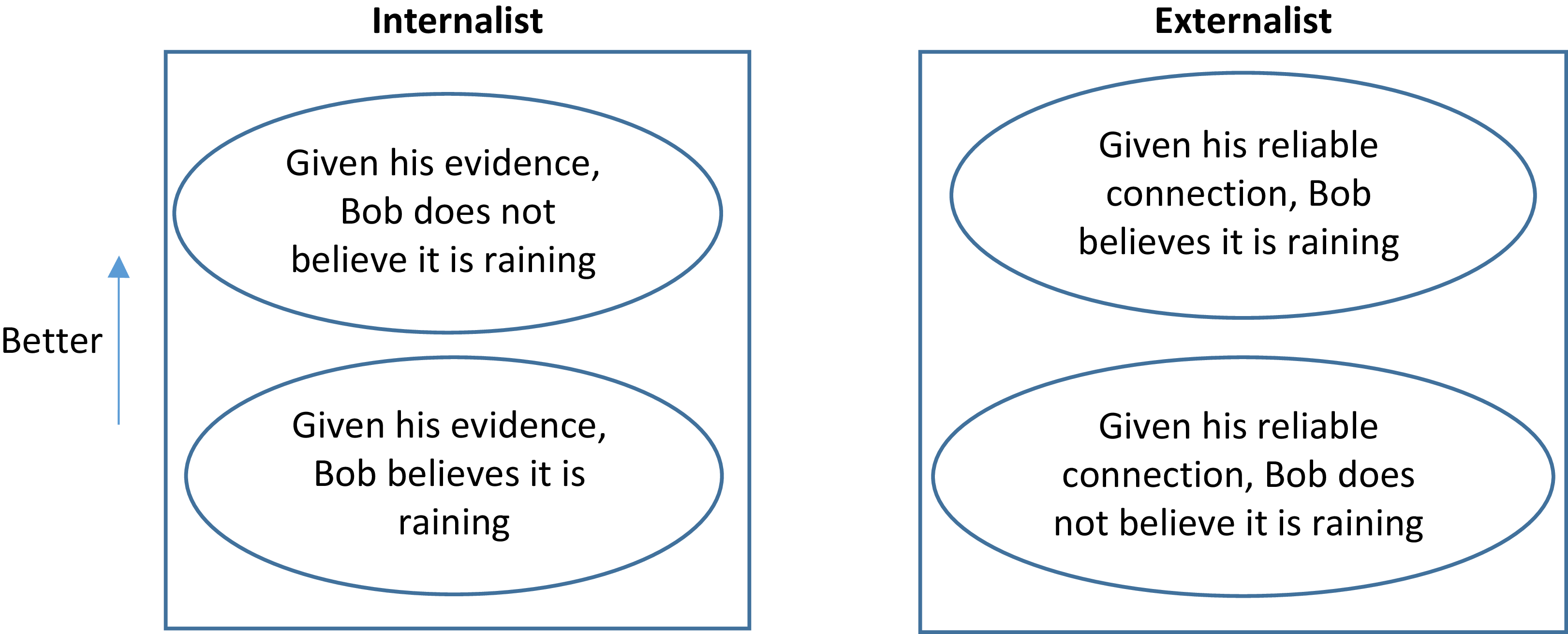
By contrast, internalists and externalists traditionally assume that the justifiers do not vary with the context. Internalists include in the modal base only what is internal to the agent, while externalists allow a broader set of propositions into the modal base. On the contextualist diagnosis, internalists correctly ascertain that only internal propositions are in the modal base in some contexts, then extrapolate too far to conclude that, in all contexts, only internal propositions are in the modal base. While externalists correctly ascertain that external propositions are in the modal base in some contexts, then extrapolate too far to conclude that, in all contexts, external propositions are in the modal base.
4. Conversations and contexts
What shifts the parameters? What determines the modal base? There are various options here. Perhaps salient possibilities are always part of the modal base. Perhaps nearby possibilities are always part of the modal base.Footnote 21 I will develop the view that the modal base is determined by the aims and intentions of the participants in the conversation. Let’s distinguish three aims a conversation might have:
-
(i) evaluating someone as a source of information
-
(ii) deliberating about what we should believe
-
(iii) appraising i.e. blaming or praising.Footnote 22
Many of our beliefs about the world come from the testimony of others, so it is important to choose reliable informants (i). We would like to choose people whom we know to have only true beliefs, but the next best thing is to choose people who we know are reliable indicators of the truth. For this purpose, there is no reason to restrict the modal base to internal propositions; so, it is plausible that in contexts of evaluation, externalists are right.
However, in contexts where we are (ii) deliberating about what we should believe, it is plausible that the justifiers must be restricted to those that can guide us. Facts about the external world, such as the reliability of our methods or our connection to the truth, might not be available to guide us, in which case they are not included in the modal base.
Similarly, in contexts where we are (iii) appraising someone, it is natural to include only internal propositions in the modal base. Not much turns on the specific judgements here. The point is only that different conversations can have different aims that correspond to different parameters.
Whether a conversation is about evaluating, deliberating or appraising depends on the aims of the participants, and may be in flux over the course of a conversation. Lewis (Reference Lewis1979) suggests that conversations should conform to the principle of accommodation, which says that when a speaker makes an utterance involving a context-sensitive term, the parameters shift to make the sentence true. In Lewis’s terms, the utterance changes the ‘conversational score’. For example, when discussing the beliefs of someone from a benighted culture in which everyone has superstitious beliefs, an anthropologist might initially claim that their beliefs are unjustified. Their colleague might reply:
‘Their beliefs are justified. They are following the beliefs of the elders in the community, which is a good way to form beliefs.’
The first speaker could reply in several ways. They might accommodate the utterance, as Lewis suggests, and agree with their colleague. They might not accommodate the utterance, perhaps replying ‘No they are not justified. We should not use anyone from this culture as a source of information’ or ‘No they are not justified. Their beliefs are not formed using a reliable method’. Or they might give the most sophisticated response: ‘Their beliefs are justified in the sense of being non-criticisable, but their beliefs are not justified in the sense I meant – we should not use anyone from this culture as a source of information/their beliefs are not formed using a reliable method’.
Some externalists might insist that justification is only about (i) evaluation. Deliberating (ii), and appraising (iii)? Mere shadows – about rationality, reasonableness, excuse, perhaps, but not justification proper. They might hold that internalist intuitions are best explained as intuitions about rationality, reasonableness, or excusability.Footnote 23
But the concept of internal justification does not match up well with concepts of rationality, reasonableness, or excusability. For example, internalists will say that if a belief is implanted in my brain without my realising, it is excusable but not justified.Footnote 24 Obviously, there is more to say here, but rather than getting drawn into that debate I want to focus on the positive view.
5. Internalist and externalist contexts
Let us return to the five arguments above.
5.1. New evil demon
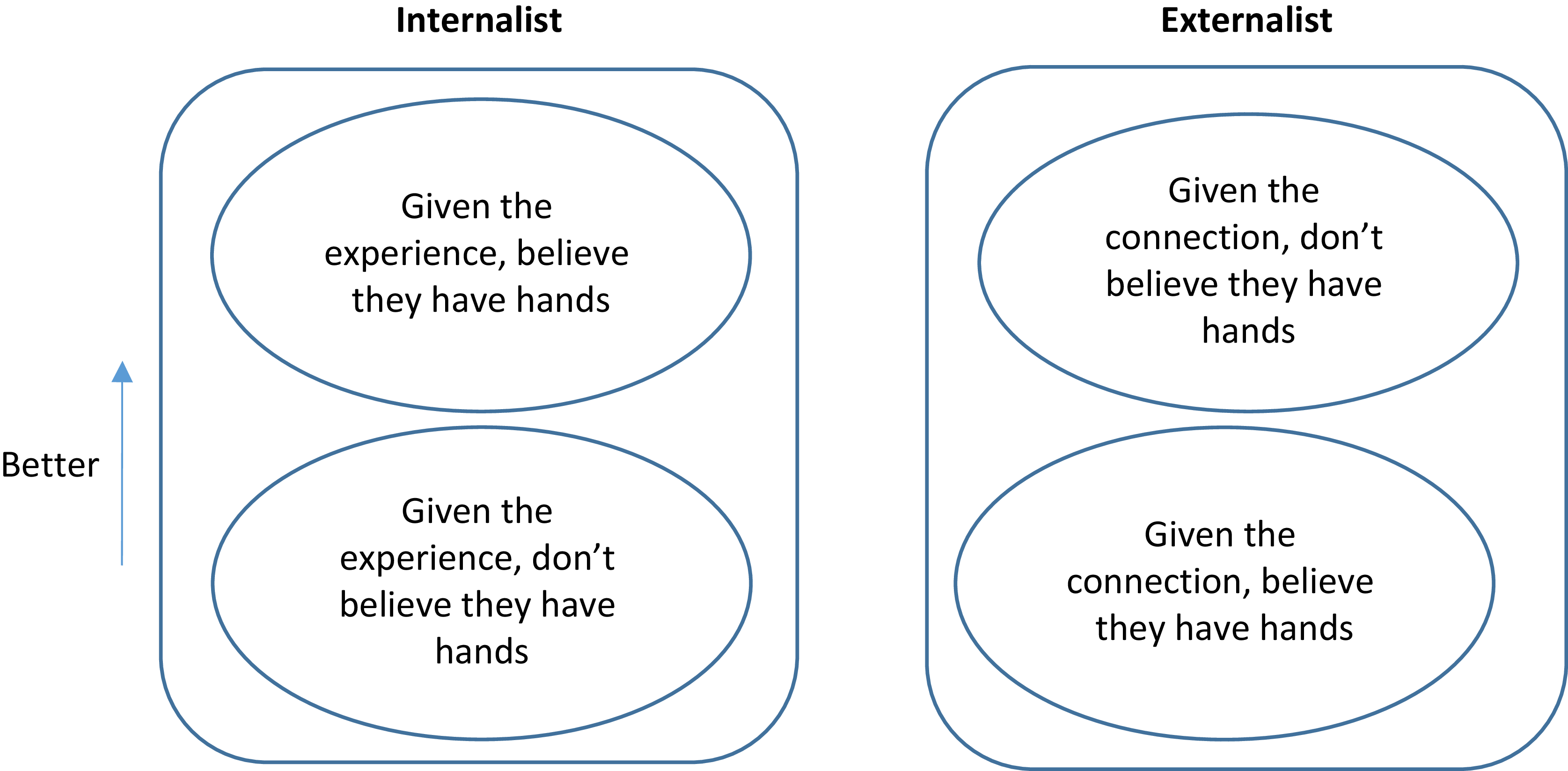
It is natural when thinking about NEW EVIL DEMON to imagine oneself in the scenario and think, ‘what would I be justified in believing’? From this first-person perspective, we naturally take the modal base to consist of only internal facts, and in this sense, I would be justified in believing I have hands, etc. It is also natural when faced with the NEW EVIL DEMON to think, ‘what would the victim be praiseworthy for believing?’ Again, it would be natural to include only internal facts. So, when the internalist says ‘the agent in the new evil demon case is justified in believing that they have hands’, the contextualist understands this as ‘the agent in the new evil demon case is justified-given-the-internal-facts in believing they have hands’.
The externalist who objects that the victim in the new evil demon scenario is not justified can be accommodated by the contextualist framework. If external facts about the victim’s unfortunate position are part of the modal base, then the victim is not justified in believing that they have hands. In such contexts, the externalist is right to say ‘the victim does not have justified beliefs’. The contextualist understands the externalist to be saying ‘the agent is not justified-given-the-external-facts in believing they have hands’. This modal base can be motivated by considering whether we would take the victim to be a good source of information.
5.2. Clairvoyance
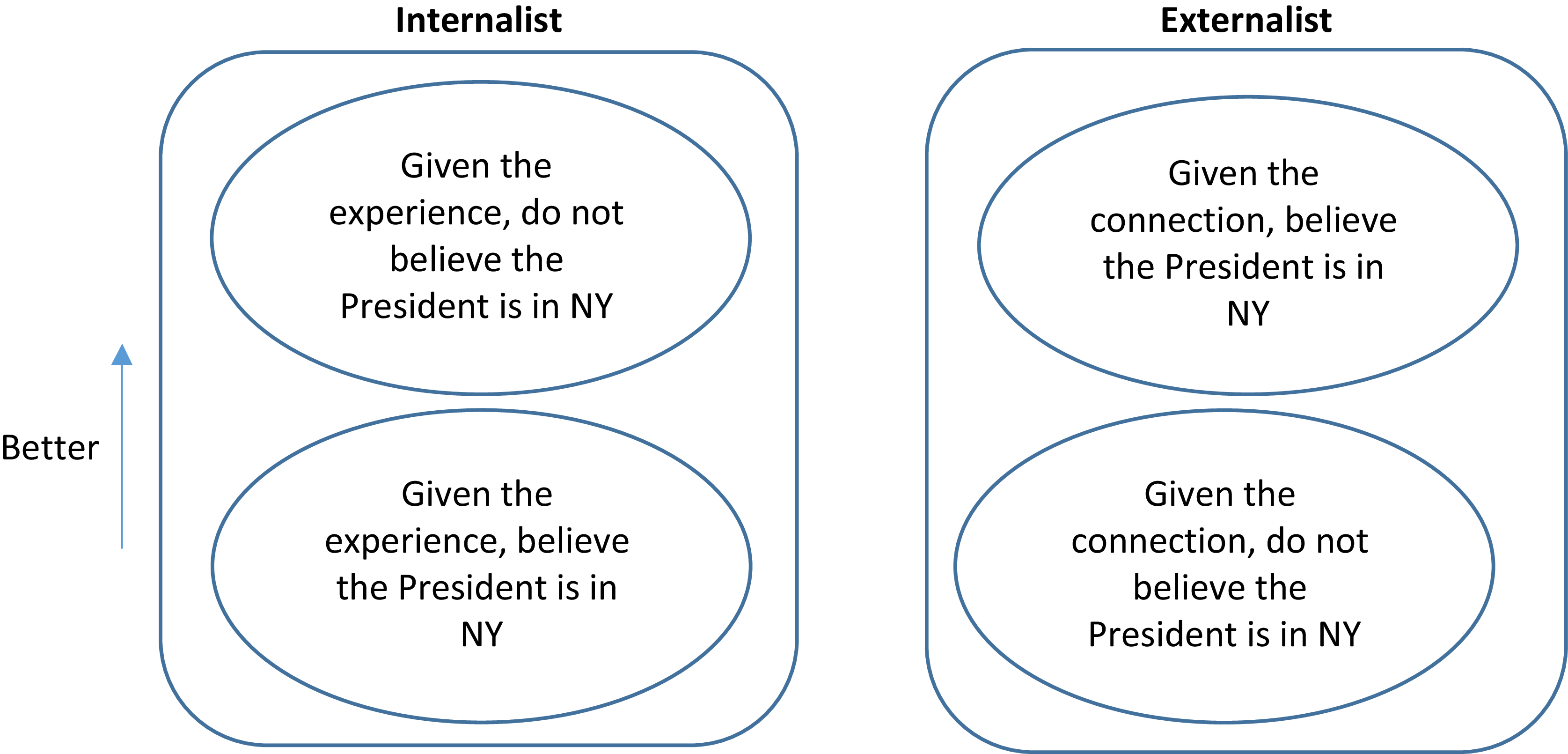
Similarly, it is natural when thinking about CLAIRVOYANCE to imagine oneself in the scenario and think, ‘what would I be justified in believing’? From this first-person perspective, we will invoke internal facts to get the internalist verdict that Norman is not justified. The same applies if we consider what Norman is praiseworthy for believing. The contextualist makes this explicit as ‘Norman is not justified-given-the-internal-facts in believing the President is in New York’.
Some externalists hold that Norman is justified. For example, imagine that Nour has the ability to pick up on cues that her interlocutor is racist, without the cues being available to consciousness (Srinivasan Reference Srinivasan2020: 416–17). Srinivasan argues that the externalist verdict that Nour is justified is more plausible. The contextualist can explain this as ‘Nour is justified-given-the-subconscious-cues’. Analogously, we might get something like ‘Norman is justified-given-the-President’s-location-and-its-link-to-Norman’s-beliefs’. This modal base can be motivated by considering whether we would take Norman or Nour to be a good source of information.
5.3. Guidance
Recall that a premise of the guidance argument for internalism says that all justifiers can always provide guidance. That is, everything in the modal base can always provide guidance. Contextualism delivers this verdict in contexts where only internal facts are allowed into the modal base. When I am thinking ‘what am I justified in believing?’, it is natural to understand the question relative to the internal facts. Similarly, when appraising someone, it is natural to do so relative to the internal facts.
The externalist who rejects the guidance argument allows an external process to be a justifier. The contextualist can understand the externalist as invoking a context in which the modal base includes external facts. In such a context, the externalist can correctly say that not all justifiers can always provide guidance. And it is natural to take this line when considering whether an agent is a good source of information.
5.4. Anti-luminosity argument
The anti-luminosity argument against internalism is an attack on the premise that all internal facts can always provide guidance. Specifically, the anti-luminosity argument is intended to show that some internal facts sometimes cannot provide guidance, e.g. Williamson intends to show that the belief that one is cold cannot always provide guidance, because in borderline cases the agent might not be in a position to know that they are cold.
This fits neatly with contextualism. The internalist-style claim in the vicinity is that in some contexts, some internal facts can provide guidance.Footnote 25 And this is compatible with Williamson’s negative claim, e.g. borderline beliefs cannot always provide guidance. Internal facts are still distinguished from external facts, which can never provide guidance (unless mediated by an internal fact).
5.5. Truth connection
Recall the direct argument said that justification entails truth. Contextualists can accommodate this by letting the truth or falsity of P into the modal base.Footnote 26 If P is a justifier, then of course believing P is justified, and if –P is a justifier than believing –P is justified. As the contextualist would put it: ‘justification-given-the-external-facts-about-the-truth entails truth’. When we are evaluating a potential source of information, it is plausible that the truth is relevant to justification, but it is not plausible when deliberating or appraising.
The indirect argument said that the justification that P requires an objective likelihood that P is true. The contextualist could agree that in some contexts justification that P requires an objective likelihood that P is true, while in other contexts justification that P requires inductive likelihood that P is true. Indeed, when we are evaluating a potential source of information, it is plausible that objective likelihood matters, whereas when we are deliberating or appraising, it is inductive likelihood that is at stake.
6. Contextualism or polysemy?
I have talked about ‘justification’ being context-sensitive, but nothing said so far rules out ‘justification’ being polysemous. In this section I will explain the distinction and argue that ‘justification’ is context-sensitive rather than polysemous. Viebhan and Vetter (Reference Vetter and Viebahn2016) say that:Footnote 27
an expression is polysemous if it is has multiple meanings which are related to each other e.g. ‘healthy’ (applying to animate objects/ applying to activities), ‘book’ (abstract work/concrete copy), ‘fish’ (activity/animal) (p.3)
an expression is context-sensitive if it has a single standing meaning that determines different semantic values in different contexts of utterance e.g. ‘I’, ‘today’. (p.6)
Viebhan and Vetter offer five ways to distinguish polysemous from context-sensitive terms:
-
(i) Linguistic intuitions. If it seems to have different meanings, it is polysemous. It seems plausible to say that ‘book’ and ‘fish’ have several meanings, but not ‘I’ and ‘today’.
-
(ii) Numbers of candidate semantic values. Context-sensitive expressions have many more candidate semantic values than merely polysemous expressions.
-
(iii) Clusters of candidate semantic values. Candidate semantic values of ‘I’ and ‘today’ do not come in clusters; their candidate semantic values form a set that is relatively homogeneous and not naturally organised into disjoint subsets. ‘Healthy’ has (at least) two clusters of candidate semantic values, one consisting of various degrees of flourishing in animate objects, and the second of properties possessed by activities.
-
(iv) Relations among candidate semantic values. Only polysemous terms have a core meaning with historical and explanatory priority e.g. ‘fish’ referred to the animal before referring to the activity.
-
(v) Logical form. Only polysemous terms allow different kinds construction at the level of logical form e.g. being a verb and a noun.
‘Justification’ looks to be clearly context-sensitive on (i), (iv), and (v). Let us go through them.
-
(i) ‘Justification’ does not seem to have different meanings. If it did, it would never have been plausible that internalists and externalists were disagreeing with each other.
-
(iv) There is no plausible core meaning for ‘justification’ that would make, say, internalist justification prior to externalist justification.
-
(v) ‘Justification’ is always a noun, and ‘justified’ is always an adjective.
All these considerations support ‘justification’ being context-sensitive rather than polysemous.
On the other hand, polysemy might seem to be favoured by (ii) and (iii). Starting with (ii), one might argue that there are only two candidate semantic values – internal and external justification.
But the literature provides evidence that there are more than two candidate semantic values. Here are six: all and only mental states accessible to the agent are justifiers;Footnote 28 all and only mental states are justifiers, even if they are not accessible to the agent;Footnote 29 all and any accessible states can be justifiers, even if they are not mental states (e.g. a note on the fridge which the agent failed to notice is a justifier);Footnote 30 the process which caused the formation of a belief can be a justifier;Footnote 31 the truth about the proposition believed can be a justifier;Footnote 32 the agent’s knowledge of the proposition can be a justifier.Footnote 33 These can be roughly thought of as on a spectrum from narrowest justifiers on the left to broadest justifiers on the right:
This relatively large number of semantic values, which can be thought of as points on a spectrum, fits much better with context-sensitivity than polysemy.
Moving to (iii), one might argue that the semantic values of ‘justification’ come in clusters – internal and external. But again, the range of options just listed suggests that the semantic values do not divide up neatly into clusters. For example, there does not seem to be a cluster of internalist views; there are just two – accessibilism and mentalism. Furthermore, there seems to be a smooth transition as we move along the table rather than a sharp cut-off where the meaning of ‘ought’ changes. So, it seems that we should simply say that there are many semantic values corresponding to the many possible modal bases, which fits contextualism rather than polysemy.
So, overall, ‘justification’ looks to be context-sensitive rather than polysemous.
7. Disagreement regained?
Someone might object that contextualism predicts that there is no genuine disagreement, and that it is implausible that there is no genuine disagreement in the internalism/externalism debate. Let us consider eight ways in which a genuine disagreement might be regained, roughly in order of increasing comfort for contextualists.
First, some might simply hold that the justification is not context-sensitive. The modal base does not vary with contexts. This will be appealing to those who insist that there must be something important that internalists and externalists are arguing about.
I do not take myself to have refuted this view; I have merely defended an alternative. I think the connections between ‘justification’ and contextualism about ‘ought’ in semantics, plus the applicability to the internalism/externalism literature, show that contextualism about justification must be taken seriously.
Second, some might hold that even if ‘justification’ in English is context-sensitive, there is a privileged parameter which picks out a normatively privileged property that has authority. Worsnip writes:
we should be careful to separate the question of whether (e.g.) the law …has genuine normative authority from whether there is a robustly normative usage of the legal ‘ought’. The former requires the law to actually possess normative authority, whereas the latter only requires there to be speakers who take the law to possess normative authority. So even if only a handful of the above ‘oughts’ reflect a genuine source of normativity, many more of them might nevertheless be robustly normative usages of ‘ought’. (Worsnip 2019, page numbers not yet available; see also Worsnip 2019).
Worsnip is working with a primitive concept of ‘normative authority’. He is allowing that there might be lots of ‘oughts’, just as contextualism predicts, but that not all of them have normative authority. Indeed, perhaps only one ‘ought’ has normative authority, in which case contextualism leads us astray.
A similar view has been discussed in detail in Eklund’s (Reference Eklund2017) that beginsFootnote 34 :
One issue that has animated much metanormative discussion concerns whether, so to speak, reality itself favors certain ways of valuing and acting, or whether reality does not have a view on this. (p.1)
A less metaphorical way of putting the objection is: ‘You’ve told me about the word ‘justification’ but I want to know about the property of justification. To move from claims about ‘justification’ (word) to justification (property) is to make a use/mention distinction.’
But how should we understand the last use of ‘justification’? It is intended to refer to the property of justification, but the contextualist posits numerous properties corresponding to the numerous uses of ‘justification’. The only way I can make sense of this objection is to attribute to the objector the intention of picking out some privileged property of justification with their last use of ‘justification’.
In response, I must confess to finding obscure both the concept of normative authority and the idea that reality favours certain ways of valuing or acting. I can just about see that there might be a privileged set of natural/fundamental/structural properties in the way defended by Armstrong (Reference Armstrong1978) and Lewis (Reference Lewis1983) – green is more natural than grue; being an electron is more natural than being a cow, etc. But it is far from clear how to extend this to normative properties.
Furthermore, even if our concept ‘ought’ is privileged, it is plausible that there is a related but slightly different concept, ‘ought*’, which is privileged*. And now we face the challenge of explaining why we should use concepts which are privileged rather than privileged*.Footnote 35 So, although positing privileged properties is compatible with contextualism, and allows for genuine disagreement, contextualism seems to undermine the motivation for such a view by providing a less mysterious explanation of our intuitions.
A third position is that ‘justification’ in English is context-sensitive, but it is not as context-sensitive as I have suggested. For example, perhaps there are only two values that the modal base parameter can take. As a result, in the internecine debates about which version of internalism (or externalism) is correct, one side is right and one side is wrong. For example, perhaps the correct form of internalism is Feldman and Connee’s (Reference Feldman and Conee2001) mentalism (so accessibilism is false), and the correct form of externalism is Goldamn’s (Reference Goldman1986) reliabilism (so Williamson’s (Reference Williamson2002) theory is false). Or perhaps extreme internalist views (like accessibilism) and extreme externalist views (like Williamson Reference Williamson2002) are false, but there is a range of values in between that the modal base parameter can take.
Notwithstanding the points made in section 7, I find this pretty plausible and it fits well enough with my guiding idea that much of the internalist/externalist debate can be dissolved.
A fourth position is to hold that sometimes disagreement involving contextualist terms should be understood as disagreement about which parameters to use. To motivate this view, note that contextualism says that the parameters are determined by the conversational context, and which parameters are operative might be in flux in a conversation. For example, consider the following conversation when all parties know that Michael Jordan is 1.98m tall and Sun Mingming is 2.45m tall:
A: Michael Jordan is tall
B: No he isn’t, Sun Mingming is tall
It is plausible that this conversation is best understood as an implicit negotiation about the standards for the word ‘tall’, and we get what Plunkett and Sundell (Reference Plunkett and Sundell2013) call meta-linguistic negotiation, i.e. an exchange in which speakers tacitly negotiate the proper deployment of some linguistic expression in a context.
A fifth position is that there might be disagreement about what to do. Björnsson and Finlay (Reference Björnsson and Finlay2010) argue that the hidden goal of many conversations involving contextualist terms is to establish what to do. Thus, there need be no disagreement over which propositions are true, but still disagreement over what to do.Footnote 36
A sixth position is that the full conversational context determines (metaphysical) the values of the parameters, but the inference (epistemic) from the full conversational context to the values of the parameters is non-obvious. This leaves room for genuine disagreement about how the inference should go, and so genuine disagreement about which beliefs are justified in the context.
I agree and think that contextualists should endorse this view. Thus, even given an extreme form of contextualism, in which anything can go into the parameters, there is still room for genuine disagreement.
A seventh position is that ‘justification’ in the epistemic sense is a technical term invented by philosophers, not a word of ordinary English. I think this is implausibleFootnote 37 , but let us concede the point for the sake of argument. Is there genuine disagreement in the internalist/externalist debate? The most obvious response is no – some philosophers invented an internalist concept of justification, others invented an externalist concept of justification, and they have talked past each other for decades. This is an alternative route to my view that the internalist/externalist debate should be dissolved.
However, there is still room for genuine disagreement. There could be disagreement about the best concept to invent. Then, contextualists could argue that the best concept to invent is the contextualist concept of justification.
An eighth position is that intuitions about disagreement motivate a relativist semantics. Speakers express/refer to the same proposition, but its truth varies with the speaker. My framework could accommodate this by letting the parameters be fixed by the context of assessment rather than the context of utterance (MacFarlane Reference MacFarlane2014). This is technically not a contextualist position, but it is very much in the spirit of the view I defend, i.e. another example of how semantics can dissolve debates in epistemology (see footnote 14).
8. What shifts? Modal base or ordering source?
A fellow contextualist might object that it is not the modal base that shifts, but the ordering source.Footnote 38 Call this the ordering source solution. In this section, we will briefly look at two ways to develop this suggestion, then some reasons for preferring the modal base solution.
Recall that the ordering source can be identified with the goal of the conversation. The first way to develop the suggestion is to say that one goal is to have internal-justified beliefs and another is to have external-justified beliefs. For example, suppose we have a sentence such as:
(1) Bob is justified in believing that it is raining.
The idea would be that when internalists utter (1), they are using an internalist ordering source, which specifies the goal of believing in accordance with one’s evidence (where evidence is construed in an internalist-friendly fashion), and ranks worlds in the modal base in terms of how close they come towards complying with this goal. (The modal base would be independently supplied by context.) When externalists utter (1), they are using an externalist ordering source – an ordering source that specifies the goal of believing reliably, and ranks worlds in the modal base in terms of how close they come towards complying with this goal.
This ordering source solution seems to be able to handle the cases above. Take a sentence like:
(2) Norman is justified in believing the president is in NY.
The ordering source solution can say that (2) is true in some contexts – those with an externalist ordering source – and false in other contexts – those with an internalist ordering source.
However, it is natural to require the goal of a conversation to be something easily specifiable in ordinary English. For example, it is typical to distinguish the goals of doing what is morally right (which determines a moral ordering) and doing what is practically right for achieving some goal (which determines a practical ordering). We can then argue about the relation between them.Footnote 39 But the distinction between internal-justified and external-justified is not easily specifiable in English. It is a technical philosophical notion, which seems to have been invented only in the late 20th century. This is a challenge to the view that conversations have the goals of identifying internal-justified or external-justified beliefs, as it is not plausible that speakers are implicitly referring to these technical philosophical notions. This problem is exacerbated if we include the range of positions in Table 1.
A spectrum of justifiers.

This leads to the second way to develop the ordering source solution – use the goals introduced in section 4, i.e. evaluating, deliberating, and appraising. These goals are easily specifiable in English, and we saw above that the goal of evaluating agents fits with externalist intuitions and the goals of deliberating and appraising fit with internalist intuitions. So consider again:
(2) Norman is justified in believing the president is in NY.
This ordering source solution says that (2) is true in contexts where evaluating is the goal and false in contexts where deliberating or appraising are the goals. So, this second version of the ordering source solution seems better. (This relatively small number of goals makes it plausible that ‘justification’ is polysemous on the goal/ordering parameter, while context-sensitive on the modal base parameter.)
Nevertheless, the modal base solution strikes me as the better way to go, for when we think about the difference between internalist and externalist intuitions, the core difference seems to be about what facts are taken to be relevant. The internalist takes the relevant facts to be limited to internal states, and the externalist does not – and this corresponds neatly to the internalist presupposing an internalist modal base and the externalist presupposing an external modal base.
One argument against the modal base solution is that it has problems with the following case:
(3) Given his evidence and his reliable connection to the truth, Bob’s belief is justified.
What happens when we explicitly include both the internalist modal base and the externalist modal base? Does the machinery break?
I don’t think so, as we can make the same move in a less contentious examples e.g.
(4) Given that he is a basketball player and a tennis player, Michael Jordan is tall.
It would be plausible to say that no determinate answer is given in such a context. Other responses are available too. We might say that (4) is true iff Michael Jordan is either tall for a basketball player or tall for a tennis player. Or we might say that (4) is true iff Michael Jordan is both tall for a basketball player and tall for a tennis player. Analogously, one might say (3) is true iff there is either a reliable connection or evidence for the belief. Or one might say that (3) is true iff there is a reliable connection and evidence for the belief. So, while there might be some complications that need working through, I do not think that there are any serious problems for the modal base view.
9. Conclusion
Contextualism has rich potential for dissolving philosophical debates. I have argued that much of the internalism/externalism debate in epistemology can be dissolved by the orthodox view in semantics that normative terms are context-sensitive. Contextualism offers a unified account of apparently contradictory intuitions and arguments. And I have argued that the contextualist framework still allows multiple genuine debates.
Let me end with a big picture view that coheres with the arguments above, inspired by Carnap (Reference Carnap1950b) and Chalmers (Reference Chalmers2011). Ordinary language is messy. Many ordinary language terms are vague, imprecise, and/or context-sensitive, and many debates in philosophy are really verbal disagreements. Raising the question of whether a debate is verbal is not an insult to those in the debate. Indeed, the question should never be far away in any philosophical argument. Determining whether a philosophical disagreement is a verbal dispute is itself a difficult philosophical question, and once a verbal debate is resolved, there may well be a deep philosophical disagreement underneath it.
Data availability Statement
None.
Acknowledgements
Thanks to Bob Beddor and several referees for helpful comments.
Funding statement
None.
Competing interests
None.
Ethical standard
None.


 Open access

