





Introduction
Plant-based diets, with limited or reduced quantities of animal foods, are increasingly recommended and promoted for both sustainability and health. However, animal-source foods are important sources of many micronutrients, including calcium, iron, zinc and iodine(1). Therefore, recommendations for a predominantly plant-based diet may have the unintended consequence of reducing the intake of certain nutrients, particularly micronutrients, unless the diets are well planned or supplemented. This review focuses on the provision of micronutrients, and iodine in particular, from predominately plant-based diets (including vegetarian and vegan diets); it does not cover the effect of such diets on the intake of other nutrients, such as protein or n-3 fatty acids.
What is a plant-based diet?
First, the term ‘plant-based diet’ needs to be defined, as there is no consensus, and a variety of interpretations and definitions are used(Reference Kent, Kehoe and Flynn2). The extreme form of a plant-based diet is veganism, with complete elimination of all animal-source foods (i.e. fish, meat, poultry, dairy products and eggs). A vegetarian diet typically excludes fish, meat and poultry but can include dairy products and eggs, depending on whether the diet is lacto-ovo vegetarian (includes dairy products and eggs), ovo-vegetarian (includes eggs) or lacto-vegetarian (includes dairy products)(Reference Kent, Kehoe and Flynn2). The more recent terminology of a plant-based diet, or flexitarian diet, is one that can include animal-source foods, but has a focus on plant foods (e.g. pulses, fruits and vegetables) with an intention to limit or reduce the frequency of animal-product consumption. The market for products sold as alternatives to meat, fish and dairy products has expanded since the early 2000s. However, the nutrient content of these products must be considered, along with the nutrients from whole foods, when considering the micronutrient adequacy of these different dietary patterns.
A small proportion of the UK population is classified as vegan (2–3 %), but a larger number of adults are transitioning to a plant-based diet, as evidenced by the fact that up to 14 % were self-reported flexitarians, or 17 % if restricting the data to adult women (as of July 2024)(3). The rise in popularity of trying a plant-based diet can also be demonstrated through the increased number of pledges to join ‘Veganuary’ (where a vegan diet is followed in January) across all countries (USA and the UK were the top two countries by numbers who signed up), with an increase of 320 % in the five years between 2018 and 2023 (from 168 500 to 706 925 pledges)(4,5) . In the UK, the latest figures show that 1 % and 3 % of adults participated in Veganuary for either the whole or part of the month, respectively, in January 2024(6). A study of participants in the UK found that intake of iodine and vitamin B12 was reduced during the four weeks of Veganuary, and that knowledge of micronutrients was low(Reference Eveleigh, Coneyworth and Craigon7). Some of the participants may continue to follow a vegan, or predominantly plant-based diet beyond January, and therefore the long-term impact on nutrient intake should be considered, with appropriate nutritional planning.
Plant-based recommendations – what are the possible effects on the intake of animal foods?
It is estimated that around one-third of all greenhouse gas emissions is from global food production and therefore an increasing number of dietary guidelines around the world focus on reduction of animal-source foods. For example, to achieve ‘Net Zero’ (i.e. a balance of greenhouse gas emission and removal), the UK Climate Change Commission has a target of a 20 % reduction in meat and dairy products by 2030 and a 35 % reduction by 2050(8). The EAT-Lancet diet (proposed in 2019) was based on the provision of a diet that would meet the world’s needs for adequate nutrition with minimal environmental impact(Reference Willett, Rockstrom and Loken9). The proposed EAT-Lancet diet included a recommended daily intake of different food groups, and was mostly based on plant foods (fruit and vegetables, whole-grains, legumes and nuts) but also included animal foods in limited quantities; for example, the intake of milk was limited to 250 g/d (with a range of 0–500 g/d), while fish and eggs were limited to 28 and 13 g/d, respectively(Reference Willett, Rockstrom and Loken9). It is important to note, that a plant-based diet does not equate to a vegan diet – that is to say that milk, dairy products, meat and fish can form part of the diet, albeit in moderate quantities and often with an aim to reduce the overall intake in the population. However, as plant-based dietary recommendations involve a reduction in animal products, to varying degrees, it is important to consider the provision of micronutrients currently provided by meat, milk and dairy products, fish, and eggs.
Why focus on micronutrients?
Deficiency in micronutrients is often termed as ‘hidden hunger’ as the effects may not be evident with clinical signs(Reference Stevens, Beal and Mbuya10) (at least not in the early stages of deficiency). Globally it has been estimated that 56 % of children aged 6–59 months (equivalent to 372 million children) and 69 % of non-pregnant women of reproductive age (equivalent to 1·2 billion women) are deficient in at least one micronutrient (iron, zinc, and/or folate)(Reference Stevens, Beal and Mbuya10). This analysis was based on biomarkers of nutrient status using data from nationally-representative surveys(Reference Stevens, Beal and Mbuya10) but as it did not include some micronutrients with a high prevalence of deficiency, such as iodine, these figures may be an underestimate. The fact that iodine was not included in the estimates may relate to the difficulties in assessing iodine status in an individual(Reference Zimmermann and Andersson11).
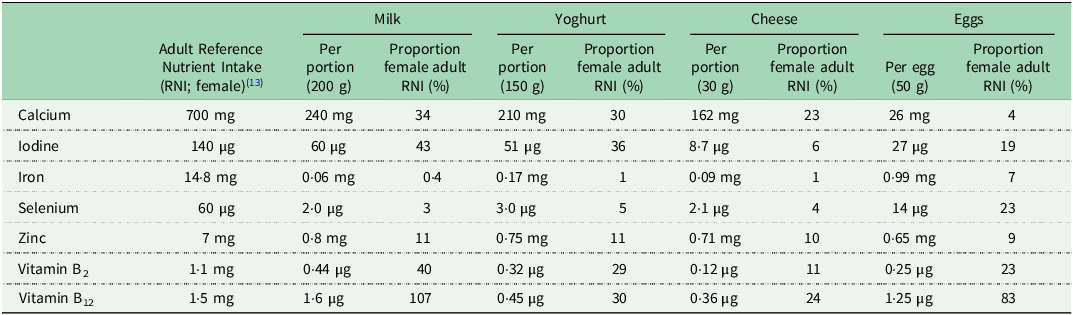
Animal foods are rich sources of many micronutrients – as an example, in the UK one portion of milk (200 g glass) would provide 43 % of iodine, 33 % of calcium, 40 % of riboflavin, and 107 % of vitamin B12 recommendations for a female adult, while one chicken egg would provide 19 % of the iodine, 23 % of the selenium and vitamin B2 recommendations, and 83 % of vitamin B12 recommendations (Table 1)(12,13) . Young women are a key population group when considering the potential impact of a transition to a plant-based diet (see later) and Table 1 shows that one portion each of milk, yoghurt and cheese (i.e. three portions of dairy products per day), would provide 161 % of vitamin B12, 87 % of calcium, 86 % of iodine and 79 % of vitamin B2 recommendations for a female adult(13).
Content of selected at-risk micronutrients in milk, dairy products and eggs and the proportion of the female adult Reference Nutrient Intake (RNI) provided by one portion

Nutrient composition data taken from UK Composition of Food(12); median value calculated from food items within the food group.
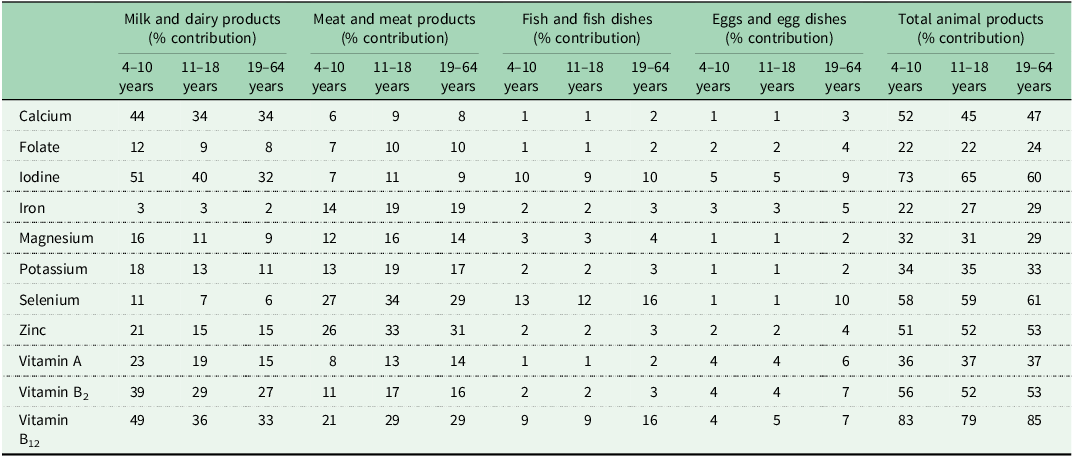
At a population level, animal foods contribute the majority of the total intake of various micronutrients (n 11 shown in Table 2). Animal products contribute over half of total intake of calcium, iodine, selenium, zinc, and vitamin B12 for at least one age group (Table 2), based on data from the UK National Diet and Nutrition Survey (NDNS)(1,14) . Total animal products contribute approximately 80 % of vitamin B12 intake and 60–70 % of iodine intake across all age groups (Table 2). Total animal product contribution to micronutrient intake may mask the picture, as some animal foods are particularly relevant for certain micronutrients. Figure 1 shows a breakdown of animal foods into (i) milk and dairy products, (ii) meat and meat products, (iii) fish and fish products, and (iv) eggs and egg dishes, as contributors to total intake of seven at-risk micronutrients in children and adults (19–64 years). Milk and dairy products contribute over 30 % of adult calcium, iodine, vitamin B12 intake, and over 25 % of vitamin B2. Meat is a major source (contributing over 25 %) of selenium, zinc, and vitamin B12, while fish (with its lower popularity in the UK diet) provides a smaller proportion of micronutrient intake, but contributes at least 10 % of iodine, selenium and vitamin B12 intake (Figure 1). Eggs and egg dishes also contribute a relatively small proportion of micronutrient intake, but contribute around 10 % of iodine and selenium intake (Figure 1).


The provision of a range of micronutrients from animal-source foods underlines the importance of considering the effect of a transition to a plant-based diet on these micronutrients; many of these are already nutrients of concern, particularly in young women (see later), as intake is low and therefore the risk of nutrient deficiency is of public-health importance. In addition, the use of substitute products (e.g. milk/meat alternatives) may be an important factor when considering the nutrients most at risk – for some nutrients, such as calcium, many alternative food products are fortified to match the nutrient content values in their animal-product equivalent, but for others, such as iodine, this is not the case(Reference Nicol, Thomas and Nugent15) (discussed later).
Evidence of lower micronutrient intake on plant-based diets
A systematic review of 141 studies that looked at nutrient intake found that compared to meat eaters, consumers of a plant-based diet had a higher intake of folate, vitamin C, vitamin E, magnesium, but a lower intake/status of vitamins B12 and D, iron, zinc, and calcium(Reference Neufingerl and Eilander16). This systematic review noted that the intake of vitamin B12, iodine and calcium intake was lowest in vegans(Reference Neufingerl and Eilander16). A subsequent systematic review, which included dietary modelling and diet optimisation studies, identified 56 studies with relevant micronutrient outcomes (one RCT, 55 observational studies)(Reference Leonard, Leydon and Arranz17). Iron intake/status was examined in all 56 studies, whereas the least investigated micronutrient was iodine (n 20). Overall, the nutrients at risk with a transition to a plant-based diet were calcium, iodine, zinc, vitamin A, vitamin B12 and vitamin D(Reference Leonard, Leydon and Arranz17).
Nutrient-specific systematic reviews have been conducted for iodine(Reference Eveleigh, Coneyworth and Avery18,Reference Eveleigh, Coneyworth and Welham19) and vitamin B12 (Reference Niklewicz, Hannibal and Warren20) in the context of plant-based diets. A systematic review and meta-analysis of 17 studies with measures of vitamin B12 status (i.e. serum B12) found that status was lower in vegans than in omnivores, as were functional measures of vitamin B12 (holotranscobalamin, methylmalonic acid and total homocysteine)(Reference Niklewicz, Hannibal and Warren20). A systematic review of 15 studies of dietary patterns and iodine found that vegans were the group most at risk of low iodine intake and status(Reference Eveleigh, Coneyworth and Avery18,Reference Eveleigh, Coneyworth and Welham19) ; in a meta-analysis, the vegan group had an iodine intake that was 62·3 µg/d (95 % CI 30·7, 93·9) lower than the omnivore group, while there was no significant difference in iodine intake between vegetarian and omnivore diets(Reference Eveleigh, Coneyworth and Welham19). In the UK, there have been case reports of goitre in vegans, including in children(Reference Brandt, Ajzensztein and Sakka21,Reference Shaikh, Anderson and Hall22) and women of childbearing age(Reference Park, Watson and Bevan23); goitre is the physical symptom of severe iodine deficiency that causes the thyroid to increase and the neck to appear swollen, and tends to develop at an intake of < 70 µg/d in adults (the Lower Reference Nutrient Intake (LRNI))(13).
An RCT in Finland examined the impact of reducing animal foods on intake and status of micronutrients(Reference Pellinen, Päivärinta and Isotalo24). The study randomised adults to either ‘ANIMAL’ (70 % animal protein, 30 % plant), ‘50/50’, or ‘PLANT’ (30 % animal and 70 % plant) groups for 12 weeks. Compared to the ANIMAL group, intake of both iodine and vitamin B12 intake was lower in the PLANT and 50/50 group. This study is useful in that it examines the effect of partial replacement, rather than the effect of a fully plant-based (i.e. vegan) diet on nutrient intake; it therefore is more relevant to the effects of plant-based dietary recommendations, such as the EAT-Lancet diet, that include animal-source foods (albeit in reduced quantities). However, the three arms of the RCT were consistent in fish and egg intake, and this study was conducted in a country where iodised salt is used in bread-making, therefore, it is not representative of the situation in all countries.
The EAT-Lancet diet was designed to provide adequate nutrition, but analysis and calculations using micronutrient values from globally-representative food composition data, along with the daily-intake recommendations for food groups in EAT-Lancet has highlighted concern that the diet may not be able to provide sufficient amounts of bioavailable micronutrients(Reference Beal, Ortenzi and Fanzo25). The EAT-Lancet diet was estimated to provide adequate vitamin A and folate, but inadequate amounts of iron, zinc, calcium and vitamin B12 (Reference Beal, Ortenzi and Fanzo25). When considering women of reproductive age, the EAT-Lancet diet was estimated to provide 55 % and 84 % of the adult intake recommendations for iron and calcium, respectively, whereas it was estimated to provide 93 % of the recommendations for both zinc and vitamin B12 (Reference Beal, Ortenzi and Fanzo25). Iodine was not included in the calculations in that study, but it has subsequently been estimated (using UK food-table values) to provide 85 % of the iodine recommendation for adults (128 v. 150 µg/d(26)), but that reduces to just 36 % (54 µg of iodine per day) if unfortified milk-alternative drinks are used in place of cows’ milk(Reference Nicol, Nugent and Woodside27).
Priority micronutrients for vulnerable populations: women of reproductive age
From a public-health perspective, when considering the effects of a transition to plant-based diets, the focus should be on micronutrients that are already of concern in terms of low intake and risk of deficiency. Dietary data in NDNS show that for girls 11–18 years and women 19–64 years, a considerable, and in some cases very high, proportion have intakes of key micronutrients below the LRNI (Table 3). For example, 16 % of 11–18-year-old girls and 9 % of adult women have intakes below the LRNI for calcium, and 28 % and 12 % of girls and adult women, respectively, have intakes below the LRNI for iodine( 1) . Even considering potential inaccuracies associated with dietary assessment, it is likely that a considerable proportion of women of childbearing age have low intake of iron, iodine, calcium and vitamin B2 (Table 3). This is supported by the NDNS data on biomarkers, which shows that for young women in particular, status is suboptimal. For example, for women aged 16–49 years, iodine status is below the threshold set for adequacy (urinary iodine concentration 98 µg/l(1), threshold > 100 µg/l), and for women 19–64 years old, 15 % and 55 % have biomarkers of iron (plasma ferritin) and vitamin B2 (erythrocyte glutathione reductase activation coefficient, EGRAC) respectively that are outside of the reference ranges(26). Taken together, the low intake and status in young women are of concern and transition to a plant-based diet could further reduce the intake of key micronutrients that is already low in vulnerable groups. In addition, teenage girls and young women are groups that are more likely to use plant-based alternative products (which may not be fortified), and to follow a vegan/plant-based diet(Reference Alae-Carew, Green and Stewart28). Research using NDNS data from 2008–2019 has shown that females are significantly more likely to be consumers of plant-based alternatives than males (OR 1·46 95 % CI 1·27, 1·67)(Reference Alae-Carew, Green and Stewart28). The data also show that 25–39-year-olds are more likely to have used plant-based alternatives than those 11–23 years or 75+ years(Reference Alae-Carew, Green and Stewart28).
Proportion with intake below lower reference nutrient intake (LRNI) for micronutrients at risk in young women of childbearing age

Concern around micronutrient deficiency in populations tends to focus on women and children. This is because they are vulnerable to the effects of deficiency as many micronutrients (e.g. vitamin B2, calcium, iron and iodine) are vital for processes including growth and development, and are particularly important for foetal development during the first 1000 d of life(Reference McCarthy, Murray and Kiely29,Reference Velasco, Bath and Rayman30) and prior to pregnancy for the optimisation of stores. Therefore, a reduced intake of these micronutrients when women of childbearing age follow a plant-based diet may have public-health implications. For example, vitamins B2 and B12 are vital during pregnancy and deficiency of these vitamins has been linked to negative child outcomes(Reference Pentieva, Caffrey and Duffy31). Adequate iodine is essential during pregnancy to produce the thyroid hormones that are required for brain and neurological development, and deficiency can alter brain structure(Reference Jansen, Korevaar and Mulder32). It has been shown that even mild-to-moderate iodine deficiency in early pregnancy is associated with lower child IQ and reading scores at age 8–9 years(Reference Bath, Steer and Golding33,Reference Levie, Korevaar and Bath34) . Therefore, iodine deficiency during pregnancy is a considerable public-health issue and it is estimated that up to 50 % of UK pregnant women are iodine deficient(Reference Bath and Rayman35).
While deficiencies of some micronutrients, such as iron and vitamin B12, are widely recognised as an issue for those consuming a vegan or predominantly plant-based diet, other micronutrients are often overlooked. Two such overlooked nutrients are iodine and vitamin B2, perhaps because there are (incorrect) assumptions that intake is generally adequate within populations, and that deficiency is not a problem in high-income countries such as the UK(Reference Duffy, McNulty and Ward36,Reference Bath and Rayman37) . That may be one of the reasons for the lack of fortification with these nutrients in plant-based alternative products, especially considering that milk and dairy products are the main source of both iodine and vitamin B2 in the UK diet(1).
Plant sources of micronutrients
For some micronutrients, such as iron, zinc and calcium, certain plant foods may be considered as a suitable food source, but for others, such as vitamin B12 and iodine, this is not the case. In the case of vitamin B12, there are no reliable plant sources and the only reasonable source on a vegan diet would therefore be fortified foods or nutritional supplements(Reference Niklewicz, Hannibal and Warren20,Reference Niklewicz, Smith and Smith38) . Seaweed is a rich plant-based source of iodine, but it is not a reliable source because it has a highly variable iodine concentration, even within the same seaweed species(Reference Teas, Pino and Critchley39), and therefore the content consumed by the consumer would be unknown(Reference Aakre, Solli and Markhus40). Some species of seaweed, including the brown seaweed kelp, can have a very high iodine concentration and should not be taken as a source of iodine, particularly during pregnancy, owing to the risk of iodine excess(Reference Farebrother, Zimmermann and Andersson41,Reference Zimmermann and Delange42) . Iodised salt is a common source of iodine in many countries, and one that would be acceptable on a plant-based diet (within the restrictions of salt intake for cardiovascular health(43,44) ). However, iodised retail salt is not widely available in all countries in Europe, including in the UK(Reference Bath, Button and Rayman45), Ireland(Reference Shaw, Nugent and McNulty46) and Norway(Reference Carlsen, Andersen and Dahl47); as such, shifts to a plant-based diet in these countries may have a considerable impact on iodine intake, where there is no food fortification policy and diets are more reliant on animal-source foods. Plant-based foods contain variable amounts of selenium, and that is largely dependent on the soil concentration and conditions(Reference Rayman48). Brazil nuts are often cited as a good plant-based source but the selenium content is highly variable and can lead to excess selenium intake if consumed frequently(Reference Rayman48); furthermore Brazil nuts contain small, and variable, amounts of radioactive radium(Reference Koeder and Keller49) and they also contain barium(Reference Lemire, Fillion and Barbosa50,Reference Duarte, Reis and Rogero51) , therefore it has been suggested that they should not be eaten daily (i.e. as if they were a supplement) in order to provide selenium.
Even for those micronutrients where there are plant-based sources (such as iron and calcium), there should be consideration of the bioavailability, and the presence of inhibitors or enhancers in the context of a plant-based diet. For example, non-haem iron is found in plant-based foods and has variable absorption as it is dependent on individual body stores, and the balance of enhancers (e.g. muscle tissues and ascorbic acid) and inhibitors (e.g. phytates, polyphenols, calcium) in the diet(Reference Brittenham and Fairweather-Tait52,Reference Hurrell and Egli53) . Iodine uptake into the thyroid gland can be competitively inhibited by dietary goitrogens, which are found in plant foods, including cruciferous vegetables such as, kale, broccoli and cabbage(Reference Di Dalmazi and Giuliani54). Generally, goitrogens are not of concern unless intake of these foods is extreme, or if iodine intake is very low(Reference Zimmermann55), however, there is a lack of data and research as to whether goitrogens could be a concern when consuming a vegan, or predominantly planted based, diet where the ratio of goitrogens to iodine could be high.
Plant-based alternative products as a source of micronutrients
Long before the trend for using alternatives to cows’ milk, there has been a decline in milk consumption in the UK. The National Food Survey (1942–2000) and later the Family Food Survey shows a 41 % reduction in milk intake between the 1970s and 2010s; milk consumption in 1974 was 2978 ml/person/week (or around 425 ml/person/day), compared to 1745 ml/person/week in 2019 (249 ml/person/day)(56). Since the early 2000s, there has been an increase in the use of plant-based milk alternatives (e.g. soy, oat and coconut drinks). In the UK, 6·7 % were consumers of plant-based alternatives in 2008–2011, which had increased to 13·2 % by 2018–2019(Reference Alae-Carew, Green and Stewart28). To achieve the necessary reductions in animal-source foods to meet dietary recommendations, such as EAT-Lancet or Net Zero goals, consumers may use plant-based alternatives that can easily be substituted in the diet. Indeed, the UK Eatwell Guide includes dairy alternatives in the section on dairy products(57), but the micronutrient profile of these alternative products may not be the same as cows’ milk(Reference Nicol, Thomas and Nugent15). For example, many plant-based milk alternatives are currently fortified to match the micronutrient profile of cows’ milk for some nutrients (such as calcium), but they are not always fortified with iodine or vitamins B12 or B2 (Reference Nicol, Thomas and Nugent15). In a 2020 UK market survey, 63 % of milk alternatives were fortified calcium, compared with just 20 % fortified with iodine, and 29 % with vitamin B2 (Reference Nicol, Thomas and Nugent15). Furthermore, when plant-based drinks were fortified, the median value of iodine and vitamin B12 was lower than that of cows’ milk (at 75 % and 48 % respectively), whereas the calcium and vitamin B2 content was similar(Reference Nicol, Thomas and Nugent15). On the other hand, many milk alternatives are fortified with vitamin D, meaning that their concentration is greater than that of UK cows’ milk(Reference Nicol, Thomas and Nugent15). Data from other countries shows a similar picture of a lack of micronutrient fortification, particularly iodine in plant-based alternative products(Reference Craig and Fresán58–Reference Khalil and Herter-Aeberli64). The plant-based alternative market is constantly changing and expanding, and therefore risk of deficiency of certain nutrients may change as brands fortify their products.
Besides milk alternatives, there are an increasing number of products that are sold as alternatives to other dairy products (e.g. yoghurt and cheese), or to meat or fish, though these products are less likely to be fortified than milk alternatives(Reference Nicol, Thomas and Nugent15). For example, in 2020, just 6 % of the yoghurt alternatives were iodine fortified (v. 72 % with calcium), and none of the cheese alternatives were fortified with iodine (compared to 55 % fortified with calcium)(Reference Nicol, Thomas and Nugent15). In the 2020 survey, none of the fish alternatives were fortified with iodine, vitamin D or vitamin B12. Some fish alternatives include kelp as an ingredient, which may provide some iodine, though there are no data on the concentration of iodine in these products, nor the bioavailability of iodine.
Milk and dairy products contribute 51 % and 33 % of the total iodine intake of UK children (4–10 years) and adults, respectively (Table 2). UK milk has a relatively high iodine concentration (approximate content of 413 µg/kg) compared to the value from milk in other countries(Reference Tattersall, Peiris and Arai65). By contrast, milk-alternative drinks that are not fortified with iodine have a low iodine concentration – approximately 2 % of that of cows’ milk (at 7·3 µg/kg)(Reference Bath, Hill and Infante66). As the market data shows that most milk-alternative drinks are not fortified with iodine, the rise in popularity of these products may place consumers at risk of iodine deficiency. Indeed, data from the National Diet and Nutrition Survey (Years 7–9; 2014–2017) shows that consumers of milk-alternatives were classified as iodine deficient and had a lower iodine intake than consumers of cows’ milk(Reference Dineva, Rayman and Bath67). As these results were based on data from before 2017, the majority of the milk-alternatives on the market would not have been fortified with iodine and therefore highlights the risk associated with unfortified alternatives. If the consumer replaced three portions of cows’ milk products per day with milk/dairy alternatives, iodine intake would reduce from 124 µg/d to 84 µg/d if two of the three portions were iodine-fortified, or just 2·6 µg/d if all products were unfortified(Reference Nicol, Thomas and Nugent15); overall complete substitution of cows’ milk products with unfortified alternatives would reduce iodine intake by 97·8 %(Reference Nicol, Thomas and Nugent15).
At the population level, using data from the NDNS, the effect of substituting cows’ milk with plant-based milk alternatives has been modelled, with varying degrees of iodine fortification of milk alternatives (from none, to 45 µg/100 ml)(Reference Nicol, Nugent and Woodside68). The modelling showed that complete replacement with an unfortified plant-based milk alternative would increase the risk of iodine insufficiency (proportion with intake < LRNI) across both children and females aged 11–18 (from 20 % to 48 %) and 19–49 years (from 13 % to 33 %). By contrast, substitution with a plant-based milk alternative fortified to either 22·5 µg/100 g or 27·4 µg/100 g (the value that corresponds to the average fortification on the UK market(Reference Nicol, Thomas and Nugent15)) had minimal impact on iodine intake in all population groups, but fortification at 45 µg/100 g resulted in an increase in the proportion above the tolerable upper limit in children. Importantly, the impact on risk of iodine insufficiency was even greater when considering the current market situation – i.e. based on the probability of consumers being able to select an iodine-fortified drink. The modelling study therefore emphasises the need for a greater proportion of the market to be fortified with iodine, so as not to negatively affect population iodine intake as these products become more popular. From this modelling exercise, fortification of milk alternatives should be fortified with ≥ 22·5 and < 45 μg iodine/100 ml to avoid a negative impact on iodine intake in the population if there was a transition to plant-based alternatives(Reference Dineva, Rayman and Bath67 , Reference Nicol, Nugent and Woodside68).
Potential solutions to providing adequate micronutrients on a plant-based diet
Education
One of the concerns with micronutrient intake and plant-based diets is the lack of awareness among the consumer, healthcare professionals and industry of the role of animal-source foods in the provision of micronutrients. While the consumer may be aware of the need to ensure adequate intake of some nutrients, such as calcium, on a plant-based diet, there is limited awareness of other nutrients. A study of UK pregnant women found that 64 % had never heard of iodine, compared to just 11 % who had not heard of calcium, and 4 % who had not heard of iron(Reference Combet, Bouga and Pan69). Furthermore, only 8–9 % of UK women of reproductive age were aware that milk was a source of iodine(Reference Combet, Bouga and Pan69–Reference O’Kane, Pourshahidi and Farren71). As a result, if women are unaware that cows’ milk is a source of iodine, and they are switching to an alternative drink, they will not be looking to ensure that a plant-based milk alternative is fortified with iodine, but they might check the label for added calcium. Other research has shown that knowledge of iodine does not differ between vegetarians, vegans and omnivores and that there are misconceptions about the dietary sources of iodine that might be relevant to those transitioning to a plant-based diet (e.g. incorrectly identifying leafy vegetables as an iodine source)(Reference Eveleigh, Coneyworth and Zhou72).
Raising awareness of the micronutrients at risk on a plant-based diet would be important. Organisations, such as the UK Vegan Society, provide information on at-risk nutrients on a plant-based diet(73); whether this is viewed by the majority of consumers considering a plant-based diet is unknown, but is perhaps unlikely. It is important that all nutrients that may be at risk on a predominantly plant-based diet are appropriately considered in nutrition guidelines and advice given by healthcare professionals.
Increased fortification of plant-based alternative products
Given the current low rate of fortification of plant-based alternative products, one option to improve supply of micronutrients on a plant-based diet would be for the food industry to fortify a greater range of products. This is particularly true for vitamin B2 and iodine, where currently less than 30 % of the milk-alternative products on the market are fortified(Reference Nicol, Thomas and Nugent15). In the case of plant-based alternatives to yoghurt, cheese, eggs and fish, there is greater scope to improve the fortification with micronutrients so that they match the nutrient profile of their animal-product equivalent. The concern is that consumers may assume that these products are nutritionally similar, whereas they are currently a poor replacement for iodine and vitamin B2. The fact that the products are largely (or at least more commonly) fortified with calcium shows that there is potential for companies to expand the fortification to other nutrients. However, this approach probably needs to go together with increased education on micronutrients in milk, as many consumers may be dissuaded from buying a product that contains an additive that they do not understand to be in cows’ milk (such as iodine).
The fortification of plant-based alternatives alone may not be enough to provide adequate amounts of micronutrients. For example, if the overall quantity of fortified milk alternatives was low in the diet of consumers (e.g. around 100 ml used in tea/coffee in a day), the provision of added micronutrients would remain low, even if a fortified product was used. As an example, 100 ml of a typically fortified milk alternative would only provide 15 % of the adult RNI of iodine, and it is unlikely that the remainder could be met from a predominantly plant-based diet. Advice from the UK Vegan Society is for the consumption of 500 g/d of fortified milk alternatives to provide around 80 % of the adult RNI for iodine(74) ; whether this large quantity of milk alternatives would be consumed is debateable as mean intake of plant-based milk alternatives in female consumers aged 19–49 years was 117 (sd 98) g/d in the NDNS Years 9–11 (2016–2019)(Reference Dineva, Rayman and Bath67). In addition, it is not possible to fortify organic versions of milk alternative products (as the use of fortificants is not permitted in organic products), and with a rise in popularity of ‘clean labels’ and minimally processed foods, the unfortified organic alternatives may become more popular.
Fortification of plant-based staple foods
Some countries, such as Australia, New Zealand, the Netherlands, and Belgium, already fortify bread with iodine – through use of iodised salt in breadmaking(75–77). This means that there is a plant-based source of iodine in the diet, and therefore the risk of low iodine intake on a plant-based diet is lower than in countries where animal products are the predominant source(Reference Bath, Verkaik-Kloosterman and Sabatier78). The fortification of bread, or other staple foods, could be explored as an option in countries that currently rely on milk and dairy products as a source of iodine (or other micronutrients). It would be important to conduct dietary modelling for the effect on population nutrient intake and in order to establish the appropriate fortification level in bread (or any other food vehicle), as was done in the case of Australia and New Zealand before the iodine policy was implemented in 2009(79).
Supplementation
For some nutrients, it may be necessary for consumers of a predominantly plant-based, or vegan, diet to take a suitable multivitamin and mineral supplement that would at least contain iodine and vitamin B12. The Vegan Eatwell Guide in the UK recommends that vegans supplement with vitamin D, vitamin B12, selenium and iodine(73). Recent research has shown that a low proportion of vegans supplement their diet with iodine; in a study in the UK, vegan participants were no more likely to take an iodine-containing supplement than vegetarians or omnivores, and use of iodine supplements was much lower than other nutrients(Reference Eveleigh, Coneyworth and Zhou72). A study of healthcare professionals at a medical conference found that of those who reported being vegan, just 12 % took an iodine-containing supplement, compared with 73 % who took vitamin D and 100 % who took B12 (Reference Jeitler, Storz and Steckhan80). The dose of micronutrients in any supplement should be appropriate (i.e. close to the RNI) and should not provide excessive amounts (for that reason, kelp supplements should not be used). For example, for adults, the dose of iodine should not be more than 150 µg/d.
Conclusions
Unless predominantly plant-based diets are well planned or supplemented, there may be a risk to intake of some micronutrients. This is especially the case for iodine in countries that lack a national fortification programme (e.g. through salt iodisation) and for nutrients that are often overlooked when considering reducing animal products in the diet. It is important that all nutrients that may be at risk on a predominantly plant-based diet are appropriately considered in nutrition guidelines and advice given by healthcare professionals. This requires greater knowledge and understanding among consumers, industry, and policymakers.
Acknowledgements
S.C.B. is grateful to the Organising Committee for the invitation to speak at the Nutrition Society Summer Conference 2023.
Ethical statement
Not applicable.
Authorship
S.C.B. is responsible for conceptualisation and writing of this manuscript.
Financial support
No specific funding for this review.
Competing interests
S.C.B. has received an honorarium from Oatly UK and from Dairy UK for delivering webinars and online videos for Healthcare Professionals.


 Open access

