





1 Introduction
Let G be a finitely generated group. The BNS-invariant $\Sigma (G)$
is a fundamental geometric object introduced in the seminal 1987 paper of Bieri, Neumann, and Strebel [Reference Bieri, Neumann and StrebelBNS87]. In 1988, two families of its higher-dimensional generalizations were defined: homological BNSR-invariants
$\Sigma (G)$
is a fundamental geometric object introduced in the seminal 1987 paper of Bieri, Neumann, and Strebel [Reference Bieri, Neumann and StrebelBNS87]. In 1988, two families of its higher-dimensional generalizations were defined: homological BNSR-invariants $\Sigma ^m(G,R)$
,
$\Sigma ^m(G,R)$
, $m\in \mathbb {N}$
, where R is a commutative unital ring, with
$m\in \mathbb {N}$
, where R is a commutative unital ring, with $\Sigma ^1(G,\mathbb Z)=\Sigma (G)$
, studied by Bieri and Renz in [Reference Bieri and RenzBR88], and homotopical BNSR-invariants
$\Sigma ^1(G,\mathbb Z)=\Sigma (G)$
, studied by Bieri and Renz in [Reference Bieri and RenzBR88], and homotopical BNSR-invariants $\Sigma ^m(G)$
,
$\Sigma ^m(G)$
, $m\in \mathbb {N}$
, with
$m\in \mathbb {N}$
, with $\Sigma ^1(G)=\Sigma (G)$
, studied by Renz in [Reference RenzRen88]. In this article, we will only deal with homotopical invariants and refer to them simply as BNSR-invariants. The mth invariant
$\Sigma ^1(G)=\Sigma (G)$
, studied by Renz in [Reference RenzRen88]. In this article, we will only deal with homotopical invariants and refer to them simply as BNSR-invariants. The mth invariant $\Sigma ^m(G)$
is defined whenever G is of type
$\Sigma ^m(G)$
is defined whenever G is of type $F_m$
, meaning G admits a classifying space with finite m-skeleton. In general, the BNSR-invariants of G form a descending chain
$F_m$
, meaning G admits a classifying space with finite m-skeleton. In general, the BNSR-invariants of G form a descending chain $\Sigma ^1(G)\supseteq \Sigma ^2(G)\supseteq \cdots $
of open subsets of the sphere
$\Sigma ^1(G)\supseteq \Sigma ^2(G)\supseteq \cdots $
of open subsets of the sphere $\mathbb {S}(G) = S^d$
, where
$\mathbb {S}(G) = S^d$
, where $d = \dim \operatorname {\mathrm {Hom}}(G,\mathbb {R})-1$
. Among other things,
$d = \dim \operatorname {\mathrm {Hom}}(G,\mathbb {R})-1$
. Among other things, $\Sigma ^m(G)$
completely determines which coabelian subgroups of G are of type
$\Sigma ^m(G)$
completely determines which coabelian subgroups of G are of type $\operatorname {\mathrm {F}}_m$
(we call a subgroup of G coabelian if it contains the commutator subgroup
$\operatorname {\mathrm {F}}_m$
(we call a subgroup of G coabelian if it contains the commutator subgroup $[G,G]$
); in particular,
$[G,G]$
); in particular, $[G,G]$
itself is of type
$[G,G]$
itself is of type $\operatorname {\mathrm {F}}_m$
if and only if
$\operatorname {\mathrm {F}}_m$
if and only if $\Sigma ^m(G)=\mathbb {S}(G)$
.
$\Sigma ^m(G)=\mathbb {S}(G)$
.
While the BNS-invariant $\Sigma (G)$
has been fully computed in a number of interesting cases, the class of groups for which all BNSR-invariants
$\Sigma (G)$
has been fully computed in a number of interesting cases, the class of groups for which all BNSR-invariants $\Sigma ^m(G)$
are defined and completely determined for all m is much smaller. One prominent class for which the latter has been accomplished is right-angled Artin groups (RAAGs) [Reference Meier, Meinert and VanWykMMV98], and it is natural to ask what can be said about BNSR-invariants for groups which are sufficiently close to RAAGs in some sense. Examples of such groups where some progress has been made include Artin groups in general [Reference Blasco-García, Cogolludo-Agustín and Martínez-PérezBGCAMP22, Reference Escartín-Ferrer and Martínez-PerezEFMP24, Reference Meier, Meinert and VanWykMMV01] and Bestvina–Brady groups [Reference Kochloukova and MendonçaKM22]. In this article, we will focus on the computation of BNSR-invariants for yet another collection of groups similar to RAAGs, which are frequently called McCool groups.
$\Sigma ^m(G)$
are defined and completely determined for all m is much smaller. One prominent class for which the latter has been accomplished is right-angled Artin groups (RAAGs) [Reference Meier, Meinert and VanWykMMV98], and it is natural to ask what can be said about BNSR-invariants for groups which are sufficiently close to RAAGs in some sense. Examples of such groups where some progress has been made include Artin groups in general [Reference Blasco-García, Cogolludo-Agustín and Martínez-PérezBGCAMP22, Reference Escartín-Ferrer and Martínez-PerezEFMP24, Reference Meier, Meinert and VanWykMMV01] and Bestvina–Brady groups [Reference Kochloukova and MendonçaKM22]. In this article, we will focus on the computation of BNSR-invariants for yet another collection of groups similar to RAAGs, which are frequently called McCool groups.
Let $F_n$
be the free group of rank n, with a fixed basis
$F_n$
be the free group of rank n, with a fixed basis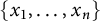 $\{x_1,\dots ,x_n\}$
. An automorphism of
$\{x_1,\dots ,x_n\}$
. An automorphism of $F_n$
is called pure symmetric if it sends each
$F_n$
is called pure symmetric if it sends each $x_i$
to a conjugate of itself. The subgroup
$x_i$
to a conjugate of itself. The subgroup $\mathrm {PSAut}_n$
of the automorphism group
$\mathrm {PSAut}_n$
of the automorphism group $\operatorname {\mathrm {Aut}}(F_n)$
consisting of all pure symmetric automorphisms arises in many contexts and has several different names. It is sometimes simply called the pure symmetric automorphism group, sometimes the McCool group, in reference to seminal work of McCool [Reference McCoolMcC86], and sometimes the pure loop braid group, for its appearance as the group of motions of n unlinked distinguishable circles in
$\operatorname {\mathrm {Aut}}(F_n)$
consisting of all pure symmetric automorphisms arises in many contexts and has several different names. It is sometimes simply called the pure symmetric automorphism group, sometimes the McCool group, in reference to seminal work of McCool [Reference McCoolMcC86], and sometimes the pure loop braid group, for its appearance as the group of motions of n unlinked distinguishable circles in $3$
-space (see, e.g., [Reference Brendle and HatcherBH13, Reference Baez, Wise and CransBWC07] for some important applications of these groups and [Reference DamianiDam17] for an overview of all their different guises). The “outer” version
$3$
-space (see, e.g., [Reference Brendle and HatcherBH13, Reference Baez, Wise and CransBWC07] for some important applications of these groups and [Reference DamianiDam17] for an overview of all their different guises). The “outer” version $\mathrm {PSOut}_n$
of
$\mathrm {PSOut}_n$
of $\mathrm {PSAut}_n$
is the quotient of
$\mathrm {PSAut}_n$
is the quotient of $\mathrm {PSAut}_n$
by the group of inner automorphisms, and we will collectively refer to all the
$\mathrm {PSAut}_n$
by the group of inner automorphisms, and we will collectively refer to all the $\mathrm {PSAut}_n$
and
$\mathrm {PSAut}_n$
and $\mathrm {PSOut}_n$
as McCool groups.
$\mathrm {PSOut}_n$
as McCool groups.
At a very superficial level, McCool groups are similar to RAAGs because they admit simple presentations by generators and relations where all relations are of the form $[u,v]=1$
for some words u and v, and in the majority of relations, u and v are both generators. However, there are much deeper analogies between these groups, which make many techniques and ideas from [Reference Meier, Meinert and VanWykMMV98] applicable to McCool groups.
$[u,v]=1$
for some words u and v, and in the majority of relations, u and v are both generators. However, there are much deeper analogies between these groups, which make many techniques and ideas from [Reference Meier, Meinert and VanWykMMV98] applicable to McCool groups.
The first BNS-invariant for the McCool groups has been completely determined by Orlandi-Korner in [Reference Orlandi-KornerOK00]. In [Reference ZaremskyZar18], the second author computed some pieces of the higher BNSR-invariants $\Sigma ^m(\mathrm {PSAut}_n)$
and conjectured that each
$\Sigma ^m(\mathrm {PSAut}_n)$
and conjectured that each $\Sigma ^m(\mathrm {PSAut}_n)$
is either dense (in the respective sphere) or empty, depending on whether
$\Sigma ^m(\mathrm {PSAut}_n)$
is either dense (in the respective sphere) or empty, depending on whether $m\leq n-2$
or not [Reference ZaremskyZar18, Remark 4.24]. The main theorem of this article confirms this conjecture and also establishes the analogous result for the groups
$m\leq n-2$
or not [Reference ZaremskyZar18, Remark 4.24]. The main theorem of this article confirms this conjecture and also establishes the analogous result for the groups $\mathrm {PSOut}_n$
.
$\mathrm {PSOut}_n$
.
Theorem 1.1 For all $n\ge 2$
, the following hold:
$n\ge 2$
, the following hold:
-
(a) $\Sigma ^{n-2}(\mathrm {PSAut}_n)$
is dense in
$\mathbb {S}(\mathrm {PSAut}_n)$
.
$\Sigma ^{n-2}(\mathrm {PSAut}_n)$
is dense in
$\mathbb {S}(\mathrm {PSAut}_n)$
. -
(b)
$\Sigma ^{n-1}(\mathrm {PSAut}_n)=\emptyset $
.



For all $n\ge 3$
, the following hold:
$n\ge 3$
, the following hold:
-
(c)
$\Sigma ^{n-3}(\mathrm {PSOut}_n)$
is dense in
$\mathbb {S}(\mathrm {PSOut}_n)$
. -
(d)
$\Sigma ^{n-2}(\mathrm {PSOut}_n)=\emptyset $
.



Hence, $\Sigma ^k(\mathrm {PSAut}_n)$
is dense for all
$\Sigma ^k(\mathrm {PSAut}_n)$
is dense for all $0\leq k\le n-2$
and empty for all
$0\leq k\le n-2$
and empty for all $k\ge n-1$
, and
$k\ge n-1$
, and $\Sigma ^k(\mathrm {PSOut}_n)$
is dense for all
$\Sigma ^k(\mathrm {PSOut}_n)$
is dense for all $0\leq k\le n-3$
and empty for all
$0\leq k\le n-3$
and empty for all $k\ge n-2$
.
$k\ge n-2$
.
Remark 1.2
-
(i) Since we always have
$\mathbb {S}(G)=\Sigma ^0(G)\supseteq \Sigma ^1(G)\supseteq \cdots $
, the “hence” part is immediate from parts (a)–(d). -
(ii) All assertions of Theorem 1.1 were previously known for
$n\leq 3$
. Indeed,
$\Sigma ^{1}(\mathrm {PSAut}_2)$
is empty and
$\Sigma ^{1}(\mathrm {PSAut}_3)$
is dense in
$\mathbb {S}(\mathrm {PSAut}_3)$
by the main theorem of [Reference Orlandi-KornerOK00], and the proof of that theorem also easily implies that
$\Sigma ^{1}(\mathrm {PSOut}_3)$
is empty. Finally, the equality
$\Sigma ^{2}(\mathrm {PSAut}_3)=\emptyset $
was established by the second author in [Reference ZaremskyZar18].



While Theorem 1.1 naturally extends the results and confirms the aforementioned conjecture from [Reference ZaremskyZar18], the techniques used in the proofs are very different, as we will see later.
A consequence of Theorem 1.1, together with Theorem 2.3 below, is that if $\chi \colon \mathrm {PSAut}_n\to \mathbb {Z}$
is a “generic” discrete character of
$\chi \colon \mathrm {PSAut}_n\to \mathbb {Z}$
is a “generic” discrete character of $\mathrm {PSAut}_n$
, then the kernel of
$\mathrm {PSAut}_n$
, then the kernel of $\chi $
is of type
$\chi $
is of type $\operatorname {\mathrm {F}}_{n-2}$
but not
$\operatorname {\mathrm {F}}_{n-2}$
but not $\operatorname {\mathrm {F}}_{n-1}$
. Similarly, the kernel of a “generic” discrete character of
$\operatorname {\mathrm {F}}_{n-1}$
. Similarly, the kernel of a “generic” discrete character of $\mathrm {PSOut}_n$
is of type
$\mathrm {PSOut}_n$
is of type $\operatorname {\mathrm {F}}_{n-3}$
but not
$\operatorname {\mathrm {F}}_{n-3}$
but not $\operatorname {\mathrm {F}}_{n-2}$
. We should also mention that our proof of parts (b) and (d) actually shows the stronger statement that
$\operatorname {\mathrm {F}}_{n-2}$
. We should also mention that our proof of parts (b) and (d) actually shows the stronger statement that $\Sigma ^{n-1}(\mathrm {PSAut}_n;\mathbb {Z})=\emptyset $
and
$\Sigma ^{n-1}(\mathrm {PSAut}_n;\mathbb {Z})=\emptyset $
and $\Sigma ^{n-2}(\mathrm {PSOut}_n;\mathbb {Z})=\emptyset $
, where these are the homological BNSR-invariants.
$\Sigma ^{n-2}(\mathrm {PSOut}_n;\mathbb {Z})=\emptyset $
, where these are the homological BNSR-invariants.
In order to prove parts (b) and (d), about certain BNSR-invariants being empty, we prove a rather easy (and somewhat “folklore”), but very general, result about groups of type $\operatorname {\mathrm {F}}$
(meaning groups admitting a finite classifying space) with nonzero Euler characteristic – see Proposition 3.1 which asserts that if G is a group of type
$\operatorname {\mathrm {F}}$
(meaning groups admitting a finite classifying space) with nonzero Euler characteristic – see Proposition 3.1 which asserts that if G is a group of type $\operatorname {\mathrm {F}}$
whose BNSR-invariants are symmetric (Definition 2.4) and whose Euler characteristic is nonzero, then
$\operatorname {\mathrm {F}}$
whose BNSR-invariants are symmetric (Definition 2.4) and whose Euler characteristic is nonzero, then $\Sigma ^\infty (G)=\emptyset $
. Since for a group of type
$\Sigma ^\infty (G)=\emptyset $
. Since for a group of type $\operatorname {\mathrm {F}},$
we have
$\operatorname {\mathrm {F}},$
we have $\Sigma ^\infty (G)=\Sigma ^m(G),$
where m is the dimension of a finite classifying space for G, parts (b) and (d) follow easily from known facts about the McCool groups.
$\Sigma ^\infty (G)=\Sigma ^m(G),$
where m is the dimension of a finite classifying space for G, parts (b) and (d) follow easily from known facts about the McCool groups.
Proving parts (a) and (c), about certain BNSR-invariants being dense, requires quite a lot more effort. The key is a criterion due to Meier, Meinert, and Van Wyk [Reference Meier, Meinert and VanWykMMV98] that relates the BNSR-invariants of a group to the BNSR-invariants of its subgroups, using the notion of higher generation of groups by families of subgroups introduced by Abels and Holz in [Reference Abels and HolzAH93] (see Theorem 4.3). The Meier–Meinert–Van Wyk criterion involves a number of hypotheses on the group, and in order to apply it to the McCool groups, we make use of the Whitehead posets and McCullough–Miller spaces (see Definitions 4.6 and 4.16) and the fact that the groups are highly generated by abelian subgroups (see Proposition 4.17). In a recent paper [Reference Ardaiz-Galé and Martínez-PérezAGMP25], a generalization of McCullough–Miller space for RAAGs is constructed with all these desired properties, so it would be interesting to use this to analyze the BNSR-invariants of the analogs of the McCool groups for RAAGs.
Given that $\mathrm {PSAut}_n$
is sometimes called the “pure loop braid group,” it is natural to ask if one could prove similar results about the pure braid groups
$\mathrm {PSAut}_n$
is sometimes called the “pure loop braid group,” it is natural to ask if one could prove similar results about the pure braid groups $\mathrm {PB}_n$
. Since
$\mathrm {PB}_n$
. Since $\mathrm {PB}_n$
splits as
$\mathrm {PB}_n$
splits as $(\mathrm {PB}_n/Z(\mathrm {PB}_n))\times \mathbb {Z}$
[Reference Farb and MargalitFM12, Section 9.3],
$(\mathrm {PB}_n/Z(\mathrm {PB}_n))\times \mathbb {Z}$
[Reference Farb and MargalitFM12, Section 9.3], $\Sigma ^\infty (\mathrm {PB}_n)$
is dense in its character sphere for trivial reasons, but an interesting problem is understanding when
$\Sigma ^\infty (\mathrm {PB}_n)$
is dense in its character sphere for trivial reasons, but an interesting problem is understanding when $\Sigma ^m(\mathrm {PB}_n/Z(\mathrm {PB}_n))$
is dense or empty. In fact,
$\Sigma ^m(\mathrm {PB}_n/Z(\mathrm {PB}_n))$
is dense or empty. In fact, $\mathrm {PB}_n/Z(\mathrm {PB}_n)$
is isomorphic to the pure mapping class group of the
$\mathrm {PB}_n/Z(\mathrm {PB}_n)$
is isomorphic to the pure mapping class group of the $(n+1)$
-punctured sphere (equivalently the n-punctured plane) [Reference Farb and MargalitFM12, Section 9.3], and it is already known that
$(n+1)$
-punctured sphere (equivalently the n-punctured plane) [Reference Farb and MargalitFM12, Section 9.3], and it is already known that $\Sigma ^{n-2}(\mathrm {PB}_n/Z(\mathrm {PB}_n))=\emptyset $
for all
$\Sigma ^{n-2}(\mathrm {PB}_n/Z(\mathrm {PB}_n))=\emptyset $
for all $n\ge 3$
[Reference Hughes and KielakHK24, Example 7.3] (when
$n\ge 3$
[Reference Hughes and KielakHK24, Example 7.3] (when $n<3,$
the group is trivial). Thus, a natural conjecture is that
$n<3,$
the group is trivial). Thus, a natural conjecture is that $\Sigma ^{n-3}(\mathrm {PB}_n/Z(\mathrm {PB}_n))$
is dense in its character sphere. This is trivially true for
$\Sigma ^{n-3}(\mathrm {PB}_n/Z(\mathrm {PB}_n))$
is dense in its character sphere. This is trivially true for $n=3$
and can be confirmed for
$n=3$
and can be confirmed for $n=4$
thanks to the computation of
$n=4$
thanks to the computation of $\Sigma ^1(\mathrm {PB}_4)$
in [Reference Koban, McCammond and MeierKMM15]. An impediment to proving this conjecture for larger n is a lack of a known analog for
$\Sigma ^1(\mathrm {PB}_4)$
in [Reference Koban, McCammond and MeierKMM15]. An impediment to proving this conjecture for larger n is a lack of a known analog for $\mathrm {PB}_n$
of the McCullough–Miller space for
$\mathrm {PB}_n$
of the McCullough–Miller space for $\mathrm {PSAut}_n$
and
$\mathrm {PSAut}_n$
and $\mathrm {PSOut}_n$
and, more generally, a lack of a known highly generating family of abelian subgroups. If one could find a family of abelian subgroups of
$\mathrm {PSOut}_n$
and, more generally, a lack of a known highly generating family of abelian subgroups. If one could find a family of abelian subgroups of $\mathrm {PB}_n$
that is
$\mathrm {PB}_n$
that is $\infty $
-generating in the sense of Definition 4.1, then proving that
$\infty $
-generating in the sense of Definition 4.1, then proving that $\Sigma ^{n-3}(\mathrm {PB}_n/Z(\mathrm {PB}_n))$
is dense would probably be within reach. We should mention that some results about highly generating families for
$\Sigma ^{n-3}(\mathrm {PB}_n/Z(\mathrm {PB}_n))$
is dense would probably be within reach. We should mention that some results about highly generating families for $\mathrm {PB}_n$
are in the Appendix of [Reference Bux, Fluch, Marschler, Witzel and ZaremskyBFM+16], but the degree of high generation is not large enough to tell us anything about
$\mathrm {PB}_n$
are in the Appendix of [Reference Bux, Fluch, Marschler, Witzel and ZaremskyBFM+16], but the degree of high generation is not large enough to tell us anything about $\Sigma ^{n-3}(\mathrm {PB}_n/Z(\mathrm {PB}_n))$
.
$\Sigma ^{n-3}(\mathrm {PB}_n/Z(\mathrm {PB}_n))$
.
We also prove further results about the second BNSR-invariant $\Sigma ^2$
for McCool groups. In dimension 2, an underutilized result from the Ph.D. thesis of Meinert [Reference MeinertMei93] leads to an easy-to-check sufficient condition for a character class to lie in
$\Sigma ^2$
for McCool groups. In dimension 2, an underutilized result from the Ph.D. thesis of Meinert [Reference MeinertMei93] leads to an easy-to-check sufficient condition for a character class to lie in $\Sigma ^2(Q)$
, where Q is a quotient of a well-understood group G (see Theorem 5.4 for the general criterion and Proposition 5.3 for the specific application to McCool groups). Since Meinert’s thesis is not easily accessible, we also provide a proof of Meinert’s theorem (see Theorem A.1 in Appendix A).
$\Sigma ^2(Q)$
, where Q is a quotient of a well-understood group G (see Theorem 5.4 for the general criterion and Proposition 5.3 for the specific application to McCool groups). Since Meinert’s thesis is not easily accessible, we also provide a proof of Meinert’s theorem (see Theorem A.1 in Appendix A).
This article is organized as follows. In Section 2, we recall some background material on BNSR-invariants and McCool groups and set the stage for inspecting BNSR-invariants of McCool groups. In Section 3, we prove parts (b) and (d) of Theorem 1.1, about BNSR-invariants being empty. In Section 4, we prove parts (a) and (c), about BNSR-invariants being dense. In Section 5, we prove our further results about $\Sigma ^2$
, stemming from Meinert’s criterion, and then in Appendix A, we provide a proof of Meinert’s criterion.
$\Sigma ^2$
, stemming from Meinert’s criterion, and then in Appendix A, we provide a proof of Meinert’s criterion.
2 Preliminaries
In this section, we recall some background material on BNSR-invariants in general and on the groups $\mathrm {PSAut}_n$
and
$\mathrm {PSAut}_n$
and $\mathrm {PSOut}_n$
that will be our main objects of interest.
$\mathrm {PSOut}_n$
that will be our main objects of interest.
2.1 BNSR-invariants
In this section, we recall the definition and some important properties of the Bieri–Neumann–Strebel–Renz (BNSR) invariants of a group. The invariants are somewhat difficult to define and usually quite difficult to compute, but reveal a wealth of information about the group. Let us gradually build up their definition.
Recall that a classifying space for a group G is a connected CW-complex whose fundamental group is isomorphic to G and whose homotopy groups vanish in all dimensions higher than $1$
. Equivalently, it is a quotient of a connected CW-complex whose homotopy groups in positive dimensions are trivial by a free cellular action of G.
$1$
. Equivalently, it is a quotient of a connected CW-complex whose homotopy groups in positive dimensions are trivial by a free cellular action of G.
A group is said to be of type $F_n$
if it admits a classifying space with a finite n-skeleton. Every group is of type
$F_n$
if it admits a classifying space with a finite n-skeleton. Every group is of type $\operatorname {\mathrm {F}}_0$
, finite generation is equivalent to type
$\operatorname {\mathrm {F}}_0$
, finite generation is equivalent to type $\operatorname {\mathrm {F}}_1$
, and finite presentability is equivalent to type
$\operatorname {\mathrm {F}}_1$
, and finite presentability is equivalent to type $\operatorname {\mathrm {F}}_2$
. A group is of type
$\operatorname {\mathrm {F}}_2$
. A group is of type $\operatorname {\mathrm {F}}_\infty $
if it is of type
$\operatorname {\mathrm {F}}_\infty $
if it is of type $\operatorname {\mathrm {F}}_n$
for all n, and if a group has a finite classifying space, it is said to be of type F.
$\operatorname {\mathrm {F}}_n$
for all n, and if a group has a finite classifying space, it is said to be of type F.
Throughout the article, by a character of a group G we will mean a homomorphism $\chi \colon G\to \mathbb {R}$
from G to the additive group of real numbers. Two characters are equivalent if they differ by multiplication by a positive scalar. The equivalence classes
$\chi \colon G\to \mathbb {R}$
from G to the additive group of real numbers. Two characters are equivalent if they differ by multiplication by a positive scalar. The equivalence classes $[\chi ]$
of nontrivial characters of G form the character sphere of G, denoted
$[\chi ]$
of nontrivial characters of G form the character sphere of G, denoted $\mathbb {S}(G)$
.
$\mathbb {S}(G)$
.
This sphere should be viewed as the boundary of the Euclidean vector space $\operatorname {\mathrm {Hom}}(G,\mathbb {R})$
. If this space is d-dimensional, then the character sphere of G is
$\operatorname {\mathrm {Hom}}(G,\mathbb {R})$
. If this space is d-dimensional, then the character sphere of G is $(d-1)$
-dimensional. BNSR-invariants of G are certain subsets of
$(d-1)$
-dimensional. BNSR-invariants of G are certain subsets of $\mathbb {S}(G)$
, which can be defined in several slightly different ways. The definition below is close, but not identical, to the original definition from [Reference RenzRen88].
$\mathbb {S}(G)$
, which can be defined in several slightly different ways. The definition below is close, but not identical, to the original definition from [Reference RenzRen88].
Let G be a group of type $\operatorname {\mathrm {F}}_n$
, so by definition it has a classifying space with finite n-skeleton. Choose any such classifying space K, let
$\operatorname {\mathrm {F}}_n$
, so by definition it has a classifying space with finite n-skeleton. Choose any such classifying space K, let $\widetilde {K}$
be the universal cover of K, and let X be the n-skeleton of
$\widetilde {K}$
be the universal cover of K, and let X be the n-skeleton of $\widetilde {K}$
, with the canonical G-action. It is not hard to show that for any nontrivial character
$\widetilde {K}$
, with the canonical G-action. It is not hard to show that for any nontrivial character $\chi $
of G there exists a map
$\chi $
of G there exists a map $h_\chi \colon X \to \mathbb {R}$
(called a height function) such that
$h_\chi \colon X \to \mathbb {R}$
(called a height function) such that $h_\chi (g.x)=\chi (g) + h_\chi (x)$
for all
$h_\chi (g.x)=\chi (g) + h_\chi (x)$
for all $g\in G$
and
$g\in G$
and $x\in X$
. For
$x\in X$
. For $t\in \mathbb {R}$
, define
$t\in \mathbb {R}$
, define $X^{h_\chi \ge t}$
to be the subcomplex of X consisting of all cells whose vertices lie in
$X^{h_\chi \ge t}$
to be the subcomplex of X consisting of all cells whose vertices lie in $h_\chi ^{-1}([t,\infty ))$
.
$h_\chi ^{-1}([t,\infty ))$
.
Definition 2.1 (BNSR-invariants)
Let n, $G,$
and X be as above. For any
$G,$
and X be as above. For any $0\leq m\leq n$
, the mth BNSR invariant
$0\leq m\leq n$
, the mth BNSR invariant $\Sigma ^m(G)$
is the subset of
$\Sigma ^m(G)$
is the subset of $\mathbb {S}(G)$
consisting of all
$\mathbb {S}(G)$
consisting of all $[\chi ]$
for which the filtration
$[\chi ]$
for which the filtration $X^{h_\chi \ge t}$
of X is essentially
$X^{h_\chi \ge t}$
of X is essentially $(m-1)$
-connected, meaning that for every
$(m-1)$
-connected, meaning that for every $t,$
there exists
$t,$
there exists $u\le t$
such that the inclusion
$u\le t$
such that the inclusion $X^{h_\chi \ge t}\to X^{h_\chi \ge u}$
induces the trivial map in all homotopy groups up to dimension
$X^{h_\chi \ge t}\to X^{h_\chi \ge u}$
induces the trivial map in all homotopy groups up to dimension $m-1$
.
$m-1$
.
Note that by construction, X in Definition 2.1 is $(n-1)$
-connected, so all k-spheres in X can be filled for any
$(n-1)$
-connected, so all k-spheres in X can be filled for any $k\le n-1$
, but what the condition
$k\le n-1$
, but what the condition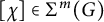 $[\chi ]\in \Sigma ^m(G)$
measures is whether they can be filled without causing the
$[\chi ]\in \Sigma ^m(G)$
measures is whether they can be filled without causing the $\chi $
value to drop too far in the negative direction somewhere along the filling disk. This definition is independent of the choices of X and
$\chi $
value to drop too far in the negative direction somewhere along the filling disk. This definition is independent of the choices of X and $h_\chi $
(see, e.g., [Reference Bieri and GeogheganBG03, Theorem 12.1]).
$h_\chi $
(see, e.g., [Reference Bieri and GeogheganBG03, Theorem 12.1]).
Remark 2.2
-
(a) One can compute BNSR-invariants using more general G-complexes. For instance, one can take X to be any
$(n-1)$
-connected CW-complex on which G acts properly, cocompactly, and cellularly (see, e.g., [Reference ZaremskyZar18, Definition 1.1]); for an even more general condition, see [Reference BuxBux04, Definition 8.1]. -
(b) For any X and
$\chi $
as in Definition 2.1, to prove that the filtration
$X^{h_\chi \ge t}$
is essentially
$(m-1)$
-connected it suffices to check the corresponding condition just for
$t=0$
. This follows easily from the fact that
$g.X^{h_\chi \ge t} = X^{h_\chi \ge {t+\chi (g)}}$
for all
$g\in G$
and
$t\in \mathbb R$
. -
(c) The original definition from [Reference RenzRen88] was as follows:
$[\chi ]\in \Sigma ^m(G)$
if there exists some X as in Definition 2.1 such that the subcomplex
$X^{h_\chi \ge t}$
is
$(m-1)$
-connected for all
$t\in \mathbb R$
. Note that unlike essential
$(m-1)$
-connectivity, this condition does depend on the choice on X. The equivalence of this definition and Definition 2.1 was established already in [Reference RenzRen88] (see also [Reference MeinertMei97, Section 2] and [Reference IsenrichLI24, Section 2]).


If $n=1$
, a natural choice for X in Definition 2.1 is the Cayley graph
$n=1$
, a natural choice for X in Definition 2.1 is the Cayley graph $\operatorname {\mathrm {Cay}}(G,S)$
with respect to some finite generating set S. Likewise, if
$\operatorname {\mathrm {Cay}}(G,S)$
with respect to some finite generating set S. Likewise, if $n=2$
, so that G is finitely presented, we can take X to be the Cayley complex associated with a finite presentation of G.
$n=2$
, so that G is finitely presented, we can take X to be the Cayley complex associated with a finite presentation of G.
If $n=1$
and
$n=1$
and $X=\operatorname {\mathrm {Cay}}(G,S)$
for a finite generating set S, there is no difference between connectivity and essential connectivity (for any S); in fact in this case, the following are equivalent for a nonzero character
$X=\operatorname {\mathrm {Cay}}(G,S)$
for a finite generating set S, there is no difference between connectivity and essential connectivity (for any S); in fact in this case, the following are equivalent for a nonzero character $\chi $
:
$\chi $
:
-
(a)
$[\chi ]\in \Sigma ^1(G)$
; -
(b)
$X^{h_\chi \geq t}$
is connected for all t; -
(c)
$X^{h_\chi \geq t}$
is connected for some t.


It is clear that (b) implies (a). That (c) implies (b) is proved, for example, in [Reference StrebelStr12, Lemma A2.9]. Finally, to prove that (a) implies (c) note that for any $u\le t$
, any vertex of
$u\le t$
, any vertex of $X^{h_\chi \geq u}$
is connected by a path in
$X^{h_\chi \geq u}$
is connected by a path in $X^{h_\chi \geq u}$
to a vertex in
$X^{h_\chi \geq u}$
to a vertex in $X^{h_\chi \geq t}$
(just choose
$X^{h_\chi \geq t}$
(just choose $s\in S^{\pm 1}$
with
$s\in S^{\pm 1}$
with $\chi (s)>0$
and multiply by
$\chi (s)>0$
and multiply by $s^n$
on the right for sufficiently large n); hence, if
$s^n$
on the right for sufficiently large n); hence, if $X^{h_\chi \geq t}$
is contained in a connected subset of
$X^{h_\chi \geq t}$
is contained in a connected subset of $X^{h_\chi \geq u}$
, then the entire
$X^{h_\chi \geq u}$
, then the entire $X^{h_\chi \geq u}$
is connected.
$X^{h_\chi \geq u}$
is connected.
If G is of type $\operatorname {\mathrm {F}}_\infty $
, then
$\operatorname {\mathrm {F}}_\infty $
, then $\Sigma ^m(G)$
is defined for all m, and we have a nested sequence
$\Sigma ^m(G)$
is defined for all m, and we have a nested sequence
 $$\begin{align*}\mathbb{S}(G) \supseteq \Sigma^1(G) \supseteq \Sigma^2(G) \supseteq\cdots \text{.} \end{align*}$$
The intersection of all the $\Sigma ^m(G)$
is denoted
$\Sigma ^m(G)$
is denoted $\Sigma ^\infty (G)$
. Note that if G is of type
$\Sigma ^\infty (G)$
. Note that if G is of type $\operatorname {\mathrm {F}}$
with a finite classifying space of dimension n, then
$\operatorname {\mathrm {F}}$
with a finite classifying space of dimension n, then $\Sigma ^n(G)=\Sigma ^\infty (G)$
(e.g., this follows from [Reference ZaremskyZar17, Citation 1.5]). Thus, for groups of type
$\Sigma ^n(G)=\Sigma ^\infty (G)$
(e.g., this follows from [Reference ZaremskyZar17, Citation 1.5]). Thus, for groups of type $\operatorname {\mathrm {F}},$
the above sequence stabilizes.
$\operatorname {\mathrm {F}},$
the above sequence stabilizes.
An important property of BNSR-invariants, proved in [Reference Bieri, Neumann and StrebelBNS87, Reference RenzRen88], is that $\Sigma ^m(G)$
is open in
$\Sigma ^m(G)$
is open in $\mathbb {S}(G)$
for all
$\mathbb {S}(G)$
for all $m<\infty $
. Another key property is that
$m<\infty $
. Another key property is that $\Sigma ^m(G)$
is invariant under the action of
$\Sigma ^m(G)$
is invariant under the action of $\operatorname {\mathrm {Aut}}(G)$
, that is, if
$\operatorname {\mathrm {Aut}}(G)$
, that is, if $\alpha $
is an automorphism of G, then for a character
$\alpha $
is an automorphism of G, then for a character $\chi ,$
we have
$\chi ,$
we have $[\chi \circ \alpha ]\in \Sigma ^m(G)$
if and only if
$[\chi \circ \alpha ]\in \Sigma ^m(G)$
if and only if $[\chi ]\in \Sigma ^m(G)$
. This easily follows from the fact that
$[\chi ]\in \Sigma ^m(G)$
. This easily follows from the fact that $\Sigma ^m(G)$
in Definition 2.1 does not depend on the choice of G-complex X or the choice of
$\Sigma ^m(G)$
in Definition 2.1 does not depend on the choice of G-complex X or the choice of $h_\chi $
, so in particular, one can keep the same complex X, but “twist” the action by
$h_\chi $
, so in particular, one can keep the same complex X, but “twist” the action by $\alpha $
.
$\alpha $
.
The main application of BNSR-invariants is the following theorem of Renz [Reference RenzRen88, Satz C] (see also Theorem 1.1 of [Reference Bieri, Geoghegan and KochloukovaBGK10]).
Theorem 2.3 [Reference RenzRen88, Satz C]
Let G be a group of type $\operatorname {\mathrm {F}}_n$
and H a subgroup of G containing the commutator subgroup
$\operatorname {\mathrm {F}}_n$
and H a subgroup of G containing the commutator subgroup $[G,G]$
. Then H is of type
$[G,G]$
. Then H is of type $\operatorname {\mathrm {F}}_n$
if and only if
$\operatorname {\mathrm {F}}_n$
if and only if $[\chi ]\in \Sigma ^n(G)$
for all
$[\chi ]\in \Sigma ^n(G)$
for all $0\ne \chi \in \operatorname {\mathrm {Hom}}(G,\mathbb {R})$
such that
$0\ne \chi \in \operatorname {\mathrm {Hom}}(G,\mathbb {R})$
such that $\chi (H)=0$
.
$\chi (H)=0$
.
For example, $[G,G]$
itself is of type
$[G,G]$
itself is of type $\operatorname {\mathrm {F}}_n$
if and only if
$\operatorname {\mathrm {F}}_n$
if and only if $\Sigma ^n(G)=\mathbb {S}(G)$
. At the other extreme in a sense, if
$\Sigma ^n(G)=\mathbb {S}(G)$
. At the other extreme in a sense, if $0\ne \chi \colon G\to \mathbb {R}$
is discrete, meaning its image is cyclic, then
$0\ne \chi \colon G\to \mathbb {R}$
is discrete, meaning its image is cyclic, then $\ker (\chi )$
is of type
$\ker (\chi )$
is of type $\operatorname {\mathrm {F}}_n$
if and only if
$\operatorname {\mathrm {F}}_n$
if and only if $[\chi ],[-\chi ]\in \Sigma ^n(G)$
. In practice, many groups have BNSR-invariants where one does not need to worry about checking both
$[\chi ],[-\chi ]\in \Sigma ^n(G)$
. In practice, many groups have BNSR-invariants where one does not need to worry about checking both $\chi $
and
$\chi $
and $-\chi $
, since they cannot have different behavior. Let us write
$-\chi $
, since they cannot have different behavior. Let us write
 $$\begin{align*}-\Sigma^m(G)= \{[-\chi]\mid [\chi]\in\Sigma^m(G)\}\text{,} \end{align*}$$
and make the following definition.
Definition 2.4 (Symmetric)
We say that the BNSR-invariants of a group G are symmetric if $\Sigma ^m(G)=-\Sigma ^m(G)$
for all m. For example, if there is an automorphism
$\Sigma ^m(G)=-\Sigma ^m(G)$
for all m. For example, if there is an automorphism $\omega $
of G such that
$\omega $
of G such that $\chi \circ \omega =-\chi $
for all
$\chi \circ \omega =-\chi $
for all $\chi $
, then the BNSR-invariants of G are symmetric.
$\chi $
, then the BNSR-invariants of G are symmetric.
2.2 McCool groups
In this section, we introduce our groups of interest. Let $F_n$
be the free group of rank n, with a fixed basis
$F_n$
be the free group of rank n, with a fixed basis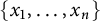 $\{x_1,\dots ,x_n\}$
. Consider the group
$\{x_1,\dots ,x_n\}$
. Consider the group $\operatorname {\mathrm {Aut}}(F_n)$
of automorphisms of
$\operatorname {\mathrm {Aut}}(F_n)$
of automorphisms of $F_n$
. Denote by
$F_n$
. Denote by $\operatorname {\mathrm {Inn}}(F_n)$
the subgroup of inner automorphisms, and let
$\operatorname {\mathrm {Inn}}(F_n)$
the subgroup of inner automorphisms, and let $\operatorname {\mathrm {Out}}(F_n)=\operatorname {\mathrm {Aut}}(F_n)/\operatorname {\mathrm {Inn}}(F_n)$
be the group of outer automorphisms. An automorphism of
$\operatorname {\mathrm {Out}}(F_n)=\operatorname {\mathrm {Aut}}(F_n)/\operatorname {\mathrm {Inn}}(F_n)$
be the group of outer automorphisms. An automorphism of $F_n$
is called symmetric if it sends each
$F_n$
is called symmetric if it sends each $x_i$
to a conjugate of some
$x_i$
to a conjugate of some $x_j$
, and pure symmetric if it sends each
$x_j$
, and pure symmetric if it sends each $x_i$
to a conjugate of
$x_i$
to a conjugate of $x_i$
. Denote the group of all symmetric automorphisms of
$x_i$
. Denote the group of all symmetric automorphisms of $F_n$
by
$F_n$
by $\mathrm {SAut}_n$
, and the group of all pure symmetric automorphisms of
$\mathrm {SAut}_n$
, and the group of all pure symmetric automorphisms of $F_n$
by
$F_n$
by $\mathrm {PSAut}_n$
. Since all inner automorphisms are pure symmetric, we have
$\mathrm {PSAut}_n$
. Since all inner automorphisms are pure symmetric, we have
 $$\begin{align*}\operatorname{\mathrm{Inn}}(F_n) \le \mathrm{PSAut}_n \le \mathrm{SAut}_n \le \operatorname{\mathrm{Aut}}(F_n) \text{.} \end{align*}$$
Taking the quotient by $\operatorname {\mathrm {Inn}}(F_n)$
, we obtain “outer” versions:
$\operatorname {\mathrm {Inn}}(F_n)$
, we obtain “outer” versions:
 $$\begin{align*}\mathrm{PSOut}_n\le \mathrm{SOut}_n \le \operatorname{\mathrm{Out}}(F_n)\text{.} \end{align*}$$
In [Reference McCoolMcC86], McCool exhibited a natural finite presentation for $\mathrm {PSAut}_n$
. There is a generator
$\mathrm {PSAut}_n$
. There is a generator $\alpha _{ij}$
for each
$\alpha _{ij}$
for each $1\le i,j\le n$
with
$1\le i,j\le n$
with $i\ne j$
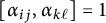
, and the defining relations are as follows:
$i\ne j$
, and the defining relations are as follows:
-
•
$[\alpha _{ij},\alpha _{k\ell }]=1$
for
$i,j,k,\ell $
distinct; -
•
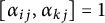
$[\alpha _{ij},\alpha _{kj}]=1$
for
$i,j,k$
distinct; -
•
$[\alpha _{ij}\alpha _{kj},\alpha _{ik}]=1$
for
$i,j,k$
distinct.



The generator $\alpha _{ij}$
is the automorphism of
$\alpha _{ij}$
is the automorphism of $F_n$
sending
$F_n$
sending $x_i$
to
$x_i$
to $x_i^{x_j}=x_j^{-1}x_i x_j$
and fixing all
$x_i^{x_j}=x_j^{-1}x_i x_j$
and fixing all $x_k$
for
$x_k$
for $k\ne i$
. We will generally refer to
$k\ne i$
. We will generally refer to $\mathrm {PSAut}_n$
and
$\mathrm {PSAut}_n$
and $\mathrm {PSOut}_n$
as McCool groups. Note that
$\mathrm {PSOut}_n$
as McCool groups. Note that $\mathrm {PSAut}_1$
is trivial, so when talking about McCool groups we will often implicitly assume
$\mathrm {PSAut}_1$
is trivial, so when talking about McCool groups we will often implicitly assume $n\ge 2$
, which will avoid some pathologies.
$n\ge 2$
, which will avoid some pathologies.
Thanks to the second relation, if $I\subseteq \{1,\dots ,n\}$
and
$I\subseteq \{1,\dots ,n\}$
and $j\in \{1,\dots ,n\}\setminus I$
, then
$j\in \{1,\dots ,n\}\setminus I$
, then $\alpha _{ij}$
and
$\alpha _{ij}$
and $\alpha _{i'j}$
commute for all
$\alpha _{i'j}$
commute for all $i,i'\in I$
. In particular, it makes sense to define
$i,i'\in I$
. In particular, it makes sense to define
 $$\begin{align*}\alpha_{I,j} = \prod\limits_{i\in I}\alpha_{ij} \text{,} \end{align*}$$
that is, the order of the product does not matter. The automorphisms $\alpha _{I,j}$
are called the Whitehead generators of
$\alpha _{I,j}$
are called the Whitehead generators of $\mathrm {PSAut}_n$
. We say that
$\mathrm {PSAut}_n$
. We say that $\alpha _{I,j}$
is based at j. Note that
$\alpha _{I,j}$
is based at j. Note that $\operatorname {\mathrm {Inn}}(F_n)$
is the subgroup of
$\operatorname {\mathrm {Inn}}(F_n)$
is the subgroup of $\mathrm {PSAut}_n$
generated by all the
$\mathrm {PSAut}_n$
generated by all the $\alpha _{[n]\setminus \{j\},j}$
for
$\alpha _{[n]\setminus \{j\},j}$
for $1\le j\le n$
, where
$1\le j\le n$
, where
 $$\begin{align*}[n] = \{1,\dots,n\}\text{.} \end{align*}$$
We will use the following basic relations between the Whitehead generators, which are all clear from the definition.
Lemma 2.5 The following hold:
-
(i)
$\alpha _{I,j}\,\alpha _{K,j}=\alpha _{I\cup K,j}$
whenever I and K are disjoint; -
(ii)
$[\alpha _{I,j},\alpha _{K,j}]=1$
; -
(iii)
$[\alpha _{I,j},\alpha _{K,m}]=1$
if either
$I\cup \{j\}$
and
$K\cup \{m\}$
are disjoint or
$I\cup \{j\}\subseteq K$
.





The McCool groups have some important topological properties that we will need to use later.
Proposition 2.6 The group $\mathrm {PSAut}_n$
is torsion-free and admits a free simplicial cocompact action on an
$\mathrm {PSAut}_n$
is torsion-free and admits a free simplicial cocompact action on an $(n-1)$
-dimensional contractible simplicial complex. Hence, it is of type
$(n-1)$
-dimensional contractible simplicial complex. Hence, it is of type $\operatorname {\mathrm {F}}$
. The group
$\operatorname {\mathrm {F}}$
. The group $\mathrm {PSOut}_n$
has the same properties, with
$\mathrm {PSOut}_n$
has the same properties, with $n-1$
replaced by
$n-1$
replaced by $n-2$
.
$n-2$
.
Proof Collins [Reference CollinsCol89] proved that the groups $\mathrm {SAut}_n$
and
$\mathrm {SAut}_n$
and $\mathrm {SOut}_n$
admit proper simplicial cocompact actions on contractible simplicial complexes of dimensions
$\mathrm {SOut}_n$
admit proper simplicial cocompact actions on contractible simplicial complexes of dimensions $n-1$
and
$n-1$
and $n-2$
, respectively. On the other hand,
$n-2$
, respectively. On the other hand, $\mathrm {PSAut}_n$
and
$\mathrm {PSAut}_n$
and $\mathrm {PSOut}_n$
are torsion-free by a result of Baumslag and Taylor [Reference Baumslag and TaylorBT68]. Since a proper action of a torsion-free group must be free, restricting the above actions of
$\mathrm {PSOut}_n$
are torsion-free by a result of Baumslag and Taylor [Reference Baumslag and TaylorBT68]. Since a proper action of a torsion-free group must be free, restricting the above actions of $\mathrm {SAut}_n$
and
$\mathrm {SAut}_n$
and $\mathrm {SOut}_n$
to their finite index subgroups
$\mathrm {SOut}_n$
to their finite index subgroups $\mathrm {PSAut}_n$
and
$\mathrm {PSAut}_n$
and $\mathrm {PSOut}_n$
, we obtain free actions which remain cocompact.
$\mathrm {PSOut}_n$
, we obtain free actions which remain cocompact.
2.3 Setting the stage for BNSR-invariants of McCool groups
We can already begin to see some facts relevant to the BNSR-invariants by looking at the McCool presentation. First, we can compute abelianizations. Since each defining relation is a commutator, the abelianization of $\mathrm {PSAut}_n$
is freely generated by the images of the
$\mathrm {PSAut}_n$
is freely generated by the images of the $\alpha _{ij}$
and thus is isomorphic to
$\alpha _{ij}$
and thus is isomorphic to $\mathbb {Z}^{n(n-1)}$
. Hence,
$\mathbb {Z}^{n(n-1)}$
. Hence, $\operatorname {\mathrm {Hom}}(\mathrm {PSAut}_n,\mathbb {R})\cong \mathbb {R}^{n(n-1)}$
, and so
$\operatorname {\mathrm {Hom}}(\mathrm {PSAut}_n,\mathbb {R})\cong \mathbb {R}^{n(n-1)}$
, and so $\mathbb {S}(\mathrm {PSAut}_n)\cong S^{n(n-1)-1}$
. As for
$\mathbb {S}(\mathrm {PSAut}_n)\cong S^{n(n-1)-1}$
. As for $\mathrm {PSOut}_n$
, in the abelianization, we take
$\mathrm {PSOut}_n$
, in the abelianization, we take $\mathbb {Z}^{n(n-1)}$
generated by the images
$\mathbb {Z}^{n(n-1)}$
generated by the images $\overline {\alpha }_{ij}$
of the
$\overline {\alpha }_{ij}$
of the $\alpha _{ij}$
, and we mod out n independent relations, of the form
$\alpha _{ij}$
, and we mod out n independent relations, of the form $\overline {\alpha }_{[n]\setminus \{j\},j}=0$
for each j. Thus, the abelianization of
$\overline {\alpha }_{[n]\setminus \{j\},j}=0$
for each j. Thus, the abelianization of $\mathrm {PSOut}_n$
is isomorphic to
$\mathrm {PSOut}_n$
is isomorphic to $\mathbb {Z}^{n(n-1)-n}=\mathbb {Z}^{n(n-2)}$
, so
$\mathbb {Z}^{n(n-1)-n}=\mathbb {Z}^{n(n-2)}$
, so $\mathbb {S}(\mathrm {PSOut}_n)\cong S^{n(n-2)-1}$
.
$\mathbb {S}(\mathrm {PSOut}_n)\cong S^{n(n-2)-1}$
.
Lemma 2.7 The BNSR-invariants of $\mathrm {PSAut}_n$
and
$\mathrm {PSAut}_n$
and $\mathrm {PSOut}_n$
are symmetric.
$\mathrm {PSOut}_n$
are symmetric.
Proof For $\mathrm {PSAut}_n$
this is [Reference ZaremskyZar18, Observation 2.3], and the argument for
$\mathrm {PSAut}_n$
this is [Reference ZaremskyZar18, Observation 2.3], and the argument for $\mathrm {PSOut}_n$
is analogous. To spell it out, from the McCool presentation, we see that there is an automorphism
$\mathrm {PSOut}_n$
is analogous. To spell it out, from the McCool presentation, we see that there is an automorphism $\omega \in \operatorname {\mathrm {Aut}}(\mathrm {PSAut}_n)$
sending each
$\omega \in \operatorname {\mathrm {Aut}}(\mathrm {PSAut}_n)$
sending each $\alpha _{ij}$
to
$\alpha _{ij}$
to $\alpha _{ij}^{-1}$
, which satisfies
$\alpha _{ij}^{-1}$
, which satisfies $\chi \circ \omega = -\chi $
for every character
$\chi \circ \omega = -\chi $
for every character $\chi $
of
$\chi $
of $\mathrm {PSAut}_n$
, and the induced automorphism
$\mathrm {PSAut}_n$
, and the induced automorphism $\overline {\omega }$
of
$\overline {\omega }$
of $\mathrm {PSOut}_n$
has the same property.
$\mathrm {PSOut}_n$
has the same property.
As we already mentioned, in [Reference Orlandi-KornerOK00], Orlandi-Korner fully computed the first BNSR-invariant $\Sigma ^1(\mathrm {PSAut}_n)$
for all n. In [Reference ZaremskyZar18], the second author gave a partial computation of
$\Sigma ^1(\mathrm {PSAut}_n)$
for all n. In [Reference ZaremskyZar18], the second author gave a partial computation of $\Sigma ^m(\mathrm {PSAut}_n)$
for
$\Sigma ^m(\mathrm {PSAut}_n)$
for $m\ge 2$
, and in particular, proved that all “positive” (and all “negative”) characters of
$m\ge 2$
, and in particular, proved that all “positive” (and all “negative”) characters of $\mathrm {PSAut}_n$
lie in
$\mathrm {PSAut}_n$
lie in $\Sigma ^{n-2}(\mathrm {PSAut}_n)\setminus \Sigma ^{n-1}(\mathrm {PSAut}_n)$
.
$\Sigma ^{n-2}(\mathrm {PSAut}_n)\setminus \Sigma ^{n-1}(\mathrm {PSAut}_n)$
.
Remark 2.8 One can also ask about the BNSR-invariants of the full (as opposed to pure) symmetric automorphism groups $\mathrm {SAut}_n$
and
$\mathrm {SAut}_n$
and $\mathrm {SOut}_n$
, but this turns out to be a much easier question since these groups have very low-dimensional character spheres. We have
$\mathrm {SOut}_n$
, but this turns out to be a much easier question since these groups have very low-dimensional character spheres. We have $\operatorname {\mathrm {Hom}}(\mathrm {SAut}_n,\mathbb {R})\cong \mathbb {R}$
, so
$\operatorname {\mathrm {Hom}}(\mathrm {SAut}_n,\mathbb {R})\cong \mathbb {R}$
, so $\mathbb {S}(\mathrm {SAut}_n)=S^0$
, and
$\mathbb {S}(\mathrm {SAut}_n)=S^0$
, and $\Sigma ^k(\mathrm {SAut}_n)$
is all of
$\Sigma ^k(\mathrm {SAut}_n)$
is all of $\mathbb {S}(\mathrm {SAut}_n)$
for
$\mathbb {S}(\mathrm {SAut}_n)$
for $k\le n-2$
and empty for
$k\le n-2$
and empty for $k\ge n-1$
[Reference ZaremskyZar18, Theorem B]. Even more extreme,
$k\ge n-1$
[Reference ZaremskyZar18, Theorem B]. Even more extreme, $\operatorname {\mathrm {Hom}}(\mathrm {SOut}_n,\mathbb {R})$
is trivial, since any nontrivial map
$\operatorname {\mathrm {Hom}}(\mathrm {SOut}_n,\mathbb {R})$
is trivial, since any nontrivial map $\mathrm {SAut}_n\to \mathbb {R}$
must restrict nontrivially to
$\mathrm {SAut}_n\to \mathbb {R}$
must restrict nontrivially to $\operatorname {\mathrm {Inn}}(F_n)$
.
$\operatorname {\mathrm {Inn}}(F_n)$
.
3 Empty BNSR-invariants
In this section, we prove parts (b) and (d) of Theorem 1.1, which assert that certain invariants are empty. This is the easier part; indeed, it was arguably already known to experts, although some pieces of proof need to be assembled.
Let G be a group such that all the rational homology groups $H_i(G,\mathbb {Q})$
of G are finite-dimensional and vanish for large enough i. For example, this happens if G is of type
$H_i(G,\mathbb {Q})$
of G are finite-dimensional and vanish for large enough i. For example, this happens if G is of type $\operatorname {\mathrm {FP}}$
, meaning the trivial G-module
$\operatorname {\mathrm {FP}}$
, meaning the trivial G-module $\mathbb {Z}$
admits a finite-length resolution by finitely generated projective G-modules. In particular, this happens if G is of type
$\mathbb {Z}$
admits a finite-length resolution by finitely generated projective G-modules. In particular, this happens if G is of type $\operatorname {\mathrm {F}}$
. The Euler characteristic
$\operatorname {\mathrm {F}}$
. The Euler characteristic $\mathcal {X}(G)$
of G is
$\mathcal {X}(G)$
of G is
 $$\begin{align*}\mathcal{X}(G) = \sum\limits_{i=0}^\infty (-1)^i \dim H_i(G,\mathbb{Q}) \text{.} \end{align*}$$
The following result must be well known, but we could not find it stated in this concise form in the literature; the proof is reasonably elementary.
Proposition 3.1 Let G be a group of type $\operatorname {\mathrm {F}}$
such that
$\operatorname {\mathrm {F}}$
such that $\mathcal {X}(G)\ne 0$
. Then
$\mathcal {X}(G)\ne 0$
. Then $\Sigma ^\infty (G)\cap -\Sigma ^\infty (G)=\emptyset $
, so in particular, if the BNSR-invariants of G are symmetric, then
$\Sigma ^\infty (G)\cap -\Sigma ^\infty (G)=\emptyset $
, so in particular, if the BNSR-invariants of G are symmetric, then $\Sigma ^\infty (G)=\emptyset $
.
$\Sigma ^\infty (G)=\emptyset $
.
Proof Suppose $\Sigma ^\infty (G)\cap -\Sigma ^\infty (G)\ne \emptyset $
. Since G is of type
$\Sigma ^\infty (G)\cap -\Sigma ^\infty (G)\ne \emptyset $
. Since G is of type $\operatorname {\mathrm {F}}$
,
$\operatorname {\mathrm {F}}$
, $\Sigma ^\infty (G)=\Sigma ^m(G),$
where
$\Sigma ^\infty (G)=\Sigma ^m(G),$
where $m<\infty $
is the dimension of some finite classifying space for G, so
$m<\infty $
is the dimension of some finite classifying space for G, so $\Sigma ^m(G)\cap -\Sigma ^m(G)\ne \emptyset $
. Since
$\Sigma ^m(G)\cap -\Sigma ^m(G)\ne \emptyset $
. Since $\Sigma ^m(G)$
is open in
$\Sigma ^m(G)$
is open in $\mathbb {S}(G)$
, we can choose a discrete character
$\mathbb {S}(G)$
, we can choose a discrete character $0\ne \chi \colon G\to \mathbb {Z}$
such that
$0\ne \chi \colon G\to \mathbb {Z}$
such that $[\pm \chi ]\in \Sigma ^m(G)=\Sigma ^\infty (G)$
. Let
$[\pm \chi ]\in \Sigma ^m(G)=\Sigma ^\infty (G)$
. Let $K=\ker (\chi )$
, so K is of type
$K=\ker (\chi )$
, so K is of type $\operatorname {\mathrm {F}}_\infty $
.
$\operatorname {\mathrm {F}}_\infty $
.
Since G has a finite classifying space of dimension m, its cohomological dimension $cd(G)$
is at most m and hence
$cd(G)$
is at most m and hence $cd(K)\leq cd(G)<\infty $
(see, e.g., [Reference BrownBro82, Propositions VIII.2.2 and VIII.2.4]). Combined with K being of type
$cd(K)\leq cd(G)<\infty $
(see, e.g., [Reference BrownBro82, Propositions VIII.2.2 and VIII.2.4]). Combined with K being of type $\operatorname {\mathrm {F}}_\infty $
, hence
$\operatorname {\mathrm {F}}_\infty $
, hence $\operatorname {\mathrm {FP}}_\infty $
, this implies that K is of type
$\operatorname {\mathrm {FP}}_\infty $
, this implies that K is of type $\operatorname {\mathrm {FP}}$
by [Reference BrownBro82, Proposition VIII.6.1]. Now, by [Reference BrownBro82, Proposition IX.7.3(d)], since K, G, and
$\operatorname {\mathrm {FP}}$
by [Reference BrownBro82, Proposition VIII.6.1]. Now, by [Reference BrownBro82, Proposition IX.7.3(d)], since K, G, and $\mathbb {Z}$
are all of type
$\mathbb {Z}$
are all of type $\operatorname {\mathrm {FP}}$
, the Euler characteristic
$\operatorname {\mathrm {FP}}$
, the Euler characteristic $\mathcal {X}$
is multiplicative for the short exact sequence
$\mathcal {X}$
is multiplicative for the short exact sequence $1\to K\to G\to \mathbb {Z}\to 1$
, and we get
$1\to K\to G\to \mathbb {Z}\to 1$
, and we get $\mathcal {X}(G)=\mathcal {X}(K)\cdot \mathcal {X}(\mathbb {Z})=\mathcal {X}(K)\cdot 0=0$
, a contradiction.
$\mathcal {X}(G)=\mathcal {X}(K)\cdot \mathcal {X}(\mathbb {Z})=\mathcal {X}(K)\cdot 0=0$
, a contradiction.
Remark 3.2 The above proof applies equally well to the homological BNSR-invariant $\Sigma ^\infty (G;\mathbb {Z})$
, since we only need to know that K was of type
$\Sigma ^\infty (G;\mathbb {Z})$
, since we only need to know that K was of type $\operatorname {\mathrm {FP}}_\infty $
(not necessarily
$\operatorname {\mathrm {FP}}_\infty $
(not necessarily $\operatorname {\mathrm {F}}_\infty $
). We should also mention that, as explained to us by Dawid Kielak, using some deep results from
$\operatorname {\mathrm {F}}_\infty $
). We should also mention that, as explained to us by Dawid Kielak, using some deep results from $\ell ^2$
-homology the assumption about the BNSR-invariants being symmetric can be relaxed, and the conclusion can be strengthened to saying that
$\ell ^2$
-homology the assumption about the BNSR-invariants being symmetric can be relaxed, and the conclusion can be strengthened to saying that $\Sigma ^\infty (G;\mathbb {Q})=\emptyset $
, where
$\Sigma ^\infty (G;\mathbb {Q})=\emptyset $
, where $\Sigma ^\infty (G;\mathbb {Q})$
is the homological BNSR-invariants with
$\Sigma ^\infty (G;\mathbb {Q})$
is the homological BNSR-invariants with $\mathbb {Q}$
coefficients. This follows from Theorem A of [Reference Hughes and KielakHK24], together with the fact that for groups of type
$\mathbb {Q}$
coefficients. This follows from Theorem A of [Reference Hughes and KielakHK24], together with the fact that for groups of type $\operatorname {\mathrm {F}}$
the Euler characteristic and
$\operatorname {\mathrm {F}}$
the Euler characteristic and $\ell ^2$
-Euler characteristic coincide (see [Reference LückLüc02, Theorem 6.80(1)]). For our purposes, we only need the result as stated in Proposition 3.1.
$\ell ^2$
-Euler characteristic coincide (see [Reference LückLüc02, Theorem 6.80(1)]). For our purposes, we only need the result as stated in Proposition 3.1.
We can now prove Theorem 1.1(b)(d), asserting that $\Sigma ^{n-1}(\mathrm {PSAut}_n)=\emptyset $
and
$\Sigma ^{n-1}(\mathrm {PSAut}_n)=\emptyset $
and $\Sigma ^{n-2}(\mathrm {PSOut}_n)=\emptyset $
.
$\Sigma ^{n-2}(\mathrm {PSOut}_n)=\emptyset $
.
Proof of Theorem 1.1(b)(d)
By Proposition 2.6, $\mathrm {PSAut}_n$
and
$\mathrm {PSAut}_n$
and $\mathrm {PSOut}_n$
are of type
$\mathrm {PSOut}_n$
are of type $\operatorname {\mathrm {F}}$
. By Lemma 2.7, the BNSR-invariants of these groups are symmetric. Finally, it is known that
$\operatorname {\mathrm {F}}$
. By Lemma 2.7, the BNSR-invariants of these groups are symmetric. Finally, it is known that $\mathcal {X}(\mathrm {PSAut}_n)\ne 0$
and
$\mathcal {X}(\mathrm {PSAut}_n)\ne 0$
and $\mathcal {X}(\mathrm {PSOut}_n)\ne 0$
; in fact,
$\mathcal {X}(\mathrm {PSOut}_n)\ne 0$
; in fact, $\mathcal {X}(\mathrm {PSAut}_n)=(1-n)^{n-1} \ne 0$
and
$\mathcal {X}(\mathrm {PSAut}_n)=(1-n)^{n-1} \ne 0$
and $\mathcal {X}(\mathrm {PSOut}_n)=(1-n)^{n-2}\ne 0$
(see Theorems 1.2 and 8.2 of [Reference McCammond and MeierMM04]). Thus,
$\mathcal {X}(\mathrm {PSOut}_n)=(1-n)^{n-2}\ne 0$
(see Theorems 1.2 and 8.2 of [Reference McCammond and MeierMM04]). Thus, $\Sigma ^{n-1}(\mathrm {PSAut}_n)=\emptyset $
and
$\Sigma ^{n-1}(\mathrm {PSAut}_n)=\emptyset $
and $\Sigma ^{n-2}(\mathrm {PSOut}_n)=\emptyset $
by Proposition 3.1.
$\Sigma ^{n-2}(\mathrm {PSOut}_n)=\emptyset $
by Proposition 3.1.
4 Dense BNSR-invariants
In this section, we prove the much more difficult, “positive” statements of Theorem 1.1, parts (a) and (c), asserting that $\Sigma ^{n-2}(\mathrm {PSAut}_n)$
and
$\Sigma ^{n-2}(\mathrm {PSAut}_n)$
and $\Sigma ^{n-3}(\mathrm {PSOut}_n)$
are dense in their respective character spheres. The general plan is to apply a criterion of Meier, Meinert, and Van Wyk, with the bulk of the work relating to the Whitehead poset
$\Sigma ^{n-3}(\mathrm {PSOut}_n)$
are dense in their respective character spheres. The general plan is to apply a criterion of Meier, Meinert, and Van Wyk, with the bulk of the work relating to the Whitehead poset $\operatorname {\mathrm {WO}}_n$
and McCullough–Miller space
$\operatorname {\mathrm {WO}}_n$
and McCullough–Miller space $\operatorname {\mathrm {MMO}}_n$
of
$\operatorname {\mathrm {MMO}}_n$
of $\mathrm {PSOut}_n$
, along with natural “auter” variants. In the coming sections, we formulate the Meier–Meinert–Van Wyk criterion, discuss the Whitehead poset and McCullough–Miller space, and then prove the density results.
$\mathrm {PSOut}_n$
, along with natural “auter” variants. In the coming sections, we formulate the Meier–Meinert–Van Wyk criterion, discuss the Whitehead poset and McCullough–Miller space, and then prove the density results.
4.1 Higher generation and the Meier–Meinert–Van Wyk criterion
The key to proving that certain characters are in certain BNSR-invariants will be a general criterion due to Meier, Meinert, and Van Wyk [Reference Meier, Meinert and VanWykMMV98] (see Theorem 4.3 below), involving the concept of higher generation due to Abels and Holz. We start with several definitions.
Let G be a group, let $\mathcal {H}$
be a family of subgroups of G, and let
$\mathcal {H}$
be a family of subgroups of G, and let $\operatorname {\mathrm {Cos}}(G,\mathcal {H})$
be the collection of all cosets
$\operatorname {\mathrm {Cos}}(G,\mathcal {H})$
be the collection of all cosets $gH$
with
$gH$
with $g\in G$
and
$g\in G$
and $H\in \mathcal {H}$
. We will view both
$H\in \mathcal {H}$
. We will view both $\mathcal {H}$
and
$\mathcal {H}$
and $\operatorname {\mathrm {Cos}}(G,\mathcal {H})$
as posets with respect to inclusion. Recall that given a poset P, the associated flag complex
$\operatorname {\mathrm {Cos}}(G,\mathcal {H})$
as posets with respect to inclusion. Recall that given a poset P, the associated flag complex $\mathcal {F}(P)$
is the simplicial complex whose simplices are finite chains of elements of P (this is also known as the order complex). If P has a global minimum element
$\mathcal {F}(P)$
is the simplicial complex whose simplices are finite chains of elements of P (this is also known as the order complex). If P has a global minimum element $\widehat {0}$
, let us also write
$\widehat {0}$
, let us also write
 $$\begin{align*}\mathcal{F}_0(P)= \mathcal{F}(P\setminus\{\widehat{0}\})\text{.} \end{align*}$$
Below, we will be concerned with two flag complexes associated with G and $\mathcal {H}$
. The first is
$\mathcal {H}$
. The first is $\mathcal {F}(\operatorname {\mathrm {Cos}}(G,\mathcal {H}))$
, the flag complex of the poset of all cosets of subgroups in
$\mathcal {F}(\operatorname {\mathrm {Cos}}(G,\mathcal {H}))$
, the flag complex of the poset of all cosets of subgroups in $\mathcal {H}$
. The second is
$\mathcal {H}$
. The second is $\mathcal {F}_0(\mathcal {H})$
, the flag complex of the poset of all nontrivial subgroups in
$\mathcal {F}_0(\mathcal {H})$
, the flag complex of the poset of all nontrivial subgroups in $\mathcal {H}$
(only the nontrivial subgroups, not all cosets thereof).
$\mathcal {H}$
(only the nontrivial subgroups, not all cosets thereof).
Let $\mathcal {U}=\{U_i\mid i\in I\}$
be a covering of a set X. Recall that the nerve of
$\mathcal {U}=\{U_i\mid i\in I\}$
be a covering of a set X. Recall that the nerve of $\mathcal {U}$
, denoted by
$\mathcal {U}$
, denoted by $N(\mathcal {U})$
, is the simplicial complex with vertex set I such that
$N(\mathcal {U})$
, is the simplicial complex with vertex set I such that $i_0,\dots ,i_p$
span a p-simplex whenever
$i_0,\dots ,i_p$
span a p-simplex whenever $U_{i_0}\cap \cdots \cap U_{i_p}$
is non-empty.
$U_{i_0}\cap \cdots \cap U_{i_p}$
is non-empty.
The following definition was introduced by Abels and Holz in [Reference Abels and HolzAH93].
Definition 4.1 (n-generating)
Let $\mathcal {H}$
be a family of subgroups of a group G, so
$\mathcal {H}$
be a family of subgroups of a group G, so $\operatorname {\mathrm {Cos}}(G,\mathcal {H})$
is a covering of G. For
$\operatorname {\mathrm {Cos}}(G,\mathcal {H})$
is a covering of G. For $n\in \mathbb {N}$
, the family
$n\in \mathbb {N}$
, the family $\mathcal {H}$
is said to be n-generating for G if the nerve
$\mathcal {H}$
is said to be n-generating for G if the nerve $N(\operatorname {\mathrm {Cos}}(G,\mathcal {H}))$
is
$N(\operatorname {\mathrm {Cos}}(G,\mathcal {H}))$
is $(n-1)$
-connected, and
$(n-1)$
-connected, and $\infty $
-generating if the nerve is contractible.
$\infty $
-generating if the nerve is contractible.
Remark 4.2 If $\mathcal {H}$
is closed under finite intersections, then by [Reference Abels and HolzAH93, Theorem 1.4(b)],
$\mathcal {H}$
is closed under finite intersections, then by [Reference Abels and HolzAH93, Theorem 1.4(b)], $N(\operatorname {\mathrm {Cos}}(G,\mathcal {H}))$
is homotopy equivalent to the flag complex
$N(\operatorname {\mathrm {Cos}}(G,\mathcal {H}))$
is homotopy equivalent to the flag complex $\mathcal {F}(\operatorname {\mathrm {Cos}}(G,\mathcal {H}))$
. Thus, in this case, we can replace
$\mathcal {F}(\operatorname {\mathrm {Cos}}(G,\mathcal {H}))$
. Thus, in this case, we can replace $N(\operatorname {\mathrm {Cos}}(G,\mathcal {H}))$
in Definition 4.1 with the complex
$N(\operatorname {\mathrm {Cos}}(G,\mathcal {H}))$
in Definition 4.1 with the complex $\mathcal {F}(\operatorname {\mathrm {Cos}}(G,\mathcal {H}))$
, which is somewhat easier to understand, being the flag complex of a poset.
$\mathcal {F}(\operatorname {\mathrm {Cos}}(G,\mathcal {H}))$
, which is somewhat easier to understand, being the flag complex of a poset.
We are now ready to state the general result of Meier–Meinert–Van Wyk from [Reference Meier, Meinert and VanWykMMV98] relating BNSR-invariants to highly generating families of subgroups.
Theorem 4.3 [Reference Meier, Meinert and VanWykMMV98, Theorem 3.1]
Let G be a group of type $\operatorname {\mathrm {F}}_n$
. Let
$\operatorname {\mathrm {F}}_n$
. Let $\mathcal {H}$
be a non-empty finite intersection-closed n-generating family of subgroups of G such that each
$\mathcal {H}$
be a non-empty finite intersection-closed n-generating family of subgroups of G such that each $H\in \mathcal {H}$
is of type
$H\in \mathcal {H}$
is of type $\operatorname {\mathrm {F}}_n$
. Let
$\operatorname {\mathrm {F}}_n$
. Let $\chi \colon G \to \mathbb {R}$
be a character such that
$\chi \colon G \to \mathbb {R}$
be a character such that $\chi |_H\ne 0$
for each nontrivial subgroup
$\chi |_H\ne 0$
for each nontrivial subgroup $H\in \mathcal {H}$
. Suppose that the following hold:
$H\in \mathcal {H}$
. Suppose that the following hold:
-
(i) Either the trivial subgroup does not belong to
$\mathcal {H}$
or the simplicial complex
$\mathcal {F}_0(\mathcal {H})$
(as defined above) is
$(n-1)$
-connected, and -
(ii)
$[\chi |_H]\in \Sigma ^n(H)$
for all nontrivial
$H\in \mathcal {H}$
.


Then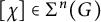 $[\chi ]\in \Sigma ^n(G)$
.
$[\chi ]\in \Sigma ^n(G)$
.
Remark 4.4 The condition that the trivial subgroup does not belong to $\mathcal {H}$
is a strong constraint since
$\mathcal {H}$
is a strong constraint since $\mathcal {H}$
needs to be closed under intersections. On the other hand, if the trivial subgroup does belong to
$\mathcal {H}$
needs to be closed under intersections. On the other hand, if the trivial subgroup does belong to $\mathcal {H}$
, the complex
$\mathcal {H}$
, the complex $\mathcal {F}(\mathcal {H})$
is trivially contractible, which explains why we are looking at
$\mathcal {F}(\mathcal {H})$
is trivially contractible, which explains why we are looking at $\mathcal {F}_0(\mathcal {H})$
rather than
$\mathcal {F}_0(\mathcal {H})$
rather than $\mathcal {F}(\mathcal {H})$
in this case.
$\mathcal {F}(\mathcal {H})$
in this case.
4.2 The Whitehead poset
In this section, we recall the definition and prove some properties of the Whitehead poset $\operatorname {\mathrm {WO}}_n$
, generally following [Reference Brady, McCammond, Meier and MillerBMMM01]. The elements of
$\operatorname {\mathrm {WO}}_n$
, generally following [Reference Brady, McCammond, Meier and MillerBMMM01]. The elements of $\operatorname {\mathrm {WO}}_n$
can be viewed combinatorially as bipartite labeled trees on
$\operatorname {\mathrm {WO}}_n$
can be viewed combinatorially as bipartite labeled trees on $[n] = \{1,2,\dots ,n\}$
, which we now define.
$[n] = \{1,2,\dots ,n\}$
, which we now define.
Definition 4.5 A bipartite labeled tree on [n] is a tree that has n vertices labeled by the integers from $1$
to n and some finite number of unlabeled vertices, satisfying the following conditions:
$1$
to n and some finite number of unlabeled vertices, satisfying the following conditions:
-
(i) each edge connects a labeled vertex to an unlabeled vertex;
-
(ii) each unlabeled vertex has degree at least
$2$
.

The set of all bipartite labeled trees on $[n]$
will be denoted by
$[n]$
will be denoted by $\operatorname {\mathrm {WO}}_n$
. We will now define a partial order on
$\operatorname {\mathrm {WO}}_n$
. We will now define a partial order on $\operatorname {\mathrm {WO}}_n$
. If
$\operatorname {\mathrm {WO}}_n$
. If $T\in \operatorname {\mathrm {WO}}_n$
has a labeled vertex v connected by edges to two unlabeled vertices
$T\in \operatorname {\mathrm {WO}}_n$
has a labeled vertex v connected by edges to two unlabeled vertices $w_1$
and
$w_1$
and $w_2$
, we can form a new tree
$w_2$
, we can form a new tree $T'$
by identifying
$T'$
by identifying $w_1$
and
$w_1$
and $w_2$
and identifying the edges joining
$w_2$
and identifying the edges joining $w_1$
and
$w_1$
and $w_2$
to v. In this case, we say that
$w_2$
to v. In this case, we say that $T'$
is obtained from T by a folding at v. See Figure 1 for an example.
$T'$
is obtained from T by a folding at v. See Figure 1 for an example.
Bipartite labeled trees on $[4]$
, with the second tree obtained from the first tree by a folding at the vertex labeled
$[4]$
, with the second tree obtained from the first tree by a folding at the vertex labeled $3$
.
$3$
.

Define a partial order $\preceq $
on
$\preceq $
on $\operatorname {\mathrm {WO}}_n$
as follows: given
$\operatorname {\mathrm {WO}}_n$
as follows: given $T_1,T_2\in \operatorname {\mathrm {WO}}_n$
, we set
$T_1,T_2\in \operatorname {\mathrm {WO}}_n$
, we set $T_1\preceq T_2$
if
$T_1\preceq T_2$
if $T_1$
can be obtained from
$T_1$
can be obtained from $T_2$
by a (possibly empty) sequence of foldings.
$T_2$
by a (possibly empty) sequence of foldings.
Definition 4.6 The set $\operatorname {\mathrm {WO}}_n$
with the partial order
$\operatorname {\mathrm {WO}}_n$
with the partial order $\preceq $
is called the Whitehead poset.
$\preceq $
is called the Whitehead poset.
We will also be working with $\operatorname {\mathrm {WA}}_n$
, the “auter” version of the Whitehead poset. We define
$\operatorname {\mathrm {WA}}_n$
, the “auter” version of the Whitehead poset. We define $\operatorname {\mathrm {WA}}_n$
to be the subposet of
$\operatorname {\mathrm {WA}}_n$
to be the subposet of $\operatorname {\mathrm {WO}}_{n+1}$
consisting of all trees T for which the vertex labeled
$\operatorname {\mathrm {WO}}_{n+1}$
consisting of all trees T for which the vertex labeled $n+1$
has degree
$n+1$
has degree $1$
.
$1$
.
If $T\in \operatorname {\mathrm {WO}}_n$
has k unlabeled vertices, define the degree of T to be
$T\in \operatorname {\mathrm {WO}}_n$
has k unlabeled vertices, define the degree of T to be
 $$\begin{align*}\deg(T) = k-1\text{.} \end{align*}$$
Let us collect a few basic properties of foldings and the degree function on $\operatorname {\mathrm {WO}}_n$
.
$\operatorname {\mathrm {WO}}_n$
.
Observation 4.7 The following hold:
-
(a) If
$T'$
is obtained from T by a folding, then
$\deg (T')=\deg (T)-1$
. -
(b)
$0\le \deg (T)\le n-2$
for all
$T\in \operatorname {\mathrm {WO}}_n$
. -
(c) Every tree of positive degree admits at least one folding.
-
(d) Every tree of degree
$< n-2$
admits at least one unfolding (the reverse of a folding). -
(e)
$\operatorname {\mathrm {WO}}_n$
contains a unique tree of degree
$0$
(in which the unique unlabeled vertex is connected to all n labeled vertices), and this tree is the (unique) global minimum of
$\operatorname {\mathrm {WO}}_n$
. -
(f) The maximal elements of
$\operatorname {\mathrm {WO}}_n$
are precisely the trees of degree
$n-2$
. Moreover, for every maximal tree
$T,$
there exists a chain
$T_0\prec T_1\prec \cdots \prec T_{n-2}=T$
in
$WO_n$
. -
(g) The maximal elements of
$\operatorname {\mathrm {WA}}_{n-1}$
are precisely the trees of degree
$n-2$
which lie in
$\operatorname {\mathrm {WA}}_{n-1}$
(recall that
$\operatorname {\mathrm {WA}}_{n-1}$
is defined as a subset of
$\operatorname {\mathrm {WO}}_n$
). Moreover, for every maximal tree
$T\in WA_{n-1}$
, every chain as in (f) is contained in
$\operatorname {\mathrm {WA}}_{n-1}$
.





Proof (a) This is clear from the definition of folding.
(b) Suppose that T has k unlabeled vertices (i.e., $k=\deg (T)+1$
). Since every edge connects an unlabeled vertex to a labeled vertex, we must have
$k=\deg (T)+1$
). Since every edge connects an unlabeled vertex to a labeled vertex, we must have $k\geq 1$
, so
$k\geq 1$
, so $\deg (T)\geq 0$
. The total number of vertices in T is
$\deg (T)\geq 0$
. The total number of vertices in T is $n+k$
and hence (since T is a tree), it has exactly
$n+k$
and hence (since T is a tree), it has exactly $n+k-1$
edges. Since in addition, every unlabeled vertex has degree
$n+k-1$
edges. Since in addition, every unlabeled vertex has degree $\geq 2$
, we have
$\geq 2$
, we have $n+k-1\geq 2k$
, that is,
$n+k-1\geq 2k$
, that is, $k\leq n-1$
, or equivalently
$k\leq n-1$
, or equivalently $\deg (T)\leq n-2$
, which proves (b).
$\deg (T)\leq n-2$
, which proves (b).
(c) A tree admits no foldings if and only if all labeled vertices have degree $1$
. This happens exactly when
$1$
. This happens exactly when $n+k-1$
(the total number of edges) equals n (the total number of labeled vertices), that is, when
$n+k-1$
(the total number of edges) equals n (the total number of labeled vertices), that is, when $k=1$
or, equivalently,
$k=1$
or, equivalently, $\deg (T)=0$
.
$\deg (T)=0$
.
(d) A tree T admits an unfolding if and only if it has an unlabeled vertex of degree $>2$
, and by the computation in (b), the latter happens exactly when
$>2$
, and by the computation in (b), the latter happens exactly when $\deg (T)<n-2$
.
$\deg (T)<n-2$
.
(e) The first assertion is clear and the second one follows from (c).
(f) If $\deg (T)=n-2$
, then T is maximal by (a) and (b), and if
$\deg (T)=n-2$
, then T is maximal by (a) and (b), and if $\deg (T)<n-2$
, then T is not maximal by (d). The last assertion of (f) follows from (c) and (a).
$\deg (T)<n-2$
, then T is not maximal by (d). The last assertion of (f) follows from (c) and (a).
(g) As in (f), if $\deg (T)=n-2$
, then T is maximal. If
$\deg (T)=n-2$
, then T is maximal. If $\deg (T)<n-2$
, then by the proof of (d) T has an unlabeled vertex of degree
$\deg (T)<n-2$
, then by the proof of (d) T has an unlabeled vertex of degree $>2$
, call it v. At least one of the neighbors of v is labeled by some
$>2$
, call it v. At least one of the neighbors of v is labeled by some $i\neq n+1$
, and an unfolding at that neighbor produces a tree
$i\neq n+1$
, and an unfolding at that neighbor produces a tree $T'\in \operatorname {\mathrm {WA}}_{n-1}$
with
$T'\in \operatorname {\mathrm {WA}}_{n-1}$
with $T\prec T'$
, so T is not maximal. The last assertion of (g) holds simply because foldings do not increase the degrees of labeled vertices, so if
$T\prec T'$
, so T is not maximal. The last assertion of (g) holds simply because foldings do not increase the degrees of labeled vertices, so if $T\in \operatorname {\mathrm {WA}}_{n-1}$
, then
$T\in \operatorname {\mathrm {WA}}_{n-1}$
, then $S\in \operatorname {\mathrm {WA}}_{n-1}$
for any
$S\in \operatorname {\mathrm {WA}}_{n-1}$
for any $S\prec T$
.
$S\prec T$
.
The following result is an immediate consequence of parts (f) and (g) of Observation 4.7.
Corollary 4.8 The flag complex $\mathcal {F}(\operatorname {\mathrm {WO}}_n)$
is
$\mathcal {F}(\operatorname {\mathrm {WO}}_n)$
is $(n-2)$
-dimensional, and the flag complex
$(n-2)$
-dimensional, and the flag complex $\mathcal {F}(\operatorname {\mathrm {WA}}_n)$
is
$\mathcal {F}(\operatorname {\mathrm {WA}}_n)$
is $(n-1)$
-dimensional.
$(n-1)$
-dimensional.
4.3 A family of abelian subgroups
The main goal of this section is to show that the Whitehead poset is isomorphic to a certain poset of abelian subgroups of $\mathrm {PSOut}_n$
ordered by inclusion. To build up to this, let us construct a subgroup
$\mathrm {PSOut}_n$
ordered by inclusion. To build up to this, let us construct a subgroup $H(T)\le \mathrm {PSOut}_n$
associated with each
$H(T)\le \mathrm {PSOut}_n$
associated with each $T\in \operatorname {\mathrm {WO}}_n$
. Given
$T\in \operatorname {\mathrm {WO}}_n$
. Given $T\in \operatorname {\mathrm {WO}}_n$
and
$T\in \operatorname {\mathrm {WO}}_n$
and $j\in [n]$
, let
$j\in [n]$
, let $T_j$
be the graph obtained from T by removing the vertex labeled j (and all edges incident to it), and consider the partition of
$T_j$
be the graph obtained from T by removing the vertex labeled j (and all edges incident to it), and consider the partition of $[n]\setminus \{j\}$
where two elements lie in the same block if and only if the vertices of
$[n]\setminus \{j\}$
where two elements lie in the same block if and only if the vertices of $T_j$
with the corresponding labels lie in the same connected component. Denote this partition by
$T_j$
with the corresponding labels lie in the same connected component. Denote this partition by $\mathcal {P}(T,j)$
. Now let
$\mathcal {P}(T,j)$
. Now let
 $$\begin{align*}H(T) = \bigg\langle \alpha_{I,j} ~\bigg|~ j\in[n]\text{, } I\in \mathcal{P}(T,j)\bigg\rangle/\operatorname{\mathrm{Inn}}(F_n) \text{,} \end{align*}$$
and write
 $$\begin{align*}\mathcal{HO}_n = \{H(T) \mid T\in\operatorname{\mathrm{WO}}_n\}\text{.} \end{align*}$$
Proposition 4.9 The group $H(T)$
is free abelian of rank
$H(T)$
is free abelian of rank $\deg (T)$
.
$\deg (T)$
.
Proposition 4.9 is easy to deduce from [Reference McCullough and MillerMM96, Proposition 5.1] (see also [Reference Jensen, McCammond and MeierJMM06, Theorem 2.3(ii)]); however, since the groups $H(T)$
are introduced in [Reference McCullough and MillerMM96] in a different way and moreover [Reference McCullough and MillerMM96] considers symmetric automorphisms of arbitrary free products (as opposed to free groups in our article) making the statements more technical, we will provide a direct proof for the convenience of the reader.
$H(T)$
are introduced in [Reference McCullough and MillerMM96] in a different way and moreover [Reference McCullough and MillerMM96] considers symmetric automorphisms of arbitrary free products (as opposed to free groups in our article) making the statements more technical, we will provide a direct proof for the convenience of the reader.
Below by $\overline {\alpha }_{i,j}$
, we denote the image of
$\overline {\alpha }_{i,j}$
, we denote the image of $\alpha _{i,j}$
in
$\alpha _{i,j}$
in $\mathrm {PSOut}_n$
. We first establish an auxiliary result.
$\mathrm {PSOut}_n$
. We first establish an auxiliary result.
Lemma 4.10 For each $1\leq j\leq n,$
let
$1\leq j\leq n,$
let $G_j=\langle \overline {\alpha }_{i,j}\mid i\neq j\rangle $
. The following hold:
$G_j=\langle \overline {\alpha }_{i,j}\mid i\neq j\rangle $
. The following hold:
-
(a) The group
$G_j$
is abelian. -
(b) Fix
$1\le j\le n$
. For
$c_i\in \mathbb {Z}$
, the product
$\prod \limits _{j\neq i}\overline {\alpha }_{i,j}^{c_{i}}$
equals
$1$
if and only if all
$c_i$
are the same. Hence,
$G_j\cong \mathbb Z^{n-2}$
. -
(c) Let
$g=\prod \limits _{j=1}^n g_j$
with
$g_j\in G_j$
for each j. Then
$g=1$
if and only if each
$g_j=1$
.


Proof (a) This is immediate from Lemma 2.5(i).
(b) The “if” part is clear. The “only if” part holds since an automorphism of the form $\prod \limits _{j\neq i}\alpha _{i,j}^{c_{i}}$
always fixes
$\prod \limits _{j\neq i}\alpha _{i,j}^{c_{i}}$
always fixes $x_j$
, so it can only be inner if it is the conjugation by a power of
$x_j$
, so it can only be inner if it is the conjugation by a power of $x_j$
.
$x_j$
.
(c) Let $V=\mathrm {PSOut}_n/[\mathrm {PSOut}_n,\mathrm {PSOut}_n]$
, and let
$V=\mathrm {PSOut}_n/[\mathrm {PSOut}_n,\mathrm {PSOut}_n]$
, and let $\pi : \mathrm {PSOut}_n\to V$
be the natural projection. As we already explained in Section 2.3,
$\pi : \mathrm {PSOut}_n\to V$
be the natural projection. As we already explained in Section 2.3, $V\cong \mathbb Z^{n(n-2)}$
. Since
$V\cong \mathbb Z^{n(n-2)}$
. Since $V=\sum _{j=1}^n \pi (G_j)$
and each
$V=\sum _{j=1}^n \pi (G_j)$
and each $G_j\cong \mathbb Z^{n-2}$
by (b), it follows that
$G_j\cong \mathbb Z^{n-2}$
by (b), it follows that $\pi $
is injective on each
$\pi $
is injective on each $G_j$
and
$G_j$
and $V=\oplus _{j=1}^n \pi (G_j)$
. This implies (c).
$V=\oplus _{j=1}^n \pi (G_j)$
. This implies (c).
Proof of Proposition 4.9
We first prove that $H(T)$
is abelian. Take any two generators
$H(T)$
is abelian. Take any two generators $\alpha _{I,j}$
and
$\alpha _{I,j}$
and $\alpha _{K,m}$
of
$\alpha _{K,m}$
of $H(T)$
, so
$H(T)$
, so $I\in \mathcal {P}(T,j)$
and
$I\in \mathcal {P}(T,j)$
and $K\in \mathcal {P}(T,m)$
. If
$K\in \mathcal {P}(T,m)$
. If $j=m$
, these generators commute by Lemma 2.5(ii).
$j=m$
, these generators commute by Lemma 2.5(ii).
Suppose now that $j\neq m$
. Since
$j\neq m$
. Since $\overline {\alpha }_{I,j}^{\,-1} = \overline {\alpha }_{[n]\setminus (I\cup \{j\}),j}$
, replacing
$\overline {\alpha }_{I,j}^{\,-1} = \overline {\alpha }_{[n]\setminus (I\cup \{j\}),j}$
, replacing $\alpha _{I,j}$
by
$\alpha _{I,j}$
by $\alpha _{[n]\setminus (I\cup \{j\}),j}$
if needed, we can assume that
$\alpha _{[n]\setminus (I\cup \{j\}),j}$
if needed, we can assume that $m\not \in I$
(and hence
$m\not \in I$
(and hence $m\not \in I\cup \{j\}$
). Since
$m\not \in I\cup \{j\}$
). Since $I\in \mathcal {P}(T,j)$
, by definition of the partition
$I\in \mathcal {P}(T,j)$
, by definition of the partition $\mathcal {P}(T,j)$
, there exists a subtree of T whose set of vertex labels is precisely
$\mathcal {P}(T,j)$
, there exists a subtree of T whose set of vertex labels is precisely $I\cup \{j\}$
. Since
$I\cup \{j\}$
. Since $m\not \in I\cup \{j\}$
, the set
$m\not \in I\cup \{j\}$
, the set $I\cup \{j\}$
must lie in a single block of the partition
$I\cup \{j\}$
must lie in a single block of the partition $\mathcal {P}(T,m)$
. Hence, either
$\mathcal {P}(T,m)$
. Hence, either $I\cup \{j\}\subseteq K$
or
$I\cup \{j\}\subseteq K$
or $I\cup \{j\}$
is disjoint from K (and hence from
$I\cup \{j\}$
is disjoint from K (and hence from $K\cup \{m\}$
). In each case,
$K\cup \{m\}$
). In each case, $\alpha _{I,j}$
and
$\alpha _{I,j}$
and $\alpha _{K,m}$
commute by Lemma 2.5(iii).
$\alpha _{K,m}$
commute by Lemma 2.5(iii).
Thus, we have proved that $H(T)$
is abelian, so any element of
$H(T)$
is abelian, so any element of $H(T)$
can be written as a product
$H(T)$
can be written as a product $\prod \limits _{j=1}^n p_j$
, where each
$\prod \limits _{j=1}^n p_j$
, where each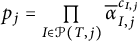 $p_j=\prod \limits _{I\in \mathcal {P}(T,j)}\overline {\alpha }_{I,j}^{c_{I,j}}$
for some
$p_j=\prod \limits _{I\in \mathcal {P}(T,j)}\overline {\alpha }_{I,j}^{c_{I,j}}$
for some $c_{I,j}\in \mathbb Z$
. By Lemma 4.10(c),
$c_{I,j}\in \mathbb Z$
. By Lemma 4.10(c), $\prod \limits _{j=1}^n p_j=1$
if and only if
$\prod \limits _{j=1}^n p_j=1$
if and only if $p_j=1$
for each
$p_j=1$
for each $1\leq j\leq n$
. For a fixed j, the elements of
$1\leq j\leq n$
. For a fixed j, the elements of $\mathcal {P}(T,j)$
are pairwise disjoint, so by Lemmas 4.10(b) and 2.5(i), we have
$\mathcal {P}(T,j)$
are pairwise disjoint, so by Lemmas 4.10(b) and 2.5(i), we have $p_j=1$
if and only if the integers
$p_j=1$
if and only if the integers $c_{I,j}$
are the same for all I. Hence,
$c_{I,j}$
are the same for all I. Hence, $H(T)$
is free abelian of rank
$H(T)$
is free abelian of rank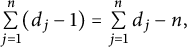 $\sum \limits _{j=1}^n (d_j-1)=\sum \limits _{j=1}^n d_j-n,$
where
$\sum \limits _{j=1}^n (d_j-1)=\sum \limits _{j=1}^n d_j-n,$
where $d_j$
is the degree of the vertex of T labeled j.
$d_j$
is the degree of the vertex of T labeled j.
Since every edge connects a labeled vertex to an unlabeled vertex, $\sum \limits _{j=1}^n d_j$
is the total number of edges of T, which is also equal to
$\sum \limits _{j=1}^n d_j$
is the total number of edges of T, which is also equal to $n+\deg (T)$
since T has n labeled vertices and
$n+\deg (T)$
since T has n labeled vertices and $\deg (T)+1$
unlabeled vertices. Thus, the rank of
$\deg (T)+1$
unlabeled vertices. Thus, the rank of $H(T)$
is equal to
$H(T)$
is equal to $(n+\deg (T))-n=\deg (T)$
, as desired.
$(n+\deg (T))-n=\deg (T)$
, as desired.
In the “auter” case, for each $T\in \operatorname {\mathrm {WA}}_n$
, let
$T\in \operatorname {\mathrm {WA}}_n$
, let
 $$\begin{align*}H_A(T)= H(T) \cap \mathrm{PSAut}_n \text{,} \end{align*}$$
where we view $\mathrm {PSAut}_n$
as a subgroup of
$\mathrm {PSAut}_n$
as a subgroup of $\mathrm {PSOut}_{n+1}$
by having each automorphism act trivially on
$\mathrm {PSOut}_{n+1}$
by having each automorphism act trivially on $x_{n+1}$
(and noting that nontrivial automorphisms of this form are never inner). Let
$x_{n+1}$
(and noting that nontrivial automorphisms of this form are never inner). Let
 $$\begin{align*}\mathcal{HA}_n= \{H_A(T)\mid T\in\operatorname{\mathrm{WA}}_n\}\text{.} \end{align*}$$
Note that each $H_A(T)$
is abelian, being a subgroup of
$H_A(T)$
is abelian, being a subgroup of $H(T)$
.
$H(T)$
.
We will show that the map $T\mapsto H(T)$
is an isomorphism of posets between
$T\mapsto H(T)$
is an isomorphism of posets between $\operatorname {\mathrm {WO}}_n$
and
$\operatorname {\mathrm {WO}}_n$
and $\mathcal {HO}_n$
(ordered by inclusion) and likewise the map
$\mathcal {HO}_n$
(ordered by inclusion) and likewise the map $T\mapsto H_A(T)$
is an isomorphism of posets between
$T\mapsto H_A(T)$
is an isomorphism of posets between $\operatorname {\mathrm {WA}}_n$
and
$\operatorname {\mathrm {WA}}_n$
and $\mathcal {HA}_n$
. First, we need some preparations.
$\mathcal {HA}_n$
. First, we need some preparations.
Definition 4.11 Let $T\in \operatorname {\mathrm {WO}}_n$
and
$T\in \operatorname {\mathrm {WO}}_n$
and $j\in [n]$
. A subset I of
$j\in [n]$
. A subset I of $[n]\setminus \{j\}$
will be called (T,j)-complete if I is a (possibly empty) union of some blocks of the partition
$[n]\setminus \{j\}$
will be called (T,j)-complete if I is a (possibly empty) union of some blocks of the partition $\mathcal {P}(T,j)$
.
$\mathcal {P}(T,j)$
.
Lemma 4.12 Let $T\in WO_n$
and
$T\in WO_n$
and $I\subseteq [n]\setminus \{j\}$
. Then
$I\subseteq [n]\setminus \{j\}$
. Then $\overline {\alpha }_{I,j}\in H(T)$
if and only if I is
$\overline {\alpha }_{I,j}\in H(T)$
if and only if I is $(T,j)$
-complete.
$(T,j)$
-complete.
Proof If I is $(T,j)$
-complete, then
$(T,j)$
-complete, then $I=\sqcup _k I_k$
, where each
$I=\sqcup _k I_k$
, where each $I_k\in \mathcal {P}(T,j)$
and hence
$I_k\in \mathcal {P}(T,j)$
and hence $\overline {\alpha }_{I,j}=\prod _k \overline {\alpha }_{I_k,j}\in H(T)$
.
$\overline {\alpha }_{I,j}=\prod _k \overline {\alpha }_{I_k,j}\in H(T)$
.
Let us now prove the converse. Suppose that $\overline {\alpha }_{I,j}\in H(T)$
for some
$\overline {\alpha }_{I,j}\in H(T)$
for some $j\in [n]$
and
$j\in [n]$
and $I\subseteq [n]\setminus \{j\}$
, so that
$I\subseteq [n]\setminus \{j\}$
, so that
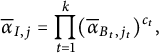 $$\begin{align*}\overline{\alpha}_{I,j}=\prod_{t=1}^k (\overline{\alpha}_{B_t,j_t})^{c_t}, \end{align*}$$
where $B_t\in \mathcal {P}(T,j_t)$
for each t, all pairs
$B_t\in \mathcal {P}(T,j_t)$
for each t, all pairs $(B_t,j_t)$
are distinct, and all
$(B_t,j_t)$
are distinct, and all $c_t\neq 0$
. By Lemma 4.10(c), we can assume that
$c_t\neq 0$
. By Lemma 4.10(c), we can assume that $j_t=j$
for each t in the above equality, and we can rewrite the latter as
$j_t=j$
for each t in the above equality, and we can rewrite the latter as
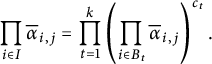 $$ \begin{align} \prod_{i\in I}\overline{\alpha}_{i,j} = \prod_{t=1}^k \left(\prod_{i\in B_t}\overline{\alpha}_{i,j}\right)^{c_t}. \end{align} $$
Suppose now that some $i,i'\in [n]\setminus \{j\}$
lie in the same block of the partition
$i,i'\in [n]\setminus \{j\}$
lie in the same block of the partition $\mathcal {P}(T,j)$
. Then
$\mathcal {P}(T,j)$
. Then $\overline {\alpha }_{i,j}$
and
$\overline {\alpha }_{i,j}$
and $\overline {\alpha }_{i',j}$
appear on the right-hand side of (***) with the same exponent. Since the only vanishing products of the elements
$\overline {\alpha }_{i',j}$
appear on the right-hand side of (***) with the same exponent. Since the only vanishing products of the elements $\overline {\alpha }_{i,j}$
for a fixed j are powers of
$\overline {\alpha }_{i,j}$
for a fixed j are powers of $\prod _{i\in [n]\setminus \{j\}}\overline {\alpha }_{i,j}$
, it follows that
$\prod _{i\in [n]\setminus \{j\}}\overline {\alpha }_{i,j}$
, it follows that $\overline {\alpha }_{i,j}$
and
$\overline {\alpha }_{i,j}$
and $\overline {\alpha }_{i',j}$
also have the same exponent on the left-hand side of (***), so i and
$\overline {\alpha }_{i',j}$
also have the same exponent on the left-hand side of (***), so i and $i'$
either both lie in I or both lie outside of I. It follows that I is a union of blocks of
$i'$
either both lie in I or both lie outside of I. It follows that I is a union of blocks of $\mathcal {P}(T,j)$
, so it is
$\mathcal {P}(T,j)$
, so it is $(T,j)$
-complete.
$(T,j)$
-complete.
Lemma 4.13 The function $\eta \ \colon T\mapsto H(T)$
is a bijection from
$\eta \ \colon T\mapsto H(T)$
is a bijection from $\operatorname {\mathrm {WO}}_n$
to
$\operatorname {\mathrm {WO}}_n$
to $\mathcal {HO}_n$
, and the function
$\mathcal {HO}_n$
, and the function $\eta _A\ \colon T\mapsto H_A(T)$
is a bijection from
$\eta _A\ \colon T\mapsto H_A(T)$
is a bijection from $\operatorname {\mathrm {WA}}_n$
to
$\operatorname {\mathrm {WA}}_n$
to $ \mathcal {HA}_n$
.
$ \mathcal {HA}_n$
.
Proof The functions $\eta $
and
$\eta $
and $\eta _A$
are surjective by construction, so we just need to prove injectivity.
$\eta _A$
are surjective by construction, so we just need to prove injectivity.
We first prove that $\eta $
is injective by describing an algorithm for extracting T from
$\eta $
is injective by describing an algorithm for extracting T from $H(T)$
. Fix
$H(T)$
. Fix $T\in \operatorname {\mathrm {WO}}_n$
. We claim that for any distinct
$T\in \operatorname {\mathrm {WO}}_n$
. We claim that for any distinct $i,j\in [n],$
the following conditions are equivalent:
$i,j\in [n],$
the following conditions are equivalent:
-
(i) The vertices labeled i and j are connected to the same unlabeled vertex in T.
-
(ii) The unique reduced path in T connecting the vertices labeled i and j contains no other labeled vertices.
-
(iii) The labels i and j lie in the same block of the partition
$\mathcal {P}(T,k)$
for any
$k\in [n]\setminus \{i,j\}$
. -
(iv) For any
$\overline {\alpha }_{I,k}\in H(T)$
with
$k\neq i,j$
, the set I contains either both i and j or neither of them.


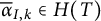

The equivalences (i) $\iff $
(ii) and (ii)
$\iff $
(ii) and (ii) $\iff $
(iii) are clear and (iii)
$\iff $
(iii) are clear and (iii) $\iff $
(iv) holds by Lemma 4.12. Since condition (iv) can be read off from
$\iff $
(iv) holds by Lemma 4.12. Since condition (iv) can be read off from $H(T)$
, the same is true for (i).
$H(T)$
, the same is true for (i).
Let us now form an auxiliary graph $\mathrm {Aux}(T)$
. It has n vertices, labeled by the elements of
$\mathrm {Aux}(T)$
. It has n vertices, labeled by the elements of $[n]$
, and no unlabeled vertices; the vertices labeled by i and j are connected by an edge if and only if the vertices of T labeled i and j are connected by edges to the same unlabeled vertex in T. By the previous paragraph,
$[n]$
, and no unlabeled vertices; the vertices labeled by i and j are connected by an edge if and only if the vertices of T labeled i and j are connected by edges to the same unlabeled vertex in T. By the previous paragraph, $\mathrm {Aux}(T)$
is determined by
$\mathrm {Aux}(T)$
is determined by $H(T)$
. On the other hand, it is easy to recover T from
$H(T)$
. On the other hand, it is easy to recover T from $\mathrm {Aux}(T)$
: create an unlabeled vertex for each maximal clique C in
$\mathrm {Aux}(T)$
: create an unlabeled vertex for each maximal clique C in $\mathrm {Aux}(T)$
and connect that vertex to a vertex labeled by i for each
$\mathrm {Aux}(T)$
and connect that vertex to a vertex labeled by i for each $i\in C$
. Thus, we have proved that
$i\in C$
. Thus, we have proved that $\eta $
is injective.
$\eta $
is injective.
We now deduce injectivity of $\eta _A$
from that of
$\eta _A$
from that of $\eta $
. For this, we need to prove that if
$\eta $
. For this, we need to prove that if $T,U\in \operatorname {\mathrm {WA}}_n$
are such that
$T,U\in \operatorname {\mathrm {WA}}_n$
are such that $H(T)\cap \mathrm {PSAut}_n=H(U)\cap \mathrm {PSAut}_n$
then
$H(T)\cap \mathrm {PSAut}_n=H(U)\cap \mathrm {PSAut}_n$
then $H(T)=H(U)$
. By symmetry, it suffices to check that
$H(T)=H(U)$
. By symmetry, it suffices to check that $H(T)\subseteq H(U)$
. Consider any
$H(T)\subseteq H(U)$
. Consider any $\overline {\alpha }_{I,j}\in H(T)$
, so
$\overline {\alpha }_{I,j}\in H(T)$
, so $j\in [n+1]$
and I is
$j\in [n+1]$
and I is $(T,j)$
-complete. We will prove that
$(T,j)$
-complete. We will prove that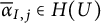 $\overline {\alpha }_{I,j}\in H(U)$
by splitting into three cases.
$\overline {\alpha }_{I,j}\in H(U)$
by splitting into three cases.
Case 1: Suppose $j\in [n]$
and
$j\in [n]$
and $n+1\not \in I$
. Then
$n+1\not \in I$
. Then $\overline {\alpha }_{I,j}\in \mathrm {PSAut}_n$
, hence the hypothesis
$\overline {\alpha }_{I,j}\in \mathrm {PSAut}_n$
, hence the hypothesis $H(T)\cap \mathrm {PSAut}_n=H(U)\cap \mathrm {PSAut}_n$
ensures that
$H(T)\cap \mathrm {PSAut}_n=H(U)\cap \mathrm {PSAut}_n$
ensures that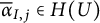 $\overline {\alpha }_{I,j}\in H(U)$
.
$\overline {\alpha }_{I,j}\in H(U)$
.
Case 2: Suppose $j=n+1$
. Since
$j=n+1$
. Since $n+1$
is a leaf in T, we have
$n+1$
is a leaf in T, we have $I=[n]$
or
$I=[n]$
or $\varnothing $
; in either case,
$\varnothing $
; in either case, $\alpha _{I,j}$
is inner, so
$\alpha _{I,j}$
is inner, so $\overline {\alpha }_{I,j}=1$
is automatically in
$\overline {\alpha }_{I,j}=1$
is automatically in $H(U)$
.
$H(U)$
.
Case 3: Suppose $j\in [n]$
and
$j\in [n]$
and $n+1\in I$
. Let
$n+1\in I$
. Let $I'$
be the complement of I in
$I'$
be the complement of I in $[n+1]\setminus \{j\}$
, so
$[n+1]\setminus \{j\}$
, so $\alpha _{I,j}\alpha _{I',j}$
is inner. Hence,
$\alpha _{I,j}\alpha _{I',j}$
is inner. Hence, $\overline {\alpha }_{I',j} = \overline {\alpha }_{I,j}^{\,\,-1}\in H(T)$
, but now
$\overline {\alpha }_{I',j} = \overline {\alpha }_{I,j}^{\,\,-1}\in H(T)$
, but now $n+1\not \in I'$
, so by case 1, we have
$n+1\not \in I'$
, so by case 1, we have $\overline {\alpha }_{I',j}\in H(U)$
, and thus
$\overline {\alpha }_{I',j}\in H(U)$
, and thus $\overline {\alpha }_{I,j}\in H(U)$
as desired.
$\overline {\alpha }_{I,j}\in H(U)$
as desired.
Recall that a poset is a meet semilattice if any two elements x and y have a unique greatest lower bound, called their meet, denoted $x\wedge y$
.
$x\wedge y$
.
Proposition 4.14 [Reference McCullough and MillerMM96, Lemmas 5.4 and 5.5] The posets $\operatorname {\mathrm {WO}}_n$
and
$\operatorname {\mathrm {WO}}_n$
and $\operatorname {\mathrm {WA}}_n$
are meet semilattices. Moreover,
$\operatorname {\mathrm {WA}}_n$
are meet semilattices. Moreover, $H(T\wedge U)=H(T)\cap H(U)$
for any
$H(T\wedge U)=H(T)\cap H(U)$
for any $T,U\in \operatorname {\mathrm {WO}}_n$
and
$T,U\in \operatorname {\mathrm {WO}}_n$
and $H_A(T\wedge U)=H_A(T)\cap H_A(U)$
for any
$H_A(T\wedge U)=H_A(T)\cap H_A(U)$
for any $T,U\in \operatorname {\mathrm {WA}}_n$
. In particular, the families
$T,U\in \operatorname {\mathrm {WA}}_n$
. In particular, the families $\mathcal {HA}_n$
and
$\mathcal {HA}_n$
and $\mathcal {HO}_n$
are closed under taking intersections and so are also meet semilattices.
$\mathcal {HO}_n$
are closed under taking intersections and so are also meet semilattices.
Now let us prove that the bijection $\eta \ \colon T\mapsto H(T)$
is a poset isomorphism from
$\eta \ \colon T\mapsto H(T)$
is a poset isomorphism from $\operatorname {\mathrm {WO}}_n$
to
$\operatorname {\mathrm {WO}}_n$
to $\mathcal {HO}_n$
, along with the “auter” version.
$\mathcal {HO}_n$
, along with the “auter” version.
Proposition 4.15 For $T,U\in \operatorname {\mathrm {WO}}_n$
, we have
$T,U\in \operatorname {\mathrm {WO}}_n$
, we have $T\preceq U$
if and only if
$T\preceq U$
if and only if $H(T)\le H(U)$
. For
$H(T)\le H(U)$
. For $T,U\in \operatorname {\mathrm {WA}}_n$
, we have
$T,U\in \operatorname {\mathrm {WA}}_n$
, we have $T\preceq U$
if and only if
$T\preceq U$
if and only if $H_A(T)\le H_A(U)$
. Hence,
$H_A(T)\le H_A(U)$
. Hence, $\eta $
and
$\eta $
and $\eta _A$
are isomorphisms of posets, and we get
$\eta _A$
are isomorphisms of posets, and we get $\mathcal {F}(\operatorname {\mathrm {WO}}_n)\cong \mathcal {F}(\mathcal {HO}_n)$
and
$\mathcal {F}(\operatorname {\mathrm {WO}}_n)\cong \mathcal {F}(\mathcal {HO}_n)$
and $\mathcal {F}(\operatorname {\mathrm {WA}}_n)\cong \mathcal {F}(\mathcal {HA}_n)$
. Analogous results also hold with
$\mathcal {F}(\operatorname {\mathrm {WA}}_n)\cong \mathcal {F}(\mathcal {HA}_n)$
. Analogous results also hold with $\mathcal {F}$
replaced by
$\mathcal {F}$
replaced by $\mathcal {F}_0$
everywhere.
$\mathcal {F}_0$
everywhere.
Proof Suppose that $T\preceq U$
, so T is obtained from U by a sequence of foldings. Then for any
$T\preceq U$
, so T is obtained from U by a sequence of foldings. Then for any $j\in [n]$
and any
$j\in [n]$
and any $I\subseteq [n]\setminus \{j\}$
that is
$I\subseteq [n]\setminus \{j\}$
that is $(T,j)$
-complete, I is also
$(T,j)$
-complete, I is also $(U,j)$
-complete. We conclude that
$(U,j)$
-complete. We conclude that $H(T)\le H(U)$
.
$H(T)\le H(U)$
.
Now suppose that $H(T)\le H(U)$
. This implies that
$H(T)\le H(U)$
. This implies that $H(T)=H(T)\cap H(U)$
, and so by Proposition 4.14, we have
$H(T)=H(T)\cap H(U)$
, and so by Proposition 4.14, we have $H(T)=H(T\wedge U)$
. By Lemma 4.13, this tells us that
$H(T)=H(T\wedge U)$
. By Lemma 4.13, this tells us that $T=T\wedge U$
, and so
$T=T\wedge U$
, and so $T\preceq U$
. Since we already know that
$T\preceq U$
. Since we already know that $\eta :\operatorname {\mathrm {WO}}_n\to \mathcal {HO}_n$
is a bijection, this proves that it is an isomorphism of posets.
$\eta :\operatorname {\mathrm {WO}}_n\to \mathcal {HO}_n$
is a bijection, this proves that it is an isomorphism of posets.
The proof for $\eta _A$
is analogous, and the remaining statements in the proposition are all immediate consequences of the facts that
$\eta _A$
is analogous, and the remaining statements in the proposition are all immediate consequences of the facts that $\eta $
and
$\eta $
and $\eta _A$
are poset isomorphisms.
$\eta _A$
are poset isomorphisms.
4.4 McCullough–Miller space
We are now ready to define the McCullough–Miller spaces $\operatorname {\mathrm {MMO}}_n$
and
$\operatorname {\mathrm {MMO}}_n$
and $\operatorname {\mathrm {MMA}}_n$
, slightly rephrasing the original definitions from [Reference Chen, Glover and JensenCGJ05, Reference McCullough and MillerMM96]. The idea for
$\operatorname {\mathrm {MMA}}_n$
, slightly rephrasing the original definitions from [Reference Chen, Glover and JensenCGJ05, Reference McCullough and MillerMM96]. The idea for $\operatorname {\mathrm {MMO}}_n$
is to glue together copies of
$\operatorname {\mathrm {MMO}}_n$
is to glue together copies of $\mathcal {F}(\operatorname {\mathrm {WO}}_n)$
, one for each element of
$\mathcal {F}(\operatorname {\mathrm {WO}}_n)$
, one for each element of $\mathrm {PSOut}_n$
, along appropriate intersections. Since we have already established that
$\mathrm {PSOut}_n$
, along appropriate intersections. Since we have already established that $\operatorname {\mathrm {WO}}_n$
is isomorphic to
$\operatorname {\mathrm {WO}}_n$
is isomorphic to $\mathcal {HO}_n$
, it is not surprising that the end result of this is a complex isomorphic to
$\mathcal {HO}_n$
, it is not surprising that the end result of this is a complex isomorphic to $\mathcal {F}(\operatorname {\mathrm {Cos}}(\mathrm {PSOut}_n,\mathcal {HO}_n))$
, and indeed we will simply define McCullough–Miller space this way. The equivalence between this viewpoint and the original viewpoint of McCullough–Miller in [Reference McCullough and MillerMM96] is not difficult, and is discussed, for example, in [Reference GriffinGri13] (along with the
$\mathcal {F}(\operatorname {\mathrm {Cos}}(\mathrm {PSOut}_n,\mathcal {HO}_n))$
, and indeed we will simply define McCullough–Miller space this way. The equivalence between this viewpoint and the original viewpoint of McCullough–Miller in [Reference McCullough and MillerMM96] is not difficult, and is discussed, for example, in [Reference GriffinGri13] (along with the $\operatorname {\mathrm {MMA}}_n$
case).
$\operatorname {\mathrm {MMA}}_n$
case).
Definition 4.16 (McCullough–Miller space)
Define the McCullough–Miller space $\operatorname {\mathrm {MMO}}_n$
to be
$\operatorname {\mathrm {MMO}}_n$
to be
 $$\begin{align*}\operatorname{\mathrm{MMO}}_n = \mathcal{F}(\operatorname{\mathrm{Cos}}(\mathrm{PSOut}_n,\mathcal{HO}_n))\text{,} \end{align*}$$
and define the “auter” version $\operatorname {\mathrm {MMA}}_n$
to be
$\operatorname {\mathrm {MMA}}_n$
to be
 $$\begin{align*}\operatorname{\mathrm{MMA}}_n = \mathcal{F}(\operatorname{\mathrm{Cos}}(\mathrm{PSAut}_n,\mathcal{HA}_n))\text{.} \end{align*}$$
The only property of the McCullough–Miller spaces that we will need is also the most important one, namely, that they are contractible.
Proposition 4.17 The complexes $\operatorname {\mathrm {MMO}}_n$
and
$\operatorname {\mathrm {MMO}}_n$
and $\operatorname {\mathrm {MMA}}_n$
are contractible. Thus,
$\operatorname {\mathrm {MMA}}_n$
are contractible. Thus, $\mathcal {HO}_n$
and
$\mathcal {HO}_n$
and $\mathcal {HA}_n$
are
$\mathcal {HA}_n$
are $\infty $
-generating, for
$\infty $
-generating, for $\mathrm {PSOut}_n$
and
$\mathrm {PSOut}_n$
and $\mathrm {PSAut}_n$
respectively.
$\mathrm {PSAut}_n$
respectively.
Proof Contractibility of $\operatorname {\mathrm {MMO}}_n$
was proved by McCullough and Miller in [Reference McCullough and MillerMM96, Section 4]. Contractibility of
$\operatorname {\mathrm {MMO}}_n$
was proved by McCullough and Miller in [Reference McCullough and MillerMM96, Section 4]. Contractibility of $\operatorname {\mathrm {MMA}}_n$
is essentially proved by Chen, Glover, and Jensen in [Reference Chen, Glover and JensenCGJ05, Theorem 3.1]. Technically, in [Reference Chen, Glover and JensenCGJ05], Chen, Glover, and Jensen consider pure symmetric automorphisms not of free groups, but of free products of finite groups. However, the proof of contractibility of the associated complex works for free products of any groups, in particular free groups, as explained by Griffin in [Reference GriffinGri13, Section 5] (see [Reference GriffinGri13, Theorem 5.5]). The statement about
$\operatorname {\mathrm {MMA}}_n$
is essentially proved by Chen, Glover, and Jensen in [Reference Chen, Glover and JensenCGJ05, Theorem 3.1]. Technically, in [Reference Chen, Glover and JensenCGJ05], Chen, Glover, and Jensen consider pure symmetric automorphisms not of free groups, but of free products of finite groups. However, the proof of contractibility of the associated complex works for free products of any groups, in particular free groups, as explained by Griffin in [Reference GriffinGri13, Section 5] (see [Reference GriffinGri13, Theorem 5.5]). The statement about $\infty $
-generation is now immediate from Remark 4.2.
$\infty $
-generation is now immediate from Remark 4.2.
4.5 Proof of density
In this section, we prove parts (a) and (c) of Theorem 1.1, asserting that $\Sigma ^{n-2}(\mathrm {PSAut}_n)$
and
$\Sigma ^{n-2}(\mathrm {PSAut}_n)$
and $\Sigma ^{n-3}(\mathrm {PSOut}_n)$
are dense in their respective character spheres. The idea is to prove that a suitably generic character satisfies the hypotheses of Theorem 4.3, using the family of subgroups
$\Sigma ^{n-3}(\mathrm {PSOut}_n)$
are dense in their respective character spheres. The idea is to prove that a suitably generic character satisfies the hypotheses of Theorem 4.3, using the family of subgroups $\mathcal {HA}_n$
for
$\mathcal {HA}_n$
for $\mathrm {PSAut}_n$
and
$\mathrm {PSAut}_n$
and $\mathcal {HO}_n$
for
$\mathcal {HO}_n$
for $\mathrm {PSOut}_n$
.
$\mathrm {PSOut}_n$
.
Most of the hypotheses involved in Theorem 4.3 have been dealt with by now. The one we still need to prove is that the flag complexes of nontrivial subgroups from the above families are highly connected. We will actually prove a stronger statement, involving the property of being homotopy Cohen–Macaulay.
Definition 4.18 (Homotopy Cohen–Macaulay)
A simplicial complex X of finite dimension n is called homotopy Cohen–Macaulay if for every p-simplex $\sigma $
, the link
$\sigma $
, the link $\mathrm {lk}(\sigma )$
is
$\mathrm {lk}(\sigma )$
is $(n-p-2)$
-connected. (This includes the empty simplex, so X itself should be
$(n-p-2)$
-connected. (This includes the empty simplex, so X itself should be $(n-1)$
-connected.) A poset is called homotopy Cohen–Macaulay if its flag complex is.
$(n-1)$
-connected.) A poset is called homotopy Cohen–Macaulay if its flag complex is.
Proposition 4.19 The posets $\operatorname {\mathrm {WO}}_n$
and
$\operatorname {\mathrm {WO}}_n$
and $\operatorname {\mathrm {WA}}_n$
are homotopy Cohen–Macaulay. Hence, the flag complex
$\operatorname {\mathrm {WA}}_n$
are homotopy Cohen–Macaulay. Hence, the flag complex $\mathcal {F}_0(\mathcal {HO}_n)$
is
$\mathcal {F}_0(\mathcal {HO}_n)$
is $(n-4)$
-connected and
$(n-4)$
-connected and $\mathcal {F}_0(\mathcal {HA}_n)$
is
$\mathcal {F}_0(\mathcal {HA}_n)$
is $(n-3)$
-connected.
$(n-3)$
-connected.
Remark 4.20 Since Proposition 4.8 says that the flag complexes of $\operatorname {\mathrm {WO}}_n$
and
$\operatorname {\mathrm {WO}}_n$
and $\operatorname {\mathrm {WA}}_n$
are
$\operatorname {\mathrm {WA}}_n$
are $(n-2)$
-dimensional and
$(n-2)$
-dimensional and $(n-1)$
-dimensional, respectively, and since
$(n-1)$
-dimensional, respectively, and since $\mathcal {F}_0(\mathcal {HO}_n)$
and
$\mathcal {F}_0(\mathcal {HO}_n)$
and $\mathcal {F}_0(\mathcal {HA}_n)$
are isomorphic to links of
$\mathcal {F}_0(\mathcal {HA}_n)$
are isomorphic to links of $0$
-simplices in the flag complexes of
$0$
-simplices in the flag complexes of $\operatorname {\mathrm {WO}}_n$
and
$\operatorname {\mathrm {WO}}_n$
and $\operatorname {\mathrm {WA}}_n$
, respectively, namely, the trivial vertices, the second statement follows from the first.
$\operatorname {\mathrm {WA}}_n$
, respectively, namely, the trivial vertices, the second statement follows from the first.
The fact that $\operatorname {\mathrm {WO}}_n$
is homotopy Cohen–Macaulay has already been proved in [Reference Brady, McCammond, Meier and MillerBMMM01, Theorem 5.13]. To show that
$\operatorname {\mathrm {WO}}_n$
is homotopy Cohen–Macaulay has already been proved in [Reference Brady, McCammond, Meier and MillerBMMM01, Theorem 5.13]. To show that $\operatorname {\mathrm {WA}}_n$
is also homotopy Cohen–Macaulay, we need to recreate and adjust the proof for
$\operatorname {\mathrm {WA}}_n$
is also homotopy Cohen–Macaulay, we need to recreate and adjust the proof for $\operatorname {\mathrm {WO}}_n$
. First, we will introduce some terminology dealing with posets.
$\operatorname {\mathrm {WO}}_n$
. First, we will introduce some terminology dealing with posets.
Definition 4.21 A poset P is called
-
• bounded if it has a global minimum and a global maximum;
-
• graded if it is bounded and all maximal chains have the same length, which is then called the length of P.
Given $p\leq q$
in a poset P, write
$p\leq q$
in a poset P, write $[p,q]=\{r\mid p\le r\le q\}$
, and call this a (closed) interval. Given
$[p,q]=\{r\mid p\le r\le q\}$
, and call this a (closed) interval. Given $p,q\in P$
with
$p,q\in P$
with $p\ne q$
, we say that q covers p if
$p\ne q$
, we say that q covers p if $[p,q]=\{p,q\}$
. An atom in a poset with a global minimum is any element that covers the global minimum.
$[p,q]=\{p,q\}$
. An atom in a poset with a global minimum is any element that covers the global minimum.
There is a nice sufficient condition (see [Reference Brady, McCammond, Meier and MillerBMMM01, Lemma 5.3]), originally due to Björner and Wachs [Reference Björner and WachsBW83], for a bounded graded poset P to be homotopy Cohen–Macaulay, namely, that it admits a recursive atom ordering.
Definition 4.22 Let P be a bounded graded poset with global minimum $\widehat {0}$
and global maximum
$\widehat {0}$
and global maximum $\widehat {1}$
. We say that P admits a recursive atom ordering if either P has length
$\widehat {1}$
. We say that P admits a recursive atom ordering if either P has length $1$
or P has length greater than
$1$
or P has length greater than $1$
and there is an ordering
$1$
and there is an ordering $a_1,\dots ,a_\ell $
of the atoms of P such that the following hold:
$a_1,\dots ,a_\ell $
of the atoms of P such that the following hold:
-
(i) For each
$1\le j\le \ell $
, the interval
$[a_j,\widehat {1}]$
admits a recursive atom ordering such that any atoms of
$[a_j,\widehat {1}]$
that cover some
$a_i$
with
$i<j$
come first in the ordering. -
(ii) For all
$i<j$
, if
$a_i,a_j < y,$
then there exist
$i'<j$
and
$z\le y$
such that z covers
$a_{i'}$
and
$a_j$
.


Let $\widehat {\operatorname {\mathrm {WO}}}_n$
be the result of adding a new element to
$\widehat {\operatorname {\mathrm {WO}}}_n$
be the result of adding a new element to $\operatorname {\mathrm {WO}}_n$
, as a global maximum. Construct
$\operatorname {\mathrm {WO}}_n$
, as a global maximum. Construct $\widehat {\operatorname {\mathrm {WA}}}_n$
from
$\widehat {\operatorname {\mathrm {WA}}}_n$
from $\operatorname {\mathrm {WA}}_n$
in the same way. Let
$\operatorname {\mathrm {WA}}_n$
in the same way. Let $\operatorname {\mathrm {ZO}}_n$
and
$\operatorname {\mathrm {ZO}}_n$
and $\operatorname {\mathrm {ZA}}_n$
be the dual posets of
$\operatorname {\mathrm {ZA}}_n$
be the dual posets of $\widehat {\operatorname {\mathrm {WO}}}_n$
and
$\widehat {\operatorname {\mathrm {WO}}}_n$
and $\widehat {\operatorname {\mathrm {WA}}}_n$
, respectively, that is, replace every
$\widehat {\operatorname {\mathrm {WA}}}_n$
, respectively, that is, replace every $\preceq $
with
$\preceq $
with $\succeq $
. By [Reference Brady, McCammond, Meier and MillerBMMM01, Theorem 5.12],
$\succeq $
. By [Reference Brady, McCammond, Meier and MillerBMMM01, Theorem 5.12], $\operatorname {\mathrm {ZO}}_n$
admits a recursive atom ordering. Our goal is to adapt that proof to the case of
$\operatorname {\mathrm {ZO}}_n$
admits a recursive atom ordering. Our goal is to adapt that proof to the case of $\operatorname {\mathrm {ZA}}_n$
.
$\operatorname {\mathrm {ZA}}_n$
.
Proposition 4.23 $\operatorname {\mathrm {ZA}}_n$
admits a recursive atom ordering.
$\operatorname {\mathrm {ZA}}_n$
admits a recursive atom ordering.
First, let us explain why Proposition 4.19 for $\operatorname {\mathrm {WA}}_n$
follows from Proposition 4.23.
$\operatorname {\mathrm {WA}}_n$
follows from Proposition 4.23.
Proof of Proposition 4.19 for
$\operatorname {\mathbf {WA}}_n$

Proposition 4.23 and [Reference Brady, McCammond, Meier and MillerBMMM01, Lemma 5.3] imply that $\operatorname {\mathrm {ZA}}_n$
is homotopy Cohen–Macaulay. It is immediate from the definitions that the flag complex of
$\operatorname {\mathrm {ZA}}_n$
is homotopy Cohen–Macaulay. It is immediate from the definitions that the flag complex of $\operatorname {\mathrm {WA}}_n$
is isomorphic to the link of the global minimum in
$\operatorname {\mathrm {WA}}_n$
is isomorphic to the link of the global minimum in $\operatorname {\mathrm {ZA}}_n$
, and that the property of being homotopy Cohen–Macaulay is inherited by links. Thus,
$\operatorname {\mathrm {ZA}}_n$
, and that the property of being homotopy Cohen–Macaulay is inherited by links. Thus, $\operatorname {\mathrm {WA}}_n$
is homotopy Cohen–Macaulay as well.
$\operatorname {\mathrm {WA}}_n$
is homotopy Cohen–Macaulay as well.
Proof of Proposition 4.23
We first check that $\operatorname {\mathrm {ZA}}_n$
is bounded and graded. Since
$\operatorname {\mathrm {ZA}}_n$
is bounded and graded. Since $\operatorname {\mathrm {ZA}}_n$
is the dual of
$\operatorname {\mathrm {ZA}}_n$
is the dual of $\widehat {\operatorname {\mathrm {WA}}}_n$
, this is equivalent to showing that
$\widehat {\operatorname {\mathrm {WA}}}_n$
, this is equivalent to showing that $\widehat {\operatorname {\mathrm {WA}}}_n$
is bounded and graded. Boundedness is clear:
$\widehat {\operatorname {\mathrm {WA}}}_n$
is bounded and graded. Boundedness is clear: $\widehat {\operatorname {\mathrm {WA}}}_n$
has a global maximum by construction and a global minimum since
$\widehat {\operatorname {\mathrm {WA}}}_n$
has a global maximum by construction and a global minimum since $\operatorname {\mathrm {WA}}_n$
does. The fact that
$\operatorname {\mathrm {WA}}_n$
does. The fact that $\widehat {\operatorname {\mathrm {WA}}}_n$
is graded follows directly from Observation 4.7(g).
$\widehat {\operatorname {\mathrm {WA}}}_n$
is graded follows directly from Observation 4.7(g).
Let us now prove that $\operatorname {\mathrm {ZA}}_n$
has a recursive atom ordering. Since
$\operatorname {\mathrm {ZA}}_n$
has a recursive atom ordering. Since $\operatorname {\mathrm {WA}}_n$
is defined as a subposet of
$\operatorname {\mathrm {WA}}_n$
is defined as a subposet of $\operatorname {\mathrm {WO}}_{n+1}$
, we can view
$\operatorname {\mathrm {WO}}_{n+1}$
, we can view $\operatorname {\mathrm {ZA}}_n$
as a subposet of
$\operatorname {\mathrm {ZA}}_n$
as a subposet of $\operatorname {\mathrm {ZO}}_{n+1}$
, with the same global minimum, call it
$\operatorname {\mathrm {ZO}}_{n+1}$
, with the same global minimum, call it $\widehat {0}$
. Clearly, the subposet
$\widehat {0}$
. Clearly, the subposet $\operatorname {\mathrm {WA}}_n$
of
$\operatorname {\mathrm {WA}}_n$
of $\operatorname {\mathrm {WO}}_{n+1}$
is closed under taking lower bounds, since a folding cannot increase the degree of a labeled vertex, so the subposet
$\operatorname {\mathrm {WO}}_{n+1}$
is closed under taking lower bounds, since a folding cannot increase the degree of a labeled vertex, so the subposet $\operatorname {\mathrm {ZA}}_n$
of
$\operatorname {\mathrm {ZA}}_n$
of $\operatorname {\mathrm {ZO}}_{n+1}$
is closed under taking upper bounds. Hence, for any
$\operatorname {\mathrm {ZO}}_{n+1}$
is closed under taking upper bounds. Hence, for any $T\preceq U$
in
$T\preceq U$
in $\operatorname {\mathrm {ZA}}_n$
, the interval
$\operatorname {\mathrm {ZA}}_n$
, the interval $[T,U]$
is the same viewed in either
$[T,U]$
is the same viewed in either $\operatorname {\mathrm {ZA}}_n$
or
$\operatorname {\mathrm {ZA}}_n$
or $\operatorname {\mathrm {ZO}}_{n+1}$
.
$\operatorname {\mathrm {ZO}}_{n+1}$
.
Denote by $\mathbf {0}$
the unique tree in
$\mathbf {0}$
the unique tree in $\operatorname {\mathrm {WO}}_{n+1}$
of degree
$\operatorname {\mathrm {WO}}_{n+1}$
of degree $0$
. Recall that it is the global minimum of
$0$
. Recall that it is the global minimum of $\operatorname {\mathrm {WO}}_{n+1}$
and thus the global maximum of
$\operatorname {\mathrm {WO}}_{n+1}$
and thus the global maximum of $\operatorname {\mathrm {ZO}}_{n+1}$
. By [Reference Brady, McCammond, Meier and MillerBMMM01, Lemmas 2.5 and 2.7], for every
$\operatorname {\mathrm {ZO}}_{n+1}$
. By [Reference Brady, McCammond, Meier and MillerBMMM01, Lemmas 2.5 and 2.7], for every $\widehat {0}\ne T\in \operatorname {\mathrm {ZO}}_{n+1}$
, any ordering of the atoms of
$\widehat {0}\ne T\in \operatorname {\mathrm {ZO}}_{n+1}$
, any ordering of the atoms of $[T,\mathbf {0}]$
in
$[T,\mathbf {0}]$
in $\operatorname {\mathrm {ZO}}_{n+1}$
is a recursive atom ordering, so by the previous paragraph, the same holds in
$\operatorname {\mathrm {ZO}}_{n+1}$
is a recursive atom ordering, so by the previous paragraph, the same holds in $\operatorname {\mathrm {ZA}}_n$
. In other words, the first condition in the definition of recursive atom ordering will always be automatically satisfied.
$\operatorname {\mathrm {ZA}}_n$
. In other words, the first condition in the definition of recursive atom ordering will always be automatically satisfied.
As for the second condition, by Observation 4.7(f)(g), the posets $\operatorname {\mathrm {ZA}}_n$
and
$\operatorname {\mathrm {ZA}}_n$
and $\operatorname {\mathrm {ZO}}_{n+1}$
are both graded of the same length (namely
$\operatorname {\mathrm {ZO}}_{n+1}$
are both graded of the same length (namely $n-1$
) and the atoms of
$n-1$
) and the atoms of $\operatorname {\mathrm {ZA}}_n$
are precisely the atoms of
$\operatorname {\mathrm {ZA}}_n$
are precisely the atoms of $\operatorname {\mathrm {ZO}}_{n+1}$
that lie in
$\operatorname {\mathrm {ZO}}_{n+1}$
that lie in $\operatorname {\mathrm {ZA}}_n$
. Now we claim that the recursive atom ordering for
$\operatorname {\mathrm {ZA}}_n$
. Now we claim that the recursive atom ordering for $\operatorname {\mathrm {ZO}}_{n+1}$
given in [Reference Brady, McCammond, Meier and MillerBMMM01] induces an ordering of the atoms of
$\operatorname {\mathrm {ZO}}_{n+1}$
given in [Reference Brady, McCammond, Meier and MillerBMMM01] induces an ordering of the atoms of $\operatorname {\mathrm {ZA}}_n$
that is also a recursive atom ordering. Say the atoms of
$\operatorname {\mathrm {ZA}}_n$
that is also a recursive atom ordering. Say the atoms of $\operatorname {\mathrm {ZA}}_n$
are ordered
$\operatorname {\mathrm {ZA}}_n$
are ordered $T_1,\dots ,T_\ell $
. Let
$T_1,\dots ,T_\ell $
. Let $i<j$
and say
$i<j$
and say $T_i,T_j\preceq U$
for some
$T_i,T_j\preceq U$
for some $U\in \operatorname {\mathrm {ZA}}_n$
. Working in
$U\in \operatorname {\mathrm {ZA}}_n$
. Working in $\operatorname {\mathrm {ZO}}_{n+1}$
, where we already know we have a recursive atom ordering, we get that there exist
$\operatorname {\mathrm {ZO}}_{n+1}$
, where we already know we have a recursive atom ordering, we get that there exist $i'<j$
and
$i'<j$
and $V\preceq U$
such that V covers
$V\preceq U$
such that V covers $T_{i'}$
and
$T_{i'}$
and $T_j$
. Since
$T_j$
. Since $\operatorname {\mathrm {ZA}}_n$
is closed under upper bounds and
$\operatorname {\mathrm {ZA}}_n$
is closed under upper bounds and $T_j\preceq V,$
we know that
$T_j\preceq V,$
we know that $V\in \operatorname {\mathrm {ZA}}_n$
. The last thing to do is show that
$V\in \operatorname {\mathrm {ZA}}_n$
. The last thing to do is show that $T_{i'}\in \operatorname {\mathrm {ZA}}_n$
.
$T_{i'}\in \operatorname {\mathrm {ZA}}_n$
.
The proof of [Reference Brady, McCammond, Meier and MillerBMMM01, Theorem 5.12] essentially provides an algorithm for constructing $T_{i'}$
from V. In that proof, the elements of
$T_{i'}$
from V. In that proof, the elements of $\operatorname {\mathrm {ZO}}_{n+1}$
are viewed as trees rooted at
$\operatorname {\mathrm {ZO}}_{n+1}$
are viewed as trees rooted at $1$
and drawn upside down. According to this graphical representation, foldings are naturally divided into two types, called lifts and merges, and the corresponding unfoldings are called drops and splits (see [Reference Brady, McCammond, Meier and MillerBMMM01, Definition 5.9], and also Figure 2 for examples). The proof shows that
$1$
and drawn upside down. According to this graphical representation, foldings are naturally divided into two types, called lifts and merges, and the corresponding unfoldings are called drops and splits (see [Reference Brady, McCammond, Meier and MillerBMMM01, Definition 5.9], and also Figure 2 for examples). The proof shows that $T_{i'}$
can be obtained from V by a split (not a drop).
$T_{i'}$
can be obtained from V by a split (not a drop).
An example of a split/merge, and a drop/lift.

On the other hand, if we view V as an unrooted tree, then any unfolding at a leaf not labeled $1$
is a drop. Since
$1$
is a drop. Since $V\in \operatorname {\mathrm {ZA}}_n$
, the vertex
$V\in \operatorname {\mathrm {ZA}}_n$
, the vertex $n+1$
in V is a leaf not labeled
$n+1$
in V is a leaf not labeled $1$
. Hence, the unfolding that produces
$1$
. Hence, the unfolding that produces $T_{i'}$
from V is not based at
$T_{i'}$
from V is not based at $n+1$
, so
$n+1$
, so $n+1$
remains a leaf in
$n+1$
remains a leaf in $T_{i'}$
and hence
$T_{i'}$
and hence $T_{i'}\in \operatorname {\mathrm {ZA}}_n$
.
$T_{i'}\in \operatorname {\mathrm {ZA}}_n$
.
We are now ready to prove our main result.
Proof of parts (a) and (c) of Theorem 1.1
The proofs of these two parts are analogous, so we will only prove (a), asserting that $\Sigma ^{n-2}(\mathrm {PSAut}_n)$
is dense in
$\Sigma ^{n-2}(\mathrm {PSAut}_n)$
is dense in $\mathbb {S}(\mathrm {PSAut}_n)$
. Let
$\mathbb {S}(\mathrm {PSAut}_n)$
. Let $\chi $
be any character of
$\chi $
be any character of $\mathrm {PSAut}_n$
such that
$\mathrm {PSAut}_n$
such that $\chi |_H\ne 0$
for all nontrivial
$\chi |_H\ne 0$
for all nontrivial $H\in \mathcal {HA}_n$
. Let us verify the hypotheses of Theorem 4.3, to confirm that
$H\in \mathcal {HA}_n$
. Let us verify the hypotheses of Theorem 4.3, to confirm that $[\chi ]\in \Sigma ^{n-2}(\mathrm {PSAut}_n)$
. We know that
$[\chi ]\in \Sigma ^{n-2}(\mathrm {PSAut}_n)$
. We know that $\mathrm {PSAut}_n$
and all the
$\mathrm {PSAut}_n$
and all the $H_A(T)$
are of type
$H_A(T)$
are of type $\operatorname {\mathrm {F}}_\infty $
, hence
$\operatorname {\mathrm {F}}_\infty $
, hence $\operatorname {\mathrm {F}}_{n-2}$
, and that
$\operatorname {\mathrm {F}}_{n-2}$
, and that $\mathcal {HA}_n$
is non-empty, finite, intersection-closed (Proposition 4.14), and
$\mathcal {HA}_n$
is non-empty, finite, intersection-closed (Proposition 4.14), and $\infty $
-generating, hence
$\infty $
-generating, hence $(n-2)$
-generating (Proposition 4.17). Since
$(n-2)$
-generating (Proposition 4.17). Since $\chi |_H\ne 0$
for all nontrivial
$\chi |_H\ne 0$
for all nontrivial $H\in \mathcal {HA}_n$
, we have that
$H\in \mathcal {HA}_n$
, we have that $[\chi |_H]\in \Sigma ^{n-2}(H)$
for all such H, since H is abelian. Finally,
$[\chi |_H]\in \Sigma ^{n-2}(H)$
for all such H, since H is abelian. Finally, $\mathcal {F}_0(\mathcal {HA}_n)$
is
$\mathcal {F}_0(\mathcal {HA}_n)$
is $(n-3)$
-connected by Proposition 4.19. All the hypotheses of Theorem 4.3 have been confirmed, and so we conclude that
$(n-3)$
-connected by Proposition 4.19. All the hypotheses of Theorem 4.3 have been confirmed, and so we conclude that $[\chi ]\in \Sigma ^{n-2}(\mathrm {PSAut}_n)$
.
$[\chi ]\in \Sigma ^{n-2}(\mathrm {PSAut}_n)$
.
The last thing to show is that the set of all such $[\chi ]$
is dense. It is clear from the McCool presentation that for any nontrivial
$[\chi ]$
is dense. It is clear from the McCool presentation that for any nontrivial $H_A(T)$
, the image of
$H_A(T)$
, the image of $H_A(T)$
in the real vector space
$H_A(T)$
in the real vector space $\mathrm {PSAut}_n/[\mathrm {PSAut}_n,\mathrm {PSAut}_n]\otimes \mathbb {R}$
has positive dimension. Thus, taking the dual, the subspace of
$\mathrm {PSAut}_n/[\mathrm {PSAut}_n,\mathrm {PSAut}_n]\otimes \mathbb {R}$
has positive dimension. Thus, taking the dual, the subspace of $\operatorname {\mathrm {Hom}}(\mathrm {PSAut}_n,\mathbb {R})$
consisting of characters that send
$\operatorname {\mathrm {Hom}}(\mathrm {PSAut}_n,\mathbb {R})$
consisting of characters that send $H_A(T)$
to
$H_A(T)$
to $0$
has positive codimension. A finite union of subspaces with positive codimension has a dense complement, so we are done.
$0$
has positive codimension. A finite union of subspaces with positive codimension has a dense complement, so we are done.
5 More on
$\Sigma ^2$
for McCool groups

Let us say that a character $\chi $
of
$\chi $
of $\mathrm {PSAut}_n$
(resp.
$\mathrm {PSAut}_n$
(resp. $\mathrm {PSOut}_n$
) is generic if
$\mathrm {PSOut}_n$
) is generic if $\chi |_H\ne 0$
for all nontrivial
$\chi |_H\ne 0$
for all nontrivial $H\in \mathcal {HA}_n$
(resp.
$H\in \mathcal {HA}_n$
(resp. $H\in \mathcal {HO}_n$
). It is not difficult to check that a character
$H\in \mathcal {HO}_n$
). It is not difficult to check that a character $\chi $
of
$\chi $
of $\mathrm {PSAut}_n$
is generic if and only if
$\mathrm {PSAut}_n$
is generic if and only if $\chi (\alpha _{I,j})\neq 0$
for all (nontrivial) Whitehead generators
$\chi (\alpha _{I,j})\neq 0$
for all (nontrivial) Whitehead generators $\alpha _{I,j}$
and likewise a character
$\alpha _{I,j}$
and likewise a character $\chi $
of
$\chi $
of $\mathrm {PSOut}_n$
is generic if and only if
$\mathrm {PSOut}_n$
is generic if and only if $\chi (\overline {\alpha _{I,j}})\neq 0$
whenever
$\chi (\overline {\alpha _{I,j}})\neq 0$
whenever $\overline {\alpha _{I,j}}\neq 1$
(recall that
$\overline {\alpha _{I,j}}\neq 1$
(recall that $\overline {\alpha _{I,j}}$
is the image of
$\overline {\alpha _{I,j}}$
is the image of $\alpha _{I,j}$
in
$\alpha _{I,j}$
in $\mathrm {PSOut}_n$
). The proof of Theorem 1.1 shows that
$\mathrm {PSOut}_n$
). The proof of Theorem 1.1 shows that $\Sigma ^{m}(\mathrm {PSAut}_n)$
and
$\Sigma ^{m}(\mathrm {PSAut}_n)$
and $\Sigma ^{m}(\mathrm {PSOut}_n)$
contain (the equivalence classes of) all generic characters for
$\Sigma ^{m}(\mathrm {PSOut}_n)$
contain (the equivalence classes of) all generic characters for $m\leq n-2$
and
$m\leq n-2$
and $m\leq n-3$
, respectively, but does not say anything about non-generic characters.
$m\leq n-3$
, respectively, but does not say anything about non-generic characters.
The precise computation of $\Sigma ^1(\mathrm {PSAut}_n)$
in [Reference Orlandi-KornerOK00] (see Theorem 5.1 below) suggests that
$\Sigma ^1(\mathrm {PSAut}_n)$
in [Reference Orlandi-KornerOK00] (see Theorem 5.1 below) suggests that $\Sigma ^{m}(\mathrm {PSAut}_n)$
should be much larger than the set of generic characters. In this section, we will pose some specific questions about the structure of
$\Sigma ^{m}(\mathrm {PSAut}_n)$
should be much larger than the set of generic characters. In this section, we will pose some specific questions about the structure of $\Sigma ^{m}(\mathrm {PSAut}_n)$
and then answer one of these questions for
$\Sigma ^{m}(\mathrm {PSAut}_n)$
and then answer one of these questions for $m=2$
. For brevity of exposition, we will limit our discussion to
$m=2$
. For brevity of exposition, we will limit our discussion to $\mathrm {PSAut}_n$
, but all the results and questions in this section have natural counterparts for
$\mathrm {PSAut}_n$
, but all the results and questions in this section have natural counterparts for $\mathrm {PSOut}_n$
.
$\mathrm {PSOut}_n$
.
Theorem 5.1 (Orlandi-Korner)
Let $n\geq 2$
and let
$n\geq 2$
and let $\chi $
be a nonzero character of
$\chi $
be a nonzero character of $\mathrm {PSAut}_n$
. Then
$\mathrm {PSAut}_n$
. Then $[\chi ]\not \in \Sigma ^1(\mathrm {PSAut}_n)$
if and only if one of the following holds:
$[\chi ]\not \in \Sigma ^1(\mathrm {PSAut}_n)$
if and only if one of the following holds:
-
(1) There exist distinct indices
$i,j$
such that
$\chi (\alpha _{\ell ,m})=0$
whenever
$\{\ell ,m\}\neq \{i,j\}$
as sets. -
(2) There exist distinct indices
$i,j,k$
such that
$\chi (\alpha _{\ell ,m})=0$
whenever
$\{\ell ,m\}\not \subseteq \{i,j,k\}$
and in addition
$\chi (\alpha _{i,k})+\chi (\alpha _{j,k})=0$
,
$\chi (\alpha _{i,j})+\chi (\alpha _{k,j})=0$
, and
$\chi (\alpha _{j,i})+\chi (\alpha _{k,i})=0$
.



Define the support $\operatorname {\mathrm {supp}}(\chi )$
of a character
$\operatorname {\mathrm {supp}}(\chi )$
of a character $\chi $
of
$\chi $
of $\mathrm {PSAut}_n$
to be the set of all
$\mathrm {PSAut}_n$
to be the set of all $(i,j)$
such that
$(i,j)$
such that $\chi (\alpha _{i,j})\neq 0$
. Thus, Theorem 5.1 implies in particular that the classes of characters whose support has at least four elements always lie in
$\chi (\alpha _{i,j})\neq 0$
. Thus, Theorem 5.1 implies in particular that the classes of characters whose support has at least four elements always lie in $\Sigma ^1(\mathrm {PSAut}_n)$
, and one may ask if a similar phenomenon holds for other BNSR invariants.
$\Sigma ^1(\mathrm {PSAut}_n)$
, and one may ask if a similar phenomenon holds for other BNSR invariants.
Question 5.2 Assume that $m\leq n-2$
and let
$m\leq n-2$
and let $\chi $
a nonzero character of
$\chi $
a nonzero character of $\mathrm {PSAut}_n$
.
$\mathrm {PSAut}_n$
.
-
(a) Does
$\Sigma ^m(\mathrm {PSAut}_n)$
always contain
$[\chi ]$
whenever
$|\operatorname {\mathrm {supp}}(\chi )|$
is largest possible, that is,
$\chi (\alpha _{i,j})\neq 0$
for all
$i\neq j$
? -
(b) Does there exist a constant
$C(m)$
and a subset
$S(m,n)$
of
$\{(i,j)\mid 1\leq i\neq j\leq n\}$
with
$|S(m,n)|=C(m)$
such that
$\Sigma ^m(\mathrm {PSAut}_n)$
always contains
$[\chi ]$
whenever
$\operatorname {\mathrm {supp}}(\chi )$
contains
$S(m,n)$
? -
(c) Does there exist a constant
$C(m)$
such that
$\Sigma ^m(\mathrm {PSAut}_n)$
always contains
$[\chi ]$
whenever
$|\operatorname {\mathrm {supp}}(\chi )|>C(m)$
?






Clearly, a positive answer to any part of Question 5.2 yields a positive answer to the preceding parts. We also note that the conclusion of Theorem 1.1 as well as each of the conditions (a)–(c) above yields a simple geometric condition on the set $\mathbb {S}(\mathrm {PSAut}_n)\setminus \Sigma ^m(\mathrm {PSAut}_n)$
, the complement of
$\mathbb {S}(\mathrm {PSAut}_n)\setminus \Sigma ^m(\mathrm {PSAut}_n)$
, the complement of $\Sigma ^m(\mathrm {PSAut}_n)$
in the character sphere of
$\Sigma ^m(\mathrm {PSAut}_n)$
in the character sphere of $\mathrm {PSAut}_n$
.
$\mathrm {PSAut}_n$
.
We first recall that $\mathbb {S}(\mathrm {PSAut}_n)$
has dimension
$\mathbb {S}(\mathrm {PSAut}_n)$
has dimension $n(n-1)-1$
and fix
$n(n-1)-1$
and fix $m\leq n-2$
. Theorem 1.1 implies that
$m\leq n-2$
. Theorem 1.1 implies that $\mathbb {S}(\mathrm {PSAut}_n)\setminus \Sigma ^m(\mathrm {PSAut}_n)$
is contained in the union of finitely many spheres of codimension
$\mathbb {S}(\mathrm {PSAut}_n)\setminus \Sigma ^m(\mathrm {PSAut}_n)$
is contained in the union of finitely many spheres of codimension $1$
, but the number of spheres grows exponentially with n. A positive answer to (a) would reduce the number of spheres in the union to
$1$
, but the number of spheres grows exponentially with n. A positive answer to (a) would reduce the number of spheres in the union to $n(n-1)$
. Since
$n(n-1)$
. Since $\Sigma ^m(\mathrm {PSAut}_n)$
is invariant under a natural action of the symmetric group
$\Sigma ^m(\mathrm {PSAut}_n)$
is invariant under a natural action of the symmetric group $S_n$
, it is easy to show that (b) would imply that
$S_n$
, it is easy to show that (b) would imply that $\mathbb {S}(\mathrm {PSAut}_n)\setminus \Sigma ^m(\mathrm {PSAut}_n)$
is contained in the union of finitely many spheres of dimension
$\mathbb {S}(\mathrm {PSAut}_n)\setminus \Sigma ^m(\mathrm {PSAut}_n)$
is contained in the union of finitely many spheres of dimension $2C(m) n$
. Finally, (c) would imply that the dimensions of the spheres can be bounded by a function of m (independent of n).
$2C(m) n$
. Finally, (c) would imply that the dimensions of the spheres can be bounded by a function of m (independent of n).
The main goal of this section is to answer Question 5.2(b) in the affirmative for $m=2$
and
$m=2$
and $n\geq 10$
. We will show that the set
$n\geq 10$
. We will show that the set $S(2,n)=\{(1,2),(3,4),(5,6),(7,8),(9,10)\}$
has the required property; in other words, we will prove the following.
$S(2,n)=\{(1,2),(3,4),(5,6),(7,8),(9,10)\}$
has the required property; in other words, we will prove the following.
Proposition 5.3 Assume that $n\geq 10$
. Then
$n\geq 10$
. Then $[\chi ]\in \Sigma ^{2}(\mathrm {PSAut}_n)$
whenever
$[\chi ]\in \Sigma ^{2}(\mathrm {PSAut}_n)$
whenever $\chi (\alpha _{i,j})\neq 0$
for all
$\chi (\alpha _{i,j})\neq 0$
for all $(i,j)\in \{(1,2),(3,4),(5,6),(7,8), (9,10)\}$
.
$(i,j)\in \{(1,2),(3,4),(5,6),(7,8), (9,10)\}$
.
We will prove Proposition 5.3 using the following general criterion.
Theorem 5.4 (Commutation
$\Sigma ^2$
-criterion for quotients)

Let $Q=\langle X \mid R \rangle $
be a finitely presented group, let
$Q=\langle X \mid R \rangle $
be a finitely presented group, let $R_1$
be a subset of
$R_1$
be a subset of $R,$
and
$R,$
and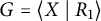 $G=\langle X \mid R_1\rangle $
(so that there is a natural surjection from G to Q). Let
$G=\langle X \mid R_1\rangle $
(so that there is a natural surjection from G to Q). Let $\chi $
be a character of Q such that:
$\chi $
be a character of Q such that:
-
(a)
$[\chi ]\in \Sigma ^2(G)$
(we denote the character of G induced by
$\chi $
by the same symbol), and -
(b) for every
$r\in R\setminus R_1$
, there exists
$g_r\in G$
with
$\chi (g_r)\neq 0$
such that
$g_r$
commutes with the image of r in G.


Then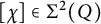 $[\chi ]\in \Sigma ^2(Q)$
.
$[\chi ]\in \Sigma ^2(Q)$
.
Theorem 5.4 is a straightforward consequence of a criterion of Meinert (see Theorem A.1 in Appendix A) established in his Ph.D. thesis [Reference MeinertMei93] (see also a remark after the proof of Corollary 2.8 in [Reference MeinertMei97], where Theorem A.1 is stated in a different language). Since [Reference MeinertMei93] is not easily accessible, we will provide a proof of Theorem A.1 in Appendix A, where we will also explain why it implies Theorem 5.4.
Remark 5.5 Theorem 5.4 is particularly convenient to apply to a group $Q=\langle X\mid R \rangle $
in the case when the majority of relations in R are of the form
$Q=\langle X\mid R \rangle $
in the case when the majority of relations in R are of the form $[x,y]=1$
for
$[x,y]=1$
for $x,y\in X$
; call such relations RAAG-like. In this case, we can let
$x,y\in X$
; call such relations RAAG-like. In this case, we can let $R_1$
be a set of some or all of the RAAG-like relations from R, so that
$R_1$
be a set of some or all of the RAAG-like relations from R, so that $G=\langle X \mid R_1\rangle $
is a RAAG, and therefore
$G=\langle X \mid R_1\rangle $
is a RAAG, and therefore $\Sigma ^2(G)$
is completely determined by the main result of [Reference Meier, Meinert and VanWykMMV98] (see Theorem 5.6 below). This allows us to get a handle on condition (a). As for condition (b), a natural way to ensure this holds is to require that for each relator
$\Sigma ^2(G)$
is completely determined by the main result of [Reference Meier, Meinert and VanWykMMV98] (see Theorem 5.6 below). This allows us to get a handle on condition (a). As for condition (b), a natural way to ensure this holds is to require that for each relator $r\in R\setminus R_1$
, there exists a generator
$r\in R\setminus R_1$
, there exists a generator $x_r\in X$
such that, for every generator x appearing in r, the (RAAG-like) relation
$x_r\in X$
such that, for every generator x appearing in r, the (RAAG-like) relation $[x_r,x]=1$
holds and lies in
$[x_r,x]=1$
holds and lies in $R_1$
. Indeed, in this case, if we set
$R_1$
. Indeed, in this case, if we set $g_r=x_r$
, then condition (b) holds for any
$g_r=x_r$
, then condition (b) holds for any $\chi $
satisfying
$\chi $
satisfying $\chi (x_r)\ne 0$
. The more RAAG-like relations from R are included in
$\chi (x_r)\ne 0$
. The more RAAG-like relations from R are included in $R_1$
, the easier it is to satisfy (b); however (unlike for
$R_1$
, the easier it is to satisfy (b); however (unlike for $\Sigma ^1$
), including too many of the RAAG-like relations in
$\Sigma ^1$
), including too many of the RAAG-like relations in $R_1$
can affect whether (a) holds. Thus, in practice, it can be a balancing act to find the most useful
$R_1$
can affect whether (a) holds. Thus, in practice, it can be a balancing act to find the most useful $R_1$
.
$R_1$
.
Theorem 5.6 below describes the $m=1$
and
$m=1$
and $m=2$
cases of the full computation of the BNSR-invariant
$m=2$
cases of the full computation of the BNSR-invariant $\Sigma ^m$
for an arbitrary RAAG, proved by Meier, Meinert, and Van Wyk in [Reference Meier, Meinert and VanWykMMV98], and also see [Reference Bux and GonzalezBG99] for an alternative proof due to Bux and Gonzalez. Before stating Theorem 5.6, we introduce some standard notation and terminology. Let
$\Sigma ^m$
for an arbitrary RAAG, proved by Meier, Meinert, and Van Wyk in [Reference Meier, Meinert and VanWykMMV98], and also see [Reference Bux and GonzalezBG99] for an alternative proof due to Bux and Gonzalez. Before stating Theorem 5.6, we introduce some standard notation and terminology. Let $\Gamma $
be a finite graph with no loops or multiple edges, and let
$\Gamma $
be a finite graph with no loops or multiple edges, and let $\widehat {\Gamma }$
be the flag complex associated with
$\widehat {\Gamma }$
be the flag complex associated with $\Gamma $
(i.e., the simplices of
$\Gamma $
(i.e., the simplices of $\widehat {\Gamma }$
are precisely the cliques in
$\widehat {\Gamma }$
are precisely the cliques in $\Gamma $
). Let
$\Gamma $
). Let $A_\Gamma $
be the RAAG corresponding to
$A_\Gamma $
be the RAAG corresponding to $\Gamma $
, that is,
$\Gamma $
, that is, $A_{\Gamma }$
has generators
$A_{\Gamma }$
has generators $\{x_v\mid v \mbox { is a vertex of }\Gamma \}$
and defining relations
$\{x_v\mid v \mbox { is a vertex of }\Gamma \}$
and defining relations $[x_v,x_w]=1$
whenever v and w are adjacent.
$[x_v,x_w]=1$
whenever v and w are adjacent.
Let $\chi $
be a nonzero character of
$\chi $
be a nonzero character of $A_{\Gamma }$
.
$A_{\Gamma }$
.
-
• A vertex v of
$\Gamma $
is called living (with respect to
$\chi $
) if
$\chi (v)\neq 0$
and dead otherwise. -
• The living subcomplex of
$\chi $
is the full subcomplex of
$\widehat {\Gamma }$
spanned by the living vertices. -
• A simplex
$\sigma $
of
$\widehat {\Gamma }$
is called dead if all its vertices are dead. -
• The living link of a simplex
$\sigma $
in
$\widehat {\Gamma }$
is the full subcomplex of the link of
$\sigma $
spanned by its living vertices.


Theorem 5.6 [Reference Bux and GonzalezBG99, Reference Meier, Meinert and VanWykMMV98] Let $\Gamma $
and
$\Gamma $
and $A_{\Gamma }$
be as above and
$A_{\Gamma }$
be as above and $\chi $
a nonzero character of
$\chi $
a nonzero character of $A_{\Gamma }$
. The following hold:
$A_{\Gamma }$
. The following hold:
-
(1)
$[\chi ]\in \Sigma ^1(A_{\Gamma })$
if and only if the living subcomplex of
$\chi $
is connected and every dead vertex is adjacent to a living vertex; -
(2)
$[\chi ]\in \Sigma ^2(A_{\Gamma })$
if and only if-
• the living subcomplex of
$\chi $
is simply-connected, -
• the living link of every dead vertex is connected and non-empty, and
-
• the living link of every dead edge is non-empty.
-


Condition (2) is often difficult to check in specific examples; however, its verification can sometimes be avoided entirely as there is a natural condition on $\Gamma $
which guarantees that
$\Gamma $
which guarantees that $\Sigma ^1(A_{\Gamma })=\Sigma ^2(A_{\Gamma })$
, namely, the following.
$\Sigma ^1(A_{\Gamma })=\Sigma ^2(A_{\Gamma })$
, namely, the following.
Definition 5.7 A graph $\Gamma $
is called chordal if any cycle C of length
$\Gamma $
is called chordal if any cycle C of length $\geq 4$
in
$\geq 4$
in $\Gamma $
has a chord, that is, an edge of
$\Gamma $
has a chord, that is, an edge of $\Gamma $
connecting non-consecutive vertices of C.
$\Gamma $
connecting non-consecutive vertices of C.
Whenever $\Gamma $
is chordal we have
$\Gamma $
is chordal we have $\Sigma ^1(A_{\Gamma })=\Sigma ^2(A_{\Gamma })$
[Reference Meier, Meinert and VanWykMMV98, Corollary 6.1], which makes understanding
$\Sigma ^1(A_{\Gamma })=\Sigma ^2(A_{\Gamma })$
[Reference Meier, Meinert and VanWykMMV98, Corollary 6.1], which makes understanding $\Sigma ^2(A_{\Gamma })$
much easier in this case. We now use RAAGs corresponding to chordal graphs to prove our main result of this section, Proposition 5.3.
$\Sigma ^2(A_{\Gamma })$
much easier in this case. We now use RAAGs corresponding to chordal graphs to prove our main result of this section, Proposition 5.3.
Proof of Proposition 5.3
Let $S=\{(1,2),(3,4),(5,6),(7,8),(9,10)\}$
and define the graph
$S=\{(1,2),(3,4),(5,6),(7,8),(9,10)\}$
and define the graph $\Gamma $
as follows. The vertices of
$\Gamma $
as follows. The vertices of $\Gamma $
are all the pairs
$\Gamma $
are all the pairs $(i,j)$
with
$(i,j)$
with $1\leq i\neq j\leq n$
. Two distinct vertices
$1\leq i\neq j\leq n$
. Two distinct vertices $(i,j)$
and
$(i,j)$
and $(k,\ell )$
are adjacent if and only if at least one of them lies in S and
$(k,\ell )$
are adjacent if and only if at least one of them lies in S and $[\alpha _{i,j},\alpha _{k,l}]=1$
in
$[\alpha _{i,j},\alpha _{k,l}]=1$
in $\mathrm {PSAut}_n$
. Note that
$\mathrm {PSAut}_n$
. Note that
-
(i) any two vertices in S are adjacent to each other,
-
(ii) every vertex of
$\Gamma $
is adjacent to a vertex in S, and -
(iii) any vertex of
$\Gamma $
not in S can only be adjacent to vertices that are in S.


If C is a cycle in $\Gamma $
, then either all vertices of C are in S or there is a vertex of C outside of S, in which case both of its neighbors must be in S by property (iii); either way, by (i), C contains a chord as soon as its length is at least 4. Thus,
$\Gamma $
, then either all vertices of C are in S or there is a vertex of C outside of S, in which case both of its neighbors must be in S by property (iii); either way, by (i), C contains a chord as soon as its length is at least 4. Thus, $\Gamma $
is chordal.
$\Gamma $
is chordal.
Now let $Q=\mathrm {PSAut}_n$
(with the McCool presentation) and
$Q=\mathrm {PSAut}_n$
(with the McCool presentation) and $G=A_{\Gamma }$
. By construction, Q is a quotient of G. Let
$G=A_{\Gamma }$
. By construction, Q is a quotient of G. Let $\chi $
be a character of Q such that
$\chi $
be a character of Q such that $\chi (\alpha _{i,j})\neq 0$
whenever
$\chi (\alpha _{i,j})\neq 0$
whenever $(i,j)\in S$
. We need to check that the induced character of G (also denoted by
$(i,j)\in S$
. We need to check that the induced character of G (also denoted by $\chi $
) satisfies the hypotheses of Theorem 5.4. The living subcomplex of
$\chi $
) satisfies the hypotheses of Theorem 5.4. The living subcomplex of $\chi $
contains S and hence is connected by properties (i) and (ii) above. Likewise, property (ii) implies that every dead vertex is adjacent to a living vertex. Hence, by Theorem 5.6(1),
$\chi $
contains S and hence is connected by properties (i) and (ii) above. Likewise, property (ii) implies that every dead vertex is adjacent to a living vertex. Hence, by Theorem 5.6(1), $[\chi ]$
lies in
$[\chi ]$
lies in $\Sigma ^1(G)$
, and
$\Sigma ^1(G)$
, and $\Sigma ^1(G)=\Sigma ^2(G)$
since
$\Sigma ^1(G)=\Sigma ^2(G)$
since $\Gamma $
is chordal. Thus, we have confirmed condition (a) of Theorem 5.4. We now check (b); actually, we will show that it holds for all
$\Gamma $
is chordal. Thus, we have confirmed condition (a) of Theorem 5.4. We now check (b); actually, we will show that it holds for all $r\in R$
, where R is the set of defining relators in the McCool presentation. This is because any
$r\in R$
, where R is the set of defining relators in the McCool presentation. This is because any $r\in R$
involves at most four indices, but S has five elements, so there exists
$r\in R$
involves at most four indices, but S has five elements, so there exists $(k,\ell )\in S$
such that neither k nor
$(k,\ell )\in S$
such that neither k nor $\ell $
appears in the subscript of any generator used in r, whence the corresponding generator
$\ell $
appears in the subscript of any generator used in r, whence the corresponding generator $x_{(k,\ell )}$
of G commutes (in G) with every generator used in r.
$x_{(k,\ell )}$
of G commutes (in G) with every generator used in r.
A A proof of Meinert’s
$\Sigma ^2$
-criterion

The goal of this appendix is to state and prove a criterion of Meinert established in his Ph.D. thesis [Reference MeinertMei93, Satz 5.2.1] and that is the key to proving Theorem 5.4.
In order to state Meinert’s criterion, we need the notion of a generating set for groups with operators. Let H be a group, and suppose we are given a set $\Phi $
together with a map
$\Phi $
together with a map $\Phi \to \operatorname {\mathrm {Aut}}(H)$
. We will say that H is finitely generated as a
$\Phi \to \operatorname {\mathrm {Aut}}(H)$
. We will say that H is finitely generated as a $\Phi $
-group if there exists a finite subset S of H such that the smallest
$\Phi $
-group if there exists a finite subset S of H such that the smallest $\Phi $
-invariant subgroup of H containing S is H itself. If H is a normal subgroup of some group G and
$\Phi $
-invariant subgroup of H containing S is H itself. If H is a normal subgroup of some group G and $\Phi $
is a subset of G, we can view H as a
$\Phi $
is a subset of G, we can view H as a $\Phi $
-group where
$\Phi $
-group where $\Phi $
acts on H by conjugation.
$\Phi $
acts on H by conjugation.
Theorem A.1 (Meinert’s
$\Sigma ^2$
-criterion for quotients)

Let $1\to N\to G\to Q\to 1$
be a short exact sequence of groups, with G and Q finitely presented. Let
$1\to N\to G\to Q\to 1$
be a short exact sequence of groups, with G and Q finitely presented. Let $\chi $
be a nonzero character of Q. Assume that
$\chi $
be a nonzero character of Q. Assume that
-
(i)
$[\chi ]\in \Sigma ^2(G)$
(as before we denote the character of G induced by
$\chi $
by the same symbol); -
(ii) N is finitely generated as a
$G_{\chi \geq 0}$
-group, where
$G_{\chi \geq 0}=\{g\in G\mid \chi (g)\geq 0\}$
.



Then $[\chi ]\in \Sigma ^2(Q)$
.
$[\chi ]\in \Sigma ^2(Q)$
.
This criterion should be compared to the classical fact that $[\chi ]\in \Sigma ^1(G)$
always implies
$[\chi ]\in \Sigma ^1(G)$
always implies $[\chi ]\in \Sigma ^1(Q)$
[Reference Bieri, Neumann and StrebelBNS87, Proposition 3.3].
$[\chi ]\in \Sigma ^1(Q)$
[Reference Bieri, Neumann and StrebelBNS87, Proposition 3.3].
Let us first deduce Theorem 5.4 from Theorem A.1.
Proof of Theorem 5.4
Assume that G and Q are as in Theorem 5.4. Then we have the short exact sequence $1\to N\to G\to Q\to 1,$
where N is the normal closure of the image of
$1\to N\to G\to Q\to 1,$
where N is the normal closure of the image of $R\setminus R_1$
in G. Condition (i) in Theorem A.1 holds by assumption, so we just need to check (ii). By definition, any element
$R\setminus R_1$
in G. Condition (i) in Theorem A.1 holds by assumption, so we just need to check (ii). By definition, any element $n\in N$
can be written as
$n\in N$
can be written as $n=\prod _{i=1}^k a_i r_i^{\pm 1} a_i^{-1}$
, where
$n=\prod _{i=1}^k a_i r_i^{\pm 1} a_i^{-1}$
, where $r_i\in R\setminus R_1$
and
$r_i\in R\setminus R_1$
and $a_i\in G$
(here we are equivocating between
$a_i\in G$
(here we are equivocating between $r_i$
and its image in G). Recall that by the hypotheses of Theorem 5.4, for each
$r_i$
and its image in G). Recall that by the hypotheses of Theorem 5.4, for each $i,$
there exists
$i,$
there exists $g_i$
such that
$g_i$
such that $\chi (g_i)\neq 0$
and
$\chi (g_i)\neq 0$
and $[g_i,r_i]=1$
in G. The latter condition means that in the above expression for
$[g_i,r_i]=1$
in G. The latter condition means that in the above expression for $n,$
we can replace
$n,$
we can replace $a_i$
by
$a_i$
by $a_i g_i^{m_i}$
for any integer
$a_i g_i^{m_i}$
for any integer $m_i$
, and since
$m_i$
, and since $\chi (g_i)\neq 0$
, after doing so we can assume that
$\chi (g_i)\neq 0$
, after doing so we can assume that $a_i\in G_{\chi \geq 0}$
. But this means that N is generated as a
$a_i\in G_{\chi \geq 0}$
. But this means that N is generated as a $G_{\chi \geq 0}$
-group by the finite set
$G_{\chi \geq 0}$
-group by the finite set $R\setminus R_1$
, so hypothesis (ii) in Theorem A.1 holds, as desired.
$R\setminus R_1$
, so hypothesis (ii) in Theorem A.1 holds, as desired.
We now make some preparations for the proof of Theorem A.1. We will start with some terminology and notation. Let X be a set. As usual, by $F(X),$
we will denote the free group with basis X. By
$F(X),$
we will denote the free group with basis X. By $\Omega (X),$
we will denote the set of all finite words in the alphabet
$\Omega (X),$
we will denote the set of all finite words in the alphabet $X\sqcup X^{-1}$
(not necessarily reduced). We can think of
$X\sqcup X^{-1}$
(not necessarily reduced). We can think of $F(X)$
as both a subset and a quotient of
$F(X)$
as both a subset and a quotient of $\Omega (X)$
(the quotient map
$\Omega (X)$
(the quotient map $\Omega (X)\to F(X)$
is a homomorphism of monoids). While no non-empty word in
$\Omega (X)\to F(X)$
is a homomorphism of monoids). While no non-empty word in $\Omega (X)$
is invertible in
$\Omega (X)$
is invertible in $\Omega (X)$
, there is a natural involution
$\Omega (X)$
, there is a natural involution $w\mapsto w^{-1}$
on
$w\mapsto w^{-1}$
on $\Omega (X)$
: if
$\Omega (X)$
: if $w=x_1\dots x_n\in \Omega (X)$
, with
$w=x_1\dots x_n\in \Omega (X)$
, with $x_i\in X^{\pm 1}$
for all i, we set
$x_i\in X^{\pm 1}$
for all i, we set $w^{-1}=x_n^{-1}\dots x_1^{-1}$
, where by convention
$w^{-1}=x_n^{-1}\dots x_1^{-1}$
, where by convention $(x^{-1})^{-1}=x$
for all
$(x^{-1})^{-1}=x$
for all $x\in X$
.
$x\in X$
.
Let R be a subset of $\Omega (X)$
. By
$\Omega (X)$
. By $R^{F(X)}$
, we will denote the normal closure of the image of R in
$R^{F(X)}$
, we will denote the normal closure of the image of R in $F(X)$
. By
$F(X)$
. By $R^{\Omega (X)}$
, we will denote the set of all words of the form
$R^{\Omega (X)}$
, we will denote the set of all words of the form $\prod _{i=1}^k a_i r_i a_i^{-1}$
, where
$\prod _{i=1}^k a_i r_i a_i^{-1}$
, where $a_i\in \Omega (X)$
and
$a_i\in \Omega (X)$
and $r_i\in R^{\pm 1}$
. Thus,
$r_i\in R^{\pm 1}$
. Thus, $R^{\Omega (X)}$
maps onto
$R^{\Omega (X)}$
maps onto $R^{F(X)}$
under the natural projection
$R^{F(X)}$
under the natural projection $\Omega (X)\to F(X)$
.
$\Omega (X)\to F(X)$
.
Definition A.2 Given a word $w=x_1\dots x_n\in \Omega (X)$
with
$w=x_1\dots x_n\in \Omega (X)$
with $x_i\in X^{\pm 1}$
for all i, by a prefix of
$x_i\in X^{\pm 1}$
for all i, by a prefix of $w,$
we will mean a subword of the form
$w,$
we will mean a subword of the form $x_1\dots x_k$
with
$x_1\dots x_k$
with $k\leq n$
. We do allow
$k\leq n$
. We do allow $k=0$
.
$k=0$
.
If X is a generating set of some group G, any character of G naturally induces a character of the group $F(X)$
and a character of the monoid
$F(X)$
and a character of the monoid $\Omega (X)$
(for simplicity, we will not introduce separate notation for those induced characters).
$\Omega (X)$
(for simplicity, we will not introduce separate notation for those induced characters).
Given $w\in \Omega (X)$
and a character
$w\in \Omega (X)$
and a character $\chi $
of
$\chi $
of $\Omega (X)$
, define
$\Omega (X)$
, define
 $$\begin{align*}\chi_{min}(w)= \min\{\chi(v)\mid v\text{ is a prefix of }w\}\text{.} \end{align*}$$
We will say that w is $\chi $
-nonnegative if
$\chi $
-nonnegative if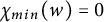 $\chi _{min}(w)= 0$
(since we count the empty word as a prefix,
$\chi _{min}(w)= 0$
(since we count the empty word as a prefix, $\chi _{min}(w)$
is never positive).
$\chi _{min}(w)$
is never positive).
The following observation collects some easy properties of the $\chi _{min}$
function.
$\chi _{min}$
function.
Observation A.3 Let X be a set, and let $u,v\in \Omega (X)$
. The following hold:
$u,v\in \Omega (X)$
. The following hold:
-
(a)
$\chi _{min}(uv)= \min \{\chi _{min}(u), \chi (u)+\chi _{min}(v)\}\geq \chi _{min}(u)+\chi _{min}(v)$
. -
(b) (special case of (a)). If
$\chi (u)=0$
, then
$\chi _{min}(uv)= \min \{\chi _{min}(u),\chi _{min}(v)\}$
. -
(c) If
$\chi (u)=0$
, then
$\chi _{min}(u^{-1})=\chi _{min}(u)$
.



We can rephrase the usual, topological definition of $\Sigma ^2(G)$
combinatorially in terms of
$\Sigma ^2(G)$
combinatorially in terms of $\chi _{min}$
as follows.
$\chi _{min}$
as follows.
Lemma A.4 Let $\langle X\mid R\rangle $
be a finite presentation of a group G, and let
$\langle X\mid R\rangle $
be a finite presentation of a group G, and let $\chi $
be a nonzero character of G. Then
$\chi $
be a nonzero character of G. Then $[\chi ]\in \Sigma ^2(G)$
if and only if
$[\chi ]\in \Sigma ^2(G)$
if and only if $[\chi ]\in \Sigma ^1(G)$
and
$[\chi ]\in \Sigma ^1(G)$
and
-
(Σ2 comb) : there is a constant C such that if
$w\in \Omega (X)$
is any
$\chi $
-nonnegative relator of G, then there exists
$w'\in R^{\Omega (X)}$
such that
$w'=w$
in
$F(X)$
and
$\chi _{min}(w')\geq C$
.



(Note that we must have $C\leq 0$
since
$C\leq 0$
since $\chi _{min}(w')$
is never positive.)
$\chi _{min}(w')$
is never positive.)
Proof Let K be the Cayley complex of G corresponding to the finite presentation $\langle X\mid R\rangle $
. Let
$\langle X\mid R\rangle $
. Let $h_\chi \colon K\to \mathbb {R}$
be as in the definition of
$h_\chi \colon K\to \mathbb {R}$
be as in the definition of $\Sigma $
-invariants.
$\Sigma $
-invariants.
First recall that $\Sigma ^2(G)$
is contained in
$\Sigma ^2(G)$
is contained in $\Sigma ^1(G)$
, and for a character
$\Sigma ^1(G)$
, and for a character $\chi ,$
we have
$\chi ,$
we have $[\chi ]\in \Sigma ^1(G)$
if and only if
$[\chi ]\in \Sigma ^1(G)$
if and only if $K^{h_\chi \ge t}$
is connected for some (or, equivalently, all)
$K^{h_\chi \ge t}$
is connected for some (or, equivalently, all) $t\in \mathbb R$
. Thus, Lemma A.4 only deals with characters
$t\in \mathbb R$
. Thus, Lemma A.4 only deals with characters $\chi $
such that
$\chi $
such that $[\chi ]\in \Sigma ^1(G)$
, and in view of Remark 2.2(b), it suffices to show that the following are equivalent for a given constant
$[\chi ]\in \Sigma ^1(G)$
, and in view of Remark 2.2(b), it suffices to show that the following are equivalent for a given constant $C\leq 0$
:
$C\leq 0$
:
-
(a) the inclusion
$K^{h_\chi \ge 0}\to K^{h_\chi \ge C}$
induces the trivial map
$\pi _1(K^{h_\chi \ge 0},1_G)\to \pi _1(K^{h_\chi \ge C},1_G)$
(note that
$1_G$
lies in both
$K^{h_\chi \ge 0}$
and
$K^{h_\chi \ge 0}$
); -
(b) (
$\Sigma ^2_{\mathrm {{comb}}}$
) holds for C.


We will use the following standard fact about the fundamental groups of CW-complexes. Let Y be a path-connected CW-complex and fix a vertex $v_0$
of Y. Then every element of
$v_0$
of Y. Then every element of $\pi _1(Y,v_0)$
is represented by an edge path, and if p is any closed edge path starting from
$\pi _1(Y,v_0)$
is represented by an edge path, and if p is any closed edge path starting from $v_0$
, then p represents the identity in
$v_0$
, then p represents the identity in $\pi _1(Y,v_0)$
if and only if there exists another closed edge path
$\pi _1(Y,v_0)$
if and only if there exists another closed edge path $p'$
starting from
$p'$
starting from $v_0$
such that:
$v_0$
such that:
-
(1)
$p'$
and p represent the same element in
$\pi _1(Y^1,v_0),$
where
$Y^1$
is the
$1$
-skeleton of Y; -
(2)
$p'$
can be written as a product
$\prod \limits _{i=1}^k\alpha _i \beta _i \alpha _i^{-1}$
, where for each
$i,$
the path
$\alpha _i$
is an edge path from
$v_0$
to some vertex
$v_i$
of Y and there exists a
$2$
-cell
$R_i$
containing
$v_i$
such that
$\beta _i$
is a closed path which starts at
$v_i$
and traverses the boundary of
$R_i$
.


We are now ready to prove the equivalence of conditions (a) and (b) above. Below we will establish the implication “(a) $\Rightarrow $
(b).” The other implication can be proved by just reversing the argument.
$\Rightarrow $
(b).” The other implication can be proved by just reversing the argument.
Suppose (a) holds. Let $w\in \Omega (X)$
be a
$w\in \Omega (X)$
be a $\chi $
-nonnegative relator of G, and let p be the unique edge path in
$\chi $
-nonnegative relator of G, and let p be the unique edge path in $\operatorname {\mathrm {Cay}}(G,X)$
starting at
$\operatorname {\mathrm {Cay}}(G,X)$
starting at $1_G$
whose label is w. Note that p is closed since w is a relator of G.
$1_G$
whose label is w. Note that p is closed since w is a relator of G.
The assumption that w is $\chi $
-nonnegative means precisely that p lies in
$\chi $
-nonnegative means precisely that p lies in $K^{h_\chi \ge 0}$
, so by our choice of C, the path p represents the identity in
$K^{h_\chi \ge 0}$
, so by our choice of C, the path p represents the identity in $\pi _1(K^{h_\chi \ge C},1_G)$
. Thus, there exists a closed edge path
$\pi _1(K^{h_\chi \ge C},1_G)$
. Thus, there exists a closed edge path $p'$
in
$p'$
in $Y=K^{h_\chi \ge C}$
satisfying (1) and (2) above. Let
$Y=K^{h_\chi \ge C}$
satisfying (1) and (2) above. Let $w'\in \Omega (X)$
denote the label of
$w'\in \Omega (X)$
denote the label of $p'$
. Condition (1) means precisely that
$p'$
. Condition (1) means precisely that $w=w'$
in
$w=w'$
in $F(X)$
, and condition (2) means precisely that
$F(X)$
, and condition (2) means precisely that $w'\in R^{\Omega (X)}$
with
$w'\in R^{\Omega (X)}$
with $\chi _{min}(w')\geq C$
. Thus,
$\chi _{min}(w')\geq C$
. Thus, $w'$
satisfies the conclusion of (
$w'$
satisfies the conclusion of ( $\Sigma ^2_{\mathrm {{comb}}}$
), and therefore (b) holds.
$\Sigma ^2_{\mathrm {{comb}}}$
), and therefore (b) holds.
We can now prove Meinert’s criterion.
Proof of Theorem A.1
To reiterate the setup, we have a short exact sequence of groups $1\to N\to G\to Q\to 1$
with G and Q finitely presented, and a nonzero character
$1\to N\to G\to Q\to 1$
with G and Q finitely presented, and a nonzero character $\chi \colon Q\to \mathbb {R}$
, with
$\chi \colon Q\to \mathbb {R}$
, with $\chi $
also denoting the induced character of G. We are assuming that
$\chi $
also denoting the induced character of G. We are assuming that $[\chi ]\in \Sigma ^2(G)$
and that N is finitely generated as a
$[\chi ]\in \Sigma ^2(G)$
and that N is finitely generated as a $G_{\chi \ge 0}$
-group. Our goal is to prove that
$G_{\chi \ge 0}$
-group. Our goal is to prove that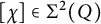 $[\chi ]\in \Sigma ^2(Q)$
.
$[\chi ]\in \Sigma ^2(Q)$
.
Since $[\chi ]\in \Sigma ^1(G)$
, we clearly have
$[\chi ]\in \Sigma ^1(G)$
, we clearly have $[\chi ]\in \Sigma ^1(Q)$
[Reference Bieri, Neumann and StrebelBNS87, Proposition 3.3]. Hence, by Lemma A.4, it suffices to show that
$[\chi ]\in \Sigma ^1(Q)$
[Reference Bieri, Neumann and StrebelBNS87, Proposition 3.3]. Hence, by Lemma A.4, it suffices to show that $\chi $
considered as a character of Q satisfies (
$\chi $
considered as a character of Q satisfies ( $\Sigma ^2_{\mathrm {{comb}}}$
).
$\Sigma ^2_{\mathrm {{comb}}}$
).
Fix a finite presentation $\langle X\mid R\rangle $
of G. Choose a finite subset
$\langle X\mid R\rangle $
of G. Choose a finite subset $R_Q$
of
$R_Q$
of $\Omega (X)$
whose image in G generates N as a
$\Omega (X)$
whose image in G generates N as a $G_{\chi \geq 0}$
-group, and set
$G_{\chi \geq 0}$
-group, and set
 $$\begin{align*}C_Q = \min\{\chi_{min}(r)\mid r\in R_Q\}\quad\text{ and}\quad C_X = \max\{\chi(x)\mid x\in X\sqcup X^{-1}\}\text{.} \end{align*}$$
Note that $C_Q\le 0$
and
$C_Q\le 0$
and $C_X>0$
. Next, let
$C_X>0$
. Next, let $C_G\leq 0$
be a constant for
$C_G\leq 0$
be a constant for $\chi $
considered as a character of G in (
$\chi $
considered as a character of G in ( $\Sigma ^2_{\mathrm {{comb}}}$
), and set
$\Sigma ^2_{\mathrm {{comb}}}$
), and set
 $$\begin{align*}C = C_Q - C_X + C_G\text{.} \end{align*}$$
Note that $C<C_Q$
.
$C<C_Q$
.
We will show that ( $\Sigma ^2_{\mathrm {{comb}}}$
) holds for
$\Sigma ^2_{\mathrm {{comb}}}$
) holds for $\chi $
as a character of Q using this constant C and the finite presentation
$\chi $
as a character of Q using this constant C and the finite presentation $Q=\langle X\mid R\cup R_Q\rangle $
. Let
$Q=\langle X\mid R\cup R_Q\rangle $
. Let $w\in \Omega (X)$
be a
$w\in \Omega (X)$
be a $\chi $
-nonnegative relator of Q. The image of w in G lies in N, so we can choose
$\chi $
-nonnegative relator of Q. The image of w in G lies in N, so we can choose $v\in \Omega (X)$
with
$v\in \Omega (X)$
with $v=w$
in G such that
$v=w$
in G such that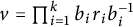 $v=\prod _{i=1}^k b_i r_i b_i^{-1}$
, for some
$v=\prod _{i=1}^k b_i r_i b_i^{-1}$
, for some $r_i\in R_Q^{\pm 1}$
and
$r_i\in R_Q^{\pm 1}$
and $b_i$
satisfying
$b_i$
satisfying $\chi (b_i)\geq 0$
for each i. Since
$\chi (b_i)\geq 0$
for each i. Since $[\chi ]\in \Sigma ^1(G)$
, without loss of generality,
$[\chi ]\in \Sigma ^1(G)$
, without loss of generality, $\chi _{min}(b_i)\geq 0$
for all i; by Observation A.3(b), this ensures that
$\chi _{min}(b_i)\geq 0$
for all i; by Observation A.3(b), this ensures that $\chi _{\min }(v)\geq C_Q$
. Now set
$\chi _{\min }(v)\geq C_Q$
. Now set $u= wv^{-1}$
, so u is a relator of G, and since
$u= wv^{-1}$
, so u is a relator of G, and since $\chi _{min}(w)=0$
by assumption, we compute using Observation A.3(b)(c) that
$\chi _{min}(w)=0$
by assumption, we compute using Observation A.3(b)(c) that
 $$\begin{align*}\chi_{min}(u)\geq \min\{\chi_{min}(w),\chi_{min}(v^{-1})\}=\chi_{min}(v^{-1})=\chi_{min}(v)\geq C_Q\text{.} \end{align*}$$
Next choose $x\in X\sqcup X^{-1}$
with
$x\in X\sqcup X^{-1}$
with $\chi (x)>0$
, and choose
$\chi (x)>0$
, and choose $n\ge 0$
minimal such that
$n\ge 0$
minimal such that $\chi (x^n)\geq -C_Q$
. By minimality,
$\chi (x^n)\geq -C_Q$
. By minimality, $\chi (x^n)< -C_Q + C_X$
. Set
$\chi (x^n)< -C_Q + C_X$
. Set $u'= x^n u x^{-n}$
, so
$u'= x^n u x^{-n}$
, so $u'$
is a
$u'$
is a $\chi $
-nonnegative relator of G. Since
$\chi $
-nonnegative relator of G. Since $[\chi ]\in \Sigma ^2(G),$
we can choose
$[\chi ]\in \Sigma ^2(G),$
we can choose $u"\in R^{\Omega (X)}$
such that
$u"\in R^{\Omega (X)}$
such that $u'=u"$
in
$u'=u"$
in $F(X)$
and
$F(X)$
and $\chi _{min}(u")\geq C_G$
. Say
$\chi _{min}(u")\geq C_G$
. Say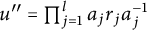 $u"=\prod _{j=1}^l a_j r_j a_j^{-1}$
for some
$u"=\prod _{j=1}^l a_j r_j a_j^{-1}$
for some $a_j\in \Omega (X)$
and
$a_j\in \Omega (X)$
and $r_j\in R^{\pm 1}$
. Since
$r_j\in R^{\pm 1}$
. Since $\chi (a_j r_j a_j^{-1})=0$
for all j, by Observation A.3(b), we get
$\chi (a_j r_j a_j^{-1})=0$
for all j, by Observation A.3(b), we get
 $$\begin{align*}\min_j \{\chi_{min}(a_j r_j a_j^{-1})\}=\chi_{min}(u")\geq C_G \text{.} \end{align*}$$
But now we can rewrite w as an element of $F(X)$
as follows:
$F(X)$
as follows:
 $$\begin{align*}w=uv=(x^{-n}u' x^n)v=(x^{-n}u" x^n)v = \left(\prod_{j=1}^l x^{-n} a_j r_j a_j^{-1}x^{n}\right)\cdot v \text{.} \end{align*}$$
Let $w'\in \Omega (X)$
denote this last word. Since
$w'\in \Omega (X)$
denote this last word. Since $v\in R_Q^{\Omega (X)}$
, we have that
$v\in R_Q^{\Omega (X)}$
, we have that $w'$
lies in
$w'$
lies in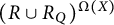 $(R\cup R_Q)^{\Omega (X)}$
and
$(R\cup R_Q)^{\Omega (X)}$
and $w=w'$
in
$w=w'$
in $F(X)$
. The only thing remaining is to prove that
$F(X)$
. The only thing remaining is to prove that $\chi _{min}(w')\ge C$
. Using Observation A.3(b) again, we have
$\chi _{min}(w')\ge C$
. Using Observation A.3(b) again, we have
 $$\begin{align*}\chi_{min}(w') = \min\{\chi_{min}(v), \chi_{min}(x^{-n} a_j r_j a_j^{-1}x^{n})\mid 1\leq j\leq l\}\text{.} \end{align*}$$
If $\chi _{min}(w')=\chi _{min}(v)$
, then
$\chi _{min}(w')=\chi _{min}(v)$
, then $\chi _{min}(w')\ge C_Q> C$
and we are done. Now suppose that
$\chi _{min}(w')\ge C_Q> C$
and we are done. Now suppose that $\chi _{min}(w')=\chi _{min}(x^{-n} a_j r_j a_j^{-1}x^{n})$
. By Observation A.3(a), we have
$\chi _{min}(w')=\chi _{min}(x^{-n} a_j r_j a_j^{-1}x^{n})$
. By Observation A.3(a), we have
 $$\begin{align*}\chi_{min}(x^{-n} a_j r_j a_j^{-1}x^{n})\geq \chi_{min}(x^{-n})+\chi_{min}(a_j r_j a_j^{-1})+\chi_{min}(x^{n})\text{.} \end{align*}$$
By construction, we have $\chi _{min}(x^{-n})> C_Q - C_X$
,
$\chi _{min}(x^{-n})> C_Q - C_X$
, $\chi _{min}(x^{n})= 0$
, and
$\chi _{min}(x^{n})= 0$
, and $\chi _{min}(a_j r_j a_j^{-1})\geq C_G$
, so putting everything together, we get
$\chi _{min}(a_j r_j a_j^{-1})\geq C_G$
, so putting everything together, we get $\chi _{min}(w')\geq C_Q-C_X+C_G = C$
, as desired.
$\chi _{min}(w')\geq C_Q-C_X+C_G = C$
, as desired.
Acknowledgements
The authors are grateful to Sam Hughes, Dawid Kielak, and Lorenzo Ruffoni for helpful discussions and pointers to references. The authors also thank the referee for many helpful suggestions.





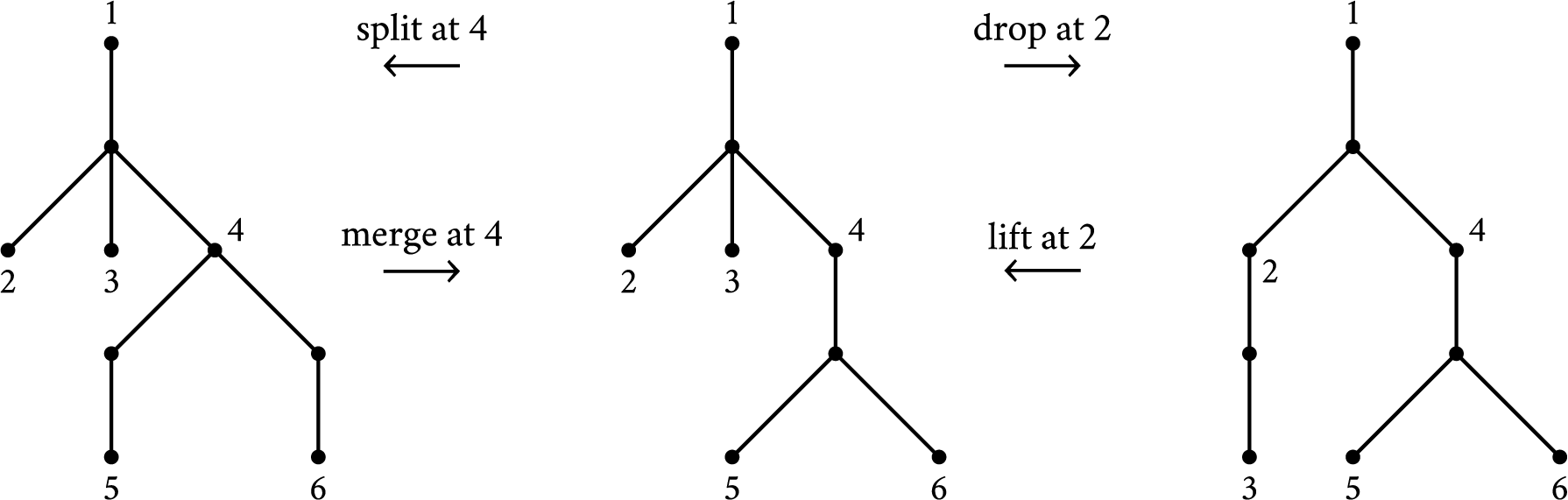

 Open access

