

Repeatedly, the Russian Revolutions have attracted the world's interest. But the emergence of this revolutionary movement was by no means only a Russian matter. Even before Red October, it had a great impact on movements and societies around the globe. Moreover, the Russian movement itself relied on actors who lived and worked far from Russian itself. In the “age of the great migrations”, even the formation of a movement against a very specific political system depended on transnational transfers and global communication. Yet, histories of the Russian revolutions of 1905 and 1917 barely acknowledge this fact.Footnote 1 The reasons for this lack of attention lie in these historians’ limited focus on one society, leading them to neglect the relevance of exchange and migration. Here I argue for taking these transfers and these migrants’ histories into account by introducing “actor-network theory” into the history of social movements. This will allow us to leave behind simplified understandings of emigration and immigration and rather shift focus to migrants’ transnational network building.
ACTOR-NETWORK THEORY AND HISTORY
This shift has its foundation in new theoretical questions that arise from the new perspectives on the modes and matters of the formation of associations, collectives, and also institutions. By this I refer to the theoretical question of how actor-network theory (ANT) can contribute to our understanding of the history of societies. Why is this a question worth asking? In the last few years ANT has developed into one of the most influential and most controversial approaches in social science, but it has, however, only rarely been accepted in historiography.Footnote 2 In the following reflections I shall start by a brief sketch of the theory itself. I shall present it “in action” and demonstrate how far ANT allows us to change perspectives and rethink the relationship between issues, both local and global, in history and in historiography.Footnote 3
I will not focus on the controversial debates centring on ANT's claim of the relevance of the “agency of objects”, which for historians should be less of a challenge than it is for sociologists.Footnote 4 To put it simply, ANT values not only human agency but also the possible agency of “microbes, scallops, rocks, and ships”.Footnote 5 No historian will deny that ships, inventions, and landscapes have massively changed the course of history, so they are naturally part of our considerations, but it is much harder for sociologists to include them in their primary field of concern: human society.Footnote 6
However, ANT's second claim also proves to be a challenge for historians, especially for social historians. ANT posits that analysis of actors in the modern world often argues in terms of “social categories”, which serve as background and explanation for motivations and mobilizations on the part of those actors.Footnote 7 But in the last two decades, ANT-inspired studies have shown time and again that this “social” often functions as an explanatory black box, a pseudo-entity that refers to the stabilization of arguments and not the uncovering of actors’ behaviour. If the “social” is to receive explanatory power, it must be explored as a network of networks, held together by actions and associations. According to this, neither the “social” nor the actors who constitute it are well-defined units, but rather loose and ever-changing networks and associations of other actor-networks.Footnote 8 Hence the hyphen in actor-network theory. According to ANT, one cannot simply “tell” the history of an actor, such as a person, a party, or any other “unit” under consideration. It is necessary to examine the formation of the agency involved which can only potentially lead to the creation of associations – and maybe a “social”. With good reason, ANT therefore demands that research should not start with events taking place in societies but rather with its base, the formation of groups, networks, and societies.Footnote 9 In short, the “social” is the explanandum, not the explanans.
Aside from the polemics surrounding ANT, it in fact merges refined versions of praxeology with network analysis. ANT centres on events, and the agencies of networks that were involved in their becoming. Therefore it sees no “context”, only “text” as interactions of collectives shaped by relations (or impacted by their interruption).Footnote 10 These collectives are connected to various settings (or constellations) and thereby transcend common conceptualizations of the micro/macro or local/global divide.Footnote 11 This distinct definition of collectives as actor-networks allows the development of a social historical perspective towards a close relation between the old antagonists, “structure” and “agency.” This, of course, is an enormous challenge for scholars working on the history of modern societies. But it also reduces the controversial potential that the first generation of ANT researchers created: from a historian's standpoint, in fact, ANT should not be considered a fully-fledged theory but rather a new perspective that will help to substantiate the recent turn towards practices in history, also combining it with the other turn towards transnationalism and transfers by stressing the importance of omnipresent change and re-orientation, group formation, interactions, and the relevance of agency in both local and trans-local networks. The key features of ANT are a new “flat” and relational perspective and a set of terms that allow thinking and observation.Footnote 12 Without engaging in “science wars”, we can use it to derive a very practical perspective on transnational history as a set of relations shaped by actor-networks, consisting of collectives engaged in local and global interactions.Footnote 13 This calls for both grassroots studies and comparative analysis.Footnote 14
Using ANT as an analytical perspective and not as an interpretative “frame” should make it still more welcome for historians. It opens the door for a demonstrative case study that connects local and global histories and follows these new perspectives in order to overcome the “methodological nationalism” which for decades has limited our perspective on the history of modern societies.Footnote 15 I will demonstrate this by focusing on the formation and the agency of RussianFootnote 16 actor-networks in the process of globalization and modern Jewish diaspora life which from 1897 onwards crystallized into a major political, social, and cultural movement: the General Jewish Labour Bund. The Bund is a striking example of the revealing power of ANT in historiography, since until now it has been understood as a party limited to a certain time and place. However, it became one of the strongest and most successful “modernizers” of Jewish life in eastern Europe and – as I will demonstrate – in Jewish emigration. This case study will therefore start with the formation of the Bund as a history of practices which eventually created a Bundist “social” and identity. From there it will lead up to a history of how radical activism, emerging from Russian revolutionary circles, influenced the development of a self-confident and secular Jewish diaspora life. This will transcend the nationalized reading of the “old” social movements by focusing on migration history and exploring networks spanning oceans and political systems.
THE BUNDIST DOIKEYT: FROM LOCAL TO GLOBAL
The Bund, after its foundation in Vilna 1897, received broad support in the “yidishe gas”, the east European Jewish street, as a revolutionary social-democratic, anti-traditional, and anti-tsarist force.Footnote 17 The Bundist approach of “making history happen” marks a turning point in the history of east European Jewry. The Bund spread rapidly across the Pale of Settlement because it could rely on a huge bandwidth of worker activism. Springing originally from the east European shtetlekh, the Bund reassembled itself in places of Jewish immigration. Best known are the Bundist organizations in the United States, such as the Tsentral Farband fun di Bundistishe Organizatsyonen in Amerika (1903), the Jewish Agitation Office (1908), and the Bund Club in New York, founded in 1923.Footnote 18 Bundist groups also emerged in Argentina, Mexico, Australia, South Africa – even Cuba.Footnote 19 For emigrants, the transfer of Bundist thought was natural as it belonged to their activist identities, but the formation of new Bundist organizations was more problematic because Bundism itself was not designed for a transnational transfer and the formation of new associations in societies entirely different from Russia or independent Poland.
Bundism first had to deal with an inherent paradox: it relied on Marx's dictum that “[t]hough not in substance, yet in form, the struggle of the proletariat with the bourgeoisie is at first a national struggle. The proletariat of each country must, of course, first of all settle matters with its own bourgeoisie.”Footnote 20 Bundist unions aggressively attacked factory owners and whomever they considered the Jewish bourgeoisie, but nevertheless neither Judaism, nor Russia, nor the transnational Bund in emigration matched Marx's fundamental unit: the nation-state. In another multi-ethnic empire, the Austro-Marxist movement faced similar problems.Footnote 21 The Bund gladly shared its concept of national-cultural autonomy and developed it into the non-Zionist, Yiddish-based, cultural, and activist concept of doikeyt (literally “here-ness”, from Yiddish do, “here”), a positive notion of Jewish diaspora life by means of high-risk activism as well as collective solidarity among workers and/or Jews.Footnote 22
Doikeyt in fact was the conceptual and practical foundation of the Bundist movement. It emphasized the necessity of class war as well as a cultural programme based on the assumption that Jewish life, identity, and experience did not stem from the Jewish religion but rather from a collective cultural experience that found its daily expression in the Yiddish language. It was this experience that had created a twofold “class problem” of Jewish life in tsarist Russia because, as the Bund put it, the Jewish workers were subject to a twofold oppression: by the “capitalist” and autocratic state, and by the traditional religious Jewish elites. Bundists rejected both obedience and emigration to Palestine (aliyah) as solutions, and favoured a socialist revolution right “here”, in the place of living; they no longer waited for the advent of a Messiah. This concept of “making history happen” triggered a huge variety of actions, through to the famous formation of Bundist self-defence groups against pogroms.
This was not only a qualitative shift: the Bund quickly became a mass movement with tens of thousands of illegal members who vociferously challenged state and Jewish leaders. More importantly, they undermined traditional authority by changing the pejorative notion of the Hebrew galut, exile as punishment, into “home”. This employed a positive understanding of diaspora life which inseparably merged with Marxist expectations of an “exodus via revolution”, also requiring the secular genesis of a new society, a society literally “made” by socialist activists.Footnote 23 Life in the diaspora, to speak in ANT's terminology, was not a punishment, nor a problem; it was a setting which allowed the Bundist to combine Marxist thought with Jewish problems in Russia, and to develop new collectives engaged in a fight for a better tomorrow. This, of course, was not exclusive to the Bund, but its strict insistence on Jewish culture and the crucial role of the Yiddish language always linked it with the “Jewish street”, where it became the most successful social movement before World War II.
The Bund, I argue, was a transnational network of socialist activism that finally led to a culturally confident workers’ movement.Footnote 24 This places practices before ideology and identification, a notion supported not only by workers’ own depictions, but also by Vladimir Medem, the epitome of the Bundist intelligencija. In his widely cited reminiscences, Medem recaptures activism for the movement as a precondition to what he only later learned to be a “Bundist identity”. In his first political exile in Switzerland he thought about this for the first time:
During my very first days in Berne I remember how [comrade] Teumin would point to one another individual on the street and say to me: “That's a ‘Bundist’.” I was still green at that time and, at first, didn't know what he meant. The term Bundist was strange to me; we never used it in Russia. Within the movement proper, in a place like Minsk, for example, or Vilnius, people were said to work in the Bund; this was self-evident. But what precisely did it mean to be a “Bundist” in Berne, in Switzerland, where there was no Jewish Labour movement?Footnote 25
Only in exile in Switzerland before 1905 did he realize that one could not only be active for the Bund, one could also develop an identity and become (and be depicted as) a “Bundist”.Footnote 26 Medem thereby underlines that the decisive point for becoming a Bundist was not membership status but simply working in the Bund. Similar positions can be found in workers’ autobiographies, such as those of Layb Berman, Hersh Mendel, or Yoel Novikov.Footnote 27
The subsequent emergence of a mass movement was closely observed by journalists and workers worldwide, which actually raised the importance of Bundism in Jewish life.Footnote 28 This led to the creation of numerous institutions which Bundist labour migrants sought to transfer to the New World. With the advent of thousands of Bundists into Jewish communities overseas from 1900–1901 and later, a new socialist mobilization emerged which caused multiple alliances and severe conflicts with surrounding movements and parties in countries such as Argentina and the United States – just as it did in Russia.Footnote 29
THE OMNIPRESENCE OF “HERE”: BUNDISM IN MIGRATION
When we understand doikeyt as the crucial element of Bundism, we need to set aside debates about ideology and the relationship of the Bund leaders to Lenin or others, and first approach the history of the Bund as a history of practices within Bundist networks.Footnote 30 Only practices enabled activists to develop their own Jewish identity via “being Bundist”.Footnote 31 This identity was based on the collective experience of the anti-tsarist struggle in Russia and centred on the “heroic” years 1901–1905.Footnote 32 During these years, Bundist activism exploded, leading to many local and illegally printed periodicals, illegal libraries, self-organized circles, and union branches, the foundation of cultural centres, self-defence groups, and many other initiatives.Footnote 33 These were not the spontaneous acts that Lenin considered them to be; they belonged to the Bundist creation of “a completely new way of life, a new framework in which to live and work”, and thereby deeply influenced the self-perception of activists.Footnote 34
This became transnational when, in the age of great migrations, many of them travelled overseas. Simultaneously in the centres of immigration, New York and Buenos Aires, strikes, meetings, and demonstrations emerged. This time saw the creation and uprising of many new institutions: the Arbeter-ring, the ILGWU, the Amalgamated Clothing Workers of America, the Jewish Socialist Federation (Yidishe Sotsyalistishe Federatsye), the Jewish Socialist Farband, and later even the YIVO were all inspired by immigrated Bundists and subject to “Bund-type radical activism”, as Françoise Basch has described it.Footnote 35 This means that the concept of doikeyt must have somehow “migrated” with the Bundists. But how? How could well-known but entirely localized practices be applied far from “di alte heym” – the old home – and be brought to the New World, where, as Eli Lederhendler has recently reminded us, the conditions of life and labour were so different?Footnote 36
Bundist groups were well equipped for this transfer. Because of their fervent activism they enjoyed, as Jonathan Frankel stated, a “head start”. It was precisely the acceptance of local situations, which divided Bundism from Zionism and communism, that propelled agency in new societies. It also enabled them to sponsor the Bund financially in the old country where the “[r]evolutionary organizations depended to an extraordinary extent on the ebb and flow of fundraising”.Footnote 37 To understand this connection, we must first remember that between 1899 and 1915 approximately 1.5 million Jews migrated to the United States alone, almost half of whom arrived between 1903 and 1907, and that they included a significant proportion of migrants who had prior experience with revolutionary movements, particularly Bundist activism.Footnote 38 The transnational exchange between the American and Russian Yiddish-speaking revolutionaries was based in the “eastward influence” that American intellectuals exercised before the foundation of the Bund.Footnote 39 But with mass migration a strong westward influence emerged, this time based more on worker activism than solely on the intellectual export of socialism.
Secondly, migration did not cut off roots. Even though Jewish immigrants to America encountered a completely new economic system, which heavily influenced their political self-perception, the Old and New Worlds were still deeply linked;Footnote 40 transfers were much more important than a simple Old World/New World antagonism can capture.Footnote 41 Despite immigration into new economic systems, the 1,000 personal documents of Bundist activists that I have examined reveal that Bundists remained Bundists even in the absence of the movement, and recreated the movement because of this very absence.Footnote 42 Even a large number of those who abandoned socialism after emigration refashioned their specific Bundist self-perception not as revolutionaries, but as Yiddishist cultural activists with strong Bundist roots.Footnote 43 This cultural activism consisted of the same three major pillars as doikeyt: the relevance of a “national” language (folkssprakh), personal participation in the creation of a better society (gezelshaftlekhe tuer), and the experience of self-organization.
This fundamentally challenges the regionalist and surprisingly static bias that dominates the historiography of the Bund. And this becomes evident when we note that migration had always been a crucial element in the formation of the Bund. Apart from the special case of Holocaust migration, there were three types of migration that constantly influenced the creation of the “Bundist social”: internal, external, and distant long-term.
Internal migration from one shtetl to another was common to everyday Jewish life in tsarist Russia. Nevertheless, the workers’ movement spurred this migration by the paths of agitation, organization, and political persecution. The strict persecution of any oppositional movement in Russia brought economic activism close to political conspiracy, which only strengthened the experience of group belonging between travellers and locals. Political activism sought recognition, trust, and khavershaft (literally: comradeship and/or friendship). Even though Jewish life in the Pale of Settlement experienced dramatic social downward mobility, workers could achieve internal upward mobility by travelling and organizing groups of workers throughout the territory.Footnote 44
External refuge was a result of the illegal status of the Russian Bund. This migration was conceptualized as temporary and frequent from the very first days of Bund until 1917. In the beginning, it was mainly intellectual leaders who went into exile in Belgium, Switzerland, France, or London; many workers later followed.Footnote 45 The Bund therefore had a dual leadership: the Central Committee hidden in Russia and the Foreign Committee in Switzerland.Footnote 46 Apart from these central institutions, many local groups emerged which tried to maintain ties with Russia. In 1907 the leading Bundist Benzion Hofman (Zivion) was impressed by a meeting of 1,000 Bundists in Paris who were, as he depicted in a Russian Yiddish journal, “already half Frenchmen” but still convinced Bundists and deeply devoted to Russian matters. Zivion understood the importance of supporting these workers and prompted the Bund to create foreign clubs as official Bundist places in the emigrant community.Footnote 47 Such groups were not implanted colonies of the Bund; they were created at the grass roots by emigrants who considered Bundism fundamental to their self-perception and created actor-networks that associated local settings with the Bundism they knew from Russia. Most importantly, their fundraising brought the two sides together and led to intensive transnational exchange via a broad bandwidth of activities, ranging from individual campaigns through visits of leading Bundists to the organization of many fundraising institutions. As a result, these small clubs and groups were the source for the transnationalization of the Bund.
On the other side of the Atlantic, similar associations emerged from the earliest years through distant and long-term emigration. As in Europe, these groups were created by migrating Bundists and partially supported by the Russian Bund itself. At the third annual convention of American Bundist organizations, held in New York in 1906, the National Secretary, Israel Bergman, proudly declared the existence of approximately twenty local Bundist organizations in the US alone, accompanied by clubs all over the world, from Montreal to Cape Town. This was flanked by a global smuggling network that, for instance, even reached Jewish prisoners-of-war in Japan.Footnote 48 Furthermore there were many Bundist groups and organizations not officially associated with the Foreign Committee, among them early groups in Germany and, most importantly, the Avangard in Buenos Aires.
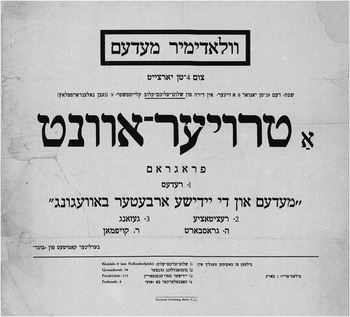
Poster of a commemorative evening on Vladimir Medem (b. 1879) held in Berlin in 1927. In 1923 Medem had died in New York from the long-term effects of the nephritis that he had contracted in a tsarist prison. As in this case, commemorative events all over the world provided an occasion for local Bundist reunions, propaganda by recent Bundist leaders, and for reintegration of emigrated and deceased activists as virtual actors in the network of the Bund. Collection IISH
Structurally, the clubs in the Americas differed from their European counterparts. Unlike the exile of politically motivated European emigration, chain and network migration made overseas assemblages subject to long-term transfers, increasing membership and personal ties. These groups also had a much lower fluctuation in membership and alliances.Footnote 49 Bundists knew that they would stay, and that these countries were in the process of providing a new “here”, a new “do”. But they were still strongly attached practically and emotionally to Russia, where they hoped that the revolution would finally succeed. When it did so in October 1917, Bundists experienced an internal division; within a few months almost all Bundist organization overseas split into socialist and communist factions that from now on not only interpreted events in Russia differently, but also the necessary forms of local work. For these transnational collectives, local problems had the same importance as Russian ones. But this attachment to Russia and its “need” for a revolution was not mirrored in re-emigration after 1917. Most of these activists remained overseas in 1917 and even those who went back, like the famous Bundist Abraham Litvak, often quickly returned. The disillusion that Alexander Berkman described in his diary was not a uniquely anarchist experience, it struck many Bundists as well.Footnote 50 But they did not re-emigrate to independent Poland where the Bund was a legal party and successful cultural actor; America already had become a new “home”, though naturally still a problematic one in the eyes of socialists.
ACTIVISM IN MIGRATION: USA
The establishment of Bundism in the United States was facilitated by experienced Bundists, who quickly gathered around self-created centres of activism. Even before the foundation of an American umbrella organization in 1903, Bundists had nine local organizations and eight landsmanshaftn. These were all created by self-organizing, Yiddish-speaking workers. Moreover, many Bundists also affiliated themselves with the newly emerging Socialist Party and deployed their Bundism within the party. To merge Bundism with American socialism required the formation of new actor networks, which materialized in new organizations: first of all the Jewish Agitation Office, and from 1912 the much more successful Jewish Socialist Federation, agitated strongly among Jewish workers and received recognition as the Yiddish-language branch of the rising Socialist Party. The famous and influential Abraham Cahan cooperated to some extent with the Federatsye, though he also voiced the suspicion that it wanted to create a “Bund in America”.Footnote 51 His claim was certainly not unsubstantiated: the leadership of the Federatsye consisted largely of the same persons as the American Bundist groups. Moreover, the publication of its own periodicals was both a contribution to American socialism and a challenge to the omnipresent Forverts.
Bundists also had an enormous influence on the most prominent associations in the American Jewish workers’ milieu, the ILGWU and the Arbeter-ring.Footnote 52 Such institutions assembled themselves by merging the agency of the American “setting” with Bundist practices and Bundist identities.Footnote 53 They were hence closely connected to the Russian “social” in the emigrant community, but even if they never became a Bund, they were, as the Bundist and long-term general secretary of the Arbeter-ring, Joseph Baskin, stated in 1927, “undoubtedly a direct outgrowth of the Bund and its position on general Jewish and cultural issues”.Footnote 54 That is why I refer to them as institutions of a secondary Bundism, which transferred Bundist thought and action into the functionally highly differentiated American society.
Secondary Bundism adopted Bundist activism without its organizational framework and therefore developed its own kind of secular Jewish modernity in America. This adaptation was a very successful mobilizer. With the shift of the Arbeter-ring from a marginal health insurance association towards a political and cultural one, secondary Bundist organizational membership rocketed up to 80,000; the ILWGU rose from a few hundred members before 1909 to a mighty union of some 50,000 members after the shirtwaistmakers’ strike,Footnote 55 a walkout driven by “Bund-type radical activism”.Footnote 56 This transfer to secondary Bundism was highly necessary: the establishment of an independent Bundist journal in 1905 – the New York Kemfer – failed after poor sales of the 15,000 printed copies.Footnote 57 A distinct “Bundist” organ would not appear until 1941, when newly arrived immigrants founded Unzer tsayt in New York. Secondary Bundist papers like the Der yiddisher sotsyalist and its successor Der veker, by contrast, existed for decades and influenced both Yiddish and socialist culture in the United States.
Whilst Bundist organizations themselves did not have a strong impact on American Jewish history, secondary Bundist groups were of crucial importance for the local adaptation of a modern Bundist life in the Jewish diaspora. Secondary Bundism relied on major ideas of Bundism, like doikeyt and yidishkayt, whereas the Bund as a general association seemed unsuited to political and economic conditions in the USA. There were still, however, hundreds of Bundist groups all over the country. They existed because American Bundist organizations were of great importance to eastern European Jewish socialism – a transnational influence that secondary Bundist organizations barely achieved.Footnote 58
Actors, I argue, were absolutely aware of this functional differentiation, making active use of it and creating associations and institutions accordingly. That is why branches of the Arbeter-ring actively founded Bundist groups in the US: fourteen such groups were created in 1905 alone – and Bundist branches, on the other hand, “agitated” the Arbeter-ring for Bundist purposes, including both politics and fundraising.Footnote 59 Their transnationalism was double-sided: on the one hand it inspired the formation and institutionalization of new collectives which were deeply embedded in the setting of the workers’ movement in America, while on the other hand these organizations contributed to the increasing transfer of Bundism to the United States as well as to a transnational Yiddish culture. Unlike for the Forverts and Abraham Cahan, for these groups Yiddish culture was not a means of Americanization, but of the creation of an “east European social” abroad.Footnote 60
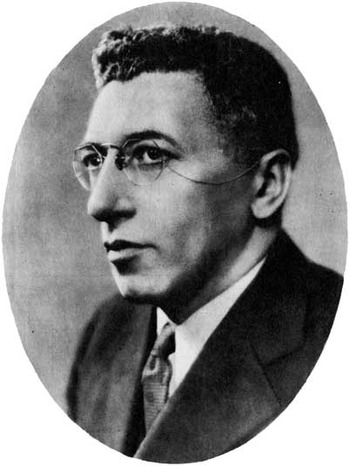
Barukh Charney Vladeck (1886–1938), active leader of the Yiddish workers’ movement in America. Although he is much better known for his work for the Forverts, Yiddish unions, and on New York's City Council, with a special interest in social politics and public housing on the Lower East Side, he remained a devoted Bundist and strongly supported the Bund's work in New York.
Collection IISH
Bundist fundraising campaigns utilized anti-tsarist language and radical socialist rhetoric that was new to the American Jewish labour movement while, on the other hand, Bundist authors brought the new language of resistance and yidishkayt even to the Forverts. The success of this campaign enabled American activists to sponsor the Russian Bund to a large extent.Footnote 61 In 1905, for example, the Russian Bund paid US$10,000 to smuggle literature into Russia, almost every cent of which the Foreign Central Committee collected abroad. Before World War I, American Bundists wired up to $40,000 per annum to the Foreign Committee, a sum that must be valued even higher as it was solely collected among Jewish workers. The Bundist fundraising of these years was in general campaign-oriented and consisted of small donations, mostly ranging between $0.50 and $2.00, collected from large numbers of Jewish workers. Such collections employed and constituted the Bund's network formation overseas by explicit reference to activism for eastern Europe. Owing to the wide outreach of the Bund, individual contributions added together to become large sums, which grew further in the 1920s and 1930s. However, fundraising campaigns were linked to the Bund in Russia and faced severe problems in the years 1907–1910 when the Bund suffered from persecution after the failed 1905 revolution.Footnote 62
In its heyday around 1905 the American Bund even created “self-defence groups” in the USA – not because of immediate local anti-Semitic pressure, but rather as offshoots of self-defence groups in Russia.Footnote 63 Their main activity, of course, was collecting money for Russia.Footnote 64 American Bundist groups were crucial for the expensive operations the Bund conducted in Russia – while at the same time they mediated Russian concerns and mobilized with great success for the transnational aim of fundraising for revolutionary Russia. Bundist groups in the US completely focused on such matters and received immense support even from Abraham Cahan, who praised the Bund and this Bundist ability to put on a fight as typically modern, and was in no way as suspicious as he was when it came to secondary Bundism.Footnote 65
In evaluating Bundism in the United States we must thus differentiate between Bundists and the Bund. Bundists were extremely important, first of all in the creation of the American strike movement and the new spirit of activism that emerged in New York with the 1909–1910 shirtwaistmakers’ strike. Bundists also staged cultural events, such as balls, lectures, and concerts, often co-organized by secondary Bundist organizations that were run in turn by Bundists.Footnote 66 At the same time, however, the Bund itself largely focused on fundraising and, apart from Russian issues, did not engage in the labour struggle in the US.
Nevertheless, and this is crucial, both trends were intrinsically linked: in strikes, Bundists were at the forefront of local struggles, but they also “used” these strikes to collect for the Bund.Footnote 67 This double transfer has been overlooked by historians of both American and east European Jewish history. Whereas the Bund in Russia, in Ezra Mendelsohn's words, offered its members “a new world in which to live and work”, in the US it encountered a secular Yiddish world already in the making – to which it added a large measure of Russian-style agency and thus Russian “social”.Footnote 68
ACTIVISM IN MIGRATION: ARGENTINA
Bundist activism in Argentina offers a telling counter-example to the history of American Bundism we have just explored. Bundists came to Argentina in two major waves, the first after 1905 when “ruso” became a synonym for “eastern European Jewish worker-immigrant” and the second in the 1920s. Even though some patterns of Bundism were similar to those in the US, such as the fact that Bundist groups temporarily became Yiddish-speaking branches of the Partido Socialista, the differences dominate. Exploring these differences will highlight the development of a distinctly foreign, but transnational Bundist organization.
Bundism in Argentina was (re)born in the barrio of Once, especially on Plaza Lavalle, a square in the middle of the growing Jewish quarter in Buenos Aires. Here, Jewish immigrants met in a birzshe – what in Russia had been a collective and conspiratorial “walking” on the shtetl streets that had allowed collusion by hiding the cabal in public motion. In Argentina, this served as an institution of orientation, and offered integration by the means of a “social grammar” that was well-known to “green” immigrants but had now lost its conspiratorial character. It was a transitional stage that led immigrants into Yiddish unions and provided community and jobs.Footnote 69 These unions, in a very unique fashion, combined the whole political immigrant experience. The leading Argentinian Bundist, Pinie Vald, captured this in a single picture: a union room in 1906. The room's walls were decorated with a Yiddish banner saying “The liberation of the working class is the act of the workers alone”, overlooked by three portraits: Karl Marx, Mikhail Bakunin, and the “Liberator of Spanish South America”, José San Martin.Footnote 70 It is impossible to draw a better picture of the early twentieth-century fusion of socialism, anarchism, Latin American pride, and Yiddish culture in Argentina – and the energetic drive for “action” which dominated Bundist community building in Argentina.
Yiddish became important amongst Russian immigrants as a tool not only for workers’ self-organization, but also for their mobilization into established Argentinian movements. Even the highly influential anarchist periodical La Protesta, for instance, featured a Yiddish page in the 1900s. However, the most important institution grew out of the immigrants’ actions themselves: the Biblioteca Rusa. Despite its Russian name, the library mainly consisted of radical Yiddish publications, imported from Russia, from global Russian emigré circles, the United States, and even from the “Galician Bund”.
The library was also a platform for assemblage: out of the Biblioteca Rusa emerged the group Avangard, the founders of the highly innovative journal, Der avangard. Avangard was clearly a Bundist group, and Der avangard a Bundist journal from Rio de la Plata which, in contrast to the failure of the Kemfer in New York, was a high-quality and influential periodical for Yiddish-speaking workers in Argentina.Footnote 71 The formation of the group also required a recreation of the “social” of the Russian Bund: avangardistas did not consider themselves as Bundists, but they transferred practical Bundism to the Southern Hemisphere. As a result, they played a founding role for Yiddish trade unions, theatres, and educational initiatives. The Avangard also actively supported and organized the Jewish strike movement, as well as anti-Semitic action.Footnote 72 This was doikeyt in action.
Of course, this also reproduced debates about the relevance of Yiddish – with Spanish as an equivalent for Russian or English – and about a distinct Jewish workers’ movement, conflicts that arose with the newspaper Iskra in Russia as well as with Shtime fun avangard in Argentina.Footnote 73 As in Russia, Bundists ultimately gained more support among Jewish workers. Moreover, when Red October dissociated Bundist unity in eastern Europe and led to harsh fights between supporters and opponents of the “Bolshevik way”, the Argentinian movement quickly followed suit.Footnote 74 The Russian-inspired urge for more violent and conspiratorial action caused dissent in the mass-based workers’ movement; young activists understood this as a generational shift that finally caused the dissolution of the group.Footnote 75 The Avangard survived persecution by the Argentinian police, the destruction of the Biblioteca Rusa in 1910 and the repression of socialist groups during World War I, even a major pogrom in Buenos Aires, the semana trágica which was mainly driven by anti-socialist violence – but it could not withstand the pressure that emerged from changes in the Russian “social” to which it was intrinsically tied.Footnote 76
This was a dramatic contrast to the American situation, where the secondary Bundist Arbeter-ring proved to be far more stable. It certainly underwent changes, but avoided a split between socialist and communist factions until 1926. The Jewish Socialists’ Federation suffered a communist split but it was directly converted into the even stronger Jewish socialist Farband. Bundist groups in Argentina, by contrast, were smashed and scattered; they only gained new strength with the formation of new transnational networks, based in the new wave of Polish immigration after 1924.
The Avangard was certainly as Bundist as it was possible to be outside of Russia – but it was formed to create a specific Argentinian Jewish workers’ movement. Still, Russia was part of these associations, as reflected not only in the institutionalizations of the movement but also on an intellectual level. The weekly lectures organized by the Avangard attracted listeners from different parties, but they mostly remained restricted to Russian immigrants by simple structural parameters: they were held only in Yiddish, Polish, or Russian, and mainly discussed Russian topics. These were no lectures about a distant land of the past: topics on Russia were never perceived as isolated from Argentina. Russia was a month-long passage away but its issues were discussed as global topics that were closely related to Argentinian themes.Footnote 77
Why was such a direct transfer of the Bundist doikeyt and even major parts of its organizational framework possible only for Bundists in South America? First there is a structural, economic fact: Argentina was still a frontier state, and within Argentina the barrios of Once and Villa Crespo were particular internal Jewish frontiers.Footnote 78 There was no noteworthy Yiddish life before mass immigration; the quarters literally grew with immigration and urban reconstruction using economic structures that were fairly similar to those in Polish Russia.Footnote 79 This was fundamental for the Bundist practice of creating a Jewish modernity. Other, negative experiences were also re-experienced in Argentina, from police persecution to an unstable political system and even the 1919 pogrom. To sum up, in Argentina the Bundist counter-culture still functioned as anti-system activism.
Secondly, there is an internal argument to be made: the Avangard, even though it bore a different name and developed a specific Argentinian constitution, was a Bund in Argentina, precisely because it was only marginally connected to the Bund in Russia. Activists could only remain Bundist when working in and for Argentina – and that meant that they had to create their own actor-networks in the Argentinian situation in order to ensure the persistence of a Bundist identity. The Avangard was deeply Bundist because it was transnational and Argentinian at the same time. This organizational distance from the Foreign Committee and the persistent political closeness to its aims allowed workers – intellectuals were far more marginal than in Russia – to assemble a “social” in the Russian fashion, but for Argentinian purposes.
CONCLUSION
The Bund and Bundist identities re-constituted themselves time and again because the Bund was, in Bruno Latour's terms, neither unit nor party, it was a group formation “enacted” by activists.Footnote 80 The internationalist rhetoric of the Bund was actively interwoven with transnational practices and local issues. Bundism in migration therefore constantly worked on the possibilities for a culture and a Jewish identity in Bundist terms, a secular modernization of Jewish life that, in large parts, never lost touch with its revolutionary past.
Even though it goes well beyond the scope of this article, a short comparison of the Bund with its neighbouring movements, Zionism and communism, allows us to understand that the Bundist formation of collectives in the age of great migrations was specific in its shape, but not in its substance. The Zionist movement was also based on relations that bridged the oceans and connected distant points for a utopian aim. Yet, the function of the past and its inclusion into the patterns of the movement's activism differed. Zionist self-perception did not centre on certain revolutions or heroic moments of activism, it searched for a “usable past”, and therefore Zionist immigrants in Palestine wanted “to cast the revolutionary past in stone and elevate it to a new status”.Footnote 81 For the Bundists it was different: motivated by historical materialism, they engaged in their “historical fight” and tried to “make” history happen. In the US the early Bundist groups “used” strikes mainly for fundraising on behalf of Russian revolutionaries, and in Argentina the Avangard acted as an Argentinian Bund. It actively fostered general strikes and uprisings – in such a radical fashion that it even went on strike against its own printer, leading to the first interruption of the journal in February and March 1909.
In this radicalism the Bundist and communist movements were not only related, they were deeply entangled, especially in Argentina, in terms of the individuals involved. In 1921, the Avangard split into a communist and a socialist branch, one joining the Comintern, the other founding the Bund Club in 1924.Footnote 82 The young Soviet state also tried to win over Bundists to their cause and succeeded with a certain delay.Footnote 83 But for the two movements the split in 1917 led to different interpretations of the function of transnationalism. Communists engaged in internationalist arguments and practices, and in the construction and support of the “world party of revolution”, the Comintern.Footnote 84 The past was refashioned as a result of this new constellation and the point of no return that was October 1917.Footnote 85 The Bundist past still centred on 1905, and in their actions Bundists focused on local groups, on their support for the Bund in independent Poland, and – most importantly – on the creation of a global secular Jewish culture. Yet the national settings were formative. The social space of Yiddish culture in Argentina was completely open for Bundist socialism; in the US, Bundists had to “relocalize” their practices owing to the existing conditions and structures of Yiddish life, and associate their objectives with collectives already in existence.
On this basis we can see that social movements do not migrate with their members, nor is there a structural “logic” that leads to the creation of such movements. Assumptions that actors simply transplanted their “well-developed socialist tradition and social consciousness” to “Milwaukee, New York and elsewhere” are far too simplified.Footnote 86 Moreover, this was an enormous challenge and a matter of constant exchange between the old and the new country. That is why the creation of the Bundist “social” far from Russia reveals unique insights into local Jewish life, as well as into what actors considered as important parts of a Russian “social”. Migrants often re-organized as a result of prior experiences, and so even revolutionary and “modernizing” movements partially relied on structural conservatism. Bundist associations abroad were not remote from Russia; they constituted a part of a Russian “social”. Thus, a Russian revolutionary “social” cannot be depicted without a close observation of its emigré groups.
Undoubtedly, the Bund created a new way of life and assembled a distinct “social” in Russia.Footnote 87 But this depended not on the Bund's “orthodox” ideology but rather on Bundist practices that were a workers’ “daily plebiscite”, thus by no means restricted to eastern Europe. It was a transnational, yet partially a global phenomenon because it tended to create diasporic “homes” everywhere Bundists migrated to.Footnote 88 These “homes” were then places for local activism and transnational exchange, from the creation of schools to commemorative reunions and pro-active union work. The emerging associations, of course, were anything but isolated islands; they were actors for the continual recreation of a transnational Bundist sphere in which Bundist activists wove the “social fabric”, as Bruno Latour put it, in order to reassociate a social movement that set out to revise Jewish life generally.
As a result, in migration studies the “exchange between poles” deserves far more attention. Half a century ago, the historian of migration, Frank Thistlewaite, diagnosed a “saltwater curtain” that he held responsible for the practical and empirical separation between emigration and immigration history.Footnote 89 This curtain still dominates perspectives on the history of “east European” Jews, wherever they lived. ANT is an appropriate way finally to overcome this artificial barrier, because it cannot be applied without broadening the perspective to networks as well as to interruptions of contact on various levels of transfer and community building. In ANT nothing is self-explanatory any more. Even fundraising, for example, the “lightest” version of anti-tsarist activism, is by no means a “natural” action for political emigrants. Bundists in the US devoted much energy to it, but they did not in Argentina. Furthermore, fundraising neither starts nor ends with cash flow. Picking up the receiver does not equal the complexity of a phone call, and wiring money does not equal the multiplicity of activism necessary for the emergence of actor-networks.
Bundists certainly forged their networks by a certain notion of war: class war. But patterns of the way in which this struggle was enforced shifted dramatically from situation to situation, and finally the “culturalized” doikeyt led to the creation of a multi-faceted, self-confident, and globally applicable concept of secular Jewish diaspora life.Footnote 90 On this basis, we can understand the “paradox” that Bundism in Argentina was far more in the Russian style than was Bundism in New York, where Bundists had much closer contact with Russia but never created a Bund of the Russian kind. In Argentina, on the other hand, the Bund was of crucial importance for the creation of the local Jewish community even until after World War II. The Bund never became an important actor in North American society, but Bundists who steadily reclaimed their Bundist identity and the relevance of Bundist practices are to be found in the highest ranks of the once so important Yiddish-speaking part of America.Footnote 91
But this also refers to the limits of this transfer: Social movements do not “run” by themselves, they need an on-going “power supply” from the activists of the movement. Besides the focus on Yiddish, it was exactly the transnational aspect, the vivid relationship between “here” and “there”, between individual perceptions of “past” and “now”, that tied the Bund to the first generation of migrants.Footnote 92 A second generation could barely experience such a strong presence of “di alte heym” and the relevance of its fights and struggles in everyday life. For those who lost touch, socialism became “just a happier way of keeping us together”. Socialism was no longer associated with heated meetings, strikes, or prison experiences; for them “Socialism [was] one long Friday evening around the Samovar and the cut-glass bowl laden with nuts and fruits, all of us singing Tsuzamen, tsuzamen, ale tsuzamen” – the Bundist anthem, which referred to nothing but “that beautiful Russian country of the mind”.Footnote 93
Despite all the progress in aviation and communications, for them the Atlantic Ocean was much wider than for the migrant generation who used to travel back and forth throughout the earlier decades of the twentieth century. Historians have long perpetuated this belief and thereby reconstructed – and surprisingly often still reconstruct – the “saltwater curtain” that separates research on the new American communities and their communities of origin in Europe.Footnote 94 The history of the Bund reveals the inability of this approach to capture the larger picture. So long as the Bund was understood as an entity, an east European party, things were easy to separate. But given the importance of transatlantic exchange and influence – which can only be seen by valuing collective agency and the dynamics of the formation Bundist actor-networks – we need to reconnect what once was one in order to understand the internal processes of the Bund as well as its influence on the outside world. In this way we can understand that migration was much more than emigration- or immigration history can see – it was a dynamic and ongoing process of global exchange by which Bundists de facto enacted their vision of a secular Jewish diaspora. Thus globalization not only created economic or political networks, it also impacted the everyday lives of authors and journalists as well as those of tailors and shoemakers.



