

Real-world interest in decolonization has exploded. As Canada’s Truth and Reconciliation Commission (2015, 17) concluded in its final report, “Colonialism remains an ongoing process, shaping both the structure and the quality of the relationship between the settlers and Indigenous peoples.” The consequences of colonization are hardly limited to historical interest but remain a life-and-death matter for those affected and a pressing political matter worldwide.
Likewise, interest in these topics has grown in the academy. Because colonial projects mobilize systems of knowledge production to advance imperial projects and subjugate colonized peoples (Bhabha Reference Bhabha1994; Ngũgĩ 2005; Said Reference Said1978), scholars have reconsidered how they conduct their research and teach their students. Accordingly, many universities have created programs centered on indigeneity and recruited scholars who use Indigenous approaches to knowledge. Some have proposed ways to modify curricula and patterns of donor support to address the wrongs of colonialism (Smith Reference Smith2021).
With the term “decolonization” circulating widely (see the appendix), how can we ensure that it retains analytic value for empirical analysis in political science? Following Brubaker and Cooper (Reference Brubaker and Cooper2000), I distinguish between categories of analysis and categories of practice. Categories of analysis provide conceptual tools to evaluate evidence and offer interpretations of research material. By contrast, categories of practice are “something akin to what others have called ‘native’ or ‘folk’ or ‘lay’ categories. These are categories of everyday social experience, developed and deployed by ordinary social actors, as distinguished from the experience-distant categories used by social analysts” (4). Scholars debate the overlap between the two (Jackson Reference Jackson2008), but most agree that we do more than simply transmit the worldviews of the people we study. Our analytic license therefore allows us to ask how well a widely circulating term serves analytic purposes.
My central argument is that even though the term has important practical value, the meanings that it has acquired in practice complicate empirical analysis.Footnote 1 Specifically, I contend that three problems emerge. First, the term’s usage in practical struggles leads to a foregrounding of its normative power over analytic precision. Second, this tends to bracket ends, glossing any move away from colonial practices as decolonial, and this bleeds into scholarly treatments. Third, the term’s usage often produces an analytic flattening that downplays nuance, context, and historical specificity. Not inherent to the concept itself, these problems stubbornly persist, despite recent work that seeks to addresses them.
To make my argument concrete, I discuss political science interventions about a single world region, Central Asia.Footnote 2 I do so partly because it is my empirical area of expertise and partly because the relative newness of scholarly engagement with Central Asia’s colonial and decolonial experiences provides an opportunity for critical reflection. Ultimately, others should consider how well Central Asia’s lessons apply elsewhere.Footnote 3
The article proceeds as follows. First, I outline criteria for evaluating the utility of analytic concepts. Second, I detail persistent problems that prevent the term from satisfying these criteria. Third, I consider productive recent work that addresses the problems but falls short of resolving them. Fourth, I turn to Central Asia to illustrate both the problems and the possibilities the term presents. I conclude with implications, suggesting possible ways forward. My hope is to encourage careful reflection that will make for more persuasive scholarly work.
Criteria for Concepts
How should we evaluate the utility of our concepts? Goertz (Reference Goertz2006, 27; emphasis in original) offers a starting point, arguing that when we deploy a concept, we make a non-arbitrary claim about the “real world”: “The core attributes of a concept constitute a theory of the ontology of the phenomenon under consideration. Concepts are about ontology. To develop a concept is more than providing a definition: it is deciding what is important about an entity. The arguments about why attribute X is important form part of the ontological theory of the object.”
In short, a concept highlights the aspects of a phenomenon that an author considers salient. The fact that copper has a “reddish color” is usually considered less important than the fact that it has a particular atomic structure (Goertz Reference Goertz2006, 27). Of course, an artist might contend the opposite: copper’s atomic structure is less salient than its reddish color if you are mixing paints. Salience is therefore never entirely free from practice or from theory.Footnote 4 But the claim itself is always both ontological and non-arbitrary.
The same principle applies when we conceptualize social phenomena. We build concepts based on an ontology of a “real world” that exists (and is at least partially knowable). Even when we prioritize social actors’ interpretations, we advance an ontological claim about what produces those interpretations. Even when we deconstruct how knowledge is produced, we advance ontological claims about real-world processes by which this occurs.
To say that there is a relationship between a concept and the real world is not to embrace a naïve realism; rather, that relationship deserves careful and critical scrutiny. Soss (Reference Soss, Simmons and Smith2021, 85) usefully distinguishes between a “realist” approach to cases (and therefore concepts), in which cases are assumed to exist “out there” in the real world, waiting to be discovered, and a “nominalist” approach to cases (and concepts), in which scholars treat a case as an “analytic construct that we develop through our efforts to theorize the phenomena we study.” But Soss’s phrase “phenomena we study” reminds us that, whatever analytic creativity and open-mindedness we deploy, we necessarily advance ontological claims. Our concepts are denotative. The “real world” may be changing, multidimensional, and hard to analyze, and our approach may be inductive, iterative, context sensitive, and provisional, but our concepts are not arbitrary. Instead, they amount to a claim that our linguistic category fits the (salient aspects of the) phenomenon of interest better than alternative concepts do.
If the first criterion for evaluating a concept is therefore its fit with cases,Footnote 5 Goertz’s (Reference Goertz2006) discussion leads us to a second criterion. As he details, discussions of concepts divide between those who follow Aristotle (Reference Furth1985) and those who follow Wittgenstein (Reference Wittgenstein, Anscombe, Hacker and Schulte2009). The former treat concepts as describing objects that have—at some level of abstraction—a common essence. The latter treat concepts as “family resemblances” with no necessary common essence. Goertz invites scholars either to specify the necessary and sufficient attributes of a phenomenon (consistent with the essentialist tradition) or to specify the sufficient attributes of a phenomenon (consistent with the family resemblances tradition). The difference between the two is that the former embraces a notion of necessity, whereas the latter does not. Further, the former sees little room for attributes to be substituted by other attributes, whereas the latter sees much room for attributes to be substituted by other attributes and still qualify as an instance of a given phenomenon. A second criterion therefore is whether a term lends itself to being described via necessary and/or sufficient attributes.
These two criteria—fit with cases and formulation through necessary and/or sufficient attributes—animate my discussion in this article.
Decolonization’s Persistent Problems
The term “decolonization” per se is no more problematic or “essentially contested” (Gallie Reference Gallie1995) than many others routinely used in political analysis. But its usage can has acquired practical meanings over time that often go unexamined, creating problems that complicate efforts to satisfy analytic criteria for concepts in empirical scholarly work. Although these meanings are not permanent and the problems generated are not insurmountable, they do persist in empirical work.
Overwhelming Normativity
The term “decolonization” has come to prize real-world and practical power over analytic precision. Betts (Reference Betts2004, 1) describes it as “awkward and inelegant.” It has acquired a wide range of meanings that help build coalitions in real-world struggles (Tuck and Yang Reference Tuck and Yang2012, 17) while eluding internal consistency and coherence. In a sense, the term is like many others in political science: “democracy,” “development,” “participation,” and “justice” each has a clear normative valence but is used widely in empirical work.Footnote 6 A problem emerges, however, when a broad, powerful normativity comes to overwhelm other considerations.Footnote 7
Like many terms, decolonization had normative content from the outset. Independence movements had explicitly built their case in moral terms (Gopal Reference Gopal2019), even if it was the practical costs of empire that persuaded imperial powers to shed colonized territories. For the UN General Assembly’s (1960) Declaration on the Granting of Independence to Colonial Countries and Peoples, decolonization required the following: “Immediate steps shall be taken, in Trust and Non-Self-Governing Territories or all other territories which have not yet attained independence, to transfer all powers to the peoples of those territories, without any conditions or reservations, in accordance with their freely expressed will and desire, without any distinction as to race, creed or colour, in order to enable them to enjoy complete independence and freedom.” Normatively powerful (“complete independence and freedom”), this understanding of decolonization was narrow, hinging specifically on the juridical “transfer of powers to the peoples of those territories.”
In practice, juridical sovereignty alone could not deliver justice. After all, legal independence could not provide newly decolonized states with governing capacity (Jackson Reference Jackson1990). Moreover, imperial legacies endured. Some were obvious and violent, as when France refused to grant independence to Algeria, resulting in the brutal War of Algerian Independence (1954–62). Others were less apparent but no less durable, as interpersonal networks and human institutions forged by the colonial power persisted generations after empire’s legal retreat. The result was an enduring habitus in the Bourdieuian sense in the independence period (Beissinger Reference Beissinger1995) that structured patterns of interethnic cooperation and conflict (Mamdani Reference Mamdani1996; Posner Reference Posner2003), foreign trade and foreign policy (Athow and Blanton Reference Athow and Blanton2002), and postcolonial political institutions (Robinson Reference Robinson2019). These patterns in practice highlighted that a narrow understanding of decolonization was insufficient.
Because colonial legacies were in practice hard to ignore but were simultaneously abstract and difficult to specify, the term’s meanings expanded. The inheritors of colonial privilege often behaved in ways that echoed colonial rule, even as they rhetorically distanced themselves from colonial atrocities. It mattered little that the United States and Soviet Union both were juridically states and not empires: their hegemony in respective spheres of influence came to be viewed as neocolonial or neo-imperial.Footnote 8 This encouraged a broadened notion of decolonization that would call for a rolling back of American or Soviet power. Similarly, the behavior of multinational corporations could repeat colonial practices, as highlighted by dependency theorists (Frank Reference Frank1967), world systems theorists (Wallerstein Reference Wallerstein1974), and critical political economists (Strange Reference Strange1988). In this usage, decolonization required an extraordinary global redistribution of wealth and a reining in of corporate power. Even the aid industry reproduced similar patterns that required similarly extraordinary remedies (New Humanitarian 2022).
This radical expansion of the term’s meanings is clearly reflected in postcolonial theory, especially the work of Frantz Fanon. Underscoring that decolonization was not just a legal or political matter, but a social, cultural, and psychological one, Fanon (Reference Fanon1963) exploded normal treatments by highlighting the long-term effects of colonial rule on “the colonized personality.” Given the deep sense of inferiority imposed on the colonized, it was no accident that violence had an appeal among colonized subjects: “The native who decides to put the program into practice, and to become its moving force, is ready for violence at all times. From birth it is clear to him that this narrow world, strewn with prohibitions, can only be called in question by absolute violence” (37). Although we should not read Fanon as advocating violence (Shatz Reference Shatz2024), his discussion conveys how deep-seated and structural the colonial legacies continued to be.Footnote 9
A practicing psychiatrist, Fanon was committed to science, but his impact on decolonization debates was to prioritize activism. His Wretched of the Earth gives us a glimpse into his thinking. Emphasizing that he was neither an observer nor an analyst, he abjured the term “scholar” and used “intellectual” primarily with the modifier “colonized.” He referred to an “intellectual” in a positive sense only when describing someone who dissolves the distance from the broader public. In this reading, the job of the intellectual was not to observe or analyze at a remove—something that could lead only to a colonized mentality—but to work with the public cheek and jowl in a real-world struggle.Footnote 10
Wretched would thus inspire both conversation and political action,Footnote 11 making available a vocabulary to empower formerly colonized peoples across what in 2026 we call the Global South. This intervention shook conventions, unsettled preconceptions, and reoriented research. It did what any effective action-oriented normative theory does: it expanded intellectual horizons to inspire action. Echoes of Fanon resounded in public discourse about the Israel–Gaza war (Cooley Reference Cooley2024) because the text captures an anger with the status quo, linking it to a globally resonant frame.
Fanon was not a typical scholar, but he was extraordinarily influential. Outside the academy, decolonization came to be valued as a good, implying a moral imperative to engage in it. This had analytic consequences in the academy. Although Fanon (Reference Fanon, Philcox, Sarte and Bhabha2004, 144) clearly recognized that in practice decolonization can produce undesirable side effects or outcomes like “anarchy, repression, the emergence of tribalized parties and federalism, etc.,” this nuance was sometimes lost on those who treated his text uncritically as the “Bible of decolonization.”Footnote 12 In the meantime, the radical expansion of the term’s denotations introduced an analytic messiness that would become difficult to overcome.
Given this ongoing and powerfully normative usage, it is not surprising to see a rise in “performative decolonization”: institutional gestures and rhetorical claims that generate visibility with questionable substantive effects (Two Convivial Thinkers 2024). Likewise, it is no wonder that Tuck and Yang’s (Reference Tuck and Yang2012) critique “Decolonization Is Not a Metaphor” continues to be influential.Footnote 13 Their clarion call to rein in the term’s unjustifiably broad and imprecise usages remains relevant: decolonization “is not an approximation of other experiences of oppression. Decolonization is not a swappable term for other things we want to do to improve our societies and schools. Decolonization doesn’t have a synonym” (3).
Taken together, a powerful normativity and an analytic messiness complicate efforts to offer nuanced empirical analysis of decolonization in specific contexts.
Bracketing Ends
A second persistent problem is that the term’s practical usage does not invite thinking about specific outcomes. Instead, it treats any move away from colonial practices as decolonial. The challenge begins with a linguistic ambiguity; the suffix “tion” can imply an outcome or a process (Grimshaw Reference Grimshaw1990). As an outcome, it suggests a final state in which the colonial is no longer meaningfully present. As a process, it implies any step toward the removal of the colonial. Because of the analytic messiness described earlier, most discussions treat decolonization as a process.
Although there are productive traditions in the social sciences that focus on processes over outcomes (Mahoney Reference Mahoney2000; Tilly Reference Tilly1978), we cannot appreciate decolonization as a process without appreciating decolonization as an outcome. Much of human action is future oriented, whether understood as strategic, hopeful, aspirational, or fearful. A sense of purpose gives meaning to human-generated processes (Giddens Reference Giddens1984, chap. 3). When we are agnostic about endpoints, we are at pains to distinguish a decolonial move from alternatives. In 2022, Russia attacked Ukraine, claiming to be decolonizing it from “Nazi” influence. Many in the West simultaneously claimed to be decolonizing Ukraine from Russian influence. Without specified endpoints, the two claims are a priori equally plausible. Similarly, the Bolsheviks’ claim to be decolonizing Central Asia in the early 1920s is prima facie no less possible than Central Asian nationalists’ claim to be decolonizing the region from Bolshevism in the 1980s and later.
We frequently underspecify what decolonial undoing is underway. Consider processes often considered to be decolonizing: truth and reconciliation, property restitution, shifts in language use, revamping historical knowledge, changing school curricula, creating national narratives, and promoting the material well-being of communities affected by colonial rule. Further, decolonization might mean a shift in epistemology (i.e., in how knowledge is produced). Thus, for Datta (Reference Datta2018), the term implies an “on-going process of becoming, unlearning, and relearning regarding who we are as a researcher and educator, and taking responsibilities for participants.” Or, as Aktürk (Reference Aktürk2023, 7) reminds us without delving into specifics, “Much remains to be done for [the] decolonization of political science.”
Thus underspecified, it becomes “awkward and inelegant” in its application to the real world (Betts Reference Betts2004, 1). Turkmenistan after the Soviet collapse illustrates this well. With a closed, authoritarian regime undergirded by a cult of personality, the Turkmen regime ideologically distanced itself from its Soviet past, promoting new national narratives and reshaping state and society (Peyrouse Reference Peyrouse, Lindstaedt and Van den Bosch2024). In the meantime, large swathes of Turkmen society were mired in poverty while a wealthy elite enjoyed spoils from natural gas receipts. Was this decolonization? It might be tempting to contend that Turkmenistan did not undergo decolonization because these transformations did not benefit Turkmen society. But, unless we specify outcomes a priori, this amounts to shooting an arrow first and then deciding where to paint the bullseye.
A similar challenge obtains with decolonial epistemologies. If the process of decolonizing research is “on-going,” if there is always more work to be done in “becoming, unlearning, and relearning” (Datta Reference Datta2018), we cannot know where the bullseye lies. Perhaps the invitation here is a welcome one: to be reflexive about one’s positionality. Yet, the social sciences already have an established and productive vocabulary on that score,Footnote 14 and it is not clear that “decolonial” serves as an appropriate north star for all intellectual journeys.Footnote 15
Decades ago, McClintock (Reference McClintock1992, 85–86) identified this problem in postcolonial theory: proceeding with a linear notion of time in which European colonization is the enduring reference point produces a flattened history with little change, save the change that comes from colonial rule.Footnote 16 If “post” means “after,” the “post” period has no logical endpoint. When the same term is used to describe India after partition in August 1947 and the country 77 years later after Modi’s second reelection, much of its analytic value is lost. The alternative is to understand “post” as “transcending,” but here too this says what it is not (colonial) and little about what it is.
In short, without logically or empirically specified endpoints, we cannot know how far moves toward decolonization have gone and how much further they could go. We benefit from clear metrics by which to evaluate change.
Analytic Flattening
The bracketing of ends leads to a third problem: a tendency to flatten analysis, which obscures nuance, context, and historical specificity. I illustrate by considering the ambiguity between states and empires.
Much of our discipline accepts broadly Weberian definitions, such that a state is considered legitimate, whereas an empire is taken to be illegitimate (Beissinger Reference Beissinger and Young1993). This may be a reasonable analytic first cut, but does it fit with real-world cases? At what point does the dominance of an ethnic “core” warrant the label “colonial?” When Kemalist authorities in Turkey considered Kurds to be “mountain Turks,” denying them rights as a distinctive community (Yavuz and Özcan Reference Yavuz and Özcan2006), were they being state actors or imperial authorities? Does the Pashtun domination of Afghanistan constitute something imperial? What about the Hindu domination of India? How does white nationalism fit in the United States? Crucially, does any notional distinction between state and empire make a difference to minorities themselves?
What about violence? For argument, one might assume that states on average engage less in overt violence than do empires because, by definition, states require legitimacy. But ceteris paribus claims say little about cases. One need not describe Israel or Myanmar, China or the United States as colonial to recognize what role violence vis-à-vis ethnic or religious minorities plays in their respective political histories. Violence does not by definition become legitimate simply because it is performed by states. Nor are all empires equally violent. Mughal rule in the Indian subcontinent and Ottoman rule in Eurasia involved periods of extraordinary tolerance for and even the promotion of cultural pluralism.
Empire is generally understood to be based on domination by an alien power (Colás Reference Colás2007), but as anyone who has lived in a nondemocratic state knows well, empires have no monopoly on domination. Moreover, although those exercising domination may indeed be described as “alien” in the sense of ethnically, rationally, or religiously “other,” difference may also be ideologically constructed. Anticommunist purges in the West and anticapitalist purges in the Eastern bloc remind us of this fact, and they have echoes in today’s politics. Put differently, domination always involves alienness, but alienness can be politically produced. Rule may be perceived as alien when an “other” is engaging in it, but rule may equally come to be perceived as alien when it is exercised according to principles deemed unjust. Thus, it is not always clear what distinguishes colonial domination from its noncolonial cousin.
Although colonization is always accompanied by violence and domination, its undoing has the potential to produce (other forms of) domination and violence. This is an empirical question but, as such, should be studied carefully and contextually. The outlier cases of Idi Amin’s Uganda and Gurbanguly Berdymukhamedov’s Turkmenistan remind us of what may occur in more subtle forms elsewhere. When Amin expelled Asian Ugandans from Uganda, unleashing state terror in 1972, he claimed to have “economic decolonization” in mind.Footnote 17 In post-Soviet Central Asia, authoritarian Turkmenistan—a polity that persistently guarded its independence from Russia—similarly dressed up systemic repression in decolonial garb. As a normative matter, the evils of empire should not give a pass to the evils of post-empire. As an analytic one, the practices of empire should not place the practices of post-empire into shadow.
Of course, the world is more complex than our concepts can capture, but when concepts obscure important political dynamics and outcomes, we should revisit them.
Implications
Taken together, these three problems—overwhelming normativity, bracketing ends, and analytical flattening— undermine our ability to satisfy two criteria for concepts: fit with cases and formulation via necessary and/or sufficient attributes. Fit with cases requires analytic precision about the categories deployed and confidence that the empirical cases are instances of the phenomenon of interest (Gerring Reference Gerring2004). To add nuance, we can describe this fit as one of degree, using fuzzy-set logic (Ragin Reference Ragin2000), but fit cannot be established without careful attention.
Further, establishing fit requires that we specify ends. This is true in diverse research traditions. Any causal claim requires a well-specified outcome variable. Any claim to offer an account based in human agency requires a specification of the ideas and goals that motivate human action. By bracketing ends, we obscure our ontology of the social.
Finally, our engagement of empirical material is strong when we consider facts “inconvenient” to our theories and carefully examine ambiguity before making analytic decisions. Here, the formulation of concepts via necessary and/or sufficient attributes is helpful. It allows for multiple causal paths, a wide variety of processes and outcomes, and attention to complex contextuality. It also enables us to consider “messiness” while forging accounts that are analytically robust.
Addressing Persistent Problems
I am not the first to notice these problems. A spate of recent work lends support to my characterizations and proposes remedies. This work contributes critically needed definition, context, and genealogy. As such, it points in promising directions, but the problems persist.
Táíwò (Reference Táíwò2022, 2) trenchantly diagnoses the problem of normative power and analytic imprecision. “Decolonisation,” he writes, “has lost its way. Originally a struggle to escape the West’s direct political and economic control, it has become a catch-all idea, often for performing ‘morality’ or ‘authenticity.’” This normative allure allows the term to function as a virtue signal, rather than an analytically grounded concept. Táíwò argues that such overextension “eviscerates the lives [Africans] led before colonialism was imposed … and the lives they have crafted since they threw off the colonial yoke” (183).
Whereas Táíwò proposes to abandon the word entirely, others seek to reengage it in a different register. Thus, Getachew and Mantena (Reference Getachew and Mantena2021) anchor decolonization within the philosophical and political visions of anticolonial thinkers such as Sudipta Kaviraj, Partha Chatterjee, and Mahmood Mamdani, seeking to move beyond a preoccupation with Eurocentrism. By examining these thinkers’ “conceptual innovation and reanimation,” Getachew and Mantena (379) identify a promising avenue for a decolonial political theory in which “the extreme normativity of contemporary democratic theory has to be jettisoned” in favor of “locating the immanent dynamics and institutions capable of transformation.” By proceeding with a different notion of decolonization, their effort is specifically to “reinvigorate the practice of political theory” (359). Whether these changes will influence other subfields focused on empirical research remains an open question.
In a similar vein, Duong (Reference Duong2021) recasts decolonization by examining the thought of radical political theorists from the Black Atlantic. As he shows, their robust advocacy for universal suffrage “struck empire’s defenders with the purest terror” (424). Studying this “half-forgotten achievement of the age of decolonization” (413) is “one way to reacquaint us with our own forgotten democratic ambitions, to rekindle aspirations for postcolonial world democracy once tethered to a mass franchise but whose dreamed-of potential our subsequent history squandered” (426). Like others in this new research wave, Duong seeks to retain decolonization’s aspirational scope and affective power, even as he refines existing usage by considering a highly specific and intellectually productive historical moment. Such work helps ensure that normative concerns do not overwhelm analytic ones. Even those who do not share Duong’s or Getachew and Mantena’s normative viewpoints nonetheless should accept that their analyses are grounded in the evidence.
Recent scholarship also goes partway toward addressing the second problem—the bracketing of ends. For example, Getachew (Reference Getachew2019, 16) studies how anticolonial nationalists in Africa problematized the “empire-to-nation narrative,” instead pursuing “more far-reaching efforts to remake rather than expand international society.” Their larger project of “worldmaking” refused to accept the existing building blocks of international order and instead sought to create a world order based on “international nondomination” (23). Getachew thus productively draws attention to an ultimate end quite different from one assumed in normal accounts.
The goal of these anticolonial nationalists “to create international institutions that could secure the conditions of nondomination” was ambitious (Getachew Reference Getachew2019, 29). Central to it was the New International Economic Order (NIEO), which was to replace the existing economic order with one based on self-determination, sovereignty, and economic justice. In practice, this ambition encountered resistance, particularly from the United States, which slowed its progress to a crawl. Similarly lofty visions were developed for regional federations (the Union of African States and the West Indian Federation) but ultimately collided with lived realities and local aspirations; they ended up being “short-lived” (109). The goal of nondomination clearly inspired real-world political action, so Getachew productively supplies purpose and direction to human action. This is an enormous improvement over accounts that bracket ends entirely. It moves us from thinking of decolonization as simply a destruction of the old order to thinking about it as constructive of something qualitatively new.Footnote 18 As a result, contributions like Getachew’s allow us glimpses of the variety of new orders being envisioned (if not created).
Finally, this new wave of literature helps avoid analytic flattening, instead emphasizing the situated nature of social and political thought and action. Pineda (Reference Pineda2021) details the rooted, messy reality of civil rights activism in the United States, demonstrating that activists engaged in a “decolonizing praxis” that linked their struggles to global anticolonial movements. Similarly, Temin (Reference Temin2024) and Sultan (Reference Sultan2024) separately attend to the theoretical and geopolitical specificity of Indigenous and anticolonial Indian thought, anchoring their accounts in notions of people’s sovereignty (rather than state sovereignty).
This pivot from the general to the specific serves to ground treatments of decolonization in their complex, multifaceted variety. Thus, Pineda (Reference Pineda2021) considers decolonization as a framing device that links African Americans’ struggles to global ones, as well as a synonym for their inward self-liberation. Temin (Reference Temin2024) and Sultan (Reference Sultan2024) consider people’s sovereignty to be tantamount to decolonization in Indigenous and Indian contexts.
This new research wave thus helps address the persistent problems I identified. It accepts the term’s normative power but pursues analytic precision. It considers the ultimate goals of those engaging in decolonizing praxis (Pineda Reference Pineda2021), rather than treating decolonization as a series of underspecified processes. It offers accounts grounded in the sometimes complex evidence specific times and places, rather than offering general claims divorced from context. As a result, it points to analytic ways forward.
Yet, to what extent can a single, general term—especially a term claiming a common inheritance (colonialism and its legacies), rather than divergent paths taken—do justice to variety? As I discuss in the conclusion, there are strategies for reconciling polysemy within a single category, but the challenge is not solely an intellectual one. In practice, decolonization can serve as a coalition device to bring together activists, administrators, funders, and scholars with different priorities under a single term that enjoys broad normative cachet. It favors open-endedness: malleable meanings allow myriad actors to project their aims onto it (Gaztambide- Fernández Reference Gaztambide-Fernández2012). When this occurs in disciplinary and institutional environments that reduce complexity, the term’s normative cachet remains prioritized over its analytic potential.
Decades ago, Mamdani (Reference Mamdani1996) warned that flattened decolonial frameworks re-entrench the very binaries they aim to break. So, although recent efforts seek to restore discipline, nuance, and specificity, they swim against currents that reward moral power, coalition breadth, and rhetorical simplicity. Thus, problems persist because of an enduring practical logic of how “decolonization” travels through academic, political, and public spheres—even as its meaning is contested, revised, and refined.
Further empirical work is required to advance this research program. Empirical work is best positioned to tackle questions about generalizability, portability to other contexts, or what Simmons and Smith (Reference Simmons and Smith2025) call “translation.” This is true for any broadly resonant category: invoking it is not the same as buttressing its use with evidence. To address the problems of imprecision, bracketing ends, and analytic flattening, we need work that explicitly considers which specific aspects of which specific cases “travel” to which other specific cases.
What Central Asia Says about Decolonization
Every geographic region has its own experience with colonization, decolonization, and scholarship focusing on the two. Central Asia is particularly interesting for its newness: both its relatively recent historical experience with colonization and decolonization and scholars’ relatively recent attention to the region. This recentness creates both a real-world challenge and a scholarly opportunity. The challenge is that Russia, the region’s modern colonial power, remains a powerful neighbor, shaping Central Asia’s colonial and decolonial history. The scholarly opportunity is to use Central Asia’s experience to address the persistent problems I identify. Based on a reading of political science literature about the region using the term “decolonization,” I argue that scholars of Central Asia have not yet properly contended with these problems.Footnote 19
What Might (De)colonization Mean in Central Asia?
One way to appreciate the contours of Central Asia’s colonial experience is to ask what its undoing might entail. Such an undoing would reveal enormous ambiguities associated with empire, lending credence to Beissinger’s (Reference Beissinger1995) argument that ambiguity lies at the heart of Russia’s overland empire.
Central Asia’s first peculiarity is that its geography militates against substantive decolonization. Its northern neighbor is much larger territorially, economically, and militarily. Russia’s border with Kazakhstan is 7,700 km, the world’s second longest. Kyrgyzstan and Tajikistan are mountainous and vulnerable to outside influence because they lack major exploitable natural resources. Add to this the fact that the Russian empire expanded over land, rather than overseas. Well after the Soviet collapse, Russia’s claims on what it calls its “near abroad” continued. Indeed, with the war against Ukraine, they resurfaced violently. Western academic treatments had underestimated Ukraine’s vulnerability (Gorodnichenko, Sologoub, and Deryugina Reference Gorodnichenko, Sologoub and Deryugina2023); a similar case might be made for Central Asia.
In turn, Kyrgyzstan and Tajikistan’s resource poverty meant that in the decades after the collapse of the USSR, they sent millions of migrants to Russia to work in construction and domestic services. Tajikistan was among the most remittance-dependent countries in the world (International Organization for Migration 2022). These migrants endured substandard working conditions and widespread official and informal discrimination (Urinboyev Reference Urinboyev2020). Yet the migrant flow continued—a testament to a fundamental structural dependency.
Resource-rich Kazakhstan took steps to manage Russia’s influence, but its ties to Moscow remained deep. It became a key informal channel for sanctioned goods to enter Russia. The country’s president Tokayev initially pushed back against Russia’s war, but in May 2024 he attended the Victory Day parade in Moscow and in 2025 speculation continued to circulate widely about the Kremlin’s designs on Kazakhstani territory.Footnote 20 After President Trump hosted all five Central Asian presidents in November 2025 during which they signed a series of bilateral deals, Tokayev immediately paid a visit to Moscow, underscoring its partnership with Russia. As of 2026, attempts to sever ties with Russia had achieved little.Footnote 21
Because of these structural realities, some analysts contended that decolonization of Russia’s external empire required the disintegration of Russia itself (e.g., the shedding of the Northern Caucasus, the Volga region, and large swathes of Siberia). The logic was persuasive: a Russia that was “right sized,” contained within a reasonable territorial expanse and no longer interested in conquest or domination, would be good both for its neighbors and for the global order (Byk Reference Byk2023). Unable to exert influence on Central Asia, Russia could not use the pretext of “protecting” Russian speakers abroad as it did in Ukraine.
In practice, the scenario raises difficult questions. At least two conditions would have to hold for such internal decolonization to occur. First, a post-Putin Russian leadership would have to be chastened by the war and prefer to shrink Russian territory. Given the patriotism that defines the political-economic elite (Sharafutdinova Reference Sharafutdinova2020; Taylor Reference Taylor2018) and the quiescence of the broader Russian public (Gugushvili Reference Gugushvili2025), a voluntary contraction of Russian territory is highly unlikely. Second, the international community would have to prefer the disintegration of Russia, even at a cost to nuclear security and political stability. This too is unlikely, given an international system inherently conservative about redrawing borders.
Yet structural factors are not destiny, so let us imagine Russia’s disintegration. It would not occur in a vacuum. A chastened, smaller, and no-longer-colonial Russia could only be a spectator as Central Asia’s other great-power neighbor, China, expanded its role in the region, essentially replacing one colonial power with another one.Footnote 22 And if the West, led by the United States, were to intervene to counter Chinese influence, we would return to questions about whether the United States is also imperial.
The near impossibility of achieving full decolonization in Central Asia underscores the two central aspects of Russia’s empire and Central Asia’s political development highlighted by Beissinger (Reference Beissinger1995). First, Russia’s empire expanded over vast terrestrial space. This expansion involved much bloodshed and violent conquest (Morrison Reference Morrison2021), but it was generally more incremental than overseas colonial expansion. In turn, it could be hard to distinguish from the expansion and consolidation of state power. Although we often treat them as distinctive projects, in the Russian case imperial expansion and state building were fused.
Second, this expansion occurred during the twilight of European colonial empires, which shaped the nature of Soviet rule. The Bolsheviks embraced the language of developmentalism, not empire, claiming to be offering self-determination rather than subordination, modernity rather than exploitation (Kalinovsky Reference Kalinovsky2018). Because the USSR collapsed, we tend to interpret the Soviet project as a disingenuous mask for exercising domination. Although Soviet ideology and institutions were eventually hollowed out, we should not read history backward. At least in the early Soviet period, claims to being “anti-imperial” enormously affected strategies toward the various peoples under its rule (Hirsch Reference Hirsch2005). As a result, Soviet rule had peculiar admixtures of the colonial, the noncolonial, and the anticolonial.
Scholarly Opportunities
Starting with Russia’s 2014 annexation of Crimea and accelerating with its 2022 full-scale invasion of Ukraine, scholars began to discuss Eurasia and Central Asia in terms of colonialism and decolonization. The Association for the Study of Eastern European and Eurasian Studies (ASEEES) in 2023 held a plenary session on decolonization, highlighting questions of sovereignty, national self-determination, and the long shadow of colonial rule. ASEEES’s president delivered an address on “decentering Russia,” noting that 30% of conference papers were related to decolonization (Johnson Reference Johnson2023). She is a scholar of comparative politics, and her address was notable, given that political science had been a latecomer to the term.Footnote 23
A similar rise was evident among scholars of Central Asia in particular. They tackled topics such as nation-building (Kudaibergen Reference Kudaibergen2025; Laruelle Reference Laruelle2021), language and ethnicity (Dave Reference Dave2007; Sharipova, Burkhanov, and Alpeissova Reference Sharipova, Burkhanov and Alpeissova2017), memory politics and social meanings (Sharipova, Bissenova, and Burkhanov Reference Sharipova, Bissenova and Burkhanov2024), agency in international relations (Dadabaev Reference Dadabaev2022), the intricacies of cultural domination in early Soviet rule (Kassymbekova Reference Kassymbekova2016), and the enduring importance of nomadism (Mustoyapova Reference Mustoyapova2023). This work invoked the term “decolonization” in various ways and to varying degrees. Most of this work appeared in English; some appeared in Russian.
In some cases, scholars took their efforts beyond the academy to inform broader publics in Central Asia about decolonization via podcasts, television appearances, video content, and other efforts. This included powerful reflections on identity (Bissenova Reference Bissenova2025; Kudaibergen Reference Kudaibergen2025; Open Democracy 2019) and efforts to support scholars from Central Asia itself (such as the USTA program, discussed in O’dekolon 2024). Following Tlostanova’s (Reference Tlostanova2018) lead, they critiqued hegemonic practices via grassroots activism, reaching audiences new to the term and its entailments.
The robustness of these extra-scholarly efforts suggests that the discourse of decolonization was not yet widespread in the region. Indeed, it was largely absent in some spaces where one might have expected it. I saw this at a May 2024 roundtable about mankurtizm, a term many Central Asians use to describe an amnesia about cultural traditions caused by Soviet assimilationism (Aitmatov Reference Aitmatov1983; Kudaibergenova Reference Kudaibergenova2018). With questions about cultural memory and preservation newly salient after Russia’s war against Ukraine, the event’s principal speaker argued that, by failing to promote the Kazakh language and shore up Kazakhs’ collective identity, Kazakhstan faced an existential threat from its powerful northern neighbor.
Given the topic, I had expected the language of decolonization to be invoked. The roundtable was about how ethnic Kazakhs had lost their language and culture and were vulnerable to Russian aggression. Thus, its focus was on collective identity: how it is constituted and what generates change. It was also about coercive power and alien rule, especially the power exerted on Central Asia by the Soviet center. Yet, during a wide-ranging discussion that followed, only one person mentioned decolonization—in an aside referencing postcolonial theory. At least in one context where one would have expected it, the vocabulary barely appeared.
In its relative infancy, the academic literature on Central Asia’s decolonization has the potential to address the persistent problems I outlined. To date, with some exceptions that come from outside political science, it has not done so.Footnote 24
Powerful Normativity
Central Asianists working on decolonization often tap into the term’s powerful normative meanings. In making a persuasive case for promoting scholarly voices from Central Asia to undercut Russia-centrism, Marat and Kassymbekova (Reference Marat and Kassymbekova2023, 9) emphasize that their central purpose is political and practical, rather than intellectual: “Decolonial thinking is primarily important for the political development of Central Asia.” Normative concerns can be a powerful source of motivation, but they may limit analytic elaboration unless coupled with conceptual and methodological clarity.
Consider how Marat and Kassymbekova address an effort by Müller (Reference Müller2020) to develop the idea of a “Global East,” an awkward term meant to capture how states like those in Central Asia are structurally disadvantaged vis-à-vis the West. Although one might reasonably contend that the term “Global East” is inaccurate, unsupported by evidence, or otherwise analytically unhelpful, Marat and Kassymbekova (Reference Marat and Kassymbekova2023, 11) find it problematic because it is an “external categorization from the so-called Global North.” From this perspective, Müller’s very authorship is problematic; he is not from the region he is analyzing.
Much research prioritizes emic over etic categories (Fu, Neilsen, and Schatz, Reference Fu, Nielsen and Schatz2026; Schatz Reference Schatz2009; Wedeen Reference Wedeen2010), but I am convinced that reasons should be analytic, rather than normative. After all, we need both experience-distant and experience-near (Geertz Reference Geertz1983) concepts; neither alone is sufficient to make sense of the world. The assumption that insiders have a monopoly on truth produces a situation “akin to focusing on descriptive representation alone without much attention to substantive representation” (Aktürk Reference Aktürk2023, 5). Although questions about authorship are relevant, a more productive way forward is to ask, “What about this piece of scholarship gives this particular scholar the authority to come to the conclusions that they come to?” and “What about this piece of scholarship is or is not persuasive?” An author’s positionality matters because it affects their scholarship, but positionality is not reducible to simple demographic characteristics or simple notions of belonging (Soedirgo and Glas Reference Soedirgo and Glas2020).
A strongly normative posture can predispose scholars to dismiss competing accounts without thorough engagement. Here too Marat and Kassymbekova (Reference Marat and Kassymbekova2023) illustrate this tendency. They claim that recent work by Central Asian scholars “dismantle[s] the long-held views of Russian benevolent empire” (9) without citing any such long-held views. They continue, “Most Western and Russian political science literature premises Central Asia as Russia’s near abroad, China’s backwater, or just a little-known region” (9) without proffering evidence. They contend that “scholars still praise the Soviet socialist system for emancipating women, providing universal education and healthcare, and promoting affirmative action among ethnic minorities,” (10) but these assertions require clearer documentary support.Footnote 25 Although their intervention is short and their claims plausible, it would be more persuasive with supporting evidence and explicit citations.
In fact, English-language scholarship on historical Central Asia does engage vibrant debates about colonial rule and its effects (Cameron Reference Cameron2018; Edgar Reference Edgar2006; Kamp Reference Kamp2011; Kassymbekova Reference Kassymbekova2016; Khalid Reference Khalid2006; Northrop Reference Northrop2004). Like any literature, it has blind spots—some more profound than others. And we do indeed require more work on colonial rule, as well as efforts to reverse or mitigate colonialism’s effects. Further, such work will indeed benefit from the voices of scholars from Central Asia itself. But the powerfully normative meanings that the term has acquired invite analytic closure. They presuppose the essential dynamics at play, rather than treating these dynamics as an empirical matter to be studied. They presuppose which scholars have important insights on these topics and which do not, without evaluating contributions individually.
Bracketing Ends
Second, many scholars of Central Asia seem content to bracket outcomes as they consider decolonization. For example, in a survey of how decolonial accounts help explain the relative peace that Central Asians experienced after the Soviet collapse, Dadabaev and Heathershaw (Reference Dadabaev, Heathershaw, Larson, Emmers, Anders Wivel and Trinkunas2021, 745) write that decolonial accounts “emphasize the importance of the region’s particular ideas and practices and how these have been formed in conditions of globalization.” Later, they unpack their epistemology (754):
First, the decolonization of IR implies seeking answers to “how” questions, as opposed to simple “what” questions. Second, it has the implication of delivering the narratives of colonized/developing/silenced nations. This is also related to the need to counter the tendency to accept the “meanings” of concepts from other regions and to apply those “meanings” to various regional contexts. Third, the decolonization of IR necessarily implies a rejection of the idea that state behavior is static, unchanging, and repetitive over time and geographic/social space. In sum, far greater plurality and diversity of perspectives is [sic] required to better interpret peaceful change (in Central Asia).
This departure from Eurocentrism in international relations (IR) theory potentially broadens intellectual horizons, but it lacks an explicit statement about aims. It focuses on “how” questions—presumably moving away from positivist (read: Eurocentric) approaches to knowledge. It delivers narratives of those who were silenced, rather than accepting Eurocentric accounts, which are implied to be intellectually or normatively inferior. It rejects notions of fixed state effects, which presumably prevail in Eurocentric approaches. In this sense, their epistemology inherits the lineage of critical scholarship, with its tendency to problematize existing approaches while stopping short of providing alternatives rooted in empirics (Latour Reference Latour2004).
Such calls for epistemological distancing runs through many decolonial frameworks used to study Central Asia. Dall’Agnola (Reference Dall’Agnola2025, 2) writes that “we should stop studying the region through a Russian lens.” Sharipova, Bissenova, and Burkhanov (Reference Sharipova, Bissenova and Burkhanov2024, 1) suggest a need for “decanonization of both imperial and national narratives, and the emergence of many voices and perspectives that have not been heard or taken seriously previously.” Reflecting on 30 years of scholarship on Central Asia, Marat (Reference Marat2021, 479) summarizes, “For much of the three decades, Western scholarship was limited in that sense: only focusing on debates within its own community with the occasional inclusion of the other. Now scholars must actively engage all perspectives and not focus solely on discussions within one position.” Decolonial approaches to Central Asia thus tend to make claims in an epistemological register: to decolonize is to approach research topics in fundamentally new ways, but those new ways are underspecified.
Notably, such work typically avoids ontological claims about what decolonization as an outcome would look like in the region itself. As with the wave of juridical decolonization after World War II, so as well with the independence of Central Asian states after the Soviet collapse: both were fundamentally insufficient for delivering justice. This much is clear, but decolonization will remain forever unfinished without properly specified endpoints.
Analytic Flattening
Although all accounts simplify, robust ones do not erase ambiguities that might be analytically revealing. As Mitchell (Reference Mitchell1991, 78) reminds us, real-world ambiguity may not be “a problem of conceptual precision but…a clue to the nature of the phenomenon.”
Key ambiguities produce a series of counterintuitive processes and outcomes in Central Asia. There is no doubt that the Russian empire colonized Central Asia and that the Bolsheviks inherited this imperial domain (Keller Reference Keller2019). Nor is there any doubt that colonial rule was based on domination and violence. Yet, in part because Russia’s expansion was over land (rather than overseas) and because empire- and state-building overlapped (Beissinger Reference Beissinger1995), there are important complexities. Whereas overseas empires generally seek to “other” and keep separate even as they dominate, overland empires tend to dominate by eliminating or assimilating. Central Asia experienced both, although assimilation predominated in the Soviet era.Footnote 26
Consider the question of cultural and linguistic domination, in which Russian and Soviet rule brought Russification. Within this broad and undeniable pattern, there were other, sometimes countervailing dynamics. For example, during the late nineteenth century many Turkic-speaking elites and intellectuals were educated in Russian language and culture; this exposed them to European nationalist discourse and practice. It is hard to understand the rise of nationalism among Kazakhs and Uzbeks, for example, without considering this fact. Articulations of difference were themselves made possible by the imperial encounter.
Further, consider colonial institutions concerning religion. As Crews (Reference Crews2006, 3) points out regarding Muslim-majority regions, “the [Russian] empire created a religion-centered framework for its subjects to engage with the autocracy. Religious authority in all its varied forms, [Tsar] Catherine concluded, could be useful for the empire.” Today, legacy institutions that echo their tsarist and Soviet predecessors continue to regulate religion in the independent states of Central Asia. What was created for imperial domination over religion now serves as a tool for regime domination in independent states.
We tend to think of settlers as the beneficiaries of empire. That may be self-evidently true in some contexts, but the tsars often treated Slavic settlers as a disposable underclass (Pianciolo and Gaignebet Reference Pianciola and Gaignebet2008). In the case of Tashkent (now Uzbekistan), local Turkic and Persianate populations clearly suffered most from colonial rule, but settlers also were mistreated (Sahadeo Reference Sahadeo2005, 123–24). As Sahadeo (118) details, such “plebian settlers were damaging efforts to present Russia as a force of order as well as an agent of ‘civilization’ (tsivilizatsiia) in the region.”
As the Bolsheviks established control over imperial lands, the regime branded itself as “anti-imperial.” This claim did not change the fact of domination. Indeed, the goal of creating a communist society and a new, Soviet man involved violent attempts to erase preexisting forms of identity, social solidarities, and modes of economy.Footnote 27 Yet whether the Soviet regime exercised domination is orthogonal to whether it was an empire. Martin (Reference Martin2001) shows that early Soviet policies promoted so-called native cadres. Khalid (Reference Khalid2006) argues that the early Soviet state’s role in Central Asia was akin to that of authoritarian state-building elsewhere in the so-called Muslim world. Comparing Central Asia to Afghanistan, Iran, and Turkey, he shows that the transformative homogenizing practices of states can be “carried out against the will of the majority of the people and [involve] substantial amounts of violence” (251). In turn, when such coercive, assimilatory practices succeed, they often succeed only partially, producing forms of hybridity over the longer term (Bhabha Reference Bhabha2015). As Tasar (Reference Tasar2017) shows, in Soviet Kyrgyzstan, citizens increasingly identified both as Kyrgyz and as Soviet.
In sum, when used with broad-brush meanings, the term “decolonial” overlooks important ambiguities, countervailing forces, and counterintuitive outcomes. To recognize this fact is not to downplay domination and violence. In the late 1920s, Kazakhstan lost an estimated one million people or 40% of its population during human-made famines (asharshylyq). As a percentage of its population, this is more deaths than Ukraine experienced during the Holodmor (Cameron Reference Cameron2018, 5), which is widely viewed as a genocide. I suspect that for survivors and their descendants (not to mention those who perished), the distinction between “empire” and “state” may be secondary to the material realities of loss and suffering. A faithful account takes stock of ambiguities while striving for analytic precision.
Colonialism and its violence brought enormous and unprecedented social, political, cultural, and economic transformations. Had they not occurred, Central Asia would have been different, but the counterfactual is not simple to construct. After all, transformations may be driven by engines other than colonialism. A Central Asia that was not colonized by Russia would still have encountered myriad influences—from Chinese territories, from Persia, from the Arab Middle East, from South Asia, perhaps from the United Kingdom, and indeed from a counterfactually non-imperial Russia. We can imagine less coercive versions of these influences, but Central Asia never existed in a vacuum.Footnote 28
The result is that hybridity has long been the norm and remains visible decades after the Soviet collapse. In 2017, when Russian opposition figure Alexei Navalny claimed, “Naturally, in Uzbekistan nobody knows who Pushkin is,” he was mobilizing a Russian nationalist trope: as non-Slavs, Uzbeks cannot possibly appreciate a Russian poet. Uzbeks responded immediately with a coordinated online effort to recite Pushkin’s poetry (Current Time 2017). One Uzbek declaimed Pushkin’s poetry in expert fashion and then jokingly played with Russian stereotypes about Uzbeks’ supposed backwardness, saying, “And, by the way, my ishak [donkey] is parked over there.”Footnote 29
Uzbeks’ embrace of the Russian poet can be read in two ways. First, one might take it as evidence that Uzbeks proudly sport hybrid identities that defy nationalist stereotypes. Alternatively, one might take it as proof of inadequate decolonization, underlining Uzbeks’ ongoing unfreedom from colonial influence.
The second reading is problematic. First, it privileges outsider over insider perspectives, which is hard to justify if one champions local voices (as decolonial scholars generally do). There is no logical or practical reason why Uzbeks cannot be well versed in multiple literary and poetic traditions. Second, it displays a bias toward the recent, singling out Russian influence as alien and abnormal while implying that myriad influences from the Turkic and Persianate world that predated Russia’s empire were authentic and normal. Finally, the reading largely ignores Pushkin’s special role in Russian literature, his biracial background, and the role that important sectors of Russia’s intelligentsia historically played in opposing autocracy.Footnote 30
A decolonial lens that sees tidy distinctions between precolonial, colonial, and postcolonial cannot treat messiness as a “clue to the nature of the phenomenon.” When Mun and Kudaibergen (Reference Mun and Kudaibergen2025) describe asar, a form of self-help and volunteerism that predated Soviet rule and remains relevant across Central Asia today, they usefully highlight a feature of the social landscape that might otherwise be missed. But their treatment is largely ahistorical, dismissing how for 70 years the Soviet regime in Central Asia also emphasized communal action through its so-called subbotniki. The fact that participation in Soviet-era subbotniki was partly coerced does not erase the ongoing social resonance of the category decades after the Soviet collapse. In 2025, when ordinary people volunteered for natural disaster relief, for an animal shelter, or for a disability rights group, we could not know a priori whether they envisioned themselves as participating in an asar, a subbotnik, both, or neither.Footnote 31 Rather than eliding complexity, scholars should preserve local categorizations and examine how they overlap and diverge.
Finally, some treatments of Central Asia are like the political theory contributions described earlier; they focus narrowly on one aspect of decolonization without considering how it relates to the broader category. Thus, for Dadabaev and Heathershaw (Reference Dadabaev, Heathershaw, Larson, Emmers, Anders Wivel and Trinkunas2021), decolonization is the relative absence of large-scale conflict in the region. For Suyarkulova (Reference Suyarkulova, de la Croix and Reeves2023), it is introducing queer theory to Central Asia. For Kassymbekova and Marat (Reference Kassymbekova and Marat2022), it is upending narratives of Russia’s imperial innocence. Thus, although each work offers a powerful intervention in a specific domain, we return to the question of how such a broad category might contend with so many disparate denotations.
Conclusion
This article invites reflection on the analytic value of the term “decolonization.” My argument is simple: the term has practical power, but the meanings it has acquired over time bring analytic disadvantages. Following the reasoning of Brubaker and Cooper (Reference Brubaker and Cooper2000) in their discussion of “identity,” I argue that decolonization’s widespread practical use complicates its utility for analysis. Specifically, I elaborate three persistent problems with the meanings acquired: their overwhelming normativity, their tendency to bracket outcomes, and their propensity to flatten analysis. In turn, these problems complicate our ability to meet two criteria for concepts: fit with cases and formulation via necessary and/or sufficient attributes. Recent work in political theory offers promising alternatives, but the problems endure, especially in empirical work. I use the study of Central Asia’s experience with Russian imperialism to illustrate, because recent scholarly engagement with these topics provides an opportunity for critical reflection.
The problems I have identified are not “genetic.” Rather, they developed from complex practices that unfolded over decades. By implication, with concerted effort, scholarly usages can shift again, even if the practical use of the term remains harder to influence. What might such shifts consist of? I provide no conclusive answers, but let me begin with a null hypothesis.
It is not impossible that some political and social processes bound up with colonial rule and its aftermath could be analyzed via alternative vocabularies and research traditions. These include changing ethnic demography, migration patterns, state policies on migration, patterns of discrimination, the reconstruction of historical memory, nation-building processes, and language policies. We might further study the depredations of concrete historical periods, the long-term consequences of such destruction and violence, and acts of protest and resistance to unjust orders. We might study how institutions, norms, and behaviors shift after colonialism’s decline. We might consider disenfranchisement, immiseration, repression, and violence. Such topics can be productively engaged, seriously studied, and effectively communicated without resort to a term that has acquired analytically fraught meanings.
Similarly, the epistemological work the academy can do is clear, but we can describe it in various ways. We might engage in participatory action research. We might support scholars who conduct research on the contexts of their upbringing. We might seek diverse voices as we produce course syllabi and teach students. We might follow scholars of science studies to ask what goes into the production and dissemination of knowledge. These steps, activities, and approaches need not be described as decolonization to be valuable.
For those scholars who prefer to use the term, I propose two principles to improve analysis. First, we need Weberian ideal types. We need to know what full decolonization might look like, which cases fit most closely the definition, and what necessary and/or sufficient attributes might describe this fit. This is more than offering a definition that one seeks to operationalize analytically. It is to break down an abstract, broad-based, and multidimensional concept into managable chunks, so that the ontological claims implied by the category are well calibrated and correspond to available evidence.
Let me illustrate what is at stake analytically. Consider a hypothetical research program about linguistic redress in Central Asia: the shift to promote local languages instead of Russian. In one version of such a program, full decolonization would involve the fundamental retreat of the Russian language from public life, such that media, scholarship, entertainment, governance, and education would occur principally if not exclusively in local (Turkic and Iranian) languages. Such decolonization would require (necessity) a retreat of the Russian language from public education, given its outsized and long-term impact on other aspects of society. If such a retreat occurred in two or three additional spheres (sufficiency) that might be enough to meet the standard of decolonization.
A second version of this hypothetical research program might center not on language retreat but on language rights. In such a version, full decolonization would involve undermining the normative assumption that Russian is somehow superior to local languages—a conceit widely propagated during the Soviet era. It would challenge the claim that learning Russian is the key to economic and social mobility—also a Soviet legacy. But such a program would take the second step to empower individuals to make informed choices regarding language learning and use, treating them as rights-bearing individuals. By this understanding, decolonization would have two necessary components. First, it would require an ongoing public challenge to the primacy of the Russian language. Second, it would require treating people living in Central Asian contexts as individuals legally empowered to make choices, while being agnostic about the choices they make.
Different understandings of decolonization embed different ontological claims and imply different research programs. How might one choose between them? Beyond our normative and professional considerations, the best way to choose is to know the context well. Contextual knowledge hardly resolves all debates, but it is sine qua non for making credible claims about a broad and multidimensional phenomenon. Such knowledge would facilitate the development of a series of adjectives to describe subtypes of decolonization, as Collier and Levitsky (Reference Collier and Levitsky1997) do for democracy. Such typological exercises refine empirical research on a wide range of important topics.
Whichever route taken, we should strive for discussions that are focused rather than diffuse, analytically precise rather than politically charged. Our aim should be to produce knowledge that is grounded, enduring, persuasive, and resilient to attacks on our credibility that come from beyond the academy. One of our era’s most consequential phenomena deserves this much.
Acknowledgments
Enormous thanks to two anonymous reviewers for their generative comments and extremely helpful suggestions, as well as to Martha Balaguera, Ronald Beiner, Mark Beissinger, Bhavna Dave, Alex Cooley, Meghan Garrity, Kate Holland, Juliet Johnson, Wendy Wong, and Ioana Zamfir for their insightful comments on an earlier draft. Thanks also to Ioana Zamfir, Arina Dmitrenko, and Kate Gonchar for their research assistance.
Appendix
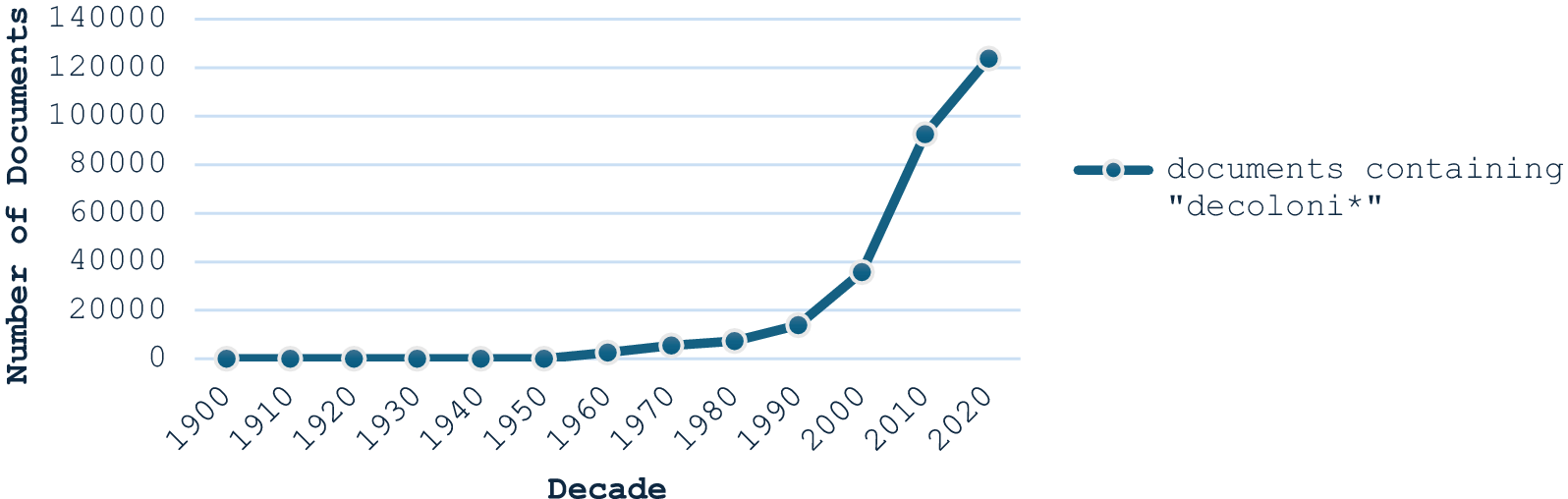
A Constellate search for academic articles, chapters, and books published between 1940 and 2024 indicates increasing use of the term “decolonization” across disciplines. Because Constellate aggregates data by decade, I extrapolated based on the yearly average from 2020–24 to predict values for 2025–29 (figure A1).
Constellate search for “decoloni*” across disciplines
Source: Constellate.

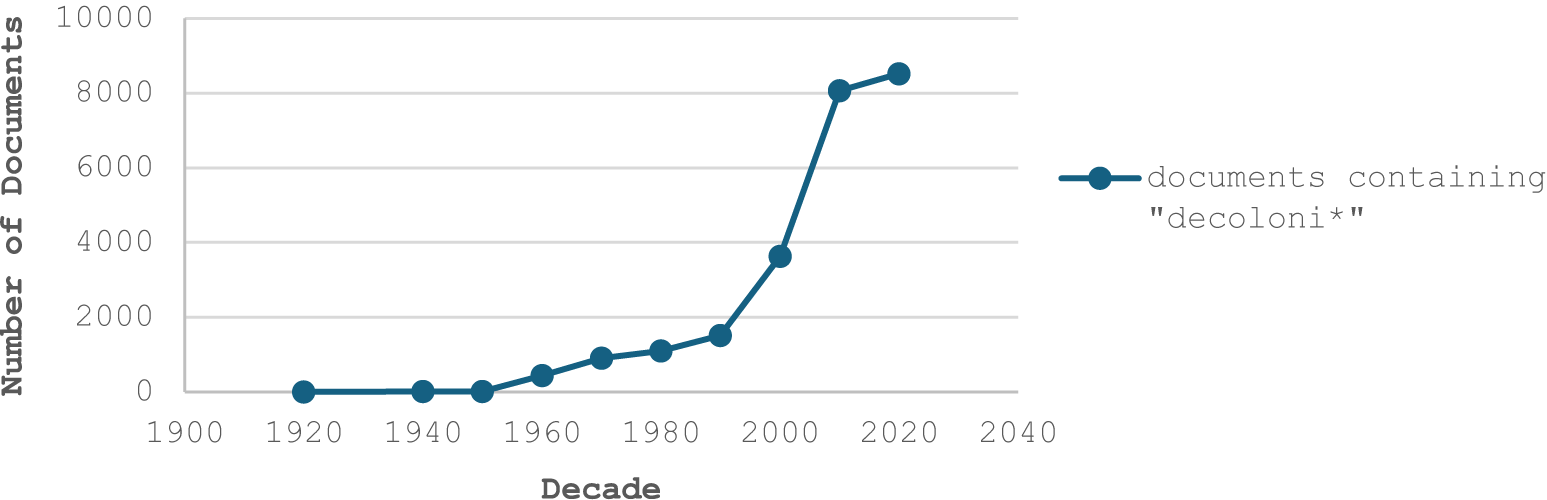
A similar search of articles and books that Constellate categorizes as “Political Science” yields a similar result. Again, I extrapolated from existing data to predict values for 2025–29 (figure A2).
Constellate search for “decoloni*” in political science
Source: Constellate.

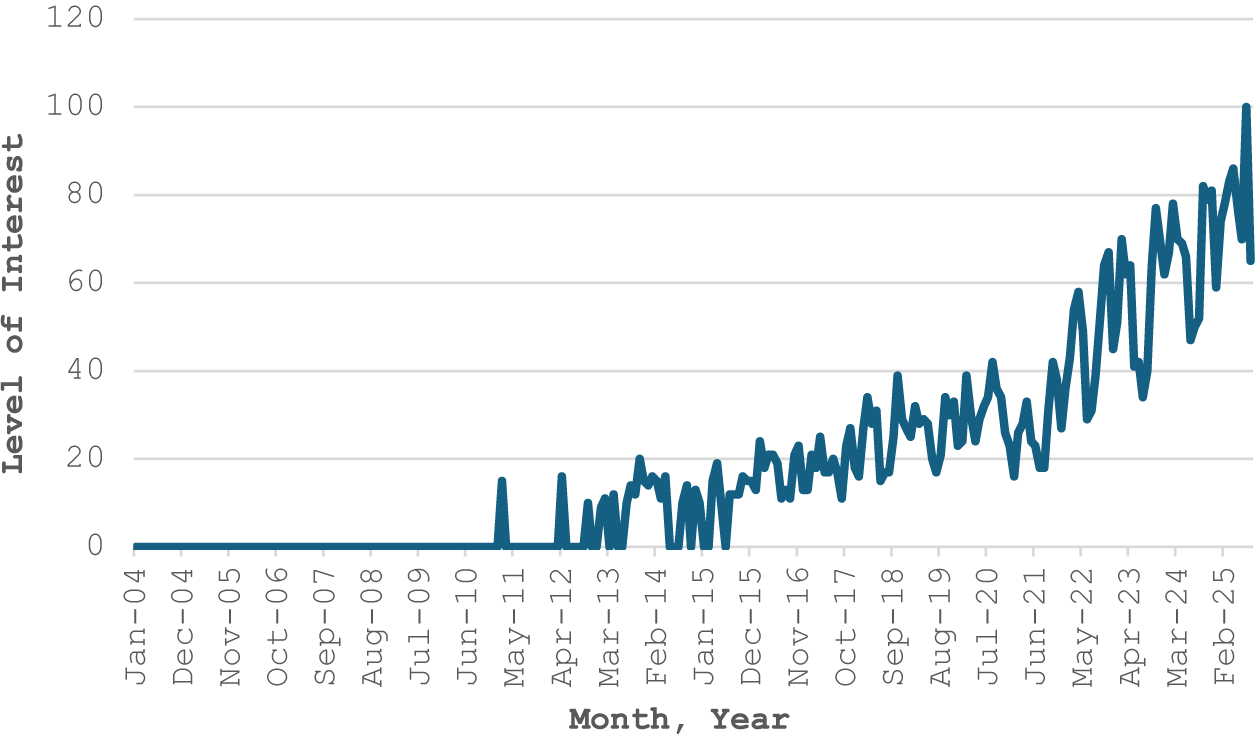
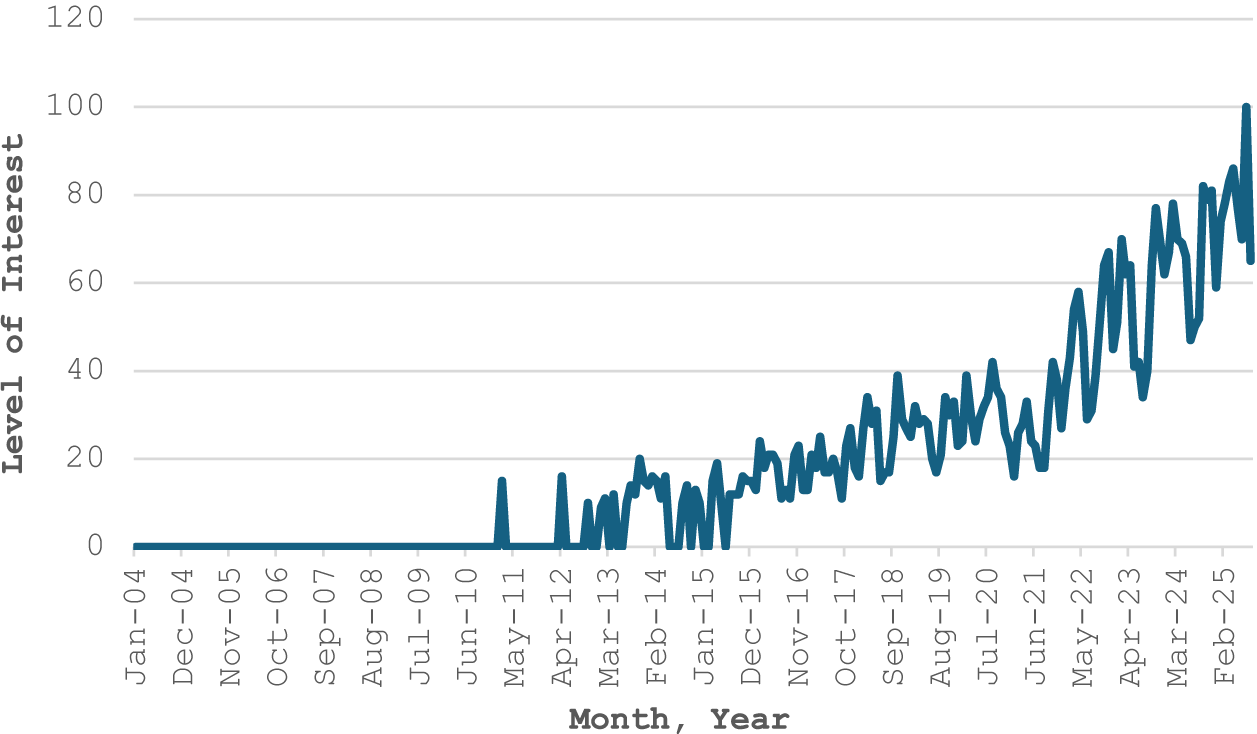
Likewise, a Google Trends search for uses of “decolonial” in Google searches in the United States suggests a rapid rise of interest in the broader public since the early 2000s. The value 100 represents the peak level of interest (figure A3).
Google Trends search for “decoloni*”
Source: Google Trends.

 Open access

