





Introduction
Aggression is generally defined as a behavior intended to cause physical or emotional harm to others, placing a high burden on the victims, their families, and society as a whole (Anderson & Bushman, Reference Anderson and Bushman2002). Longitudinal studies beginning in the preschool years show that the prevalence of physical aggression peaks during the second and third year of life and declines thereafter (Tremblay et al., Reference Tremblay, Nagin, Seguin, Zoccolillo, Zelazo, Boivin, Perusse and Japel2004). However, a significant minority of children (5–15%) manifest persisting physical aggression during elementary school (Cote et al., Reference Cote, Beauregard, Girard, Mensour, Mancini-Marie and Perusse2007; Nagin & Tremblay, Reference Nagin and Tremblay1999; Tremblay, Reference Tremblay2010). At school, these children have more difficulties complying with demands and routines, are at higher risk of being rejected by their peers, and of underachieving academically (Vuoksimaa et al., Reference Vuoksimaa, Rose, Pulkkinen, Palviainen, Rimfeld, Lundstrom, Bartels, van Beijsterveldt, Hendriks, de Zeeuw, Plomin, Lichtenstein, Boomsma and Kaprio2021). Compelling evidence suggests that variations in aggression are under moderate-to-strong genetic influences (Burt, Reference Burt2009; Chen et al., Reference Chen, Yu, Zhang, Li and McGue2015; Hudziak et al., Reference Hudziak, van Beijsterveldt, Bartels, Rietveld, Rettew, Derks and Boomsma2003; Lacourse et al., Reference Lacourse, Boivin, Brendgen, Petitclerc, Girard, Vitaro, Paquin, Ouellet-Morin, Dionne and Tremblay2014; Tuvblad & Baker, Reference Tuvblad and Baker2011).
Capturing genetic influences on aggression beyond candidate genes
While most studies that examine the etiology of aggression have employed a candidate gene approach targeting serotonergic and dopamine transmission, with inconsistent results (Koyama et al., Reference Koyama, Kant, Takata, Kennedy and Zai2024; Vassos et al., Reference Vassos, Collier and Fazel2014; Veroude et al., Reference Veroude, Zhang-James, Fernandez-Castillo, Bakker, Cormand and Faraone2016), genome-wide association studies (GWASs) are now generally regarded as more reliable. GWASs test, without a priori hypotheses, whether individual differences in a phenotype are associated with allelic variation at hundreds of thousands of measured or imputed single nucleotide polymorphisms (SNPs) across the genome. GWASs conducted specifically on aggression did not identify SNPs at a genome-wide level of significance (n = 8,747), although signals (at p < 1×10⁻⁵) emerged for genes implicated in neuronal excitability, astrocyte differentiation, and long-term potentiation (LRRC7, STIP1, and FYN genes) (Mick et al., Reference Mick, McGough, Loo, Doyle, Wozniak, Wilens, Smalley, McCracken, Biederman and Faraone2011, Reference Mick, McGough, Deutsch, Frazier, Kennedy and Goldberg2014). Pappa et al. (n = 18,988) identified one region (2p12) associated at near genome-wide significance (top SNP rs11126630, p = 5.30×10⁻⁸) with aggression in childhood and adolescence, explaining between 10 and 54% of the phenotypic variance (Pappa et al., Reference Pappa, St Pourcain, Benke, Cavadino, Hakulinen, Nivard, Nolte, Tiesler, Bakermans-Kranenburg, Davies, Evans, Geoffroy, Grallert, Groen-Blokhuis, Hudziak, Kemp, Keltikangas-Jarvinen, McMahon, Mileva-Seitz and Tiemeier2016). The latest meta-GWAS, conducted in 29 cohorts of North-European ancestry aged 1.5–18 years (n = 87,485), also did not find genome-wide significant SNPs but detected a signal for three genes previously identified with education, intelligence, and adventurousness, namely, ST3GAL3, PCDH7, and IPO13 (Ip et al., Reference Ip, van der Laan, Krapohl, Brikell, Sanchez-Mora, Nolte, St Pourcain, Bolhuis, Palviainen, Zafarmand, Colodro-Conde, Gordon, Zayats, Aliev, Jiang, Wang, Saunders, Karhunen, Hammerschlag and Boomsma2021). Beyond these isolated SNPs, GWASs inform the construction of polygenic scores (PGSs) by aggregating the effects of thousands of SNPs associated with a given phenotype (e.g., aggression). PGSs provide an estimate of an individual’s genetic propensity for a specific trait, typically following a continuous and normally distributed pattern within the population that could be used to examine gene–environment interplay (Choi et al., Reference Choi, Mak and O’Reilly2020). Specifically, PGSs for aggression (PGSAGG) based on the GWAS by Pappa et al. (Reference Pappa, St Pourcain, Benke, Cavadino, Hakulinen, Nivard, Nolte, Tiesler, Bakermans-Kranenburg, Davies, Evans, Geoffroy, Grallert, Groen-Blokhuis, Hudziak, Kemp, Keltikangas-Jarvinen, McMahon, Mileva-Seitz and Tiemeier2016) accounted for between 1 and 5% of the variance in childhood aggression, conduct problems, and externalizing behaviors (Elam et al., Reference Elam, Clifford, Shaw, Wilson and Lemery-Chalfant2019; Kretschmer et al., Reference Kretschmer, Ouellet-Morin, Vrijen, Nolte and Hartman2023; Luo et al., Reference Luo, Pappa, Cecil, Jansen, van and Kok2022; Shaw et al., Reference Shaw, Galán, Lemery-Chalfant, Dishion, Elam, Wilson and Gardner2019). The PGSAGG derived from the GWAS conducted by Ip and colleagues (2021) has been associated with mother-reported aggression in 7-year-old Dutch children (n = 4,491), explaining 0.44% of the variance. No studies have yet tested whether the predictive value of these PGSAGG varies according to distinct trajectories of aggression during childhood, even though prior evidence showed that the influence of genetic factors likely increases with age, contributing to its stability (Niv et al., Reference Niv, Tuvblad, Raine and Baker2013; Waltes et al., Reference Waltes, Chiocchetti and Freitag2016) and changes in aggression over time (Pingault et al., Reference Pingault, Rijsdijk, Zheng, Plomin and Viding2015; Porsch et al., Reference Porsch, Middeldorp, Cherny, Krapohl, van Beijsterveldt, Loukola, Korhonen, Pulkkinen, Corley, Rhee, Kaprio, Rose, Hewitt, Sham, Plomin, Boomsma and Bartels2016). Current research thus requires a developmental approach.
Aggression through the lenses of a genetic–environmental correlation (rGE) framework
Elucidating the mechanisms through which genetic and environmental influences shape the developmental trajectories of aggression remains a key challenge. Although these influences are often conceptualized as independent – or as interacting such that genetic predispositions are exacerbated by adverse environments (i.e., gene–environment interaction, GxE) (Odintsova et al., Reference Odintsova, Hagenbeek, van der Laan, van de Weijer, Boomsma, Swaab and Meynen2023) – evidence from twin and molecular genetic studies suggests that genetic propensities for aggression may be confounded with environments conducive to aggression, including harsh parenting practices, deprived neighborhood, and peer victimization (Avinun & Knafo, Reference Avinun and Knafo2014; Caspi et al., Reference Caspi, Taylor, Moffitt and Plomin2000; DiLalla & John, Reference DiLalla and John2014). A gene–environment correlation (rGE) framework thus provides a valuable approach for understanding how genetic risk for aggression may become partially embedded in social experiences associated with aggressive behaviors.
Notably, rGE can arise through three distinct processes: passive, evocative, and active rGE (Jaffee & Price, Reference Jaffee and Price2007). Active rGE occurs when individuals seek out environments, such as peers, that align with genetically influenced traits or behaviors. Evocative rGE arises when individuals elicit responses from others based on those traits or behaviors (Schulz-Heik et al., Reference Schulz-Heik, Rhee, Silvern, Haberstick, Hopfer, Lessem and Hewitt2010). For example, early irritability or impulsiveness in a child with a genetic propensity toward aggression may elicit harsher parenting, thereby reinforcing aggressive behavior. In contrast, passive rGE occurs when the environment provided by parents is partly shaped by their own genetically influenced traits, which are also passed on to their offsprings. Because children inherit both their genes and aspects of their rearing environment from their parents, genetic propensities for aggression may be confounded with family environments that increase the risk for developing aggression, especially early in development.
The rGE framework thus underscores the possibility that genetic influences may be partially mediated by – or confounded with – adverse environmental exposures, such as maltreatment experiences (Jaffee & Price, Reference Jaffee and Price2007). This perspective has been discussed in several comprehensive reviews on aggression and externalizing behaviors (Burt, Reference Burt2022; Jaffee, Reference Jaffee and Maikovich-Fong2011). Of particular relevance, childhood maltreatment is one of the most robust predictors of aggression (Ran et al., Reference Ran, Zhang, Zhang, Li and Chen2023), and both twin and GWAS studies indicate that self-reports of childhood maltreatment are partly heritable (Dahoun et al., 2025; Dalvie et al., Reference Dalvie, Maihofer, Coleman, Bradley, Breen, Brick, Chen, Choi, Duncan, Guffanti, Haas, Harnal, Liberzon, Nugent, Provost, Ressler, Torres, Amstadter, Bryn Austin and Nievergelt2020; Jay Schulz-Heik et al., Reference Schulz-Heik, Rhee, Silvern, Lessem, Haberstick, Hopfer and Hewitt2009; Warrier et al., Reference Warrier, Kwong, Luo, Dalvie, Croft, Sallis, Baldwin, Munafo, Nievergelt, Grant, Burgess, Moore, Barzilay, McIntosh, van and Cecil2021). Specifically, genetic predispositions for aggression – shared in part with those of parents – may be confounded with parenting behaviors such as disengagement, coercive and harsh discipline, and maltreatment (Beaver et al., Reference Beaver, Shutt, Vaughn, DeLisi and Wright2012; Marceau et al., Reference Marceau, Horwitz, Narusyte, Ganiban, Spotts, Reiss and Neiderhiser2013). A rGE framework thus offers a theoretical basis for examining whether environments conducive to aggression may relate to – and partially account for – the association between genetic risk for aggression and developmental trajectories of childhood aggression.
Importantly, the presence of rGE does not diminish the value of other genetically informed study designs, such as discordant monozygotic twin comparisons, aiming to provide strong support for the causal role of parental practices, including maltreatment, in shaping children’s aggressive behavior (Moffitt, Reference Moffitt2005). Rather, the rGE framework complements these findings by identifying additional pathways through which family processes shaped by both the parents and the children genotypes may sustain intergenerational patterns of aggression, without attributing maltreatment to the child’s genetic background, traits, or behaviors.
To date, however, few studies have formally tested whether maltreatment experiences partially mediate the association between PGSAGG and aggression in school-aged children (Burt, Reference Burt2022; Schulz-Heik et al., Reference Schulz-Heik, Rhee, Silvern, Haberstick, Hopfer, Lessem and Hewitt2010). A notable exception it the study by Kretschmer et al. (Reference Kretschmer, Vrijen, Nolte, Wertz and Hartman2022), which examined a Dutch cohort (n = 2,734) and found that the association between a PGS derived from a GWAS conducted on externalizing problems (Karlsson Linnér et al., Reference Karlsson Linner, Mallard, Barr, Sanchez-Roige, Madole, Driver, Poore, de Vlaming, Grotzinger, Tielbeek, Johnson, Liu, Rosenthal, Ideker, Zhou, Kember, Pasman, Verweij, Liu and Dick2021) and externalized behaviors in early adulthood (ages 19–28) was partially mediated by family dysfunction, measured between ages 11 and 16. These findings are suggestive of a weak evocative gene–environment correlation (Kretschmer et al., Reference Kretschmer, Vrijen, Nolte, Wertz and Hartman2022). Similarly, Su et al. (Reference Su, Jamil, Elam, Trevino, Lemery-Chalfant, Seaton, Cruz and Grimm2025) reported that PGSs targeting aggression (Ip et al., Reference Ip, van der Laan, Krapohl, Brikell, Sanchez-Mora, Nolte, St Pourcain, Bolhuis, Palviainen, Zafarmand, Colodro-Conde, Gordon, Zayats, Aliev, Jiang, Wang, Saunders, Karhunen, Hammerschlag and Boomsma2021) and externalizing problems (Karlsson Linnér et al., Reference Karlsson Linner, Mallard, Barr, Sanchez-Roige, Madole, Driver, Poore, de Vlaming, Grotzinger, Tielbeek, Johnson, Liu, Rosenthal, Ideker, Zhou, Kember, Pasman, Verweij, Liu and Dick2021) predicted greater family conflicts at ages 9–10, which in turn was associated with a higher likelihood of being assigned to a trajectory characterized by elevated externalizing behavior from ages 9 to 13 years in a subsample of non-Hispanic White participants. This pattern was consistent with a complete mediation process (Su et al., Reference Su, Jamil, Elam, Trevino, Lemery-Chalfant, Seaton, Cruz and Grimm2025). Emerging evidence also suggests that PGSAGG is associated with lower family cohesion and reduced parental supervision, both of which have been linked to later aggression (Elam et al., Reference Elam, Chassin, Lemery-Chalfant, Pandika, Wang, Bountress, Dick and Agrawal2017, Reference Elam, Chassin and Pandika2018). However, although some studies have formally tested the mediating role of family environments, none specifically examined maltreatment experiences.
Unpacking aggressive behaviors: a multifaceted construct
Most genetically informed studies relied on broad scales of aggression (Crick & Dodge, Reference Crick and Dodge1996), potentially overlooking distinctions related to the functions or motivations behind these behaviors (Koyama et al., Reference Koyama, Kant, Takata, Kennedy and Zai2024; Odintsova et al., Reference Odintsova, Hagenbeek, van der Laan, van de Weijer, Boomsma, Swaab and Meynen2023; Veroude et al., Reference Veroude, Zhang-James, Fernandez-Castillo, Bakker, Cormand and Faraone2016). Indeed, proactive aggression typically involves premediated actions undertaken with the intention of securing a reward, strategically avoiding unpleasant stimuli, or asserting dominance. Characterized by lower emotional arousal, proactive aggression is executed when the costs, such as the risk of being caught or experiencing pain, are minimal (Dodge & Coie, Reference Dodge and Coie1987). In contrast, reactive aggression is an emotionally charged and sympathetically driven response to perceived threat or provocation, with the intent to dispel a source of frustration. Proactive and reactive aggression are thought to be mediated, in part, by distinct neural pathways aligned with their motivation (reward vs. response to threat). While proactive aggression is expected to be driven by dopaminergic pathways, reactive aggression more strongly involves stress systems (Vassos et al., Reference Vassos, Collier and Fazel2014). Approximately half of children who engage in one form of aggression display the other, one-third exhibit a predominance for reactive aggression, and a minority (∼15%) manifest solely proactive aggression (Dodge et al., Reference Dodge, Lochman, Harnish, Bates and Pettit1997). Moderate heritability estimates have been reported for proactive (32–48%) and reactive aggression (20–43%) (Baker et al., Reference Baker, Raine, Liu and Jacobson2008; Brendgen et al., Reference Brendgen, Vitaro, Boivin, Dionne and Perusse2006; Waltes et al., Reference Waltes, Chiocchetti and Freitag2016). Shared and unique genetic and environmental contributions have also been documented between these two functions of aggression (Waltes et al., Reference Waltes, Chiocchetti and Freitag2016). Our team also showed that proactive and reactive aggression shared 76% of their genetic influences and 12% of environmental influences, pointing to a common and unique genetic and environmental etiology between proactive and reactive aggression (Brendgen et al., Reference Brendgen, Vitaro, Boivin, Dionne and Perusse2006). While the PGSAGG has shown predictive validity in independent samples (Bouliane et al., Reference Bouliane, Boivin, Kretschmer, Lafreniere, Paquin, Tremblay, Côté, Gouin, Andlauer, Petitclerc and Ouellet-Morin2025; van der Laan et al., Reference van der Laan, Morosoli-García, van de Weijer, Colodro-Conde, a, C., Krapohl, Brikell, Sánchez-Mora, Nolte, Pourcain, Bolhuis, Palviainen, Zafarmand, Colodro-Conde, a, Zayats, Aliev, Jiang and Boomsma2021), no studies have yet tested its association with reactive and proactive aggression.
Building on previous findings indicating partially distinct genetic and environmental etiologies for proactive and reactive aggression, especially once common manifestations are accounted for (Brendgen et al., Reference Brendgen, Vitaro, Boivin, Dionne and Perusse2006), we propose that the mediating role of maltreatment in the association between PGSAGG and aggression differs according to the function of aggression. Indeed, several studies suggest that maltreatment is a stronger predictor of reactive aggression than of proactive aggression (Vitaro, Reference Vitaro, Brendgen and e. J. A. R. E. Tremblay2005). This aligns with evidence drawn from a preventive intervention that reduced reactive aggression, not proactive aggression, with the effect primarily driven by decreased parental coercion (Barker et al., Reference Barker, Vitaro, Lacourse, Fontaine, Carbonneau and Tremblay2010). No studies have yet examined whether childhood maltreatment plays a more significant role in the pathways through which genetic risk relates to proactive versus reactive aggression. Describing these associations during elementary school is crucial as some children show a decline in aggression during this period, while a minority exhibits persistent aggression throughout elementary school. Identifying differences in these pathways could guide interventions tailored to the specific needs of children following distinct developmental trajectories of proactive and reactive aggression.
This study examined the association between PGSAGG and aggression behaviors reported prospectively by independent raters (i.e., teachers) at six occasions between 6 and 13 years of age. First, we tested whether PGSAGG was associated with age-specific and average scores of reactive and proactive aggression. Second, we tested whether developmental trajectories of aggression were differently associated with the PGSAGG. Third, we examined whether cumulative maltreatment experienced from 5 months to 12 years partially mediated these associations, particularly for reactive aggression. We focused on cumulative maltreatment because we did not hypothesize distinct patterns of associations across different types of maltreatment (e.g., emotional vs. physical abuse or family violence). Rather, we focused on the number of maltreatment types experienced as an indicator of the breadth of potentially harmful exposures. An overarching aim was to examine whether these associations were specific to a particular type of aggression, given that proactive and reactive aggression often co-occur in the same children.
Methods
Participants
Participants were part of the Quebec Longitudinal Study of Child Development (QLSCD), a population-based cohort managed by the Institut de la statistique du Québec (Quebec Statistics Institute) that includes 2,120 children born in Quebec (Canada) in 1997–1998. Further details about the cohort can be found online (https://www.jesuisjeserai.stat.gouv.qc.ca/) and in the cohort profile (Orri et al., Reference Orri, Boivin, Chen, Ahun, Geoffroy, Ouellet-Morin, Tremblay and Côté2021). A total of 952 participants from the QLSCD were initially genotyped. Of these, 14 were excluded due to genotyping issues, and 33 were removed because they were part of the QLSCD pilot sample, in which maltreatment indices had not been derived. Following quality control and imputation procedures, an additional 184 participants were excluded due to quality control issues, yielding a final genotyped sample of 721 participants (44.9% males; 99.0% White). The QLSCD cohort was initially representative of singleton births to French- or English-speaking mothers residing in Quebec, encompassing a range of socioeconomic backgrounds (Orri et al., Reference Orri, Boivin, Chen, Ahun, Geoffroy, Ouellet-Morin, Tremblay and Côté2021). However, children who provided a biological sample differed from those who did not: they were more likely to come from higher socioeconomic backgrounds, to have French as their first language (the predominant language in Quebec), and to be raised in biparental families. Of the 721 participants for whom the PGSAGG was derived, 706 had at least one valid data point on aggression, and 621 also had a cumulative index of childhood maltreatment (86.13%). The QLSCD protocol was approved by the Institut de la statistique du Québec’s ethics committee. Informed consent was obtained from participants and/or their parents at each data collection.
Measures
Genotyping, quality control, and imputation of genetic data
Extraction. A total of 992 families agreed to provide saliva or blood samples of participants aged 10 years. DNA samples were extracted using Qiagen FlexiGene DNA kit Cat#51206 according to the manufacturer’s instructions. DNA concentration and purity were measured and normalized if needed. Genotyping was done using a custom chip based on the Illumina Infinium PsychArray–24v1.3 Beadchip, to which 790 additional SNPs were selected with prior knowledge of associations with social behaviors and mental health. A total of 588,952 variants were genotyped for 938 participants who had DNA in sufficient quantity and quality (n = 54 excluded). Quality control and imputation followed the approach in Morneau-Vaillancourt et al. (Reference Morneau-Vaillancourt, Andlauer, Ouellet-Morin, Paquin, Brendgen, Vitaro, Gouin, Séguin, Gagnon, Cheesman, Forget-Dubois, Rouleau, Turecki, Tremblay, Côté, Dionne and Boivin2021), though the numbers of participants differ as the prior study included another cohort. Quality control was performed using PLINK v1.90b5.3 and R v3.4.3 software. SNPs with a minor allele frequency (MAF) less than 1% were excluded, along with SNPs genotyping rate < .98, and participants with SNP call rate < .95 (n = 15). Participants were also excluded for sex mismatches (n = 4) and genetic duplicates (n = 8). We also checked potential relatedness using identity-by-descent estimates (PI-HAT ≥ .125) to ensure data independence; none were identified. Population genetic stratification was modeled using 10 principal components of genetic data. SNPs that did not meet the criteria for Hardy–Weinberg equilibrium (HWE) at p < 10−3 and SNPs with MAF less than 5% were excluded. Remaining SNPs were pruned according to a region of 200 variants, a step size of 100, and a correlation between a pair of loci (r 2) inferior to .20. Participants with outliers exceeding 4 SD of the mean in the first eight multidimensional scaling ancestry components, as well as those with high autosomal or X-chromosomal heterozygosity rates (>4 SD from the mean), were excluded (n = 157). Non-autosomal variants in deviations from HWE (p < 1*10−6) were excluded. After this initial quality control step, our sample contained 284,164 SNPs. Imputation was conducted using 1000 Genomes Phase 3 as a reference panel. Haplotypes on the reference panel were estimated using SHAPEIT v2 (r837; Delaneau et al., Reference Delaneau, Howie, Cox, Zagury and Marchini2013). Before imputation, ambiguous SNPs with respect to their strand orientation were removed. Strands of SNPs were checked relative to the reference panel, flipped if a mismatch was found, or otherwise removed. SNPs were then imputed using IMPUTE2 v2.3.2 (Howie et al., Reference Howie, Donnelly and Marchini2009) in 5 megabasepair chunks with 500 kilobase buffers, using all reference data. Variants with a MAF ≥ 1% and an INFO metric ≥ .8 were then filtered, leading to a sample of 8,465,216 SNPs for a total of 721 participants that passed all the steps of quality control.
Aggression polygenic score
The PGSAGG was calculated based on previously reported GWAS (Ip et al., Reference Ip, van der Laan, Krapohl, Brikell, Sanchez-Mora, Nolte, St Pourcain, Bolhuis, Palviainen, Zafarmand, Colodro-Conde, Gordon, Zayats, Aliev, Jiang, Wang, Saunders, Karhunen, Hammerschlag and Boomsma2021) using PRS-CS software. Briefly, PRS-CS is a Bayesian estimation method that applies a continuous shrinkage prior to SNP weighting and shown to be superior to other methods (e.g., clumping and thresholding; Ge et al., Reference Ge, Chen, Ni, Feng and Smoller2019). A global shrinkage parameter phi set to 0.01 was used. PGSAGG was computed by using a linear combination of genotype data and the adjusted summary statistics in PLINK 1.90 (Chang et al., Reference Chang, Chow, Tellier, Vattikuti, Purcell and Lee2015). PGSAGG was adjusted for population stratification using the residuals of the first ten principal factor components derived from the pairwise genetic relationship matrix during quality control.
School-age aggression
Teacher ratings of children’s aggression were collected prospectively at six time points (ages 6, 7, 8, 10, 12, and 13 years) in the Spring of each school year using items adapted from Dodge and Coie’s questionnaire (Dodge & Coie, Reference Dodge and Coie1987) and the Social Behavior Questionnaire (Tremblay et al., Reference Tremblay, Loeber, Gagnon, Charlebois, Larivée and LeBlanc1991). The measure of proactive aggression comprised three items (Cronbach alphas [α] = .73–.80; e.g., “scared other children to get what he/she wanted”) while four items were used to assess reactive aggression (α = .85–.89; e.g., “reacted in an aggressive manner when contradicted”). Teachers rated these items on a Likert scale (never [1], sometimes [2], often [3]) in the past six months. At each collection time, aggression scores were calculated to have a minimum value of 0. Then, the items’ average was multiplied by the number of items and rescaled from 0 to 10. The same items were repeated at each time point and moderately correlated over time (proactive: r s = .18-.47, p s < .01; reactive: r s = .33−.57, p s < .01). Measures of proactive and reactive aggression were moderately correlated at each time point (r s = .57−.69, p s < .01; see Table S1), indicating a shared variance between these two forms of aggression (r s 2 = .32−.48).
Childhood maltreatment
As no standardized questionnaires prospectively measured childhood maltreatment in this cohort, we derived a prospective indicator of cumulative maltreatment as based on available information collected from 5 months to 12 years (i.e., up to 10 occurrences) across multiple informants (mothers, children, teachers, home observations) and a wide range of experiences, including emotional, physical, and sexual abuse, emotional and physical neglect, and family violence (Scardera et al., Reference Scardera, Langevin, Collin-Vezina, Cabana, Pinto Pereira, Cote, Ouellet-Morin and Geoffroy2023). Information was first screened by two independent raters based on definitions from the Quebec Youth Protection Act (Québec, 2024) and supporting resources (Grounds for Reporting a Situation, 2022). From the 462 items considered for inclusion, two maltreatment experts independently selected the items and identified cut-offs for dichotomization of indicators of probable maltreatment. Any disagreements were resolved through discussion, leading to a final sample of 251 items included. The index of cumulative maltreatment reflects the exposure to various types of maltreatment (physical abuse, sexual abuse, psychological abuse, emotional neglect, physical neglect, and family violence). The prospectively derived cumulative indicator of probable child maltreatment used in this study is conceptually and empirically distinct from measures of harsh or coercive parenting. Specifically, indicators of probable maltreatment were developed in line with the legal definitions from the Quebec Youth Protection Act, and each item was independently evaluated by experts based on severity, repetition, and potential harm. This rigorous process ensured that only experiences meeting established thresholds for probable maltreatment were included. Consistent with their distinctiveness, supplementary analyses revealed only modest correlations between this cumulative maltreatment indicator and harsh parenting scales measured during the same period (12 time points; r s = .10–.28), underscoring the specificity of each construct. We further described the construct validity of the maltreatment indicators derived in this cohort (Langevin et al., Reference Langevin, Ouellet-Morin, Kay, Chartrand, Castellanos-Ryan, Collin-Vezina and Geoffroy2025). The cumulative maltreatment index showed a dose–response relationship with early maternal and familial risk factors assessed between 5 and 17 months (e.g., maternal age, depressive symptoms, and antisocial behaviors, family socioeconomic status [SES], and single-parent home), as well as with functioning difficulties in early adulthood (ages 20–23), including depression, anxiety, suicidality, alcohol misuse, and unemployment status – developmental outcomes commonly associated with childhood maltreatment (Langevin et al., Reference Langevin, Ouellet-Morin, Kay, Chartrand, Castellanos-Ryan, Collin-Vezina and Geoffroy2025). These findings suggest the strong construct validity of the cumulative indicator of maltreatment. In this study subsample, 217 children had no experience of maltreatment (34.9%), whereas 205 (33.0%), 126 (20.3%), and 73 children (11.8%) had one, two, three, or more experiences of maltreatment, respectively. Males were exposed, on average, to more maltreatment than girls [t (619) = 2.165, p = .031].
Potential confounders
All regression analyses were adjusted for sex and SES due to their well-established associations with aggression and childhood maltreatment, although the link between sex and maltreatment is comparatively less robust, particularly regarding prospective measures. SES was operationalized using information collected on maternal and paternal education, occupational prestige, single parenthood, and family income and aggregated into a common factor of family SES using a confirmatory factorial analysis. The indices were then averaged across the six time points (5 months to 5 years) (Wilms et Shields, Reference Wilms and Shields1996).
Statistical analyses
Analyses were performed in four steps. First, we examined the correlation between PGSAGG and aggression behaviors at each age. Second, we used growth mixture models with polynomial quadratic effects including 1 to 4 groups to identify distinct subgroups with homogeneous patterns of aggression during childhood. We selected the models that best fit the data according to the log-likelihood (LL; higher is better), the Bayesian information criterion ( lower is better), entropy estimate (higher is better), and the Lo–Mendell–Rubin likelihood ratio test and groups with a prevalence higher than 5%. Third, we conducted multinomial logistic regressions (MLR) using Mplus’s three-step approach – an extension that adjusts for classification errors in latent class assignment – to test whether the PGSAGG predicted membership in higher versus lower aggression trajectories. This approach allows classes and their predictors/outcomes to be modeled in the same model, thus reducing the bias introduced by forcing assignment to a class (Tihomir & Muthén, Reference Tihomir and Muthén2012). Fourth, we examined whether childhood maltreatment mediated the association between PGSAGG and aggression using a mediation model implemented through multinomial logistic regression in Mplus (version 8.10). Indirect effects were estimated using 5,000 bootstrap samples, with significance determined by bias-corrected 95% confidence intervals. The model included a path from the independent variable (PGSAGG) to the proposed mediator (maltreatment; path a), and from the mediator to each outcome dummy variable (e.g., Higher-Persistent vs. Lower-Stable aggression trajectories; path b). An indirect effect was considered significant if the 95% confidence interval did not include zero. Analyses were performed using the MLR estimator, which provides robust standard errors and enables full information maximum likelihood to account for missing data. All models were conducted separately for proactive and reactive aggression and controlled for sex and family SES. To address the known overlap between these two functions of aggression and to describe the specificity of these associations, we subsequently included dummy variables representing the trajectory groups of the other function of aggression (i.e., Childhood-Limited vs. Lower-Stable and Higher-Persistent vs. Lower-Stable) as covariates in the regression models.
Results
Associations between PGS AGG and age-specific aggression scores
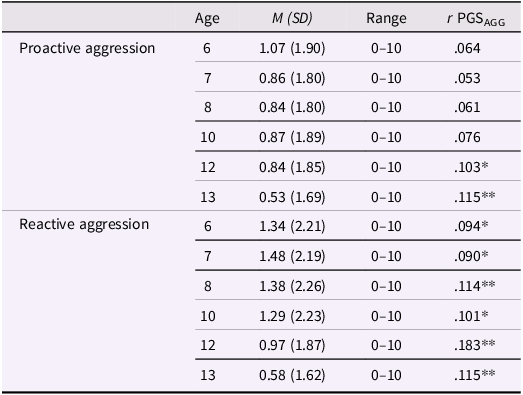
Means and standard deviations for the measures of aggression among the participants with a valid PRSAGG are presented in Table 1, along with the bivariate correlation estimates with the PRSAGG. The PRSAGG was associated with age-specific measures of proactive and reactive aggression across most time points, with a trend toward stronger correlations in late childhood. A decline in aggression was noted from the ages 6 to 13 years for both functions of aggression. We also noted a more robust pattern of associations emerging for reactive aggression compared to proactive aggression.
Descriptive statistics of teachers-rated aggression across childhood for proactive and reactive aggression, and their bivariate correlations with PGSAGG
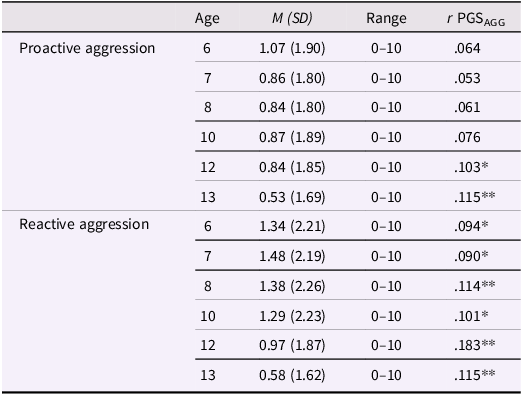
Notes. Data were compiled from the final master file of the Québec Longitudinal Study of Child Development (2004–2011), ©Gouvernement du Québec, Institut de la statistique du Québec. The number of participants with valid PGSagg and score of aggression varied between 473 and 708, according to the specific time points. PGS AGG = polygenic score for aggression. **p = <.01, *p = <.05.
Associations between PGS AGG and developmental trajectories of aggression
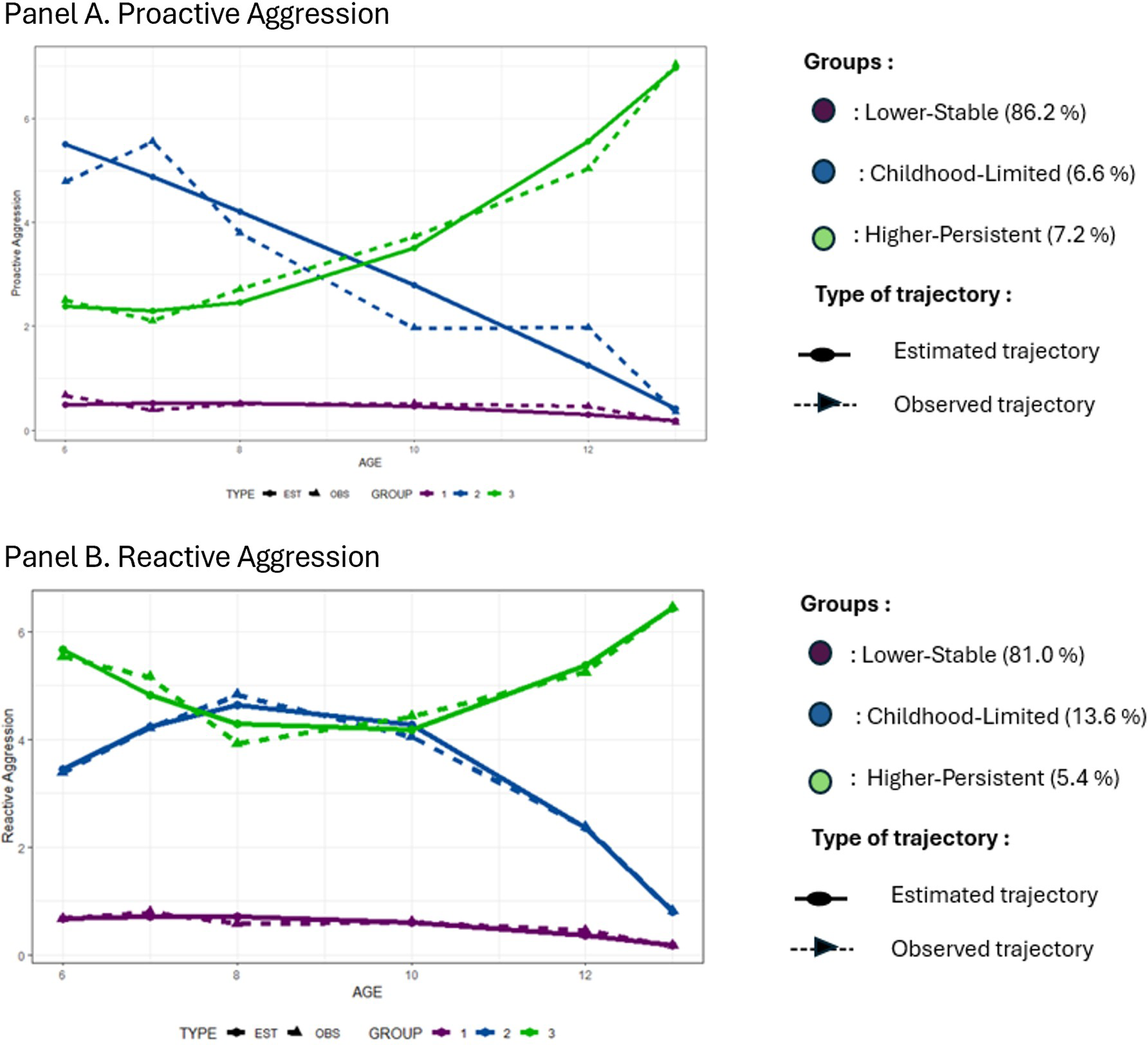
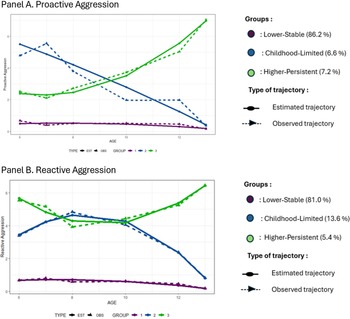
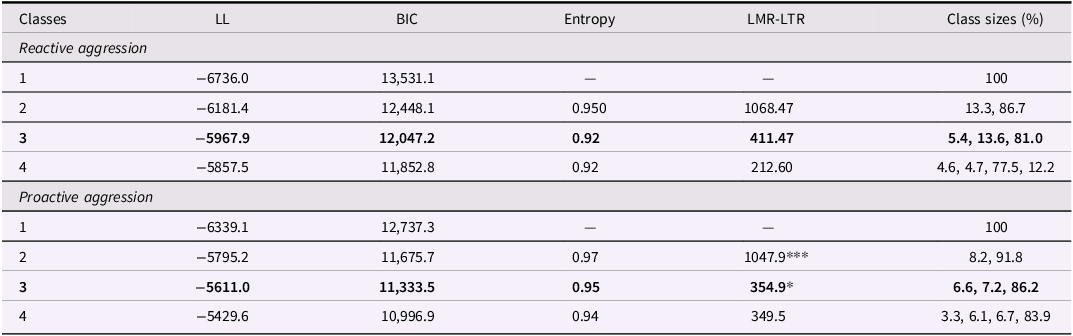
Table 2 shows the fit indices for the growth mixture models estimated on maximum available data. For both proactive and reactive aggression, the 3-group solution best fit the data and yielded groups that had a frequency of at least 5%. Figure 1 shows the best-fitting trajectories model, depicting children who displayed “Lower-Stable,” “Childhood-Limited,” and “Higher-Persistent” levels of aggression between ages 6 and 13 years. Similar to other cohorts, we showed that most children exhibited low levels of aggression during childhood (proactive: 86.2%; reactive: 81.0%). A small proportion displayed higher scores in early childhood that weakened subsequently (proactive: 6.6%; reactive: 13.6%), while a minority had higher levels of aggression throughout childhood (proactive: 7.2%; reactive: 5.4%).
Group-based trajectories of proactive aggression (Panel A) and reactive aggression (Panel B) between 6 and 13 years. Latent class analyses identified three trajectory groups: Lower-Stable, Childhood-Limited, and Higher-Persistent. Solid lines represent estimated trajectories, and dashed lines represent observed trajectories. Percentages indicate the proportion of children assigned to each group.
Model fit of the latent class growth models with varying number of classes for reactive and proactive aggression reported by teachers between 6 and13 years
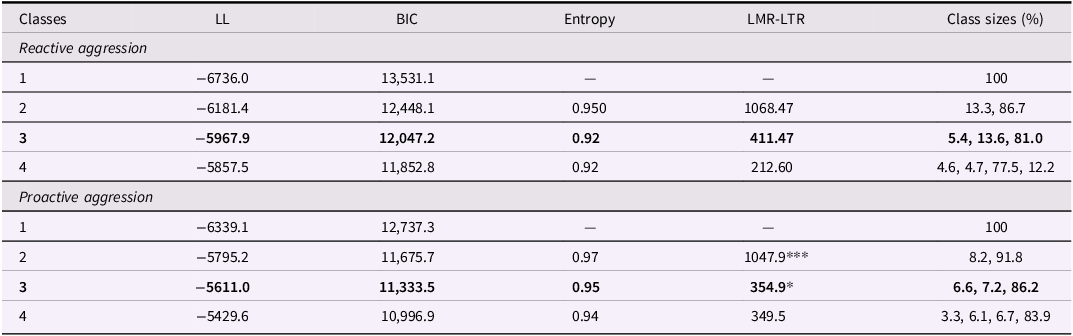
Notes. N = 706 participants with genetic data and at least one valid point on aggression. The selected models are presented in bold. LL = log-likelihood; BIC = Bayesian information criteria; LMR-LTR = Lo–Mendell–Rubin likelihood ratio test. ***p = <.001, **p = <.01, *p = <.05.
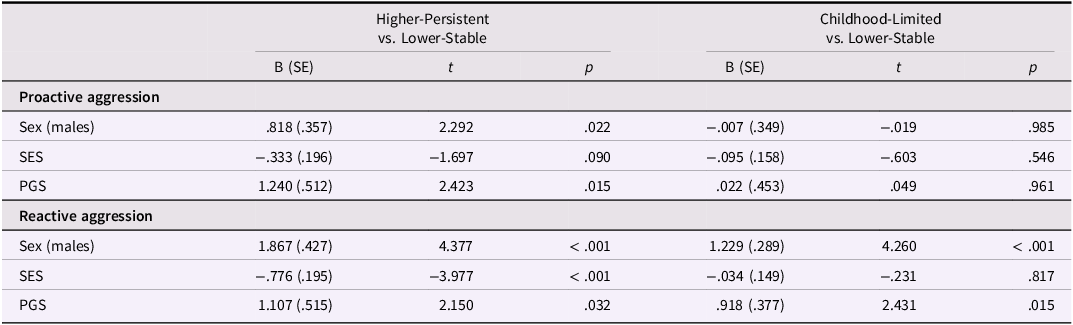
Using multinomial logistic regressions accounting for a posteriori membership to each trajectory, we noted that children with higher PGSAGG scores were more likely to display a Higher-Persistent trajectories of proactive (B = 1.240, SE = .512, t = 2.423, p = .015) and reactive (B = 1.107, SE = .515, t = 2.150, p = .032) aggression in comparison to the Lower-Stable trajectories (see Table 3). When contrasting Childhood-Limited to Lower-Stable trajectories, the PGSAGG was only significantly associated with reactive aggression (B = .918, SE = .377, t = 2.431, p = .015). Furthermore, since children manifesting one type of aggression are reported to be more likely to display the other, we examined if it was the case in this cohort, according to their developmental trajectories. Children who were part of the Higher-Persistent or Childhood-Limited trajectories of proactive aggression were indeed more likely to follow similar trajectories for reactive aggression (χ 2 (4) = 257.00, p < 0.001; Cohen’s weighted kappa = 0.55), indicating a moderate degree of overlap between the two functions of aggression. To clarify whether the association with PGSAGG was specific to each function of aggression, we conducted additional analyses controlling for the other form of aggression using dummy variables. As expected, the trajectories of proactive and reactive aggression were strongly associated (Higher-Persistent trajectories: t s = 3.205-6.174, p s < .001; Childhood-Limited trajectories: t s = 3.456–5.922, p s < .001). Accounting for this phenotypic overlap led to a loss of significance in the association between the PGSAGG and Higher-Persistent (vs. Lower-Stable) aggression trajectories (proactive: t = 1.189, p = .234; reactive: t = .875, p = .382). This suggests that the PGSAGG was not uniquely associated with either function of persistent aggression, but rather with their shared variance. In contrast, controlling for the other function of aggression did not alter the association between PGSAGG and the Childhood-Limited trajectory of reactive aggression (t = 2.335, p = .020), indicating a unique association between the PGSAGG and this specific trajectory of aggression.
Associations between the PGSAGG and the developmental trajectories of proactive and reactive aggression
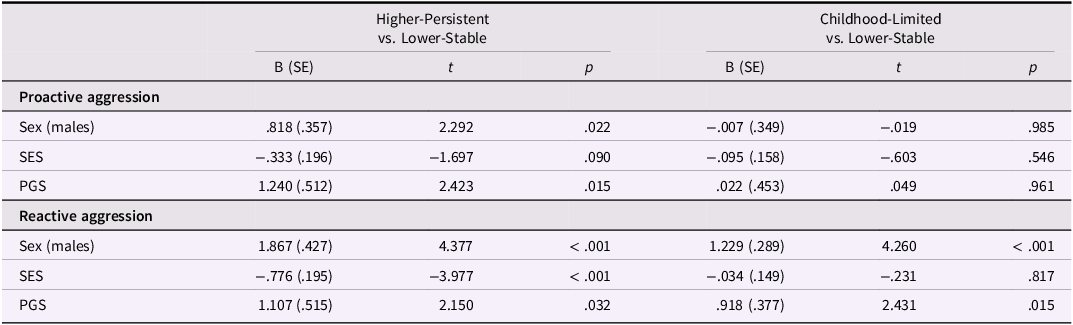
Notes. The Low-Stable trajectories were the reference category. B = beta; SE = standard error; t = t statistic; SES = socioeconomic status; PGS = polygenic score.
Mediation analyses
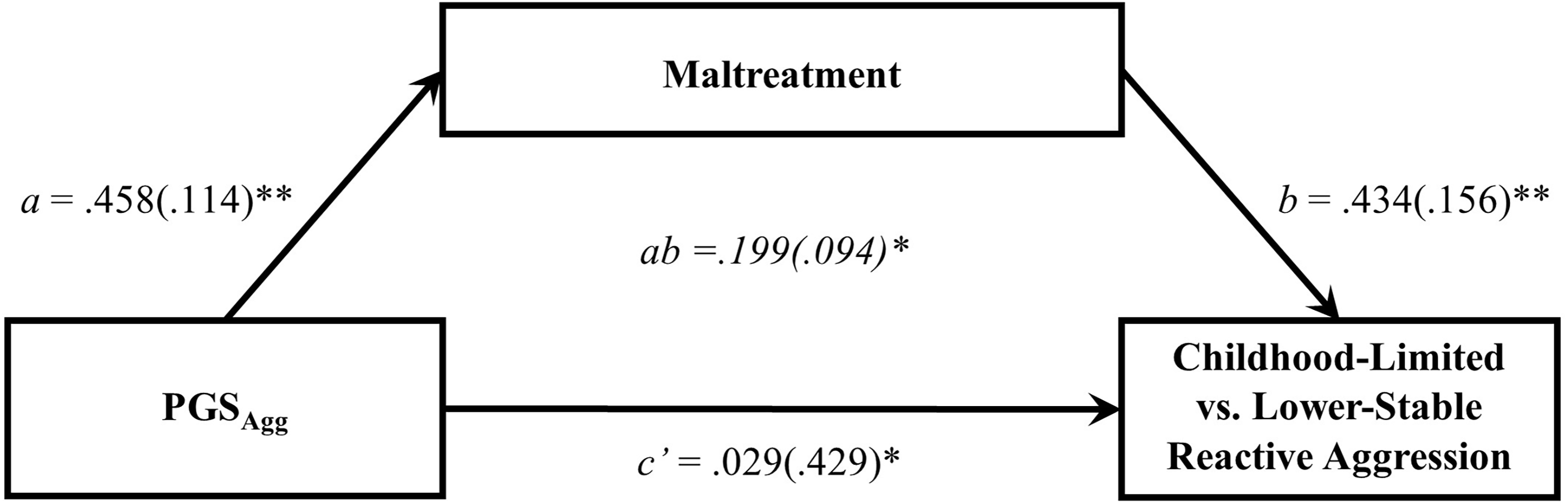
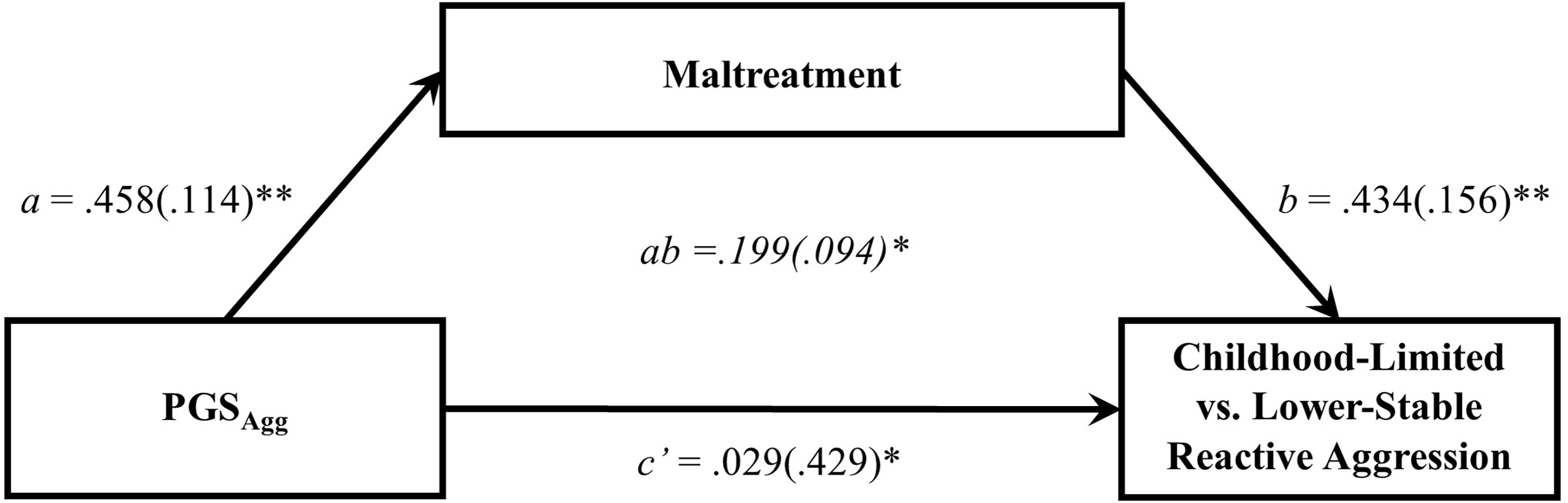
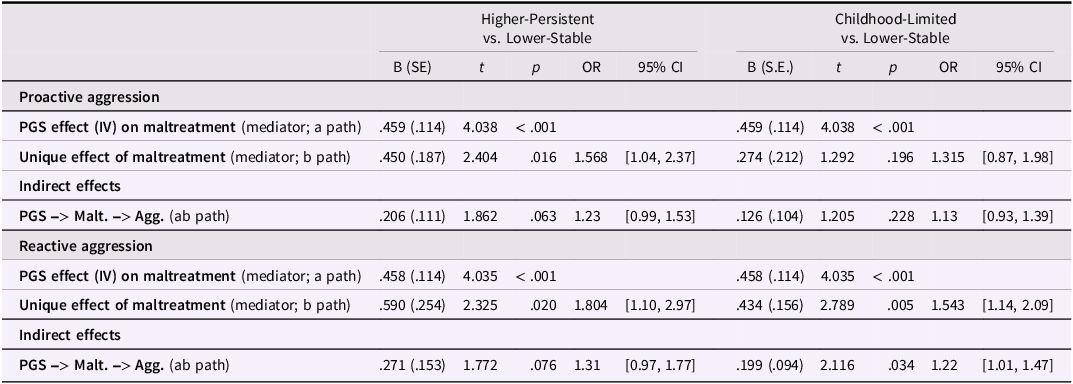
Table 4 presents the models testing the mediation role of maltreatment in the association between the PGSAGG and the higher aggression developmental trajectories. Notably, children with higher levels of cumulative maltreatment were more likely to belong to the Higher-Persistent trajectories of proactive and reactive aggression compared to the Lower-Stable trajectories, except for Childhood-Limited proactive aggression (p = .196). Only one significant mediation effect was detected plus two marginally significant (see Figure 2). Children who had a higher PGSAGG had more experiences of maltreatment (path a: t = 4.035, p < .001), which were associated with a higher risk of belonging to the Childhood-Limited versus Lower-Stable trajectory of reactive aggression (path b: t = 2.789, p = .005, OR = 1.543, 95% CI [1.14, 2.09]; bootstrap estimation or the indirect path ab: t = 2.116, p = .034, OR = 1.22, 95% CI [1.01, 1.47]). Moreover, the PGSAGG remained a predictor (path c′: t = 2.400, p = .016, OR = 2.798, 95% CI [1.21, 6.49]), consistent with partial mediation. This mediation effect remained significant even after accounting for the overlap with the proactive aggression trajectories (indirect path ab: t = 2.152, p = .031, OR = 1.225, 95% CI [1.02, 1.47]). Alternatively, the marginally significant indirect effects observed for the Higher-persistent proactive and reactive aggression trajectories remained in the same direction but depart from the significance threshold when controlling for the other function of aggression (proactive: path ab: t = .541, p = .588; OR = 1.10, 95% CI [.77, 1.57]; reactive: path ab: t = .054, p = .957, OR = 1.324, 95% CI [.00, 37366.47]). Taken together, these findings suggest that the trajectories of Higher-Persistent proactive and reactive aggression are closely intertwined, as noted according to both their association with the PGSAGG and marginal evidence of a common mediation pathway involving maltreatment experiences. To address potential reverse causation arising from the temporal overlap between the mediator (maltreatment; 0–12 years) and the outcome (aggression trajectories; 6–13 years), we estimated a serial mediation model separating the indirect effects related to early childhood (0–5 years), middle childhood (6–12 years), and persistent experience of probable maltreatment (r = .73 between 0–5 and then 6–12, p < .001; see Supplementary Table S2 and Figure S1). Early childhood maltreatment did not mediate the association between PGSAGG and the Childhood-Limited Reactive Aggression trajectory, whereas both persistent and middle-maltreatment experiences showed marginally significant indirect effects of comparable magnitude. Because new experiences of maltreatment (6–12 years) cannot be entirely attributed to children’s genetic risk or behavior, the mediation effect uncontaminated by reverse causation is likely larger than that captured by the persistent maltreatment path alone. Altogether, these results suggest that the mediation reported in the main analysis – based on maltreatment from birth to age 12 – is unlikely to be explained by reverse causation.
The effect of PGSAGG on Childhood-Limited versus Lower-Stable reactive aggression mediated by maltreatment. Notes. Unstandardized coefficients and standard errors are reported. ab = indirect effect. Bootstrap sample size = 5000. Sex and family socioeconomic status were included as covariates. PGSAGG = aggression polygenic score. **p < .05, **p < .01.
Mediation models testing the indirect effects of the PGSAgg (Independant Variable; IV) on aggression (Dependant Variables; DVs) through maltreatment (mediator)
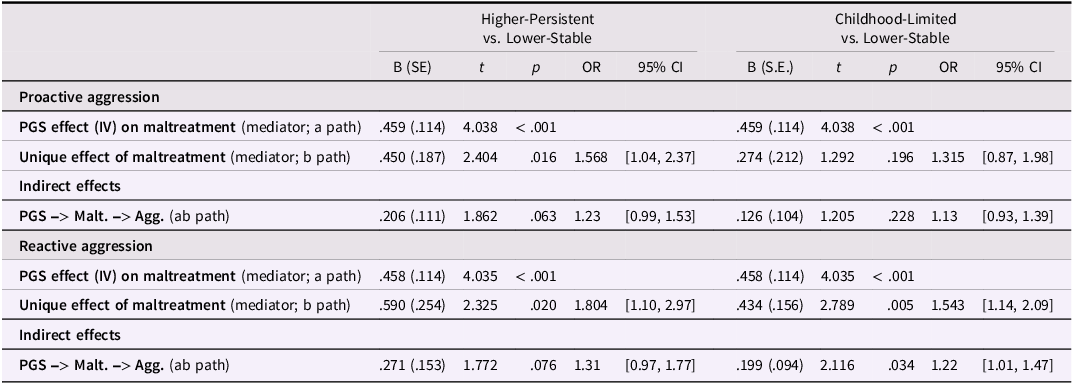
Notes. All models included sex and family socioeconomic status as confounders. The Low-Stable trajectory was the reference category. B = beta; CI = 95% confidence interval; OR = odds ratio; SE = standard error; t = t statistic; PGS AGG = polygenic score for aggression.
Discussion
This study investigated the contribution of PGSAGG to school-aged aggression, with a focus on identifying whether distinct associations emerged based on developmental trajectories of aggression during the elementary school years, as well as for the proactive and reactive functions of aggression. According to the rGE framework, we also tested whether childhood maltreatment partly mediated the association between the PGSAGG and the developmental trajectories depicting higher versus lower levels of aggression. First, the shape of the developmental trajectories was similar regardless of the function of aggression. Second, while the PGSAGG was associated with age-specific aggression scores, particularly with reactive aggression and toward the end of elementary school, examining developmental trajectories revealed more nuanced findings. Compared to the lower trajectories of aggression, PGSAGG was associated with Higher-Persistent trajectories of both proactive and reactive aggression, as well as with the Childhood-Limited trajectory of reactive aggression. However, the mediation role of cumulative maltreatment in the PGSAGG-aggression association was evident only for the Childhood-Limited trajectory of reactive aggression.
Using growth mixture modeling, we identified three distinct developmental trajectories for both proactive and reactive aggression from ages 6 to 13: a Lower-Stable group, a Childhood-Limited group, and a Higher-Persistent group. Consistent with prior studies (Barker et al., Reference Barker, Tremblay, Nagin, Vitaro and Lacourse2006; Cui et al., Reference Cui, Colasante, Malti, Ribeaud and Eisner2016; Evans et al., Reference Evans, Dίaz, Callahan, Wolock and Fite2021), most participants exhibited consistently low levels of aggression across this period (proactive: 86.2%; reactive: 81.0%). A subgroup showed elevated levels of aggression limited to childhood – declining from age 6 for proactive aggression (6.6%) and from age 8 for reactive aggression (13.6%). Finally, a small proportion of children followed a trajectory of persistently high aggression (proactive: 7.2%; reactive: 5.4%), comparable to previous findings in a similarly aged cohort (7–12 years) (Cui et al., Reference Cui, Colasante, Malti, Ribeaud and Eisner2016). While the trajectories of proactive and reactive aggression displayed broadly similar patterns, their distinct prevalence and timing of decline support both their interdependence and unicity (Card & Little, Reference Card and Little2006). For example, a greater proportion of children followed the Childhood-Limited trajectory for reactive aggression (13.6%) compared to proactive aggression (6.6%), suggesting that reactive aggression may be most common, but transient during this developmental period.
Our findings reveal robust, albeit small, associations between the PGSAGG and reactive and proactive aggression measured on six occasions between ages 6 and 13 years by independent teachers. This is consistent with other studies using this PGS (van der Laan et al., Reference van der Laan, Morosoli-García, van de Weijer, Colodro-Conde, a, C., Krapohl, Brikell, Sánchez-Mora, Nolte, Pourcain, Bolhuis, Palviainen, Zafarmand, Colodro-Conde, a, Zayats, Aliev, Jiang and Boomsma2021; van der Laan et al., Reference van der Laan, van de Weijer, Pool, Hottenga, van Beijsterveldt, Willemsen, Bartels, Nivard and Boomsma2023) and the previous one (Pappa et al., Reference Pappa, St Pourcain, Benke, Cavadino, Hakulinen, Nivard, Nolte, Tiesler, Bakermans-Kranenburg, Davies, Evans, Geoffroy, Grallert, Groen-Blokhuis, Hudziak, Kemp, Keltikangas-Jarvinen, McMahon, Mileva-Seitz and Tiemeier2016). We selected a GWAS conducted specifically on aggression among children and adolescents because the heritability of aggression varies during development (Pingault et al., Reference Pingault, Cote, Booij, Ouellet-Morin, Castellanos-Ryan, Vitaro, Turecki and Tremblay2013; Porsch et al., Reference Porsch, Middeldorp, Cherny, Krapohl, van Beijsterveldt, Loukola, Korhonen, Pulkkinen, Corley, Rhee, Kaprio, Rose, Hewitt, Sham, Plomin, Boomsma and Bartels2016). Moreover, GWASs targeting more largely antisocial behaviors (e.g., criminality, rule-breaking) likely capture signals encompassing more heterogeneous expressions of individual and environmental difficulties (e.g., poverty, systemic discrimination) (Karlsson Linner et al., Reference Karlsson Linner, Mallard, Barr, Sanchez-Roige, Madole, Driver, Poore, de Vlaming, Grotzinger, Tielbeek, Johnson, Liu, Rosenthal, Ideker, Zhou, Kember, Pasman, Verweij, Liu and Dick2021; Tielbeek et al., Reference Tielbeek, Medland, Benyamin, Byrne, Heath, Madden, Martin, Wray and Verweij2012, Reference Tielbeek, Johansson, Polderman, Rautiainen, Jansen, Taylor, Tong, Lu, Burt, Tiemeier, Viding, Plomin, Martin, Heath, Madden, Montgomery, Beaver, Waldman and Gelernter2017). A more specific signal may facilitate the investigation of the mechanistic processes related to aggression (Abdellaoui et al., Reference Abdellaoui, Yengo, Verweij and Visscher2023; van der Laan et al., Reference van der Laan, Morosoli-García, van de Weijer, Colodro-Conde, a, C., Krapohl, Brikell, Sánchez-Mora, Nolte, Pourcain, Bolhuis, Palviainen, Zafarmand, Colodro-Conde, a, Zayats, Aliev, Jiang and Boomsma2021). Nonetheless, even though Ip and colleagues (Reference Ip, van der Laan, Krapohl, Brikell, Sanchez-Mora, Nolte, St Pourcain, Bolhuis, Palviainen, Zafarmand, Colodro-Conde, Gordon, Zayats, Aliev, Jiang, Wang, Saunders, Karhunen, Hammerschlag and Boomsma2021) performed a genome-wide association meta-analysis to increase the power for gene discovery using repeated assessments of aggression and multiple informants, the loss in power due to the sole inclusion of children and adolescents remains a concern.
Aggressive behaviors are anticipated to vary in frequency and persistence among children during the school years (Tremblay et al., Reference Tremblay, Nagin, Seguin, Zoccolillo, Zelazo, Boivin, Perusse and Japel2004). While most children exhibit little aggression, some display frequent aggression upon entering school that fades over time, whereas a minority maintains higher levels of aggression throughout their school years. Children with higher PGS were more likely to be assigned to Higher-Persistent (vs. Lower-Stable) trajectories of proactive and reactive aggression, as well as to a Childhood-Limited trajectory of reactive aggression. Our findings partly align with those showing that youth with a higher genetic risk for aggression were more likely to belong to a Moderate (vs. Low) or High (vs. Moderate and Low) trajectory of aggression between 11 and 22 years (Kretschmer et al., Reference Kretschmer, Ouellet-Morin, Vrijen, Nolte and Hartman2023). However, few associations were detected with teachers-reported aggression using the previous PGS (Pappa et al., Reference Pappa, St Pourcain, Benke, Cavadino, Hakulinen, Nivard, Nolte, Tiesler, Bakermans-Kranenburg, Davies, Evans, Geoffroy, Grallert, Groen-Blokhuis, Hudziak, Kemp, Keltikangas-Jarvinen, McMahon, Mileva-Seitz and Tiemeier2016). In our cohort, we did not find any indications of a more robust pattern of associations with the Higher-Persistent vs. Childhood-Limited trajectories for reactive aggression. This contrasts with the idea that more frequent and persistent manifestations of aggression are more heritable than those limited in time (Lacourse et al., Reference Lacourse, Boivin, Brendgen, Petitclerc, Girard, Vitaro, Paquin, Ouellet-Morin, Dionne and Tremblay2014). This finding is also surprising because GWASs may be more attuned to stable manifestations of the targeted phenotypes compared to transient ones. Notably, once we controlled for the co-occurring form of aggression, the associations between PGSAGG and each Higher-Persistent trajectory were no longer significant. These results may reflect the well-documented phenotypic overlap between reactive and proactive aggression (Card & Little, Reference Card and Little2006; Thomson & Centifanti, Reference Thomson and Centifanti2018), as well as prior evidence of genetic overlap between these constructs in childhood (Brendgen et al., Reference Brendgen, Vitaro, Boivin, Dionne and Perusse2006; Paquin et al., Reference Paquin, Lacourse, Brendgen, Vitaro, Dionne, Tremblay and Boivin2017; Tuvblad et al., Reference Tuvblad, Raine, Zheng and Baker2009), rather than an absence of genetic risk for Higher-Persistent trajectories of aggression. For example, in a study of 223 monozygotic and 332 dizygotic twin pairs assessed between ages 6 to 12, reactive and proactive aggression were shown to share genetic influences at baseline, whereas subsequent changes were driven by unique genetic factors. Because our analytic approach emphasizes early individual differences – where the initial set points disproportionally influence the classification into developmental trajectories – this may help explain why the Higher-Persistent trajectories of reactive and proactive aggression share a common association with the PGSAGG. Nonetheless, our findings support evidence that the PGS derived from the Ip et al. (Reference Ip, van der Laan, Krapohl, Brikell, Sanchez-Mora, Nolte, St Pourcain, Bolhuis, Palviainen, Zafarmand, Colodro-Conde, Gordon, Zayats, Aliev, Jiang, Wang, Saunders, Karhunen, Hammerschlag and Boomsma2021) GWAS predicts persistent and transient patterns of aggression in childhood, in addition to age-specific scores of teachers’ rated aggression during the elementary school years.
We also showed that children who experienced higher levels of maltreatment were more likely to aggress others during elementary school, whether they follow a Higher-Persistent or Childhood-Limited trajectory of aggression. This is consistent with another study indicating that children displaying more physical aggression from grades 1 to 6 were exposed to more maternal harshness before school entry (Campbell et al., Reference Campbell, Spieker, Vandergrift, Belsky and Burchinal2010). Maltreatment assessed at age 3 (n = 4,898) subsequently predicted aggression at age 9 (Font & Berger, Reference Font and Berger2015). We further showed that these associations were independent of those related to PGSAGG. This is consistent with prior evidence drawn from discordant/differences twin designs controlling for genetic influences, pointing to environmentally driven influences of harsh parenting and maltreatment experiences on antisocial behavior (Burt et al., Reference Burt, Clark, Gershoff, Klump and Hyde2021; Jaffee, Caspi, Moffitt, Polo-Tomas, et al., Reference Jaffee, Caspi, Moffitt, Polo-Tomas, Price and Taylor2004; Jaffee et al., Reference Jaffee, Strait and Odgers2012; Johansson et al., Reference Johansson, Rotkonen and Jern2021; Moffitt, Reference Moffitt2005). Furthermore, the associations with the PGSAGG were more consistent for reactive aggression, which also aligns with previous findings and theories suggesting that maltreatment relates particularly to reactive aggression through negative perceptions of others (Dodge et al., Reference Dodge, Bates and Pettit1990; Hepp et al., Reference Hepp, Schmitz, Urbild, Zauner and Niedtfeld2021; Zhu, Reference Zhu, Chen and Xia2020), alterations in parent–child attachment (Mitchell & Beech, Reference Mitchell and Beech2011), and by affecting neurobiological systems regulating emotions and behaviors (e.g., amygdala, orbitofrontal cortex) (McCrory et al., Reference McCrory, De Brito and Viding2010; Teicher et al., Reference Teicher, Samson, Anderson and Ohashi2016). Crucially, our findings expand on previous work by measuring maltreatment prospectively and repeatedly during childhood and using multiple informants (i.e., parents, teachers, research assistants), methods (i.e., questionnaires, observations), and types of experiences (i.e., abuse and neglect) (Scardera et al., Reference Scardera, Langevin, Collin-Vezina, Cabana, Pinto Pereira, Cote, Ouellet-Morin and Geoffroy2023). Past meta-analyses and systematic reviews have evidenced stronger associations with retrospective measures (and subjective, e.g., self-reported), as compared to prospective (and objective, e.g., based on legal definitions) measures (Baldwin et al., Reference Baldwin, Coleman, Francis and Danese2024; Fitton et al., Reference Fitton, Yu and Fazel2020; Francis et al., Reference Francis, Tsaligopoulou, Stock, Pingault and Baldwin2023). However, since prospective measures are less affected by individuals’ recollections or interpretations of these experiences years later (Baldwin et al., Reference Baldwin, Reuben, Newbury and Danese2019), our findings provide additional support for the association between maltreatment and childhood aggression.
Numerous findings across diverse methodologies and research designs indicate that maltreatment experiences are associated with children’s genetic background (Burt, Reference Burt2022; Font & Berger, Reference Font and Berger2015; Pittner et al., Reference Pittner, Bakermans-Kranenburg, Alink, Buisman, van den Berg, Block, Voorthuis, Elzinga, Lindenberg, Tollenaar, Linting, Diego and van2020; Warrier et al., Reference Warrier, Kwong, Luo, Dalvie, Croft, Sallis, Baldwin, Munafo, Nievergelt, Grant, Burgess, Moore, Barzilay, McIntosh, van and Cecil2021). The small but significant association between the PGSAGG and maltreatment is consistent with this possibility. More generally, a GWAS performed with self-reports of childhood maltreatment (discovery sample: n = 124,000) identified two genome-wide significant loci (FOXP1, p = 4.35×10⁻⁸; FOXP1, p = 3.24×10⁻⁸; located on chromosome 12), which are also implicated in language impairment, internalizing and externalizing symptoms, and risk-taking behaviors (Dalvie et al., Reference Dalvie, Maihofer, Coleman, Bradley, Breen, Brick, Chen, Choi, Duncan, Guffanti, Haas, Harnal, Liberzon, Nugent, Provost, Ressler, Torres, Amstadter, Bryn Austin and Nievergelt2020). This suggests that these children’s individual characteristics, partly inherited from their parents, may heighten their risk of experiencing a range of abusive and neglectful experiences. Importantly, this does not imply that children are responsible for these experiences. Rather, it highlights the possibility that heritable characteristics of both parents and children may be intertwined with the environments that parents provide, pointing to a potential rGE. This finding is also consistent with twin research indicating that much of the association between corporal punishment and conduct problems is attributable to shared genetic factors (Jaffee, Caspi, Moffitt, Polo-Tomas, et al., Reference Jaffee, Caspi, Moffitt, Polo-Tomas, Price and Taylor2004; Schulz-Heik et al., Reference Schulz-Heik, Rhee, Silvern, Haberstick, Hopfer, Lessem and Hewitt2010). In contrast, experiences of maltreatment severe enough to cause physical injury are associated with children’s conduct problems primarily through environmental pathways (Jaffee, Caspi, Moffitt, Polo-Tomas, et al., Reference Jaffee, Caspi, Moffitt, Polo-Tomas, Price and Taylor2004).
The present study expanded on this work by formally testing whether maltreatment experiences mediate the PGSAGG-aggression association. Results showed that children with higher PGSAGG experienced higher levels of maltreatment, which was associated with a higher risk of belonging to a Childhood-Limited trajectory of reactive aggression. Although no previous studies have directly tested these mediation processes using PGS related to aggression, one study reported no significant mediation of mother-reported childhood maltreatment in the association between the PGSADHD (Demontis et al., Reference Demontis, Walters, Athanasiadis, Walters, Therrien, Nielsen, Farajzadeh, Voloudakis, Bendl, Zeng, Zhang, Grove, Als, Duan, Satterstrom, Bybjerg-Grauholm, Baekved-Hansen, Gudmundsson, Magnusson and Børglum2023) and ADHD symptoms (Tovo-Rodrigues et al., Reference Tovo-Rodrigues, Camerini, Martins-Silva, Carpena, Bonilla, Oliveira, de Paula, Murray, Barros, Santos, Rohde, Hutz, Genro and Matijasevich2024). Moreover, although Elam and colleagues (2018) showed that children with a greater genetic risk for aggression (Pappa et al., Reference Pappa, St Pourcain, Benke, Cavadino, Hakulinen, Nivard, Nolte, Tiesler, Bakermans-Kranenburg, Davies, Evans, Geoffroy, Grallert, Groen-Blokhuis, Hudziak, Kemp, Keltikangas-Jarvinen, McMahon, Mileva-Seitz and Tiemeier2016) experienced lower family cohesion, that latter variable did not mediate genetic childhood effects on childhood aggression (Elam et al., Reference Elam, Chassin and Pandika2018). Additionally, Kretschmer and colleagues (Reference Kretschmer, Vrijen, Nolte, Wertz and Hartman2022) showed that – although the PGS for externalizing problems (Karlsson Linner et al., Reference Karlsson Linner, Mallard, Barr, Sanchez-Roige, Madole, Driver, Poore, de Vlaming, Grotzinger, Tielbeek, Johnson, Liu, Rosenthal, Ideker, Zhou, Kember, Pasman, Verweij, Liu and Dick2021) did not predict family dysfunction – it was indirectly linked to the PGS through externalizing problems (Kretschmer et al., Reference Kretschmer, Vrijen, Nolte, Wertz and Hartman2022). Preliminary evidence also suggests that childhood maltreatment partially mediates the genetic risk for schizophrenia (Pardinas et al., Reference Pardinas, Holmans, Pocklington, Escott-Price, Ripke, Carrera, Legge, Bishop, Cameron, Hamshere, Han, Hubbard, Lynham, Mantripragada, Rees, MacCabe, McCarroll, Baune, Breen and Walters2018) and psychosis-like experience (Marchi et al., Reference Marchi, Elkrief, Alkema, van Gastel, Schubart, van Eijk, Luykx, Branje, Mastrotheodoros, Galeazzi, van Os, Cecil, Conrod and Boks2022).
Interpreting these findings according to a broader rGE framework is complex. Our results indicate that children’s genetic predispositions to aggression are associated with a higher likelihood of following a Childhood-Limited trajectory of reactive aggression, an association partly explained by maltreatment experiences. This mediation may reflect passive rGE, whereby parents’ genetic risk contributes both to the child’s genetic propensity to aggression and to the creation of adverse rearing environments. Alternatively, it may reflect evocative rGE, whereby genetically influenced disruptive behavior in children elicits harmful responses from caregivers. Disentangling these pathways requires genetically informed family designs, such as the Children-of-Twins or Extended Twin Family Designs. For example, Marceau et al. (Reference Marceau, Horwitz, Narusyte, Ganiban, Spotts, Reiss and Neiderhiser2013), using an extended Children-of-Twins design with a Swedish sample of 909 twin parents and a U.S. sample of 405 adolescent siblings and their parents, found that evocative rGE – rather than passive rGE or direct environmental effects – accounted for the association between parental negativity and adolescent externalizing behaviors (Marceau et al., Reference Marceau, Horwitz, Narusyte, Ganiban, Spotts, Reiss and Neiderhiser2013). Similar findings have been reported in peer contexts (DiLalla & DiLalla, Reference DiLalla and DiLalla2018). In contrast, some studies report findings more consistent with passive rGE (Lemery-Chalfant et al., Reference Lemery-Chalfant, Kao, Swann and Goldsmith2013), whereas others point to predominantly environmentally driven effects (Narusyte et al., Reference Narusyte, Neiderhiser, Andershed, D’Onofrio, Reiss, Spotts, Ganiban and Lichtenstein2011). Importantly, these processes are not mutually exclusive; multiple pathways may link genes, environments, and behavior (McAdams et al., Reference McAdams, Gregory and Eley2013). Accordingly, Elam et al. (Reference Elam, Lemery-Chalfant and Chassin2023) propose a gene–environment cascade framework in which early genetic liability to psychopathology increases exposure to adverse environments, primarily through passive rGEs. These early exposures may later be amplified by social information processing, leading to the accumulation of maladaptive behaviors and adverse experiences – for example, by evoking hostile responses from parents (evocative rGE) or fostering affiliation with delinquent peers (active rGE). Such recursive, rGE-driven cascades progressively constrain opportunities for positive experiences and increase risk for psychopathology (Elam et al., Reference Elam, Lemery-Chalfant and Chassin2023). Recognizing that multiple rGE processes unfold and often overlap across development, the framework and accumulating evidence underscore the need for developmentally sensitive, genetically informed designs to examine them.
Furthermore, broad measures of maltreatment, such as those used in the present study, may encompass experiences that differentially relate to children’s genetic risk of aggression. While the role of physical discipline in the development of antisocial behavior has been shown to be consistent with evocative rGE, a more severe form of maltreatment may not be genetically mediated by child behavior (Jaffee, Caspi, Moffitt, Polo-Tomas, et al., Reference Jaffee, Caspi, Moffitt, Polo-Tomas, Price and Taylor2004; Jaffee, Caspi, Moffitt et Taylor, Reference Jaffee, Caspi, Moffitt and Taylor2004). To further disentangle these rGE mechanisms, future studies should include data from parents, children, and siblings in a genetically sensitive research design, along with repeated assessments of maltreatment and aggression. In the present cohort, such parental or sibling genetic data were not available, limiting our ability to distinguish between passive and evocative rGE. Nonetheless, identifying potential rGE processes should not detract from the central role of the family environment. Rather, the findings highlight the need to expand theoretical models to more accurately reflect the multiple pathways through which genetic and environmental influences shape the development of aggression.
Beyond its heuristic value, identifying a mediation pathway consistent with rGE processes may also have important practical implications. It highlights that some parents may face greater challenges in providing optimal rearing environments – characterized by sensitive, developmentally appropriate, and consistent parenting – finding it more difficult to promote prosocial behavior without resorting to physical, hostile, or coercive discipline, or to regulate negative emotions triggered by their child’s disruptive behaviors. Evidence-based interventions that reduce harsh disciplinary practices and promote positive strategies for managing these behaviors may help mitigate these challenges and reduce the risk of coercive parent–child cycles (Jaffee et al., Reference Jaffee, Strait and Odgers2012). Importantly, future studies should examine whether similar mediation processes are observed in relation to other environmental influences, both within the family (e.g., communication patterns, attachment quality) and outside this context (e.g., peer victimization, neighborhood violence).
It is unclear as to why the mediation effect emerged more robustly for children who display reactive aggression that faded in late childhood, as compared to those of the Higher-Persistent trajectory. Based on previous studies, children manifesting transient aggression may have been exposed to more services at school or had less severe difficulties in emotional control, learning, and peer relations (Veenstra et al., Reference Veenstra, Lindenberg, Verhulst and Ormel2009) and at home with their family (Barker & Maughan, Reference Barker and Maughan2009). We hypothesize that since these factors are partly inherited and not readily captured in the measurement of cumulative maltreatment, genetic influences related to these individual characteristics and environments may have escaped the mediation process for children following a Higher-Persistent trajectory of proactive or reactive aggression. Alternatively, the lower statistical power may have limited the detection of these indirect effects, as the prevalence of the persistent trajectories of aggression was two to three times lower than that of the Childhood-Limited trajectory for reactive aggression. Moreover, the marginally significant association between PGSAGG and Higher-Persistent proactive and reactive aggression trajectories became non-significant when controlling for the other type of aggression. This suggests that, like the main association with the PGSAGG, these trajectories are intertwined, echoing similar findings linking the same PGSAGG to broad measures of aggression (Bouliane et al., Reference Bouliane, Boivin, Kretschmer, Lafreniere, Paquin, Tremblay, Côté, Gouin, Andlauer, Petitclerc and Ouellet-Morin2025; Ip et al., Reference Ip, van der Laan, Krapohl, Brikell, Sanchez-Mora, Nolte, St Pourcain, Bolhuis, Palviainen, Zafarmand, Colodro-Conde, Gordon, Zayats, Aliev, Jiang, Wang, Saunders, Karhunen, Hammerschlag and Boomsma2021; van der Laan et al., Reference van der Laan, Morosoli-García, van de Weijer, Colodro-Conde, a, C., Krapohl, Brikell, Sánchez-Mora, Nolte, Pourcain, Bolhuis, Palviainen, Zafarmand, Colodro-Conde, a, Zayats, Aliev, Jiang and Boomsma2021). Notably, an analytic strategy able of capturing the overlap between proactive and reactive aggression within a single framework could have more directly examined this shared mediation process according to naturally co-occurring profiles of aggression during elementary school. However, methodological constraints prevented us from proceeding in this way. Indeed, the trajectories of primary interest (i.e., Childhood-Limited and Higher-Persistent) each represented only between 5.4% and 13.6% of the sample for reactive aggression and 6.6% and 7.2% for proactive aggression. Cross-classifying these trajectories would have yielded some subgroups representing only 2–3% of the sample, which would not have provided sufficient power to support reliable or interpretable analyses. Additionally, genetic influences on aggression may operate through a variety of alternative pathways not addressed in this study, including social factors (e.g., attachment, peer victimization), individual characteristics (e.g., impulsivity, hyperactivity), and neurophysiological mechanisms involved in emotional and behavioral regulation. More research is needed to examine the associations between PGSAGG and aggression beyond maltreatment, to capture the broader range of developmental processes through which genetic risk may be expressed.
Few GWASs focused on aggression, and none explored the proactive and reactive functions of aggression. Our findings show that youth with higher PGSAGG were more likely to belong in the higher trajectories of proactive and reactive aggression. However, the PGSAGG remained only associated with the Childhood-Limited reactive aggression after accounting for the overlap between the two functions of aggression. This is consistent with the report of a common genetic etiology between these outcomes between 6 to 12 years (Paquin et al., Reference Paquin, Lacourse, Brendgen, Vitaro, Dionne, Tremblay and Boivin2017). In contrast, we showed that the PGSAGG uniquely predicted the Childhood-Limited trajectory of reactive aggression when adjusting for proactive aggression. The same finding emerged for the mediating role of cumulative maltreatment. This finding echoes the unique genetic effects reported for proactive and reactive aggression (Paquin et al., Reference Paquin, Lacourse, Brendgen, Vitaro, Dionne, Tremblay and Boivin2017). Reports of aggression from teachers and parents, which GWASs heavily rely on, may more easily capture reactive than proactive aggression. This may be due to various factors, including the fact that reactive aggression is more frequently accompanied by observable emotional responses, making it more noticeable. This discrepancy may inadvertently advantage the alignment of the GWAS onto reactive aggression. Furthermore, as the measures of proactive and reactive aggression often confound the forms (e.g., physical aggression) and functions of aggression (e.g., proactive vs. reactive) (Polman et al., Reference Polman, de Castro, Thomaes and van Aken2009), we speculate that disaggregating these two aspects of aggression may provide new insights into their etiologies.
This study builds on prospectively and repeatedly collected data on maltreatment and aggression according to multiple informants. Nonetheless, some limitations should be noted. First, genetic data were not available for all participants, and the sample was relatively modest in size. Replication in larger samples is needed. Second, we did not examine whether specific types of child maltreatment (deprivation vs. threat), patterns of recurrence over time, or retrospective reports of maltreatment lead to distinct patterns of findings. In this cohort (Scardera et al., Reference Scardera, Langevin, Collin-Vezina, Cabana, Pinto Pereira, Cote, Ouellet-Morin and Geoffroy2023) and others (Baldwin et al., Reference Baldwin, Reuben, Newbury and Danese2019, Reference Baldwin, Coleman, Francis and Danese2024, Reference Baldwin, Sallis, Schoeler, Taylor, Kwong, Tielbeek, Barkhuizen, Warrier, Howe, Danese, McCrory, Rijsdijk, Larsson, Lundstrom, Karlsson, Lichtenstein, Munafo and Pingault2023), prospective and retrospective assessments of maltreatment only modestly correlated, each capturing partially distinct groups of individuals. Third, our measures of aggression relied exclusively on teachers’ reports. Although moderate agreement is typically observed between parents’ and teachers’ reports, and similar estimates of genetic and environmental contributions are reported across these measures (Hudziak et al., Reference Hudziak, van Beijsterveldt, Bartels, Rietveld, Rettew, Derks and Boomsma2003), it is possible that teachers may not have consistently distinguished between proactive and reactive aggression, as they may not have witnessed all the interactions leading to aggressive behaviors (e.g., conflicts occurring during recess). Teachers may nevertheless provide more accurate reports of aggression than parents because they observe children daily in social settings with peers, where aggression is more likely to occur, and can compare behaviors across multiple children. Additionally, teachers are less prone to emotional bias, allowing for more objective assessments. Fourth, the PGSAGG was derived from the GWAS conducted by Ip et al. (Reference Ip, van der Laan, Krapohl, Brikell, Sanchez-Mora, Nolte, St Pourcain, Bolhuis, Palviainen, Zafarmand, Colodro-Conde, Gordon, Zayats, Aliev, Jiang, Wang, Saunders, Karhunen, Hammerschlag and Boomsma2021), which included a range of aggression-related measures, encompassing behavioral indicators of conduct disorder and oppositional defiant disorder. Consequently, the resulting PGS may not solely reflect a genetic propensity specific to aggression, but rather a broader susceptibility to externalizing behaviors. Fifth, a key limitation is the partial temporal overlap between the mediator (maltreatment, 0–12 years) and the outcome (aggression trajectories, 6–13 years), which leaves open the possibility of reverse causation. We probed this with a serial mediation model partitioning probable maltreatment indices into early (0–5), middle (6–12), and persistent childhood exposure. Both persistent and newly occurring maltreatment showed marginally significant indirect effects, suggesting that reverse causation does not fully explain the main mediation, especially considering that middle childhood experiences are unlikely to be wholly attributable to children’s inherited characteristics or behavior. Nonetheless, directionality cannot be determined definitively, and residual bidirectional influence may remain. Future work should use denser measurement schedules to enable random-intercept cross-lagged tests.
Conclusion
Childhood displays of aggressive behavior have consistently been associated with more concurrent and long-term difficulties. Our findings suggest that both the stability and change in aggression across childhood, along with its distinct functions, should be taken into account to better understand the role of genetic factors, especially in the context of cumulative maltreatment experiences. More research is needed to investigate how genetic risk for aggression is phenotypically expressed and how it correlates with various individual characteristics and environments early in life.
Supplementary material
The supplementary material for this article can be found at https://doi.org/10.1017/S0954579425100801.
Data availability statement
The data analyzed in this study were obtained from a third party: the Institut de la statistique du Québec. As stipulated in clauses 10 and 11 of the Institut de la statistique’s Québec Act (Canada), access to the data is restricted to parties who have previously signed a data-sharing agreement. In the QLSCD cohort, the participants only consented to share their data with the study’s affiliated partners and researchers and their collaborators. Requests to access these data can nevertheless be directed to the Institut de la statistique du Québec’s Research Data Access Services – Home (https://statistique.quebec.ca/en/services-recherche/rda-home).
Funding statement
The QLSCD data collection was made possible by a partnership with the Ministère de la Santé et des Services sociaux, the Ministère de la Famille, the Ministère de l’Éducation and Ministère de l’Enseignement supérieur (Québec ministries), the Lucie and André Chagnon Foundation, the Institut de recherche Robert-Sauvé en santé et en sécurité du travail, the Research Centre of the Sainte-Justine University Hospital, the Ministère de l’Emploi et de la Solidarité sociale, and the Institut de la statistique du Québec. The longitudinal data collection over the years was funded by the Fonds de Recherche du Québec – Santé, the Fonds de Recherche du Québec – Société et Culture, the Social Science and Humanities Research Council of Canada, the Canadian Institutes of Health Research, and the Canada Research Chairs.
Competing interests
The authors declare that they have no conflict of interest.


 Open access

