In 2007, our paper, ‘Organic agriculture and the global food supply’, demonstrated the potential for organic production methods to produce enough food to feed the entire human population. This finding created quite a stir when it was published. The study grew out of a class field trip and stimulated a year-long research project by a group of faculty and graduate and undergraduate students. Once we completed the study and wrote the paper, it took another 2 years to get it published, because of strong negative and positive reactions from reviewers. These reactions revealed major ideological fault lines among agronomists and food-industry advocates. We met with strong resistance and encouragement every step of the way. Nonetheless, once the paper was published, it was widely read and cited worldwide. As of March 2026, the paper has been cited over 1,800 times and mentioned by 8 news outlets, 18 policy sources, and 2 Wikipedia pages (Altmetric data, 1 March 2026). Renewable Agriculture and Food Systems lists this article as their most cited publication.
Our study stimulated several follow-up analyses over the next decade; these used additional data and more sophisticated analytical methods. With more cautionary language than in our paper, these studies largely confirmed our major findings—that organic agriculture had the potential to make a major contribution to the global food supply. Below, we elaborate upon the origin and accomplishment of our study, the ideologies that emerged during the review process and beyond, and the findings of later studies. We conclude with brief thoughts about the current status of organic agriculture and future research.
By way of disclosure (and because some of our early critics claimed that we as academics have no direct experience with farming), all three of us have ongoing farming experience. One of us lives on an organic farm; one conducts ecological field research for several months each year on coffee farms in Chiapas, Mexico, and Puerto Rico; and one manages the Campus Farm on the Ann Arbor campus of the University of Michigan. We are familiar with the labor of growing crops, ways of managing soil fertility, and the challenges of suppressing crop pests, as well as obstacles that organic producers encounter in marketing their products. We are also familiar with the satisfaction of growing and sharing food that is flavorful and delicious, whether eaten directly, sold, or donated.
Origin and accomplishment
This study began in an undergraduate course entitled ‘Food, land, and society’, which investigated these topics through discussions, farm visits, and field exercises. Two of us taught the course and used the diverse rural and urban farms and food-related businesses in southeastern Michigan as representative of the challenges and opportunities in US agriculture. In most years, we also had an optional 2-week short course to either Chiapas or Cuba to see how a different country’s food system operated. A morning visit in 2003 to a small organic farm north of Ann Arbor set the spark for this study. The farmer grew salad greens in multiple rotations on 3 acres of land that included a large greenhouse (high tunnel). At the end of the visit, one of us asked the farmer if he had ever calculated how much biomass of produce was harvested on his farm per year (over a 7-month outdoor growing season). The farmer had documented the weight of produce harvested the previous year: 26 tons of salad greens and sprouts on 3 acres. With this surprising figure in our minds, we left that farm for the next activities. By the end of the day, we asked ourselves, ‘If Rob can grow 26 tons of organic salad greens on 3 acres, then why can’t organic agriculture feed the world?’ Admittedly, there is quite a scaling leap between one farm and the global food supply. But the question stared at us and demanded attention.
At the end of the term, a group of students in the course along with the instructors and some of their graduate students decided to form a study group to investigate the question of whether organic agriculture had the potential to feed the world. We met weekly for a year, with each person taking a role in gathering data, analyzing data, writing drafts of the manuscript, and contacting researchers or organizations (such as the Rodale Institute) for information, including unpublished data about controlled experiments. We knew that most agronomists and food-industry advocates considered organic agriculture a minor ‘niche’ component of the food system with no capacity to make a major contribution to any country’s food supply. But our experience meeting young farmers who were establishing small, diversified organic farms in rural and urban settings revealed a passion for growing crops and raising animals without synthetic fertilizers and pesticides. These farms appeared remarkably productive, and there were (and still are) robust local markets for the food raised, in the form of farmers’ markets, restaurants, and subscription shares. So, could organic agriculture make a greater contribution than experts claimed?
The principal objections against organic agriculture making a major contribution to the food system were that yields were too low, there was insufficient organic fertilizer, there was not enough labor to get the work done, and a larger land base would be needed. Our team attempted to address three of these objections (all but the claim about labor).
Our overall approach had five components, explained in detail in the 2007 paper. (1) We gathered quantitative data about the current food supply across approximately 30 different food categories from the Food and Agricultural Organization (FAO) of the United Nations. FAOSTAT, the data-gathering section of FAO, reports these data for most of the world’s countries on a semi-annual basis. We downloaded data for all countries in the FAOSTAT database and aggregated the data for the world, for countries in the developed world, and for countries in the developing world, following the UN designation of which countries belonged in which category. At the time of our working group, full data were available for 2001. (2) From published, peer-reviewed studies and some reputable gray-literature sources, we compiled data about yield comparisons between conventional and organic production of plant and animal products. Some of these studies were before-and-after conversion from conventional to organic production, while others were side-by-side experiments or paired farms in the same climate and soil regime. (3) We aggregated the yield comparisons into ten general food categories, largely following FAO groupings, and then calculated average yield ratios. We reasoned that if the yield data from individual studies included examples from many countries, including temperate and tropical regions, that the average yield ratios would be meaningful; hence, we calculated average yield ratios and the standard error for each food category. (4) We then multiplied the amount of food currently produced in each food category by the average yield ratio for that category and computed the corresponding standard error. The thought experiment was to scale up the yield ratios to production on the current land base as if all products were raised by organic practices. This estimate was then revised downward for various losses. (5) Then we converted the amount of food produced organically in each category to caloric equivalents to estimate whether organic agriculture could provide sufficient calories for the global human population at the time. All of these calculations and the data upon which they are based were presented in the paper.
We made four assumptions. The first was that the current amount of land for cropland and pasture was used. At the time of our study, the area of total cropland was 1,513.2 million hectares. The second was that the foods produced have the same caloric and nutritional value raised by organic as by non-organic methods, even though some claims disputed that equivalence. The third assumption was that the same amount of food losses occurred as in the current system. The food supply for human consumption as a proportion of total production ranged from 11% for sugars and sweeteners to 50% for grains to 98% for meats, with the rest going for feed, seed, or wasted (FAOSTAT data). The fourth assumption was that the same amounts of plant and animal products were consumed as in the current system, although there were already various studies advocating for a shift in diets to reduce sugary and fat-rich food products. In 2001, less than 1% of global cropland was in organic production, so we did not compensate for this small contribution to the food supply. (Thus, it was easy to see why agronomists and food-industry advocates considered organic agriculture as an insignificant niche market.)
Finally, we treated yield comparisons differently for developed versus developing countries. For developing countries, the published comparisons with organic yields were sometimes for low-intensive, subsistence methods and sometimes for conventional methods. Most organic agriculture was not certified and was for local consumption. For these reasons, we made separate calculations for developed countries versus developing countries. From the aggregated data and average yield ratios, we constructed two models of the global food supply grown by organic practices. Model 1 used our findings for the developed world—in which average yield ratios of organic: non-organic were lower than for the developing world (overall average of 0.92 for the developed world versus 1.80 for the developing world). Model 1 provided a lower estimate since it applied lower yield ratios for all food categories to global food production. Model 2 used separate calculations for developed versus developing countries with the respective yield ratios applied to food production in each region, then added together for the global result. The standard error was scaled up for each model estimate.
A separate part of our study involved estimates of nitrogen amendments from cover crops grown during fallow periods, in between crop rotations, or as a relay crop. We estimated whether biological N fixation from leguminous cover crops would be able to provide enough supplemental nitrogen for crop-plant uptake such that no synthetic fertilizer inputs would be needed on the world’s croplands. We obtained N-fertilizer equivalency data from 77 studies from temperate and tropical regions. Table 4 and Appendix 2 in the 2007 paper report the results from these calculations and the data sources, respectively.
The findings from the food-production analysis and the biological N-fixation analysis both showed that organic methods have the potential to produce enough calories to supply the needs of the current human population without increasing the global land base devoted to food production. We have reviewed here the various steps, assumptions, and model decisions to demonstrate that we went to great lengths to generate large datasets, to recognize and account for complexities of the global food system, and to avoid subtle biases that would favor organic production. We rejected no studies of yield comparisons, for example, because they documented low values of organic yields.
Once we had a full draft of the paper, we sent it to seven experienced academic colleagues and asked for their comments. In particular, we requested that they find flaws in our reasoning or datasets and anticipate the comments of negative reviewers so that we could address those concerns in advance. The suggestions that we received from these colleagues were helpful in sharpening certain points and making sure that we clarified what our study did and did not show. We anticipated correctly that some reviewers would willfully misunderstand our methods and findings.
The publishing saga
It took 2 years for the paper to be published. We submitted the manuscript and two appendices of data and sources to five journals that had broad audiences. The responses from editors and reviewers had considerable ideological content as well as peer feedback and revealed either deep hostility toward organic agriculture or cautious support for organic and other forms of regenerative agriculture. The timeline and outcome of submissions are as follows:
-
(1) Our first submission was to Nature in late July 2004, with response from the editor on August 26, 2004. One reviewer was sarcastically harsh, the other favorable. Both reviews had useful suggestions, which we followed in revising the manuscript. As an illustration of the ideological response, the negative referee had the following statements in the opening paragraph: ‘There is no question that the topic addressed…interests many, but the manuscript is based on questionable assumptions and data that result in grossly misleading conclusions. My major criticism is that the authors have mostly relied on secondary data for their analysis and many of these data do not meet the standards of peer-reviewed scientific research. …. The authors recognize that this is only meant to be a feasibility study, but, given the numerous flaws it contains, I believe that its publication would not do any good for the course of agriculture’. In fairness, two pages of specific comments and suggestions followed, but the statements in the first paragraph were sufficient to cause the editor to reject the paper. Referee 2 had the following statements, along with several specific suggestions: ‘This ambitious piece of analysis is very commendable, based indeed on some fairly conservative assumptions…. More could be said in response to this very provocative but well-grounded article. Its conclusions deserve the attention and thought of many scientists across many disciplines’. It is hard to imagine two more different assessments. Referee 2 later wrote to us to identify himself after receiving Nature’s decision and offered encouragement and useful references to strengthen the paper further.
-
(2) We revised the manuscript based on responses from reviewers and submitted it next to Science in November 2004. We received a response from a senior editor on December 14, 2004. The editor received one review and rejected the paper based on the single review. The referee claimed to be a strong supporter of organic agriculture, but the text of the review had a nasty tone.
-
(3) In early 2005, we submitted the revised manuscript to the Proceedings B of the Royal Society. We received two reviews—one largely positive, with constructive suggestions. The second review was negative but included four pages of useful comments and recommended references. Although the journal rejected the manuscript, this was the first pair of peer reviews with a professional tone.
-
(4) In April 2005, we submitted a further revised manuscript to the Proceedings of the U.S. National Academy of Sciences as a direct submission. The journal decided not to send the manuscript for review with the semi-automatic reply that the topic was not of general interest.
-
(5) In May 2005, we sent the manuscript to Bioscience. We were not successful there either.
-
(6) After these five submissions and one entire year of failed attempts to publish the study after several rounds of refinements, we decided to submit to a specialized journal and went directly to Renewable Agriculture and Food Systems. There we found sympathetic and helpful editors, John Doran and Janet Doran. The first set of reviews had quite mixed reactions, and we went through two rounds of revision and re-review before the paper (along with its two long appendices of data and sources) was accepted for publication on June 9, 2006, and was printed in the second issue of Volume 22 in 2007 (Badgley et al., Reference Badgley, Moghtader, Quintero, Zakem, Chappell, Aviles-Vazquez, Samulon and Perfecto2007a). Along with our paper was published a forum of two commentaries about the paper, both rather negative. Neither author had seen the final published version before writing their commentaries. One commentary claimed that too much of our data about yield comparisons came from unreliable sources (gray literature). It did not seem to matter that earlier papers comparing organic and conventional agriculture that also used such sources had been published and were widely cited (e.g., Stanhill, Reference Stanhill1990). Nonetheless, finally our paper was available for broad readership and distribution.
Once published, the saga continued. The paper received widespread enthusiastic interest as well as attacks from advocates for industrial agriculture. We were interviewed on radio and for newspaper articles in several countries, and several non-profit organizations (including Food First and the Pesticide Action Network) printed summaries of our paper in their newsletters. The most extensive attack came from Alex Avery of the Hudson Institute. He wrote a critique on the Hudson Institute website (their section titled ‘Center for Global Food Issues’) and sent a four-page critique to Renewable Agriculture and Food Systems. He claimed that we cherry-picked our yield data and double-counted favorable ratios and attacked the veracity of some of our published, peer-reviewed sources. The Dorans consulted some of these authors for response and their comments added to our reply to Avery. Both the Avery critique and our response were published as commentaries in the December 2007 issue of Renewable Agriculture and Food Systems (Avery, Reference Avery2007; Badgley et al., Reference Badgley, Perfecto, Chapell and Samulon2007b).
On balance, the positive reception was broader and more balanced than the attacks. Over the years, the paper remains one of our most cited publications. One of the misrepresentations that often arose from both those who praised the study and those who attacked it was that we claimed that organic agriculture could systematically outperform conventional methods. Our data do not support that claim, nor did we make any such statement. We simply demonstrated that organic agriculture has the potential to provide sufficient yields to feed the world at recommended caloric and nutritional levels.
Subsequent analyses
Later studies comparing organic and conventional agriculture gathered new data, from studies published after our paper was accepted. Notable among these later studies are those by De Ponti, Rijk and Van Ittersum (Reference De Ponti, Rijk and Van Ittersum2012), a group of researchers from Wageningen University, the Netherlands; Seufert, Ramankutty and Foley (Reference Seufert, Ramankutty and Foley2012), a group from McGill University and the University of Minnesota; and Ponisio et al. (Reference Ponisio, M’Gonigle, Mace, Palomino, De Valpine and Kremen2015), a group of researchers from the University of California, Berkeley. All three of these studies employed meta-analyses and found higher yield gaps. De Ponti et al. analyzed 362 paired crop yield comparisons and found that, on average, organic yields were 80% of conventional yields, with substantial variation (standard deviation 21%) depending on crop type and geographic region. Our average for comparisons of organic versus conventional across all plant foods, including fruits, sugars, and legumes, was 91% (Table 2 of our article). De Ponti and colleagues observed that the yield gap tends to widen as conventional yields increase, possibly due to limitations in nutrient availability and pest control in organic systems.
Seufert, Ramankutty and Foley (Reference Seufert, Ramankutty and Foley2012), whose study was published in Nature, reanalyzed the data that we compiled for organic versus conventional methods, added new yield comparisons published since our paper came out, and made further comparisons (long-term vs. short-term under organic management, amount of supplemental nitrogen). They confirmed that organic yields are typically lower than their conventional counterparts and emphasized that this gap is highly context dependent. Their meta-analysis revealed that organic yields are typically 5% lower for some rain-fed legumes and perennials under specific soil conditions, up to 13% lower with best organic practices, and can be as much as 34% lower when only the most comparable organic and conventional systems are considered. However, in studies that used conventional yields that are representative of regional averages, or in developing countries, they found that the difference between organic and conventional goes down to 13% and 8%, respectively. Importantly, Seufert et al. noted that with better management, suitable crop types, and favorable conditions, organic yields come near those of conventional methods. They emphasized the need for further research into the factors limiting organic productivity, while also considering social and environmental benefits.
Ponisio et al. (Reference Ponisio, M’Gonigle, Mace, Palomino, De Valpine and Kremen2015) conducted the most comprehensive study published after ours. They analyzed a much larger dataset, including 115 studies and over 1,000 comparisons and using a new hierarchical analytical method. Their findings estimated the average organic yield gap at 19.2% (±3.7%) below conventional yields, which is smaller than the gap reported by Seufert, Ramankutty and Foley (Reference Seufert, Ramankutty and Foley2012). Crucially, Ponisio et al. found that crop type (e.g., legumes vs. non-legumes) and country development status did not significantly affect the yield gap. Instead, they identified management practices, especially agricultural diversification (multi-cropping and organic crop rotations), as critical in reducing the yield gap. Where these practices were used in organic systems, the gap narrowed to 9 ± 4% and 8 ± 5%, respectively. Ironically, they found bias in their meta-dataset toward higher yields in conventional relative to organic yields (see their supplementary information). They also found a trend toward larger yield gaps in more recent studies (which our original study would not have known about); this trend remains a puzzle and deserves further exploration. Their paper noted that organic agriculture would not solve global problems of hunger and obesity, which are political and cultural in nature, but would offer low-cost methods for peasant farmers to raise production levels in a sustainable manner. Their findings indicate that focused research and investment in organic management practices could significantly reduce or entirely close the yield gap for certain crops and regions.
Since these three papers, several additional meta-analyses have been published, showing similar findings (Table 1). Most of these studies find that organic yields are generally about 10–30% lower than conventional methods, though this gap can be narrowed with optimal management and diversification. Key factors include crop type, climate, fertilization, soil management, and rotation practices. Using low-input systems may also help reduce this difference while promoting sustainability. Although none of these studies explicitly claims that organic farming can significantly contribute to the global food supply, this conclusion can be inferred.
Table 1.
Studies published after 2010 that compared yields of organic and conventional (industrial) agriculture for various crops

Table 1. Long description
The table contains eight rows, each representing a study published between 2012 and 2023, and four columns labeled Year, Authors, Scope, and Reported yield gap. From the top row downward: 2012, De Ponti et al., general scope for various crops, report organic yields average 80 percent of conventional with a 20 percent gap and higher gaps at larger scales. 2012, Seufert et al., general scope for various crops, find yield gap is highly context-specific, ranging from 5 to 34 percent lower for organic, and 13 percent lower with best organic practice. 2015, Ponisio et al., general scope for various crops, report organic yields 19.2 percent lower, but the gap reduces to 8 to 9 percent with multi-cropping or rotation. 2016, Hossard et al., specific to maize and wheat, findorganic maize and wheat yields are 19 to 25 percent lower, but low-input maize matches conventional yields. 2017, Lesur-Demoulin et al., specific to horticulture, report organic yields 10 to 32 percent lower, with a 10 percent chance the gap exceeds 50 percent and a 20 percent chance organic outperforms conventional. 2018, Knapp and van der Heijden, general scope for various crops, find organic yields 16 percent lower overall, gap narrows to 12 percent with equal fertilization, and green manure improves yield stability. 2022, Alvarez, general scope for various crops and cereals, reports organic yields 25 percent lower overall, cereals show a 30 percent gap, and productivity gap can reach up to 44 percent when accounting for rotation. 2023, De la Cruz et al., general scope for various crops and climate, finds overall organic yields 18.4 percent lower, warm temperate regions 21.2 percent lower, and note that climate, crop, and soil effects are significant. Studies are listed in order of publication date.
A recent meta-analysis not included in Table 1 is noteworthy. Romero Antonio et al. (Reference Romero Antonio, Faye, Betancur-Corredor, Baumüller and von Braun2025) provide the first comprehensive systematic review and meta-analysis of empirical research comparing agroecological practices and monocultures in Africa. Although the comparison is not between organic and conventional methods (and that is why we did not include it in Table 1), the results highlight a component of our study that other reviews published after ours fail to mention or discuss. Our study highlighted the great potential of organic or agroecological practices for increasing food production in the Global South (developing countries), where a large percentage of the population is poor and lives in rural areas, and where ‘conventional’ agriculture usually consists of monocultures with suboptimal use of agrochemicals. This study revealed that although ‘agroecology’ is not explicitly mentioned often, many studies across Africa have examined practices such as crop rotation, intercropping, organic fertilizer use, soil and water conservation, and rhizobium inoculation. A meta-analysis of 392 experiments shows that agroecological practices are strongly associated with higher land productivity, with crop yields increasing by an average of 39% over traditional monoculture systems that lack additional inputs. The most substantial yield gains occurred when organic fertilizers were combined with small amounts of mineral fertilizers. The impact varied depending on the practice, crop type, agroecological zone, soil conditions, and whether comparisons were made with input-heavy monocultures or low-input systems. While their estimates of yield improvements between agroecological and conventional methods are somewhat lower than ours, they still observe higher yields with agroecological approaches, emphasizing the significant potential of agroecology to boost food production across Africa.
Two additional studies expand the topic by considering the role of organic agriculture in a broader food-system context. In a thoughtful review article in Nature Plants, Reganold and Wachter (Reference Reganold and Wachter2016) evaluated organic farming systems in terms of comparative productivity, environmental impacts, economic viability, and social well-being with conventional farming systems. Acknowledging the studies of yield gaps, they note several studies that show greater yields in organically managed farms during drought years than in their conventional counterparts, because of higher soil moisture in organic soils. With regard to environmental impacts, they note several measures of higher soil quality and greater functional diversity of plants, herbivores, predators, and pollinators in organically farmed systems. In addition, the lower energy use per hectare and greater amounts of soil organic matter mean that organic farming systems can both limit greenhouse gas emissions from use of fossil fuels and sequester more carbon than conventional farming systems. Regarding economics, they note that the price premiums for organic food products make organic farms more profitable, but without price premiums, the net returns for the value of time and labor are lower than on conventional farms. Labor costs are higher on organic farms, and this labor is beneficial for rural employment. In terms of well-being, Reganold and Wachter cite studies documenting increased social interactions between farmers and consumers and greater cooperation among farmers in organically managed farms. Livestock animals raised by certified organic methods experience more humane conditions that allow natural behaviors. Finally, they note the various obstacles to greater adoption of organic practices, including the vested interests of large agribusinesses in the status quo and their undue influence on food and farm policies, much less funding for research on organic practices in developed and less-developed countries, and the cost of and inconsistencies among organic certification programs. They state that governments should create enabling policy, legal, and financial measures for the further development and adoption of organic and other forms of sustainable farming systems.
Muller et al. (Reference Muller, Schader, Scialabba, Brüggemann, Isensee, Erb, Smith, Klocke, Leiber, Stolze and Niggli2017) take a food-systems approach in a different manner. Their concern is that the lower yields of organically raised plants and animals could necessitate an increase in the agricultural land base in order to feed the increasing human population (over 8 billion in 2026). They developed a model that includes the amount of land under organic production, changes in the amount of agricultural land devoted to raising animal feed (with corresponding changes in livestock numbers and dietary consumption of animal products), and reductions in food wastage. The authors model multiple scenarios that include changes in cropland area of 0–100% organic production, 0–100% reduction in feed production (‘food-competing feed’), and 0–50% reduction in food wastage. For various combinations of these scenarios, they evaluate impacts of three magnitudes of climate change for the year 2050, with 2005–2009 as a baseline. They find that the effects of climate change and lower organic yields on dietary change are smaller than the impacts of reducing the amount of land devoted to livestock feed and thereby consumption of animal products. In summary, Muller et al. make the important point that the potential of organic production to increase food-system sustainability is markedly improved if combined with a reduction in production of livestock feed, dietary changes to replace some animal products with plant-based protein sources, and a substantial reduction in food wastage. In combination, these modifications enable the greatest benefits and fewest negative environmental impacts.
We commend the authors of both studies for situating the various benefits of organic agriculture and the obstacles facing its practitioners within a food-system context.
Growth in organic agriculture
Both in the United States and globally, the number of organic farms and the amount of land in organic production have increased since 2007. Between 2011 and 2021, the number of certified organic operations increased by 90% (to 17,445 farms), and the amount of certified organic cropland in the US increased by 79% to 3.6 million acres (1.46 million ha). In contrast, organic pastureland and rangeland decreased by 22% (to 1.3 million acres, or 526,000 ha) (Raszap Skorbiansky, Reference Raszap Skorbiansky2025). Together certified organic corn and soybeans comprise only 0.3% of the acreage planted to these crops (McConnell, Reference McConnell2021). While the demand for organic feed for certified organic livestock animals has driven an increase in the acreage of organically grown commodity crops, the other uses of corn and soybeans do not require organic production and conventional practices still dominate their production methods. US federal food policies still prioritize economic efficiency over environmental and social impacts and are doing little to encourage adoption of organic methods (Ikerd, Reference Ikerd2026).
According to FiBL (Forschungsinstitut für biologischen Landbau, or the Research Institutes of Organic Agriculture), 96.4 million hectares were under organic management globally in 2022, with an increase in organic farming area on all continents (Willer, Trávnícek and Schlatter, Reference Willer, Trávnícek and Schlatter2025). This amount represents 2% of the world’s agricultural land, a doubling since the time of our study. In 2022, 4.5 million organic farmers were reported. Seventy-five countries have legislation on organic agriculture in 2023. These are but a few of the indicators of the continuing growth of organic agriculture.
Conclusion
The most important implication of our study and the subsequent studies comparing yields is that farming methods that rely on agroecological practices rather than synthetic fertilizers, synthetic pesticides, and genetically modified seeds can make a major contribution to feeding the human population. Diversified agroecological farms would have an even greater impact if less food were diverted to livestock feed and if less food were wasted. The many studies from health practitioners, conservation biologists, and sustainability scientists arguing for reduced consumption of animal products in high-income countries point out the environmental benefits of such reductions (e.g., Willett and Skerrett, Reference Willett and Skerrett2017; Clark et al., Reference Clark, Springmann, Hill and Tilman2019; Read, Hondula and Muth, Reference Read, Hondula and Muth2022; Higuita, LaRocque and McGushin, Reference Higuita, LaRocque and McGushin2023), whether the food is raised organically or not. Agroecological farming also entails a commitment to social justice in the food system (Anderson et al., Reference Anderson, Bruil, Chappell, Kiss and Pimbert2019; Perfecto and Vandermeer, Reference Perfecto and Vandermeer2024). These perspectives all point toward a transformation of the food system that serves people and nature.






 This is an Open Access article, distributed under the terms of the Creative Commons Attribution licence (http://creativecommons.org/licenses/by/4.0), which permits unrestricted re-use, distribution and reproduction, provided the original article is properly cited.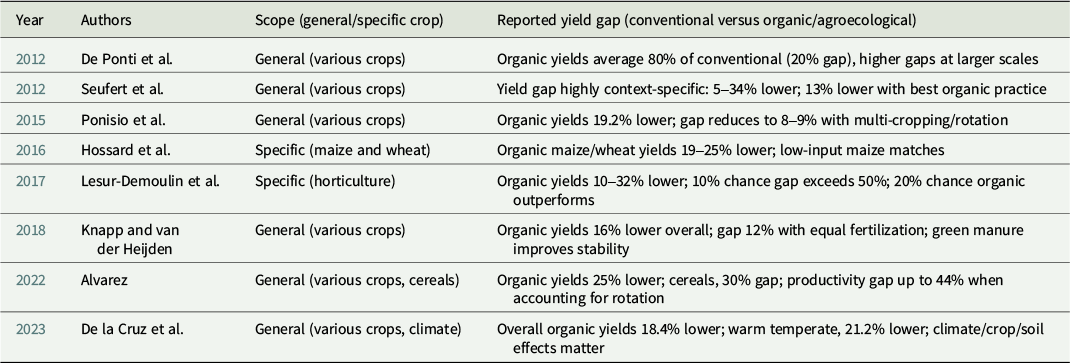
 You have
Access
You have
Access
 Open access
In 2007, our paper, ‘Organic agriculture and the global food supply’, demonstrated the potential for organic production methods to produce enough food to feed the entire human population. This finding created quite a stir when it was published. The study grew out of a class field trip and stimulated a year-long research project by a group of faculty and graduate and undergraduate students. Once we completed the study and wrote the paper, it took another 2 years to get it published, because of strong negative and positive reactions from reviewers. These reactions revealed major ideological fault lines among agronomists and food-industry advocates. We met with strong resistance and encouragement every step of the way. Nonetheless, once the paper was published, it was widely read and cited worldwide. As of March 2026, the paper has been cited over 1,800 times and mentioned by 8 news outlets, 18 policy sources, and 2 Wikipedia pages (Altmetric data, 1 March 2026). Renewable Agriculture and Food Systems lists this article as their most cited publication.
Our study stimulated several follow-up analyses over the next decade; these used additional data and more sophisticated analytical methods. With more cautionary language than in our paper, these studies largely confirmed our major findings—that organic agriculture had the potential to make a major contribution to the global food supply. Below, we elaborate upon the origin and accomplishment of our study, the ideologies that emerged during the review process and beyond, and the findings of later studies. We conclude with brief thoughts about the current status of organic agriculture and future research.
By way of disclosure (and because some of our early critics claimed that we as academics have no direct experience with farming), all three of us have ongoing farming experience. One of us lives on an organic farm; one conducts ecological field research for several months each year on coffee farms in Chiapas, Mexico, and Puerto Rico; and one manages the Campus Farm on the Ann Arbor campus of the University of Michigan. We are familiar with the labor of growing crops, ways of managing soil fertility, and the challenges of suppressing crop pests, as well as obstacles that organic producers encounter in marketing their products. We are also familiar with the satisfaction of growing and sharing food that is flavorful and delicious, whether eaten directly, sold, or donated.
Origin and accomplishment
This study began in an undergraduate course entitled ‘Food, land, and society’, which investigated these topics through discussions, farm visits, and field exercises. Two of us taught the course and used the diverse rural and urban farms and food-related businesses in southeastern Michigan as representative of the challenges and opportunities in US agriculture. In most years, we also had an optional 2-week short course to either Chiapas or Cuba to see how a different country’s food system operated. A morning visit in 2003 to a small organic farm north of Ann Arbor set the spark for this study. The farmer grew salad greens in multiple rotations on 3 acres of land that included a large greenhouse (high tunnel). At the end of the visit, one of us asked the farmer if he had ever calculated how much biomass of produce was harvested on his farm per year (over a 7-month outdoor growing season). The farmer had documented the weight of produce harvested the previous year: 26 tons of salad greens and sprouts on 3 acres. With this surprising figure in our minds, we left that farm for the next activities. By the end of the day, we asked ourselves, ‘If Rob can grow 26 tons of organic salad greens on 3 acres, then why can’t organic agriculture feed the world?’ Admittedly, there is quite a scaling leap between one farm and the global food supply. But the question stared at us and demanded attention.
At the end of the term, a group of students in the course along with the instructors and some of their graduate students decided to form a study group to investigate the question of whether organic agriculture had the potential to feed the world. We met weekly for a year, with each person taking a role in gathering data, analyzing data, writing drafts of the manuscript, and contacting researchers or organizations (such as the Rodale Institute) for information, including unpublished data about controlled experiments. We knew that most agronomists and food-industry advocates considered organic agriculture a minor ‘niche’ component of the food system with no capacity to make a major contribution to any country’s food supply. But our experience meeting young farmers who were establishing small, diversified organic farms in rural and urban settings revealed a passion for growing crops and raising animals without synthetic fertilizers and pesticides. These farms appeared remarkably productive, and there were (and still are) robust local markets for the food raised, in the form of farmers’ markets, restaurants, and subscription shares. So, could organic agriculture make a greater contribution than experts claimed?
The principal objections against organic agriculture making a major contribution to the food system were that yields were too low, there was insufficient organic fertilizer, there was not enough labor to get the work done, and a larger land base would be needed. Our team attempted to address three of these objections (all but the claim about labor).
Our overall approach had five components, explained in detail in the 2007 paper. (1) We gathered quantitative data about the current food supply across approximately 30 different food categories from the Food and Agricultural Organization (FAO) of the United Nations. FAOSTAT, the data-gathering section of FAO, reports these data for most of the world’s countries on a semi-annual basis. We downloaded data for all countries in the FAOSTAT database and aggregated the data for the world, for countries in the developed world, and for countries in the developing world, following the UN designation of which countries belonged in which category. At the time of our working group, full data were available for 2001. (2) From published, peer-reviewed studies and some reputable gray-literature sources, we compiled data about yield comparisons between conventional and organic production of plant and animal products. Some of these studies were before-and-after conversion from conventional to organic production, while others were side-by-side experiments or paired farms in the same climate and soil regime. (3) We aggregated the yield comparisons into ten general food categories, largely following FAO groupings, and then calculated average yield ratios. We reasoned that if the yield data from individual studies included examples from many countries, including temperate and tropical regions, that the average yield ratios would be meaningful; hence, we calculated average yield ratios and the standard error for each food category. (4) We then multiplied the amount of food currently produced in each food category by the average yield ratio for that category and computed the corresponding standard error. The thought experiment was to scale up the yield ratios to production on the current land base as if all products were raised by organic practices. This estimate was then revised downward for various losses. (5) Then we converted the amount of food produced organically in each category to caloric equivalents to estimate whether organic agriculture could provide sufficient calories for the global human population at the time. All of these calculations and the data upon which they are based were presented in the paper.
We made four assumptions. The first was that the current amount of land for cropland and pasture was used. At the time of our study, the area of total cropland was 1,513.2 million hectares. The second was that the foods produced have the same caloric and nutritional value raised by organic as by non-organic methods, even though some claims disputed that equivalence. The third assumption was that the same amount of food losses occurred as in the current system. The food supply for human consumption as a proportion of total production ranged from 11% for sugars and sweeteners to 50% for grains to 98% for meats, with the rest going for feed, seed, or wasted (FAOSTAT data). The fourth assumption was that the same amounts of plant and animal products were consumed as in the current system, although there were already various studies advocating for a shift in diets to reduce sugary and fat-rich food products. In 2001, less than 1% of global cropland was in organic production, so we did not compensate for this small contribution to the food supply. (Thus, it was easy to see why agronomists and food-industry advocates considered organic agriculture as an insignificant niche market.)
Finally, we treated yield comparisons differently for developed versus developing countries. For developing countries, the published comparisons with organic yields were sometimes for low-intensive, subsistence methods and sometimes for conventional methods. Most organic agriculture was not certified and was for local consumption. For these reasons, we made separate calculations for developed countries versus developing countries. From the aggregated data and average yield ratios, we constructed two models of the global food supply grown by organic practices. Model 1 used our findings for the developed world—in which average yield ratios of organic: non-organic were lower than for the developing world (overall average of 0.92 for the developed world versus 1.80 for the developing world). Model 1 provided a lower estimate since it applied lower yield ratios for all food categories to global food production. Model 2 used separate calculations for developed versus developing countries with the respective yield ratios applied to food production in each region, then added together for the global result. The standard error was scaled up for each model estimate.
A separate part of our study involved estimates of nitrogen amendments from cover crops grown during fallow periods, in between crop rotations, or as a relay crop. We estimated whether biological N fixation from leguminous cover crops would be able to provide enough supplemental nitrogen for crop-plant uptake such that no synthetic fertilizer inputs would be needed on the world’s croplands. We obtained N-fertilizer equivalency data from 77 studies from temperate and tropical regions. Table 4 and Appendix 2 in the 2007 paper report the results from these calculations and the data sources, respectively.
The findings from the food-production analysis and the biological N-fixation analysis both showed that organic methods have the potential to produce enough calories to supply the needs of the current human population without increasing the global land base devoted to food production. We have reviewed here the various steps, assumptions, and model decisions to demonstrate that we went to great lengths to generate large datasets, to recognize and account for complexities of the global food system, and to avoid subtle biases that would favor organic production. We rejected no studies of yield comparisons, for example, because they documented low values of organic yields.
Once we had a full draft of the paper, we sent it to seven experienced academic colleagues and asked for their comments. In particular, we requested that they find flaws in our reasoning or datasets and anticipate the comments of negative reviewers so that we could address those concerns in advance. The suggestions that we received from these colleagues were helpful in sharpening certain points and making sure that we clarified what our study did and did not show. We anticipated correctly that some reviewers would willfully misunderstand our methods and findings.
The publishing saga
It took 2 years for the paper to be published. We submitted the manuscript and two appendices of data and sources to five journals that had broad audiences. The responses from editors and reviewers had considerable ideological content as well as peer feedback and revealed either deep hostility toward organic agriculture or cautious support for organic and other forms of regenerative agriculture. The timeline and outcome of submissions are as follows:
(1) Our first submission was to Nature in late July 2004, with response from the editor on August 26, 2004. One reviewer was sarcastically harsh, the other favorable. Both reviews had useful suggestions, which we followed in revising the manuscript. As an illustration of the ideological response, the negative referee had the following statements in the opening paragraph: ‘There is no question that the topic addressed…interests many, but the manuscript is based on questionable assumptions and data that result in grossly misleading conclusions. My major criticism is that the authors have mostly relied on secondary data for their analysis and many of these data do not meet the standards of peer-reviewed scientific research. …. The authors recognize that this is only meant to be a feasibility study, but, given the numerous flaws it contains, I believe that its publication would not do any good for the course of agriculture’. In fairness, two pages of specific comments and suggestions followed, but the statements in the first paragraph were sufficient to cause the editor to reject the paper. Referee 2 had the following statements, along with several specific suggestions: ‘This ambitious piece of analysis is very commendable, based indeed on some fairly conservative assumptions…. More could be said in response to this very provocative but well-grounded article. Its conclusions deserve the attention and thought of many scientists across many disciplines’. It is hard to imagine two more different assessments. Referee 2 later wrote to us to identify himself after receiving Nature’s decision and offered encouragement and useful references to strengthen the paper further.
(2) We revised the manuscript based on responses from reviewers and submitted it next to Science in November 2004. We received a response from a senior editor on December 14, 2004. The editor received one review and rejected the paper based on the single review. The referee claimed to be a strong supporter of organic agriculture, but the text of the review had a nasty tone.
(3) In early 2005, we submitted the revised manuscript to the Proceedings B of the Royal Society. We received two reviews—one largely positive, with constructive suggestions. The second review was negative but included four pages of useful comments and recommended references. Although the journal rejected the manuscript, this was the first pair of peer reviews with a professional tone.
(4) In April 2005, we submitted a further revised manuscript to the Proceedings of the U.S. National Academy of Sciences as a direct submission. The journal decided not to send the manuscript for review with the semi-automatic reply that the topic was not of general interest.
(5) In May 2005, we sent the manuscript to Bioscience. We were not successful there either.
(6) After these five submissions and one entire year of failed attempts to publish the study after several rounds of refinements, we decided to submit to a specialized journal and went directly to Renewable Agriculture and Food Systems. There we found sympathetic and helpful editors, John Doran and Janet Doran. The first set of reviews had quite mixed reactions, and we went through two rounds of revision and re-review before the paper (along with its two long appendices of data and sources) was accepted for publication on June 9, 2006, and was printed in the second issue of Volume 22 in 2007 (Badgley et al., Reference Badgley, Moghtader, Quintero, Zakem, Chappell, Aviles-Vazquez, Samulon and Perfecto2007a). Along with our paper was published a forum of two commentaries about the paper, both rather negative. Neither author had seen the final published version before writing their commentaries. One commentary claimed that too much of our data about yield comparisons came from unreliable sources (gray literature). It did not seem to matter that earlier papers comparing organic and conventional agriculture that also used such sources had been published and were widely cited (e.g., Stanhill, Reference Stanhill1990). Nonetheless, finally our paper was available for broad readership and distribution.
Once published, the saga continued. The paper received widespread enthusiastic interest as well as attacks from advocates for industrial agriculture. We were interviewed on radio and for newspaper articles in several countries, and several non-profit organizations (including Food First and the Pesticide Action Network) printed summaries of our paper in their newsletters. The most extensive attack came from Alex Avery of the Hudson Institute. He wrote a critique on the Hudson Institute website (their section titled ‘Center for Global Food Issues’) and sent a four-page critique to Renewable Agriculture and Food Systems. He claimed that we cherry-picked our yield data and double-counted favorable ratios and attacked the veracity of some of our published, peer-reviewed sources. The Dorans consulted some of these authors for response and their comments added to our reply to Avery. Both the Avery critique and our response were published as commentaries in the December 2007 issue of Renewable Agriculture and Food Systems (Avery, Reference Avery2007; Badgley et al., Reference Badgley, Perfecto, Chapell and Samulon2007b).
On balance, the positive reception was broader and more balanced than the attacks. Over the years, the paper remains one of our most cited publications. One of the misrepresentations that often arose from both those who praised the study and those who attacked it was that we claimed that organic agriculture could systematically outperform conventional methods. Our data do not support that claim, nor did we make any such statement. We simply demonstrated that organic agriculture has the potential to provide sufficient yields to feed the world at recommended caloric and nutritional levels.
Subsequent analyses
Later studies comparing organic and conventional agriculture gathered new data, from studies published after our paper was accepted. Notable among these later studies are those by De Ponti, Rijk and Van Ittersum (Reference De Ponti, Rijk and Van Ittersum2012), a group of researchers from Wageningen University, the Netherlands; Seufert, Ramankutty and Foley (Reference Seufert, Ramankutty and Foley2012), a group from McGill University and the University of Minnesota; and Ponisio et al. (Reference Ponisio, M’Gonigle, Mace, Palomino, De Valpine and Kremen2015), a group of researchers from the University of California, Berkeley. All three of these studies employed meta-analyses and found higher yield gaps. De Ponti et al. analyzed 362 paired crop yield comparisons and found that, on average, organic yields were 80% of conventional yields, with substantial variation (standard deviation 21%) depending on crop type and geographic region. Our average for comparisons of organic versus conventional across all plant foods, including fruits, sugars, and legumes, was 91% (Table 2 of our article). De Ponti and colleagues observed that the yield gap tends to widen as conventional yields increase, possibly due to limitations in nutrient availability and pest control in organic systems.
Seufert, Ramankutty and Foley (Reference Seufert, Ramankutty and Foley2012), whose study was published in Nature, reanalyzed the data that we compiled for organic versus conventional methods, added new yield comparisons published since our paper came out, and made further comparisons (long-term vs. short-term under organic management, amount of supplemental nitrogen). They confirmed that organic yields are typically lower than their conventional counterparts and emphasized that this gap is highly context dependent. Their meta-analysis revealed that organic yields are typically 5% lower for some rain-fed legumes and perennials under specific soil conditions, up to 13% lower with best organic practices, and can be as much as 34% lower when only the most comparable organic and conventional systems are considered. However, in studies that used conventional yields that are representative of regional averages, or in developing countries, they found that the difference between organic and conventional goes down to 13% and 8%, respectively. Importantly, Seufert et al. noted that with better management, suitable crop types, and favorable conditions, organic yields come near those of conventional methods. They emphasized the need for further research into the factors limiting organic productivity, while also considering social and environmental benefits.
Ponisio et al. (Reference Ponisio, M’Gonigle, Mace, Palomino, De Valpine and Kremen2015) conducted the most comprehensive study published after ours. They analyzed a much larger dataset, including 115 studies and over 1,000 comparisons and using a new hierarchical analytical method. Their findings estimated the average organic yield gap at 19.2% (±3.7%) below conventional yields, which is smaller than the gap reported by Seufert, Ramankutty and Foley (Reference Seufert, Ramankutty and Foley2012). Crucially, Ponisio et al. found that crop type (e.g., legumes vs. non-legumes) and country development status did not significantly affect the yield gap. Instead, they identified management practices, especially agricultural diversification (multi-cropping and organic crop rotations), as critical in reducing the yield gap. Where these practices were used in organic systems, the gap narrowed to 9 ± 4% and 8 ± 5%, respectively. Ironically, they found bias in their meta-dataset toward higher yields in conventional relative to organic yields (see their supplementary information). They also found a trend toward larger yield gaps in more recent studies (which our original study would not have known about); this trend remains a puzzle and deserves further exploration. Their paper noted that organic agriculture would not solve global problems of hunger and obesity, which are political and cultural in nature, but would offer low-cost methods for peasant farmers to raise production levels in a sustainable manner. Their findings indicate that focused research and investment in organic management practices could significantly reduce or entirely close the yield gap for certain crops and regions.
Since these three papers, several additional meta-analyses have been published, showing similar findings (Table 1). Most of these studies find that organic yields are generally about 10–30% lower than conventional methods, though this gap can be narrowed with optimal management and diversification. Key factors include crop type, climate, fertilization, soil management, and rotation practices. Using low-input systems may also help reduce this difference while promoting sustainability. Although none of these studies explicitly claims that organic farming can significantly contribute to the global food supply, this conclusion can be inferred.
Studies published after 2010 that compared yields of organic and conventional (industrial) agriculture for various crops
Table 1. Long description
The table contains eight rows, each representing a study published between 2012 and 2023, and four columns labeled Year, Authors, Scope, and Reported yield gap. From the top row downward: 2012, De Ponti et al., general scope for various crops, report organic yields average 80 percent of conventional with a 20 percent gap and higher gaps at larger scales. 2012, Seufert et al., general scope for various crops, find yield gap is highly context-specific, ranging from 5 to 34 percent lower for organic, and 13 percent lower with best organic practice. 2015, Ponisio et al., general scope for various crops, report organic yields 19.2 percent lower, but the gap reduces to 8 to 9 percent with multi-cropping or rotation. 2016, Hossard et al., specific to maize and wheat, findorganic maize and wheat yields are 19 to 25 percent lower, but low-input maize matches conventional yields. 2017, Lesur-Demoulin et al., specific to horticulture, report organic yields 10 to 32 percent lower, with a 10 percent chance the gap exceeds 50 percent and a 20 percent chance organic outperforms conventional. 2018, Knapp and van der Heijden, general scope for various crops, find organic yields 16 percent lower overall, gap narrows to 12 percent with equal fertilization, and green manure improves yield stability. 2022, Alvarez, general scope for various crops and cereals, reports organic yields 25 percent lower overall, cereals show a 30 percent gap, and productivity gap can reach up to 44 percent when accounting for rotation. 2023, De la Cruz et al., general scope for various crops and climate, finds overall organic yields 18.4 percent lower, warm temperate regions 21.2 percent lower, and note that climate, crop, and soil effects are significant. Studies are listed in order of publication date.
Note: Studies are listed in order of publication date.
A recent meta-analysis not included in Table 1 is noteworthy. Romero Antonio et al. (Reference Romero Antonio, Faye, Betancur-Corredor, Baumüller and von Braun2025) provide the first comprehensive systematic review and meta-analysis of empirical research comparing agroecological practices and monocultures in Africa. Although the comparison is not between organic and conventional methods (and that is why we did not include it in Table 1), the results highlight a component of our study that other reviews published after ours fail to mention or discuss. Our study highlighted the great potential of organic or agroecological practices for increasing food production in the Global South (developing countries), where a large percentage of the population is poor and lives in rural areas, and where ‘conventional’ agriculture usually consists of monocultures with suboptimal use of agrochemicals. This study revealed that although ‘agroecology’ is not explicitly mentioned often, many studies across Africa have examined practices such as crop rotation, intercropping, organic fertilizer use, soil and water conservation, and rhizobium inoculation. A meta-analysis of 392 experiments shows that agroecological practices are strongly associated with higher land productivity, with crop yields increasing by an average of 39% over traditional monoculture systems that lack additional inputs. The most substantial yield gains occurred when organic fertilizers were combined with small amounts of mineral fertilizers. The impact varied depending on the practice, crop type, agroecological zone, soil conditions, and whether comparisons were made with input-heavy monocultures or low-input systems. While their estimates of yield improvements between agroecological and conventional methods are somewhat lower than ours, they still observe higher yields with agroecological approaches, emphasizing the significant potential of agroecology to boost food production across Africa.
Two additional studies expand the topic by considering the role of organic agriculture in a broader food-system context. In a thoughtful review article in Nature Plants, Reganold and Wachter (Reference Reganold and Wachter2016) evaluated organic farming systems in terms of comparative productivity, environmental impacts, economic viability, and social well-being with conventional farming systems. Acknowledging the studies of yield gaps, they note several studies that show greater yields in organically managed farms during drought years than in their conventional counterparts, because of higher soil moisture in organic soils. With regard to environmental impacts, they note several measures of higher soil quality and greater functional diversity of plants, herbivores, predators, and pollinators in organically farmed systems. In addition, the lower energy use per hectare and greater amounts of soil organic matter mean that organic farming systems can both limit greenhouse gas emissions from use of fossil fuels and sequester more carbon than conventional farming systems. Regarding economics, they note that the price premiums for organic food products make organic farms more profitable, but without price premiums, the net returns for the value of time and labor are lower than on conventional farms. Labor costs are higher on organic farms, and this labor is beneficial for rural employment. In terms of well-being, Reganold and Wachter cite studies documenting increased social interactions between farmers and consumers and greater cooperation among farmers in organically managed farms. Livestock animals raised by certified organic methods experience more humane conditions that allow natural behaviors. Finally, they note the various obstacles to greater adoption of organic practices, including the vested interests of large agribusinesses in the status quo and their undue influence on food and farm policies, much less funding for research on organic practices in developed and less-developed countries, and the cost of and inconsistencies among organic certification programs. They state that governments should create enabling policy, legal, and financial measures for the further development and adoption of organic and other forms of sustainable farming systems.
Muller et al. (Reference Muller, Schader, Scialabba, Brüggemann, Isensee, Erb, Smith, Klocke, Leiber, Stolze and Niggli2017) take a food-systems approach in a different manner. Their concern is that the lower yields of organically raised plants and animals could necessitate an increase in the agricultural land base in order to feed the increasing human population (over 8 billion in 2026). They developed a model that includes the amount of land under organic production, changes in the amount of agricultural land devoted to raising animal feed (with corresponding changes in livestock numbers and dietary consumption of animal products), and reductions in food wastage. The authors model multiple scenarios that include changes in cropland area of 0–100% organic production, 0–100% reduction in feed production (‘food-competing feed’), and 0–50% reduction in food wastage. For various combinations of these scenarios, they evaluate impacts of three magnitudes of climate change for the year 2050, with 2005–2009 as a baseline. They find that the effects of climate change and lower organic yields on dietary change are smaller than the impacts of reducing the amount of land devoted to livestock feed and thereby consumption of animal products. In summary, Muller et al. make the important point that the potential of organic production to increase food-system sustainability is markedly improved if combined with a reduction in production of livestock feed, dietary changes to replace some animal products with plant-based protein sources, and a substantial reduction in food wastage. In combination, these modifications enable the greatest benefits and fewest negative environmental impacts.
We commend the authors of both studies for situating the various benefits of organic agriculture and the obstacles facing its practitioners within a food-system context.
Growth in organic agriculture
Both in the United States and globally, the number of organic farms and the amount of land in organic production have increased since 2007. Between 2011 and 2021, the number of certified organic operations increased by 90% (to 17,445 farms), and the amount of certified organic cropland in the US increased by 79% to 3.6 million acres (1.46 million ha). In contrast, organic pastureland and rangeland decreased by 22% (to 1.3 million acres, or 526,000 ha) (Raszap Skorbiansky, Reference Raszap Skorbiansky2025). Together certified organic corn and soybeans comprise only 0.3% of the acreage planted to these crops (McConnell, Reference McConnell2021). While the demand for organic feed for certified organic livestock animals has driven an increase in the acreage of organically grown commodity crops, the other uses of corn and soybeans do not require organic production and conventional practices still dominate their production methods. US federal food policies still prioritize economic efficiency over environmental and social impacts and are doing little to encourage adoption of organic methods (Ikerd, Reference Ikerd2026).
According to FiBL (Forschungsinstitut für biologischen Landbau, or the Research Institutes of Organic Agriculture), 96.4 million hectares were under organic management globally in 2022, with an increase in organic farming area on all continents (Willer, Trávnícek and Schlatter, Reference Willer, Trávnícek and Schlatter2025). This amount represents 2% of the world’s agricultural land, a doubling since the time of our study. In 2022, 4.5 million organic farmers were reported. Seventy-five countries have legislation on organic agriculture in 2023. These are but a few of the indicators of the continuing growth of organic agriculture.
Conclusion
The most important implication of our study and the subsequent studies comparing yields is that farming methods that rely on agroecological practices rather than synthetic fertilizers, synthetic pesticides, and genetically modified seeds can make a major contribution to feeding the human population. Diversified agroecological farms would have an even greater impact if less food were diverted to livestock feed and if less food were wasted. The many studies from health practitioners, conservation biologists, and sustainability scientists arguing for reduced consumption of animal products in high-income countries point out the environmental benefits of such reductions (e.g., Willett and Skerrett, Reference Willett and Skerrett2017; Clark et al., Reference Clark, Springmann, Hill and Tilman2019; Read, Hondula and Muth, Reference Read, Hondula and Muth2022; Higuita, LaRocque and McGushin, Reference Higuita, LaRocque and McGushin2023), whether the food is raised organically or not. Agroecological farming also entails a commitment to social justice in the food system (Anderson et al., Reference Anderson, Bruil, Chappell, Kiss and Pimbert2019; Perfecto and Vandermeer, Reference Perfecto and Vandermeer2024). These perspectives all point toward a transformation of the food system that serves people and nature.
Acknowledgments
We thank the editorial staff of Renewable Agriculture and Food Systems for inviting us to submit a commentary for the 40th anniversary edition of the journal. This essay benefitted from suggestions from two anonymous reviewers. In addition, we thank the farmers and students whose efforts and questions motivated our initial study.
Author contribution
All authors have contributed information to this manuscript. All authors have read and approved the final version.