



This work studies moduli spaces of hyperbolic surfaces
${\mathcal {M}_{g,n}^{\mathrm {hyp}}}(\mathbf {L})$
 , with an emphasis on the computation of Weil–Petersson volumes. Building on the seminal work of Mirzakhani, who showed that these volumes are symmetric polynomials
$V_{g,n}^{\mathrm {Mirz}}(\mathbf {L})$
, with an emphasis on the computation of Weil–Petersson volumes. Building on the seminal work of Mirzakhani, who showed that these volumes are symmetric polynomials
$V_{g,n}^{\mathrm {Mirz}}(\mathbf {L})$
 in boundary lengths
$\mathbf {L} \in \mathbb {R}_{\ge 0}^n$
in boundary lengths
$\mathbf {L} \in \mathbb {R}_{\ge 0}^n$
 with coefficients given by intersection numbers on
$\overline {\mathcal {M}}_{g,n}$
with coefficients given by intersection numbers on
$\overline {\mathcal {M}}_{g,n}$
 , we extend the theory to surfaces containing cone points of arbitrary angles in
$(0,2\pi )$
, we extend the theory to surfaces containing cone points of arbitrary angles in
$(0,2\pi )$
 .
.
The addition of cone points with angles
$\theta _j=-iL_j \in (0,2\pi )$
 significantly alters the geometry of the associated moduli spaces
${\mathcal {M}_{g,n}^{\mathrm {hyp}}}(\mathbf {L})$
significantly alters the geometry of the associated moduli spaces
${\mathcal {M}_{g,n}^{\mathrm {hyp}}}(\mathbf {L})$
 . For example, the existence of natural coordinates arising out of hyperbolic pair of pants decompositions is no longer guaranteed. Moreover, there does not exist a natural compactification of
${\mathcal {M}_{g,n}^{\mathrm {hyp}}}(\mathbf {L})$
. For example, the existence of natural coordinates arising out of hyperbolic pair of pants decompositions is no longer guaranteed. Moreover, there does not exist a natural compactification of
${\mathcal {M}_{g,n}^{\mathrm {hyp}}}(\mathbf {L})$
 coinciding with the Deligne–Mumford compactification
$\overline {\mathcal {M}}_{g,n}$
coinciding with the Deligne–Mumford compactification
$\overline {\mathcal {M}}_{g,n}$
 . This work contributes to the study of both the real- and complex-analytic geometry of
${\mathcal {M}_{g,n}^{\mathrm {hyp}}}(\mathbf {L})$
. This work contributes to the study of both the real- and complex-analytic geometry of
${\mathcal {M}_{g,n}^{\mathrm {hyp}}}(\mathbf {L})$
 with arbitrary boundary data
$\mathbf {L} \in \{\mathbb {R}_{>0} \cup [0,2\pi )i\}^n$
with arbitrary boundary data
$\mathbf {L} \in \{\mathbb {R}_{>0} \cup [0,2\pi )i\}^n$
 , where
$L_j = 0$
, where
$L_j = 0$
 corresponds to a hyperbolic cusp,
$L_j \in \mathbb {R}_{>0}$
corresponds to a hyperbolic cusp,
$L_j \in \mathbb {R}_{>0}$
 to a geodesic boundary curve of length
$L_j$
to a geodesic boundary curve of length
$L_j$
 and
$L_j \in (0,2\pi )i$
and
$L_j \in (0,2\pi )i$
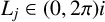 to a cone point of angle
$\theta _j=-iL_j$
to a cone point of angle
$\theta _j=-iL_j$
 . In particular, we introduce new real-analytic coordinates on
${\mathcal {M}_{g,n}^{\mathrm {hyp}}}(\mathbf {L})$
. In particular, we introduce new real-analytic coordinates on
${\mathcal {M}_{g,n}^{\mathrm {hyp}}}(\mathbf {L})$
 and examine the varying behaviour of hyperbolic surfaces as one approaches the boundary
$\partial {\mathcal {M}_{g,n}^{\mathrm {hyp}}}(\mathbf {L})$
and examine the varying behaviour of hyperbolic surfaces as one approaches the boundary
$\partial {\mathcal {M}_{g,n}^{\mathrm {hyp}}}(\mathbf {L})$
 . In the case of only cone points and cusps, an understanding of the complex-analytic geometry allows us to construct a compact topological space
$\overline {\mathcal {M}}^{\mathrm {hyp}}_{g,n}(\mathbf {L})$
. In the case of only cone points and cusps, an understanding of the complex-analytic geometry allows us to construct a compact topological space
$\overline {\mathcal {M}}^{\mathrm {hyp}}_{g,n}(\mathbf {L})$
 whose elements we identify with weighted pointed stable curves. We establish topological and geometric properties of
$\overline {\mathcal {M}}^{\mathrm {hyp}}_{g,n}(\mathbf {L})$
whose elements we identify with weighted pointed stable curves. We establish topological and geometric properties of
$\overline {\mathcal {M}}^{\mathrm {hyp}}_{g,n}(\mathbf {L})$
 and ultimately determine a homeomorphism between this space and certain Hassett compactifications
$\overline {\mathcal {M}}_{g,\mathbf {a}}$
and ultimately determine a homeomorphism between this space and certain Hassett compactifications
$\overline {\mathcal {M}}_{g,\mathbf {a}}$
 of
$\mathcal {M}_{g,n}$
of
$\mathcal {M}_{g,n}$
 , generalising the Deligne–Mumford compactification.
Our primary tool for computing volumes of moduli spaces
${\mathcal {M}_{g,n}^{\mathrm {hyp}}}(\mathbf {L})$
 for
$\mathbf {L}= i\boldsymbol {\theta } \in i[0,2\pi )^n$
for
$\mathbf {L}= i\boldsymbol {\theta } \in i[0,2\pi )^n$
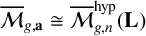
 is intersection theory on
$\overline {\mathcal {M}}_{g,\mathbf {a}} \cong \overline {\mathcal {M}}^{\mathrm {hyp}}_{g,n}(\mathbf {L})$
is intersection theory on
$\overline {\mathcal {M}}_{g,\mathbf {a}} \cong \overline {\mathcal {M}}^{\mathrm {hyp}}_{g,n}(\mathbf {L})$
 . We define a Weil–Petersson form
$\omega ^{\mathrm {WP}}(\mathbf {L})$
. We define a Weil–Petersson form
$\omega ^{\mathrm {WP}}(\mathbf {L})$
 for the moduli space of conical hyperbolic surfaces, show that it extends as a closed current to the compactification and determine its cohomology in terms of tautological classes on
$\overline {\mathcal {M}}_{g,\mathbf {a}}$
for the moduli space of conical hyperbolic surfaces, show that it extends as a closed current to the compactification and determine its cohomology in terms of tautological classes on
$\overline {\mathcal {M}}_{g,\mathbf {a}}$
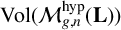
 . This leads to polynomial volume formulae for
$\mathrm {Vol}({\mathcal {M}_{g,n}^{\mathrm {hyp}}}(\mathbf {L}))$
. This leads to polynomial volume formulae for
$\mathrm {Vol}({\mathcal {M}_{g,n}^{\mathrm {hyp}}}(\mathbf {L}))$
 . In special cases, volumes coincide with the evaluation of Mirzakhani polynomials
$V_{g,n}^{\mathrm {Mirz}}(\mathbf {L})$
. In special cases, volumes coincide with the evaluation of Mirzakhani polynomials
$V_{g,n}^{\mathrm {Mirz}}(\mathbf {L})$
 at imaginary-valued boundary lengths
$\mathbf {L}= i\boldsymbol {\theta }$
at imaginary-valued boundary lengths
$\mathbf {L}= i\boldsymbol {\theta }$
 . In general, however, such substitutions do not result in the actual volume of the corresponding moduli space of conical hyperbolic surfaces. We characterise precisely when they do, allowing us to assign geometric meaning to Mirzakhani’s polynomials in these cases and to study the limiting behaviour of volumes as cone angles approach
$2\pi $
. In general, however, such substitutions do not result in the actual volume of the corresponding moduli space of conical hyperbolic surfaces. We characterise precisely when they do, allowing us to assign geometric meaning to Mirzakhani’s polynomials in these cases and to study the limiting behaviour of volumes as cone angles approach
$2\pi $
 .
.
More broadly, we prove in this work that the volumes
$\mathrm {Vol}({\mathcal {M}_{g,n}^{\mathrm {hyp}}}(\mathbf {L}))$
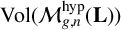 form a piecewise polynomial function in cone angles
$\boldsymbol {\theta }=-i\mathbf {L} \in [0,2\pi )^n$
form a piecewise polynomial function in cone angles
$\boldsymbol {\theta }=-i\mathbf {L} \in [0,2\pi )^n$
 . The parametrisation space of admissible cone angles is decomposed into chambers separated by walls, with each chamber assigned a distinct polynomial that determines the volumes of the corresponding moduli space. The chambers are naturally partially ordered and the maximal chamber corresponds to Mirzakhani’s polynomial. Volume polynomials in other chambers are related to Mirzakhani’s polynomial via explicit wall-crossing formulae. We prove that the resulting piecewise polynomial volume function is globally differentiable and satisfies natural geometric properties in certain limits. Finally, we illustrate the computational power of our wall-crossing formula through a range of geometrically interesting examples.
The thesis is available online at https://hdl.handle.net/11343/368374. Some of the research has been published in [Reference Anagnostou, Mullane and Norbury1, Reference Anagnostou and Norbury2].


