

In July 2015, Trinity Church Wall Street in New York City announced its “Mass Reimaginings” project, a commissioning initiative curated by composer Daniel Felsenfeld. Five composers—Netsayi Chigwendere, Jonathan Newman, Paola Prestini, Julian Wachner, and Sarah Kirkland Snider—were invited to offer their own twenty-first-century takes on the traditional Mass. According to Wachner, Trinity’s former music director, the organization had “never undertaken such an ambitious project before, particularly one that is intended to enrich and impact the repertory in such a significant manner.”Footnote 1 Trinity’s only stipulation was that each composer retain the original Latin text for the Gloria, Sanctus, and Benedictus movements in their works so that they might be used in church services.Footnote 2
Mass for the Endangered (2018) was Sarah Kirkland Snider’s first large-scale choral commission. Snider describes her work as “a hymn for the voiceless and the discounted, a requiem for the not-yet-gone.”Footnote 3 She has credited the ecological theme of the Mass to her friend and frequent collaborator, the poet, writer, and visual artist Nathaniel Bellows, who contributed original English text to four of the work’s six movements. In an interview, Snider remarked that she and Bellows “share a deep love of the natural world” and that when she asked Bellows what he would want to write about she already knew the answer: “endangered animals and the global environmental crisis.”Footnote 4 Snider’s Mass, a work steeped in eco-anxiety, provides a compelling case study for examining how contemporary musical works in the Western art music tradition can foster ecological awareness.Footnote 5
What does it mean to think ecologically about music? Might ecological thinking about music help us to understand, mitigate, and adapt to the crisis of the so-called Anthropocene?Footnote 6 Aaron S. Allen and Jeff Todd Titon pose these questions at the start of a recent volume of ecomusicological scholarship.Footnote 7 Both questions invite contemplation on how music might foster ways of (re)thinking coexistence within a period of global ecological instability. Indeed, the Anthropocene raises the stakes on ontological claims, explicit or not, as it obliges one to confront the inadequacy of human-centered paradigms. As a framework for ecocritical inquiry, the Anthropocene exposes the limits of approaches that privilege a human-world correlation, even when those approaches seek to destabilize that correlation. That contradiction highlights the need for theoretical and conceptual tools that move beyond mere critique of anthropocentrism toward alternative ways of conceiving agency or, to put it another way, how things exist.
It must be noted that there is a difference between asking how music can bring about ecological awareness and how thinking about music can bring about ecological awareness. Both topics are relevant here. Alexander Rehding poses a question that seems to imply both: “What can music do to help turn our collective attention to the future?”Footnote 8 This question, which assumes that music has the potential to influence how we contemplate and imagine the future, sets the stage for this article. Here, I propose that literary theorist and philosopher Timothy Morton’s ecocritical and ecophilosophical work provides some intriguing responses to that question. To bridge the gap between that work and music studies proves to be a precarious endeavor, though, given Morton’s strong ties to Object-Oriented Ontology (OOO), a philosophical vantage point that tends to challenge modern assumptions wherever it goes.Footnote 9
Morton is a leading figure in ecophilosophical and ecotheoretical discourse, widely recognized for shaping how ecological thinking and ecological awareness are understood in the humanities.Footnote 10 OOO, the work of American philosopher Graham Harman, is a realist philosophy that abandons the anthropocentrism of modern thinking by asserting that all things, entities, or substances, human or nonhuman, which it calls objects, exist autonomously and in an irreducible way. For more than a decade now, Morton has demonstrated the profound ecological implications of OOO in their own work. Through interpretive analysis of Snider’s Mass, I provide some initial support for a connection between that work and music studies. In doing so, this article addresses a central issue for ecomusicological studies: namely, how music can not only help with understanding the history of the Anthropocene but also support ways of making sense of the future that it anticipates.
Careful attention to Morton’s work and its full range of implications for thinking ecologically about music (and thinking about music as ecological) has yet to emerge, despite its steady influence in other areas of the environmental humanities, ecophilosophical discourse, and literary theory. This article addresses that gap in the literature. Morton’s work is significant because it provides a rich array of conceptual tools for thinking about complex, planetary-scale issues like global warming and helpfully diagnoses eco-anxiety in its various stages and forms. It grapples with what it means to think ecologically and to be ecological in the twenty-first century.Footnote 11 I touch on only a fraction of what that work might contribute to ecomusicological studies here.
Two of Morton’s most significant conceptual contributions are the ecological thought and dark ecology, each of which they detail in two monographs of the same names and visit elsewhere in numerous other publications.Footnote 12 Despite the definite article, the ecological thought is not something that can be pointed to directly. It is not a singular thought or even a kind of thought. Morton describes it as the source of ecological awareness, something that eludes direct perception, experience, knowledge, and thinking itself. My work here draws out the implicit object-oriented perspective of that concept.Footnote 13 I read Morton’s concept of the ecological thought as an object in the OOO sense, as something irreducible to its components or its effects on other things.Footnote 14 I claim that it belongs to the interior of Snider’s Mass in the same way that a waterlily belongs to a Monet. This claim is interpretive and ontological in a speculative sense, since one cannot directly point to the existence of the ecological thought in the Mass. Ultimately, I contend that the ecological thought is the source of whatever ecological awareness Snider’s work bestows on its listener and that how the Mass stylizes the ecological thought corresponds to the aesthetics of dark ecology.Footnote 15
Dark ecology is ecological awareness that embraces ecological reality in all its strangeness and unpleasantness, that is radically open to guilt, shame, melancholy, horror, disgust, and abjection. Dark ecology is, in many ways, a response to the Anthropocene. Indeed, Morton suggests that the aesthetic and poetic aspects of dark ecology correspond to the aesthetics of the Anthropocene and to the issues that concept raises in relation to thinking ecologically.Footnote 16 Consequently, the kind of ecological thinking that the Anthropocene entails becomes accessible to listeners through works characterized by dark ecology. Snider’s Mass provides its listeners a glimpse into the reality of the Anthropocene, or what Morton simply calls “an age of mass extinction.”Footnote 17 I entertain dark ecology as a useful tool for musical analysis rather than an ecological theory for a logic of future coexistence (the subtitle of Morton’s monograph).
This article has three interconnected goals. The first is to demonstrate how two of Morton’s most important concepts, the ecological thought and dark ecology, can be useful to (eco)musicological endeavors, or thinking ecologically about music. Because Morton discusses both in relation to twenty-first-century environmental themes, the second aim is to apply those concepts to an interpretive analysis of a twenty-first-century musical work to better understand how music that is either explicitly or implicitly environmentally oriented can support listener engagement with the reality of present-day environmental issues. The third goal is to reveal object-oriented music criticism as a productive framework for musical analysis in an ecocritical mode.Footnote 18 The pursuit of all three supports a response to the question regarding how music might turn our attention to the future.
In the first section of this article, I cover how Snider and Bellows have described the Mass, the role of the visual art created for it, and the libretto. In the second section, I provide explanations of the ecological thought and dark ecology according to passages in Morton’s work and survey the reception of the 2020 recording. In the third section, I apply those two concepts to interpretive and analytical commentary on Snider’s Mass, examining passages in the work that highlight its dark-ecological qualities. I organize my interpretive remarks around the three primary layers (zones) of dark ecology that Morton identifies: depression, uncanniness, and sweetness.Footnote 19 Finally, I suggest how Morton’s concepts might apply to ecomusicological thinking beyond the sort of interpretive work I conduct here.
Mass for the Endangered
Following the commission from Trinity Wall Street, Snider composed five movements of the Mass in early 2018. “Once I started writing,” she recalled in a 2020 interview, “the music came quickly, for me—a few months.”Footnote 20 Recalling the initial creative stages of the Mass, Snider stated in one interview: “I was thrilled to immerse myself in memories of singing the Mozart, Brahms, and Fauré requiems, the Palestrina and Byrd masses, the Bach chorales.” Regarding those other composers’ influence, she remarked: “Rather than consciously upend those traditions, I wanted to open the gates in my mind between centuries-old European vocal traditions and those of more recent American vernacular persuasion, and write from a place where differing thoughts about line, text, form, and expression could co-exist.” She spent the following year revising the work and added the Alleluia movement to highlight the lower voices of the choir.Footnote 21
The Mass premiered on April 16, 2018, as part of Trinity’s three-month-long “Total Embrace” concert series celebrating the centennial of Leonard Bernstein.Footnote 22 The work, composed for four-part chorus and eleven instruments (flute, oboe, clarinet, bassoon, vibraphone, marimba, crotale, piano, harp, string quartet, and contrabass), uses the five fundamental parts of the Mass Ordinary (the Alleluia belongs to the Proper). The Kyrie, Gloria, Alleluia, and Agnus Dei movements all feature additional English text by Bellows. A recording of the Mass, the fourth album in a partnership between New Amsterdam Records and Nonesuch, was released in September 2020 and features the English vocal ensemble Gallicantus conducted by Gabriel Crouch. In notes for the album, Snider shares her thoughts about the concept of the work:
The origin of the Mass is rooted in humanity’s concern for itself, expressed through worship of the divine which, in the Catholic tradition, is a God in the image of man. Nathaniel and I thought it would be interesting to take the Mass’s musical modes of spiritual contemplation and apply them to concern for non-human life—animals, plants, and the environment. There is an appeal to a higher power—for mercy, forgiveness, and intervention—but that appeal is directed not to God but rather to Nature itself.Footnote 23
Snider stated in one interview that she and Bellows took on the subject of endangered species and global warming “for personal reasons […] rather than political ones, per se,” that they “weren’t explicitly striving to galvanize change,” and that, moreover, she prefers art that “gives people space to reflect internally.”Footnote 24 In another interview, Snider asserted something similar: “What we tend to underestimate is that if the art speaks to someone, it can actually make a difference.”Footnote 25 Nevertheless, topics like global warming, endangered animals, and the impact of anthropogenic effects on the planet are political ones. To what extent do these topics and their alliance with the Mass make it a political work? For the object-oriented thinker, Mass for the Endangered is political if and only if it gives aesthetic life to political topics, but it is not political insofar as it brings those topics into its orbit, or inspires listeners to take stock of their role in environmental politics. In other words, political elements become relevant to Mass for the Endangered by contributing to its autonomy.Footnote 26 In any case, the comments above suggest that Snider sees her work not as a call to action but as an opportunity to press pause on our habitual apathy toward nonhuman things, to spend time “tuning” to them instead; that is, coexisting with them via the musical work.Footnote 27 Morton has suggested that, in an age of ecological awareness, “ecological art is going to be more and more about this kind of tuning.”Footnote 28 Nonhuman things (especially those that raise environmental concerns, like global warming, viruses, and trash) now impinge on everyday awareness in ways that induce ecological awareness—a kind of weird ecological awareness in which one recognizes or begins to recognize the irreducible gap between the reality of something and its appearances.Footnote 29 Art provides cognitive pathways to help make sense of this awareness.
Visual art often influences Snider’s work.Footnote 30 Brooklyn-based visual artist Deborah “CandyStations” Johnson created music videos for each movement of the work based on illustrations by Bellows.Footnote 31 These videos sometimes accompany performances of the work. My analytical commentary focuses exclusively on the experience of listening to Snider’s Mass without its accompanying visual artwork. From an object-oriented standpoint, the experience of the work alongside or through its music videos would constitute a different object of study altogether. Nonetheless, the music videos highlight aspects of the work that are relevant to the discussion at hand.
The music video for the Kyrie depicts a blank triptych or panel painting. As the video progresses, intricate geometrical figures and illustrations of various species gradually pervade the panels, eventually spilling over their boundaries, dyeing both the panels and the place surrounding them blue. The music videos for the Gloria and the Alleluia portray balanced environments transformed by dramatic anthropogenic disturbances. The future is portrayed as bleak for many species. The Credo and Sanctus/Benedictus videos depict life forms and the cosmos as interconnected through a series of kaleidoscopic effects. The music video for the Agnus Dei, the final movement, features an assortment of the same imagery used in the other videos. Conductor Jamie L. Bunce, who received Snider’s guidance on a performance of the work, remarks that, from her own experience, staging the work with the visual artwork projected somewhere “is worth the effort and expense. The beautiful images and coordinated lighting enhance the direct musical expression of an already organically expressive work.”Footnote 32
In keeping with the solemnity of the traditional Mass and the theme of the work, Bellows’s supplemental poetry is generally gloomy. The Kyrie features five short English stanzas, all of which pray for mercy on all nonhuman things. Each stanza attempts to pay tribute to as many nonhumans as possible: “Give mercy to all wing and paw/Mercy to all creed and claw/On flower, seed, leaf and root” (second stanza). A final line, dramatically set apart from the five stanzas in the libretto, turns the prayer toward humans: “And mercy now for what we’ve done.” With this line, listeners might find themselves unexpectedly implicated in the environmental issues to which the work as a whole alludes. The text for the Alleluia features abrupt shifts in imagery (“Contour, carve, corrode—/breathe through camphor, coal,/seed each breeze with gold./Poison, parch, pollute—/plow the coast, the dune,/flow toward constant moon”) along with an unsettling warning: “She who is sleeping,/Is she who will wake.” The Credo features twelve separate stanzas and is Bellows’s most significant contribution to the work. The phrase “We believe,” repeated twenty-two separate times, helps to characterize the Credo as the most optimistic movement in the work. The ecological theme of the Mass makes the symbol of the lamb in the final movement ambiguous.
Mass for the Endangered is more than a requiem for this year’s list of endangered species: the Kyrie asks a “barren, poisoned land” for forgiveness, and the Credo sings to “stone and moss, sand and grass.” The music videos for the Gloria and the Alleluia portray fragile ecosystems under threat. The Sanctus/Benedictus presents troubled optimism, and the Agnus Dei reflects on the innocence of nonhuman things threatened by anthropogenic climate change. The Mass appeals for parity and compassion toward nonhuman things beyond those which humans (may occasionally) ascribe sentience.
The Ecological Thought
“The ecological crisis we face is so obvious that it becomes easy—for some, strangely or frighteningly easy—to join the dots and see that everything is interconnected. This is the ecological thought. And the more we consider it, the more our world opens up.”Footnote 33 This is how Morton’s The Ecological Thought begins. One way to read this passage would be to take the phrase “the ecological thought” as a descriptive noun for the kind of ecological awareness the author alludes to in the first sentence, as in this kind of ecological awareness is the ecological thought, or thinking interconnectedness just is the ecological thought. From an object-oriented standpoint, however, the passage suggests that ecological awareness is something traceable to an object that Morton calls “the ecological thought.” If thinking is a derivative of attunement (what objects do when they encounter one another), then ecological awareness (at least for humans anyway) is a derivative of attuning to the object that Morton calls the ecological thought. It is a side effect of attuning to that object. The second sentence is therefore clearer if read: “This is the ecological thought at work.” Numerous passages throughout Morton’s book indicate that the ecological thought is helpfully understood as an object that one only ever encounters indirectly, as opposed to a process or operation one voluntarily chooses to perform. “One doesn’t act awareness,” Morton reminds us, “it happens to one.”Footnote 34 In this way, thinking the ecological thought may be akin to thinking the Anthropocene, too.
Morton imagines the ecological thought through an assortment of analogies, metaphors, and oblique descriptions. The following examples from the introduction of The Ecological Thought have been selected primarily for their conciseness and because they illustrate that the topic lends itself to an object-oriented reading: “How do we begin? Where do we go from here? Is that the sound of something calling us from within the grief—the sound of the ecological thought?”Footnote 35 Here, questions concerning ecological crises signal the presence of the object. (The three questions posed at the beginning of this article signal the presence of it here, too.) It is “a virus that infects all other areas of thinking,” a thing that “creeps over other ideas until nowhere is left untouched by its dark presence,” and then as a “force” that transforms thought.Footnote 36 (Dark ecology explains why Morton refers to its presence as “dark.”) Morton also establishes that “it doesn’t just occur ‘in the mind.’”Footnote 37 Because thinking it is so difficult (thinking it directly or fully is impossible), Morton refers to it metaphorically as “a practice and a process of becoming fully aware of how human beings are connected with other beings.”Footnote 38 Crucially, it is also “always to come, somewhere in the future.” Because of the rift between what the ecological thought is and how it appears (its manifestations in the aesthetic dimension), because its reality remains interminably withdrawn, always just beyond the horizon, Morton concludes that it “will have been thought at some undefined future point.”Footnote 39 Finally, Morton calls it “a thinking that is ecological, a contemplating that is a doing.”Footnote 40 A listener who forms an attachment with the ecological thought via a musical work may be understood to be engaged in “action that is thoughtful and thought that is active,”Footnote 41 a sentiment that aligns with OOO’s understanding of aesthetic experience.Footnote 42
Because the ecological thought is “so new and so open, and therefore so difficult,” Morton writes, “we should expect art to show us some of the way.”Footnote 43 OOO recognizes art as a form of cognition that can bring objects into focus without knowledge, which for OOO involves one of two things (or both simultaneously): the reduction of something to its parts or its relations.Footnote 44 Accordingly, art is something that dissolves any barrier between thinking and doing. Emphasizing the importance of aesthetics in relation to the ecological thought, Morton describes the ecological thought as “intrinsically dark, mysterious, and open, like […] an unresolved chord.”Footnote 45
Dark Ecology
Morton introduces dark ecology at the beginning of The Ecological Thought as a new ecological aesthetics that “puts hesitation, uncertainty, irony, and thoughtfulness back into ecological thinking.”Footnote 46 Dark ecology recognizes the withdrawal of objects, their strange irreducibility. Consequently, dark ecology is characterized by melancholia, uncertainty, and anxiety—the feeling that “the more you know about something, the stranger it grows.”Footnote 47 More generally, dark ecology refers to a feeling of coexistence that emerged concurrently with the reality of the Anthropocene: the realization that humans are now, and have been for an indeterminate amount of time, a geological force on a planetary scale. If the ecological thought is the source of ecological awareness, then dark ecology describes the basic characteristics of that awareness in the twenty-first century.
In one of their most candid essays about OOO in the humanities Morton concludes that “OOO allows us to think deep down things.”Footnote 48 This phrase and its adverbial sense of “down” is meant to evoke both the withdrawal of objects, their inaccessible “dark side” that one can never know, and OOO’s insistence that the reality of things can only be approached obliquely, never directly.Footnote 49 It is because reality withdraws from direct access that thinking the ecological thought is intrinsically dark. Indirect access is exemplified by the use of non-literal statements or expressions, which, for OOO’s theory of art, are the source of all aesthetic experience. In the case of Homer’s metaphor “wine-dark sea,” for instance (a metaphor Harman regularly adopts for the same purpose), the beholder’s imagination must work to reconcile “wine-dark” qualities with a “sea” object for any aesthetic effect to occur. The beholder brings to life a new object, whose source is a perceptible “sea” object, which by itself produces no aesthetic effect. In those moments, the object of the beholder’s attention becomes something “more real.”Footnote 50 By analogy, a listener “finds” the ecological thought within Snider’s Mass as a term that adopts dark-ecological qualities. It is the listener who brings its reality to life.Footnote 51
Critical responses to Mass for the Endangered highlight the efficacy of its ecological message and point to its dark-ecological style. Critic Jonathan Blumhofer remarks that the Mass is “unsettling” as well as a “touching and haunting effort,” while percussionist Colin Currie similarly suggests that the work “caresses, haunts, and illuminates the listener.”Footnote 52 A critic for WQXR notes the “spine-tingling textures” of the work and calls it “perfectly fragile music for increasingly fragile circumstances.”Footnote 53 David Patrick Stearns, writing for ArtsJournal and in a passage that indicates an especially sensitive listening of the Kyrie movement suggests that the Mass begins by “tipping off the listener that love for the planet will be mixed with sorrow and anger over its current state of degradation.”Footnote 54 In a review of the 2020 album, Kate Wakeling describes the Mass as “luminous and arresting” and that it “conveys its urgent ecological message with power and beauty.”Footnote 55 Writing for San Francisco Classical Voice, Steven Winn calls the work “diaphanous and urgent, exultant and wary,” and that it “immerses us in this perilous era and stirs us to examine our collective conscience.”Footnote 56 Winn also suggests that ambiguity, reversed polarities, and layered meaning are attributes of the work’s libretto and notes that “there are no consoling tonic chords”—the Mass “seems to turn back on itself, renounce its own premises, fall into abrupt silences.”Footnote 57 Irony, doubt, and wonder are key characteristics of dark ecology and at the center of theory, from which Morton’s critique of Nature and environment (as place), and consequently dark ecology, emerges.Footnote 58
Dark ecology is ecological awareness that is not only radically open but also radically deep. It is a descent “into” the ecological thought that traverses through three zones, each one further down than the last. Dark ecology is first “dark-depressing,” then it is “dark-uncanny,” and finally, it is “dark-sweet.”Footnote 59 The order here reflects a progression from caring (about coexistence, the ecological crisis we find ourselves in, endangered species, and nonhumans in general), to acknowledging the irreducible strangeness of things (the impossibility of ever directly encountering those things), to a kind of intimacy with things that makes thinking itself ecological, thinking that turns in on itself (to acknowledge its own nonhuman status).Footnote 60 I trace how Snider’s Mass traverses all three of these zones, although not neatly in that exact order. “Dark-ecological listening,” the interpretive mode that informs my commentary, does not necessarily adhere to the kinds of listening that conform to pre-established large-scale formal patterns. To support my claim that the ecological thought belongs to Snider’s Mass requires an indirect approach. It involves listening and thinking (both of which constitute tuning) down the musical work.
Dark-ecological Listening
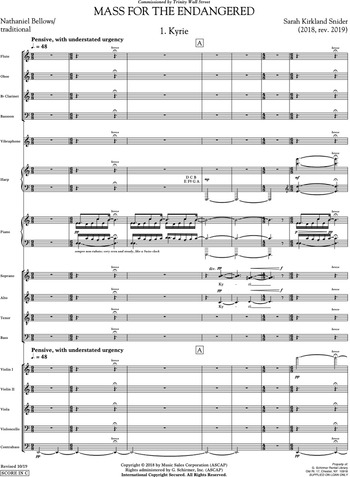
Dark ecology recognizes the spectral nature of withdrawnness: things are both “real” (there) and “unreal” (not-there) simultaneously. Mass for the Endangered begins with a low D played by the contrabass. The note hums along almost inaudibly, like ambient noise in the background. The three-note motive in the piano ostinato, which evokes the intonation of a question, is likely the first thing that the listener notices (see Example 1).Footnote 61 Like a specter, the low D haunts the more immediately perceptible parts. Occasionally, those parts stop, and its presence enters the foreground. Movement and stillness, background and foreground, flip into one another.Footnote 62 The phrase Kyrie eleison comes in fragments—it is sung completely just once during the beginning of the movement in an agitated and anxious manner (0:36–0:56).Footnote 63 The score indicates that the piano ostinato should be played “sempre non-rubato; very even and steady, like a Swiss clock.”Footnote 64 Syncopation and asymmetrical phrases, however, mean everything sounds as if it is continually getting stuck and restarting. Timbrally, rhythmically, and motivically, the beginning of Snider’s Mass feels constrained. Hesitancy and uncertainty characterize the first minute of the work.
Sarah Kirkland Snider, Mass for the Endangered, the first page of the full score.
Credit statement: MASS FOR THE ENDANGERED, Music by Sarah Kirkland Snider, Text by Nathaniel Bellows, Copyright © 2018 by G. Schirmer, Inc., International Copyright Secured. All Rights Reserved. Used by permission.

Example 1 Long description
Panel A: The musical score for Mass for the Endangered by Sarah Kirkland Snider. The score includes various instruments such as flute, oboe, B flat clarinet, bassoon, vibraphone, harp, piano, soprano, alto, tenor, bass, violin I, violin II, viola, violoncello, and contrabass. The score is marked with the tempo of adagio at 48 beats per minute and the dynamic marking of piano. The score is divided into sections for each instrument, with notes and rests indicated. The text above the score reads Pensive, with understated urgency. The score is commissioned by Trinity Wall Street and is a traditional mass with text by Nathaniel Bellows.
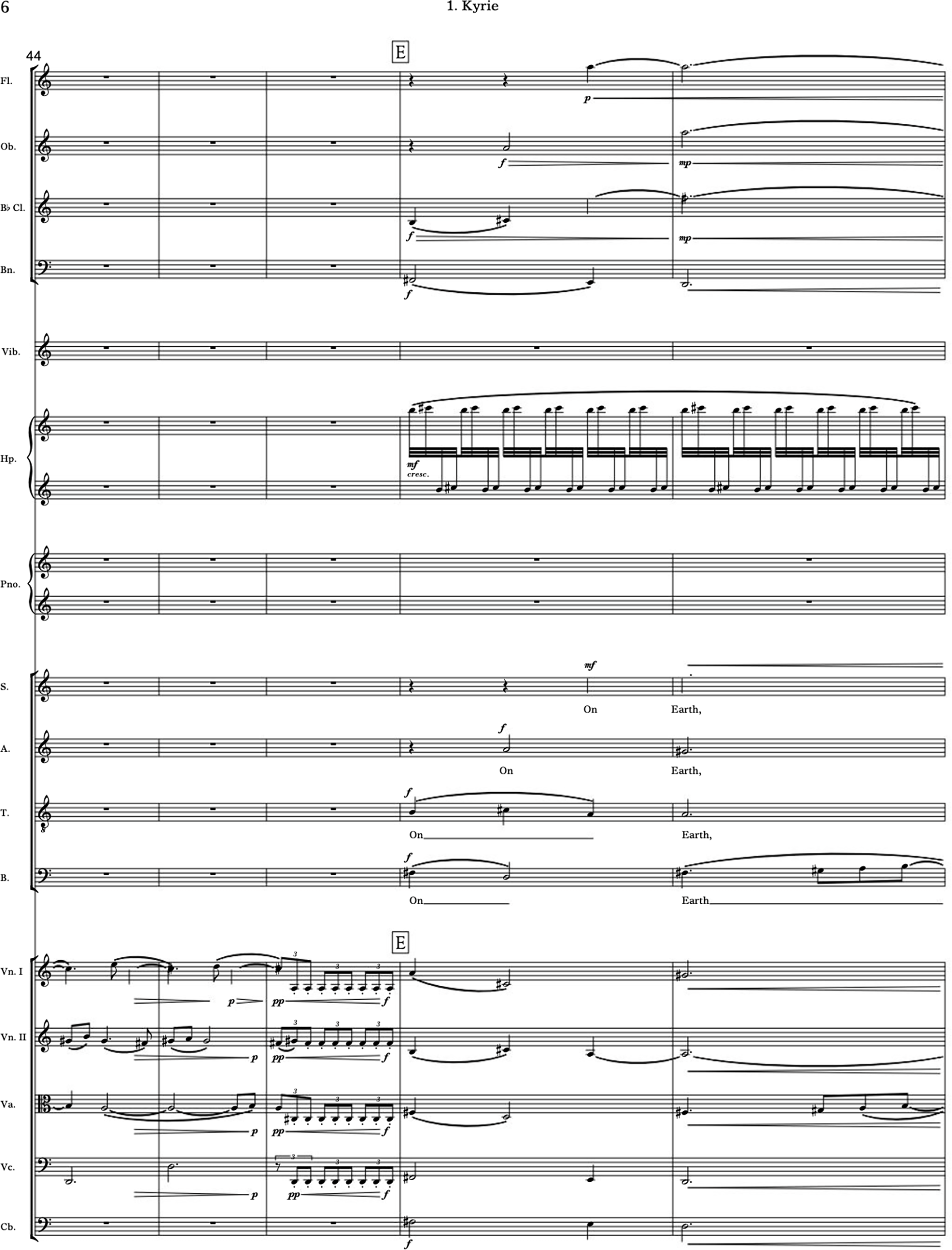
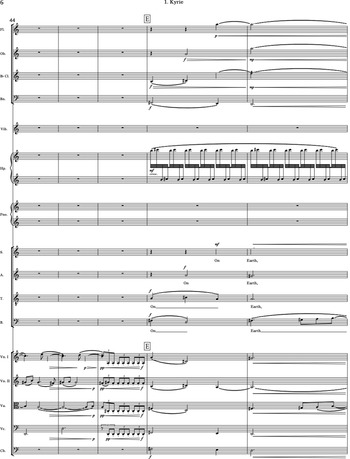
With the string quartet that takes over at 1:39, the timbral range of the Mass suddenly expands, and with this expansion comes an impression that the music has opened up.Footnote 65 The harmonic rhythm accelerates in an uninterrupted stream of four-part polyphonic writing, and with the addition of a new triplet figure, this passage quickly expands the variety of both harmonic and rhythmic material. Then, unexpectedly, all four vocal parts enter together in dramatic fashion (2:03)—the music opens up completely (see Example 2). It is here that the first English stanza by Bellows begins: “On earth, air, and water/Have mercy/On stone, tree, and flower/Have mercy, world have mercy.” The text here gestures toward the classical elements supposed to constitute Nature, toward the objects that it contains. This appeal to the world is the final stage in a long process of zooming out. The path to the first stanza, its preparation, and its own musical handling reflect the phenomenology of dark ecology. The beginning of Snider’s Mass is first ominous, then strangely comforting, and finally solemn. In the span of two minutes, the first movement moves from anthropocentrism to ecocentrism, from the narrow vision of a human plea for mercy to a perspective that seems to make that plea obsolete. The effect feels like the kind of ecological awareness Morton attributes to the ecological thought—a feeling of opening with a touch of melancholy.
Sarah Kirkland Snider, Mass for the Endangered, the sudden entrance of all four vocal parts at 2:03 (reh. E).
Credit statement: MASS FOR THE ENDANGERED, Music by Sarah Kirkland Snider, Text by Nathaniel Bellows, Copyright © 2018 by G. Schirmer, Inc., International Copyright Secured. All Rights Reserved. Used by permission.
Generally speaking, object-oriented interpretive analysis seeks to uncover the individual reality of the work or object in question—what makes something that particular thing. Because OOO denies any form of direct access to the reality of things, when it comes to getting a hold of that reality, indirect discourse provides the best way forward.Footnote 66 Beyond the sort of indirect approach taken above regarding the existence of the ecological thought in the Mass, what else might dark-ecological listening entail?
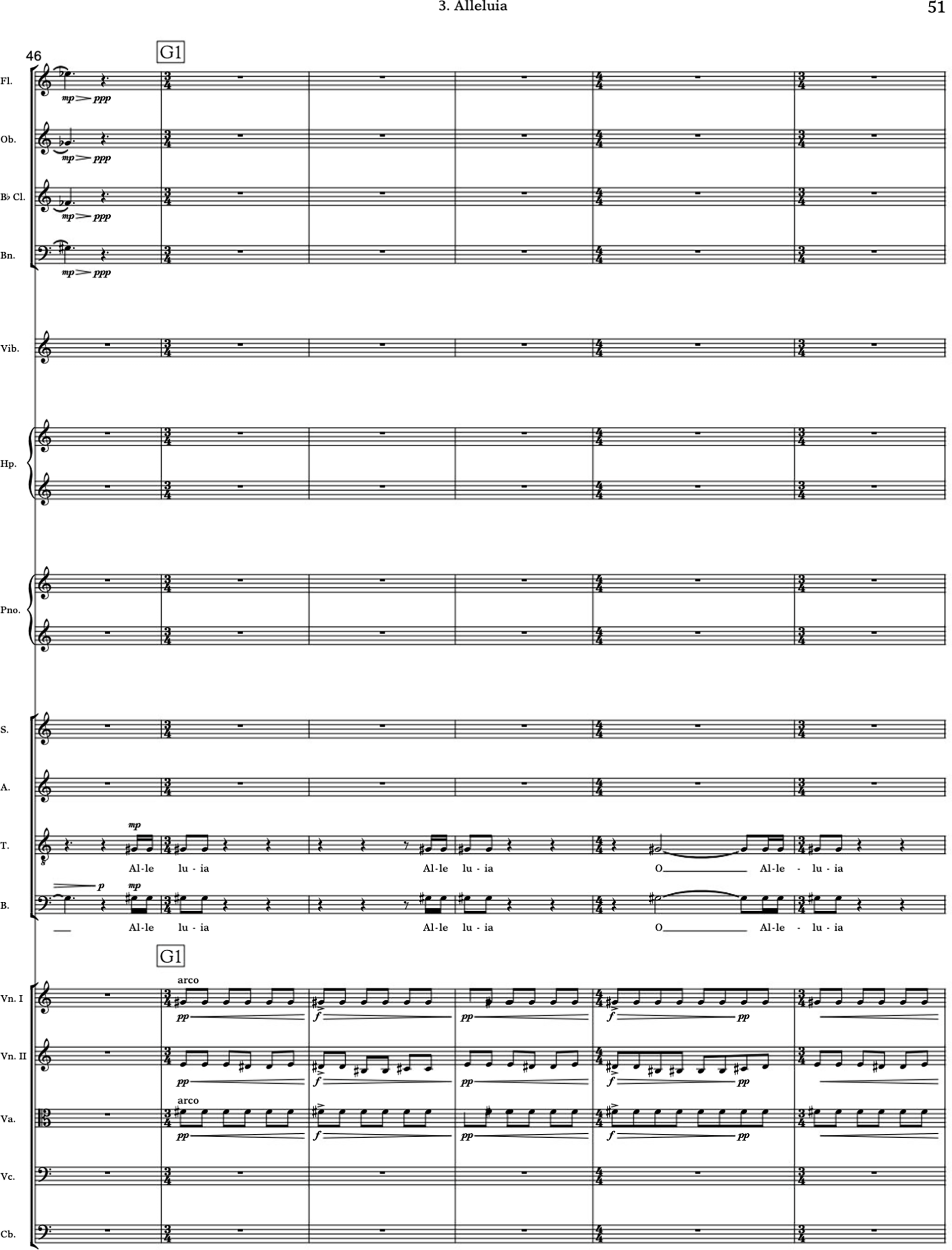
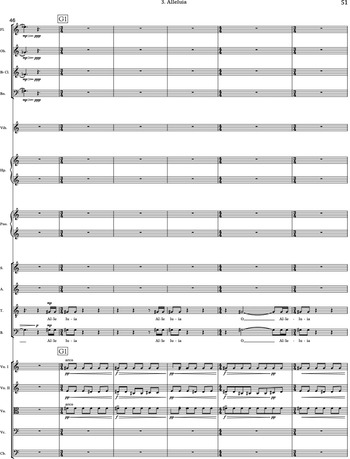
Object-oriented criticism of any kind favors countermethods, counterfactuals, and what Harman calls “countercompositionals.”Footnote 67 Counterfactuals help one appreciate the reality of a thing by imagining that thing inhabiting other situations or having other effects than it currently has or may reasonably be expected to have. Harman writes: “Counterfactuals do indirect labor by alluding to the elusive reality of the object apart from its relations.”Footnote 68 One might draw attention to the modest impact Mass for the Endangered has made on contemporary classical music or contemporary environmental discourse by imagining it as the most successful concert work composed since the turn of the century. Alternatively, countercompositionals can help one appreciate the reality of a thing by imagining that thing composed of different elements.Footnote 69 For example, the passage in which the voices sing “alleluia” for the first time (1:48 in the Alelluia) is effectively ruined by changing E♮ to E♯—its unsettling and nervous character is replaced by something more tranquil, reminiscent of a refrain in popular music, especially when heard against the gloomy passages that precede it (see Example 3).Footnote 70 Snider remarked: “There are certain things that I do in the Mass […] that you don’t really hear in any other contemporary choral music and those are the things that are coming from pop music.”Footnote 71 To my ear, hearing this proposed countercompositional draws attention to the influence of popular music in the passage.Footnote 72 This E♯ version could fit easily into the chorus of a twenty-first-century pop, indie, or alternative rock song. Moreover, this countercompositional draws attention to the fact that the effect of the passage seems to hinge on a single note, which in turn draws attention to its fragility. Fragile is an apt label for a passage that works to inspire the sense of awe one might experience reflecting on the dramatic impact of anthropogenic effects on the planet.
Sarah Kirkland Snider, Mass for the Endangered, Alleluia, countercompositional features E♯ instead of E natural (Vn. II).
Credit statement: MASS FOR THE ENDANGERED, Music by Sarah Kirkland Snider, Text by Nathaniel Bellows, Copyright © 2018 by G. Schirmer, Inc., International Copyright Secured. All Rights Reserved. Used by permission.
If one only ever discusses what music does, then one inevitably excludes what it might be able to do, which is more interesting from an object-oriented perspective. Indirect discourse and countermethods play a central role in object-oriented interpretive analysis. The examples above mainly serve to guide the reader’s understanding of the ensuing vignettes. I do not adhere strictly to countermethods in my commentary, but I support my claim that the ecological thought belongs to the Mass by describing how the work stylizes that object, which constitutes an indirect approach. If Snider’s Mass causes concern for nonhuman things, speculation about the status of Nature in the twenty-first century, or anxiety about the future of the planet, it is because its beholder is engaged in living the reality of those topics in some non-literal fashion, reconciling dark ecological qualities to the ecological thought. Dark-ecological listening involves identifying those surprising moments of a work that ask one to enact some new or other reality. It involves speculation about the reality of a work, which ultimately directs one’s attention to the future.
Dark-depressing
At the end of Dark Ecology, Morton discusses several different layers (zones) of ecological awareness.Footnote 73 The names of the three zones are initially misleading. They encompass the experience of more than just the adjectives attached to them. The first zone, “dark-depressing,” is host to several related qualities: abjection, anxiety, guilt, shame, melancholy, and horror, to name a few. In the adjectival sense, “depressing” may be understood as a placeholder for these and other like qualities. (As a passing observation, in true OOO fashion, while each of the three zones may be characterized by its own collection of affective experiences, they remain irreducible to any such collection.) Ecological awareness is dark-depressing because it moves one further down into (one of) the two other zones. “Depression is the inner footprint of coexistence,” Morton evocatively writes, “a highly sensitive attunement to other beings, a feeling of being sensitized to a plenitude of things. De-pressed by them.”Footnote 74 Morton verbifies the feeling of depression, of being depressed, by referring to the origins of that feeling, the causal effects of some other object or, in this case, a profusion of objects.Footnote 75
To clarify what Morton means by depressing within the context of dark ecology, it is useful to differentiate between something that is depressive and something that is depressing. Something depressive elicits a feeling of despondency or hopelessness in its beholder. Morton uses the term depressing, however, to refer to something overwhelming or overpowering (the prefix de- meaning down), as in “being de-pressed by the overwhelming presence of processes and entities that one can’t shake off.”Footnote 76 The ecological message of Mass for the Endangered is plainly depressive: nonhuman things are suffering due to the impact of anthropogenic effects on the planet, and it may be too late to do anything besides pay homage to them before they are gone. Descriptions of the work and its theme, the content of its libretto, even the title itself—all these things indicate that the work is, generally speaking, a depressive work.Footnote 77 It is depressing, though, insofar as it successfully draws its listener into greater intimacy with the reality of those environmental issues.
A major symptom of this kind of depression is that, according to Morton, “your time window collapses to a diameter of a few minutes into the past and a few minutes into the future.”Footnote 78 Even more dramatic would be when that time window collapses to a diameter of just a few seconds. As OOO understands time as something that objects emit, from an interpretive standpoint, there are a couple of options. The feeling of being depressed may be attributed to passages that are timbrally, texturally, or motivically dense, especially in relation to surrounding passages. Dense passages like these overwhelm the listener to the point where they are likely to give up trying to parse out all the distinct parts (as sometimes happens when listening to an especially complex fugue). Accordingly, these passages create the sense that linear time is progressing quickly. Meanwhile, the opposite case would lead the listener to experience time as coming to a standstill. In both cases, the “time window” collapses for the listener. One either attempts to make sense of a profusion of objects and feels depressed, or one lingers in anxiety about what might happen next.Footnote 79 Here I focus on one section in the first movement, the first section in the Mass that I propose is dark-depressing.Footnote 80
Before, I suggested that the A section of the Kyrie constitutes a feeling of opening, as distinct from the impression or understanding that one is “in” an opening section, which does not necessarily entail that same feeling. Here, I propose that the B section is the focal point of the movement—not for structural reasons, but because it is there that, for the first time, the Mass obliges one to genuinely care about its topic. The B section contains more than two-thirds of the text of the entire movement, and its musical handling of that text is what makes it dark-depressing. Listeners either strive to make sense of the text and, in failing to do so, become overwhelmed, or they do not, in which case the effect of the entire section is reduced to something more banal (merely developmental or contrasting).
While notions of progress, development, or achievement may align with the ecological message of the Mass, the Kyrie revolves around a plea for forgiveness and mercy for what has already been done. Dark-ecological listening offers an interpretation of the B section that approaches how it summons the listener to appreciate the gravity of that plea, which is the central focus of the movement, as well as the Mass as a whole. The B section increases the intensity of the plea, ironically, by obscuring it. Snider remarks in her interview with Bunce that “it would be instructive and helpful for conductors to spend focused time with Nathaniel’s text, since the setting of the text determined every musical decision.”Footnote 81 Through its musical handling of the text, the B section works to overwhelm or de-press the listener; in other words, to make the listener care (more) about the message that the text conveys. A dark-ecological listening of the Kyrie subverts structural listening.
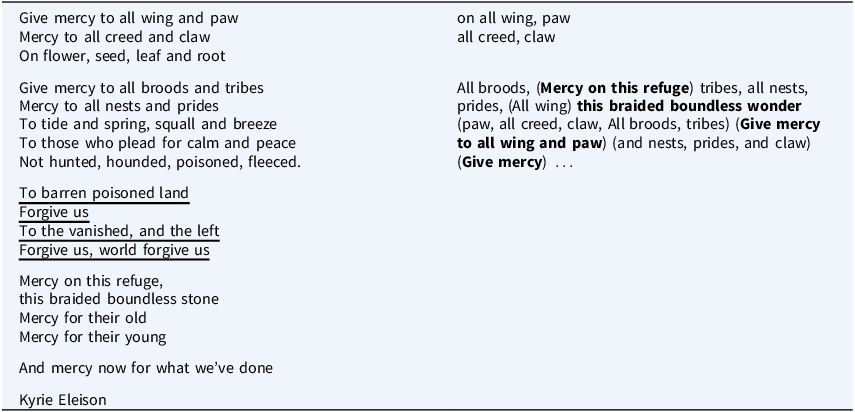
The conventionally designated B section of the first movement (2:54–4:29) begins with the second complete statement of “Kyrie eleison” (mm. 67–70, solo soprano part), which merges into the second English stanza, so that “Kyrie eleison” replaces “Give mercy.” To illustrate the prevalence of elision and text convergence throughout this section, I have placed the text as it appears in the libretto next to my own version of the text, which is meant to emulate how one is likely to perceive the musical handling of the text (2:54–3:35, mm. 71–89, see Table 1). Parentheses indicate text that occurs out of order (in relation to the text as it appears in the libretto) or is repeated. Bold text indicates where the text intersects with the text around it.Footnote 82 Snider uses the underlined text for the last section of the movement. The table is meant to draw attention to the difficulty of following all the text in this section. Having the libretto at hand only serves to make the experience of following along more difficult.
Nathaniel Bellows’s text (incomplete) as published in the score (left) versus how it is set musically (right)
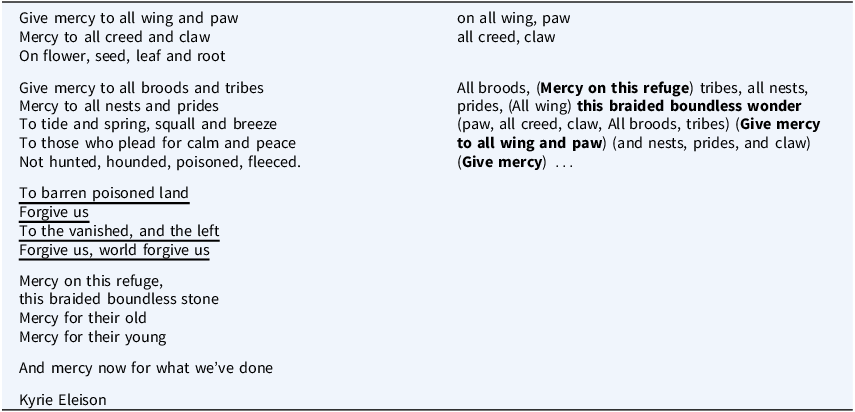
The text in bold receives melodic treatment while the rest of the text gradually accepts a role as accompaniment for each new melodic phrase. Somewhere between 3:35 and 3:40, just as the soprano line ascends on the words “boundless wonder,” is where I suspect one is likely to hear the staggered text in the lower voices fully integrated as accompaniment to the melodic phrases above it. Just as this happens, though, the treatment of the text as accompaniment ends and all vocal parts are temporarily present in a passage that features six-part polyphony (mm. 90–95). The last intelligible phrase is “give mercy.” From 3:38 on, the words become unintelligible due to the rhythmic independence of all the parts. It might be illustrated how all the parts coalesce in a single timbral stream for the listener, which reaches its breaking point with the high B in the top soprano line. Abruptly, at 3:52 (m. 96, reh. H), the alto voices begin singing a jaunty tune on the words “Not hunted, hounded, poisoned, fleeced” while the other voices repeat the word “not” in syncopated rhythm. To my ear, this short passage suggests the sort of mocking tunes children might “sing” while playing together. Whereas a more conventional structural analysis would be inclined to suggest that this mocking tune interrupts a would-be climax, a dark-ecological listening makes it clear that by this point, the climactic moment has already passed. At 3:52, the music comes to a halt only if the listener is already somehow engaged in enacting the urgency of the environmental concern to which the entire section alludes. In this way, the mocking tune is not “about” the denial of cadential closure but is “about” the listener. The final line, “And mercy now for what we’ve done,” which receives no musical treatment that is particularly noteworthy, stands out more than any other part of the text—and there is the listener, caring.
Dark-uncanny
Ecological awareness, Morton suggests, involves an “awareness of specters.”Footnote 83 Given that the Mass behaves like a requiem, this description deserves some attention. Dark ecology understands ecological beings as objects that “provide insights into the weird way in which entities are riven from within between what they are and how they appear.”Footnote 84 In other words, ecological beings are objects in the OOO sense: entities that withdraw from all relation, even their relation to their own appearances. Morton creatively evokes the withdrawnness of objects by referring to objects as specters or spectral, terms intended to evoke a collection of ghostly features and, as a result, double the strangeness of objects.Footnote 85 Objects are spectral because the more we think them, “the more we discover that such beings are not solidly ‘real’ nor completely ‘unreal’” but always withdraw from our capacity to think them.Footnote 86 Profound ambiguity, a sense of knowing and not knowing simultaneously, and uncertainty—these things reflect the second zone of dark ecology, where things become darkly uncanny.
The composer’s description of the Mass as “a requiem for the not-yet-gone” may be read two different ways. The “not-yet-gone” are, presumably, nonhuman entities or ecological beings (ambiguity emerges when “ecological beings” encompasses humans, too). The phrase indicates that the nonhumans in the Mass may either be “not-yet-gone” in the sense that they are still with us, or “not-yet-gone” in the sense that any hope for them is a lost cause. The Credo highlights this ambiguity.
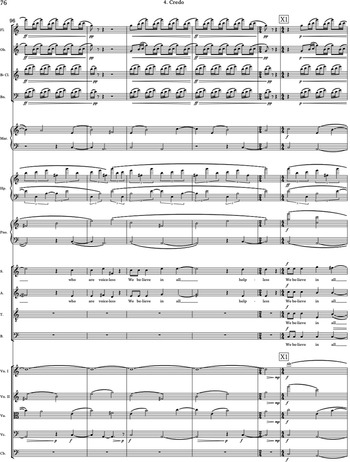
The Credo is built on a five-note ground (g2 b1 c2 e2 f♯1) adapted from Caroline Shaw’s song, Cant voi l’aube (2016). Snider remarks that she “loved the idea of honoring [the parody mass tradition] in a twenty-first-century twist, with one female composer borrowing material from another contemporaneous female composer’s chanson.”Footnote 87 The phrase “We believe in all,” repeated throughout the movement, is also based on a five-note rhythmic motive (m. 19, reh. O1). The Credo emphasizes the redemption of the “not-yet-gone.” Faith in the present and hope for the future are combined throughout. The voices celebrate both sentiments simultaneously at 2:53 (mm. 95–109, reh. W1). Perfect intervals, evocative of plainchant, permeate the texture (see Example 4). In the four woodwinds, hairpin dynamics give a sense of shape and breath to the dynamically static voices, which can only declare their grief-stricken faith plangently. When asked if she borrowed any plainchant for the Mass, Snider replied: “No, but I went for that a couple times. I went for the plainchant vibe [in the Credo].”Footnote 88 Starting at 6:11 (mm. 193–197) the voices sing “We believe in all who are stalwart/We believe in all who are fearless” and the Latin Exspecto vitam venturi sæculi (translated to English in the libretto as “And I await the life of the world to come”) at the same time. The former retains the basic five-note shape of the repeated phrase while the latter evokes the ascending stepwise motion of a plainchant melody. The Credo is a vehicle for a message of faith in Nature while recognizing that Nature is difficult to pin down. Nature, like the ecological thought, is futural, always to come.
Sarah Kirkland Snider, Mass for the Endangered, Credo, where perfect intervals permeate the texture.
Credit statement: MASS FOR THE ENDANGERED, Music by Sarah Kirkland Snider, Text by Nathaniel Bellows, Copyright © 2018 by G. Schirmer, Inc., International Copyright Secured. All Rights Reserved. Used by permission.
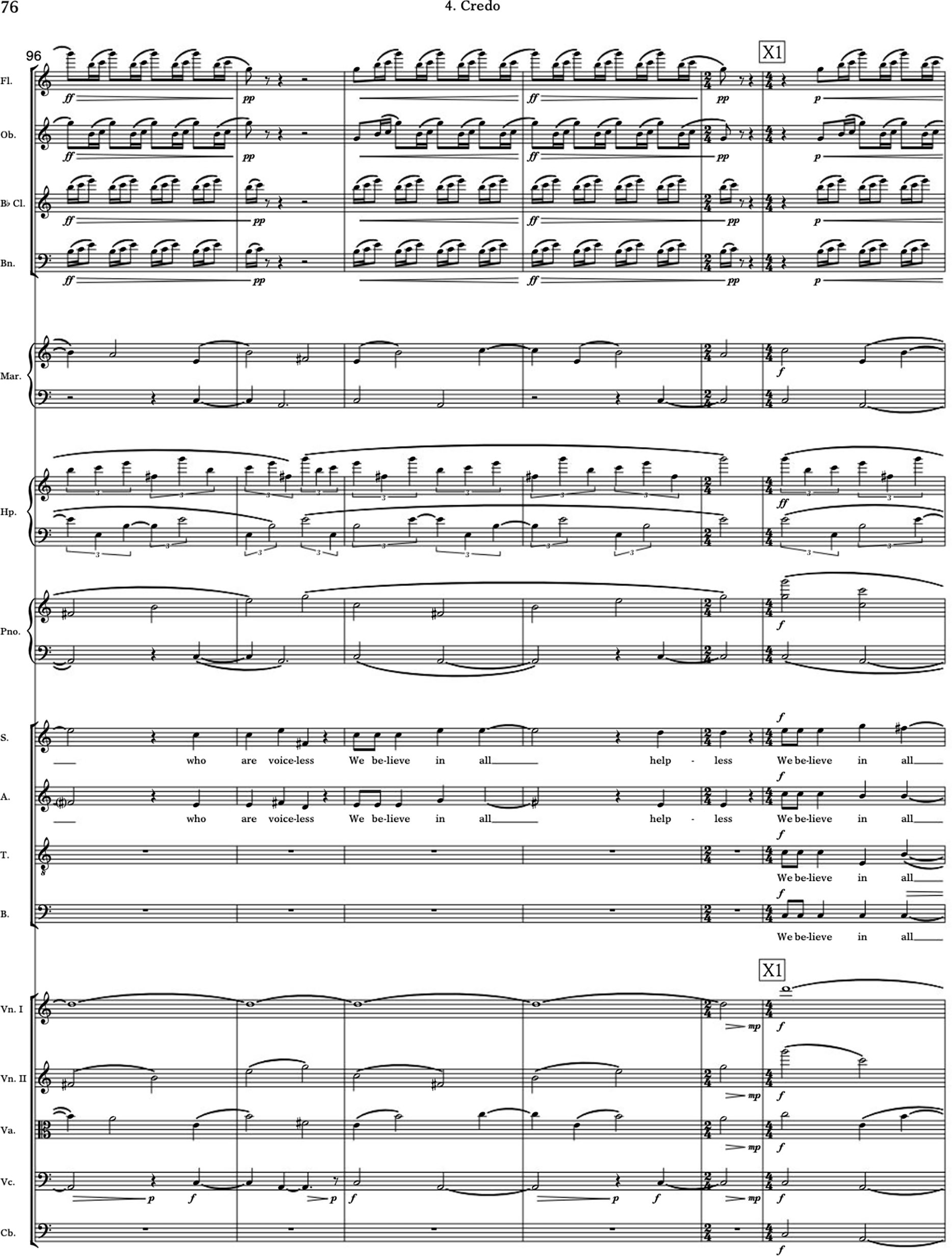
Example 4 Long description
Panel A: The musical score features various instruments and vocal parts. The instruments include flute, oboe, B-flat clarinet, bassoon, horn, harp, piano, and strings (violin I, violin II, viola, cello, and double bass). The vocal parts are labeled S, A, T, and B. The score is divided into measures and includes dynamic markings such as pp and p. The text We believe in all is repeated throughout the score. Panel B: The score continues with the same instruments and vocal parts. The measures are numbered, and there are indications for tempo and dynamics. The text We believe in all is prominently featured.
As ecological criticism, dark ecology resists the view that one special kind of entity is the root of all others, the view that all things are x, but some things are more x than others.Footnote 89 With respect to Mass for the Endangered, two obvious substitutes for x here include God or Nature. Rather than proposing a false oneness with either Nature or Nature-as-God, though, the Mass sustains a key feature of dark ecology: acknowledging gaps is actually “a paradoxical way of having greater fidelity to things.”Footnote 90 The Mass maintains a critical perspective on one of the central positions it adopts: namely, that there is a gap between humans and nonhumans. While the libretto of the Mass apparently maintains a taxonomic distinction between human and nonhuman, its musical handling makes the boundary between those two categories difficult to detect. Often, the voice in the Mass may be heard as either human or nonhuman in origin. From an interpretive standpoint, its source is ambiguous. Until the end of the Kyrie, when the chorus sings “for what we’ve done,” listeners may hear nonhumans as the source of the plea for mercy. With that last line of the text, the listener must recognize their complicity—they can no longer deny their own voice.
“Voice” itself is made ambiguous through interactions between the choir and instrumental ensemble. Starting at 1:27 (measure 48, reh. R1) in the Credo, immediately after the words “Mercy, now, on all animalia,” the expansive range of the woodwinds and harp is reduced to the interval of a fourth and three pitches (B♮, D♯, and E♮). Two syncopated E major chords, played by the string quartet and contrabassoon, signal both the end of the first large section and the beginning of the next, and disrupt an otherwise more intimate mood. The score instructs the subsequent stanza, beginning with the words “Take no tooth or tusk, steal no heart, hair, or husk,” to be sung “with a sardonic jaunt.” Hearing the sardonic jaunt of the voices lends something to the preceding chords. The voices, as if taunting the forcefulness of the chords, avoid the conclusive-sounding E♮, and primarily alternate between G♯ and B♮. The chords take on the character of a protest, then, especially as they flank the Latin phrase et vitam venturi saeculi in measures 69–72. The “Amen” that is supposed to follow this phrase, according to the traditional presentation of the text, is absent. The chords do not merely interrupt but lend a crucial air of defiance to the text, which in turn lends the rhythmic jabs a more aggressive, competitive character. The “voice” of the Mass can be found in the instrumental parts, too.
The Credo complicates the pronoun “we.” Bellows’s text substitutes the traditional singular “I” (in Credo in unum Deum) with the plural “we.” Without repetition, there would be no such thing as uncanniness. The repetition of the phrase “We believe” throughout the Credo becomes a mantra and, like a mantra, gives way to uncertainty about the meaning of the phrase—about who “we” are. Morton notes that pronouns are complicated by the ecological thought: “how many beings does we gather together and are they all human?”Footnote 91 The Credo abandons the singular focus of the Latin text for an ecological perspective that underscores the uncanniness of life forms.
Nature evades reduction. Morton finds that wherever we look for Nature, we encounter “a long metonymic string.”Footnote 92 The text of the Credo alludes to nonhumans, “all who” are constituents of Nature. These nonhumans are questions, or specters—objects in the two worlds that the Mass envisions: the present one, and an imagined, more hopeful world to come. Listeners detect them only by way of the abject qualities attributed to them: they are “offset,” “outcast,” “voiceless,” and “stranded.” Each iteration of the Credo’s mantra, which always returns as the five-note rhythmic pattern, preserves hope for them and amplifies their depressive quality of life. The “dark side” of the ecological thought is embodied in an assertion of “the contingent and necessarily queer idea that we want to stay with a dying world.”Footnote 93 Each repetition of the mantra compels one to reflect once more on the two distinct worlds and their inhabitants.
Especially captivating moments in the Mass are those where the text either bonds with surprising musical qualities or the musical qualities already present with the text are severed from it. The only Latin retained for the Credo is the last line in the traditional text: Et expecto resurrectionem mortuorum, et vitam venturi saeculi. Traditionally, this line follows acceptance of baptism for the remission of sins. Snider’s Credo disposes of sin, however, and replaces it with blind faith. The Credo offers what Morton calls “abjection without cleansing, a melancholia without mourning,” a place to recognize the depth of ecological awareness.Footnote 94
Alongside its unwavering faith in nonhumans, the Credo awaits “the life of the world to come.” “Life” here evidently refers to future nonhumans. The phrase also grants strength and endurance to “all who,” despite their current abject status, may at some future point in time prosper (again). Without indicating any specific nonhuman things, the features of the anticipated “world to come” fuse with “life,” that is, in both cases, unknowable. The phrase “life of the world” may evoke a sense of place, too, in its original sense, as a meeting place, perhaps for both humans and nonhumans alike. By eliciting a feeling about nonhumans and the feeling of a potential future, standard impressions of nonhumans or Nature as distinguishable things-over-there quickly dissolve. “The ecological thought sneaks up on you from the future,” Morton reminds us, “a picture of what will have had to be there, already, for ‘ecology without nature’ to make sense.”Footnote 95
Finally, Morton points out that to truly love nature would be to love what is non-identical with us.Footnote 96 The Credo lingers in sadness over what is non-identical to humans. The opening verses describe strange, otherworldly entities. They are “the lesser and the left”; they feature “the blessing of wing, angelic, ingenious” along with “the holy pelt and fin, hoary hide and shell.” The Credo’s message of faith is simultaneously a declaration of love for these beings whose source is “the spirit housed in the opposite” (first stanza). Morton suggests that dark-ecological love is “excessive, exuberant, and riskier than a bland extension of humanitarianism to the environment.”Footnote 97 It acknowledges the irreducibility, the deep and sometimes troubling strangeness of the beloved. It is a love for the “mute, objectified quality of the object, its radical nonidentity.”Footnote 98
The Credo adopts a stance toward Nature that is essentially questioning: what could, or will, Nature be? The mantra (“We believe…”) implies a kind of spiritual faith in the future existence of nonhumans (what Nature will be), but encapsulating this faith is the work’s general insistence that humans are responsible for that future (what Nature could be). Indeed, Morton argues that place itself is “always caught up in a certain question, assuming the form of a questioning, or questioning attitude.”Footnote 99 Nature, environment, nonhumans, place—the Credo brings the reality of these familiar things into question. It is the listener’s adoption of a questioning attitude toward those things that situates them within the second zone of dark ecology.
Dark-sweet
Listening to Mass for the Endangered in its entirety, one discovers that it is actually a loop, or perhaps a Möbius strip.Footnote 100 The last movement, the Agnus Dei, begins and ends just like the first movement, the Kyrie. The first two minutes of the Agnus Dei echo the first two minutes of the Kyrie in both form and content. Where there was the unexpected entrance of the string quartet in the Kyrie, in the Agnus Dei, the first verse of the English text begins: “Lamb of God,/of longing, loss,/have mercy on us” (compare 1:25–1:42 in the Kyrie to 1:33–1:55 in the Agnus Dei). If the listener anticipates the arrival of the string quartet again near the 1:50 mark, then its absence is unexpected. Either way, the Agnus Dei diverges from the Kyrie at that moment. The change effectively ruins the feeling of opening previously discussed and attributed to the Kyrie. Whereas the Kyrie sets the work in motion, the Agnus Dei twists the entire work back in on itself.
Both movements begin with a single sustained pitch, both feature the same piano ostinato (transposed up a whole step for the last movement), and both feature the same build-up with harp and vibraphone (compare 0:30–0:57 in the Kyrie to 0:48–1:10 in the Agnus Dei). The build-up in the Agnus Dei highlights the phrase “qui tollis peccata mundi” (“you take away the sins of the world”) and infuses it with optimism. In the Gloria, that phrase took on an ominous tone during a transitional passage (2:53–3:11, mm. 84–90). There, it is also the first phrase sung by the lower voices as the movement journeys into darker territory (Gloria, 3:20). In the Agnus Dei, its importance is greatly diminished by its singular appearance in that passage. Throughout the final movement, familiar material adopts more poignant, bittersweet qualities, even if only because one recognizes that it now belongs to the end of the work.
In Dark Ecology, Morton tries “to get to the third darkness, the sweet one, through the second darkness, the uncanny one.”Footnote 101 To characterize the last movement as uncanny is fairly straightforward: things sound familiar—timbrally, dynamically, rhythmically, motivically—and unfamiliar simultaneously. A soprano sings “Agnus Dei” while material from the Kyrie lends the voice a strange, otherworldly presence (0:05–0:38). The reversal of vowel sounds (e-i rather than i-e) may also add to the effect. At the end of the movement, the flute, clarinet, and second violins play an ascending figure that recalls the one heard in the Credo (compare 5:38 in the Credo to 8:26 in the Agnus Dei). The repeated sixteenth notes played by the winds starting at 2:26 (reh. H3, “Slightly dreamy”) recall the repeated eighth notes played by the strings in the Alleluia; the rising figure in the soprano voices at 3:08 recalls the beginning of the Sanctus (0:10–0:17), and the solo declaration of “Lamb of/God—give wonder, wish/give kindness back” that serves as a transition to the final section of the movement starting at 6:22 is comparable to the final transitional passage in the Alleluia from 2:48–3:08 where a single soprano voice declares “She who is sleeping,/Is she who will awake.” Morton describes that “third darkness” as a particular kind of longing—a bittersweet longing that is passionate, joyful, which blurs the boundary between longing and sadness. Dark-ecological sweetness is a “spiritual” version of ecological awareness where irony and sincerity intertwine.Footnote 102 The realization that one is caught in a loop and simultaneously involved in its creation is analogous to what dark ecology calls dark-sweetness.Footnote 103
The phrase “Agnus Dei” frames the final movement: it is sung at the beginning (until 1:51) and at the end (7:58 onwards). Regarding its use in the movement, Snider mentions: “Nathaniel and I […] decided that ‘Lamb of God’, or ‘Agnus Dei’, would represent an actual lamb—a representative of all vulnerable, powerless nonhuman life forms on Earth.”Footnote 104 The full Latin phrase “Agnus Dei, qui tollis peccata mundi” then suggests that it is Nature or nonhuman life who “takes away the sins of the world”—an environmentalist revenge fantasy in which Nature reclaims its dominion over all things. But because the Mass complicates the boundary between humans and nonhumans and therefore what actually constitutes Nature, a more apt interpretation is that it is coexistence with all forms of life that “takes away the sins of the world”—a hopeful solution rather than a veiled threat. With that in mind, a listener could hear the repetition of the phrase at the end of the movement, like “We” in the Credo, as a mantra that lends the phrase a layer of ambiguity. Its repetition signals not one particular “Lamb of God” but many different “lambs of god.” The phrase alludes to the innocence of all fragile life forms. Its recognition as such is joyous, sad, and hopeful.
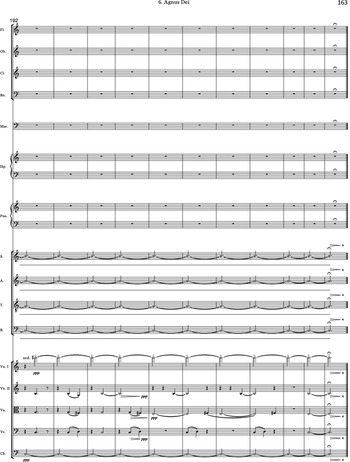
At 4:33 (measure 95), there is a dramatic pause. Snider comments on the choral passage that immediately follows: “I wanted this particular moment of the music to celebrate and exalt the lamb—again, standing in for all of the Earth’s biodiversity—before the music gradually shifts into the more questioning, bittersweet, uncertain terrain in which the movement ends.”Footnote 105 The start of the coda (from 7:56 or measure 162 on) signals the completion of that gradual shift. The score instructs the choir to chant “Agnus Dei” ecstatically, majestically. As if shepherding it ahead, the solo soprano voice continually sings one beat ahead of the chant. Because the beginning of the Agnus Dei mirrors the beginning of the Kyrie, it encourages listeners to hear the phrase “Agnus Dei” in the same vein as the phrase “Kyrie Eleison,” that is, as a solemn appeal. But the last movement achieves more than uncanniness by mirroring the first; it descends further to bittersweetness. The movement concludes with a long fade-out, which one might hear as symbolic of the gradual disappearance of endangered species (see Example 5).
Sarah Kirkland Snider, Mass for the Endangered, the final measures.
Credit statement: MASS FOR THE ENDANGERED, Music by Sarah Kirkland Snider, Text by Nathaniel Bellows, Copyright © 2018 by G. Schirmer, Inc., International Copyright Secured. All Rights Reserved. Used by permission.
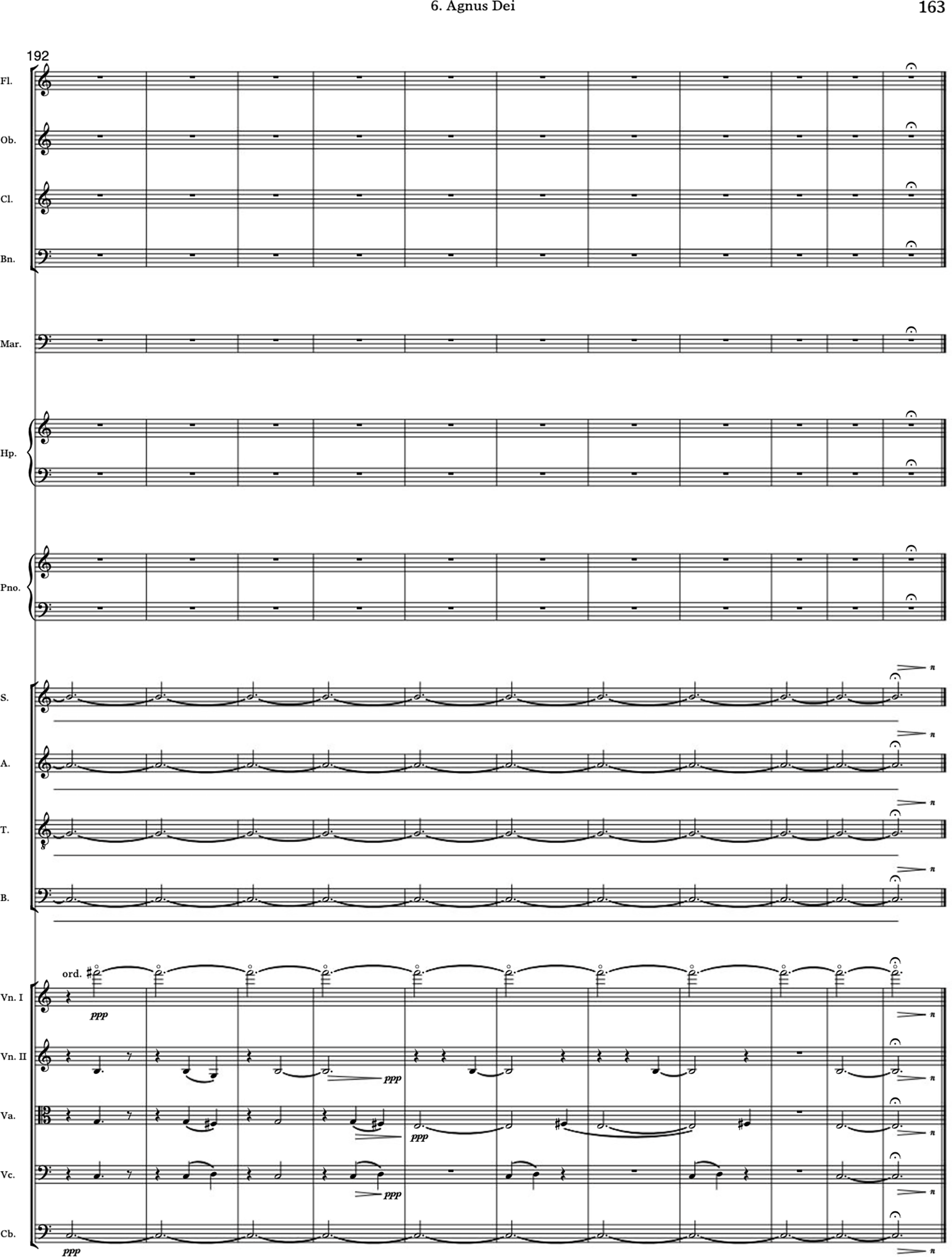
Like the Kyrie, the Agnus Dei also concludes with a tritone. Snider comments: “It was important to me that the music not feel like it was wrapped up with a bow, with a sense of finality at the significant endpoints, but rather with a sense of questioning, as the music is about a dire situation on our planet that currently remains very much unresolved.”Footnote 106 The long fade-out that ends the work inspires reflection on the work as a whole. One may wonder about the status of the endangered things that it mourns. Was it really a “requiem for the not-yet-gone”? Is there hope? The longing that follows the questioning feeling is analogous to the bittersweetness of dark ecology: a state of wonder whose source is longing, or attunement to an object that recedes the more one tries to grasp it. Dark-sweetness is the feeling that one is stuck in a loop that endlessly traverses sadness, longing, and joy. Morton describes the ecological thought as “intrinsically dark, mysterious, and open, like […] an unresolved chord.”Footnote 107
“And mercy now for what we’ve done”
Even the brightest moments of Mass for the Endangered are tinged with guilt, shame, and irony (for example, the end of the Sanctus/Benedictus, where ecstatic praise abruptly turns timid). Dark ecology pervades the work to its core. Morton compares the form of dark ecology to film noir, wherein the narrator “begins investigating a supposedly external situation […] only to discover that she or he is implicated in it.”Footnote 108 I propose that this is analogous to a listener’s experience of the Mass. Passages throughout the work allude to external real-world ecological crises by severing components of their supposed reality (nature, environment, and nonhumans specifically) from their ordinary, expected qualities. The Mass puts the future in doubt because it puts ideas of nature, environment, and nonhumans in doubt. In short, the Mass de-literalizes its central topics. Listeners are not merely passive observers of this but find themselves implicated in it. Listeners imaginatively co-produce the environmental problems that the work addresses, executing their accompanying concern, fear, and anxiety. This is the ecological thought.Footnote 109
The two questions posed at the beginning of this article raise two separate and related questions: what is ecological awareness, and where does it originate? Morton’s work offers answers to both. Dark ecology describes ecological awareness in what may be the latest age of mass extinction, and from an object-oriented perspective, the ecological thought is its source. My work here demonstrates how Morton’s concepts can helpfully inform ecocritical approaches to individual musical works, especially those that handle topics and themes directly tied to contemporary environmental issues. Musical works can challenge listeners to reflect on how they personally relate to environmental issues, to (re-)examine their own ideas about nature, the environment, and nonhuman things. Snider’s Mass effectively demonstrates these points. From an object-oriented perspective, art can reveal to its beholder some previously undisclosed reality of the objects it aestheticizes. Non-literal (aesthetic) experience, exemplified by metaphor, is the foundation for discovering new and different ways of thinking about the reality of ecological crises. Morton puts this sentiment more straightforwardly: “Art forms have something to tell us about the environment, because they can make us question reality.”Footnote 110 Morton’s work, alongside OOO, provides the much-needed conceptual tools to discuss that fact.
Finally, as suggested, an object-oriented approach to interpretive musical analysis involves approaching musical works in a new light, as things that can harbor surprising perspectives on environmental topics through their non-literal handling of those topics. Approaching musical works this way involves starting from a position of radical openness, following the feeling of ecological awareness, of dark ecology. To that end, it may be more accurate to say that, rather than approaching musical works in a new light, object-oriented analysis in an ecocritical mode pursues objects down through whatever kind of darkness surrounds them. This pursuit “down” entails thinking about the hidden reality of objects, otherwise known as their future. For the object-oriented ecomusicologist, this involves being ecological in a very active sense—“acknowledging in a deep way the existence of beings that aren’t you, with whom you co-exist.”Footnote 111
Acknowledgments
I am extremely grateful to William Robin for his expert guidance. My sincerest thanks to the two anonymous reviewers and the editors for their careful attention to this article.
Nathaniel Harrell is a musicologist whose work focuses on music that is environmentally oriented, especially from the late twentieth and twenty-first centuries. His research explores how music directs listeners to engage with environmental topics, themes, and concerns. He completed a PhD in musicology at the University of Maryland in 2026.

 Open access

