


Introduction
Selection placed on weed populations by repeated POST herbicide applications contributes greatly to the occurrence of herbicide resistance (Culpepper et al. Reference Culpepper, Grey, Vencill, Kitchler, Webster, Brown, York, Davis and Hanna2006; Norsworthy et al. Reference Norsworthy, Ward, Shaw, Llewellyn, Nichols, Webster, Bradley, Frisvold, Powles, Burgos, Witt and Barrett2012). Early-season application of residual herbicides is often recommended as a means to mitigate selection for resistance to POST herbicides by reducing the number of weedy propagules that POST herbicides are required to control (Norsworthy et al. Reference Norsworthy, Ward, Shaw, Llewellyn, Nichols, Webster, Bradley, Frisvold, Powles, Burgos, Witt and Barrett2012). Longevity of residual herbicides may be influenced by time of application. Timing of residual herbicide applications (preplant vs. PRE) may directly affect the longevity of weed control and the amount of crop injury observed.
When making the decision whether to apply a herbicide preplant or PRE, one consideration is the ability or likelihood of the herbicide being activated. Activation is the movement of the herbicide through the soil profile to the location of germinating weed seeds by precipitation or irrigation (Knake et al. Reference Knake, Appleby and Furtick1967). Herbicides with high water solubility have the ability to be activated with lower amounts of water than herbicides that are less water soluble; however, herbicides that are highly water soluble may have a higher leaching or runoff potential if too much water is present (Fieser and Haddadin Reference Fieser and Haddadin1965). Activation of herbicides before crop emergence may also reduce the risk for crop injury caused by splashing of the herbicide onto emerging seedlings during the first activating rainfall (Yoshida et al. Reference Yoshida, Sakaki, Sato, Hada, Nagano and Oshio1991). Herbicides applied before planting increase the likelihood of herbicide activation; however, applying herbicides prior to planting may reduce longevity of weed control.
Many variables affect the longevity of weed control achieved by soil-residual herbicides. The fate of a herbicide is dependent on its physical and chemical properties as well as how it responds to biotic and abiotic factors (Cheng Reference Cheng and Cheng1990). A longer persisting herbicide allows for lengthier residual weed control; however, lengthened herbicide persistence increases the risk for negative environmental impacts (Thurman et al. Reference Thurman, Goolsby, Meyer and Kolpin1991). The rate of dissipation/degradation of a herbicide is dependent on many factors, such as the amount of precipitation/irrigation, temperature, light quantity/intensity, herbicide rate, soil properties (percent organic matter, clay content, cation exchange capacity, pH), soil moisture, microbial flora, and plant uptake (Koskinen and Harper Reference Koskinen, Harper and Cheng1990; Pierzynski Reference Pierzynski, Clapp, Larson and Dowdy1994; Wagenet and Rao Reference Wagenet, Rao and Cheng1990).
Persistence of the herbicide in the environment can also be affected by mobility of the compound, which is controlled by Kd (soil sorption), KOC (soil organic carbon sorption) (Wauchope et al. Reference Wauchope, Yeh, Linders, Kloskowski, Tanaka and Rubin2002), and vapor pressure of the compound (Hamaker and Kerlinger Reference Hamaker, Kerlinger and Gould1969). Loss potentials for herbicides vary greatly (Hamaker and Kerlinger Reference Hamaker, Kerlinger and Gould1969). Residual herbicide selection is often based on the amount of herbicide available for uptake as well as the estimated longevity and level of weed control. Another variable influencing residual herbicides is the sensitivity of the weed that is to be controlled. Protoporphyrinogen oxidase (PPO)–resistant Palmer amaranth poses a new problem for soybean producers. Palmer amaranth has evolved resistance to residual herbicides like fomesafen, a diphenylether herbicide (Salas et al. Reference Salas, Burgos, Tranel, Singh, Glasgow, Scott and Nichols2016), that have been commonly used in soybean over the past decade. Now that Palmer amaranth with resistance to multiple sites of action is common in midsouthern agricultural fields (Varanasi et al. Reference Varanasi, Brabham, Norsworthy, Nie, Young, Houston, Barber and Scott2018), a reevaluation of herbicide selection, timing, and efficacy is needed to establish the most effective programs in this region.
The objective of this research was to evaluate the impact of preplant vs. at-planting residual herbicides on soybean injury and longevity of Palmer amaranth control. The null hypothesis was that at-planting and preplant herbicides would provide similar lengths of Palmer amaranth control beyond planting.
Materials and Methods
Field experiments were conducted near Marianna (34.72°N, 90.74°W) (2017, 2018), Crawfordsville (35.22°N, 90.38°W) (2018), and Fayetteville (36.09°N, 94.17°W) (2017 and 2018), AR. Multiple site-years of data were needed to capture variability in timing, quantity of rainfall, and herbicide efficacy on different Palmer amaranth biotypes. The Palmer amaranth biotype at Crawfordsville had previously been characterized as resistant to PPO-inhibiting herbicides (Varanasi et al. Reference Varanasi, Brabham, Norsworthy, Nie, Young, Houston, Barber and Scott2018). At all locations, CDZ 5150 LL soybean (Bayer CropScience, Research Triangle Park, NC) was planted. The soil series in the production field near Crawfordsville, AR, was a Dundee silt loam (Fine-silty, mixed, active, thermic Typic Endoaqualfs) with 11% sand, 77% silt, 12% clay, 1.95% organic matter (OM), and a pH of 5.5. Trials at Fayetteville, AR, were conducted at the University of Arkansas Research and Extension Center, on a Leaf silt loam soil (Fine, mixed, active, thermic Typic Albaqualts) with 34% sand, 53% silt, 13% clay, 1.5% OM, and in 2017 and 2018, a pH of 6.8 and 6.2, respectively. Trials near Marianna, AR, were conducted at the Lon Mann Cotton Research Station on a Convent silt loam (Coarse-silty, mixed, superactive, thermic Fluvaquentic Endoaquepts) with 9% sand, 80% silt, 11% clay, 1.8% OM, and in 2017 and 2018, a pH of 6.8 and 6.5, respectively. The soil at all locations was prepared with a disk, hipper, and a field cultivator to smooth the raised rows before planting. Rainfall and irrigation events were recorded at each site. At all locations, a natural population of Palmer amaranth was the predominant weed present.
Soybean was planted at a rate of 346,000 seeds ha–1 in four-row plots measuring 7.6 m in length at all locations. Near Crawfordsville and Marianna, the row width was 96 cm, and in Fayetteville, rows were 91 cm wide. All trials were planted with a four-row vacuum planter (John Deere, Moline, IL), except Crawfordsville in 2018, which was planted with an eight-row (twin row) vacuum planter (Great Plains, Salina, KS).
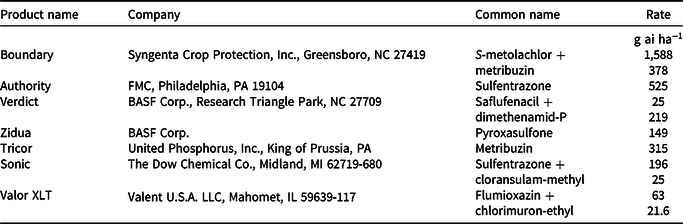
The experiment was designed as a two-factor factorial randomized complete block with four replications. Factor A was application timing (preplant or PRE), and factor B was labeled herbicide treatments (S-metolachlor + metribuzin; sulfentrazone; sulfentrazone + cloransulam-methyl; saflufenacil + dimethenamid–P + pyroxasulfone + metribuzin; flumioxazin + chlorimuron-ethyl) (Table 1). Herbicide treatments were selected to evaluate a range of crop injury risks, through incorporating historically injurious and safe herbicides. Preplant treatments were applied 12 to 16 d prior to planting, and at-planting applications were made the day of planting. Application and planting dates are displayed in Figures 1–3. Herbicide applications were made with a CO2-pressurized backpack sprayer calibrated to deliver 140 L ha–1 at 4.8 km h–1 with AIXR flat-fan 110015 nozzles (Teejet Technologies, Springfield, IL). The entire test area was treated with paraquat (700 g ai ha–1) at planting to control any emerged weeds. Paraquat was applied to both preplant and at-planting applications to evaluate only in-crop residual weed control. Crawfordsville received no supplemental irrigation, whereas Fayetteville was irrigated using an overhead lateral move system. The site near Marianna was furrow irrigated. Once soybean emergence had occurred, irrigation was applied within 7 to 8 d of receiving a rainfall event of 1.5 cm or an irrigation event until crop maturity. Irrigation, rainfall events, and planting date for each location are shown in Figures 1–3.
Product name, manufacturer, herbicides common name, and rate of herbicide tested.
Cumulative rainfall in Crawfordsville, AR, in 2018 starting at time of the preplant application (dashed line shows time of planting/PRE application) and continuing 3 mo past planting.

Cumulative rainfall in Marianna, AR, in (A) 2017 and (B) 2018 starting at time of the preplant application (dashed line shows time of planting/PRE application) and continuing 3 mo past planting.

Cumulative rainfall in Fayetteville, AR, in (A) 2017 and (B) 2018, starting at time of the preplant application (dashed line shows time of planting/PRE application) and continuing 3 mo past planting.

To evaluate the residual activity of treatments, emerged Palmer amaranth plants were counted and removed by hand at 2 and 4 wk after planting from two established 0.5-m2 quadrats, with care given to avoid disturbing the plots. Visible estimates of Palmer amaranth control were evaluated weekly through 10 wk after planting relative to a nontreated control on a 0 to 100% scale, with 0 being no control and 100% being complete control (Frans and Talbert Reference Frans, Talbert and Truelove1977). Soybean injury was also visibly rated on a 0 to 100% scale, with 0 representing no crop injury and 100% indicating plant death. Injury ratings were based on stunting, chlorosis, and necrosis.
Data Analysis
Visible estimates of control were analyzed using JMP 14.1 (SAS Institute Inc., Cary, NC). Because of differences in environmental conditions, site-years were analyzed separately, giving an accurate representation of the variability in longevity of control across different soils and environmental conditions. All Palmer amaranth control data were regressed against days after soybean planting using the Fit Curve platform of JMP. A quadratic function was fit, allowing for a more accurate prediction estimate than a linear model based on AICc, weighted AICc, SSE, and R-squared values. Days above 80% Palmer amaranth control were predicted using a model that separated data by site-year, application timing (preplant, PRE), and herbicide treatment. Confidence intervals (95%) were calculated for mean number of days that control exceeded 80%. Differences among herbicide treatments or between timings can be inferred if the confidence intervals of the two predicted means do not overlap.
Soybean injury and Palmer amaranth density data were analyzed by site-year in JMP 14.1 with ANOVA. Soybean injury 21 d after planting is presented to show the effects that application timing had on crop injury. Cumulative Palmer amaranth density 28 d after planting and soybean injury 21 d after planting in all 5 site-years failed to follow a normal distribution based on a Shapiro-Wilks test (Shapiro and Wilk Reference Shapiro and Wilk1965); therefore, a Box-Cox transformation test was performed to determine the lambda value and most suitable transformation (Box and Cox Reference Box and Cox1964). Soybean injury and cumulative Palmer amaranth density data were transformed with a log transformation to determine P values and mean separations, but original means are displayed for ease of interpretation.
Results and Discussion
Herbicide Activation
Variability among herbicides in longevity of control can be explained by application timing and environmental conditions at different site-years. In all site-years, applications made 12 to 16 d prior to planting were activated with a 3.5- to 13.3-cm rainfall before planting (Figures 1 to 3). Applications made PRE were probably activated prior to weed emergence with rainfall events in excess of 3.0 cm at test sites near Marianna in 2017, Crawfordsville in 2018, and Fayetteville in 2018. Applications made PRE in Fayetteville in 2017 and near Marianna in 2018 received rainfall at 3 and 7 d after applications, respectively; however, soil conditions were such that Palmer amaranth emergence was observed prior to the first rainfall event. PRE soil moisture, soil temperature, and light conditions were conducive for weed emergence prior to herbicide activation in Fayetteville 2017 and near Marianna 2018; therefore, weed germination occurred before PRE herbicides were activated.
Visible Estimates of Injury
Near Marianna in 2018 and Crawfordsville in 2017, no soybean injury was present in any treatment evaluated. At the three locations where injury was observed (Marianna 2017, Fayetteville 2017, and Fayetteville 2018), a significant two-way interaction for herbicide treatment by application timing occurred (Tables 2 and 3). In these 3 site-years, sulfentrazone was less injurious to soybean when applied preplant vs. PRE (Table 3). Similarly, Dirks et al. (Reference Dirks, Johnson, Smeda, Wiebold and Massey2000) did not observe soybean injury when sulfentrazone was applied preplant; however, Taylor-Lovell et al. (Reference Taylor-Lovell, Wax and Nelson2001) observed 4% to 61% injury to soybean when sulfentrazone was applied PRE when applied to multiple varieties. Preplant application timing reduced soybean injury at Marianna in 2017 relative to PRE applications for sulfentrazone + cloransulam-methyl and saflufenacil + dimethenamid-P + pyroxasulfone + metribuzin. Soybean injury was reduced in Fayetteville 2018 when saflufenacil + dimethenamid-P + pyroxasulfone + metribuzin was applied preplant vs. PRE. Similar findings by Moshier and Russ (Reference Moshier and Russ1981) show that high rates of metribuzin applied PRE reduced soybean stand, height, and yield; however, applications of metribuzin made 3 wk prior to planting reduced visible soybean injury, and no height or yield reduction was observed. These findings lead to the conclusion that applying historically injurious herbicides to soybean 12 to 16 d prior to planting reduces the risk for crop injury. Differences in the level of herbicide injury among treatments were expected but not necessarily the objective of the study. These data show the safening effects of application timing and longevity of weed control, which can aid in herbicide application decisions (VanGessel et al. Reference VanGessel, Johnson and Scott2017).
P values from ANOVA for soybean injury 21 d after planting and Palmer amaranth density 28 d after planting for 5 site-years in Arkansas.

a No data were collected at these locations because of lack of injury caused by the herbicide treatment.
Visible estimates of soybean injury 21 d after planting near Marianna, AR, in 2017, and at Fayetteville, AR, in 2017 and 2018.

a Applications of herbicides were made the day of planting.
b Applications of herbicides made 14 d prior to planting.
c Means that are significantly different are represented by letter separation by site-year; means without the same letter are significantly different.
Palmer Amaranth Control
The site-year near Marianna in 2018 illustrates the consequences of applying a residual herbicide without the ability to irrigate or properly activate the herbicide (Figure 2). Preplant applications were made on May 11, 2018, and from the time of application until planting, the trial received 3.0 cm of rainfall (Figure 2). The PRE application made on May 25, 2018, was followed by seven consecutive days without rainfall. Following planting, Palmer amaranth germinated and emerged without hindrance from the applications made PRE. Overall, poor Palmer amaranth control from the applications PRE were seen in this site-year (Table 4). Similar findings by Whitaker et al. (Reference Whitaker, York, Jordan and Culpepper2010) show that timing and amount of rainfall can affect the residual activity of PRE herbicides. All treatments applied preplant resulted in longer Palmer amaranth control compared to those PRE. Failure of residual herbicides applied PRE can cause increased selection for resistance on POST herbicide applications and likewise decrease the effectiveness of POST application or hasten the earliness of POST applications (Norsworthy et al. Reference Norsworthy, Ward, Shaw, Llewellyn, Nichols, Webster, Bradley, Frisvold, Powles, Burgos, Witt and Barrett2012).
Regression analysis of quadratic trend at all locations, showing inverse predictions of the number of days after planting that the herbicide achieved 80% control of Palmer amaranth relative to the nontreated check; also shown is the mean confidence interval.

a >80% control is the number of days that the herbicide provided above 80% control of Palmer amaranth. Values were calculated using the inverse prediction.
b Mean confidence interval (CI) can be interpreted as there is a 95% probability that the confidence interval will capture the true population mean.
c Asterisks represent significant difference between application timings at P = 0.05.
The number of days sulfentrazone + cloransulam-methyl and saflufenacil + dimethenamid-P + pyroxasulfone + metribuzin provided above 80% Palmer amaranth control did not differ between application timings in 4 of the 5 site years (Table 4). Marianna 2018 was the only site-year that differed, because of lack of herbicide activation. Sulfentrazone applied preplant provided an equal or greater number of days above 80% Palmer amaranth control in all 5 site-years when compared to sulfentrazone applications made PRE (Table 4). Of these herbicides, sulfentrazone and pyroxasulfone have half-lives of more than 70 d (Table 5).
Published estimates of KOC (soil and organic carbon sorption ratio) and half-life of herbicides evaluated.

When comparing application timings of S-metolachlor + metribuzin and flumioxazin + chlorimuron-ethyl, preplant applications provided a shorter duration of Palmer amaranth control in Fayetteville in 2018 and near Marianna in 2017 (Table 3). S-metolachlor + metribuzin and flumioxazin + chlorimuron-ethyl have similar characteristics, as none of the four herbicides with activity on Palmer amaranth have a half-life that exceeds 27 d (Table 5). Whitaker et al. (Reference Whitaker, York, Jordan and Culpepper2010) reported that metribuzin + chlorimuron-ethyl provided 87% Palmer amaranth control 3 wk after application, but control declined to 77% by 7 wk after application.
Palmer Amaranth Emergence
Data collected from Marianna in 2018 is an example of an at-planting herbicide treatment not receiving an activating rainfall until 7 d after planting (Figure 2). Only the main effect of application timing was significant (P < 0.0001), with lower Palmer amaranth emergence 28 d after planting from the preplant applications than from applications PRE (26% and 64%, respectively, compared to the nontreated; Table 6).
Palmer amaranth density at 28 d after planting at Marianna, AR, in 2017 and 2018, and Fayetteville, AR, in 2018, based on application timing.a

a Data from Fayetteville, AR, in 2017 and Crawfordsville, AR, in 2018 are not shown because of a nonsignificant interaction and main effects.
b Applications of herbicides were made the day of planting.
c Applications of herbicides were made 14 d prior to planting.
d Uppercase letters are used to separate means of herbicide-by-timing interaction; means followed by the same letters do not differ based on Fisher’s protected LSD (P = 0.05).
e Lowercase letters represent significant differences between the main effects application timing and herbicide treatment within site-year; means followed by the same letters do not differ based on Fisher’s protected LSD (P = 0.05).
At Mariana in 2017, all herbicide treatments applied preplant except S-metolachlor + metribuzin had higher Palmer amaranth emergence 28 d after planting when compared to herbicide treatments applied at planting. Higher than expected Palmer amaranth emergence occurred in preplant-treated plots at Marianna in 2017, possibly as a result of the high amounts of precipitation received at this location. Nearly 28 cm of rainfall was received from the time the preplant applications were applied until 4 wk after planting (Figure 2). The difference in rainfall amount received from the time of preplant application until the PRE application can influence longevity of weed control (Jhala and Singh Reference Jhala and Singh2012). Applying herbicides preplant increases the likelihood of herbicide activation and likewise increases the cumulative amount of rainfall the herbicide is exposed to, which can reduce herbicide persistence and decrease weed control (Oliver et al. Reference Oliver, Klingaman, McClelland and Bozsa1993).
Data from site-years at Fayetteville 2017, Fayetteville 2018, and near Crawfordsville 2018 were similar. Significant effects of application timing or an interaction of application timing by herbicide treatment were not present in the results from the analysis (Table 6). Application timing did not influence the longevity of Palmer amaranth control in Crawfordsville 2018, Fayetteville 2017, and in Fayetteville 2018 despite a difference in environmental conditions (Figure 1).
Conclusion and Practical Implications
Sulfentrazone, sulfentrazone + cloransulam-methyl, and saflufenacil + dimethenamid-P + pyroxasulfone + metribuzin applied preplant would be a safer option than applying these herbicides PRE for producers to reduce the potential for crop injury without suffering a loss in weed control. By applying these herbicides preplant, the available period for herbicide activation is lengthened, therefore increasing the odds for proper activation to occur before weed emergence after crop planting (Oliver et al. Reference Oliver, Klingaman, McClelland and Bozsa1993). However, if tillage occurs after preplant herbicides are applied, the efficacy could be affected. The study also shows that herbicides with an overall shorter residual persistence and/or those most affected by rainfall amounts do not have the potential to be applied preplant without suffering a reduction in longevity of weed control. Therefore, when herbicide selection decisions are being made for preplant applications, the duration of residual activity should be assessed, so that residual herbicides with more protracted activity should be selected and applied preplant.
Acknowledgments
Funding for this research was provided by the Arkansas Soybean Promotion Board.


 Open access

