





Non-technical Summary
The theory of punctuated equilibria, originally proposed in paleobiology, suggests that species exhibit extended periods of morphological stability interrupted by rapid phenotypic change at speciation events. This concept, reshaping evolutionary biology, introduced a hierarchical model for the organic world. Despite facing limited attention initially, this hierarchical approach experienced a resurgence in the new millennium, integrating genomics and computational methodologies. This revival has led to a more comprehensive theoretical foundation for understanding biological evolution and has fueled empirical studies across various disciplines.
This paper argues for the hierarchy theory of biology as a comprehensive framework for understanding the organic world. It remains flexible by not specifying particular mechanisms, accommodating diverse biological models. Applied to speciation analysis, the hierarchy theory reveals causal processes, identifies entities and interactions, and bridges economic and genealogical hierarchies. Open to refinement based on empirical data, the hierarchy theory of biology stands as a paradigm that shapes interdisciplinary exploration and inspires investigations across disciplines. Overall, it presents a promising avenue for understanding the complexities of biological evolution and fostering a holistic and integrative approach within the field of biology.
Punctuated Equilibria and Its Intellectual Legacy
The foray of punctuated equilibria into paleobiology was a pivotal point in the history of the discipline and became one of the cornerstones of contemporary evolutionary theory with far-reaching ramifications that echoed across the natural and social sciences. At the heart of this theory is the interweaving of a paleontological empirical claim, which shows that most species remain morphologically stable for most of their existence, and a biological model of speciation, which suggests that new species arise from small isolated populations at the edges of the ancestral range (Eldredge and Gould Reference Eldredge, Gould and Schopf1972). As stated in the original proposal, the corollary of the theory was that lineage-splitting events were relatively rapid and accommodated by bursts of phenotypic divergence, generating seemingly sudden pronounced morphological gaps between ancestor and descendant species in the fossil record. The morphological discontinuities were hypothesized to be caused by differences in selective pressures between the species’ ancestral range and a peripherally isolated area, and the rapid rate of divergence was due to small population size of peripheral isolates, facilitating the spread and fixation of morphological novelty. Another significant aspect of punctuated equilibria was the reconceptualization of species as discrete, enduring, homeostatic evolutionarily significant entities. Developmental constraints that act to canalize and restrict the amount and type of morphological change that can occur were hypothesized to be responsible for the species enduring morphological stasis. The overarching picture that the theory paints is that of prevailing morphological stasis enduring over long stretches of geological time, only occasionally punctuated by rapid events of speciation and morphological divergence.
The most prominent and long-lasting impacts the idea of punctuated equilibria had were reintegrating paleontology with the mainstream of evolutionary biology and reinvigorating the study of patterns and mechanisms of evolution in biological systems by highlighting long-term morphological stasis of species and offering a new perspective on long-term evolutionary patterns and trends (reviewed by Sepkoski Reference Sepkoski2012; Hunt and Rabosky Reference Hunt and Rabosky2014; Eldredge Reference Eldredge2015; Lidgard and Hopkins Reference Lidgard and Hopkins2015).
More subtly, punctuated equilibria triggered a tectonic shift in the conceptual core of the entire field of biology. Recognizing species as discrete and stable entities invited a plethora of hypotheses about diversification dynamics involving distinct processes at the species and population levels. Implicit in the original contribution on punctuated equilibria, this insight paved the way for the development of a full-fledged hierarchical model of the organic world, the significance of which is yet to be acknowledged. The new concept was fueled by the nascent field of biological complexity (Simon Reference Simon1962; Pattee Reference Pattee and Waddington1970, Reference Pattee and Rosen1972, Reference Pattee1973; Wimsatt Reference Wimsatt1972), new ideas in philosophy pertaining to species ontology (Ghiselin Reference Ghiselin1966, Reference Ghiselin1969, Reference Ghiselin1974; Hull Reference Hull1976, Reference Hull1978) and the replicator–interactor dichotomy (Williams Reference Williams1966; Dawkins Reference Dawkins1976; Hull Reference Hull1980, Reference Hull and Plotkin1988), and the revision of the explanation for large-scale patterns in the fossil record (reviewed by Grantham Reference Grantham1995, Reference Grantham, Briggs and Crowther2001). The hierarchical model was formalized in mid-1980s in a series of works (written individually and in collaboration) by Niles Eldredge, an invertebrate paleontologist and the principal architect of the punctuated equilibria hypothesis, and Stanley Salthe, a biologist and a philosopher of science (Eldredge and Salthe Reference Eldredge and Salthe1984; Eldredge Reference Eldredge1985b, Reference Eldredge1986; Salthe Reference Salthe1985). Possibly, owing to its primarily theoretical and philosophical outlook, the model did not initially receive much traction.
The dawn of the new millennium witnessed a resurgence in hierarchical approaches to evolution, marked by the emergence of a new synthesis that integrates breakthroughs in genomics, computational methodologies, complex systems sciences, and recent philosophical strides in the ontology of biological organization levels (Tëmkin and Eldredge Reference Tëmkin, Eldredge, Serrelli and Gontier2015; Eldredge et al. Reference Eldredge, Pievani, Serrelli and Tëmkin2016; Brooks et al. Reference Brooks, DiFrisco and Wimsatt2021). This revitalization not only furnished a more comprehensive theoretical foundation for elucidating patterns and processes in biological evolution but also laid the groundwork for an expanding array of empirical studies, spanning the realms from genomics to paleobiology (for examples, see Eldredge et al. Reference Eldredge, Pievani, Serrelli and Tëmkin2016).
The present contribution delineates the key facets of the current state of the hierarchical model, exploring the potential it harbors for establishing a comprehensive, unifying theory within the biological sciences. As a tangible illustration of its application, it puts forth a more exhaustive causal analysis of the speciation process. The aim is to illuminate the intricate interplay between cladogenesis and morphological divergence, a pivotal inquiry posed in the original punctuated equilibria half a century earlier.
The Core Principles of the Hierarchy Theory of Biology
A brief overview of fundamental principles of the hierarchy theory in biology is presented here. For a more comprehensive and nuanced revision of the theory, see Tëmkin and Eldredge (Reference Tëmkin, Eldredge, Serrelli and Gontier2015), Eldredge et al. (Reference Eldredge, Pievani, Serrelli and Tëmkin2016), and Tëmkin (Reference Tëmkin, Brooks, DiFrisco and Wimsatt2021).
Biological Systems and Levels of Organization
The living world is composed of hierarchically nested systems capable of maintaining ordered structure through active, regulated energy and matter exchange with the environment over a lifetime and/or potentially indefinitely by information transmission through descendant systems. Structurally, a biological system is a complex network of entities that comprise an integrated whole with systemwide properties. Such systems are spatiotemporally bounded entities (i.e., individuals in a philosophical context) capable of birth, development, and death. In such an arrangement, a system in focus consists of parts, or a network of lower-level systems, and is itself a part of a network of a higher-level, more-inclusive system, collectively comprising a nested compositional hierarchy (or holarchy sensu Koestler [Reference Koestler1967, Reference Koestler1978]).
In the nested compositional hierarchy of biological systems, scalar differences in process rates give rise to two main interaction types: strong interactions with high-frequency dynamics within levels and weak interactions with low-frequency dynamics among levels (Simon Reference Simon1962, Reference Simon and Pattee1973; Wimsatt Reference Wimsatt, Globus, Maxwell and Savodnik1976; DiFrisco Reference DiFrisco2016). Entities within the same level interact directly in the same dynamic process, while entities across different levels interact only in an aggregative manner (Grantham Reference Grantham2007). The non-transitivity of direct effects across systems, characterized by specific energy levels of their components’ interactions, relaxation times, and size scales, establishes the levels as robust local maxima of predictability and regularity in a multidimensional phase space of biological systems properties across scale (Wimsatt Reference Wimsatt, Globus, Maxwell and Savodnik1976, Reference Wimsatt, Brewer and Collins1981, Reference Wimsatt, Brooks, DiFrisco and Wimsatt2021). It has also been argued that entities at a given level are characterized by qualitatively different types of relations that are not observed in interactions of their constituent subsystems (e.g., Volk Reference Volk2017). Thus, systems at different levels are quasi-independent or nearly decomposable (sensu Simon Reference Simon1962), allowing for investigating dynamics of individual levels on their own right. (See Brooks et al. [Reference Brooks, DiFrisco and Wimsatt2021] for the exhaustive treatment of levels of biological organization.)
Hierarchical Dynamics of Biological Systems
Intralevel interactions are governed by common topological features of complex networks that are isomorphic across levels and typically display a suite of properties contributing to robustness, an exceptionally high degree of tolerance against random failures and external perturbations (Barabási and Albert Reference Barabási and Albert1999; Strogatz Reference Strogatz2001; Albert and Barabási Reference Albert and Barabási2002; Barabási Reference Barabási2002; Dorogovtsev and Mendes Reference Dorogovtsev and Mendes2003; Newman Reference Newman2003). Interlevel interactions involve dual control, whereby upper and lower levels influence each other indirectly through upward and downward causation (Polanyi Reference Polanyi1968). Upward causation manifests in lower-level entities determining conditions that affect upper-level systems in an aggregate or emergent fashion. Downward causation entails higher-level entities imposing constraints, directing control across all component subsystems simultaneously. Processes at a focal level can both initiate conditions for upper levels and set boundaries for lower levels (Salthe Reference Salthe1985). Simultaneously, they are influenced by conditions set by these levels. Noncontiguous levels can indirectly impact the focal level through cascading upward and downward effects. The complexity of biological dynamics arises from the synergistic interplay of idiosyncratic processes at different levels and the dynamics of interactions between these levels.
Lineages
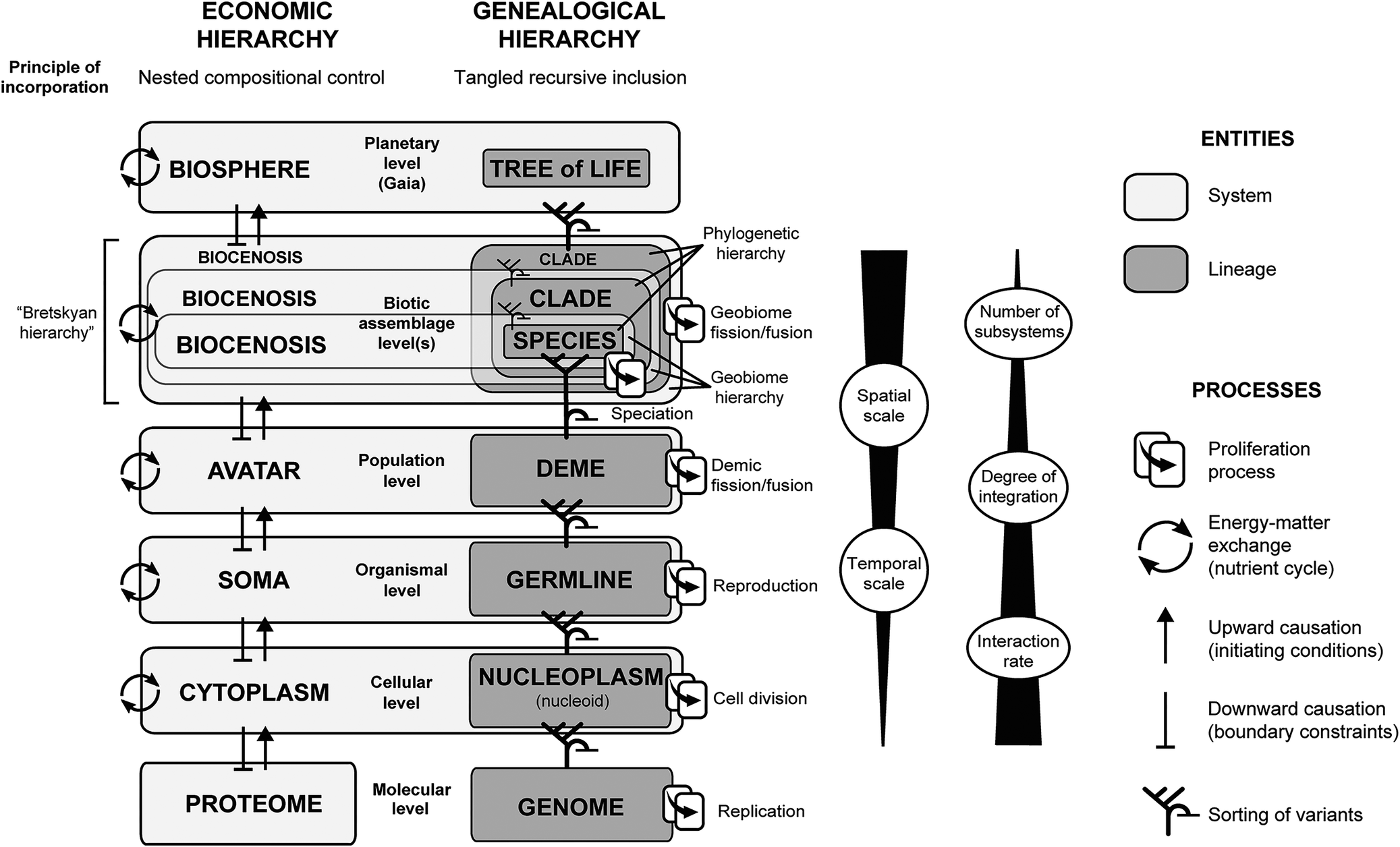
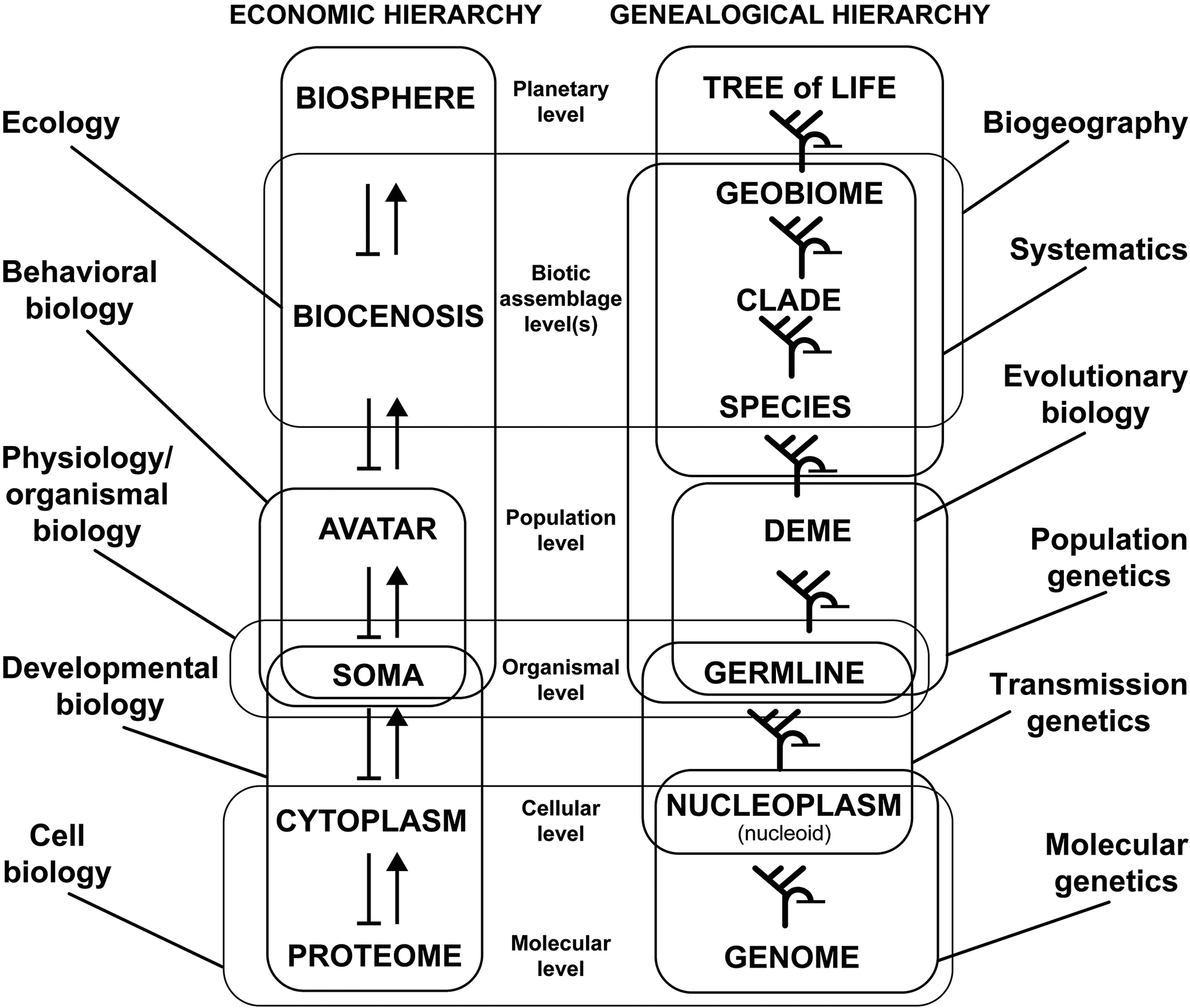
Informational and dynamic processes are often decoupled in biological systems, leading to distinct but partly overlapping interconnected nested sets: the ecological or economic hierarchy of interactors and the reproductive hierarchy of replicators (Eldredge and Salthe Reference Eldredge and Salthe1984; Eldredge Reference Eldredge1985b; Salthe Reference Salthe1985; Maynard Smith and Szathmáry Reference Maynard Smith and Szathmáry1995; Fig. 1). The interactors are open biological systems (Bertalanffy Reference Bertalanffy1950, Reference Bertalanffy1969) that maintain organized states through regulated energy and matter exchange with their environment, deviating from thermodynamic equilibrium (dissipative structures sensu Prigogine [Reference Prigogine and Marois1969] and Brooks and Wiley [Reference Brooks and Wiley1988]). The consumed energy is invested in maintenance of the system itself as well as into expansion through proliferative reproduction or, simply, proliferation (Van Valen Reference Van Valen1976; Tëmkin and Serrelli Reference Tëmkin, Serrelli, Eldredge, Pievani, Serrelli and Tëmkin2016), a process that enables such systems to endure in time beyond their eventual demise through their descendants. This process gives rise to lineages, a different kind of biological individual. Unlike systems with interacting parts and developmental capabilities, lineages consist of collections of variant systems that are open to sorting (Caponi Reference Caponi, Eldredge, Pievani, Serrelli and Tëmkin2016), exemplified by Darwinian natural selection that operates on phenotypic properties of individual organisms. The ancestor–descendant continuity of lineages relies on some form of proliferation and heritability mechanisms, producing the material overlap of systemic properties between generations. In this context, information is broadly understood as a specific configuration of the lower-level constituent parts (subsystems) of the biological system in question that is transmitted across generations (Tëmkin and Serrelli Reference Tëmkin, Serrelli, Eldredge, Pievani, Serrelli and Tëmkin2016). In this broader view of biological information transmission, inheritance is not limited to genetic replication at a molecular level and does not necessitate coding mechanisms (Griesemer Reference Griesemer2000).
The nested compositional hierarchical model of biological systems, delineating classes of fundamental processes. The economic (ecological) hierarchy embodies dynamics in matter and energy exchange, while the genealogical (informational or evolutionary) hierarchy encapsulates the transmission of heritable information and modes of proliferation. The members of the phylogenetic aspect of the genealogical hierarchy (the “Linnaean hierarchy” of Spiridonov and Eldredge [Reference Spiridonov and Eldredge2024]) do not have an intrinsic mechanism of proliferation but diversify due to the fission–fusion dynamics of the more-inclusive geobiome lineages. Note that at the biotic assemblage levels, the biocenotic systems and lineages (the “Bretskyan hierarchy” of Spiridonov and Eldredge [Reference Spiridonov and Eldredge2024]), comprise scalar continua. The discordant pattern of intercalated geobiome and phylogenetic lineages across scale comprises a single complex network of nested anastomosing lineages.
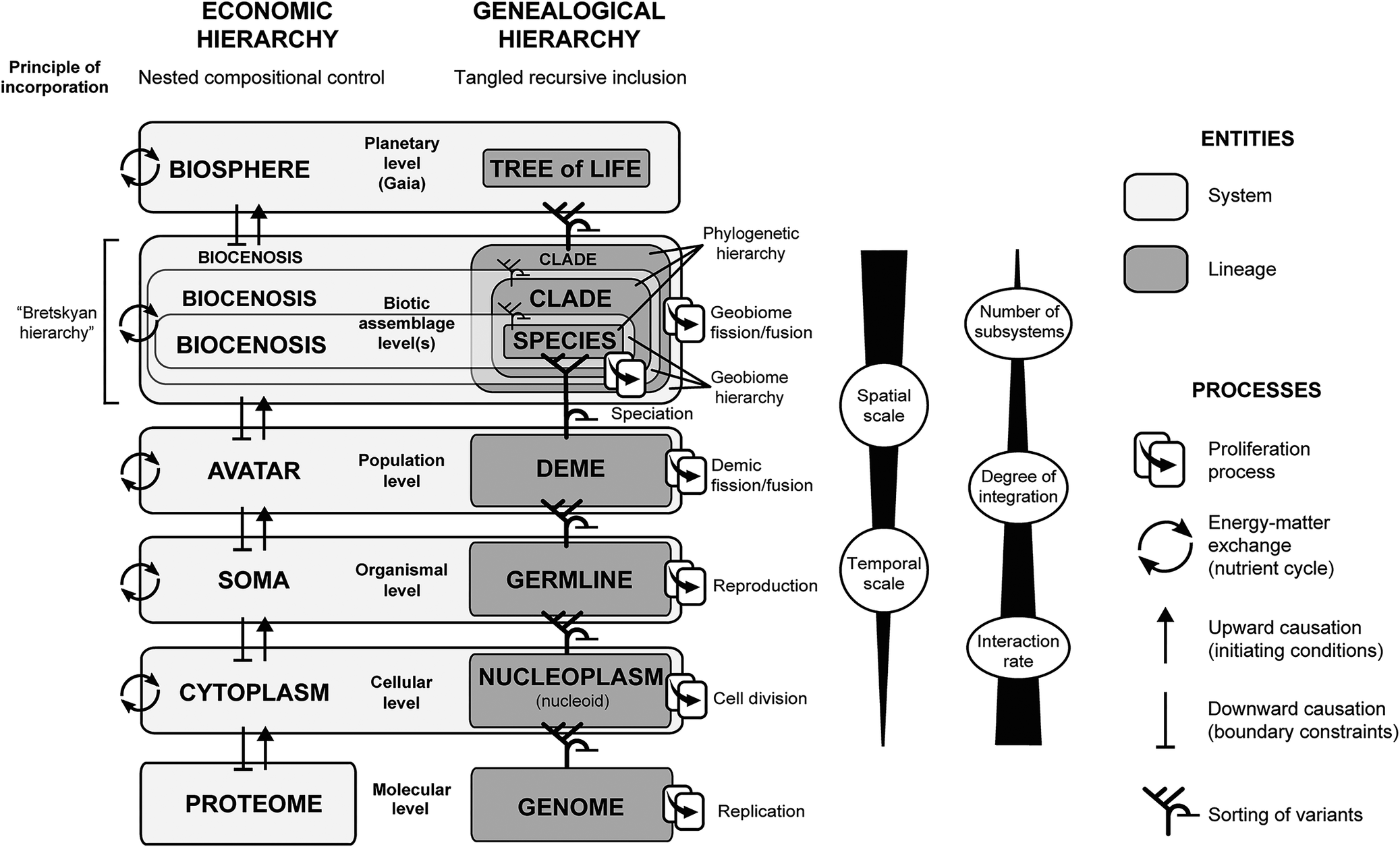
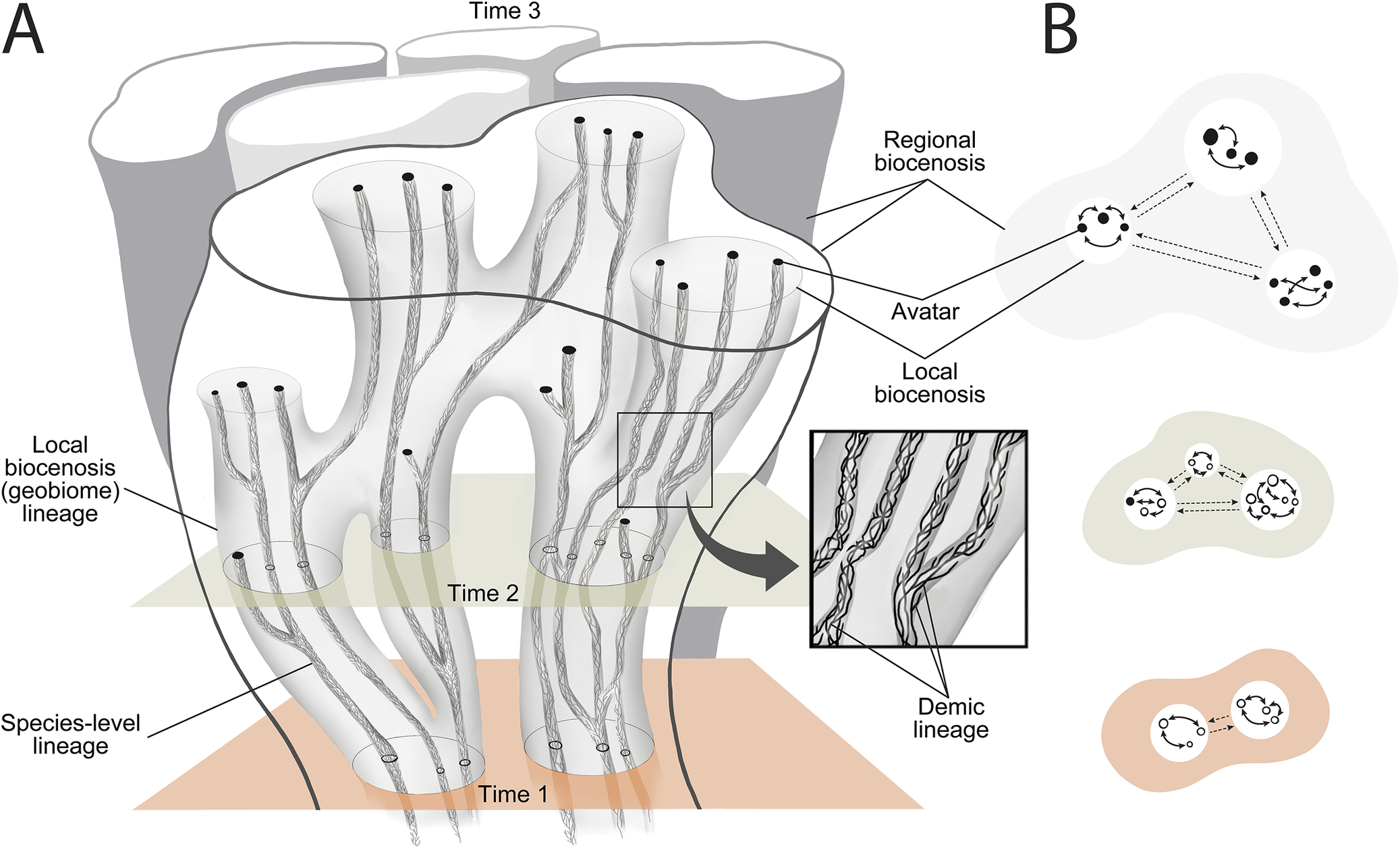
Lineages are integrated into a distinct nested hierarchy through genealogical descent. However, the genealogical hierarchy operates on a different principle: while the economic hierarchy of systems relies on nested composition, facilitating interlevel process control, the genealogical hierarchy follows a principle of tangled recursive inclusion, emphasizing vertical coupling and the unidirectional, irreversible extension through time via the generation of descendants, reflecting the historical fate of biological systems. In representational terms, the architecture of the hierarchy of systems can be visualized as a nested set of boxes or a Venn diagram, whereas the historical record of lineages is captured by a rooted tree or directed anastomosing network (Fig. 2).
Diagrammatic representation of the interconnectedness and temporal dynamics of systems and lineages, exemplified by four levels of organization at three time intervals. Lineages (A) are generated by proliferation of systems (B), that maintain organized states through regulated energy and matter exchange with their environment. Curved solid arrows represent ecological interactions among avatars in local biocenoses; straight dotted arrows represent energy–matter flow among local biocenoses within a more encompassing regional biocenosis. The terms “local” and “regional” are used here only to designate relative degree of inclusion, rather than referring to specific spatial scale. The identity of interacting systems and the nature of their interactions change as shown by the comparison of three time intervals due to temporal dynamics of lineages formed by systems at different levels. Lineages comprised or demes and geobiomes display rather anastomosing (fission–fusion) dynamics, whereas species-level lineages produce predominantly bifurcating patterns. Also note that lineages at different hierarchical levels can be incongruent, exemplified by integration avatars of disparate origins within a local biocenosis by the fusion dynamics within lineages of local geobiomes.

Lineages generated by variant systems at different levels may display different prevailing patterns. For instance, notwithstanding instances of hybridization, most speciation events in animals are regarded to result from cladogenesis, producing bifurcating tree-like patterns of taxic diversity at and above species level, whereas demes are integrated by the anastomosing network of genetic sources and sinks (Pulliam Reference Pulliam1988; Miller Reference Miller2006). Lineages at different hierarchical levels can be incongruent, producing more-inclusive lineages composed of multiple constituent lineages of different origins, exemplified by incomplete lineage sorting and taxic composition of geobiomes (see below). From this discussion, it follows that the ontological distinction between systems and lineages precludes the exact one-to-one mapping of entities between the hierarchies and the establishment of a single consistent hierarchical structure.
Recent developments in the hierarchy theory of biology challenge the exclusively genetically based organizational principle of the genealogical component of the dual hierarchical model. There is a growing recognition of biotic-level multispecies interactive networks, or biocenoses, as discrete, temporally extended, and geomorphologically demarcated systems (geobiomes sensu Spiridonov and Eldredge [Reference Spiridonov and Eldredge2024]), capable of variational evolution (Lekevičius Reference Lekevičius2002; Spiridonov and Eldredge Reference Spiridonov and Eldredge2024). Such entities comprise a continuum of nested geobiomes across scale with traceable genealogies (i.e., the Bretskyan hierarchy sensu Spiridonov and Eldredge [Reference Spiridonov and Eldredge2024]), where the durations of such systems are congruent with the geographic area they occupy (i.e., the larger, more-encompassing biocenoses persists longer than smaller, lower-level constituent ones). It must be noted, that despite their spatially nested patch hierarchies in the context of a landscape (Wu Reference Wu1999), the geobiomes of different degrees of inclusiveness are members of the same phenomenological level—that of the biotic assemblage level—as no fundamentally new types of relations arise through the continuum of their size scale (Tëmkin and Eldredge Reference Tëmkin, Eldredge, Serrelli and Gontier2015). They differ, however, as Spiridonov and Eldredge (Reference Spiridonov and Eldredge2024) have noted, in the degree of integration, in which a higher level of integration occurs among lower-level geobiomes, driven by the prominent role of biotic interactions, is contrasted with a decreasing level of integration in higher-level geobiomes, primarily due to spatial geomorphological boundaries. This observation agrees with previously acknowledged asymmetry in nested compositional hierarchy across scale: lower-level systems demonstrate significantly stronger interactions and a wider range of variation compared with more-inclusive, higher-level systems (Tëmkin and Eldredge Reference Tëmkin, Eldredge, Serrelli and Gontier2015). In the present work, the concept of the geobiome is recognized as fundamentally equivalent to that of biocenosis, but the usage of both terms is maintained to emphasize the lineage-forming aspect of biotic assemblages by the former and their role as energy and matter processing systems by the latter. Importantly, the history of geobiomes and the phylogenetic affinity of included taxa can generate rather discordant patterns, ultimately producing a complex intercalated pattern of nested anastomosing lineages, iterated over temporal and spatial scale (Fig. 2).
These observations on large-scale biological systems parallel the analyses of the dynamics occurring in lower-level systems: in the context of individual organisms, the constituent lower-level subsystems (i.e., cells) engage in complex economic interactions and maintain enduring stability over a period of time (e.g., DeGregori and Eldredge Reference DeGregori and Eldredge2020), and the obligatory ecological interaction of the host organism and its microbiota (collectively referred to as holobiont; Meyer-Abich Reference Meyer-Abich1943; see Baedke et al. [Reference Baedke, Fábregas-Tejeda and Delgado2020] for the history of the concept) is likewise amenable to evolutionary dynamics (Roughgarden et al. Reference Roughgarden, Gilbert, Rosenberg, Zilber-Rosenberg and Lloyd2018; Gilbert Reference Gilbert2023).
Hierarchy and Evolution
The ontological distinction between systems and lineages allows for a more concrete formulation of the concept of evolution as the historical pattern of differential persistence among biological systems, irrespective of the specific level of biological organization. Thus, the concept of evolution is inapplicable to any individual biological system. Rather, it signifies in a specific albeit narrower sense than traditionally accepted a record of the temporal relationships among different variants of individual systems due to their differential persistence and sorting, such as through selection or drift, which are isomorphically manifested across multiple levels. Individual systems do not evolve: they grow, age, and interact with other such systems, whereas the historical pattern that emerges from these interactions (Caponi Reference Caponi, Eldredge, Pievani, Serrelli and Tëmkin2016), that is, evolution, is evident in a lineage formed by these systems.
The complex nature of evolution arises from the intricate responses of biological systems to temporally decoupled perturbations at multiple levels, impacting the evolutionary dynamics of lineages they comprise. The prolonged stability of biological systems stems from their inherent robustness, a general property of complex biological networks across scale to maintain their structure and function in the face of internal failures or external attacks (Simon Reference Simon1955; Albert et al. Reference Albert, Jeong and Barabási2000; Dorogovtsev and Mendes Reference Dorogovtsev and Mendes2002, Reference Dorogovtsev and Mendes2003; Barabási and Bonabeau Reference Barabási and Bonabeau2003; Newman Reference Newman2003; Proulx et al. Reference Proulx, Promislow and Phillips2005). Hierarchical nesting further buffers the system’s ability to withstand external stress and remain in a steady state by preventing the cascading effects across systemic levels in cases of perturbation capable of disrupting a steady state of the component subsystems or more-inclusive systems. The state of equilibrium is further maintained by limiting the range of variation at the focal level through adjacent levels, reducing initiating conditions and tightly controlling boundary conditions. In the absence of external disruptions, these systems are expected to remain in equilibrium.
Evolution unfolds in response to disruptions that sufficiently disturb the system’s equilibrium, leading to a breakdown in buffering mechanisms and percolating through the levels. Strong perturbations compromising the system’s buffering mechanisms disrupt the flow of energy and matter, thus producing cascading effects across the levels of the economic hierarchy. The causal link between the interactions in the economic hierarchy and the differential propagation of genealogical individuals suggests that systemic changes can affect changes in information transmission, triggering an evolutionary response. Alterations in transmitted information affect the diversity of genealogical individuals, either increasing through new variants or decreasing through sorting (e.g., selection and drift). As genealogical individuals ensure long-term system persistence, changes in information flow create new initiating conditions for system reassembly after a disruption. Ultimately, evolution is the process by which a biological system regains equilibrium in a new state, responding to external disruptions at the intersection of economic and genealogical hierarchies, translating dynamic interactions into historical patterns.
A Case in Point: Speciation Analysis in a Hierarchical Perspective
Species are segments of time-extended, population-level lineages generated by lineage-splitting events resulting from the perturbation and partitioning of demic networks. Therefore, the key to understanding speciation needs to be sought in identifying pertinent biological systems, elucidating factors that disrupt their stability, and exploring the cascading effects of such perturbations up and down hierarchical levels. These factors either have a direct impact upon entities in the genealogical hierarchy or indirectly affect them via interactions with individuals in the hierarchy of interacting systems.
Molecular Level
Within a normal range of environmental conditions, molecular interaction networks buffer regular small-scale perturbations (von Dassow et al. Reference von Dassow, Meir, Munro and Odell2000; Albert and Othmer Reference Albert and Othmer2003; Siegal et al. Reference Siegal, Promislow and Bergman2007; Álvarez-Buylla et al. Reference Álvarez-Buylla, Chaos, Aldana, Benítez, Cortes-Poza, Espinosa-Soto and Hartasánchez2008) and may even enhance their stability (Eisenberg and Levanon Reference Eisenberg and Levanon2003; Wagner Reference Wagner2003; Berg et al. Reference Berg, Lässig and Wagner2004). Simultaneously they increase evolvability by accumulating hidden (unexpressed) variation at the molecular level and further enhancing robustness by evolving redundancy and interconnectedness (Jeong et al. Reference Jeong, Mason, Barabási and Oltvai2001; Ravasz et al. Reference Ravasz, Somera, Mongru, Oltvai and Barabási2002; Hintze and Adami Reference Hintze and Adami2008). Such molecular-level dynamics is translated into robust phenotypic stability at the organismal and cellular levels (Scharloo Reference Scharloo1991; Gibson and Wagner Reference Gibson and Wagner2000; Álvarez-Buylla et al. Reference Álvarez-Buylla, Chaos, Aldana, Benítez, Cortes-Poza, Espinosa-Soto and Hartasánchez2008).
When the level of perturbations exceeds the threshold of the structural integrity and, consequently, the buffering capacity of genetic networks, the networks either collapse or become reconfigured. This is manifested at the higher levels as a rapid increase of phenotypic variation as a result of the release of previously accumulated hidden polymorphisms (evolutionary capacitance sensu Bergman and Siegal [Reference Bergman and Siegal2003], Hermisson and Wagner [Reference Hermisson and Wagner2004], and Rutherford and Lindquist [Reference Rutherford and Lindquist1998]).
Whereas the accumulation of non-expressed variation could have been a gradual and cumulative process, a short-term destabilization during which the system undergoes reorganization just to regain an equilibrium under altered circumstances, the canalization and modularity of gene regulatory networks manifest at the organismal level in an abrupt, step-wise phenotypic change (Cossins Reference Cossins1998; von Dassow et al. Reference von Dassow, Meir, Munro and Odell2000; Abouheif and Wray Reference Abouheif and Wray2002; Alon Reference Alon2003; Ingolia Reference Ingolia2004). This can potentially account for morphological discontinuity between ancestors and descendants documented by punctuated equilibria in the fossil record (Eldredge and Gould Reference Eldredge, Gould and Schopf1972; Hunt Reference Hunt2008; Mattila and Bokma Reference Mattila and Bokma2008; Strotz and Allen Reference Strotz and Allen2013). Consistent with the results from studies on gene regulatory networks, population genetic models of punctuations indicate that the rapid transition between population states in long-term stasis is accompanied by the increase in variance during punctuation while being preceded and followed by prolonged periods of low haplotypic variation, the dynamics independent of selection regime at the population level (Bergman and Feldman Reference Bergman, Feldman, Crutchfield and Schuster2003).
Organismal Level
Perturbations directly affecting individual organisms (i.e., not acting as a downward effect of higher-level system disruptions) have little effect on speciation; depending on the magnitude of stress, responses range from no evolutionary consequences (as in a trivial chance event of accidental death) to a substantial shift in the entire population in adaptive response to a climatic change mediated by natural selection. Perturbations of the second class typically produce short-term, population-level anagenetic trends that over a greater period of time appear as fluctuations around a stable mean and contribute little to the evolution of higher genealogical entities.
Population Level
Perturbations at the population level potentially can lead to the evolution of higher-level genealogical entities by affecting the spread and fixation of mutations in a deme. However, interdeme sorting occurs under a restricted, although not exceptionally rare, set of circumstances and contributes little to evolution (Lewontin Reference Lewontin1970). Over evolutionary timescales, these short-term processes are unlikely to yield significant consequences for the entire population, assuming equilibrium of a more-inclusive biocenotic system. The net equilibrium is maintained by continuous local extinction, recolonization, and habitat tracking (Eldredge Reference Eldredge1985a), integrated by a network of genetic sources and sinks. These predictions are consistent with empirical evidence indicating that the rate of mutation fixation in natural populations is substantially lower than the potential rate (Shaposhnikov Reference Shaposhnikov1965, Reference Shaposhnikov1978; Maynard Smith Reference Maynard Smith1978).
Biotic Assemblage Level
Biocenoses (geobiomes), geomorphologically demarcated and time-enduring biotic components of ecosystems across scale, are highly structured cybernetic systems of populations interconnected by networks of energy and matter flow (avatars sensu Damuth [Reference Damuth1985]), exemplified by mutualistic relationships, trophic and host–parasite interactions, and competitive redistribution of resources. The temporal persistence and resilience of biocenoses to disturbances comes from the interactions of various ecological networks operating simultaneously over a period of relative environmental stability. Theoretical and empirical studies suggested that shared general structural features (MacArthur Reference MacArthur1955; Solé and Montoya Reference Solé and Montoya2001; Camacho et al. Reference Camacho, Guimerà and Amaral2002; Dunne et al. Reference Dunne, Williams and Martinez2002a,Reference Dunne, Williams and Martinezb; Montoya and Solé Reference Montoya and Solé2002, Reference Montoya and Solé2003; Olesen and Jordano Reference Olesen and Jordano2002; Williams et al. Reference Williams, Berlow, Dunne, Barabási and Martinez2002; Jordano et al. Reference Jordano, Bascompte and Olesen2003) and regularities of biocenotic assembly and constraints (Duffy Reference Duffy2002; Cattin et al. Reference Cattin, Bersier, Banašek-Richter, Baltensperger and Gabriel2004) contribute to the stability of ecological networks.
In undisturbed physical environments, biocenoses act as homeostatic systems, limiting inter-avatar dynamics, leading to persistent taxonomic stability and enduring phenotypic stability of constituent taxa. Such a pattern of long-term morphological stasis, the hallmark of the punctuated equilibria hypothesis, is amply documented in the fossil record, and the data are mounting (e.g., Hunt et al. Reference Hunt, Hopkins and Lidgard2015; Nagel-Myers et al. Reference Nagel-Myers, McRoberts and LaPointe2018; Cerca et al. Reference Cerca, Meyer, Stateczny, Siemon, Wegbrod, Purschke, Dimitrov and Struck2019; Witts et al. Reference Witts, Landman, Hopkins and Myers2020, Reference Witts, Myers, Garb, Irizarry, Larina, Rashkova and Landman2022; Marriott et al. Reference Marriott, Prothero and Watmore2022; Olson et al. Reference Olson, Prothero, Balassa and Syverson2022). This aligns with ecological models predicting phenotypic stability in a stable environment, where avatars remain in stasis for extended periods (Stenseth and Maynard Smith Reference Stenseth and Smith1984). Additionally, well-integrated biocenoses effectively resist the establishment of invasive species (Case Reference Case1990; Stachowicz et al. Reference Stachowicz, Whitlatch and Osman1999, Reference Stachowicz, Fried, Osman and Whitlatch2002; Stachowicz and Byrnes Reference Stachowicz and Byrnes2006; Beshai et al. Reference Beshai, Truong, Henry and Sorte2023), supported by empirical evidence showing collisions of regional biotas generally do not result in the formation of taxonomically mixed biocenoses (e.g., Zherikhin Reference Zherikhin1987). A pattern of long-term stasis of co-localized avatars has been amply documented in the fossil record, a phenomenon termed “coordinated stasis” (Brett and Baird Reference Brett, Baird, Erwin and Anstey1995; Brett et al. Reference Brett, Ivany and Schopf1996; Bonelli et al. Reference Bonelli, Brett, Miller and Bennington2006). While direct assessment of inter-avatar network dynamics is challenging in paleontological data, the frequent similarity in species composition among biocenoses separated geographically and temporally suggests that the extended persistence is linked to the ecological roles of component taxa (Thorson Reference Thorson and Hedgpeth1957; Walker and Laporte Reference Walker and Laporte1970; Boucot Reference Boucot1975, Reference Boucot1978; Levinton and Bambach Reference Levinton and Bambach1975; Wallace Reference Wallace1978). This parallelism in species composition is observed across great distances and time spans, supporting the notion of prolonged biocenotic persistence and relative insensitivity to external perturbations.
Powerful disturbances that disrupt ecological networks trigger varied responses depending on avatar diversity and connectivity. Biocenoses with diverse species and skewed-degree distributed food web connections withstand random avatar removal but become unstable if generalist or highly connected species are targeted; those with fewer species and Poissonian food web connections are vulnerable to both random and targeted avatar removals (Montoya and Solé Reference Montoya and Solé2003). Highly connected avatars, serving as energy bottlenecks (Allesina and Bodini Reference Allesina and Bodini2004), cause extensive secondary extinctions and food web fragmentation when selectively removed (Solé and Montoya Reference Solé and Montoya2001; Dunne et al. Reference Dunne, Williams and Martinez2002b; Montoya and Solé Reference Montoya and Solé2003), leading to significant detrimental effects on overall biocenotic stability (Pimm Reference Pimm1980, Reference Pimm1991).
A disturbance leads to a period of rapid ecological restructuring, resulting in a shift to a new equilibrium. Despite the initial instability, this phase is expected to be brief, with biocenoses restoring balance and stabilizing the locally optimal avatar configuration. The quick response may be attributed to the small-world property of ecological networks, allowing for the rapid dispersion of perturbation effects (Williams et al. Reference Williams, Berlow, Dunne, Barabási and Martinez2002). The reestablishment of network connections and increased interdependence among avatars after a crisis enhances species abundance (Anderson and Jensen Reference Anderson and Jensen2005) and fosters self-stabilization, demonstrating how nonequilibrium and stochastic processes contribute to ecological system stability (Urban et al. Reference Urban, O’Neill and Shugart1987; Turner et al. Reference Turner, Romme, Gardner, O’Neill and Kratz1993; Wu and Levin Reference Wu and Levin1994).
Speciation Dynamics
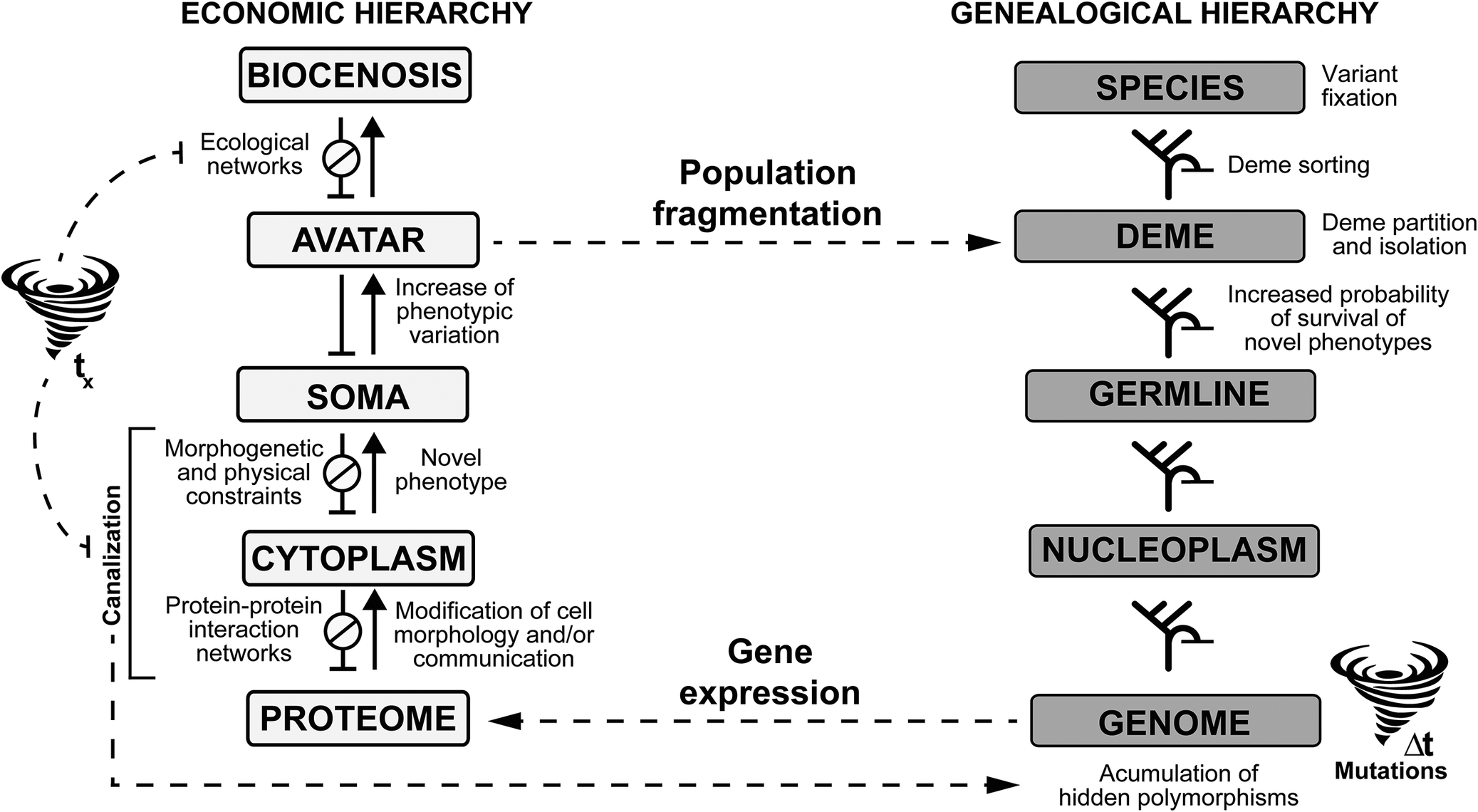
Environmental disturbances that disrupt biocenotic networks or/and compromise their geomorphological boundaries, such as climatic, lithological, and geochemical events, are causally tied to evolutionary responses at various levels, particularly influencing speciation. This connection arises from two factors (Fig. 3). First, such disturbances unleash previously suppressed organismal phenotypic variance due to compromised evolutionary capacitance at the molecular level. Second, they offer a limited time frame for the spread and fixation of new genotypes by releasing biocenotic control over population dynamics during a temporary destabilization. A significant disturbance affecting the entire metapopulation dynamics, envisioned as avatar networks, has an upward impact on speciation rates. This occurs by fragmenting metapopulations into isolated avatars (and, consequently, isolated demes) through patch extinction while simultaneously influencing their persistence and differentiation (Allmon Reference Allmon1992; McKinney and Allmon Reference McKinney and Allmon1995). The primacy of abiotic environmental factors as ultimate drivers of speciation is evidenced in the fact that allopatry has been suggested to be the most frequent mode of speciation, at least in animals and plants (Hernández-Hernández et al. Reference Hernández-Hernández, Miller, Román-Palacios and Wiens2021).
Conceptual model of causality in speciation within the hierarchy theory framework. The flow diagram identifies key speciation controls (dashed arrows) and their effects, showcasing the cascading breakdown of downward constraints (stop sign symbols) across different levels of the economic hierarchy. The model underscores the synergistic impact of biological responses to temporally decoupled environmental drivers (whirlpool symbols) on both hierarchies. External perturbations at the molecular level play a dual role, generating molecular-level variation through mutations and expressing hidden phenotypic variance by compromising evolutionary capacitance. The spread and fixation of novel genotypes are facilitated by the temporary removal of control over population dynamics through environmentally triggered disruption or destabilization of ecological networks at the biocenosis level.
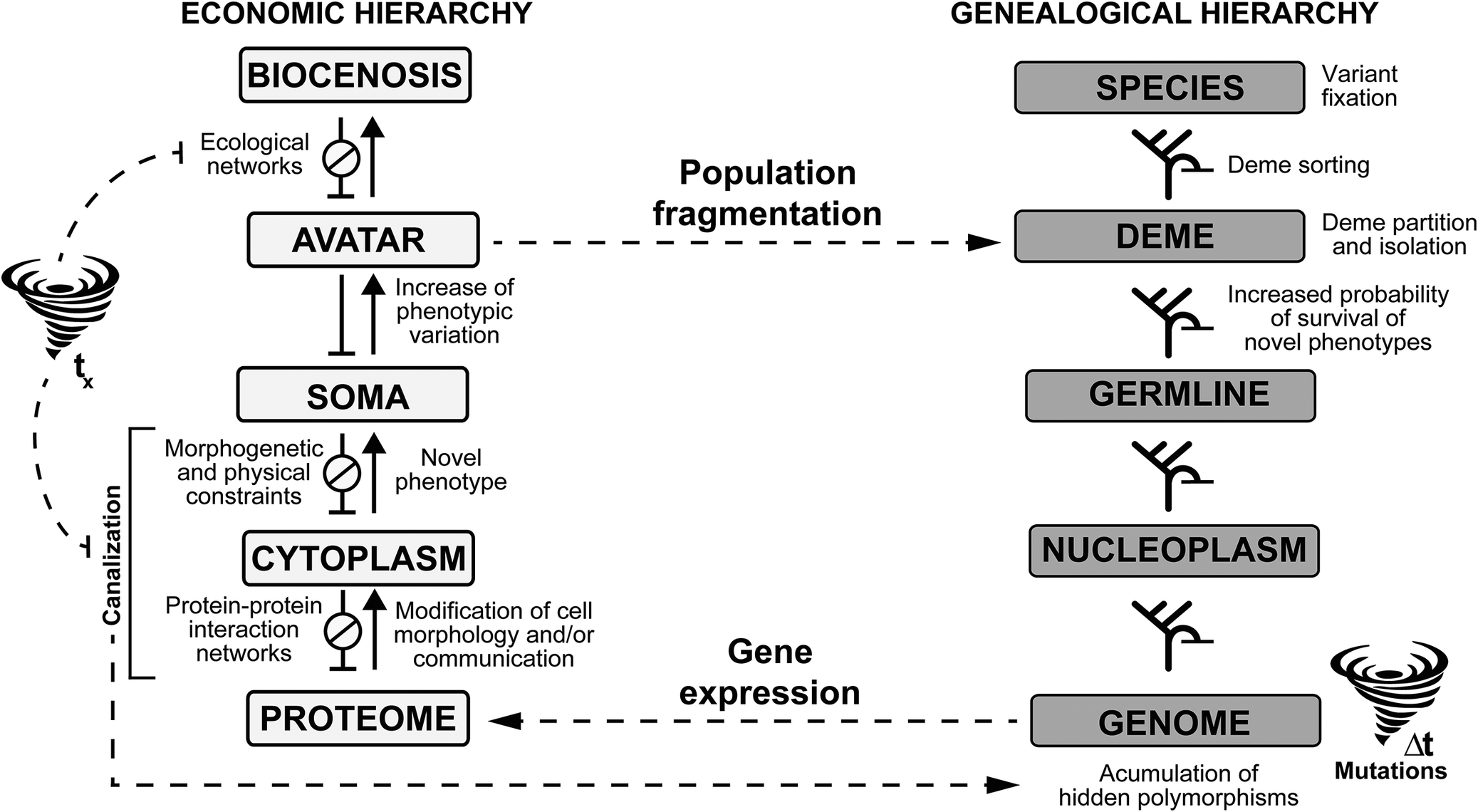
Such extensive disturbances at the biocenosis level impact multiple lineages simultaneously, irrespective of their phylogenetic affinities. As evidenced in the fossil record, the observed pattern of synchronous, cross-lineage, species-level transitions (“turnover pulses”; Vrba Reference Vrba1985, Reference Vrba1993; Foote Reference Foote2005; van Dam et al. Reference van Dam, Abdul Aziz, Ángeles Álvarez Sierra, Hilgen, van den Hoek Ostende, Lourens, Mein, van der Meulen and Pelaez-Campomanes2006) entails a relatively rapid and intense period of taxonomic and ecological restructuring. The breakdown of ecological networks leads to unchecked fluctuations in population demographics, driven largely by stochastic processes as avatars, former members of the collapsed biocenosis, opportunistically reconfigure their ecological connections and spatial relationships. Factors influencing the taxonomic composition and ecological configuration of the future biocenosis include phenotypic properties, behavior, stenotopic–eurytopic characteristics, dispersal ability, and population size. Laboratory experiments simulating controlled environmental perturbations have demonstrated context-dependent population responses affecting population size and phenotypic variance, potentially leading to nonlinear positive density-dependent effects in a variable environment (Benton et al. Reference Benton, Cameron and Grant2004).
Turnover pulses serve as the primary force shaping taxic patterns. While predicting a specific species-level response may be challenging due to stochasticity and nonlinear dynamics from perturbation, it typically falls into one of three categories: extinction, speciation, or migration (habitat tracking) (Eldredge Reference Eldredge1995; Miller Reference Miller2002). Additionally, significant destabilization of biocenotic organization allows successful invasion by non-native species, contributing significantly to the emerging new biocenosis and inducing rapid morphological evolution in native species (Freeman and Byers Reference Freeman and Byers2006). The diverse response to population-level perturbation aligns with the empirically derived correlation of taxic origination and extinction rates among clades in the fossil record (Stanley Reference Stanley1979, Reference Stanley1990): geographically restricted, especially endemic, species are expected to originate and become extinct at a higher rates than more geographically widespread species.
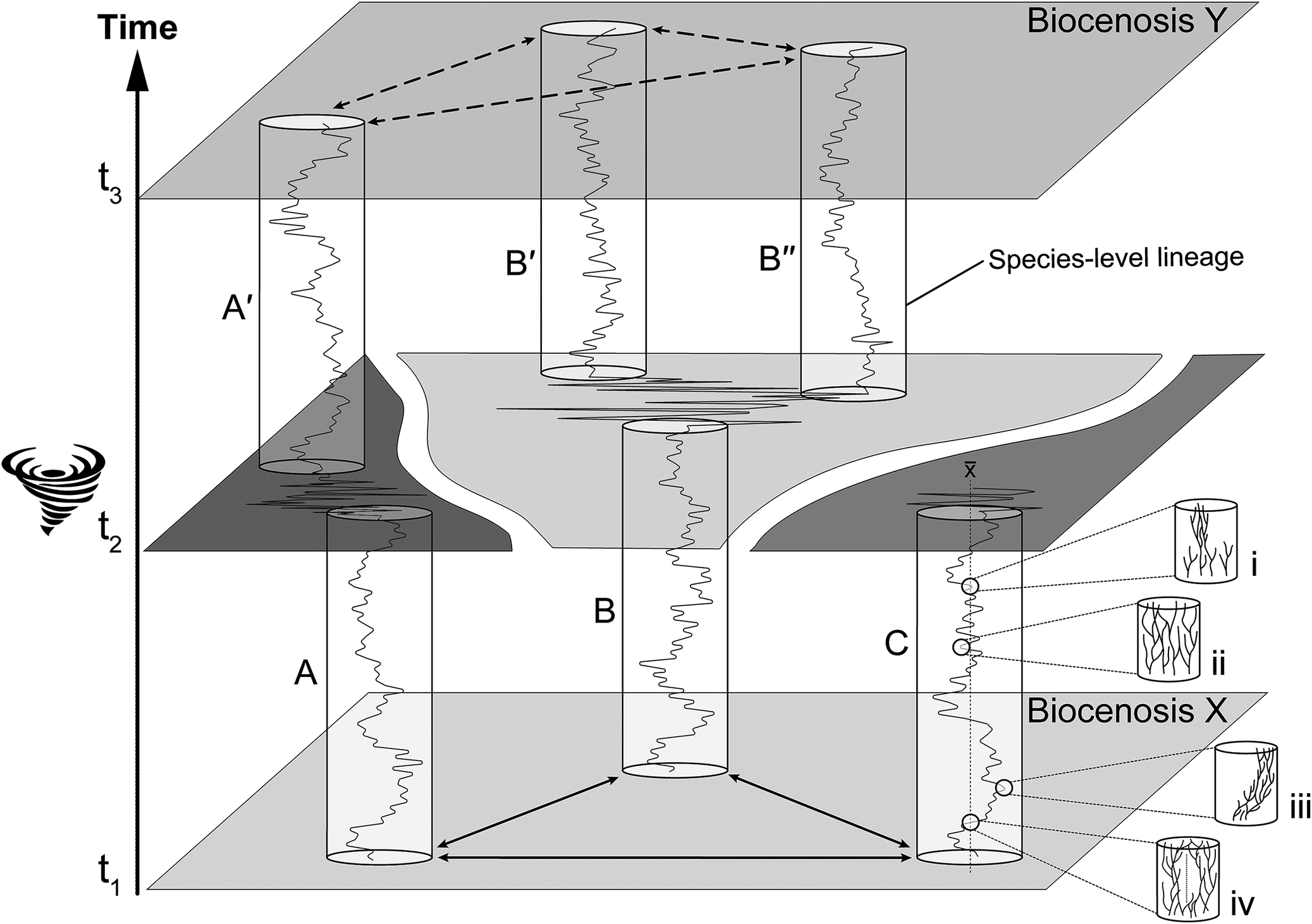
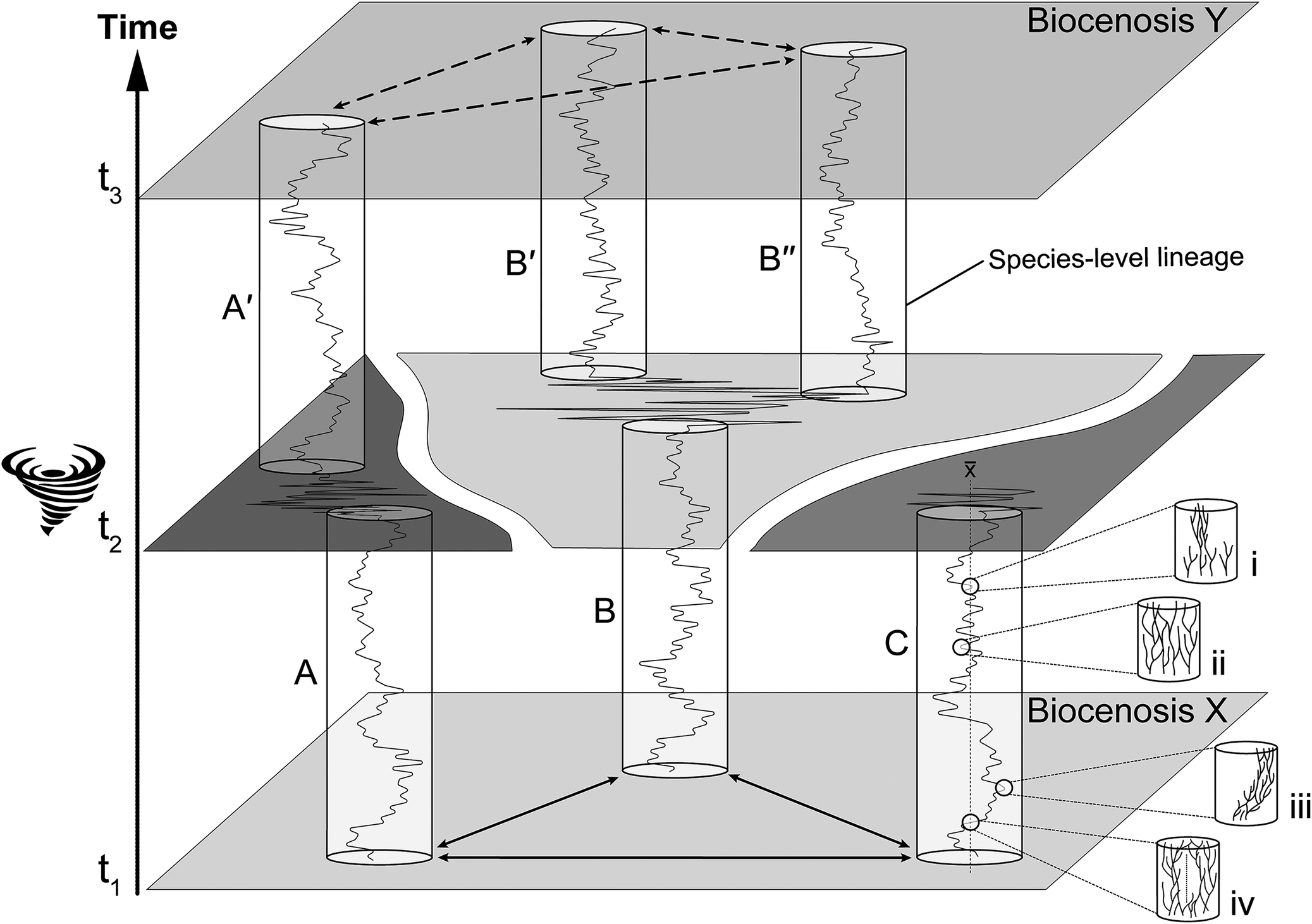
In summary, speciation is an integrated outcome of biological systems’ responses to partially temporally decoupled perturbations across different levels of the economic hierarchy (Figs. 3, 4). Environmental perturbations both generate molecular-level variation and allow the expression of hidden phenotypic variance by compromising evolutionary capacitance. The spread and fixation of novel genotypes, crucial for taxic evolutionary patterns, are facilitated by the temporary removal of control over population dynamics through environmentally triggered disruption or destabilization of ecological networks at the biocenosis level. The evolutionary contingency of life’s history is chiefly influenced by stochasticity and nonlinear dynamics during the flux of biocenotic processes.
Punctuated equilibria in the hierarchical perspective. The diagram depicts the evolution of three hypothetical ancestral species-level lineages (vertical cylinders A, B, and C). During a prolonged period of environmental stability (t 1–t 2), species’ lineages maintain morphological stasis within the biocenosis X, maintained by the ecological network (double-headed solid arrows). At the population level, component demes exhibit various patterns—decline (i), stability (ii), directional change (iii), and divergence (iv)—without long-term consequences (indicated by the oscillations around a mean). Environmental perturbation (whirlpool symbol) triggers hidden polymorphisms, increasing morphological variance (indicated as increased amplitude of the oscillations beyond the normal range) and temporarily destabilizing the biocenosis (at t 2). During this window, population demographics undergo unchecked fluctuations, facilitating the spread and fixation of novel genotypes. Intensive ecological reconfiguration leads to a turnover pulse, resulting in speciation (A′, B′, and B″ lineages) and extinction (lineage C). The nonequilibrial regime transitions into a new equilibrial state (biocenosis Y) with locally optimal configurations of species A′, B′, and B″ stabilized by a new ecological network (double-headed dashed arrows).
The Efficacy of the Hierarchy Theory of Biology
The hierarchy theory of biology presents a distinctive and comprehensive framework for understanding the complex organization of living systems and their evolution. It uniquely conceptualizes life as a series of nested hierarchies, wherein each level operates with its own dynamics, contributing to the overall robustness and stability of biological systems. Unlike traditional approaches, this theory highlights two distinct but interrelated hierarchies: the economic hierarchy of interactors, focused on energy and matter exchange, and the genealogical hierarchy of replicators, centered on lineage formation and information transmission. By distinguishing between these hierarchies, the theory offers novel insights into the intricate interactions that drive evolution, framing it as the emergent pattern of differential persistence among systems in response to disruptions. This perspective not only unifies diverse biological phenomena under a single conceptual model but also provides new avenues for exploring the mechanisms underlying the organization and evolution of life across multiple scales.
The hierarchy theory provides a formal approach to addressing questions of evolutionary causation by offering a theoretically and operationally unified framework. This approach unravels the causal processes behind evolutionary patterns by identifying the individuals involved and their properties, the hierarchical levels they occupy, and the interactions both within and across these levels, as well as between the two hierarchies. The following outlines the steps for this formal investigation of causality.
-
1. Identifying the focal level(s) in the genealogical hierarchy: determining the specific level(s) within the genealogical hierarchy where the evolutionary pattern of interest is observed;
-
2. Identifying relevant entities and attributes: pinpointing the entities at the focal level and identifying the specific attributes relevant to the evolutionary pattern being studied;
-
3. Classifying attributes as emergent or aggregate: assessing whether these attributes are emergent properties unique to the entities at the given level or are aggregate products of lower-level attributes;
-
4. Determining the source of attribute variation: establishing whether the variation in these attributes arises from sorting of lower-level traits or through new variations introduced at the focal level;
-
5. Identifying influential levels in the economic hierarchy: identifying the levels and entities within the economic hierarchy that can directly influence the fate of replicators by sorting variants or modifying their attributes at the focal level in the genealogical hierarchy; and
-
6. Exploring cascading effects of causation: investigating the potential indirect effects of upward and downward causation from more remote levels in the economic hierarchy that could impact variants at the focal level in the genealogical hierarchy.
The conceptual framework articulated herein uniquely encapsulates the entirety of the organic world, predicated on the foundational axiom that life manifests a hierarchical structure. Despite its apparent self-evidence, this hierarchical framework has curiously occupied a relatively modest role in biological theory. Characterized by a concise set of fundamental ontological principles, the hierarchy theory of biology not only furnishes an articulated model delineating the composition and organization of the biological realm but also delineates explicit assumptions concerning the classes of dynamic processes intrinsic to this structure. It maintains agnosticism toward specific mechanisms, and its generality necessitates a heightened ontological clarity and conceptual transparency to facilitate a more profound integration across the life sciences.
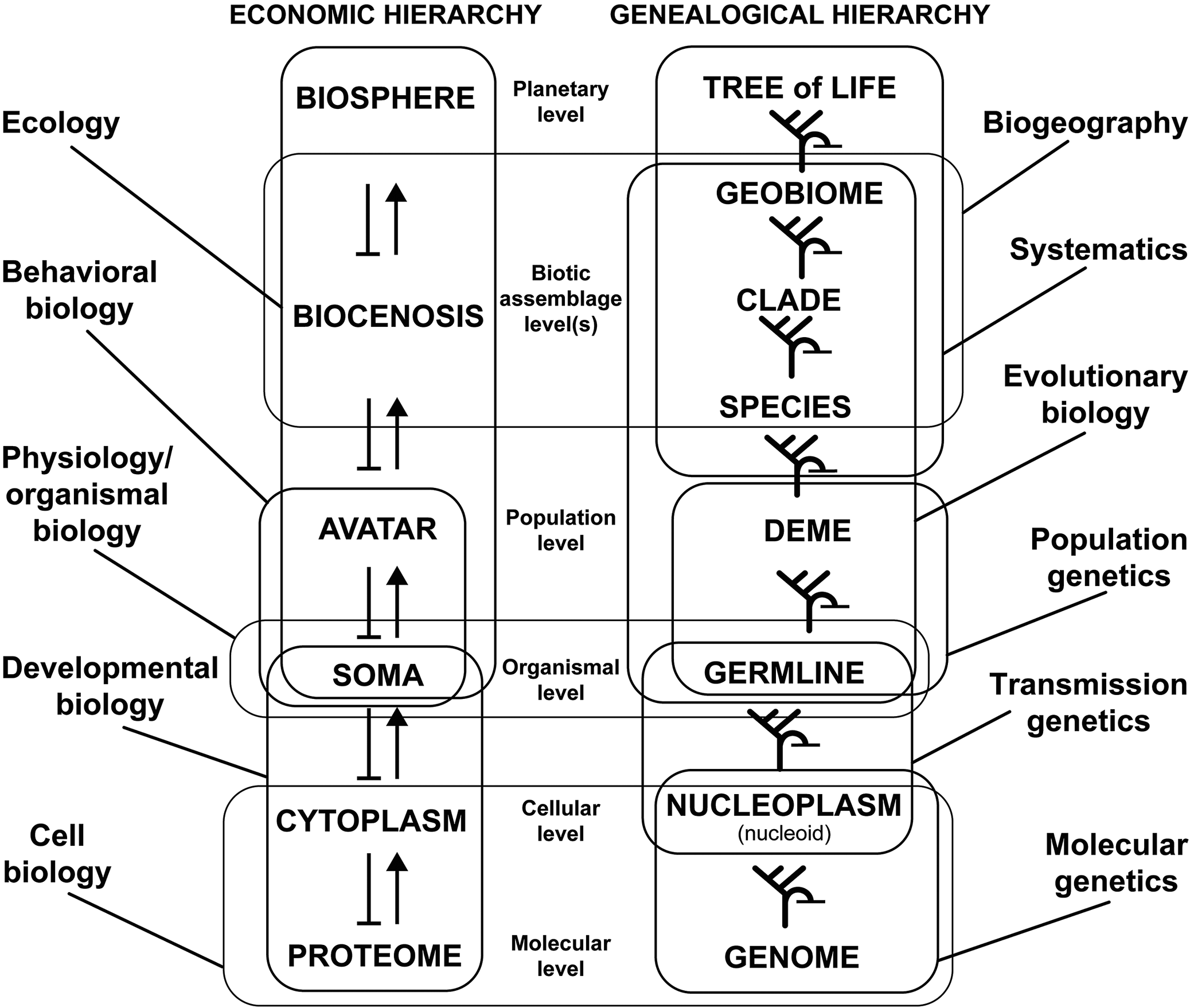
While firmly grounded in extant empirical evidence and being in agreement with well-established concepts and empirically verified generalizations, the hierarchy theory of biology extends beyond the scope of existing data, providing explanatory frameworks capable of accommodating a diverse spectrum of phenomena. Its inherent flexibility facilitates the harmonious integration of various biological models and theories into a unified perspective, offering novel perspectives for hypothesis generation, structuring debates, and elucidating connections among theories spanning diverse disciplines (Fig. 5).
The interconnectedness of major branches within biology and their alignment with the overarching hierarchical model of biological systems. The domains of the disciplines in the context of the biological hierarchy are identified by the principal living systems they focus on and the underlying body of distinct theoretical frameworks. Refer to Fig. 1 for a more accurate depiction of level structure in the dual hierarchical model.
As exemplified by the elucidation of the speciation process discussed earlier, the hierarchy theory furnishes a theoretically and operationally cohesive framework, systematically unraveling the causal processes underpinning the generation of evolutionary patterns. This entails the identification of involved entities, their properties, the hierarchical levels they inhabit, and their intricate interactions within and across levels, bridging the two hierarchies seamlessly.
It is crucial to acknowledge that the general hierarchy theory of biology presented here does not arrogate itself as the exclusive or definitive general biological theory. Nor does it assert the infallibility of all its assumptions, acknowledging the potential for substantial revision in light of empirical data. Nevertheless, its core tenets have engendered an enduring intellectual tradition within paleobiology (reviewed by Grantham Reference Grantham, Briggs and Crowther2001; Myers and Saupe Reference Myers and Saupe2013), inspiring investigations across different disciplines (see contributions in Eldredge et al. [Reference Eldredge, Pievani, Serrelli and Tëmkin2016] and Congreve et al. [Reference Congreve, Falk and Lamsdell2018]). In the context of evolutionary theory, the hierarchy theory provides a more ontologically coherent and self-consistent alternative to the idea of the extended evolutionary synthesis (e.g., Pigliucci and Müller Reference Pigliucci and Müller2010), the most comprehensive to date attempt to provide a unified conceptual framework to a broad spectrum of evolutionary phenomena. Moreover, the dual hierarchical structure of the organic realm is being increasingly used as a conceptual explanatory framework for cultural evolution in our own species (e.g., Eldredge Reference Eldredge, Prentiss, Kuijt and Chatters2009; Tëmkin Reference Tëmkin, Brooks, DiFrisco and Wimsatt2021; Rosenberg Reference Rosenberg2022), albeit a review of development lies beyond the scope of the present contribution. In this regard, the hierarchy theory of biology stands as a bona fide paradigm in the Kuhnian sense, shaping the trajectory of inquiry and fostering interdisciplinary exploration (Kuhn Reference Kuhn1962).
Acknowledgments
I thank B. Lieberman and the organizers of the “Punctuated Equilibrium: 50 Years” symposium at the Geological Society of America Annual Meeting in Denver, Colorado (9–12 October 2022) for the invitation to present the initial iteration of this contribution. I express my thanks to A. Spiridonov for fruitful discussion of biological hierarchies, and the anonymous reviewers, whose recommendations significantly enriched this contribution. I am indebted to N. Steare for preparing Figure 2. Also, I express my gratitude to N. Eldredge for his profound insights and engaging discussions over the course of many years that helped the development of this paper.
Competing Interests
The author declares no conflicts of interest.

 Open access

