




Introduction
Global aging is associated with increasing incidence and prevalence of chronic conditions including dementia, with an estimated 152 million persons living with dementia by 2050, more than 2.5 times the number in 2019 (Nichols et al., Reference Nichols, Steinmetz, Vollset, Fukutaki, Chalek, Abd-Allah, Abdoli, Abualhasan, Abu-Gharbieh, Akram, Hamad, Alahdab, Alanezi, Alipour, Almustanyir, Amu, Ansari, Arabloo, Ashraf and Vos2022). In 2019, Alzheimer’s disease and other forms of progressive dementia (e.g., frontotemporal, Lewy body) were reported as the world’s seventh leading cause of death (World Health Organization, 2020). Persons living with dementia (with any specific diagnosis) can experience impaired ability to find their way (impaired spatial orientation), with an estimated 6 in 10 individuals wandering at least once in the course of their disease (Alzheimer Association, 2022; Hillier et al., Reference Hillier, Harvey, Conway, Hunt and Hoffman2016). It is common for persons living with dementia to have wayfinding challenges, and this critical wandering, wandering that results in walking with impaired orientation to time and place, may ultimately result in getting lost and going missing (Algase et al., Reference Algase, Moore, Vandeweerd and Gavin-Dreschnack2007; Puthusseryppady et al., Reference Puthusseryppady, Manley, Lowry, Patel and Hornberger2020).
Missing incidents among persons living with dementia, including repeat incidents, have a large impact on this population and the wider community. From 2016 to 2017, nearly 24 per cent (~68,500 cases) of adults (not necessarily only those living with dementia) reported missing in the United Kingdom (UK) were repeat cases (National Crime Agency, 2019). In Canada, first responders are responsible for locating a missing person and this task is among the most time and resource intensive for police services given the personnel required and time-sensitive nature of a search (Fyfe et al., Reference Fyfe, Stevenson and Woolnough2015). The reduction and prevention of repeat missing person incidents has the potential to decrease the burden on police resources (Harris & Shalev Greene, Reference Harris and Shalev Greene2016; Huey et al., Reference Huey, Ferguson and Kowalski2020) and reduce the risk (including serious injury and death) for persons living with dementia (Huey et al., Reference Huey, Ferguson and Kowalski2020; Murata et al., Reference Murata, Takegami, Onozuka, Nakaoku, Hagihara and Nishimura2021). Missing incidents may also have severe emotional consequences for persons living with dementia and their circles of care, with increased rates of institutionalization after a missing incident (Shalev Greene et al., Reference Shalev Greene, Clarke, Pakes and Holmes2019).
Strategies, such as technologies (e.g., GPS trackers) and alert systems (e.g., Purple Alert), can help prevent a missing incident or aid in locating a missing person living with dementia (Alzheimer Scotland, n.d.; Neubauer et al., Reference Neubauer, Lapierre, Ríos-Rincón, Miguel-Cruz, Rousseau and Liu2018). However, few strategies focus specifically on preventing missing incidents in persons living with dementia. Among dementia-related missing incidents, a significant proportion of care partners take little or no steps to prevent future missing incidents (Bowen et al., Reference Bowen, McKenzie, Steis and Rowe2011). Approaches that support persons living with dementia and their care partners after an incident, such as connecting them to community support services, could mitigate risks of going missing again.
Similar experiences of getting lost and going missing apply to other populations, such as youth (Harris & Shalev Greene, Reference Harris and Shalev Greene2016). To address the high rates of repeat missing incidents among youth populations, some police services in the UK have implemented return-home interviews (Harris & Shalev Greene, Reference Harris and Shalev Greene2016). These interviews, which are also known as return discussions (as used throughout this paper), are in-person dialogues conducted between a returned missing person and a service provider (Harris & Shalev Greene, Reference Harris and Shalev Greene2016). In fact, return discussions must be offered to all returned missing children in the UK. Initial checks immediately after being found or returning home (to confirm safety) are typically conducted by police. However, the longer return discussions conducted by non-police personnel (e.g. charity worker, person independent to the care of the youth) occur within 72 hours of a child’s return (Harris & Shalev Greene, Reference Harris and Shalev Greene2016; The Scottish Government, 2017). Questions asked (e.g., what happened during the incident? How did you return home? Who were you with while away?) during a return discussion assist service providers in investigating underlying reasons for the missing incident such as issues with health or radicalization (Harris & Shalev Greene, Reference Harris and Shalev Greene2016). By identifying and exploring why a person went missing, service providers can find ways to prevent repeat missing events by connecting the returned missing person to available community supports (Harris & Shalev Greene, Reference Harris and Shalev Greene2016).
For persons living with dementia, a missing incident could indicate issues with wayfinding ability, adequate care, and abuse, among others. According to Rowe, Greenblum, and D’Aoust (Reference Rowe, Greenblum and D’Aoust2012), a missing incident indicates a need for a cognitive assessment as well as the care partner’s capacity to support the person at risk. An understanding of the factors associated with missing incidents may reduce repeat missing incidents and delay or prevent institutionalization. An outcome may be to connect persons living with dementia and their care partners with vital community supports, such as Alzheimer Societies, community-based health professionals, and vulnerable person registries. Given these outcomes, the UK return discussion model, which tries to understand the root causes of the incident and facilitate connections to supports and resources, may fill a potential gap in Canadian practices related to returned missing persons living with dementia.
To date, it is unclear what, if any, information is available regarding the use of return discussions after missing persons living with dementia are found. Thus, the aims of this paper are twofold: (1) present the findings of a scoping review of academic and grey literature on return discussions and (2) understand the current practices for return discussions with persons living with dementia through interviews with first responders and service providers in Canada and the UK. The overall objective is to provide a comprehensive overview of current knowledge and practices related to return discussions.
Methods
This paper consists of two phases: a scoping review and semi-structured interviews. The following methods and results are presented with details of the scoping review first and the interviews next.
Scoping review
Study design
In the scoping review, we used a design based on Daudt et al.’s modification of Arksey and O’Malley’s framework for scoping reviews (Arksey & O’Malley, Reference Arksey and O’Malley2005; Daudt et al., Reference Daudt, Van Mossel and Scott2013). Arskey and O’Malley use six stages: (1) identifying the research question, (2) identifying relevant studies, (3) selecting studies, (4) charting the data, (5) collating, summarizing, and reporting the results, and (6) consulting with experts. Daudt et al.’s modifications include using an interprofessional team in Step 2 and a three-tiered approach to select and crosscheck studies in Step 3. We also followed all elements of the PRISMA-ScR checklist (Tricco et al., Reference Tricco, Lillie, Zarin, O’Brien, Colquhoun, Levac, Moher, Peters, Horsley, Weeks, Hempel, Akl, Chang, McGowan, Stewart, Hartling, Aldcroft, Wilson, Garritty and Straus2018). This approach provided an extensive and comprehensive search and rigorous extraction and analysis processes.
Information sources and search strategy
This review examined academic and grey literature published in any language and year. The search of both academic and grey literature was conducted in July 2022. The search strategy was developed in consultation with health sciences librarians at the University of Waterloo and University of Alberta. We searched 19 databases of academic literature: Sociological Abstracts (via ProQuest), SCOPUS, APA PsycInfo (via OVID), and the University of Alberta Library platform (Academic Search Complete, OAIster, SocINDEX with Full Text, CINAHL Plus with Full Text, Networked Digital Library of Theses and Dissertations, MEDLINE, ProjectMUSE, Business Source Complete, Education Research Complete, University of Alberta Library, ERIC, Health Source: Nursing/Academic Edition, Criminal Justice Abstracts, Science Direct, Directory of Open Access Journals, and Family Studies Abstracts). Search terms included ‘return home interview’, ‘missing’, ‘lost’, and/or ‘runaway’. See Table 1 for an example of a complete search strategy and the supplementary material 1 for all search strategies.
Example of complete search strategy

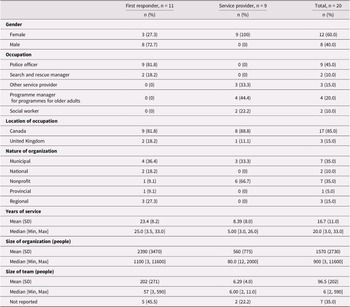
Study participant characteristics

Grey literature was searched across Google.ca Incognito (to reduce bias in searches), Google.ca Advanced (to allow for more detailed searching), and keyword searching across websites identified by Google.ca searches. Search terms included (interview OR Return home interview OR Return interview) AND (missing-person OR missing-persons OR missing-people OR lost-person OR lost-persons OR lost-people). The search was guided and validated by a librarian at the University of Waterloo (Stapleton, Reference Stapleton2022). See the supplementary material 1 for further details.
Source selection
Academic articles were exported to RefWorks for de-duplication and uploaded to Covidence for secondary de-duplication. Two raters (LM and CD) completed title and abstract screening, and then three raters (LM, CD, and EL) reviewed the full texts to determine inclusion eligibility. Each stage of screening was preceded by a calibration of all raters to ensure understanding of inclusion and exclusion criteria. Two raters independently reviewed each article. Conflicts were resolved through consensus and with input from the third rater. Articles deemed ineligible were excluded and the exclusion reason was reported (see Figure 1).
Academic literature review results.

We used Microsoft Excel to keep track of the grey literature using the University of Waterloo Grey Literature Search Plan Template (Stapleton, Reference Stapleton2022). Details of each search were recorded including the database, search terms and strategy, number of results, results for further screening, and URL. See supplementary material 1 for further details.
Inclusion and exclusion criteria
We included articles that were about ‘return home interview’ and ‘missing or lost people’ (and synonyms of these). We included articles in any language, publication year, publication type (peer-reviewed journals, books, book chapters, conference abstracts, dissertations and theses, commentaries, editorials, and research reports), and research method (primary study, literature reviews, and meta-analyses). We excluded articles that 1) did not focus on the collection of information about the missing incident from the missing person or their circle of care after they were found alive, 2) did not include sufficient information for extraction, and 3) were unavailable.
Bias control
We implemented strategies to control bias. We used multiple databases (n = 19) and included publications in any language and any year to minimize publication bias. Three independent raters completed screening and study selection, and two independent raters completed data extraction to minimize rater bias. We controlled for tower of babel bias (only including sources in one language, often English) by including sources in any language (Grégoire et al., Reference Grégoire, Derderian and Le Lorier1995).
Data extraction
Data extracted from the academic sources included information about the return discussions, reference and study information, description of cohorts or population, definitions, and any additional information. Data extracted from the grey literature included information about the return discussions, the source, definitions, and any additional information. See supplementary material 2 for further details.
Data analysis
Data analysis was conducted by LM and EL. Extracted information was verified by a second reviewer to confirm accuracy (LM and EL). Content analysis was conducted to code the data. Coded data were also verified by a second reviewer (LM, EL, or CD) before descriptive statistics were calculated. Verification by the second reviewer for accuracy revealed minor differences in extraction and coding (e.g., typos) and ambiguity in the source, in which case, a team-wide discussion took place with decisions applied to any already coded data.
Semi-structured interviews
Individual interview analysis used a qualitative descriptive design (Sandelowski, Reference Sandelowski2000). Qualitative description is appropriate when the study purpose is to give a basic description and summary of people’s experiences (Kim et al., Reference Kim, Sefcik and Bradway2017).
Participant characteristics and recruitment
Participants (n = 20) were first responders or service providers who had experience working with persons living with dementia involved in a missing incident or conducting return discussions with returned missing persons of any age. Eligible first responders included police and search and rescue personnel. Eligible service providers included social workers, support workers, health professionals, and staff of community organizations. Participants were required to be 18 years of age or older and speak English.
Participants were recruited through existing professional networks among those affiliated with the Aging and Innovation Research Program at the University of Waterloo, through relevant professional associations (e.g., social work associations) and through social media (e.g., Twitter and LinkedIn). We were interested in the Canadian context; however, our scoping review revealed that there was little Canadian-specific information. In contrast, our review revealed a wealth of information from the UK. Thus, we limited participants to Canada and the UK. Prospective participants were invited to contact a team member to express their interest, after which they received a study overview, information letter, and consent form by email. A videoconference or phone interview was scheduled with each participant. At the start of the interview, interviewers re-explained study procedures and the informed consent letter, answered questions, and recorded verbal consent. This study received ethics clearance from the University of Waterloo Research Ethics Board (REB#42310).
Data collection
Data were obtained through semi-structured individual interviews from October 2020 to February 2022, and these were conducted by telephone or videoconferencing. Each interview was conducted by two of the following four female researchers: undergraduate-level research assistants (EL and LM), a research assistant professor (CD, Ph.D.), and one project manager (CC, MEd). Interviewers received training from expert qualitative researchers on the team (LL and CD), and two interviewers were present at each interview. Prior to the interviews, researchers provided participants with the interview guide (six questions with additional probes) allowing time to reflect on relevant topics (see supplementary material 3 for the interview guide). The interview guide was extensively reviewed by a panel of experts on the team. During the interview, researchers administered the guide and used probes to encourage participants to elaborate or clarify their responses. Interviews were between 30 to 90 minutes, were digitally recorded, and then transcribed and deidentified. Participants were recruited until saturation was reached, that is no new information was presented in the interviews. Because data collection and analysis were completed concurrently and iteratively, the team was able to determine when saturation was reached. Specifically, given that we had high quality of data (clear audio recordings with transcripts checked) and a large amount of useful information from each participant (interviews ranged from 30 minutes to 2 hours), after discussion with the team, we believed that saturation had been reached with the final three interviews not yielding significant new information (Mayan, Reference Mayan2009). Our sample also exceeded recommendations for participant numbers in similar interviews (Hennink & Kaiser, Reference Hennink and Kaiser2022).
Data analysis and rigour
Conventional content analysis (Hsieh & Shannon, Reference Hsieh and Shannon2005) guided data analysis, and NVivo 12 R1.6 (QSR International Pty Ltd., 2020) was used to manage the data. One researcher (LM) coded transcripts. Data collection and analysis were concurrent and iterative. The researcher first used Microsoft Word to annotate (write initial thoughts or questions about the data) the interview transcripts. These were discussed to generate codes allowing the grouping and comparison of data. After coding was completed in NVivo, the team categorized the data inductively and generated category descriptions to describe their contents and themes that represented the categories. Finally, categories were organized into general themes (Mayan, Reference Mayan2009).
The research team followed Lincoln and Guba’s (Reference Lincoln and Guba1985) credibility, transferability, dependability, and confirmability criteria (Korstjens & Moser, Reference Korstjens and Moser2017) to ensure the trustworthiness. Specifically, we used peer debriefing for credibility (Barber & Walczak, Reference Barber and Walczak2009) and an audit trail for dependability and confirmability (Korstjens & Moser, Reference Korstjens and Moser2017). Peer debriefing (Barber & Walczak, Reference Barber and Walczak2009) took the form of weekly team meetings to discuss and scrutinize potential codes, coding hierarchies, and themes and to determine if saturation was reached. Peer debriefing also helped to improve clarity, internal, and external homogeneity of codes and categories (Mayan, Reference Mayan2009). It also allowed us to consider alternative interpretations and explanations, which also promotes researcher reflexivity (Barber & Walczak, Reference Barber and Walczak2009). The audit trail contained documentation of meetings and decisions made. These decisions were reviewed during the analysis to consider how these influenced interpretations and findings.
Results
Scoping review
Source selection
The academic search identified 1,493 articles; after removing duplicates, 841/1,493 (56.3%) articles were retained and screened. Eight hundred of 841 articles (95.1%) were excluded in the title and abstract screening phase. Forty-one articles underwent full-text review, and 30/41 articles (73%) were excluded in this phase. In total, 11 articles were included for data extraction (Figure 1). The level of agreement between the raters was high during title and abstract screening (96.1% accuracy, Cohen’s Kappa = 0.57, and prevalence-adjusted bias-adjusted Kappa (PABAK) = 0.96) and moderate during full-text screening (53.7% accuracy, Cohen’s Kappa = 0.40, PABAK: 0.46). Given this moderate agreement, we added additional processes for papers with a disagreement. Specifically, we involved all members of the research team when making final decisions following rounds of discussion and training. A total of 94 grey literature sources were identified in the grey search. All 94 sources were included for data extraction.
Descriptive analysis
Among the 11 included academic articles, the overall number of participants reported was 215 and male/female per cent distribution was 48/52 (103/215). Most (6/11, 55%) were related to children or youth. None were specific to persons living with dementia nor to older adults (55+ years of age). Almost all articles (9/11, 82%) did not report participants’ medical conditions. Study types included original investigation (6/12, 50%) and reviews (4/12, 33%). Study designs varied; each article reported a different design (see Table S1 in supplementary material 4). Most articles did not report geographic location (8/11, 73%); those that were reported include the UK (2/11, 18%) and the U.S. (1/11, 9%). The most frequent terminology used for return discussions was Return Interview (8/11, 73%). Other terms included Functional Assessment; however, these represented less than 30 per cent of the total terms found. The most frequent purpose for conducting return discussions was to understand the causes of the incidents (8/11, 73%), identify support needs (3/11, 27%) and confirm the safety of the individual (3/11, 27%) (supplementary material 4 – Table S2).
Of the 94 grey literature sources included, the majority (61/94, 65%) were related to children/youth. Geographically, return discussions most commonly took place in England (27/56, 48%). The most frequent terminologies used for return discussions were Return Home Interview (35/125, 28%) and Return Interview (28/125, 22%). Other terms included Independent Return Interview and Safe and Well Check; however, these represented less than 15 per cent of total terms found. The most frequent purposes for conducting return discussions were to provide support (45/191, 24%), understand causes of a missing incident (44/191, 23%), and understand what happened during the missing incident (41/191, 22%) (see Table S3 in supplementary material 4).
Protocols for return discussions
Table S2 in supplementary material 4 provides information from the academic articles directly related to the protocols of return discussions. These included: (1) who conducts the return discussion, (2) when they are conducted, (3) where they are conducted, and (4) how they are conducted. The most frequent provider of return discussions was police (5/19, 26%) followed by a social worker or community organization employee/volunteer (each at 3/19, 16%). Most articles did not provide details about the timing of return discussions (6/11, 55%). Of the articles that did report on the timing of the return discussions, most suggested that they should be completed within a specific time frame (e.g. within 72 hours and within 5 days, see Table S2 in supplementary material 4) (3/11, 27%). Information regarding where return discussions take place included geographical locations (see overall insights) and venues. Only 2/11 articles (18%) reported on the specific venue, and these included family home, foster care placement, residential placement, and school. Return discussions were most frequently conducted in-person either as a single event (2/6 reported, 33%) or multiple events (2/6 reported, 33%). Only one article reported information on the questions asked during return discussions, and the authors reported that open-ended questions were used.
The grey literature included information about (1) who conducts the return discussion, (2) when they are conducted, (3) where they are conducted, (4) how are they conducted, (5) what questions are asked, and (6) how they are asked. Not all studies reported elements of these five categories of information. The denominators represent the numbers from sources that did report the specified information. The most frequent organizations conducting return discussions were charities (e.g. Missing People) (31/75, 41%) followed by police (24/75, 32%). Regarding the role or profession of the individual conducting the interview, an independent person (e.g. any person the returned missing person has no relationship with and a person that is not involved in their care) was the most frequent person conducting return discussions (24/48, 50%). The timing of return discussions was most frequently within 72 hours of the missing person returning home (21/33, 64%). Discussions took place slightly more often in a venue outside of the person’s home (4/7, 57%) than inside the missing person’s home (3/7, 43%). Modes of conducting return discussions included a fixed form in physical or electronic format (2/4, 50%), one-on-one (1/4, 25%) versus multiple people, and in-person (1/4, 25%) versus telephone or videoconferencing. The most frequent questions asked during return discussions were about people’s experiences during the missing incident (16/42, 38%) and causes of, or contributing factors to the missing incident (13/42, 31%). Both open-ended (3/5, 60%) and forced choice questions (2/5, 40%) were asked (Table S4 in supplementary material 4).
Semi-structured interviews
Results of the qualitative study are presented as follows: participant information, purpose of return discussions, features of current return discussion practices, and facilitating conditions for return discussions.
Participants
We interviewed 20 participants who were first responders (n = 11) and service providers (n = 9) in Canada (n = 17; Ontario, British Columbia, Alberta, and Nova Scotia) and the UK (n = 3; Scotland and UK as a whole). These included police officers (n = 9), search and rescue managers (n = 2), social workers (n = 2), managers of programmes that serve older adults (n = 4), and other service providers (n = 3; e.g. care coordinator and community education specialist). Participants worked for municipal (n = 7), non-profit (n = 7), regional (n = 3), national (n = 2), and provincial (n = 1) organizations. Participants worked for organizations that served large catchment areas. All participants except one had experience working with older adults and persons living with dementia. The one participant who did not had experience conducting return discussions with other populations. Table 2 describes participant characteristics.
Current practices
In Canada, no formal return discussion practices were in place. While return discussions were reported to be mandatory for children in the UK, a few municipalities also conducted return discussions with adults. Specific to returned missing persons living with dementia, there were no reported standardized practices across Canada or the UK. However, there were communities and organizations that had practices with similar goals and features. Participants addressed the following topics: (a) the purpose of the practices, (b) the features of the practices, and (c) facilitators for return discussions.
Purpose of return discussion approaches
Participants identified that the main purpose of return discussions was to reduce repeat incidents. One participant stated, ‘we can explore in more depth the reasons for which they went missing and to make sure that those reasons are addressed, so that they are not at risk of going missing, again, in the future’ (Participant 16, UK service provider). However, this was further divided into three main areas of action: check on well-being and safety, collect information for future use, and offer support.
Check on well-being and safety
First responders and service providers may connect with persons at risk of going missing again in-person or via telephone to check on their well-being and safety. In some cases, such as when safe and well checks are requested or concerns about the decision-making capacity of the person living with dementia arise, first responders or service providers are tasked with checking on the safety and well-being of a person at risk of going missing again and believe the person is at risk due to reduced ability to make decisions for themselves.
[In] those reassurance call programs, we do a check in call with clients who maybe are isolated, who might not have somebody checking in on them, it’s just like a safety check. We would call them in the morning, try and reach them. If we can’t reach them, then we try and call them throughout the day to see what’s going on. And if we can’t reach them, by like, mid-afternoon, we try to call their emergency contacts to see if they know where they are, or to check on them if we can’t get there for some reason. If, for some reason, we can’t find an emergency contact and it’s unusual for that client to miss a call, we might go out and do a wellness check or call the police to have them go out and do a wellness check (Participant 9, Canadian service provider)
Collect information for future use
Information collected in a return discussion after a missing incident can be archived in a database. This information (e.g. previous work locations and preferred modes of transport) may be accessed by first responders and service providers to provide background information that may inform how a search may be conducted in the case of a repeated incident.
There’s a standardized form, so a [FORM NAME] form that would be completed. And again, a prescriptive information to kind of capture, you know, what were the circumstances to the - the location of the person and information that can be collected, and obviously, it would be retained in our [POLICE DATABASE]. So if there’s any type of situation moving forward, there’s at least some type of material that can be referred back to on this previous occurrence (Participant 6, Canadian service provider)
Offer support
First responders and service providers work with the person of concern and/or their circle of care to determine what support may be required to meet the person of concern’s and/or the circle of care’s needs related to supporting safety and well-being, reducing repeat incidents, and ultimately aging in place. Some support services offered by first responders and service providers take an upstream approach by identifying issues before they turn into missing incidents. The upstream approach prevents an incident from happening by putting long-term strategies in place.
Protect and provide some assistance. If … and where needed. A lot of the times it’s the caregiver not knowing that there’s services and programs available to them. Sometimes we deal with caregiver fatigue. And in addition to assisting the clients, I also try to assist the caregiver and letting them know what’s available to help them respite-wise as well. And in doing so, it kind of helps everybody - helps the whole unit in moving forward. (Participant 5, Canadian Social Worker)
Features – the how – of return discussions
Participants identified features of existing practices similar to return discussions. However, no participant was aware of any standardized practice protocol for conducting, recording, or using return discussions in Canada. Below are themes and examples of who, when and where, and what related to return discussions.
Who is involved in return discussions
Participants stated that people involved in a return discussion should be a facilitator, the returned person, and anyone in the person’s circle of care as appropriate. The facilitator was often reported to be a first responder or service provider. While the specifics of who should facilitate return discussions were not clear, participants generally agreed that they should have dementia-specific training and experience working with returned missing persons. In the UK, ‘independent persons’ conduct discussions with children to ensure that it is someone not directly involved in the care of the child. The facilitator should not have a conflict of interest, and should consider any power differential with the person.
What I tend to look for is people who have experience working with seniors, people who have experience working with mental health. I don’t want to hire somebody who’s going to be surprised by that, right? To be surprised by the types of things that they might encounter. Or I look for people who have an educational background in social service work, or social work, or community justice, or those kinds of things because oftentimes, those people will have been exposed to that “we don’t judge people for their life choices” sort of thing. We’re really big on enabling people to stay at home and letting them live with dignity and how they choose to live. (Participant 9, Canadian service provider)
Participants stated that, whenever possible, the person who was missing should be involved in the discussion as they have the lived experience and a unique insight into the incident and their needs. Also important is to include members of the circle of care, such as family, friends, health care professionals, or staff of care homes. Some persons living with dementia cannot respond to the discussion questions because of cognitive and communication challenges. Thus, discussions should be conducted with others who can tell the story to uncover the factors leading up to the incident, people’s needs, and how to best support people.
She didn’t know how long she was – she had a rest and – and then she walked and then somebody – people ran into her. She doesn’t – she didn’t know how long she was gone for. She couldn’t say where she had gone. So, I think that that’s going to be common in those situations. You do tend to get more information from dealing with the caregivers of the families, this, you know, the spouses, the sons. If it’s a facility, then somebody from the facility that can kind of give you some information, some background. (Participant 10, Canadian First Responder)
Participants stated that an important consideration in determining who to involve in a return discussion is the process of establishing trust. Consent is an ongoing process and should be obtained from all parties involved.
When and where
Participants reported that the ideal timing for return discussions to take place is as soon as possible after a missing person is returned. Early timing is important as the details of the incident may be forgotten over time. However, this should be balanced with ensuring the returned missing person is safe and well and able to discuss what occurred. Participants reported that within 72 hours of the missing person’s return home, as per the statutory guidance in the UK, it is common practice. Participants also suggested that perhaps during a missing incident, the discussion could begin with the circle of care.
So, we’re able to offer support to the family who were waiting, we were able to help them connect to other supports, sharing information as approved, and try to, you know, do some brainstorming about what happens next, because once the person is found, unless they need to go to hospital, they’re going to go home, and home may not be ready. They may not have the strategies and the interventions in place in order to support that person. So, we try to help with that, you know, first 24 to 48 hours when everything kind of seems out of kilter, because the, you know, this traumatic event has occurred, and now they’ve got to figure out, “what do we do next? (Participant 15A, Canadian service provider)
Participants did not provide standard locations for return discussions. They stated that it should take place where the person is most comfortable and may be inside or outside of a main residence. Inside the home may provide more information for the facilitator to identify areas of support; however, being outside of the home environment may allow participants to speak more freely.
You know, an assessment done in an office is going to be – can be quite different than an assessment in the home environment, just like this. So, you can see the different types of things that they would be dealing with on a daily basis that gives you a much more holistic, global view of their life. And it gives you a glimpse into their past. So, you can – you might see pictures on the wall, and then you can start, you know, asking them about that. So, for instance, we had a person who was wanting to always – who had been in the military and the military base is on the opposite side of [PROVINCE]. So, this person was wanting to get back to the military base. And so, that was – that was the driving force. (Participant 15B, Canadian service provider)
What is explored
Participants identified two main topics of discussion during a return discussion: the incident and the person in context. Given the non-standardized nature of return discussions, there were no specific interview questions or guides that organizations followed. Discussions should be free flowing and adapt to each person and situation, including the method of the discussion (e.g. in-person and over the phone), data collection and storage, and collaboration between first responder and service provider teams.
The incident. First responders and service providers would review the events surrounding the missing incident, including potential causes. The analysis of an event could include the how, when, where, why, and who of an incident from the perspective of the person who was missing, and of a care partner. Sometimes, such an analysis may reveal signs of abuse.
The person who was missing. Participants stated it was important for the person facilitating the discussion to understand the individual and current context. This includes one’s current living situation, health status, and support. Facilitators may explore what additional support the person may benefit from and offer assistance accessing that support.
…we’re just trying to establish, you know, what’s your current kind of living situation? How are things going in your home? Do you have family or friends that you connect with regularly? How are you getting your food? Are you finding that you need more care in terms of your personal needs? We’re just trying to get a bit of a snapshot of what could be happening in the home. (Participant 7, Canadian service provider)
Facilitating conditions for return discussions
All participants identified key conditions for effective return discussions. These cover three levels: the system level, the organization level, and the person and family level (see Figure 2).
The return discussion bridge.
Note. Three pillars of facilitating conditions for return discussions to bridge individuals and support/resources: the person themself, the organization conducting return discussions, and the system within which they exist. If any of these pieces are absent, limited, or tenuous (e.g., circle of care not willing to participate in return discussion, organization at maximum capacity, and no information sharing between relevant organizations), individuals may not be connected to the support they need.

At the system level, the facilitating conditions were having a standardized protocol to pull from and privacy laws that allow for referrals and information sharing with consent thereby preventing siloed systems.
I think that it would probably be helpful if we had a – if we had a more standardized approach, if everybody was aware of, you know, what resources – if every officer – I’d like to say that all of them are well aware of what’s out there and what’s available to people and that they could share that with – but I don’t think that’s the case, likely. So, we could probably do with a little more training. (Participant 10, Canadian first responder)
At the organization or provider level, facilitating conditions include creating a specific scope of practice for return discussions, as organizations that provide return discussion usually provide other important services, and improving training and experience, as providers require ongoing professional development resources.
…it’s really up to – the officer that shows up there might have 20 years on the job or they might have two years on the job and there’s not really – there’s not a great deal of training that we have in this field. So, it’s really subjective on whoever’s showing up and whoever might be, you know, better versed to collect that information. But a good – a good officer who asks the right questions should be able to document, you know, where they’re likely to be found, how often they’ve gone missing in the past, that should all be in the report so that the next time that that person goes missing, whether it’s our dispatcher or the officer in charge should be able to bring up that report and say – and direct officers, “check this location. This is where they used to live. They take the bus off in check.” So, we’re able to do that but we do that fairly well. Assuming that the – the – the report was written detailed first time. (Participant 10, Canadian first responder)
Facilitating conditions at the person and family level are physical and mental well-being, as they may face health challenges, stress, and trauma after a missing incident, and an openness to being interviewed, which can be encouraged through clear communication and trust building.
Discussion
This study aimed to provide a comprehensive overview of return discussions as they exist in the academic and grey literature as well as an understanding of the current practices for return discussions with persons living with dementia in Canada and the UK. It identified existing purposes, protocols, procedures, and facilitating conditions. The scoping review found very little literature relating to return discussion with adults, with none being specific to persons living with dementia. However, some of the common and best practices used with returned missing children have the potential to be adapted to adults and persons living with dementia. The interviews in this study provide details on day-to-day practices similar to return discussions in Canada, where no federal or provincial mandates exist, and in the UK where return discussions are mandatory for children. Taken together, the findings from this study provide insight for the first time on current practices and explore how existing practices can be adapted to returned missing persons living with dementia.
From the literature, little information was available on the location and how return discussions were conducted. These gaps were addressed through the semi-structured interviews. Interview participants identified a range of current practices across Canada and provided insight into details of how return discussions run in practice in the UK. Specifically, practices are similar in terms of purposes of discussions, as well as practical details such as who conducts the discussions (police/first responders and independent persons/service providers), who is involved (the returned missing person and their circle of care), where discussions take place (in the home or a separate neutral location), and what is explored during a discussion (events leading up to incident, during an incident, and support needed). Participants also shared barriers that should be addressed for successful return discussions with persons living with dementia within a Canadian context.
Persons living with dementia are adults who have a ‘right’ to be missing (Rowe et al., Reference Rowe, Vandeveer, Greenblum, List, Fernandez, Mixson and Ahn2011). They can choose to be absent from the places they are expected to be and are not required to inform anyone of their chosen absenteeism. Even when they cannot live independently, persons living with dementia may become missing because of a choice to leave the area away from a care partner or caregiver, possibly due to agitation. Rowe et al. (Reference Rowe, Vandeveer, Greenblum, List, Fernandez, Mixson and Ahn2011) found that in 2 per cent of missing incidents involving persons living with dementia, care partners were aware that their loved one had chosen to leave. Returned missing persons living with dementia have a right to decline participation in a return discussion. If there are questions about the capacity of a person living with dementia, a health practitioner should be consulted to assess the person’s capacity (Hegde & Ellajosyula, Reference Hegde and Ellajosyula2016). A person’s decision-making capacity and legal right to be missing pose challenges to be considered in the development of a return discussion protocol.
If persons other than the returned missing person (e.g., family members) are to be consulted during a return discussion, the person living with dementia should first be asked for consent. The philosophy ‘Nothing About Us Without Us’ (Charlton, Reference Charlton1998) reminds discussion facilitators that no part of a return discussion should be conducted without consent and direct involvement of the person living with dementia or their care partner(s), or both. Not only should a person living with dementia consent to consultation with others involved in their care, but any collected information should be shared with the individual. If a person living with dementia does not consent to the involvement of persons in their circle of care, this choice must be respected. As mentioned, it is assumed a person living with dementia has the capacity to make decisions until evidence suggests otherwise (Hegde & Ellajosyula, Reference Hegde and Ellajosyula2016). If a person with dementia does not have the capacity to consent to participation in a return discussion, the process of consent should include a substitute decision-maker (e.g. a care partner) while still including the person with dementia.
It is possible that the returned missing person and care partner(s) may disagree on participation in a return discussion. A care partner may not want the person with dementia to participate in a return discussion if abuse or neglect is taking place. The Alzheimer Society of Canada reports that as much as 10 per cent of older adults are abused (Alzheimer Society of Canada, n.d.). Even if a person living with dementia consents to participation, care partner(s) may influence them to retract the consent. Further, if a care partner does not agree with the participation of a person with dementia in a return discussion, the care partner may withhold functional support such as driving them to the location of the discussion. For care partners, a missing loved one can be an emotionally exhausting life event (Shalev Greene et al., Reference Shalev Greene, Clarke, Pakes and Holmes2019). Care partners may choose to decline participation in a return discussion because they are overwhelmed by the recent experience of the missing event and their loved one’s return home. Return discussion protocol regarding interviewing returned missing persons and their care partners should be informed by literature that addresses conducting interviews with persons living with dementia (e.g., McKillop & Wilkinson, Reference McKillop and Wilkinson2004), their care partners, and persons who have experienced recent trauma (e.g., Rohan, Reference Rohan, Brenda and Watkins2018).
First-time missing incidents should raise questions about how a person with dementia and the care partners are coping. In a retrospective review of missing incidents among persons living with dementia enrolled in the Safe Return programme (a programme designed to support the safe return home of lost persons living with cognitive impairment), Rowe and Glover (Reference Rowe and Glover2001) found that many (93%) incidents were first-time events. Further, the majority of individuals enrolled in Safe Return who went missing were not reported to the police (Rowe & Glover, Reference Rowe and Glover2001). Accuracy of repeat missing person events is challenging because care partners may not report every missing event for reasons including guilt and fear of judgment from police (Shalev Greene et al., Reference Shalev Greene, Clarke, Pakes and Holmes2019). Return discussions provide an opportunity for the returned missing person and care partners to disclose and discuss prior unreported missing events. The guilt and exhaustion of care partners should also be considered during and after the return discussion as it may limit the information provided and willingness to consider recommendations. Return discussions should be a starting point for connection for persons living with dementia, their care partners, and the community support resources, not a stand-alone event.
Not all persons living with dementia have family or friends who quickly recognize that they are missing (Adekoya et al., Reference Adekoya, Daum, Neubauer, McLennan and Liu2021). Persons living with dementia may live alone, possibly in rural or remote locations. Isolated persons living with dementia have reduced support networks (Adekoya et al., Reference Adekoya, Daum, Neubauer, McLennan and Liu2021). During the COVID-19 pandemic, circles of care and support networks for persons living with dementia may have been reduced further due to restrictions on travel and visits. The connection of found missing persons living with dementia and their care partners with community support services, such as local Alzheimer Society chapters, could be a helpful process in return discussion protocol to prevent future incidents. Community support services exist to help a person living with dementia and care partners manage difficulties and risks associated with lost incidents. The issue may not be that communities lack support services for persons living with dementia, but that people are not aware of the resources. Community services offered by local police, such as vulnerable persons registries and the Herbert Protocol (The Herbert Protocol, n.d.), expedite information gathering and search processes and support police in assisting vulnerable persons, such as missing persons living with dementia (York Regional Police, n.d.). Additionally, community alert systems, such as Purple Alert (implemented in Scotland), share identifying information with community volunteers to support locating a missing person living with dementia as quickly as possible (Alzheimer Scotland, n.d.). Finally, home care services may also be effective as the care partner may be struggling to cope or the person living with dementia is struggling to thrive at home. Home care occupational therapists and health care aides or personal support workers who can assist with activities of daily living may be beneficial. Community support services such as these are designed to assist community members but are only effective if used. Adding to this difficulty is that many of these supports exist in silos; therefore information is not easily shared between them. Awareness of existing community support services in found missing persons living with dementia and their families and access to these supports aided by return discussions, are a critical step towards mitigating future missing incidents.
Although police services were reported to conduct return discussions, the literature identified challenges. Police personnel face difficulties meeting public demand for law enforcement; police may lack resources and time to conduct adequate return discussions with returned missing persons (Morris, Reference Morris2010). Public attitudes towards police may not always be positive. If a returned missing person has a negative perception of police, there may be reluctance to talk openly with police about their missing incident or accept support from them. Victim Services units within police organizations may be positioned to conduct return discussions. Sometimes employing volunteers, Victims Services are specially trained to follow up with victims of crime and connect them to community support services. Another alternative to frontline officers are police Mental Health units. These units employ specially trained officers who work with persons living with mental health challenges (Ottawa Police Service, n.d.). In collaboration with mental health clinicians such as nurses and social workers, the Mental Health unit connects people with community support services (Ottawa Police Service, n.d.). A follow-up with returned missing persons could be included within Victim Services or Mental Health portfolios.
Social workers could also conduct return discussions with returned missing persons living with dementia. Both Tanner (Reference Tanner2013) and Manthorpe (Reference Manthorpe2016) highlight the emerging area of work between social workers and persons living with dementia, including providing support to community services designed for this population. Social workers already work alongside other professions, such as police or health clinicians, and connect vulnerable populations to community support services. In Ontario, Canada, at least two police organizations partner with social workers to serve vulnerable populations, such as older adults and persons living with mental health issues (Ottawa Police Service, n.d.; York Regional Police, n.d.). In some areas of the UK, although it is police officers who conduct return discussions with returned missing persons, social workers are responsible for using the information collected to connect the returned missing person to community support services (The Scottish Government, 2017).
Little information was provided in the literature on how return discussions are conducted including the specific physical location where they are conducted, the modes used to conduct them, and how questions were asked. More details on specific practices were obtained during the semi-structured interviews compared to the literature; however, practices vary widely. McKillop and Wilkinson (Reference McKillop and Wilkinson2004) emphasize the importance of place when interviewing persons living with dementia and suggest the person living with dementia be involved in choosing the location. McKillop and Wilkinson (Reference McKillop and Wilkinson2004) also provide guidance for conducting in-person interviews; however, conducting return discussions in-person may not be practical in some circumstances. In Canada, the percentage of persons living in rural areas range from 14 per cent to 53 per cent across provinces and territories (Statistics Canada, 2018). In rural areas, community service jurisdictions, such as police, can cover several hundred kilometres of land, creating accessibility challenges. Therefore, it may be more practical to conduct return discussions over the telephone or use an online video conferencing platform if the returned missing person has access to technology and is capable of using it. Open-ended questions may facilitate a conversation between the return discussion provider and the returned missing person, supporting the return discussion provider’s understanding of the missing incident and the community support services the returned missing person may benefit from. More than one discussion may be required to prevent future missing incidents.
This review examined existing literature on return discussions and investigated existing approaches, including purposes and procedures, in Canada and the UK. As there is no academic or grey literature source offering a comprehensive definition of return discussions, we propose a working definition based on our understanding of the review and interview findings; return discussions are a public service offered to missing persons within 72 hours of their return and are discussions (facilitated by service providers, such as police or community organizations) that seek to explore and understand a person’s missing incident in order to identify community support services that could support the returned missing person’s safety and well-being, to ultimately prevent future missing incidents.
Limitations
While this paper provides a comprehensive overview of both the literature and current practices regarding return discussions and similar approaches, it has limitations. First, the availability of academic literature on return discussions was scarce and only 11 articles were included in the review. Second, although we searched 19 academic databases and conducted an exhaustive search of the grey literature, it is possible that not all relevant academic articles and grey literature sources were identified, perhaps due to return discussions being referred to using a different descriptive name of which we were not aware. Also, we were unable to locate 6 articles (2 books (from 1993 and 1987), 1 dissertation (from 1975), 2 journal articles (from 1998 and 2019), and 1 grey literature website article (from 2016)); future work could reach out to authors to try and access these materials. Third, while our interviews did reach saturation, they may not be representative of all approaches across Canada and the UK. Further, we did not consider perspectives outside of these regions.
Future research
We found no standardized approaches to discussions with returned missing persons living with dementia in Canada. However, this paper provides insights into how similar approaches are conducted. Future research on return discussions could focus on creating a standardized procedure or guide and evaluating its implementation protocols. Postdiscussion interventions, such as referral to community services and types of services, could be evaluated for impact on preventing future missing incidents or helping people live safely in their communities for longer periods of time. Future work should also investigate the direct perspectives of persons living with dementia and their care partners on return discussions and what is explored in them (e.g., current needs and past experiences). Finally, continued research on return discussions with any missing population would benefit from harmonization of terminologies used to describe these discussions or interviews.
Conclusion
The risks of serious injury and death that missing persons living with dementia face present an opportunity for adoption of better processes focused on preventing repeat missing incidents. Return discussions have the potential to reduce repeat missing incidents by supporting people and their care partners to connect to community support services after a missing incident. Return discussions with persons who have dementia are not common practice according to the literature, and current Canadian approaches vary widely. As global populations age and missing incidents increase among persons living with dementia, it is time to apply and evaluate strategies used to mitigate missing incidents.
Supplementary material
The supplementary material for this article can be found at http://doi.org/10.1017/S0714980824000382.
Acknowledgements
We thank Hamsana Gnanathasan, who assisted in grey literature search; Samantha Marshall, who helped with screening articles; and Liz Dennett, librarian, University of Alberta, who advised on the search strategy conducted by the members of the team. This work was funded by the Government of Canada, Search and Rescue New Initiatives Fund (SAR NIF), and Aging Gracefully across Environments using Technology to support Wellness, Engagement, and Long Life Networks of Centres of Excellence (AGE-WELL NCE) [grant number AWCRP08-2020].
Declaration of conflicting interest
The authors declared no potential conflicts of interest with respect to the research, authorship, and/or publication of this article.



 Open access

