




Introduction
The Late Neolithic period of southern Scandinavia (2350–1700 BC) is best known for its elaborately knapped bifacial flint artefacts (Figure 1; Lomborg 1973) and the revival of metal import (Figure 2; Vandkilde Reference Vandkilde1996); but is also characterised by the construction of numerous two-aisled post-built houses (e.g. Sparrevohn et al. Reference Sparrevohn, Kastholm and Nielsen2019) and the intensification of cereal cultivation (e.g. Andreasen Reference Andreasen2009; Prescott Reference Prescott, Prescott and Glørstad2012; Johannsen Reference Johannsenin press). With the increasing importance of metal, in particular, the Late Neolithic is often seen as a prelude to the Nordic Bronze Age. The latter is characterised by the construction of burial mounds and monumental houses, the creation of rich deposits of imported metal artefacts in hoards and graves, and marked variation in burial wealth (Nilsson Reference Nilsson1994; Holst et al. Reference Holst, Rasmussen, Kristiansen and Bech2013; Bergerbrant Reference Bergerbrant2017), which are interpreted as evidence for the development of a steep social hierarchy during the Bronze Age (1700–1100 BC).
Dagger of Lomborg Type IV. The dagger, which is approximately 200mm long, is part of a hoard containing eight other daggers and a sickle. The hoard was found during fieldwork in Betarp, Burseryd parish, Småland, in the south-western part of Sweden (see Johannsen Reference Johannsen and Mandrupin press) (photograph by author).

Four bronze axes found at the edge of a bog at Havholmgård on the outskirts of Skibby in northern Zealand, Denmark. The three smallest axes were produced in Scandinavia, while the largest is probably from Bohemia in Czechia. The axes are typologically dated to the last phase of the Late Neolithic/Early Bronze Age I (photograph by Kristian Grøndahl/ROMU).

There has been much discussion about the degree to which social hierarchy had already begun to emerge during the Late Neolithic of this region (see Table 1). The lack of consensus around this question may, in part, be explained by the equivocal nature of some of the archaeological features typically associated with elite groups, such as elaborate graves and material culture, that are documented for the southern Scandinavian Late Neolithic.
Different interpretations of Late Neolithic social structure. Partly after Vandkilde (Reference Vandkilde1996: fig. 278).

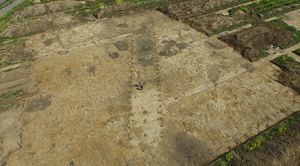
The emergence of monumental houses around 2000 BC is one of the key points of reference in these discussions (Figure 3). These houses are suggested to represent the presence of ‘big men’, leaders or chieftains (Nielsen Reference Nielsen and Fabech1999: 162, Reference Nielsen, Sparrevohn, Kastholm and Nielsen2019: 29; Kristiansen Reference Kristiansen and Sjögren2006: 184; Artursson Reference Artursson2009: 192) and are sometimes even referred to as ‘halls’ (Poulsen Reference Poulsen and Brattli2009: 162–63; Iversen Reference Iversen2017: 368), implying the combined role of elite residence, feasting hall and temple similar to the halls of the Late Iron Age or Viking period (Herschend Reference Herschend1993; Bradley Reference Bradley2021: 183).
The monumental house from Vinge (photograph by Martin Hamberg/ROMU).

The interpretation of these houses as halls is based on their large size—sometimes above 45m in length. Although rarely explicitly stated, the underlying logic is that such monumental structures were built to impress, serving as tangible and permanently visible manifestations of the social power and its ability to organise labour (e.g. Earle Reference Earle1997: 156–58; Bradley Reference Bradley2021). Similarities between these southern Scandinavian monumental houses and those of the contemporaneous Early Bronze Age Central European Únětice culture are often cited to support this interpretation; again, based on their size, the latter have been suggested to be elite residences (Nielsen Reference Nielsen and Fabech1999: 159–63; Poulsen Reference Poulsen and Brattli2009: 164; Johannsen Reference Johannsen2017; Küßner & Wechler Reference Küßner, Wechler, Meller, Friederich, Küßner, Stäuble and Risch2019; Nielsen et al. Reference Nielsen, Nielsen and Stilborg2022: 256). Thus, the interpretation of the monumental houses focuses almost exclusively on their size, while discussion of the actual function or functions is generally neglected.
The present article moves beyond the focus on size by turning to the function of these monumental houses to examine the implications for their interpretation and their significance within Late Neolithic society. Evidence from the six largest known Late Neolithic houses in southern Scandinavia is reviewed; these are selected as the clearest examples of potential elite residences, following the reasoning above. The function of these houses is reinterpreted from their internal organisation and associated finds, and conclusions are placed within the wider cultural and economic context of the Late Neolithic of southern Scandinavia.
The largest Late Neolithic houses of southern Scandinavia
The six largest Late Neolithic houses excavated to date in Scandinavia are located at five different sites, all in Denmark: Vinge, Sydvej 2, Stuvehøj Mark, Hemmed Plantation and Limensgård (Figure 4).
Distribution map of monumental Late Neolithic houses discussed in the text. 1) Vinge; 2) Sydvej 2; 3) Stuvehøj Mark; 4) Hemmed Plantation; 5) Limensgård (figure by author).

Vinge: Eight Late Neolithic houses have been excavated at Vinge, near Frederikssund in northern Zealand. The largest, measuring 45.5 × 7.2m, covers an area of approximately 320m2, twice the size of the second largest house at the same site (Figure 3). The house is divided into two aisles by the central postholes, with smaller postholes positioned close to the walls indicating subdivisions (Johannsen Reference Johannsen2017: 17–18). Three rooms—one large and two smaller—and a narrow entrance room can thus be distinguished in the western part of the house. Together, the largest room and the smaller room to the east correspond to the layout of the smaller, so-called Fosie-type houses, found throughout southern Scandinavia during the Late Neolithic and first identified at the eponymous settlement of Fosie in southern Sweden (Figure 5; Björhem & Säfvestad Reference Björhem and Säfvestad1989; Johannsen et al. Reference Johannsen, Sparrevohn, Krüger and Torfingin press a). Charred material, including grain, was recovered from the postholes of the largest room in the Vinge house, indicating the location of a fireplace and the use of the room for food preparation. Based on its size and the evidence for heating and food preparation, this room is interpreted as the main living quarters. The eastern end of the house had a sunken floor and appears to have been a large, open room. Only a few flint tools, some flint debitage and a small number of pottery sherds were recovered from this room, providing limited information about its function. The identification of the western end of the house as the main living quarters makes it likely that the large eastern room had a different function, possibly for stalling of livestock and/or grain and winter fodder storage. The house is radiocarbon dated to the years immediately after 2000 BC (see Figure 6; Johannsen Reference Johannsen2017; Johannsen et al. Reference Johannsen, Sparrevohn, Krüger and Torfingin press a).
Alignment of central posts with posts recessed from the side walls is interpreted as evidence for internal walls in Fosie-type houses. Similar room division can be found in five of the six houses discussed in this article and is exemplified here by comparison between a house from the eponymous site of Fosie (above, after Björhem & Säfvestad Reference Björhem and Säfvestad1989) and the monumental house from Vinge (below, elements corresponding to the smaller house marked in grey, after Johannsen Reference Johannsen2017).

Available radiocarbon dates from monumental Late Neolithic houses in Denmark (figure by Emil Winther Struve/ROMU).

Sydvej 2: The settlement of Sydvej 2, located between Roskilde and Copenhagen, featured a 44m × 7.5m two-aisled house. As at Vinge, the house included a large room in the western end with a smaller room to the east. Finds from the house include a small quantity of pottery, flint debitage and a fragment of a shaft-hole axe, as well as charred wheat and barley grains. A single radiocarbon analysis broadly dates the house to the centuries around 2000 BC (see Figure 6; Sparrevohn et al. Reference Sparrevohn, Kastholm and Nielsen2019: cat. no. 45).
Stuvehøj Mark: This settlement, located near the town of Ballerup in north-eastern Zealand, consisted of two two-aisled houses, of which House 32 is estimated to be 47 × 7m. A bifacial crescent-shaped sickle was recovered from one of the central postholes (Figure 7). The house is typologically dated to the Late Neolithic II (1950–1700 BC) or Early Bronze Age I (1700–1500 BC; Sparrevohn et al. Reference Sparrevohn, Kastholm and Nielsen2019: cat. no. 21).
Crescent-shaped bifacial sickle found in one of the central posts of the large house from Stuvehøj Mark (drawing by Kenneth Paulmann/Kroppedal Museum).

Hemmed Plantation: The two-aisled House I from the settlement of Hemmed Plantation in eastern Jutland was 45 × 8m, covering 360m2 and making it the largest documented Late Neolithic house in Scandinavia. Again, the house has a large room in the western end with a smaller room to the east, resembling the layout of a Fosie-type house. The remains of a fireplace were identified in the largest room, and the possible remains of another fireplace at the east end of the house. Finds include the hilt of a Type IV dagger, flint debitage, pottery sherds, the bones of oxen and the charred remains of acorns, hazelnuts and cereal grains. The house is dated to the Late Neolithic II by finds and radiocarbon analyses (see Figure 6; Boas Reference Boas1991: 130–31, Reference Boas, Sparrevohn, Kastholm and Nielsen2017: 249–50).
Limensgård: The Limensgård site on the island of Bornholm is unique in that it contains several houses of considerable size dating to the Late Neolithic. The two largest houses are interpreted as measuring respectively 40 × 7.15–7.70m (House S) and 43.5 × 7.5–8.8m (House AB). Both structures have ground plans reminiscent of Fosie-type houses, though the layouts are less distinct here, possibly because houses from several different phases overlap (Nielsen et al. Reference Nielsen, Nielsen and Stilborg2022: figs. 1.5, 4.7 & 4.18). Finds from Houses AB and S include pottery sherds, a few flint tools, flint debitage, grinding stones, fragments of shaft-hole axes and burnt animal bone. Both houses are broadly dated to the Late Neolithic (see Figure 6; Nielsen et al. Reference Nielsen, Nielsen and Stilborg2022: 165–72, 184–91).
In five of these six monumental houses, therefore, the same internal division of space as in the smaller contemporaneous houses of the Fosie-type is found (Figure 5). The remains of fireplaces in the largest room in the western ends of the Vinge and Hemmed Plantation houses suggests these were heated areas and served as main living quarters. This interpretation is supported by the presence of charred grain, possibly deriving from food preparation. Again, the interpretation of these larger rooms located at the western ends of houses as the living quarters corresponds with interpretations of the largest room in Fosie-type houses, where indications of heating have also been recognised (Johannsen Reference Johannsen2017: 18; Johannsen et al. Reference Johannsen, Sparrevohn, Krüger and Torfingin press a). The discovery of sickles (Figure 7), carbonised grain, grinding stones and animal bones all suggest that, besides being dwellings, these monumental structures were also farmhouses.
Given the similarities in room division and material culture, it is therefore suggested that the functions of these monumental houses were essentially the same as those of the smaller Fosie-type houses: they were a combined place of dwelling and a base for the agricultural production of a household, here defined as a group of people collectively engaging in activities essential for their sustenance, encompassing both material and social requirements (Wilk & Rathje Reference Wilk and Rathje1982: 620–21). In other words, it is argued that these houses were simply grandiose versions of typical, but much smaller, Late Neolithic farmhouses. Furthermore, it may, with some caution, be concluded that the phenomenon of monumental, two-aisled houses emerged around 2000 BC and continued into the Early Bronze Age I (see Figure 6). As such, these monumental Late Neolithic houses can be seen as the predecessors of the monumental three-aisled houses, which were constructed from the Early Bronze Age II (1500–1300 BC) and beyond (Nilsson Reference Nilsson1994; Ethelberg et al. Reference Ethelberg, Jørgensen and Meier2000).
The reneolithisation of southern Scandinavia
After a diminution in the importance of agropastoralism, the so-called deneolithisation of southern Scandinavia in the Middle Neolithic B (2800–2350 BC, e.g. Iversen Reference Iversen, Larsson and Debert2013; Nielsen et al. Reference Nielsen, Persson and Solheim2019), the Late Neolithic is characterised by a process of reneolithisation. The monumental farmhouses described above are one of several indications of this agricultural intensification. The bifacial crescent-shaped sickle (Figures 7 & 8), which was primarily used for harvesting cereals, was developed in the earliest part of the Late Neolithic and remained the most common tool type into the Early Bronze Age (1700–1100 BC, Johannsen Reference Johannsen, Sparrevohn, Krüger and Torfingin press a). Soil sampling at Late Neolithic houses demonstrates that spelt was introduced during this period and that a wide range of wheat and barley varieties were cultivated at each settlement (Andreasen Reference Andreasen2009); ard marks further show that fields were routinely worked as part of the Late Neolithic cultivation cycle (Johannsen et al. Reference Johannsen, Sparrevohn, Krüger and Torfingin press a: tab. 5). Agriculture favours sedentism, and the contrast between the limited evidence of two-aisled houses from the Middle Neolithic B and the numerous remains of sturdy, permanent houses dated to the Late Neolithic (Brink Reference Brink2013; Sparrevohn et al. Reference Sparrevohn, Kastholm and Nielsen2019) is thus an indirect but strong indication of the increased importance of agriculture and the (re)introduction of the farmhouse as the hub of food production (Johannsen Reference Johannsen2023: 4).
The Gilbjerghoved hoard from the northern part of Zealand, Denmark contains 26 sickles, 86 sickle preforms, one spearhead and one dagger preform (Type Ix) and is the largest Late Neolithic hoard from southern Scandinavia (photograph by author).

Preservation of animal bones from the southern Scandinavian Late Neolithic is poor, but the importance of animal husbandry is reflected in pollen analyses (Johannsen et al. Reference Johannsen, Sparrevohn, Krüger and Torfingin press a) and further emphasised by the ability of Late Neolithic farmers to cultivate nutrient-hungry crops on the same lean soils across generations, implying extensive manuring (Poulsen Reference Poulsen, Bergerbrant and Wessman2017: 205; Johannsen & Mandrup Reference Johannsen and Mandrupin press). Although hunting, fishing gathering to some extent also contributed to the Late Neolithic subsistence (Andersen Reference Andersen, Holm, Jørgensen and Raun1996; Johannsen Reference Johannsen2021; Johannsen et al. Reference Johannsen, Sparrevohn, Krüger and Torfingin press a) it is thus reasonable to assume that Late Neolithic society was largely based on farming. This process of agricultural intensification and the consequent increase in food production must be understood as the foundation for a boom in population across southern Scandinavia during the Late Neolithic (Nielsen et al. Reference Nielsen, Persson and Solheim2019; Bunbury et al. Reference Bunbury, Austvoll, Jørgensen, Vatsvåg Nielsen, Kneisel and Weinelt2023; Friman & Lagerås Reference Friman and Lagerås2023; Johannsen et al. Reference Johannsen, Laabs, Bunbury and Mortensenin press b).
Subsistence and power
It is generally accepted that surplus food production is required to free up labour for other non-subsistence tasks and thus this surplus is ultimately a prerequisite for a social hierarchy (e.g. Childe Reference Childe1954: 30–31; Sahlins Reference Sahlins1972: 86, 185–91). The labour freed up by surplus food production can be transformed into, for example, monumental construction, elaborate tombs, specialised production and organised armies—all of which archaeologists typically associate with social elites. As Svend Hansen (Reference Hansen, Gimatzidis and Jung2021: 63) has stated, these are all “surplus products which were only possible because their producers were fed by people who produced more than was necessary for biological survival”. It has also been pointed out, however, that there are always potential surpluses available, and it is the ability of institutions to exploit these surpluses, and not the surplus itself, that drives social evolution (Pearson Reference Pearson, Polanyi, Arensberg and Pearson1957: 339; D'Altroy et al. Reference D'Altroy1985: 187). A productive farming economy, capable of supplying a society with plentiful food, is thus not a source of power in its own right, but rather a resource that can be potentially mobilised by aspiring leaders.
In Late Neolithic/Early Bronze Age Scandinavia, it is assumed that the rising demand for bronze became the means by which power centralised into fewer hands. In short, access to metals came to be controlled by leaders who used its redistribution to extract tribute in the form of food and labour, which could in turn be used to extend social control (e.g. Vandkilde Reference Vandkilde1996: 285; Kristiansen Reference Kristiansen and Sjögren2006: 189; Earle & Spriggs Reference Earle and Spriggs2015; Iversen Reference Iversen2017: 370; Hayden & Earle Reference Hayden, Earle, Ling, Kristiansen and Chacon2022). One example is the construction of large seagoing boats, the existence of which in the Late Neolithic is evidenced by direct contact across the Skagerrak—the strait that runs between the Jutland, the east coast of Norway and the west coast of Sweden (Østmo Reference Østmo, Prescott and Glørstad2012). The construction of these boats demanded the mobilisation of large and skilled workforces over long periods. An underlying prerequisite for their construction was thus an agricultural surplus to support the required labour. This surplus was thereby transformed into large, seagoing boats, that could be used for raiding and, perhaps more importantly, trade expeditions, further consolidating the power of the individuals who organised the boats’ construction (Ling et al. Reference Ling, Earle and Kristiansen2018).
However, although a food surplus-generating subsistence base as described above is implicitly recognised as an underlying prerequisite for the emergence of social elites, sustained analysis of subsistence as a key element in the rise of a socio-economic elite within Late Neolithic Scandinavia is, with few exceptions (Kristiansen Reference Kristiansen and Sjögren2006: 184), still largely lacking. It is argued here that it was the agricultural intensification at the beginning of the Late Neolithic which prepared the ground for the increasingly hierarchical organisation of society that accelerated as metal import increased around 2000 BC.
Status among farmers
Humans are inherently socially hierarchical, comparing individual and group status across a range of measures. Status is often signalled by size (Høgh-Olesen Reference Høgh-Olesen2019: 86–88). Who is biggest, strongest or richest? Who has the largest, most expensive car, TV set, house or ice cream? In societies where subsistence is almost exclusively based on agriculture, and hence food production is a prerequisite for the centralisation of power, status may be signalled by the scale of agricultural traits. One example is the fashion for idealised paintings and prints of extraordinarily large cows, pigs and sheep in nineteenth-century Britain (Quinn Reference Quinn1993); these oversized animals were proof of their owners’ skills as animal breeders and thereby acted as status symbols, which were perpetuated (and exaggerated) in artistic representations (Figure 9). Another example is the relationship between large numbers of livestock and large quantities of manure, sometimes expressed through the somewhat peculiar tradition in historic rural Denmark of locating the dunghill in the most visible part on the farm—in the middle of the courtyard or directly facing the road—as a subtle display of wealth (Schmidt Reference Schmidt1939: 724–28).
A pair of pigs, unknown artist, about 1850 (painting photographed by Jamie Woodley, licensed by Compton Verney).

The monumental Late Neolithic farmhouse can be understood in a similar way. The farmhouse served several practical functions as a combined dwelling and agricultural base and was thus a symbol of the structure and organisation of society as a whole. The monumental farmhouse therefore signalled large-scale agricultural production and was a tangible and widely visible display of the wealth and power of the household. Although their agricultural function remained the same as that of smaller, contemporaneous farmhouses, their monumentality is the most explicit expression of the emergence of a farmer-elite in agricultural communities around 2000 BC. That said, in an increasingly hierarchical society, where subsistence goods were the primary means to advance power, the economic system may have been organised around a ‘staple finance’ model, whereby grain and livestock served as payments to leaders (D'Altroy et al. Reference D'Altroy1985). In this context, monumental houses might also have functioned as storage spaces for such tribute; in turn, the size of these storage facilities again acted as an explicit display of the wealth and power of the household.
During the Late Neolithic, metals were imported into Scandinavia from western and central Europe (Nørgaard et al. Reference Nørgaard, Pernicka and Vandkilde2021). In particular, the metal production of the contemporaneous Únětice Culture of central Europe came to exert influence in Scandinavia in the second half of the Late Neolithic (Figure 2). Direct connections between the two areas are reflected in the unique metal objects from central Europe included in the Gallemose (three bronze rods) and Skeldal (beehive box) hoards deposited in Denmark (Vandkilde Reference Vandkilde1988; Randsborg Reference Randsborg1992). The monumental scale of houses in southern Scandinavia and in central Europe have also invited comparisons, with similarities in their two-aisled construction (Nielsen Reference Nielsen and Fabech1999: 159–63; Poulsen Reference Poulsen and Brattli2009: 164; Johannsen Reference Johannsen2017; Küßner & Wechler Reference Küßner, Wechler, Meller, Friederich, Küßner, Stäuble and Risch2019; Nielsen et al. Reference Nielsen, Nielsen and Stilborg2022: 256). It is hardly a coincidence that monumental houses first appeared in southern Scandinavia at the same time as a boom in metal imports from other areas in Europe where monumental houses also existed. The Scandinavian farmers involved in the importation of metal must have known, and probably even seen, how the central European elite expressed their power with extravagant metal artefacts, huge burial mounds and monumental houses. It is reasonable to assume that this knowledge stimulated the construction of monumental houses in southern Scandinavia (Johannsen Reference Johannsen2017: 21–22).
Variations in house size may reflect emerging hierarchies, as competition, and therefore the need for display, is particularly intense in the early stages of power centralisation (Earle Reference Earle1997: 178–79). In Late Neolithic Scandinavia social hierarchy was not yet institutionalised; only the monumental farm of the Limensgård site seems to have had more than a single phase. Given that the wooden houses lasted only one or two generations, sometimes even less (Zimmermann Reference Zimmermann1998: 53–62), these early attempts at power consolidation seem to have been short-lived. This power seems to have dissolved quickly, possibly when the head of the household weakened or died, leaving only the monumental imprint of their former power consolidation behind.
Conclusion
Around 2000 BC, monumental-scale farmhouses first appeared in southern Scandinavia. Similar in their basic functions to small farmhouses, their size signalled significant socio-economic developments. These monumental houses are the most tangible evidence for the rise of a powerful farmer elite who differentiated themselves from the rest of society through the adoption of an architectural form used by the hierarchical, metal-producing societies in central Europe. In this way, the elite signalled their close ties with Únětice societies and the latter's extravagant expressions of power.
Large houses, exotic objects and extensive exchange networks are typically taken to indicate the emergence of elites in prehistoric societies. By focusing on the function, rather than size, of monumental houses, this article has attempted to draw attention to the importance of agricultural production, as a fundamental element in the emergence of elites on the threshold of the Nordic Bronze Age. The expansion of agricultural production in the Late Neolithic formed the foundation for social economic hierarchy at the end of the Neolithic and in the Bronze Age. A productive farming economy, capable of providing sufficient or surplus food, was a prerequisite for mobilising the labour needed to construct monumental houses and large sea-going boats and to engage in the growing metal trade. Monumental houses thereby represented the accumulation of livestock, cereals and winter fodder, which were used in turn to express social power. That the existence of this elite is most clearly reflected by monumental farmhouses underscores the importance of agriculture in Late Neolithic society. The whole of society was involved in farming. Even the dagger-carrying, powerful heads of households—who lived in the monumental houses, had widespread social networks and who travelled long distances to access exotic metals—were first and foremost farmers.
Acknowledgements
Thanks to Emil Winther Struve, Martin Egelund Poulsen, Martin Furholt and Lotte Reedtz Sparrevohn for help and comments.
Funding statement
The present article would not have been possible without financial support from Møller-Clausen Fonden Augustinus Fonden, Aage og Johanne Louis-Hansens Fond and the Kulturministeriets Forskningsudvalg (KFU).


 Open access

