




Policy Significance Statement
Despite the recognized importance of data and statistics for policy efficiency and accountability in achieving the Sustainable Development Goals (SDGs), significant challenges remain in translating them into actionable decision intelligence. While the 2014 World That Counts report advanced global coordination of SDG data production and use—particularly for accountability purposes—it underestimated the requirements for data to have a tangible impact on outcomes. While data supply has increased in volume, velocity, variety, and veracity, policymakers demand and capacity to effectively use this data have not kept pace. To fully realize the impact of the data revolution, this paper reflects on lessons learned and identifies the adapted assumptions needed to unlock greater value for global development.
1. Introduction
Achieving sustainable and inclusive trajectories across human and environmental systems is a core challenge for current and future generations’ wellbeing. The United Nations (UN) Sustainable Development Goals (SDGs), adopted in 2015, provide an ambitious framework with measurable targets. However, since 2020, global progress towards the 17 Sustainable Development Goals (SDGs) has largely stalled, with increasing rates of extreme poverty in many countries (Sachs et al., Reference Sachs, Kroll, Lafortune, Fuller and Woelm2022; United Nations, 2023). Complex socio-environmental challenges, including natural disasters and entrenched disadvantage, are accelerating, while new governance transitions show varied progress in integrating SDG frameworks into national targets and programs (Allen et al., Reference Allen, Malekpour and Mintrom2023).
The SDG agenda is unprecedented in global scope and and integration of 17 goals; success in one area is often contingent on progress in another (Allen et al., Reference Allen, Metternicht and Wiedmann2016; Nilsson et al., Reference Nilsson, Griggs and Visbeck2016). Some challenges are linked to simultaneous international spillovers of the pandemic, climate-related disasters, and geopolitical disruptions (Nature, 2023). While some exogenous factors shape national-level progress, other barriers to policy design and innovation stem from the complexity generated by the interconnected goal framework, requiring the coupling of human, technical, and natural systems (Sachs et al., Reference Sachs, Schmidt-Traub, Mazzucato, Messner, Nakicenovic and Rockström2019).
Emerging at the same time as the SDGs, the data revolution for sustainable development was framed as an additional pathway for ensuring accountability and accelerating the effectiveness of the SDG policy agenda, through better monitoring and measurement of progress and outcomes (Espey, Reference Espey2019a; World Bank, 2021). This article reviews the progress and role of data and statistics in advancing policy and implementation of these goals since 2015.
1.1. Framing the data revolution as a catalyst for the SDGs
As with other global agreements, the SDGs are not legally binding, instead relying on accountability mechanisms enabled through measurable targets and 231 standardized indicators (Biermann et al., Reference Biermann, Kanie and Kim2017). Progress relies on country-driven, bottom-up institutional models reporting to a global high-level political forum. This flexibility allows for adapting the goals to country-specific contexts, but also implies that the main accountability mechanism depends on data and statistical reporting of indicators.
The SDGs were negotiated during a period of global socio-technical change, including expanded access to the internet, mobile phones, satellite imagery, and crowd-sourcing platforms. Their adoption coincided with the rapid increase in the velocity, variety, veracity, and volume of data supply and use, differentiating the pathways to impact from previous eras of sustainable development initiatives (Sachs, Reference Sachs2015). In May 2013, the UN Secretary-General’s High-Level Panel on Post-2015 Development Agenda identified data as one of the core disruptors driving transformations across society and sectors (Yudhoyono et al., Reference Yudhoyono, Sirleaf and Cameron2013). At the time of SDG negotiations, rapid changes to data production and analysis inspired policymakers to assess the future role that data and statistics could play in how governments, companies, and communities design, decide, and implement SDG-related programs (Chatterley et al., Reference Chatterley, Slaymaker, Badloe, Nouvellon, Bain and Johnston2018). These aspirations were being countered by critiques of the costs versus benefits of what amounts to potentially billions of dollars of annual investments into statistical systems (Jerven, Reference Jerven2014). This reflects differing assumptions on the potential value of the data revolution.
1.2. The context for a pathway towards “A World That Counts”
During the design and negotiation of the SDG agenda, the UN Secretary General invited an Independent Expert Advisory Group (IEAG) to prepare a roadmap for how the data revolution could accelerate policy coordination and impact. The group of 25 independent experts drawn from the United Nations, national statistical agencies, universities, NGOs, and private sector organizations convened in the context of wider calls from the international statistical community to advance policy commitment, financing, and political support for data. In 2014, A World That Counts: Mobilizing the Data Revolution for Sustainable Development (WTC) (IEAG, Reference Melamed2014) provided key recommendations for how to mobilize the data revolution to monitor progress, hold governments accountable, and foster sustainable development. The IEAG was working in the wider context of rapidly changing private and public sector data collection and analysis capabilities, framing the opportunity for statistical systems and data as part of the pathways to achieving the global goals.
The WTC principally identified several pathways where data could be an agent of change:
-
1. The Accountability Pathway: Improved data production focused on measurement and monitoring by academics, civil society, and communities themselves would enhance the accountability of government actions and communication with the public. This included recommendations on principles and standards, finance, and leadership.
-
2. The Policy Pathway: Using statistical systems to design more targeted and effective policies and programs for implementation. The increasing availability of high-quality data would provide “the right information on the right things, at the right time,” (IEAG, Reference Melamed2014, p. 2).
The WTC recognized a third pathway through the private sector leveraging the data revolution to spur new economic opportunities. However, the WTC did not provide specific recommendations for how the private sector should act to improve their use of data in ways that advance the SDGs.
The two main pathways, and their underlying assumptions, drew upon lessons from the Millennium Development Goals (MDGs), which highlighted that without adequate disaggregated or community-led monitoring, many issues remained invisible in national policy-making. The WTC report therefore had a strong emphasis on “leaving no one behind” and reaching marginalized communities, including women, youth, people with disabilities, and indigenous communities (Briggs, Reference Briggs2018; Winkler and Satterthwaite, Reference Winkler and Satterthwaite2017). The WTC report focused on the opportunity to accelerate the disaggregation of data to better highlight the position of women (Abreu and Bailur, Reference Abreu and Bailur2018; Cochrane and Rao, Reference Cochrane and Rao2019; Kim, Reference Kim2017), youth (Misunas et al., Reference Misunas, Cappa, Murray, You, Hattori, Beise, Krasevec, Carvajal, Hug, Evans, Petrowski, Murphy, Kumapley, Bain, Andrew Porth and Yu2017), those with disabilities, and indigenous people. More data and better collection were assumed to be crucial for inclusive government programs and policies.
The WTC report outlined recommendations to achieve these outcomes by focusing on both supply and demand for information. The recommendations centered around increasing data production capacity (supply) and enhancing data application to SDG policy and implementation (demand). Achieving these would require increasing financial investments, building data analytics capabilities, and strengthening government and non-government actors’ capacity to leverage information systems.
Inequality between regions and countries was also a strong theme of the SDG negotiations and the data revolution was presented as a means to better monitor and ultimately close those gaps. The WTC recognized data asymmetries between high- and low-income countries, emphasizing the need for increased funding for statistical systems, and more Official Development Assistance (ODA) to build data capacities, especially in Least Developed Countries (LDCs), Land-locked Developing Countries (LLDCs), and Small Island Developing States (SIDS) (IEAG, Reference Melamed2014).
The World That Counts core assumptions
A decade on, national governments and the global data and statistics communities are now reflecting on the distinctive contributions of the data revolution. This article aims to surface the assumptions underpinning global efforts in the “data for development” community, serving as a check on the relevance of recommendations for leveraging the data revolution. If the assumptions no longer hold true, then the WTC recommendations will not lead to the long-term goal of data being “the lifeblood” for SDG attainment.
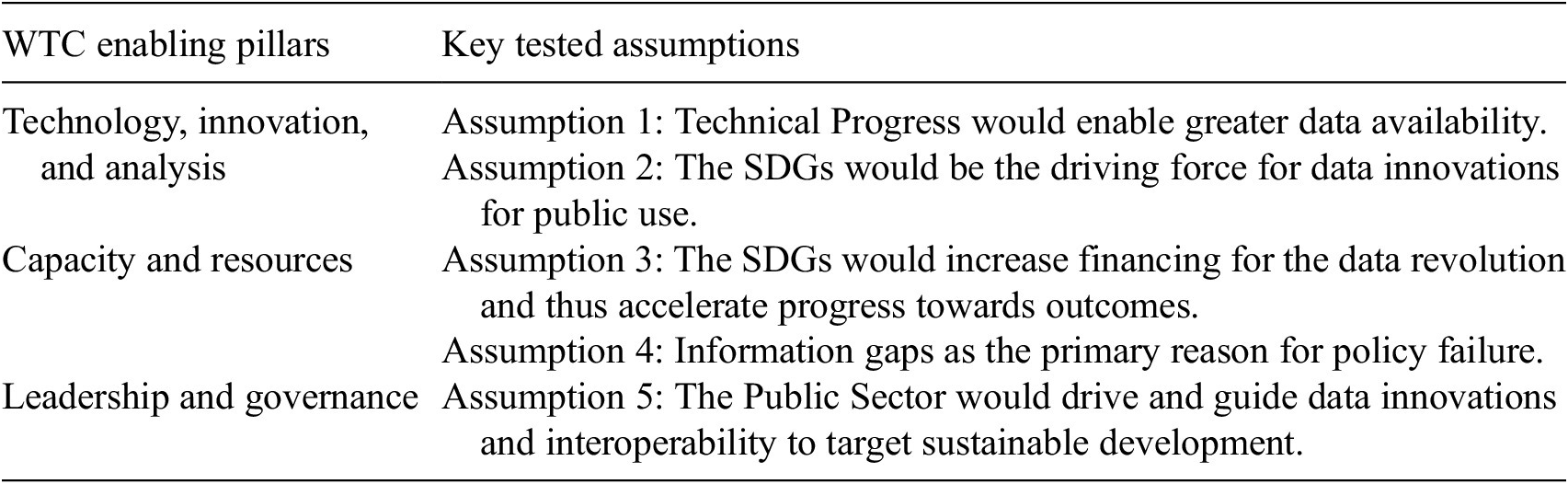
This article examines the enabling pillars and primary assumptions in the WTC report (see Table 1). The WTC outlined pathways linking data production, analysis, and outcome reporting to decision-making needs, forming its implicit Theory of Change. The WTC emphasized that SDG accountability requires “improving the data essential for decision-making, accountability, and solving development challenges” (IEAG, Reference Melamed2014). These pathways connect increased data supply with improved decision-making outcomes. The first pathway focuses on using data to measure and report SDG indicators, the main accountability mechanism within the SDGs. The second pathway involves using data and statistics within the policy cycle to design and implement sustainability goals, including services for the hardest-to-reach populations.
WTC’s enabling pillars and five assumptions
The WTC primarily focused on statistical agencies as key actors in advancing recommendations, but also suggested wider engagement with non-official data producers from the private and non-government sectors.
1.3. Methods
This article seeks to understand how underlying assumptions about the data and statistical systems have enabled or constrained the global data revolution policy agenda, decision-making, and outcomes for the SDGs. The review explores how these assumptions—specifically the theories of change regarding the impact of data and analysis on policy outcomes—can be adapted and when they should remain unchanged.
The identified assumptions by the lead authors were based on a review of documents, including the WTC report. After listing potential assumptions—none of which were explicitly stated in the report—authors used the following criteria to prioritize key assumptions: (a) distinct from previous global development initiatives; (b) directly underpinning the WTC’s four core pillars; (c) advancing the logic sequence of policy and accountability pathways; and (d) having a clear contingent relationship with expected SDG results. Before assessing the identified assumptions, a review of recent academic and grey literature was conducted, examining each assumption domain and its related literature. No articles discussing the specific assumptions or providing detailed policy analysis of the comprehensive field defined as the “Data Revolution” for the SDGs were identified in the review. The identified assumptions were reviewed by the United Nations Sustainable Development Network (SDSN) Thematic Research Network on Data and Statistics (TReNDS), a group of 15 global data experts chaired by two original authors of the WTC. Following feedback from Network members, the assumptions were adjusted, and a comprehensive academic literature review was conducted, along with tracking of grey literature from international agencies, think tanks, policy analysts, and community organizations.
This paper is limited to a global assessment; however, the authors note that the significant potential for future analysis could be disaggregated to regional and country levels. A future systematic review of cross-country and cross-goal progress could provide more rigorous testing and refinement of these assumptions.
Further systematic analysis is possible on specific goals and targets, where natural variation in data generation and use exists. Recent progress in global statistical systems for self-assessment, including aggregated analysis by PARIS21 and case studies from the Global Partnership for Sustainable Development Data (GPSDD), may support future efforts. Consequently, this report aims to initiate global reflection and discussion, rather than serve as an endpoint.
2. Pillar one: technology, innovation, and analysis
The first pillar of the WTC focused on the supply side of the data revolution, premised on the assumption that new data collection, processing, and platform-access technologies would exponentially increase data volume, creating unprecedented opportunities for governance and more disaggregated community programs (IEAG, Reference Melamed2014, p. 2; Levine, Reference Levine2014). Increased global cooperation between public and private data producers was expected to enable national statistical systems and development actors to generate new data, particularly disaggregated and localized data, to ensure greater equality and that no one was left behind (Melamed, Reference Melamed2014). The WTC authors assumed that responsibly harnessed data would advance societal wellbeing, despite concerns about data privacy, ownership, and security (Zook et al., Reference Zook, Barocas, Boyd, Crawford, Keller, Gangadharan, Goodman, Hollander, Koenig, Metcalf, Narayanan, Nelson and Pasquale2017).
2.1. Technical progress would enable greater data supply and use for SDG monitoring (Assumption 1)
The first assumption was that recent technological advances would exponentially increase the volume, velocity, veracity, and variety of data supply (Lucas, Reference Lucas2015; Melamed, Reference Melamed2014). By 2014, the global development community had begun using a wide range of new data collection tools such as mobile phone data and spatial population data for various crises, including the West African Ebola outbreak (USAID, 2017), as well as crowd-sourced infrastructure mapping for development and humanitarian platforms (Mooney and Minghini, Reference Mooney and Minghini2017). This was accompanied by an expectation of a surge in “big data,” from mobile phone data to earth observation data to social media data (Letouze, Reference Letouze2012), crowdsourcing, and citizen-science (Fraisl et al., Reference Fraisl, See, Campbell, Danielsen and Andrianandrasana2023; Grossman et al., Reference Grossman, Platas and Rodden2018). There was also an expectation that there would be more open data and more data sharing and reconciliation of administrative data (Rodriguez and Schonrock, Reference Rodriguez and Schonrock2018) and private sector data (GPSDD, 2018). Policies encouraging open statistics and data sharing further supported this trend (ODW, 2015).
Subsequent experience has reaffirmed this assumption. Data supply has increased, impacting SDG reporting since the WTC’s publication. Although aggregate data supply growth is not reliably measured, technology firms estimate a 5,000% increase in data creation and storage between 2010 and 2020, alongside growth in internet users, broadband, mobile connectivity, and administrative data for public services (Press, Reference Press2020). The velocity of data collection has also increased, leveraged in global SDG data initiatives like Data4Now, which enables countries to generate and utilize near real-time data for policy and monitoring (Espey, Reference Espey2019b). SDGs Today is another collaboration visualizing and reporting near real-time SDG indicators, some updated hourly (SDSN, 2023).
While a full systematic assessment is needed to uncover specific patterns of innovations for each SDG target, a rapid review since 2015 highlights multiple examples of new technologies being used to increase data collection. Monitoring poverty levels under SDG 1 has advanced using remote sensing and satellite imagery to supplement survey data for better estimates and predictive analysis of disaggregated poverty rates (Andree et al., Reference Andree, Mahler and Newhouse2023). Health and wellbeing under SDG 3 have benefited from mobile phone data to predict infectious disease spread and measure service coverage (Dahmm, Reference Dahmm2020; Oliver et al., Reference Oliver, Oliver, Lepri, Sterly, Lambiotte, Deletaille, De Nadai, Letouzé, Salah, Benjamins, Cattuto, Colizza, de Cordes, Fraiberger, Koebe, Lehmann, Murillo, Pentland, Pham and Vinck2020). Achieving zero hunger (SDG 2) involves measuring food prices using online and crowd-sourced data sources to assess food security in near-real time. Clean water and sanitation access (SDG 6) is being measured using water utility sensors, satellite imagery, and administrative data to improve global measures (Fischer, Reference Fischer2017; Thomson and Koehler, Reference Thomson and Koehler2016). Maritime vessel tracking data from automatic identification systems has revealed illegal fishing activities impacting SDG 14 (Coleman, Reference Coleman2022). These examples demonstrate significant advances in data supply for various SDG targets, with much of it leveraged by government services and civil society organizations from private sector sources, rather than government official statistical systems.
A significant challenge during the WTC drafting was the uncertainty of SDG indicators. Negotiations of the global SDG indicator framework were launched in 2015 after adoption of the goals under the leadership of the United Nations Inter-Agency and Expert Group on SDG Indicators ( IAEG-SDGs ). The IEAG led the development and standardization of 231 SDG indicators. This has resulted in 225 SDG targets having well-developed and internationally agreed methodologies to ensure comparability, accuracy, and reliability. However, as of 2023, many indicators lack consistent data reporting, particularly in several goals and regions(Eshetie, Reference Eshetie2022; United Nations, 2023). For example, less than half of the 193 countries have shared data for goals on climate action (SDG 13), gender equality (SDG 5), and strong institutions (SDG 16) (United Nations, 2023).
However, considerable variation remains in data availability between SDG indicators. A systematic literature review of SDG monitoring identified 100 datasets derived from big data, covering 15 goals, 51 targets, and 69 official indicators (Allen et al., Reference Allen, Smith, Rabiee and Dahmm2021). The largest share of papers corresponded to SDG 15 on life on land (21%), SDG 6 on clean water and sanitation (15%), SDG 1 on poverty (12%), and SDG 11 on sustainable cities (12%) (Allen et al., Reference Allen, Smith, Rabiee and Dahmm2021). The largest data gaps were found for SDG 13 on climate action and SDG 14 on life below water, for which few countries have the capacity to report data (Sachs et al., Reference Sachs, Kroll, Lafortune, Fuller and Woelm2021). These findings align with other analyses showing significant gaps in data availability for environmental targets (Dahmm, Reference Dahmm2021).
While the assumption of increasing data supply holds, three challenges need reconsideration. First, data supply does not always increase where needed most, with varied levels between SDG indicators and regions. Second, it is not only the supply but also the analytic methods that need clarification and standardization to leverage data value, particularly when using uncertainty science and synthetic data generation (Andree et al., Reference Andree, Mahler and Newhouse2023; Savage, Reference Savage2023). Finally, new data supplies do not always measure what matters most for the SDGs or inform key decisions, necessitating new approaches to prioritize data collection (Shepherd et al., Reference Shepherd, Hubbard, Fenton, Claxton, Luedeling and de Leeuw2015).
2.2. The SDGs would be the driving force for data innovations for public use (Assumption 2).
The second major assumption posits that the holistic, global, and integrated nature of the SDG framework would sustain political demand for data and statistical system innovations, particularly for national policy design and program implementation. This assumption builds on the experiences of the MDGs, where global coordination generated political attention and investments into national statistical systems (United Nations, 2016). The WTC authors acknowledged that MDG-framed initiatives successfully filled gaps in national statistical systems to track progress against country-level development plans, going further that the SDG momentum was expected to continue driving data generation, standardization, and use.
The SDGs have provided a political and financial mandate to advance pre-existing global commitments on data and statistics and driven UN activities. The Marrakech Action Plan for Statistics (MAPS), endorsed by the United Nations Statistics Commission in 2004, emphasized the role of official statistics in development monitoring, reinforcing the Monterrey Consensus, a 2002 global agreement on financing for development that highlighted the importance of data for accountability and policy effectiveness. Since 1999, PARIS21 has been strengthening national statistical agencies to bridge data gaps and, since 2015, has expanded its support by guiding countries in developing SDG-focused National Strategies for the Development of Statistics and tracking financial commitments through PRESS. Since 2015, UN SDSN Thematic Research Group on Data and Statistics, and cross-sector mobilizations by the Global Partnership for Sustainable Development Data, have driven strategic analysis and cooperation.
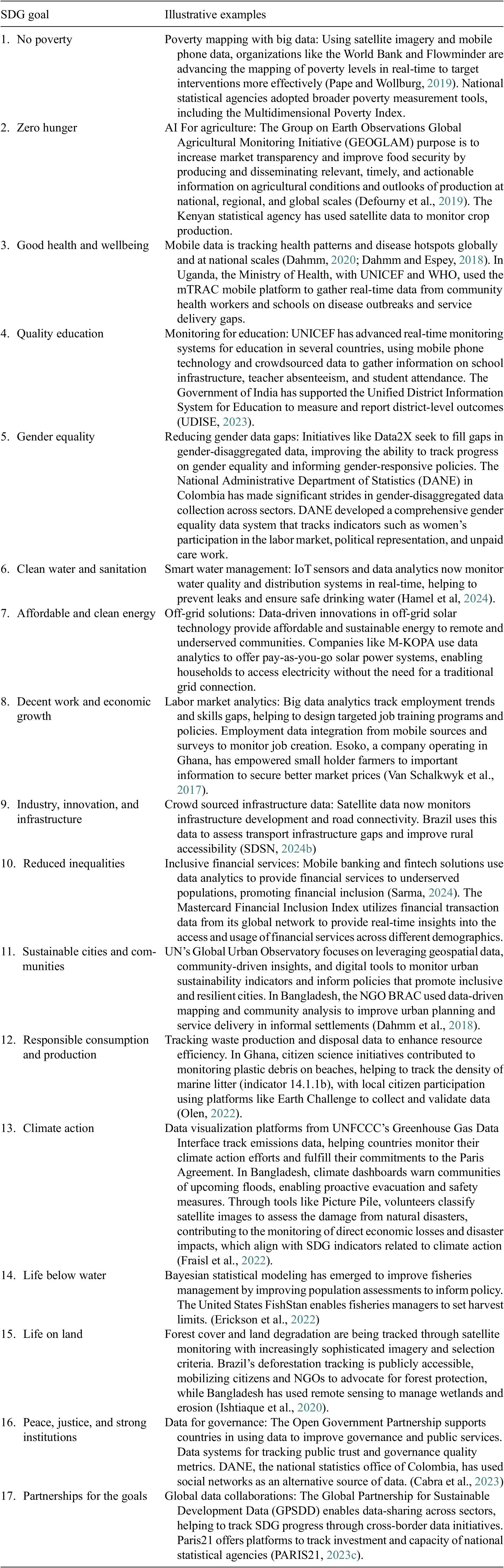
Numerous UN initiatives have driven and maintained collaborative data platforms to interpret indicator data for accountability and global progress assessments. However, there is no systematic assessment of these innovations or their contributions to SDG outcomes. Table 2 provides illustrative examples showing the breadth of international and national public use, but it cannot systematically assess this assumption.
Illustrative examples of SDG-driven data innovations and public uses
While the SDG agenda has spurred much collaboration and innovation internationally, progress on national data and statistical innovation has been much slower. Although some countries established central coordinating offices for national SDG implementation (see UNDP, 2017, p. 42 for eight country-specific initiatives), a series of cascading global crises has shifted policymaking away from deliberate multi-year approaches towards crisis response. For example, the COVID-19 pandemic forced governments to rapidly adapt data production to prioritize data informing near-real-time policy formation. Movement restrictions necessitated changes in data collection methods, shifting from face-to-face household surveys to mobile phone-based surveys, while social media digital transactions, and mobile money were used to track employment, food security, and social safety net distributions (Carletto et al., Reference Carletto, Chen, Kilic and Perucci2022; World Bank, 2020, 2021, p. 35).
National responses during COVID-19 drove a significant number of new data producer-user collaborations and non-official data approaches, which had been previously identified as part of the data revolution. For example, Jamaica established a national cross-sector hub combining data from 30 organizations (Young and Verhulst, Reference Young and Verhulst2017), while Sierra Leone collaborated with the UN Economic Commission to produce geospatial datasets. Finally, the pandemic accelerated open data initiatives and interactive data visualization platforms, such as the Johns Hopkins global COVID-19 dashboard (Koch, Reference Koch2021).
The assumption that the SDGs would be the main driver for innovation in public use of data held within the UN system is less clear at the international and national levels. Evidence suggests that the COVID-19 pandemic was a greater accelerant of the data revolution at national levels, while the SDGs provide an organizing framework for data innovation. The cumulative impact of the pandemic and the subsequent crises of inflation, global conflicts, and, most recently, the cutting of foreign aid, has reinforced a reactive approach to national policymaking rather than one driven by a holistic approach framed by the SDGs.
3. Capacity and resources
The second pillar focuses on the financial resources and institutional capability required to deliver value from the first two assumptions. It assumes that the global political momentum for the SDGs would unlock greater development financing and target national budgets to build capacity within statistical systems. With increased funding, statistical systems would enable decision-makers to overcome information barriers and make more effective decisions.
3.1. The SDGs would enable the financing resources needed for the data revolution to accelerate progress toward outcomes (Assumption 3)
The third assumption posits that the data revolution requires reversing the persistent underfunding of official statistical systems and generating innovative funding streams for both official systems and the wider data ecosystem. The WTC assumed that underfunding could be addressed by providing investment roadmaps, aligning global funding pledges with national statistical plans, and leveraging innovative financing mechanisms, including private sector participation. The WTC made three key recommendations: (1) develop statistical system plans with cost estimates; (2) advocate for funders to fulfill pledges; and (3) establish accountability processes to track funding commitments (IEAG, Reference Melamed2014).
Since the WTC report, efforts have been made to mobilize greater financing from internal domestic and international sources for official statistics, with progress across all three recommendations. However, funding remains significantly below target levels and has decreased in real terms. In this paper, our focus is primarily on international sources of funding for data and statistics, recognizing that future analysis will be possible when reporting on national funding is standardized and available.
Following the WTC report in 2015, SDSN TReNDS estimated that over US$1 billion per year of additional funding was needed for statistical and data systems to support and measure the SDGs, including an addition of US$200 million annually in international assistance to low-income countries (Espey et al., Reference Espey, Swanson, Badiee, Christensen, Fischer, Yetman, de Sherbinin, Levy, Chen, Qiu, Greenwall, Klein, Jutting, Jerven, Cameron and Milena2015). This funding would cover censuses, household surveys, agricultural surveys, geospatial data infrastructure, civil registration, vital statistics, administrative data, economic statistics, and environmental data.
Country-level statistical roadmaps with budget estimates followed (Swanson and Eele, Reference Swanson and Eele2016), alongside global estimates for gender-disaggregated data funding (Open Data Watch, 2021).
The 2017 Cape Town Global Action Plan for Sustainable Development Data (CTGAP) revised these estimates to identify US$5.6 billion annual cost for 75 low- and lower-middle-income countries and 69 upper-middle-income countries with $4.3 billion (77%) covered by domestic resources, leaving a $1.3 billion (23%) gap for external sources (Calleja & Rogerson, Reference Calleja and Rogerson2019).
This sets a target for a ratio of 0.7% of Official Development Assistance (ODA) to be directed towards statistical systems.
The 2018 Dubai Declaration, endorsed by the United Nations Statistical Commission in 2019, mandated a coordinated and demand-driven funding approach for national statistical systems, including public-private partnerships. In response, two multilateral initiatives were established: the World Bank’s Global Data Facility and the Complex Risk Analytics Fund (CRAF’d). The Global Data Facility mobilizes and coordinates donor support for data and statistics at various levels (World Bank, 2019), while CRAF’d pools funding for supporting fragile state partners to use data in addressing complex risks and post-conflict recovery (CRAF’d, 2023).
Progress in accountability and investment since 2015 includes tracking funding commitments. SDG indicator 17.18.3 tracks the funding levels and sources of national statistical plans under PARIS21’s custodianship. Three platforms now track investments and capacity development: Partner Report on Support Statistics (PRESS), the PARIS21 Statistical Capacity Monitor, and the World Bank Statistical Performance Indicators (Dang et al., Reference Dang, Pullinger, Serajuddin and Stacy2023; PARIS21, 2023c).
Investment trends since 2015
Mobilizing financing for data and statistics remains a priority and has increased in aggregate since 2015. In the 2016-2020 period, ODA pledges for statistical systems have increased by an average of USD 104million per year as compared to the average ODA levels from 2011 to 2015. ODA investment in statistical systems rose to USD 542 million in 2020 from USD 453 million in 2015, peaking in 2018 and 2019 (PARIS21, 2022) and increasing again in 2021 (PARIS21, 2023c). PARIS21 also tracks the increase in bilateral and private funding modalities, although multilateral funding remains the largest source (PARIS21, 2023d).
However, despite aggregate increases, when adjusted to real terms to account for inflation and changing purchasing power, financing in real terms appears to have declined from the 2015 levels. When adjusted to real terms using World Bank Deflators, the 2020 ODA investment into statistical systems is $415 million compared to $453 million in 2015 (PARIS21, 2022).
The reported levels of ODA financing for statistical systems remain below the target of 0.7% of total ODA. The rate hit close to 0.4% in 2018 but has declined to 0.3% in 2020. These figures are based on analysis and OECD data reported by PARIS21 and OECD (PARIS21, 2022).
Both real and nominal measures show that ODA for statistical systems has not increased to achieve the investment levels argued as necessary to inform the SDGs. This reflects that while progress has been made in accountability and investments, there are still significant limitations of funding in total quantum, but also in distribution and use.
Beyond aggregate finance levels, distribution also requires consideration. The most recent OECD data that disaggregates ODA funding reveals that significant portions of ODA funding are allocated towards specific demographic and survey projects, leaving less funding for core capabilities that support foundational parts of statistical systems and managerial functions of statistical agencies, or to scale data revolution innovation (PARIS21, 2023a).
The subsequent experience raises questions about the motivation behind global financing and its role in shaping national statistical systems. The assumption that greater financing would target critical components of these systems is challenged by evidence showing funds are often directed toward specific projects, not core capabilities of the statistical systems. The World Bank leads global statistical system funding, providing nearly twice as much as USAID and UNICEF, but much of this funding focuses on specific surveys, potentially limiting the capacity and innovation central to the data revolution (PARIS21, 2023a).
The WTC report emphasized the need to focus on low-income and fragile states by reversing underinvestment and developing tailored approaches for conflict-prone contexts (World Bank, 2021). However, disaggregated ODA data shows these states have not seen the expected increase in financial support, despite being key targets of the WTC’s global data initiatives.
Time is running out for national governments and development partners to fully fund data and statistical systems. While the assumption that more financing is needed remains valid, it may require adjustment. Not all funding accelerates SDG impact, and the distribution of funds, incentives, absorption capacity, and ability to leverage statistical products in policymaking are critical factors that must be reevaluated over the next seven years.
3.2. Information gaps are the primary reason for policy failure (Assumption 4)
The WTC framed the pathway towards improved outcomes as contingent on the information provided to the policy design and implementation process. The WTC authors assumed three elements for how the Data Revolution would deliver value to policy and decision systems: reducing data gaps would prevent policy failures, increasing data supply would improve program efficacy and ensure accountability at domestic and global scales, and enabling statistical agencies would drive whole-of-government data use to meet decision-makers’ needs.
In the subsequent years, limited systematic assessment has been made on the impact of improved data and statistics systems for SDG-related policy decision outcomes. UN Sustainable Development Progress reports consistently identify data production and reporting gaps as undermining policy making, not how data is used (United Nations, 2022, 2024). The 2024 Sustainable Development Report notes the considerable increases in data to monitor the SDGs with 51 per cent of indicators having more than two data points in more than half countries, however, it also notes that policymakers lack information to make timely, informed decisions due to significant variability in data availability between goals, countries and timeliness of data (United Nations, 2024). While there are a growing number of assessments around data production capacity and illustrative case studies of value for decisions, particularly at the urban level (Jain and Espey, Reference Jain and Espey2022), there are limited systematic comparisons between countries or impact on individual SDG goals.
The most comprehensive systematic review of this assumption is the global PARIS21 Statistical Capacity Monitor, launched in 2022, which assesses statistical agencies’ capacity. The 2017 Cape Town Action Plan for Sustainable Development Data (CTGAP) set measurable targets for statistical systems (World Bank, 2022). Within roughly 100 indicators identified developments in the capacities of national statistical systems, six focus on the use of statistics, of which one tracks the use of statistics in national policy documents, and the others focus on newspapers and use by international organizations (PARIS21, 2023c). While an important step forward, these indicators do not enable assessment of how data is being used, the data gaps needed for policy decisions, or the integration across decision-making processes.
As discussed in the previous section, experiences after 2015 also show that gaps in data disaggregation remain, from sex to age, and are often attributed as a driver of policy failures (ADB, 2021; Henninger et al., Reference Henninger, Swanson, Noe, Wahabzada, Pittman, Hadnot and Appel2023; Misunas et al., Reference Misunas, Cappa, Murray, You, Hattori, Beise, Krasevec, Carvajal, Hug, Evans, Petrowski, Murphy, Kumapley, Bain, Andrew Porth and Yu2017). One consistent illustration of these gaps is the limited disaggregation of data on women and girls, with 22% of gender-specific indicators producing reports regularly, thus inhibiting national efforts to monitor and achieve SDG 5 (Pryor and Seck, Reference Pryor and Seck2019). By 2023, just 30% of indicators for SDG 5 (gender equality) had adequate data (PARIS21, 2023b).
The WTC did not differentiate the data and statistical needs across different stages of the policymaking cycle, yet there is a range of assumptions, supported by wider policy analysis literature, on the value of data within this cycle (Davis et al., Reference Davis, Althaus and Bridgman2018). The difficulty of getting data used in policy formulation is that it is an inherently political non-linear process, arguably more so than the reporting or problem assessment stages. The WTC did recognize that the reality of policymaking is not neatly sequenced steps, but assumed that SDG policy was rationalist in centralized structures. Data analytics integrated into policy cycles informs, and thus potentially challenges, the decision-making process for resource allocation. Scholarship on policy approaches is drawing attention to how data and statistics are used in contested overlapping nodes of responsibility (Ostrom, Reference Ostrom2010), each seeking relevant analytic tools and with different hierarchies of relevance (Cairney, Reference Cairney2021).
In retrospect, the assumption that increasing statistical systems data supply would catalyze policy impact and implementation effectiveness has been challenged on several fronts.
First, many policy design decisions are driven by political interests, not technocratic ones. Efforts have been made to reimagine the SDG data ecosystem, shifting focus away from increasing supply towards sharpening the collection for what matters most to the policy challenge. Recent literature has discussed how decision makers are not asking the right questions to guide the collection of the data that matters most for their specific decision needs, and thus it is not a data production gap rather the lack of decision-relevant data (Cripps et al., Reference Cripps, Fischer, Santow, Afshar and Davis2023; Levy, Reference Levy2017; Shepherd et al., Reference Shepherd, Hubbard, Fenton, Claxton, Luedeling and de Leeuw2015; S. Verhulst et al., Reference Verhulst, Chafetz and Fischer2024). This implies changes to what data is collected, and the frequency needed to respond to decision needs. An example has been the change to definitions and measures for SDG 6 for global water, sanitation, and hygiene (WASH). The Joint Monitoring Programme has expanded the measures beyond access to include water safety and reliability, as well as measuring public institutions such as schools and health clinics (Chatterley et al., Reference Chatterley, Slaymaker, Badloe, Nouvellon, Bain and Johnston2018). But national surveys do not address real-time delivery, and new integrated water monitoring systems are responding to the decision needs of government agencies and water service providers simultaneously (Hope et al., Reference Hope, Foster, Koehler and Thomson2019; Thomson and Koehler, Reference Thomson and Koehler2016).
Second, while boosting the capacity of statistical agencies is a policy priority, assumptions about how to increase this capacity are constantly evolving. In recent years, there has been growing recognition that policymaking and implementation agencies often lack the internal skills to interpret and utilize this data effectively. Models like Germany’s data labs networked across government agencies offer examples of how to build this capability (Engler, Reference Engler2022). Although statistical agencies remain crucial for producing trusted official data, they operate within a broader data ecosystem that supports cross-sector decision making (Verhulst, Reference Verhulst2021). Collective intelligence frameworks, including accelerator labs and distributed data systems, are expanding the role of these agencies by focusing on the data and insights required for key decisions(Peach et al., Reference Peach, Berditchevskai, Mulgan, Lucarelli and Ebelshaeuser2021).
Third, as the WTC report anticipated, technological advances are transforming data systems alongside established statistical practices. However, while much of the data revolution has centered on boosting statistical capacity, this has not been matched by improvements in the capability of policymakers to use the data effectively. This suggests that the assumption should shift from focusing solely on reducing data gaps to addressing gaps in capability and processes within policy formation. Greater innovation is needed to bridge the interaction between politics and technocratic advances.
Finally, national statistical systems are assumed to be the most trusted and legitimate sources of data due to their rigorous methods, but the rise of post-truth politics has challenged the role of evidence in policymaking (Habermann and Louis, Reference Habermann and Louis2020). Public trust in statistical systems has eroded, exacerbated by the exclusion or misrepresentation of certain communities in datasets or the politicization of distrust of data systems (Pullinger, Reference Pullinger2020). This raises the challenge of requiring data as part of the policy design and accountability process.
The national policy ecosystem’s reliance on data maturity and analytic capacity underscores the need to balance expanding data production with building the capacity to use existing resources effectively for complex decision-making.
4. Leadership and governance
The WTC’s third pillar focuses on allocating the roles and responsibilities required to enable the data revolution across multiple overlapping nodes of global, national, local, private sector, and civil society decision-makers. It assumes that governments would be the main driver of SDG progress and accompanying data innovations, with the private sector and civil society playing supporting roles.
4.1. The public sector would drive and guide data innovations to target sustainable development (Assumption 5)
The WTC report placed national governments at the center of the data revolution, positioning them as both guarantors and drivers of innovation, contrasting with the assessment of internationally driven incentives during the MDG era (Florini and Pauli, Reference Florini and Pauli2018; IEAG, Reference Melamed2014). National governments were assumed to be the primary agents sustaining the data revolution by providing financial incentives, demand points, and pathways for applying data innovations. While the WTC report acknowledged the role of the private sector and civil society as key to data supply innovations, it emphasized government leadership in advancing SDG reporting, downscaling data to enable national policy needs, and guiding standardization (United Nations, 2015). The WTC also assumed that governments would oversee data protection, and drive innovation to ensure universal coverage in line with the SDG commitment to “leave no one behind.”
Building on the WTC recommendations and SDG mandate, the Global Partnership for Sustainable Development Data (GPSDD) was formed and has since built a network of 300 organizations with over 100 strategic partnerships and data collaborations with national statisticians and country-level SDG campaigners and data innovators (Melamed, Reference Melamed2021). This initiative was established to foster innovative practice and informal accountability for commitments.
However, since the SDGs were adopted, governments have been less central to data innovation than anticipated. While they continue to lead official statistical monitoring and Voluntary National Reviews, much of the data innovation has come from civil society, academia, and multilateral organizations, including citizen-generated data and geospatial applications (World Bank, 2021). Civil society has also driven partnerships for inclusive data policies, such as the Open Data Charter (Davies et al., Reference Davies, Walker, Rubinstein and Perini2019). Meanwhile, private sector data generators have sought government action, but government coordination of private-sector contributions remains limited (Li and Hinrichsen, Reference Li and Hinrichsen2023).
There are several areas where we see this divergence. The first is that many key data innovations and applications to the SDGs have been driven by civil society, academia, and multilateral organizations, including citizen-generated data production and geospatial data. (Fritz et al., Reference Fritz, See, Carlson, Haklay, Oliver, Fraisl, Mondardini, Brocklehurst, Shanley, Schade, Wehn, Abrate, Anstee, Arnold, Billot, Campbell, Espey, Gold, Hager and West2019; World Bank, 2021). The second is the role that civil society has played in driving new partnerships and coordination, motivated by the agenda for inclusive and open data to ensure no one is left behind, including contributions to policies such as the Open Data Charter and Inclusive Data Charter. (Badiee and Melamed, Reference Badiee and Melamed2014; Davies et al., Reference Davies, Walker, Rubinstein and Perini2019; GPSDD, 2022) The third is that governments have not coordinated or incentivized the private sector; rather, corporations and the private sector have sought government action to enable their contributions. (GPSDD, 2018; Li and Hinrichsen, Reference Li and Hinrichsen2023)
Several factors explain this shift. First, international efforts have prioritized building official statistical capacity for SDG monitoring over driving demand for innovative data (Besley et al., Reference Besley, Burgess, Khan and Xu2022; Andrews et al., Reference Andrews, Pritchett and Woolcock2017). Second, the decentralization of power to regional and municipal levels has led to more networked approaches to data use, leading to innovations from multiple actors rather than centralized government initiatives (Allen et al., Reference Allen, Malekpour and Mintrom2023). Third, much private sector data innovation has been driven by Environmental, Social, and Governance (ESG) reporting obligations, not government incentives. Until recently, companies adhered to voluntary reporting standards such as the Task Force for Climate-Related Financial Disclosures (TCFD) (Task Force on Climate-Related Financial Disclosures Guidance on Metrics, Targets, and Transition Plans, 2021), the Global Reporting Initiative, and the Sustainability Accounting Standard Board (SASB). Organizations like ESRI and Groupe Special Mobile Association (GSMA) have facilitated public-private collaboration, contributing to the growing ESG data landscape (ESRI, 2021). Opimas, a consultancy firm, estimates the global market for ESG data surpassed $ US$1.3 billion in 2022, a fivefold increase from 2015 levels (Foubert, Reference Foubert2022). However, despite substantial private investment, largely in high-income countries, coordination around a data revolution agenda remains limited.
This corresponds to recent scholarship and policy commentary on the emergence of collective intelligence, or knowledge systems driven by people, technology, and data, where simultaneous independent data inputs are pooled to create shared information systems. Collective intelligence systems are not driven by a single force; instead, they combine the incentives of multiple sources and actors (Mulgan, Reference Mulgan2017). Demonstrating steps towards this approach, the World Bank has recommended integrated national data systems (INDS) built around frameworks for whole-of-government and multistakeholder governance and legal frameworks for data protection and rights (World Bank, 2021) and the United Nations Development Programme has set up national collective intelligence data labs (Peach et al., Reference Peach, Berditchevskai, Mulgan, Lucarelli and Ebelshaeuser2021).
At the midpoint of Agenda 2030, it is clear that the private sector and civil society are playing a more significant role in driving data innovation for sustainable development data than anticipated. While the WTC envisioned a government-led data revolution, progress has come from collective intelligence and decentralized drivers. Opportunities exist for greater collaboration, such as aligning ESG standards with global statistical frameworks like the System of Environmental-Economic Accounting (SEEA), particularly for biodiversity reporting. Citizen-generated data, such as monitoring plastic marine litter, also holds potential for enhancing metrics that national statistical offices cannot capture.
5. Discussion
Since the release of A World that Counts in 2014, a decade ago, the world has changed dramatically, and so too have the processes through which data may improve development outcomes. A set of core assumptions shaped the SDG-driven data revolution and drove advocacy for the recommendations presented in the WTC report. While many assumptions have held central for a time, and there has been some significant progress, the scale of ambition envisaged by the SDG Data Revolution has not been achieved. The WTC report did not, for example, consider the emerging role of Artificial Intelligence, both as an accelerant of data analysis and visualization, but also as a demand point for data use.
Assumptions underlying WTC pathways have proven to be useful for improving country-level monitoring and reporting of SDG indicators. Technical progress through the growth of digital technologies has enabled an explosion in data availability, particularly in sectors like health, environmental monitoring, and poverty measures. Data is being generated in ever greater quantities from diverse sources, including satellite imagery, sensors, mobile networks, and citizen science, as initially predicted. Accountability through data has improved for many national governments, particularly through greater integration of statistical offices and VNRs, as they continue to play a central role in monitoring SDG progress. Global efforts to support national statistical capabilities have been formalized and are now tracked in global platforms with supportive funding mechanisms. This has increased reporting on SDG indicators across all goals. However, many gaps remain in frequency and coverage. The public sector’s responsibility for official statistical data collection has held true, though new actors are increasingly complementing the central government’s role.
Despite many of the WTC recommendations being implemented, including new global coordination platforms dedicated to supporting national statistical systems, networked cross-sector leadership, and data generation and visualization innovation, assumptions relating to capacity, resources, and leadership have not proven accurate. Resourcing for data and statistical improvements remains insufficient and has declined in real terms. Chronic underfunding has not been reversed despite progress in building roadmaps and new investment vehicles. Further, significant proportions of global funding are allocated to specific programs, not country-led priorities. This has raised questions about the motivations behind global financing and its impact on national statistical systems, particularly in fragile states, which were identified as priority targets by the WTC.
There is a set of evolving tensions between assumptions and actual experiences in generating value from data for the SDGs. The first key tension lies between calling to increase financing and data supply versus prioritizing specific data generation relevant for decision-making. More targeted data collection does not diminish the need for more financing. Still, it suggests that when funding is limited, a more intentional investment strategy is possible to target measuring what matters most and generates most value for decision-making needs in policy design and service delivery. This might come at the cost of existing programs and might reprioritize focus from international policy makers towards national governments and sub-national constituents.
The second tension contrasts the role of statistical systems, as a trusted official data generator and provider, with the emerging need and function of distributed data collection and analysis labs, which can be more relevant to informing policy and implementation processes. Exploring this tension finds inconsistency in the national policy ecosystem’s capability to use data and statistics. The value derived from official statistics is linked to the data maturity and analytic capacity integrated across government institutions to realize value from statistical services. It is also contingent upon the perceived trustworthiness of information across a wider civil society and government ecosystem, and minimizing politicization. An additional driver of change, which is pressuring many NSOs to consider a broader distributed approach to data collection, is the international dialogue on digital transformation. This is most succinctly summarized in the Global Digital Compact, agreed by Heads of State and Government in 2024 as part of the Pact for the Future, which seeks to advance digital public information infrastructure supported by interoperable national data governance frameworks, and is focused on efforts to counter mis- and disinformation.
The third tension highlights differences in the perceived value and application of data in relation to institutional decision-making. In discussions of the SDG data revolution, the dominant assumption is that national governments are the main actors responsible for policy decisions and public services. In countries with sufficient centralized state capacity, national agencies prioritize data that serves their centralized, often technocratic objectives—driving demand for information that aligns with their dual roles of public service provision and political accountability. However, this centralized approach overlooks the valuable role that other government agencies and non-governmental actors can play in a more distributed evidence-informed decision-making structure. A polycentric governance model considers the multiple, overlapping decision points across a range of actors, including individuals, civil society, the private sector, and local to regional governments. This model values data as a tool for empowering diverse stakeholders and reducing information asymmetry in a way that fosters collective decision intelligence. Where this model has been recognized, decision-making is no longer solely technocratic but distributed across political and civic spheres, recognizing that actionable insights emerge from a combination of perspectives within these interdependent institutions.
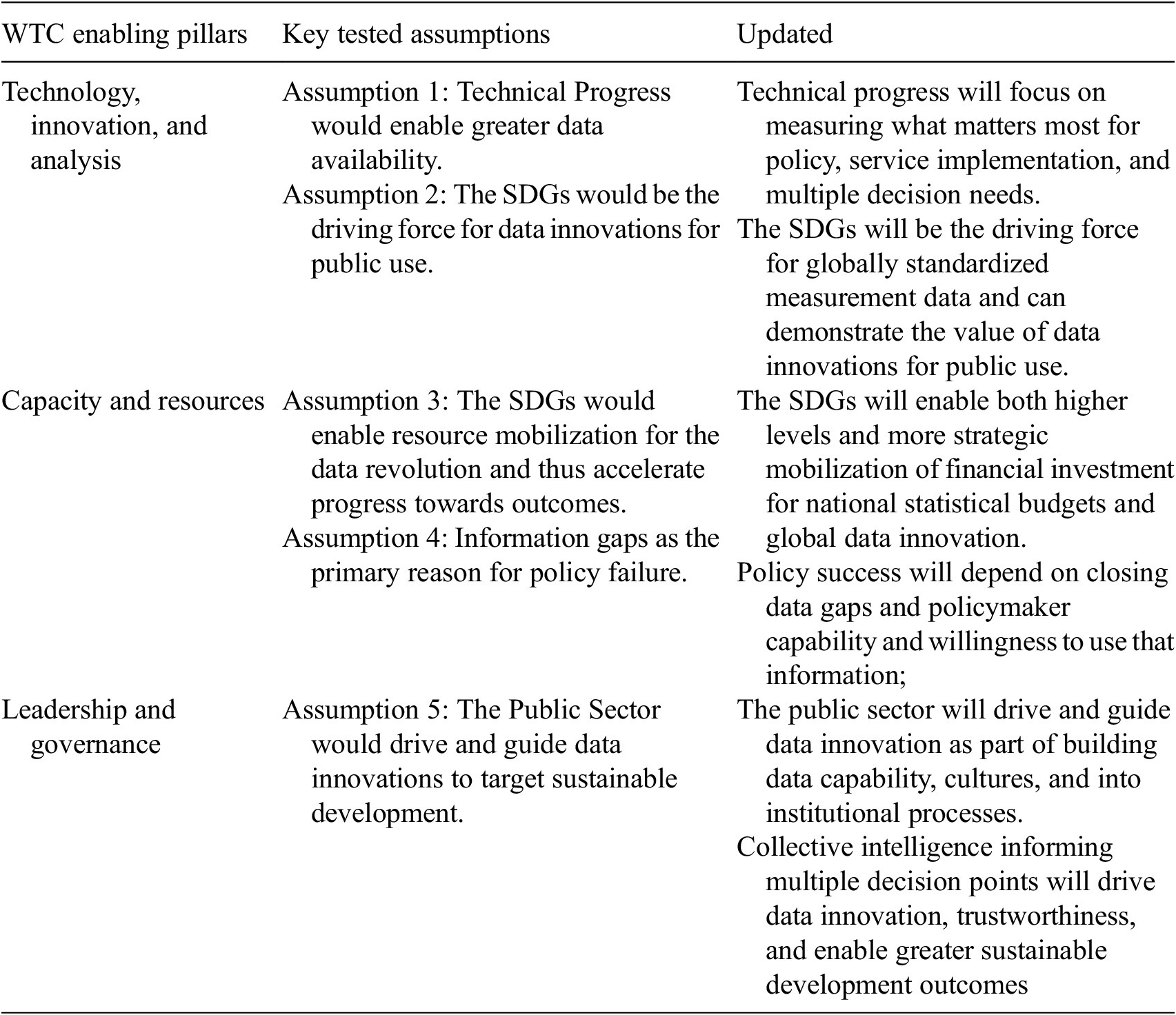
The review findings in this article suggest a need to update our assumptions about the contributions of data and statistics to guide the remaining five years of the 2030 Agenda. Summarized in Table 3, they reflect a shift to focus on the demand points for information, a renewed focus on optimizing investment aligned to the data value chain, and the shifts in institution design differentiating data producers’ responsibility compared to data users.
WTC enabling pillars and updated assumptions
6. Conclusion
While A World That Counts provided a strong foundation for advancing the data revolution, the experience over the last decade reveals that new assumptions are necessary to better align information systems with SDG policy formation and delivery. This review has found that the assumptions underpinning the accountability pathway in the WTC report have made the most significant progress since 2014. The impact of the data revolution has been most well documented around the adoption and standardization of 231 SDG indicators, and the rapidly improving velocity, variety, and veracity of data and statistics.
Subsequent experience since the WTC suggests that the policy efficiency pathway has not achieved the same degree of progress. While there are many individual cases documenting the data revolution’s impact, these are often for individual SDG targets in specific country contexts, not a consistent or generalizable trend. Fragile and low-income states are still being left behind in financing, and the production and use of disaggregated data for women, people living with disability, and many rural and remote areas remains insufficient to enable more effective policy decisions.
At the same time, core technical innovation assumptions are likely to shift towards not just increasing data supply but measuring what matters most to generate impact across the data value chain. This includes adjusting assumptions around how artificial intelligence will require raw data inputs, while also shaping access and use of data analysis tools and approaches for communities and policymakers. While more funding is required, the sources are not likely to come from global financing mechanisms alone, and should increase focus on strategic allocation of existing resources.
This review found that identifying and assessing the key assumptions in the UN report enables a reflexive process to determine how we might adapt recommendations for the coming years. Immediate practical recommendations for the next five years are in separate publications and collaborative review processes supported by UN SDSN and published as a policy discussion paper (SDSN, 2024). These sit alongside a set of future monitoring and research initiatives that have been identified beyond this article. Finally, this review found that the global focus on advancing the data revolution has left a gap in the systematic and consolidated assessment of the impact of data and statistics on policy and implementation outcomes. This leaves a clear future policy and research opportunity to build on the multiple existing initiatives seeking to link statistical systems in pursuit of common goals, and to improve frameworks and tools to assess the data value chain within polycentric decision systems.
Abbreviations
- MDG
-
Millennium Development Goals
- ODA
-
Official Development Assistance SDSN: Sustainable Development Solutions Network
- SDG
-
Sustainable Development Goals
- TReNDS
-
Thematic Research Network on Data and Statistics
- UN
-
United Nations
- WTC
-
The World That Counts report
Data availability statement
Data availability is not applicable to this article as no new data were created or analysed in this study.
Acknowledgements
The authors are grateful for the Independent Expert Group on a Data Revolution for Sustainable Development and the ongoing support provided by the United Nations Sustainable Development Solutions Network and the members of the Thematic Research Network on Data and Statistics.
Author contribution
Conceptualization: J.E., S.B., C.T., G.C., A.F.
Competing interests
The authors declare none.


 Open access


Comments
No Comments have been published for this article.