





1. Introduction
This article discusses the realization of /rl/ in Bavarian German,Footnote 1 which surfaces with a flap and syllabic lateral as [ɾl̩]; see representative data in (1).


All data in (1) show examples where the flap [ɾ] is the onset of a final syllable where [l] occurs in the nucleus.Footnote 2 Such a realization is notably different from a Standard GermanFootnote 3 realization in which the phonological /ʀ/ is realized as a vocalized [ɐ], and the final /l/ functions as a coda consonant. This reduces the overall syllable count by one, for example, /kϵʀl/ → [kϵɐ̯l]. However, the data presented in (1) may be further subdivided into two different types of examples. Example (1a) shows data where the corresponding Standard German form always ends in an orthographic <rl>, whereas (1b) presents data with the -erl diminutive.Footnote 4 We return to the significance of these two etymological categories in more detail in the later sections of this article, but for now, we note that both data types may surface with a final [ɾl̩], where the [ɾ] occurs in the onset and the [l̩] in the nucleus.
In this article, we discuss two topics related to these data. The first pertains to the segmental interpretation of such data. In (1), we presented the data as they appear in Noelliste (Reference Noelliste2019). In that work, the data were collected and transcribed based on speaker interviews conducted in Ramsau am Dachstein, Austria. It is notable that other sources from across the Bavarian German dialect region provide different interpretations of the data in question. Specifically, other sources transcribe the data in (1a) variously as [dl], [dl], or [.l̥], whereas diminutive data like those in (1b) are often transcribed as [ɐl], with no consonant between the vocalic period and the [l]. In section 3, we discuss the segmental interpretation of these data, with specific regard to older sources on Austrian and German varieties.
The remaining sections and the main thrust of the article situates these data in the literature on the phonological theory of sonority. Noelliste (Reference Noelliste2019) argues that certain data from Bavarian German provide evidence against a universal sonority hierarchy à la Parker (Reference Parker2008, Reference Parker, van Oostendorp, Ewen, Hume and Rice2011) and instead demonstrate that an emergent, language-specific sonority hierarchy is to be preferred. That analysis is predicated on data like [kϵ.ɾl̩] Kerl ‘guy’, underlyingly /kϵʀl/, in which the underlyingly uvular /ʀ/ undergoes a flapping rule (see Noelliste Reference Noelliste2019:14). Noelliste (Reference Noelliste2019) gives a phonological analysis arguing that, based on syllabification of <rl> sequences, the class of liquids must be divided within the sonority hierarchy in this dialect, such that flaps are less sonorous than trills and laterals. Noelliste (Reference Noelliste2019:25–26) suggests: “The present analysis maintains that no one sonority hierarchy or claim about the sonority of certain segments is universal; rather, sonority is language-dependent and perhaps best described in terms of phonological interactions of segments within a given language” (cf. other German language-specific sonority hierarchies, as in Wiese Reference Wiese1996, Hall Reference Hall2002). The current article seeks to test this claim by investigating proposed phonetic correlates, including those in Parker (Reference Parker2008, Reference Parker, van Oostendorp, Ewen, Hume and Rice2011) using sound recordings of Bavarian German speech from both Noelliste (Reference Noelliste2017, Reference Noelliste2019) and Bolter (Reference Bolter2022) in order to give a phonetic account of Bavarian German <rl> sequences. We concur with the findings from Noelliste (Reference Noelliste2019:2) that, based on this phonetic evidence, the universal sonority hierarchy proposed in Parker (Reference Parker2008, Reference Parker, van Oostendorp, Ewen, Hume and Rice2011) “cannot account for the Bavarian German data … as the Bavarian German flap behaves as a less-sonorous sound than the lateral…” That is, our measurements show that in terms of intensity, measured in decibels, and duration, measured in milliseconds, the Bavarian German flap exhibits physical properties that make it less sonorous than the adjacent lateral. Our results of this sonority ranking of the lateral over the flap are in line with Parker’s earlier study of 2002, in which these segments were investigated for English.
In this article, we therefore suggest that defining sonority in terms of one particular phonetic property is likely to miss certain generalizations, and instead a multi-pronged approach to sonority is preferred. This approach agrees with much previous scholarship on sonority (e.g. Miller Reference Miller and Parker2012), including some of the most vocal critics of the concept of sonority (e.g. Ohala Reference Ohala1992).
The article is organized as follows: In section 2, we provide a brief background of phonological works on sonority; in section 3, we present earlier grammars on Bavarian German; section 4 contains our own phonetic study of Bavarian German <rl>; we discuss the theoretical implications of our Bavarian German study in section 5; and we conclude in section 6.
2. Background on sonority
Sonority has such a lengthy history in the phonological literature that it is difficult to give a succinct comprehensive review that accounts for all of the various facets of the literature; for a good overview, we refer the reader to the work of Parker (Reference Parker2002, Reference Parker2008, Reference Parker, van Oostendorp, Ewen, Hume and Rice2011) and perhaps especially Parker (Reference Parker2017). To the best of our knowledge, the theory dates back at least as far as Sievers (Reference Sievers1881), Jespersen (Reference Jespersen1904), and Saussure (Reference Saussure1916). Some notable works invoking theories of sonority within the latter part of the last century include Vennemann (Reference Vennemann1972), Kiparsky (Reference Kiparsky1979), Steriade (Reference Steriade1982), Selkirk (Reference Selkirk, Aronoff and Oehrle1984), Zec (Reference Zec1988), and Clements (Reference Clements, Kingston and Beckman1990).Footnote 5 Great recent attention has been given to sonority by Parker (Reference Parker2002, Reference Parker2008, Reference Parker, van Oostendorp, Ewen, Hume and Rice2011, Reference Parker2017), who approaches sonority with a less abstract phonological and more quantifiable phonetic-property methodology.Footnote 6
Although there has been ample research on the topic, the definitional question of what exactly sonority is has been and will likely remain a difficult one. However, a definition that we think represents most trends in research on sonority can be found in Parker (Reference Parker, van Oostendorp, Ewen, Hume and Rice2011:1), who describes the concept of sonority as follows:
Sonority can be defined as a unique type of relative, n-ary (non-binary) feature-like phonological element that potentially categorizes all speech sounds into a hierarchical scale. For example, vowels are more sonorous than liquids, which are higher in sonority than nasals … sonority is like most other features: it demarcates groups of segments that behave similarly in cross-linguistically common processes. At the same time, however, sonority is unlike most features in that it exhaustively encompasses all speech sounds simultaneously, i.e. every type of segment has some inherent incremental value for this feature.
The notion that there is an essential difference between vowels on the one hand and consonants on the other seems so fundamentally obvious that it hardly requires much scrutiny. Yet, sounds that occur somewhere between the two, such as rhotics, laterals, nasals, can be difficult to place.
A major function of sonority within phonological theory has to do with syllabification; that is, the sonority hierarchy plays a principal role in the organization of segments within the syllable (Zec Reference Zec and de Lacy2007). For example, “more sonorous sounds, such as vowels, tend to occur in the nucleus, while less sonorous sounds normally appear in the marginal (non-peak) positions – onsets and codas” (Parker Reference Parker, van Oostendorp, Ewen, Hume and Rice2011:1). This generalization has often been referred to as the Sonority Sequencing Principle.
As the above quote from Parker (Reference Parker, van Oostendorp, Ewen, Hume and Rice2011) makes clear, the concept of sonority cannot be extricated from that of a sonority hierarchy. Many authors have given various versions of sonority hierarchies, some of which are intended to be universal, while others are denoted as language-specific; some relevant examples from the literature are given in (2). Each sonority hierarchy in (2) contains slightly different categories concerning r and l sounds. See, for example, (2a), where the class of “liquids” encapsulates all r and l sounds within one category. In the German-specific sonority hierarchy in (2b), the authors divide the classification of liquids into two discrete categories, namely “rhotics” and “laterals.” Finally, the Bavarian German sonority hierarchy from (2c) separates out the class of “rhotics” into the distinctions of “trills” and “flaps”.


The question of whether sonority hierarchies should be considered language-specific (as in the hierarchies above) or universal has received much attention in the last several decades. See, for example, works on sonority hierarchies within the Optimality Theory framework (Prince & Smolensky Reference Prince and Smolensky1993, Reference Prince and Smolensky2004), particularly by de Lacy (Reference de Lacy2002, Reference de Lacy2004, Reference de Lacy2006, Reference de Lacy and de Lacy2007). As mentioned above, Parker (Reference Parker2008, Reference Parker, van Oostendorp, Ewen, Hume and Rice2011) also advocates for a universal sonority hierarchy, proposing that the most quantifiable determination of sonority can be found by measuring the intensity of individual segments. This is supported by earlier works such as Bloomfield (Reference Bloomfield1914) and Laver (Reference Laver1994). Parker’s work therefore represents a significant step forward in that he attempts to provide a universal sonority hierarchy that is tied to specific phonetic properties. However, the proposed hierarchies are slightly different in his published works. In particular, Parker Reference Parker2002 presents a different sonority hierarchy than Parker Reference Parker2008, Reference Parker, van Oostendorp, Ewen, Hume and Rice2011. The sonority for Parker Reference Parker2002 is given in (3).


In later work, Parker modifies his sonority hierarchy. In his 2008 article in the Journal of Phonetics, Parker (Reference Parker2008:79) provides a formula that he uses for calculating the mean intensity for segments. This is presented in (4).
-
(4) Formula for determining sonority
sonority = 13.9 + .48 x Lrel (in dB)
Based on his data and calculations, Parker (Reference Parker2008, Reference Parker, van Oostendorp, Ewen, Hume and Rice2011) provides the sonority hierarchy given in (5) and makes the list of conclusions about sonority hierarchies in (6).


-
(6) Parker’s conclusions about sonority hierarchies (Parker Reference Parker, van Oostendorp, Ewen, Hume and Rice2011:17)
All else being equal, an ideal sonority scale would have these characteristics:
-
a. Universal: It potentially applies to all languages.
-
b. Exhaustive: It encompasses all categories of speech sounds.
-
c. Impermutable: Its rankings cannot be reversed (although they may be collapsed or ignored).
-
d. Phonetically grounded: It corresponds to some consistent, measurable physical parameter shared by all languages.
-
Parker predicts that sonority hierarchies should be both universal and impermutable, both of which Noelliste (Reference Noelliste2019) argues against based on her data from Bavarian German. Below we find a middle ground between Parker (Reference Parker, van Oostendorp, Ewen, Hume and Rice2011) and Noelliste (Reference Noelliste2019); namely, if Parker is correct that the sonority hierarchy is both universal and impermutable, then the sonority scale must necessarily be expanded, as more data from other language varieties are considered in terms of sonority. We expand on this discussion in section 5.
Parker’s work, in contrast with the works referenced in the first part of this section, emphasizes a debate that has arisen in the literature on the sonority hierarchy: namely, whether sonority should be defined by a particular phonetic property or whether it is best defined with reference to its phonological patterning. Nowhere is this debate more clearly evident than in Parker’s edited volume The Sonority Controversy (Parker Reference Parker2012). In that volume, sonority is approached from numerous angles, in particular by discussing its interface with adjacent fields, including: Phonotactics, Phonetics, Language Acquisition, Sign Language, and Computational Modeling. For example, Baertsch (Reference Baertsch and Parker2012) discusses monosyllabic words in American English, including some data, such as those discussed here, where syllabic liquids form the peaks of syllables. She finds that the sonority in American English syllables does not pertain simply to a rise and fall in sonority, namely, the steepness of sonority slope within a syllable; rather, she argues that linguists need to refer to both the sonority profile as well as the sonority level of individual segments (cf. similar discussions in Steriade Reference Steriade1982, Dell & Elmedlaoui Reference Dell and Elmedlaoui1985, Reference Dell and Elmedlaoui1988). Others in that same volume take a different approach. Miller (Reference Miller and Parker2012:287) argues that sonority “is largely determined by articulatory primitives that naturally arrange in two scales of relative perceptibility (the sound source and aperture scales).” Still others, such as Henke, Kaisse, & Wright (Reference Henke, Kaisse, Wright and Parker2012), argue that the concept of sonority and various theoretical principles derived from it, such as the SSP or the Syllable Contact Law (SCL), are flawed, as they do not offer a good explanation as to why certain phonotactic sequences are preferred over others. Instead, these authors argue that cue robustness is a better explanation for phonotactic generalizations than the SSP.
Scholars differ to what degree they wish for the Sonority Hierarchy to be tied to one or multiple characteristics. Parker Reference Parker2002, Reference Parker2008, Reference Parker, van Oostendorp, Ewen, Hume and Rice2011 appears to take a more mono-characteristic approach, investigating sonority in terms of the measurable phonetic property of intensity. Outside of that, we see authors who are more multi-characteristic in their view on sonority; we favor the latter approach. The current study thus takes Parker’s works as a starting point (we investigate the Bavarian German data in terms of intensity readings), and we conclude that perhaps the most nuanced understanding of sonority encompasses multiple factors, as summarized in (7):
-
(7) Correlates of sonority
-
a. Higher sonority segments have higher intensity than lower sonority segments (e.g. Bloomfield Reference Bloomfield1914, Ohala Reference Ohala1992, Laver Reference Laver1994, Parker Reference Parker2002, Reference Parker2008, Reference Parker, van Oostendorp, Ewen, Hume and Rice2011, Reference Parker2017);
-
b. Higher sonority segments are longer in duration (e.g. Price Reference Price1980);
-
c. Higher sonority segments are more periodic and less “noise”-driven (e.g. Ohala Reference Ohala1992);
-
d. Higher sonority segments are produced with a greater jaw aperture (e.g. Bloomfield Reference Bloomfield1914, Jespersen Reference Jespersen1922, Goldsmith Reference Goldsmith1990, Kirchner Reference Kirchner1998);
-
e. Higher sonority segments are more likely to occur closer to the center of a syllable (e.g. Selkirk Reference Selkirk, Aronoff and Oehrle1984, Zec Reference Zec1988, Reference Zec and de Lacy2007, Clements Reference Clements, Kingston and Beckman1990).
-
We find many authors who advocate for a similar multi-pronged approach to sonority. These include at least the following: Price (Reference Price1980), Miller (Reference Miller and Parker2012). Even Ohala (Reference Ohala1992), who argues that “‘Sonority’ and its cousin ‘strength’ do not exist and should be abandoned” (Ohala Reference Ohala1992:334), ultimately advocates that sonority should be replaced by multiple acoustic parameters, including the following: amplitude, periodicity, spectral shape, F0.
Accordingly, we would like to propose that speech segments which meet all of these characteristics (e.g. vowels) can be ordered highest in a sonority hierarchy and those that exhibit none of these characteristics (e.g. voiceless stops) are of lowest sonority. The problematic cases arise when one of the above characteristics is not met. Such segments occupy the middle-ground of the sonority hierarchy. A simple example of this middle-ground, as pointed out by Proctor & Walker (Reference Proctor, Walker and Parker2012:309), is the case of nasals as compared to fricatives. Nasals, which have a complete occlusion in the vocal tract, would appear to be less sonorous than fricatives, which have no such closure (metric (d)). However, nasals, generally being voiced, are clearly more sonorous with respect to metric (c), as well as the other metrics (a) and (b). Not surprisingly, then, the phonological distribution (metric (e)) follows quite clearly. Miller (Reference Miller and Parker2012) discusses other examples where the multiple correlates of sonority provide contradictory evidence, including voiced stops as compared to voiceless fricatives, implosives as compared to other obstruents, and glottals as compared to other obstruents. With this in mind, we may say that the sonority hierarchy is universal and impermutable, in as far as it is grounded in the inherent characteristics of the vocal tract, but it may instantiate itself differently in different languages. Indeed, different languages have different phones and phonemes and thus, the specifics of the sonority hierarchy for a given language will always differ from some other language.
In the following sections, we discuss a case study for sonority based on data from Bavarian German dialects, specifically instances of <rl> sequences. In section 3, we discuss previous literature on such sequences in Bavarian German, and in section 4, we provide a phonetic account for Bavarian German <rl>, using Parker’s works and methodologies as a foundation for understanding Bavarian German <rl> from a measurable, phonetic view.
3. Previous accounts of Bavarian German <rl>
Bavarian German, with its estimated 14.5 million speakers (Eberhard et al. Reference Eberhard, Simons and Fennig2022), represents one of the largest and most well-known dialect regions of the German-speaking world. It is spoken in the German Bundesland of Bayern, most of Austria (excluding Vorarlberg), and South Tyrol (Italian Alto Adige) in Northern Italy. Traditionally, Bavarian German is subdivided between North Bavarian, Central Bavarian, South Bavarian, which can be seen on the map in (8) as B3, B2, and B1, respectively (for summaries of the subvarieties of Bavarian, see Russ Reference Russ1989).
Although sources on Bavarian German within Austria are more sparse than other areas of the German-speaking world, there is nonetheless a considerable body of literature on Bavarian varieties. Within this body of literature, <rl> sequences have received considerable attention. For example, Kranzmayer (Reference Kranzmayer1956), in his work on the historical phonology of Bavarian German, writes extensively on the topic of <rl> sequences. Kranzmayer (Reference Kranzmayer1956:124) writes:
Now we come to the most difficult part, to the sound sequences -rl, -rn, -rt, -rr, in other words r + coronal. In Central Bavarian including Burgenland, Styria, and Lower Carinthia, the sound sequence -rl, assuming an original tongue tip r, has become -dl (today still found in the Lavant Valley, the upper Styrian Uppermur area, and in Western Styria) and then developed further to the Central Bavarian post-dental - d l, for example in khę̄ d l (Kerl), khǭ d l (Karl) or rather in ghę̄ d l, ghǭ d l or ghę̄ɒ d l, ghǭɒ d l.Footnote 8
Therefore, according to Kranzmayer, most Central Bavarian varieties have developed +rl sequences as either |dl| or |dl|. It is not immediately clear to us how the distinction between |dl| and |dl| would translate in the present-day IPA, however the use of superscript notation would seem to imply that the sound in question is shorter in duration than a conventional voiced stop. Thus, one conceivable interpretation would be that |d| would be a flap/tap transcribed in the IPA as [ɾ]. We return to this question in section 4.
Outside of Kranzmayer (Reference Kranzmayer1956), there are a number of grammatical descriptions of Bavarian German that are specific to a particular town or region. A map with some relevant dialect grammars is given in (8).
-
(8) Map of Ortsdarstellungen for Bavarian German (Wiesinger, Raffin, & Voigt Reference Wiesinger, Raffin and Voigt1982)


In the remainder of this section, we discuss a few of these works, in order to get a better understanding of the previous work on Bavarian German. Specifically, we focus on Schatz (Reference Schatz1897), Lessiak (Reference Lessiak1903), Pfalz (Reference Pfalz1911, Reference Pfalz1913), Pilz (Reference Pilz1938), Leitinger (Reference Leitinger1939), Lawatsch (Reference Lawatsch1945), Rader (Reference Rader1966), and Perner (Reference Perner1971).


From the table in (9), it can be seen that early scholars had different descriptions of /rl/, including |dl|, |-l̥||, |ˑl|, |.l̥|. Of course, these authors present descriptions of different localities throughout the Bavarian speaking world. Thus, it could be the case that each town or locality pronounced these segments differently, as found in the descriptions in the table. However, it is equally plausible that the phonetic realizations in the different towns and localities given in the table in (9) were actually the same but were merely interpreted differently by different authors. Ultimately, we are not in a position to provide a definitive answer to this question. However, we tentatively conclude, on the basis of our interviews with present-day speakers, that there is one type of consonantal realization for /r/ in /rl/ sequences and that that realization is [ɾ].
Another aspect of the older dialectological research that we find compelling is that these authors already recognized the relevance of data like that in (9) to the burgeoning theory of sonority. Some authors had interesting insights into the sonority hierarchy. Consider, for example, Pfalz (Reference Pfalz1911), who provides a rather detailed description as to why +rl sequences differ from +rn sequences, couched firmly in the theory of sonority, using the terminology of the time. On +rn (and +dn) sequences, Pfalz (Reference Pfalz1911: 247) writes:
In words such as reen, ‘to talk’, the common tongue articulation of the d and n is performed only once and so the vibration of the vocal cords during the formation of the closure is not interrupted, which makes only the n audible. Thus, the pitch of the vowel and sonorant consonant are joined across the d. The d leaves its trace inasmuch as the vowel is not nasalized. n is therefore not syllabic, because it has the same pitch and air pressure as the vowel and because the sonority in relation to the vowel is too small to allow it to be a syllabic center, even if it has become more sonorous via the fusion [with the d], like for example onset n. The development of these forms is to be understood as reden → redn̥ → ren̥ → reen.Footnote 13
On +rl (and +dl) sequences, Pfalz (Reference Pfalz1911:248) writes:
l melts with a preceding d to -l. In a word like šdo̜o̜-l̥ ‘barn’ the inherently weakly articulated d dissolves into the very sonorous liquid, which is articulated at the back part of the alveolar ridge at the upper jaw and leaves behind only a stronger closure. The tongue tip is released onto the upper jaw ridge. Whatever the air pressure gains in strength vis-à-vis the l, it loses in length, making the -l sound clipped. The sonority of the l-sound is so high, that it does not lose its ability to form a syllable. The process and the result are the same, when r occurs next to l, e.g., khe̜e̜ɒ-l̥ ‘guy’, be̜e̜ɒ-l̥ ‘little berry’.Footnote 14
This tells us that even at this early period of German dialectology (the early twentieth century), there was a clear recognition that /rl/ sequences were interesting and that they behaved the way they did because /r/ and /l/ sounds occupy a middle-ground between the realms of consonants and vowels.
Before proceeding to the following section, we would like to discuss the distribution of /l/ allophones in Austrian varieties of German, as this is highly relevant to the discussion of sonority that follows. The literature on this topic, especially the older strand, is inconsistent on this matter. Thus, we provide the distribution of consonantal /l/ on the basis of our collected data. Representative data are given in (10). For a similar figure, see Luttenberger et al. (Reference Luttenberger, Weihs and Reinisch2024:5). For other sources that discuss similar data, the reader may consult Pauritsch (Reference Pauritsch and Wiesinger1984) and Seifter (Reference Seifter2013).


According to (10), the realization of /l/ varies depending on the preceding environment. In postvocalic position, there are some varieties with a vocalized [i], whereas others show a retroflex [ɭ], accompanied by rounding in the preceding vowels. Still others show a pattern where the rounding of front vowels is present, but the retroflex [ɭ] is dropped. For a summary of the various varieties and where they are spoken, the reader should consult Kranzmayer (Reference Kranzmayer1956: map 4) and Bolter (Reference Bolter2022: especially ch. 6). Following consonants, the /l/ has surface forms that are influenced by the preceding consonant, specifically retroflex [ɭ] following labials, palatal [ʎ]/[lʲ] or velar [ʟ] following dorsals, and a variably velarized [l]/[ɫ] following coronals.Footnote 15 Although it may not be immediately apparent, we understand these realizations to exhibit a pattern of progressive assimilation. For labials, the assimilatory nature can be seen in the fact that both labials and retroflexes are produced with a lowering of the upper formants, that is, they are [flat] in Jakobsonian phonology (for discussion on this, see Bolter Reference Bolter2022: ch. 3, Pauritsch Reference Pauritsch and Wiesinger1984:37, Ohala Reference Ohala and Fromkin1985). The postdorsal [ʎ], [lʲ], [ʟ] is mentioned briefly by many sources (e.g. Luttenberger et al. Reference Luttenberger, Weihs and Reinisch2024:5, Moosmüller et al. Reference Moosmüller, Schmid and Kasess2016:492), but we are not aware of extensive descriptions of its articulatory or acoustic properties. Therefore, we are not certain what accounts for the variable transcriptions – [ʎ], [lʲ], [ʟ] – encountered in the literature. Nonetheless, its assimilatory nature is clear.
4. Phonetic account of Bavarian German <rl>
4.1. Data collection and methodology
For this study, vowel + flap + lateral sequences were segmented by hand for 30 tokens of monomorphemic flap + lateral sequences and 35 tokens of -erl Diminutive. This means that the data analyzed here comprise a small subset of two data sets, one of which was collected in Noelliste (Reference Noelliste2017) and the other which was collected in Bolter (Reference Bolter2022). One reason why the data set is smaller than we might have hoped for is that flap realization is variable, and a few speakers did not realize flaps at all in such words.Footnote 16 However, it should be noted that the corpus is roughly balanced for the two types of data.
The first data set contains data that were collected in Ramsau, Austria, in the years 2013–2014 by having subjects read aloud wordlists (written in Standard German but produced by subjects in dialect), as well as reading nouns and then producing the dialectal form for that noun’s diminutive. Data from two speakers from Ramsau are used in this current study; both speakers are men, aged 30–45. Data were collected in four different sessions in each subject’s home; the sessions were recorded on a Zoom H2 recorder, where the recorder sat on the dining room table between the investigator and subject.
The second data set involves speakers originally analyzed in Bolter (Reference Bolter2022). These speakers were interviewed in the summers of 2017 and 2018. All recordings in Bolter (Reference Bolter2022) took place in or around Graz, Austria. These recordings were also collected using a Zoom H2 recorder, though not the same one as described in the preceding paragraph. The 2017 recording sessions asked speakers to perform four different tasks: a wordlist task, a reading of the 40 Wenkersätze, a verb conjugation task, and a dialectal rendering of the fable The Northwind and the Sun. The 2018 recording sessions also contained a picture identification task in addition to all the tasks above. Altogether there were 16 speakers in the Graz data, including 4 men and 12 women. The data analyzed here were drawn exclusively from the wordlist task. Although all speakers were interviewed in Graz, some speakers originally grew up in some other location in the southeastern area of Austria (usually within Carinthia, Southern Styria, or Southern Burgenland). The full speaker demographic information for both data sources is given in the Appendix below.
All audio recordings presented in this article are analyzed with Praat phonetic software (Boersma & Weenink Reference Boersma and Weenink2022). Some representative examples of how segmentation was performed are given in section 4.2. After segmenting these sequences, we collected measurements of the minimum, average, and maximum intensities (measured in decibels) for each of the segments in question, as well as the duration (measured in milliseconds) of each of the segments. These measurements were tabulated in a spreadsheet, which is accessible in the supplementary materials for this article.
Segmenting liquids, especially discerning the boundaries between a liquid and an adjacent vowel, can be challenging, as has been noted in the literature (cf. Skarnitzl Reference Skarnitzl, Esposito and Vích2009, Nelson Reference Nelson2013). We determine segment boundaries based on three factors; namely, we analyze the boundaries between word-internal segments to be at the point where a marked change occurs and aligns for the waveform, spectrogram, and formant values. In most cases, this process is relatively intuitive, as laterals in our sample stand out from adjacent flaps by having a noticeably higher amplitude (see examples in the following section). Furthermore, laterals differ from vowels in that their waveforms are noticeably “simpler” than adjacent vowels (on segmenting laterals, see Skarnitzl Reference Skarnitzl, Esposito and Vích2009). In difficult cases, we resorted to the cross-modal method (Skarnitzl Reference Skarnitzl, Esposito and Vích2009), that is, we determined the boundaries based on our auditory impression of where the sound in question began or ended. Thus, although it may be difficult to produce an accurate and consistent segmentation of the speech sounds in question, we believe that minor movements to the left or the right of our proposed segmentations would have minimal effect on the measurements taken. Indeed, Parker (Reference Parker2008:66) reports that moving the boundaries 20–25 ms to the left has little effect on the overall decibel readings.
4.2. Phonetic analysis of Bavarian German <rl>
In this section, we present some specific data points from Bavarian German speakers with <rl>. As we have noted previously, these data come in (at least) two different subtypes: monomorphemic <rl>, such as Kerl, Karl, etc., and -erl diminutives, such as Schmankerl, Kasperl. In discussing and evaluating these two types of data, it is important to note that both subtypes have variable realizations. For monomorphemic -erl words, the two realizations include [Vɐ̯l] and [V(ɐ̯).ɾl̩], whereas -erl diminutives are variably realized as either [ɐl] or [ɐ.ɾl̩]. In both of these types, however, the second possibility (i.e. [ɐ.ɾl̩]) results in there being an additional syllable in which [ɾ] occurs in the onset and [l] in the nucleus.
The first set of examples, given in (11), (13), and (15), are notable because they demonstrate most clearly that /rl/ data in these varieties may be realized with an intervening flap, although this has not always been appreciated in the earlier literature (see section 3).
-
(11) Waveform and Spectrogram of Karl ‘Carl (given name)’ (Female speaker, GZ 8)


In the example in (11), it can be seen that there is a brief low amplitude period that it is surrounded by two noticeably higher (and noticeably longer) amplitude peaks. We would therefore transcribe this example as [kʰɔɐ̯.ɾl̩], where the low amplitude period is identified as [ɾ], and the two peaks are [ɔɐ̯] and [l̩], respectively. The [ɔɐ̯] peak is diphthongal, as can be seen in the rise of F2 prior to the following sound [ɾ]. In this token, the diphthongal transition is relatively modest, but it can be seen more clearly in other tokens. In any case, it is apparent from the values in (12) that [l] has a higher intensity profile than [ɾ], since it has both a higher average intensity and a higher maximum intensity. In fact, the average intensity of [l] is louder than the first peak. It is interesting to note that the [l] has a relatively low minimum intensity reading, which we suspect is due to the fact that the [l] is utterance-final. Furthermore, if Parker (Reference Parker2008, Reference Parker, van Oostendorp, Ewen, Hume and Rice2011) is correct that vowels (peaks) are best measured by their maximum intensity reading, whereas consonants (valleys) are best measured by their minimum intensity reading, then the intensity difference between [ɾ] and [l] would be even greater (viz. 56.50dB < 63.06dB).
Next, we present an example of the segmentation of an -erl Diminutive. This is given in (13).
-
(13) Waveform and spectrogram of Kasperl ‘clown’ (Male speaker, GZ 7)


In the example in (13), both the average and maximum intensity readings are higher in the lateral, [l], than they are in adjacent flap, [ɾ]. However, the minimum intensity is actually lower in the lateral. In our data set, it was not uncommon for utterance-final segments to have low minimum intensity readings. For this reason, we find that they are less informative for determining sonority.Footnote 17 Nonetheless, it can clearly be seen that the duration of [l] is more than five times longer than the preceding [ɾ].
A further example of an [ɾl] realization that we analyzed in our data set is presented in (15).
-
(15) Waveform and spectrogram of Schmankerl ‘delicacy’ (Male speaker, GZ 1)


In (16), it may be seen that the minimum, average, and maximum intensity readings are higher in the lateral, [l], than they are in the adjacent flap, [ɾ]. As elsewhere, the differences are not terribly large, but they are nonetheless present. Additionally, the flap is significantly shorter in duration than the adjacent lateral, in this instance roughly 2.5 times as long.
Having presented the unambiguous flap + lateral sequences in the examples in (11), (13), and (15), we now give some cases where there is no clear flap. These examples are interesting, but they do not factor in the data sets given in section 4.3. The first example of this, given in (17), presents a token of an -erl diminutive without an intervening flap.
-
(17) Waveform and spectrogram of Kasperl ‘clown’ (Female speaker, GZ 8)

In the token in (17), it may be observed that there no intervening [ɾ] between the vowel proper and the final [l]. That is to say, the vocalic period transitions to a lateral with no intervening low amplitude period that could be classified as a flap/tap.
Furthermore, examples without an intervening [ɾ] like that given in (17) are not only found in the -erl diminutives, but may also be observed in cases where the -erl is monomorphemic (and also monosyllabic). Such an example is provided in (18).

-
(18) Waveform and spectrogram of Kerl ‘guy’ (Female speaker, GZ 2)
As in (17), the example given in (18) also shows no low amplitude period between the vocalic period, here a phonetic diphthong [eɐ̯], and the final lateral.
Finally, it is important to note that we encountered some examples in which there was an apparent flap period with no historical (or synchronic?) +r. Such examples were particularly common in the data set collected and analyzed in Bolter (Reference Bolter2022). The waveform/spectrogram in (19) presents just such an example.
-
(19) Intervocalic /l/ with preceding flap: Fehler ‘mistake’ (Male speaker, GZ 1)

In (19), there is a brief low amplitude period prior to the start of the /l/ proper, marked as ‘?’ in the above figure. This is surprising because there is no historical +r, nor is there an <r> in present-day German orthography. It is notable that such data have also been reported by Pauritsch (Reference Pauritsch and Wiesinger1984:42), who discusses the occurrence of a [d] (her transcription) being variably realized by some Austrian speakers in words such as [meːdl] Mehl ‘flour’.
The collective weight of the examples in (17)–(19) indicates that there is variability in the realization of flaps/taps in Bavarian German. Our assumption is that -erl diminutives and monomorphemic <rl> data, as in (17) and (18), may be realized as either [... .ɾl̩] or as [… ɐl].Footnote 18 The flap realization results in the addition of a final syllable with the lateral functioning as the syllabic center, whereas the [ɐl] necessitates that the [l] appears in coda position and there is no surface [ɾ]. The primary focus of the remainder of this article is on the flap realization and what that has to say about theories of sonority. Regarding data points with no etymological +r, as in (19), we are not sure what the significance of such data points is, but we assume that such examples are categorically different from the examples in which there is clearly a historical +r as well as synchronic /r/ (on the synchronic status of /r/ in examples like those presented in (1), see Noelliste Reference Noelliste2019).
4.3. Statistical analysis of measurements taken
The tables in this section collect all measurements taken from the speakers given in Appendix A. It is important to note that measurements could not be taken from all speakers given in the Appendix. This is because some speakers did not realize a clear phonetic flap in any token in our sample. This is the case, for instance, for speakers GZ 4, GZ 6, GZ 9, and GZ 12. Most commonly, those speakers used realizations without a flap, as shown in the two representative examples given in (17) and (18). The tables in (20) and (21) present the examples of monomorphemic /rl/ and -erl diminutive /rl/, respectively. The table in (22) collects both types into one master table.


It can be seen from the tables in (20)–(22) that both data subtypes show a higher average intensity reading in the lateral than in the flap, a difference that is also found when the two subtypes are pooled together. Of course, this difference is not always particularly large (but then again, neither is the difference in absolute terms between the stressed vowel and either the flap or the lateral). This pattern is also apparent in the speaker averages with two exceptions (GZ 5 and GZ 13). The exceptions can be attributed to the fact that the lateral has a significantly longer duration and considerable intensity dip at the end of an utterance; this artificially brings down the average intensity reading for the lateral.
On the measure of duration, the difference between flap and lateral is noticeably greater. For both data types given above, the lateral is more than four times as long as the flap. By extension, the lateral is much closer in duration to the (stressed) vowel, being about ∼73 percent as long in the average of the two types given in (22). Therefore, to the extent that duration and intensity can be viewed as phonetic correlates of sonority, the lateral is noticeably higher in both cases.Footnote 19
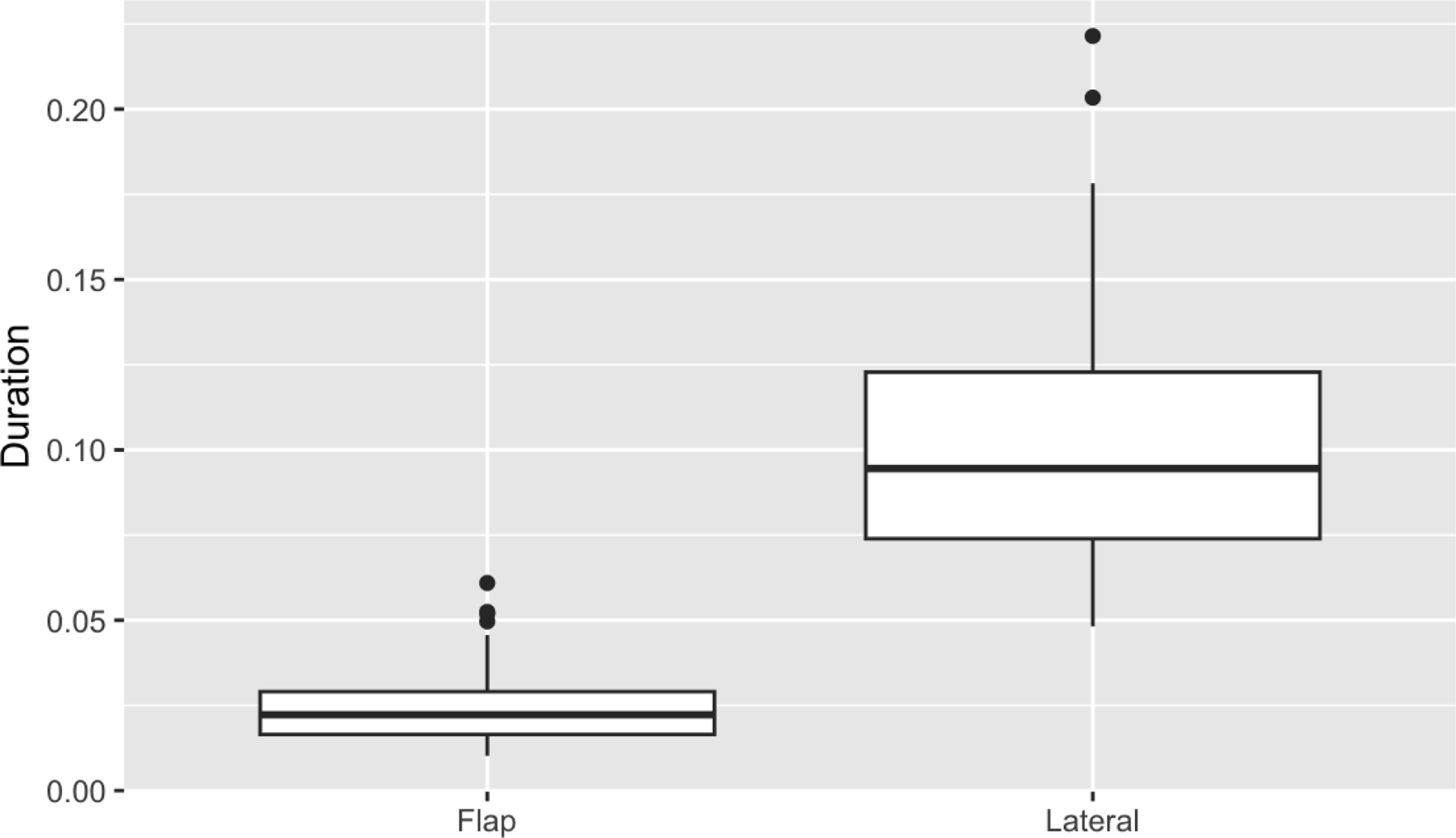
We now report on two models that we conducted to evaluate the statistical significance of the descriptive statistics presented in the tables in (20)–(22).Footnote 20 We begin with the model on duration (see boxplots in Figure 1). For duration, we performed a linear mixed-effects model, using the lmer function from the lmerTest package in R. This model incorporates fixed effects for “Sound,” indicating the phonemic identity of /r/ or /l/; “Word Type,” categorizing the word’s morphemic status as either monomorphemic (e.g. Karl) or part of an -erl diminutive (e.g. Kasperl); and “Speaker Age,” a continuous variable.Footnote 21 Interactions between these variables are considered alongside random intercepts for “Speaker Code” to account for variability attributable to individual speaker identities. The formula applied in this analysis is as follows:
lmer(Duration ∼ Sound * Word_Type + Word_Type * Speaker_Age + (1 | Speaker_Code), data = FL_Duration)
Boxplots for duration for [ɾ] and [l] in all [ɾl] sequences

The analysis revealed a statistically significant effect of phoneme on duration, with the lateral [l] exhibiting longer durations compared to the flap [ɾ] (β = 0.066, SE = 0.006, t = 10.169, p < .001). Contrarily, neither the morphemic category (β = −0.005, SE = 0.021, t = −0.226, p = 0.822) nor speaker age (β < −0.001, SE < 0.001, t = −0.230, p = 0.819) were found to be significant.
Furthermore, the interaction of phonemic category and morphemic status was found to be significant (β = 0.020, SE = 0.010, t = 2.086, p = 0.039), suggesting that the effect of phonemic identity on duration is modulated by the morphemic status of the word. However, the interaction of morphemic status and speaker age did not achieve statistical significance (β < 0.001, SE < 0.001, t = 0.597, p = 0.552). Assumption tests for this model were also performed and are available in the supplementary materials for the article.
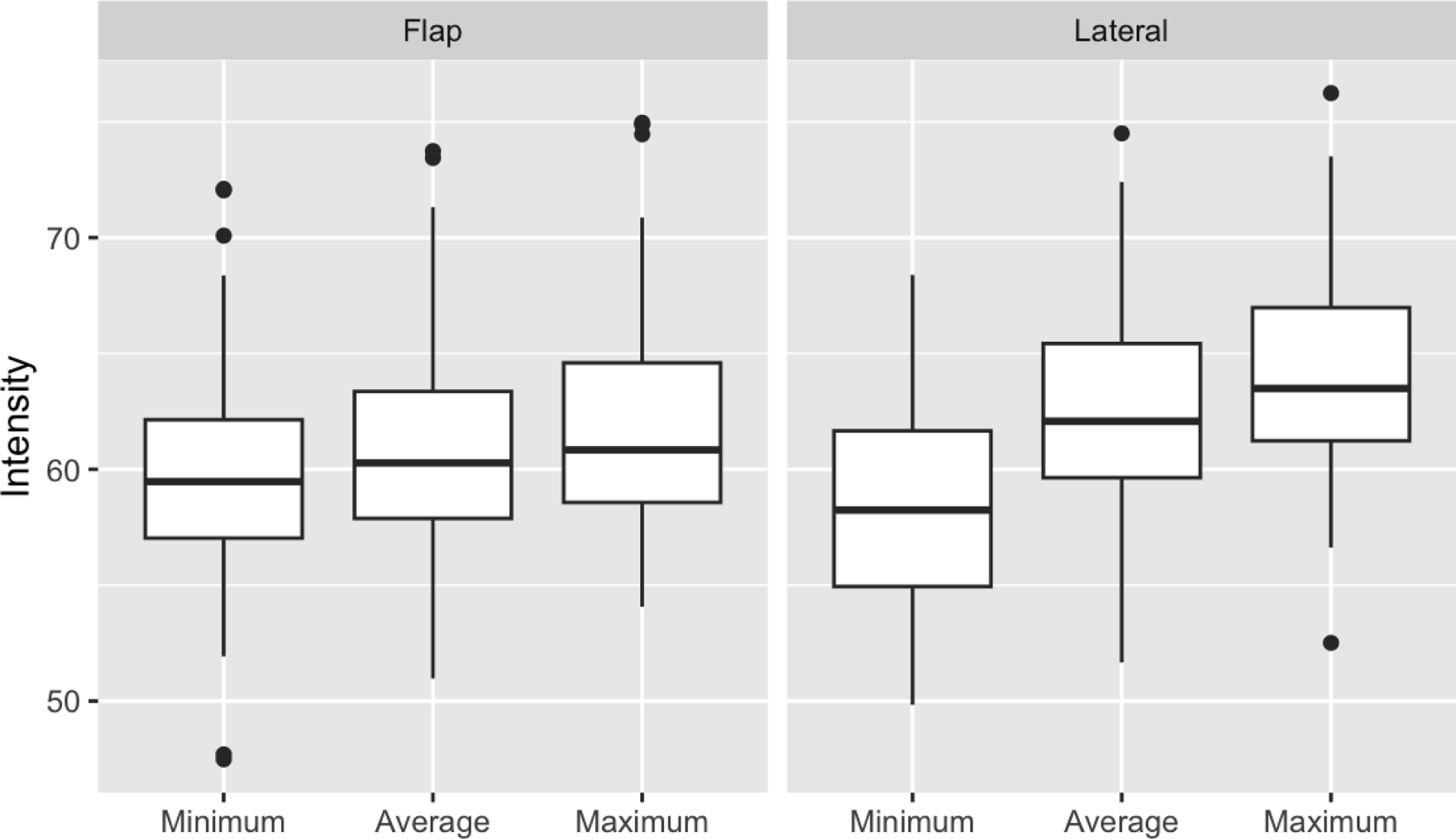
Second, we performed a statistical model on the intensity readings. The descriptive statistics for those values can be seen in the tables in (20)–(22), and the boxplots are given in Figure 2. The statistical analysis we performed was a linear mixed-effects regression model using the lmer function from the lmerTest package in R. This model using the fixed effects of “Sound,” indicating the phonemic identity of /r/ or /l/; “Ratings,” the three intensity readings (minimum, average, maximum) taken during the flap and lateral, respectively; “Speaker Age”; “Word Type,” monomorphemic (e.g. Karl) or part of an -erl diminutive (e.g. Kasperl). The interaction of the variable “Sound” and “Ratings” was also included in the model.Footnote 22 The formula for that model was the following:
lmer(Values ∼ Sound * Ratings + Speaker_Age + Word_Type + (1 | Speaker_Code), data = FL_Intensity_long)
Boxplots for minimum, average, and maximum intensities for [ɾ] and [l] in all [ɾl] sequences

The analysis revealed a statistically significant effect of phoneme on average intensity, with the lateral [l] being more intense than the flap [ɾ] (β = 1.89, SE = 0.432, t =4.365, p < 0.001). In addition, the values of maximum intensity are higher than those of average intensity (β =1.038, SE = 0.432, t = 2.401, p = 0.017) and those of minimum intensity are lower than those of average intensity (β = −1.084, SE = 0.432, t = −2.508, p = 0.013). Monomorphemic (-erl) words also exhibit greater intensity values than those of -erl diminutives (β = 0.896 SE = 0.275, t = 3.260, p = 0.001). Finally, the interaction of phonemic identity (as /l/) and minimum intensity reading results also reaches statistical significance (β = −2.917, SE = 0.611, t = −4.774, p < 0.001).
On the other hand, the variable of speaker age does not have a significant effect on the intensity values (β = 0.156, SE = 0.101, t = 1.547, p= 0.150). This is also the case for the interaction of phonemic identity (as /l/) and maximum intensity reading (β = 0.482, SE = 0.611, t = 0.789, p = 0.431).
Finally, to further understand the intensity readings in rhotics and laterals, we performed an Estimated Marginal Means (EMMs), using the emmeans package in R. This emmeans analysis took place in two steps. First, we computed the following:
emmeans(mo2, pairwise ∼ Sound|Ratings)
This function allowed for comparison between maximum and minimum values of [ɾ] and [l], in addition to the pairwise comparison of average intensity values given in the preceding paragraphs. We found that flaps had lower maximum intensity readings than laterals (Estimate = −2.37, t = −5.48, p < 0.001). However, flaps had higher values of minimum intensity (Estimate = 1.03, t = 2.385, p = 0.018).
Second, we computed the following:
emmeans(mo2, pairwise ∼ Ratings|Sound)
This function allowed for comparison between minimum, average, and maximum values within the categories of flap and lateral, respectively. Within the category of flap, average intensity was significantly lower than maximum intensity (Estimate = −1.04, t = −2.401, p = 0.044); average intensity was significantly higher than minimum intensity (Estimate = 1.08, t = 2.508, p = 0.034); and maximum intensity was significantly higher than minimum intensity (Estimate = 2.12, t = 4.910, p <0.001). With the category of lateral, average intensity was significantly lower than maximum intensity (Estimate = −1.52 t = −3.517, p = 0.001); average intensity was significantly higher than minimum intensity (Estimate = 4.00 9.259, p <0.001); and maximum intensity was significantly higher than minimum intensity (Estimate = 5.52, t = 12.776, p <0.001).
In sum, the results can be summarized as follows. The duration of [l] is longer than that of [ɾ], and this difference is statistically significant. Participant age does not significantly influence duration. The morphemic identity of the word (being monomorphemic as in Kerl or from a diminutive as in Schmankerl) also does not significantly affect the duration of sounds in general. However, [l] in a monomorphemic word is significantly longer, as indicated by the results of the interactions in our model.
Regarding intensity, [l] has a higher maximum and average intensity reading than [ɾ], and that achieves statistical significance in our model, although in raw terms that difference is not particularly large. The minimum intensity readings for [l] are lower than those of [ɾ], which is surprising given the other readings. However, one should consider that these values were taken in utterance-final position as part of a wordlist reading task, which might lead to unexpectedly low intensity readings.
5. Discussion
In this article, we approach the Bavarian German data with a phonetically defined analysis of sonority in the spirit of Parker (Reference Parker2002, Reference Parker2008, Reference Parker, van Oostendorp, Ewen, Hume and Rice2011), and this analysis provides several interesting advancements to both the literature on sonority, as well as the literature on Bavarian German <rl>. From our phonetic analysis, which demonstrates that [l̩] is both longer in duration than [ɾ] and higher in intensity, we conclude that the Bavarian German flap [ɾ] is less sonorous than the syllabic lateral [l̩]. This raises questions about Parker’s (Reference Parker2008, Reference Parker, van Oostendorp, Ewen, Hume and Rice2011) conclusions that there is an impermutable cross-linguistic sonority hierarchy, where flaps are always more sonorous than laterals and trills. Namely, our data contradict this particular fixed universal sonority hierarchy, and instead, our findings suggest a different solution.
We see two possible solutions, which both essentially lead to the same conclusion. In Thesis A, given in (23), there is a language-specific sonority hierarchy for Bavarian German (in line with Noelliste Reference Noelliste2019), where laterals are more sonorous than flaps (cf. findings in Parker’s Reference Parker2002 study); following Parker’s (Reference Parker2008, Reference Parker, van Oostendorp, Ewen, Hume and Rice2011) data, there is then a different language-specific sonority hierarchy for Quechua and Spanish, where the reverse is true: Flaps are more sonorous than laterals (which are in turn more sonorous than trills). For this model, one does not have to specify which flap or lateral is being considered, as the language has one representation for each in the hierarchy (see Thesis B below).


Thesis B, given in (24), is more in line with Parker’s (Reference Parker2008, Reference Parker, van Oostendorp, Ewen, Hume and Rice2011) inquiry, where the universal hierarchy has been expanded to include two different types of flaps. Flap type 1 is that of Quechua and Spanish and is more sonorous than laterals, and flap type 2 represents the sound spoken in Bavarian German, which is less sonorous than laterals.Footnote 24 Following Thesis B, the universal sonority hierarchy would need to be expanded to include and account for sounds which behave differently in terms of sonority, depending on the language and speakers thereof. We hypothesize, for example, that under Thesis B, cross-linguistic studies of languages where laterals behave differently would necessitate at least two different levels for laterals, particularly when one considers research from Sproat & Fujimura (Reference Sproat and Fujimura1993), which shows that the velar lateral is higher in sonority (i.e. it has a dorsal articulation more similar to vocalic articulations) than apical laterals.Footnote 25


We believe that both theses discussed above can coexist; namely, languages can have their own sonority hierarchies, which are a subset of an expanded version of Parker’s (Reference Parker2008, Reference Parker, van Oostendorp, Ewen, Hume and Rice2011) universal hierarchy.
The discussion above leads to grander questions, including: What do we as phonologists want the sonority hierarchy to be? What are the goals of having a (universal) sonority hierarchy? For example, if we desire the sonority hierarchy to be universal, would this not mean that we would have to differentiate between, say, fricatives of different places of articulation? After all, as Henke, Kaisse, & Wright (Reference Henke, Kaisse, Wright and Parker2012:71, fn. 8) point out, /f/ has weaker auditory cues than /s/, meaning that it might be argued that it is the less sonorous of the two; however, such a claim is unusual in the literature. We have come to an understanding that some of the differences discussed above are about point of view or lens, and they do not necessarily make different predictions. We see this as a strength of the theory concerning sonority and sonority hierarchies, as the theory itself holds up from multiple angles.
With these questions in mind, we may now return to our conception of the sonority hierarchy. Based on the data and analysis presented here and in Noelliste (Reference Noelliste2019), we would like to propose that sonority can best be modeled as a conglomeration of characteristics that are both phonological and phonetic in orientation, as in (25), repeated from (7).
-
(25) Correlates of sonority
-
a. Higher sonority segments have higher intensity than lower sonority segments (e.g. Bloomfield Reference Bloomfield1914, Ohala Reference Ohala1992, Laver Reference Laver1994, Parker Reference Parker2002, Reference Parker2008, Reference Parker, van Oostendorp, Ewen, Hume and Rice2011, Reference Parker2017);
-
b. Higher sonority segments are longer in duration (e.g. Price Reference Price1980);
-
c. Higher sonority segments are more periodic and less “noise”-driven (e.g. Ohala Reference Ohala1992);
-
d. Higher sonority segments are produced with a greater jaw aperture (e.g. Bloomfield Reference Bloomfield1914, Jespersen Reference Jespersen1922, Goldsmith Reference Goldsmith1990, Kirchner Reference Kirchner1998);
-
e. Higher sonority segments are more likely to occur closer to the center of a syllable (e.g. Selkirk Reference Selkirk, Aronoff and Oehrle1984, Zec Reference Zec1988, Reference Zec and de Lacy2007, Clements Reference Clements, Kingston and Beckman1990).
-
In our study, we set out to identify a phonetically measurable means for determining the sonority of Bavarian German <rl> sequences. We used Parker’s works (2002, 2008, 2011) as our point of departure and, accordingly, we found that Bavarian German [l] had a consistently higher intensity than the flap, across all speakers analyzed. That is, for metric (a), the lateral was more sonorous than the flap with two important caveats. First, the numerical difference between the two sounds’ intensity readings was not particularly large. Second, the average minimum intensity readings for [l̩] were actually lower than those for [ɾ], and our EMMs pairwise comparison found this result to be significant. To us, these latter facts underscore the importance of considering multiple properties of sonority.
The same holds true for Bavarian German <rl> sequences according to metrics (b), (c), and (e).Footnote 26 That is, as shown in section 4, the Bavarian German laterals were 76.7 msecs longer in duration than the flaps (i.e. per metric (b), the lateral is more sonorous than the flap), a finding that was demonstrated to be statistically significant in our linear mixed-effects model. Regarding metric (c), we have not measured or quantified this directly, however, our impression of the waveforms given above is that the flap realizations tend to have periods of noisiness that is not found in the laterals.Footnote 27 Finally, according to metric (e), the lateral was more sonorous than the flap: The flap consistently served as an onset to a syllabic lateral (cf. discussion of the phonological behaviors of Bavarian German <rl> in Noelliste Reference Noelliste2019).
The category of liquids (laterals and rhotics) presents a notable challenge to any sonority hierarchy since there is a great diversity of manners and places of articulation that are uncontroversially identified as members of the two phonological classes, such that it becomes difficult to give a concise positive definition that describes them to the exclusion of all other speech sounds, especially for rhotics (see Lindau Reference Lindau and Fromkin1985, Ladefoged & Maddieson Reference Ladefoged and Maddieson1996: ch. 7, Wiese Reference Wiese, van Oostendorp, Ewen, Hume and Rice2011, Chabot Reference Chabot2019, among many others), but diversity is also found in laterals, particularly with regard to place of articulation (see Sproat & Fujimura Reference Sproat and Fujimura1993, Proctor Reference Proctor2011). This means that there are a great number of sounds in these intermediate categories, whose sonority is up for grabs. We hypothesize that in these cases, expanding the number of phonetic correlates of sonority allows for a better understanding of the relative sonority for these sounds.
In the current study of Bavarian German liquids, we found that when we applied the metrics above to our data, the conclusion was unanimous that the lateral is higher in sonority than the flap. We suggest that other studies may likewise benefit from considering multiple phonetic and phonological metrics when determining segment sonority.
6. Conclusion
The concept of sonority has enjoyed a life on the precipice since its conception. As Gretchen McCulloch points out in her Lingthusiasm podcast:
sonority is one of those really interesting concepts to me because when you first encounter it, you’re like, “Wow! This explains everything!” And then you encounter more languages, or you go to grad school, or something, and then you’re like, “Oh, no. This doesn’t make sense at all. This explains nothing. Every language does it slightly differently. Maybe it doesn’t exist.” It can exist in both of those states at once where you’re like, on the one hand, this does actually seem to account for some stuff and, on the other hand, the details of how you wanna implement it can get really complicated really quickly.
And yet, the concept of sonority continues to persist in linguistic theory. This persistence, in spite of the difficulties in defining the concept, attests to the explanatory power of the theory. We have suggested here that a concrete phonetic definition of sonority (in the sense of Parker) may be a step in the right direction, yet it also needs to be refined by further phonetic work, in particular with languages outside of English, Spanish, and Quechua. Nonetheless, it remains likely that no matter how much phonetic work is conducted, there will still be sonority patterning effects that evade our phonetically derived understanding of sonority. Indeed, phonology, and perhaps linguistics as a whole, are likely to remain prime examples of what author Michael Blastland (Reference Blastland2019) calls “the hidden half”: The idea that in nearly all cases, a scientific explanation has an underbelly that is ultimately inexplicable. In our quest to define and constantly redefine the sonority hierarchy based on the phonetic properties of individual languages, we are likely to find yet other examples that fall outside the pattern.
For example, Russian ртуть ‘mercury’ with its falling sonority onset cluster /rt/ presents a difficult case. Indeed, such problematic sonority onsets (or codas) are hardly rare in attested human languages, as Yin et al. (Reference Yin, van de Weijer and Round2023) show. A conceivable phonetic explanation as to why falling sonority onset clusters like /rt/ do not present genuine counterexamples to the Sonority Sequencing Principle (Clements Reference Clements, Kingston and Beckman1990) could be found in the phonetic properties of trills. Due to the aerodynamic requirements of producing a trilled [r], it is likely that brief vocalic periods will occur prior to (and potentially also after) the beginning of trilling proper (cf. Ladefoged & Maddieson Reference Ladefoged and Maddieson1996, Bolter Reference Bolter2021). Thus, a sequence like /rtutʲ/ might be produced as [ərətutʲ] (for discussion of these epenthetic periods in some Slavic languages, see Savu Reference Savu, Spreafico and Vietti2013:145–147). If this were the case, then the surface syllabification could be [ər.tutʲ] or [rə.tutʲ], neither of which would present a problem for the Sonority Sequencing Principle (Clements Reference Clements, Kingston and Beckman1990). However, this potential phonetic explanation would require a phonetic study verifying the presence of such vocalic periods. Currently, the present authors are unaware of such work.Footnote 28 When such evidence is lacking, explanations such as “In Russian, falling sonority onsets such as /rt/ are permitted at a language-specific level” might well be the best that can currently be offered.
In this article, we have given a phonetic-based analysis of the sonority of the Bavarian German flap and proposed two different angles from which linguists can see a viable solution in line with earlier work on both Bavarian German (cf. Noelliste Reference Noelliste2019) and sonority (cf. Parker Reference Parker2002, Reference Parker2008, Reference Parker, van Oostendorp, Ewen, Hume and Rice2011). Based on multiple prior scholars’ works, we have also proposed five correlates for sonority, which, when used together, can provide a more accurate and detailed understanding of sonority, as it is realized in different languages. We believe there is much more work to be done on sonority and the sonority hierarchy, and we see these five correlates as a helpful point of departure for future research.
Abbreviations and symbols
- +
-
Reconstructed form
- *
-
Unattested/Ungrammatical form
- ||
-
Phonetic transcription of an original source
- //
-
Underlying form
- []
-
Phonetic form
- →
-
Is realized as
- >
-
Becomes (at a later historical stage)
- Italics
-
Citation of a non-English word
- ‘…’
-
English gloss of a non-English word
Supplementary material
To view supplementary material for this article, please visit https://doi.org/10.1017/S1470542726100233
Appendix A. Demographic information about speakers

Appendix B. Words elicited



 Open access

