


Introduction
A variety of recent research has identified the polar regions as especially sensitive components of the global-climate system. Modeling experiments with general circulation models (GCMS) involving future scenarios with doubled CO2 concentrations and past climates under altered orbital configurations have shown that high latitudes respond most strongly to global-climate changes (e.g. Reference Mitchell, Manabe, Meleshko, Tokioka, Houghton, Jenkins and EphraumsMitchell and others, 1990; Reference Kutzbach, Gallimore and GuetterKutzbach and others, 1991). Paleoenvironmental evidence supports these results and suggests that polar climates vary widely on time-scales of decades to millions of years (e.g. Reference Alley, Smith and GrebmeierAlley, 1995). As a consequence of this extreme sensitivity and its global implications, it is essential that polar regions are modeled in order to diagnose and predict their role in future global change.
One of the most robust results of GCM simulations with increased atmospheric CO2 is the pronounced poleward amplification of warming. This result has been illustrated by a variety of experiments, ranging in sophistication from instantaneous CO2 doubling using coupled atmospherestatic mixed-layer ocean models (e.g. Reference Washington and MeehlWashington and Mechl, 1984) and coupled atmosphere mixed-layer models with prescribed oceanic heat transport (e.g. Reference Wilson and MitchellWilson and Mitchell, 1987), to transient CO2 doubling using fully coupled atmosphere–ocean models (e.g. Reference Manabe, Stouffer, Spelman and BryanManabe and others, 1991). Such sensitivity tests have found that the high-latitude warming due to increased CO2 is 2–3 times the global average. These studies have attributed the enhanced sensitivity of both polar regions to the greatly increased air-sea heat transfer when sea ice and snow cover are reduced.
The role of sea ice in amplifying the high-latitude climatic response deserves particular attention, because of the direct thermodynamic and hydrologic effects of sea ice on both the atmosphere (by regulating the air–sea exchange of heat and moisture) and the ocean (by controlling salt fluxes into the mixed layer). Unfortunately, sea-ice models are known to be sensitive to numerous uncertain parameters and processes, such as the parameterization of leads (Reference VavrusVavrus, 1995), surface albedo (Reference Shine and Henderson-sellersShine and Henderson-Sellers, 1985);. ocean–ice heat flux (Reference Maykut and UntersteinerMaykut and Untersteiner, 1971), and ice dynamics (Reference Hibler, Hansen and TakahashiHibler, 1984). Sea-ice simulations may also depend on other mechanisms even more difficult to quantify, such as the partitioning of solar energy between oceanic warming and ice melting (Reference Maykut and PerovichMaykut and Perovich, 1987), vertical and lateral mixing of water within leads and beneath ice Ilocs (Reference Perovich and MaykutPerovich and Maykut, 1990), and the presence of thin and thick ice floes within an ice pack (Reference Curry, Schramm and EbertCurry and others, 1995).
The goal of this study is to test several parameterizations in a sea-ice model to evaluate the importance of various processes that could affect the simulation of Arctic ice cover, and to estimate the most likely behavior of the actual ice–ocean system by comparing simulations with observations. The emphasis here is to improve sea-ice simulations in large-scale climate models, rather than in high-resolution regional and operational models.
Model Description
An overview of the essential components of the model is given here. The model is a one-dimensional(1-D) representation of the growth and decay of sea ice at a single point representative of the central Arctic; there is no latitudinal or longitudinal variation. The ice cover is underlain by a 50m mixed layer that is completely decoupled from the deep ocean, so that none of the warm Atlantic water at depth can reach the ice base. This decoupling is justified by the central Arctic's extreme stratification, which has been confirmed by a number of studies (e.g. Reference McPhee and UntersteinerMcPhee and Unter-steiner, 1982: Reference Morison and SmithMorrison and Smith. 1981). The skeletal thermodynamics of the model are described in Reference SemtnerSemtner (1976), Reference Parkinson and WashingtonParkinson and Washington (1979), and Reference Ebert and CurryEbert and Curry (1993). The 0-layer approximation of Reference SemtnerSemtner (1976) is used for the diffusive heat flux through the ice. The growth and decay of leads are a combination of the approaches used by Reference Parkinson and WashingtonParkinson and Washington (1979) and Reference Ebert and CurryEbert and Curry (1993). The model also includes melt ponds, the depths of which follow the approach of Reference Ebert and CurryEbert and Curry (1993), but the areal extent of which is a linear function of the surface melt rate to produce a seasonal cycle consistent with observed estimates (Reference BarryBarry, 1983). As in Reference Ebert and CurryEbert and Curry (1993), there is a prescribed ice-export term, which forces ice divergence at all times of the year. The basal heat flux is prognostic, and is determined by the input of solar energy into the mixed layer, with a temperature and turbulence dependence described by Reference McPheeMcPhee (1992).
An alternate model version allows the solar-energy input to be partitioned in a prescribed manner between the warming of the mixed layer and lateral melting. During melting conditions, there is a prescribed ice-thickness distribution within the pack, to account for the vertical meltoff of thin ice and the different lateral melting rates of thin and thick ice. Unlike previous models, which assume a uniform distribution of thin and thick ice floes (e.g. Reference HiblerHibler. 1979: Reference HarveyHarvey, 1988), the ice distribution here is assumed to be triangularly shaped between 0 and twice the mean ice thickness, giving the smallest amounts of very thin and very thick ice and the largest amounts of ice near the mean thickness. This choice of distribution is more consistent with measured thickness distributions of Arctic sea ice (e.g. Reference Tucker, Perovich, Gow, Weeks, Drink and CarseyTucker and others. 1992). A vertical-mixing coefficient within leads was used (set to 50% of complete mixing in the control case) during the melt season to account for the assumed stratification between the upper lead (water surface to ice bottom) and the lower lead (bottom of ice to mixed-layer depth of 50 m). A lateral-mixing coefficient (set to 100% of possible mixing in the control case) adjusts the amount of mixing between the lower lead and the water beneath the ice. The ice and snow albedos are functions of cloud cover, surface temperature and thickness and are based on a variety of observational estimates and theoretical calculations (Reference Fifechet and GasparGrenfell and Maykut, 1977; Reference GrenfellGrenfell, 1979; Reference Shine and Henderson-sellersShine and Henderson-Sellers, 1985). The rate of turbulent heal transfer from the air to the ice, snow or water depends on the atmospheric stability, as described by Reference Ebert and CurryEbert and Curry (1993). The model is forced by the atmospheric dataset published there, except for snowfall, for which Reference Maykut and UntersteinerMaykut and Untersteiners (1971) values are used.
Results of Control Simulation
Using the atmospheric forcings for the central Arctic described earlier, the model was run to equilibrium using the control settings of the lateral- and vertical-mixing coefficients, the ice-thickness distribution, and the basal heal flux formula (Table 1). The simulated seasonal and annually averaged sea-ice characteristics compare well with observations, with respect to ice thickness and lead fraction (Fig. 1), basal heat flux, melt-pond fraction, and ice-surface temperature. A comparison with other sea ice models' sensitivity to infrared heat flux perturbations (Reference Curry, Schramm and EbertCurry and others, 1995) shows that this model is comparably sensitive to those of Reference Ebert and CurryEbert and Curry (1993), Reference Maykut and UntersteinerMaykut and Untersteiner (1971), and Reference SemtnerSemtner (1976).
Parameters used in the control simulation

The annual cycle of central Arctic sea-ice thichkness and lead fraction in the control simulation.

The simulated sea ice is thickest at the end of May (3.56 m) and thins to a late-summer minimum of 2.74 in in mid-September. The mean annual thickness is 3.18 m, close to the observed estimates of Reference Bourke and GarrettBourke and Garrett (1987). The predicted concentration of open water is smallest in February and March, but never reaches the minimum value of 0.5% allowed by the model, because of the divergence produced by the ice-export term. This behavior is in sharp contrast to a simulation with a leads parameterization by Reference VavrusVavrus (1995), in which the lack of ice export allowed significant thickening of ice by ridging once the minimum lead fraction was reached during winter. Open water becomes most widespread in mid-September (13%), the timing and magnitude of which agrees with observations, as does the phase and amplitude of the annual cycle of lead fraction (Reference AsselinAsselin, 1977; Reference Zakharov, Kotlyakov and Grosval'dZakharov, 1987).
The predicted basal heat flux is 0 during the polar night and peaks at 8.4 W m−2 in mid-August. The mean annual value of 1.75 W m−2 is close to the inferred value around 2 W m−2 (Reference Maykut and UntersteinerMaykut and Untersteiner, 1971). The simulated maximum melt-pond fraction, which was formulated to match observed estimates, is 25%, and occurs in mid-July. The ice-surface temperature in the model drops to 240 K in January and February, and peaks at the melting point from late-June to late-August.
Sensitivity to Parameterizations
The uncertainty of how solar-energy absorption in the upper Arctic Ocean is actually partitioned between mixed-layer warming and ice melting has been raised in previous observational and modeling studies (Reference Maykut and PerovichMaykut and Perovich, 1987; Reference SteeleSteele, 1992). Here the model is subjected to a range of possible partitionings to examine how sensitive the ice characteristics are to the choice of partitioning, and to assess which combinations produce the most realistic patterns of ice thickness and concentration. As outlined in the model description, an option exists for shutting off the model's prognostic partitioning of mixed-layer heat content and replacing it with prescribed fractions of the air–sea energy flux at the lead surface to warm the mixed layer and to melt the ice laterally. The results of this experiment are presented in Figure 2, which shows a pronounced non-linearity in the response of the mean annual ice thickness to changes in heal partitioning. If less than half of the energy entering the mixed layer is applied to heating, then reductions in this fraction (F HEAT) cause substantial thickening of the ice. If a majority of the incoming energy goes toward heating, however, then only negligible variations in ice thickness occur when the heal partitioning changes. Because F HEAT is a measure of the ocean–ice heat transfer, these results are consistent with those of Reference Maykut and UntersteinerMaykut and Untersteiner (1971), who showed that sea-ice thickness is more sensitive to decreases in the basal heat flux (especially at very low values) than to increases.
The mean annual central Arctic sea-ice thickness (solid line) and maximum summer time lead fraction (dashed line) as a function of the fraction of atmospheric-heat energy entering the mixed layer that is used to warm the upper ocean. The remaining fraction is used to melt ice laterally.

The ice in this model thins even more gradually with increases in F HEAT, however, because the basal heat flux parameterization allows only a fraction of the mixed-layer heat content to melt the ice bottom. The maximum summer-time lead fraction displays a more linear decrease with increases in F HEAT. as less energy is available for lateral melting. Note that there is still open water simulated, even with no lateral melting, owing to the effects of the prescribed ice-export term and the vertical meltoff of thin ice.
If one accepts that in the central Arctic the mean annual ice thickness is around 3 m (SHEBA, 1993) and that the maximum open-water fraction is about 0.15 (Reference AsselinAsselin, 1977; Reference Zakharov, Kotlyakov and Grosval'dZakharov, 1987), then these results suggest that the energy gained by the upper ocean during summer goes almost equally toward heating and melting. This conclusion supports the ad hoc approach used in the sea-ice models of Reference Mellor and KanthaMellor and Kantha (1989) and Reference HiblerHibler (1979), who used half of the mixed-layer heat content for lateral melting and half for heating of the ocean. The remainder of this paper describes the results of experiments in which the amount of lateral melting and mixed-layer warming are no longer prescribed, but are instead predicted by the model.
The mean ice thickness and the timing of open-water production are fairly insensitive to the amount of lateral mixing between water within leads and water beneath ice, as long as there is at least some mixing. Figures 3a and b illustrate the responses of the ice thickness to the prescribed fraction of complete lateral mixing (LATMIX) within the upper ocean, and to the prescribed fraction of complete vertical mixing (VERTMIX) within leads. Figure 3a shows the mean ice thickness when a control value of 0.5 for VERTMIX is fixed, while LATMIX is varied from 0 (no lateral mixing) to 1 (complete lateral mixing). When there is at least 4% of complete lateral mixing, then the ice thickness remains within a range of about 20 cm. The sea ice actually thickens slightly as LATMIX increases, even though enhanced mixing causes more of the solar energy absorbed by leads to reach the water beneath the ice and generate more vertical melting. The reason for this surprising response is that enhanced lateral mixing also lorces the sub-ice mixed layer to lose its heat content more quickly once the cold season ensues.
The effect of (a) the lateral-mixing efficiency within the mixed layer (LATMIX) and (b) the vertical-mixing efficiency within leads (VERTMIX) on the mean annual sea-ice thickness.

Since leads lose heat rapidly to the overlying atmosphere beginning in early autumn, and because a large LATMIX allows easy energy exchange across the entire mixed layer, the extra heat gained by the sub-ice portion of the mixed layer with vigorous lateral mixing is quickly lost during the fall.This process results in reduced bottom melting, compared to cases with only slight lateral mixing. If the mixed layer becomes too stagnant, however (LATMIX < 0.04), then virtually none of the solar energy absorbed by open water is available for bottom melting, and thus the ice thickens to an unrealistic maximum of almost 5 m for the limit of no lateral mixing. This limit is also unrealistic because, in this case, the open water concentration does not reach its maximum until late October, over one month later than observed.
Whether leads are well stratified or not makes virtually no difference to sea-ice characteristics (Fig. 3b). With LATMIX fixed at the control value of 1.0. variations of VERTMIX from 0–1 cause a < 10 cm difference in the mean annual ice thickness, and virtually no dilferenee in the timing of the peak lead fraction. It should be noted, however, that the lateral-melting rate in the parameterization used here depends on the energy absorbed by the upper lead during a time-step, rather than on the temperature difference between the upper lead and the adjacent ice. It would be physically more plausible to make the lateral-melt rate a function of the temperature difference, and in such a scheme the amount of vertical mixing within leads might be important. Unfortunately, this kind of parameterization is difficult to implement, owing to wide discrepancies in observed lateral-melt rates and the requirement of an (as yet unverifiable) ice-floe geometry distribution (Reference SteeleSteele, 1992).
Given the amount of discussion in the literature regarding the best choice of a basal heat flux parameterization (e.g. Reference HarveyHarvey, 1990; Reference SteeleSteele, 1992), a surprising result of this study is how little the ice pack seems to depend on which approximation is used. Table 2 shows the results of three very different parameterizations. The control case uses the formula from Reference McPheeMcPhee (1992), which is based on a variety of measurements across the Arctic, and allows the mixed layer to exceed freezing point, consistent with observations (Reference Maykut and McPheeMaykut and McPhee, 1995). The second case uses only half this value, while the third case immediately applies all of the mixed-layer heating beneath the ice to bottom melting, an approximation frequently used in sea-ice models (e.g. Reference Fifechet and GasparFifechet and Gaspar, 1988).
The effect of heat Jlm parameterizations used in the experiments
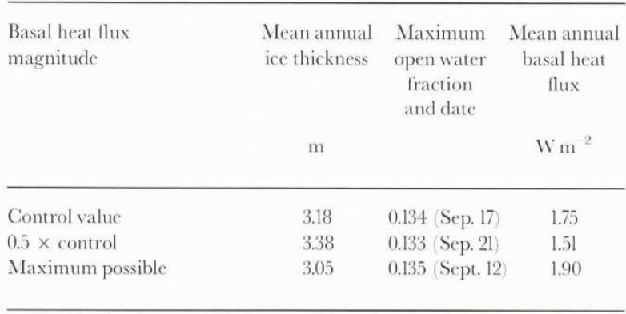
Although the mean annual ice thickness does differ, depending on the parameterization, the range is surprisingly small. As expected, the thinnest ice results when all of the heat energy is used to melt the ice, but this thickness differs by only about 10 cm from that obtained with the control parameterization, which uses only a small fraction of the available heat energy to melt the ice. The reason for the similar response is that the control parameterization allows the mixed layer to serve as a heat reservoir during the summer, and then slowly dissipates this energy in the form of enhanced bottom melting during the late-summer and fall, relative to the third case. This extra melting from below during autumn retards the rapid thickening of ice as the atmosphere is cooling, which results in a mean annual thickness quite close to the case with maximum bottom ablation. Note also that the choice of a basal heat flux parameterization has little effect on the timing or magnitude of the maximum open water amount during summer.
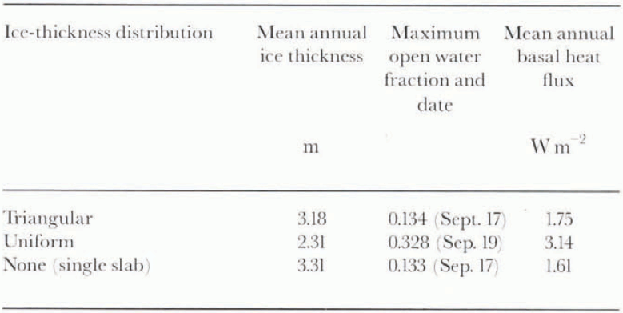
Traditionally sea-ice models have not used an ice-thickiness distribution, instead treating the ice at a gridpoint as a single slab of a given thickness. Numerous observations from submarine sonar and ice platforms have shown, however, that ice packs consist of ice floes of various shapes and sizes (e.g. Reference Wadhams and HorneWadhams and Horne, 1980; Reference Tucker, Perovich, Gow, Weeks, Drink and CarseyTucker and others, 1992). In an attempt to account for this spatial variability, some models have included a prescribed ice-thickness distribution, in which the ice is assumed to be uniformly distributed between 0 and twice the mean thickness in a gridbox (Reference HiblerHibler, 1979; Reference HarveyHarvey, 1988; Reference Pollard and ThompsonPollard and Thompson, 1994). When vertical ablation occurs, the fractional ice coverage is decreased to account for the meltoff of the thinnest floes (see Reference HarveyHarvey (1988) for details). Although mathematically simple, the assumption of a uniform thickness distribution is at odds with most measurements from the Arctic and Antarctic (e.g. Reference Tucker, Perovich, Gow, Weeks, Drink and CarseyTucker and others, 1992; Reference Wadhams, Lange and AckleyWadhams and others, 1987), which show only small amounts of very thin and very thick ice, but large amounts of ice near the mean local thickness. To incorporate this kind of observed distribution, the model described here prescribes that sea ice be distributed between the limits of 0 and twice the mean thickness, but with a triangularly shaped probability density function that peaks at the mean ice thickness, and falls to zero at the two limits.
The effect of the various distributions of the simulated ice characteristics is shown in Table 3. There is a strong similarity between the simulation with a triangular distribution and the one with a single slab of constant thickness, because very little thin ice exists in the former case and none exists in the latter. A uniform distribution causes much more open water during summer and a much thinner ice cover, due to the over-abundance of assumed thin ice floes and the resulting positive feedbacks that occur between melting and Solar heating within the ice pack as the lead fraction increases.
The effect of ice-thickness distributions used in the experiments
Conclusions
A 1-D sea-ice model of the central Arctic is used to assess the ice pack's sensitivity to a variety of parameterizations and processes. The advantages of this model over earlier sea-ice models include the inclusion of a melt-pond parameterization, improved treatment of leads, a more realistic' ice-thickness distribution, and a sophisticated albedo parameterization. The results suggest that the solar energy absorbed in the mixed layer should be divided nearly evenly between warming of the water and lateral melting of the ice. As long as there is some lateral mixing within the mixed layer, then the exact amount does not strongly affect the ice thickness or concentration. The amount of vertical stratification within leads appears to be an even less important influence on the ice pack, as variations in vertical mixing ranging from complete to none, produced only slight differences in the simulated ice Held.
The choice of the bottom-melting parameterization has surprisingly little effect on the ice thickness, at least for the present climate, because efficient conversion of oceanic-heat energy into bottom melting during summer depletes the mixed-layer heat content more rapidly, resulting in reduced basal heat fluxes during autumn. The type of ice-thickness distribution strongly affects the ice thickness and open water amount. It appears that the use of a uniform ice-thickness distribution will favor an ice pack that is too thin and sparse, as occurred in a recent atmospheric GCM simulation of the Arctic that used such an approximation (Reference Pollard and ThompsonPollard and Thompson, 1994).
Within the limitations of the model, these results may be useful for large-scale climate models that require a balance between sophisticated physics and computational efficiency. These simulations suggest that such models need not be very concerned with the amount of mixing in the upper ocean, nor even with the treatment of the basal heat flux. More consideration should be given to how much solar energy is used for lateral melting and to the choice of an ice-thickness distribution. A caveat to these conclusions is that they apply to the modern Arctic sea-ice pack; sensitivities to parameterizations may be quite different under altered climatic regimes, such as CO2, doubling or palcoclimates.
Acknowledgements
This work was supported by a NASA Global Change Graduate Fellowship (NGT 30346).



