





1. Introduction
In their special report entitled The Ocean and Cryosphere in a Changing Climate, the Intergovernmental Panel on Climate Change highlights the need to better understand whether ongoing and projected ice mass loss is irreversible (Meredith and others, Reference Meredith and Pörtner2019). Therefore, exploring periods throughout geologic history that enable us to gain insight into the reversibility of ice mass loss is critical. Uncovering any evidence that parts of the Antarctic Ice Sheet have recovered from a smaller-than-present configuration would thus be important in suggesting a tipping point for runaway retreat has not yet been reached. Ice mass gain after a period of accelerated loss can be observed in the recent past (mid-to-late Holocene) and throughout deeper time (last and previous interglacials) via access to the ice-bed interface made possible by subglacial drilling. Once an access hole through the ice has reached within several meters of the bedrock, a rock-coring system can then be used to retrieve a sample of the upper 1–2 m of underlying bedrock for cosmogenic nuclide exposure dating. Evidence of above-background levels of targeted cosmogenic nuclides indicates prior exposure of the bedrock at or near the surface because cosmic radiation can penetrate as much as 5–10 m of ice cover (Spector and others, Reference Spector2018; Balco and others, Reference Balco2023). Therefore, the depth below the current ice surface at which nuclides are measured indicates ice sheet thinning of at least that magnitude.
Subglacial drilling has been attempted in parts of West Antarctica and Greenland (e.g. GreenDrill) with success at depths of tens to hundreds of meters (e.g. Spector and others, Reference Spector2018; Balco and others, Reference Balco2023, Balter-Kennedy and others, Reference Balter-Kennedy2023). Thus far, sites in East Antarctica and the Antarctic Peninsula have yet to be drilled. In West Antarctica in 2016/17, a team retrieved an 8 m rock core at 150 m depth at Pirrit Hills, West Antarctica (Spector and others, Reference Spector2018) using a drill system intended to reach depths up to 700 m. Following the successful extraction of a subglacial bedrock core at Pirrit Hills, a workshop was convened in 2019 to prioritize drill sites across Antarctica that would capture past extents of the ice sheet (Spector and others, Reference Spector2019). Of particular interest were sites that may record periods of time with a climate similar to present. The field campaigns discussed here targeted periods during the Pleistocene, for which it has been hypothesized that the ice volume of the West Antarctic Ice Sheet (WAIS) may have been greatly reduced (Scherer and others, Reference Scherer1998; Kopp and others, Reference Kopp, Simons, Mitrovica, Maloof and Oppenheimer2009; Lau and others, Reference Lau2023). More recently, there is evidence for retreat and readvance during the late Holocene after recent studies revealed evidence for retreat of the WAIS in both the Weddell Sea sector (Bradley and others, Reference Bradley, Hindmarsh, Whitehouse, Bentley and King2015; Kingslake and others, Reference Kingslake2018) and the Ross Sea sector (Venturelli and others, Reference Venturelli2020, Reference Venturelli2023). Once the geographic scope of sites was narrowed down based on targeted geologic time periods, specific targets for future drill sites were further refined on how well they met the following criteria: (1) past ice volume fluctuations at the drill site occurred on a regional scale representing larger ice sheet dynamics, not simply local ice dynamics, (2) the rock types at each site must be appropriate for cosmogenic nuclide measurements to determine if glacial thinning occurred at the site, (3) the upper few meters of the subglacial bedrock surface (where the cosmogenic nuclide record is preserved) must have remained free from erosion that would otherwise erase or obscure results by removing rock that would archive cosmogenic nuclides (Spector and others, Reference Spector2018) and (4) the bedrock must be above sea level when deglaciated to prevent shielding of cosmogenic rays caused by water (Granger, Reference Granger2014). Additional considerations for site selection from a logistical perspective included the need to select sites that: (1) allowed for ground-penetrating radar (GPR) imaging of subglacial topography at targeted depths, (2) have limited crevassing for site-safety considerations and (3) could be reached by small plane support such as a Twin Otter or Basler. For an extensive review of these criteria and an overview of the sensitivity analysis for sites to capture past deglaciation events of the WAIS, see Spector and others (Reference Spector2018, Reference Spector2019).
Here we focus on lessons learned from five shallow drilling (<120 m) campaigns (Fig. 1) carried out since 2016/17. Four were undertaken at Ohio Range, Mount (Mt.) Murphy, Hudson Mountains and Enterprise Hills. Drilling at the fifth site, Mount (Mt.) Waesche, is planned for 2024/25 and we include the site here to highlight the advantages of a pre-drilling season dedicated to reconnaissance and GPR data collection. We discuss the success and challenges related to the use of GPR for drill site selection and the Winkie Drill system and its evolution. For the five sites, we provide a brief site description and summary of key takeaways from each field season. Additional details related to the scientific significance of each site and an overview of radar surveys with corresponding GPR data and drilling efforts are found in the supplemental material.
Overview map of Antarctica showing study locations and campaign dates of subglacial drill sites. Previously drilled sites include Ohio Range, Mt. Murphy (Kay Peak), Hudson Mountains (Winkie Nunatak), and Enterprise Hills. A reconnaissance geophysical survey was conducted at Mt. Waesche in 2018/19 with drilling proposed to begin in 2024/25 as noted by the asterisk. Red pins indicate Winkie Drill sites. The green pin indicates an additionally mentioned drill site that used the Agile Sub-Ice Geologic Drill (ASIG), capable of drilling to depths of 700 m. WAIS – West Antarctic Ice Sheet. EAIS – East Antarctic Ice Sheet. Textured gray represents the current ice-sheet surface (from Reference Elevation Model of Antarctica [Howat and others, Reference Howat, Porter, Smith, Noh and Morin2019]). Shaded gray areas outlined in blue represent ice shelves. Bathymetry (blue and white shades) is from GEBCO2019 global dataset (GEBCO group, 2019). The basemap was created from the SCAR Antarctic Digital Database.

2. Drilling and radar overview
2.1 Drilling technology
A variety of technologies provide access to the ice-bed interface including those that melt through ice [e.g. clean-access, hot-water drilling (Tulaczyk and others, Reference Tulaczyk2014; Priscu and others, Reference Priscu2021)] and those that permit the collection of ice [e.g. ice coring (see Boeckmann and others, Reference Boeckmann2021) or ice augering (see Rix and others, Reference Rix, Mulvaney, Hong and Ashurst2019)]. The tools used and timeframe targeted for subglacial access efforts depend on conditions at the site (blue ice vs firn), the depth to bedrock and the logistical support available. Here, we focus primarily on the use and evolution of the Winkie Drill, a commercially available rock coring system that can reach depths of 120 m and has had demonstrated success in extracting bedrock cores at depths up to 50 m. In addition, the Winkie Drill system is commonly used for drilling efforts in remote, polar environments because of logistical considerations related to the size and weight of the system and the support provided by the U.S. Ice Drilling Program (IDP). For the United States Antarctic Program, the Winkie Drill system is operated by the IDP, a National Science Foundation funded program to provide planning support, drill equipment and services and drill operators for field campaigns. See Boeckmann and others, Reference Boeckmann2021 for a comprehensive overview of the initial criteria for selecting the Winkie Drill for polar subglacial drilling efforts.
2.2 Ground-penetrating radar surveys
All subglacial bedrock recovery drilling projects so far have targeted sites adjacent to exposed bedrock nunataks where the surface topography indicates that exposed ridges are likely to continue into the subsurface and the outcropping bedrock is suitable for analysis. Continental-scale digital elevation models such as Bedmap 2 and 3 (Fretwell and others, Reference Fretwell2013; Fremand and others, Reference Fremand, Pritchard, Fretwell and Bodart2023) and BedMachine (Morlighem, Reference Morlighem2022) are not expected to be accurate at these locations, so small-scale, ground-based GPR surveys are necessary for drill site selection (e.g. Balco and others, Reference Balco2023). GPR is the preferred tool for such surveys over alternatives such as airborne radar because GPR systems can easily be transported to remote field sites and collect high resolution data for near surface drilling targets. GPR is used to trace subglacial nunatak ridges and to pinpoint topographic features to target for drilling and the surveys provide observations of ice thickness, crevasse detection and englacial stratigraphy.
When conducting GPR surveys, radar technicians generally have several goals in mind. First, teams will survey larger areas (hundreds of meters to kilometers) to map prominent subglacial bedrock ridges and ice thickness. Additionally, these larger spatial surveys can place local drill site englacial stratigraphy and ice thicknesses into broader context. Once a general area is selected based on the initial survey, a secondary survey is made to pinpoint target drill sites over a smaller area and in higher resolution. If buried crevasses are a concern, a crevasse-detection survey may be carried out as well for site safety. Although large crevasses may be apparent in surveys using lower frequency antennas, there remains the possibility of missing the detection of smaller or shallow crevasses or stress fractures, multiple crevasses in close proximity or crevasses that run parallel to the lines of an initial GPR survey. As a general practice, it is best to survey the potential drill site at multiple orientations relative to the known crevasses (perpendicular, oblique and parallel) as this may reveal additional crevasses that went undetected.
3. Study sites
Shallow drilling (<120 m) to recover subglacial bedrock has been attempted at five sites in Antarctica thus far (see Table 1; Fig. 1). The five sites span a range of glaciological settings and we provide insight into the challenges associated with shallow subglacial bedrock drilling from both geophysical and technical perspectives in various glaciological environments. The Ohio Range and Mt. Waesche sites are situated in the center of the thickest parts of the WAIS, whereas Mt. Murphy, Hudson Mountains and Enterprise Hills are situated nearer the coast. The latter three are therefore expected to record changes in thickness of marine-terminating outlet glaciers near their grounding lines, in contrast to the Ohio Range and Mt. Waesche sites that will record ice thickness changes far inland. A summary of the details for each field site is included in Table 1.
Summary of shallow subglacial drilling campaigns at five sites in Antarctica

3.1 Ohio range (drilled 2016/17)
3.1.1 General site description
The Ohio Range is a ~50 km long escarpment located within the interior West Antarctica near the West Antarctic Ice divide (Fig. 2). A blue ice ablation zone with supraglacial debris occurs at the base of the escarpment at ~1500 m. Cosmogenic nuclide exposure dates of subaerial bedrock samples along the Ohio Range escarpment and nunataks range from 2 to 7 Ma (millions of years) indicating ice free conditions with low erosion rates (Mukhopadhyay and others, Reference Mukhopadhyay, Ackert, Pope, Pollard and DeConto2012). Exposure ages of erratics indicate the most recent high stand occurred ~12 ka about 125 m above the present ice elevation and that several nearby nunataks were ice covered (Ackert and others, Reference Ackert, Mukhopadhyay, Parizek and Borns2007). The extent of previous low stands in this high elevation region of WAIS was unknown, however, the exposure data indicate the region experienced delayed elevation changes relative to down-glacier environments consistent with model results (Ackert and others, Reference Ackert, Mukhopadhyay, Parizek and Borns2007). Drilling was targeted on subglacial granite bedrock ridges extending from Bennet Nunataks in a blue ice area (Fig. 2).
(a) Overview map of Ohio Range from Landsat Image Mosaic of Antarctica (LIMA) satellite imagery showing topographic lines spaced at 100 m intervals. The red box indicates the area photographed in the right panel. The black arrow is oriented in the direction at which the photo in the right panel was taken. (b) aerial photograph of the Ohio Range showing the location of Bennet Nunataks and the East and West Antarctic Ice Sheets (EAIS and WAIS, respectively). The blue dots indicate drill site locations. Photo ID: TMA CA05750009, USGS, 26 December 1959.

3.1.2 Key takeaways from radar and drilling efforts
The drill sites at Ohio Range were characterized by frozen conditions at the bed as expected from the sites location and elevation. See section 4.3 (Fig. 8) for an example of the frozen interface when the team drilled into steeply dipping rock that was extracted with an ice wedge. Although surface melt was observed and linked to supraglacial debris that covered much of the ablation area at the drill site, it was not found at ice-bed interface. Cold ice resulted in greater GPR signal return strength in surveys as meltwater within or at the base of ice can increase attenuation and complicate radargram interpretations. However, at deeper sites, estimates of ice thickness from GPR surveys included greater uncertainties due to geometric spreading of radio waves reflecting off more complex subglacial topography (Moran and others, Reference Moran, Greenfield and Arcone2003; Lapazaran and others, Reference Lapazaran, Otero, Martín-Español and Navarro2016). This results in false bed reflectors that can impact ice thickness estimates by several or more meters.
From a drilling perspective, this was the first attempt at using the converted Winkie Drill system to extract subglacial bedrock samples. The team found that the Winkie Drill was not successful in drilling through ice and had to rely on Kovacs auger extensions to create boreholes from depths between 10 and 30 m. The augers performed well at depths of 30 m or less. However, a borehole attempted at a greater depth (56 m) was unsuccessful due to a failure of the Kovacs auger connection points due to the weight of multiple Kovacs flights. It was noted that the augers bent throughout the season and this was partially due to misalignment between borehole and drive shaft. It was recommended that a shorter auger section be used for drilling the initial pilot hole. This first season highlighted the difficulty of drilling to depths greater than 50 m and the importance of beginning to drill at shallower depths and then progressing to deeper depths when possible. When drilling at greater depths, the time necessary to troubleshoot drill-related issues increases, as does the time required for the drill to reach bedrock and return to the surface.
3.2 Mt. Murphy (drilled 2019/20)
3.2.1 General site description
Mt. Murphy is a volcanic massif situated between the western lateral margin of Thwaites Glacier and the eastern lateral margin of Pope Glacier (Fig. 3). Exposed bedrock ridges on the north side of Mt. Murphy are the closest location to Thwaites and Pope Glaciers where ice thickness changes associated with grounding line retreat or advance would be expected to cause changes in the extent of bedrock exposure that could be detected by subglacial bedrock exposure dating. Drilling was undertaken at the foot of a ridge extending northwards from Kay Peak, where quartz-bearing bedrock (exposed basement rocks) suitable for cosmogenic-nuclide analysis outcrops at the ice margin (Johnson and others, Reference Johnson2020; Balco and others, Reference Balco2023).
(a) Overview map of Mt. Murphy. The red box indicates the enhanced image in panel (b). The outlined light gray area indicates the ice shelf. (b) Location map for Kay Peak. The black lines in a grid indicate location of the GPR survey. The red dots are the approximate location of the drill sites. Images for both panels are from the Landsat Image Mosaic of Antarctica (LIMA).

3.2.2 Key takeaways from radar and drilling efforts
Overall, this project was successful in that multiple bedrock cores were collected as planned, and the cores were subsequently used to show that this site experienced ice thinning during the middle Holocene followed by thickening to present conditions (Balco and others, Reference Balco2023). From the perspective of drilling operations, several successes were also achieved. First, it was a successful application of on-the-fly site selection by radar survey immediately (one day) in advance of drilling, which shows the feasibility of this strategy for sites with relatively simple geometry where the surface topography strongly suggests the presence of suitable subglacial bedrock targets. At Mt. Murphy, this approach proved feasible with a highly experienced radar technician, although we do not recommend this strategy due to the likelihood of unknown subsurface complexities such as complicated basal geometry, off-axis reflections, and crevassing, each resulting in difficult-to-interpret radar data and additional time for radar surveys. Second, adaptation of the Winkie system to firn-covered sites using the Eclipse drill, casing, and packer was also a success, which greatly expanded the possible range of Antarctic and other sites accessible using the Winkie system.
On the other hand, this project also exposed some key limitations that significantly impacted drilling. First, warm ambient temperatures at the low-elevation site created difficulty in keeping drilling equipment, in particular the Eclipse sonde and the Winkie drilling fluid, below freezing. Warm drilling equipment and fluid degrades drill performance, damages the borehole, and creates the risk of equipment loss by freezing into the hole. Although this was mitigated by working during nighttime hours (where the lower sun angle reduced air temperatures and direct solar heating) and burying drill fluid drums in the firn, continued problems with warm fluid and refreezing of borehole water eventually prevented core collection in the final borehole. Second, continuing difficulties with transport of cuttings derived from ice-rock-clay mixtures in the basal ice greatly slowed drilling by requiring repeated halts and rod trips to unclog bit waterways and other parts of the fluid system blocked by flocculated cuttings (rod tripping entails removing or replacing drill rod from the borehole to access the coring assembly or drill bit). This appeared to be primarily caused by: (1) poor dispersion of clay cuttings in the drill fluid (Isopar-K) itself and/or immiscible fluid/water mixtures created by failure to maintain the fluid temperature below freezing, and (2) difficulties in filtering ice chips that were likely also exacerbated by the warm fluid.
3.3 Hudson mountains (drilled 2022/23)
3.3.1 Site description
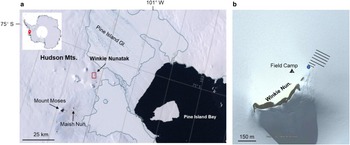
The Hudson Mountains are a series of volcanic peaks adjacent to Pine Island Glacier (Fig. 4). The chosen drill site was located at the southern end of Winkie Nunatak, which is situated ~10 km from the present margin of Pine Island Glacier and less than 50 km upstream of the current grounding line. The nunatak comprises a narrow, exposed ridge top ~1 km long, rising ~500 m above the surface of the adjacent Pine Island Glacier. Bedrock at Winkie Nunatak is composed of subaerially deposited basaltic bedrock with a weathered and eroded surface. Mineralogically, the rock is appropriate for cosmogenic nuclide dating using in situ 14C (Pigati and others, Reference Pigati, Lifton, Jull and Quade2010) and 36Cl (Evans and others, Reference Evans, Stone, Fifield and Cresswell1997) in olivine and feldspar, respectively. Near-surface conditions at the drill site were similar to those at Mt. Murphy with snow and firn overlaying ice. High resolution satellite imagery revealed crevassing near Winkie Nunatak.
(a) Overview of Hudson Mountains from the Landsat Image Mosaic of Antarctica (LIMA). Textured gray represents the current ice-sheet surface and shaded gray areas outlined in blue represent ice shelves. The red box indicates the location of Winkie Nunatak. (b) Enhanced image of Winkie Nunatak with black lines indicating GPR survey described in radar survey section. Dotted black line indicates location of GPR survey in Fig. S4. The blue dot indicates the location of the drill site. Imagery from Google Earth: © 2023 Maxar.

3.3.2 Key takeaways from radar and drilling efforts
Overall, the field campaign experienced several obstacles that ultimately prevented the successful extraction of bedrock cores. One major obstacle was related to crevassing directly over potential drill sites. Since this region is experiencing ongoing rapid change, conditions had changed since the previous season when a reconnaissance GPR survey was undertaken. Thus, the initial plan to GPR survey the site for two days immediately prior to drilling had to be increased to five days to properly map out crevasse hazards. At sites with snow and firn, we recommend that future teams are equipped with GPR systems appropriate for not only imaging ice thickness but also for detecting and flagging near-surface crevasses. This will allow for GPR to be used in tandem (not in place of) traditional field safety methods that include probing the area for crevasse hazards. In addition, when working at sites located near grounding lines or shear margins, the potential for changing near-surface conditions from year to year requires that a GPR survey be conducted the same season as drilling operations even if a reconnaissance season is carried out in previous years. Teams should have an inventory of backup drill sites as well, in case the first-choice site is not drillable due to crevassing.
A second obstacle was the need to drill at greater depth below the ice surface than originally planned because of the heavily crevassed terrain over the subglacial bedrock ridge at shallower depths. Crevassing also dictated that a drill site on the upstream flanks of the ridge was chosen, rather than on the ridge crest. Drilling to greater depths was time consuming and resulted in insufficient time to attempt drilling further boreholes. At this site, the basal zone was found to contain frozen sediment and clay which prevented the team drilling to bedrock. Since selecting a site from GPR surveys with a clean ice-bed transition is inherently difficult, off ridge-crest drilling should be discouraged as there is a greater likelihood of encountering subglacial sediment in such settings. Finally, adding to these obstacles was the loss of two out of five weeks of field time, due to delays getting into the field. This further compounded the difficulties described above.
3.4 Enterprise hills (drilled 2022/23)
3.4.1 Site description
The Enterprise Hills, composed of Paleozoic quartzites of the Crashsite group, form the northern rim of Horseshoe Valley, a large ice-filled valley in the Heritage Range of the Ellsworth Mountains (Fig. 5). Ice in Horseshoe Valley flows in a general northwest direction toward the modern grounding line which is situated at Hercules Inlet. In several places, glaciers cross the escarpment edge and flow in a more northerly direction toward the grounding line. One such glacier is Plummer Glacier and at its distal end this glacier merges with an extensive area of blue ice that is found all along the leeward side of the Enterprise Hills. At the mouth of Plummer Glacier is a small nunatak, 40–60 m above present-day ice. Prior to deployment to the field, this nunatak (informally named Plummer Nunatak) and a nearby small outlier were identified as the highest priority target for drilling in the Enterprise Hills. Although there are additional rock outcrops in closer proximity to the grounding line at Hercules Inlet this site was selected for two main reasons: (1) available satellite imagery suggested less extensive snow and firn cover and numerous rock outcrops directly next to blue ice zones (a prerequisite for drilling with the available system), (2) several potential sites in close proximity were identified which, given the lack of a dedicated radar survey season prior to the drilling season, increased chances of finding a viable drill site once on the ground.
(a) Overview of Enterprise Hills. The red pin in the main image indicates the location of Plummer Nunatak. The red box in the inset map in the upper right highlights the area shown in the main image. (b) Enhanced map showing blue ice area around Plummer Nunatak. Blue dots indicate drill site locations. Base maps for both panels were created from Google Earth: Imagery © 2023 Maxar.

3.4.2 Key takeaways from radar and drilling efforts
Overall, the season was a success, with the team able to extract multiple cores from the site using the modified Winkie Drill system. Preseason on-site training from experienced drillers at the IDP contributed to this success. However, a more extensive GPR survey by an experienced technician could have identified a drill site with a more favorable configuration of subglacial topography (i.e. a gently dipping ridge crest), and would have avoided several days being dedicated to troubleshooting GPR operational issues. Side reflections in the radargrams made ascertaining accurate depths difficult, and this was exacerbated by the lack of GPR experience in the team. Fig. S5 shows the GPR-estimated ice thickness and the actual drill-depths and highlights the increasing inaccuracy of ice thickness estimates at increasing depths. In contrast, the drill sites were all located on blue ice that made assessment of site safety straightforward. From a drilling perspective, the ice augers used to create boreholes performed well to ~30 m depth, similar to the experience of the team at the Ohio Range site. With the modified Winkie Drilling system (see section 3.3 above), the team found that the presence of any ice and/or liquid water within the drill fluid circulation loop could be avoided through improved fluid management.
3.5 Mt. Waesche (to be drilled 2024/25)
3.5.1 General site description
The Mt. Waesche massif consists of two coalesced, undissected volcanic shields and is located on the high plateau of West Antarctica in the Executive Committee Range, a line of volcanoes projecting through the WAIS in Marie Byrd Land (Fig. 6). The oldest known deposits at Mt. Waesche are dated at 2.0 ± 0.1 Ma (Panter, Reference Panter1995). Although much of the volcanoes are ice-covered, the southern flank of the massif exhibits a remarkable set of well-exposed and preserved scoria cones and lava flows (Fig. 6b) with a range of geochemical compositions, related to a pulse of eruptive activity between 0.2 and 0.1 Ma (Dunbar and others, Reference Dunbar, Smellie, Panter and Geyer2021; Panter and others, Reference Panter, Smellie, Panter and Geyer2021; Wilch and others, Reference Wilch, McIntosh, Panter, Smellie, Panter and Geyer2021). The volcano is currently in a dormant state but is potentially still active (Dunbar and others, Reference Dunbar, Smellie, Panter and Geyer2021). These young volcanic rocks are ideally suited, both in terms of age and composition, to constraining interior WAIS elevations during the Last Interglacial using a combination of 40Ar/39Ar and cosmogenic dating.
(a) Overview map of Mt. Waesche. The red box indicates the location of Mt. Waesche in panel (b). Topographic lines are spaced at 500 m intervals. (b) Enhanced image of Mt. Waesche showing GPR survey from 2018/19 (black dashed lines) and future drill site locations (red stars). The images from both panels are produced from the Landsat Image Mosaic of Antarctica (LIMA).

Present-day regional ice flow is southward from a dome centered on the northern Executive Committee Range where ice elevations reach 2200 m. WAIS surface elevations near Mt. Waesche are ~2000 m above sea level and the ice-covered summit caldera reaches 3200 m above sea level. A combination of ice flow processes and local winds have resulted in a notable local ablation (blue ice) area that occurs to the southwest of Mt. Waesche (Fig. 6b). This blue ice area, which is 8 by 10 km in extent, contains numerous englacial tephra layers that represent a repository of local and distal volcanism (Dunbar and others, Reference Dunbar, Smellie, Panter and Geyer2021). The geometry of tephra layers indicates that in some areas the local ice has undergone complex deformation, likely as a result of interacting with subglacial bedrock topography. Work at Mt. Waesche seeks to better understand both the tephra stratigraphy and complex deformation using GPR survey information.
3.5.2 Preparations for upcoming drill season
IDP will deploy their Eclipse and Winkie Drill equipment at Mt. Waesche in the upcoming drilling season. The drilling objective is to collect eight subglacial bedrock cores (at least 0.5 m in length) from depths ranging from 30–100 m. In advance of the drilling season, IDP plans to test new downhole coring tools with improved bit clearance as a potential solution to the bit plugging and glazing that has negatively impacted drilling efforts at other sites (e.g. Hudson Mountains, section 3.3). If successful, new tooling may substantially increase the likelihood of recovering multiple bedrock cores in a single field season by improving drill performance in sediment rich basal environments. Additionally, IDP plans to rely on a new full-face ice drilling bit which can provide faster access to the bed at greater drill depths than the Eclipse drill that has previously been used.
Detailed grid surveys were carried out in 2018/19 to obtain 3-D radargrams of the sites. The advantage of 3-D imaging for drill site selection is to map out potential near-surface hazards, to better reduce ice thickness estimates in areas with complex subglacial topography, and to preselect multiple target drill sites. The targeted drill sites are noted in Figure 6b and an example of the 3-D radargrams from one of the drill sites in shown in Figure 7. A reconnaissance GPR season is advantageous at a site like Mt. Waesche because the drill site is located over slow-moving blue ice so the complications presented by crevassing are not an issue like at other sites such as the Hudson Mountains.
(a) A 3-D-processed radargram collected in 2018/19 used for drill site selection for the upcoming field campaign. The radar profiles were time-zero corrected, distance normalized to flag survey points (spaced at 10 m intervals) and migrated to increase ice thickness estimates and reduce the noise to signal ratio. (b) example of 3-D radar profile shown in slices at various depths beneath the ice surface (40, 46, 52, 58 m). On the horizontal plane, the darker colors indicate ice and the areas of white indicate bedrock (BR). Note that the ratio of bedrock to ice increases with depth. Orientation of a – a’ and b – b’ can be found in panel (c). (c) Image showing location of GPR survey (red lines) near the flank of Mt. Waesche. Imagery from Google Earth: Imagery © 2023 Maxar.

4. Discussion and recommendations
We have discussed in detail the results and efforts of drilling campaigns and radar surveys at five sites in Antarctica. Decisions regarding drill site selection, what equipment to use in various glaciological settings, and the necessary time to complete the objectives of a field campaign are complex and need to be considered carefully well in advance of reaching the field site. It is essential to use as much information as possible for each site from a glaciological, geological, technical and logistical perspective. To improve the likelihood of success in future subglacial bedrock drilling efforts, we have the following recommendations.
4.1 Recommendations for future site selection
Here we highlight the importance of field site conditions when considering scientific objectives. Sites described in this overview were targeted based on sensitivity analysis and the likelihood of recording broader, regional ice volume change (Ohio Range, Mt. Waesche) and others because they were ideally located to capture grounding line retreat (Mt. Murphy, Hudson Mountains). However, some of these sites presented significant challenges with logistics as well as field safety due to heavy crevassing near targeted drill locations. For example, Winkie Nunatak (Hudson Mountains) is located adjacent to the shear margin of Pine Island Glacier and the drill site was situated over snow and firn. Although the field site was surveyed in December 2019, changes in ice flow dynamics in the subsequent three years resulted in heavy crevassing at ideal drilling locations when the site was resurveyed in January 2023. Therefore, it was deemed necessary to drill at a location that was safer, but with the consequence that it was more challenging to reach bedrock due to the greater ice thickness and steepness of subglacial topography. Conversely, at Enterprise Hills, a site was selected on blue ice where crevasse hazards could be mitigated or avoided completely. However, that site was not an optimal location to capture grounding line retreat in the Weddell sector of Antarctica. This demonstrates the need to consider the tradeoffs between selecting sites that best serve to answer a specific science question but are in regions with less favorable glaciological conditions (snow and firn sites, crevassing, proximity to ice streams and margins) compared with sites that will ease logistical constraints based on proximity to field stations and are in more favorable glaciological settings (blue ice), but may not fully capture certain elements of the proposed scientific question.
4.2 Recommendations for future GPR surveys
Since drilling efforts began in Antarctica with the Winkie Drill at Ohio Range in 2016/17, GPR technology has improved so that systems are capable of imaging englacial features (stratigraphy, crevasses) at higher resolution, are more compact and easier to transport so that teams have the option to use multiple systems, and data can be processed quickly in the field to provide real-time imaging of the ice-bedrock interface. GPR is widely used in cryosphere studies and an essential tool for drill site selection and safety when carrying out fieldwork on glaciers. Here we summarize key takeaways when considering the use of GPR for drill site selections.
1) We recommend that a dedicated radar specialist is included in every field team. The radar operator should have sufficient field experience with equipment and the knowledge and preparation for rapid data processing in the field. Although GPR systems are relatively user friendly and are often borrowed and used by teams without a dedicated radar technician, properly interpreting radargrams in the field with limited time is difficult. Challenges include properly identifying the depth to bedrock, crevasse detection, and interpreting englacial stratigraphy. In addition, it is rare that GPR systems do not require troubleshooting in the field because of the harsh conditions in which they operate.
2) Although GPR is a powerful tool for imaging englacial stratigraphy and providing depth estimates, greater survey depths, coupled with complex subglacial topography, will lead to a larger uncertainty in the depth estimate because of geometric spreading of the radar signal and side reflections (e.g. Moran and others, Reference Moran, Greenfield and Arcone2003; Lapazaran and others, Reference Lapazaran, Otero, Martín-Español and Navarro2016). We recommend sufficient time is given to carry out a detailed GPR grid survey over the intended drill site with additional time needed for processing the data in the field. The amount of time needed will vary based on site complexity and radar technician experience.
3) GPR surveys should be planned in advance of the field season using satellite imagery and digital elevation models of the ice surface as well as adjacent ice-free areas to save time once on site in the field. When on the ground, a survey can first be conducted at points of interest with the technician starting a transect at the ice surface-nunatak transition and surveying away from exposed bedrock to trace the depth of subglacial topography. Based on those results, a grid survey can be set up over an area of interest to map the area in greater detail (see Figs. S3, S4, S5).
4) GPR can also be used for crevasse detection at sites with snow and firn cover but should not be relied on to reveal all hazards at a field location. Crevasses may go undetected for numerous reasons including the angle at which the radar is towed over a crevasse, the frequency of antenna used for surveying, the post-processing techniques used in the field, and the experience of the radar technician interpreting radargrams. A GPR crevasse survey is best used after site safety has been established by conventional techniques (visual inspection and probing by an experienced field mountaineer/field guide). Given the weight of the drilling equipment, it is essential to identify and flag major crevasse systems that may hamper drilling efforts or create safety concerns for field personnel. Crevasse hazards at sites with snow and firn cover highlight the importance of conducting a GPR survey in the same season as drilling if the area is in an area of rapid ongoing glaciological change. For sites where drilling will be conducted on slow-moving blue ice, a reconnaissance survey season may be appropriate because surface conditions are unlikely to change much from year to year.
4.3 Recommendations for future subglacial drilling campaigns
Substantial engineering development of the Winkie Drill has made it an effective tool for collecting shallow (<120 m) subglacial samples on logistics-constrained projects. Drill operational and site selection recommendations are summarized below for future drilling campaigns.
1) Subglacial drilling with the Winkie Drill requires that the basal ice-bed contact are sealed as this prevents contamination of the subglacial environment (Doran and Vincent, Reference Doran, Vincent, Siegert and Kennicutt2011) as well as maintaining a closed fluid circulation system. At interior sites such as the Ohio Range, this was not an issue. At one coastal site, Mt. Murphy, meltwater from the local nunatak made its way to the ice-bed interface and complicated drilling efforts that ultimately resulted in abandoning that access hole. Figure 8 shows the difference in the ice-bed interface between these two sites.
2) If possible, selecting a drill site with blue ice that is free of fractures is an effective strategy to reduce the necessary drilling equipment. Subglacial drilling at blue ice site does not require a separate electro-mechanical access drill and casing system to seal the outer borehole surface since competent blue ice is impermeable to drill fluid. It is also noteworthy that access drilling using the Winkie Drill is more efficient compared to a standard electro-mechanical drill such as the Eclipse drill.
3) Warm ambient temperatures degrade drill performance and increase the risk of equipment loss by freezing in the hole for both access and subglacial drilling operations. If ambient temperatures approaching −4°C (25 °F) are anticipated, we recommend using a fluid chiller to cool drill fluid. It is also recommended to use a windscreen or drilling tent to shade the access drill during surface operations.
4) Transporting and positioning drill equipment, drilling an access hole, and collecting a subglacial core from a single borehole constitute a substantial time commitment of days to more than a week. Therefore, it is recommended to complete a detailed GPR survey to select a drill site and not relying solely on estimates from models such as BedMachine or BedMap as this can greatly improve the efficiency of subglacial drilling efforts.
5) It is recommended that drilling campaigns start with a shallow core first (10–20 m) and then progress to drilling at deeper sites if successful. This approach increases the likelihood of success as it allows the drill operator to efficiently troubleshoot site-specific challenges while also tuning drilling parameters without excessive tripping times. Additionally, drilling a shallow core and obtaining an exact depth to bedrock will serve as a ground-truth point for GPR estimates of ice thickness when applied in post-processing. For example, at Enterprise Hills (Fig. S5), a shallow drill site was GPR-estimated at 10 m depth and the actual drill depth was 10.8 m. However, at a deeper site GPR estimated at 21 m, the actual drill depth was 29.5 m. This is a nearly 30% under estimation by the GPR due to the steepness of the subglacial terrain and limited time for post processing. At the Hudson Mountains, additional time was allotted for post-processing GPR data due to other delays and the GPR estimated depth of 43 m underestimated the drill depth of 49.6 m by ~ 15% (drilled into debris-filled ice that was likely within 1 m of bedrock; Fig. S4).
6) Drilling through subglacial sediment and clay overburden can stall drilling and substantially impact the time required to reach bedrock. Any information available on subglacial topography or drill site lithology should be leveraged to select a drill site that prioritizes a clean transition from ice to bedrock. A detailed GPR survey can mitigate drilling risk by targeting subglacial topography that minimizes sediment accumulation (such as ridges or domes). At present, GPR cannot differentiate between bedrock and debris-covered bedrock at the ice-bed interface. To address this issue from a technological perspective, it is recommended that future development focus on improving chip transport of clay and sediment to prevent bit plugging. One possible solution is to implement a drilling fluid additive that reduces clay flocculation to prevent aggregation of sediments on the downhole bit and tooling. Another option is to investigate an alternative core barrel assembly with oversized fluid circulation waterway to improve chip transport.
(a) A photo of a core collected from Mt. Murphy that illustrates increasing debris density down core. These fine debris and clay material can delay or hamper drilling efforts for the Winkie Drill system. (b) Photo of a core collected from Ohio Range. The core was recovered with the basal ice frozen directly to the bedrock. The red arrow in each photograph is pointing downcore.

5. Conclusion
Despite the challenges presented by subglacial geologic drilling in polar environments, the method remains the only conclusive means by which to test for past instabilities of existing ice sheets. The implementation of the Winkie Drill to recover bedrock from shallow sites has been successful at many locations, and results from some of those studies provide direct evidence for past ice volume changes of AIS (Balco and others, Reference Balco2023). Future drilling campaigns in Antarctica will continue to use the Winkie Drill (Mt. Waesche) as well as other systems such as with the INCISED program which will use a newer drill system, the percussive rapid access isotope drill (P-RAID; Timoney and others, Reference Timoney2020). In Greenland, the GreenDrill Program will target subglacial bedrock sites at depths of hundreds of meters after a successful campaign in 2023 using the Winkie and ASIG drills. Given the urgency to reduce uncertainties in future contributions of the Antarctic Ice Sheet to sea level rise, we expect continued and increasing efforts to collect subglacial bedrock samples to constrain past ice volume changes at more locations in Antarctica and Greenland. Our recommendations for radar surveys and drilling efforts will increase the likelihood of success for such future endeavors.
Supplementary material
The supplementary material for this article can be found at https://doi.org/10.1017/aog.2024.12
Acknowledgements
We thank the Ice Drilling Program, United States Antarctic Program and British Antarctic Program for their support in efforts to recover subglacial bedrock cores. For Hudson Mountains and Mt. Murphy, this work is part of the ‘Geological History Constraints’ project, a component of the International Thwaites Glacier Collaboration. This work was supported by the National Science Foundation (grant OPP-1738989 and 2303344 – SB, GB, SC, RV) and the Natural Environment Research Council (grants NE/S006710/1, NE/S00663X/1 and NE/S006753/1 – JSJ, KN and JW). This is ITGC Contribution No. ITGC-119. Work at Mt. Waesche is supported by the National Science Foundation (grant 1745015 – ND). Work at Ohio Range is supported by the National Science Foundation (grant 1341658 – SM). Work at Enterprise Hills is supported by the Natural Environment Research Council (fellowship NE/T011963/1 – DS). Ohio Range, Mt. Murphy and Mt. Waesche IDP drilling campaigns were supported by the National Science Foundation under Cooperative Agreement No. 1836328 to Dartmouth, and sub-awards to University of Wisconsin and University of New Hampshire which support the work of the U.S. Ice Drilling Program (IDP). DS thanks the U.S. Ice Drilling Program for support activities through NSF Cooperative Agreement No. 1836328. Geospatial support for this work provided by the Polar Geospatial Center under NSF-OPP awards 1043681, 1559691, and 2129685.
Authors’ contributions
Following the CRediT authorship guidelines, the contributions are as follows: Conceptualization: GB, SC, JSJ, RA, DS, ND, SB and SM. Methodology: SB, SC, EM, GVB, GB, RV, DS, RA, JSJ, ND, SM, BG and JW. Formal analysis: SB, SC, GB, RV, DS, RA, KN, JSJ, ND, SM, BG and JW. Investigation: SB, SC, GB, RV, DS, RA, KN, JSJ, ND, SM, BG and JW. Resources: SB, SC, EM, GVB, GB, RV, DS, RA, KN, JSJ, ND, BG and SM. Data Curation: SB, SC, EM, GVB, GB, RV, DS, RA, JSJ, ND, BG and SM. Writing – original draft: SB, SC, EM, GVB, GB, RV, DS, RA, KN and JSJ. Review and editing: SB, SC, EM, GVB, GB, RV, RA, KN, JSJ, ND, BG and JW. Visualization: SB, SC, GVB, GB, ND, DS. Supervision: SC, GB, RV, JSJ, DS, RA, ND and SM. Project administration: SC, GB, RV, JSJ, DS, RA, BG, ND and SM. Funding acquisition: SC, GB, JSJ, DS, ND, SM, BG and JW.




 Open access

