




1 Introduction
The research presented here addresses a familiar quantity change in English, commonly referred to as Middle English Open Syllable Lengthening (MEOSL). Earlier publications on the subject, including Minkova (Reference Minkova1982, Reference Minkova, Eaton, Fischer, Koopman and van der Leek1985, Reference Minkova2014), Ritt (Reference Ritt and Markus1988, Reference Ritt, Rissanen, Ihalainen and Nevalainen1992, Reference Ritt1994, Reference Ritt1997, Reference Ritt2000), Bermúdez-Otero (Reference Bermúdez-Otero1998), Lahiri & Dresher (Reference Lahiri and Elan Dresher1999), identified some problematic aspects of the existing accounts. In particular, the outstanding question is whether the set of diachronic correspondences covered by the change can be adequately explained – as its established name suggests – in terms of a single conditioning factor. This contribution extends the empirical base for the discussion, reveals new details in the array of previously recognized phonological factors, and provides a phonological account which shrinks the randomness in the relation between the inputs to the change and its Present-day English (PDE) descendants. The limited remaining cases where application of the change is unpredictable are modeled using Maxent OT, a stochastic grammar formalism, deriving a probabilistic grammar which successfully predicts that variation should occur in exactly these cases.
We start with an introduction to MEOSL, a brief survey of the basic regularities it describes, and highlight the problems it raises both empirically and theoretically. Focusing on (C)V.CV(C) stem-forms, we present the full input–output database in terms of the weight and the sonority of both the onset and the coda of the post-tonic syllable (σ2). The syllable weight condition is categorical at the endpoints of a continuum, gradient in-between. The variable outcomes in (C)V.CV(C) stem-forms have been described as depending ‘on chance’ (Liberman Reference Liberman, Adamas, Brinton and Fulk2015: 172), yet the examination of σ2 onsets, which have been ignored in earlier accounts, reveals a new angle on this familiar change: the inhibiting effect of intervocalic sonorants on lengthening. On the other hand, the outcome in items with medial obstruents varies, leading to the hypothesis that the discrepancy is motivated by the phonotactic relations between the σ2 onset and coda. We formalize the empirical findings using the OT formalism, and show that the ME quantitative changes in the entire set of disyllabic stem-form inputs can be accounted for in terms of compensatory lengthening, conditioned by σ2 apocope and syncope or lack thereof. Our findings reaffirm the link between σ2 apocope and syncope in the context of multiple factors which generate variability in the phonological representations of vowels, and thereby lead to an account of the variable yet systematic way in which vowel lengthening has come to be reflected in the English lexicon.
1.1 Some preliminaries: revisiting MEOSL
MEOSL is usually understood as a change affecting stressed, short, non-high vowels in open penultimate syllables of disyllabic words: #(C)V́.Cə# > (C)V́V.C(ə) > #(C)V́VC#. (1) is a reminder of what OSL stands for.

Evidence of vowel quantity in ME is often ambiguous, and it allows for variability. This means that the OSL initiation point is as difficult to reconstruct as is the way in which the change evolved from what must have been an optional and phonetically conditioned process at first into the phonologically reinterpreted representations identifiable in the PDE lexicon.Footnote 2 Thus, crucially, the most informative long-term evidence of the change comes from its post-medieval reflexes in the form recorded in PDE ‘standard’ pronouncing dictionaries. We can be quite sure that name, meat, nose and beaver must have had phonologically short vowels in Old English (OE), judging from the way such items are treated in the verse. We are also sure that the majority of their realizations had long vowels when the Long Vowel Shift started, because otherwise they would not have been affected by it.
The time-line for the beginning of the change is fuzzy, especially in view of the significant absence of original compositions and autograph texts between c. 1066 and the second half of the twelfth century.Footnote 3 Doubling of vowels to indicate length in early ME is attested only sporadically for some items, but not for any of the OSL candidates pre-1325 (see A Corpus of Narrative Etymologies from Proto-Old English to Early Middle English (CoNE) on Orthographic Doubling of Long Vowels (ODLV)). The first rhyme evidence for OSL appears around the mid-thirteenth century in the northern dialects (Luick Reference Luick1964: §391; Jordan & Crook Reference Jordan, Crook and Crook1974: 47–9; CoNE s.v. MEOSL). The gradual southward spread of the change is suggested by rhymes found in identifiably southern texts before the middle of the fourteenth century, e.g. before : sore (OE beforan ‘before’, OE sār ‘sore’).Footnote 4 The rhyme evidence for a full merger of the newly lengthened vowels with the pre-existing long vowels is unambiguous only after the middle of the fifteenth century (Luick Reference Luick1964: §391; Ikegami Reference Ikegami1984: 315–20; Ogura Reference Ogura1987: 126–8). Although the evidence points to an earlier start of OSL in the north, the details of the regional spread of the change in late ME/early Modern English are not clear-cut and continue to show variability. Dobson (Reference Dobson1957: 467, 474) remarks specifically on the variable quantity of the stressed syllable in sonorant-final disyllables: father, rather, water, haven, brazen; leaven, lever, heron, leper.Footnote 5 Variable vowel quantities for stems preserving their disyllabic structure diachronically, the (C)V.CəC~(C)VV.CəC subset, are projected in PDE variants such as GB [ˈlɛʒə]~AmE [ˈliʒər] ‘leisure’, AmE /ˈsædər/~/ˈseɪdər/ ‘satyr’. The preferred association between stress and weight in open syllables is demonstrated in the realization of new lexical items: preta (1811), NATO (1949), modem (1958), comp. model (1570); laser (1960), quasar (1964), comp. tassel (1330), dossal (1658), precluding positing a terminus ad quem for the change.
Saying that evidence of MEOSL is scarce and often indirect does not mean there is none of it. On the contrary, one of the reasons why we think that the change is worth revisiting is precisely that more empirical/philological information is accessible now than twenty years ago. A new look at the data and the application of new theoretical models can refine our picture and deepen our understanding of the change considerably. Thus, some of the questions about OSL that had to be left open in earlier research have become addressable today, and that's the goal of the present study.
1.2 A note on the immunity of high vowels to OSL
Discussion of stressed vowels marked V in this article excludes high vowels. The OE short high vowels were subject to sporadic lowering and lengthening to [eː] and [oː] in the Northern dialects, but only three /ɪ/-lengthened forms survive in PDE: OE wicu > PDE week, OE wifel ‘weevil’, possibly OE yfel ‘evil’ ~ Old Kentish *efel (MED); the commonly cited item beetle is attested only as a trisyllabic form in OE, bitela (DOE) and in ME (MED). The only two examples of sustained OSL of /ʊ/ are OE wudu ‘wood’ and (possibly) OE duru ‘door’, but the vowel in both words can be explained without reference to OSL. The default development is preservation of the high vowels as monomoraic: OE hype ‘hip’, OE dile ‘dill’, OE hulu ‘hull’, OE lufu ‘love’, OE munuc ‘monk’. We are ignoring possible variable length in ME; lengthened ME forms of e.g. OE gyfan ‘to give’, sunu ‘son’ are not quantifiable.
There is a reasonable explanation for why high vowels may have failed to reliably lengthen in lengthening environments. High vowels are intrinsically shorter than mid vowels in PDE (Peterson & Lehiste Reference Peterson and Lehiste1960)Footnote 6 and in many if not all of the world's languages (Lehiste Reference Lehiste1970), so they were likely shorter in ME as well. If a historical process were to lengthen the short high vowels – the shortest stressed vowels in the inventory – this would have the effect of making them less perceptually distinct from mid vowels, and therefore be antithetical to the maintenance of a dispersed vowel space.
2 Focus on the post-tonic syllable
While a disyllabic input (C)V.CV(C) is the starting point, the macro-perspective shows that the probability of lengthening depends on multiple competing factors. In the course of ME, schwa apocope in (C)VCə stems was ubiquitous; a */-ə/# constraint was practically inviolable by c. 1400–50 (Minkova Reference Minkova and Sanchez-Stockhammer2015); see section 4.1 for an Optimality Theoretic (OT) treatment of this constraint. Unstressed vowel syncope in (C)VCəC stems, on the other hand, was optional and generally preserved the disyllabic structure of the inputs.Footnote 7 A previously established predictor of lengthened and unlengthened stressed short vowels in the stem-forms is σ2 stability (Minkova Reference Minkova1982, Reference Minkova, Eaton, Fischer, Koopman and van der Leek1985; Ritt Reference Ritt1994: 30ff.): diachronic loss of σ2 as in (2a) corresponds to a near-categorical lengthening.

The relevance of the stability of the second syllable is statistically testable: the ratio of lengthened to unlengthened forms in the bottom (C)V.Cə bar in figure 1 is reversed in the first and second bars.
OSL and post-tonic syllable preservation as percentageFootnote 9

For the (C)V.Cə inputs the 4.9 percent of unlengthened forms is based, very conservatively, on Minkova (Reference Minkova1982: n. 5), but if we exclude CV.stə items: cast, fast, hasp (OE hæpse), mast, rest, which have northern and Scots lengthened forms, the unlengthened forms ratio drops to 3.3 percent. Further, there are ME lengthened forms for the remaining exceptions: crack (ME crak(e), rhyming with blake, spake, lake), beck (Sc. baik), drop (ME droupe), fret (ME freaten), get (ME geyt, gait), lap (ME lape, Sc laip), rot (ME roote, royte), tread (ME treide). Excluding knock (OE cnucian) and wag (ME waw) makes the (C)V.Cə > (C)VVC change practically exceptionless, which is our justification for referring to it as ‘categorical’ in the rest of this article.
The inputs surviving as PDE disyllabic forms, the top two bars in figure 1, are of particular interest in all OSL accounts. The different results for monosyllabic and disyllabic outputs have been a central concern in the long OSL research history. The link between variability and the presence of coda sonorants in the unstressed syllable has always been part of the narrative (Luick Reference Luick1964: §191, 192; Dobson Reference Dobson1962: 127–8; Lass Reference Lass and Blake1992: 73; Bermúdez-Otero Reference Bermúdez-Otero1998). Bermúdez-Otero is very specific about ‘the positive correlation between lengthening and the presence of a sonorant consonant in the post-tonic rhyme’ (Reference Bermúdez-Otero1998: 175). Separating .CəT# from .CəR# second syllables is justified by the imbalance in the outcomes: a breakdown of the (C)V.CəC data shows that in 39 items the σ2 coda is an obstruent: these are words of the type gannet, planet, relic, rocket, both native words and pre-1400 loanwords. The details on (C)V.CəT stems are presented in (3):
(3) (C)V.CəT items eligible for OSL (Minkova Reference Minkova1982; Bermúdez-Otero Reference Bermúdez-Otero1998: 193)Footnote 10
(a) Lengthened: 1 item: naked
(b) Unlengthened: 39 items: chalice, collop, eddish, gannet, haddock, planet, provost, radish, relic, trivet Footnote 11 \\ anet, anise, †barrat,Footnote 12 claret, damask, faggot,Footnote 13 habit, latchet,Footnote 14 marish, palace, palate, statute, brevet, ethic, jealous, legate, prelate, senate, trellice, bonnet, closet, crocket, forest, profit, rocket, rochet,Footnote 15 socket, solace; cherish.
With the exception of naked, possibly influenced by the ME verb nāke (c.1350) and adjective nāk(e) ‘naked’ (c.1300),Footnote 16 all other items preserve the original short vowel. The inhibition of lengthening in stems with -.əT# σ2 rhymes seems to require an explanation independent of the framework in which the analysis is conducted. Ritt (Reference Ritt1994, 1997) relates this to the weight of the second syllable. Lahiri & Dresher (Reference Lahiri and Elan Dresher1999: 694–5) acknowledge the imbalance between σ2 -.əT# and -.əR# rhymes, but do not consider the presence of a stem-final obstruent a determining factor for the discrepancy; they refer to possible tri-syllabic forms and medial geminates as blocking lengthening, but these considerations also apply to forms with σ2 sonorant codas, where the results are significantly different.
Since the results in the (C)VCəT# database in (3) are practically uniform, we leave that set aside for the moment, noting that the vowel in unstressed –.CəT#, the rocket-type, is stable compared to –əR#, where schwa alternates with the syllabic sonorant as in the set surveyed in the next section.
2.1 Target group: (C)V.CəR
Figure 2 compares lengthened and unlengthened reflexes of (C)V.CəR inputs.
Reflexes of (C)V.CəR inputs

The details on the items under discussion are presented in (4). Forms whose stressed vowel varies in length are boldfaced; they are recorded twice: both as ‘unlengthened’ and as ‘lengthened’. The slashes separate inherited OE words from early ME loans.
(4) (C)V.CəR items (Minkova Reference Minkova1982; Bermúdez-Otero Reference Bermúdez-Otero1998):
(a) Lengthened: 38 items
acorn, acre, beaver, besom, chafer, cradle/creddle, even, gable, haven, hazel, ladle, maple, navel, open, over (cf. uvver), raven, staple, taper, weasel \\ bacon, basin, blazon, capon, favour, flavour, label, labour, mason, paper, patient, savour, razor, tabor, vacant, vapour, azure, moment, odour.
(b) Unlengthened: 128 items
saddle, aspen, bastard, batten, besom, better, blather, bottom, bracken, brothel, cackle, camel, canon, castle, chaffer, clatter, cocker, cockle, copper, creddle/cradle, edder, father, feather, fennel, fester, fetter, fettle, gammon, gather, gavel, gravel, hammer, hatchel, heaven, hovel, hover, kettle, Latin, latter, leather, maslin (obs.), nether, nettle, otter, oven, uvver (dial.; cf. over), pebble, pepper, pottle, rather, reckon, repple (obs.), saddle, seven, shackle, shovel, smother, sollar, swaddle, talent, tetter, throttle, throstle, treadle, water, wattle, weather, wether, whether \\ alum, azure (also long), baron, barren, barrel, cattle, channel, chattel, clamour, dragon, flatter, gallon, hazard, latten, mallard, manor, panel, satchel, satin, tabard, talon, tassel, travel, valour, vassal, warrant, beryl, bezant, cellar, deavour, desert, felon, herald, kennel, lecher, lesson, metal, pennon, peril, present, record, revel, second, tenant, tenor, treasure, tremor, venom, coffin, collar, common, coral, florin, foreign, honour, moral, volume; colour, covin.
The variability of the results for (C)V.CəR inputs has been noted and commented on before (see Bermúdez-Otero Reference Bermúdez-Otero1998; Lahiri & Dresher Reference Lahiri and Elan Dresher1999; Page Reference Page2006). We cite some representative statements in (5):
(5) Why are (C)V.CəR inputs interesting?
Lengthening applies unpredictably among unapocopated disyllables containing a sonorant consonant in the post-tonic rhyme.
(Bermúdez-Otero Reference Bermúdez-Otero1998: 176)Words ending in final sonorants can go in both directions. It is not clear why this should be the case, but it should be noted, that there are relatively few disyllabic words with final obstruents of Germanic origin in Old English to begin with.
(Lahiri & Dresher Reference Lahiri and Elan Dresher1999: 695)Footnote 17The lengthenings [in items whose post-tonic rhyme contains a sonorant] appear to be more the exception than the rule.
(Page Reference Page2006: 69)If the application of OSL depends on the σ2 coda, as one might be tempted to infer on the basis of the contrast of the two lower bars in figure 1, the substantial proportion of lengthened (C)V.CəR words, 22.9 percent, warrants further inquiry.Footnote 18
The instability of [-ə-] in σ2 in -.CəR can be traced back to the earliest stages of English.Footnote 19 In OE verse -.CəR forms can scan as monosyllabic; similarly, in ME and Renaissance verse the syllabic value of .-TəR continues to be variable.Footnote 20 Walker (Reference Walker1797: §102, §159, §170) also focuses on variants triggered by a σ2 coda sonorant and recommends syncope in weas'l, haz'l, mas'n, seas'n, blaz'n, dev'l, but objects to it in woolen, flannel, cavil, Latin, allowing both forms in novel, raven. Bermúdez-Otero's compensatory analysis (Reference Bermúdez-Otero1998: 175–8) attributed the potential lengthening in (C)V.CVR words, e.g. OE beofor > PDE beaver, to optional/variable schwa deletion in the second syllable, whereby unrealized input schwas are mora-donors. This hypocorrective compensation option has the advantage of aligning the beaver, paper-type forms with the nama-type forms in terms of moraic preservation. As we will show in section 4, this is on the right track, especially if one factors in the significant effect of the medial sonorants in (C)V.RəC inputs.Footnote 21 The compensatory factor contributing to the lengthening is therefore central to the process; a more detailed treatment of (C)V.CVR forms allows interesting predictions about the probability of lengthened vs unlengthened forms within that notoriously variable subset.
3 Medial consonants in (C)V.CVR inputs to OSL
No study of MEOSL other than Ritt (Reference Ritt1994) considers the possibility that variable lengthening in (C)VCVC inputs may be sensitive to the nature of the medial consonant.Footnote 22 Ritt's attention to this matter is unique, but he bundles together uniformly unlengthened forms: OE -ig forms and the gannet-type forms shown in (2), with the (C)VCVR items which behave variably (Reference Ritt1994: 63ff.). His basic proposal zeroes in on the structural association of the medial consonant to the stressed vowel.
For a fresh look at the postvocalic consonants traditionally regarded as onsets of the second syllable we rechecked and recounted just the ‘variable’ (C)VCVR subset; table 1 presents only the raw counts for the long and short PDE reflexes.
Medial consonants in (C)V.CəR inputs to OSL
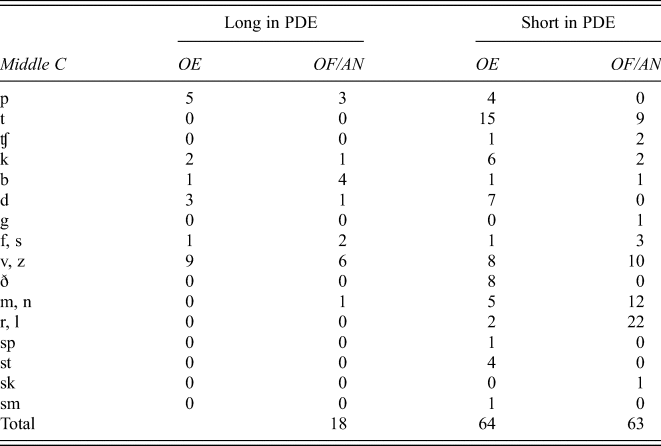
The distribution of lengthened and unlengthened forms in the 166 items with (C)V.CəR structure either in OE or in early ME is charted in figure 3. The subset of (C)V.RəR items shows practically no variability in the results for stems with a medial sonorant: 42 items are of the type valor, venom, moral, with only a single lengthened item: moment, whose etymology (Lat. mōmentum) may have interfered, making the intersyllabic sonorant in (C)V.RəR a factor which blocks OSL.Footnote 23 Further, there are no lengthened forms with –V.sCəR, where the medial clusters are also legal word-initial clusters: -sp-, -st-, -sk-, -sm-.
Medial consonants and lengthened/unlengthened (C)V.CəR inputs

Only 38 items (23 percent) in the database show a long vowel, if and only if the medial consonant is an obstruent. /t/ and /-ð-/ categorically inhibit lengthening.Footnote 24 Alveolar stop lenition, possibly resulting in tapping, can be traced back to early ME (6).
(6) Orthographic evidence for alveolar stop lenition in early English
OE botm ~ bodan ‘bottom’, ME variant spellings boþom, boddo, bodme, boden Footnote 25
OE Angl. cetel, WS cytel ‘kettle’, ME ketel~chedel~chidel~chithel,
(Chedelhampton, Devon 1242)
ME oter ~ oder-, other- (1208, 1278, in place names, MED) ‘otter’
ME water(e) ~ wade- as in wadetons, wadertons ‘water-casks’Footnote 26
ME catel ~ cadel ‘property’ (c. 1400)
ME fete ‘fetter’, federys ~ feþorys ‘fetters’ (1440, 1450)
ME potage (1230) podech (1528) ~ porage (1533) ‘porridge’
ME pottinger (1415), podenger (1463) ~ porrynger (1467) ‘porringer’Footnote 27
The data in (6) are fully compatible with ambisyllabicity of the intervocalic consonant, offering a previously unnoticed evidential angle on the early history of flapping in English. For now, if we take a bold step and project a lenited /-ɾ-/ realization of the alveolar stop, then we are looking at a segment whose features include [ +sonorant] and [ +continuant], which places it in the same set as (C)V.RVC words.Footnote 28
Crucially, the new empirical finding on the behavior of (C)V.RVC stems adds a new perspective on both Ritt's (Reference Ritt1994) focus on medial sonorants, and Bermúdez-Otero's (Reference Bermúdez-Otero1998) focus on the presence of a second syllable sonorant coda and its link to the compensatory OSL model. Since variability occurs only in forms with both an intervocalic obstruent and a final sonorant, it is their exceptional behavior that calls for further scrutiny.
3.1 OSL and intersyllabic consonants
Figure 4 uses the same data as in table 1 and figure 3; (L) stands for ‘lengthened’, (S) stands for ‘short’.
Sonorant vs obstruent medial consonants in (C)V.CəR inputs to OSL

In the group shown in figure 4 the ratio of unlengthened to lengthened reflexes of items with a medial obstruent is 80:38; they are the locus of variability. Medial sonorants are a robust barrier to lengthening, moment being the only exception, and it is really not a good candidate for OSL, coming from Lat. mōmentum.
Before voiced consonants the vowel duration contributes to the perception of voicing. In our case medial /-b-, -d-, -v-, -z-/, in combination with a word-final sonorant, as in gable, cradle, beaver, hazel, would induce increased duration of the stressed vowel; perceived phonetic lengthening could then be reanalyzed as phonemic. This factor adds to the complexity of the overall picture, but it is clearly not the ‘solution’ of the problem of travel vs haven, saddle vs ladle. Nor does it tell us why (C)V.TəR items such as bacon, capon, maple were lengthened, while baron, galon, florin were not. So, based solely on the voicing/duration criterion of stressed (C)V[C]σ, the uniform behavior of intervocalic sonorants is hard to account for – a problem noticed as ‘particularly disturbing’ and ‘odd’ by Ritt (Reference Ritt1994: 40–1).
A summary of the stem-types discussed in sections 1–3 is shown in (7):
(7) A summary of stem-based OSL types

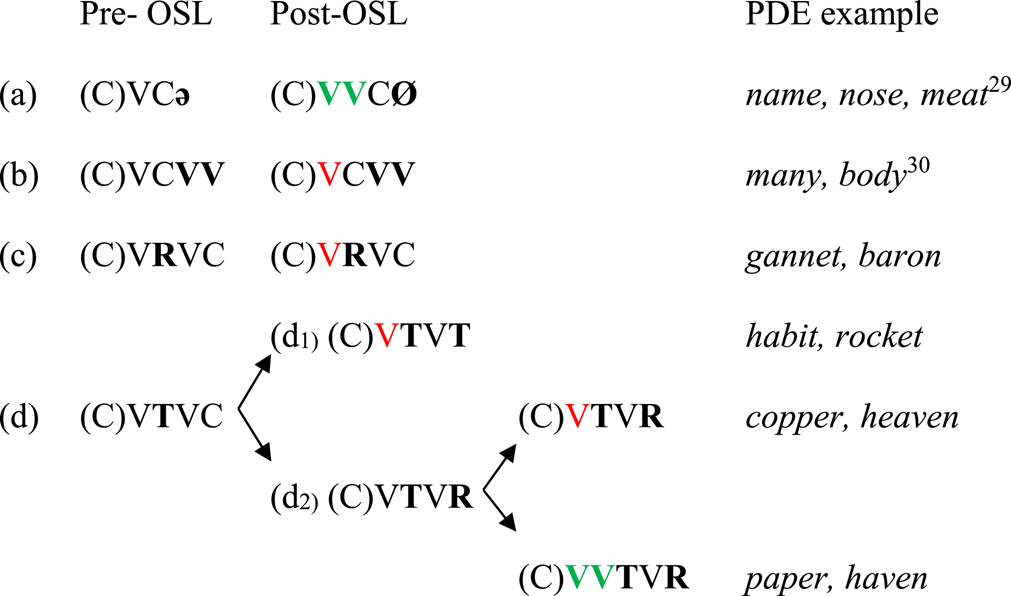
This completes the survey of the disyllabic stem-based data relevant to OSL.
4 A phonological account of MEOSL
The following section offers a phonological account of the general pattern of lengthening and non-lengthening in the disyllabic ME stems in (7), making use of Classical OT, and, to account for the word forms which exhibit variation, Maxent OT.
A quantified version of the pattern to be accounted for is summarized in table 2. Other than the (C)VTəR subset, these word forms are effectively categorical in terms of the length of their PDE reflexes, the only two exceptions being moment for the (C)VRəC subset, and naked for the (C)VTəT subset, which, as already discussed, may be long for etymological or morphological reasons, respectively.
Overall patterns of lengthening in input disyllables

4.1 An OT grammar for MEOSL
Lengthening in our account is treated as primarily compensatory: a response to syncope or apocope, hypothesized to have occurred contemporaneously with lengthening. Compensatory lengthening can be modeled in OT by way of a constraint motivating the deletion of schwa, and any sort of constraint which forbids the output from being moraically shorter than the input, motivating compensation. These constraints must dominate the relevant faithfulness constraints which forbid deletion and lengthening (see table 3).
Constraints and definitions

Since we now have a constraint that involves counting morae, some discussion here of our assumptions regarding weight is warranted. We assume that a short vowel (or a syllabic sonorant) is associated with one mora, a long vowel with two, and that coda consonants are associated with a mora as well, regardless of their sonority. Crucially, we treat intervocalic consonants as ambisyllabic, and therefore as mora-bearing. For example, a CVCə (‘name’) input has three morae, and not two. Deleting the final schwa to get CVC would bring the count down to two, and only by lengthening the vowel to CVVC would the original weight be preserved.Footnote 32
These constraints are enough to explain the distinction between (C)VCə (nose, name) words on the one hand and (C)VCVV (body, many) words on the other: in the former, lengthening is a by-product of apocope, while in the latter, there is no motivation to lengthen at all, since the faithful forms are completely unmarked (see table 4).
OT tableau for (C)VCə, (C)VCVV

Among (C)VCəC words, lengthening occurs only in the (C)VTəR (paper) variety, and in these only variably. We follow Bermúdez-Otero (Reference Bermúdez-Otero1998) in proposing that lengthening in the paper words is, just as for name and nose, primarily compensation for the deletion of schwa in the second syllable.Footnote 33 While the word-final sonorant in these words syllabifies in these cases (violating a low-ranked faithfulness constraint on consonant syllabicity), this syllabification is not enough to compensate for the mora lost to schwa deletion, since CVR syllables have both a nucleus and a coda, and CR̩ syllables do not. Tables 5 and 6 show how the identity of the syllabic specification can affect the realization of CR̩ syllables. The careful reader may here interject that the deletion of a vowel in the second syllable in ME was not always accompanied by compensatory lengthening: (C)VVTTə words like OE sōfte, ME soft(e) ‘soft’, OE cēpte, ME kept(e) ‘kept’, underwent apocope, but in fact had their first vowel shortened, violating Max-μ twice. We can straightforwardly account for these cases with reference to an independent process, namely ME shortening before consonant clusters (Jordan & Crook Reference Jordan, Crook and Crook1974; Lass Reference Lass and Blake1992; Ritt Reference Ritt, Rissanen, Ihalainen and Nevalainen1992; Minkova Reference Minkova2014). This process can be explained in OT by an undominated constraint like *VVCC. Except for the ambivalently weighted -sp, -st, -sk, a problem throughout the history of English because they are variably cohesive (Minkova Reference Minkova1982: 42; 2014: 334), and the special case of the so-called OE Homorganic Cluster Lengthening, e.g. cild > cīld ‘child’, grund > grūnd ‘ground’ (Luick Reference Lass and Blake1964; Lass Reference Lass and Blake1992; Ritt Reference Ritt, Rissanen, Ihalainen and Nevalainen1992; Minkova Reference Minkova2014), there are no -VVCC# stems in ME, or in PDE except a handful of real outliers (traipse, oops, yikes).
Constraint definition for ID(syllabic)

OT tableau for (C)VTəR

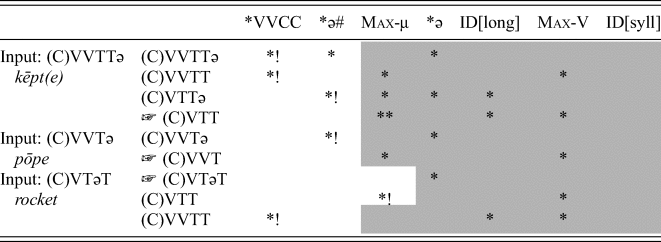
Since deletion occurs in the (C)VVTTə forms, some constraint motivating deletion must dominate Max-μ. We must explain, then, why no deletion occurs in the (C)VTəT (rocket) forms. The easiest way to do so is to distinguish syncope generally from apocope, and have a constraint which enforces the latter be undominated, such that, unlike syncope, apocope applies without exception (which is in fact the empirical pattern observed across ME). Apocope (*ə#) and *VVCC are defined in table 7.
Constraint definitions for apocope and *VVCC

The ranking *ə#, *VVCC > Max-μ allows us to explain kept, as well as other word forms where apocope occurred without lengthening, such as (C)VVTə words like pope where the vowel in the first syllable was already long in ME and could not lengthen any further since English prohibits overlong vowels.
The ranking *VVCC, Max-μ > *ə explains why (C)VTəT (rocket) words do not undergo syncope: if syncope were to apply with compensatory lengthening in these words, this would create a long vowel in exactly the sort of environment where ME shortens long vowels. Conversely, if syncope were to apply without compensatory lengthening, this would violate Max-μ (table 8).
OT tableau for (C)VVTTə, (C)VVTə, (C)VTəT
Recall that (C)VTəR (paper) words can undergo syncope with compensatory lengthening without violating *VVCC because their final sonorant can be syllabified, avoiding a coda cluster. Because English (like most languages outside North Africa and the Pacific Northwest) forbids syllabic obstruents,Footnote 35 the same strategy is not available for the CVTəT (rocket) words, where syncope inevitably creates a branching coda.
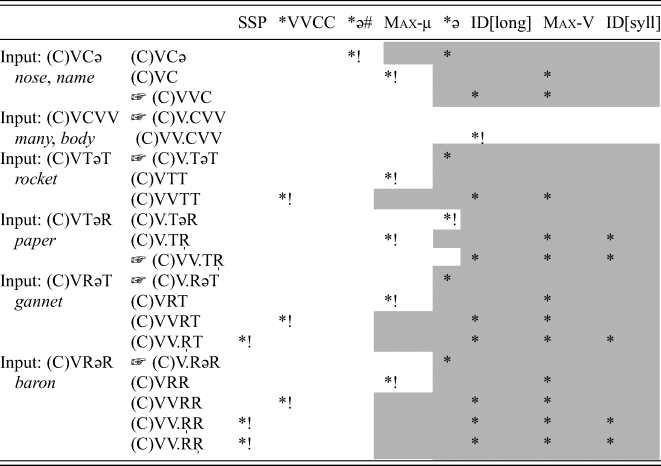
The last thing to be explained is why there is no sonorant syllabification in the (C)VRəC (gannet, baron) words. This can be explained with reference to the sonority sequencing principle, or SSP.Footnote 36 A number of constraints are associated with this principle, but we here need only make reference to any constraint or constraints which require a rise in sonority from onset to nucleus (table 9). For conciseness, we here define SSP-Onset-Nuc such that it is also violated by onsetless syllables (which have no sonority rise). We could just as well have used an additional constraint, Onset, to be added to the same stratum, and this pair of constraints would achieve exactly the same effect.
Constraint definition for the Sonority Sequencing Principle

The medial sonorants of (C)VRəC (gannet, baron) words cannot syllabify because σ2 would be [R̩C] with no onset, violating SSP (or Onset, see above). Similarly, if the final sonorants in the (C)VRəR (baron) words were to syllabify, it would create a syllable of the form [RR̩], which does not rise in sonority.Footnote 37
Essentially, we are proposing that syncope is sensitive to the relative sonority of the consonants that it would bring into contact. Reassuringly, this exact sensitivity has been observed for trisyllabic syncope in PDE: Polgárdi (Reference Polgárdi2015: 383) finds that ‘English post-tonic syncope is sensitive to the quality of the flanking consonants: the consonant following the alternating vowel must be a sonorant which is more sonorous than the consonant preceding it (dél*(i)cate, cól*(o)ny).’
With the addition of SSP, all of the data can be accounted for, as shown in table 10.
OT tableau for all (C)VCV(C) forms
4.2 Modeling variation with classical OT
The analysis in the previous section derives what kind of word forms can lengthen. In particular, it derives lengthening in the (C)VTəR (paper, copper) cases, when in fact lengthening in these forms occurs only variably.
In order to better understand how this variation could result from variable constraint ranking, we employed the constraint-ranking software OTSoft (Hayes et al. Reference Hayes, Tesar and Zuraw2013). This software, when given a tableau indicating winning candidates and constraint violations, finds a constraint ranking which predicts the winners. We ran the software twice: first on the tableau in table 10, where the winning candidate for the (C)VTəR input was set to be categorically (C)VVTR̩ (deriving the paper cases), and then on a similar tableau in which the winning candidate for (C)VTəR was the faithful one (deriving the copper cases). OTSoft gave the constraint rankings shown in table 11, which we'll refer to as the ‘paper’ grammar and the ‘copper’ grammar, respectively.
Constraint ranking and strata learned by OTSoft for tableaux which differ only in whether lengthening applies to (C)VTəR forms

Note that a ‘stratum’ is a set of constraints whose relative ranking does not affect the outcome. However, even this representation is over-specified, in that not all of the pairwise rankings implied by these strata are necessary. For example, while *VVCC is in a higher stratum than Max-V in both grammars, neither of the tableaux rely on the relative ranking of these two constraints. A better understanding of how the grammars work can therefore be gleaned from their Hasse diagrams (also generated by OTSoft), which represent the constraint rankings that are necessary to derive the winners. The Hasse diagrams show more information than the constraint ranking. For example, SSP is in the top stratum because it is undominated, but it also doesn't strictly dominate anything else, which is why it's isolated in the diagram: it could be in any stratum and the grammar would make the same predictions. Hasse diagrams for the two grammars are given in figure 5.
Hasse diagrams for the ‘paper’ grammar in which (C)VTəR words show lengthening (left) and for the ‘copper’ grammar in which (C)VTəR words do not show lengthening (right). In the latter, the dotted lines indicate rankings which need not all be present. In particular, any of the following would suffice to predict the data: Max-V > *ə, ID[long] > *ə, or ID[syll], Max-μ > *ə

From figure 5 we can see that the only necessary change in constraint ranking to block lengthening in the (C)VTəR words is the demotion of *ə (syncope) with respect to at least one of the constraints that is violated when syncope with compensatory lengthening applies: Max-V, ID[long] or ID[syll] (in conjunction with Max-μ). If any one of these three dominates *ə, then the change will be blocked. Thus, two grammars with minimal differences in constraint ranking could produce different outcomes in the (C)VTəR cases, holding the other cases constant.
4.3 Modeling variation with Maxent OT
The analysis presented in section 4.2 is sufficient if the lengthening variation in these cases is to be explained as variation between grammars: this could be synchronic inter-speaker variation, dialect variation, intra-speaker stylistic variation, word-specific diachronic variation due to lexical factors like frequency, or any number of other things.
However, stochastic varieties of OT are also capable of modeling variation using a single grammar, corresponding to the possibility of true free variation in these forms, even for individual speakers, at the time of the change. Maxent OT (Goldwater & Johnson Reference Goldwater, Johnson, Spenader, Eriksson and Dahl2003) is one such stochastic variety, in which constraints have weights rather than a strict ranking. Maxent grammars do not predict a winning candidate, but rather a probability (Pr) for each candidate based on its harmony (h), the weighted sum of its constraint violations, such that candidates with more violations of higher weighted constraints are less probable.
OTSoft is capable of learning the weights for a maxent grammar. The input is much the same as before – a tableau with candidates and constraint violations, but rather than indications of winning candidates, observed counts for candidates must be provided. We once again used the tableau in table 10, with an additional column indicating the number of attested stems matching the form of each candidate, summarized in table 12.Footnote 38
Candidate counts given to OTSoft for fitting the weights of a maxent grammar (candidates given counts of 0 are not shown in this table)

Using the tableau in table 10 augmented with the candidate counts in table 12, and with maximum constraint weight capped at 500,Footnote 39 OTSoft learned the constraint weights in table 13.
Constraint weights learned by OTSoft

A maxent grammar with these learned weights predicts candidate probabilities which match the patterns seen in the data almost exactly: it predicts categoricity for the categorical cases, and predicts variation for the paper/copper cases, with lengthening occurring 32 percent of the time. A Maxent OT tableau with the learned weights is given in table 14.
Maxent tableau with weights learned by OTSoft. h = harmony (the weighted sum of a candidate's violations), Pr = predicted probability
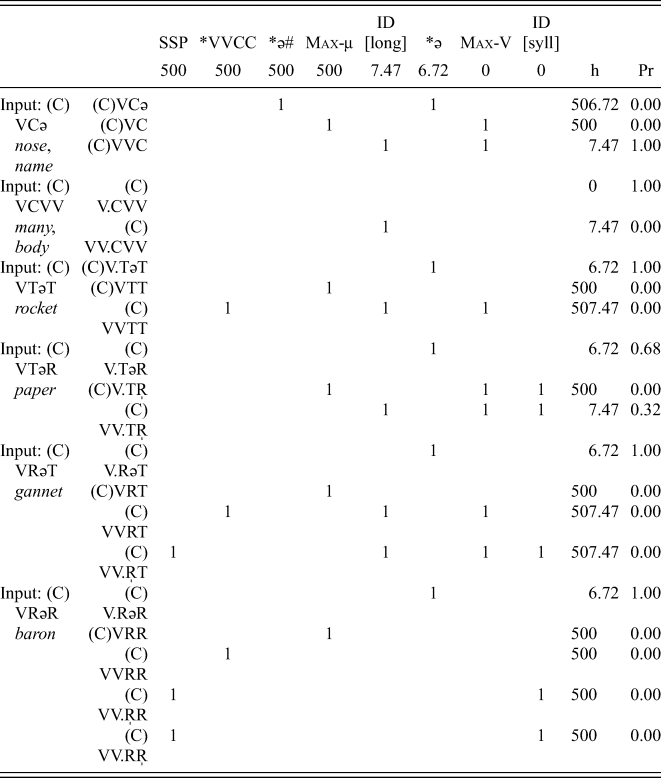
This maxent grammar accomplishes its close fit to the data by relying on the interplay between ID[long] and *ə (syncope), which are assigned similar, comparatively small weights.Footnote 40 Because ID[long] has a small weight, changes to length will practically always occur when necessary to satisfy stronger constraints like *ə# (apocope) and *Max-μ. However, because syncope has a similarly small weight, ID[long] is enough to prevent syncope with compensatory lengthening from occurring 68 percent of the time. Syncope without compensatory lengthening is ruled out by the much higher weight of Max-μ.
Note that while the weights learned by OTSoft are mathematically ‘optimal’ in terms of their ability to match the observed, there could be alternative values for the weights that perform just as well, and derive the same qualitative pattern: for example, if ID[syll] or Max-V, rather than ID[long], had been given a weight similar to *ə, the interplay between that constraint and *ə might have resulted in variation in the (C)VTəR words in much the same way, since lengthening in these cases also involves the syllabification of sonorants and the deletion of vowels.
4.3.4 Future work
In our account, the OE (C)VCə inputs (nose, name) map to (C)VVC rather than (C)VC outputs due to a constraint which prefers preservation of word-level metrical weight in the face of apocope (table 4). A related, lexicon-specific question is whether the (C)VVC candidates could have been preferred because the lengthened vowel guaranteed better preservation of lexical contrast. We leave this line of inquiry for further research, but we note that post-apocope moraic preservation maintains contrast with pre-existing CVC monosyllables in the lexicon: bane–ban, bake–back, bale ‘evil’ – ball, bathe–bath, bead–bed, break–brack, cloak–clock, dean ‘valley’ – den, vane–fan, hate–hat, hope–hop, mane–man, lame–lamb, lease–less, mate–mat, meat–met, sake–sack, snake–†snack, soak–sock, stake–stack, tale–tell, weal–well, wane–wan… All of these -VV-:-V- minimal pairs are pre-1400. The (C)VC–(C)VVC contrast in ME carried very high ‘functional load’ in ME. Wedel et al. (Reference Wedel, Kaplan and Jackson2013) have provided statistical evidence that ‘the probability of phoneme merger is inversely related to functional load’. Another inquiry in that context would address the functional load of the contrast between pre-existing and newly lengthened (C)VVC items. We have not searched for minimal pairs of that type, but we note that potential mergers might be disfavored. The hyperarticulation which would initially characterize post-apocope lengthening would not necessarily be perceived as identical to a pre-existing target. In the set of the pre-lengthening inputs (Minkova Reference Minkova1982: 40–1), items with a low vowel, [a~æ] in the stressed syllable represent over 50 percent of the entire database. The post-lengthening vowel [aː] was distinct from pre-existing OE [ɒː] > ME [ɔː], northern and Scottish [ɑː]. Lengthened OE [ɛ] could only merge with the monophthongized OE [ɛǝ], but not with OE [eː], and lengthened OE [ɔ] could only merge with the reflex of ME [ɔː] < OE OE [ɒː], but not with OE and ME [o:]. As noted in section 1, rhyme evidence for a merger of newly lengthened vowels with the pre-existing long vowels is unambiguous only after the middle of the fifteenth century. Not least, the potential functional load imbalance would be useful in establishing the distinctiveness of vowel quantity vs quality in providing information.
5 Summary and conclusion
As our title suggests, we propose a new descriptive name for the process discussed in this study: Middle English Compensatory Lengthening (MECL). In Middle English, the overall pattern of lengthening in (C)VCə(C) stems can be explained phonologically by postulating that lengthening in these cases was moraic compensation for the deletion of a stressless vowel in the following syllable. The open-syllable condition for lengthening is, under this account, completely epiphenomenal: in closed monosyllabic stems, no lengthening will occur because there is no deletion to be compensated for, while in closed first syllables of disyllabic inputs like ende ‘end’ the vowel is followed by a word-medial cluster, and vowels before clusters shorten in ME. The constraints used for the (C)VCəC inputs apply also to other disyllabic inputs (kēpte, pōpe) and can be generalized over much of the ME and PDE lexicon.
The fact of pre-cluster shortening in ME simultaneously explains why, of the (C)VCəC words, lengthening only occurs when the final consonant is a sonorant: after syncope, sonorant syllabification is necessary to avoid creating a cluster following a long vowel. Lengthening is less frequent in (C)VTəR (paper, copper) words than in (C)VCə (nose, name) words precisely because deletion is less frequent, which can be attributed to the fact that syncope, unlike apocope, is an optional process in ME.
The various factors that have been described as creating large classes of ‘exceptions’ to lengthening in open syllables, such as the segmental identity of the following consonant and the nucleus and coda of the second syllable, are demystified: these factors straightforwardly relate to deletion in the second syllable, the trigger for lengthening.
Revisiting the entire set of (C)VCəC inputs and their reflexes in PDE in the context of the discovery that sonorant σ2 onsets inhibit lengthening has led to a promising side-line to the main points in the article: the alignment of /-t-/ with the sonorants in σ2 onset position (figure 3 and the attestations in (6)). The parallel results for the gannet, baron types and the bottom, fetter types is a previously unidentified argument for projecting alveolar stop lenition, a central process in PDE, back to at least Middle English, though not readily recognizable in the written records.
In sum, a re-examination of the database and a constraint-based analysis supports Bermúdez-Otero's (Reference Bermúdez-Otero1998) insight regarding the compensatory potential in (C)VCəR inputs and accounts for the previously puzzling variability of the outcome. It also allows a broader perspective on the diachronic conditions shaping the phonology of Present-day English.


 Open access

