





1 Introduction
Cut elimination in non-wellfounded/cyclic proof theory is currently an active topic of research and has been addressed by several researchers with different tools. For example via finite approximations in [Reference Acclavio, Curzi, Guerrieri, Murano and Silva1], via cyclic proofs in [Reference Afshari and Kloibhofer2], via multicuts in [Reference Afshari, Leigh and Turata3], via runs in [Reference Das, Pous, Ghica and Jung4], via infinitary rewriting in [Reference Saurin, Ramanayake and Urban11], via ultrametric spaces in [Reference Savateev and Shamkanov12, Reference Savateev, Shamkanov, Iemhoff, Moortgat and Queiroz13, Reference Shamkanov15], among others.Footnote 1 The richness of methods is a witness of the hardness of the problem. We believe that this hardness arises, among other things, from two fundamental facts:
-
1. In principle non-wellfounded proofs do not have a notion of height associated with them. This means that we cannot recurse over them.
-
2. Verifying that a tree is a proof in the finitary setting just requires to check a “local” condition globally, in particular that every node is the conclusion of a rule instance. In the non-wellfounded setting a global condition on the branches is added, proving that this condition is preserved after the process of cut elimination is the principal headache.
In [Reference Miranda, Studer, Zenger, Ciabattoni, Gabelaia and Sedlár10] we defined a method to establish cut elimination and, more generally, to make proof translations between local-progress sequent calculi. These are sequent calculi allowing non-wellfounded proofs such that any infinite branch goes through some rules infinitely many times. Examples of logics with this kind of calculus abound in provability logic (e.g., see [Reference Horvat, Miranda and Studer5, Reference Horvat, Miranda and Studer6, Reference Miranda and Studer8, Reference Miranda and Studer9, Reference Savateev and Shamkanov12, Reference Shamkanov14]). The method is based on splitting the proof into two parts, one of them amenable to tools of finitary proof theory such as recursion. The other part needs to be treated corecursively, but this treatment is generic and does not need to be reimplemented for each sequent calculus. The combination of these two facts brings the study of local-progress calculi much closer to the study of finitary calculi, simplifying the proof theory of the first.
We left open the question whether this simplification can be adapted to other non-wellfounded systems with more complex branch conditions. In this article we answer this question positively providing a novel cut elimination method for a non-wellfounded system for the master modality (
$\text {K}^+$
 ). Cut elimination for
$\text {K}^+$
). Cut elimination for
$\text {K}^+$
 was already proved by Shamkanov in [Reference Shamkanov15] by the method of continuous cut elimination via ultrametric spaces. We replace the use of ultrametric spaces by partitions, a simplification which will make it possible to study further levels of the recursive–corecursive iteration scheme occurring naturally in non-wellfounded proof theory.
1.1 Structure of the article
In Section 2 we introduce the logic
$\text {K}^+$
 , together with a sequent calculus for it and some tools to work with local-progress calculi. In Section 3 we introduce a variation of the sequent calculus for
$\text {K}^+$
, together with a sequent calculus for it and some tools to work with local-progress calculi. In Section 3 we introduce a variation of the sequent calculus for
$\text {K}^+$
 that helps to simplify some technicalities in the cut elimination proof. In Sections 4 and 5 we define some transformations of proof that we will later need for the cut elimination procedure. In Section 6 we show two transformations that allow to push cuts away from the root. In Section 7 we prove that any proof with finitely many cuts can be transformed into a cut-free proof. Finally, in Section 8 we conclude the article by proving that any proof using cuts can be converted into a cut-free proof, dropping the assumption of finiteness.
2 Preliminaries
2.1 Master modality
We use this section to introduce some concepts that are needed for the rest of the article.
$\text {K}^+$
 is a modal logic, we will work with its formulation in the modal language with connectives
$\bot , \to $
is a modal logic, we will work with its formulation in the modal language with connectives
$\bot , \to $
 and unary modalities
$ \Box , \Box ^+$
and unary modalities
$ \Box , \Box ^+$
 . The operator
$ \Box ^+$
. The operator
$ \Box ^+$
 is what we call the master modality. We use usual Kripke models for the semantics of this logic. If
$\mathbf {M} = (W,R, V)$
is what we call the master modality. We use usual Kripke models for the semantics of this logic. If
$\mathbf {M} = (W,R, V)$
 is a Kripke model, then the semantics for box and master formulas is as follows:

where
$R^+$
 is the transitive closure of R, i.e.,
$w R^+ v$
is the transitive closure of R, i.e.,
$w R^+ v$
 iff there is a (non-empty) sequence
$w_0, \ldots , w_n$
iff there is a (non-empty) sequence
$w_0, \ldots , w_n$
 such that
$w = w_0 R \dots R w_n = v$
such that
$w = w_0 R \dots R w_n = v$
 .
.
Given a multiset of formulas
$\Gamma $
 we will write
$\boxdot ^+ \Gamma $
we will write
$\boxdot ^+ \Gamma $
 to mean
$\Gamma , \Box ^+\Gamma $
to mean
$\Gamma , \Box ^+\Gamma $
 .
.
Definition 2.1. We define the Hilbert system
$\text {HK}^+$
 as the Hilbert system over the language of the master modality with axioms:
-
1. $\phi \to (\psi \to \phi )$
 ;
; -
2. $(\phi \to (\psi \to \chi )) \to ((\phi \to \psi ) \to (\phi \to \chi ))$
; -
3. $((\phi \to \bot ) \to \bot ) \to \phi $
; -
4. $ \Box (\phi \to \psi ) \to ( \Box \phi \to \Box \psi )$
; -
5. $ \Box ^+(\phi \to \psi ) \to ( \Box ^+ \phi \to \Box ^+ \psi )$
; -
6. $ \Box ^+ \phi \to \Box \phi $
; -
7. $ \Box ^+ \phi \to \Box \Box ^+ \phi $
; -
8. $ \Box \phi \to ( \Box ^+ (\phi \to \Box \phi ) \to \Box ^+ \phi )$
.








And the rules of modus ponens and necessitation for
$ \Box ^+$
 :
:

As proved in [Reference Shamkanov16],
$\text {HK}^+$
 is sound and weakly complete with respect to the
$\text {K}^+$
is sound and weakly complete with respect to the
$\text {K}^+$
 semantics.
2.2 Shamkanov’s non-wellfounded sequent calculus for
$\text {K}^+$

Shamkanov provided a non-wellfounded Gentzen calculus for
$\text {K}^+$
 in [Reference Shamkanov16], let us denote it as
$\text {G}^\infty \text {K}^+$
in [Reference Shamkanov16], let us denote it as
$\text {G}^\infty \text {K}^+$
 and its version with cut as
$\text {G}^\infty \text {K}^+ + \textsf {Cut}$
and its version with cut as
$\text {G}^\infty \text {K}^+ + \textsf {Cut}$
 . In
$\text {G}^\infty \text {K}^+$
. In
$\text {G}^\infty \text {K}^+$
 sequents are ordered pairs
$(\Gamma , \Delta )$
sequents are ordered pairs
$(\Gamma , \Delta )$
 where
$\Gamma , \Delta $
where
$\Gamma , \Delta $
 are finite multisets of formulas. These are usually denoted as
$\Gamma \Rightarrow \Delta $
are finite multisets of formulas. These are usually denoted as
$\Gamma \Rightarrow \Delta $
 . Proofs are non-wellfounded trees, i.e., trees that are allowed to have infinite length paths from the root (infinite branches). It is easy to show that
$\text {G}^\infty \text {K}^+$
. Proofs are non-wellfounded trees, i.e., trees that are allowed to have infinite length paths from the root (infinite branches). It is easy to show that
$\text {G}^\infty \text {K}^+$
 is sound and that if
$\text {HK}^+ \vdash \phi $
is sound and that if
$\text {HK}^+ \vdash \phi $
 then
$\text {G}^\infty \text {K}^+ + \text {Cut} \vdash {\Rightarrow \phi }$
then
$\text {G}^\infty \text {K}^+ + \text {Cut} \vdash {\Rightarrow \phi }$
 (by induction on the size of the Hilbert proof and some inversion principles of
$\text {G}^\infty \text {K}^+ + \text {Cut}$
(by induction on the size of the Hilbert proof and some inversion principles of
$\text {G}^\infty \text {K}^+ + \text {Cut}$
 ), so
$\text {G}^\infty \text {K}^+ + \text {Cut}$
), so
$\text {G}^\infty \text {K}^+ + \text {Cut}$
 is also weakly complete. Then, (weak) completeness follows as a consequence of the cut elimination procedure we are going to describe in this article.Footnote
2
is also weakly complete. Then, (weak) completeness follows as a consequence of the cut elimination procedure we are going to describe in this article.Footnote
2
As usual with non-wellfounded proofs a condition limiting the possible shape of the infinite branches needs to be added, for the sake of soundness. This condition is simplified by turning to another non-wellfounded Gentzen calculus, which we will denote as
$\text {G}^\infty _\ell \text {K}^+$
 , whose sequents are annotated. Let us define it precisely.
An annotation is just a formula or the symbol
$\circ $
 , meaning that no formula is annotated. Sequents in
$\text {G}^\infty _\ell \text {K}^+$
, meaning that no formula is annotated. Sequents in
$\text {G}^\infty _\ell \text {K}^+$
 are triples
$(\Gamma , s, \Delta )$
are triples
$(\Gamma , s, \Delta )$
 , where
$\Gamma , \Delta $
, where
$\Gamma , \Delta $
 are finite multisets of formulas and s is an annotation. An additional condition is imposed on sequents, if the annotation of the sequent is a formula
$\phi $
are finite multisets of formulas and s is an annotation. An additional condition is imposed on sequents, if the annotation of the sequent is a formula
$\phi $
 then
$ \Box ^+ \phi $
then
$ \Box ^+ \phi $
 must occur in
$\Delta $
must occur in
$\Delta $
 . A sequent
$(\Gamma , s, \Delta )$
. A sequent
$(\Gamma , s, \Delta )$
 is denoted by
$\Gamma \Rightarrow _s \Delta $
is denoted by
$\Gamma \Rightarrow _s \Delta $
 . In the case the annotation is a formula
$\phi $
. In the case the annotation is a formula
$\phi $
 , we say that the formula is in focus and if it is
$\circ $
, we say that the formula is in focus and if it is
$\circ $
 , we say that the sequent is unfocused. Then the rules of
$\text {G}^\infty _\ell \text {K}^+$
, we say that the sequent is unfocused. Then the rules of
$\text {G}^\infty _\ell \text {K}^+$
 are
are


The condition on infinite branches is then that any branch has a suffix that always has the same formula
$\phi $
 in focus.Footnote
3
in focus.Footnote
3
We are allowed to move from studying cut elimination in
$\text {G}^\infty \text {K}^+$
 to study cut elimination in
$\text {G}^\infty _\ell \text {K}^+$
to study cut elimination in
$\text {G}^\infty _\ell \text {K}^+$
 since it can be shown that

and the same if we have the cut rule in both. For the right to left we just need to delete the annotations and notice that the branch condition of
$\text {G}^\infty _\ell \text {K}^+$
 implies the branch condition of
$\text {G}^\infty \text {K}^+$
implies the branch condition of
$\text {G}^\infty \text {K}^+$
 . For the left to right notice that by the shape of the rules there is only one possible way of annotating a proof in
$\text {G}^\infty \text {K}^+$
. For the left to right notice that by the shape of the rules there is only one possible way of annotating a proof in
$\text {G}^\infty \text {K}^+$
 such that the root is annotated with
$\circ $
such that the root is annotated with
$\circ $
 . It is straightforward to see that the branch condition of
$\text {G}^\infty \text {K}^+$
. It is straightforward to see that the branch condition of
$\text {G}^\infty \text {K}^+$
 will imply that the branch condition of
$\text {G}^\infty _\ell \text {K}^+$
will imply that the branch condition of
$\text {G}^\infty _\ell \text {K}^+$
 is fulfilled in the annotated version of the proof.
2.3 Cut elimination for local-progress systems
As we mentioned in the introduction, we want to use our previously defined tools of [Reference Miranda, Studer, Zenger, Ciabattoni, Gabelaia and Sedlár10] to prove cut elimination. Let us briefly introduce these tools here.
We work with a local-progress non-wellfounded sequent calculi, let us fix an arbitrary one and call it
$\mathcal {C}$
 . As usual,
$\mathcal {C}$
. As usual,
$\mathcal {C}$
 has a set
$\mathcal {R}$
has a set
$\mathcal {R}$
 whose elements are sequent rules, which we call the rules of
$\mathcal {C}$
whose elements are sequent rules, which we call the rules of
$\mathcal {C}$
 . A pre-proof in
$\mathcal {C}$
. A pre-proof in
$\mathcal {C}$
 is a (possibly non-wellfounded) tree whose nodes are labelled by an ordered pair consisting of a sequent and a rule from
$\mathcal {R}$
is a (possibly non-wellfounded) tree whose nodes are labelled by an ordered pair consisting of a sequent and a rule from
$\mathcal {R}$
 such that for any node with sequent S and rule R if
$S_0, \ldots , S_{n-1}$
such that for any node with sequent S and rule R if
$S_0, \ldots , S_{n-1}$
 are the sequents of its successors (in order) then
$(S_0, \ldots , S_{n-1}, S)$
are the sequents of its successors (in order) then
$(S_0, \ldots , S_{n-1}, S)$
 must be a rule instance of R.
In addition,
$\mathcal {C}$
 has a function L called the local-progress function. Given a rule instance r with premises
$S_0, \ldots , S_{n-1}$
has a function L called the local-progress function. Given a rule instance r with premises
$S_0, \ldots , S_{n-1}$
 and conclusion S of some rule
$R \in \mathcal {R}$
and conclusion S of some rule
$R \in \mathcal {R}$
 , we have that
$L_R(S_0, \ldots , S_{n-1}, S) \subseteq \{0, \ldots , n-1\}$
, we have that
$L_R(S_0, \ldots , S_{n-1}, S) \subseteq \{0, \ldots , n-1\}$
 .Footnote
4
We interpret this function as follows. Imagine we have a pre-proof in
$\mathcal {C}$
.Footnote
4
We interpret this function as follows. Imagine we have a pre-proof in
$\mathcal {C}$
 and w is a node with n successors. The node w is labelled with the sequent S and rule R and each of the successors is labelled with the sequent
$S_0, \ldots , S_{n-1}$
and w is a node with n successors. The node w is labelled with the sequent S and rule R and each of the successors is labelled with the sequent
$S_0, \ldots , S_{n-1}$
 , respectively. Then we will say that from w to its i-th successor there is progress iff
$i \in L_R(S_0, \ldots , S_{n-1}, S)$
, respectively. Then we will say that from w to its i-th successor there is progress iff
$i \in L_R(S_0, \ldots , S_{n-1}, S)$
 . A proof in
$\mathcal {C}$
. A proof in
$\mathcal {C}$
 is a pre-proof such that in any infinite branch there is infinitely often progress from a node in the branch to its successor in the branch.
When defining local-progress system it will be usual to describe the rules as

where
$S_0, \ldots , S_{n-1}, S$
 are sequent-schemes. This defines the rule R whose rule instances are the tuples
$(S_0, \ldots , S_{n-1}, S)$
are sequent-schemes. This defines the rule R whose rule instances are the tuples
$(S_0, \ldots , S_{n-1}, S)$
 where
$S_i$
where
$S_i$
 is an instantiation of
$\mathcal {S}_i$
is an instantiation of
$\mathcal {S}_i$
 and S is an instantiation of
$\mathcal {S}$
and S is an instantiation of
$\mathcal {S}$
 . In addition we will say that progress only occurs at the
$i_0, \ldots , i_k$
. In addition we will say that progress only occurs at the
$i_0, \ldots , i_k$
 -th premises of R to mean that
$L_R(S_0, \ldots , S_{n-1}, S) = \{i_0, \ldots , i_k\}$
-th premises of R to mean that
$L_R(S_0, \ldots , S_{n-1}, S) = \{i_0, \ldots , i_k\}$
 , where
$(S_0, \ldots , S_{n-1}, S)$
, where
$(S_0, \ldots , S_{n-1}, S)$
 is any rule instance of R. In case we do not mention anything about progress in a rule R or we say that in R there is no progress, we mean that
$L_R(r) = \varnothing $
is any rule instance of R. In case we do not mention anything about progress in a rule R or we say that in R there is no progress, we mean that
$L_R(r) = \varnothing $
 for any rule instance r of R.Footnote
5
for any rule instance r of R.Footnote
5
Any proof in a local-progress system can be divided into (possibly infinitely many) finite trees, creating a partition of the nodes of the proof. An element of this partition is called a local fragment of the proof, the idea is that two nodes are in the same local fragment iff there is a (non-directed) path in the tree that allows to go from one node to the other without encountering progress. In particular, note that inside a local fragment no progress can occur and that all progress in the proof occurs from a leaf of a local fragment to the root of another local fragment. The main local fragment of a proof is the fragment starting at the root. The local height of the proof will be the height of the main local fragment, for a proof
$\pi $
 this height will be denoted as
$|\pi |$
this height will be denoted as
$|\pi |$
 .
.
The tools that we developed in [Reference Miranda, Studer, Zenger, Ciabattoni, Gabelaia and Sedlár10] basically allowed us to do corecursion at the level of local fragments. In other words, in a corecursive step we will give not only the last node of the resulting proof after the corecursion, but the whole main local fragment. For details consult Section 3 in [Reference Miranda, Studer, Zenger, Ciabattoni, Gabelaia and Sedlár10].
3 Definition of
$\alpha \textsf {-}\text {G}^{ \infty }_{ \ell }\text {K}^{ + }_{ s }$

For the Gentzen calculi we are going to define we need to consider the concept of proof with witnesses. Usually a Gentzen calculi rule is of the shape

However, we are going to use rules of shape

where
$\pi _0, \ldots , \pi _{m-1}$
 will be proofs of
$S_0, \ldots , S_{m-1}$
will be proofs of
$S_0, \ldots , S_{m-1}$
 , respectively, in other Gentzen calculi(which will be defined beforehand, generating a hierarchy of sequent calculi defined recursively). In the proof tree this will look as a node with the label
$(S, R, \pi _0, \ldots , \pi _{m-1})$
, respectively, in other Gentzen calculi(which will be defined beforehand, generating a hierarchy of sequent calculi defined recursively). In the proof tree this will look as a node with the label
$(S, R, \pi _0, \ldots , \pi _{m-1})$
 and n successors, labelled with sequents
$S_m$
and n successors, labelled with sequents
$S_m$
 to
$S_{m+n-1,}$
to
$S_{m+n-1,}$
 respectively.
In such a rule instance
$\pi _0, \ldots , \pi _{m-1}$
 are called witnesses. Given a proof in a system with this kind of rules we will sometimes call it a proof with witnesses and the witnesses are all the witnesses that occur at some of its rule instances. The main global fragment of such a proof is its structure without considering the witnesses.
When we talk about a subproof in a calculus of this kind we mean a proof generated by taking one of its nodes as the root. In particular, these nodes always belong to the main global fragment, so the witnesses are not subproofs.
Note that in a proof
$\pi $
 we may have that a witness
$\tau $
we may have that a witness
$\tau $
 is a proof with witnesses so it also has witnesses. The witnesses of
$\tau $
is a proof with witnesses so it also has witnesses. The witnesses of
$\tau $
 are not witnesses of
$\pi $
are not witnesses of
$\pi $
 (i.e., being a witness is not transitive). In this setting we have to understand that a cut-free proof is not only a proof without instances of cut such that neither its witnesses have any instances of cut nor its witnesses of witnesses and so on.
Definition 3.1. For each ordinal
$\alpha $
 and annotation s, we define the system
$\alpha \text {-G}^{ \infty }_{ \ell }\text {K}^{ + }_{ s }$
and annotation s, we define the system
$\alpha \text {-G}^{ \infty }_{ \ell }\text {K}^{ + }_{ s }$
 as the local-progress system with rules:


where
$\beta ,\gamma < \alpha $
 and
$\tau \vdash ^{ \alpha }\Gamma \Rightarrow _{ s' }\Delta $
and
$\tau \vdash ^{ \alpha }\Gamma \Rightarrow _{ s' }\Delta $
 means that
$\tau $
means that
$\tau $
 is a proof of
$\Gamma \Rightarrow _{ s' }\Delta $
is a proof of
$\Gamma \Rightarrow _{ s' }\Delta $
 in
$\alpha \text {-G}^{ \infty }_{ \ell }\text {K}^{ + }_{ s' }$
in
$\alpha \text {-G}^{ \infty }_{ \ell }\text {K}^{ + }_{ s' }$
 . We note that
$\Gamma , \Delta , \Sigma , \Pi $
. We note that
$\Gamma , \Delta , \Sigma , \Pi $
 are finite multisets of formulas and, in particular, may be empty.
In instances of the rules
$\to \text {L}$
 ,
$\to \text {R}$
,
$\to \text {R}$
 ,
$ \Box $
,
$ \Box $
 ,
$ \Box ^+_f$
,
$ \Box ^+_f$
 , and
$ \Box ^+_u$
, and
$ \Box ^+_u$
 , we define the principal formula to be the displayed formula in the conclusion. In the modal rules, the multisets
$\Sigma $
, we define the principal formula to be the displayed formula in the conclusion. In the modal rules, the multisets
$\Sigma $
 and
$\Delta $
and
$\Delta $
 will be called the weakening part of the rule instance.
Progress occurs at the right premise of the
$ \Box ^+_f$
 rule. Notice that
$ \Box ^+_f$
rule. Notice that
$ \Box ^+_f$
 and
$ \Box ^+_u$
and
$ \Box ^+_u$
 have side conditions
$s = \phi $
have side conditions
$s = \phi $
 and
$s \neq \phi $
and
$s \neq \phi $
 , respectively. This, together with the progress condition, implies that if
$s = \circ $
, respectively. This, together with the progress condition, implies that if
$s = \circ $
 the system is in fact finitary (every branch will be finite).
As we stated in the preliminaries, a proof in a local-progress calculus can be split into local fragments. In particular, each proof in
$\alpha \text {-G}^\infty _\ell \text {K}^+_s$
 has a local fragment starting at the root and local fragments starting at each right premise of a
$ \Box ^+_f$
has a local fragment starting at the root and local fragments starting at each right premise of a
$ \Box ^+_f$
 rule instance.
The s in
$\alpha \text {-}\text {G}^\infty _\ell \text {K}^+_s$
 determines which annotation is in focus, so when the annotation in focus is changed we are forced to go to a witness with a different annotation (see the
$ \Box ^+_u$
determines which annotation is in focus, so when the annotation in focus is changed we are forced to go to a witness with a different annotation (see the
$ \Box ^+_u$
 rule).
Definition 3.2 (Systems with cuts).
We define the cut rule

which makes no progress.
For each
$\alpha $
 we define the systems:
-
1. We define $\alpha \text {-G}^\infty _\ell \text {K}^+_s + \textsf {Cut}$
to be the systems as in Definition 3.1 with adding
$\textsf {Cut}$
to the list of rules (in particular, Cut may be used in the main global fragment, in witnesses, in witnesses of witnesses, and so on). -
2. $\alpha \text {-G}^\infty _\ell \text {K}^+_s + \textsf {wCut}$
are the system as in Definition 3.1 with allowing the witnesses to belong to
$\beta \text {-G}^\infty _\ell \text {K}^+_s + \textsf {Cut}$
for
$\beta < \alpha $
and not adding the
$\textsf {Cut}$
rule. -
3. $\alpha \text {-G}^\infty _\ell \text {K}^+_s + \textsf {mCut}$
are the systems as in Definition 3.1 with the same witnesses but adding the
$\textsf {Cut}$
rule, i.e.,
$\textsf {Cut}$
may occur in the main global fragment but the witnesses must be cut-free.









A proof in the second system is said to have witnesses-cuts only and a proof in the third system is said to have main-cuts only.
Definition 3.3. We say that
$\pi $
 is a proof in
$\text {G}^{ \infty }_{ \ell }\text {K}^{ + }_{ s }$
is a proof in
$\text {G}^{ \infty }_{ \ell }\text {K}^{ + }_{ s }$
 iff there is an
$\alpha $
iff there is an
$\alpha $
 such that
$\pi $
such that
$\pi $
 is a proof in
$\alpha \text {-G}^{ \infty }_{ \ell }\text {K}^{ + }_{ s }$
is a proof in
$\alpha \text {-G}^{ \infty }_{ \ell }\text {K}^{ + }_{ s }$
 and similarly iff we add Cut, mCut, or wCut. If
$\pi $
and similarly iff we add Cut, mCut, or wCut. If
$\pi $
 is a proof in
$\text {G}^{ \infty }_{ \ell }\text {K}^{ + }_{ s } + \textsf {Cut}$
is a proof in
$\text {G}^{ \infty }_{ \ell }\text {K}^{ + }_{ s } + \textsf {Cut}$
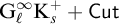 we will denote by
$\|\pi \|$
we will denote by
$\|\pi \|$
 the minimum ordinal
$\alpha $
the minimum ordinal
$\alpha $
 such that
$\pi $
such that
$\pi $
 is a proof in
$\alpha \text {-G}^{ \infty }_{ \ell }\text {K}^{ + }_{ s } + \textsf {Cut}$
is a proof in
$\alpha \text {-G}^{ \infty }_{ \ell }\text {K}^{ + }_{ s } + \textsf {Cut}$
 . This ordinal is called the (ordinal) height of the proof. The (ordinal) height of a node in a proof is the height of the subproof at that node.
Given a cut in a proof we can talk about its size (which is the size of its cut formula) and its height (which is the Hessenberg sum of the ordinal height of its premises).
The next proposition claims trivial facts about the three possible ways of adding cut to systems
$\alpha \text {-}\text {G}^\infty _\ell \text {K}^+_s$
 and establishes the connection to system
$\text {G}^\infty _\ell \text {K}^+$
and establishes the connection to system
$\text {G}^\infty _\ell \text {K}^+$
 .
.
Proposition 3.4. We have that
-
1. If $\pi $
is a proof in
$\alpha \text {-G}^\infty _\ell \text {K}^+_s$
then it is also a proof in
$\alpha \text {-G}^\infty _\ell \text {K}^+_s + \textsf {wCut}$
and in
$\alpha \text {-G}^\infty _\ell \text {K}^+_s + \textsf {mCut}$
. -
2. If $\pi $
is a proof in
$\alpha \text {-G}^\infty _\ell \text {K}^+_s + \textsf {wCut}$
or in
$\alpha \text {-G}^\infty _\ell \text {K}^+_s + \textsf {mCut}$
then it is a proof in
$\alpha \text {-G}^\infty _\ell \text {K}^+_s + \textsf {Cut}$
. -
3. $\text {G}^\infty _\ell \text {K}^+_s \vdash \Gamma \Rightarrow _s \Delta $
iff
$\text {G}^\infty _\ell \text {K}^+ \vdash \Gamma \Rightarrow _s \Delta $
and similarly if we add
$\textsf {Cut}$
.











Proof. The first two claims are straightforward by definition. The third claim is proven by induction on
$\|\pi \|$
 where for
$\pi $
where for
$\pi $
 in
$\text {G}^\infty _\ell \text {K}^+$
in
$\text {G}^\infty _\ell \text {K}^+$
 (
$+ \textsf {Cut}$
(
$+ \textsf {Cut}$
 ),
$\|\pi \|$
),
$\|\pi \|$
 refers to the definition of height in [Reference Shamkanov15].
Our objective will be to show that if
$\text {G}^\infty _\ell \text {K}^+_s + \textsf {Cut} \vdash \Gamma \Rightarrow _s \Delta $
 then
$\text {G}^\infty _\ell \text {K}^+_s \vdash \Gamma \Rightarrow _s \Delta $
then
$\text {G}^\infty _\ell \text {K}^+_s \vdash \Gamma \Rightarrow _s \Delta $
 . Broadly, we will prove this in three steps (see Theorem 8.1 and Figure 1):
-
1. If $\text {G}^\infty _\ell \text {K}^+_s + \textsf {Cut} \vdash \Gamma \Rightarrow _s \Delta $
then
$\text {G}^\infty _\ell \text {K}^+_s + \textsf {mCut} \vdash \Gamma \Rightarrow _s \Delta $
. -
2. If $\text {G}^\infty _\ell \text {K}^+_s + \textsf {mCut} \vdash \Gamma \Rightarrow _s \Delta $
then
$\text {G}^\infty _\ell \text {K}^+_s + \textsf {wCut} \vdash \Gamma \Rightarrow _s \Delta $
, with the additional property that the proof in
$\text {G}^\infty _\ell \text {K}^+_s + \textsf {wCut}$
will only have finitely many cuts in each witness. -
3. If $\text {G}^\infty _\ell \text {K}^+_s + \textsf {wCut} \vdash \Gamma \Rightarrow _s \Delta $
with only finitely many cuts in each witness, then (using cut admissibility)
$\text {G}^\infty _\ell \text {K}^+_s \vdash \Gamma \Rightarrow _s \Delta $
.







3.1 On the use of the expressions “cut admissibility” and “cut elimination”
In the proof theoretical literature it is usual to distinguish “cut admissibility” and “cut elimination.” It is common to understand cut elimination as an algorithmic procedure operating on proofs to eliminate the cut rule from a sequent calculus and cut admissibility simply as proving (not necessarily in an algorithmic way) that the cut rule is not necessary, e.g., via the semantics. This is not the meaning that we will give to these expressions. To be more precise, if
$\mathcal {G}$
 is a sequent calculus, cut admissibility for
$\mathcal {G}$
is a sequent calculus, cut admissibility for
$\mathcal {G}$
 is the statement that if
$\mathcal {G} \vdash \Gamma \Rightarrow \Delta , \chi $
is the statement that if
$\mathcal {G} \vdash \Gamma \Rightarrow \Delta , \chi $
 and
$\mathcal {G} \vdash \chi , \Gamma \Rightarrow \Delta $
and
$\mathcal {G} \vdash \chi , \Gamma \Rightarrow \Delta $
 then
$\mathcal {G} \vdash \Gamma \Rightarrow \Delta $
then
$\mathcal {G} \vdash \Gamma \Rightarrow \Delta $
 . On the other hand, cut elimination is the statement that the sequents provable in
$\mathcal {G} + \textsf {Cut}$
. On the other hand, cut elimination is the statement that the sequents provable in
$\mathcal {G} + \textsf {Cut}$
 (i.e., the system
$\mathcal {G}$
(i.e., the system
$\mathcal {G}$
 extended by the cut rule) are also provable in
$\mathcal {G}$
extended by the cut rule) are also provable in
$\mathcal {G}$
 .
.
In wellfounded proof theory both statements can be shown to be equivalent by using an induction on the height of proofs. However, in the non-wellfounded setting, both statements are not equivalent and elimination is strictly stronger than admissibility. Our method can be seen as a way of lifting admissibility into elimination. Also, we would like to notice that if a non-wellfounded proof has finitely many cuts, admissibility suffices to produce a cut-free proof.
4 Change of annotations
Sometimes we have a proof of a sequent
$\Gamma \Rightarrow _s \Delta $
 and we need a proof of
$\Gamma \Rightarrow _{s'} \Delta $
and we need a proof of
$\Gamma \Rightarrow _{s'} \Delta $
 , i.e., we need to change the annotation of the sequent. As we will show in the following definition, it is possible to define such a translation of proofs. However, it may change the (ordinal) height of the proof.
Definition 4.1. Given
$\pi $
 in
$\text {G}^{ \infty }_{ \ell }\text {K}^{ + }_{ s }$
in
$\text {G}^{ \infty }_{ \ell }\text {K}^{ + }_{ s }$
 we can define the proof
$\pi ^{ s' }$
we can define the proof
$\pi ^{ s' }$
 of the same sequent in
$\text {G}^{ \infty }_{ \ell }\text {K}^{ + }_{ s' }$
of the same sequent in
$\text {G}^{ \infty }_{ \ell }\text {K}^{ + }_{ s' }$
 . If
$s = s'$
. If
$s = s'$
 we just return the same proof, otherwise we proceed by induction on the local height and cases in the last rule applied:


If
$\pi $
 is
is

(so
$s = \phi $
 and then
$s' \neq \phi $
and then
$s' \neq \phi $
 ) then it maps to

If
$\pi $
 is
is

then it maps to

in case
$s' \neq \phi $
 , or it maps to

in case
$s' = \phi $


After a change of annotation the height of the proof may be altered. In the next lemma we prove some bounds to its change.
Lemma 4.2. Let
$\phi $
 be a formula and s be an annotation. We have that
-
1. If $\pi $
is a proof in
$\text {G}^{ \infty }_{ \ell }\text {K}^{ + }_{ \phi }$
, then
$\|\pi ^{ s }\| \leq \|\pi \| + 1$
. -
2. If $\pi $
is a proof in
$\text {G}^{ \infty }_{ \ell }\text {K}^{ + }_{ \circ }$
, then
$\|\pi ^{ s }\| \leq \|\pi \|$
.


Proof. By induction on the local height. In 1. the possible increase occurs in the
$ \Box ^+_{f}$
 -case since it can turn a subproof
$\pi '$
-case since it can turn a subproof
$\pi '$
 with (possibly)
$\|\pi '\| = \|\pi \|$
with (possibly)
$\|\pi '\| = \|\pi \|$
 to a witness which will impose that the new height is strictly bigger ordinal. Notice that in 2. this is not possible since there are no instances of
$ \Box ^+_f$
to a witness which will impose that the new height is strictly bigger ordinal. Notice that in 2. this is not possible since there are no instances of
$ \Box ^+_f$
 in the original proof, only of
$ \Box ^+_{u}$
in the original proof, only of
$ \Box ^+_{u}$
 .
.
In the future, we will need to apply this construction while we prove cut admissibility and cut elimination. However, in order to use this translation adequately in the proofs, we will need to have some additional properties. For example, if we apply this translation to a proof without cuts it must remain without cuts after the translation. We will now describe the conditions that we need for this translation and other auxiliary translations such as weakening, contraction, and inversion. But first we need to define a special type of cut, local cuts.
Definition 4.3. Let
$\pi $
 be a proof in
$\text {G}^\infty _\ell \text {K}^+_s + \text {Cut}$
be a proof in
$\text {G}^\infty _\ell \text {K}^+_s + \text {Cut}$
 . We say that
$\pi $
. We say that
$\pi $
 has local cuts only in case
$\pi $
has local cuts only in case
$\pi $
 is a proof in
$\text {G}^\infty _\ell \text {K}^+_s + \text {mCut}$
is a proof in
$\text {G}^\infty _\ell \text {K}^+_s + \text {mCut}$
 and all the instances of cut occur at the main local fragment (i.e., before any modal rule). The cuts occurring in the main local fragment of a proof will be called the local cuts of the proof.
Definition 4.4. Let f be an n-ary function whose domain is some set of tuples of proofs and its range is some sets of proofs. We say that f preserves:
-
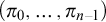
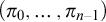
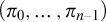
1. Ordinal height iff given a tuple $(\pi _0, \ldots , \pi _{n-1})$
in the domain of f the height of
$f(\pi _0, \ldots , \pi _{n-1})$
is smaller or equal than the maximum of heights of the
$\pi _i$
s. -
2. Local height iff given a tuple $(\pi _0, \ldots , \pi _{n-1})$
in the domain of f the local height of
$f(\pi _0, \ldots , \pi _{n-1})$
is smaller or equal than the maximum of local heights of the
$\pi _i$
s. -
3. Size of cuts iff given a tuple $(\pi _0, \ldots , \pi _{n-1})$
in the domain of f such that each
$\pi _i$
has all its cuts of size smaller than
$ n$
, then
$f(\pi _0, \ldots , \pi _{n-1})$
has also all its cuts of size smaller than n.Footnote
6
In particular, if the
$\pi _i$
s are cut-free (i.e., the sizes of cuts are
$< 0$
) then
$f(\pi _0, \ldots , \pi _{n-1})$
is also cut-free. -
4. Freeness of cuts in the main local fragment iff given a tuple $(\pi _0, \ldots , \pi _{n-1})$
in the domain of f such that each
$\pi _i$
without cuts in its main local fragment, then
$f(\pi _0, \ldots , \pi _{n-1})$
does not have cuts in its main local fragment either. -
5. Locality of cuts iff given a tuple $(\pi _0, \ldots , \pi _{n-1})$
in the domain of f such that each
$\pi _i$
has local cuts only, then
$f(\pi _0, \ldots , \pi _{n-1})$
also has local cuts only. -
6. Locality of cuts in witnesses iff given a tuple $(\pi _0, \ldots , \pi _{n-1})$
in the domain of f such that each
$\pi _i$
has witnesses with local cuts only, then the witnesses of
$f(\pi _0, \ldots , \pi _{n-1})$
have local cuts only.











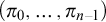


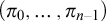


If f preserves local height, sizes of cuts, freeness of cuts in the main local fragment, and locality of cuts we say that it is weakly preserving. If f preserves all the properties described above we will say that it is strongly preserving.
The following observation is straightforward from the definition.
Proposition 4.5. Change of annotations, i.e., the function
$\pi \mapsto \pi ^s$
 , is weakly preserving.
Proof. That it preserves sizes of cuts is trivial from the definition. Preservation of local height is due to the transformation converts one rule application in one rule application and modal rules into modal rules, this last property makes the main local fragment to be at the same position (as the main local fragment is determined by where modal rules occur). Freeness of cuts in the main local fragment and locality of cuts are preserved since the transformation introduces cuts just from cuts that where already there and, as stated before, it keeps the main local fragment at the same position.
5 Auxiliary functions
In this section we just state one big lemma with all the auxiliary functions that we will need (apart from change of annotations, see Section 4). All the auxiliary functions can be defined straightforwardly by recursion on the local height and all its properties can be shown straightforwardly by induction on the local height. If the reader wants to see explicit definitions they are encouraged to look at Appendices A–C.
Lemma 5.1. Let p be a propositional variable,
$\chi , \chi _0, \chi _1$
 be formulas, and
$\Gamma $
be formulas, and
$\Gamma $
 ,
$\Gamma '$
,
$\Gamma '$
 ,
$\Delta $
,
$\Delta $
 ,
$\Delta '$
,
$\Delta '$
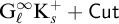
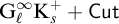
 be multisets of formulas. There are strongly preserving functions
$\textsf {wk}_{\Gamma ';\Delta '}$
be multisets of formulas. There are strongly preserving functions
$\textsf {wk}_{\Gamma ';\Delta '}$
 ,
$\textsf {lctr}_p$
,
$\textsf {lctr}_p$
 ,
$\textsf {rctr}_p$
,
$\textsf {rctr}_p$
 ,
$\textsf {rctr}_{ \Box ^+ \chi }$
,
$\textsf {rctr}_{ \Box ^+ \chi }$
 ,
$\textsf {inv}_\bot $
,
$\textsf {inv}_\bot $
 ,
$\textsf {linv}^0_{\chi _0 \to \chi _1}$
,
$\textsf {linv}^0_{\chi _0 \to \chi _1}$
 ,
$\textsf {linv}^1_{\chi _0 \to \chi _1}$
,
$\textsf {linv}^1_{\chi _0 \to \chi _1}$
 ,
$\textsf {rinv}_{\chi _0 \to \chi _1}$
,
$\textsf {rinv}_{\chi _0 \to \chi _1}$
 from proofs in
$\text {G}^\infty _\ell \text {K}^+_s + \textsf {Cut}$
from proofs in
$\text {G}^\infty _\ell \text {K}^+_s + \textsf {Cut}$
 to proofs in
$\text {G}^\infty _\ell \text {K}^+_s + \textsf {Cut}$
to proofs in
$\text {G}^\infty _\ell \text {K}^+_s + \textsf {Cut}$
 such that:
-
1. $\pi \vdash \Gamma \Rightarrow _s \Delta $
implies
$\textsf {wk}_{\Gamma ';\Delta '}(\pi ) \vdash \Gamma , \Gamma ' \Rightarrow _s \Delta , \Delta '$
. -
2. $\pi \vdash \Gamma , p, p \Rightarrow _s \Delta $
implies
$\textsf {lctr}_{p}(\pi ) \vdash \Gamma , p \Rightarrow _s \Delta $
. -
3. $\pi \vdash \Gamma \Rightarrow _s \Delta , p, p$
implies
$\textsf {rctr}_{p}(\pi ) \vdash \Gamma \Rightarrow _s \Delta , p$
. -
4. $\pi \vdash \Gamma \Rightarrow _s \Delta , \Box ^+ \chi , \Box ^+ \chi $
implies
$\textsf {rctr}_{ \Box ^+ \chi }(\pi ) \vdash \Gamma \Rightarrow _s \Delta , \Box ^+ \chi $
. -
5. $\pi \vdash \Gamma \Rightarrow _s \Delta , \bot $
implies
$\textsf {ctr}_{\bot }(\pi ) \vdash \Gamma \Rightarrow _s \Delta $
. -
6. $\pi \vdash \Gamma , \chi _0 \to \chi _1 \Rightarrow _s \Delta $
implies
$\textsf {linv}^0_{\chi _0 \to \chi _1}(\pi ) \vdash \Gamma \Rightarrow _s \Delta , \chi _0$
. -
7. $\pi \vdash \Gamma , \chi _0 \to \chi _1 \Rightarrow _s \Delta $
implies
$\textsf {linv}^1_{\chi _0 \to \chi _1}(\pi ) \vdash \Gamma , \chi _1 \Rightarrow _s \Delta $
. -
8. $\pi \vdash \Gamma \Rightarrow _s \Delta , \chi _0 \to \chi _1$
implies
$\textsf {rinv}_{\chi _0 \to \chi _1}(\pi ) \vdash \Gamma , \chi _0 \Rightarrow _s \Delta , \chi _1$
.
















6 Pushing cuts
The first task to prove cut elimination will be to show that it is possible to push cuts to upper parts of the proof. We will do this in two stages: first pushing them outside the main local fragment recursively and then pushing them outside the main global fragment to witnesses corecursively.
6.1 Pushing a cuts outside main local fragment
Definition 6.1. Let
$\pi \vdash \Gamma \Rightarrow _s \Delta , \chi $
 and
$\tau \vdash \chi , \Gamma \Rightarrow _s \Delta $
and
$\tau \vdash \chi , \Gamma \Rightarrow _s \Delta $
 . We define
$\textsf {cut}^\chi (\pi , \tau )$
. We define
$\textsf {cut}^\chi (\pi , \tau )$
 to be the result of applying the rule
$\textsf {Cut}$
to be the result of applying the rule
$\textsf {Cut}$
 to
$\pi $
to
$\pi $
 and
$\tau $
and
$\tau $
 .
.
Notice that it preserves the locality of cuts.
We start by pushing only one cut that we assume to be a top-most cut in the main local fragment, i.e., there are no cuts above it belonging to the main local fragment.
Lemma 6.2. There is a binary function
$\textsf {push-top}_\chi $
 whose domain are the pairs
$(\pi , \tau )$
whose domain are the pairs
$(\pi , \tau )$
 of proofs such that
-
1. $\pi $
and
$\tau $
are proofs in
$\text {G}^\infty _\ell \text {K}^+_s + \textsf {Cut}$
with no cuts in their main local fragment, and -
2. we have that $\pi \vdash \Gamma \Rightarrow _s \Delta , \chi $
and
$\tau \vdash \chi , \Gamma \Rightarrow _s \Delta $
for some
$\Gamma , \Delta $
,


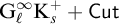


and that returns a proof in
$\textsf {G}^\infty _\ell \text {K}^+_s + \textsf {Cut}$
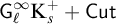 with the following properties:
-
1. $\textsf {push-top}_\chi (\pi , \tau ) \vdash \Gamma \Rightarrow _s \Delta $
and has no cuts in its main local fragment, -
2. if the size of cuts in $\pi $
, the size of cuts in
$\tau ,$
and the size of the formula
$\chi $
are strictly smaller than n, then the size of cuts in
$\textsf {push-top}_\chi (\pi , \tau )$
is strictly smaller than n, and -
3. $\textsf {push-top}$
preserves the locality of cuts in witnesses.


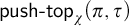

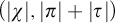
Proof. We proceed by induction on the pair
$(|\chi |, |\pi | + |\tau |)$
 (i.e., the size of
$\chi $
(i.e., the size of
$\chi $
 and the sum of the local heights of
$|\pi |$
and the sum of the local heights of
$|\pi |$
 and
$|\tau |$
and
$|\tau |$
 ) ordered lexicographically. For all cut reductions (see Appendix A), we are going to argue that conditions 1–3 are fulfilled after each of the reductions, and we have to say what each
$\textsf {cut}_i$
) ordered lexicographically. For all cut reductions (see Appendix A), we are going to argue that conditions 1–3 are fulfilled after each of the reductions, and we have to say what each
$\textsf {cut}_i$
 is when it occurs in a cut reduction.
The case where the label is the cut formula and the axiomatic cases are straightforward using the properties of the auxiliary functions.
In the principal reduction case,
$\textsf {cut}_1$
 and
$\textsf {cut}_2$
and
$\textsf {cut}_2$
 are just applications of the induction hypothesis (I.H.) using that the size of the cut formula is strictly smaller. No cut will be in the main local fragment and the condition on the size will be fulfilled since we use the I.H. with smaller cut formulas. If the original proof has witnesses with local cuts only, then so does the proof after the cut reduction just by using the I.H. In this argument, we have to use that the auxiliary functions used are strongly preserving.
For the commutative implication cases, each
$\textsf {cut}_i$
 will just be an application of the I.H. using that the sum of local heights is smaller with the same cut formula
$\chi $
will just be an application of the I.H. using that the sum of local heights is smaller with the same cut formula
$\chi $
 . That the conditions are fulfilled can be seen by using that the auxiliary functions used are strongly preserving and employing the I.H. in a similar manner to previous case (although for the bound in the sizes of cuts we now use that the I.H. is used with
$\chi $
. That the conditions are fulfilled can be seen by using that the auxiliary functions used are strongly preserving and employing the I.H. in a similar manner to previous case (although for the bound in the sizes of cuts we now use that the I.H. is used with
$\chi $
 , and not with a smaller cut formula).
We turn to the modal cases. If the cut formula is in the weakening part of a modal rule, all the desired properties are easily fulfilled. So we turn to the commutative cases. In these,
$\textsf {cut}_i$
 will always be a proper application of the cut rule. We note that still the main local fragment will have no application of cut since all the
$\text {cut}_i$
will always be a proper application of the cut rule. We note that still the main local fragment will have no application of cut since all the
$\text {cut}_i$
 appear outside the main local fragment. The condition on the sizes of cuts is easily fulfilled since the cut formulas of the
$\textsf {cut}_i$
appear outside the main local fragment. The condition on the sizes of cuts is easily fulfilled since the cut formulas of the
$\textsf {cut}_i$
 are smaller or equal than the original cut formula (the cut formula will be of shape
$ \Box \chi _0$
are smaller or equal than the original cut formula (the cut formula will be of shape
$ \Box \chi _0$
 or
$ \Box ^+ \chi _0$
or
$ \Box ^+ \chi _0$
 and the
$\text {cut}_i$
and the
$\text {cut}_i$
 ’s will have either the cut formula or
$\chi _0$
’s will have either the cut formula or
$\chi _0$
 only). We also note that all the auxiliary functions used are at least weakly preserving, so using them will not break this property.
Lastly we argue for the locality of cuts in witnesses. We note one thing: when we apply an auxiliary function to a subproof of the main global fragment of the original proof, we want to use the preservation of locality of cuts in witnesses, while if we apply an auxiliary function to a witness, we want to use the preservation of locality of cuts (because the witness local cuts only while the subproof will have the property that its witnesses have local cuts only).Footnote
7
Strongly preserving auxiliary functions preserves both, but change of annotations only preserves the locality of cuts. However, change of annotations is only applied to witnesses. Also, the
$\textsf {cut}_i$
 ’s we add at witnesses are always in the main local fragment (since we add them at the bottom and we do not add any modal rule at witnesses).
Let us explicitly discuss what occurs at
$ \Box $
 -
$ \Box ^+_f$
-
$ \Box ^+_f$
 and
$ \Box ^+_u$
and
$ \Box ^+_u$
 -
$ \Box ^+_f$
-
$ \Box ^+_f$
 reductions, since these cases are a little harder. In these cases some witnesses become subproofs after the cut reduction,
$\pi _0$
reductions, since these cases are a little harder. In these cases some witnesses become subproofs after the cut reduction,
$\pi _0$
 in the first reduction and both
$\pi _0$
in the first reduction and both
$\pi _0$
 and
$\pi _1$
and
$\pi _1$
 in the second. This is non-problematic for our reasoning since we know that after applying all the auxiliary functions to those witnesses they have local cuts only, and then all their witness have no cuts so in particular all the witnesses have local cuts only. In other words, we are adding the cuts in the main local fragment of the witnesses to the main global fragment of the proof after the cut reduction, thus enlarging the number of cuts in the main global fragment. This is non-problematic because the cuts added in this way are outside the main local fragment, which is what we want to have cut-free in this lemma.
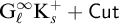
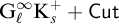
Lemma 6.3. There is a function
$\textsf {push-local}$
 from proofs in
$\text {G}^\infty _\ell \text {K}^+_s + \textsf {Cut}$
from proofs in
$\text {G}^\infty _\ell \text {K}^+_s + \textsf {Cut}$
 to proofs in
$\text {G}^\infty _\ell \text {K}^+_s + \textsf {Cut}$
to proofs in
$\text {G}^\infty _\ell \text {K}^+_s + \textsf {Cut}$
 such that:
-
1. for any $\pi \vdash \Gamma \Rightarrow _s \Delta $
proof in
$\text {G}^\infty _\ell \text {K}^+_s + \textsf {Cut}$
we have that
$\textsf {push-local}(\pi ) \vdash \Gamma \Rightarrow _s \Delta $
with no cuts in its main local fragment, -
2. $\textsf {push-local}$
preserves sizes of cuts, and -
3. $\textsf {push-local}$
preserves the locality of cuts in witnesses.



Proof. The proof is a simple induction on the number of cuts in the main local fragment of
$\pi $
 , using push-top.
6.2 Pushing cuts outside main global fragment
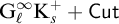
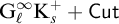
Lemma 6.4. There is a function
$\textsf {push}$
 from proofs in
$\text {G}^\infty _\ell \text {K}^+_s + \textsf {Cut}$
from proofs in
$\text {G}^\infty _\ell \text {K}^+_s + \textsf {Cut}$
 to proofs in
$\text {G}^\infty _\ell \text {K}^+_s + \textsf {wCut}$
to proofs in
$\text {G}^\infty _\ell \text {K}^+_s + \textsf {wCut}$
 (so without cuts in its main global fragment) such that:
-
1. for any $\pi \vdash \Gamma \Rightarrow _s \Delta $
proof in
$\text {G}^\infty _\ell \text {K}^+_s + \textsf {Cut}$
, we have
$\textsf {push}(\pi ) \vdash \Gamma \Rightarrow _s \Delta $
, -
2. $\textsf {push}$
preserves sizes of cuts, and -
3. $\textsf {push}$
preserves the locality of cuts in witnesses.




Proof. To obtain
$\textsf {push}$
 it suffices to apply
$\textsf {push-local}$
it suffices to apply
$\textsf {push-local}$
 corecursively through the main global fragment. By the first condition of
$\textsf {push-local}$
corecursively through the main global fragment. By the first condition of
$\textsf {push-local}$
 it is clear that the resulting proof will have no cuts in its main global fragment since all local fragments constituting the new proof are cut-free.
If we have a bound n on the size of cuts, by the conditions of
$\textsf {push-local}$
 , we have that each of the local fragments in the new proof will have the same bound for cuts. But note that if each local fragment of a proof has all the cut-sizes bounded by n, the all cut-sizes of the proof are bounded by n.
For the condition on witnesses we have the same, by
$\textsf {push-local}$
 we know that if we start with a proof whose witnesses have local-cuts only then each local fragment in the resulting proof after the corecursion will have witnesses with local-cuts only. But a proof with such local fragments will be a proof whose witnesses have local-cuts only, as desired.
7 Cut admissibility
Our strategy to show cut elimination will require first to show that the rule Cut is admissible. Notice that for finitary proofs it is straightforward to prove cut elimination from cut admissibility by an induction on the height of the proof. Our cut elimination will follow a similar approach, but it is more involved since our notion of height is not so straightforward (we do not decrease height by going to a child node but only by going to a witness).
With cut admissibility in
$\text {G}^\infty _\ell \text {K}^+_s$
 we mean that for any
$\Gamma , \Delta , \chi $
we mean that for any
$\Gamma , \Delta , \chi $
 if
$\text {G}^\infty _\ell \text {K}^+_s \vdash \Gamma \Rightarrow _s \Delta , \chi $
if
$\text {G}^\infty _\ell \text {K}^+_s \vdash \Gamma \Rightarrow _s \Delta , \chi $
 and
$\text {G}^\infty _\ell \text {K}^+_s \vdash \chi , \Gamma \Rightarrow _s \Delta $
and
$\text {G}^\infty _\ell \text {K}^+_s \vdash \chi , \Gamma \Rightarrow _s \Delta $
 then
$\text {G}^\infty _\ell \text {K}^+_s \vdash \Gamma \Rightarrow _s \Delta $
then
$\text {G}^\infty _\ell \text {K}^+_s \vdash \Gamma \Rightarrow _s \Delta $
 .
.
If we talk about cut admissibility for
$\chi $
 we mean the statement that for any
$\Gamma , \Delta $
we mean the statement that for any
$\Gamma , \Delta $
 if
$\text {G}^\infty _\ell \text {K}^+_s \vdash \Gamma \Rightarrow _s \Delta , \chi $
if
$\text {G}^\infty _\ell \text {K}^+_s \vdash \Gamma \Rightarrow _s \Delta , \chi $
 and
$\text {G}^\infty _\ell \text {K}^+_s \vdash \chi , \Gamma \Rightarrow _s \Delta $
and
$\text {G}^\infty _\ell \text {K}^+_s \vdash \chi , \Gamma \Rightarrow _s \Delta $
 then
$\text {G}^\infty _\ell \text {K}^+_s \vdash \Gamma \Rightarrow _s \Delta $
then
$\text {G}^\infty _\ell \text {K}^+_s \vdash \Gamma \Rightarrow _s \Delta $
 , and if we talk about cut admissibility for
$\chi $
, and if we talk about cut admissibility for
$\chi $
 with cuts of height smaller than
$\alpha $
with cuts of height smaller than
$\alpha $
 we mean the statement that for any
$\Gamma , \Delta , \pi , \tau $
we mean the statement that for any
$\Gamma , \Delta , \pi , \tau $
 if
$\pi \vdash \Gamma \Rightarrow _s \Delta , \chi $
if
$\pi \vdash \Gamma \Rightarrow _s \Delta , \chi $
 ,
$\tau \vdash \chi , \Gamma \Rightarrow _s \Delta $
,
$\tau \vdash \chi , \Gamma \Rightarrow _s \Delta $
 in
$\text {G}^\infty _\ell \text {K}^+_s$
in
$\text {G}^\infty _\ell \text {K}^+_s$
 and
$\|\pi \| \oplus \|\tau \| < \alpha $
and
$\|\pi \| \oplus \|\tau \| < \alpha $
 (where
$\oplus $
(where
$\oplus $
 is the Hessenberg sum of ordinals) then
$\text {G}^\infty _\ell \text {K}^+_s \vdash \Gamma \Rightarrow _s \Delta $
is the Hessenberg sum of ordinals) then
$\text {G}^\infty _\ell \text {K}^+_s \vdash \Gamma \Rightarrow _s \Delta $
 .
.
7.1 Atomic
Lemma 7.1. If
$\text {G}^\infty _\ell \text {K}^+_s \vdash \Gamma \Rightarrow _{ s }\Delta , p$
 and
$\text {G}^\infty _\ell \text {K}^+_s \vdash p, \Gamma \Rightarrow _{ s }\Delta $
and
$\text {G}^\infty _\ell \text {K}^+_s \vdash p, \Gamma \Rightarrow _{ s }\Delta $
 , then
$\text {G}^\infty _\ell \text {K}^+_s \vdash \Gamma \Rightarrow _{ s }\Delta $
, then
$\text {G}^\infty _\ell \text {K}^+_s \vdash \Gamma \Rightarrow _{ s }\Delta $
 .
.
Proof. We prove this by induction on
$|\pi | + |\tau |$
 (i.e., the sum of local heights). The possible cut reductions are the axiomatic cases, the implication commutative cases, and the weakening case in the modal cases. We note that in all these cases were a cut rule appears in the reduction it can be solved using the I.H. (i.e., the local height is smaller).
7.2 Box formulas
Lemma 7.2. If we have cut admissibility for cut formula
$\chi $
 and
$\text {G}^\infty _\ell \text {K}^+_s\vdash \Gamma \Rightarrow _{ s }\Delta , \Box \chi $
and
$\text {G}^\infty _\ell \text {K}^+_s\vdash \Gamma \Rightarrow _{ s }\Delta , \Box \chi $
 and
$\text {G}^\infty _\ell \text {K}^+_s\vdash \Box \chi , \Gamma \Rightarrow _{ s }\Delta $
and
$\text {G}^\infty _\ell \text {K}^+_s\vdash \Box \chi , \Gamma \Rightarrow _{ s }\Delta $
 , then
$\text {G}^\infty _\ell \text {K}^+_s\vdash \Gamma \Rightarrow _{ s }\Delta $
, then
$\text {G}^\infty _\ell \text {K}^+_s\vdash \Gamma \Rightarrow _{ s }\Delta $
 .
.
Proof. We prove this by induction on
$|\pi | + |\tau |$
 (i.e., the sum of local heights). The possible cut reductions are the axiomatic cases where the axiomatic character is in a side formula, the implication commutative cases, the weakening case, and
$ \Box $
(i.e., the sum of local heights). The possible cut reductions are the axiomatic cases where the axiomatic character is in a side formula, the implication commutative cases, the weakening case, and
$ \Box $
 -
$ \Box $
-
$ \Box $
 ,
$ \Box $
,
$ \Box $
 -
$ \Box ^+_u$
-
$ \Box ^+_u$
 , and
$ \Box $
, and
$ \Box $
 -
$ \Box ^+_f$
-
$ \Box ^+_f$
 in the modal cases. In the axiomatic and weakening cases, no cut remains after the reduction. In the implication commutative cases, we can use the I.H. when a
$\textsf {cut}_i$
in the modal cases. In the axiomatic and weakening cases, no cut remains after the reduction. In the implication commutative cases, we can use the I.H. when a
$\textsf {cut}_i$
 appears after the reduction since the sum of local heights is smaller. Finally, for the
$ \Box $
appears after the reduction since the sum of local heights is smaller. Finally, for the
$ \Box $
 -
$ \Box $
-
$ \Box $
 ,
$ \Box $
,
$ \Box $
 -
$ \Box ^+_u$
-
$ \Box ^+_u$
 , and
$ \Box $
, and
$ \Box $
 -
$ \Box ^+_f$
-
$ \Box ^+_f$
 cases it suffices to use the assumption of cut admissibility for
$\chi $
cases it suffices to use the assumption of cut admissibility for
$\chi $
 .
.
7.3 Master formula
This case provides the main difficulty for cut admissibility. The idea is to show the admissibility in two steps: first we push the cut with cut formula
$ \Box ^+ \chi $
 outside the main fragment, where we can use the reduction in the height to get rid of it. In this process we leave (possibly infinitely many) cuts in the main fragment with cut formula
$\chi $
outside the main fragment, where we can use the reduction in the height to get rid of it. In this process we leave (possibly infinitely many) cuts in the main fragment with cut formula
$\chi $
 . The cut admissibility proof continues by pushing these cuts outside the main global fragment to the witnesses, each witness having finitely many cuts with cut formula
$\chi $
. The cut admissibility proof continues by pushing these cuts outside the main global fragment to the witnesses, each witness having finitely many cuts with cut formula
$\chi $
 . Then we can use the admissibility of cut with cut formula
$\chi $
. Then we can use the admissibility of cut with cut formula
$\chi $
 to eliminate all cuts from witnesses, obtaining a cut-free proof as desired.
Definition 7.3. We say that a proof is
$( \Box ^+ \chi , \alpha )$
 -unblocked iff all its cuts have cut formula
$\chi $
-unblocked iff all its cuts have cut formula
$\chi $
 or
$ \Box ^+ \chi $
or
$ \Box ^+ \chi $
 and in case the cut formula is
$ \Box ^+ \chi $
and in case the cut formula is
$ \Box ^+ \chi $
 then the height of the cut is
$\leq \alpha $
then the height of the cut is
$\leq \alpha $
 and the subproofs at the premises are proofs in
$\text {G}^\infty _\ell \text {K}^+_s$
and the subproofs at the premises are proofs in
$\text {G}^\infty _\ell \text {K}^+_s$
 (i.e., they have not cuts).
Lemma 7.4 (Main lemma).
Assume we have cut admissibility for
$\chi $
 (with cuts of any height) and also for
$ \Box ^+ \chi $
(with cuts of any height) and also for
$ \Box ^+ \chi $
 with cuts of height smaller than
$\alpha $
with cuts of height smaller than
$\alpha $
 . If
$\pi \vdash \Gamma \Rightarrow _{ s }\Delta , \Box ^+ \chi $
. If
$\pi \vdash \Gamma \Rightarrow _{ s }\Delta , \Box ^+ \chi $
 and
$\tau \vdash \Box ^+ \chi , \Gamma \Rightarrow _{ s }\Delta $
and
$\tau \vdash \Box ^+ \chi , \Gamma \Rightarrow _{ s }\Delta $
 in
$\text {G}^\infty _\ell \text {K}^+_s$
in
$\text {G}^\infty _\ell \text {K}^+_s$
 such that
$\|\pi \| \oplus \|\tau \| \leq \alpha $
such that
$\|\pi \| \oplus \|\tau \| \leq \alpha $
 , then there is a
$\rho \vdash \Gamma \Rightarrow _{ s }\Delta $
, then there is a
$\rho \vdash \Gamma \Rightarrow _{ s }\Delta $
 in
$\text {G}^\infty _\ell \text {K}^+_s + \textsf {mCut}$
in
$\text {G}^\infty _\ell \text {K}^+_s + \textsf {mCut}$
 that is
$( \Box ^+ \chi , \alpha )$
that is
$( \Box ^+ \chi , \alpha )$
 -unblocked and has no cuts in its main local fragment.
Proof. By induction on the sum of the local height of
$\pi $
 and
$\tau $
and
$\tau $
 . The possible cut reductions are the axiomatic cases where the label is the cut formula, the axiomatic character is in a side formula, the commutative implication cases, and the modal cases of weakening or
$ \Box ^+_u$
. The possible cut reductions are the axiomatic cases where the label is the cut formula, the axiomatic character is in a side formula, the commutative implication cases, and the modal cases of weakening or
$ \Box ^+_u$
 -
$ \Box $
-
$ \Box $
 ,
$ \Box ^+_u$
,
$ \Box ^+_u$
 -
$ \Box ^+_u$
-
$ \Box ^+_u$
 , and
$ \Box ^+_u$
, and
$ \Box ^+_u$
 -
$ \Box ^+_f$
-
$ \Box ^+_f$
 . In the reduction rules where the label is the cut formula, axiomatic and modal weakening no cuts remain, so clearly the desired result holds.
In the commutative implication reductions it suffices to substitute each
$\textsf {cut}_i$
 with an application of the I.H.
Finally, we treat the
$ \Box ^+_u$
 -
$ \Box $
-
$ \Box $
 ,
$ \Box ^+_u$
,
$ \Box ^+_u$
 -
$ \Box ^+_u$
-
$ \Box ^+_u$
 , and
$ \Box ^+_u$
, and
$ \Box ^+_u$
 -
$ \Box ^+_f$
-
$ \Box ^+_f$
 reductions. By inspection we see that all the main local fragments have no cuts. Finally, let us see how to interpret
$\textsf {cut}_i$
reductions. By inspection we see that all the main local fragments have no cuts. Finally, let us see how to interpret
$\textsf {cut}_i$
 in each case to get a proof with main cuts only and the unblocked condition.
$ \Box ^+_u$
 -
$ \Box $
-
$ \Box $
 . In this case
$\textsf {cut}_1$
. In this case
$\textsf {cut}_1$
 is admissibility of cuts with cut formula
$ \Box ^+ \chi $
is admissibility of cuts with cut formula
$ \Box ^+ \chi $
 and height smaller than
$\alpha $
and height smaller than
$\alpha $
 and
$\textsf {cut}_2$
and
$\textsf {cut}_2$
 is admissibility of cuts with cut formula
$\chi $
is admissibility of cuts with cut formula
$\chi $
 . We are allowed to use the first admissibility for the
$\textsf {cut}_1$
. We are allowed to use the first admissibility for the
$\textsf {cut}_1$
 since
since

thanks to
$\|\pi _1\| < \|\pi \|, \|\tau _0\| < \|\tau \|$
 being witnesses. This gives a proof without cuts so it has main cuts only and it is unblocked, as desired.
$ \Box ^+_u$
 -
$ \Box _u$
-
$ \Box _u$
 . In this case
$\textsf {cut}_1, \textsf {cut}_3$
. In this case
$\textsf {cut}_1, \textsf {cut}_3$
 are by admissibility of cuts with cut formula
$ \Box ^+ \chi $
are by admissibility of cuts with cut formula
$ \Box ^+ \chi $
 and height smaller than
$\alpha $
and height smaller than
$\alpha $
 and
$\textsf {cut}_2, \textsf {cut}_4$
and
$\textsf {cut}_2, \textsf {cut}_4$
 is admissibility of cuts with cut formula
$\chi $
is admissibility of cuts with cut formula
$\chi $
 . We are allowed to use the first admissibility for
$\textsf {cut}_1$
. We are allowed to use the first admissibility for
$\textsf {cut}_1$
 and
$\textsf {cut}_3$
and
$\textsf {cut}_3$
 since
since


thanks to
$\|\pi _1\| < \|\pi \|, \|\tau _0\|, \|\tau _1\| < \|\tau \|$
 being witnesses. This gives a proof without cuts so it has main cuts only and it is unblocked, as desired.
$ \Box ^+_u$
 -
$ \Box _f$
-
$ \Box _f$
 . In this case
$\textsf {cut}_1$
. In this case
$\textsf {cut}_1$
 is by admissibility of cuts with cut formula
$ \Box ^+ \chi $
is by admissibility of cuts with cut formula
$ \Box ^+ \chi $
 and height smaller than
$\alpha $
and height smaller than
$\alpha $
 and
$\textsf {cut}_2$
and
$\textsf {cut}_2$
 is by admissibility of cuts with cut formula
$\chi $
is by admissibility of cuts with cut formula
$\chi $
 and
$\textsf {cut}_3, \textsf {cut}_4$
and
$\textsf {cut}_3, \textsf {cut}_4$
 are standard cuts. We are allowed to use the first admissibility for
$\textsf {cut}_1$
are standard cuts. We are allowed to use the first admissibility for
$\textsf {cut}_1$
 since
since

thanks to
$\|\pi _1\| < \|\pi \|, \|\tau _0\| < \|\tau \|$
 being witnesses. There are two cuts after the reduction, one with cut formula
$\chi $
being witnesses. There are two cuts after the reduction, one with cut formula
$\chi $
 (
$\textsf {cut}_4$
(
$\textsf {cut}_4$
 ) and other with cut formula
$ \Box ^+ \chi $
) and other with cut formula
$ \Box ^+ \chi $
 (
$\textsf {cut}_3$
(
$\textsf {cut}_3$
 ).
$\textsf {cut}_3$
).
$\textsf {cut}_3$
 has the premises with no cuts, and its height is

thanks to
$\|\pi _1\| < \|\pi \|$
 being a witness and
$\|\tau _1\| \leq \|\tau \|$
being a witness and
$\|\tau _1\| \leq \|\tau \|$
 being a subproof. This means that the resulting proof has only main cuts and it is
$( \Box ^+ \chi , \alpha )$
being a subproof. This means that the resulting proof has only main cuts and it is
$( \Box ^+ \chi , \alpha )$
 -unblocked.
Lemma 7.5. Assume we have cut admissibility for
$\chi $
 (with cuts of any height) and also for
$ \Box ^+ \chi $
(with cuts of any height) and also for
$ \Box ^+ \chi $
 with cuts of height smaller than
$\alpha $
with cuts of height smaller than
$\alpha $
 . Let
$\pi \vdash \Gamma \Rightarrow _s \Delta $
. Let
$\pi \vdash \Gamma \Rightarrow _s \Delta $
 in
$\text {G}^\infty _\ell \text {K}^+_s + \textsf {mCut}$
in
$\text {G}^\infty _\ell \text {K}^+_s + \textsf {mCut}$
 and assume it is
$( \Box ^+ \chi , \alpha )$
and assume it is
$( \Box ^+ \chi , \alpha )$
 -unblocked. Then, there is a
$\rho \vdash \Gamma \Rightarrow _s \Delta $
-unblocked. Then, there is a
$\rho \vdash \Gamma \Rightarrow _s \Delta $
 in
$\text {G}^\infty _\ell \text {K}^+_s + \textsf {mCut}$
in
$\text {G}^\infty _\ell \text {K}^+_s + \textsf {mCut}$
 that is
$( \Box ^+ \chi , \alpha )$
that is
$( \Box ^+ \chi , \alpha )$
 -unblocked and has no cuts with cut formula
$ \Box ^+ \chi $
-unblocked and has no cuts with cut formula
$ \Box ^+ \chi $
 in its main local fragment.
Proof. This is a simple induction using Lemma 7.4 in the number of cuts with cut formula
$ \Box ^+ \chi $
 in its main local fragment. The assumption that
$\pi $
in its main local fragment. The assumption that
$\pi $
 is
$( \Box ^+ \chi , \alpha )$
is
$( \Box ^+ \chi , \alpha )$
 -unblocked is of fundamental importance since it allows use to use Lemma 7.4 to any cut at the main local fragment with cut formula
$ \Box ^+ \chi $
-unblocked is of fundamental importance since it allows use to use Lemma 7.4 to any cut at the main local fragment with cut formula
$ \Box ^+ \chi $
 .
.
Lemma 7.6. Assume we have cut admissibility for
$\chi $
 (with cuts of any height) and also for
$ \Box ^+ \chi $
(with cuts of any height) and also for
$ \Box ^+ \chi $
 with cuts of height smaller than
$\alpha $
with cuts of height smaller than
$\alpha $
 . Then
$\text {G}^\infty _\ell \text {K}^+_s \vdash \Gamma \Rightarrow _{ s }\Delta , \Box ^+ \chi $
. Then
$\text {G}^\infty _\ell \text {K}^+_s \vdash \Gamma \Rightarrow _{ s }\Delta , \Box ^+ \chi $
 and
$\text {G}^\infty _\ell \text {K}^+_s \vdash \Box ^+ \chi , \Gamma \Rightarrow _{ s }\Delta $
and
$\text {G}^\infty _\ell \text {K}^+_s \vdash \Box ^+ \chi , \Gamma \Rightarrow _{ s }\Delta $
 , implies
$\text {G}^\infty _\ell \text {K}^+_s + \textsf {mCut} \vdash \Gamma \Rightarrow _{ s }\Delta $
, implies
$\text {G}^\infty _\ell \text {K}^+_s + \textsf {mCut} \vdash \Gamma \Rightarrow _{ s }\Delta $
 such that all the cuts have
$\chi $
such that all the cuts have
$\chi $
 as cut formula.
Proof. This is just a corecursion for a local-progress system (i.e., at each corecursive step we provide a whole local fragment, not just a node) using Lemma 7.5.
Lemma 7.7. Assume we have cut admissibility for cuts of size smaller than n and let
$| \Box ^+ \chi | = n$
 . Then
$\text {G}^\infty _\ell \text {K}^+_s \vdash \Gamma \Rightarrow _{ s }\Delta , \Box ^+ \chi $
. Then
$\text {G}^\infty _\ell \text {K}^+_s \vdash \Gamma \Rightarrow _{ s }\Delta , \Box ^+ \chi $
 and
$\text {G}^\infty _\ell \text {K}^+_s \vdash \Box ^+ \chi , \Gamma \Rightarrow _{ s }\Delta $
and
$\text {G}^\infty _\ell \text {K}^+_s \vdash \Box ^+ \chi , \Gamma \Rightarrow _{ s }\Delta $
 implies
$\text {G}^\infty _\ell \text {K}^+_s \vdash \Gamma \Rightarrow _{ s }\Delta $
implies
$\text {G}^\infty _\ell \text {K}^+_s \vdash \Gamma \Rightarrow _{ s }\Delta $
 .
.
Proof. Let
$\pi \vdash \Gamma \Rightarrow _s \Delta , \Box ^+ \chi $
 and
$\tau \vdash \Box ^+ \chi , \Gamma \Rightarrow _s \Delta $
and
$\tau \vdash \Box ^+ \chi , \Gamma \Rightarrow _s \Delta $
 . We proceed by induction on
$\|\pi \| \oplus \|\tau \|$
. We proceed by induction on
$\|\pi \| \oplus \|\tau \|$
 , so assume we have cut admissibility for
$ \Box ^+\chi $
, so assume we have cut admissibility for
$ \Box ^+\chi $
 with cuts of height smaller than
$\|\pi \| \oplus \|\tau \|$
with cuts of height smaller than
$\|\pi \| \oplus \|\tau \|$
 . We also have cut admissibility for
$\chi $
. We also have cut admissibility for
$\chi $
 thanks to the assumptions. Then by Lemma 7.6 we can get a proof
$\rho _0$
thanks to the assumptions. Then by Lemma 7.6 we can get a proof
$\rho _0$
 of the same sequent in
$\text {G}^\infty _\ell \text {K}^+_s + \textsf {mCut}$
of the same sequent in
$\text {G}^\infty _\ell \text {K}^+_s + \textsf {mCut}$
 whose only cut formula is
$\chi $
whose only cut formula is
$\chi $
 .
.
Then we can use Lemma 6.4 to obtain a proof
$\rho _1$
 with witness cuts only and all of them of size smaller than n and each occurring at the main local fragment of some witness (so each witness has a finite amount of cuts). By an induction on the number of local cuts in the witness and using the hypothesis of cut admissibility for size
$< n$
with witness cuts only and all of them of size smaller than n and each occurring at the main local fragment of some witness (so each witness has a finite amount of cuts). By an induction on the number of local cuts in the witness and using the hypothesis of cut admissibility for size
$< n$
 we can change each witness to a cut-free witness, obtaining the desired proof.
7.4 General case
Theorem 7.8 (Cut admissibility).
Let
$\text {G}^\infty _\ell \text {K}^+_s \vdash \Gamma \Rightarrow _s \Delta , \chi $
 and
$\text {G}^\infty _\ell \text {K}^+_s \vdash \chi , \Gamma \Rightarrow _s \Delta $
and
$\text {G}^\infty _\ell \text {K}^+_s \vdash \chi , \Gamma \Rightarrow _s \Delta $
 . Then, we have that
$\text {G}^\infty _\ell \text {K}^+_s \vdash \Gamma \Rightarrow _s \Delta $
. Then, we have that
$\text {G}^\infty _\ell \text {K}^+_s \vdash \Gamma \Rightarrow _s \Delta $
 .
.
Proof. This is a simple induction on the size of
$\chi $
 using the lemmas previously proved in this section. In case
$\chi $
using the lemmas previously proved in this section. In case
$\chi $
 is an implication, i.e., of shape
$\chi _0 \to \chi _1$
is an implication, i.e., of shape
$\chi _0 \to \chi _1$
 , first we need to apply the inversion to get formulas of smaller size (and weakening to make the sequents match).
With cut admissibility we can show cut elimination for proofs with finitely many cuts. However, in the non-wellfounded setting it is not straightforward that this gives us cut elimination for any proof, since our proofs may have infinitely many cuts. The purpose of the next section will be to show cut elimination in full generality for
$\text {G}^\infty _\ell \text {K}^+_s$
 using cut admissibility, thus providing an example of how to get cut elimination from admissibility in the non-wellfounded setting. Before finalizing this section we show a corollary which we will use during cut elimination.
Corollary 7.9. Suppose that
$\pi \vdash \Gamma \Rightarrow _s \Delta $
 in
$\text {G}^\infty _\ell \text {K}^+_s + \textsf {Cut}$
in
$\text {G}^\infty _\ell \text {K}^+_s + \textsf {Cut}$
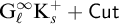 . Assume that either:
-
1. $\pi $
has finitely many instances of cut, or -
2. $\pi $
has local cuts only.


Then
$\text {G}^\infty _\ell \text {K}^+_s \vdash \Gamma \Rightarrow _s \Delta $
 .
.
Proof. In case
$\pi $
 has local cuts only then it must be the case that
$\pi $
has local cuts only then it must be the case that
$\pi $
 has finitely many instances of cut, since the main local fragment is always finite. Then, in both cases we can assume that
$\pi $
has finitely many instances of cut, since the main local fragment is always finite. Then, in both cases we can assume that
$\pi $
 has finitely many instances of cut. The result is then proven by an induction on the number of cuts using Theorem 7.8.
8 Cut elimination
We finish the article by proving the promised result: cut elimination for
$\text {G}^\infty _\ell \text {K}^+_s$
 . Note that by the translations defined in Section 3 between
$\text {G}^\infty _\ell \text {K}^+$
. Note that by the translations defined in Section 3 between
$\text {G}^\infty _\ell \text {K}^+$
 and
$\text {G}^\infty _\ell \text {K}^+_s$
and
$\text {G}^\infty _\ell \text {K}^+_s$
 this cut elimination will prove cut elimination for
$\text {G}^\infty _\ell \text {K}^+$
this cut elimination will prove cut elimination for
$\text {G}^\infty _\ell \text {K}^+$
 . In fact, since in reality the difference between
$\text {G}^\infty _\ell \text {K}^+_s$
. In fact, since in reality the difference between
$\text {G}^\infty _\ell \text {K}^+_s$
 and
$\text {G}^\infty _\ell \text {K}^+$
and
$\text {G}^\infty _\ell \text {K}^+$
 is just how we accommodate the information of proofs, it can be argued that this cut elimination is a cut elimination method for
$\text {G}^\infty _\ell \text {K}^+$
is just how we accommodate the information of proofs, it can be argued that this cut elimination is a cut elimination method for
$\text {G}^\infty _\ell \text {K}^+$
 and
$\text {G}^\infty _\ell \text {K}^+_s$
and
$\text {G}^\infty _\ell \text {K}^+_s$
 just provides a way to define the necessary corecursive functions easier.
Theorem 8.1 (Cut elimination).
If
$\text {G}^\infty _\ell \text {K}^+_s {\kern-1pt}+{\kern-1pt} \textsf {Cut} {\kern-1pt}\vdash{\kern-1pt} \Gamma {\kern-1pt}\Rightarrow _s \Delta $
 , then
$\text {G}^\infty _\ell \text {K}^+_s {\kern-1pt}\vdash{\kern-1pt} \Gamma {\kern-1pt}\Rightarrow _s \Delta $
, then
$\text {G}^\infty _\ell \text {K}^+_s {\kern-1pt}\vdash{\kern-1pt} \Gamma {\kern-1pt}\Rightarrow _s \Delta $
 .
.
Proof. Let
$\pi \vdash \Gamma \Rightarrow _s \Delta $
 in
$\text {G}^\infty _\ell \text {K}^+_s + \textsf {Cut}$
in
$\text {G}^\infty _\ell \text {K}^+_s + \textsf {Cut}$
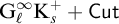 . We proceed by induction on
$\|\pi \|$
. We proceed by induction on
$\|\pi \|$
 . Note that for any witness
$\tau $
. Note that for any witness
$\tau $
 of
$\pi $
of
$\pi $
 we have that
$\|\tau \| < \|\pi \|$
we have that
$\|\tau \| < \|\pi \|$
 . So by induction hypothesis we can get a
$\tau '$
. So by induction hypothesis we can get a
$\tau '$
 proof in
$\text {G}^\infty _\ell \text {K}^+_s$
proof in
$\text {G}^\infty _\ell \text {K}^+_s$
 proving the same sequent as
$\tau $
proving the same sequent as
$\tau $
 . Let
$\pi _1$
. Let
$\pi _1$
 be the result of replacing each of its witnesses
$\tau $
be the result of replacing each of its witnesses
$\tau $
 by
$\tau '$
by
$\tau '$
 , we notice that
$\pi _1$
, we notice that
$\pi _1$
 is a proof in
$\text {G}^\infty _\ell \text {K}^+_s + \textsf {mCut}$
is a proof in
$\text {G}^\infty _\ell \text {K}^+_s + \textsf {mCut}$
 proving the same sequent as
$\pi $
proving the same sequent as
$\pi $
 (changing witnesses do not alter the conclusion, but we may have altered the height of the proof so from now on the I.H. cannot be used anymore).
Let
$\pi _2 := \textsf {push}(\pi _1)$
 , by Lemma 6.4 (using that a proof with main cuts only have witnesses with local cuts only) we have that
$\pi _2$
, by Lemma 6.4 (using that a proof with main cuts only have witnesses with local cuts only) we have that
$\pi _2$
 is proof in
$\text {G}^\infty _\ell \text {K}^+_s + \textsf {wCut}$
is proof in
$\text {G}^\infty _\ell \text {K}^+_s + \textsf {wCut}$
 proving the same sequent as
$\pi $
proving the same sequent as
$\pi $
 and such that all its witnesses have local cuts only.
A graphical representation of the cut elimination process.

Figure 1 Long description
The diagram consists of four panels arranged in two rows, connected by squiggly right-pointing arrows. Each panel features a large downward-pointing triangle at the base with two smaller upward-pointing triangles resting on its top edge, separated by an ellipsis.
1. Top-left panel: All three triangles are filled with solid gray shading.
2. Top-right panel: The large base triangle remains gray, but the two upper triangles are now white with black outlines.
3. Bottom-left panel: The large base triangle is now white. The two upper triangles are white except for a small gray shaded section at their bottom tips where they meet the base.
4. Bottom-right panel: All triangles are completely white with black outlines, representing the final state of the elimination process.
Let
$\iota $
 be a witness of
$\pi _2$
be a witness of
$\pi _2$
 , by Corollary 7.9 there is an
$\iota '$
, by Corollary 7.9 there is an
$\iota '$
 proof in
$\text {G}^\infty _\ell \text {K}^+_s$
proof in
$\text {G}^\infty _\ell \text {K}^+_s$
 proving the same sequent as
$\iota $
proving the same sequent as
$\iota $
 . Let
$\pi _3$
. Let
$\pi _3$
 be the result of replacing each witness
$\iota $
be the result of replacing each witness
$\iota $
 of
$\pi _2$
of
$\pi _2$
 by
$\iota '$
by
$\iota '$
 . Then
$\pi _3$
. Then
$\pi _3$
 proves the same sequent as
$\pi $
proves the same sequent as
$\pi $
 , since a change of witnesses does not change the conclusion. In addition since
$\pi _2$
, since a change of witnesses does not change the conclusion. In addition since
$\pi _2$
 have witness-cuts only and
$\pi _3$
have witness-cuts only and
$\pi _3$
 has the same main global fragment as
$\pi _2$
has the same main global fragment as
$\pi _2$
 but with no cuts in the witnesses we can conclude that
$\pi _3$
but with no cuts in the witnesses we can conclude that
$\pi _3$
 is cut-free.
We can see a graphical representation of the process below at Figure 1. The wide triangle represents the global fragment of the proof, while the thinner triangles represents the witness. We note that there could be infinitely many witnesses, which is represented by the horizontal dots. We start with all the triangles being gray, which represents that cut can occur at all levels: in the main fragment and in the main global fragment. In the first step we apply the induction hypothesis to all witnesses at the same time, meaning that all the cuts left are in the main global fragment. This is represented in the picture by making the witnesses triangles white. In the second step we apply the
$\textsf {push}$
 function. Since after the first step the proof had witnesses with local cuts only, after the second step this property is preserved. This is represented by having the witness triangles with a little bit of gray, but not fully covered in gray. On the other hand, thanks to the application of
$\textsf {push}$
function. Since after the first step the proof had witnesses with local cuts only, after the second step this property is preserved. This is represented by having the witness triangles with a little bit of gray, but not fully covered in gray. On the other hand, thanks to the application of
$\textsf {push}$
 we know that the main global fragment is cut-free. Then all the cuts which are left are in the witnesses and occur in the main local fragment of them. In the third step, we simultaneously apply cut admissibility on all the witnesses (since the main local fragment is finite having all the cuts there implies that there are only finitely many cuts) in order to obtain a cut-free proof, as desired.
We would like to finish the article with a remark. When defining cut elimination methods for non-wellfounded proofs, the cut-free proof is usually defined via the convergence of its approximations (e.g., [Reference Acclavio, Curzi, Guerrieri, Murano and Silva1]). When a method of this kind is applied to a preproof, it will not necessarily converge. In our case we face a similar problem with preproofs, namely, that they lack the notions of local height and ordinal height. The recursions we use would not be available and what to do would not even be defined. So for our methodology slicing the proof into adequate parts, which we call local and global fragments, is fundamental. The slices help us to organize the order in which we push the cuts, requiring some back-and-forth, another thing that contrasts with other cut elimination methods for non-wellfounded proofs.Footnote 8
9 Conclusion and future work
We have provided a proof of cut elimination for a non-wellfounded calculus of
$\text {K}^+$
 , using only basic techniques of structural proof theory, such as ordinal recursion and corecursion. The method is mainly based on splitting the proofs nicely, taming the global branch condition in the process. This proof also works for similar systems to the master modality, such as common knowledge over
$\mathrm {K}$
, using only basic techniques of structural proof theory, such as ordinal recursion and corecursion. The method is mainly based on splitting the proofs nicely, taming the global branch condition in the process. This proof also works for similar systems to the master modality, such as common knowledge over
$\mathrm {K}$
 , in which the
$ \Box $
, in which the
$ \Box $
 and
$ \Box ^+$
and
$ \Box ^+$
 rules change to (in the system
$\text {G}^\infty _\ell \text {K}^+$
rules change to (in the system
$\text {G}^\infty _\ell \text {K}^+$
 ):
):

where we assume we have n agents,
$i \in \{0, \ldots , n-1\}$
 ,
$ \Box _i$
,
$ \Box _i$
 is the knowledge modality for agent i, and
$\mathsf {C}$
is the knowledge modality for agent i, and
$\mathsf {C}$
 is the common knowledge modality.
In [Reference Miranda, Studer, Zenger, Ciabattoni, Gabelaia and Sedlár10] proofs consist of a base recursive level with a corecursive level on top. In the present article proofs have those two levels and on top of them another recursive level, an extension which is needed to accommodate the master modality. This suggests a hierarchy of classes of proof systems in which each time the number recursive–corecursive alternation increases, allowing greater expressivity. Exploring the intricacies of this hierarchy is left as future work.
Another line of work is to explore how our method can be extended to more complex branch conditions such as the ones used to deal with the modal
$\mu $
 -calculus. In this direction there are two questions which we consider of interest to explore:
-
1. How can we slice non-wellfounded proofs to ease cut elimination?
-
2. Which methods can be used to show cut elimination from cut admissibility for non-wellfounded proofs?
Appendix A Cut reductions
Here we display all the cut reductions we are going to use. We will write
$\textsf {cut}_i$
 with
$i \in \mathbb {N}$
with
$i \in \mathbb {N}$
 to have a way to refer to each instance of cut since when we use the cut reductions in proofs, it may be the case that we leave cuts as cuts or that we replace them by some proof provided by cut admissibility.
We notice that the cut reductions of this section provides all possible cut reductions when we have a
$\pi \vdash \Gamma \Rightarrow _s \Delta , \chi $
 and
$\tau \vdash \chi , \Gamma \Rightarrow _s \Delta $
and
$\tau \vdash \chi , \Gamma \Rightarrow _s \Delta $
 for an arbitrary
$\chi $
for an arbitrary
$\chi $
 (the cut formula). In case
$\chi $
(the cut formula). In case
$\chi $
 is of a particular shape (e.g., a propositional variable or a box formula) we will mention explicitly in the proof which are the cut reductions that appear. We are prepared to write all the cut reductions.
A.1 Labeling and cut formula coincides
Let
$\chi = \Box ^+ \chi _0$
 and
$s = \chi _0$
and
$s = \chi _0$
 . Since
$\chi , \Gamma \Rightarrow _s \Delta $
. Since
$\chi , \Gamma \Rightarrow _s \Delta $
 is the conclusion of
$\tau $
is the conclusion of
$\tau $
 and s is a formula, we know that
$ \Box ^+ s = \Box ^+ \chi _0$
and s is a formula, we know that
$ \Box ^+ s = \Box ^+ \chi _0$
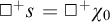 must appear in
$\Delta $
must appear in
$\Delta $
 .Footnote
9
Then
$\Delta = \Delta _0, \chi $
.Footnote
9
Then
$\Delta = \Delta _0, \chi $
 and the conclusion of
$\pi $
and the conclusion of
$\pi $
 would be
$\Gamma \Rightarrow _s \Delta _0, \Box ^+ \chi _0, \chi $
would be
$\Gamma \Rightarrow _s \Delta _0, \Box ^+ \chi _0, \chi $
 , i.e.,
$\Gamma \Rightarrow _s \Delta _0, \chi , \chi $
, i.e.,
$\Gamma \Rightarrow _s \Delta _0, \chi , \chi $
 .
.
We have the cut reduction

From now on we assume that either
$\chi $
 is not of shape
$ \Box ^+ \chi _0$
is not of shape
$ \Box ^+ \chi _0$
 or if it is then
$s \neq \chi _0$
or if it is then
$s \neq \chi _0$
 .
.
A.2 Axiomatic cases
Assume that either
$\pi $
 or
$\tau $
or
$\tau $
 is axiomatic.
A.2.1 Axiomatic character is in side formula


A.2.2 Axiomatic character is in the cut formula


From now on we assume that neither
$\pi $
 nor
$\tau $
nor
$\tau $
 is axiomatic, so
$\pi $
is axiomatic, so
$\pi $
 and
$\tau $
and
$\tau $
 have each a principal formula.
A.3 Principal reduction
Assume the cut formula is principal in
$\pi $
 and
$\tau $
and
$\tau $
 . Then
$\chi = \chi _0 \to \chi _1$
. Then
$\chi = \chi _0 \to \chi _1$
 and the cut reduction has shape


A.4 Commutative implication cases
Assume the cut formula is not principal in
$\pi $
 or
$\tau $
or
$\tau $
 and the principal formula where the cut formula is not principal is an implication. The cut reduction has four possible shapes:


A.5 Modal cases
Assume the cut formula is not principal in
$\pi $
 or
$\tau $
or
$\tau $
 and where the cut formula is not principal, the principal formula is of shape
$ \Box \phi $
and where the cut formula is not principal, the principal formula is of shape
$ \Box \phi $
 or
$ \Box ^+ \phi $
or
$ \Box ^+ \phi $
 . So where the cut formula is not principal the last rule is either
$ \Box , \Box ^+_f$
. So where the cut formula is not principal the last rule is either
$ \Box , \Box ^+_f$
 , or
$ \Box ^+_u$
, or
$ \Box ^+_u$
 .
.
A.5.1 Weakening.
If the cut formula belongs to the weakening part where the cut formula is not principal, then it is trivial to eliminate the cut: just keep that proof changing the weakening part to not include the cut formula.
A.5.2 Commutative.
We can assume that the cut formula is not principal with last rule either
$ \Box , \Box ^+_f$
 , or
$ \Box ^+_u$
, or
$ \Box ^+_u$
 occurs at
$\tau $
occurs at
$\tau $
 since if it occurs at
$\pi $
since if it occurs at
$\pi $
 it would be in the weakening part. In addition, to not occur at the weakening part of the LHS of
$\tau $
it would be in the weakening part. In addition, to not occur at the weakening part of the LHS of
$\tau $
 the cut formula must be of shape
$ \Box \chi _0$
the cut formula must be of shape
$ \Box \chi _0$
 or
$ \Box ^+ \chi _0$
or
$ \Box ^+ \chi _0$
 . In
$\pi $
. In
$\pi $
 we have two options, either the cut formula is principal or not.
If it were not principal, then the principal formula of
$\pi $
 is of shape
$\phi \to \psi $
is of shape
$\phi \to \psi $
 ,
$ \Box \phi $
,
$ \Box \phi $
 , or
$ \Box ^+ \phi $
, or
$ \Box ^+ \phi $
 . The first case was already covered in Section A.4 and the other two will provoke that the cut formula belongs to the weakening part of a modal rule, which we covered in Section A.5.1. So we can safely assume that
$\chi $
. The first case was already covered in Section A.4 and the other two will provoke that the cut formula belongs to the weakening part of a modal rule, which we covered in Section A.5.1. So we can safely assume that
$\chi $
 is principal in
$\pi $
is principal in
$\pi $
 and in addition, since if
$\chi = \Box ^+ \chi _0$
and in addition, since if
$\chi = \Box ^+ \chi _0$
 then
$s \neq \chi _0$
then
$s \neq \chi _0$
 (by Section A.1), we know that the last rule applied at
$\pi $
(by Section A.1), we know that the last rule applied at
$\pi $
 is either
$ \Box $
is either
$ \Box $
 or
$ \Box ^+_u$
or
$ \Box ^+_u$
 . This leaves six cases depending on the last rule of
$\pi $
. This leaves six cases depending on the last rule of
$\pi $
 and the last rule of
$\tau $
and the last rule of
$\tau $
 .
.
In all the subsequent cases we are going to have
$\Sigma _0, \Sigma _1, \Gamma _0, \Gamma _1, \Pi _0, \Pi _1$
 such that

Then we define
$\Gamma _2 = \Gamma _0, (\Gamma _1 \setminus \Gamma _0) = \Gamma _1, (\Gamma _0 \setminus \Gamma _1)$
 ,
$\Pi _2 = \Pi _0, (\Pi _1 \setminus \Pi _0) = \Pi _1, (\Pi _0 \setminus \Pi _1)$
,
$\Pi _2 = \Pi _0, (\Pi _1 \setminus \Pi _0) = \Pi _1, (\Pi _0 \setminus \Pi _1)$
 and
$\Sigma _2$
and
$\Sigma _2$
 as the only multiset such that
$\Sigma _2, \Box \Gamma _2, \Box ^+ \Pi _2 = \Sigma _0, \Box \Gamma _0, \Box ^+ \Pi _0 = \Sigma _1, \Box \Gamma _1, \Box ^+ \Pi _1$
as the only multiset such that
$\Sigma _2, \Box \Gamma _2, \Box ^+ \Pi _2 = \Sigma _0, \Box \Gamma _0, \Box ^+ \Pi _0 = \Sigma _1, \Box \Gamma _1, \Box ^+ \Pi _1$
 . Notice that
$\Gamma _0, \Gamma _1 \subseteq \Gamma _2$
. Notice that
$\Gamma _0, \Gamma _1 \subseteq \Gamma _2$
 ,
$\Pi _0, \Pi _1 \subseteq \Pi _2$
,
$\Pi _0, \Pi _1 \subseteq \Pi _2$
 .
.
${\Box }$
 -
${\Box }$
-
${\Box }$
 reduction.


${\Box }$
 -
${\Box ^+_u}$
-
${\Box ^+_u}$
 reduction.


${\Box }$
 -
${\Box ^+_f}$
-
${\Box ^+_f}$
 reduction.


${\Box ^+_u}$
 -
$ {\Box }$
-
$ {\Box }$
 reduction.


where
$\rho _0 = \textsf {cut}_2(\textsf {wk}(\pi _0),\textsf {cut}_1({\textsf {wk}(\pi _1)}^{\circ }, \textsf {wk}(\tau _0)))$
 .
.
$ {\Box ^+_u}$
 -
${\Box ^+_u}$
-
${\Box ^+_u}$
 reduction.


where
$\rho _0 = \textsf {cut}_2(\textsf {wk}(\pi _0),\textsf {cut}_1({\textsf {wk}(\pi _1)}^{\circ }, \textsf {wk}(\tau _0)))$
 and
$\rho _1 = \textsf {cut}_4({\textsf {wk}(\pi _0)}^\phi ,$
and
$\rho _1 = \textsf {cut}_4({\textsf {wk}(\pi _0)}^\phi ,$ $\textsf {cut}_3({\textsf {wk}(\pi _1)}^{\phi }, \textsf {wk}(\tau _1)))$

$ \Box ^+_u$
 -
$ \Box ^+_f$
-
$ \Box ^+_f$
 reduction.


where
$\rho _0 = \textsf {cut}_2(\textsf {wk}(\pi _0),\textsf {cut}_1({\textsf {wk}(\pi _1)}^{\circ }, \textsf {wk}(\tau _0)))$
 .
.
Funding
Research supported by the Swiss National Science Foundation project 200021_214820.






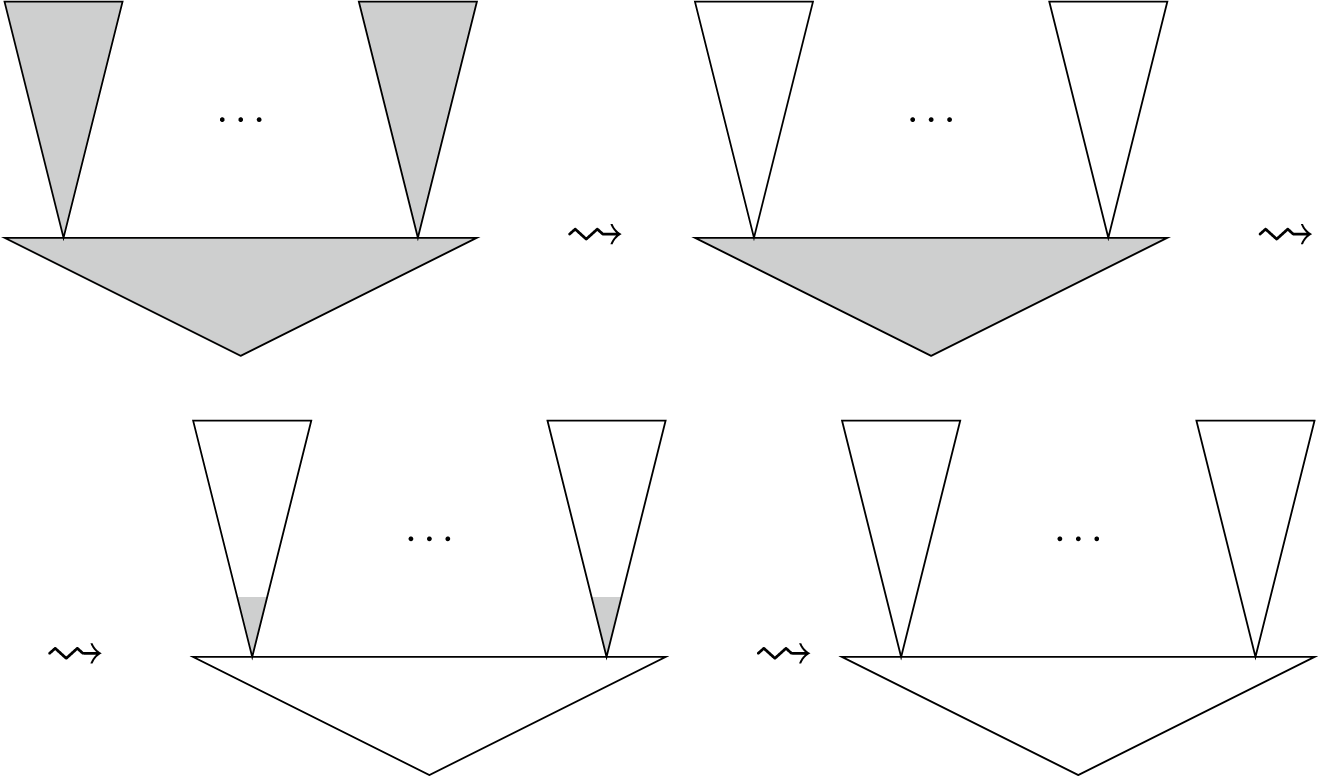

 Open access

