




Introduction
The search for life beyond Earth has long focused on Mars, a planet that once had conditions more hospitable to life (Wordsworth, Reference Wordsworth2016; Adams, Reference Adams, Scheucher, Hu, Ehlmann, Thomas, Wordsworth, Scheller, Lillis, Smith, Rauer and Yung2025). While the planet’s surface today is cold, dry and bombarded by cosmic radiation and small meteorites, its subsurface offers a more protected and potentially habitable environment for microorganisms. Martian caves are among the most promising locations for astrobiological exploration, which may serve as refuges for microbial life or as sheltered archives preserving biosignatures, i.e., chemical, biological or physical evidence of past or present life, including the existence of ancient ecosystems. The existence of caves on Mars, particularly lava tubes, have been confirmed through high-resolution orbital imaging and application of cutting-edge artificial intelligence-powered image scan approaching, marking them as high-priority targets for future robotic and human exploration (Léveillé and Datta, Reference Léveillé and Datta2010; Blank et al., Reference Blank, Roush, Stoker, Colaprete, Datta, Wong and Wynne2018; Watson and Baldini, Reference Watson and Baldini2024; Domínguez et al., Reference Domínguez, Pérez-del-Pulgar, Paz-Delgado, Polisanò, Babel, Germa, Dragomir, Carlietti, Berthet, Danté and Kirchner2025). Compared to terrestrial geomorphological context of caves, the most likely type of underground systems on Mars is lava tubes and basaltic caves (Sauro et al., Reference Sauro, Pozzobon, Massironi, De Berardinis, Santagata and De Waele2020; Léveillé & Datta, Reference Léveillé and Datta2010).
On Earth, caves represent unique and extreme ecosystems, providing valuable analogs for studying life in extraterrestrial subsurface environments. Caves are commonly characterized by challenging abiotic factors (i.e., oligotrophy, total darkness, high mineral concentrations, high concentration of CO2 and variable pH levels) but relatively stable in terms of microclimatic conditions, thus providing a buffered habitat from surface environmental fluctuations. (Léveillé et al., Reference Léveillé and Datta2010; Colak and Güngör, Reference Çolak and Güngör2022). These characteristics make terrestrial caves highly relevant for understanding habitability, biosignatures preservation and microbial survival strategies in extreme environments (Blank et al., Reference Blank, Roush, Stoker, Colaprete, Datta, Wong and Wynne2018). Microbial communities thriving in Earth’s caves have evolved specialized metabolic strategies, including chemolithoautotrophy. These microbes harness energy from reduced chemical compounds such as nitrogen, sulfur, iron, manganese and atmospheric trace gases, supporting survival and growth under nutrient limitation. These strategies may resemble the survival strategies of potential Martian microbes (Bay et al., Reference Bay, Ni, Lappan, Leung, Wong, Holland and Greening2024; Jurado et al., Reference Jurado, Northup and Saiz-Jimenez2024).
The discovery of over 1000 potential cave entrances on Mars, detected through data from the Mars Reconnaissance Orbiter’s CTX and HiRISE cameras, underscores their significance for astrobiological investigations. Unlike the exposed Martian surface, which is subjected to high levels of ionizing radiation (∼250 mGy/year), extreme temperature fluctuations, micro-meteorites rain and desiccation, caves provide natural shielding that could allow microbial communities to survive in more stable conditions. Additionally, the presence of subsurface water ice in multiple Martian regions suggests that transient liquid brines may persist in cave environments, further supporting life offering a potential medium for microbial metabolism (Martínez and Renno, Reference Martínez and Renno2013; Ojha et al., Reference Ojha, Wilhelm, Murchie, McEwen, Wray, Hanley and Chojnacki2015). Should Mars have ever hosted microbial life, caves would constitute some of the most promising environments in which to investigate extant or fossilized biosignatures. Consequently, robotic mission concepts are being tested in terrestrial lava tubes that serve as analogues for Martian subsurface systems (Domínguez et al., Reference Domínguez, Pérez-del-Pulgar, Paz-Delgado, Polisanò, Babel, Germa, Dragomir, Carlietti, Berthet, Danté and Kirchner2025).
Earth’s caves provide a natural laboratory for studying how life can persist in environments deprived of sunlight and with limited nutrients (Figure 1). Many of the extremophiles found in terrestrial caves, including psychrophiles, halophiles, acidophiles and chemolithotrophs, demonstrate metabolic flexibility and resilience that could be applicable to potential Martian organisms (Sarbu et al., Reference Sarbu, Kane and Kinkle1996; Chen et al., Reference Chen2009; Northup et al., Reference Northup, Melim, Spilde, Hathaway, Garcia, Moya and Riquelme2011; Tetu et al., Reference Tetu2013; Ortiz et al., Reference Ortiz, Legatzki, Neilson, Fryslie, Nelson, Wing and Maier2014; Nguyễn-Thuỳ et al., Reference Nguyễn-Thuỳ2017; Waring et al., Reference Waring2017; Cheng et al., Reference Cheng2021: Nicolosi et al., Reference Nicolosi, Galdenzi, Messina, Miller, Petralia, Sarbu and Isaia2022; Bay et al., Reference Bay, Ni, Lappan, Leung, Wong, Holland and Greening2024). Furthermore, cave environments preserve biosignatures exceptionally well due to their stable microclimatic conditions. On Earth, microbial activity leaves behind distinct biochemical, isotopic and morphological traces, such as silica deposits, iron- and manganese-stained biofilms and fossilized microbial filaments, all of which could provide templates for biosignature detection on Mars (Preston et al., Reference Preston, Melim, Polyak, Asmerom and Southam2014; Hays et al., Reference Hays, Graham, Des Marais, Hausrath, Horgan, McCollom and Lynch2017). Terrestrial analog studies, such as those conducted in Lechuguilla Cave (USA), Cueva de Villa Luz (Mexico) and Rio Tinto (Spain), offer direct insights into how microbial communities interact with geochemical environments in ways that could inform future planetary exploration missions (Tomczyk-Żak et al., Reference Tomczyk-Żak and Zielenkiewicz2016; D’Auria et al., Reference D’Auria, Artacho, Rojas, Bautista, Méndez, Gamboa and Gómez-Cruz2018; Zhu et al., Reference Zhu, Jiang and Liu2024).
Schematic summary of key environmental features and astrobiological potential of Martian cave systems. Panels A and B show images from Grotta del Caudano (Credit: Dr. Federico Biagioli). Panels C and D are from the U.S. Geological Survey https://www.usgs.gov.

This mini-Review synthesizes current knowledge on terrestrial cave microbiology and its relevance for Martian astrobiology, focusing on three key aspects: i) the habitability of cave environments, comparing geochemical and environmental conditions on Earth and Mars; ii) microbial diversity and metabolic adaptations in terrestrial caves, with emphasis on extremophiles that serve as potential analogs for Martian life; and iii) the preservation of biosignatures in caves, exploring how microbial activity can leave long-lasting traces that may inform life-detection strategies for Mars missions.
Understanding the microbial ecology of Earth’s caves provides critical insights into potential Martian subsurface life, refining the strategies for biosignature detection and guiding the design of future robotic exploration missions.
Cave environments as Martian analogs
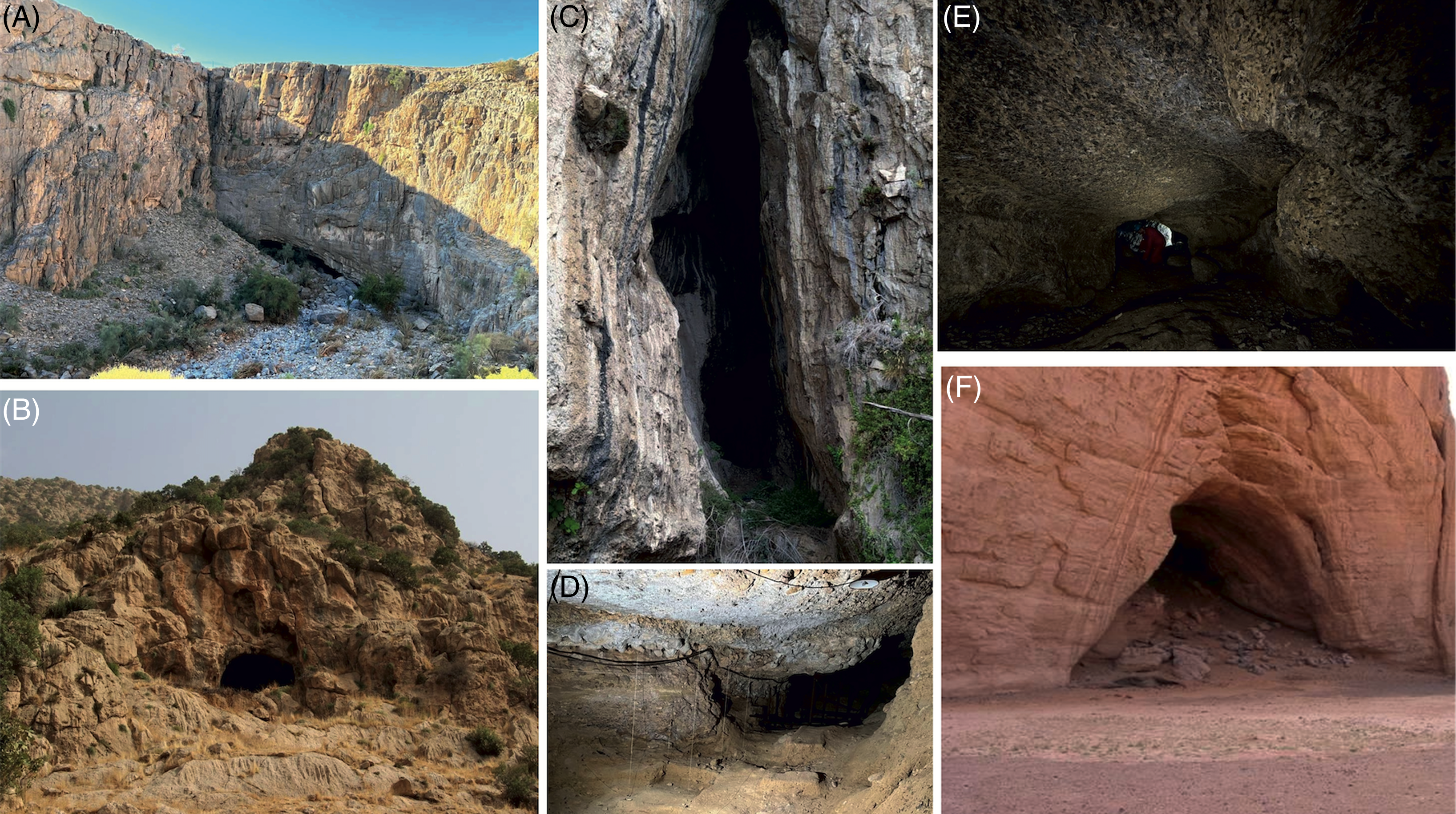
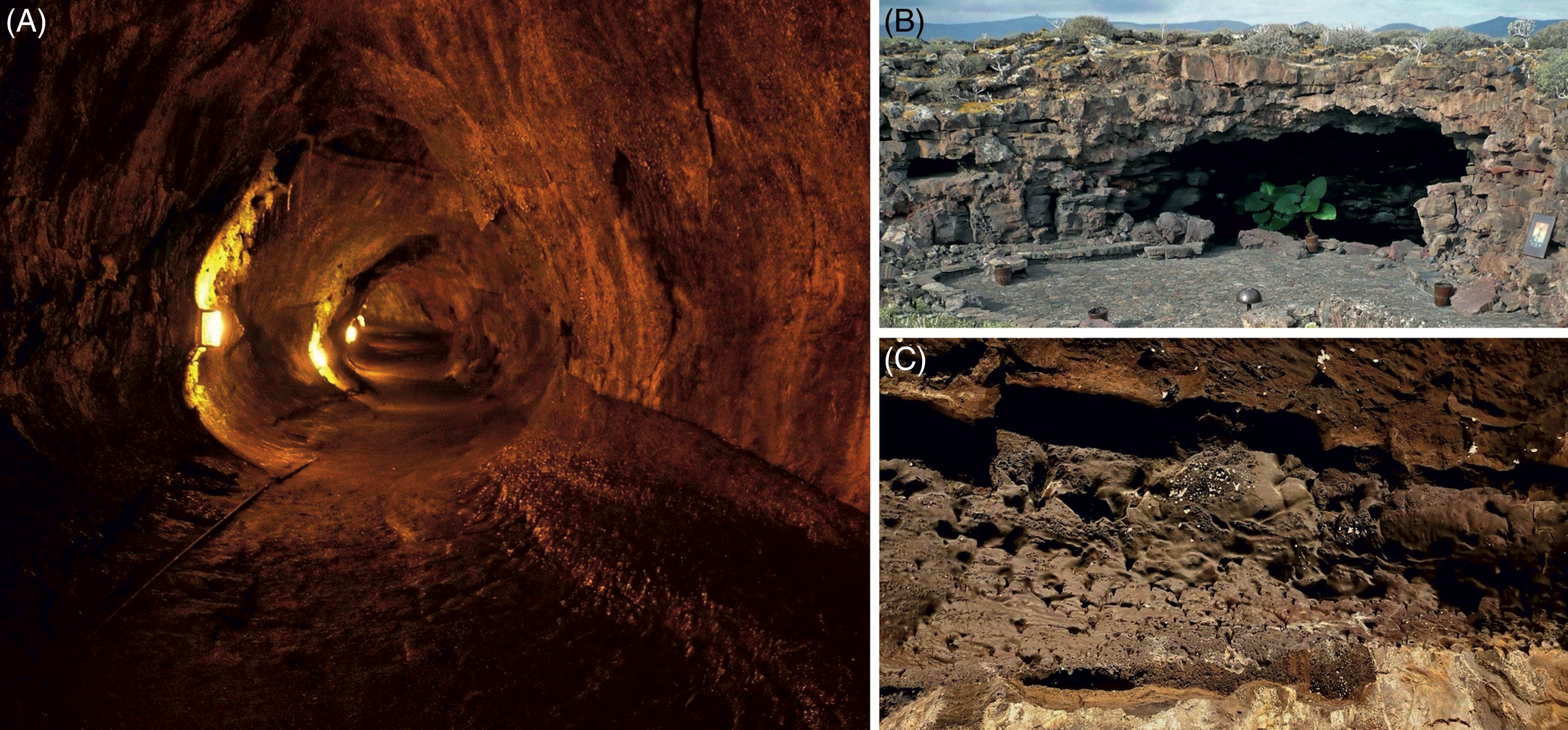
Caves on Earth are generally defined as openings large enough for human exploration and exploitation (White and Culver, Reference White and Culver2019). From the geological point of view, caves are voids below the ground surface, formed by a variety of geological and geomorphological processes. Most cave systems are related to karst processes (Figure 2) and formed in limestone, dolomite, evaporites and conglomerates due chemical dissolution (Jones and White, Reference Jones, White, White, Culver and Pipan2019). Occasionally, also silicates and sandstone bedrocks host cave systems in their subsurface (Figure 2), formed due to solutional processes (mainly driven by hydrolysgais; Wray, Reference Wray1997; Young et al., Reference Young, Wray and Young2009; Zerboni et al., Reference Zerboni, Perego and Cremaschi2015). In general, caves represent a gradient of environments, as environmental conditions vary with increasing distance from the entrance and according to the complexity of their development (Lauritzen, Reference Lauritzen, Moldovan, Kováč and Halse2018). In cave-entrance areas, parameters such as temperature, humidity, ventilation and light exposure do not differ substantially from external conditions. However, deeper within the conduits, environmental conditions change markedly, with implications for the nature of biological colonization (Tuttle and Stevenson, Reference Tuttle, Stevenson, Tyburec, Chenger, Snow and Geiselman2011; Lauritzen, Reference Lauritzen, Moldovan, Kováč and Halse2018). A specific variety of caves – lava tubes (Figure 3) – have been described also in volcanic contexts throughout the world (Sauro et al., Reference Sauro, Pozzobon, Massironi, De Berardinis, Santagata and De Waele2020). They form as the result of surface cooling of lava flows or, alternatively, the result of sequential lava flows. In the latter case, later flows go underneath the older ones and form cavities due to inflation (Pipan and Culver, Reference Pipan, Culver, White, Culver and Pipan2019). Subsurface karst systems (including those developed in sandstone bedrock) are related to underground drainage system and their long-term evolution led to the development of deep (e.g., hundreds to thousands of meters) cave systems with a variety of features (galleries, wells, halls), whereas lava tubes generally form very close to the surface (Figure 3), displaying elongated features of regular diameter.
Examples of terrestrial caves carved into different geological bedrocks by karst dissolution or silicates solution. A) Northern entrance of the Al Hoota Cave (limestone of the Al Hajar Mt., Sultanate of Oman). B) A cave along the limestone of the Zagros Mt. (Kurdistan Region of Iraq). C) A cave along the Balzi Rossi cliff (calcarenite, Ventimiglia, Northern Italy). D) Madonna dell’Arma Cave carved into conglomerates (Sanremo, Northen Italy). E) The Tana della Mussina Cave in the gypsum bedrock of the northern Apennines of Italy (picture: M. Cremaschi). F) The Uan Afuda Cave carved into quartz-bearing sandstone (SW Libya).
Examples of lava tubes from (A) the Hawai‘i Island and (B) Lanzarote; (C) is the external part of a lava tube in Lanzarote (pictures: R.S. Azzoni).
If we consider the main topic of this contribution, we shall start from the consideration of White and Culver (Reference White and Culver2019), suggesting that from the biologist’s point of view, caves are openings that can accommodate cave-adapted organisms. Cave environments on Earth provide a valuable analog for Martian subsurface habitats, as they share key geological, geochemical and microclimatic characteristics that could support microbial life. Martian caves, particularly lava tubes, have been identified as high-priority targets for astrobiological exploration due to their natural protection from surface radiation, stable thermal conditions and potential for water ice preservation (Léveillé and Datta, Reference Léveillé and Datta2010; Blank et al., Reference Blank, Roush, Stoker, Colaprete, Datta, Wong and Wynne2018; Sauro et al., Reference Sauro, Pozzobon, Massironi, De Berardinis, Santagata and De Waele2020).
Terrestrial and Martian caves exhibit similar formation processes and mineralogical compositions, making them excellent comparative systems for astrobiological investigations (Figure 1). While Earth hosts a diverse range of caves, formed by the dissolution of limestone, solutional weathering on silicates and volcanic lava tubes, Mars is predominantly characterized by basaltic lava tubes, which have been detected in multiple regions using orbital imaging (Martínez and Renno, Reference Martínez and Renno2013; Ojha et al., Reference Ojha, Wilhelm, Murchie, McEwen, Wray, Hanley and Chojnacki2015; Sauro et al., Reference Sauro, Pozzobon, Massironi, De Berardinis, Santagata and De Waele2020). However, some evidence suggests that geological substrate that can suffer dissolution or solutional weathering could also exist on Mars, thus confirming the potential presence of caves. This hypothetic occurrence of underground karst-related landforms on Mars is confirmed by the identification of soluble evaporitic rocks such as gypsum and halite, and signs of past flowing water on the Martian surface (Hajna et al., Reference Hajna, Baioni and Tramontana2017; Baioni, Reference Baioni2018). Furthermore, the Mars Global Cave Candidate Catalog (MGC3) has identified potential cave entrances associated with deep fractures and atypical pit craters (APCs) in regions exhibiting karst-similar characteristics (Cushing et al., Reference Cushing, Okubo and Titus2015).
On Earth, the activity of microbial communities is often a co-factor promoting the occurrence of (bio-)chemical weathering of rocks, likely enhancing the effects of dissolution and hydrolysis (Viles, Reference Viles1984; Berthelin, Reference Berthelin, Lerman and Meybeck1988; Barker et al., Reference Barker, Welch, Banfield, Banfield and Nealson1997; Bin et al., Reference Bin, Ye, Lijun and Ruidong2008, Zhao et al., Reference Zhao, Xiong and Yan2024). Microbial communities are thus involved in karst corrosion and silicates solutional contributing to the formation of caves. At the same time, microbial communities occupy all parts of cave systems from their atrial parts, where photosynthetic organisms can survive although the limited penetration of light, up to the inner parts of galleries and deepest abysses. Therein, subsurface microbial communities primarily rely on organic carbon inputs from surface-derived sources, with the majority predicted to be organoheterotrophs. However, many can also derive energy from chemolithotrophic processes, including nitrification (ammonia and nitrite oxidation), sulfur oxidation and, in some cases, manganese and iron oxidation (Sarbu et al., Reference Sarbu, Kane and Kinkle1996; Chen et al., Reference Chen2009; Tetu et al., Reference Tetu2013; Ortiz et al., Reference Ortiz, Legatzki, Neilson, Fryslie, Nelson, Wing and Maier2014; Carmichael and Bräuer, Reference Carmichael, Bräuer and Summers Engel2015).
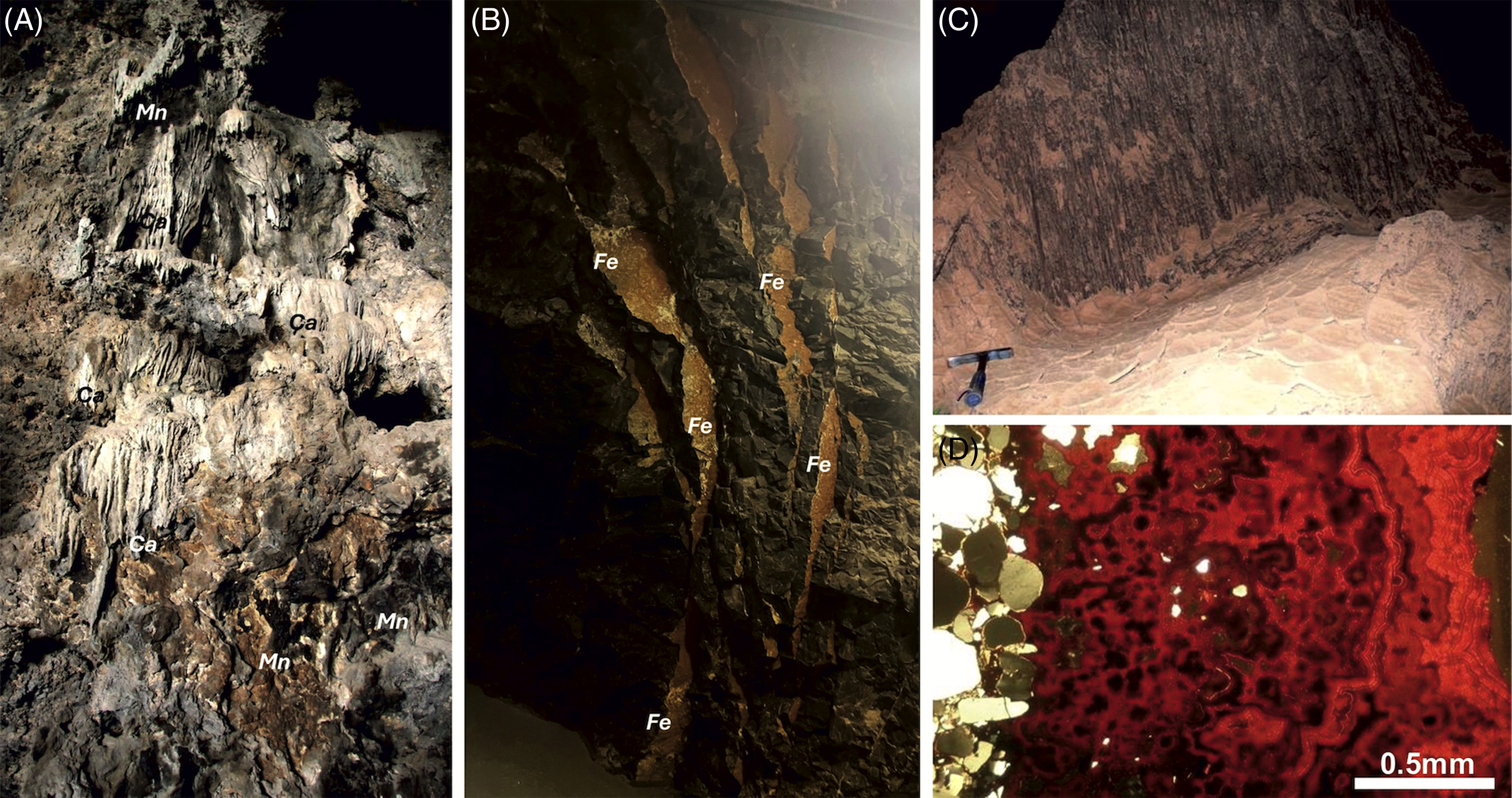
Biomineralizations resulting from the activities of chemolithotrophic communities are commonly found along the walls of caves on Earth (Forti, Reference Forti2001; Northup et al., Reference Northup DE, Lavoie2001, Boston et al., Reference Boston, Spilde, Northup, Melin, Soroka, Kleina, Lavoie, Hose, Mallory, Dahm, Crossey and Schelble2004; Miller et al., Reference Miller, Dionísio, Jurado, Cuezva, Sanchez-Moral, Cañaveras, Saiz-Jimenez and Sanjurjo Sanchéz2013) and includes the deposition of Fe- and/or Mn-bearing coatings and nodules, consisting of mixtures of iron and manganese oxides and hydroxides (Figs. 4, 5). Microbial communities also contribute to the growth of calcitic biocrusts and occasionally speleothems (Figure 4). Biomineralization of iron and manganese have been described with a plethora of shapes, form micrometric staining up to more complex features including thin laminates layers of oxides and clays resembling stromatolites. Figs. 4, 6 illustrate an example of laminate biomineralization alternating clay rich layers to layers of iron oxides (hematite) form the solutional underground network of the central Sahara. Greenish photosynthetic biofilms and other kind of microbial mat can also appear in the twilight zone (Figure 5) on the walls and roof of the atrial parts of caves (Villa et al., Reference Villa, Wu, Zerboni and Cappitelli2022) or in the deeper and aphotic parts of underground systems as consequence of human contamination or positioning of artificial lights (Northup et al., Reference Northup, Melim, Spilde, Hathaway, Garcia, Moya and Riquelme2011; Saiz-Jimenez, Reference Saiz-Jimenez2012; Zerboni et al., Reference Zerboni, Villa, Wu, Solomon, Trentini, Rizzi, Cappitelli and Gallinaro2022). The existence of inactive disappearances of microbial communities is occasionally suggested by the occurrence of other mineralization, such as Ca-oxalates efflorescence (Figure 5), that can represent the byproduct of metabolic activities (Gallinaro and Zerboni, Reference Gallinaro and Zerboni2021). Additionally, numerous cave microbes have been shown to utilize atmospheric trace gases such as H2, CO and CH4 as alternative energy sources (Waring et al., Reference Waring2017; Nguyễn-Thuỳ et al., Reference Nguyễn-Thuỳ2017; Cheng et al., Reference Cheng2021; Bay et al., Reference Bay, Ni, Lappan, Leung, Wong, Holland and Greening2024). Some chemoautotrophs are hypothesized to fix CO2 using H2 as an energy source, while aerobic methanotrophs metabolize CH4 as both an energy and carbon source (Waring et al., Reference Waring2017; Cheng et al., Reference Cheng2021; Bay et al., Reference Bay, Ni, Lappan, Leung, Wong, Holland and Greening2024). These metabolic pathways are particularly relevant for understanding potential Martian ecosystems, given that Mars exhibits substantial iron oxide and sulfate deposits, as well as potential trace gases in its atmosphere that could sustain analogous microbial processes (Boston et al., Reference Boston, Spilde, Northup, Melin, Soroka, Kleina, Lavoie, Hose, Mallory, Dahm, Crossey and Schelble2004; Northup et al., Reference Northup, Melim, Spilde, Hathaway, Garcia, Moya and Riquelme2011). Additionally, studies of hydrothermal and sulfur-rich caves suggest that analogous environments may have existed on ancient Mars, where volcanic and aqueous interactions likely shaped habitable niches (D’Auria et al., Reference D’Auria, Artacho, Rojas, Bautista, Méndez, Gamboa and Gómez-Cruz2018; Tomczyk-Żak et al., Reference Tomczyk-Żak and Zielenkiewicz2016).
Examples of bio-mineralization found along caves on Earth. A) Calcitic (Ca) and Mn-bearing (Mn) mineralization along a wall of a cave in the Kurdistan Region of Iraq. B) Fe-bearing (Fe) mineralization along the wall of the Al Hoota Cave. C) Fe-bearing speleothem, likely formed after biomineralization in the underground network of the Tadrart Acacus Massif (SW Libya). D) Microphotograph of C) illustrating the stromatolitic structure of Fe-bearing cave concretions (Zerboni et al., Reference Zerboni, Perego and Cremaschi2015).
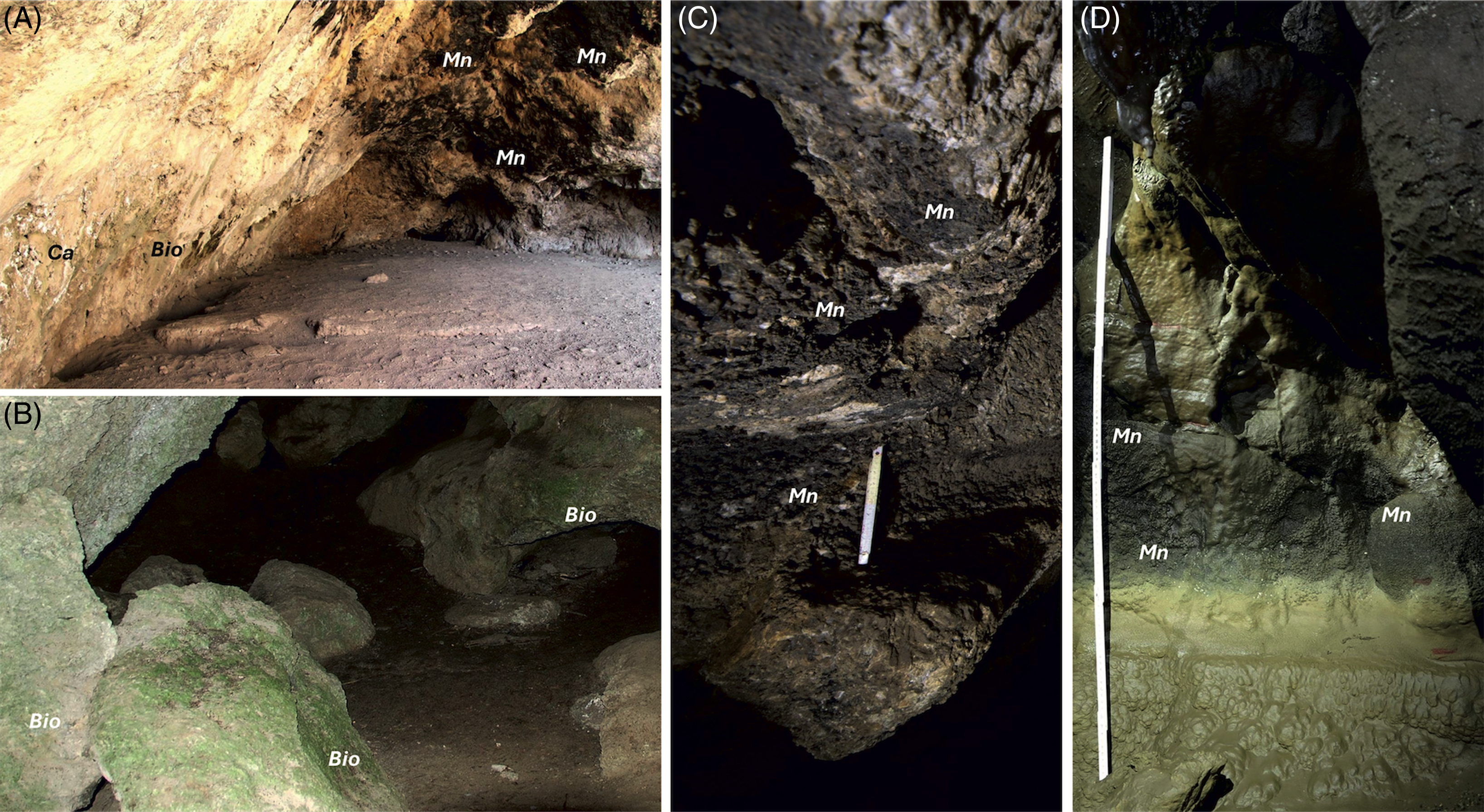
Examples of biofilms found along caves on Earth. A) Cave entrance in the Zagros Mt. showing Mn-bearing (Mn) and photosynthetic (Bio) biofilms; (Ca) indicates the presence of oxalates effloresces, likely related to epiliths. B) Photosynthetic (Bio) biofilms in the Tana della Mussina Cave (picture: M. Cremaschi). C) Mn-bearing (Mn) biofilms in the Tana della Mussina Cave (picture: M. Cremaschi). D) Mn-bearing (Mn) biofilms in a cave from the central Apennines of Italy (picture: L. Forti).
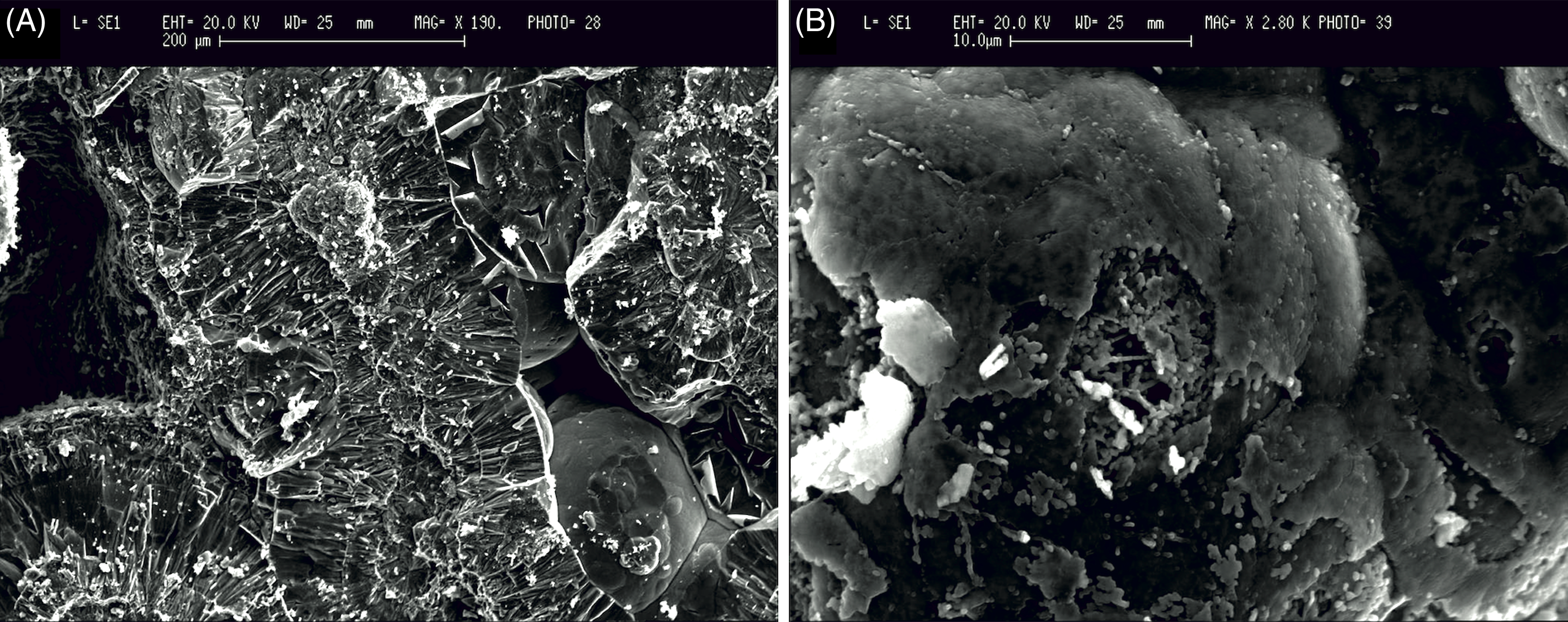
Scanning electron micrographs of Fe-bearing speleotem of Figure 4. A) Stromatolitic structure of the mineralization. B) Potential fossil extracellular iron oxide biomineral structures.
One key factor influencing habitability is water availability. Earth’s caves are often fed by percolating water or containing groundwater (karst systems), drip pools or ice deposits, in the case of lava tubes, they are close to the surface and can exchange humidity from the atmosphere or occasionally flooded. On the contrary, Martian caves may harbor subsurface water ice or transient briny solutions, particularly in polar and mid-latitude regions (Martínez and Renno, Reference Martínez and Renno2013). If liquid water or high-humidity microenvironments persist within Martian lava tubes, they could sustain microbial life, much like their terrestrial counterparts.
In terms of astrobiological modeling, terrestrial karst caves and lava tubes offer two distinct frameworks for understanding potential Martian habitats. Karst caves are formed by the chemical weathering of rocks such as limestone, dolomite and evaporites through interactions with acidic water (enriched in CO2 coming from the atmosphere or produced by soil metabolism). These systems typically exhibit high microbial diversity, mineral deposits and redox gradients, which make them excellent environments for biosignature studies. However, since carbonate-based cave systems (limestone caves) have not been identified on Mars, they serve primarily as biological analogs rather than geological ones (Northup et al., Reference Northup, Melim, Spilde, Hathaway, Garcia, Moya and Riquelme2011). In contrast, lava tubes, which form when the surface of a lava flow cools while the interior remains molten, eventually leaving behind hollow subsurface tunnels, are known to exist on Mars (Léveillé et al., Reference Léveillé and Datta2010; Sauro et al., Reference Sauro, Pozzobon, Massironi, De Berardinis, Santagata and De Waele2020; Qiu et al., Reference Qiu and Ding2023). These structures provide highly stable microclimates, shielding against cosmic and solar radiation and could serve as potential reservoirs for ice preservation, making them prime targets for astrobiological exploration. This makes them more relevant as Martian analogs (Léveillé and Datta, Reference Léveillé and Datta2010; Sauro et al., Reference Sauro, Pozzobon, Massironi, De Berardinis, Santagata and De Waele2020). For instance, microbial mat composed of different microorganisms, including cyanobacteria, and associated biomineralizations (e.g., kerolite and aragonite) cover the Maniniholo Dry Cave on Kauai (Hawai‘i; Léveillé et al., Reference Léveillé, Fyfe and Longstaffe2000; Sauro et al., Reference Sauro, Pozzobon, Massironi, De Berardinis, Santagata and De Waele2020). Furthermore, the atmospheric conditions inside Martian caves represent an interesting astrobiological aspect to investigate. While the Martian atmosphere is extremely rarefied (with a surface pressure less than 1% of that of Earth) the deepest cave zones or sealed chambers could potentially maintain different atmospheric compositions and pressure, spawning favorable conditions for microbial-like life forms specialized in gas (i.e., CO2 and CH4) exploitation and fixation, as reported in terrestrial subsurface habitats (Martin-Pozas et al., Reference Martin-Pozas, Cuezva, Fernandez-Cortes, Cañaveras, Benavente, Jurado and Sanchez-Moral2022).
Several well-studied caves on Earth provide direct insights into potential Martian habitats, serving as astrobiological test sites for understanding microbial survival and biosignature formation. One notable example is Lechuguilla Cave in the United States, one of the world deepest caves in limestone. It is an oligotrophic environment with extremely low organic input from the surface, making it a valuable model for understanding how microbial life can persist in nutrient-poor subsurface environments (Northup et al., Reference Northup, Melim, Spilde, Hathaway, Garcia, Moya and Riquelme2011). Another significant example is Cueva de Villa Luz in Mexico, a sulfidic cave characterized by high concentrations of hydrogen sulfide and sulfuric acid (D’Auria et al., Reference D’Auria, Artacho, Rojas, Bautista, Méndez, Gamboa and Gómez-Cruz2018). The Rio Tinto caves in Spain offer yet another relevant model, as they are highly acidic, iron-rich environments that support extremophiles capable of iron oxidation and sulfate reduction. Given that the Martian surface is rich in iron oxides and apparently also of iron sulfates (Benison, Reference Benison2016; Ehlmann, Reference Ehlmann, Swayze, Milliken, Mustard, Clark, Murchie, Breit, Wray, Gondet, Poulet, Carter, Calvin, Benzel and Seelos2016), Rio Tinto provides insights into how similar metabolic pathways could sustain life in Martian caves, as much as analogous extreme environments for life on its surface (Papike, Reference Papike, Karner, Spilde and Shearer2006; Amils et al., Reference Amils, González-Toril, Aguilera, Rodríguez, Fernández-Remolar, Gómez and Sanz2011; Fernández-Remolar et al., Reference Fernández-Remolar and Knoll2008).
Additionally, ice caves such as those in Antarctica represent another key terrestrial analog for Martian environments. These caves maintain stable subzero temperatures and host microbial life in ice and rock substrates, demonstrating how psychrophilic organisms can persist in extreme cold with minimal nutrients. Notably, the lava tube caves of Mt. Erebus in Antarctica provide an even more relevant comparison, as they combine both volcanic and cryogenic conditions, resembling potential subsurface habitats on Mars. These lava tubes harbor microbial communities adapted to thermal and geochemical gradients, with some microbes utilizing volcanic gases as energy sources, further reinforcing their astrobiological significance as analogs for putative Martian cave ecosystems, where ice deposits have been detected (Martínez et al., Reference Martin-Sanchez, Jurado, Porca, Bastian, Lacanette, Alabouvette and Saiz-Jimenez2014; Stibal et al., Reference Stibal, Wadham, Lis, Telling, Pancost, Dubnick and Anesio2012).
All these terrestrial analogues can be used as training grounds to develop the technologies required for the exploration of Martian caves. As recently demonstrated in a study carried out on lava tubes in Lanzarote (Domínguez et al., Reference Domínguez, Pérez-del-Pulgar, Paz-Delgado, Polisanò, Babel, Germa, Dragomir, Carlietti, Berthet, Danté and Kirchner2025), the advancement of robotic technology is crucial. In this pilot experiment, a team of robots succeeded in generating a three-dimensional model of the area surrounding cave entrances and skylight, deploying a scout rover via rappelling and exploring the interior of the cave. The production of three-dimensional maps of Martian caves therefore represents a fundamental starting point, for which equipping rovers and robots with remote sensing instruments such as LiDAR is essential. However, this is only the beginning: it is also necessary to develop hardware and software technologies capable of detecting microorganisms in specific refugia within the caves, as well as identifying biomineralized traces of their past or present existence.
Microbial diversity in terrestrial caves
Microorganisms in terrestrial caves include bacteria, archaea, fungi and micro-eukaryotes, forming highly diverse and functionally complex communities that contribute to ecosystem stability and biogeochemical cycling (e.g. Martin-Sanchez et al., Reference Martin-Sanchez, Jurado, Porca, Bastian, Lacanette, Alabouvette and Saiz-Jimenez2014; Tomczyk-Żak et al., Reference Tomczyk-Żak and Zielenkiewicz2016; Kosznik-Kwaśnicka et al., Reference Kosznik-Kwaśnicka, Golec, Jaroszewicz, Lubomska and Piechowicz2022; Biagioli et al., Reference Biagioli, Coleine, Piano, Nicolosi, Poli, Prigione and Selbmann2023, Reference Biagioli, Coleine, Delgado-Baquerizo, Feng, Saiz-Jimenez and Selbmann2024; Bay et al., Reference Bay, Ni, Lappan, Leung, Wong, Holland and Greening2024; Poli et al., Reference Poli, Zanellati, Piano, Biagioli, Coleine, Nicolosi and Varese2024). Fungal and bacterial communities in caves exhibit remarkable taxonomic and functional diversity. At the phylum level, cave microbial communities often reflect the diversity found in surface soils, with bacterial groups such as Proteobacteria, Actinobacteria, Acidobacteria and Firmicutes commonly detected (Weng et al., Reference Weng, Zaikova and Millan2022; Biagioli et al., Reference Biagioli, Coleine, Delgado-Baquerizo, Feng, Saiz-Jimenez and Selbmann2024; Hathaway et al., Reference Hathaway, Spilde and Northup2024). Fungi represented by Ascomycota, Basidiomycota and Mortierellomycota are abundant in humid cave environments and play key roles in organic matter decomposition and symbiotic interactions with bacteria (Northup and Hathaway, Reference Northup, Hathaway and Snider2012; Gonzalez-Henao and Schrenk, Reference Gonzalez-Henao and Schrenk2025). Additionally, Archaea domain constitutes an important fraction of terrestrial cave microbiomes, with phyla Thaumarchaeota and Euryarchaeota largely reported across different subterranean environments (Bontemps et al., Reference Bontemps, Alonso, Pommier, Hugoni and Moënne-Loccoz2022; Biagioli et al., Reference Biagioli, Coleine, Piano, Nicolosi, Poli, Prigione and Selbmann2023), contributing to various biogeochemical processes (Cheng et al., Reference Cheng, Xiang, Yun, Wang, Wang and Bodelier2023). Studies on microbial communities from Mount Erebus, an active volcano in Antarctica, have revealed a predominance of bacteria belonging to the phyla Proteobacteria and Firmicutes (Rasmussen et al., Reference Rasmussen, Noell, Herbold, Dickie, Richards-Babbage, Stott and McDonald2024).
Microbial diversity also varies across different cave zones. The atrial entrance, which receives some light and organic input from the external environment, typically supports a more diverse microbial community, including phototrophic and heterotrophic organisms. In contrast, the twilight and deep zones, where darkness and oligotrophy prevail, host specialized microbial assemblages. While these deeper zones are characterized by low organic input, they can still support diverse microbial life through inorganic energy sources, including trace gas oxidizers and nitrifiers (Biagioli et al., Reference Biagioli, Coleine, Piano, Nicolosi, Poli, Prigione and Selbmann2023; Bay et al., Reference Bay, Ni, Lappan, Leung, Wong, Holland and Greening2024).
Comparative studies between different cave systems worldwide have shown that microbial diversity is not only shaped by abiotic factors but also by historical biogeographic patterns. Some caves harbor endemic microbial taxa, while others show similarities with microbial communities from distant but geochemically comparable environments (Gonzalez-Henao and Schrenk, Reference Gonzalez-Henao and Schrenk2025; Northup et al., Reference Northup, Hathaway and Snider2012). This spatial heterogeneity underscores the complexity of cave microbiomes and their potential for harboring novel microbial lineages with unique ecological roles. Despite the broad environmental, geological and geo-morphological heterogeneity of subterranean ecosystems, 52 bacterial and 50 fungal phylotypes were found dominant in caves worldwide. Mainly represented by genera genera Nitrospira, Pseudomonas, Bacillus, Flavobacterium and Mortierella, Cladosporium, Pseudogymnoascus and Cephalotrichum, their diversity patterns were largely driven by outdoor growing aridity conditions, selecting specific dominant taxa and constraining the total cave microbial diversity (Biagioli et al., Reference Biagioli, Coleine, Delgado-Baquerizo, Feng, Saiz-Jimenez and Selbmann2024). These findings may be particularly relevant in supporting the hypothesis that if primordial life forms had originated on Mars, they could have evolved specific adaptations to colonize underground habitats. This adaptation might have occurred regardless of their biogeographic features, leading to the development of a shared microbial core similar to that observed in Earth’s caves.
Microbial adaptations and survival strategies of caves microbes
Studies on karst underground systems and lava tube have demonstrated that microbial diversity is strongly influenced by factors such as nutrient availability, humidity, temperature and mineral composition (Biagioli et al., Reference Biagioli, Coleine, Piano, Nicolosi, Poli, Prigione and Selbmann2023; Léveillé and Datta, Reference Léveillé and Datta2010). Recent advances in systems biology and community-level ecology suggest that microbial consortia in caves may exhibit emergent properties, such as metabolic complementarity and cooperative stress responses. These interactions could be critical for sustaining life in oligotrophic environments and may resemble the dynamics of early microbial ecosystems in extraterrestrial settings (Bay et al., Reference Bay, Ni, Lappan, Leung, Wong, Holland and Greening2024). Karst caves, primarily composed of calcium carbonate, typically exhibit more alkaline conditions, while volcanic lava tubes tend to be more acidic. These cave systems, shaped by distinct geological and climatic processes, impose different environmental filters such as pH, mineralogy, water availability and redox conditions that result in heterogeneous selection and variable successional trajectories of microbial communities. According to community assembly theory, these environmental pressures lead to differences in microbial composition and function across cave types, where deterministic processes such as niche differentiation and environmental filtering dominate over stochasticity. As such, karst and volcanic caves may host functionally distinct microbial consortia, with succession patterns shaped by the availability of electron donors and the stability of microclimatic niches (Costantin et al., Reference Constantin, Toulkeridis, Moldovan, Villacís and Addison2019).
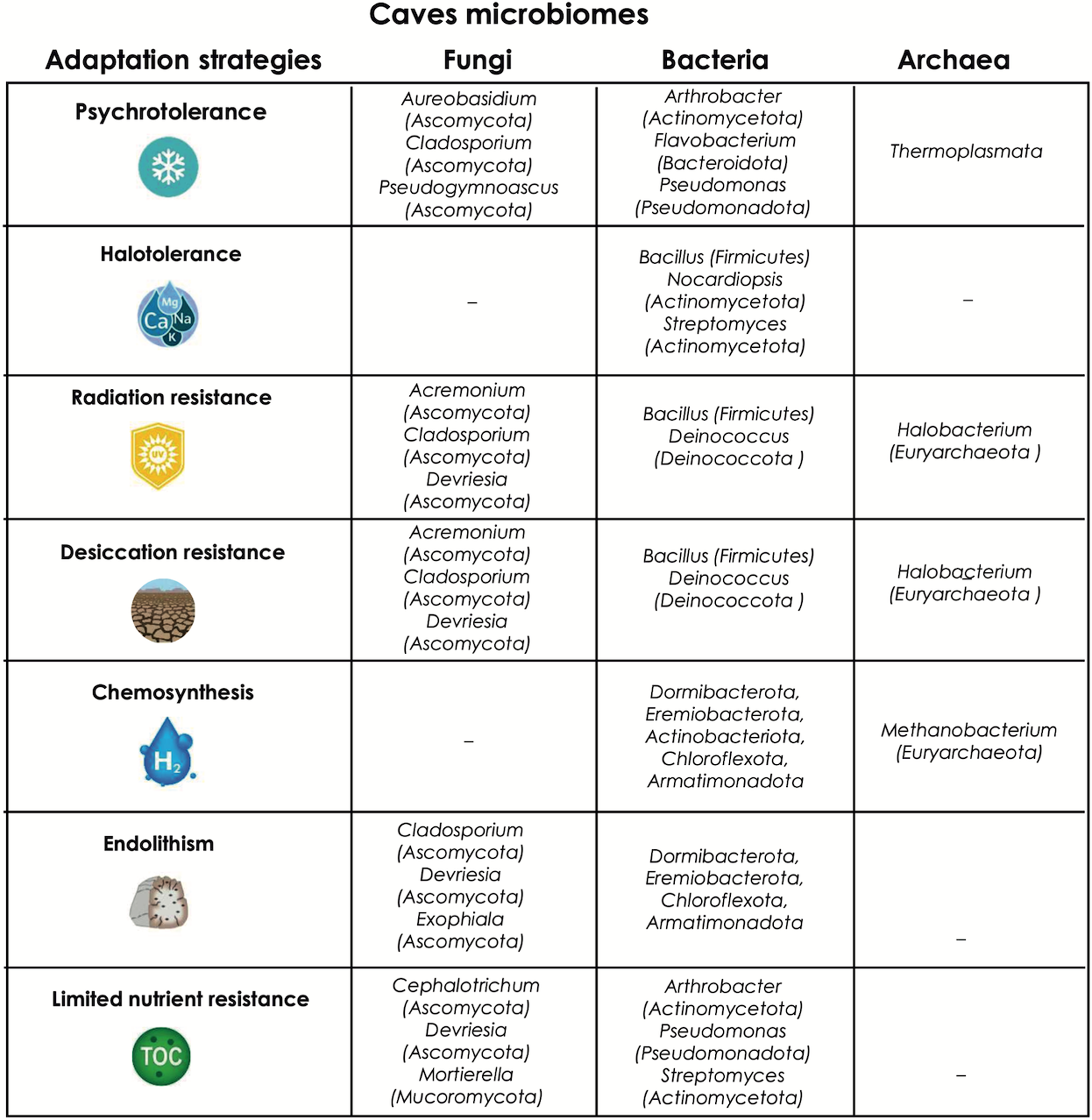
Despite these differences, microbial communities in both environments have adapted to nutrient scarcity, darkness and fluctuating humidity, relying on organic carbon from the surface, trace gases, ammonia, nitrite and sulfide for survival (Luis-Vargas et al., Reference Nayeli Luis-Vargas, Webb, White and Bay2024; Bay et al., Reference Bay, Ni, Lappan, Leung, Wong, Holland and Greening2024). These adaptations, including chemolithotrophy, biofilm formation and endolithic colonization, highlight the potential for microbial life in Martian caves, where similar constraints exist. Additionally, cave microbes exhibit resistance to desiccation, radiation and temperature variations, making them valuable analogs for extraterrestrial life (Boston et al., Reference Boston, Spilde, Northup, Melin, Soroka, Kleina, Lavoie, Hose, Mallory, Dahm, Crossey and Schelble2004; Northup et al., Reference Northup, Melim, Spilde, Hathaway, Garcia, Moya and Riquelme2011; Léveillé and Datta, Reference Léveillé and Datta2010). In the following parts, we briefly summarize the different strategies adopted by microbial communities to survive caves’ environmental conditions (Figure 7).
Adaptation strategies of extremophilic microorganisms in subsurface and extreme environments. The table summarizes key adaptive strategies employed by fungi, bacteria and archaea. Microbial taxa are listed according to their respective domain and associated adaptation mechanisms.
Psychrophiles and halophiles in subsurface environments
One of the most significant adaptations observed in cave environments is the ability of microbes to survive in permanently cold and hypersaline conditions, which are directly relevant to Martian analog environments. In ice caves such as those found in Antarctica and Greenland, psychrophilic fungi, bacteria and archaea thrive in permanently frozen conditions, demonstrating metabolic activity at subzero temperatures (Connell and Staudigel, Reference Connell and Staudigel2013; Tebo et al., Reference Tebo, Davis, Anitori, Connell, Schiffman and Staudigel2015; Kelly et al., Reference Kelly, Rivett, Pakostova, Creer, Cotterell and Johnson2023). Many of these microbes rely on antifreeze proteins and cryoprotectants to prevent cellular damage caused by ice crystal formation. Likewise, halophilic microbes, such as those found in hypersaline cave lakes, can tolerate extreme osmotic stress by accumulating compatible solutes to maintain cellular integrity (Hallsworth et al., Reference Hallsworth, Koop, Dallas, Zorzano, Burkhardt, Golyshina and McKay2021).
The relevance of low temperature resistance to the life in underground habitats was emphasized by the high frequency of isolates psychrophilic/psychrotolerant microbial strains, belonging to the bacterial genera Pseudomonas, Arthrobacter and Bacillus and to the fungal genera Aureobasidium, Cladosporium and Pseudogymnoascus, regardless of geographic and climatic location of caves surveyed (Burow et al., Reference Burow, Grawunder, Harpke, Pietschmann, Ehrhardt, Wagner and Kothe2019; Poli et al., Reference Poli, Zanellati, Piano, Biagioli, Coleine, Nicolosi and Varese2024; Rusakova et al., Reference Rusakova, Sidorenko and Kim2024). However, the presence of some genera, particularly ubiquitous laboratories and environmental taxa such as Pseudomonas and Bacillus, may indicate potential contamination and should therefore be interpreted with caution.
These adaptations are particularly relevant for Mars, where subsurface brines have been detected, and cave environments may contain pockets of liquid water that intermittently become available for microbial metabolism (Ojha et al., Reference Ojha, Wilhelm, Murchie, McEwen, Wray, Hanley and Chojnacki2015).
Chemolithotrophic life and subsurface ecosystems
Chemolithotrophy is one of the most significant metabolic strategies employed by cave-dwelling microbes, allowing them to obtain energy from the oxidation of inorganic compounds rather than relying on sunlight or organic matter. In sulfidic and iron-rich caves, microbial communities commonly rely on sulfur oxidation, iron oxidation and manganese reduction to drive energy metabolism. For example, bacteria such as Beggiatoa and Desulfovibrio thrive in sulfur-rich caves like Cueva de Villa Luz, where they metabolize hydrogen sulfide, producing biomineralized deposits (Northup et al., Reference Northup DE, Lavoie2001; Hedrich et al., Reference Hedrich and Schippers2021). Similarly, Fe/Mn bacteria, including Acidithiobacillus ferrooxidans and Leptospirillum spp., dominate acidic cave systems such as the Rio Tinto caves in Spain, where they use iron oxidation to generate energy under extreme pH conditions (Jones et al., Reference Jones, Schaperdoth, Northup, Gómez-Cruz and Macalady2023; Reference Jones, Schaperdoth and Macalady2014; Reference Jones, Schaperdoth and Macalady2016; Martin-Pozas et al., 2023; Kelly et al., Reference Kelly, Rivett, Pakostova, Creer, Cotterell and Johnson2023). Carmichael et al. (Reference Carmichael, Carmichael, Santelli, Strom and Bräuer2013) suggest that a unique consortia of Mn(II)-oxidizing bacteria dominates the environment of the predominantly epigenic cave systems of the upper Tennessee River Basin (USA) also promoting biomineralization processes and playing an important role in the formation of cave ferromanganese deposits.
Beyond sulfur, iron and manganese cycling, nitrogen-based chemolithotrophy also plays a significant role in cave ecosystems. Nitrifying bacteria, such as those described in metagenomic studies of microbial slime communities, have been shown to drive inorganic nitrogen metabolism in cave environments (Tetu et al., Reference Tetu2013; Ortiz et al., Reference Ortiz, Legatzki, Neilson, Fryslie, Nelson, Wing and Maier2014). In addition, sulfide-oxidizing bacteria form the foundation of chemoautotrophic food webs in sulfidic caves, as demonstrated in the Movile Cave ecosystem (Sarbu et al., Reference Sarbu, Kane and Kinkle1996; Chen et al., Reference Chen2009; Nicolosi et al., Reference Nicolosi, Galdenzi, Messina, Miller, Petralia, Sarbu and Isaia2022). Methanotrophy represents yet another key metabolic pathway in subterranean systems. Cave-dwelling methanotrophs, such as those detected in limestone caves and tropical karst systems, contribute to methane depletion and atmospheric methane oxidation (Waring et al., Reference Waring2017; Nguyễn-Thuỳ et al., Reference Nguyễn-Thuỳ2017; Cheng et al., Reference Cheng2021).
These diverse metabolic strategies underscore the remarkable adaptability of cave microbial communities to extreme environments. In particular, nitrifiers, sulfide oxidizers and methanotrophs not only sustain subsurface ecosystems in the absence of light but also provide valuable insights into analogous biogeochemical processes that may occur on other planetary bodies. Given that Mars hosts extensive iron oxide and sulfate deposits, along with potential atmospheric methane, these metabolic pathways serve as key models for identifying biosignatures and developing strategies for extraterrestrial life detection.
Endolithic communities
Endolithic organisms are microbes that inhabit the interior of rocks thriving in environments previously considered inhospitable to life. These organisms include a diverse array of life forms such as bacteria, fungi, algae, lichens and viruses (Friedmann, Reference Friedmann1982; Archer et al., Reference Archer, De los Ríos, Lee, Niederberger, Cary, Coyne and Pointing2017; Ettinger et al., Reference Ettinger, Saunders, Selbmann, Delgado-Baquerizo, Donati, Albanese and Coleine2023; Coleine et al., Reference Coleine, Biagioli, de Vera, Onofri and Selbmann2021, Reference Coleine, Albanese, Ray, Delgado-Baquerizo, Stajich, Williams and Selbmann2024). They have been discovered in various harsh settings, including the hyper-arid Atacama Desert and the McMurdo Dry Valleys in Antarctica. Their ability to survive in such extreme conditions has made them subjects of interest in astrobiology, as they may serve as analogs for potential life on other planets (Meslier and DiRuggiero, Reference Meslier and DiRuggiero2019).
Endolithic colonization is another survival strategy in extreme cave environments. These microbes have been documented in deep karst systems, lava tubes and even Antarctic ice caves, where they survive by accessing trace amounts of water and nutrients within the rock matrix (Wierzchos et al., Reference Wierzchos, Davila, Artieda, Cámara-Gallego, de los Ríos, Nealson and Ascaso2013; Coleine et al., Reference Coleine, Biagioli, de Vera, Onofri and Selbmann2021; Rhind et al., 2024). For example, melanized rock-inhabiting fungi belonging to the genera Exophiala, Devriesia and Cladosporium, were widely recorded in subterranean habitats across multiple substrates such as sediments, walls and speleothems and also recognized among the dominant taxa in caves worldwide (Liu et al., 2022; Biagioli et al., Reference Biagioli, Coleine, Delgado-Baquerizo, Feng, Saiz-Jimenez and Selbmann2024). These microbes exhibit slow growth rates but high resilience to extreme environmental conditions (Ertekin et al., Reference Ertekin, Meslier, Browning, Treadgold and DiRuggiero2021; Perez-Fernandez et al., Reference Perez-Fernandez, Wilburn, Davila and DiRuggiero2022). Recent studies have revealed that many of these endolithic microorganisms can oxidize trace atmospheric gases such as hydrogen (H2) and carbon monoxide (CO) to obtain energy, a process known as atmospheric chemosynthesis (Greening and Grinter, Reference Greening and Grinter2022). This metabolic strategy enables them to survive in nutrient-poor environments by utilizing high-affinity enzymes to extract energy from these gases (Coleine et al., Reference Coleine, Albanese, Ray, Delgado-Baquerizo, Stajich, Williams and Selbmann2024; Williams et al., Reference Williams, Allen, Ray, Benaud, Chelliah, Albanese and Ferrari2024). Their ability to survive in nutrient-poor, radiation-exposed habitats (Sajjad et al., Reference Sajjad, Ilahi, Kang, Bahadur, Zada and Iqbal2022; Coleine et al., Reference Coleine, Albanese, Ray, Delgado-Baquerizo, Stajich, Williams and Selbmann2024; Williams et al., Reference Williams, Allen, Ray, Benaud, Chelliah, Albanese and Ferrari2024) makes them ideal analogs for potential microbial life in Martian subsurface environments, where endolithic niches could provide refuge from surface radiation and desiccation (McNamara et al., Reference McNamara, Perry, Bearce, Hernandez-Duque and Mitchell2006; Popović et al., Reference Popović, Nikolić, Predojević, Jakovljevic, Rađa, Anđelković and Subakov Simic2021).
Biofilms
Another crucial adaptation seen in cave microbiomes is the formation of biofilms and microbial mats, which allow microbial communities to adhere to mineral surfaces and collectively withstand environmental stresses (Banerjee et al., Reference Banerjee and Joshi2013; Popović et al., Reference Popović, Subakov Simić, Stupar, Unković, Predojević, Jovanović and Ljaljević Grbić2015; Figure 5). Biofilms create microenvironments that can retain moisture, concentrate nutrients and offer protection against desiccation, radiation and temperature fluctuations. In terrestrial caves, biofilms contribute to the weathering of rock surfaces, often leading to the precipitation of minerals that can serve as biosignatures over geological timescales (Pfendler et al., Reference Pfendler, Karimi, Maron, Ciadamidaro, Valot, Bousta and Aleya2018). The presence of similar biomineralized structures in Martian lava tubes could indicate past or present microbial activity, making biofilms a key target for future astrobiological missions.
Resistance to desiccation, radiation and limited nutrients
Microbial resistance to desiccation is a well-established survival strategy in cave environments. Although resistance to ionizing radiation is not typically selected for in Earth’s caves, given their natural shielding, it is highly relevant when considering potential microbial life in Martian caves. Such resistance may be necessary in shallow or partially exposed systems or retained as an ancestral trait from more irradiated environments. Many microbes exhibit robust DNA repair mechanisms and protective cellular structures that enable them to endure prolonged periods of dryness and exposure to high-energy radiation. On Earth, extremo-tolerant and extremophilic organisms like Deinococcus radiodurans, known for their resistance to radiation, desiccation and other harsh conditions, exemplify the resilience of life in extreme environments. Studies show that desiccated and frozen cells of D. radiodurans can withstand radiation doses up to 140 kGy, suggesting potential survival strategies for microbes in Martian subsurface environments (Slade et al., Reference Slade and Radman2011; Sudharsan et al., Reference Sudharsan, Prasad, Chakraborty and Rajendrasozhan2022; Liu et al., Reference Liu, Li and Zhang2023). Certain cryptoendolithic fungi such as Cryomyces antarcticus and C. minteri, found in Antarctic deserts, display high resistance to UV radiation and desiccation (Pacelli et al., Reference Pacelli, Selbmann, Zucconi, Coleine, de Vera, Rabbow and Onofri2019; Gomez-Gutierrrez et al., Reference Gomez-Gutierrrez, Sic-Hernandez, Haridas, LaButti, Eichenberger, Kaur and Grigoriev2024). Other extremophiles, like Halobacterium salinarum, survive intense UV exposure through efficient DNA repair and protective pigments (Baati et al., Reference Baati, Siala, Azri, Ammar, Dunlap and Trigui2022; Bouhamed et al., Reference Bouhamed, Chaari, Baati, Zouari and Ammar2024). Similarly, desiccation-resistant bacteria found in deep karst systems provide clues about microbial persistence in the dry subsurface of Mars (Coleine and Delgado-Baquerizo, Reference Coleine and Delgado-Baquerizo2022). These findings suggest that if microbial life exists on Mars, it may employ similar strategies to survive in subsurface caves, where water availability is intermittent, and radiation exposure is reduced.
In addition to desiccation and radiation tolerance, oligotrophy-resistance represents a crucial microbial adaptation for survival in nutrient-poor cave systems. Many cave-dwelling microbes have evolved metabolic flexibility, slow growth rates and efficient nutrient recycling mechanisms that allow them to persist under persistent energy limitations. For instance, microbial communities colonizing weathered rocks in subsurface karst caves exhibit syntrophic interactions and specialized metabolic pathways to exploit scarce resources (Wang et al., Reference Wang, Cheng, Wang, Zhou, Liu and Tuovinen2022). Similarly, oligotrophic fungi isolated from carbonate caves, including newly described Cephalotrichum species, demonstrate the ability to thrive in carbon- and nitrogen-limited environments (Jiang et al., Reference Jiang, Cai and Liu2017). These adaptations are highly relevant when considering the possibility of life in Martian caves, where both radiation protection and extreme oligotrophy would be defining constraints. The convergence of desiccation, radiation and oligotrophy-resistance strategies reinforces the potential for microbial survival in extraterrestrial subsurface niches.
Anthropogenic impacts such as tourism, artificial lighting and pollution have also been shown to alter microbial diversity, introducing opportunistic species and disrupting native microbial assemblages (Biagioli et al., Reference Biagioli, Coleine, Piano, Nicolosi, Poli, Prigione and Selbmann2023; Hathaway et al., Reference Hathaway, Spilde and Northup2024; Zerboni et al., Reference Zerboni, Villa, Wu, Solomon, Trentini, Rizzi, Cappitelli and Gallinaro2022). Understanding how microbial communities respond to these stressors is crucial, as human exploration of Mars could introduce Earth microbes that may compete with or obscure indigenous Martian life.
Preservation of biosignatures in caves
Caves provide an exceptional environment for the long-term preservation of biosignatures, acting as natural time capsules that protect microbial fossils from external degradation. The most suitable systems for biosignature preservation are fossil/inactive karst systems, where water flowing and percolation are limited or absent, and lava tubes, which display minimal interaction with the outer environment. Due to their microclimatic conditions, including minimal exposure to ultraviolet radiation, low rates of sedimentary disturbance and geochemically dynamic mineral surfaces, caves offer one of the most promising terrestrial environments for studying biosignature formation. On Mars, subsurface caves may serve a similar role by shielding potential organic material and microbial remnants from the harsh surface conditions, including cosmic radiation, oxidation and extreme temperature fluctuations (Dartnell et al., Reference Dartnell, Desorgher, Ward and Coates2007). Understanding the processes of biosignature preservation in Earth’s caves is therefore critical for developing life-detection strategies in Martian lava tubes.
One of the primary mechanisms through which biosignatures are preserved in caves is mineral entrapment and biomineralization, particularly through the deposition of silica, sulfates and iron oxides. These mineral matrices can encapsulate microbial cells, biofilms and extracellular polymeric substances, creating fossilized structures that can persist for thousands to millions of years (Dubois et al., Reference Dubois, Quinif, Baele, Barriquand, Bini, Bruxelles and Vergari2014; Melim et al., Reference Melim, Northup, Boston and Spilde2016). For instance, the stromatolite-like speleothems of Figure 4 likely formed in the Neogene, several million years ago (Zerboni et al., Reference Zerboni, Perego and Cremaschi2015), but at the microscale still highlights the occurrence of features that can be interpreted as extracellular iron oxide biominerals like those described in different environmental contexts (Cockell et al., Reference Cockell, Pybus, Olsson-Francis, Kelly, Petley, Rosser, Howard and Mosselmans2011; Chiu et al., Reference Chiu, Kato, McAllister, Field and Chan2017). Fe- and Mn-coating along cave walls entomb and shelter trace of biological activities as much as rock varnish do in open air environments (Zerboni, Reference Zerboni2008). Silica precipitation, for example, has been shown to rapidly entomb microbial filaments and organic compounds, preserving fine-scale morphological and chemical features that can serve as indicators of past life. Similar silica-rich deposits have been identified in Martian surface sediments and hydrothermal regions, making silica an important target for biosignature detection (Brolly et al., Reference Brolly, Parnell and Bowden2019). Sulfate deposits, particularly those associated with sulfidic caves and hydrothermal systems, provide another critical medium for microbial fossilization. Sulfur-metabolizing bacteria, such as those found in Cueva de Villa Luz, interact with dissolved sulfates and hydrogen sulfide to form gypsum and other sulfate minerals, effectively embedding microbial structures within the rock record (Jones et al., Reference Jones, Schaperdoth, Northup, Gómez-Cruz and Macalady2023). On Mars, sulfate-rich outcrops identified by orbital spectrometers suggest that similar biomineralization processes may have occurred in ancient aqueous environments, providing potential analogs for preserved biosignatures (Antunes et al., Reference Antunes, Lau Vetter, Flannery and Li2023).
Iron oxides and iron-rich sediments are also significant contributors to biosignature preservation in caves. In systems such as the Rio Tinto caves in Spain, microbial communities involved in iron oxidation generate extensive iron-rich biofilms, which can become lithified over time, preserving microbial textures and molecular biosignatures (Olías et al., Reference Olías and Nieto2015; Nicholas et al., Reference Nicholas and Thomas2022). Given that Mars’ surface is dominated by iron oxides, it is plausible that microbial life, if it existed in Martian caves, could have left similar biogeochemical signatures in iron-rich deposits (Kelly et al., Reference Kelly, Rivett, Pakostova, Creer, Cotterell and Johnson2023). The identification of hematite and goethite on Mars further supports the possibility that microbial iron oxidation may have played a role in the planet’s early geochemical cycles (Chen et al., Reference Chen, Heaney, Post, Fischer, Eng and Stubbs2021; Jiang et al., Reference Jiang, Liu, Roberts, Dekkers, Barrón, Torrent and Li2022).
In the context of extinct life, microbial fossils and preserved biosignatures in Earth’s caves serve as models for potential evidence of past life on Mars (Uckert et al., Reference Uckert, Chanover, Getty, Voelz, Brinckerhoff, McMillan and Chavez2017). Microbial filaments preserved in speleothems, iron oxide deposits and stromatolitic structures in terrestrial caves indicate that past microbial activity can leave long-lasting traces in mineral formations. The presence of silica-rich deposits in Martian caves, like those found in Yellowstone’s hot spring-associated caves and hydrothermal systems (Brolly et al., Reference Brolly, Parnell and Bowden2019; Çolak et al., Reference Çolak and Güngör2022), suggests that mineralized biosignatures could be preserved within Martian lava tubes and subsurface cavities.
Taken together, these examples illustrate how mineral interactions with microbial communities in caves create lasting records of biological activity. Future exploration efforts should prioritize the investigation of silica, sulfate and iron-rich deposits within Martian lava tubes, as these materials have demonstrated a strong capacity for preserving microbial structures and molecular biosignatures over geological timescales. The integration of spectroscopic, microscopic and isotopic techniques in upcoming Mars missions will be essential for distinguishing abiotic mineral formations from potential biosignatures, ultimately guiding the search for extraterrestrial life.
Yet, in addition to morphological and mineralogical traces, recent developments in metagenomics, metabolomics and lipidomics offer promising avenues for identifying molecular biosignatures in low-biomass or highly mineralized environments (Azua-Bustos et al., Reference Azua-Bustos, Fairén, González-Silva, Prieto-Ballesteros, Carrizo, Sánchez-García, Parro, Fernández-Martínez, Escudero, Muñoz-Iglesias, Fernández-Sampedro, Molina, García Villadangos, Moreno-Paz, Wierzchos, Ascaso, Fornaro, Brucato, Poggiali, Manrique, Veneranda, López-Reyes, Sanz-Arranz, Rull, Ollila, Wiens, Reyes-Newell, Clegg, Millan, Johnson, McIntosh, Szopa, Freissinet, Sekine, Fukushi, Morida, Inoue, Sakuma and Rampe2023). Integrating these -omics approaches into planetary instrumentation could greatly enhance our ability to detect subtle or cryptic forms of life in Martian subsurface habitats (Rutter et al., Reference Rutter, Barker, Bezdan, Cope, Costes, Degoricija and Muratani2020).
Future research and exploration strategies
Despite significant advances in understanding terrestrial cave microbiomes and their astrobiological implications, several critical knowledge gaps remain. One of the main unresolved questions concerns the true extent of microbial diversity within these ecosystems, particularly in oligotrophic environments where microbial life is thought to persist at the limits of habitability. Current studies have provided insights into chemolithotrophic metabolism, biofilm formation and endolithic colonization, yet a comprehensive characterization of microbial functional diversity, community interactions and long-term survival mechanisms in caves is still lacking. Additionally, while research has demonstrated that microbial life can thrive in extreme cave environments on Earth, it remains uncertain whether Martian caves possess comparable environmental conditions that would allow for the persistence of life. Factors such as microclimatic stability, humidity retention and subsurface geochemical gradients on Mars require further investigation to assess their potential for supporting microbial ecosystems.
Given that multiple lines of evidence suggest that the Martian surface underwent several warm cycles, characterized by increases and decreases in water availability and consequent phases of hydration of the surface and adjacent areas (Wordsworth et al., Reference Wordsworth, Knoll, Hurowitz, Baum, Ehlmann, Head and Steakley2021; Rapin et al., Reference Rapin, Dromart, Clark, Schieber, Kite, Kah, Thompson, Gasnault, Lasue, Meslin, Gasda and Lanza2023; Kite and Conway, Reference Kite and Conway2024; Adams et al., Reference Adams, Scheucher, Hu, Ehlmann, Thomas, Wordsworth, Scheller, Lillis, Smith, Rauer and Yung2025), it is important to highlight the potentially special role of subsurface cavities. While overall increases in surface water availability may have acted as a booster for biological activity, at least in specific regions, the transition to hyperarid conditions must instead have imposed severe ecological constraints on life. By contrast, because subsurface cavities are environments more resilient to surface climatic fluctuations (Mammola et al., Reference Mammola, Piano, Cardoso, Vernon, Domínguez-Villar, Culver, Pipan and Isaia2019), they may also have functioned on Mars as ecological refugia or even as true oases, where the concentration and persistence of residual moisture could have enabled microbial communities to develop adaptive strategies. For this reason, efforts should focus on the potential to identify biological activity or its biomineralized traces in subaerial ‘oasis’ environments. Given the challenges of exploring subterranean environments on Mars – which is even more difficult than exploring its surface –, robotic missions for subsurface life detection are becoming a key focus of planetary exploration (Olsson-Francis et al., Reference Olsson-Francis, Doran, Ilyin, Raulin, Rettberg, Kminek and Zaitsev2023; Morrell et al., Reference Morrell, da Silva, Kaufmann, Moon, Kim, Lei and Blank2024). Several recent and upcoming missions aim to develop the technology necessary to explore Martian caves and lava tubes (e.g., Domínguez et al., Reference Domínguez, Pérez-del-Pulgar, Paz-Delgado, Polisanò, Babel, Germa, Dragomir, Carlietti, Berthet, Danté and Kirchner2025), providing crucial data on their habitability and potential for biosignature preservation (Pires et al., Reference Pires, Moura, Nunes, Barcelos, Caetano, Quinteiro and Chaminé2023; Morrell et al., Reference Morrell, da Silva, Kaufmann, Moon, Kim, Lei and Blank2024). The NASA BRAILLE (Biologic and Resource Analog Investigations in Low Light Environments) project has tested autonomous robotic systems in terrestrial caves, demonstrating the feasibility of machine learning-assisted exploration and biosignature detection in dark and complex environments (Blank, Reference Blank2023). Similarly, ESA’s ExoMars rover, equipped with a subsurface drill, aims to search for organic molecules and potential biosignatures in the Martian regolith, paving the way for future cave exploration missions (Altieri et al., Reference Altieri, Frigeri, Lavagna, Le Gall, Nikiforov, Stoker and Vago2023). While current technology is primarily designed for surface and near-subsurface investigations, future missions will need to incorporate advanced autonomous navigation, robotic mobility and subsurface sampling capabilities to access deeper cave systems on Mars.
Beyond navigation challenges, the detection and characterization of biosignatures within Martian caves will require sophisticated instrumentation capable of distinguishing biological materials from abiotic geochemical signatures. Traditional life-detection methods, such as gas chromatography-mass spectrometry (GC-MS) and Raman spectroscopy, have proven effective for organic molecule detection (Baqué et al., Reference Baqué, Backhaus, Meeßen, Hanke, Böttger, Ramkissoon and de Vera2022; Rull et al., Reference Rull, Veneranda, Manrique-Martinez, Sanz-Arranz, Saiz, Medina and Lopez-Reyes2022; Ansari et al., Reference Ansari2023) but may not be sufficient for identifying subtle or fossilized biosignatures in mineral-rich cave environments. Novel analytical techniques, including amino acid chirality analysis, isotopic fractionation studies and in situ fluorescence-based biofilm detection, could enhance the ability of future missions to identify potential biosignatures in Martian lava tubes. Additionally, the development of drilling and sampling technologies that minimize contamination risks will be essential for ensuring the integrity of collected samples, particularly for future sample return missions. This point is of critical importance, as it is highly probable that Martian caves also preserve vestiges of a previous phase of biological colonization preserved as biomineralization. It is therefore necessary to expand current capabilities to distinguish between products of microbial metabolism and those of authigenic precipitation, starting from the study of terrestrial analogues.
In the coming decades, a multidisciplinary approach combining microbiology, geology, robotics and planetary science will be necessary to advance our understanding of cave environments as potential extraterrestrial habitats. Future Mars exploration missions should prioritize subsurface investigations, with a focus on detecting and characterizing biosignatures within Martian lava tubes and other protected subsurface structures (Çolak et al., Reference Çolak and Güngör2022; Wynne et al., Reference Wynne, Titus, Agha-Mohammadi, Azua-Bustos, Boston, de León and Williams2022). By leveraging insights gained from terrestrial cave research, we can refine exploration strategies and improve the likelihood of detecting signs of life beyond Earth. The integration of autonomous robotic exploration, high-resolution life-detection instruments and comparative studies of terrestrial analogs will be crucial in shaping the future of astrobiological investigations on Mars.
Concluding remarks
The study of terrestrial caves provides critical insights into the potential habitability of Martian subsurface environments, highlighting their role as natural refuges for microbial life and reservoirs for biosignatures. Research on cave microbiomes has demonstrated that extremophilic organisms can thrive in conditions characterized by nutrient scarcity, darkness and geochemical gradients, employing metabolic strategies such as chemolithotrophy, endolithic colonization and biofilm formation. These adaptations offer compelling analogs for potential life in Martian caves, where similar environmental conditions suggest that subsurface microbial ecosystems could exist. Furthermore, mineralogical processes observed in Earth’s caves, including the biomineralization of silica, sulfates and iron oxides, provide key mechanisms for biosignature preservation, reinforcing the importance of cave environments in the search for past or present extraterrestrial life.
Given their astrobiological significance, Martian caves should be prioritized in life-detection strategies for future exploration missions. Unlike the planet’s surface, where organic molecules are rapidly degraded by radiation and oxidative processes, subsurface environments offer greater protection and a higher likelihood of preserving biosignatures over geological timescales. By studying how microbial communities interact with mineral substrates in terrestrial caves, researchers can refine their approaches for detecting and interpreting potential biosignatures in Martian lava tubes.
The exploration of subsurface environments represents a new frontier in astrobiology, offering one of the most promising opportunities to answer the fundamental question of whether life exists or ever existed, beyond our planet. By leveraging the knowledge gained from terrestrial cave research, we can refine our strategies for planetary exploration, improving our ability to detect and interpret biosignatures on Mars and, ultimately, across the Solar System.
Acknowledgments
C.C. is supported by the European Commission under the H2020 Marie Skłodowska-Curie Actions Grant Agreement No. 702057 (DRYLIFE). S.K.B. is supported by an Australian Research Council Discovery Early Career Research award (DE230101346). This work is part of the activities supported by the MUR through the project “Dipartimenti di Eccellenza 2023–2027” (WP3) awarded to the Dipartimento di Scienze della Terra “Ardito Desio” of the Università degli Studi di Milano. R.S. Azzoni, M. Cremaschi and L. Forti are acknowledge for sharing pictures of terrestrial caves.
Author contributions
Federico Biagioli: conceptualization, visualization, writing – review and editing. Sean K. Bay: visualization, writing – review and editing. Andrea Zerboni; resources, funding acquisition, visualization, writing – review and editing. Claudia Coleine: conceptualization, resources, supervision, funding acquisition, visualization, writing – original draft, writing – review and editing.
Competing interests
The authors declare that they have no known competing interests.


 Open access

