




1 Introduction
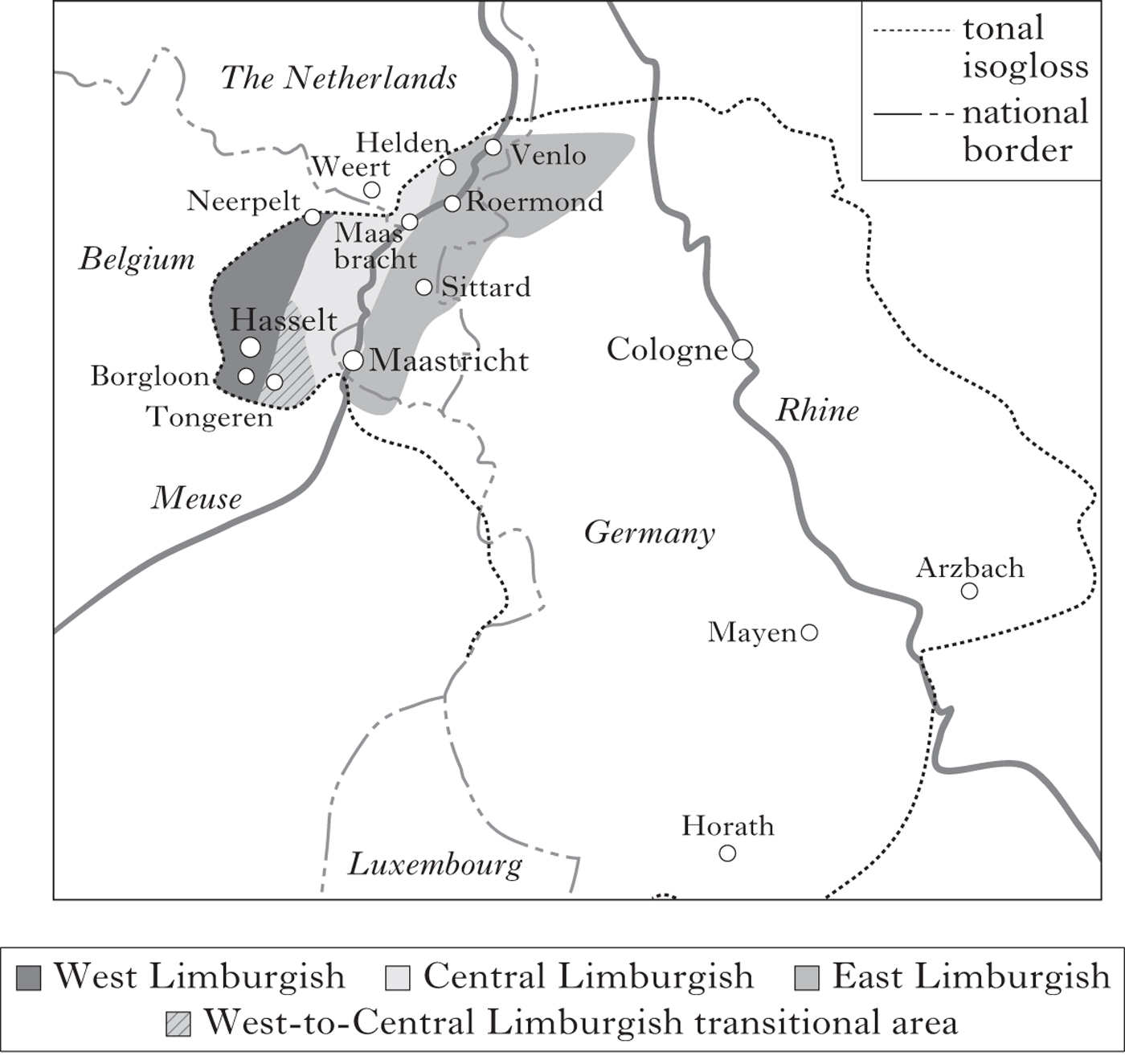
Köhnlein (Reference Köhnlein2016) argues that the surface tone contrast in Franconian, which is spoken in the area shown in the map in Fig. 1, is underlyingly a foot contrast. This reply argues that an underlying tone contrast provides a better basis for describing the facts. In the dialects in question, the syllable with main stress, typically the final or penultimate, displays a surface pitch contrast, usually referred to as Accent 1 vs. Accent 2. This is illustrated in (1) for the Mayen dialect (Schmidt Reference Schmidt1986, Köhnlein Reference Köhnlein2016).Footnote 1
(1)


Map of the relevant tonal area, based on Goossens (1965: map 2).
The shapes of the F0 contours for the two categories generally depend on the identity of the intonational tones in the syllable. In many dialects, Accent 1 has an F0 fall in the rhyme of the stressed syllable in internal positions in a declarative intonation phrase (IP), contrasting with a high F0 for Accent 2, while under interrogative intonation the contrast is between an F0 rise and a low F0 respectively. Across the dialects, in particular in the periphery of the tone area, there is considerable variation in the number and shape of the F0 contours, in part depending on the complexity of the intonation system (e.g. Gussenhoven & van der Vliet Reference Gussenhoven and van der Vliet1999, Peters Reference Peters2008, Köhnlein Reference Köhnlein2011).
2 Tonal and metrical analyses
Tonal analyses of the distinction exemplified in (1) are formulated in terms of a lexical tone in words with Accent 2 interacting with the string of intonational tones, whereas metrical analyses treat the difference as a matter of how intonational tones are associated and/or aligned with syllables. Köhnlein (Reference Köhnlein2011, Reference Köhnlein2016) defends his analysis mainly on the basis of the distribution of phonological and morphological constituents (e.g. his argument that Accent 1 must be the morphologically and phonologically more elaborate, or ‘marked’, form). We defend the tonal approach on two grounds. First, unlike Köhnlein's metrically derived tonal analysis, it requires no novel theoretical devices. Second, we argue that the advantages that Köhnlein attributes to his analysis are not advantages at all.
2.1 Tonal analyses
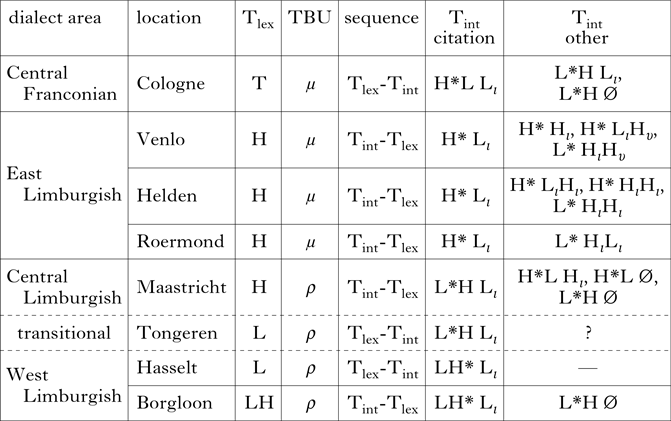
With the exception of Hermans (Reference Hermans1994: 286) and Bruce & Hermans (Reference Bruce and Hermans1999), who assume a privative tone for Accent 1, tonal analyses of Franconian have postulated a privative tone in the stressed syllable to represent Accent 2. Analyses of the pitch contours of sentences without Accent-2 words cover sentences containing Accent-2 words under the assumption that each of these contributes a tone or tones. Beyond this, the tone grammars of the dialects vary considerably. East Limburgish and the dialects of Maastricht and Cologne have phonological rules that alter the underlying representations, while neutralisations occur in non-focal sentence-internal positions in East Limburgish. Variation is also found in the identity of the lexical tone and the TBU. The TBU is either the mora (μ) or the rhyme (ρ), as shown in Table I. The dialects also vary in the sequencing of the intonational pitch accent and the lexical tone in the stressed syllable, and in the number of nuclear intonation melodies. Additionally, the opposition is confined to stressed syllables with two sonorant moras, except in West Limburgish, where it also occurs in stressed syllables with a single sonorant mora, as in /bɔs1/ ‘forest’ vs. /bɔs2/ ‘wallet’ (Peters Reference Peters2008, Goossens Reference Goossens2017). Schmidt (Reference Schmidt1986) exhaustively describes the data for the dialect of Mayen, which have not been analysed autosegmentally, and are not included in Table I.
Phonological parameters in analyses with a privative lexical tone contrast (Tlex = Accent 2; Tint = nuclear intonation melodies; μ = mora; ρ = rhyme; T* = tone of pitch accent; T in Tlex column = lexical tone; T in Tint columns = second tone of pitch accent, also known as trailing tone; Tι = boundary tone of the Intonational Phrase (IP); Tv = boundary tone of the Utterance Phrase (UP)). Sources: Cologne: Gussenhoven & Peters (2004), Peters (2006); Venlo: Gussenhoven & van der Vliet (1999), Fournier (2008), Gussenhoven (2014); Helden: Gussenhoven & van den Beuken (2012), Gussenhoven (2014); Roermond: Gussenhoven (2000); Maastricht: Gussenhoven (2012b); Tongeren: Heijmans (1999), Gussenhoven (2004); Hasselt: Peters (2008); Borgloon: Peters (2007).
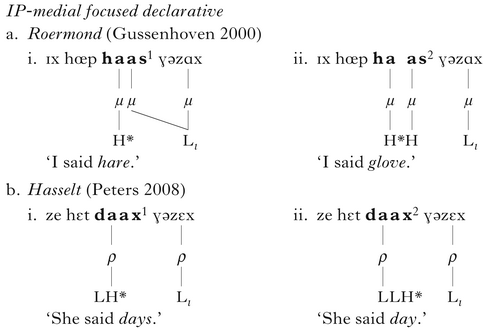
Examples (2a.i) and (ii) give representations of Accent 1 and Accent 2 respectively for focused non-final syllables in the moraic dialect of Roermond, in which the lexical H is aligned to the right of the intonational pitch accent (H* in this example), while (2b) does the same for the syllabic dialect of Hasselt, in which the lexical tone L is aligned to the left of the intonational pitch accent (always LH* in this dialect). In (2a.i), the boundary tone associates with the empty second mora in haas 1; in (b.ii), lexical H pre-empts the association of H* with the rhyme daax 2. The blocking of the association of the starred tone by a lexical tone follows the analyses of Swedish in Bruce (Reference Bruce1977) and Riad (Reference Riad2014: 254). Here, the ‘star’ notation functions as an instruction to associate the tone concerned with a ‘starred’ rhyme, i.e. an accented syllable (in bold), while the association line represents the actual association (Goldsmith Reference Goldsmith1976).Footnote 2 As in Pierrehumbert's (Reference Pierrehumbert1980) analysis of English, all tones in the surface representation, whether floating or associated, are pronounced.Footnote 3 References in (2) and similar examples are to tonal analyses.
(2)
2.2 Metrical analyses
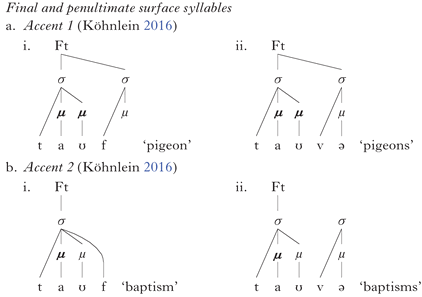
Three analyses involving a metrical contrast underlying the surface tone contrast have been put forward, (i) Hermans & Hinskens (Reference Hermans, Hinskens, Schmidt, Glaser and Frey2010) and Hermans (Reference Hermans2012), (ii) Köhnlein (Reference Köhnlein2016) and (iii) Kehrein (Reference Kehrein, Kehrein, Köhnlein, Boersma and van Oostendorp2018). Of these, (ii) is the most explicit and comprehensive. On the basis of segmental correlates, (i) argues for a distinction between a moraic trochee for Accent 1 and a syllabic trochee for Accent 2, a foot assignment which agrees with (iii), but is the reverse of that proposed in (ii). We will focus on Köhnlein's representations, which have a syllabic trochee for Accent 1, reproduced in (3a.i) and (ii) for words with surface final and penultimate stress respectively. Accent 2 is a moraic trochee, as shown for the equivalent structures in (3b). The weak branch of the foot in (3a.i), a word-final stressed syllable on the surface, has an empty nucleus. It contrasts with a segmentally specified weak syllable in the surface disyllabic foot with Accent 1 in (a.ii) and with an unparsed segmentally specified weak syllable in the surface disyllabic foot with Accent 2 in (b.ii). Word-final syllables with Accent 2 have a word-final monosyllabic moraic trochee (b.i). An important consequence of this analysis is that the two moras in the stressed syllables in (3a) occur in the strong branch of a syllabic trochee, while the equivalent ones in (b) divide up as the strong and weak moras of a moraic trochee. Strong moras are in bold.
(3)
3 Three arguments for the metrical approach
Köhnlein (Reference Köhnlein2016) gives three arguments for the metrical approach, one based on morphological encoding (§3.1), one based on the reinterpretation of durational enhancement features (§3.2.1) and a third based on potential stress-related segmental correlates (§3.2.2).
3.1 Encoding morphological operations
On the basis of the general Germanic pattern in which singular nominatives are base forms and plural forms are derived by suffixation, plural forms with Accent 1 of nouns that have segmentally identical singulars with Accent 2 might be expected to have a phonologically specified suffix that replaces Accent 2 with Accent 1. However, the majority of tonal analyses, including those in Table I, assume that Accent 2 is the privative tone, with Accent 1 being unspecified. Köhnlein's analysis relies on what we will call the Exceptionless Additive Morphology Hypothesis, which holds that every term of a morphological category except the base form has a phonological exponent. Against this background, Köhnlein's argument is that a privative lexical H for Accent 2 reverses the pattern identified at the beginning of this section, because, to derive the plural form, a tone must be deleted from the singular form, as in (2b), involving the removal of L (for this point see also van Oostendorp Reference Oostendorp2005). However, a counterargument to a morphological expression of Accent 1 is that the tonally marked grammatical number distinction does not represent a productive process. There are between 15 (Maastricht) and four (Cologne) tonal minimal pairs like [ʃtaːn1] and [ʃtaːn2] ‘stone.sg ~ pl’ in the dialects listed in Table I, as far as we are aware. In Maastricht, an additional four cases display variation with productive segmentally suffixed plurals, and in Cologne, one such case exists. As in the case of the remnants of umlauted plurals in English (e.g. teeth, geese, feet; lice, mice, dormice), we assume that they do not represent a productive morphological process, and are learned as exceptions to more regular plural formation patterns. For English umlauted plurals, for instance, there have been reports of plural formations like [ˈmaʊsɪz] for mice (e.g. Marcus et al. Reference Marcus, Pinker, Ullman, Hollander, John Rosen, Xu and Clahse1992), but formations like [haɪs] for houses or [miːs] for moose (pl) can only be used facetiously. (We have no similarly anecdotal evidence in the case of the Franconian tonal minimal pairs.) Non-productive cases of subtractive morphology typically arise as a result of phonological changes, as must have happened in cases like French [œf ~ ø] œuf ~ œufs ‘egg.sg ~ pl’ and [ɔs ~ o] os ~ os ‘bone.sg~pl’ (where the lowered vowel in the singular is independently conditioned by the presence of a coda consonant), and more generally in Cushitic, as in Murle onyiit ~ onyii ‘rib.sg ~ pl’, rottin ~ rotti ‘warrior.sg ~ pl’ (Arensen Reference Arensen1982: 40, cited from Payne Reference Payne2006: 45) or Arbore lassan ~ lássa ‘loaf’, nebelin ~ nebel ‘cock ostrich.sg ~ pl’ (Hayward Reference Hayward1984: 159ff, cited from Corbett Reference Corbett2000: 17; Zimmermann Reference Zimmermann2017: ch. 3 provides a discussion of two phonological mechanisms producing subtraction). Exceptional unproductive patterns are typically recessive, in accordance with the assumption that lemmas tend to lose their lexically listed forms over time. The tonally marked plurals are recessive, as is evident not just from their small number, but also from the appearance of alternative plural forms with productive segmental suffixes. The next section briefly considers the difficult question of when exceptional inflected forms of nouns must be assumed to have a phonologically encoded affix.Footnote 4
3.1.1 Extending the database
The problem of the small number of relevant data points may be mitigated by taking into account additional morphological alternations that can be described with the help of the syllabic trochee that determines Accent 1. In this connection, Köhnlein (Reference Köhnlein2016) appeals to the transphonologisation of the Franconian tone contrast as a quantity contrast in the dialect of Weert (Heijmans Reference Heijmans, Fikkert and Jacobs2003), which yields six cases in which the plural has one mora less than the singular in the speech of a male speaker, plus one that has an alternative suffixed plural form. His account attributes the shortened vowels in the plurals to Trochaic Shortening, which is triggered by the empty syllable in (3a.i). That is, in order to account for six exceptional plurals, a typologically unexpected trochaic foot contrast is introduced into the language; notice that there is no other evidence of such shortening in the Weert dialect. On this latter point, Germanic has Trochaic Lengthening (Prokosch's Law; Prokosch Reference Prokosch1939: 160).
There is stronger motivation for Köhnlein's (Reference Köhnlein2018) account of the subtractive plural formation in the tonal dialect of Horath (Reuter Reference Reuter1989). These forms arose mainly in the southern zone of the tonal area (see Bellman et al. Reference Bellmann, Herrgen and Schmidt1997: map 77.1) as a result of deletion of the plosive in a sonorant + plosive coda cluster when it came to be parsed as the onset of an unstressed syllable, as in Arzbach [ˈkindɐ], [ˈhʊndə] > [ˈkinɐ], [ˈhʊnə] ‘children, dogs’ (Köhnlein Reference Köhnlein2018). Subsequent apocope in [ə]-final words gave [ˈkinɐ1], [ˈhʊn1], alongside the surface singulars [ˈkint2], [ˈhʊnt2], with final devoicing. In line with the Exceptionless Additive Morphology Hypothesis, Köhnlein takes the plural suffix to be a syllabic trochee, as in (3a.i), which will override the default foot (3b.i) and cause the final obstruent to be in the onset of a syllable with an empty nucleus, besides creating Accent 1 in the surface word-final syllable. Rather than deleting, which would compromise the Exceptionless Additive Morphology Hypothesis, the consonant merges with the preceding consonant, whereby [+sonorant] provides a stronger feature, thus causing the sonorant to appear on the surface.Footnote 5 Horath has seven singular/plural and 36 nominative singular/dative singular tonal minimal pairs in which the nominative singular has Accent 2 but the dative singular and plural have Accent 1; four words appear in both sets: [ˈbεriʃ2] ‘mountain’, [pεːrt2] ‘horse’, [ʃvain2] ‘boar, pork’ and [vain2] ‘wine’. In addition, there are ten such singular/plural cases in which the vowel is umlauted and two cases with a vowel change from a different source, while there are nine monosyllabic cases of tonally unchanged plurals with a vowel change. In 15 singular/plural cases, the tone contrast is accompanied by subtractive C-deletion as well as a vowel change, of which 13 originate from umlaut. One case, [bum2 ~ baːm1] ‘tree.sg ~ pl’, combines the tonal change, a vowel change and vowel lengthening. There are 24 cases of subtractive datives and five cases of vowel-changed datives not originating from umlaut that also have the tone alternation. In other cases, the nominative and dative forms are identical. In addition, plural suffixes include [-s, -ən, -ər], of which the last two may co-occur with segmental or tonal changes. Our point here is that despite the introduction of a foot contrast into the vocabulary, numerous lexical entries will need to be specified for particular phonological changes which apply to the plural or dative forms.
There are two exceptionless generalisations among these adjustments. First, umlaut never appears in dative singulars. Umlauted vowels are historically due to a fronting of Old High German vowels which were followed by [i j] in an unstressed syllable, found in the plural suffix but not in the dative singular. A second exceptionless generalisation is that consonant deletion in plural forms combines with the umlauted, i.e. front vowel, as well as with Accent 1, while in dative singulars it combines without exception with Accent 1. Historically, the short vowel before CC came to be syllable-final after the plosive deleted in disyllables, as in Horath plurals [ˈkenər] ‘children’, [hen1] (< *[ˈhenə]) ‘dogs’; cf. the singulars [kent2] and [hont2]. In a tonal analysis, the lexical tone (Accent 2) requires a second mora inside the stressed syllable, which is equally true for today's dialects, as illustrated in Horath [ˈɔnət] ‘on it’; cf. [ɔn2] ‘to, on’ (see e.g. Hermans Reference Hermans1985, Schmidt Reference Schmidt1986). When schwa was apocopated and the sonorant became moraic, the monosyllable remained toneless, i.e. it acquired a contrastive Accent 1.Footnote 6 These implications are expressed by ‘&’ in (4), which lists sample lexical entries in which singular datives are by default the same as singular nominatives and plurals are marked for specific suffixes. Exceptional features that are derived from the syllabic trochee in Köhnlein's analysis appear in italics; ‘tone’ means that Accent 1 appears where the nominative has Accent 2; ‘CC > C’ indicates stem-final consonant deletion, ‘umlaut’ denotes an umlauted vowel and ‘vowel’ some other vowel change.
(4)
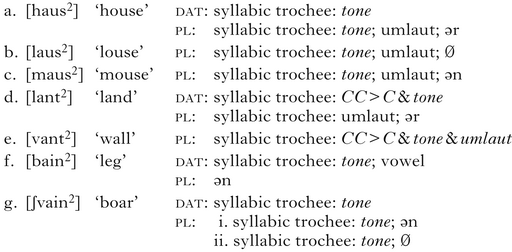
How can these generalisations be expressed differently from the listwise specifications in (4)? One option is to follow Köhnlein in adopting empty foot templates. The implication CC > C ∧ dat.sg ⊃ tone could be accommodated by a segmentless moraic trochee for the dative singular suffix, for cases like (4d). For the plural suffix, the same template could be used, with [―back] included in the stressed syllable for cases like (e). Observe how umlaut and CC > C can be vacuous, as in the case of the datives in (a) and (g) and the plurals in (b) and (g.ii), meaning that the two suffixes are more widely usable than for monosyllabic stems with a short back vowel and a sonorant + plosive coda cluster. In other cases, like the dative in (f) or the plurals in (b), (c) and (g.i), additional exceptionality markings would be needed, while for (f) the template is unusable because of the absence of the tone change.
Another option is to make the generalisations themselves available in the lexicon, along with other phonological regularities, such as the fact that if there is a vowel change other than umlaut, this will involve [ai] > [aː] or [εi] > [ai], e.g. [bain2] ~ [baːn1] ‘leg.nom ~ dat’ and [krεits2] ~ [kraits1] ‘cross.nom ~ dat’. Either strategy would be compatible with Bermúdez-Otero's conception of storage as ‘analytic listing’ (Reference Bermúdez-Otero and Trommer2012: 18), referred to by Köhnlein (Reference Köhnlein2018). The second option has the advantage that other non-productive generalisations can be stated in the lexicon as well, for example the [ai] > [aː] and [εi] > [ai] vowel correspondences, which are not easily expressed with the help of a template. It would be interesting to see if, independently of numbers of exceptional forms, there is any cognitive difference between exceptions that can be templatically encoded and those that cannot, but, in the absence of such evidence, treating all ‘minor’ regularities in the same way may be a better policy.
A final point concerns the relation between the phonological element causing the violation of the Exceptionless Additive Morphology Hypothesis and the phonological exponent that is introduced to obliterate it. In the case of the sonorant-final plurals whose singulars have coda clusters, the prosodic template and the obliterated consonant are phonologically unrelated, but in the case of the tonal alternations, these two terms are similar, viz. a default moraic trochee and a lexicalised syllabic trochee. Our case against this analysis rests on the irrelevance of the tonal alternations for derivational morphology, but even if these cases were to be taken as regular morphology, they might as well be described as subtractive morphology. That is, the singular would have had a lexical tone which the plural prosodic template would obliterate, just as it obliterates the plosive in the final coda cluster of the singular.
3.1.2 Non-distinctive Accent 2
We close this section with a brief discussion of a potential argument against privative Accent 2 which is not raised by Köhnlein (Reference Köhnlein2016). Toneless dialects on the periphery of the tonal area have intonation contours that resemble the Accent-2 contours of the tonal area (Wiesinger Reference Wiesinger, Veith and Göschel1975, Schmidt Reference Schmidt1986, Peters Reference Peters2006, Gussenhoven Reference Gussenhoven, Kubozono and Giriko2018a). A question which arises is why intonation contours containing lexical tones, rather than those without lexical tones, have propagated as postlexical intonation contours in the surrounding area (cf. non-distinctive accent; Schmidt Reference Schmidt1986). The crucial consideration here is that any expectation that the simpler phonological form should be found outside the tonal area ignores the fact that speakers are typically unaware of their phonological representations. Neither language change nor language acquisition is informed by the representations of the parental input, since infants are unaware of the phonological representations of the ambient phonetic forms (Lightfoot Reference Lightfoot2010). Quite possibly, the extra phonetic length of Accent 2 served as a desirable feature during the spread of the tone contrast from thirteenth-century Cologne, and spread further than the tone contrast itself (cf. Gussenhoven Reference Gussenhoven, Kubozono and Giriko2018a).
3.2 Enhancement features as arguments for the metrical approach
Köhnlein's (Reference Köhnlein2016) second and third arguments concern the phonetic enhancements of the surface tone contrast. The segmental lengthening that may accompany Accent 2 is addressed in §3.2.1, where we argue that this is a phonetic (enhancing, non-categorical) phenomenon. We show that the representation in (3a.i) neither addresses this phonetic behaviour nor accounts for the durational properties of Accent 1. In §3.2.2, we deal with his third argument, which is that the segmental correlates of the tone contrast suggest that they are stress-related. There we will argue that these correlates are due in part to further enhancements of the durational enhancement and in part to microprosodic effects of high vowels and voiceless consonants on the distribution of the tone categories.
3.2.1 The durational enhancement of Accent 2
In many dialects, syllables with Accent 2 are longer than those with Accent 1, particularly in IP-final position. The motivation for the recruitment of such ‘secondary’ features in the phonetic implementation is perceptual (Stevens & Keyser Reference Stevens and Keyser1989). For instance, the cross-linguistically attested shortening of the sonorant rhyme portion before voiceless obstruents (cf. English /eɪ/ in mace vs. May, maize, or /εn/ in bent vs. Ben, bend) is proportional to the phonetic salience of the voicing difference in the obstruents themselves, with Arabic showing no shortening, French some and English a lot (Kluender et al. Reference Kluender, Diehl and Wright1988). Similarly, Accent-2 lengthening would appear to depend on the salience of the pitch contrast. For instance, to discriminate Accent 1 from Accent 2 in IP-final positions, the Roermond dialect contrasts a fall with a fall-rise in declaratives, and a rise-fall with a rise in interrogatives, while falling pitch contrasts with high pitch IP-medially (cf. (2a)), and rising pitch with low pitch in the same intonational conditions (Gussenhoven Reference Gussenhoven and Horne2000: 6). Across prosodic contexts (as determined by the word's accentuation and its position in the IP), Accent-2 syllables in Roermond were found by Fournier et al. (Reference Fournier, Verhoeven, Swerts and Gussenhoven2006) to be only 8% longer than those with Accent 1, with Accent 1 being longer than Accent 2 in 30 out of 100 comparisons. No perceptual effect of duration was found. The IP-final contrast in the Maastricht dialect is between an early fall and a late fall in declaratives, and between a simple rise and a rise that reverses at the very end in interrogatives, while in positions before the IP-penultimate syllable an Accent-1 rise contrasts with an Accent-2 rise by being followed by low pitch instead of mid pitch. A further indication of the non-salience of this latter contrast is provided by the fact that in IP-penultimate syllables Accent 1 has low pitch, followed by a peak in the IP-final syllable. (The non-final interrogative contrasts show a more complex picture still; see Gussenhoven Reference Gussenhoven2012a: Fig. 17.) Accent 2 is 34% longer than Accent 1 in IP-final position and 22% longer in IP-internal position. The Cologne dialect shows still more Accent-2 lengthening (Peters Reference Peters2006). In IP-final declaratives, both Accent 1 and Accent 2 fall, after a weak rise of about 100 ms from the rhyme onset, but whereas Accent 1 falls immediately, Accent 2 retains high pitch for another 100 ms before falling. The equivalent interrogatives have rising movements, with the rise starting later on Accent-2 syllables, after a low-pitched stretch of some 200 ms, whereas the rise starts almost immediately in the case of Accent 1. In IP-internal position, the differences depend in part on the F0 context, and in the clearest cases appear as a steep fall instead of a slow fall in Accent-1 declaratives and rising instead of high pitch in Accent-1 interrogatives. There is a substantial difference between declaratives (with Accent 2 being 62% longer than Accent 1 IP-finally and 35% IP-internally) and interrogatives (33% and 14% respectively). We suggest that the difference between the two intonational conditions is related to the different degrees of discriminability for the surface tone contrasts, as can be inferred for the F0 contour shapes that would exist if Accent-2 lengthening were absent. That is, Accent-2 lengthening would appear to be a derivationally ‘late’ measure, implemented in the interest of maintaining contrast (Kingston & Diehl Reference Kingston and Diehl1994).
Köhnlein (Reference Köhnlein2016: 112) explains Accent-2 lengthening as an effect of its monosyllabic foot (i.e. the default moraic trochee used for Accent 2), which will be longer than the strong syllable of the disyllabic syllabic trochee used for Accent 1. This phonological account can be interpreted as enhancement resembling the way in which phonological lip rounding for back vowels and lip spreading for front vowels increases the salience of front–back vocalic contrasts (e.g. Stevens & Keyser Reference Stevens and Keyser1989). Köhnlein's account of Accent-2 lengthening cannot be interpreted as phonetic enhancement, which would require the addition of a phonetic cue to the primary cue that derives from the phonological contrast, such as duration being added to pitch in the case of Franconian tone or to voice in the case of English coda obstruents. In Köhnlein's account, duration is the primary cue, with greater duration deriving from the moraic trochee.Footnote 7 An interpretation of Accent-2 lengthening as arising from a (quasi-)quantity contrast is problematic to the extent that durational properties of the contrast between short and long vowels (i.e. α vs. αα) differ from those found in Accent-2 lengthening. First, the short–long vowel contrast in the non-tonal Weert dialect is immune to prosodic context, quite unlike the durational enhancement differences in the tonal dialects (Fournier et al. Reference Fournier, Verhoeven, Swerts and Gussenhoven2006). Second, the partial reinterpretation of the tone contrast as a quantity contrast for the high vowels in the Maastricht dialect can be most clearly demonstrated on the basis of the different duration patterns shown by the short–long vowel-quantity difference in high vowels on the one hand and the tone difference among non-high vowels on the other (Gussenhoven Reference Gussenhoven2012a). Statistically, however, the sensitivity of the durational enhancement of the tone contrast to prosodic context is due to the difference between the IP-final and IP-internal positions, a fact which is addressed by Köhnlein (Reference Köhnlein2016). In his analysis, the greater degree of IP-final Accent-2 lengthening is due to the existence of an abstract, or at least rhymeless, unstressed syllable to the right of Accent-1 syllables in surface IP-final position, which protects Accent 1 from the additional effect of IP-final lengthening. This correctly predicts that the durational difference between Accent 1 and Accent 2 is greater IP-finally than IP-internally ((3a.i) vs. (3b.i)), but incorrectly predicts that IP-final syllables with Accent 1 are durationally equivalent to penultimate syllables with Accent 1 in IP-final words ((3a.i) vs. (3a.ii)). In all dialects for which durational data are available, Accent-1 syllables in surface final position are considerably longer than Accent-1 syllables in surface penultimate position.
3.2.2 Segmental enhancements of Accent 2
Loss of the tone contrast, whether from the dialect as a whole or from phonologically defined subsets of the lexicon, has frequently led to transphonologised segmental features. These include the insertion of postvocalic [k] in stressed syllables with Accent 1 and a high vowel in Luxembourgish (Gilles Reference Gilles, Auer, Gilles and Spiekermann2002), the distinction between mid-high and low-mid long vowels as reflexes of Accent 1 and Accent 2 respectively in northern Belgium (Verstegen Reference Verstegen and van de Wijngaard1996) and diphthongs in rhymes with Accent 1 and monophthongs or less wide diphthongs in rhymes with Accent 2 in the dialects of Sittard, Genk and the toneless area south of Maastricht (Dols Reference Dols1953, Cajot Reference Cajot2006: 14, Goossens Reference Goossens2009; see also references in Kehrein Reference Kehrein, Kehrein, Köhnlein, Boersma and van Oostendorp2018). Gussenhoven (Reference Gussenhoven, Cole and Hualde2007, Reference Gussenhoven and Limpens2011) argues that these effects are phonologisations of (enhancements of) the durational difference, itself an enhancement of the tone contrast when it was still present (§3.2.1). Mid-to-high vowel raising has been shown to increase perceived vowel duration, while raising the second element of a closing diphthong shortens perceived duration (Gussenhoven Reference Gussenhoven, Cole and Hualde2007). Similarly, glottal stops, narrower diphthongs (e.g. Canadian Raising; Bermúdez-Otero Reference Bermúdez-Otero2017) and lower vowels have been argued to enhance the shortening of sonorant rhyme portions before voiceless obstruents in dialects of English (Gussenhoven Reference Gussenhoven, Cole and Hualde2007, Reference Gussenhoven, Hyman and Plank2018b). In as much as these effects concern vowel quality, they are interpreted by Köhnlein (Reference Köhnlein2016) as stress-related, but he gives no further indication of their motivation when he states that the tone contrast has ‘several correlates on the surface, similar to what is found in the realisation of word stress’ (Reference Köhnlein2016: 89).
Not all vowel effects have their origin in durational enhancements, however. Hermans (Reference Hermans2012) presents data from recent loans in the dialect of Maasbracht showing statistical effects of vowel quality in the distribution of the two tone classes that cannot be explained as vowel changes aiding the perception of duration, since they concern stable vowel qualities and consonant properties. Specifically, while there are exceptions, stressed penultimate syllables typically have Accent 2 if the (unstressed) final syllable has a high vowel or a voiceless onset (5a, b), but Accent 1 otherwise (5c).
(5)
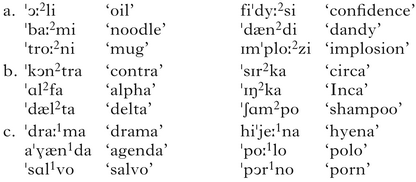
Hermans (Reference Hermans2012) argues that because lower vowels are more sonorous than higher vowels, syllables with lower vowels cannot be parsed as unstressed, while a voiceless onset will force a preceding coda sonorant to be dominated by a weak mora, disabling that mora as a unique TBU for L. As a result, the H on the first mora will spread to the second. This ultimately leads to contrastive footing, whereby Accent-2 disyllables end up as syllabic trochees, and Accent-1 disyllables as monosyllabic moraic trochees. This is the reverse foot assignment from that assumed by Köhnlein (Reference Köhnlein2016), suggesting at least that the relation between segmentals and footing is not transparent. In our interpretation, these data show how the Franconian tone is still being assigned today on the basis of the same segmental effects on F0 as it was shortly after the tonogenesis: higher F0 for higher vowels and for voiceless obstruents. The same contexts affected tone assignment in the early days after tonogenesis, when in the central area Accent 1 co-occurred with non-high [aː æː eː øː oː] and the centring diphthongs [iə yə uə], as well as with high [iː yː uː] and the closing diphthongs [ei øy ou] if a voiced obstruent followed (Wiesinger Reference Wiesinger1970: 65). Vowel height was active in similar ways in Hu (Mon Khmer, Palaungic; Yunnan Province, China), where non-high long vowels developed low tone and high long vowels high tone, as did all short vowels (Svantesson Reference Svantesson and Davidson1991), while both vowel height and voicelessness were active in closely related U, spoken some 400 km further south, where non-high vowels in open syllables caused high tones to lower after a tonogenesis had produced low tones before original nasals and high tones before original voiceless obstruents (Svantesson Reference Svantesson1988). That is, while the connection with F0 is unambiguous and typologically supported, the connection with stress is not, because the same vowel qualities are explainable by either of the two foot types, depending on which analysis is adopted.
3.3 Summary: non-tonal arguments for the metrical approach
The relatively drastic introduction of lexically contrastive trochaic foot types should ideally lead to correct predictions of aspects that go beyond the tonal representations that are derived by the different feet. In this section, we have argued that Köhnlein's three cases (singular/plural marking, durational enhancement and vowel-quality correlates) do not achieve that goal. In the next section, we consider the adequacy of metrically derived tonal representations.
4 On the adequacy of metrically derived tonal representations
To account for the postlexical pitch shapes, tonal analyses employ tones from two morphological sources, the lexical tone (shown as Tlex in Table I) and the intonational melody, whose tones belong either to pitch accents or to boundary tones that align with the right edge of the IP or UP (collectively shown as Tint (citation) and Tint (other) in Table I). Metrical analyses reduce the tone strings to intonational melodies, and derive the lexical tone difference by constraining the ways in which tones can associate with syllabic and moraic structures. Ignoring boundary tones, stressed syllables, from the point of view of the tonal analyses, have one of the four tone structures arising from two binary variables: ‘with or without lexical tone’ and ‘with or without intonational pitch accent’.
Metrical analyses have been given for pitch-accented IP-medial syllables with the lexical tone contrast for the dialects of Cologne and Arzbach (Köhnlein Reference Köhnlein2016), as well as for Hasselt and Roermond (Köhnlein Reference Köhnlein2011: ch. 5). In the latter work, the IP-final cases are also considered for those four dialects. IP-final accented (focal) contrasts are dealt with in §4.1. In §4.2, we consider IP-internal unaccented (postfocal) syllables. Here, the metrical approach must overcome the problem that there are no intonational pitch accents in those locations.
4.1 IP-final accented syllables
Köhnlein's (Reference Köhnlein2011: 138) analysis of Accent 2 in IP-final syllables in the Cologne dialect employs a second theoretical innovation, that of joining tones with the same specification, which is described as one tone functioning as another tone (Reference Köhnlein2011: 112). For instance, in declaratives with Accent 2, the second mora of the accented syllable is associated with a single L tone, made up of a trailing tone of the pitch accent H*L and the final low boundary tone Lι, as indicated by the curly brackets in (6a.ii). In interrogatives, the first mora of the accented syllable is associated with a L tone that is at the same time a focal tone (L*) and the final low boundary tone. Two theoretical issues arise in this account. First, there is the fact that a new category of tone, or tone interaction, is introduced. The incarnation of two phonologically identical tones as a single tone, henceforth a ‘joint tone’, is not equivalent to the single remaining tone after application of the OCP, since a joint tone obeys alignment constraints that apply to each of the two morphologically different tones. Neither is it the same as coalescence, which concerns phonologically different segments which yield a single segment that is a phonological mix of the contributing segments. Also, a joint tone may be phonetically longer or shorter than a single tone in the same location. The time allotted to joint tones varies without explanation. The late realisation of low pitch in (6a.ii) is due to the long stretch of high pitch that H* is allowed to create, leaving very little time for the joint L tone as compared to the shorter duration of H* in (6a.i). But in (6b.ii), the joint L tone takes up more time than the single tone L tone in (6b.i) and the joint L tone in (6a.ii), implying that durational effects are not consistent.
(6)
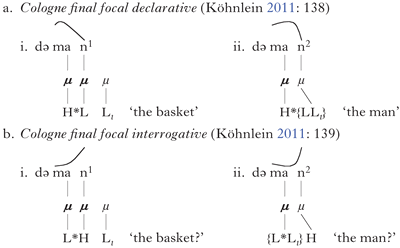
The second issue concerns the location of Lι before the trailing H in (6b.ii). It is explained by the requirement that boundary tones should merely occur in the final syllable, not necessarily finally in the tone string. The unexpected sequencing of Lι between L* and the trailing H implies a novel interpretation of ‘alignment’ in Alignment Theory (McCarthy & Prince Reference McCarthy and Prince1993), since the tone is no longer aligned with any edge.Footnote 8
Köhnlein's solution for the equivalent Roermond forms is presented in (7). In addition to joint tones, Hυ, a boundary tone in the UP, is introduced in (7a.ii) and (7b.ii). It appears exclusively when the last syllable of the UP has Accent 2, the position where the last surface syllable is also the last underlying syllable. Introducing yet another convention applying to joint tones, Köhnlein (Reference Köhnlein2011: 148) points out that the Accent-2 context is unique in not having Lι on the last sonorant mora, because it forms a joint L tone with L* on the first. Finally, because of the high-ranking constraint NoRise, Lι will cause Hυ to be deleted in all other cases.
There are two problems with this account. First, because the continuation intonation is identical to the interrogative intonation, Accent 2 appears as readily at the end of a UP-internal IP as at the end of a UP-final IP. In a sentence like [iəʀs sεgɪx haas2 dɑn sεgɪx haas1] ‘first I say glove, then I say hare’, the contour for [haas2] is no different from that in (7b.ii), yet it is not at the end of an UP, and no Hυ can reach it.
(7)
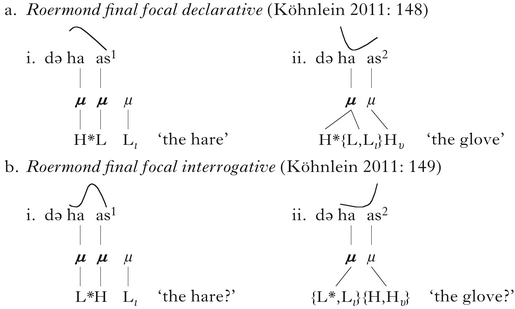
The second problem is of a rather different order. The right-edge Hυ is undetectable for the language learner or adult language user in the vast majority of IPs, since it only shows up in about half of the words with bimoraic sonorant rhymes in IP-final stressed syllables. A rough estimate might put their number at 20%, the other words having final stress with one sonorant mora or with bimoraic sonorant word-final Accent 1, or having penultimate or antepenultimate stress. It seems to us unlikely that language learners would analyse that tone as a boundary tone, rather than as an inherent, i.e. lexical, tone of such words, the more so since these words are tonally distinct in other contexts.
4.2 Postfocal syllables
In postfocal words (which, as in standard Dutch and German, are not accented), the tone contrast is preserved in a number of dialects. While in East Limburgish it is neutralised postfocally in all IP-medial words (Fournier et al. Reference Fournier, Verhoeven, Swerts and Gussenhoven2006) and prefocally in both accented and unaccented words, the contrast is preserved both postfocally and prefocally in Hasselt and Cologne (Peters Reference Peters2008). In the Arzbach dialect, it is lost postfocally in declaratives, though not in interrogatives (Köhnlein Reference Köhnlein2011: 37).Footnote 9 The tonal approach describes neutralisation as a deletion of the lexical tone, correctly allowing F0 to be interpolated right through the word, as illustrated in (8a).
(8)
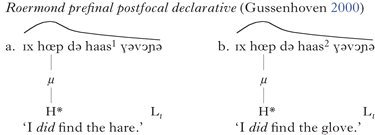
Köhnlein's analyses do not exhaustively discuss the implications of these partial tonal representations. Again taking tonal analyses as our perspective, the tone-mapping procedures need to be manipulated so as to provide (i) only boundary tones for unaccented IP-final words, as in Arzbach declaratives, (ii) only intonational pitch accents for prefocal words, as in East Limburgish, (iii) absence of tone for postfocal IP-medial words, as in East Limburgish, and (iv) a lexical tone in non-final postfocal contexts in dialects that maintain a contrast there, like Hasselt, or, in interrogatives, Arzbach. In context (iv), the metrical approach provides neither a pitch accent nor a boundary tone to create a tonal representation of the contrast.
We first consider an example of (iv) discussed by Köhnlein (Reference Köhnlein2011: 129). Hasselt Accent-2 words have a L associated to the stressed syllable, as in (9a.ii), which contrasts with (9a.i) in having a steeper postfocal fall (Peters Reference Peters2008). Köhnlein (Reference Köhnlein2011) solves this problem by appealing to the trailing L of a L*HL pitch accent. It skips any postfocal Accent-1 words, because a mora in a stressed syllable occurs in the strong branch of a syllabic trochee, and as such spurns L, as seen in (9b.i). Trailing L, however, associates with the weak second mora in the stressed syllable of the Accent-2 word in (9b.ii), where the joint tone functions as the trailing tone expressing the lexical tone contrast.
(9)
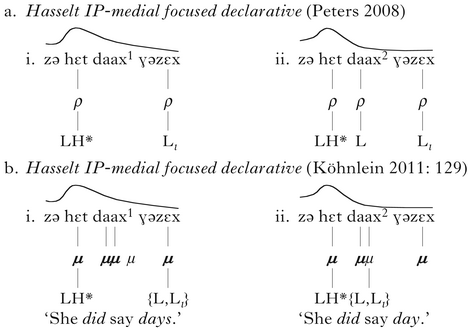
There are two problems with this solution. First, if employing a trailing tone for characterising postfocal tone contrasts is to be generally applicable, such contrasts can only be described if a trailing tone is available, and, moreover, is identical to the lexical tone. This would not work, therefore, for the Borgloon dialect, which has a LH* pitch accent and a LH lexical tone (Peters Reference Peters, Riad and Gussenhoven2007). Similarly, the Maastricht dialect has lexical H, and strictly obeys the OCP within the IP, causing any adjacent tone to be L (Gussenhoven Reference Gussenhoven2012a). Second, there may be more than one postfocal IP-medial Accent-2 syllable, but in Köhnlein's analysis only one such tone is available for them. Although no examples of postfocal Accent 2 are given in Peters (Reference Peters2006, Reference Peters2008), one with two postfocal IP-medial Accent-2 syllables in nearby Borgloon is given in Peters (Reference Peters, Riad and Gussenhoven2007: Figs 15–17).
4.3 Summary: tonal representations in the metrical approach
Köhnlein's analyses are unique in carrying through the promise of the metrical approach for virtually all contexts for four typologically representative varieties of Franconian. As such, the result may be seen as a demonstration of how hard it is to produce transparent sentence-level tonal representations from feet. The analyses necessitate the introduction of a number of novel phonological concepts: ‘joint’ tones, i.e. single tones that embody two phonologically identical but morphologically distinct tones, where the grammar may refer to either, while also having specific phonetic implementation conventions affecting their duration, an alignment option that demands that segments be located inside a constituent, alongside the usual edge-based alignment constraint family, and a phonological tone making up a pitch accent which changes its morphological function from a late-aligning trailing tone to that of a boundary tone, depending on the foot structure of the postfocal words. It is hard to find instances in which the metrically derived tonal representations produce unexpected correct predictions. Moreover, pace Kehrein (Reference Kehrein, Kehrein, Köhnlein, Boersma and van Oostendorp2018: 162), who attempts to account for cases like (19) by proposing that Accent 2 is an ‘echo-accent’, i.e. the slight F0 bulge that has been reported for postfocal stressed syllables generally (Pierrehumbert Reference Pierrehumbert1980: 124, Rietveld Reference Rietveld1983, Xu & Xu Reference Xu and Xu2005), the case of unaccented IP-medial tone contrasts would appear to be a problem in principle for an approach that can only produce tones in phrase-final or accented syllables.
In §5, we demonstrate how a tonal analysis that is unfettered by metrical conditions can be explanatory in a way that a metrical analysis cannot. It compares Köhnlein's (Reference Köhnlein2011, Reference Köhnlein2016) analysis with an alternative given in Gussenhoven (Reference Gussenhoven, Asu and Lippus2013).
5 Tones vs. tones derived from feet: the Arzbach dialect
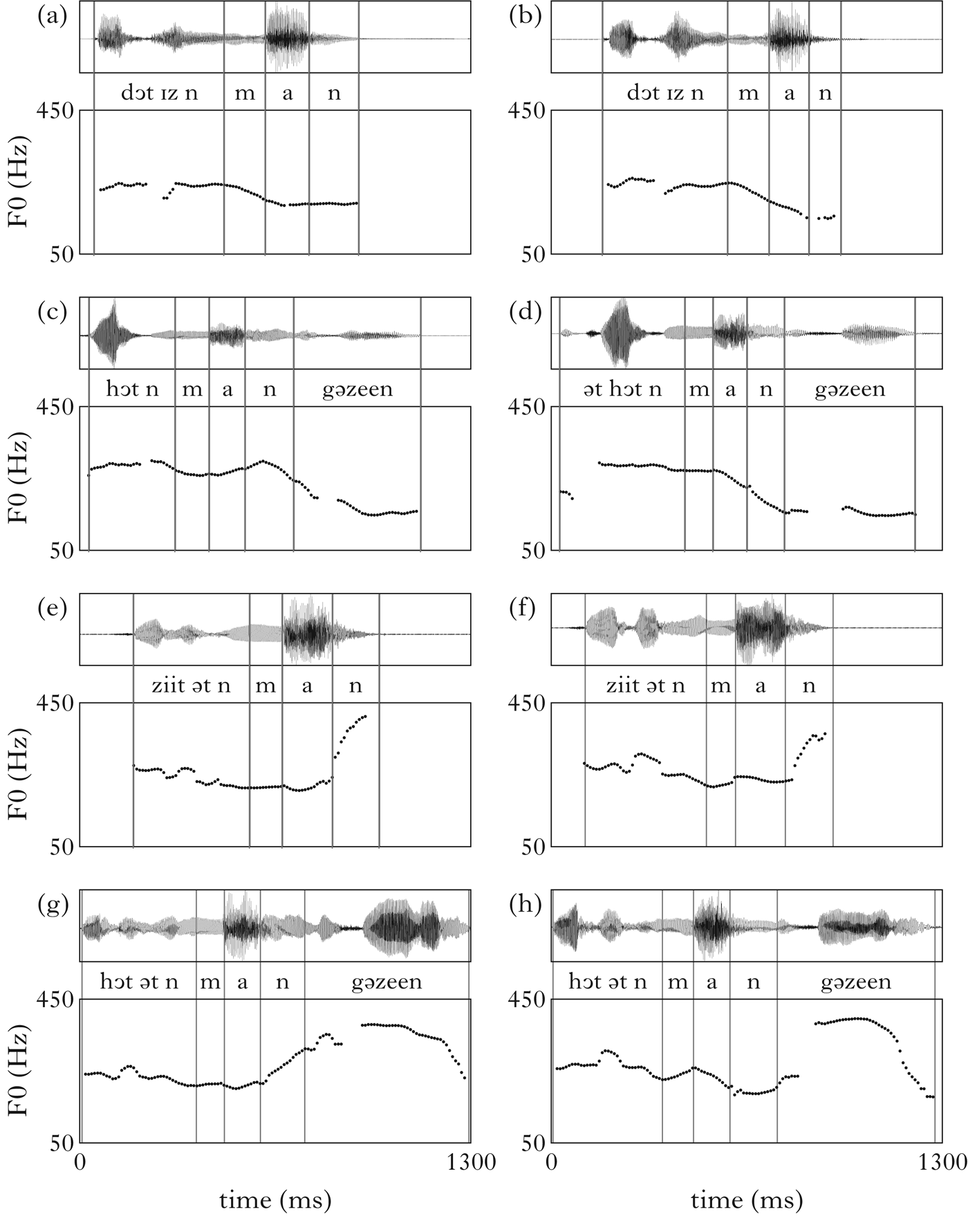
Figure 2 gives F0 tracks and speech waveforms of nuclear accented [man1] ‘basket’ (lefthand panels) and [man2] ‘man’ (righthand panels) in IP-final and IP-internal positions for declarative ((a)–(d)) and interrogative intonation ((e)–(h)), with segment boundaries for the target words. Although the F0 tracks might suggest otherwise, the perceptual salience of the tone contrast in the IP-final contours is quite robust. For instance, the nuclear [a] of (e) is not as firmly low as is that of (f), and in comparison with the contour in (g), the [n] of (h) sounds firmly low-pitched.
Speech waveforms and F0 tracks of Arzbach sentences produced by a female speaker containing focused pronunciations of [man1] ‘basket’ (lefthand panels) and [man2] ‘man’ (righthand panels) for IP-final (a, b) and IP-internal declarative intonation (c, d), and IP-final (e, f) and IP-internal interrogative intonation (g, h). Sound files for the sentences are embedded courtesy of Björn Köhnlein.
5.1 A tonal analysis of the Arzbach data
A visual comparison of the lefthand and righthand panels in Fig. 2 (Accent 1 vs. Accent 2) shows that Accent 2 has lower F0 towards the end of the target syllables. In (a) and (b), this is due to a lower end point, in (c) and (d) it is due to an earlier F0 fall, while in (e)–(h) it is due to a later F0 rise. Since the declarative intonation generally gravitates towards low F0 at the end of the IP, an IP-final Lι-tone is assumed, while the preceding higher F0 will be due to a focus-marking H*. Similarly, the interrogative contours in (e)–(h) have a focus-marking L* and a complex boundary tone HιLι, where Lι is truncated in IP-final accented syllables, as shown in (e) and (f), but not otherwise, as in (g) and (h). Figure 2 was produced with the help of Praat (Boersma & Weenink Reference Boersma and Weenink2016), using a script written by Francisco Torreira.
5.1.1 The tonal analysis of the Arzbach data
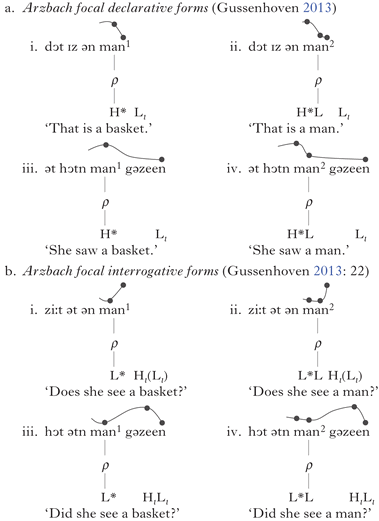
Gussenhoven (Reference Gussenhoven, Asu and Lippus2013) attributes the consistently lower F0 for Accent 2 to a lexical L associated with the rhyme. On the standard assumption that a TBU can only associate with a single tone, the lexical L will block the association of H* and L*, leaving these tones floating to the left of the associated L (cf. the similar situation in the dialect of Hasselt illustrated in (2b.ii), where the intonational pitch accent LH* aligns to the right of the lexical L). Accent-1 falls will be later than Accent-2 falls, due the contrast between H* Lι (Accent 1) and H*L Lι (Accent 2). Similarly, Accent-1 rises will be later than Accent-2 rises, due to the contrast between L* Hι(Lι) and L*L Hι(Lι), where the bracketed tone is truncated in monosyllabic cases (e) and (f) in Fig. 2, as is often the case in German dialects (Schmidt Reference Schmidt1986, Gussenhoven & Peters Reference Gussenhoven and Peters2004: n. 3). This analysis is illustrated in (10a) for IP-final ((i), (ii)) and IP-internal ((iii), (iv)) accented syllables in declaratives, while (10b) shows the corresponding interrogatives. For added clarity, we here indicate the tonal targets in the graphic contours as bullets.
(10)
5.1.2 A tentative phonological prediction of the tonal analysis
All contours follow the predictions of analysis (10a), with the exception of Fig. 2a. Although (10a.i) predicts a steep F0 fall, this is not found in Fig. 2a. We suggest that the weak fall observed in (a), which occurs at the start of the Accent-1 rhyme [an], must be due to downstep, !H*, which requires an earlier H in the IP. Since IPs can begin low-pitched, there cannot be an obligatory initial Hι boundary tone, so that the only remaining position in which an H tone can occur is that of a leading H in a pitch accent H+H*, in which H* is obligatorily downstepped, i.e. phonetically [H+!H*] (Grice Reference Grice1995 for English, Gussenhoven Reference Gussenhoven2004: 311). This pitch accent should exist in the dialect as an alternative to H*; its phonological and phonetic forms are given in (11).
(11)
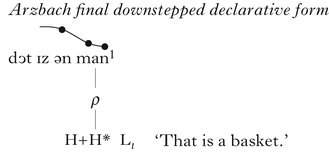
The analysis is supported by the non-downstepped data from a different speaker in Fig. 3, from Köhnlein (Reference Köhnlein2011: 49), corresponding to (10a.i, ii). Here, Accent 1 again appears in (a); the timing of non-downstepped H* is quite late in the rhyme, much like the Accent-1 peak of the first speaker in IP-internal position in Fig. 2c. It contrasts with Accent 2 as produced by the same speaker (Fig. 3b), where the target of the lexical L occurs at the end of the vowel, just as in the phonologically identical contour in Fig. 2b. The principal phonetic cue distinguishing Accent 1 from Accent 2 in (10a.i) thus differs from that in (11). The different timings of the falls for Accent 1 and Accent 2 in Fig. 3 are distinctive enough, leaving no motivation for ending the fall for non-downstepped Accent 1 (H* Lι) at mid pitch. By contrast, the contour in Fig. 2a shows a high-to-mid-to-level fall as the realisation of downstepped [!H*Lι], to ensure that it is distinct from the similarly timed Accent-2 high-to-low fall (Figs 2b and 3b).
Speech waveforms and F0 tracks of Arzbach sentences containing focused pronunciations by a female speaker of IP-final declarative intonation for (a) [man1] ‘basket’ and (b) [man2] ‘man’. Adapted from Köhnlein (2011: 49).

In terms of the typology of Table I, the provisional analysis of the Arzbach dialect is thus as shown in Table II.
Phonological parameters in analyses with privative lexical tone contrast for Arzbach. Sources: Gussenhoven (2013) and this paper, based on data from Köhnlein (2006).

The question arises as to why there appears to be no downstepped version of H* in the case of Accent 2. Since the unassociated H* is timed before the rhyme, the fall would be earlier than that shown in Fig. 2b. The resulting compressed early fall that would result on [man2] would very probably give the impression of a narrow-range, non-prominent version of downstepped [man1] in (11), shown in Fig. 2a. Observe that although it is customary to specify the syllable as the TBU where we specify the rhyme, for these data it is particularly relevant to see that neither type of TBU, i.e. the mora or the rhyme, includes the syllable onset (Howie Reference Howie1974, Duanmu Reference Duanmu2000: 216).Footnote 10 Our conjecture is therefore that H* in Accent-2 contours cannot be downstepped, which suggests a condition on downstep: H* should have an association, ruling out downstepped Accent 2 (see (9b.ii)).
5.2 The metrical analysis of the Arzbach data
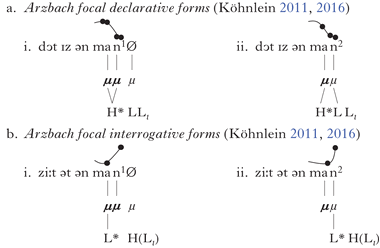
Köhnlein's metrically derived representations for the monosyllabic condition in (10) are given in (12). Köhnlein assumes the pitch accents H*L for declaratives and L*H for interrogatives, plus a single boundary tone for both, Lι. Briefly, strong moras repel L and attract H; minimally, an accented syllable should have an association with T*. This leads to the doubly linked H* in (12a.i) vs. H*L in (12a.ii), predicting a timing difference of the fall late in (12a.i) and early in (12a.ii). In (12b.i), the first mora is headed at the level of the syllable. Unlike the foot head, in which a mora does not attract L*, as seen in (12b.ii), the syllable head does attract, thus creating an early alignment of the low target in (12b.i) and a late one in (12b.ii).
(12)
5.3 Comparing the Arzbach tonal and metrical analyses
The two descriptions make different predictions about the phonetic shapes of the Arzbach forms on three counts. First, the analysis in (10a.ii) predicts that H* in the final declarative Accent-2 contour has its target before the rhyme, i.e. during and just before onset [m]. This is confirmed in Figs 2b and 3b. (12a.ii) incorrectly suggests that H* will have its target inside the rhyme. Even in the non-final case (Fig. 2d), where H-targets are typically later in Germanic (e.g. Peters et al. Reference Peters, Hanssen and Gussenhoven2015), the F0 falls sharply from the beginning of the vowel onwards. Second, assuming that the targets of L tones might be identifiable by F0 ‘dipping’, the Accent-2 contours in (f) and (h) show weak falling flanks in the exact locations of L* (at the syllable-onset margin) and L (at the [a]–[n] boundary in the final form in (d) and inside [n] in the non-final form (f)). By contrast, such dips are seen in the corresponding Accent-1 forms for L* well inside the rhyme in [a] ((e) and (g)). Third, Köhnlein (2013) reports lower F0 peaks of the postfocal interrogative contours for Accent 2 than for Accent 1. The tonal analysis explains this lowering as an effect of lexical L on the realisation of the final HιLι peak.Footnote 11 The fact that the contrast is only maintained in interrogatives must be due to the scope for that phonetic difference, which is unavailable within the low-pitched postfocal declarative contour. The metrical analysis does offer an explanation for this fact, but this comes at the expense of the usual phonetic interpretation of differences in the phonological locations of tones. Köhnlein (Reference Köhnlein2011) accounts for the higher pitch in Accent 1 by allowing the trailing H to associate to both moras in the stressed syllable of a syllabic trochee, but only to the first mora in a moraic trochee. The phonetic implementation will create a higher target for a doubly associated H as compared to H that has an association with the left mora only, following a phonetic convention used by Manfredi (Reference Manfredi, van der Hulst and Snider1993). This phonetic pitch-range effect of H-spreading is not otherwise attested in the Franconian data. Finally, the metrical analysis would not be able to express the fact that only Accent 1 has a downstepped alternative by appealing to an association difference, as in §5.1, since H* has a moraic association in both (12a.i) and (ii).
The tonal analysis would appear to make an incorrect prediction about the distribution of the tone contrast. In the Franconian dialects spoken in Belgium, syllabic association consistently allows the contrast to occur in all stressed rhymes, including those with a single sonorant mora, i.e. those with a short vowel followed by a coda obstruent, and penultimate short-vowel rhymes followed by the onset of a word-final unstressed syllable. This follows from the analysis, in that rhyme nodes are generally available in stressed syllables, but sonorant bimoraicity is not. Our claim that the Arzbach TBU is the rhyme – not the mora, as in Werth (Reference Werth2011) and Köhnlein (Reference Köhnlein2011, Reference Köhnlein2016) – incorrectly suggests that the tone contrast is maintained in syllables with a single sonorant mora (Bach Reference Bach1921, Köhnlein Reference Köhnlein2011: 3). In the Netherlands, there is at least one ‘syllabic’ dialect, Maastricht, with a recessive distribution of the tone contrast, as evidenced by the absence of any examples of Accent 2 on rhymes with a short vowel plus obstruent and the existence of only a single example with a short-vowel rhyme, [ˈhʏmə2] ‘singlet’, in the speech of Gussenhoven's (Reference Gussenhoven2012a) main informant. This suggests that the connection between rhyme association and an unconstrained distribution of the tone contrast is not obligatory, and that distributional restrictions may develop without a concomitant change in the TBU.
6 Discussion and conclusion
Köhnlein's (Reference Köhnlein2011, Reference Köhnlein2016, Reference Köhnlein2018) metrical analysis of the Franconian tone contrast covers four varieties, Cologne, Arzbach, Roermond and Hasselt, which are representative of the typological spread of the tone and intonation systems of the tonal dialects. As such, it is an unusually explicit and comprehensive treatment of the phenomenon within the metrical approach. We have considered his approach against the background of tonal analyses. Köhnlein focuses on the principled advantages of taking a metrical approach. In §6.1 we summarise his three main arguments. In §6.2 we briefly comment on the place of the Franconian dialects within the group of languages with lexical tone, while in §6.3 we conclude with a comment on the status of non-productive alternations and suggest an experimental procedure that could establish the nature of the element, i.e. foot or tone, underlying the tone contrast.
6.1 The three arguments
Köhnlein (Reference Köhnlein2016) supports his metrical analysis with three phenomena which he argues are better explained in the metrical approach. We believe that two of these, the nature and distribution of enhancement features, are better explained by the tonal approach, as argued in §3.2.1 for durational enhancement and in §3.2.2 for segmental enhancements. The third phenomenon is the existence of nouns in which the nominative/accusative singular has Accent 2 and the dative singular and/or plural Accent 1. Since tonal analyses have identified Accent 2 as a privative lexical tone, Köhnlein argues that these alternations constitute violations of what we have referred to as the Exceptionless Additive Morphology Hypothesis. While the more northerly dialects have between four and 15 of these exceptional plurals, they are supplemented in a zone along the southern tonal isogloss by larger numbers of tonally distinct datives, as well as by segmentally subtractive plurals with Accent 1 where the nominative stem has Accent 2. These exceptional inflectional forms exist alongside plurals and datives that violate the Exceptionless Additive Morphology Hypothesis by being homophonous with the stem or, in the case of plurals, only by displaying a vowel change. The web of exceptions in Horath nouns (Reuter Reference Reuter1989) contains a number of implicational relations, the most relevant of which are that segmental subtraction for the plural (13 cases) always combines with the tone change and a change of back to front vowel, as in [ʃaŋk2] ~ [ʃεŋ1] ‘cupboard(s)’ (ignoring the alternative [hon1] for [hen1] ‘dogs’), while segmental subtraction for the dative always co-occur with the tone change (24 cases). Such generalisations will probably exist in some form in the lexicon, perhaps as implicational statements or, as Köhnlein (Reference Köhnlein2018) argues, in terms of a lexically distinctive syllabic trochee with affixal status, one that exists alongside a default moraic trochee. His solution makes the subtractive plurals forms comply with the Exceptionless Additive Morphology Hypothesis, but, for a number of reasons, this solution might be seen as too costly.
First, it ignores the intonational and tonal evidence for Accent 2 as a lexically specified privative tone. Various researchers have shown that the pitch contours of tonal dialects are best understood by assuming that sentences without any Accent-2 words are like those of non-tonal varieties of Dutch and German, and that Accent-2 words locally add a tone (or tones in the case of the Borgloon dialect) to those contours. Second, the introduction of a lexically distinct foot type has no typological support. Lexical foot marking has been used to enforce non-default stress locations with prosodic information that forms part of the same foot inventory (e.g. Hayes Reference Hayes1980, Kager Reference Kager1989, Gussenhoven Reference Gussenhoven and Jun2014). Morén-Duolljá (Reference Morén-Duolljá2013) uses metrical structure to derive the Swedish tone contrast from a difference in the attachment of the weak syllable in a trochee, which is within the foot domain by default, but above it in lexically marked cases. Moreover, the lexical marking of the exceptional higher branching structure is used to describe exceptional (antepenultimate) stress location as well as exceptional Accent 1, unlike in Köhnlein's analysis of Franconian, in which Accent-1 words with exceptional stress locations are unaccounted for. Third, the marked foot is used for the deletion of the stem-final consonant by means of a novel form of phonological coalescence, whereby a sonorant + plosive cluster yields an (unchanged) sonorant (§3.1). The number of such innovative theoretical moves increases once tonal representations are derived from the feet. One is the joint tone, which obeys the constraints and phonetic implementation conventions applying to two morphologically different but phonologically identical tones. The other is a type of alignment constraint that merely requires a tone to occur within the prosodic constituent, regardless of its location in that constituent. Fourth, descriptive inadequacies in the derived tonal structures were identified in §4 that have no parallels in the tonal approach. In addition to these disadvantages, we have been unable to identify any predictions about data that lie beyond those on which the analysis was based. In §5, we tried to show what such predictions could involve, by pointing out how the tonal analysis of the Arzbach system, with the addition of a H+H* pitch accent, makes predictions that go beyond the data presented in Köhnlein (Reference Köhnlein2011, Reference Köhnlein2016), even though we cannot tell whether they are correct at this point.
6.2 The place of Franconian dialects among languages with lexical tone
What might cause tone languages like Franconian to be selected for non-tonal analyses in the first place? The Franconian dialects are not exceptional in the way in which they rely on pitch in the production and perception of the tone contrast. Nor do they require the introduction of any theoretical apparatus not offered by phonological theory. Research has shown that F0 is the main perceptual correlate in East Limburgish (Fournier et al. Reference Fournier, Verhoeven, Swerts and Gussenhoven2006), as well as in the Mayen and Arzbach dialects (Werth Reference Werth2011: 145–234), and speakers of the Roermond dialects have been shown to be more sensitive to pitch contrasts than speakers of (non-tonal) standard Dutch (Ramachers et al. Reference Ramachers, Brouwer and Fikkert2018). Also, the salience of the tone contrast is influenced by the intonational context in the tonal dialect of Roermond, but the quantity contrast in etymologically identical words in the dialect of Weert is not (Heijmans Reference Heijmans, Fikkert and Jacobs2003, Fournier et al. Reference Fournier, Verhoeven, Swerts and Gussenhoven2006). That is, the surface contrast is unmistakably tonal. As for the theoretical issues, autosegmental phonology as applied to tone and intonation (Pierrehumbert & Beckman Reference Pierrehumbert and Beckman1988, Yip Reference Yip2002, Gussenhoven Reference Gussenhoven2004, Ladd Reference Ladd2008) has proved to be perfectly suitable for analysing the Franconian dialects, with no additional machinery being required. Perhaps the reason for adopting a metrical approach to the Franconian data (Köhnlein Reference Köhnlein2011, Reference Köhnlein2016, Hermans Reference Hermans2012, Kehrein Reference Kehrein, Kehrein, Köhnlein, Boersma and van Oostendorp2018) is the way in which Franconian differs from the best-known tone languages, Chinese, Thai and Vietnamese, as well as from West African languages like Yoruba, Igbo and Hausa. Franconian differs from these in being otherwise prosodically close to genetically related non-tonal varieties with complex intonation systems. The lexical tone co-occurs with intonational tones in the same syllable, causing each tone category to appear with a number of different pitch shapes, quite unlike the relative immunity of tone shapes to intonation in the Asian and African languages. Where the pitch shapes of tone categories do vary, as in Chinese tone sandhi, this is due to other lexical tones, not – or much less so – to intonational tones. This distinction strikes us as typologically significant, rather than as providing evidence against tonal analyses. Prosodic systems like those of the Franconian dialects, just like the tonal contrasts in North Germanic languages and South Slavic (cf. van der Hulst et al. Reference Hulst, Hendriks and van de Weijer1999), should in our view be included in a typological study of lexical tone (cf. Yip Reference Yip2002: 260). The Franconian story is of considerable significance for the way intonational tones and lexical tones interact and for the drastically different, but collectively coherent, tonal grammars that have arisen in the various dialects when their complex Dutch/German intonation systems were invaded by a tone contrast. In this latter respect, the East Limburgish dialects differ from the Scandinavian tonal languages, as well as from the West Limburgish dialects and the Franconian dialects spoken in Germany, in having up to four different intonation contours. Also, the way in which their tone contrasts have found a place within their (originally probably even more) complex intonation grammars offers instructive perspectives on the relation between phonetics and phonology.
6.3 On the status of non-productive generalisations
Köhnlein (Reference Köhnlein2018) appears to take a step back from a full commitment to an exclusive reliance on synchronic (near-)regularities by referring to Jackendoff & Audring (Reference Jackendoff, Audring, Audring and Masini2019), who observe that a learner cannot know in advance whether an alternation is productive. The authors go on to suggest that upon finding that the observed pattern is not productive, a learner might not then expunge the cognitive record of the regularity from their grammar. We agree that continued observation of a non-productive pattern is a reality, as suggested by the facetious uses of non-existent English umlauted plurals noted in §3.1, but we are not convinced that such regularities have any status in the grammar. Rahmani et al. (Reference Rahmani, Rietveld and Gussenhoven2015) show that Persian listeners perform similarly to French and Indonesian listeners in a sequence recall task with disyllabic stimuli varying in the location of an F0 peak (e.g. [númi] vs. [numí]). Unlike French and Indonesian, Persian uses accent location as a cue to syntactic structure, and the accent thus has a high functional load. However, it is not included in the lexicon, there being no lexically unpredictable determinants of accent locations. The three languages thus share the property of having prosodically empty lexicons, which explains their virtually identical scores in the sequence recall task. By contrast, the scores for the same prosodic contrast for Dutch and Japanese participants, who have stress and accent markings respectively in their lexicons, were well above those of the three other groups, i.e. they were not ‘stress-deaf’, in the terminology of Dupoux et al. (Reference Dupoux, Peperkamp and Sebastián-Gallés2001). This suggests that, however important a feature is for the processing of speech, the lexicon does not become cluttered with the remnants of early or later exposure to speech contrasts if these do not have a lexical role to play in the grammar. This allows us to end with the suggestion that the tonal approach predicts that Dutch speakers, but not Limburgish and Chinese speakers, will be ‘tone-deaf’ in a sequence recall task with monosyllabic stimuli that vary in their pitch shape (e.g. [núùm] vs. [nûúm]), while the metrical approach predicts that Limburgish listeners will align with Dutch listeners. It may be time for an experimental perspective.


 Open access

