

1. Introduction
Eolian deposition is an important component of marine sediments as well as a good record of the evolution of palaeoclimate and palaeoenvironment in geological history (Rea, Reference Rea1994; Maher et al. Reference Maher, Prospero, Mackie, Gaiero, Hesse and Balkanski2010). Each year, approximately 2000 Mt of eolian dust is released into the atmosphere, 75% of which is deposited on the continent and 25% of which is delivered to the ocean (Shao et al. Reference Shao, Wyrwoll, Chappell, Huang, Lin, McTainsh, Mikami, Tanaka, Wang and Yoon2011). Eolian dust can significantly influence the global climate by altering the radiation budget of the Earth system and affects biogeochemical cycles by carrying nutrients such as Fe, crucial to the ocean–atmosphere CO2 exchange (Martin, Reference Martin1990; Jickells et al. Reference Jickells, An, Andersen, Baker, Bergametti, Brooks, Cao, Boyd, Duce, Hunter, Kawahata, Kubilay, laRoche, Liss, Mahowald, Prospero, Ridgwell, Tegen and Torres2005; Shao et al. Reference Shao, Wyrwoll, Chappell, Huang, Lin, McTainsh, Mikami, Tanaka, Wang and Yoon2011). In addition, the frequent occurrence of heavy sandstorms and weather extremes in recent years has caused serious threats to social development and human life. Research on eolian dust sediments is therefore of great significance in terms of determining the source region, revealing the mechanism of dust generation and transportation, reconstructing palaeoclimate and atmospheric circulation, and understanding climate feedback (Rea & Leinen, Reference Rea and Leinen1988; Porter & An, Reference Porter and An1995; Shao et al. Reference Shao, Wyrwoll, Chappell, Huang, Lin, McTainsh, Mikami, Tanaka, Wang and Yoon2011; Shi & Liu, Reference Shi and Liu2011).
As the second-largest dust source on Earth, Asian deserts are divided into three regions according to their geographical distribution and the Sr–Nd isotopic compositions of their < 5 μm siliciclastic fractions: the northern Chinese deserts (NCDs; e.g. the Gurbantunggut Desert), the central Asian deserts (CADs; e.g. the Taklimakan Desert) and the eastern Asian deserts (EADs; e.g. the Ordos Desert) (Chen et al. Reference Chen, Li, Yang, Rao, Lu, Balsam, Sun and Ji2007; Seo et al. Reference Seo, Lee, Yoo, Kim and Hyeong2014). The westerlies and the East Asian winter monsoon (EAWM) are considered the main transport mechanisms of Asian dust (Sun, Reference Sun2004; Shi & Liu, Reference Shi and Liu2011). It is generally accepted that the westerlies primarily carry dust thousands of kilometres from the CADs to the northern Pacific (Rea, Reference Rea1994; Zhao et al. Reference Zhao, Sun, Balsam, Lu, Liu, Chen and Ji2014). In contrast, eolian dust that originates from the EADs is mainly transported SE-wards by the EAWM, influencing eastern China and the western Pacific marginal seas (Hsu et al. Reference Hsu, Wong, Gong, Shiah, Huang, Kao, Tsai, Candice, Lin, Lin, Hung and Tseng2008; Zhao et al. Reference Zhao, Sun, Balsam, Lu, Liu, Chen and Ji2014; Xu et al. Reference Xu, Li, Clift, Lim, Wan, Chen, Tang, Jiang and Xiong2015).
The Philippine Sea, located downwind of the EAWM, is an ideal area for reconstructing the evolution history of Asian dust deposition; it is separated from the influence of dust materials (such as loess) transported by the East Asian rivers by surrounding volcanic arcs. Terrigenous sediments input to the Philippine Sea have been certified to be a typical binary mixture of fluvial sediments from local volcanic arcs and eolian dust from Asian deserts (Wan et al. Reference Wan, Yu, Clift, Sun, Li and Li2012; Jiang et al. Reference Jiang, Frank, Li, Chen, Xu and Li2013). Although the local volcanic materials could be transported to the Philippine Sea, the dust signal is easy to recognize on account of the significant differences of mineral, elemental and isotopic compositions between Asian dust and local volcanic materials. Due to its geological significance, Asian dust records in the Philippine Sea on different timescales, as well as their palaeoenvironmental implications, have received considerable attention over recent decades. Previous studies on the provenance and flux of Asian dust input to the Philippine Sea, as well as its palaeo-productivity and carbon cycle effects, have obtained great achievements (Patterson et al. Reference Patterson, Farley and Norman1999; Mahoney, Reference Mahoney2005; Seo et al. Reference Seo, Lee, Yoo, Kim and Hyeong2014; Xiong et al. Reference Xiong, Li, Algeo, Doering, Frank, Brzezinski, Chang, Opfergelt, Crosta, Jiang, Wan and Zhai2015; Bagtasa et al. Reference Bagtasa, Cayetano and Yuan2018; Jiang et al. Reference Jiang, Zhu, Li, Zhou, Xiong, Feng, Yin and Li2019). However, research on modern dust is rare and the exact sources and transport agents of the eolian dust deposition in this region are still controversial. The predominant viewpoint is that the Asian dust sediments in the Philippine Sea are mainly composed of materials from the EADs that are carried by the EAWM (Wan et al. Reference Wan, Yu, Clift, Sun, Li and Li2012; Ming et al. Reference Ming, Li, Huang, Wan, Meng, Jiang and Yan2014; Jiang et al. Reference Jiang, Zhou, Nan, Zhou, Zheng, Li, Li and Wang2016; Yu et al. Reference Yu, Wan, Colin, Yan, Bonneau, Liu, Song, Sun, Xu, Jiang, Li and Li2016; Xu et al. Reference Xu, Li, Colin, Clift, Sun, Yu, Wan and Lim2018). However, Seo et al. (Reference Seo, Lee, Yoo, Kim and Hyeong2014) argued that the long-distance transport of dust from the CADs by the westerlies contributes more to the overall dust budget of the northwestern Pacific. Early studies on dust records of the Philippine Sea focused mainly on the geological past since the late Quaternary Period, while modern observations on marine eolian deposition processes are extremely rare. Furthermore, the reliability of the geological records of Asian dust deposition based on pelagic sediments still needs to be verified. Modern observations of dust emission, transport and deposition processes will provide considerable information to solve the problems mentioned above; additionally, this information can improve our understanding of the geological records of long-term eolian dust deposition. Consequently, it is necessary to discriminate the exact sources and transport mechanisms of dust deposition in the Philippine Sea based on modern observations.
The mineral constituent and trace-element compositions of sediments have been proven to be effective methods for tracing dust sources (Honda et al. Reference Honda, Yabuki and Shimizu2004; Chen & Li, Reference Chen and Li2011; Xu et al. Reference Xu, Li, Wan, Yin, Jiang, Sun, Choi and Lim2014). In this study, the microscopic mineral characteristics and trace-element compositions of the siliciclastic fractions of modern eolian dust collected from the Philippine Sea in 2014 and 2015 were analysed and compared with those of sediments from potential source regions. Backwards trajectory analysis was used to simulate the dust transport processes during the sampling period. This work aims to constrain the source regions and forcing mechanisms of modern dust to the Philippine Sea, and to shed light on the geological records of Asian dust deposition in this area.
2. Materials and methods
Nearly 2 years of continuous observation of the total mass fluxes and biogenic fluxes of the time-series sediment traps in the Shikoku Basin (29° 30′ N, 135° 15′ E) show the highest values in the spring of 1999 (Li et al. Reference Li, Masuzawa and Kitagawa2004). Furthermore, 1-year time-series sediment traps were deployed at water depths of 500 m and 2800 m on the Benham Rise (15° 58′ N, 124° 41′ E, Fig. 1) in the western Philippine Sea from 15 January to 21 December 2015. The highest eolian dust fluxes are observed in spring followed by winter, while the lowest mass concentration occurred in summer and autumn (Xu et al. Reference Xu, Li, Colin, Clift, Sun, Yu, Wan and Lim2018). Spring and winter are therefore appropriate periods for sampling eolian dust over the sea. In this study, modern eolian dust samples were collected from the air during two western Pacific cruises in the summer (from 4 June to 10 July) of 2014 and the winter (from 27 November to 27 December) of 2015, and the sampling sites are shown in Figure 1. The sampling periods covered both high and low dust flux seasons, permitting us to obtain evidence to discriminate the provenances and the transport agents of modern eolian dust input to the Philippine Sea. Samples were continuously collected on quartz-fibre filters throughout the cruises, using a high-volume air sampler that was placed on the highest deck of the ship to avoid contamination from vehicle exhaust. The airflow set point was 1.05 m3/min. In total, 33 samples were obtained at intervals of 48 h, and one sample was lost in a gale. Among these samples, 18 were collected in the summer of 2014 and 15 were collected in the winter of 2015. The filter membranes with atmospheric particulates were dried, weighed and then stored in clean sealable bags for further analysis.
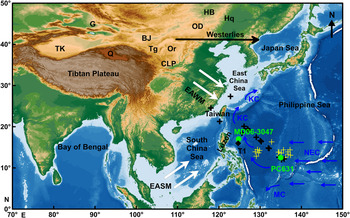
Map showing the locations of modern dust sampling sites (yellow crosses represent the sampling sites in the summer of 2014, and black crosses represent the sampling sites in the winter of 2015), sediment trap site T1 (black diamond, Xu et al. Reference Xu, Li, Colin, Clift, Sun, Yu, Wan and Lim2018), and other sediment cores discussed in the text: MD06-3047 (Xu et al. Reference Xu, Li, Clift, Lim, Wan, Chen, Tang, Jiang and Xiong2015) and PC631 (Seo et al. Reference Seo, Lee, Yoo, Kim and Hyeong2014). Possible dust provenances including the northern Chinese deserts (NCDs, e.g. G – Gurbantunggut Desert; OD – Onqin Daga Sandy Land; HB – Hunlun Buir Sandy Land; HQ – Horqin Sandy Land), the central Asian deserts (CADs, e.g. TK – Taklimakan Desert; Q – Qaidam Desert), the eastern Asian deserts (EADs, e.g. BJ – Badain Jaran Desert; Tg – Tengger Desert; Or – Ordos Desert) and the Chinese Loess Plateau (CLP) are also shown on the map. The white arrows show the East Asian winter monsoon (EAWM) and the East Asian summer monsoon (EASM), and the black arrow shows the westerlies. The North Equatorial Current (NEC), Kuroshio Current (KC), and Mindanao Current (MC) are shown with blue arrows.

The microstructure of the individual mineral particulates in the modern dust samples was analysed by scanning electron microscopy energy-dispersive X-ray spectroscopy (SEM-EDS) (S-3400) at the Institute of Oceanology, Chinese Academy of Sciences. Small pieces with a size of 1 cm2 were cut from each sampled filter membrane, attached to the conductive table and coated with a thin layer of conductive material before the SEM-EDS observations were taken.
The siliciclastic sediment fractions were isolated from the sampled filter membranes for trace-element analyses. First, half of each filter membrane was shredded into pieces and then immersed in deionized water for 8 h to ensure the particulates were well dispersed. Isolated sediment particles were then extracted by ultrasonication and centrifugation. The siliciclastic fractions of modern aerosols were isolated from the bulk samples according to the pretreatment procedure described in detail by Xu et al. (Reference Xu, Li, Clift, Lim, Wan, Chen, Tang, Jiang and Xiong2015). In brief, the bulk samples were treated with 4 mol L–1 glacial acetic acid, a mixture of 0.25 mol L–1 hydroxylammonium chloride and 25% glacial acetic acid, 30% hydrogen peroxide solution and 0.02 mol L–1 nitric acid and 4 mol L–1 anhydrous sodium carbonate to remove calcium carbonate, Fe–Mn oxide, organic compounds and biogenic silica, respectively. The contamination by local sea spray and research vessels, which possibly introduces soluble and organic matter to the samples, is also excluded by these treatments. The remaining siliciclastic fractions were then dried at 50°C and ground into powder for further processing. Trace-element compositions were measured by inductively coupled plasma mass spectrometry (IRIS Intrepid α XSP) at the Shandong Institute of Geophysical and Geochemical Exploration. The analytical precision and accuracy were determined by standard substances (GBW07314, GBW07315, GBW07316, BHVO-2 and BCR-2), with an uncertainty of better than 5%. The mass accumulation rate (MAR) of modern dust deposited to the Philippine Sea was calculated using the following equation:
 $${\rm MA}{{\rm R}_{{\rm dust}}} = {\rm LSR} \times {\rm DBD} \times {{\rm P}_{\rm D}}/100,$$
where LSR, DBD and PD indicate the liner sedimentation rate, dry bulk density and percentage of eolian dust, respectively (Rea & Janecek, Reference Rea and Janecek1981).
The wind directions during the sampling period were simulated based on a dataset provided by the National Oceanic and Atmospheric Administration (NOAA) National Center for Environmental Prediction (NCEP) (https://www.esrl.noaa.gov/psd/data/). Furthermore, the hybrid single-particle Lagrangian integrated trajectory (HYSPLIT) model (http://ready.arl.noaa.gov/HYSPLIT_traj.php) was used to calculate wind back trajectories of the aerosol particles during the sampling time (Draxler & Hess, Reference Draxler and Hess1998). In total, 120 h of air mass back trajectories were obtained for arrival heights of 1000 m, 3000 m and 5000 m above the Philippine Sea.
3. Results
The microscopic mineral assemblages of the aerosols collected in this study were mainly composed of quartz, illite and plagioclase, followed by gypsum, K-feldspar and halite. Quartz, feldspar and gypsum of the collected aerosols exhibited similar subangular to sub-rounded shapes, which are typical characteristics indicating wind transport and abrasion (Fig. 2). Illite on sampled filter membranes tends to display flake structures and subangular to sub-rounded characteristics, which are quite different from the sediment samples from Lanzhou Malan loess examined by Yu et al. (Reference Yu, Wan, Colin, Yan, Bonneau, Liu, Song, Sun, Xu, Jiang, Li and Li2016). In addition, there was no authigenic illite characterized by fine acicular structures along the edges in our study.
Scanning electron microscopy (SEM) images of detrital minerals on the filter membranes: (a) quartz, (b) illite and (c) gypsum.

The mass fluxes of the total particulates, together with the selected trace-element compositions (e.g. Th, Sc and Zr) of the siliciclastic fractions obtained from the samples collected in this study, are presented in Table 1 and Figure 3. The fluxes of the total particulates ranged from 452.32 to 2111.66 mg/m2/day, with an average value of 1146.51 mg/m2/day. The concentrations of trace elements (e.g. Th, Sc and Zr) from the sampled aerosols are rather uniform. The trace-element data of the collected aerosols were plotted in a ternary diagram of Zr–Th–Sc (Fig. 3), which has been confirmed to be a reliable index of provenance identification (Bhatia & Crook, Reference Bhatia and Crook1986; Muhs et al. Reference Muhs, Budahn, Johnson, Reheis, Beann, Skipp, Fisher and Jones2008). The modern aerosols were obviously different from the loess and palaeosol samples from the Chinese Loess Plateau and Lingtai Section, showing relatively lower Sc concentrations (Fig. 3).
Sampling information, selected trace-element compositions (Zr, Th and Sc) and mass fluxes of modern dust samples collected in the Philippine Sea. ND – not determined

Ternary diagram of the Zr–Th–Sc compositions of the siliciclastic fractions of the modern dust samples from the Philippine Sea. Surface dust samples from the Ordos Desert (Rao et al. Reference Rao, Tan, Jiang and Chen2011), the Badain Jaran Desert (Hu & Yang, Reference Hu and Yang2016) and the Taklimakan Desert (Yang et al. Reference Yang, Zhu and White2007), as well as loess and palaeosol samples from the Lingtai Section and the Chinese Loess Plateau (Ding et al. Reference Ding, Sun, Yang and Liu2001; Qiao et al. Reference Qiao, Hao, Peng, Wang, Li and Liu2011) are shown for comparison. The pink, light green, yellow and dark blue shading represents the central Asian deserts (CADs), the eastern Asian deserts (EADs), the Chinese Loess Plateau (CLP) and the modern dust samples in the Philippine Sea, respectively.

4. Discussion
4.a. Potential sources of modern eolian dust: microscopic mineralogical evidence
The micromorphology of the detrital minerals investigated by the SEM-EDS analysis can indicate the sediment origin and transport processes (Wang et al. Reference Wang, Dong, Yan, Yang and Hu2005; Chen & Li, Reference Chen and Li2011; Yu et al. Reference Yu, Wan, Colin, Yan, Bonneau, Liu, Song, Sun, Xu, Jiang, Li and Li2016). Quartz is the most common mineral in dust, and its identification is an effective method of determining the depositional environment (Doornkamp & Krinsley, Reference Doornkamp and Krinsley1971; Vos et al. Reference Vos, Vandenberghe and Elsen2014). Microscopic features of detrital quartz grains are generally influenced by transport mechanisms, distance, time and by the original shapes of the particles from sediments sources. Quartz particles from deserts often show subangular to rounded shapes with slightly blunt or smooth edges, as they have been suspended in the air for long-range transport and been physically eroded by wind (Marshall et al. Reference Marshall, Bull and Morgan2012). However, quartz grains produced in warm and humid environments are significantly different from those in deserts. Solution pores and secondary siliceous precipitation are generated on the surface of quartz grains during the reconstruction by chemical interactions under hygrothermal conditions, such as those in tropical regions. On the other hand, quartz particles transported by rivers and currents can also be easily identified because they usually have angular shapes related to high-energy water environments with limited transport distances (Vos et al. Reference Vos, Vandenberghe and Elsen2014). In brief, certain micromorphology of quartz grains can be used as an indicator of specific sediment environments and provenances. In this study, most of the analysed quartz grains exhibit subangular to sub-rounded shapes with shallow pits on the surface (Fig. 2a), typical characteristics related to eolian dust movement processes. The detrital quartz grains within the aerosol samples in this study show similar microscopic features to those from the Asian deserts, suggesting that these aerosols are primarily carried from central Asia by wind. This conclusion is further supported by the fact that angular grains with solution pores and secondary siliceous precipitation, which are common chemical weathering products of local volcanic materials, are not detected in our samples. It is therefore proposed that the provenance of detrital quartz in the aerosols collected in the Philippine Sea is likely the arid and semi-arid regions in central Asia.
Illite is a representative mineral formed by the physical erosion of terrigenous materials under cold and dry conditions (Chamley, Reference Chamley1989). The microscopic morphological characteristics of the sampled illite (Fig. 2b) suggest that they have been physically abraded and may therefore have undergone long-range wind transport (Yu et al. Reference Yu, Wan, Colin, Yan, Bonneau, Liu, Song, Sun, Xu, Jiang, Li and Li2016). In addition, illite tended to be the most abundant clay mineral in this research, clearly distinguished from the sediments delivered from nearby rivers on Luzon. Previous studies have demonstrated that the rivers on Luzon discharge clay-sized sediment that is mainly composed of smectite (average, 86%), with very little illite (< 2%) (Liu et al. Reference Liu, Zhao, Colin, Siringan and Wu2009); Luzon is therefore excluded as a potential source of illite in this study. Kolla et al. (Reference Kolla, Nadler and Bonatti1980) proposed that the illite- and chlorite-rich materials in the surface sediments of the Philippine Sea probably originated from East China or Taiwan or even from the Chinese Loess Plateau. Detrital sediments containing high illite content from Asian rivers and islands are transported to sea via two main pathways: one is oceanic surface currents and the other is turbidity currents along the slopes. The Kuroshio Current, which originates from the North Equator Current, is the most important surface current in the Philippine Sea. However, the study area and the location of modern sediment traps are on the main path of the northwards-flowing Kuroshio Current, preventing illite-rich sediments sourced from East China or Taiwan or the Chinese Loess Plateau being transported southwards to the study area. The Luzon Undercurrent is considered to be another potential pathway to transport Asian dust materials southwards to the West Philippine Sea. However, this process is also excluded as the illite crystallinity and chemical index together with the Sr–Nd isotopic compositions of the detrital sediment fractions from Taiwan and the Chinese Loess Plateau are distinctly different from those of the terrigenous sediments in the Philippine Sea (Wan et al. Reference Wan, Yu, Clift, Sun, Li and Li2012; Jiang et al. Reference Jiang, Frank, Li, Chen, Xu and Li2013; Yu et al. Reference Yu, Wan, Colin, Yan, Bonneau, Liu, Song, Sun, Xu, Jiang, Li and Li2016). We therefore argue that oceanic currents could not be the potential pathway for transporting illite to the study area, whereas the illite in modern dust samples was deduced to be dominantly derived from mainland Asia by eolian transport.
In the study region, most gypsum particles display subangular to sub-rounded shapes with slightly blunt edges related to wind abrasion (Fig. 2c). The western tropical Pacific cannot be the source of gypsum because gypsum is considered to be a mineral representative of arid environments, such as inland China (Qin et al. Reference Qin, Chen and Shi1995; Shi et al. Reference Shi, Chen, Li and Wang1995). Various studies have suggested that SO2 can dissolve in the water films formed on the surfaces of the mineral particles under humid environments, which can be oxidized or catalysed by Fe (III) or Mn (II) to form SO42–. Secondary gypsum will be generated after SO42– combined with Ca2+ in the samples (Falkovich et al. Reference Falkovich, Ganor, Levin, Formenti and Rudich2001); the appearance of these gypsum grains observed by SEM tends to be as idiomorphic crystals, readily distinguished from those detrital crystals that been mechanically abraded. Although the concentrations of Ca2+ and SO42– are high in seawater, our sampling records suggest that the air mass was dry in most cases and did not spend much time over the marine boundary layer of the Philippine Sea; gypsum produced from seawater is therefore very rare. This conclusion is further confirmed by the extremely low NaCl content in the sampling aerosols. Considering the low secondary gypsum content and the SEM morphology characteristics in our samples, we suggest that detrital gypsum grains within the aerosols also come from dry and cold regions of high latitude by eolian transport, whereas the small amounts of secondary gypsum were most likely sourced from local ocean–atmosphere processes.
Because the small amount of sampled dust was insufficient for X-ray diffraction, the mineral compositions were difficult to quantitatively measure. Consequently, Asian dust input into the Philippine Sea is interpreted based on qualitative analysis of the phase composition and microstructure of mineral particulates. Additional data are essential to discriminate the sources and potential transport mechanisms of eolian dust in the study area.
4.b. Potential sources of modern eolian dust: geochemical evidence
Geochemical characteristics are confirmed to be reliable indices of sediment provenance (Taylor & McLennan, Reference Taylor and McLennan1985; McManus et al. Reference McManus, Berelson, Klinkhammer, Johnson, Coale, Anderson, Kumar, Burdige, Hammond and Brumsack1998), especially for high-field-strength elements such as Th and Sc. These are relatively stable and can be quantitatively incorporated into clastic sediments during sedimentary processes, bearing the chemical characteristics of the parent rocks. These elements are therefore often used as suitable indicators of provenance discrimination (Taylor & McLennan, Reference Taylor and McLennan1985; Bhatia & Crook, Reference Bhatia and Crook1986; Hao et al. Reference Hao, Guo, Qiao, Xu and Oldfield2010). Th and Sc are mainly concentrated in felsic and mafic rocks, respectively, and the Th/Sc ratio varies according to the chemical compositions of source areas. In addition, the Zr/Sc ratio tends to show a remarkable elevation because Zr is usually enriched in zircon during weathering, erosion and transport, while the Th/Sc ratio generally remains unchanged. The Th/Sc versus Zr/Sc plot is therefore commonly used as a reliable index to evaluate heavy mineral enrichment and sedimentary recycling processes. Th/Sc ratios of initial sediments are positively correlated with Zr/Sc ratios, while Zr/Sc ratios of those sediments with a higher degree of recycling increase considerably, contrasting with the small variation in Th/Sc ratios (McLennan et al. Reference McLennan, Hemming, McDaniel, Hanson, Johnsson and Basu1993). In this study, the Th/Sc (1.49–5.36) and Zr/Sc ratios of the aerosol samples in the Philippine Sea show an obvious positive correlation (Fig. 4). The small variation of the Zr/Sc ratios indicates an insignificant influence of sedimentary recycling processes, and the trace-element components of these aerosols are primarily controlled by the chemical compositions of source regions. Furthermore, according to Xu et al. (Reference Xu, Li, Wan, Yin, Jiang, Sun, Choi and Lim2014), there are no apparent correlations (R = –0.42, α = 0.05) between median grain size and Zr composition in the sediments from core MD06-3047 in the west Philippine Sea (Fig. 1), suggesting dynamic sorting is not an important factor affecting Zr composition in the core. Consequently, variations in Zr, Th and Sc compositions of the study aerosol samples should be considered as representing changes in sediment provenances.
Th/Sc versus Zr/Sc diagram showing the provenance nature of the modern eolian samples in the Philippine Sea and possible effects of the sedimentary recycling (after McLennan et al. Reference McLennan, Hemming, McDaniel, Hanson, Johnsson and Basu1993).

The Sc compositions of surface sediments from possible provenances are relatively homogeneous, ranging from 7 to 16 μg g–1. However, the Th and Zr contents of the fine fractions of surface sediments show significant differences among the Taklimakan Desert, the Ordos Desert, the Badain Jaran Desert and the Chinese Loess Plateau. The Taklimakan Desert is characterized by relatively higher Th content (10.4–65.8 μg g–1) and lower Zr content (70.2–1014 μg g–1) (Yang et al. Reference Yang, Zhu and White2007). The Badain Jaran Desert is characterized by relatively lower Th content (5.15–27.4 μg g–1) and moderate Zr content (114–1529 μg g–1) (Hu & Yang, Reference Hu and Yang2016). The Ordos Desert is characterized by moderate Th content (9–30.2 μg g–1) and higher Zr content (512–1780 μg g–1) (Rao et al. Reference Rao, Tan, Jiang and Chen2011). Compared with the Asian deserts, the Chinese Loess Plateau has relatively lower Th content (15.56–18.72 μg g–1) and lower Zr content (25.43–40.14 μg g–1; Ding et al. Reference Ding, Sun, Yang and Liu2001; Qiao et al. Reference Qiao, Hao, Peng, Wang, Li and Liu2011). The geochemical data of our modern aerosol samples, together with data on the surface dust samples collected from the Taklimakan Desert (Yang et al. Reference Yang, Zhu and White2007), the Badain Jaran Desert (Hu & Yang, Reference Hu and Yang2016), the Ordos Desert (Rao et al. Reference Rao, Tan, Jiang and Chen2011), and loess and palaeosol samples from the Lingtai Section and the Chinese Loess Plateau (Ding et al. Reference Ding, Sun, Yang and Liu2001; Qiao et al. Reference Qiao, Hao, Peng, Wang, Li and Liu2011), are plotted in Figure 3. Both the study samples collected in the summer of 2014 and in the winter of 2015 are offset from the loess and palaeosol samples, being located much closer to the Th apex. We can therefore exclude the Chinese Loess Plateau as a potential source region of dust to the Philippine Sea (Seo et al. Reference Seo, Lee, Yoo, Kim and Hyeong2014; Xu et al. Reference Xu, Li, Colin, Clift, Sun, Yu, Wan and Lim2018). The modern aerosols collected in this study were virtually distributed between the field of the Taklimakan Desert and the EADs (Fig. 3), suggesting that these two regions are probable sources of eolian dust to the Philippine Sea. Compared with sediments from the Badain Jaran Desert, the studied samples tended to show a binary mixture of the Taklimakan Desert materials and the Ordos Desert dust, but their relative contributions were still unclear.
Sr–Nd isotopes have been confirmed to be a credible proxy for characterizing and quantifying sediments from different source regions input to the Pacific (Grousset & Biscay, Reference Grousset and Biscaye2005; Seo et al. Reference Seo, Lee, Yoo, Kim and Hyeong2014; Jiang et al. Reference Jiang, Zhou, Nan, Zhou, Zheng, Li, Li and Wang2016). The Sr–Nd isotopic compositions of terrigenous sediments collected on the Benham Rise are consistent with a binary mixture of eolian dust from mainland Asia and volcanic materials from Luzon Island (Jiang et al. Reference Jiang, Frank, Li, Chen, Xu and Li2013; Xu et al. Reference Xu, Li, Clift, Lim, Wan, Chen, Tang, Jiang and Xiong2015, 2018; Yu et al. Reference Yu, Wan, Colin, Yan, Bonneau, Liu, Song, Sun, Xu, Jiang, Li and Li2016). Luzon Island bedrocks show relatively less radiogenic Sr and highly Nd isotope characteristics (87Sr/86Sr ratios, 0.70366–0.70524; ϵNd values, from +5.8 to +7.1, respectively; Defant et al. Reference Defant, Maury, Joron, Feigenson, Leterrier, Bellon, Jacques and Richard1990). However, the Sr and Nd isotopic compositions of the < 5 μm eolian dust from Asian deserts, including the Taklimakan Desert (87Sr/86Sr ratios, 0.72682–0.73018; ϵNd values, from –10.7 to –10.3), the Tengger/Badain Jaran Deserts (87Sr/86Sr ratios, 0.72919–0.73218; ϵNd values, from –11.9 to –8.3) and the Ordos Desert (87Sr/86Sr ratios range, 0.72114–0.72419; ϵNd values, from –17.7 to –11.5) are more evolved (Chen et al. Reference Chen, Li, Yang, Rao, Lu, Balsam, Sun and Ji2007; Seo et al. Reference Seo, Lee, Yoo, Kim and Hyeong2014). Xu et al. (Reference Xu, Li, Colin, Clift, Sun, Yu, Wan and Lim2018) reported new Sr–Nd isotopic data of the siliciclastic fractions of modern sediment trap samples collected from site T1 (15° 58′ N, 124° 41′ E) on the Benham Rise (Fig. 1) at water depths of 500 m and 2800 m in 2015; these results provide robust evidence for discriminating specific provenance of dust inputs to the western Philippine Sea.
The Sr–Nd isotopic compositions of sediment trap samples are plotted close to the mixing curve between the Luzon volcanic sediments and the Ordos Desert materials (Fig. 5), indicating a binary mixture of volcanic materials from Luzon and eolian dust from the Ordos Desert. Figure 5b shows a more detailed Sr–Nd isotopic plot with several mixing lines between the Luzon and different values of dust from the Taklimakan Desert (20%, 40% and 60%) and the Ordos Desert (80%, 60% and 40%) for comparison. This comparison permits us to quantify the respective contributions of eolian dust from the Taklimakan Desert and the Ordos Desert. From this figure, we can clearly see that almost all modern sediment trap samples fall into the region where the Ordos Desert materials account for more than 80% of the eolian deposition at site T1. This result suggests that the eolian dust originated from the Ordos Desert (> 80%) dominates the dust budget of the study site. Combined with our results regarding the trace-element compositions, we conclude that modern dust deposition in the Philippine Sea is predominantly derived from the Ordos Desert (> 80%), and the contributions of the Taklimakan Desert and the Badain Jaran Desert are relatively small. This conclusion is consistent with the prevailing view that eolian dust from the CADs is primarily transported to the northern Pacific (Shao et al. Reference Shao, Wyrwoll, Chappell, Huang, Lin, McTainsh, Mikami, Tanaka, Wang and Yoon2011; Zhao et al. Reference Zhao, Sun, Balsam, Lu, Liu, Chen and Ji2014). Furthermore, previous research on the backwards trajectories of the eolian dust particulates during the dust event that occurred in the spring of 2006 definitely revealed that the air masses above the Benham Rise and the Philippine Sea can be tracked to the same provenance on the eastern Asian continent, which confirms a significant flux of eolian dust from the Ordos Desert to the Philippine Sea (Jiang et al. Reference Jiang, Frank, Li, Chen, Xu and Li2013).
Discrimination plots showing (a) the variations in the Sr–Nd isotopic compositions of the siliciclastic fractions in sediments collected from site T1 and cores MD06-3047 and PC631, together with data of potential dust provenances. (b) Enlargement of key part of (a) (modified from Xu et al. Reference Xu, Li, Colin, Clift, Sun, Yu, Wan and Lim2018).

Possible impacts of detrital sediments from rivers draining the Asian continent (e.g. the Yangtze River) and islands (e.g. Taiwan) carried by oceanic currents have been excluded by previous clay mineral and Sr–Nd isotope studies on the core sediments and surface sediments of the Philippine Sea (Wan et al. Reference Wan, Yu, Clift, Sun, Li and Li2012; Seo et al. Reference Seo, Lee, Yoo, Kim and Hyeong2014; Jiang et al. Reference Jiang, Zhou, Nan, Zhou, Zheng, Li, Li and Wang2016). Taking into consideration the Sr and Nd isotopic compositions of the sediment trap samples as well as the barrier effect of the northwards-travelling Kuroshio Current, detrital sediments derived from the Asian continent and transported by marine currents are negligible. Previous research on the terrigenous sediments in the Philippine Sea demonstrated that volcanic materials from Luzon are likely transported by rivers and currents (Wan et al. Reference Wan, Yu, Clift, Sun, Li and Li2012; Jiang et al. Reference Jiang, Frank, Li, Chen, Xu and Li2013; Yu et al. Reference Yu, Wan, Colin, Yan, Bonneau, Liu, Song, Sun, Xu, Jiang, Li and Li2016). We therefore make the preliminarily deduction that the volcanic materials from Luzon Island are dominantly transported by the ocean currents to the study area, while eolian dust originated from the Ordos Desert is unlikely to be carried by ocean currents to the Philippine Sea.
4.c. Potential transport mechanisms of modern eolian dust
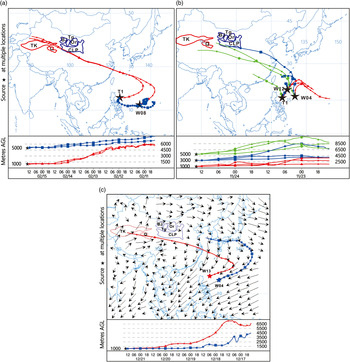
Sedimentary dynamic investigations of eolian particulates and atmospheric circulation observations indicate that eolian dust particles in the Asian deserts are mainly transported over long distances by the EAWM and westerlies to the Pacific (Sun, Reference Sun2004; Shi & Liu, Reference Shi and Liu2011; Zhao et al. Reference Zhao, Sun, Balsam, Lu, Liu, Chen and Ji2014). It is generally accepted that dust originating from the Taklimakan Desert is principally transported by the high-altitude westerlies for long-range delivery to the northern Pacific (Sun, Reference Sun2002; Shi & Liu, Reference Shi and Liu2011; Zhao et al. Reference Zhao, Sun, Balsam, Lu, Liu, Chen and Ji2014), and dust derived from the EADs is mainly transported by the surface circulation of the EAWM (Shi & Liu, Reference Shi and Liu2011; Zhao et al. Reference Zhao, Sun, Balsam, Lu, Liu, Chen and Ji2014; Yu et al. Reference Yu, Wan, Colin, Yan, Bonneau, Liu, Song, Sun, Xu, Jiang, Li and Li2016; Xu et al. Reference Xu, Li, Colin, Clift, Sun, Yu, Wan and Lim2018). Spring and winter are the most appropriate seasons for modern marine dust analyses. To further discriminate the dust sources and the potential transport mechanisms, we investigated the backwards trajectories of the modern eolian particulates at arrival heights of 1000 m, 3000 m and 5000 m above the sampling sites in the spring and winter of 2015. The air mass trajectories show that the sampled modern dust in the Philippine Sea can be tracked back to mainland Asia, including the Taklimakan Desert and the Ordos Desert. Furthermore, two typical pathways of dust transport trajectories also revealed that both eolian materials from the Taklimakan Desert and the Ordos Desert were carried SE-wards by the EAWM and influenced by the northeasterly Trade Winds (Fig. 6). Our results show that a small fraction of Taklimakan Desert matter was delivered to the study region by the EAWM, which was consistent with the previous conclusion that most eolian dust from the Taklimakan Desert is predominantly transported by westerlies to the northern Pacific (Shi & Liu, Reference Shi and Liu2011; Zhao et al. Reference Zhao, Sun, Balsam, Lu, Liu, Chen and Ji2014). In addition, the highest dust fluxes at Site T1 are observed in the spring of 2015, followed by the winter, and the lowest dust fluxes occur during summer and autumn (Xu et al. Reference Xu, Li, Colin, Clift, Sun, Yu, Wan and Lim2018). In the winter of 2015 NW winds prevailed over the Philippine Sea, and the wind back trajectories showed that air parcels originated from Asian deserts were transported southwards to the study area in both spring and winter. These results indicate that the increased dust fluxes in the spring and winter are associated with an intensified EAWM other than the westerlies, suggesting that the EAWM is the dominant transport mechanism of eolian dust input to the Philippine Sea. Consequently, we conclude that modern dust deposition in the Philippine Sea is dominated by eolian materials transported by the EAWM. This result suggests that the EAWM intensity strengthened in winter due to the combined effects of the Siberian high and the Aleutian low, thus intensifying the physical erosion and increasing the entrainment of dust from the Asian continent. This result is similar to those obtained from geological records during glacial periods, indicating enhanced aridity in mainland Asia and strengthened EAWM intensity when the palaeoclimate was colder (Sun & An, Reference Sun and An2005; Wan et al. Reference Wan, Yu, Clift, Sun, Li and Li2012; Jiang et al. Reference Jiang, Zhou, Nan, Zhou, Zheng, Li, Li and Wang2016).
Wind back trajectories of air masses at sites T1 (15° 58′ N, 124° 41′ E), W04 (16° 38.496′ N, 130° 03.404′ E), W08 (12° 32.987′ N, 134° 34.161′ E), W12(17° 26.218′ N, 129° 03.987′ E) and W13 (18° 27.884′ N, 125° 36.248′ E) in (a) spring and (b, c) winter. Surface wind directions on the Asian continent and the Philippine Sea in December 2015 are also shown in part (c). Abbreviations as defined in Figure 1.

The mass fluxes of the modern dust particulates collected in the winter of 2015 display great fluctuations during the sampling period (Table 1). Meteorological analyses indicate that the wind speed, atmospheric relative humidity, precipitation and temperature critically influence the dust fluxes (Zhang et al. Reference Zhang, Tan, Zheng, Wei and Yin2006; Li & Dong, Reference Li and Dong2010). There is usually a positive correlation between the dust flux and the relative humidity as well as the wind speed, while the precipitation shows a negative correlation with the dust emission. The wet deposition process is considered the dominant reason for dust removal (Andronache, Reference Andronache2003), especially for fine particulates that are difficult to deposit and may remain suspended in the atmosphere for a long time. Meteorological observations show that no strong sandstorm occurred on the Asian continent during our sampling period in the winter of 2015; however, the weather map showed rainfall in central China on 25–26 November 2015 and on 7 December 2015 (http://www.nmic.cn/). Subsequently, the lowest fluxes occurred on 1 December 2015 and 15 December 2015, respectively. Considering that the transport time of dust raised from the Asian deserts is approximately 6–7 days before it is deposited in our study region, the decreases of the modern dust fluxes in the Philippine Sea that appeared on 1 December 2015 and 15 December 2015 should be related to the greater precipitation and relatively wet conditions on the Asian continent on 25–26 November 2015 and on 7 December 2015. Consequently, we infer that the relatively lower dust fluxes in the Philippine Sea should be influenced by the wet weather conditions in the dust source regions, and there is a time lag of 6–7 days.
5. Conclusions
Microscopic mineralogical and geochemical analyses of modern dust samples collected over the Philippine Sea in the summer of 2014 and the winter of 2015 were investigated to discriminate the provenances and the transport mechanisms of the eolian deposition in the Philippine Sea. The major conclusions are summarized as follows.
The microscopic mineral assemblage of modern dust is generally dominated by quartz, illite, plagioclase and gypsum, followed by K-feldspar. These detrital minerals showed similar characteristics of wind erosion, indicating that they were probably derived from mainland Asia and were transported by wind. In addition, the selected trace-element compositions (Zr, Th and Sc) of the siliciclastic fractions of modern aerosol particulates, together with the published Sr–Nd isotopic compositions of the siliciclastic fractions from modern sediment trap samples, demonstrate that the modern eolian dust deposited in the Philippine Sea mainly originated from the Ordos Desert (> 80%), while the Taklimakan Desert and the Badain Jaran Desert made limited contributions (< 20%). Eolian dust from the eastern Asian deserts is predominantly transported to the Philippine Sea by the EAWM. Furthermore, the precipitation in the dust source regions can significantly influence the mass fluxes of eolian aerosol particulates deposited in the study area, with a delay period of 6–7 days. Such results concerning the modern eolian dust source-to-sink processes may improve both reconstructions of the Asian dust input to the Philippine Sea and the identification of the underlying mechanisms during the geological past.
Acknowledgements
We thank the crews of the cruises during which we collected the modern dust samples in the Philippine Sea and Xuguang Feng and Wei Liu for their assistance in analysing the samples. We are grateful to the editors of Geological Magazine (e.g. Sun Youbin) and the anonymous reviewers for their thorough and constructive comments that significantly improved the original manuscript. Funding for this research was provided by the National Natural Science Foundation of China (grant nos 41676038, 41876034 and 41376064), the Scientific and Technological Innovation Project financially supported by the Qingdao National Laboratory for Marine Science and Technology (grant no. 2016ASKJ13), the National Special Project for Global Change and Air-Sea Interaction (grant nos GASI-GEOGE-02, GASI-GEOGE-04 and GASI-GEOGE-06-02), the Korea Institute of Ocean Science & Technology (grant no. PM61310) and the Shandong Provincial Natural Science Foundation, China (grant no. ZR2016DM12).