


Experiential learning is the integration of real-life experience into educational curriculum, with the goal that students can apply the knowledge gained outside of the classroom(Reference Yardley, Teunissen and Dornan1). Service learning (SL) is one type of experiential learning where students learn in the classroom about the positive effects they can have in the community and then work to achieve these effects first-hand. These service experiences are designed to provide benefits for both the students and community members. Communities benefit from the services they receive, while students gain knowledge, awareness and skills(Reference Furco2). Research using both student-reported measures and empirical data has shown that SL pedagogy increases students’ civic engagement, academic performance and knowledge of stereotypes and diversity(Reference Celio, Durlak and Dymnicki3–Reference Warren5).
Implementing SL into college-level courses can be challenging, since SL can take many forms. Morton(Reference Morton6) discusses SL as a set of three paradigms based on the concern for root causes of social issues and investment in relationships. At the lowest level, the ‘charity’ paradigm exhibits low concern and low investment. Although charity-based SL opportunities have good intentions, the service can worsen community problems by making recipients dependent on those performing the service. The ‘project’ paradigm is characterised by mid-level concern and investment. Project-based SL models show great potential for positive and long-lasting impacts on the community but can incur unintended negative impacts such as an increased awareness of power inequalities by community members themselves. Last, the ‘social change’ paradigm displays high concern and high investment. The goal of a social change-based SL programme is to uncover extraneous circumstances and reveal the root causes of a community issue, allowing for programme development to address these root causes and result in the ‘empowerment of the systematically disenfranchised’(Reference Morton6).
When used appropriately, SL can affect students’ motivation to participate in civic life. For example, participation in an SL course was shown to decrease self-oriented motives and increase awareness of civic duty(Reference Parker-Gwin and Mabry7). However, these results rely heavily on programme design and the instructor’s methods, and it may take an enrolment period longer than one semester to see significant results(Reference Parker-Gwin and Mabry7). Additionally, it is not clear how students’ motivations to help the less fortunate relate to students’ chosen method of service or future career. In one study by Morton(Reference Morton6), when asked how the students felt they could make the biggest impact right now, most responded, ‘providing direct service to another person.’ In contrast, when asked how the students felt they could make the biggest impact throughout their life, most replied, ‘helping to set up and support community service organizations that are addressing immediate community needs’(Reference Morton6). Further research is needed to explore how SL courses impact students’ motives for public service and whether these motives differ by SL type.
To determine one’s motivation for public service, Perry(Reference Perry8) created the public service motivation (PSM) scale to measure ‘an individual’s predisposition to respond to motives grounded primarily or uniquely in public institutions.’ The PSM scale uses twenty-four items to assess four dimensions of public service: attraction to public policymaking, commitment to the public interest, compassion and self-sacrifice(Reference Perry8). The PSM scale corresponds to certain outcome measures like job satisfaction(Reference Naff and Crum9,Reference Homberg, McCarthy and Tabvuma10) , performance(Reference Naff and Crum9), psychological empowerment(Reference Miao, Newman and Schwarz11) and innovative behaviour(Reference Miao, Newman and Schwarz11), while dimension ratings tend to differ by gender(Reference DeHart-Davis, Marlowe and Pandey12), employment(Reference Yudiatmaja13) and religious and family socialisation(Reference Perry14,Reference Ritz, Brewer and Neumann15) . Research has also examined the antecedents of PSM. While it has been widely theorised that females and older individuals would report higher PSM scores, recent studies show mixed results about the effects of gender and age on PSM levels(Reference Parola, Harai and Herst16–Reference Andersen, Pallesen and Holm Pedersen18). Additionally, one’s culture may influence how PSM is affected by age and gender. For example, Parola et al.(Reference Parola, Harai and Herst16) discovered that men tend to report higher PSM scores in Confucian Asian countries (i.e. China, Taiwan, Korea), while women tend to report higher scores in Anglo countries (i.e. United States of America, England, Australia). No gender differences were found in Germanic Europe countries (i.e. Switzerland, Flanders)(Reference Parola, Harai and Herst16). However, limited research has investigated the link between Morton’s SL paradigms and PSM among American college students. The purpose of this study was to determine whether dietetic students would report a change in their PSM score following a SL course, and whether the type of SL experience (charity or project) would influence this change differently.
Methods
Study design
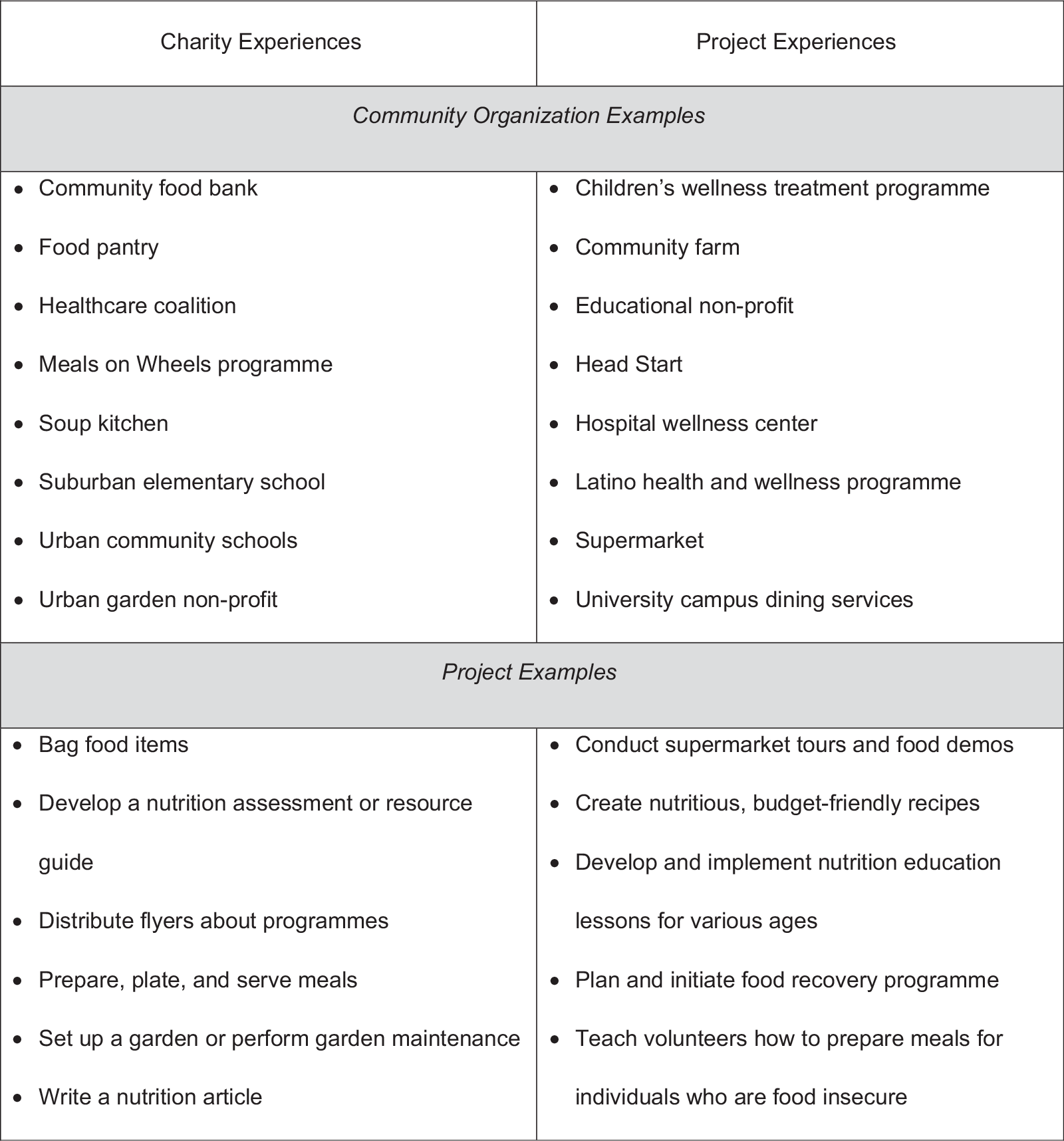
Students enrolled in six sections (n 142) of the same undergraduate SL course were compared using a pretest–posttest, nonequivalent groups quasi-experimental design. The course—Applied Community Nutrition—was taught between 2016 and 2019 at a public university in northeastern United States. This course is required for, and exclusive to, dietetic students. Students must complete 14 SL hours with a community organisation and write reflection journals based on this experience. Two sections of the course held in Fall 2016 provided ‘charity’ SL experiences (n 63), and four sections held in subsequent semesters offered ‘project’ SL experiences (n 79). Charity experiences included those such as preparing food at a soup kitchen or sorting food donations at a food bank, while project experiences comprised those such as planning and implementing nutrition lessons at a government-funded pre-school or developing a food recovery programme in coordination with campus dining (Fig. 1). Students were unaware of which type of SL experience they would have prior to course registration. During the second week of each semester, students were given a list of six to eight pre-arranged SL options and students chose their experience on a first-come, first-serve basis. Overall, 142 students were placed at thirty different sites, with no overlap between sites providing charity (10 sites) and project (20 sites) experiences. Every course section lasted 15 weeks, was taught by the same professor and utilised the same syllabi, lectures and assignments regardless of the semester taught. All students completed the required 14 SL hours.
Examples of charity and project service learning organisation partners and project activities incorporated into a community nutrition course
Recruitment and data collection
During the first 2 weeks of the semester, students were asked to complete an anonymous pre-survey via the university’s learning management system, Canvas (Instructure). The survey included questions regarding students’ demography, knowledge of community nutrition concepts, motivation to engage in public service, and personal and professional behaviours. The same survey was administered during the last week of each semester. To pair students’ pre- and post-data and retain anonymity, students answered the questions: ‘What is the first name of your current best friend?’ and ‘What was the last name of your third-grade teacher?’ Before beginning either survey, each student read an online consent form and indicated whether they permitted their survey responses to be included in the study. All students were offered a nominal amount of course credit for completing the survey (about 1 % of the course grade for each survey submitted) regardless of whether they consented to the study and allowed their answers to be included in analysis. In other words, students automatically received full points for submitting the survey no matter their answer to the consent question.
Demographic measures
The survey asked students for their academic standing (i.e. freshman, sophomore, junior, senior, graduate certificate, Master’s degree student), gender identity (i.e. female, male, other), and race and ethnicity (i.e. American Indian or Alaskan Native, Asian, Black or African American, Hispanic, Native Hawaiian or Pacific Islander, White, other). Students were able to select as many racial and ethnic categories as they desired. Students reported their birth year, and the age of students enrolled in a Fall course, which began in September, was calculated by subtracting birth year from the year that the student was enrolled in the course. The age of students enrolled in a Spring semester course, which began in January, was calculated by subtracting birth year from the year before the student was enrolled in the course. Students were asked whether they ever lived in a household that received governmental food assistance (i.e. yes, no, unsure) and whether none, one or all of their parents/guardians and siblings attended or graduated college.
Motivation for public service
To determine whether and how students’ motivation for public service would change during the SL course, students were asked to complete Perry’s PSM scale, a twenty-four-item scale is composed of four dimensions:
-
Attraction to public policymaking (three items): excitement and self-importance one feels at the notion of formulating public policies;
-
Commitment to the public interest/civic duty (five items): altruistic desire to serve the public;
-
Compassion (eight items): often-emotional urge to protect the needy and
-
Self-sacrifice (eight items): willingness to perform acts of service without tangible rewards(Reference Perry8,Reference Bringle, Phillips and Hudson19) .
Each item is listed as a statement, and respondents rate their level of agreement on a five-point Likert scale (1 = strongly disagree, 5 = strongly agree). PSM score is calculated as the average of all twenty-four items, and mean scores are calculated for each dimension. The PSM scale’s measures of validity include t-values significant at the P < 0·05 level, with factor loadings ranging from 0·39 to 0·78(Reference Perry8). Overall fit has been determined using goodness of fit (0·88) and adjusted goodness of fit (0·84). For reliability, alpha coefficient for the entire scale is 0·90 and alpha coefficient for the four dimensions ranges from 0·69 to 0·74 (the alpha values corresponding to each dimension have not been published)(Reference Perry8). Within the present study sample, the PSM scale showed similar acceptable reliability, with a Cronbach’s alpha of 0·83 for the entire scale, 0·58 for attraction to public policymaking, 0·62 for compassion, 0·71 for commitment to the public interest and 0·74 for self-sacrifice.
Data analysis
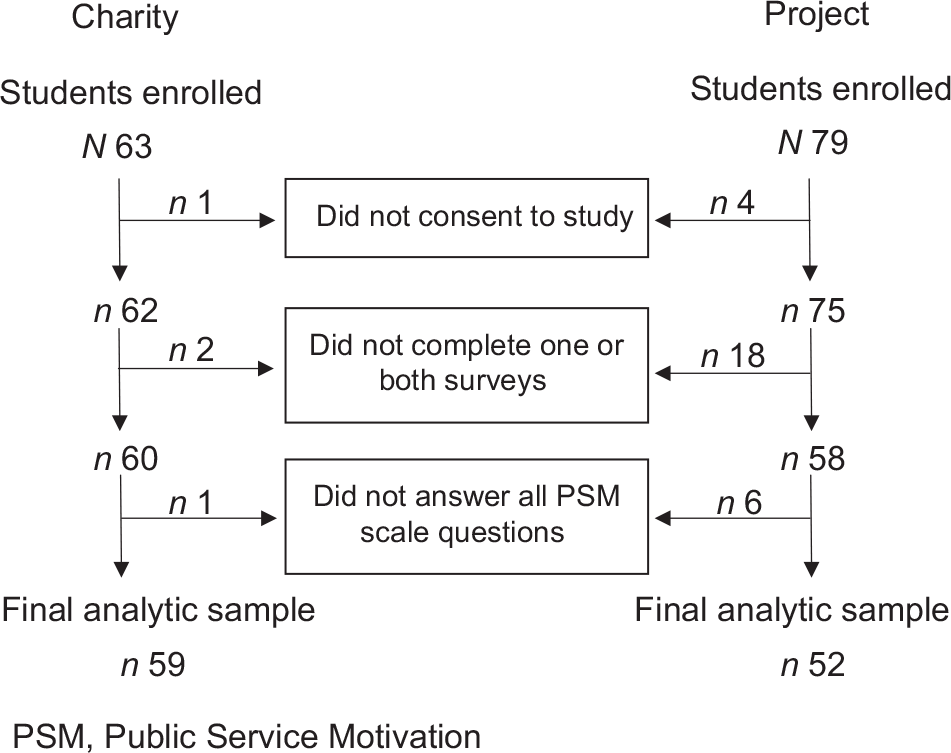
Responses were exported into SPSS, version 25 (IBM Corporation) for analysis. A total of 142 students were enrolled in the course, with 94·4 % (n 134) submitting the pre-survey and 91·5 % (n 130) submitting the post-survey. Of those who participated in the pre-survey, 99·3 % (n 133) consented to having their data included in the study. Of those who participated in the post-survey, 96·9 % (n 126) consented to their data being included. Any student who indicated they did not want their responses included or did not answer the consent question was removed from analysis. Additionally, students who did not complete both surveys, or who did not provide responses to the PSM scale, were removed. The final analytic sample comprised 111 students, for a response rate of 78·2 % (Fig. 2). A dummy variable was created for SL type (0 = charity, 1 = project), whereby respondents enrolled in the Fall 2016 semester were categorised into the charity group (n 59) and respondents enrolled in subsequent semesters were categorised into the project group (n 52). New variables were created to provide the average score for the PSM total scale and each PSM dimension, after negatively worded items were reverse coded.
Flow chart of the final analytic sample of dietetic students enrolled in a community nutrition course with either charity or project service learning models
Descriptive statistics and χ 2 tests were used to compare demographic data between charity and project groups. Independent samples t tests were used to compare PSM total scale and dimension scores between groups at pre-survey and post-survey. Paired sample t tests were run to evaluate changes in PSM total scale and dimension scores over time overall and within each SL group. Finally, one-way ANCOVA was used to assess the effect of SL type on post-survey scores, controlling for pre-survey scores. SPSS was used to run all statistical analysis using a CI of 95 %. Significance was determined at P < 0·05.
Results
The majority of the sample were female (91·9 %), White (64 %) and senior-level students (67·6 %) who had never lived in a household receiving governmental food assistance (80·2 %). Average age was 25·2 (sd 6·6) years. Most of the sample had at least one parent/guardian with a college degree (67·5 %) and at least one sibling with a college degree (63·0 %). No significant differences were found between SL groups for any demographic characteristic (Table 1).
Demographic characteristics of a sample of dietetic students (n 111), compared by service learning group

* P-values when comparing characteristic by service learning group using χ 2 and Student’s t tests (depending on variable type).
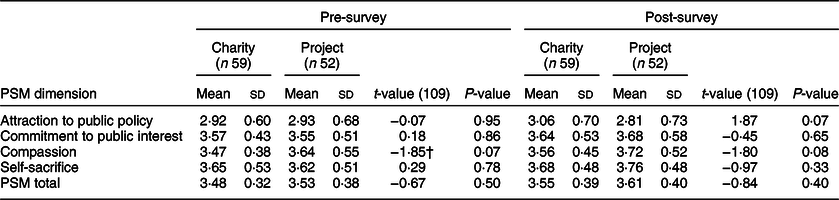
The mean PSM total scale and dimension scores were compared between SL groups at both time points. There were no significant differences in total scale or dimension scores between charity and project groups, either at pre-survey or post-survey (Table 2). Overall, students showed a small but significant increase in their PSM total scale score between pre-survey and post-survey (3·50 v. 3·58; t(110) = 3·58, P = 0·001). Of the four PSM dimensions, all but the attraction to public policy dimension showed a small but significant increase from pre-survey to post-survey (Table 3). When analysing each SL group separately, students in the charity group exhibited a significant increase in the PSM total score from pre-survey to post-survey (3·48 v. 3·55; t(58) = 2·25, P = 0·03), but no change in any of the four component dimensions. Comparatively, students in the project group reported a significant increase in the PSM total score (3·53 v. 3·61; t(51) = 2·83, P = 0·007), as well as the commitment to public interest (3·55 v. 3·68; t(51) = 2·34, P = 0·02) and the self-sacrifice dimensions (3·62 v. 3·76; t(51) = 3·57, P = 0·001).
Comparison of mean PSM dimension and total scale scores* between service learning groups at pre-survey and post-survey in a sample of dietetic students from a community nutrition course
PSM, public service motivation.
* PSM scale statements scored as 1 (strongly disagree) to 5 (strongly agree).
† Levene’s test indicated unequal variances (F = 6.07, P = 0.02), so degrees of freedom were adjusted from 109 to 88.
Comparison between mean public service motivation (PSM) dimension and total scale scores* between pre- and post-surveys for all students, and by service learning type, in a sample of dietetic students from a community nutrition course

* PSM scale statements scored as 1 (strongly disagree) to 5 (strongly agree).
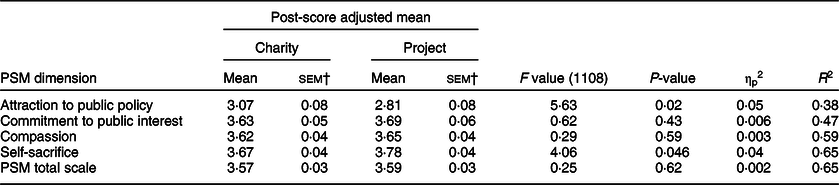
Finally, one-way ANCOVA was conducted to compare the effect of SL type on post-survey scores while controlling for pre-survey score (Table 4). Levene’s test and normality checks were carried out, and the assumptions met. There was a significant difference in the attraction to public policy dimension post-score (F(1,108) = 5·632, P = 0·02) between the two SL groups, with the charity group reporting a higher estimated marginal mean compared with the project group (3·07 v. 2·81, respectively), though the effect size was small (partial η 2 = 0·05). Additionally, there was a significant difference in the self-sacrifice dimension post-score (F(1,108) = 4·062, P = 0·046), such that the estimated marginal mean of the project group was higher than the charity group (3·78 v. 3·67, respectively), though again the effect size was small (partial η 2 = 0·04). No other dimension post-scores, nor the PSM total post-score, differed by SL type when pre-scores were held constant.
ANCOVA results for post-survey public service motivation (PSM) dimension and total scale scores* by service learning group, controlling for pre-survey scores in a sample of dietetic students from a community nutrition course
* PSM scale statements scored as 1 (strongly disagree) to 5 (strongly agree).
† Post-score adjusted mean and sem adjusted for dimension pre-score mean.
Discussion
The objectives of this study were to determine (1) whether dietetic students would report a change in PSM scores following an SL community nutrition course, and (2) whether the type of SL experience would lead to differential changes. With regard to the first objective, students expressed a slight motivation for public service at the beginning of the semester and showed a statistically significant increase in PSM score by the end of the course, regardless of SL type. However, this increase was small (0·08 points), and it is unknown whether this is a meaningful change as few prior studies exist. In one study of sixteen nursing students who engaged in nutrition-based SL experiences, Tanner and Brown(Reference Tanner and Brown20) found no change in PSM scores. Unfortunately, the researchers utilised a six-point, rather than a five-point Likert scale and did not report average PSM scores, so it was impossible to directly compare these findings.
Other studies of non-nutrition SL courses have found small but significant changes in PSM over time. For example, when compared with a control group, students enrolled in a social justice-oriented SL programme reported significantly higher increases in an abbreviated PSM by the end of the programme(Reference Seider, Rabinowicz and Gillmor21). Although statistically significant, the rise in the average PSM score was small (0·30 points), which the researchers attribute to the short, one-year programme duration(Reference Seider, Rabinowicz and Gillmor21). Likewise, a pair of concurrent SL courses at the University of North Florida was created to teach engineering and physical therapy students the process of designing, constructing and evaluating rehabilitation technology for children with disabilities(Reference Lundy, Rodriguez and Aceros22,Reference Lundy and Aceros23) . Lundy et al.(Reference Lundy, Rodriguez and Aceros22,Reference Lundy and Aceros23) found a significant increase in PSM at the conclusion of the semester, though again the change was small (0·20 points). Thus, it may be that increases in PSM scores rise concomitantly with the number of hours spent in SL experiences and that more than one semester or year is necessary to bring about more meaningful change. Interestingly, when Lundy et al.’s data were analysed by discipline, only engineering students were noted to have significantly increased PSM levels(Reference Lundy, Rodriguez and Aceros22,Reference Lundy and Aceros23) . The researchers postulate that because the work of physical therapists is already service-oriented, the physical therapy students benefitted more from the technical experience of working with engineering students rather than the service element(Reference Lundy, Rodriguez and Aceros22). Given that the work of registered dietitian nutritionists (RDN) is also service-oriented, it may be unreasonable to expect dramatic changes in PSM scores, even with increased exposure to SL experiences. Additional research is needed to explore whether there is a dose-response effect, and whether this effect differs by discipline.
When looking at the PSM dimensions among the entire sample, students reported small but significant increases (0·08–0·10 points) in their commitment to public interest, compassion and self-sacrifice, and no change in their attraction to public policy. It would appear that reading and discussing socially-oriented topics such as community assessment, programme planning, healthcare, cultural competence and food security, along with completing 14 SL hours, shifted students’ motives in these three dimensions. Similarly, Lundy et al.(Reference Lundy, Rodriguez and Aceros22,Reference Lundy and Aceros23) found that their interdisciplinary rehabilitation technology SL course increased all students’ commitment to public interest, whereas only engineering students reported an increase in compassion. Unfortunately, the researchers do not attempt to explain these results(Reference Lundy, Rodriguez and Aceros22,Reference Lundy and Aceros23) . Interestingly, despite also covering public policy and policymaking in the community nutrition course, the sample scored lowest in the attraction to public policy dimension at both pre- and post-surveys and showed no significant change over time. It is possible that the low scores are related to the divisive political climate during the intervention period, which occurred during the Trump administration (2016–2020). In fact, Ward(Reference Ward24) noted the 2000 presidential election was a potential confounding variable that influenced voting behaviours and political interests and may have affected the attraction to public policy among their sample of AmeriCorps participants. Similarly, it can be speculated that the polarising effect of the 2016 presidential election and subsequent 4 years contributed to the dietetic students’ low scores in attraction to public policy at both time points. Still, it should be noted that the attraction to public policy dimension has been criticised for its low internal validity, as well as the fact that it is based on American service values and therefore cannot be used in other cultures without modification(Reference Giauque, Ritz and Varone25–Reference Vogel and Kroll28). Because of these limitations, several researchers have suggested using items other than those in Perry’s PSM scale to measure one’s attraction to politics and policymaking(Reference Giauque, Ritz and Varone25–Reference Vandenabeele30).
Regarding the second objective, SL experience type did not predict PSM total scale post-scores when pre-scores were controlled, though students showed differing changes in PSM dimension scores depending on the type of SL experience assigned. Unfortunately, other studies comparing PSM scores between different types of SL experiences could not be located. As previously mentioned, it may be that 14 h of SL is not enough to detect a significant difference in PSM scores between those engaged in charity v. project experiences. However, it is important to note that PSM-related variables have been shown to exhibit high stability over time, suggesting the possibility that PSM is a stable trait rather than a dynamic one(Reference Vogel and Kroll28). Alternatively, it may be that while any SL experience leads to an increase in PSM total score over time, the type of SL experience affects the component dimensions differently, such that some dimensions are higher among one SL type v. another yet when averaged together lead to similar overall scores regardless of the amount of time spent in SL activities. Further research is needed to elucidate this finding.
Among the sample, the charity group showed higher scores in attraction to public policy by the end of the semester, while the project group scored higher in the self-sacrifice dimension. Regarding attraction to public policy, Morton(Reference Morton6) explains that the main problems in project-based service are balancing the goals of the programme with the limited available resources. Therefore, it is possible that students in the project group had more exposure to the flawed politics or underlying causes of injustice leading to the need for service organisations and accordingly experienced reduced attraction to public policy compared with students in the charity group. Regarding self-sacrifice, Morton(Reference Morton6) recalls his interview with the director of a homeless shelter, who mentioned that although he still believed charity-based service to be beneficial, he felt worn down after serving so many people without seeing tangible results. It may be that the students in the charity group shared this sentiment and therefore were less likely to report self-sacrifice tendencies. Specifically, many of the charity-based experiences could have been completed by any volunteer, regardless of their level of nutrition knowledge. Conversely, project-based experiences required both the presence and application of dietetics-related concepts—food composition, nutrition education techniques, evaluation methods, etc.—in order to teach community members or create programmes. Students who felt their contribution was unique or dependent upon their knowledge and skills may have been more likely to experience intangible rewards like pride and accomplishment, compared with their peers in the charity group who may have felt their role was generic and thus require more tangible benefits to continue. Further research is needed to test these hypotheses and gain a better understanding of why different types of SL experiences elicit change in one PSM dimension over another.
These findings should be interpreted within the study’s limitations. First, the sample was drawn from a single course at one university, albeit over several semesters. It is not known whether the dietetic students in the sample differ from those at other universities, or how they compare students in other healthcare fields or non-health majors. Thus, these results may not be generalisable to all university students, or even all dietetic students. It should also be noted that both the course and the SL opportunities were offered in a face-to-face modality. However, with the growth of online instruction and pivot to digital interactions due to the COVID-19 pandemic, more research is needed to identify updated and flexible SL models and evaluate the role that remote SL opportunities have on PSM. Additionally, while the two groups that were compared varied by SL type, a control group of similar students enrolled in a non-SL course was not included. Had a control group been available, more dramatic differences in PSM scores may have been observed between SL and non-SL students. Last, while potential confounders such as course instructor, lectures, assignments and university setting were controlled for, there are other factors could not be held constant. For example, studies indicate that PSM varies with age, gender, personality, religiosity and religious socialisation, spirituality, family socialisation, experiencing family poverty and employment type(Reference DeHart-Davis, Marlowe and Pandey12–Reference Andersen, Pallesen and Holm Pedersen18,Reference Seider, Rabinowicz and Gillmor21–Reference Lundy and Aceros23,Reference Jang31,Reference Camilleri32) . Unfortunately, there was not enough variation in the sample to analyse differences by age, gender and food assistance, nor were we able to control for prior or concurrent volunteer experience that may have affected responses to the PSM scale.
Conclusions
Despite these limitations, the current findings suggest that an SL course in community nutrition can positively affect dietetic students’ motivation for public service. This is important given the increased need and demand for community-based RDN resulting from growing healthcare costs, burden of diet-related chronic diseases and emphasis on preventative care(Reference Bruening, Udarbe and Jimenez33). Yet nationally, the percentage of RDN working in community nutrition has been declining (9 % in 2019(34), down from 11 % in 2002(Reference Rogers35)), while the majority of RDN work in clinical nutrition with growing frequency (61 % in 2019(34), up from 54 % in 2002(Reference Rogers35)). One estimate from 2015 indicates the need for a 113 % increase in the public health nutritionist workforce to meet recommended staffing ratios(Reference Bruening, Udarbe and Jimenez33). Due to these trends, dietetic students may lack familiarity with, exposure to and interest in the types of professional roles they can play within communities. Dietetic educators should consider adopting pedagogical methods like SL into curricular offerings to enhance students’ motivation for public service and understanding of community-based roles for RDN. In doing so, future students may be more willing to pursue career paths in community nutrition and help fill the growing need for competent practitioners.
Acknowledgements
Acknowledgements: The authors thank Renata Blumberg for her involvement in survey design, and Kaitlin Overgaard for her assistance with data collection and analysis. Financial support: This research received no specific grant from any funding agency, commercial or not-for-profit sectors. Conflict of interest: None. Authorship: L.D. conceived the study, conducted the surveys and completed the data analysis. L.D. and J.K. drafted the manuscript. Both authors read and approved the final manuscript submitted for publication. Ethics of human subject participation: This study was conducted according to the guidelines laid down in the Declaration of Helsinki, and all procedures involving study participants were approved by the Montclair State University Institutional Review Board. Written informed consent was obtained from all subjects.



